OAKPARK.COM | RIVERFOREST.COM
CONNECTS
Wednesday Journal, September 18, 2019
B1
A YEAR-LONG SERIES FOCUSING ON COMMUNICATING OUR PRIORITIES FOR CHILDREN
Inclusion in the classroom
How local school districts best teach students with different abilities By LACEY SIKORA
Contributing Reporter
ALEX ROGALS/STAFF PHOTOGRAPHER
I
n school districts in Oak Park and River Forest, inclusion in the classroom starts with the youngest students and continues through high school. From co-taught classrooms, which include a general education teacher and a special education teacher, to blended classrooms, in which one teacher is trained to cover a class in both general education and special education, local special education directors say that research shows all students can benefit from classrooms which include students of differing abilities. Donna Middleton, senior director of student services in Oak Park’s District 97 public elementary schools, says the district begins providing inclusive programming at the earliest stages of a child’s education. Two models are employed in early childhood classes in Oak Park. Whittier’s pre-school program is what she calls a blended program. Students with IEPs (Individual Education Plans) are in class with students who do not have IEPs. At Whittier, the class is taught by one teacher who is a specialist in early childhood education, special education, and English Language Learners. Currently, the Whittier program has two sections -- morning and afternoon, each with roughly 15 students. In those classes of three and four-yearolds, five of the children will have an IEP and the remaining 10 will not. In the Early Childhood PKP program at Longfellow, the district has a cotaught classroom of approximately 20 students. Roughly six of those students
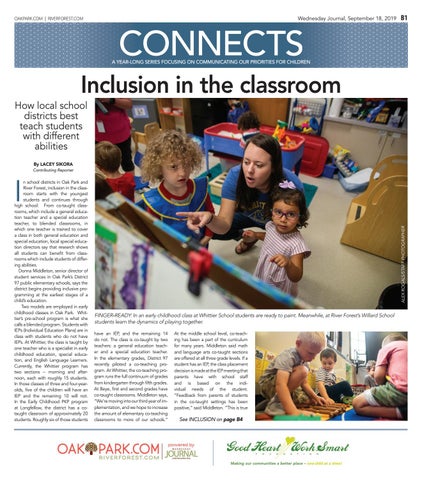
FINGER-READY: In an early childhood class at Whittier School students are ready to paint. Meanwhile, at River Forest’s Willard School students learn the dynamics of playing together. have an IEP, and the remaining 14 do not. The class is co-taught by two teachers: a general education teacher and a special education teacher. In the elementary grades, District 97 recently piloted a co-teaching program. At Whittier, the co-teaching program runs the full continuum of grades from kindergarten through fifth grades. At Beye, first and second grades have co-taught classrooms. Middleton says, “We’re moving into our third year of implementation, and we hope to increase the amount of elementary co-teaching classrooms to more of our schools.”
At the middle school level, co-teaching has been a part of the curriculum for many years. Middleton said math and language arts co-taught sections are offered at all three grade levels. If a student has an IEP, the class placement decision is made at the IEP meeting that parents have with school staff and is based on the individual needs of the student. “Feedback from parents of students in the co-taught settings has been positive,” said Middleton. “This is true
See INCLUSION on page B4
B2
Wednesday Journal, September 18, 2019
OAKPARK.COM | RIVERFOREST.COM
The virtues of beginning early
River Forest’s District 90 fosters inclusivity with its youngest students By LACEY SIKORA
Contributing Reporter
V
ALEX ROGALS/STAFF PHOTOGRAPHER
ictoria Bynum has been teaching preschool for 15 years, the last three of those at River Forest’s Willard School, and says that during her career, inclusive preschool classrooms have been considered the best practice for children. Her classroom includes children with IEPs (Individual Education Plans) and identified special needs as well as students without IEPs. At Willard, the full inclusion model means that all of the students that receive special therapies receive them in the classroom rather than being pulled out of the classroom. Bynum teaches two sections of preschool, one in the morning and one in the afternoon. Each class is made up of approximately 15 students aged three to five-years old. Denise Matthews, D90s special ed director, says the state identifies chilHANDS ON, HANDS IN: Legos capture the attention in an early childhood class at River Forest’s Willard School while at Whittier School in dren who might qualify for special education slots at district preschools. Oak Park the lesson comes with sand and funnels. Children who receive therapies through early intervention services Center. Matthews says the morning because they’re not in flux constantly, before the age of three are evaluated and afternoon sessions at the RFCC moving in and out of the classroom.” by the school district when they turn follows a similar model to that used at Importantly, she says that all stuthree. Once special education services Willard, in which students with special dents, not just those with special are deemed necessary, those children education needs are in class with typi- needs, are having a better school excan enter the district’s cally developed perience in an inclusive classroom. preschool program p peers. “Students without special needs just upon reaching three From By- see a valuable member of the com“It’s really great years of age. Students n num’s perspec- munity sitting next to them. They see a without special needs for kids with therat tive at Willard, diverse community. Everyone contribare eligible to enter a inclusive utes,” says Bynum. peutic needs to get an the district preschool c classroom is She says one of the goals of presystem if they turn that in the social b benefi cial for school is building on functions for all three before the start s students and children, and the inclusive classroom setting of the classof the school year. All t teachers alike. allows children with special needs to students can remain in room.” S She says that reach that goal. “Another big benefit the preschool for the w working in the is the generalization of skills. If chiltwo years prior to en— Jess Tyrrell cclassroom with dren are taught something in a pulltering kindergarten. Willard School parent tthe various ther- out situation, in a quiet setting all on According to Mataapists results in their own, it can be difficult to translate class, says she has seen those benefits successful, you need the school aspect. thews, the state caps a collaboration. those skills in a classroom full of their in her boys. Both boys received speech It doesn’t translate if you’re getting class size at 20 stutherapy before preschool, and Jame- therapy in an isolated environment.” dents in inclusionary preschool classes “There’s a good flow between us. I peers,” she says. As her sons move into their second son received other therapies that have If they learn and hone those skills in and mandates that no more than 30 learn from them, and they learn from year at Willard’s preschool, she says continued in the preschool setting. me.” a classroom setting, she says they get percent of students in the class have kids that she has seen them make good Tyrrell says, “It’s really great for For the children, she says receivthe necessary practice they need to use an IEP. Willard’s established pre-school program has recently been augment- ing therapeutic services in the class- their abilities in the general community. with therapeutic needs to get that in progress with Bynum and the theraJess Tyrrell, a parent whose twin sons the social setting of the classroom. You pists. “I’ve seen them make such a difed by an inclusionary preschool class rooms gives them a sense of stability. held at the River Forest Community “They get a good sense of belonging Caden and Jameson are in Bynum’s can’t have one without the other. To be ference. It’s been night and day.”
B3
Wednesday Journal, September 18, 2019
HTTPS://WWW.YOUTUBE.COM/WATCH?V=GRS6IDSHUJM
OAKPARK.COM | RIVERFOREST.COM
DOUBLING UP: Pam Gaffney and Rachel Youngberg co-teach a sixth grade class at Gwendolyn Brooks Middle School. The effort, says Youngberg, creates a sense of cohesion among students.
Talk to parents, talk to teachers, blending spec ed and general ed works Co-teaching expansion at D97, new inclusion facilitator at D200 BY MICHAEL ROMAIN Staff Reporter
In April, Erika Eckart, the mother of an Irving School student who has autism and speech delay, wrote a letter to Wednesday Journal touting the benefits of placing him in a general education classroom. “Research shows that children with disabilities placed primarily in general education classes have more rigorous IEP goals and thus better outcomes in the short and long term,” Eckart wrote. “Our son’s inclusion has been a major factor in the amazing progress he has made in the last four years,” she added. “He went from mostly non-verbal to speaking now in 8- to 10-word sentences. He can mostly perform at grade level with modified work. He is a real part of the fabric of his class and of the Irving community. We are so thankful that District 97 has and continues to include him. It has changed the trajectory of his entire life.” Over the last several years at Oak Park Elementary School District 97 and Oak Park and River Forest High School District 200, there have been major strides among officials to be more sensitive to the needs of students like Eckart’s son. After implementing co-teaching pilot programs at Percy Julian and Gwendolyn Brooks Middle
Schools in 2013, that program is now a permanent fixture in the schools. This is now the third year of a co-teaching pilot in the elementary schools which began at Irving and Whittier elementary schools. Similar efforts began at Beye two years ago. Donna Middleton, senior director of student services, said in addition to growing the program at Beye the district is planning an expansion at either Longfellow or Lincoln. “Our priority is to bring coteaching to our schools where we have self contained special education classrooms,” said Middleton. Eboney Lofton, D97’s chief academic and accountability officer, defines co-teaching as “an inclusive service delivery model that is really supported by federal and state law, but it’s also just instructional best practice. “We bring two individuals together — a general education and a special education teacher, both highly skilled professionals — and we really leverage their skills to make sure we understand the what and how of learning. They work in a synergistic marriage to make sure we’re instructing a diverse group of students.” In 2018, the percentage of students who receive special education services in a setting separate from the general student population for more than 60 percent of their school day ranged between roughly 10 and 11 percent, according to D97 data. The special education department’s goal, Lofton says, is for that number of separated students not to exceed 10 percent. Not only is co-teaching aligned with the Individuals with Disabilities Act, which requires that -“to the maximum extent appropriate” -- students with disabilities are being educated in the regular
school environment, but it’s also academically and emotionally beneficial for all students involved, D97 administrators and teachers say. “The students with unique needs are able to be with peers and adapt to more typical routines and learning experiences at a given grade level,” say District 97 teachers Annie Darley and McKenzie Kula, who comprise the 4th-grade co-teaching team at Whittier. Darley teaches general education while McKenzie teaches special education. The two co-teaching partners submitted a joint statement on the powers of the model to the Journal. “A co-taught classroom has the benefit of two teachers, and often even a teaching assistant, working to know each learner on any given level and to develop ways to meet the needs of students wherever they are. “All students are capable of deepening interactions with each other and benefitting from groups and interactions throughout the day that are inclusive and social. We see this in the respectful ways the kids treat each other in our room and allow students to be leaders and experts at something that others can see and appreciate.” Rachel Youngberg, one-half of the 6th-grade coteaching team at Brooks, says that the model has contributed to a sense of cohesion among her students. “I really believe the kids have no idea who necessarily receives special ed services and who doesn’t — I think they all feel we’re just one class,” says Youngberg, who partners with Pam Gaffney. “We’ve been able to work together to make things so accessible that it’s like no one knows why things are differentiated because everything is different for everybody. It’s whatever you need, whatever
Eboney Lofton, D97s chief academic and accountability officer learning style you use best. It’s just become really natural and completely normal in here.” Lauren Arends had been a special education teacher at OPRF for seven years before she was tapped to become the high school’s first inclusion facilitator. She says that her priority for this school year is to identify students in self-contained special education classes who are capable of transitioning into co-taught college prep courses and making that transition as smooth as possible. “My role, in a nutshell, is to help students with disabilities be included in general education classrooms by adjusting or helping others adjust how they are taught and what they are taught,” she says. “I’m currently working with about 40 students identified as having the most significant needs, along with their teachers and the paraprofessionals that support them in general education classes.” For more info on D97’s co-teaching experience, watch the district’s YouTube video here: https:// www.youtube.com/watch?v=grs6idSHUJM.
B4
Wednesday Journal, September 18, 2019
OAKPARK.COM | RIVERFOREST.COM
INCLUSION continued from page B1
ALEX ROGALS/STAFF PHOTOGRAPHER
for parents of children with a disability or without. We are fortunate that our community values inclusion and changing discriminatory attitudes. As a staff, we have been collecting data through various methods to ensure our students are making growth and feel a sense of belonging.” Beyond the academic curriculum, Middleton says the district works on inclusion through activities such as Best Buddies, Special Olympics and piloting the Nora Project. She describes the Nora Project as similar to Best Buddies but for younger students. “In the early grades, they work on friendships and developing empathy.” In River Forest’s District 90 elementary schools, inclusion classrooms also start at preschool. Denise Matthews, special education director, the district’s Willard School has a morning and afternoon preschool class that are taught by one teacher, with dual certifications in general education and special education, and there are two aides also in the classroom. The classes are made up of students with and without IEPs and conform to state guidelines that no more than 30 percent of the students in the class will have an IEP. “It is the best practice model for stu- START WITH GLUE: Willard School early childhood student mixes glue and feathers. dents with IEPs to be with general education peers with push-in services,” fits all. We are constantly making adsaid Matthews. justments to what our students need. For elementary school children in One constant is that we’re always grades kindergarten and beyond, looking for ways for students to be inDr. Kennedi Dixon, divisional spe- students can continue at OPRF until other falls back, and they can reverse Matthews says the district employs a cluded, not just in the classroom but cial education director at District 200, the age of 22. The TEAM (Transi- roles. For example, a teacher might number of methods of making sure says OPRF has a number of ways tional Education with Access to the teach one unit, and the other teacher all children are included. “We strive throughout the school community as well.” to include students of all abilities Mainstream) program is designed to will teach the next. A third approach is to have students At Roosevelt prepare students with mild, moder- called station teaching. One teacher throughout their high school years. in the least restricJunior High, MatJ She said OPRF has four general ate, and severe intellectual disabili- delivers instructions to the whole tive environment. thews says some t categories for special education. ties, to live and work in their home group, and then they break down to One of the things “We are fortunate students with IEPs s smaller groups with each teacher tak“The special education department communities. we’re most proud a in general eduthat our community are At the freshman level, Dixon says ing on some of the kids.” has various programs for learning deof is that we’re not cation classrooms c OPRF works to keep co-teaching velopment with a smaller student to all core classes are co-taught, with creating isolating values inclusion for the majority f teacher ratio. The social-emotional special education and general edu- pairs together so that the two teachsituations for our of o the day, while and changing disabilities program is for students at cation teachers working together. ers in a classroom can build relationstudents.” some students cans all learning levels academically, but “What’s unique about OPRF is that ships, and Dixon says teachers have Some of the discriminatory not n do that. “If a these students have some emotional we have a lot of students with IEPs in embraced the practice. “They welmethods used at student cannot be s issues that hinder them. We also have different levels, honors and college come the opportunity to have anothattitudes.” the elementary in the general eduprogramming for students with more prep. The students are not boxed er colleague to bounce ideas off of. level in District 90 — Donna Middleton cation classroom all c significant social-emotional disabili- into a one-size-fits-all program.” Relationship building is a big part of include push-in D97s senior director of day, we’re always d This past summer, teachers took making this work. One teacher is not ties, and TEAM/CITE is for our stusupports in which student services part in professional development pro- an aide, and the kids are confident in dents with intellectual disabilities.” lo looking for ways specialists come The CITE (Community-Integrated grams on the blended classroom, and going to either teacher.” f students to be for into the general Transition Education) program is of- Dixon says there are different models Dixon says that of OPRF’s roughly e engaged and inclassroom, and the fered to students with disabilities who teachers can use. “With parallel class- 3,400 students, there are 655 in spedistrict also uses pull-outs when stu- cluded with their peers, whether that’s have completed four to five years of a es, the two teachers are working in cial education, each with unique needs dents require one-on-one supports. through homeroom or music class or high school program and have not re- sync. In another approach, one teach- and that the district strives to make the Classroom aides are also employed another outlet.” ceived a high school diploma. These er leads some of the time while the school welcoming for everyone The district offers co-taught classes and can help students facilitate relationship building or participation in the at the junior high level in the core content areas of reading, writing and classroom. Both Matthews and Middleton say Distribution of information by a community group in accordance with District 97 Matthews says the district strives to math, and Matthews says opportunithat teachers and staff in the junior policy does not imply, directly or indirectly, that the group’s program(s), event(s) and/or make a case-by-case determination ties for professional development in service(s) is sanctioned, sponsored or endorsed by the district, the Board of Education about what is best for each child. “In co-teaching models will be targeted highs, work to prepare students for or the superintendent. special education, there’s no one size this year. high school.
What happens when these students reach OPRF?