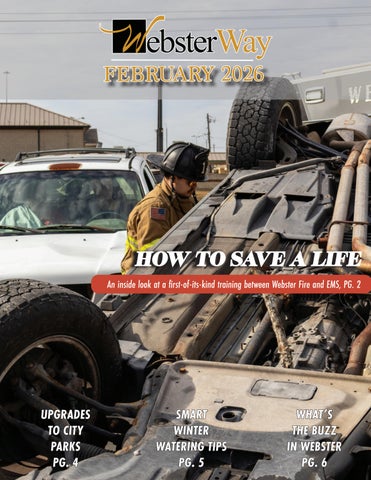
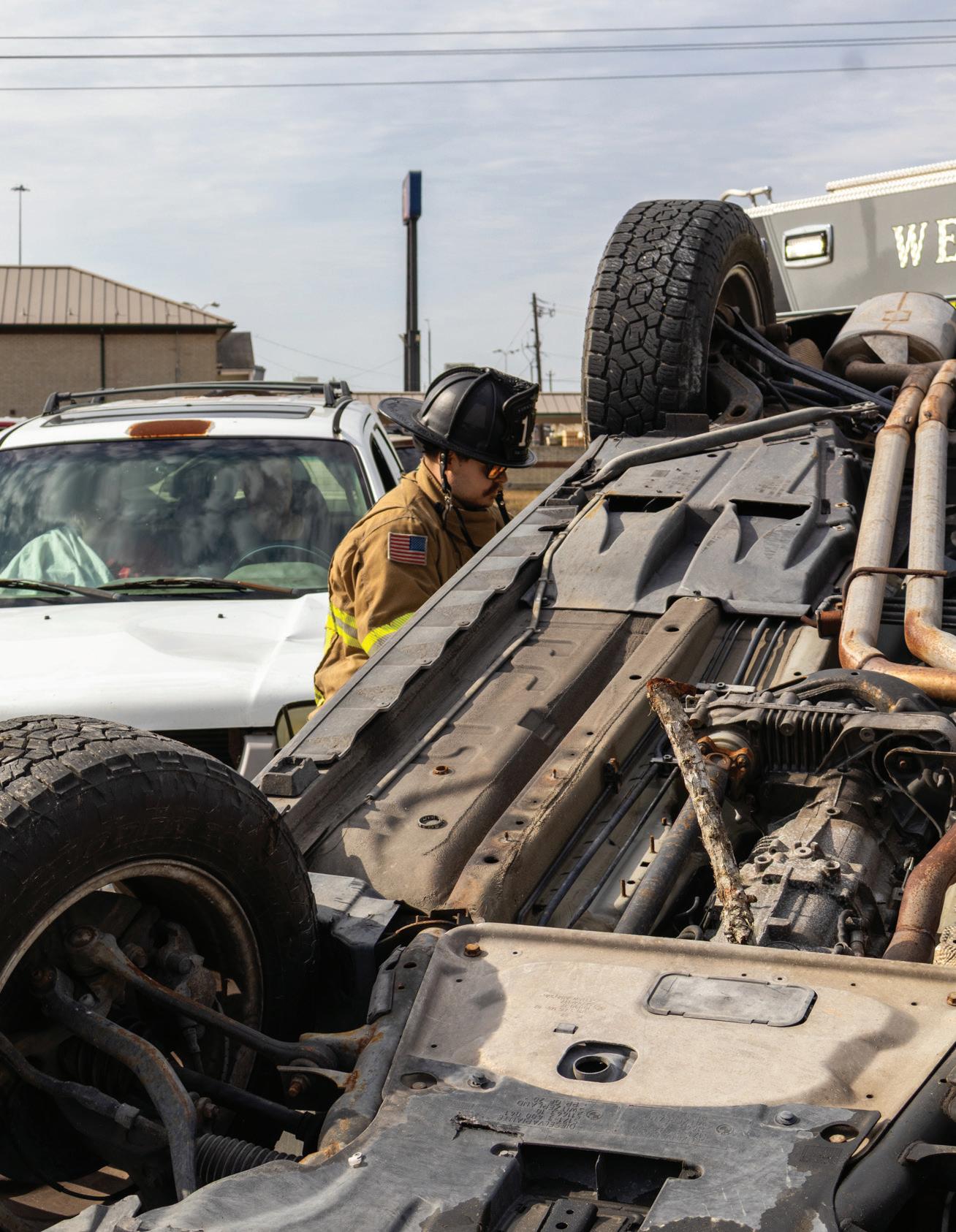
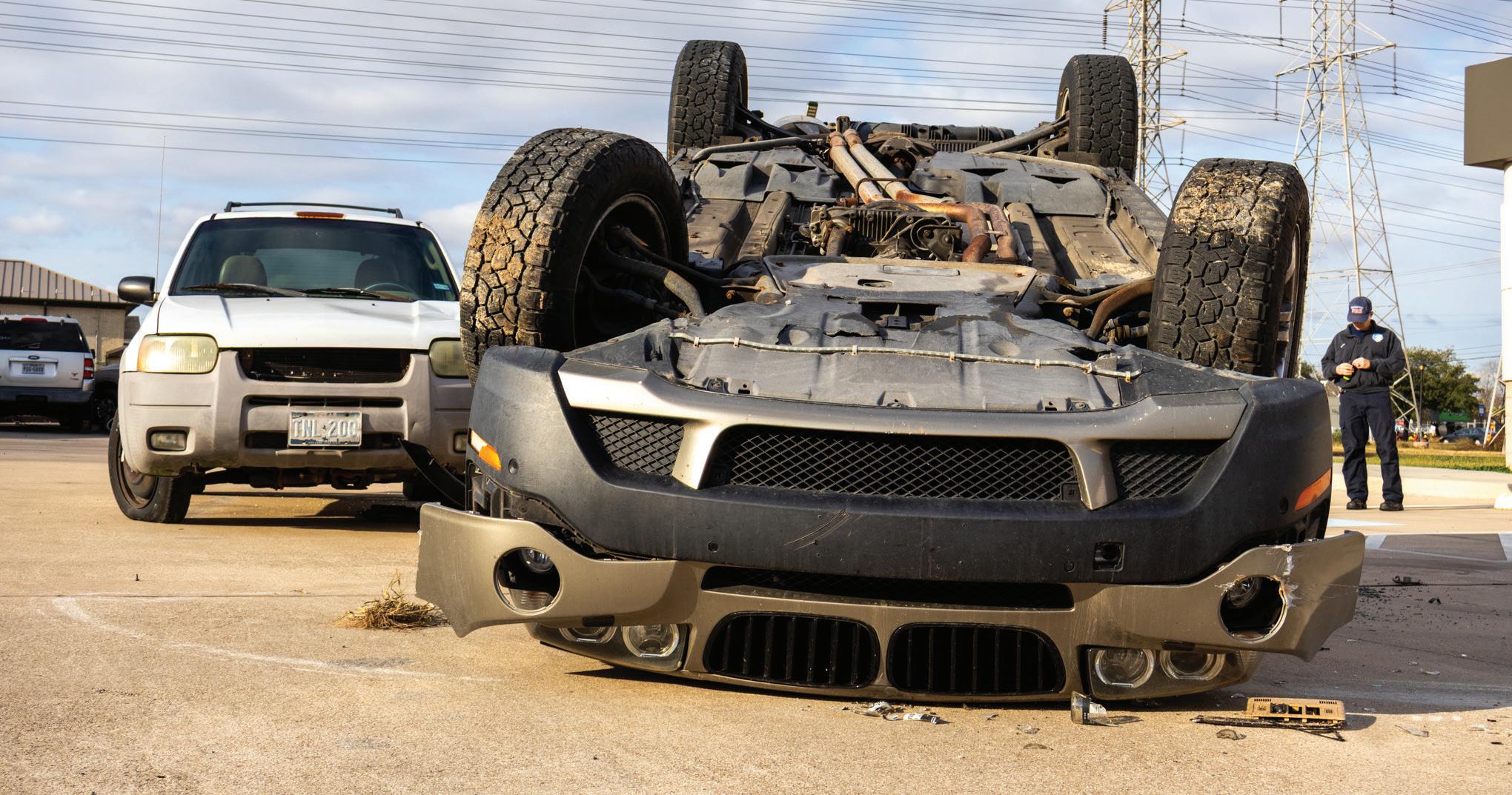
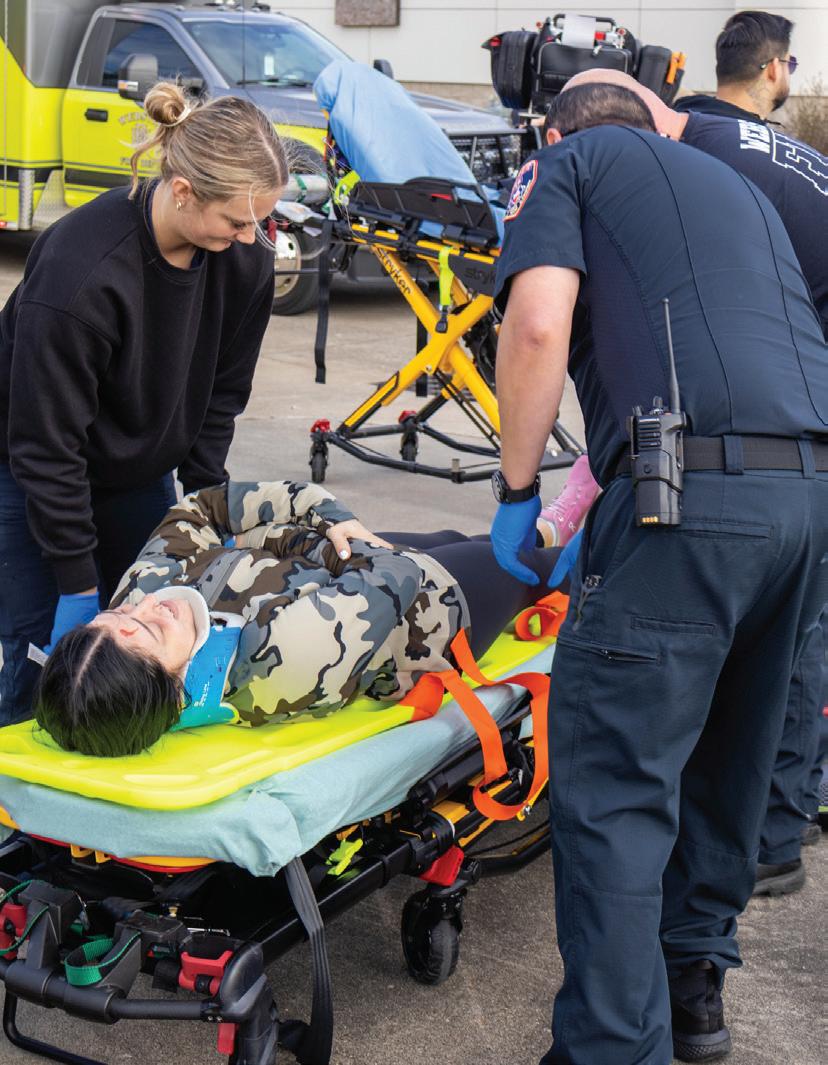
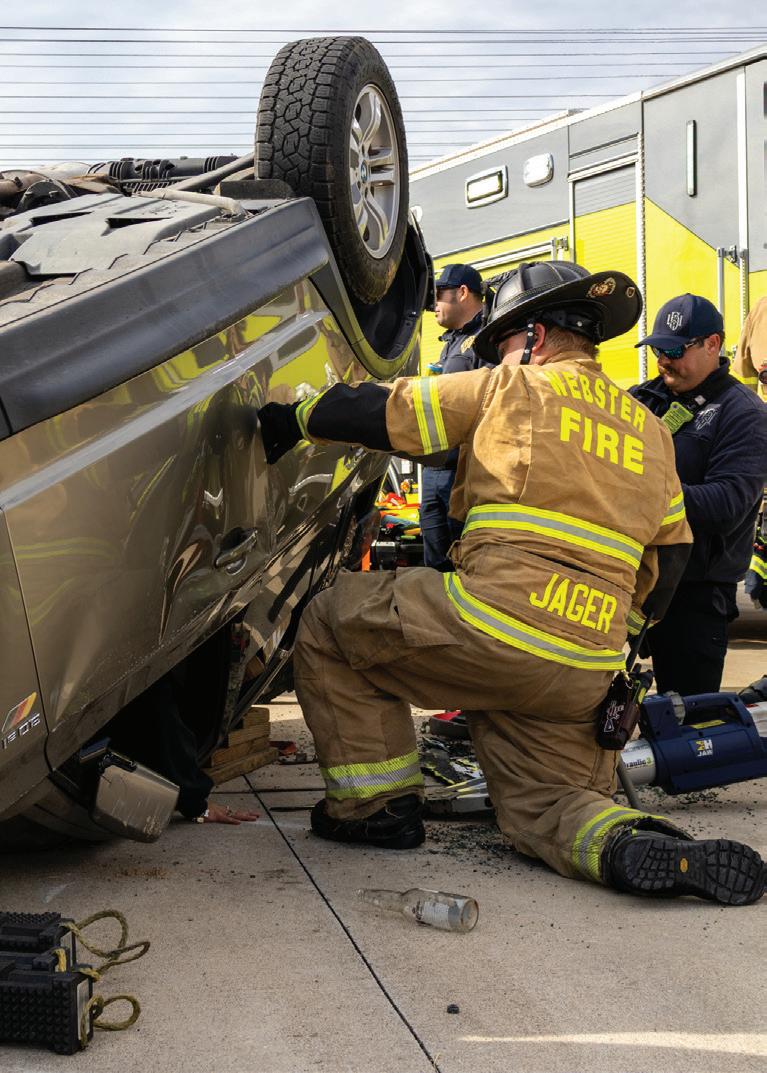
A voice cries out for help from a flipped car, while shattered glass litters the pavement. Firefighters, paramedics, and EMTs jump into action, evaluating the situation and working to free victims from the wreckage.
The scene has all the characteristics of a potentially devastating crash, but today, there are no lives on the line. This staged rollover accident is part of a large-scale training
exercise attended by Webster Fire and EMS.
“These trainings, I think they’re incredibly important because you never know what you’re going to go to, you never know what family emergency you’re going to have,” says EMT Rachel Holliday. “You never know what the scene’s going to look like.”
Battalion Chief Marshall Boyd says
the training was the culmination of three months of planning, with six cars being transported to Webster from Galveston to create realistic crash scenes. Each of the three multi-vehicle scenes looked different, but Boyd says they were all designed with the same goal in mind.
“What we’re trying to recreate is decision-making moments that have come up in the past, that
don’t tend to be black and white or really simple,” he says.
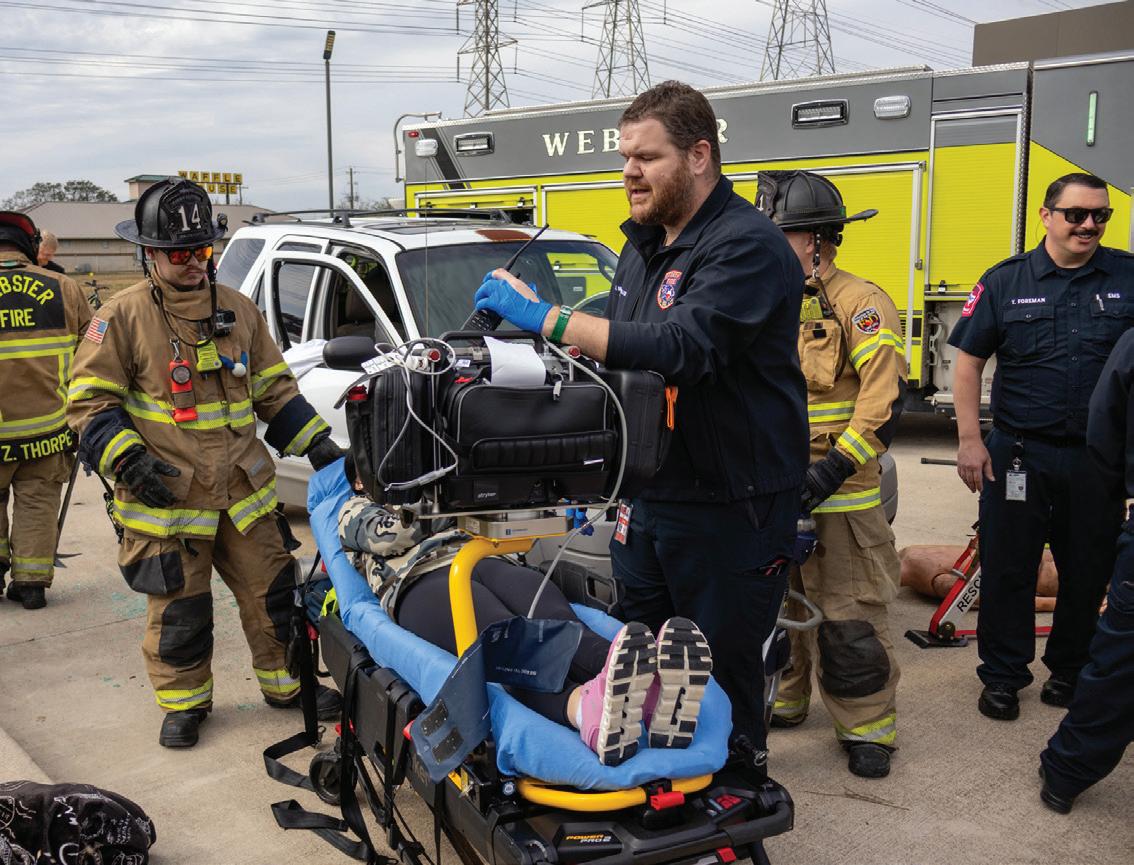
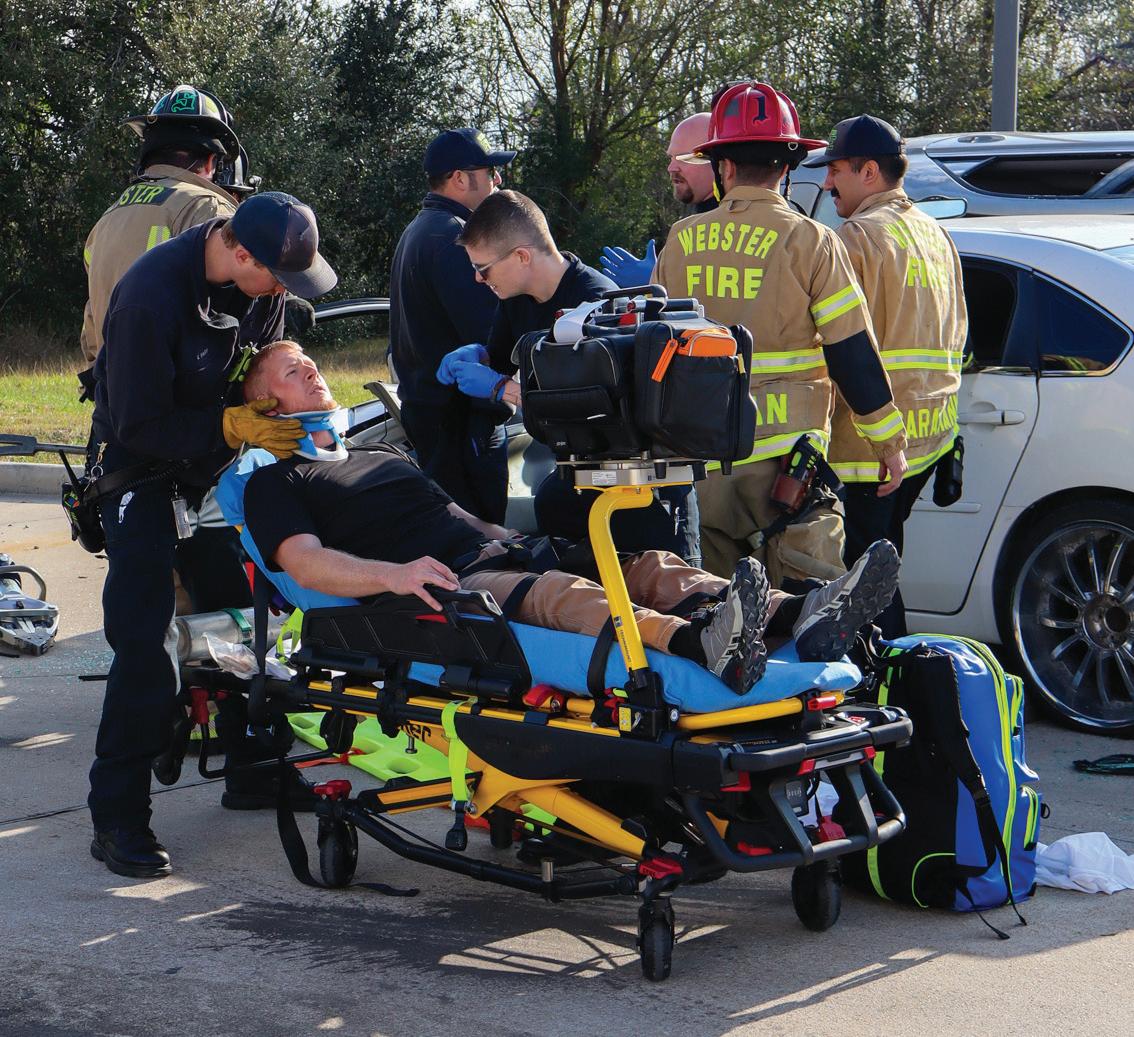
At each scene, first responders worked to triage “patients” –portrayed by a group of Alvin Community College EMS students – all with different levels of simulated injuries.
“That’s one of the biggest struggles and the hardest decisions is to look at all these human beings that need help and decide, and prioritize [them],” Boyd says.
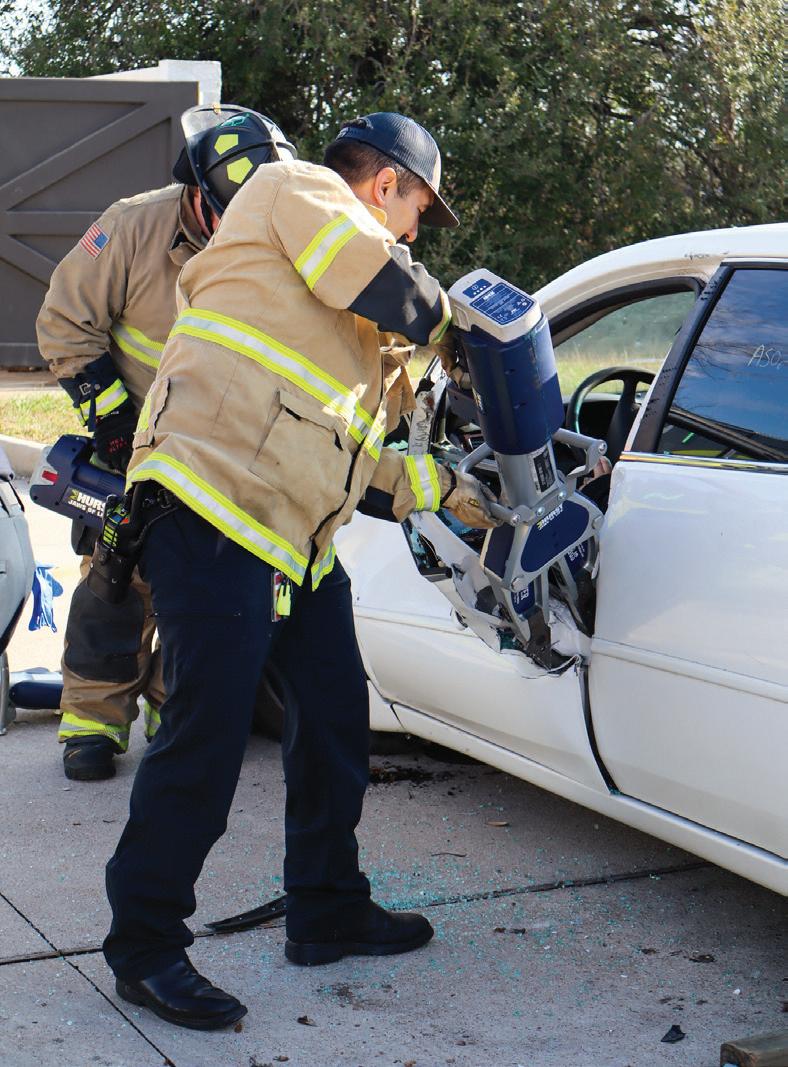
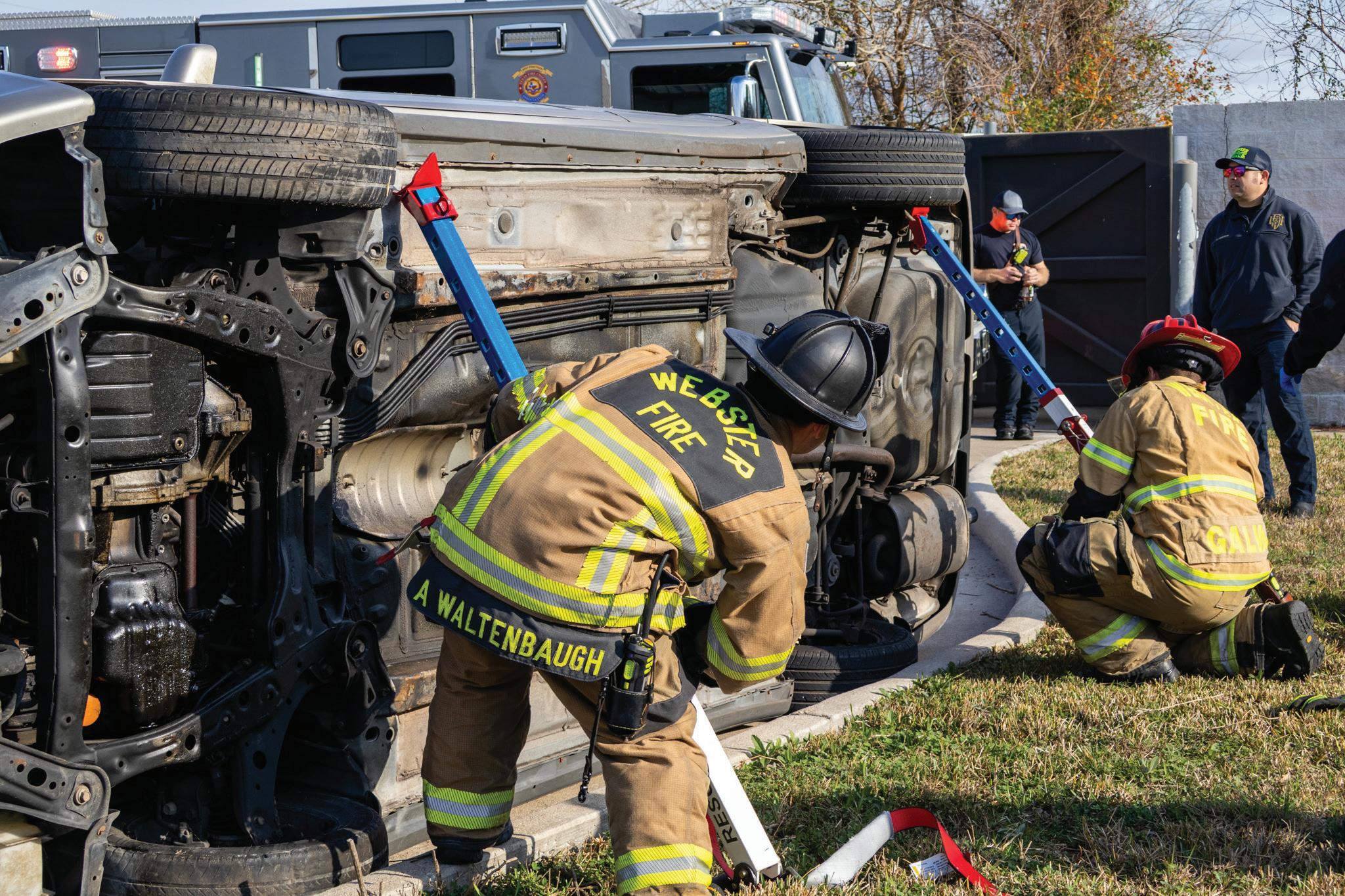
Additionally, firefighters practiced using an array of extrication tools, breaking windows and cutting doors to get the patients out of the vehicles. According to Boyd, entrapments require a higher level of communication between first responders, adding an extra layer to the training.
Paramedic Josue Cepeda says drills like this help first responders strengthen bonds with their coworkers, and he adds that frequent training can turn stressful situations into “just another day at the office.”
“It’s so second nature, you don’t even get butterflies when you show up, you just know what you have to do,” Cepeda says.
At the end of each scenario, crews participated in an informal evaluation known as a “hot wash,” and the day concluded with Boyd and fellow Battalion Chief Anthony Pearson leading a more formal debrief back at the station.
he says.
Among the key takeaways from the training were a focus on clear, concise communication, assignment of roles in an incident, and how to optimize the use of tools and equipment at an emergency scene.
EMS Chief Brad Starkey called the exercise a great opportunity for everyone to observe and learn from one another.
“Even I learned a lot here today, and I think everyone else did, too,”
The joint training exercise was also the first of its kind between Webster FD and EMS. While the Fire Department conducts largescale training sessions multiple times a year, this was the first time since the inception of the EMS division in 2025 that the two have been able to collaborate in a training of this magnitude.
“We are one department. Our quarterly trainings moving forward hopefully look like this, with Fire and EMS working together,” Boyd says.
above: Webster firefighters work to stabilize a vehicle on its side during one of three simulated crash scenarios. Meanwhile, Alvin Community College students portraying crash victims receive care from EMTs and paramedics.
Pictured
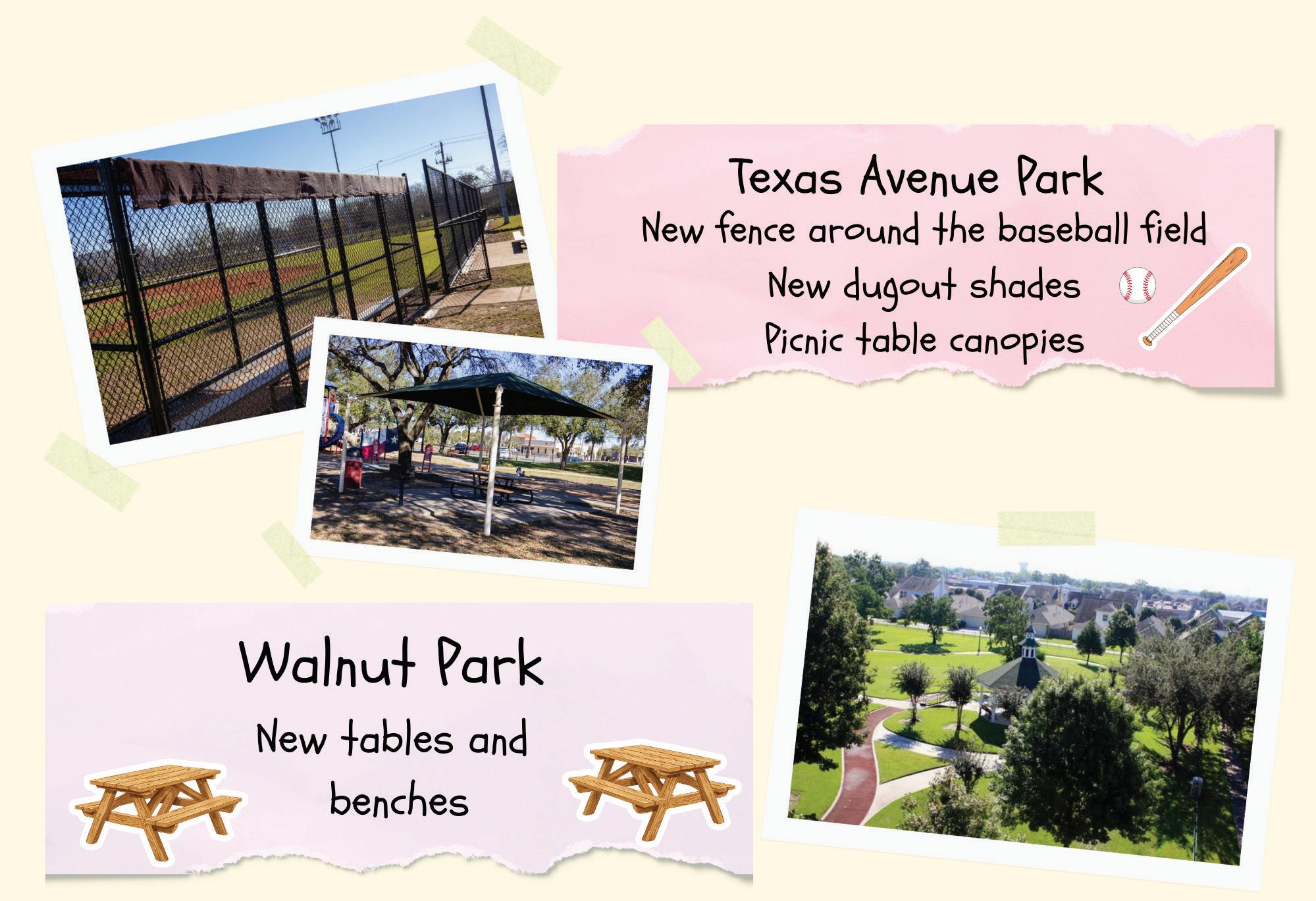
CITY PARKS RECEIVING UPGRADES IN 2026
The City of Webster Parks Division works year-round to keep our public spaces beautiful and well-maintained, and residents can expect to see some upgrades to our parks as we prepare for spring. Check out just some of the projects being completed early this year!
Starting February 2nd, AARP representatives will provide FREE tax assistance. Visit the Webster Recreation Center at 311 Pennsylvania Ave. to make an appointment. Please do not call for an appointment, as we are unable to book over the phone.
1 p.m.
Winter in the Greater Houston area is mild compared to the rest of the country, but your lawn and landscape still need far less water this time of year. Overwatering during the winter can waste water, increase your utility bill, and even weaken your plants going into spring. Here are some simple tips from Webster Public Works to help you water wisely.
Water Less — Your Yard Doesn’t Need Much
Cooler temperatures and natural rainfall mean most lawns only need watering every 2–3 weeks, if at all. Many established lawns can go the entire winter without extra irrigation.
Rule of thumb:
If we receive half an inch of rain in a week, you can skip irrigation entirely.
Water Only When Needed
Before you turn on your sprinklers, check the soil moisture. If the top 2–3 inches of soil are still damp, there’s no need to water.
A simple screwdriver test works:
• Push a screwdriver into the soil.
• If it slides in easily, the soil still has plenty of moisture.
Water In the Morning
If you do need to irrigate, run your system in the morning.
• This reduces evaporation.
• Minimizes freeze risk during overnight lows.
• Helps water soak in efficiently.
Use Manual Mode On Your Controller
Winter is a great time to turn your irrigation controller to manual or off mode. Consider adding a rain or freeze sensor. Only water when the lawn truly needs it — don’t let automatic timers run when rain or cool weather makes it unnecessary.
Focus On Your Trees And Shrubs
Grass needs very little water in winter, but young trees and newly planted shrubs may need a deep soak every 3–4 weeks if rainfall is low. Deep watering helps roots grow stronger ahead of spring.
Protect Your System On Freeze Nights
When a freeze is predicted:
• Turn sprinklers off to avoid icing sidewalks and driveways.
• Insulate exposed irrigation backflow preventers with a cover or towel.
• Drain hoses and disconnect them from outdoor faucets.
Small Adjustments Make A Big Difference!
Smart winter watering saves water, protects your landscape, and keeps our community’s water system running efficiently. Thank you for doing your part!
CITY COUNCIL RECAP
• City Council unanimously approved Ordinance 25-13, adopting Budget Amendment #1 for Fiscal Year 25-26.
• City Council unanimously authorized the disposal of City surplus property in an online auction.
• City Council unanimously authorized a purchase order for $95,000 to Big Boy Concrete to install stamped concrete on Water Street.
• City Council unanimously accepted a proposal for $424,000 from IDS Engineering Group for design services for Magnolia Avenue gravity sanitary sewer improvements.
• City Council approved Resolution 25-16 authorizing changing the name of the portion of West Nasa Blvd. within the limits of the City of Webster and naming new and future street construction in the Nasa Bypass Extension Phases 1 and 2 projects.
• City Council unanimously authorized a purchase order for $100,023.60 to Alsay Incorporated for Water Well No. 2 rehabilitation services.
• City Council unanimously authorized a purchase order for $119,505.23 to Construction Masters of Houston, Inc. for the replacement of deteriorated doors and frames at the Wastewater Treatment Plant.
• City Council unanimously declined adopting a resolution to cast votes to appoint directors to the Harris Central Appraisal District’s Board of Directors due to lack of candidate information.