All rights reserved. No part of this publication may be reproduced, stored in a retrieval system, or transmitted in any form or by any means –electronic, mechanical, photocopying, recording, or otherwise –without prior consent from the publisher.
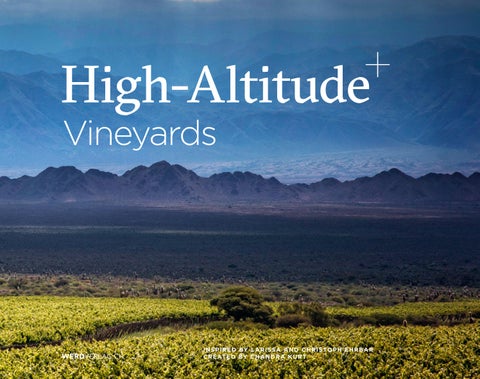
High-Altitude Vineyards
INSPIRED BY LARISSA AND CHRISTOPH EHRBAR CREATED BY CHANDRA KURT
For Ursula Hess and in loving memory of Donald Hess
Larissa and I look out over the valley. We’ve been coming here for over 17 years, but the landscape looks different every time we visit. Words, and even images, fail to fully portray the incredible scale and vastness of this landscape.
It’s January – rainy season. It rained yesterday on the journey from Salta over the Piedra del Molino, so the road over the mountain pass was in bad condition. We even had a flat tyre. The route to Altura Máxima is long and extreme. We drove over the Piedra del Molino Pass at 3,300 metres above sea level, before traversing the Altiplano on the Recta del Tin Tin – probably the straightest road I have ever seen – and arriving in Payogasta, the small village near the Altura Máxima vineyard. From here, it still takes about 30 minutes ascending gravel slopes until you reach one of the highest vineyards in the world, at 3,111 metres above sea level. Viticulture at this extreme altitude brings several advantages. The thermal amplitude – with daily fluctuations of up to 25 °C  – and the stronger UV radiation are just two key factors. We are part of a group of pioneers seeking to push the boundaries of viticulture, often in finding ourselves in extreme locations exposed to the
whims of nature. Larissa’s stepfather, Donald Hess, who founded the Altura Máxima vineyard, was the trailblazer in the cultivation of vineyards at these altitudes.
This book is a tribute to Donald Hess. With his courage and conviction, Donald paved the way for the cultivation of world-class grape varieties such as Malbec, Pinot Noir, and Sauvignon Blanc at elevations up to 3,111 metres. He was the first person to plant vines at these altitudes. We are honoured and grateful to continue his work and introduce people around the world to the uniqueness of the vines in these extreme microclimates and elevations. We aren’t competitive about who owns the highest vineyard or who produces wine at these lofty heights. Rather, we see ourselves as part of a movement that seeks the perfect terroir and microclimate for the production of exceptional wines.
This book is dedicated to all the courageous characters who have explored new avenues in viticulture with passion and a determination to push the boundaries. They have taken the hard road in most cases, and their courage and vision have made it possible for vines to grow in spectacularly unique places around the world today. We’d like to say a huge thank you to all the authors who contributed to this book. Special thanks go to Chandra Kurt, who made this project possible with her enthusiasm for viticulture at the highest elevations.
We are excited to introduce you to the vineyards in this book.
Saludos
Larissa and Christoph Ehrbar
About this book
Chandra
Kurt
High-altitude vineyards have existed for a long time. More than 25 years ago, the Swiss wine pioneer and visionary Donald Hess went to Argentina and created a winery at 3,111 metres above sea level – the highest in the world at that time. To honour his legacy, we collaborated with talented wine writers to explore other high-altitude vineyards and get a glimpse into this elevated region of the wine world – with the endorsement of Larissa and Christoph Ehrbar, who are part of the Donald Hess family. We feature wineries from 11 different countries: Argentina, Bolivia, Chile, China, Cyprus, France, Italy, Peru, Spain, Switzerland, and the USA. Some have existed for many years, while others were created more recently. Of course, there are many other wineries we could cover, but this is a personal selection. Each chapter tells of the landscape, the people and the story of the various wineries – with less of a focus on the wines themselves. It is a mix of different wine adventures and passions that take you through the journey of each of these pioneers. There are also stories about almost-forgotten grapes and vineyards, and the search for the right grapes on new lands. Every story has its own voice and is illustrated with a rich selection of photos of the unique, characteristic landscapes that sit high up, close to the sky.
High-altitude viticulture – an introduction
Chandra Kurt
When speaking of high-altitude vineyards, it is important to point out that latitude also plays a key role.
When speaking of high-altitude vineyards, it is important to point out that, in addition to altitude, latitude also plays a key role – i.e., the proximity to the equator. Therefore, an altitude of 1,000 metres above sea level does not create the same conditions for viticulture everywhere on the planet. In Europe, vineyards over 1,300 metres above sea level are already among the highest on the continent. The situation is completely different in warmer climate zones or regions bordering the tropics. Here, vines ripen at altitudes twice as high as those in the Alpine regions, for example, where for a long time another winery with Swiss roots was
considered to be the highest in Europe. The St. Jodern Kellerei in Visp, Valais, held this title for a long time. They are still the guardian of vineyards that thrive at 1,150 metres above sea level, where one of Switzerland’s most famous indigenous grapes is cultivated – the Heida. The vineyards here descend steeply into the valley, supported by the famous Swiss drystone walls.
Light and temperature
Vine health
Global warming is an important factor that has led to an increase in the number of vines being planted at higher altitudes. Temperatures have been rising in recent years, harvests are taking place earlier and the vines are maturing faster. For some wine regions, this has had a positive effect, while in others it is suddenly becoming too warm – if it isn’t too hot already.
The higher the plantation, the bigger the temperature differences between day and night.
At the same time, fresher and lighter wines are growing in popularity, so one can find an increasing number of highaltitude plantations in the Alto Adige, Aosta, Cyprus, the Dolomites, Etna or Tenerife – to name but a few. More will follow as the average temperature drops by 0.6 °C for every 100 metres of altitude. The higher the plantation, the bigger the temperature differences between day and night. These temperature contrasts allow for a slower and more balanced ripening of the grapes. Cold nights help to preserve the acidity of the grapes, often resulting in fresher wines. In addition, the altitude comes with intense sunlight. Sunlight becomes stronger with increasing altitude, and UV rays intensify by 10% to 12% every 300 metres. In response to these conditions, grapes tend to develop a thicker skin, which can give the wine more intense aromas, richer colours and more prominent tannins. On the other hand, a thick skin protects the grapes from the strong temperature fluctuations that occur at higher altitudes. This in turn has a major influence on the development of the wine’s aromas and colour, as well as the entire fermentation process that follows. As a result, light management is a key factor in viticulture at higher altitudes.
Another advantage of growing grapes at high altitudes is related to the health of the vines. In fact, high-altitude vineyards are generally less susceptible to diseases and parasites. This is due to the harsher climatic conditions, which are unsuitable for the survival of many parasites and diseases. This factor contributes to cleaner and more sustainable wine production. The air is healthy and the light is pure. In addition, the soils in these regions are often stony and poor in nutrients, which makes life difficult for the vines. They quickly deprive the vines of water and force them to form deep roots in order to obtain water and nutrients. In the mountains, this may seem like a disadvantage, but it is actually beneficial for the quality of the wine. However, we all know that the oenological result of a vine that has had to “suffer” a little is often more interesting than that of a vine that has been able to produce grapes without much effort and simply pump itself full of nutrients. In fact, vines that are forced to fight for their very existence also dedicate more energy to the production of high-quality grapes rather than foliage development, for example. This results in more concentrated and expressive wines.
UV rays intensify by 10% to 12% every 300 metres.
The higher the plantation, the bigger the temperature differences between day and night. These temperature contrasts allow for a slower and more balanced ripening of the grapes. Temperature
Oxygen is important for fermentation, especially as it is a factor in the conversion of sugar into alcohol.
Nutrient
The soils in these regions are often stony and poor in nutrients, which makes life difficult for the vines. They quickly deprive the vines of water and force them to form deep roots in order to obtain water and nutrients.
The combination of low nutrient and oxygen content in the soil, temperature fluctuations and intense sunlight creates a different growing season. Vineyards at high altitudes blossom later in spring and the harvest time is earlier. And one more thought about oxygen: it is also important for fermentation, especially as it is a factor in the conversion of sugar into alcohol. At higher altitudes, its content is lower, which in turn influences the fermentation process.
Planting, tending and harvesting vines on steep slopes is also labour-intensive. In addition, soil erosion is a major problem in mountain vineyards, while access to water can also be a challenge. In many mountain regions, water is a precious and limited resource. Vine growers often rely on irrigation to supply their vines with water, which requires careful water management.
After all, growing grapes at high altitudes can also pose logistical challenges. Transporting wine from remote vineyards is complicated, especially given harsh weather conditions – and underdeveloped infrastructure.
Growing grapes at high altitudes is no easy task. There are several unique challenges that winemakers must overcome in order to produce high-quality wine. Nevertheless, high-altitude wines are a growing category in the world of wine.
Characteristics of high-altitude wines
+ Grapes ripen more slowly.
+ Grapes develop more acidity and freshness.
+ Grapes develop thicker skins – leading to more aromas, colour and longevity.
+ Grapes are generally healthier, as fewer diseases occur.
+ Mountain vineyards are often exposed to extreme weather conditions, including very low temperatures, strong winds and large temperature fluctuations between day and night.
+ These conditions can damage the vines and impair the quality of the grapes.
+ Severe winters delay the flowering and ripening of the grapes, which can lead to a lower yield.
+ Vines produce fewer grapes, but with more character and complexity.
+ Water shortages are not uncommon.
+ Light management is crucial.
Guinness World Record: Pure Land at 3,563 metres
The highest vineyard in the world is Pure Land & Super-High Altitude Vineyard in Cai Na Xiang, Lhasa, Tibet, as recognised by Guinness World Records in 2018. The vineyard was established in 2013 with the support of the local government. The vineyards on the Tibet Plateau are planted with 11 grape varieties, including Vidal, Muscat and an indigenous ice wine variety called Bei Bing Hong, according to Rong Shun Biotechnology Development Ltd, which is responsible for the vineyard.
High-altitude wine pioneers from different countries and continents
We have followed pioneers who cultivate wine at high altitudes around the world – from Chile to China. There is something fascinating about this challenging zone of the wine world. Follow us on a journey to unforgettable vineyards that cope with extreme temperatures, elevations and unique planting conditions. Some of these higher-up mountain vineyards have existed for generations, while others have been borne from new adventures.
Overwhelmed by the powerful nose and deep colour, Donald knew straight away that he had found a diamond in the rough – and one with a long history, as the winery was founded in 1831 by the last Spanish governor of Salta, Nicolás Isasmendi. “I knew immediately that I had found my place in Argentina,” he later recalled. Argentina is not only the largest wine-producing country in South America, but also one of the oldest. Legend has it that Jesuit missionaries cultivated the first vines in
BODEGA COLOMÉ
Argentina’s pioneer winery
the foothills of the Andes around the mid16th century. Today, the area under vine is around 220,000 hectares, located between 22° and 45° latitude. The key advantages for viticulture are the high altitudes of the Andes, the variability of the soils, and the vast stretch of the land from north to south. In general, the grape selection in Argentina is reminiscent of southern European wine-growing regions. This is no coincidence, especially as immigrants from Italy, Portugal and Spain imported Bonarda, Barbera and Tempranillo in the 19th century. However, the country’s main variety is Malbec, which arrived in Argentina in 1853.
passing golden deserts, towering red cliffs, dramatic rock formations, and cactus groves that stand resilient against the forces of nature. “Every time we made that drive, I saw something new,” Donald would say. “The landscape never repeated itself.” As a visionary, he saw great potential here and didn’t want to plant vines further south in Mendoza like many others. He was also fascinated by the landscape, the climate, the people and, of course, the altitude he knew well from the Swiss Alps, where he had grown up.
The key advantages for viticulture are the high altitudes of the Andes, the variability of the soils, and the vast stretch of the land from north to south.
at the Estancia - a nine-room boutique hotel - and at the estate’s own farm, where animals are raised and organic vegetables are grown.
As religion plays an important role in the local community, one of Donald and Ursula’s first initiatives was to build a church, as the nearest one was 25 kilometres away in the picturesque village of Molinos. “If you want to be part of a place, you have to understand what matters to the people who live there,” he said. It was a gesture that told you everything about the kind of man he was.
When it came to the vineyards, Donald added 55 hectares of new plantings. Com-