Phone: +1 403-770-5766
How to Simplify DLC Server Deployment in High-Performance Data Centers High-performance data centers supporting AI, HPC, and accelerated computing face increasingly demanding thermal requirements as processor power and rack densities rise. Traditional airbased approaches may struggle to manage concentrated heat efficiently at higher densities. Designed to remove heat directly from critical components, DLC servers offer data center operators a practical approach to improving thermal management while preparing infrastructure for demanding current and future computing workloads.
Table of Contents Why Liquid Cooling Matters for High-Performance Data Centers ...........................................................................2 Start With Compatible Liquid-Cooled Servers .........................................................................................................2 Assess Thermal Requirements before Installation ....................................................................................................2 Coordinate Server and Facility Infrastructure ...........................................................................................................3 Standardize the Deployment Process ........................................................................................................................3 Plan for Future Scalability.........................................................................................................................................4 Prioritize Serviceability and Maintenance .................................................................................................................4 Consider Compatibility across Processor Platforms .................................................................................................4 Validate Before Full-Scale Deployment ...................................................................................................................4 Build the Cooling Strategy around Long-Term Growth............................................................................................5 Simplify Deployment with an Integrated Strategy ....................................................................................................6 Frequently Asked Questions .................................................................................................................................6 Conclusion ................................................................................................................................................................7 .
1
Phone: +1 403-770-5766
Why Liquid Cooling Matters for High-Performance Data Centers Modern CPUs, GPUs, and AI accelerators generate substantial heat within increasingly compact server architectures. By bringing coolant close to these heat-generating components, direct liquid cooling technology transfers heat at the source and reduces reliance on air as the primary heattransfer medium. Cooling should also be considered alongside power availability, server architecture, rack density, maintenance requirements, and future expansion. Selecting advanced server cooling solutions as part of the overall infrastructure strategy helps create a coordinated thermal environment instead of treating cooling as an isolated facility requirement. A simplified liquid-cooling deployment typically coordinates server compatibility, thermal requirements, coolant distribution, facility integration, and commissioning. Properly designed liquid loop cooling systems connect these areas and establish a controlled path for transferring heat from server components toward the facility heat-rejection infrastructure.
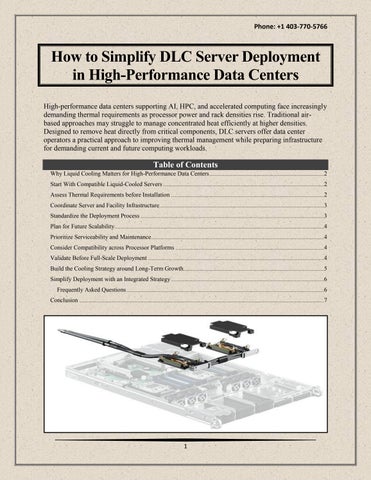
Start With Compatible Liquid-Cooled Servers Hardware compatibility should be established before detailed deployment planning begins. Preconfigured DLC servers reduce deployment complexity by limiting the amount of server-side cooling customization required during installation and helping teams work with clearly defined thermal and mechanical requirements. Coldplate loops can be integrated into compatible server platforms from major server manufacturers. Within this deployment ecosystem, CoolIT Systems provides coldplate technology designed to support current high-performance processor architectures and demanding liquid-cooled computing environments.
Assess Thermal Requirements before Installation A successful deployment begins with understanding processor thermal loads, rack density, coolant temperatures, flow requirements, pressure conditions, and anticipated operating environments. Properly selected direct liquid cooling technology should correspond to the thermal characteristics of the computing platform rather than function as a generic cooling layer. Planning for future hardware is equally important. As successive generations of GPUs and accelerators increase power density, DLC servers provide an architecture that can help data centers prepare for greater thermal requirements without repeatedly redesigning the entire server cooling approach.
2
Phone: +1 403-770-5766
Coordinate Server and Facility Infrastructure Liquid-cooled infrastructure works most effectively when server-side and facility-side requirements are considered together. During the design stage, liquid loop cooling systems should be evaluated for connection points, coolant flow, pressure requirements, redundancy, monitoring, maintenance access, and integration with coolant distribution equipment. This coordinated approach reduces the likelihood of facility infrastructure becoming a limitation as computing capacity grows. When evaluating data center equipment, teams should consider how server hardware, coldplates, rack manifolds, coolant distribution units, piping, and heatrejection infrastructure function as an integrated thermal system.
Standardize the Deployment Process Standardization makes large-scale installations easier to commission, maintain, troubleshoot, and expand. Consistent connection methods, operating parameters, rack configurations, maintenance procedures, and advanced server cooling solutions can reduce unnecessary variation between deployment phases. Pre-integrated DLC servers further support standardization because their cooling components are engineered around defined server architectures. CoolIT Systems reports that servers equipped with its coldplates can provide up to 30–40% better thermal performance than standard DLC designs, depending on the system configuration and operating environment.
3
Phone: +1 403-770-5766
Plan for Future Scalability AI and HPC environments rarely remain static. New racks, more powerful accelerators, and greater compute capacity can substantially increase thermal loads over time. Scalable direct liquid cooling technology provides a framework for accommodating these changes while maintaining a consistent approach to thermal management. Manufacturing capacity in Canada has expanded as demand for liquid-cooled AI and highperformance computing infrastructure continues to develop. Planning cooling infrastructure around future capacity requirements helps operators avoid treating each new hardware generation as an entirely separate deployment project.
Prioritize Serviceability and Maintenance Thermal performance alone does not determine the long-term effectiveness of a cooling deployment. Technical teams also require practical access to servers, connections, manifolds, monitoring points, and other serviceable components. Well-planned liquid loop cooling systems support routine inspection and maintenance while minimizing unnecessary complexity around high-value computing equipment. Clear procedures for installation, leak checking, commissioning, monitoring, and maintenance further improve operational consistency. Standardized practices for DLC servers also make it easier for technical teams to manage liquid-cooled environments across multiple racks, data halls, or deployment phases.
Consider Compatibility across Processor Platforms High-performance data centers may operate hardware from several processor and server vendors. Cooling architecture should therefore account for current processor requirements and future technology roadmaps. Flexible advanced server cooling solutions help organizations accommodate changing compute platforms without abandoning a consistent thermalmanagement strategy. Coldplate designs can support a variety of high-performance server configurations and processor architectures. Through deployments involving major OEM platforms, CoolIT Systems contributes liquid-cooling technology for data center environments requiring scalable thermal management.
Validate Before Full-Scale Deployment Testing a representative configuration before a large rollout can identify integration challenges early. Validation should examine coolant flow, temperatures, connections, monitoring, rack-level behavior, and expected operating conditions. A structured commissioning process makes DLC servers easier to deploy consistently across a high-performance computing environment. 4
Phone: +1 403-770-5766 Commissioning data also establishes an operational baseline for future monitoring. When direct liquid cooling technology is validated against defined thermal and system requirements, operators gain useful reference information for identifying abnormal behavior, planning maintenance, and evaluating additional capacity.
Build the Cooling Strategy around Long-Term Growth A modular cooling strategy provides greater flexibility as computing requirements change. Properly planned liquid loop cooling systems allow thermal infrastructure to expand alongside rack and server capacity instead of requiring a complete redesign whenever new computing hardware is introduced. Liquid-cooling manufacturing capabilities in Canada have grown alongside increasing demand for AI infrastructure. Expanding production capacity for components such as coolant distribution units, rack manifolds, and server coldplate loops demonstrates how the liquid-cooling ecosystem is developing to support higher-density computing environments.
5
Phone: +1 403-770-5766
Simplify Deployment with an Integrated Strategy Server selection, thermal engineering, facility design, installation, and commissioning should operate as connected parts of the same deployment strategy. An integrated approach to DLC servers reduces potential compatibility challenges and gives facility engineers, installation teams, and data center operators clearer technical requirements throughout the project. For demanding AI and HPC environments, properly selected advanced server cooling solutions establish a scalable foundation for managing increasing processor power and rack density while supporting consistent operation and future infrastructure growth.
Frequently Asked Questions What are DLC servers? DLC servers use liquid-cooled components, typically coldplates, to transfer heat directly away from high-power processors such as CPUs, GPUs, and accelerators. They are particularly relevant to AI, HPC, and other high-density computing environments. How does direct liquid cooling help high-density computing? Direct liquid cooling technology removes heat close to the components generating it, providing a direct thermal path for high-power processors and reducing dependence on server-room airflow for primary heat transfer. What should be considered when planning a liquid cooling loop? Effective liquid loop cooling systems require consideration of coolant conditions, flow rates, pressure, connections, manifolds, monitoring, redundancy, facility integration, and maintenance access before full-scale deployment. Why are advanced cooling systems important for AI infrastructure? As AI processors become more powerful and rack densities increase, advanced server cooling solutions provide thermal management capacity to accommodate concentrated heat loads while supporting scalable computing infrastructure. How can data centers simplify DLC server deployment? A simplified deployment starts with compatible DLC servers and coordinates thermal requirements, rack infrastructure, coolant distribution, facility connections, commissioning, monitoring, and maintenance before large-scale installation begins.
6
Phone: +1 403-770-5766
Conclusion Simplifying liquid-cooled server deployment requires a coordinated strategy rather than selecting individual cooling components in isolation. Data center operators should assess server compatibility, processor heat loads, rack architecture, coolant distribution, facility integration, serviceability, validation, and future scalability during the early planning stages. With these requirements aligned, DLC servers provide a structured approach to supporting high-density AI and HPC environments while preparing cooling infrastructure for continued increases in computing power. Explore the location in Canada and plan a visit to learn more about the company. Get directions to CoolIT Systems on the map today.
Get in Touch:
7