![]()


Pearson House | The Foundation
Built in 1926 and situated on Titoki Street, Parnell facing the Auckland Domain, Pearson House is a Category 1 Heritage Listed Building. Originally created as a residence catering to the needs of blind men, it helped to ensure the blind were a constant public presence in the city. Nearly one hundred years on, it has been fully transformed into a key component of The Foundation, a significant multistage development that is more luxury hotel than retirement village.
The upgrade of Pearson House involved bringing the original colonnade back to life, seamlessly linking the Drawing Room and a Reading Room and establishing a café at ground level. Upstairs has been redesigned to house a luxurious boutique cinema, billiard room, lounge, an art studio, cardio studio and wellbeing suite.
And at the centre of this transformation was the visionary eye of awardwinning interior designer Stewart Harris, of Macintosh Harris. The choice of absolutely everything – from the room-by-room colour palettes to the furnishings and even the tableware – was overseen by Stewart, with the building’s Neo-Georgian design providing a faithfully followed template.
I imagined how one would journey through the spaces, and how that should be an uplifting experience, with bursts of light and colour along the journey,” says Stewart. “The Georgians liked to use bright colours, so the spaces had to be very colourful, very joyful, something that is very uplifting as you move through it.
“And so, we have pinks, we have blue staircases, we have beautiful pale turquoise. The Georgians were very fond of pea green, so the reading room features a pea green palette, with green being very conducive to calmness and reading. Then we bounce it up a bit when you get into the drawing room and the reception room with the brighter turquoise, something that’s going to really lift your spirit when you go in there.”
Beyond the period-correct colours used throughout Pearson House, fixtures and furnishings also needed to reflect the building’s heritage while retaining a sense of modernity and first-class comfort for visitors. The solution called for a hybridised approach from Stewart, combining, for example, selected wallcoverings and artworks which link the old with the new, creating a collection of the contemporary and the traditional.
Generus Living director Graham Wilkinson describes Pearson House as an uplifting space that enhances the cultural fabric of The Foundation. “The Parnell precinct, with its rich history and enviable location, is incredibly special,” he says. “Pearson House is a tangible link to the past, and its preservation ensures this remarkable property continues to inspire.”


Pearson House is a cornerstone of The Foundation’s multi-stage development, which will accommodate over 250 residents when completed. This visionary project includes luxury residences that complement the historic and contemporary architectural features of the village.
The Nathan Residences, the first stage of the development, opened in October 2023. The next stage, Abbott Residences, is set to open in August 2026, furthering The Foundation’s goal of creating a harmonious blend of luxury, heritage, and sustainability.
Contact us today to book a private tour of The Foundation or to view plans for the Abbott Residences.
For More Information
Visit www.thefoundationvillage.co.nz or email enquiries@thefoundationvillage.co.nz


Good Form Design Gallery / 86 Newton Road, Eden Terrace Auckland . goodform.co.nz
Exclusive Representation / Mr. Bigglesworthy Architectmade . Astep
CC-Tapis . Karimoku Case Study . Ercol
Nedre Foss . OMK 1965 . Oblure . Omann Jun
Rex Kralj . Saito Wood . Stoff Nagel . Tomado
Warm Nordic . Zaha Hadid Design
New Zealand Design / Cam Barrett . Dilana . Gidon Bing Studio

Designed in collaboration with London-based architect Alex Wilcock and built to exacting standards by Triple Star Construction, the home is a careful composition of proportion, material and view. The result is refined, quietly theatrical architecture that never shouts, it simply draws you to the water and lets the light do the talking.


Calming and connecting colours for 2026


Key awarded luxury lodge. Enjoy a complimentary third night with signature lodge inclusions when you book a two 26. T&Cs apply.


Your goals for the coming year represent more than just financial milestones; they represent the life you have worked hard to build.
Whether you are finding sanctuary in a new home or a fresh renovation , securing your future by refinancing to reduce debt, or growing your legacy by expanding your investment property portfolio and the passive income you deserve.
At Alex Wang, we believe 2026 isn’t just another year—it’s your turning point. We specialize in bridging the gap between your aspirations and your reality, providing the expertise needed to reach financial freedom.
Let us help you focus on your goals and turn “what if” into “what’s next”.


Publishing Details
printer
Crucial Colour 24 Fairfax Avenue
Penrose
Auckland 1061
Publishing Contacts
Edition of 1,700 Offset printed, 162 pages 113gsm Matt Art 100gsm Laser Offset
Freely distributed to subscribers or available at select public art spaces and hospitality venues.
Paul Evans Managing Director paul@webbs.co.nz +64 21 866 000
Caolán McAleer Director of Marketing & Operations caolan@webbs.co.nz +64 27 929 5603
head office advertising press design
Angela Gracie Client & Partnerships Manager angela@webbs.co.nz +64 22 495 3943
Art Department
Elizabeth Boadicea Snow Head of Brand & Marketing elizabeth@webbs.co.nz +64 22 029 5611
Alessandra Banal Senior Designer design@webbs.co.nz +64 9 529 5609
wellington christchurch auckland
Emily Gardener Director of Art emily@webbs.co.nz +64 22 595 5610
Megan Shaw Manager, Art megan@webbs.co.nz +64 22 301 8259
Jo Bragg Logistics & Inventory Coordinator, Art jo@webbs.co.nz +64 21 113 5001
Georgina Brett Specialist, Select georgina@webbs.co.nz +64 27 929 5609
Lily McCowan Specialist, Art Online lily@webbs.co.nz +64 22 068 4932
Georgia Clapshaw Registrar, Art georgia@webbs.co.nz +64 22 522 8144
Mia Foulds Administrator, Art mia@webbs.co.nz +64 9 529 5609
Stephanie Arrowsmith Administrator, Art art@webbs.co.nz +64 9 529 5609
Charles Tongue Valuations Specialist valuations@webbs.co.nz +64 22 406 5514
Mark Hutchins-Pond Senior Specialist, Art mark@webbs.co.nz +64 22 095 5610
Virginia Woods-Jack Exhibitions Manager virginia@webbs.co.nz +64 22 679 8664
Sean Duxfield Specialist, Art sean@webbs.co.nz +64 21 053 6504


Two decades of enriching modern lives and spaces with meaningful scent experiences. To our loyal community — thank you for being part of our journey.

ashleyandco.co


Webb’s joined forces with Star Gossage, Taika Waititi and a powerful collective of artists to support Oscar-nominated producer Chelsea Winstanley and her film
TOITŪ: Visual Sovereignty. This collaboration celebrated the global presence of Māori art and artists, raising over $120,000.
Chelsea Winstanley has reached another major milestone with her directorial debut documentary, which sold out screenings at the New Zealand International Film Festival and has now headed offshore. The film, TOITŪ: Visual Sovereignty, had its international premiere in February at the Santa Barbara International Film Festival, followed by the Berlin European Film Market (EFM), marking a significant moment for Māori storytelling on the world stage.
TOITŪ: Visual Sovereignty offers an intimate, behind-the-scenes look at Toi Tū Toi Ora: Contemporary Māori Art (2020–2021) at Auckland Art Gallery Toi o Tāmaki, the largest exhibition of contemporary Māori art ever staged in Aotearoa. The documentary is a powerful extension of Winstanley’s long-standing commitment to creative autonomy, authorship and Indigenous narratives.
To support the film’s international journey, a fundraising art auction spearheaded by Webb’s was held on Thursday 29 January at Auckland Art Gallery Toi o Tāmaki. The evening opened with a screening of the film and a Q&A with exhibition curator Nigel Borell, setting a reflective and celebratory tone.
The auction proved hugely successful, raising an outstanding $120,350. Highlights included two works by Taika Waititi from his Dirty Money Series (1999), which far exceeded expectations, fetching $22,500 and $20,000 respectively. The event itself was sparked by a simple act of generosity from artist Star Gossage, whose offer to create a painting became the catalyst for a wider collective effort involving artists including Shane Cotton, Charlotte Graham, Emily Karaka and Reuben Paterson.
Winstanley said the funds allowed the team to dream bigger, supporting festival travel, international markets and distribution. “Being ready to respond to any opportunity is an independent filmmaker’s dream,” she says. “Ngā mihi to everyone who showed up for the arts and for independent film.”
The event was generously supported by Tim Melville Gallery, Gow Langsford, WORLD, and the artists themselves, whose collective mana, aroha and generosity made the evening possible.
Caolán McAleer

Webb’s is delighted to have supported the recent Bill Hammond: Serenading Imagined Worlds exhibition at Te Uru Waitākere Contemporary Gallery, which celebrated the life and work of one of Aotearoa New Zealand’s most intriguing, unique and influential artists.
Bill Hammond (1947–2021) developed a singular practice over more than four decades, one that moved fluidly between subjects, styles, and mediums, yet remained unmistakably his own and unmistakably of this land.
Serenading Imagined Worlds surveyed Hammond’s career, tracing his journey from an inventive young artist to a figure whose works became cultural touchstones; shaping how we in Aotearoa understand our histories, mythologies and landscapes.
The exhibition brought together works from four key chapters of his practice, offering a rare opportunity to experience the full breadth of his vision: from the handcrafted playfulness of his wooden works, through the precision of his prints, to the raw vitality of paintings from the 1980s and early 1990s, and the profound otherworldliness of paintings shaped by his visit to the Auckland Islands.
Hammond’s early wooden work, rarely exhibited, embodies a spirit of experimentation and humour, revealing an artist already testing the boundaries between art and object. In the 1980s, his practice took on a sharper, more confrontational edge. His paintings and finely wrought etchings from this period drew on pop culture, music and anarchic aesthetics, channelling a restless energy that reflected the cultural and political undercurrents of the time.
A pivotal moment came in 1989, when Hammond joined an artists’ expedition to the Auckland Islands. Encountering this remote, subantarctic landscape proved transformative, giving rise to the bird-human hybrids that would define his most celebrated works.
These enigmatic figures evoke both beauty and unease, speaking to the fragility of nature, the weight of colonial histories, and the shifting boundary between the human and the non-human.
Bill Hammond’s art remains a taonga, resonant, challenging and deeply embedded in the cultural imagination of Aotearoa. Webb’s is proud to have supported Te Uru in bringing this exhibition to fruition.

Highlights from this March Works of Art Live Auction catalogue are exhibited at Queenstown’s globally recognised hospitality venue: Amisfield Restaurant & Cellar Door. We sat down with its founder John Darby and his partner, Sally Ridge about their passion for art and collecting.

“Allowing the artworks to hang at Amisfield for a week and letting people view them has been wonderful. [Webb’s] effort in moving and presenting works so people can connect with them firsthand is important… these pieces are meant to be seen and learned from.”
John Darby and Sally Ridge on highlights from Works of Art being exhibited at Amisfield Restaurant.

How did your art collecting journey begin?
John Darby (JD): I was heavily influenced by my sister (the artist Helen Calder) and by being in a family who pursued creative careers. The first significant work I bought was by Julia Morison, one of her early works after she undertook the Moët & Chandon contemporary art residency in France. Also, I grew up in Queenstown and Ralph Hotere was very present in our early years. I also collected Stephen Bambury early on. That’s how it all began, it triggered an interest in New Zealand art which I’ve pursued for over 30 years.
Sally Ridge (SR): I went to art school, and I love painting. Shane Cotton has been one of my favourite artists from a very young age. I have quite a few works by him, and they’re all different. Every day I come home, sit with a cup of tea and look at my artworks. Even after 20 years, I still love looking at them. It never wears thin. Also, I’m very good friends with the Cottons, so I’ve followed them for many, many years, since my kids were little. Early on I also started collecting artists like Tony de Lautour, Michael Parekōwhai, and Peter Robinson.
What is the most treasured piece in your collection?
JD: Helen [Calder] is one of my favourite artists, of course I am biased, but she is! I also collected a large early Ralph Hotere oil painting. It references a New Zealand soldier from World War I whose letter was encapsulated in a poem by Bill Manhire. The soldier was from Central Otago, where I grew up, so it has a deep emotional connection for me. I gravitate toward works that speak of New Zealand.
SR: We also have a new addition to our collection, the Bill Hammond Cornwall Road Cave which hangs in the lounge.
You’ve added some remarkable pieces to your collection recently and the Hammond was acquired through Webb’s. What spoke to you about that work?
JD: I briefly met Bill late in his life. The painting expressed a creative period of his life, referencing a cave near where he lived, with Māori carvings and etchings that inspired him. It also reflects his parallel world of birds in New Zealand and as a country of birds, that resonates strongly. His ability to take that into fine art expression isn’t easy. The connection to place and to Bill made it special.
How has your love of art influenced your vision for Amisfield?
JD: Well, as a wine company, Amisfield is really about expressing the best of what our land and our people can produce together. For us, wine doesn’t sit on its own, it naturally connects to food, art, and the environment. That relationship feels seamless and important. We’ve been fortunate to have art, at the building at Lake Hayes, that refreshes and evolves over time. It is a meeting point for wine, food, and art, all in one place and we’re widening that to include other artists we love, artists who, in our view, express what we’re trying to do. There’s a shared sense of New Zealand identity that runs through it all. That’s really the common theme for us. So we remain focused on New Zealand artists, including up-and-coming ones. Supporting that creative expression feels aligned with what we’re doing in wine.
To read the full interview or explore the March Works of Art catalogue online visit webbs.co.nz

Emily Gardener Director of Art
emily@webbs.co.nz
+64 22 595 5610
We are now inviting entries for our upcoming Works of Art live auction, taking place on Monday 24 August, 6.30pm.
As New Zealand's foremost auction series of blue chip, museum-quality art, we are particularly interested in:
High-quality paintings, sculptures, and mixed media works; artworks of local and international significance; works by celebrated New Zealand artists such as Paul Dibble, Charles F. Goldie, Bill Hammond, Pat Hanly, Frances Hodgkins, Michael Illingworth, Colin McCahon, Fiona Pardington and Michael Parekōwhai, among others.
If you are considering selling an artwork or collection, contact our team for a complimentary, no-obligation appraisal.
Featuring your work or entire collection in this auction connects it with a wide network of collectors and institutions across Aotearoa, supported by our targeted marketing campaigns and a national preview tour.
Don Binney, Two Aspects of Tokatoka Price Realised incl. BP: $390,443 est. $350,000—$500,000

Price Realised incl. BP: $215,100 est. $180,000—$220,000


Since its founding in 1976, Webb’s has stood as a meeting place between culture and commerce, connecting collectors with objects that define their era. As Webb’s celebrates its 50th anniversary this year, this landmark moment invites reflection on the artworks, objects, and stories that have shaped its legacy, and on the wider role our auctions play in recording the cultural history of a nation.


As part of our 50th anniversary celebrations, Webb’s is presenting an exhibition that reflects on the many significant moments that have shaped our past. To support this, we are seeking to loan exceptional works purchased through Webb’s, as well as archival material, photographs, and personal anecdotes connected to the auction house and its place within Aotearoa’s cultural landscape.
Together, these contributions will help tell the story of an auction house shaped by its people, its collections, and five decades of extraordinary moments. Should you have an object, image, or story you would like to share for consideration, please contact us.
This year, Webb’s celebrates its 50th anniversary, marking a significant milestone as New Zealand’s premier multi-department auction house. Founded in 1976 by Peter Webb, a pioneering figure in the country’s art world, Webb’s was established with a vision to broaden access to art and collectables and to introduce a new, dynamic auction culture to Aotearoa. From its beginnings, Webb’s has played a defining role in shaping the nation’s secondary market, bringing together expertise, scholarship, and innovation across a wide range of collecting categories.
Over the past five decades, Webb’s has evolved into a trusted institution known for excellence in its respective departments: Art; Decorative Arts; Asian Art; Collectors’ Cars, Motorcycles, & Automobilia; Fine Jewels, Watches, & Luxury Accessories; Fine Wines & Whiskies, The Estate, and Material Culture. Through record-setting auctions, landmark consignments, and an enduring commitment to curatorial rigour, Webb’s has united collectors with objects of outstanding beauty, rarity, and significance, locally and internationally.
Central to this success has been Webb’s dedication to specialist knowledge, meticulous valuation, highly targeted marketing and meaningful engagement with New Zealand’s thriving cultural community.
To mark this significant anniversary, Webb’s is to present a series of special initiatives throughout 2026, including an exhibition, accompanying publication, and educational programmes that reflect on our history and look toward the future.
“Auctions serve as cultural mirrors, reflecting a society’s evolving values, aesthetics, and ambitions. Across its 50-year history, Webb’s has borne witness to profound shifts and pendulum swings in collecting across all categories. Together, these movements trace the changing contours of taste, revealing what each era deems culturally significant, enduring, and investmentworthy. Our history as New Zealand’s leading auction house is indelibly tied to that of our nation’s creative history and cultural evolution.”
—Caolán McAleer, Director of Marketing & Operations, Webb’s.
This anniversary is more than a celebration; it is a reaffirmation of Webb’s role at the forefront of New Zealand’s art and wider secondary markets and an investment in the country’s cultural future.
We look forward to celebrating this anniversary together with the people who have helped us reach this exciting milestone.
Caolán
McAleer
Director of Marketing & Operations
caolan@webbs.co.nz +64 27 929 5603

Renewed momentum from enthusiasts has prompted Webb’s to bring back a dedicated, high-octane, motorcycle-only auction, shifting gears back to a format long missed by our clients and the wider market.
online auction 30.03.26—13.04.26
viewing times
Thursday 9 April, 10am—5pm
Friday 10 April, 10am—5pm
Saturday 11 April, 10am—4pm
Sunday 12 April, 10am—4pm
Monday 13 April, 10am—5pm
1935 Brough Superior 'MX80' est. $40,000—$50,000
In a country where the motorcycle holds near-mythic status, Webb’s Collectors’ Cars, Motorcycles & Automobilia is proud to present Motorcycles Online, our return to a standalone, two-wheeled auction for the first time in over a decade. Built on years of placing exceptional machines into the collections of discerning enthusiasts, this sale marks a renewed commitment to the art, prowess and legacy of classic motorcycling.
Leading this inaugural online edition is the Chris North Collection – Part II. When we first offered twelve motorcycles from the esteemed engineer’s stable, they represented only a glimpse into a lifetime devoted to mid-century British performance. The result was a white-glove success. Now, we return to that well-curated reserve, presenting a further twelve machines that continue the momentum of a landmark offering. Elsewhere in the catalogue, Italian performance features prominently, with standout examples from Ducati’s famed Borgo Panigale
Chris Wiseman Specialist, Collectors’ Cars, Motorcycles & Automobilia chris@webbs.co.nz +64 22 187 7693
2025 FTN Streetdog
80 X John Reynolds
est. $12,000—$15,000
factory. Headlining is the rare 2001 Ducati MH900e, an icon of turn-of-the-millennium ambition and the first production motorcycle ever retailed exclusively online. Alongside it stands the 2003 Ducati 998S, the final and most refined evolution of the legendary 916 bloodline, pairing Tamburini’s immortal design with the formidable Testastretta engine.
For collectors seeking something altogether singular, the 2025 FTN Streetdog 80 offers a compelling modern counterpoint. A true one-of-one, this machine has been transformed by prominent New Zealand artist John Reynolds into a rolling artwork of signature flamboyance, equally at home on the road or in a contemporary art collection.
These headline lots will be joined by dozens of collectorgrade motorcycles when bidding opens on 30 March, presenting enthusiasts with a rare opportunity to secure exceptional machines in a dedicated online arena.

Webb's
Christine Power
Head of Fine Jewels, Watches & Luxury Accessories, AJP (GIA)
christinep@webbs.co.nz
+64 27 929 5607

Webb’s Fine Jewels, Watches & Luxury Accessories is often entrusted with bringing to market objects of desire from global maisons deeply intertwined with the contemporary art world.
Cartier, Louis Vuitton, Rolex… these stalwarts of good taste have long invested in the advancement of artists whose aesthetics and values align with their own. Our Fine Jewels, Watches & Luxury Accessories clients understand that to wear pieces from these houses is, in a sense, to signal an affinity with the artistic vision and cultural dialogue each brand embodies.
To celebrate these philanthropic efforts, we have compiled a selection of the most significant maisons that frequently appear at auction through Webb’s and who support the arts worldwide by commissioning, exhibiting, or investing in visual and performing arts, architecture, and beyond.

Established in 1984, the Fondation Cartier pour l'art contemporain is one of the most prominent private cultural institutions in France. The Fondation recently relocated to a Jean Nouvel-designed building in the heart of Paris, it commissions and supports artists across various fields, including painting, photography, video art, and design, fostering both established and emerging talents. Notably, The Fondation Cartier project Aumoana, included in their Exposition Générale (October 2025—August 2026), was conceived and presented by Māori artist Nikau Hindin. This installation is the fruit of a collaboration with several artists who work with traditional bark cloth across New Zealand and the Pacific.

The Swiss watchmaker Rolex has a longstanding tradition of championing the arts through various initiatives including its "Mentor and Protégé" programme, which pairs young, aspiring artists with established masters in fields like literature, music, dance, and film. Visual art and architecture mentors have included icons such as David Hockney, Anish Kapoor, Olafur Eliasson, David Chipperfield, and Peter Zumthor. The company’s commitment to the arts dates back to the 1970s when New Zealand soprano Dame Kiri Te Kanawa became the first Rolex Testimonee in music.


The maison has maintained a long-standing connection to dance, dating back to the early 20th century when members of the Arpels family were devoted patrons of the Paris ballet. This passion inspired the iconic ballerina clips introduced in the 1940s, delicate, gemstone-set figures that became emblematic of the house.
In 2020, Van Cleef & Arpels launched Dance Reflections by Van Cleef & Arpels, an initiative supporting choreographic artists through performances, festivals, and educational programmes. In 2024, the maison supported the presentation of Te Ao Mārama by Moss Te Ururangi Patterson, a powerful work inspired by haka, performed by the Royal New Zealand Ballet as part of DanceX.

Funded by LVMH, the Fondation Louis Vuitton is a major art museum and cultural centre in Paris designed by Frank Gehry and opened in 2014. It houses significant modern and contemporary collections and presents major temporary exhibitions.
Beyond the Fondation, Louis Vuitton supports global artistic initiatives, commissions, and cultural partnerships. LVMH was also a principal corporate donor to the restoration of Notre-Dame Cathedral following the devastating 2019 fire.
The Fondation d'entreprise Hermès supports contemporary artists through residencies, exhibitions in its spaces (including La Verrière in Brussels), and programmes such as its Académie des savoir-faire, which focuses on the transmission of craftsmanship. The foundation often bridges artistic creation and artisanal excellence. New Zealand artists who have participated in Fondation initiatives include Yona Lee and Kate Newby.

Through the Chanel Culture Fund, Chanel provides grants to artists, curators, and performers, partnering with institutions such as the National Portrait Gallery and the Centre Pompidou.
The brand also awards the Chanel Next Prize, a biennial international arts award granting ten artists a total of €1 million in prize funding. The prize recognises contemporary practitioners who are redefining their disciplines and shaping the future of culture.
Webb’s Fine Wines & Whiskies Live Auctions have become highlights in the Auckland calendar, combining the competitive sport of live auctions with culinary feasts that reflect the country of origin of the lots being sold.

Theatre with an epicurean twist
Marcus Atkinson, DipWSET Head of Fine Wines & Whiskies

Webb’s live fine wine and spirits auctions have long held a special place on New Zealand’s collecting calendar, but the dinner component has elevated the format to an altogether rarer and much more sought-after experience.
Our most recent, February 2026 auction was no different. Included in the catalogue was the ‘Pinnacle Selection of Late Scenic Cellars Legend, Peter Taylor,’ which included one of the most significant Bordeaux offerings to appear at auction in recent memory.
The line-up read like a who's who of both Left and Right Bank royalty including Château Pétrus, the nearmythical Pomerol; Le Pin, produced in minute quantities and revered for its finesse; and the First Growths of the Left Bank, presented with remarkable depth and unity.
The sovereign sweet wine estate Château d’Yquem appeared in rare large formats, including an imposing six-litre impériale, a theatrical centrepiece befitting the evening’s grandeur.
Beyond Bordeaux, Burgundy was represented at its zenith by Domaine de la Romanée-Conti, one of which realised a price of $26,290 (incl. BP), reflecting Taylor’s nuanced understanding of terroir and rarity. The sale concluded with a tightly curated selection of rare whiskies and Cognacs, underscoring the breadth of our auctions.
What makes Webb’s live auctions unique, however, is the seamless integration of gastronomy, storytelling and spirited competition. Proceedings began with Aotearoa and international lots accompanied by a refreshing Rivington Gin and Tonic from Bordeaux Distilling Company. As Burgundy and Sauternes crossed the block, guests enjoyed duck rillettes with cornichons and Dijon, paired with 2014 Château Climens Barsac.
The crescendo came as the great Bordeaux reds were offered alongside a main course of slowbraised beef cheek à la Bordelaise and roasted chicken supreme, served with pommes Anna and green beans scented with confit orange and almond. 2017 Château Fourcas Hosten, Listrac-Médoc and 2016 Château Haut-Simard, Saint-Émilion Grand Cru flowed generously, blurring the line between auction theatre and private cellar dinner.
By the time Cognac and whisky lots took the stage, dessert, vanilla panna cotta with poached rhubarb, canelé, and Hennessy XO Cognac, provided a fittingly indulgent finale.
Should you wish to join our upcoming live auction and dinner events, please contact our teams of specialists… be part of something special.
Webb’s invites entries for our upcoming Material Culture auction, showcasing indigenous art and cultural heritage. We are seeking quality examples of carvings, textiles, personal adornments, tools, ceramics, metalwork, and other objects that reflect rich traditions and craftsmanship. To learn more about buying or selling in our Material Culture auctions, contact our specialist team today.

Leah Morris
Head of Decorative Arts
leah@webbs.co.nz +64 22 574 5699
entries close Friday 17 April

a magazine of dialogue, exhibitions, exploration, galleries, homes, insights, interviews, opinions, previews, retrospectives, reviews, sketchbooks, studios, think pieces
SUBSCRIBE ONLINE artnews.co.nz


Skateboarding in the ’90s was a rich subculture shaped by music, graphics, hip-hop and graffiti. How did that scene influence the visual language you use today? Skateboarding was a massive influence on who I am and what I do. It was an escape and a balance between school and real-world experience. That culture, physically shaped by its environment, stayed with me. I eventually came full circle and began making the kinds of objects that created that culture: concrete landscapes, architecture, sculpture. Traditional graffiti appealed to me because it felt outside institutional rules. But I realised it had its own parameters, and I wanted to break those. Instead of being at war with the wall, I became interested in asking, “What is the wall?” In Dunedin, looking at old architecture, I imagined designs that worked with buildings rather than against them. Once I made peace with the wall, I started creating the wall. Early influences included local artists like Aaron B and Melbourne artists like Murder and Duel, who were creating sculptural graffiti, alongside German artists like Daim, Delta, and Loomit. I was also drawn to modernist movements, German Expressionism, Russian Art Nouveau, and to angular, geometric forms.
architecture as part of the composition. Rather than painting a three-dimensional object onto a building, I treated the building as the object.
You still move between murals, small works and large-scale public sculpture. How does shifting scale and materials change the challenges, or reward, of your practice? With sculpture, especially larger works, I want viewers to keep discovering new details. Hand-assembling moulds inside out and backwards is extremely challenging. Getting the concrete mix right, casting, then discovering an error after demoulding can be devastating when you’re striving for precision. Casting glass taught me even more. I made multiple versions of the same form in different types of crystal, dark, light, opaque. Each had its own life. Thickness changes affect colour and light; glass darkens or lightens depending on depth. But glass wants to be round; it resists right angles, so translating my angular language into glass has been a technical challenge.
Bronze, on the other hand, allows brush marks, patinas, splatters of green, bringing painterly qualities back into otherwise monochrome forms.
Speaking of monochrome… at an early stage you removed colour from your work… When did that happen? During the Rugby World Cup in Auckland, graffiti was painted over in grey by Council workers. I wondered: if I made my work grey, would it survive? It became a form of camouflage, like an animal blending into its environment. Using brush paint left ridges. Even after works were painted over, the ghost of the piece remained in relief. I began leaning into that, layering paint, sanding back, revealing what was beneath. In exhibitions like Timepiece, I explored accumulation and abrasion, the buildup of layers over time and their eventual erosion.
Skateboarding reinforced this idea: wearing down shoes, decks, wheels, while also wearing down concrete. Watching smooth surfaces crack and age fascinated me.
this page
opposite
Levi
Future Relics: Levi Hawken is a selling exhibition at Webb’s Wellington from 17.03.26—11.04.26. To read the full interview or explore the catalogue visit webbs.co.nz
How did brutalist architecture come into your work? Growing up, the places we skated were largely brutalist: university buildings, medical schools, training colleges, Aotea Square. I already had a fondness for that architecture and even fantasised about designing skate parks with brutalist monuments you could ride. When I began working in concrete, the similarities became obvious. Brutalism offered solutions for realising objects in concrete, certain shapes work better, and forms need to connect in specific ways. The process of moulding and forming naturally guides the direction of the work. I was also influenced by spomenik sculptures in Bosnia and Eastern Europe, and by architects like Carlo Scarpa. Even when I was painting murals, I was thinking beyond the flat wall, painting around corners, onto doors, using
Titles like Time Piece, Lost Gods and False Idols suggest themes of belief, monument and memory. What ideas underpin these works? I was tasked with designing a headstone for my grandparents, and they wanted a crucifix on it because they were Catholic. So I began thinking about symbolism. If you don’t follow a specific religion, what symbol would you have on a headstone to represent the power of the universe? That question led to the creation of the series of sculptures titled Idols I’m interested in what happens when monuments lose their cultural meaning, when no one remains to explain them. That unexplained space, before corruption or definition, is where I like my work to sit. I’ve never felt strongly connected to one religion or culture, so creating my own symbolic language, without rules, has been liberating.
What can audiences expect from your upcoming show at Webb’s? The upcoming show brings together forms and materials developed over decades, pushing technical casting processes while retaining visible imperfections. In an era of AI, 3D printing, and CNC cutting, I value handcrafted work. The roughness, board-form marks, and small imperfections feel increasingly important. I hope viewers first respond to the material presence, light, shadow, texture, and then construct their own narratives. I want the work to offer a moment outside rules, in the power of the unknown.


28.04.26

Webb’s Asian Art department specialises in bringing exquisite art and artefacts to market and we are currently seeking entries for our upcoming Online and Live auctions happening throughout 2026.
We are particularly interested in high-quality Asian carvings, ceramics, jade pieces, bronzes, textiles, scrolls, art, lacquerware, furniture, homewares and other items and we have the expertise and resources to market single, important objects as well as entire collections.
Our team has ushered exceptional results for our clients and the New Zealand market continues to see growing interest in this field, making this an auspicious time to consign your valuable pieces.
Contact our team of specialists to discuss your auction needs or to obtain a complimentary appraisal.
Tom Pan Head of Asian Art
asianart@webbs.co.nz
+64 21 045 0118


Come and visit our store before, or after, your next Webb’s viewing. We are conveniently located, virtually next door, and open 7 days.


Normanby Road, Mt Eden, Auckland. Telephone: 09-630 8751 www.sabato.co.nz


Queenstown Programme
Queenstown is the first stop in our national Works of Art tour, offering South Island collectors an unparalleled opportunity to view a quality curation of artworks at Amisfield, featuring works by Gretchen Albrecht, Paul Dibble, C.F. Goldie, Bill Hammond, Pat Hanly and more. Webb’s Director of Art Emily Gardener and Specialist Sean Duxfield will be available throughout this extended viewing period to share details about the works and offer complimentary appraisals.
Wellington Programme
Join us for our Wellington launch, where Gallerist Hamish McKay will share personal stories about his longstanding connection with the late Sir Miles Warren, and the building of his collection at Ōhinetahi House & Garden.
Launch Event
Wednesday 4 March 6.30pm—8.30pm
Viewing
Wednesday 4—Saturday 7 March 10am—5pm
Christchurch Programme
We are delighted to invite guests for a special viewing of Sir Miles’ private collection at his residence, Ōhinetahi House & Garden ahead of our live auction. During the event, Sarah Smith, Chair of the Ōhinetahi Charitable Trust, will provide an overview of the property’s history and future plans and speak to the significance of the works on display.
Launch Event
Wednesday 11 March 5.30pm—7.30pm
Viewing
Thursday 12—Friday 13 March 9am—5.30pm
Saturday 14 March 11am—4pm
Auckland Programme
To celebrate the final stop on our national tour, we look forward to welcoming John Coop, Managing Director of Warren & Mahoney who will present his reflections on the legacy of Sir Miles Warren and his love of art and architecture, followed by music by Jaimie Webster-Haines. The entire catalogue will be on display ahead of the live auction.
Ōhinetahi Event
Saturday 21 March 11am—12pm
Viewing
Wednesday 18—Friday 20 March 10am—5pm
Saturday 21 March 10am—4pm
auckland
33a Normanby Road
Mount Eden 1024 wellington 23 Marion Street Te Aro 6011
Launch Event
Wednesday 25 March 6pm—8pm
Viewing
Wednesday 25—Friday 27 March 10am—5pm
Saturday 28—Sunday 29 March 10am—4pm
Monday 30 March (by request) 10am—5pm
Live Auction
Monday 30 March 6.30pm


Emily Gardener Director of Art
Kia ora koutou, Together with the Art team, we are proud to present our March 2026 Works of Art catalogue, launching our 50th anniversary celebrations with a particularly special offering. This season features a selection of works from the private collection of esteemed architect, the late Sir Miles Warren, shown alongside masterworks by Gretchen Albrecht, Tony Fomison, Bill Hammond, Ralph Hotere, Colin McCahon, Milan Mrkusich, Fiona Pardington, Andy Warhol and more.
Sir Miles Warren (1929–2022) was one of Aotearoa New Zealand’s leading twentieth-century architects and cofounder of Warren and Mahoney. The practice helped define ‘The Christchurch Style’ and produced landmark buildings, including College House (University of Canterbury, 1964), the Christchurch Town Hall (1972), and the New Zealand Chancery in Washington D.C. (1981). His collection reflects the architect’s refined artistic sensibility. A fine draftsman also known for his watercolour perspectives, Warren used painting as both a professional tool and lifelong passion, often travelling in Europe with friend and artist, John Coley. His work has been exhibited widely, including in Miles: A Life in Architecture (2010) and Grand Tourist (2023). Drawing shaped his understanding of the world around him, and his collection reflects his eye for line, texture and form.
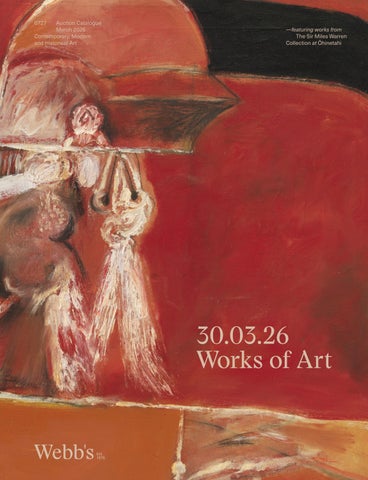
Our cover image, Pat Hanly’s Protective Helmet (1962), exemplifies this cultured outlook. Created while Hanly was working in Europe alongside British and American contemporaries including David Hockney, R. B. Kitaj and Peter Blake, the work’s ‘Bacon-esque’ qualities respond to Cold War tensions. Sir Miles' long-standing relationship with Hanly is evident throughout his collection and in the mural integrated into the Christchurch Town Hall.
This season’s offering highlights deep personal and artistic connections across disciplines. The chance to acquire works with such history and connection is rare. Through Sir Miles’ eyes, we see an inherent respect for the artistic community and the productive interplay
between art and architecture. Charles F. Goldie’s Te Aho o Te Rangi Wharepu (1939) reveals the trust between artist and sitter, Colin McCahon’s Floodgate I (1964–65), once owned by Rosalie Gascoigne, reflects artistic admiration and patronage that helped shape her own practice. While Ralph Hotere’s Requiem series honours his friend, composer Tony Watson, seeding an intrinsic relationship between art and music.
We are also excited to extend these connections across art, architecture, fine wine and cuisine. Art patrons Sally Ridge and John Darby have generously welcomed Webb’s to Amisfield, Queenstown for the first stop in our national tour, where guests can view auction highlights from our Works of Art auction within their award-winning restaurant and cellar door. Sally and John share Webb’s passion for art and objects, and among their treasured works is Bill Hammond’s Cornwall Road Cave (2011), presented by Webb’s last July. We offer another exceptional example from this series, Wishbone Ash Stash 2, Cornwall Road (2011) in this edition affirming Webb’s leading market presence and most established collector base for Hammond’s work in New Zealand. Webb’s continues to champion significant local initiatives, including Bill Hammond’s survey show Serenading Imagined Worlds (Dec 2025-Feb 2026) at Te Uru Gallery, and the fundraising auction for TOITŪ: Visual Sovereignty directed by Oscar-nominated producer, Chelsea Winstanley who is championing Māori artists on the world stage. We also celebrate the work of Webb’s Manager, Art, Dr Megan Shaw, as she embarks on a prestigious research fellowship at the University of Oxford’s Bodleian Library between April and June; and of course, a major upcoming highlight for the New Zealand art scene is Fiona Pardington’s representation at the Venice Biennale 2026.
We look forward to sharing more on these ambitious projects in the coming months and hope you enjoy perusing our upcoming catalogue, offering a taste of the remarkable talent around us.


In 2012 Sir Miles Warren generously gifted Ōhinetahi to the nation, ensuring its legacy would be enjoyed by future generations. The property is now overseen by the Ōhinetahi Charitable Trust, which is dedicated to caring for the historic homestead, its celebrated gardens and the visitor experience.
Set in Governors Bay, just a short drive from Ōtautahi Christchurch, Ōhinetahi spans 1.25 hectares of internationally acclaimed garden rooms, features more than 24 contemporary sculptures, and centres on a Grade I listed nineteenth-century house. Preserving and enhancing a property of this calibre is a continual undertaking.
To help fund this ongoing work, the Trust is offering a selection of artworks from the substantial Ōhinetahi collection. The proceeds will support essential maintenance, future improvements, and the continued sharing of this remarkable place with the public. Making space within the on-site gallery will also allow for refreshed, curated displays, including a focused presentation of Sir Miles Warren’s watercolours.


John Coop Managing Director Warren and Mahoney
There are many students of Sir Miles Warren’s architectural legacy, and a renaissance of sorts has occurred recently through the creation and widespread screening of the in-depth documentary Maurice and I, directed and produced by Rick Harvie and Jane Mahoney (Maurice Mahoney’s daughter). This timely project has deepened our collective understanding of Miles and Maurice, their wonderful partnership of mutual respect, and their work. It reminds us of their way of working, and describes the formation of their partnership in Christchurch in the late 1950s. Their background, the conditions and connections that enabled their success, and the place they and their buildings forged within the post-war creative output in Christchurch and Canterbury are again laid out and celebrated. The mid-tolate twentieth century saw flourishing across architecture, literature, painting, sculpture and music. Importantly, this local work was strongly founded in international modernism, as Christchurch and the country continued what had begun prior to the war and found its own expression.
Many creative leaders of this time were close friends or acquaintances of Sir Miles. He refers to many of these connections in his autobiography, and others in academia have written, or surely will write, about this network of shared encouragement, patronage and influence. A tour through the house and garden at Ōhinetahi, Miles’s splendid home in Governors Bay, reveals many of these relationships through its sculptures and paintings that he clearly held dear.
From the perspective of the Warren and Mahoney that my partners and I lead today, a diverse 300-person international design company now working across Australasia and further afield, it is the way in which Miles and Maurice integrated art and artists
into their buildings that remains so inspirational. Look closely, and art is nearly always present and in relationship with the architecture.
When we look to the landmark projects of Warren and Mahoney’s early work, we think of the Christchurch Town Hall, the Michael Fowler Centre, College House, and countless other civic and institutional projects. The Christchurch Town Hall, newly restored by our practice, has its vast Pat Hanly mural fully integrated into its design. The Michael Fowler Centre included magnificent textile banners by Gordon Crook. The white block walls of College House hold a large collection of Canterbury and New Zealand modernists, and who can forget the epic twin Bill Suttons hanging in Miles’s formal sitting room at Ōhinetahi.
Miles and Maurice were tremendously creative, brilliant architects. Many worked with them and were influenced by them. In their own way they were ambitious, deeply considered, and had superb creative and technical judgement. They believed in the power of buildings to transform places and enhance the lives of those they served. They used art, and collaboration with artists, to enrich their process and elevate the experience of their architecture. Theirs is arguably one of New Zealand’s most famous and far-reaching creative partnerships.
It is a privilege to share thoughts about Miles and his love of art in relation to architecture. We hope the many pieces within the collection, chosen with such care, find wonderful new homes and go on to enhance new rooms, spaces and places in ways Miles would have appreciated.
John Coop will give a short talk on Sir Miles Warren at our Auckland launch event on Wednesday 25 March, 6pm


Installation view of artworks at Ōhinetahi. Pat Hanly, Fire This Time (Lot 24) and Andrew Drummond, Penetrated sample (Lot 38).


1 Pauline and James Yearbury (Hine-Ngahuru) Autumn Girl With Child
acrylic on incised wood panel
signed JPY with incision lower right
600 × 300mm
est $5,000—$8,000
provenance
Private Collection, Northland

2 Pauline and James Yearbury Haumia-Tiketike
acrylic on incised wood panel
signed JPY with incision lower left
600 × 300mm
est $5,000—$8,000
provenance
Private Collection, Northland
3 Sara Langdon
Evergreen II 2022 oil on board
signed Sara Langdon, dated 2022 and title inscribed Evergreen II
900 × 900mm
est $9,000—$11,000


acrylic,
and gold leaf on board signed Max Gimblett, dated 2014 and title inscribed Traced upon her Brow in brushpoint verso 640 × 640mm (widest points) est $25,000—$35,000

Feb 1986
est $20,000—$30,000 provenance
Private Collection, Auckland

6 Gretchen Albrecht
Gabriel 2020
acrylic and oil on canvas
signed Albrecht, dated 2020 and title
inscribed GABRIEL in brushpoint verso
500 × 1000mm (widest points)
est $30,000—$45,000
provenance
Private Collection, Auckland

7 Reuben Paterson
Crystal Calm Clarity 2008
resin, acrylic and glitter on canvas
signed Reuben Paterson, dated 2008 and title
inscribed Crystal Calm Clarity in ink verso 1010 × 1010mm
est $15,000—$20,000
Private Collection, Auckland
8 Michael Parekōwhai
Portrait of Ed Brown 2004
type-c photograph
1250 × 1010mm
est $18,000—$24,000
provenance
Private Collection, Otago

c. 1990 oil on canvas
signed SWC in brushpoint lower right 305 × 615mm
est $12,000—$16,000
provenance
Private Collection, Christchurch; Purchased Webb’s 2024


11 Heather Straka Honeytrap - Sophie 2022 oil on canvas
signed Heather Straka, dated 2022 and title inscribed Sophie in ink verso
685 × 560mm
est $20,000—$28,000
provenance
Private Collection, Auckland
12 Heather Straka The Gatekeeper 2005 oil on board
signed Heather Straka, dated 2005 and inscribed The Gatekeeper in ink verso
790 × 520mm
est $40,000—$50,000
provenance
Private Collection, Auckland
Lisa Reihana
Cooks Transit of Venus
pigment print on cotton rag paper, mounted on aluminium dibond behind acrylic glass, edition of 9 plus 2 AP
760 × 1620mm
est $40,000—$50,000


14 Frances Hodgkins Canal Scene 1902
watercolour on paper signed FH and dated 02 in brushpoint lower left 180 × 120mm est $6,000—$8,000
provenance
Private Collection, Auckland; Previously in the Collection of Miss Janet Atkinson, c. 1939. Frances Hodgkins Catalogue FH0363.

15 Frances Hodgkins Girl with a Calf 1903
watercolour on paper signed FH and dated 1903 in brushpoint lower left 180 × 120mm est $6,000—$8,000
provenance
Private Collection, Auckland; Previously in the Collection of Mrs S M Brockett, Kaikoura, New Zealand. Frances Hodgkins Catalogue FH0395.

W D Hammond, dated 1990 and title inscribed in brushpoint lower right 255 × 450mm
est $25,000—$35,000
Private Collection, Greymouth

acrylic on linen signed W D Hammond, dated 1985 and inscribed The Strength to Carry On in brushpoint lower right 1925 × 1830mm est $70,000—$80,000

18 Colin McCahon
Floodgate I 1964–65 oil on hardboard signed Colin McCahon, dated 1964 1965 and inscribed FLOODGATE I in brushpoint on verso 909 × 763mm est $240,000—$280,000
provenance
Private Collection, Australia; Previously in the Collection of Rosalie Gascoigne, Canberra; Purchased from Peter McLeavey Gallery, Wellington; Anne McCahon.


1 Quoted in Nicola Francis, My Own Sort of Heaven: A Life of Rosalie Gascoigne, 2024, 297.
2 Ibid., 300.
3 Ibid.
Floodgate I (1964–65) is one of a pair of works with that title (Floodgate 2 is dated 1965), painted when Colin McCahon was in his mid-40s and had recently left his curatorial job at Auckland Art Gallery to teach at Elam School of Art. It was a transitional moment in his career that saw him moving away from the hard-edged, geometrical abstraction of the extensive Gate series (1961–62) towards landscape-related motifs, as in the large Waterfall series of 1964–66 and others. In a sense, the Floodgate works register this transition, as they allude to the Gate series, both in their titles and in their geometrical imagery, and to the Waterfall series in their depiction of moving bodies of water. The Gate-period preoccupation with issues of ‘barriers’ and ‘ways through’ (gates being both of these things simultaneously) is here applied to the real-world context of rivers and flood control.
Floodgates are mechanisms engineered for the control of water, especially in flood conditions. It is possible that the idea of extending gate imagery in this direction came to McCahon through designing a cover for Ruth France’s novel Ice Cold River (1961) – a design that utilises both gate and waterfall imagery.
The squarish Floodgate I is dominated by a large black rectangular form thrusting diagonally upwards from bottom left towards upper right, the shape being emphatically cropped by the frame. A second black form, narrow and tapering, extends from the top down the right edge of the painting. The small gap between them, through which (in a landscape reading) creamy-white water is turbulently gushing, is the focal point of the painting. Agitated water also enters the picture horizontally and lower down from the right. Turbulence is suggested by dark wavy
lines running through the billowing foam, debouching into a calmer, less agitated region in the bottom-right segment of the work.
The Floodgate paintings originally belonged to McCahon’s wife, Anne, but in 1972 they were among three previously unexhibited works sent by the artist to his Wellington dealer, Peter McLeavey, for sale on her behalf. Floodgate I stayed in his stockroom, until it was acquired by the New Zealand-born Australian sculptor Rosalie Gascoigne (1917–99), who retained it for the rest of her life – a part of the backstory of the painting that adds considerably to its interest.
Rosalie Gascoigne, an almost exact contemporary, had a deep admiration for McCahon’s work. She once told an interviewer: “I would cross the seas to go anywhere with Colin McCahon … I really think he’s the greatest Antipodean.”1
Coincidentally, Gascoigne’s first New Zealand exhibition, Sculpture 1975–82 (1983–84), was at Wellington’s National Gallery at the same time as a comprehensive exhibition of the Gallery’s McCahons: The Mystical Landscape. While visiting Wellington for the event, she purchased Floodgate I, saying, “It is a good strong McCahon and I am thrilled to have it.”2 She spoke to McCahon by phone before returning to Canberra, particularly praising the Northland panels, as seen in Wellington; McCahon apparently responded with typical modesty: “Not really a very good painting.” Later she wrote of McCahon’s Wellington exhibition: “The power of its honesty was almost overwhelming. Here is an artist who draws his art from within himself. He speaks of who he is, where he lives and what life has made and is making of him.”3
These qualities are strongly evident in the dynamic and forceful Floodgate I


19 Max Gimblett
Pomegranate - 2
2014
gesso, acrylic and vinyl polymers, epoxy, oil size, and sunrise variegated metal leaf on canvas
signed Max Gimblett, dated 2014 and title
inscribed Pomegranate 2 brushpoint verso
900 × 760 × 50mm
est $35,000—$50,000
provenance
Private Collection, Wellington
20 Louise Henderson
Cloud over harbour oil on board
signed Louise Henderson in brushpoint lower left inscribed Cloud over harbour verso
950 × 1250mm
est $70,000—$90,000
provenance
Private Collection, Dunedin

Andy Warhol
Campbell’s Soup Can II - Hot Dog Bean
1969
screenprint on paper, A/P 5 of 250 signed Andy Warhol in graphite verso 860 × 550mm
est $30,000—$50,000
provenance
Private Collection, Auckland. Acquired from Gow Langsford Gallery, 2019.


22 Milan Mrkusich
Painting No.3 1959
oil on canvas signed Mrkusich, dated 1959 and inscribed painting No.3 1959 verso
780 × 540mm
est $70,000—$90,000
provenance
Private Collection, Auckland; Previously on loan to Auckland Art Gallery Toi o Tāmaki.


23 Julian Dashper
Untitled 1998
vinyl on drumskin 580mm diameter
est $18,000—$24,000
provenance Ōhinetahi Art Collection

24 Pat Hanly Fire This Time 1984
enamel on board signed Hanly, dated 1984 and inscribed fire this time in brushpoint
825 × 920mm
est $65,000—$80,000
provenance
Ōhinetahi Art Collection


25 Pat Hanly Summer Land 1974 enamel on board signed P Hanly, dated 74 and inscribed summer land in brushpoint verso 440 × 440mm est $38,000—$58,000
Ōhinetahi Art Collection

26 Pat Hanly Protective Helmet 1962 oil on canvas signed Hanly, inscribed Amsterdam, and dated 62 in brushpoint lower right 730 × 945mm est $80,000—$100,000
provenance
Ōhinetahi Art Collection
literature Gregory O'Brien, Pat Hanly, 2012, 49
Protective Helmet is a powerful painting by one of Aotearoa New Zealand’s most celebrated artists. Vibrant and visceral, its scale and strong imagery immediately draw attention. Part of a series created in Europe between 1961 and 1962, this is a rare example of Pat Hanly’s mature but early work, before his practice took a distinctive turn. The strong environmental and social messages that characterise Hanly’s practice are present in this work, yet the execution is distinct and international in focus.
Protective Helmet was painted at a time when Hanly’s reputation was rising in London. He was showing alongside British and American contemporaries including David Hockney, R. B. Kitaj and Peter Blake, and was singled out by critics for his practice. The recipient of a Dutch Government scholarship, Hanly travelled from London to Amsterdam and while there created the Massacre of the Innocents series, of which this work is a part. In one seven-week period he produced 35 paintings and numerous works on paper. As was his habit, he later renounced the series, destroying nearly all of the works. Those that survive are now held in important public and private collections.
Taking the biblical story as its theme, the Massacre of the Innocents series is a commentary on the world at that time. In a complex body of work, the tense political environment of the late 1950s was the catalyst for Hanly’s exploration of pain, vulnerability and anxiety. Reflecting on this time, photographer Gil Hanly comments, “It was quite different arriving in England, it was in the middle of the Cold War and everyone was living with this four-minute warning hanging over their
heads.”1 Deeply concerned about nuclear threat and a pessimistic future, Pat and Gil Hanly joined the Campaign for Nuclear Disarmament protest movement.
The emotion, suffering and psychological complexity play out clearly across the canvas in this painting. Here, Hanly’s anxiety for the future is rendered palpable through form and colour. Ghostly, half-formed apparitions dominate the middle of the canvas. A strong chalky-white diagonal feels like a scream emitted from something suggestive of a military helmet, a faceless form adorned by a symbol of authority. The ‘Murder of the Innocents’ is a popular theme in traditional European art, often highlighting the emotional agony of mothers. While historical painters may focus on the massacre of a single innocent, Hanly extrapolates the metaphor. Instead, the whole of humanity is in imminent danger, the frightening reality of existence echoed in his use of blood red against black, white and shades of rusty orange. This intensity of emotion is reflected in the urgent brush strokes, where the application of paint is visceral.
After completing this series, and overwhelmed by the global politics and tense realities of nuclear threat in Europe, Hanly returned to Aotearoa in 1962. While the work that came after continued to reflect his concerns about humanity’s impact on the world, it is in Protective Helmet, with its influence of international modernism and the impact of the world’s great art centres, that Hanly’s ability to project the full intensity of the human condition is most strongly expressed.
1 “Pat Hanly: Painter of Light,” Art News 158, Spring 2012, https://artnews.co.nz/pat-hanly-2012/
At first glance, Brent Wong’s Coal (1974) appears to be a modest, even serene landscape, spare in composition, subdued in palette and rooted in the familiar contours of Aotearoa’s natural terrain. Yet it is the cloud, vast, white and billowing above the land, that unsettles the scene and shifts its emotional register. The luminous form dominates the work, transforming what might otherwise be a quiet observation into a potent visual metaphor. Whether read as steam, smoke, or something more ambiguous, the cloud interrupts the stillness and calls attention to the forces shaping the environment, both natural and man-made.
Created in the mid-1970s, a period marked by heightened political and environmental consciousness, Coal carries a quiet but unmistakable sense of critique. Greenpeace Aotearoa was founded in the same year, emerging within a broader environmental movement concerned with natural-resource protection, and increasing public resistance to the National Party’s ‘Think Big’ projects. This backdrop of shifting attitudes toward resource extraction and environmental stewardship lends Wong’s painting an added resonance, even though the work itself avoids overt symbolism or narrative. Instead, the looming cloud suggests consequences that extend beyond the edge of the frame. The land feels paused, suspended in a moment
when something has just happened or is about to occur.
First gaining significant attention with his 1969 debut exhibition, Wong quickly emerged as a distinctive presence in Aotearoa painting, shaping a world of imagined, uninhabited terrains where floating architectural forms and charged skies unsettle the everyday. While frequently aligned with surrealism or realism, his practice ultimately resists such categorisation. Instead, Wong’s imagery functions as a contemplative study of solitude and perception, a space where mood, structure and psychological undercurrents coalesce into quietly resonant, metaphysical landscapes. Positioned slightly outside the mainstream of Aotearoa art history, Wong developed a visual language rooted in isolation, withheld narrative, and the tension of the said and unsaid, what is shown and what is suggested. Coal reveals this sensibility with particular clarity: a considered and compelling voice, one that uses subtlety, contrast and mood to engage with the complex relationship between land, industry and the atmosphere that hangs above both. Its minimalism is not emptiness, but deliberation. Ultimately, Coal is an invitation to look again, not just at the painting, but at the histories, pressures and tensions embedded within the landscapes we often take for granted.
27 Brent Wong Coal 1974
acrylic on board signed B Wong, dated 1974 and inscribed Coal verso 560 × 685mm
est $50,000—$70,000
provenance Ōhinetahi Art Collection


Installation view at Ōhinetahi.


380 × 325 × 295mm
est $3,000—$5,000

30 Don Peebles
Untitled No. Two 1993
acrylic on canvas with rope signed Don Peebles, dated 1993 and inscribed Number Two in brushpoint verso
2690 × 1835mm
est $5,000—$8,000
provenance
Ōhinetahi Art Collection
exhibitions Exhibited: Don Peebles: The Harmony of Opposites, 1996

32 Edith Isaac Rose
Rocca San Angelo 1998 oil on canvas
signed Isaac Rose in brushpoint lower right
305 × 305mm
est $1,000—$1,500
provenance
Ōhinetahi Art Collection

33 Darryn George Waru 2007 oil on canvas signed Darryn George, dated 2007 and inscribed Waru in brushpoint verso 1530 × 2130mm est $12,000—$15,000
provenance Ōhinetahi Art Collection


34 Peter Robinson Divine Comedy 2001
Lambda print printed by Image Lab, Wellington for P Robinson, 2001
2200 × 1200mm est $15,000—$20,000
Ōhinetahi Art Collection


est $8,000—$12,000


37 Don Peebles
Relief Construction 1974–75
oil and acrylic on wood signed Don Peebles, dated 1974/5 and inscribed Relief in brushpoint verso 1330 × 1330mm
est $38,000—$44,000
provenance
Ōhinetahi Art Collection
exhibitions Exhibited: Don Peebles: The Harmony of Opposites, 1996

38 Andrew Drummond
Penetrated sample 2007
stainless steel, patina
190 × 510 × 265mm
est $2,000—$3,000
provenance
Ōhinetahi Art Collection


Working Drawings, Kazu Nakagawa Archives. Courtesy of the artist.
Kazu Nakagawa with his award winning piece from the 1989 Craft Council/Winstone Biennale. Photo: Haru Sameshima. Reproduced in Christine Thacker, ‘Kazu Nakagawa’, Craft New Zealand, Winter 1991, Issue 36, 24.


39 Kazu Nakagawa
Pair of chairs 1989
ash and walnut
1550 × 645 × 395mm
est $3,000—$5,000
provenance
Ōhinetahi Art Collection. Acquired from CSA Gallery, Ōtautahi Christchurch, July 1991.
exhibitions
New Allegories: Noel Lane, Kazu Nakagawa, Fox Street Gallery, Tāmaki Makaurau Auckland, 9–29 September 1990. The Chair Show, CSA Gallery, Ōtautahi Christchurch, 2–14 July 1991. The Chair: A Story of Design and Making in Aotearoa, Objectspace, Tāmaki Makaurau Auckland, 2 December 2023–3 March 2024. The Chair: A Story of Design and Making in Aotearoa, Objectspace at Sir Miles Warren Gallery, Ōtautahi Christchurch, 6 April–19 May 2024.
literature
Kim Paton and Victoria McAdam, eds., The Chair: A Story of Design and Making in Aotearoa (Objectspace, 2024), 138–139
40 Kazu Nakagawa
Hall table 1991
ash and walnut
835 × 1050 × 345mm
est $3,000—$5,000
provenance
Ōhinetahi Art Collection. Acquired from CSA Gallery, Ōtautahi Christchurch, 1991.
exhibitions
2nd New Zealand Crafts Biennale, Auckland Museum, 9–24 September 1989 (Merit Award). New Allegories: Noel Lane, Kazu Nakagawa, Fox Street Gallery, Tāmaki Makaurau Auckland, 9–29 September 1990. Tables & Lamps, CSA Gallery, Ōtautahi Christchurch, 25 August–27 September 1992.
41 Kazu Nakagawa
"I" / keep thinking the difference 1995–97
wood, canvas, clay, natural resin, acrylic signed Kazu and dated 97 verso 640 × 895mm
est $2,000—$3,000
provenance
Ōhinetahi Art Collection. Purchased from Campbell Grant Gallery, Christchurch 1998. Acquired from Campbell Grant Galleries, Ōtautahi Christchurch, May 1998.
exhibitions
Kazu Nakagawa, “I”/Still have our dream, Gow Langsford Gallery, Tāmaki Makaurau Auckland, 4–22 February 1997. Kazu Nakagawa, “I”/Still have our dream, Campbell Grant Galleries, Ōtautahi Christchurch, 14 April–l2 May 1998.
“Everything comes through your hands into the work you are making even without you noticing.”
—Kazu Nakagawa, 1998
A sense of contemplation radiates from Kazu Nakagawa’s elegant, meditative and thought-provoking work. In a career spanning more than three decades, producing intimately scaled sculptures, chairs, frames, ladders, tables, cabinets, wall reliefs and installations, Nakagawa’s voice is unique in contemporary art practice in Aotearoa New Zealand. Conceptually focused, his output explores time, distance, memory and the human condition. Subconsciously distilling feelings and experiences is at the heart of his thinking, while striving, in his own words, for truth. His work is often seen in relation to the Japanese concept of ma, the space between and around structures, identified as a ‘negative space’ filled with potential, stillness and balance.
Nakagawa’s Hall Table was first exhibited in 1990 in the 2nd New Zealand Crafts Biennale in Tāmaki Makaurau Auckland, receiving a Merit Award from the Australian-based judge, Grace Cochrane. Executed in ash and walnut, the table is crafted using traditional cabinetmaker’s tools from Nakagawa’s native Japan; he claims, “a normal wood worker would be surprised at the small amount of tools I use.”1
Full of complex rhythms, it is a series of identical legs, which gently curve outwards from the floor, counterbalanced by convex forms under the table top, and three vertical struts to strengthen the structure. The repeated spaces between the legs resonate, as the table appears to breathe. Sitting lightly on the floor, it gives the impression of weightlessness.
The inclusion of Ash Chairs in Objectspace’s 2024 survey The Chair: A Story of Design and Making in Aotearoa acknowledges the importance of Nakagawa’s contribution to Aotearoa’s studio furniture movement of the late twentieth century. Characterised by consummate craftsmanship, the chairs are unique objects. The tall, slender backs suggest stateliness. Although the chairs are essentially mirror images of each other, the two horizontal struts in the back of one chair and three in the other acknowledge a difference; it is tempting to interpret the pair-
ing as a male and female partnership. What is not evident in the photograph is the realisation of a subtle curve created when the box seats almost touch. Precise dovetail joins are also a noteworthy feature. Urushi resin (sourced from Japan) was applied to the surface of the chairs to highlight the rhythms of the wood grain and create a unique patina. While deeply architectural, Ash Chairs progress beyond functional furniture to pure sculpture. Writing about Nakagawa’s furniture-based works in 1996, Justin Paton described them as “immaculately crafted and almost prayer-like in their silence.”2
“I”/keep thinking the difference (1995–97) was included in two solo exhibitions titled “I”/ Still have our dream in Tāmaki Makaurau and Ōtautahi Christchurch. The series explores the concept of “I” (oneself), while also suggesting Aotearoa is where Nakagawa’s dreams could be realised. This wall-based cabinet with several components offers multiple readings. The grid pattern in the top section is in fact impressions of the artist’s thumbprint and the textured surface of three-dimensional spindle-form, top right, was created by repeatedly pushing a piece of wood into a saw blade hundreds of times. Nakagawa was born in Tokyo in 1957. While travelling on his honeymoon with his then wife Mika, he stepped onto the shores of Aotearoa in 1986 unable to speak a word of English and, falling in love with the country, he has resided on Waiheke Island ever since. During 1987–88 he was an apprentice furniture maker and designer at Carin Wilson’s Tāmaki Makaurau studio, before setting up his own studio on Waiheke Island. In 2000 he was artist in residence at Christchurch Polytechnic Institute of Technology (now Ara). He has exhibited regularly in Tāmaki Makaurau and Ōtautahi, including in the landmark exhibitions Artiture, Tāmaki Makaurau (1990), and Always Song in the Water, New Zealand Maritime Museum, Tāmaki Makaurau (2023). Nakagawa’s Waiheke Library commission won the award for Commercial Architectural Excellence in 2015. Examples of his work are included in The Dowse Art Museum, Te Awa Kairangi ki Tai Lower Hutt; Christchurch Art Gallery Te Puna o Waiwhetū; New Zealand Maritime Museum and the New Zealand Embassy in Tokyo.
Photo and sketch: Kazu Nakagawa. Reproduced in Christine Thacker, ‘Kazu Nakagawa’, Craft New Zealand, Winter 1991, Issue 36, 25.
1 Adrienne Rewi, “Enigmas, Intangibles: Exploring Beyond Edge,” Sunday Star-Times, 19 April 1998, F9.
2 Justin Paton, “Chairished Works,” New Zealand Herald, 6 December 1996, B5.


42 Gordon Crook Screen Goddess Series 2004
acrylic on wood, four panels both sides
1200 × 400 × 50mm (each panel) est $3,000—$5,000
provenance
Ōhinetahi Art Collection. Purchased from Campbell Grant Gallery, Christchurch 2005.


43 Matthew Browne Sequester III 2000
oil on canvas
signed Matthew Browne, dated 2000 and inscribed Sequester III in brushpoint verso
1000 × 1400mm
est $2,500—$3,000
provenance
Ōhinetahi Art Collection

44 Milan Mrkusich
Achromatic Yellow with Red, Green and Blue 1994
Alkyd on aluminium signed Mrkusich, dated 94 and inscribed
Achromatic yellow with red, green and blue verso
480 × 930mm
est $10,000—$15,000
provenance Ōhinetahi Art Collection
45 Richard McWhannell
Renee on the slipper chair
2003–04 oil on canvas on board
signed R McWhannell, dated 2003-4 and inscribed Renee on the slipper chair verso 865 × 1310mm
est $5,000—$7,000
provenance
Ōhinetahi Art Collection. Purchased from Campbell Grant Gallery, Christchurch 2005.


46 Julia Morison Torque 2001
acrylic, oil, and varnish on wood signed Julia Morison, dated 2001 and inscribed Torque C in brushpoint verso 2730 × 910mm est $12,000—$18,000
provenance Ōhinetahi Art Collection

47 Stephen Bambury untitled (from the Necessary Correction series) 1995
graphite and gilded silver on rag paper
500 × 320mm
est $3,000—$5,000
provenance
Ōhinetahi Art Collection
Ralph Hotere is the first artist of Māori descent to have been written, by Pākehā, as early as 1968, into a history of New Zealand art. 1 Despite his ambivalence about being labelled as any kind of cultural or Indigenous artist, it is impossible to deny that he was a founding figure of the contemporary Māori art movement and that his work has continued to be hugely influential on subsequent generations of both Māori and Pākehā artists.
Hone Papita Raukura (Ralph) Hotere was brought up in a devout Roman Catholic family. His father, Tangirau, was a katikita (Catechist); his mother, Ana Maria, was named for St Ann, and his sister for St Mary, the mother of Jesus. The Hahi Katorika tradition into which he was born near Mitimiti and baptised in 1931 had originated with French missionaries of the Society of Mary, under the leadership of Bishop Pompallier. Hotere completed his secondary school education at St Peter’s Māori College (Hato Petera) in Auckland. Steeped in Catholic liturgy, theology, sacramentalism, mysticism, iconography and Latin texts, the young Hotere was provided with a magnificent
resource from which, as an artist, he would draw inspiration for the rest of his life. 2
In light of his upbringing, it is no surprise that when Hotere’s close friend, New Zealand modernist composer Anthony (Tony) Watson, took his own life in 1973, Hotere chose the Catholic liturgical tradition of the Requiem Mass as a metaphor to express his grief through painting. Traditionally performed to remember and honour the dead and farewell their souls from this world, the Requiem Mass has also been used as form of memorial and consolation for the grieving by countless composers; most famously by Mozart in the eighteenth century, by Verdi in the nineteenth and by Benjamin Britten in the 1960s. The Requiem title of Hotere’s eulogy series of paintings dedicated to his friend, therefore, is intended to resonate spiritually, pictorially and musically.
2
3
Hotere met Tony Watson in Dunedin during Watson’s residency as the first Mozart Fellow at Otago University in 1970, the year following Hotere’s own residency at the university as the Frances Hodgkins Fellow. With Watson being an innovative modernist composer and talented violinist, while

48 Ralph Hotere Requiem 1974 oil on canvas
signed Hotere, dated 1974 and title
inscribed REQUIEM, Port Chalmers
1220 × 1220mm
est $90,000—$120,000
Ōhinetahi Art Collection
Hotere was a rising light in contemporary art, forging his own language of modernist painting, it seems inevitable that the pair would become close friends.
In the aftermath of Watson’s sudden death, Hotere channelled his grief into his work, producing a quietly contemplative yet deeply moving series of paintings that eloquently convey the intense feeling of loss everyone experiences following the death of a loved one.
The Requiem paintings appear to be a logical formal progression from Hotere’s Malady series, painted a few years earlier, inspired by and incorporating the three words of text that make up Bill Manhire’s modernist poem, ‘Malady’. The chromatic language and compositional structure of the Requiem and Malady works have much in common; all have a dark, dense ground, usually of matt black that owes much to Ad Reinhardt’s enigmatic abstractions of the 1960s. Some are overpainted with bands of fine striations of rich colour, while others incorporate bold geometric elements, or both, while a few, such as the Requiem painting from Sir Miles Warren’s collection, are entirely black.
But where the Malady works feature the plainly stencilled text of Manhire’s poem within and across their structural geometries, the Requiem paintings incorporate Latin text in highly stylised gothic script. Like the Maladies , the text in the Requiem works is limited to just a few words rhythmically repeated in bands. Variations in density of the stencilled text create the illusion of some words or phrases advancing while others recede. Such apparent spatial vacillation animates the painted surface and accentuates the sensation of a rhythmic chant or audible incantation.
The first works of the Requiem series were exhibited in Auckland at Barry Lett Galleries in early December 1973. In his accompanying notes for the exhibition, Hotere states, “The Latin text is from Verdi’s Requiem , the Māori, a translation from the Psalms. This work is a tribute to Anthony Watson, musician and composer 1933–1973.” 3
The repeated Latin text in Lot 49, Kyrie Eleison , translates as “Lord, have mercy”, perhaps seeking peace for the tortured soul of the recently departed. Other early works from the series that incorporate repetitions of Miserere Nobis , translating as “Take pity on us”, could just as easily be interpreted as an imploring prayer to the Heavenly Father on behalf of mourners as well as the dead. In all cases, Hotere utilises the appropriated text to create structure and form as well as meaning.
As Ian Wedde points out in his observations on Hotere’s Requiem works: The combined vitality and orchestrated serenity of these effects are, again, so close to music or speech that a viewer’s ‘entry’ to the work is almost in terms of listening and responding, of speaking or singing ‘along with’ the painting’s score. It’s a moving sense, like being within the engaged space of music that invites us to join, in the darkness of a disorderly grief that becomes the ground of, is incorporated into, an exquisite eulogy … In sum, an extraordinary contribution to the suite of tributes to a dearly loved composer and friend, Tony Watson. 4
1 Jonathan Mane-Wheoki, “The Black Light Paradox: The Sumptuous Austerity of Ralph Hotere’s Art, Art New Zealand 98, Autumn 2001, referencing Mark Young, New Zealand Art: Painting 1950–1967,1968.
2 Mane-Wheoki, “The Black Light Paradox.”
3 Ralph Hotere, Ian Wedde, Gwynneth Porter and John Walsh, Ralph Hotere Black Light: Major Works Including Collaborations with Bill Culbert, 2000, 116.
4 Ian Wedde, “Requiem (B) (For Tony),” in Webb’s, Works of Art July 2025, 100.

KYRIE ELEISON Requiem 1974
oil on canvas
signed Hotere, dated 1974 and title inscribed
KYRIE ELEISON Requiem series Port Chalmers
1050 × 1210mm
est $80,000—$120,000 provenance
Private Collection, Nelson
One of only a half-dozen works surviving from Fomison’s time in London, [sic] paintings developed out of sketches which persuaded him to reject the gestural ‘angry’ style he had developed at art school in Christchurch between 1958 and 1961. Caravaggio was an important influence on Fomison: he is one obvious contributor to Fomison’s tenebrism, and to his liking of strong directional lighting, the dramatic modelling of the profile, and near two-dimensional-backgrounds in which a sculptural perspective is suggested by meticulously graded dark tones. As well, we might guess that Fomison relished the whiff of corruption in some of Caravaggio’s paintings, a predilection that links through to his interest in Pre-Raphaelitism and fin-de-siècle decadence.1
Tony Fomison distinguished himself as a painter when he first exhibited with The Group in Christchurch and gained the attention of Bill Sutton, Doris Lusk and Toss Woollaston. This may seem a bit surprising, as, although he was studying at the University of Canterbury’s Ilam School of Fine Arts at the time, where Sutton was a senior tutor in painting, Fomison chose to study the modelling of three-dimensional form in Ilam’s sculpture department and would not have been among Sutton’s students.
From 1962 on, Fomison exhibited regularly in group shows at various galleries around Christchurch, developing a strong regional support base that spread to Auckland in 1963, when his work featured in the exhibition Contemporary New Zealand Painting at Auckland Art Gallery.
In 1964 an Arts Advisory Board travel grant enabled him to travel to England and Europe for the first time, where his work was included in the exhibition New Zealand Artists at Qantas Gallery, London. He travelled and stayed in various cities in Europe until 1967, but his OE did not end well. After falling in with street gangs in Paris, Fomison was imprisoned and deported to England, where his drug habit landed him in Banstead Hospital for three months.
It was around this time that Fomison began painting works based on masterpieces by Car-
avaggio, Morales and other European masters. Caravaggio’s original painting St John with Ram (c. 1610), on which this work by Fomison is based, hangs in the Borghese Gallery in Rome. It is unclear if the drawings Fomison did of this Caravaggio were made while directly in front of the original while visiting Rome, or from a reproduction of the painting he had come across. Whichever the case, he chose to make significant changes to the original composition when he painted John the Baptist, from Caravaggio’s St John with Ram, most notably, his dramatic cropping of his picture to two thirds of the top half of the original. This cropping effectively eliminates the golden ram referenced in the title, which, along with the scarlet drapery St John reclines on, provides the work by Caravaggio with much of its chromatic warmth. Fomison’s image is far cooler, not just chromatically, but also in mood; the subject appears detached and introspective rather than smouldering with Caravaggio-esque sensuality.
This work is one of the earliest examples that demonstrate Fomison’s admiration and adaptation of Caravaggio’s dramatic use of chiaroscuro: the employment of a strong, singular light source that rakes across the subject, throwing certain features into high relief while swamping others in dark shadow. Fomison continued to explore and exploit his own interpretations of chiaroscuro for the rest of his career, but his palette was always cooler and more monochrome than that of the Italian Baroque artists who were also inspired by Caravaggio centuries earlier. In his notes on this work, Ian Wedde suggests Fomison may have felt some empathy with Caravaggio the man as well as the painter. They certainly had several personal traits in common: both had attracted admiration for their painting at a young age; both considered themselves outsiders and, to some extent, social outcasts attracted to the seedy, criminal underbelly of urbanity; both had homosexual tendencies; and both were addicted to mind-altering intoxicants. Fortunately, in Fomison’s case, his drugs of choice led him to quietly withdraw into an internal realm of altered state rather than become fiercely violent and murderous.
1 Ian Wedde, notes on the work John the Baptist, from Caravaggio’s St John with Ram, 1966, in Tony Fomison: What Shall We Tell Them? (City Gallery Wellington, 1994), 148.

50 Tony Fomison
John the Baptist, from Caravaggio's St John with Ram 1966 oil on jute signed Fomison and dated 20–28.9.66
30.9.66 in brushpoint lower left; inscribed John the Baptist from Caravaggio's St John with Ram in brushpoint lower right 435 × 585mm
est $300,000—$500,000
provenance
Acquired directly from the artist c. 1960s. Private Collection, Christchurch.
exhibitions Fomison; What Shall We Tell Them? City Gallery, Wellington, 13 February—22 May 1994


“The background is a stage on which images flicker in the lightness or are buried in the darkness to emerge and surprise their oppositeness to what can be seen easily.” 1
– Séraphine Pick, 1995
Séraphine Pick is interested in the intangible. These two paintings from the mid1990s embody the psychological intensity and pared-back visual language characteristic of this period in her practice. Made just two years apart, Untitled (1995) and Insomnia (1997) reveal an artist preoccupied with the unstable thresholds between interior and exterior experience, memory, language, and the body.
In Insomnia , Pick uses a subdued, nocturnal palette. She uses the sharp end of her paintbrush to scratch spidery images into the painting’s surface, then wipes on white paint to create a misty overlay. 2 The faint
figures drift in and out of focus, hovering in a liminal state distorted by tiredness. The painting offers a sense of unrest in the space between sleep and wakefulness.
Untitled (1995) introduces a more structured compositional system. The dark ground is interrupted by pale, rectangular panels that resemble fragments of signage, labels, or textual markers. We are carried from Auckland to Amsterdam, New York to Madrid. Thin, vertical lines connect these elements, forming a fragile network that hints at systems of order and an itinerary. Lightly sketched female figures linger and recline at the edges of these places, reinforcing a sense of peripheral human presence shaped by larger, unseen structures.
Motifs such as suitcases, bags, and wandering figures recur throughout Pick’s 1990s practice, signalling themes of transience, memory, and psychological drift. Yet, the explicit naming of cities in Untitled stands
4
3
2
1
out as unusual within her oeuvre. These concrete geographic references introduce a specificity rarely found in her typically dreamlike, indeterminate environments, anchoring the work momentarily in the real world before it slips again into ambiguity.
In 1994, she was awarded the Olivia Spencer Bower Foundation Art Award and a Queen Elizabeth II Arts Council Travel Grant, which allowed her to travel to Europe, the United States and the United Kingdom. This work captures her international trip, but is not explicitly a travel diary. “The images aren’t diaristic,” she has reflected, “they’re not an excavation of me: that’s too small, too limiting… I want the work to be universal, open to interpretation. It can’t be specific, or it ends the story or the thought.”3 With her travel to Europe and America came exposure to the traditions of international art history, most notably Hieronymus Bosch, Piero della Francesca, the Symbolists, PreRaphaelites and the contemporary Belgian painter Luc Tuymans. 4
Neither painting offers narrative closure. Instead, they reward sustained observation, inviting viewers to engage with subtle shifts of tone, surface, and mark-making. Their scale enhances this pull, creating spaces that feel at once intimate and estranging. Seen together, Untitled and Insomnia operate as parallel meditations: rigorous explorations of consciousness, fragmentation, and the tenuous persistence of the human figure within uncertain worlds and states. In 2025 Pick was awarded an Arts Foundation Te Tumu Toi Laureate Award in recognition for her committed artistic practice.

literature
52 Séraphine Pick untitled 1995 oil on canvas signed Pick and dated 95 in brushpoint lower left 1210 × 1520mm est $40,000—$60,000
provenance
Private Collection, Auckland


signed C. F. Goldie and dated 1939 in brushpoint lower left 290 × 310mm
est $450,000—$550,000 provenance
Private collection, Waimana. Acquired by gift, 1991; Private collection, Auckland. Acquired from Fine Paintings & Jewellery, Webb's, July 1985, lot 116.
1 Blackley, Roger: Goldie Auckland, 1997, page 1.
2 Anonymous source quoted from an article in the 1947 Yearbook of New Zealand
3 Blackley, Roger: Introduction on Christchurch Art Gallery website to Goldie: The Exhibition, 1997- 99, curated by Roger Blackley and toured by Auckland Art Gallery.
4 Blackley, Roger: Introduction on Christchurch Art Gallery website, ibid.
5 A Study, 1905, Te Aho o te Rangi Wharepu, Ngati Matuta, Auckland Art Gallery, reproduced in Blackley, Roger: Goldie. Auckland, 1997, page 104.
6 Te Aho, a Noted Waikato Warrior, 1902, Blackley, Roger: Goldie. Auckland, 1997, Te Aho o te Rangi Wharepu, Ngati Matuta, Auckland Art Gallery, reproduced in Blackley, Roger: Goldie. Auckland, 1997, page 105.
7 Clarke, Jacquie: C.F. Goldie: The Old Master Revisited, New Zealand Geographic, issue 038, April 1998.
Charles Frederick Goldie is likely New Zealand’s best-known artist. Descendants of Goldie’s models revere the depictions of their tūpuna, while others have denounced the paintings as documents of colonial racism. Yet the story of the artist and his career is embedded in a thick accretion of myth, where dubious anecdotes rub shoulders with strongly opposing opinions.1 His intensely observed and meticulously rendered form of realism was seen as outdated and backward-looking by contemporary art critics. Some pointing out that such obsessive attention to factual detail had been made redundant by the technical advances of hand-coloured photography. One critic considered his work “more suitable for a museum of ethnology and anthropology than the walls of an art gallery.”2
Goldie dismissed such comments as ignorant and irrelevant, firm in his belief that his highly detailed paintings of esteemed Māori elders with traditional tā moko (facial tattoos) would become important historic records in times to come. He felt compelled to record what he saw as the last noble vestiges of pre-European Māori culture before they disappeared, and in so doing he created artworks that are now widely acknowledged to be of significant historical and cultural importance to Aotearoa New Zealand.
Although dismissed as pedantically old-fashioned by art critics of the day, Goldie’s Māori portraits continued to be enormously popular with the general public. In 1908, readers of the Weekly Graphic magazine placed Goldie at the top of their list of New Zealand’s best artists.3 Goldie’s portraits have always been held in high esteem by Māori, and because of their importance as ancestral images, are regarded
as taonga, or treasures. Te Heuheu Tūkino, the paramount chief of Ngāti Tūwharetoa and the artist’s friend, described Goldie’s works as “he tohu mo nga Māori i roto i te whakatupuranga”, icons for Māori of future generations.4
Goldie’s portrait of Te Aho o te Rangi Wharepu, dated 1939, is a beautiful example of the artist’s classic, late style. At this stage in his career, Goldie often revisited earlier subjects on a more intimate scale and frequently through a romanticising lens. The subject of this late portrait was a highly regarded and well-respected rangatira from the Waikato region who had sat for Goldie a number of times previously. There are two quite different portraits of this same sitter in the collection of the Auckland Art Gallery Toi o Tāmaki. Both are frontal views; the first is a classic frontal presentation of the chest and head of the sitter positioned fully upright in the centre of the composition,5 while the second work is also a bust portrait, the sitter is posed reclining with his head back, resting on a pillow. The portraits in Auckland Art Gallery are nearly twice the size of the later rendition, featured here, and more conventionally formal, predating the later work by two decades.6
While Goldie was studying at L’Academie Julian in Paris during the late 1890s he took the opportunity to travel extensively through Europe, visiting many of the famous galleries and copying at first hand many of the works of the Old Masters. The young Goldie was especially influenced by Rembrandt, a formative influence that stayed with him, as evidenced by the distribution of deep shadows and soft light on rich complexions that became a hallmark of Goldie’s Māori portraits,7 clearly evident in this fine work we have the pleasure to bring to auction.
“Is the fundamental point of existence situated in the manifest world? Objects are on the essential level, a viscerality of self. Is it possible to know anything at all outside our subjective relationships, outside the contingency of life?”1 — Fiona Pardington, 2010
Native Aotearoa New Zealand birds have long been a defining subject in our art history. Artists such as Don Binney, Raymond Harris-Ching and many others have drawn inspiration from the distinctive fauna of Aotearoa. Our cultural fixation extends far beyond aesthetics; it is entwined with national identity. New Zealanders, or ‘Kiwis’, take pride in belonging to such a naturally biodiverse island nation.
This sense of sacredness and scarcity has deep roots. Long before the arrival of Captain James Cook or Sir Walter Buller, birds held an essential place in mātauranga Māori. They appear throughout Māori cosmology and mythology as guardians, messengers and bearers of prophecy. Their feathers and bones were used in adornments that enhanced the mana of the wearer.
With the arrival of the European, however, introduced predators such as cats, stoats and rats triggered dramatic declines in native bird populations. The ornithologist Sir Walter Buller recognised the impending loss; he responded not by protecting species, but by shooting, collecting and stuffing them, transforming living birds into museum specimens.
Before Fiona Pardington’s arresting gothic photographs, birds in Aotearoa art were typically approached as objects of admiration, as specimens or relics. Working within regional museum archives, Pardington reframed this tradition. Her practice is essential to navigating our shared histories in this post-colonial world,
confronting the ways Western practices such as taxidermy intervene in the natural cycle of death and decay. The birds of Pardington’s photographs dwell in limbo; neither at rest with the dead nor autonomously in the land of the living. What results is a palpable stripping of mana, a loss of agency.
The species she selects mark varying points of historical, cultural and ecological crisis: the huia, hunted to extinction by both Māori and Pākehā; the kiwi, whose numbers have begun to recover due to reintroduction and breeding efforts; and tauhou, the waxeye, neither flightless nor prized for its brilliant plumage, who has been a constant witness to environmental change.
Across the three works offered in this catalogue, Pardington neither romanticises the past nor treats the museum as a neutral stage. Instead, she foregrounds the entanglement of mātauranga Māori, scientific collecting and nationalist image making – and insists on seeing each bird as an ancestor.
In the act of photographing them, Pardington shifts these birds from specimens to muses. In doing so, the birds are free to roam in an afterlife, with restored dignity and presence. Her practice is essential to Aotearoa’s art history for the way it interrogates and rebalances past injustice.
Our art history has often directed our gaze upward, perhaps over headlands in Binney’s skies; or downward in Harris-Ching’s precise studies. Pardington brings our eyes to a level plane. In the rich darkness of her prints, we encounter not symbols but guardians, witnesses, and potential partners in a renewed future. If these images feel sacred, it is because they demand reciprocity: to honour the mana of manu is to reconsider how we choose to live alongside them.
1 In conversation with Rhana Devonport, ‘Foreword’ in The Pressure of Sunlight Falling, ed. Kriselle Baker and Elizabeth Rankin, 2011, 6.

54 Fiona Pardington
Pipitonu, Two Hearts Beat as One 2022 pigment inks on Hahnemühle Photo Rag paper, edition of 10 signed Fiona Pardington in ink verso 1750 × 1380mm est $35,000—$50,000
provenance Private Collection, Auckland

55 Fiona Pardington
Te Rapurapu, Kiwi, South Canterbury Museum 2024 pigment inks on Hahnemühle
Photo Rag paper 3/10 signed Fiona Pardington in ink verso 1080 × 810mm est $28,000—$38,000
provenance
Private Collection, Auckland

pigment inks on Hahnemühle Photo Rag 4/10 signed Fiona Pardington in ink verso 1120 × 1080mm each est $45,000—$65,000


Suspended between the permanence of architecture and the mobility of an unhung painting, the room divider occupies a singular position within art and interior design. Filling both utilitarian and aesthetic purposes, this object can modulate natural light, create privacy and separate a nook within an interior space, while at the same time being sculptural and, in some cases, entirely painterly.
The tradition of painted room dividers emerged in China during the Six Dynasties (220–589 CE), when Buddhism and Daoism flourished alongside literary culture. The format later developed in Japan, where folding screens became central to landscape painting and narrative storytelling, often depicting expansive rural cartographies animated by social scenes. As Japonisme became en vogue in Victorian and Aesthetic Movement interiors in the United Kingdom (c. 1860s), settlers to New Zealand brought with them those prevailing decorative tastes. Middle-class homes increasingly emphasised elaborate interior decoration: a cultural context in which decorative folding screens and painted room dividers were introduced as part of these predilections.
James Nairn’s The Four Seasons (1888) and May Buick’s untitled (1900) are early examples of the migration of the painted screen from Japan, via Europe and the UK, to our shores. Likewise, the 1985 and 1987 exhibitions The Folding Image at the Fisher Gallery (now Te Tuhi) consolidated its importance by bringing together New Zealand’s leading contemporary artists to explore the folding screen as both a functional and artistic form. Within this context, Gretchen Albrecht’s Sea Screen No. 1 stands as “a unique stylistic process that effortlessly straddled international colour-field abstraction and lyrical extrapolations of the New Zealand landscape, palette and sense of place,” as described by Hamish Coney when this screen last came to market as part of The Collection of Dame Judith Te Tomairangi o Te Aroha Binney and Sebastian Black.1
Sea Screen No. 1 is a double-sided triptych with one face depicting horizontally stacked swathes of colour on a neutral backdrop, while further lines frame this strong, central composition. It creates a feeling of tectonic weight that can be read as architectural; a structure with a series of cantilevers, or an assemblage of rock cairns.
The other side is ethereal and entirely aquatic; organic and even nautical forms seem to float within a block of aqua. The pigments are deeply embedded into the grain of the canvas, and the transitions between colours create translucent layers that evoke the shifting light. Although these poured forms want to bleed and interact, something Albrecht masters in later series, there is still a solidity between them. Meanwhile, a clearly defined red horizon on the upper quadrant anchors the tableau into something land-based, as if allowing the viewer, and the interior space in which the screen resides, to come up for air.
The comparisons that have followed Albrecht throughout her career are all present here: Mark Rothko and Helen Frankenthaler; Piet Mondrian and Morris Louis; Colin McCahon and Toss Woollaston. However, this is also an authoritative example of the artist’s transition from the figurative work of the 1960s into the lyrical abstraction that has defined her oeuvre since the 1970s. The screen’s ‘liquid’ side begins to show the physicality that now suffuses her painting process. At the same time, the more formalised stacked forms hint at her later hemisphere or oval series, where strong geometries act as frame or container for raw applications of colour. The physical structure of the room divider alludes to Albrecht’s later fascination with the sculptural potential of the painting’s surface as a key component of the overall work. Sea Screen No. 1 is lyrical and multifaceted, an exciting example of a millenary tradition of painted screens; a powerful interior statement and a key in understanding Albrecht’s artistic evolution.
4 June 2015.

acrylic on canvas mounted to board in three-fold double sided screen structure signed Albrecht and dated 1976 in brushpoint 1810 × 1950 × 600mm (each panel) installation size variable est $100,000—$140,000
Collection, Australia


58 Bill Hammond
Wishbone Ash Stash 2, Cornwall Road 2011 acrylic on canvas
signed W.D Hammond, dated 2011 and title inscribed Wishbone Ash Stash 2, Cornwall Road in brushpoint upper right 855 × 1040mm
est $360,000—$500,000
exhibitions Cornwall Road Cave, McLeavey Gallery, 16 Nov–10 Dec 2011
literature
Peter Vangioni and Tony de Lautour, et al., Bill Hammond: Across the Evening Sky, 2021, Christchurch Art Gallery Te Puna o Waiwhetū, 126-127.
Bill Hammond’s Wishbone Ash Stash 2, Cornwall Road (2011) is a commanding work from one of the artist’s final major series, Wishbone Ash (2010–11). It is refined, confident and deeply symbolic. The painting is a triumph of modern Aotearoa New Zealand art, balancing visual elegance with the artist’s long-standing interest in mortality, memory and transformation. Its surface is cool and poised, echoing the elongated grace of its avian figures, even as it engages with themes that feel weighty, ancient and ritualised. We take a deep breath before entering the smoke.
Named after the English rock band Wishbone Ash, this series riffs on the domestic ritual of pulling a wishbone from a Sunday-roast bird. Traditionally, the wishbone fracture determines who receives a ‘wish’, a small gesture of luck or future promise. Hammond subverts this superstition. Birds wield small handheld burners, reducing the bones to ash, transforming the wishbones into smoke. The rising trails of vapour are like incense, suggesting purification rites or funerary rituals rather than childhood games or mealtime sociability.
Hammond’s bird people, central to his practice since the early 1990s, are neither wholly human nor wholly avian. They occupy a liminal space as guardians, mourners, musicians or witnesses; roles that shift subtly between works. They are also witnesses to environmental loss in Aotearoa. Following Hammond’s pivotal journey to the subantarctic Auckland Islands,
his figures began to hold themselves like museum specimens: elongated, still, and suspended between life and display. The figures’ specimen-like restraint and the clinical precision of their actions recall an era when living birds were translated into skins, diagrams and Victorian curiosity cabinets. The burning of bones becomes an elegy for what has vanished under the pressures of habitat destruction, introduced predators and extractive colonial histories. Hammond often situates his narratives outside linear chronology. Here, the twilight palette and ambiguous spatial field create a world both before and after rupture. Within this temporal ambiguity, the subversion of the wishbone ritual, a domestic custom imported through settler culture, gains force. Instead of splitting the bone to secure a future, the birds incinerate it. The gesture suggests the costs embedded in certain kinds of wishing: ideas of progress, possession or dominion that have reshaped land and life in Aotearoa.
This is a painting to listen to as much as to look at. Hammond worked with music playing in his studio, and his paintings are infused with musical references, riddles, lyrics, and the combined spirit of a 1980s rocker and an elegant classical musician. Ultimately, the work stands as a late career distillation: contemplative but unsentimental, earthly yet otherworldly. In transforming the humble wishbone into a site of ritual and release, Hammond offers an elegy, a performance, and a quiet meditation on what remains after the flame.


59 Brent Wong Study, Hills 1974
acrylic on hardboard
signed B. Wong and dated '74 in brushpoint lower left; signed Brent Wong, dated 1974 and inscribed "Study, Hills" in brushpoint verso 422 × 606mm
est $60,000—$80,000
provenance
Private Collection, Timaru. Acquired c. 1970s, Wellington.


390 × 600mm
est $25,000—$40,000


Peter Roche Ring of Fire neon, fibreglass and steel 2120 × 1400mm (widest points) est $60,000—$80,000
2018
Marine-grade stainless steel, corten steel 1600 × 2300 × 800mm (widest points); 1080 × 1840 × 1140mm (plinth) est $100,000—$120,000
provenance
Private Collection, Canterbury. Purchased from Gow Langsford Gallery, Auckland.

1998
gold leaf and mixed media on wood signed J Morison, dated 98, reworked 2026, and title inscribed Gild the Pill verso 1200 × 1200mm
est $25,000— $35,000
provenance
Private Collection, Christchurch
exhibitions Edicts & Tondos, Jensen Gallery, Auckland 1998

Tondo:
1999 silver leaf and mixed media on wood signed J Morison, dated 98, reworked 2026, and title inscribed Stand to Reason verso in ink 1200 × 1200mm est $25,000— $35,000
provenance
Private Collection, Christchurch

signed M D Smither and dated '67 in brushpoint lower left 900 × 1020mm
est $60,000—$100,000
Art historian Bernard Smith aptly describes Michael Smither as an “artist who uses paintings as a language which reveals every aspect of his personal experience.”1 For Smither, the choosing of familial scenes as subjects for his paintings began in 1964, when his eldest child, Sarah, the main subject of this work was born. The arrival of Sarah sparked a major new theme in Smither’s practice, one that would coexist alongside the iconic mountain and rock-pool works for which he was becoming known. This significant shift in his personal life did not simply introduce new subject matter: the embrace of the caring required for parenthood is directly reflected in the care and love for humanity shown in the artist’s domestic-narrative compositions post-1964.
There is a tangible element of human warmth and emotive intimacy present in all of Smither’s paintings of Sarah. Unmistakeable warmth and compassion is conveyed through the smallest of gestures and expressions. This sentiment of fatherly tenderness enhances the artist’s portrayal of his three-year-old daughter’s innocent sense of wonder and fascination at the insects she and her companion are discovering among the cabbages. Paternal affection is further emphasised by the endearing, exaggerated ungainliness in which Smither has recorded his daughter’s stance. Despite the familial charm of this scene, however, it’s
important to acknowledge that Smither seems determined to avoid stylistic sentimentality: on the contrary, the delightfully innocent sense of wonder at the natural world he portrays in his young daughter’s eyes is brilliantly tempered by the stark, almost jarring quality of Smither’s hyper-realistic style.
Acknowledging the significance of this realism is key to appreciating this work: the carefully planned and tightly constructed composition is rendered with vivid colour and extreme linear clarity. Smither’s combining of these pictorial qualities with his exaggerated treatment of the figures of the animated children creates a rather stark sense of contrived theatricality. The interplay between realism and controlled distortion is one of Smither’s most recognisable artistic traits. The distinctive hard-edged realist style seen here has become synonymous with Smither’s painting. Over the course of his career, the artist has been able to apply his own regionalist realism to a wide variety of subject matter, from Taranaki landscapes to still life and imagery of his daughter. Sarah Among the Cabbages is a wonderful example of Smither’s ability to portray the innocent wonder of childhood within an uncompromisingly realist and formal composition.
66 John Walsh
@theHaakari, back in 5 days
2009 oil on board
1200 × 890mm
est $20,000—$30,000
provenance
Collection, Palmerston North

67 Peter McIntyre
Sampans c. 1960
oil on canvas
signed Peter McIntyre in brushpoint lower right 497 × 600mm
est $25,000—$35,000
provenance
John Leech Gallery c. 1964


68 Reagan Lee untitled 2013 acrylic on paper signed Reagan Lee and dated 2013.9.6 lower right 1800 × 970mm (each) est $300,000—$400,000
exhibitions
Gus Fisher Gallery, East/West:
by Reagan
(9 February–7 March 2016). Supported by the Public Art Foundation.
Reagan Lee, a graduate of the China Central Academy of Fine Arts, is a key figure in China’s experimental art movement. His life across Asia, Africa, and Oceania, including serving as private painting master to the President of the Seychelles, shaped his fusion of Eastern ink traditions with Western modernism. His expressive, unconventional brushwork reveals contemporary restlessness and his rebellious artist voice, rare among overseas Chinese artists. In 2014, the Today Art Museum in Beijing presented his major exhibition and publication Melancholy within the Cross: Reagan Lee’s Circulation Studio
The artist in his Circulation Studio, Auckland. Photo: Melancholy within the Cross, 2014.

69 Barry Brickell
untitled
wood-fired terracotta
1140 × 560mm (widest points)
est $15,000—$25,000
provenance
Private Collection, Auckland


signed Tony Lane and dated 1991 in ink verso (each) 600 × 1870mm (each) est $15,000—$20,000
Private Collection, Auckland

signed LIZ MAW, dated '10 and inscribed Miss Egypt 2009 and Tom Araya in brushpoint verso
280 × 395mm
est $13,000—$18,000
72 Louise Henderson
Untitled abstract c. 1970 oil on paper signed Henderson in brushpoint lower left 375 × 545mm
est $7,000—$10,000
provenance
Private Collection, Christchurch

73 Gordon Walters Kura 1982
screenprint on paper
signed Gordon Walters, dated 1982 and inscribed Kura 44/150 in graphite lower left 555 × 445mm
est $16,000—$20,000
provenance
Private Collection, Wairarapa


Bronwynne Cornish Oracle with Bat 2023
ceramic 600 × 240mm (widest points) est $6,000—$9,000
provenance
Private Collection, Auckland. Acquired directly from the artist.
75 Terry Stringer untitled 2014
bronze 2/3 signed Terry Stringer, dated 2014
250 × 100mm est $4,000—$6,000
provenance
Private Collection, Auckland


77 Tony de Lautour Monument Plan 2002
oil and acrylic on canvas signed Tony de Lautour, dated 2002 and inscribed Monument Plan in brushpoint 710 × 1010mm
est $14,000—$18,000
provenance
Provenance: Private Collection, Christchurch. Acquired from Brooke Gifford Gallery, 2002.

78 Shane Cotton Headstone 2004
acrylic on canvas
signed SC, dated '04 and title inscribed HEADSTONE in brushpoint lower right corner
450 × 350mm
est $12,000—$16,000
Private Collection, Otago

lithograph
signed Hotere, dated 97 and inscribed Black 4/20
752 × 566mm
est $7,000—$9,000
provenance
Private Collection, Wairarapa


We are delighted to present three magnificent works by Aotearoa’s leading sculptors, Chris Booth and Paul Dibble, which are available by Private Sale and will be on view at Amisfield, Queenstown until 31 March 2026. For sales enquiries, please get in touch.
Emily Gardener Director of Art emily@webbs.co.nz +64 22 595 5610
Paul Dibble A Moment 2023
cast bronze 4/5 2110 × 355 × 320mm price $175,000


The terms and conditions of sale listed here contain the policies of Webb’s (Webb Fine Art). They are the terms on which Webb’s (Webb Fine Art) and the Seller contract with the Buyer. They may be amended by printed Saleroom Notices or oral announcements made before and during the sale. By bidding at auction you agree to be bound by these terms.
The conditions that are listed below contain terms that are used regularly and may need explanation. They are as follows:
“the Buyer” means the person with the highest bid accepted by the Auctioneer.
“the Lot” means any item depicted within the sale for auction and in particular the item or items described against any lot number in the catalogue.
“the Hammer price” means the amount of the highest bid accepted by the auctioneer in relation to a lot.
“the Buyer’s Premium” means the charge payable by the Buyer to the auction house as a percentage of the hammer price.
“the Reserve” means the lowest amount at which Webb’s has agreed with the Seller that the lot can be sold.
“Forgery” means an item constituting an imitation originally conceived and executed as a whole, with a fraudulent intention to deceive as to authorship, origin, age, period, culture or source, where the correct description as to such matters is not reflected by the description in the catalogue.
Accordingly, no lot shall be capable of being a forgery by reason of any damage or restoration work of any kind (Including re-painting).
“the insured value” means the amount that Webb’s in its absolute discretion from time to time shall consider the value for which a lot should be covered for insurance (whether or not insurance is arranged by Webb’s).
All values expressed in Webb’s catalogues (in any format) are in New Zealand Dollars (NZD$). All bids, “hammer price”, “reserves”, “Buyers Premium” and other expressions of value are understood by all parties to be in New Zealand Dollars (NZD$) unless otherwise specified.
2. Webb’s Auctions as Agent
Except as otherwise stated, Webb’s acts as agent for the Seller. The contract for the sale of the property is therefore made between the Seller and the Buyer.
3. Before the Sale
3.1. Examination of Property Prospective Buyers are strongly advised to examine in person any property in which they are interested before the Auction takes place. Neither Webb’s nor the Seller provides any guarantee in relation to the nature of the property apart from the Limited warranty in the paragraph below. The property is otherwise sold “AS IS”
3.2. Catalogue and Other Descriptions
All statements by Webb’s in the catalogue entry for the property or in the condition report, or made orally or in writing elsewhere, are statements of opinion and are not to be relied upon as statements of fact. Such statements do not constitute a representation, warranty or assumption of liability by Webb’s of any kind. References in the catalogue entry to the condition
report to damage or restoration are for guidance only and should be evaluated by personal inspection by the bidder or a knowledgeable representative. The absence of such a reference does not imply that an item is free from defects or restoration, nor does a reference to particular defects imply the absence of any others. Estimates of the selling price should not be relied on as a statement that this is the price at which the item will sell or its value for any other purpose. Neither Webb’s nor The Seller is responsible for any errors or omissions in the catalogue or any supplemental material.
Images are measured height by width (sight size). Illustrations are provided only as a guide and should not be relied upon as a true representation of colour or condition. Images are not shown at a standard scale. Mention is rarely made of frames (which may be provided as supplementary images on the website) which do not form part of the lot as described in the printed catalogue.
An item bought “on Extension” must be paid for in full before it will be released to the purchaser or his/ her agreed expertising committee or specialist. Payments received for such items will be held “in trust” for up to 90 days or earlier, if the issue of authenticity has been resolved more quickly. Extensions must be requested before the auction. Foreign buyers should note that all transactions are in New Zealand Dollars so there may be a small exchange rate risk. The costs associated with acquiring a good opinion or certificate will be carried by the purchaser. If the item turns out to be forged or otherwise incorrectly described, all reasonable costs will be borne by the vendor.
3.3. Buyers Responsibility
All property is sold “as is” without representation or warranty of any kind by Webb’s or the Seller. Buyers are responsible for satisfying themselves concerning the condition of the property and the matters referred to in the catalogue by requesting a condition report.
No lot to be rejected if, subsequent to the sale, it has been immersed in liquid or treated by any other process unless the Auctioneer’s permission to subject the lot to such immersion or treatment has first been obtained in writing.
At the Sale
4.1. Refusal of Admission
Webb’s reserves the right at our complete discretion to refuse admission to the auction premises or participation in any auction and to reject any bid.
4.2. Registration Before Bidding
Any prospective new buyer must complete and sign a registration form and provide photo identification before bidding. Webb’s may request bank, trade or other financial references to substantiate this registration.
4.3. Bidding as a Principal
When making a bid, a bidder is accepting personal liability to pay the purchase price including the buyer’s premium and all applicable taxes, plus all other applicable charges, unless it has been explicitly agreed in writing with Webb’s before the commencement of the sale that the bidder is acting as agent on behalf of an identified third party acceptable to Webb’s and that Webb’s will only look to the principal for payment.
4.4. International Registrations
All International clients not known to Webb’s will be required to scan or fax through an accredited form of photo identification and pay a deposit at our discretion in cleared funds into Webb’s account at least 24 hours before the commencement of the auction. Bids will not be accepted without this deposit. Webb’s also reserves the right to request any additional forms of identification prior to registering an overseas bid.
This deposit can be made using a credit card, however the balance of any purchase price in excess of $5,000 cannot be charged to this card without prior arrangement.
This deposit is redeemable against any auction purchase and will be refunded in full if no purchases are made.
4.5. Absentee Bids
Webb’s will use reasonable efforts to execute written bids delivered to us AT LEAST 24 Hours before the sale for the convenience of those clients who are unable to attend the auction in person. If we receive identical written bids on a particular lot, and at the auction these are the highest bids on that lot, then the lot will be sold to the person whose written bid was received and accepted first. Execution of written bids is a free service undertaken subject to other commitments at the time of the sale and we do not accept liability for failing to execute a written bid or for errors or omissions which may arise. It is the bidder’s responsibility to check with Webb’s after the auction if they were successful. Unlimited or “Buy” bids will not be accepted.
4.6. Telephone Bids
Priority will be given to overseas and bidders from other regions. Please refer to the catalogue for the Telephone Bids form. Arrangements for this service must be confirmed AT LEAST 24 HOURS PRIOR to the auction commencing. Webb’s accepts no responsibility whatsoever for any errors or failure to execute bids. In telephone bidding the buyer agrees to be bound by all terms and conditions listed here and accepts that Webb’s cannot be held responsible for any miscommunications in the process. The success of telephone bidding cannot be guaranteed due to circumstances that are unforeseen. Buyers should be aware of the risk and accept the consequences should contact be unsuccessful at the time of Auction. You must advise Webb’s of the lots in question, and you will be assumed to be a buyer at the minimum price of 75% of estimate (i.e. reserve) for all such lots. Webb’s will advise Telephone Bidders who have registered at least 24 hours before the auction of any relevant changes to descriptions, withdrawals, or any other sale room notices.
4.7. Online Bidding
Webb’s offers an online bidding service. When bidding online the buyer agrees to be bound by all terms and conditions listed here by Webb’s. Webb’s accepts no responsibility for any errors, failure to execute bids or any other miscommunications regarding this process. It is the online bidder’s responsibility to ensure the accuracy of the relevant information regarding bids, lot numbers and contact details. Webb’s does not charge for this service.
4.8. Reserves
Unless otherwise indicated, all lots are offered subject to a reserve, which is the confidential minimum price below which the Lot will not be sold. The reserve will not exceed the low estimate printed in the catalogue. The auctioneer may open the bidding on any Lot below the reserve by placing a bid on behalf of the Seller. The auctioneer may continue to bid on behalf of seller up to the amount of the reserve, either by placing consecutive bids or by placing bids in response to other bidders.
4.9. Auctioneers Discretion
The Auctioneer has the right at his/ her absolute and sole discretion to refuse any bid, to advance the bidding in such a manner as he/she may decide, to withdraw or divide any lot, to combine any two or more lots and, in the case or error or dispute and whether during or after the sale, to determine the successful bidder, to continue the bidding, to cancel the sale or to reoffer and resell the item in dispute. If any dispute arises after the sale, then Webb’s sale record is conclusive.
4.10. Successful Bid and Passing of Risk
Subject to the auctioneer’s discretion, the highest bidder accepted by the auctioneer will be the buyer and the striking of his hammer marks the acceptance of the highest bid and the conclusion of a contract for sale between the Seller and the Buyer. Risk and responsibility for the lot (including frames or glass where relevant) passes immediately to the Buyer.
4.11. Indicative Bidding Steps, etc.
Webb’s reserves the right to refuse any bid, withdraw any lot from sale, to place a reserve on any lot and to advance the bidding according to the following indicative steps: Increment Dollar Range Amount
$20
$50
$0–$500
$500–$1,000
$100 $1,000–$2,000
$200 $2,000–$5,000
$500 $5,000–$10,000
$1,000 $10,000–$20,000
$2,000 $20,000–$50,000
$5,000 $50,000 – $100,000
$10,000 $100,000–$200,000
$20,000 $200,000–$500,000
$50,000 $500,000–$1,000,000 Absentee bids must follow these increments and any bids that don’t follow the steps will be rounded up to the nearest acceptable bid.
5. After the Sale
5.1. Buyers Premium
In addition to the hammer price, the buyer agrees to pay to Webb’s the buyer’s premium. The buyer’s premium is 19.5% of the hammer price plus GST (Goods and Services Tax) where applicable.
5.2. Payment and Passing of Title
The buyer must pay the full amount due (comprising the hammer price, buyer’s premium and any applicable taxes and GST) not later than 2 days after the auction date.
The buyer will not acquire title to the lot until Webb’s receives full payment in cleared funds, and no goods under any circumstances will be released without confirmation of cleared funds received. This applies even if the buyer wishes to send items overseas.
Payment can be made by direct transfer, cash (not exceeding NZD$5,000, if wishing to pay more than NZD$5,000 then this must be deposited directly into a Bank of New Zealand branch and bank receipt supplied) and EFTPOS (please check the daily limit). Payments can also be made by credit card in person with a 2.2% merchant fee for Visa and Mastercard and 3.3% for American Express. Invoices that are in excess of $5,000 and where the card holder is not present, cannot be charged to a credit card without prior arrangement. Bank cheques are subject to five days clearance. The buyer is responsible for any bank fees and charges applicable for the transfer of funds into Webb’s account.
5.3. Collection of Purchases & Insurance
Webb’s is entitled to retain items sold until all amounts due to us have been received in full in cleared funds. Subject to this, the Buyer shall collect purchased lots within 2 days from the date of the sale unless otherwise agreed in writing between Webb’s and the Buyer. At the fall of the hammer, insurance is the responsibility of the purchaser.
5.4. Packing, Handling and Shipping
Webb’s will be able to suggest removals companies that the buyer can use but takes no responsibility whatsoever for the actions of any recommended third party. Webb’s can pack and handle goods purchased at the auction by agreement and a charge will be made for this service. All packing, shipping, insurance, postage & associated charges will be borne by the purchaser.
5.5. Permits, Licences and Certificates
Under The Protected Objects Act 1975, buyers may be required to obtain a licence for certain categories of items in a sale from the Ministry of Culture & Heritage, PO Box 5364, Wellington.
5.6. Remedies for Non-Payment If the Buyer fails to make full payment immediately, Webb’s is entitled to exercise one or more of the following rights or remedies (in addition to asserting any other rights or remedies available under the law)
5.6.1. to charge interest at such a rate as we shall reasonably decide.
5.6.2. to hold the defaulting Buyer liable for the total amount due and to commence legal proceedings for its recovery along with interest, legal fees and costs to the fullest extent permitted under applicable law.
5.6.3. to cancel the sale.
5.6.4. to resell the property publicly or privately on such terms as we see fit.
5.6.5. to pay the Seller an amount up to the net proceeds payable in respect of the amount bid by the defaulting Buyer. In these circumstances the defaulting Buyer can have no claim upon Webb’s in the event that the item(s) are sold for an amount greater than the original invoiced amount.
5.6.6. to set off against any amounts which Webb’s may owe the Buyer in any other transactions, the outstanding amount remaining unpaid by the Buyer.
5.6.7. where several amounts are owed by the Buyer to us, in respect of different transactions, to apply any amount paid to discharge any amount owed in respect of any particular transaction, whether or not the Buyer so directs.
5.6.8. to reject at any future auction any bids made by or on behalf of the Buyer or to obtain a deposit from the Buyer prior to accepting any bids.
5.6.9. to exercise all the rights and remedies of a person holding security over any property in our possession owned by the Buyer whether by way of pledge, security interest or in any other way, to the fullest extent permitted by the law of the place where such property is located. The Buyer will be deemed to have been granted such security to us and we may retain such property as collateral security for said Buyer’s obligations to us.
5.6.10. to take such other action as Webb’s deem necessary or appropriate. If we do sell the property under paragraph (4), then the defaulting Buyer shall be liable for payment of any deficiency between the total amount originally due to us and the price obtained upon reselling as well as for all costs, expenses, damages, legal fees and commissions and premiums of whatever kinds associated with both sales or otherwise arising from the default.
If we pay any amount to the Seller under paragraph (5) the Buyer acknowledges that
Webb’s shall have all of the rights of the Seller, however arising, to pursue the Buyer for such amount.
5.7. Failure to Collect Purchases
Where purchases are not collected within 2 days from the sale date, whether or not payment has been made, we shall be permitted to remove the property to a warehouse at the buyer’s expense, and only release the items after payment in full has been made of removal, storage handling, insurance and any other costs incurred, together with payment of all other amounts due to us.
Webb’s agrees to refund the purchase price in the circumstances of the Limited Warranty set out in paragraph 7 below. Apart from that, neither the Seller nor we, nor any of our employees or agents are responsible for the correctness of any statement of whatever kind concerning any lot, whether written or oral, nor for any other errors or omissions in description or for any faults or defects in any lots. Except as stated in paragraph 7 below, neither the Seller, ourselves, our officers, agents or employees give any representation warranty or guarantee or assume any liability of any kind in respect of any lot with regard to merchantability, fitness for a particular purpose, description, size, quality, condition, attribution, authenticity, rarity, importance, medium, provenance, exhibition history, literature or historical relevance. Except as required by local law any warranty of any kind is excluded by this paragraph.
Subject to the terms and conditions of this paragraph, the Seller warrants for the period of thirty days from the date of the sale that any property described in this catalogue (noting such description may be amended by any saleroom notice or announcement) which is stated without qualification to be the work of a named author or authorship is authentic and not a forgery. The term “Author” or “authorship” refers to the creator of the property or to the period, culture, source, or origin as the case may be, with which the creation of such property is identified in the catalogue.
The warranty is subject to the following: it does not apply where a) the catalogue description or saleroom notice corresponded to the generally accepted opinion of scholars and experts at the date of the sale or fairly indicated that there was a conflict of opinions, or b) correct identification of a lot can be demonstrated only by means of a scientific process not generally accepted for use until after publication of the catalogue or a process which at the date of the publication of the catalogue was unreasonably expensive or impractical or likely to have caused damage to the property. the benefits of the warranty are not assignable and shall apply only to
the original buyer of the lot as shown on the invoice originally issued by Webb’s when the lot was sold at Auction.
the Original Buyer must have remained the owner of the lot without disposing of any interest in it to any third party.
The Buyer’s sole and exclusive remedy against the Seller in place of any other remedy which might be available, is the cancellation of the sale and the refund of the original purchase price paid for the lot less the buyer’s premium which is non-refundable. Neither the Seller nor Webb’s will be liable for any special, incidental nor consequential damages including, without limitation, loss of profits.
The Buyer must give written notice of claim to us within thirty days of the date of the Auction. The Seller shall have the right, to require the Buyer to obtain two written opinions by recognised experts in the field, mutually acceptable to the Buyer and Webb’s to decide whether or not to cancel the sale under warranty.
the Buyer must return the lot to Seller in the same condition that it was purchased.
If any part of these Conditions of Sale is found by any court to be invalid, illegal or unenforceable, that part shall be discounted, and the rest of the Conditions shall continue to be valid to the fullest extent permitted by law.
9. Copyright
The copyright in all images, illustrations and written material produced by Webb’s relating to a lot including the contents of this catalogue, is and shall remain the property at all times of Webb’s and shall not be used by the Buyer, nor by anyone else without our prior written consent. Webb’s and the Seller make no representation or warranty that the Buyer of a property will acquire any copyright or other reproduction rights in it.
10. Law and Jurisdiction
These terms and conditions and any matters concerned with the foregoing fall within the exclusive jurisdiction of the courts of New Zealand, unless otherwise stated.
11. Pre-Sale Estimates
Webb’s publishes with each catalogue our opinion as to the estimated price range for each lot. These estimates are approximate prices only and are not intended to be definitive. They are prepared well in advance of the sale and may be subject to revision. Interested parties should contact Webb’s prior to auction for updated pre-sale estimates and starting prices.
12. Sale Results
Webb’s will provide auction results, which will be available as soon as
possible after the sale. Results will include buyer’s premium. These results will be posted at www.webbs.co.nz.
13. Goods and Service Tax
GST is applicable on the hammer price in the case where the seller is selling property that is owned by an entity registered for GST. GST is also applicable on the hammer price in the case where the seller is not a New Zealand resident. These lots are denoted by a dagger symbol † placed next to the estimate. GST is also applicable on the buyer’s premium.
Albrecht, Gretchen 59, 128, 129
B
Bambury, Stephen 109
Booth, Chris 157
Brickell, Barry 146
Browne, Matthew 106
C
Cornish, Bronwynne 150
Cotton, Shane 62, 63, 96, 154
Crook, Gordon 104, 105
D
Dashper, Julian
80, 81
Dibble, Paul 88, 89, 156, 157
Dolezel, Jenny 152
Drummond, Andrew 99
F
Fomison, Tony 114, 115
G
George, Darryn 94
Gimblett, Max 57, 74
Goldie, C. F. 120, 121
H
Hammond, Bill 68, 69, 130, 131, 133
Hanly, Pat 82, 83, 84, 85, 158
Henderson, Louise 75, 149 Hodgkins, Frances 66, 67 Hotere, Ralph 110, 111, 112, 113, 155
K
Kregar, Gregor
L
37
Lane, Tony 147
Langdon, Sara 56 de Lautour, Tony 153 Lee, Reagan 144, 145 M
Maw, Liz
148
McCahon, Colin 70, 72, 73 McIntyre, Peter 143
McWhannell, Richard 107
Morison, Julia 108, 138, 139 Mrkusich, Milan 77, 106
Nakagawa, Kazu 100, 101, 102, 103
Pardington, Fiona 122, 123, 124, 125, 126, 127
Parekōwhai, Michael 61 Paterson, Reuben 60
Peebles, Don 91, 92, 98, 99 Pick, Séraphine 116, 117, 118, 119 R
Reihana, Lisa 65 Robinson, Peter 95, 97 Roche, Peter 136, 137 Rose, Edith Isaac 93 S
Scott, Ian 58 Siddell, Peter 135 Smither, Michael 140, 141 Straka, Heather 64 Stringer, Terry 151
Twiss, Greer 90
Walters, Gordon 149 Walsh, John 142 Warhol, Andy 76 Wong, Brent 86, 87, 134 Y
Yearbury, Pauline and James 54, 55