
BEYOND THE SILENCE – Issue 10 – Spring 2026

Page 1


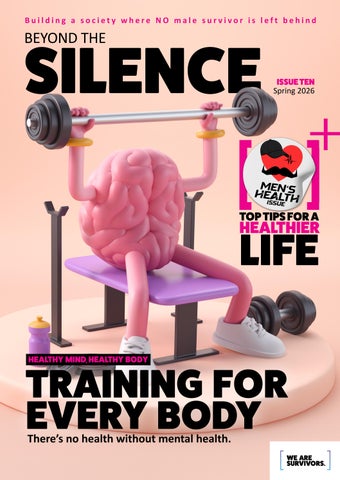
Building a society where NO male survivor is left behind

TOP TIPS FOR A HEALTHIER LIFE

HEALTHY MIND, HEALTHY BODY

TRAINING FOR EVERY BODY

There’s no health without mental health.
FROM THE CEO

This month in Beyond The Silence, we turn the spotlight on the health of male survivors.

“For he who has health has hope; and he who has hope, has everything.” OWEN ARTHUR OVER THE YEARS, VARIOUS GOVERNMENTS AND POLITICAL LEADERS HAVE TALKED ABOUT, WRITTEN ABOUT AND PASSED POLICY AND LEGISLATION ON THE HEALTH OF THE NATION.

Each one comes with ideas, plans, and usually a plethora of campaigns and slogans. The one that really sticks in my mind is “there’s no health without mental health.” As a psychotherapist, mental health has always been an important part of my work; and as someone who has at times poor mental health, I see the connection between mind and body.

higher premature mortality compared to women, and men are more likely than women to engage in unhealthy behaviours such as smoking, harmful gambling, alcohol consumption and substance misuse.

But looking back over the last few years there has certainly been a change in attitude - and in action - with men’s health, and men’s mental health becoming the topic to discuss, and even the Secretary of State for Health and Social Care publishing the first ever men’s health strategy (p14).

It’s music to my ears and it gives us the opportunity to talk about male survivors health, because research highlights health inequalities connected to men and boys as survivors and we have to change that.

BEYOND

Men’s health has always been the ‘Cinderella’ topic in health, for whatever reason, and we should certainly be embarrassed about that - particularly when you look at health data that shows men account for 80% of suicide deaths which is now the biggest cause of death for men under 35, men experience lower life expectancy (78.6 years in the UK) and

So here it is, our attempt to begin a conversation looking at the health and wellbeing of male survivors; and the start of our commitment to ensure that there is no good men’s health without good male survivors health.

VICTIM'S CODE UNDER REVIEW

We Are Survivors has submitted its response.

THE GOVERNMENT HAS BEEN UNDERTAKING A REVIEW of the Victims Code, talking with victims, professional stakeholders and the public at large, to look at each of the twelve rights with the aim of ensuring victims have a better journey in healing.

We Are Survivors held three consultations: one with male survivors, one with the loved ones of male survivors, and one with our

Expert Reference Group; and the comments and opinions of every one of them had male survivors health and wellbeing in mind.

Our report has now been submitted to Government and we hope the new Victims Code, which contain those vitally important 12 victims rights, will be published before the end of the year.

We’ll keep you up-to-date.

IT'S WHAT YOU KNOW ISN'T IT!

WE ARE SURVIVORS RECENTLY HELD IT’S FIRST EVER MALE SURVIVOR RESEARCH CONFERENCE at the University of Manchester, with speakers focusing on men in prison; the history of sexual harms and the law; and jury’s attitudes to male victims. The confernece was a huge success and look out for the recordings of all the presentations, including the two lightening speakers, which We Are Survivors will publish over the next month.

WARNING

FOLLOWING THE VAST CONCERNS RAISED BY VICTIM/SURVIVOR ORGANISATIONS, INCLUDING WE ARE SURVIVORS; The National Centre for Violence Against Women and Girls and Public Protection (NCVPP) and the National Police Chiefs’ Council (NPCC) have issued a clear national position statement on the use of ‘self-swabbing’ kits in unregulated environments following rape, warning that such kits present significant risk to victims, undermine safeguarding, and jeopardise the integrity of evidence. Scan the QR code for more.

MEET THE TEAM

LEE

Nightingale Navigator

“Hi, I’m Lee—part harm reduction guide, part music nerd, part calm-in-the-storm specialist. I’m the Nightingale Navigator at We Are Survivors, helping families and loved ones find their footing as they navigate the often bewildering Criminal Justice System. As a survivor myself, I’ve travelled through therapy, EMDR, The Safe Room, and ISVA support, and I learned pretty quickly that healing alongside other survivors wasn’t just comforting—it was life changing. Before joining We Are Survivors, I spent years teaching and supporting young people with additional needs, picked up a couple of music degrees along the way, and now I still volunteer with people in recovery. In my role here, I blend all of that—lived experience, teaching know how, and a lot of empathy—to help loved ones understand vicarious trauma, run groups, and make sense of the CJS without feeling like they’re lost in a maze. If survivorship has sent shockwaves through your world, I’m here to walk the journey with you—steadfast, down to earth, and probably cracking a well timed joke when you need it most. Together we heal… and maybe even smile along the way.”

Find out more about our work at: www.wearesurvivors.org.uk

OUR STATS

THIS ISSUE OF BEYOND THE SILENCE IS FOCUSSING ON MEN’S HEALTH - BOTH PHYSICAL AND MENTAL.

Here at We Are Survivors, we host a number of community activities which always promote the benefits of good health and wellbeing; and we know just how much positive good these activities can have on the lads that attend. And we’re reaching LOTS of guys.

Here’s our Nick with some more insightful numbers on the positive impact of community activities at We Are Survivors in the last financial year.

To find our more about our community activities, and how you can get involved, jump over to page 16 or scan the QR code opposite to find out more online.

THE DIFFERENCE WE MAKE. AT A GLANCE.

SCAN HERE to donate!

GREAT MANCHESTER RUN 2026

HOW YOUR DONATION HELPS

Whatever you can donate*, we guarantee it will help male survivors to improve their health and wellbeing.

£5 DONATION

funds refreshments at The Art Room

RUNNING FOR SURVIVORS

Grab those running shoes, and join Team We Are Survivors as we Run For Survivors at this year’s Great Manchester Run.

A group of We Are Survivors staff and supporters will be racing through the streets during the Great Manchester Run this May, raising money for our amazing charity.

Run for Survivors is the campaign we have developed to spur on our runners, raise awareness of our services, and raise funds. We want to break the silence for the 1 in 10 men who experience rape and being one of many runners doing the 10k seemed fitting. This statistic means hundreds of male survivors could be running past our lads and supporter stations, learning about We Are Survivors and taking the next step to finding the support they deserve. We certainly plan to make a hell of a lot of noise on the day.

We’ve set ourselves a target of raising a minimum of £1500. Valuable funds that will be directed towards our wellbeing

activities delivered by the Community Development team. This health and wellbeing activity might include:

The Garden at RHS Bridgewater Health walks, our lads get moving together

Yoga sessions in our wellbeing space

Mindfulness sessions

On the 31st May 2026 we Run for Survivors. We Run for Change.

Go to www.justgiving.com/campaign/ runforsurvivors or scan the QR code (above)to donate. If you’re already taking part in the run and want to fundraise for us, please get in touch with rachael.b@ wearesurvivors.org.uk

We can support you with your fundraising and provide a branded t-shirt to wear on the day.

Open Studio weekly sessions, a creative outlet facilitated by our art therapists.

£20 DONATION

funds one wellbeing walk, a monthly stroll for our lads to improve health and reduce isolation.

£30 DONATION

funds a taxi to The Garden, these weekly gardening sessions at RHS Bridgewater give survivors the opportunity to learn new skills, enjoy time outdoors and build a supportive community.

£400 DONATION

funds one month of The Safe Rooms, a peer led support group for adult male survivors to get together, talk, and learn from each other.

£900 DONATION

funds one place on our Healing Steps programme, twelve one-to-one sessions of advice, emotional support and practical coping strategies.

* PLEASE NOTE: All figures based on March 2025 costs.

Scan the QR code above to donate in support of all our runners and all the men and boys we support.

ALLIES! TOGETHER WE’RE

We’re proud to work with our brothers at Mandem Meetup.

Mandem Meetup is a grassroots charity promoting, and improving the conversation around men’s mental health and wellbeing. They provide an open, inclusive community for all those who identify as a man, offering psycho-social interventions and recreational activities, to practical advice and guidance, as well as talking therapy and more. Find out more at mandemmeetup.org

WE ARE ALLIES!

Survivor Ally is now We Are Allies. And with the change of name, we’re about to launch our refreshed website.

AS SURVIVOR ALLY - OUR JOINT CAMPAIGN WITH MANDEM MEET UP - REACHES ITS SECOND ANNIVERSARY, WE’VE TAKEN THE OPPORTUNITY TO REFRESH THE CAMPAIGN. STARTING WITH THE NAME...

We Are Allies continues the important work of the campaign, which aims to educate and inform service providers on how to respect male survivors in industries which traditionally have a - literal - hands-on approach. Think dentists, barbers, sexual health clinics, and tattooists. We’ll also be expanding the campaign and delivering it in other regions, and further developing the online training for service industry professionals. Aside from the name change, you’ll also notice a new lick of paint on the website from May.

Theo at We Are Survivors is responsible for developing We Are Allies, alongside our friends at Mandem Meetup. He explained why the campaign was ramping up:

“We want to grow We Are Allies into a nationwide training programme. This will enable more professionals in physical settings to understand how to create survivor safe spaces through communication and understanding. I’m so excited to help expand this much needed training.”

Scan the QR code to visit the We Are Allies site and take the test! BE AN ALLY TODAY

NEW NAME, SAME CAMPAIGN
* Not final artwork

ON IT CONFERENCE 2026

A CONFERENCE LIKE NO OTHER

Back in January, The Eagle Manchester hosted a one-of-a-kind ChemSex conference. The reaction was amazing.

FRIDAY 30TH JANUARY 2026 SAW MANCHESTER HOST THE ON IT CONFERENCE , the city’s first ever ChemSex conference. The event took place in the basement bar of The Eagle, in the Gay Village. It was perhaps an unconventional location for a conference, but ideal for ON IT – a harm reduction campaign which places emphasis on lived-experience, and a no-nonsense, non-judgemental approach to delivering its messages.

The ON IT team have been overwhelmed at the positive response to the conference. Here’s what just one attendee told us: “This conference addressed some serious

subjects with care, integrity and clear intent. I found each session really informative and carefully balanced. The inclusion of lived experience was particularly powerful and clearly integral to the event. It grounded the learning, challenged assumptions, and reinforced the real impact of the issues discussed. Overall this was an excellent conference it was informative, human and impactful, and set a high standard for how these subjects should be explored in professional settings.”

You can read a full report about the day, check out more reactions to the day, and watch all the sessions again at www.onit.org.uk

WHAT'S NEXT FOR ON IT?

THE ON IT TEAM ARE CERTAINLY NOT RESTING ON THEIR LAURELS, WITH SOME EXCITING THINGS ON THE HORIZON.

As a result of this year’s ON IT conference, we’ve been working with a number of organisations and individuals to take ON IT further and deliver more events and important campaign messages promoting wellbeing and learning.

We’ll be revealing more in our next issue, but keep your eye on our socials for updates and remember... there’s no place like home. <wink>

MOODGOODFOOD

WHAT WE EAT AND OUR MOOD ARE CLOSELY LINKED. The food we eat provides us with the energy and nutrients our brain needs to work well. The food we choose to eat can affect our emotions and how we think. Equally, our mental health can also influence our eating habits; I like to refer to this as the domino effect.

Today, modern scientific research is clarifying this food mood connection. There is growing evidence that diet and mental illness are closely linked. Improving your nutrition can directly affect mental health symptoms and improve overall mental wellness. While you can’t cure depression with a healthy meal, making healthy eating choices can help improve many mental illness symptoms.

Our frame of mind can strongly affect what, when, and how we eat. Feeling depressed, anxious, tense, or unhappy may mean some people lose their appetite or have little interest in eating. Others may be more likely to turn to comfort foods, which happens when we eat because of how we feel rather than because we are hungry. ‘Comfort’ foods are different for everyone, but they’re often linked to childhood memories or times when we felt

“We may rely more heavily on soft drinks and sugary foods to fight tiredness and low energy, which are common symptoms of depression and anxiety.”

RIZ from We Are Survivors looks at the positive mental benefits we gain from a healthy diet. And offers up a tasty recipe!

safe and happy. Common comfort foods like biscuits, chocolate, and ice cream are low in nutrients but high in calories, fat, and sugar, which can lead to weight gain if eaten often.

Some anti depressant medications can also affect our appetite or cause side effects, which may lead to changes in our eating habits. Low levels of energy and a lack of motivation due to depression can make preparing or cooking meals off putting. This may lead to relying on takeaways and processed foods, which are high in fat, sugar, and salt. We may rely more heavily on soft drinks and sugary foods to fight tiredness and low energy, which are common symptoms of depression and anxiety. Others may drink more alcohol, hoping it will help them relax.

Depression, anxiety, and stress often go together with drinking more alcohol in an attempt to cope with emotions, block out feelings, or relax. However, alcohol affects our brain, so it can have a negative effect on mood and increase the risk of depression. Excessive drinking also affects sleep quality and can cause hangovers that leave us feeling unwell, anxious, and less able to cope the next day. Plus, alcohol reduces the ability to absorb some vitamins and minerals the brain needs to function well.

SCIENCE FACT!

YOUR BODY RELIES on a combination of vitamins, minerals, antioxidants, fats, carbohydrates (for fibre and energy), water, and protein to function. Your body can turn some of them into hormones and neurotransmitters that help the body and mind regulate themselves. Without these nutrients, the body works to conserve the available nutrients, often prioritising keeping you alive while sacrificing mental well being and energy levels.

Serotonin is a transmitter that carries messages between nerve cells in the brain and throughout your body. Serotonin plays a vital role in such body functions as mood, sleep, digestion, nausea, wound healing, bone health, blood clotting, and sexual desire. Serotonin levels that are too low or too high can cause physical and psychological health problems.

Serotonin in your brain regulates your mood. It’s often called your body’s natural “feel good” chemical. Low levels of serotonin are associated with depression, anxiety, sleep problems, digestive problems, suicidal behaviour, obsessive compulsive disorder, post traumatic stress disorder, panic disorders, schizophrenia, and phobias. We can increase our serotonin levels by eating foods containing tryptophan: dairy products like milk and cheese; soy products like tofu and soy milk; poultry like chicken or turkey; salmon; eggs; nuts; oats and seeds; fruit and veg like bananas, potatoes, and string beans. It is worth noting that processed foods will deplete your serotonin levels. Eating foods high in tryptophan will not necessarily boost serotonin levels on its own. Getting more sunlight also helps. Not getting enough exposure to sunlight can lead to mood disorder. Finally, and importantly, getting more exercise and lowering your stress levels. Regular exercise is known to increase serotonin levels.

Serotonin plays a key role in such bodily functions as mood, sleep, appetite, anxiety, digestion, blood clotting, and sexual desire. If you have a health condition that affects serotonin or is affected by serotonin, ask your healthcare provider.

Riz’s

Mediterranean Chicken Bake

Famous for being one of the world’s healthiest diets, the Mediterranean way of eating includes plenty of good fats, protein and colourful vegetables.

INGREDIENTS

• 750g Baby Potatoes halved

• 2 Tablespoons of Olive Oil (or any Vegetable based oil)

• 1 Red Onion cut into wedges

• 1 Bulb of garlic separated

• 1 Lemon cut into wedges

• 8 Chicken Thighs skin on

• 125 ml of Veg or Chicken stock

• Handful of green and black olives

• 100g Feta cheese

• 1 teaspoon dried Italian seasoning

• Salt & Pepper to taste

• Dried chilli flakes optional

METHOD

Heat the oven to 200C/fan 180C/gas 6. Put the potatoes in a large roasting tray, add 2 tbsp of olive oil and season with salt and pepper, sprinkle 1 teaspoon of Italian seasoning (dry chilli flakes optional). Toss everything to coat then roast for 20 minutes.

Add the red onion, garlic cloves, lemon wedges and chicken thighs, then drizzle over the thighs with another tbsp of oil and season. Roast for another 20 minutes then take out and turn the oven up to 220C/fan 200C/gas 7. Add the tomatoes, the stock and olives, then put the tray back in the oven and cook for a final 20 minutes until the chicken is crisp and golden. Sprinkle over the feta and a little more Italian seasoning, drizzle with a little more olive oil and serve.

AMBASSADORS

WELLBEING OF

AT WE ARE SURVIVORS , WE’RE INCREDIBLY LUCKY TO HAVE A TEAM OF AMAZING AMBASSADORS THAT USE THEIR PLATFORMS, THEIR FOLLOWING, AND THEIR VOICE TO RAISE AWARENESS OF MALE SEXUAL HARMS. As Ambassadors, they stand up for the health and wellbeing of our lads. Our CEO Duncan asked them what top tips they had for good men’s health. Here’s what they said...

CHARLY LESTER

“I HAVE ALWAYS FOUND GETTING INTO A REGULAR PATTERN WITH EXERCISE HELPS ME BOTH PHYSICALLY AND MENTALLY. I used to set myself weekly targets of how many times I’d exercise, but then I’d have a bad day or week, or get ill and feel like I’d totally failed. So for the last ten years or so, I always start the year with a set number of days I’m going to do exercise - eg 250 all year (which is just under 5 days a week). I count the days on my calendar - and the exercise can be anything - from a quick swim, to a game of tennis, to a marathon - it all counts the same. By just setting one goal for the whole year, if I have a bad day or week or even month, I haven’t failed - there’s always time to catch up (or to take a break, if I am on holiday etc) For me, tracking and planning my exercise that way has given me a healthier mindset.”

JAMES SUTTON

“MAINTAINING A HEALTHY MIND AND BODY STARTS WITH KEEPING SMALL PROMISES TO YOURSELF, CONSISTENTLY, FOR A LONG PERIOD OF TIME. The first promises I started keeping to myself were centred around a morning routine, which grew into the same morning routine I still adhere to every day. I wake at the same time; I don’t negotiate with myself, no snoozing the alarm. I drink a full pint of water with electrolytes before anything else—overnight dehydration affects your cognitive ability, so it’s important to bring your brain back online. Our dopamine receptors and hormones are highly sensitive, so I don’t touch my phone for the first hour of the day, which makes a massive difference to my overall mood and energy. I spend 20 minutes in silence with a cup of tea, manifesting what the best day ahead would look like, basking in positivity. Then I head to the gym, shower, eat a protein-heavy breakfast, and take a twenty-minute walk outside. Only then do I sit down to work—the first output of my day is creative. None of it is complicated or impressive, but each step makes the next one easier. By mid-morning I’ve already kept several promises to myself, and that’s the goal: to start each day as someone I can trust. The routine itself doesn’t matter—create your own, shape it around your life, your time, your responsibilities. Physical health and mental health aren’t separate; they run on the same engine, and that engine is fuelled by consistency. You don’t need a routine that inspires you. You need a routine boring enough to survive on a bad day. Now repeat after me—“I am someone I can trust.”

PROTOCOL is James’ motivational new website. www.jamessutton.com

CHEDDAR GORGEOUS

“I THINK FOR MANY MEN THE HARDEST STEP TOWARDS LIVING A HEALTHIER LIFE IS OFTEN THE FIRST. Believing that your wellbeing is something that warrants your attention, peace of mind is something you deserve and from time to time everyone needs support. Being a strong man doesn’t mean facing things alone or ignoring when something is a challenge, it’s about learning to lean on those around you when you need to and being there for them when they need the same.”

AKA: DR. MICHAEL ATKINS

RICHARD GADD

“I DO NOT ALWAYS FIND IT EASY TO MAKE TIME FOR THIS, but setting aside twenty minutes each day to just sit and focus your mind on as little as possible can have a meaningful impact on general wellbeing/happiness. In a perfect world, I would do it in the morning and at night to help settle my mind and brush off the struggles of the day. The more I practice it, the better I become in terms of keeping my mind from wandering in my day to day life. It is classic meditation stuff. Training my brain to be steady and calm. It is harder when I am doing television shows as the schedule becomes impossible and so I try to keep some structure by eating at regular times throughout the day instead - 9am, 12pm, 3pm and 6pm each day. I feel it helps me my body get into rhythm which allows me to have more energy and focus. I also prefer to eat less later in the evening, which leaves me feeling lighter and more refreshed the next day. And not overeating each time too. That is a big one. Small, high-protein meals which are easy to digest throughout the day. All of these small things go a long way.”

Richard’s new drama, HALF MAN, airs weekly from 24th April on BBC iPlayer & BBC One.

MARK STUART ROBERTS

STEP 1: KEEP IT SHORT-TERM

I’ll be straight with you: I’m not someone who thinks about health in the long term. Grand plans, year-long goals, complete lifestyle overhauls don’t work for me. What works is short-term. Broken down. Manageable. Because if I can’t action it today or this week, it’s not a plan, it’s just a wish.

STEP 2: PROTECT YOUR SLEEP

Everyone says “no blue light before bed” and fine, that’s good advice. But for me, the bigger issue is my brain. I’m an anxious person, and if I don’t deal with what’s rattling around in my head before I try to sleep, I’m done. So I write it down. Everything that’s potentially going to keep me awake, the worry, the to-do list, I get it out of my head and onto paper. Ninety-nine percent of the time, when I look at it written down, there’s actually nothing I can do about any of it right now. But the act of writing it down almost empties my mind. Mornings work the same way. When you wake up, get up. That’s it. As far as your brain is concerned, you haven’t properly started the day yet. So now, whenever I wake up, 6, 7, half 8, whatever, that’s my cue. Get up. Move. It doesn’t need to be a workout. Just move.

STEP 3: STOP OVERCOMPLICATING GYM AND DIET I spent years overcomplicating both. The perfect programme, the perfect macro split, the perfect plan. And you know what all that overthinking got me? Paralysis. If you need advice, ask someone, find a good source, get a session with a trainer. There’s no shortage of help out there. Just go and do it. Yes, the gym is intimidating. Yes, walking in feels uncomfortable. Take the step.

Step 4: Keep the Promises You Make to Yourself

Personally, I train hard for six months and then I’m off for six. It all comes down to self-discipline. Not motivation, not willpower. So keep the promises you make to yourself. Because we don’t rise to our standards when everyone’s watching. We fall to them when no one is.

Wellness isn’t about finding a perfect plan; it’s measured by how well you treat yourself. It’s an ongoing relationship with yourself, built through daily kindness and respect.

ARE

WE REALLY MOVING TOWARDS

A SOCIETY OF NO

MALE

SURVIVOR LEFT

BEHIND IF NO ONE KNOWS THAT MEN CAN BE SURVIVORS?

YOU MIGHT ASSUME that public awareness of men and boys as victims of sexual harms has increased over recent years...

MANY THINGS HAVE CONTRIBUTED TO A GREATER SOCIETAL AWARENESS AND UNDERSTANDING; from our own work helping create storylines for Hollyoaks, Coronation Street and to our work on the ‘Biggest Rape Case in British Legal History’, that of Reynhard Sinaga; and the stratospheric success of Baby Reindeer

We Are Survivors, with the invaluable support of Movember, are seeking to find out more about general attitudes towards male sexual harms in a joint piece of research. As an organisation and a community of survivors (60% of our workforce are survivors), we can speak to the depth of men and boys victimhood amidst crime statistics classified as ‘violence against women and girls’, such as that 0.7% of men aged 16+ experienced sexual assault (including attempts) in the year ending March 2025. But are we really moving towards an envisioned society of no male survivor left behind if no one knows that men can be victims/survivors?

This is where Movember comes in. Not only does our mission overlap with their leadership in ‘changing the face of men’s health’, with their influence and outreach We Are Survivors can work with Movember to place male sexual harms in the growing public conversation on men’s health. In a new project led by Sam (Information and Data Manager), Nick (Operations Manager), and Rory (Senior Information and Policy Officer), supported by Duncan our CEO; we will be designing a survey to be distributed across social media platforms including that of Movember and We Are Survivors, Mandem Meetup to name a few; and key stakeholder

mailing lists. The survey will ask respondents general questions, covering themes of ‘understanding’, ‘attitude’, and ‘prevalence’ of male sexual harms.

We will use a mixed method approach using ‘likert’ scales, multiple choice, and free text fields. The data analysis effort will then be conducted by We Are Survivors’ Operations Team, who will be guided by the expertise of our academic partners at the University of Manchester, Lancaster University, Kings College London and University of Kingston. The team will use leading software to analyse both the quantitative and qualitative results, as well as using comparison data such as 2021 Census Data, Crime Survey for England and Wales, Police Recorded Crime Data and the CPS Data on Charges/Convictions. This will ensure we are able to validate our findings and identify any trends or patterns from the data. With all the data refined and written up, a final report of findings will be disseminated across all mentioned social networks and mailing lists, with co-ordination between our own Communications & Engagement Team and with support from Movember’s own communications folks.

The aim for this research is to help shift the ‘overton window’ on male victimhood/survivorship. That male sexual harms are understood alongside other gender specific men’s health issues, such as prostate cancer, diabetes, and suicide.

So do keep an eye out on our socials and your inbox, so that you can share your point of view with us!

MOVEMBER IS A GLOBAL MOVEMENT dedicated to improving men’s health, with a focus on mental health and suicide prevention, prostate cancer, and testicular cancer. Each November, men and supporters take action by growing a moustache, getting active, or taking on challenges to raise funds and start conversations about health topics that are often overlooked.

At its core, Movember encourages men to be more proactive about their wellbeing and to talk openly without stigma. By funding research and community programmes, it promotes early intervention, connection, and the message that taking care of your health—and each other— is a sign of strength, not weakness.

STEP FORWARD? IS THE MEN’S HEALTH STRATEGY A

LOOKING BACK TO INTERNATIONAL MEN’S DAY IN NOVEMBER 2025, THE RT. HON. WES STREETING AS SECRETARY OF STATE FOR HEALTH AND SOCIAL CARE PUBLISHED THE MEN’S HEALTH STRATEGY .

A call for evidence was run in the first half of 2025, with We Are Survivors providing a wealth of data, evidence, and testimony, alongside other organisations that work in men’s health like George House Trust and Mankind Initiative.

This strategy represents a significant step forward to better outcomes in the mental and physical health of men and boys. We are, of course, especially pleased that our response to the Department of Health and Social Care’s call for evidence was acknowledged in this Strategy. For your interest, you can find these on pages 20 and 38, 53, with respect to male sexual harms and its relationship with HIV and chemsex.

It details that “0.7% experienced any sexual assault, although figures may be underreported”, and, “according to the Centre of Expertise on Child Sexual Abuse, at least 5% of boys (and 15% of girls) in England and Wales are sexually abused before the age of 16.”

“This strategy represents a significant step forward to better outcomes in the mental and physical health of men and boys. We are especially pleased that our response to the Department of Health and Social Care’s call for evidence was acknowledged in this Strategy.”

RORY, WE ARE SURVIVORS

Further, that the Department for Health and Social Care are “taking action to end new transmissions of HIV within England by 2030, as well as improve sexual health more broadly.” By “investing £27 million additional funding for 2025 to 2026 to expand the highly successful NHS emergency department opt-out HIV testing programme.”

With respect to the ON IT information we submitted as evidence, the strategy states; “Chemsex commonly involves crystal methamphetamine, gamma hydroxybutyrate (GHB) and gamma butyrolactone (GBL) and synthetic cathinones, sometimes injecting these drugs (also known as slamming)”. “While data on prevalence is limited, we know it occurs predominantly among GBMSM” (‘gay, bisexual and men who have sex with men’).

While We Are Survivors are pleased with the Government’s willingness to learn more in the pursuit of implementing this strategy, our Community Services Director took to our website journal to reflect on it. He stated that the strategy falls short in not acknowledging ‘rape myths’, and that any discussion about male sexual harms should account for the disbelief faced by men and boys when they choose to disclose. Likewise, it is important to dispel the myth that victimhood necessarily leads one to perpetrate harms themselves. As such, while we are empowered as a data-rich and trauma-informed organisation that is ready to work with government, there is still much to be done, either in implementing this strategy, or raising awareness on topics not yet acknowledged.

If you’d like to read the Men’s Health Strategy, just scan the QR code opposite.

TRAINING

YOUR BRAIN!

TRAINING IS MORE THAN PHYSICAL FITNESS. Your brain needs a workout too! Carving out time for a daily puzzle is a small habit with big rewards. From crosswords to Sudoku, puzzles gently exercise memory, logic, and creative thinking, keeping the mind sharp and flexible. They also offer a welcome pause from daily noise—a moment of focus that ends with the quiet satisfaction of solving something well. And also, our Grahame loves puzzles and has always wanted to have a puzzle page in Beyond The Silence. So here we are! The solutions are on page 18.

SCRAMBLE

Make as many words as you can with these letters (no repeats!), plus 1 bonus letter of your choice. Get 100+ points!

SPOT THE DIFFERENCE

SUDOKU

Fill the grid with the numbers 1-9, so that each row, column, and 3x3 section contains each number only once.

TAG YOU'RE IT!

Actor DAVID TAG (Hollyoaks, DEPARTURES) is a big supporter of We Are Survivors, and recently hosted our gym Boot Camps. He knows his stuff when it comes to fitness.

WE ASKED DAVID FOR SOME TIPS FOR THOSE OF US WHO MIGHT BE A BIT NERVOUS OR RETICENT ABOUT GOING ALONG TO A GYM FOR THE FIRST TIME, AND STARTING A FITNESS JOURNEY.

What advice would you give to guys who would like to start going to a gym, but feel nervous or anxious about it?

If you feel nervous, my advice is to remember everyone at the gym is focused purely on themselves, so there should be no judgement from other gym goers. Remember, they all had a first time too, and if there is judgement or you find people are staring? F**k ‘em!

Aside from the physical benefits of training/gym, how else can a fitness journey help someone?

For me, the gym is the biggest mood booster. It can improve your mood/mindset and is one of the best things you can do for mental health as well as physical health.

What’s your advice for maintaining a commitment to a fitness journey and not skipping the gym?

If you’re going to take it seriously, then my advice would be to track your progress. Take photographs, weigh yourself regularly,

take circumference measurements, then keep monitoring and updating everything so you can see and feel the difference. It isn’t always about aesthetic - how good you look. Physical monitoring can also help with increasing the number of sit-ups/press-ups you can do without a break or help you keep running for longer; and this will all really help with your continued commitment.

How quickly will you see the benefits of a fitness/gym routine? Well, in terms of a mood boster, the benefits are practically instant! Looking at body shape, it depends on your ‘level’. For a beginner, it may take roughly two to four weeks to see a difference. For intermediate, around two to three months, and for an advance gym goer probably a bit longer. But the key is to stick with it! You WILL see results, and you WILL feel the positive benefits.

So, what are you waiting for? If you’ve been putting off that first visit to the gym - there’s really nothing stopping you. We’d always advise checking with your GP first, and taking advantage of any free gym ‘inductions’, so you can learn how to use all the equipment safely, and talk to the trained staff about a safe and well-balanced starting routine that works for you. Go for it!

FILM

DEPARTURES

You can catch David’s brand new film DEPARTURES in cinemas this April.

DAVID CAN SOON BE SEEN ON THE BIG SCREEN IN A NEW FILM.

DEPARTURES is a bold British comedy-drama that explores the emotional rise and fall of a modern queer relationship. Directed by Lloyd Eyre-Morgan and We Are Survivors own Neil Ely, the film follows Benji (played by Lloyd), a Mancunian man whose impulsive meeting with the charismatic and controlling Jake (played by David) at an airport departure gate sparks an intense connection. Their relationship unfolds through secret monthly getaways to Amsterdam, where passion, dependency, and power imbalances

slowly surface. Inspired by real-life heartbreak, DEPARTURES blends dark humour with raw emotional honesty, offering a sharp, intimate portrait of love, control, and the difficulty of letting go.

DEPARTURES has been met with strong critical acclaim, and powerful word-of-mouth, with reviewers praising its raw emotional honesty, sharp writing and refreshing Northern voice within British queer cinema. We’ve seen it, and we loved it!

DEPARTURES is at selected cinemas from Friday 17th April 2026.

COMMUNITY GROUPS

MONDAYS

DROP IN

A safe space to connect.

HEALTH WALK

Fresh air and good company. Join us!

MANDEM MEETUP TALKING CIRCLE

A judgement free talking circle hosted by our brothers at Mandem Meetup.

TUESDAYS

WELLBEING SESSION

A weekly session in a safe space.

THE COFFEE SHOP

Let’s grab a brew and have a chat.

THE HANGOUT

A brand new group for survivors 18-35.

THE SAFE ROOM

Confidential, peer-to-peer support groups. Talk, listen and learn.

WEDNESDAYS

THE SAFE ROOM

Confidential, peer-to-peer support groups. Talk, listen and learn.

THE WRITER’S ROOM

Get creative. All abilities welcome!

THURSDAYS

THE BUILDERS YARD (LEGO)

Come and join other survivors and get building with Lego.

THE COFFEE SHOP

Let’s grab a brew and have a chat.

THE SAFE ROOM

Confidential, peer-to-peer support groups. Talk, listen and learn.

FRIDAYS

THE ART ROOM

Express yourself artistically - all abilities!

HEALTH WALK

Fresh air and good company. Join us!

THE GARDEN AT RHS

Get out of the city for a gardening session in beautiful surroundings.

SATURDAYS

THE SAFE ROOM (ONLINE)

Confidential, peer-to-peer support groups. Talk, listen and learn.

(Twice a month) Scan the QR code to sign up for regular updates!

GALLERY

IS YOUR PAGE. Share your art, poetry and creativity with us.

Every issue we want to celebrate the creativity of male survivors. Expressing yourself through art, poetry and writing can be an important part of healing. If you’d like to share your work, send them to the e-mail on page 2.

NO BOX by Mark

They want me simple.

One word.

One shape.

Gay, Bi, Straight. Hard or soft.

Camp or Masc.

Strong or broken. I am none of these alone. Rape doesn’t ask what you love, who you love, or how you stand. It took something from me. I won’t pretend it didn’t. But it didn’t take everything. Rugby gave me my body back. Shoulder to shoulder.

No explanations needed. Boxing taught me controlBreath over panic. Focus over rage. Logic over fear. The gym taught me routine. Turn up.

Repeat.

Get stronger.

And when strength wasn’t loud, music held me.

Shakespeare named what hurt. Star Trek reminded me that hope survives even in the dark.

So why must I fit a box?

Why must a survivor look one way? Why must a man explain himself?

Survivors are everywhere.

On pitches.

In rings.

In theatres.

In silence.

Don’t let the rapist define you. They already took too much. Take control backin your body, in your mind, in your life.

You don’t belong in a box. You belong to yourself.

‘I WISH YOU KNEW’, OUR CREATIVE WRITING AND STORYTELLING PROJECT FOR SURVIVORS IS NOW WELL UNDERWAY, AND WE WANT TO MAKE SURE NO ONE MISSES THE CHANCE TO BE PART OF IT.

‘I Wish You Knew’ is a project designed to give survivors the space to explore their own journey with survivorship through storytelling. The title comes from a phrase many participants have found to be a powerful starting point – yet the direction you take is entirely your own. Your piece ‘or pieces’ can take any form or style that feels right to you. So far, contributions have included letters to loved ones; letters to perpetrators; autobiographical reflections;

PUZZLE SOLUTIONS

poems; musical compositions; short plays and dialogues. The workshop runs through one-to-one sessions, offering dedicated time and support to help you put pen to paper. Some people find a single session is all they need to get started; others prefer to return regularly and use the space to develop their work over time. Some participants choose to write independently and simply send their piece in when they’re ready – every approach is welcome. If you prefer, you are very welcome to submit your work anonymously.

With participants’ consent, we are now hoping to bring these pieces together in a published collection. We are also keen to record submissions being spoken aloud,

creating an ‘I Wish You Knew’ library of recordings and performances. Whether you’d like support in crafting something new or you already have a piece you’d love to submit, we would be delighted to hear from you.

On this page, you’ll find ‘No Box’, a poem already submitted to the project – just one example of the powerful and varied work emerging from the workshop.

If you’d like to get involved, please get in touch. Drop and e-mail to christopher.e@ wearesurvivors.org.uk or kaelin.f@ wearesurvivors.org.uk; or call 0161 236 2182 and let us know you’re enquiring about the ‘I Wish You Knew’ workshop.

LAST THE

WORD

THE COST OF SILENCE VS THE VALUE OF SUPPORT

WE OFTEN HEAR ABOUT THE IMPACT OF DONATIONS AND VOLUNTEERING ON THE SERVICE USERS OF AN ORGANISATION, AN OBVIOUS MOTIVATOR IN DECIDING TO SUPPORT A CAUSE.

However, little emphasis is placed on the benefits experienced by donors themselves. Volunteering can help people to feel less isolated, depending on the type of volunteering it can even get people active and out of the house. From a mental health and wellbeing perspective, we feel better when we’re doing something for others. Contributing to something bigger than ourselves provides perspective and meaning, another thing that can reduce feelings of isolation. Donating time and money to a charity is both an individual and community experience, the importance of both elements should be respected.

This edition has dived into how important it is to foster good mental and physical health, especially in the face of the difficulties experienced by survivors of sexual harms. Male survivors continue to face significant barriers to recognition, support, and justice. The social stigma, misconceptions about masculinity, and limited access to services keep too many silent. Our mission is, and

NO male survivor left behind

MAIN OFFICE

Unit 9 Brewery Yard

Deva City Office Park

Trinity Way, Salford M3 7BB

Office: 0161 236 2182

E-mail:

support@wearesurvivors.org.uk

Website: www.wearesurvivors.org.uk

always will be, to break the silence for male victims of sexual harms. My role as Head of Fundraising and Communications contributes to breaking the silence in two ways; bringing in the funds that ensure our life changing services continue for many years to come and building awareness of those services and the community we support. I have the privilege to champion the voices of survivors and the moments when the weight of silence is lifted. I see how donations both big and small, monetary and time-based, facilitate these moments.

Wellbeing isn’t an individual pursuit, it’s something we build together. Whether that’s a member of our donor community feeling proud about their contribution to our mission, or one of our lads stepping into a Safe Room for the first time and sharing their experiences with others. There is community in coming together for each other and making a difference.

We would love you to join our supporter community, whether you’d like to donate as an individual, build a partnership as a company, or become a volunteer, get in touch with me at: rachael.b@wearesurvivors.org.uk

OTHER USEFUL CONTACTS

24/7 Support Line 0808 500 2222 247sexualabusesupport.org.uk

Shout 85258

This is as 24/7 text service that supports people if they are feeling overwhelmed or anxious. Free and confidential.

Samaritans 116 123 (available 24 hours a day) jo@Samaritans.org.uk

Mankind 018823 334 244 (Domestic Abuse Support) Mon-Fri, 10am-4pm www.mankind.org.uk

Dad Matters 0161 344 0669 dadmatters.org.uk

Supporting Men’s Mental Wellbeing Through Community, Activity & Purpose. info@mandemmeetup.org www.mandemmeetup.org

Turn static files into dynamic content formats.

Create a flipbook