Editor: Jonathan Fraser. Editorial enquiries to jon@fu-media.co.uk
ADVERTISE HERE
To advertise your business to Birmingham Law Society members call Fraser Urquhart Media on 0116 2533445 or you can email jon@fu-media.co.uk or kevin@fu-media.co.uk
4. President’s Address
6. Member’s Events
8. Member’s News Updates
11. Talent Doesn’t Leave Law - It Leaves When Development Stops
13. Discretion Causes Challenges For Paralegals
15. 2026 Diversity and Inclusion Scheme Winners Announced.
22. Committee News
28. AI Use- Regulatory And Compliance Considerations
30. More Than SQE Preparation: New LLM Equips Future Solicitors for Modern Practice
EXPERT WITNESSES FOR:
l Mechanical and Process Engineering
l Manufacturing Industries
l Oil and Gas Industries
l Petrochemicals and Chemicals
l Pharmaceuticals
l Fertilizers and Pesticides
l Metallurgical Industries
l Safety and Environmental
Dear Members, Colleagues & Friends of the Birmingham Law Society
and to ask who they are afterwards. More than simply good manners, it is hospitality as a duty owed by the host and enforced by the gods. In Homer, the way a household treats the stranger who arrives unannounced tells you everything you need to know about that household.
I have thought about this a great deal as I enter the closing weeks of my year as President, because it
five hundred; from every practice area, and from backgrounds that look nothing like one another. The obligation is the same in every case: to make them welcome before asking who they are, or what they need.
That is what most of what we do amounts to, once the programme titles are stripped away. Our specialist committees give practitioners a
space in which their corner of the law is the main subject rather than a footnote. The Legal Leaders’ Lunches do the same for those carrying the weight of running firms and chambers, who have fewer places than most to say honestly how it is going.
Training events, networking mornings and evenings, COLP/COFA forums, the Legal Awards, the President’s Dinner: different rooms, but the same principle. A seat at the table, offered without condition.
Every membership organisation describes itself as welcoming. It is easier to say than to do. Anyone who has stood at the edge of a room in which everybody else appears to know one another understands the difference between an open door and a genuine welcome. I am the first professional in my family. I arrived at a solicitors’ firm on a week’s work experience from sixth form and simply kept coming back, and when I eventually wanted to qualify at a firm that offered no training contracts, I wrote my own programme and asked the partners to approve it. They agreed, and I remain grateful. But it depended on my knowing to ask, and on their being willing to say yes, and not everybody gets either. The honest question is not whether we are welcoming, but who is still outside –and what we propose to do about it.
Some of this year’s work has been focussed on that question. When I began this year, the two organisations for junior lawyers in this city operated entirely outside Birmingham Law Society, having separated from it long ago. Looking honestly at what this Society once was, I understand why.
Until the year 2000, every President of BLS had been a man, and the flagship event in our calendar was a dinner to which a junior lawyer would not realistically have been invited. The Junior Lawyers Division, formed in January, is not so much something new as something put right.
Council has also widened the criteria for membership, and among those now eligible are the business support professionals without whom no legal practice functions at all. They are forming a professional committee of their own, the Professional Support Committee: a committee made up of, and chaired by, people who could not have joined this Society a year ago.
The other half of xenia, which is easy to miss, is that it is reciprocal. Today’s guest is tomorrow’s host. That is how
this Society works. Almost everyone now chairing a committee, sitting on Council or standing for office first walked into a BLS event knowing nobody at all. They were made welcome, and in time they took on the duty of welcoming others. That is how I entered this Society. It is entirely voluntary, it is unpaid, and it is the only reason any of this holds together. To everyone who has done it during my year: thank you.
This is my last welcome as President. My term ends at the Annual General Meeting in September, when I hand over to my successor, Guy Barnett. I have no doubt that he will be welcomed, as was I, with more ceremony than any shipwrecked traveller. The Society he inherits is in good order and still changing: new committees about to open their doors, a broader membership than we had twelve months ago, and a clear sense of what we are here to do. I wish him a very good year. Before then, I hope to see many of you at the President’s Dinner on 17th September at the Council House. It has been a privilege to serve you all this year. For you, the door to Birmingham Law Society will always be open. Welcome.
Supporting Birmingham’s Hidden Gem Projects
LoveBrum is a Birmingham charity that champions the city’s hidden gems – the incredible volunteer led and grassroot projects making a real difference in communities across our city every day.
Matt O’Brien President, Birmingham Law Society
With thanks to our Platinum Sponsor
With thanks to our Gold Sponsors
We believe Birmimgham is full of people doing amazing things, and we’re here to help them be seen, celebrated and supported. Through fundraising, storytelling and bringing people together, we shine a spotlight on local projects that deserve more recognition, helping them access the funding and awareness they need to grow their impact.
Feeding Birmingham
LoveBrum working in partnership with Mahirs Foundation will be funding 1500 meals for individual and families facing homelessness and hardship over the coming weeks.
• That’s 1,500 moments of relief.
• 1,500 reminders that somebody cares.
• 1,500 examples of what can happen when Birmingham comes together.
None of this happened because of LoveBrum alone. It happened because of the support the Birmingham business community has provided.
We’ll be supporting causes like: Diver’s Community CIC and Let’s Feed Brum who are a dedicated
team providing support, outreach and guidance to rough sleepers and homeless individuals across Birmingham.
Reconnected and Tabor Living who provide housing, support and opportunities for vulnerable people across Birmingham. They help turn despair into hope and get people back on their feet following hard times.
Birmingham Says No and King’s Heath Community Kitchen who offer a free community space to individuals and families across Birmingham who need a hot meal and a little extra support during difficult times.
How can I make a difference?
There are so many ways you can support and our supported causes whether that be volunteering your time, partnering with us at one of your upcoming events or supporting us with a fundraising activity. You can also support us in helping those experiencing homelessness by signing up to our Bags for Brummies campaign where we pack care packages to help give hope and dignity back to someone during the dark winter months.
You can find out more about the incredible hidden gem projects across Birmingham and how you can get involved by visiting lovebrum.org. uk or contacting hello@lovebrum.org.uk
JLD Pilates & Networking
Summer Networking Social
JLD Secrets to Success
JLD & TLS Looking Ahead
JLD Summer Party
Supporting Every Route Into The Legal Profession
Although MSB Solicitors has had a presence in Birmingham for just two years, investing in our business and developing legal talent across the Midlands has always been central to our ambitions, writes Gemma Kelsey, Partner at MSB Solicitors.
We opened our Birmingham office with a dedicated crime team and have since expanded to offer Family Law and Social Housing services. Like my colleague Simon Craddock, I entered the profession through the traditional university route. At the time, the pathway to qualification was relatively straightforward. Today, the profession offers far greater flexibility – something we believe should be celebrated.
There is no longer a single route into law, nor should there be.
Every individual brings different experiences, ambitions and strengths, so we support our people in choosing the path that is right for them.
Across MSB, colleagues are progressing through apprenticeships, the Solicitors Qualifying Examination (SQE), the legacy Legal Practice Course (LPC) route and CILEX qualifications. Each has its merits, and our focus is on helping people succeed whichever they choose.
Our paralegal Mary Polding is a great example of how the profession is evolving. Having successfully completed the SQE, she will join MSB’s trainee programme in September 2026.
The role of a trainee solicitor has changed considerably. Under the previous LPC route, aspiring solicitors completed a formal two-year training contract, rotating through departments before qualifying. SQE candidates must still complete at least two years’ qualifying work experience and demonstrate that they are ready to practise as a Day One solicitor. However, that experience can be gained across a much broader range of legal settings.
This allows talented people to build valuable experience alongside their studies, opening the profession to a
wider range of aspiring solicitors while maintaining high standards.
Mary had already gained qualifying work experience at MSB and did not need a traditional training contract. She chose our trainee programme for the additional support it provides, including structured mentoring, dedicated training, collaboration with fellow trainees and continued practical experience. We are incredibly proud of everything she has achieved and look forward to supporting the next stage of her career.
Our commitment to development continues after qualification. Team members build their expertise through Resolution and Law Society accreditations, specialist training, postgraduate study and Master’s degrees. By investing in our people throughout their careers, we ultimately provide a better service to our clients.
As our Birmingham office grows, so will our commitment to developing the next generation of legal professionals. Whether someone joins through an apprenticeship, SQE, the LPC legacy route or CILEX, our approach remains the same: to help talented people fulfil their potential and build rewarding legal careers.
WARD HADAWAY STRENGTHENS TEAM WITH SENIOR APPOINTMENTS
Ward Hadaway has continued its recruitment drive with seven senior appointments across its employment, education, corporate, regulatory and private client teams.
The UK Top 100 law firm employs almost 600 people across Birmingham, Leeds, Manchester, Newcastle and Teesside and is investing in areas experiencing increased client demand.
In Birmingham, employment lawyers Helen Badger and Gemma Lynch have joined as partners, strengthening the firm’s work with NHS trusts, independent healthcare providers and health technology businesses.
Both join from Browne Jacobson, where they advised healthcare organisations across England and Wales. Helen specialises in complex employment issues, workforce strategy and high-value litigation, while Gemma advises on employment matters arising from service redesign, organisational change and collaborative operating models.
Harmajinder Hayre, head of employment at Ward Hadaway, said: “Helen and Gemma bring senior expertise in areas where clients need advisers who understand the sector, the pace at which decisions have to be made and the pressures leadership teams are working under.”
Emma Swann and Jill Donabie have also joined as partners in the firm’s national education team, following a year in which work from education providers increased by approximately 40%.
Emma brings more than 20 years’ experience and advises multiacademy trusts, independent schools, further education colleges and Diocesan Boards on governance, commercial arrangements, academy expansion, mergers and acquisitions.
Jill specialises in employment and education law, supporting schools, colleges and universities with staffing, safeguarding, parental complaints, exclusions and special educational needs and disability issues. Their arrival follows the promotion of education employment specialist Tom Shears to partner.
Ward Hadaway’s Birmingham operation has been further strengthened by the appointment of strategic risk specialist Mike Gore. His role combines legal expertise with practical advice on regulatory compliance, health and safety, business continuity and corporate governance.
Mike has extensive in-house experience of managing operational risk within multi-site businesses and working with boards to identify emerging issues, establish governance frameworks and respond to critical incidents.
The corporate team has welcomed Nicola Williams as a partner specialising in corporate tax and share incentives. Recognised by The Legal 500 as a Next Generation Partner, Nicola advises on mergers and acquisitions, private equity investments, reorganisations, property transactions and reward structures.
Her appointment follows Ward Hadaway’s 2025 merger with Teesside-based The Endeavour Partnership and the arrival of corporate partners Paul Wigham and Alex Cooper earlier this year.
The firm has also appointed Maria Coster as a partner to lead its family and matrimonial team in Leeds. Maria has worked exclusively in family law for almost 15 years, advising on divorce, high-value financial disputes, arrangements concerning children and asset protection.
Managing partner Steven Petrie said: “We’re focused on building teams with the right mix of experience and leadership to support the firm’s longterm development.
“These appointments broaden our capabilities across several important areas and strengthen the specialist, sector-focused advice we provide to organisations and individuals throughout the country.”
Sydney Mitchell Appoints New Partner And Retains Accreditation
Midlands law firm Sydney Mitchell has appointed commercial property specialist Ben Lyons as a partner as it continues to strengthen its regional presence.
Ben, who has practised across the West Midlands since 2011, joins
from Knights LLP, formerly Thursfields Solicitors. Based at Sydney Mitchell’s Birmingham office, he will advise clients on commercial property transactions, landlord and tenant matters, site development and secured lending.
Ben said: “I am incredibly excited to join a multi-disciplinary firm with a prestigious 260-year heritage and work with award-winning colleagues on complex cases.”
Commercial property team head
Shilpa Unarkat described Ben as “a
strong addition to both the team and the firm”. The appointment coincides with Sydney Mitchell successfully retaining its Lexcel accreditation, The Law Society’s quality mark for legal practice, client care and business management. The firm also continues to hold its Conveyancing Quality Scheme accreditation.
Senior partner Karen Moores said the accreditations reflected the team’s “dedication, professionalism and commitment” to maintaining the highest standards.
Left to right: Helen Badger, Gemma Lynch, Jill Donabie, Emma Swann, Mike Gore, Nicola Williams, Nik Tunley, Maria Coster
Talent Doesn’t Leave Law - It Leaves When Development Stops News
Every law firm wants to attract and retain talented people. Yet for many smaller and mid-sized firms, providing high-quality leadership and personal development can feel like a luxury rather than a necessity.
Unlike larger national firms with dedicated learning and development teams, in-house coaching programmes and substantial training budgets, many smaller practices simply don’t have enough people to justify running bespoke development programmes. But that doesn’t mean their people need development any less.
In fact, I’d argue the opposite. Over the last few years I’ve had the privilege of coaching hundreds of legal professionals across the UK. From trainees and associates to partners and senior leaders, one theme appears again and again.
Technical ability isn’t what holds people back. Mindset is.
The lawyers I meet are intelligent, capable and hardworking. Yet so many quietly struggle with confidence, visibility, imposter phenomenon, difficult conversations, resilience or simply believing they deserve the next opportunity. These aren’t “soft skills”. They are career-defining skills.
How often have we seen someone avoid applying for promotion because they don’t feel ready? Stay silent in meetings despite having the answer? Turn down networking opportunities because they don’t feel comfortable putting themselves forward?
Left unchecked, these moments accumulate. Confidence shrinks, ambition fades and talented people begin to look elsewhere.
The profession has made huge strides in recognising the importance of wellbeing, inclusion and flexible working. The next challenge is ensuring that development is available to everyone—not just those working in the largest firms.
One of the most rewarding aspects of delivering The Bounce Mindset® Programme has been watching what happens when lawyers realise they are not the only one experiencing these thoughts.
Whether someone is starting at apprenticeship level, struggling with self-doubt after promotion, returning from maternity leave, stepping into management for the first time or simply wondering what comes next in their career, the relief of discovering that others feel the same is incredibly powerful.
Learning alongside peers from different firms also creates something unique.
Participants share experiences, perspectives and solutions they might never encounter within their own organisation. They leave with practical tools, wider professional networks and greater confidence in themselves as leaders. And importantly, firms benefit too.
More confident lawyers communicate better with clients, build stronger relationships, network, embrace business development
opportunities and are more likely to stay and progress within their organisation. Research consistently shows that coaching and structured development improve engagement, resilience and performance, making development an investment rather than a cost.
For years, organisations have assumed leadership development starts at partner level. I don’t believe it should.
Future leaders are shaped much earlier through the conversations they have, the confidence they build and the opportunities they are given to step outside their comfort zone. This autumn I’m delighted to be launching an open cohort of The Bounce Mindset® Programme specifically designed for professionals working in law firms and barristers chambers that may not have the numbers to run an in-house programme.
The programme brings together delegates from across the profession to explore practical topics including confidence, resilience, overcoming imposter phenomenon, communication, visibility, goal setting and career progression. Participants also benefit from peer coaching, accountability and a supportive network that often continues long after the programme has finished.
One in two alumni of the programme delivered at No5 Chambers have gone on to achieve promotion, but perhaps more importantly, participants consistently tell us they leave thinking differently about themselves and their careers.
The legal profession has never been more demanding. Technical excellence will always be essential, but it is mindset that enables people to thrive under pressure, lead others and fulfil their potential.
Every lawyer deserves access to development that helps them become not only a better professional, but a more confident and fulfilled person.
Firm size shouldn’t determine whether that opportunity exists.
If we want to retain great people in our profession, perhaps the question is no longer whether we can afford to invest in development.
It’s whether we can afford not to.
Find out more here.
Charity Expert Promoted To Partnership
Anthony Collins has promoted charity specialist Edwina Turner to partner as part of 13 promotions across its Birmingham and Manchester offices.
Recognised by The Legal 500 for her charity law expertise, Edwina advises national and international organisations, with a particular focus on religious charities. She specialises in restructures, mergers and internal governance, supporting boards and senior leadership teams through periods of change. She also acts as an interim manager for the Charity Commission and plays a leading role in the firm’s trainee solicitor development programme. Edwina said: “Being promoted to the Anthony Collins partnership is a recognition of our charity work being
at the heart of the firm. Its social purpose ethos shines through in the work we deliver, and I am proud to be part of the high-performing charities sector team.”
Esther Campsall has been promoted to legal director in the governance team, while Laura Mynott becomes a legal director in the property team.
Five colleagues have been promoted to senior associate: Catherine Gibbons in governance, Penny Bournes in housing litigation and management, Amy Barons in property, Sarah Owen in personal injury, and Hazel Findlay in employment and pensions.
Ben Bray, Ravinderjit Dosanjh, Sike Olawale and Gail Saunders have been promoted to associate across the property, commercial litigation, projects and private client teams respectively. April Hill has also become an executive caseworker in the private client team.
Senior partner Matthew Wort said: “Promoting our people is a mark of our ongoing success and our commitment to delivering excellent client service. By investing in the leaders of tomorrow, we are creating a business model with sustainable growth built in.”
Shooting Success for VWV’s Susie
Susie Luckman, Corporate Partner at VWV and Narrow Quay Solutions, has been selected to represent Great Britain in target rifle shooting in international competition in Canada and the USA this summer.
Target rifle shooting is a highly technical precision sport, involving long-distance shooting at ranges between 300 and 1,000 yards. Susie has been involved in the discipline since the age of 16 and achieved early success including selection for a cadet tour to Canada at the age of 18. Susie was chosen to represent the Great Britain Under-25s team until the age of 26, when she captained the squad. She has also represented England on international tours, competing in Australia, South Africa, Canada and the United States, but never quite managed to attain a full GB cap.
Everyone at VWV and Narrow Quay Solutions wishes Susie every success as she competes for her country.
WM Failures Rise As UK Administrations Reach
Business failures in the West Midlands have risen sharply, with 90 companies entering administration during the first six months of 2026 – 61% more than the 56 recorded during the same period last year.
Analysis of The Gazette by national law firm Shakespeare Martineau placed the West Midlands as the UK’s fourth worstaffected region, behind Greater London, the North West and the South East.
Justine Ball, joint lead of the firm’s Birmingham office, said businesses were facing domestic economic uncertainty and wider geopolitical pressures, with the real estate sector particularly affected.
She said: “Hybrid working has altered demand for office space, which affects everything from car parks and retail to hospitality and leisure. Many businesses are still trying to find the right balance while adapting to those changing patterns.”
Nationally, 1,159 companies entered administration during the first half of 2026, a 48% increase from 783 in 2025 and the highest level since 2010. It is also the first time administrations have exceeded the pre-pandemic figure of 940 recorded in 2019.
Real estate experienced the largest increase, with administrations rising from 78 to 336. Retail recorded 142 failures, followed by manufacturing with 102, hospitality with 99 and construction with 88.
The financial sector also saw administrations increase from 47 to 85, while arts and entertainment almost doubled from 18 to 34.
Greater London was the UK’s insolvency hotspot, with 479 administrations, although the figure was heavily
16-Year High
influenced by hundreds of special purpose property companies connected to the collapse of bridging lender Market Financial Solutions. The North West recorded 158 administrations, followed by the South East with 102.
Andy Taylor, partner and head of restructuring at Shakespeare Martineau, said the figures represented a “significant and worrying shift”.
“Many businesses have spent the past few years absorbing higher borrowing costs, inflationary pressures and increased operating expenses,” he said. “The cumulative impact of those challenges, combined with subdued economic growth and cautious consumer spending, is now feeding through into administration numbers.”
He urged directors to seek professional advice at the first signs of financial difficulty. “Directors who act early have far more options available to restructure, protect value and, where possible, rescue the business. Waiting until cashflow becomes critical can significantly reduce those options.”
Discretion Causes Challenges For Paralegals
A legal system without discretion leaves little room for humanity, proportionality, or flexibility. Legislation cannot anticipate every factual scenario, and unfair outcomes can result from strict adherence to procedure. However, discretion also carries risk of arbitrariness, bias and inconsistency – or at least a perception of these writes Christian Hill, paralegal and member of NALP (National Association of Licensed Paralegals)
Discretion allows systems to function efficiently and to respond flexibly to individual circumstances. But problems crop up where discretion is exercised without transparency, without clear limits, or in a way that effectively overrides statutory procedure.
It is in this context that paralegals—who are increasingly supporting members of the public in navigating civil enforcement processes—often encounter significant difficulty. Statutory interpretation and legally sound argument can be outweighed by administrative discretion, internal practice, or retrospective procedural interpretation. This creates uncertainty for practitioners and undermines confidence in the predictability of outcomes.
Local authorities are afforded wide discretion in administering civil enforcement. While discretion is necessary to manage high-volume systems, problems arise where its exercise is not transparent or predictable. Paralegals regularly encounter situations in which procedural requirements are not clearly stated at the outset, additional conditions are introduced late in the appeal process, statutory time limits are reinterpreted through administrative practice rather than express provision, or decision-makers rely on internal policy instead of published guidance or legislation. In such circumstances, advising clients becomes challenging, as outcomes cannot be reliably predicted by reference to statute alone.
Appeals and review mechanisms are intended to function as safeguards against error, yet practitioners frequently observe that these safeguards operate narrowly. Review thresholds are often strictly applied, errors of law or fact are characterised as non-material, discretionary justification is
favoured over statutory analysis, and review decisions may be undertaken by the same adjudicator who issued the original determination. Although such arrangements may be procedurally permissible, they can create a perception that review mechanisms lack sufficient separation from the original decision-making process.
These practices have broader consequences for access to justice. Clients struggle to understand or trust the process, practitioners find it difficult to provide clear advice, legally arguable cases are deemed futile, and individuals may abandon challenges despite statutory grounds. Where outcomes are perceived to depend more on discretionary tolerance than legal merit, confidence in civil justice is weakened.
Paralegals handling civil enforcement disputes must therefore recognise that outcomes are not determined solely by statutory interpretation or the strength of legal argument. In practice, wide administrative discretion, internal policy, and tribunal reluctance to interfere with enforcement structures often play a decisive role. This requires paralegals to manage client expectations carefully, to distinguish early between issues of law and issues governed largely by discretion, and to advise pragmatically on risk rather than assuming that procedural correctness will necessarily prevail.
Understanding these limitations is essential to providing competent, realistic advice and avoiding unnecessary escalation or distress for clients.
At the same time, paralegal involvement in civil enforcement disputes should be recognised as a constructive resource rather than a procedural inconvenience. Through careful analysis of legislation, correspondence, and decision-making processes, paralegals are often well placed to identify gaps, inconsistencies, or unintended consequences within enforcement systems. When raised appropriately, such issues offer authorities and tribunals an opportunity to clarify procedures, correct errors, and improve transparency. Treating paralegal input as part of a continuous improvement process, rather than solely as a challenge to be resisted, would strengthen procedural fairness and enhance public confidence in civil enforcement.
Paralegals are trained to apply legislation, analyse procedure, and advocate within defined frameworks. When those frameworks are undermined by opaque discretion or retrospective interpretation, the profession’s ability to operate effectively is compromised. A system that cannot be navigated predictably by trained practitioners cannot reasonably be expected to be accessible to the public.
The issue is not discretion itself, but clarity and accountability in its use. Greater consistency could be achieved through clearer national guidance on representation rights, early disclosure of procedural requirements, limits on retrospective reinterpretation of statutory deadlines, and enhanced independence at the review stage.
Such measures would benefit practitioners, enforcement authorities, and the public alike.
Walking For Justice
The Birmingham Legal Walk in flaming June was a resounding success, bringing together over 220 participants from across the legal community, raising over £3,400 and counting for access to justice.
Solicitors, barristers and members of the wider legal community came together to walk 10km along Birmingham’s iconic canals, in a strong show of support for increasing free legal representation. Their efforts recognise access to justice not only as a professional principle, but as a shared commitment to ensuring legal advice reaches the people who need it most. We extend our thanks to everyone who took part, donated or helped organise this fantastic event. Special thanks to Birmingham Law Society and sponsors BPP University, St Philips Chambers, Duncan Lewis Solicitors and University of Birmingham, Kennedys, DAC Beachcroft, MSB Solicitors and Communicourt Intermediaries.
Where Your Fundraising Makes a Difference
Over 11 million people across the UK currently have an unmet legal need, unable to access the advice required to resolve problems affecting their housing, income or family (LSB Legal Needs Summary Report, 2024).
At The Access to Justice Foundation, we are working to change this. We are the only UK funder dedicated solely to increasing free legal support, advice and representation. We work with other funders, law firms and individuals to raise money, and we use our sector expertise to strategically direct funding to the communities where it will make the greatest impact.
Our Impact in Birmingham
We currently fund three organisations providing vital services to communities across Birmingham: Nishkam Civic Association, Spitfire Advice and
Support Services, and Narthex Sparkhill. Together, these partners have received over £1.2 million in grant funding. Funds raised from the Birmingham Legal Walk will enable us to make further grants to organisations like these.
Nishkam Civic Association plans to use funding to expand its Community Safety Net project. The funding will increase capacity through new dedicated advisers and improve data evaluation and outcome monitoring, with a focus on early intervention, casework and tribunal representation to reduce financial hardship. NCA delivers culturally sensitive legal support for diverse communities in Birmingham, empowering individuals to overcome barriers, improve wellbeing, and achieve social and financial independence and stability.
The JustGiving page remains open for anyone who would still like to sponsor the walkers and extend the impact of their fundraising.
Become a Regular Supporter
Consider setting up a regular donation or nominating us as your firm’s charity of the year. Sustained support allows us to plan strategically and fund long-term projects that create lasting change.
Donate Residual Client Balances
Firms can donate unclaimed client funds where the client cannot be traced. Every amount is pooled to help us make impactful grants to the communities that need them most. We also offer indemnities to protect your firm should a client come forward.
Support Through Pro Bono Costs Orders
Lawyers can maximise the impact of their pro bono work by applying for a Pro Bono Costs Order (PBCO) in civil courts, tribunals or settlements. As the designated recipient of PBCOs, we direct these funds to frontline pro bono legal advice services, meaning your pro bono work can help fund support for many more people beyond the original case. We encourage all our legal colleagues, from trainees to barristers, to request PBCOs wherever they apply.
For more information about supporting our work, visit atjf.org.uk or contact Eve Slater, Development Officer, The Access to Justice Foundation, at eveslater@atjf.org.uk.
2026 Diversity and Inclusion Scheme Winners Announced
Birmingham Law Society (BLS) is delighted to announce Hasan Ahmed and Korya Xhignesse as the recipients of its 2026 Diversity and Inclusion Scheme (DIS) scholarships.
Established in 2020, the Diversity and Inclusion Scheme was created to support aspiring solicitors from disadvantaged and under-represented backgrounds by helping to remove barriers to qualification.
Delivered in partnership with The University of Law, The College of Legal Practice, Higgs LLP and Devonshires, the scheme provides successful applicants with financial support towards the Legal Practice Course (LPC) or Solicitors Qualifying Examination (SQE), alongside mentoring, work experience and career development opportunities.
Following a highly competitive application and interview process, Birmingham Law Society is proud to congratulate this year’s recipients, whose determination, resilience and commitment to a career in law impressed the judging panel.
Hasan Ahmed, 24, said:
“Being awarded the Diversity and Inclusion Scheme is an honour and a significant milestone in my journey. Through this scheme, I am able to further my goal of qualifying as a Solicitor. As someone with no connections in the legal sector and one of the first in my family to attend university, this scholarship is proof that, regardless of your background or journey into law, success can be achieved through hard work and determination.
I have championed the importance of diversity and inclusion, particularly during my time as President of Aston Law Society (2023/24), and it is something I will continue to advocate for with pride as a recipient of this scheme.”
Korya Xhignesse, 24, said:
“Being awarded the Birmingham Law Society Diversity and Inclusion Scholarship is a humbling and major step in my legal career, and I am truly grateful for this moment.
Being the first person in my family to leave her home country and everything she has ever known to study law, I feel like this opportunity will make a significant difference to the trajectory of my career and education. I will have the chance to prepare for the
SQE while receiving support and mentorship. I am looking forward to making the most of it!”
The Diversity and Inclusion Scheme continues to play a vital role in widening access to the legal profession, ensuring talented individuals are supported to achieve their ambitions regardless of their background.
Paul Doddridge, Campus Director (Birmingham/ Nottingham) at The University of Law, said: “It is a privilege to be involved in a programme that helps talented future lawyers realise their ambitions. The determination, resilience and potential demonstrated by this year’s successful candidates has been truly inspiring. At The University of Law, we are committed to ensuring that ability and aspiration—not background— determine opportunity, and we are proud to play a part in helping create a more diverse and inclusive legal profession.”
Scarlett McGinley-Hughes, Student Services Manager at The College of Legal Practice, said: “The College of Legal Practice is very proud to continue to be part of this important scheme, recognising the talent and potential of all of the candidates involved. We are delighted to continue working with Birmingham Law Society to support in overcoming financial barriers, and remain committed to widening participation to the legal profession through accessible training. We’re very excited to support Korya through her SQE preparation journey, as part of her well-deserved scholarship award.”
Hardeep Kharbanda-Camp, Resource and Inclusion Advisor at Higgs LLP, said: “At Higgs, we believe our differences make us stronger. We are committed to creating an environment where everyone feels valued, supported and able to thrive, regardless of their background or circumstances. By celebrating different perspectives and removing barriers to opportunity, we are building a more inclusive profession for the future. Our continued participation in the Diversity & Inclusion Scheme is one of the many ways we bring this commitment to life, opening doors, nurturing talent and helping individuals build rewarding careers in law.”
Sharon Thandi, co-Chair of the Birmingham Law Society Social Mobility committee said: “I am thrilled that the Birmingham Law Society’s Diversity and Inclusion Scheme, now in its seventh year, continues to support talented individuals from diverse and underrepresented backgrounds. It has been great to see the success of the scheme as a driver to improve access to opportunity and social mobility within our legal profession. At Devonshires we are committed to supporting individuals take the next steps in their careers and increasing access to opportunities to help foster a truly inclusive legal sector and so we are delighted to have been able to support the scheme this year. My thanks also go to our other partner organisations, Higgs LLP, the University of Law and the College of Legal Practice for their continued support with the scheme. Lastly congratulations to Hasan and Korya, this year’s successful candidates!”
Birmingham Law Society extends its congratulations to Hasan and Korya and thanks all of the scheme’s partners for their continued commitment to widening access to the legal profession and supporting the next generation of legal talent.
New CEO For Birmingham Law Society
The Board of Directors of the Birmingham Law Society (“BLS”) are delighted to announce the appointment of Calum Nisbet as its new Chief Executive.
Calum has an extremely strong membership background, having previously been the West Midlands Regional Director for the Institute of Directors and the Commercial Director for the Black Country Chamber of Commerce. He is currently the Chief Executive of The Kaleidoscope Plus Group, a West Midlands based charity focusing on mental health and wellbeing in the business, education and public sectors.
“Dear Justice.”
“I am absolutely delighted that we have managed to recruit someone of Calum’s calibre into this crucial, senior role” commented BLS board chair, Peter Brewer. “Calum is well known in Birmingham and the broader region, and will bring ideas and vision to the Society as we look to develop it into the near future. I think I can speak on behalf of all of my fellow directors and other officers of the society when I say that we are really looking forward to having him on board.”
Calum said “I am honoured to be joining Birmingham Law Society as
Chief Executive Officer at such an exciting time in its history.
Throughout my career I have been passionate about bringing people together, creating strong partnerships and helping organisations realise their ambitions. I look forward to building on the Society’s remarkable heritage while embracing new opportunities for innovation, collaboration and growth.
I am particularly passionate about supporting the next generation of legal professionals, ensuring they have the opportunities, networks and inspiration to build successful and fulfilling careers. Birmingham Law Society is well positioned as a convenor for our city—bringing together the legal profession with colleagues across the wider professional services community to foster the relationships that drive investment, growth and innovation across the West Midlands.
Together, we have an opportunity to strengthen Birmingham’s voice on the national stage, champion our members and demonstrate the vital contribution that professional services make to the prosperity and success of our city and region. I cannot wait to get started.
The Birmingham Law Society commenced its operations over 200 years ago, and with over 9,000 members is the largest provincial law society in England and Wales.
Spoken Word Competition Winner Announced
The Birmingham Law Society REACH committee would like to congratulate Adam Fawaz as the winner of this years spoken word competition, which addressed the theme “What does Justice mean to me?” The title of Adam’s poem is “Dear Justice.”
Adam stated, “When first writing ‘Dear Justice’, I wanted it to reflect my own personal experiences with justice and its misuse, but also the wider public sentiment towards the state of the world at the moment. I believe at the start, it was coming from a bitter, angry and frustrated place. Yet, as it went along, it brought up a lot of emotions thinking about the people and places in my life that showed me what justice can be and what it deserves to be.
Through that, the poem ended up being a tribute to the human
spirit and the importance of hope. I dedicate this award to my family, the people of Lebanon and all those in the oppressive struggle. I am truly honoured to the Birmingham Law Society for this award and pushing the boundaries on what it means to be a lawyer.”
Shaid Parveen, chair of the REACH committee stated “We received a number of high-quality entries, which provided powerful testimonials on how young people perceived justice at a time when the rule of law is under threat. Adam’s entry stood out, as his voice echoed how some people are feeling across the world.
We would like to thank Browne Jacobson for supporting the prize with a paid placement.”
Calum is also a Deputy Lieutenant for the West Midlands region.
New Senior Management Structure For City Chambers
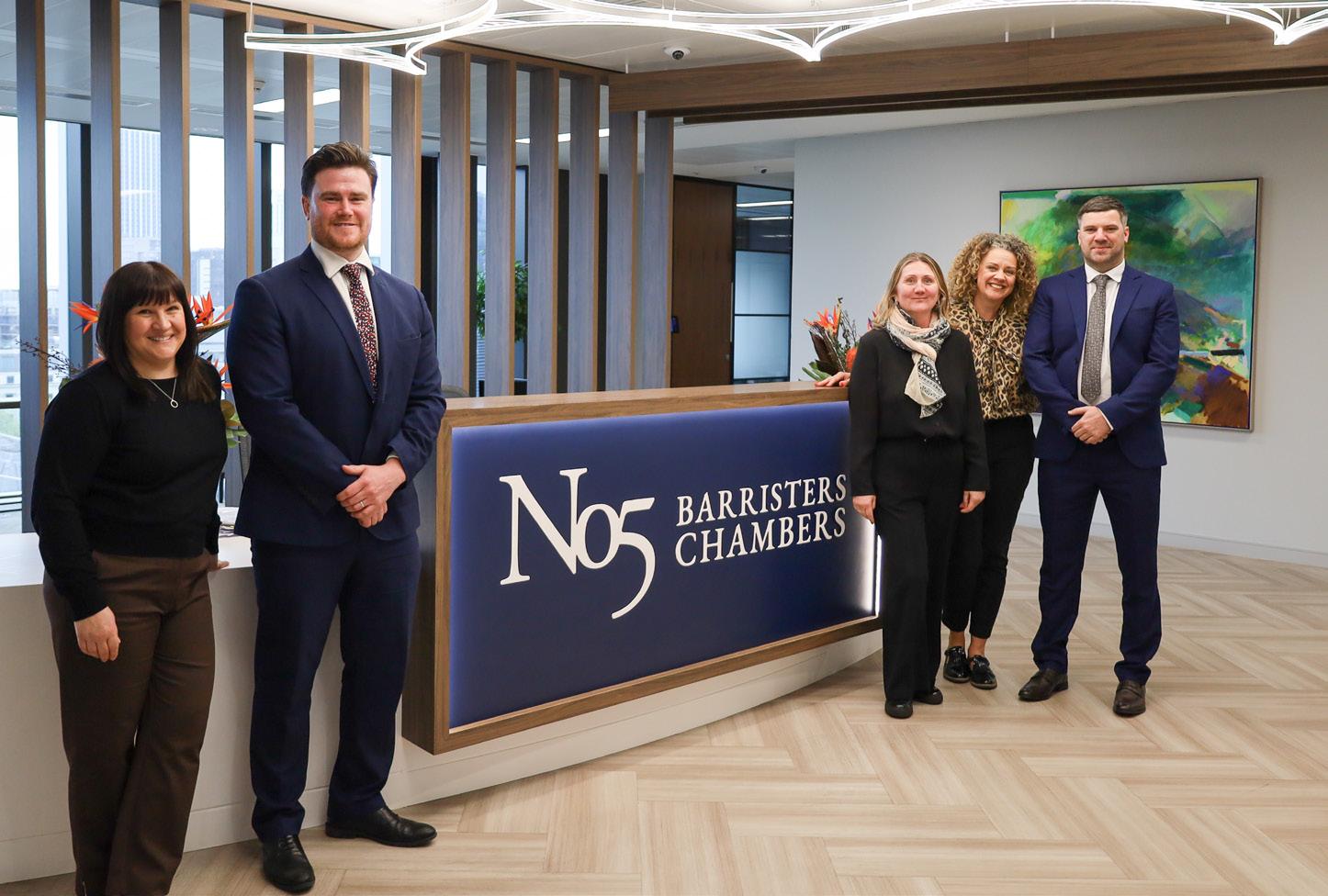
National and international set No5 Barristers’ Chambers has unveiled a new senior management structure with the appointment of a C-suite leadership team as the set looks to build on the sustained growth it has achieved over recent years.
The new structure sees Ian Tullett appointed chief operating officer, Daniel Griffiths appointed chief clerk and Marc Forrest-Thomas appointed chief commercial officer.
These appointments form part of a wider evolution of the set’s leadership and management structure as No5 continues to expand its operations, strengthen client relationships and enhance service delivery across its offices in London, Birmingham and Bristol.
Joint heads of chambers Michelle Heeley KC and Peter Goatley KC said:“The creation of this new senior management structure reflects the scale, ambition and continued development of No5 as one of the country’s leading barristers’ chambers.
“Ian, Daniel and Marc are leading marketplace professionals who each bring significant experience, leadership and expertise to their respective roles. Together, they will play an important part in supporting our continued growth and ensuring we continue to deliver the highest standards of service to our clients, members and wider stakeholders.”
Daniel Griffiths has been with No5 for almost 18 years, having joined as a junior clerk before progressing to business and property practice director and then director of clerking (Birmingham). Recognised by both Chambers and Partners and Legal 500, Daniel is highly regarded for his clerking expertise, client service and leadership within practice management. As chief clerk, he will lead the set’s clerking and practice management functions across all offices, with a focus on delivering service excellence.
Marc Forrest-Thomas joined No5 a decade ago as a clerk before progressing to become practice director for the nationally recognised planning and environment team. He has played an increasingly prominent role in the set’s external engagement and business development activity, regularly representing No5 at industry events and professional forums and is recognised in Chambers and Partners and Legal 500. As chief commercial officer, Marc will oversee No5’s commercial strategy, brand development and wider engagement across the legal and professional sectors.
Ian Tullett returned to No5 as finance director in 2020. Since then, he has played a central role in the set’s strategic and operational development, including overseeing the relocation of No5’s London office to Savoy Court, Bristol office in Queen Square and Birmingham office to 103
Colmore Row. He has led significant improvements across finance, administration, & IT infrastructure (which has just been recognised in Legal Cheek). As chief operating officer, Ian will oversee the day-today operational management of the chambers and the implementation of its long-term strategic development.
Former President of the Birmingham Law Society, Tony McDaid remains an important part of the management structure at No5 in his capacity as Executive Consultant.
Ian Tullett said: “No5 has experienced significant growth over recent years and the creation of this new management structure reflects both the scale of chambers today and our ambitions for the future.
”By bringing together expertise across operations, clerking and commercial development we are creating a structure that will support continued growth while maintaining the high standards of service and support for which No5 is recognised.
“Daniel, Marc and I are all excited to take on these new roles and help shape the continued success and development of No5.”
Marc Forrest-Thomas is the Chair of the Birmingham Law Scoiety LGBTQ+ committee, you can read more about the committee and their upcoming Summer Social on page 20.
Wigs, Gowns and Ambition
Wigs Gowns and Ambition is an informative step by step guide written by a barrister and a solicitor to assist students or those with an interest in obtaining a career in law navigate the process.
The book enables readers to see behind the doors of the court giving them the ability to learn and discover about the legal profession, understand the reality of having a career in law and providing them with a clear insight into what is required of them in their journey to their chosen legal role by providing them with easy to follow informative guidance.
Wigs, Gowns and Ambition was written with the intension of giving students or those with an interest in obtaining a career in law guidance, encouragement and real life insight into the journey they will need undertake to achieve their goal.
The book has been written with the hope that it will resonate not only with students and those with a keen interest in obtaining a career in law but also mentors and professionals who are committed to widening access to the legal profession for those who would like to become part of it.
From studying at university to appearing in court Wigs Gowns
and Ambition is intended to remind its readers that success is not only about wearing a wig and gown, but also about having the ambition to earn them.
The book will be launched on the 1st September 2026 at our official book launch.
As the authors of Wigs Gowns and Ambition we are passionate about providing opportunities to students and those with an interest in obtaining a career in law. Therefore, we have offered three students the opportunity to attend our book launch. We have therefore invited students and aspiring lawyers to write a 500 word essay on ‘What skills will define a successful lawyer in the next decade?’ and will pick the three best authors of the essays and invite them to attend our book launch and receive a copy of the book.
https://wigsgownsandambition.com
CALL FOR ENGAGEMENT
Are culture and gender shaping your clients’ testamentary decisions? The University of Law is pleased to announce a research project led by Graduate Teaching Assistant Priya Varaitch, under the academic supervision of Holly Butler, Senior Lecturer in Law. The project investigates how cultural norms, intergenerational relationships, and gendered expectations shape testamentary decisions.
WHO WE ARE LOOKING FOR: Private client professionals with experience advising South Asian clients are invited to share insights, trends, or challenges emerging in their practice. Your contributions will help ensure that this research reflects real, lived professional experience.
WHY THIS RESEARCH MATTERS
• Advances evidence-based understanding of how culture and gender influence will-making, contributing to efforts to modernise the law of wills.
• Strong community relevance, particularly given Birmingham’s large and culturally diverse South Asian population.
• Offers practical insights to assist practitioners advising clients from these backgrounds on estate planning matters.
Kaur v Estate of Karnail Singh & Ors [2023] EWHC 304 (Fam) highlights the intersection of family dynamics, cultural expectations, and testamentary freedom.
GET IN TOUCH
Priya Varaitch – Graduate Teaching Assistant priya. varaitch@law.ac.uk Holly Butler – Senior Lecturer in Law holly.butler@law.ac.uk
Financial Capability As A Vulnerability Factor: What Might It Mean In
A Divorce Context?
Vulnerability remains an important area of focus within family law. Discussions around participation, domestic abuse, communication needs, trauma, neurodiversity and decision-making all reflect an ongoing exploration of how personal circumstances can affect a client’s experience of the process and, ultimately, the outcome achieved write Victoria Jones, Chartered Financial Planner and Erin Florendine, Principal Lead, Family Wealth & Divorce, (pic’d left to right) Professional Services Channel – Quilter Cheviot.
Alongside these developments, the financial services sector has been developing its own approach to vulnerability. The Financial Conduct Authority (FCA), the sector’s regulator, identifies four drivers of vulnerability: health, life events, resilience and capability. Capability includes financial capability, recognising that a person’s ability to understand and engage with financial decisions can itself influence outcomes.
In the context of divorce, financial capability is particularly relevant. Many clients are required to make decisions about pensions, property, income and future financial security at a time of significant personal change. Some are financially confident. Others may have had little involvement in financial decision-making during the marriage or limited experience of managing wealth independently.
The FCA framework suggests that differences in financial capability may matter because it can influence how someone engages with financial decisions and the outcomes they achieve.
Against that backdrop, a question emerges:
If financial capability is recognised as a form of vulnerability in financial services, should it form part of the wider conversation about vulnerability and fair outcomes in family law?
Family law understandably focuses on participation, communication, safeguarding and effective engagement with the legal process.
The FCA framework introduces an additional consideration: whether an individual is equipped to engage effectively with financial decisions. A client may be fully able to participate in proceedings, instruct their solicitor and understand the legal advice they receive, while still finding it difficult to assess the practical implications of different financial options. Understanding a pension sharing order, for example, is not necessarily the same as understanding what a particular pension outcome could mean for long-term financial security. Notably, financial capability does not tend to feature as a distinct vulnerability category in the way it does within the FCA framework.
If financial capability has a role to play in this discussion, it also prompts a practical question: how might it best be supported?
Family lawyers already work alongside a range of professionals where different expertise can help clients navigate particular aspects of divorce. Financial planners bring a perspective focused on helping clients understand financial options and their implications over time. In that sense, this may be an area worth exploring further. If low financial capability can be viewed as a vulnerability factor, can collaboration between family lawyers and financial planners help address that vulnerability?
This is one of the ideas we have found ourselves reflecting on through the development of our Beyond Settlement Divorce offering, and our work alongside family lawyers. We look forward to exploring this further with practitioners and hearing wider perspectives from across the family law community in an upcoming event we are hosting this October.
To join us on Thursday 8 October (8am – 9.30am) at our Birmingham office (One Centenary Way) for an interactive discussion exploring these questions and their practical implications for clients and the professionals who advise them, please email paige.johnson@quiltercheviot. com to reserve your place.
Want to know more?
Discover how Quilter Cheviot’s Beyond Settlement Divorce offering supports clients through complex financial decisions during divorce, providing clarity, confidence and long-term perspective through a collaborative approach with family lawyers. Visit our website to find out more.
The value of investments, and the income from them, can go down as well as up and past performance is no guarantee of future return. You may not recover what you invest. This material is not tax, legal or accounting advice and should not be relied on for tax, legal or accounting purposes. Quilter Cheviot Limited does not provide tax, legal or accounting advice. You should consult your own tax, legal and accounting adviser(s) before engaging in any transaction.
Quilter Cheviot and Quilter Cheviot Investment Management are trading names of Quilter Cheviot Limited. Quilter Cheviot Limited is registered in England and Wales with number 01923571, registered office at Senator House, 85 Queen Victoria Street, London, EC4V 4AB. Quilter Cheviot Limited is a member of the London Stock Exchange and authorised and regulated by the UK Financial Conduct Authority and as an approved Financial Services Provider by the Financial Sector Conduct Authority in South Africa. This is a marketing communication.
Victoria Jones, Chartered Financial Planner and Erin Florendine, Principal Lead, Family Wealth & Divorce, Professional Services Channel (pic’d left to right) – Quilter Cheviot
The Enquiry You Lost Last Night Went To The Firm Down The Road...
A prospective client visits your website at 9.30 on a Tuesday evening. They’re facing a divorce. They’re frightened, and they need to feel heard. They scroll your team page, read a few lines about your expertise, and find a contact form. They don’t fill it in. They move to the next firm.
This isn’t hypothetical — it’s happening on law firm websites across Birmingham tonight. The firms gaining ground aren’t winning on credentials alone. They’re winning on response.
The first firm to engage a prospective client, meaningfully and at the moment they’re ready, wins the instruction. The second firm does not.
Integriti Systems has built an AI client engagement agent that qualifies, reassures, and captures enquiries around the clock — SRA-aligned, trained on your own firm’s content, sounding like your firm rather than a generic script.
See it working right now, live — type in a real enquiry and watch it respond.
Try the live demonstration at demo.integritisystems.com
Freeths advises on CBPE investment
Freeths has advised the shareholders and management team of Brookbanks Development Group on securing strategic investment from private equity investor CBPE.
Founded in 1997, Brookbanks is a multidisciplinary development consultancy specialising in complex UK development and infrastructure projects. The investment will support growth through investment in its people, services, geographic reach and targeted acquisitions. The existing leadership team will remain in place.
The Freeths team was led by Corporate Partner Mohammed Abbas, supported by specialists across its corporate, employment, banking and finance, and tax teams.
Commenting on the deal, Mohammed Abbas said: “Brookbanks has built an outstanding reputation as a trusted development consultancy, delivering on significant development and infrastructure projects. This investment marks an exciting new chapter for the business and provides a strong platform for future growth.
It was a pleasure to support Paul, Andrew and Richard, and we wish them every success as they embark on this partnership with CBPE. This transaction further demonstrates Freeths’ strength in delivering highquality private equity mandates and our deep sector expertise in the built environment consultancy market.”
Private Client Committee Host Conference
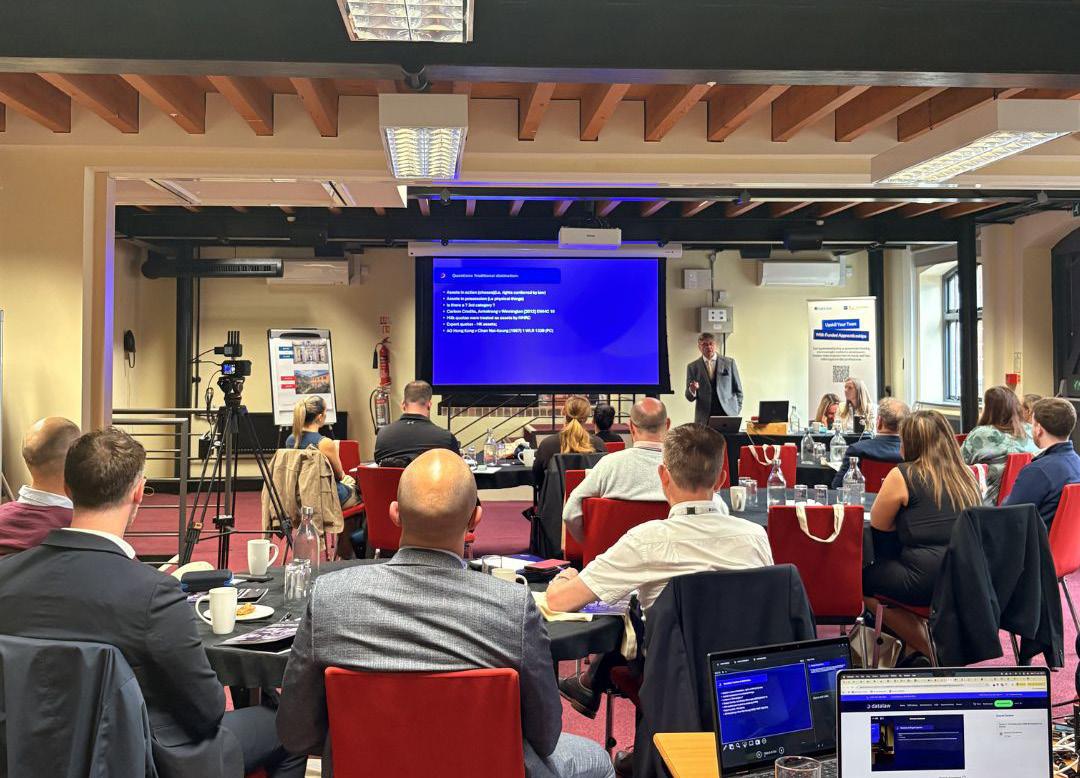
Birmingham Law Society hosted its first conference in collaboration with Datalaw on 17th June at IET Birmingham: Austin Court.
Jessica Beddows, Chair of the BLS Private Client Committee, hosted the day which included an excellent range of speakers from across the legal
profession. In the morning, attendees received a taxation of crypto update from Michael Sherry of Temple Tax Chambers. Michael also ran through some recent tax cases to demonstrate the approach of HMRC in this area. Stephanie Kerr of Irwin Mitchell and Stephen Lawson of IDR Law each provided interesting talks on the area of contentious probate; their combined experience providing some helpful tips for private client professionals to consider in practice. Tax specialist Iris Wuenschmann-Lyall provided an update on the new rules for Business and Agricultural Relief together with a very useful section on potential planning opportunities.
Attendees welcomed the chance to catch up over lunch before Heledd Wyn of Rothley Law provided an update on capacity and financial abuse of vulnerable adults. Gavin McLeod of St Philips Chambers provided the final session, being an update on the role of a private client lawyer in contentious probate cases.
We received great feedback, attendees finding the day insightful and
a good update on key developments across the private client sector. “Excellent conference with some really thought provoking topics that was not only useful but insightful on things we need to think about when determining a clients ability to understand etc.” - Ryan Johnson, Solicitor Advocate, Lloyd Legal Experts.
Datalaw has been sponsoring legal professionals and law firms for over 30 years, providing training to help people progress at every stage of their legal career. A key part of Datalaw’s work is helping firms upskill their employees through governmentfunded law apprenticeships, including the Level 3 Paralegal Apprenticeship and the Chartered Legal Executive Apprenticeship.
Alongside apprenticeships, Datalaw delivers a wide range of professional training, including CPD courses, SQE preparation, CQS training and legal accreditations.
The next collaboration conference will be on Employment Law, taking place on 14th October. More details here.
LGBTQ+ Committee: Reflecting on Pride Month & Looking Ahead
With Pride Month now behind us for another year, it seems like the perfect opportunity to reflect on the past few months and celebrate Birmingham’s legal community coming together to support LGBTQ+ inclusion
Whilst Pride Month takes place every June, Birmingham Pride traditionally kicks off the celebrations over the second May Bank Holiday weekend and this year’s theme, “Power in Pride”, was a powerful one, encouraging LGBTQ+ people and allies to stand together in the face of rising hate crime and growing challenges to LGBTQ+ rights across world.
The LGBTQ+ Committee was delighted to host its annual Birmingham Pride celebration ahead of the parade, beginning with a brunch at No5 Barristers’ Chambers, kindly sponsored by No5 Barristers’ Chambers, Irwin Mitchell and MFG Solicitors. We were thrilled to welcome a record number of attendees, reflecting the continued growth of our network and the increasing engagement of Birmingham’s legal community with LGBTQ+ issues.
Following the brunch, members, colleagues and allies joined the Birmingham Pride Parade, which wound its way through the city centre before finishing in the Gay Village, where the weekend’s celebrations continued. For many, the parade is one of the most uplifting parts of the weekend. It’s an opportunity to come together, celebrate
diversity and show support for the LGBTQ+ community. At the same time, it is important to remember Pride began as a protest and the parade continues to serve as both a celebration and a reminder that the fight for equality is not yet over. This year’s theme resonated strongly with many participants, highlighting that progress should never be taken for granted and that meaningful change depends on communities and allies continuing to stand together.
One of the most encouraging aspects of this year’s Pride season was the level of support shown across Birmingham’s legal sector. At a time when diversity and inclusion initiatives face increasing scrutiny in some quarters, it was heartening to see so many individuals and organisations continuing to demonstrate their commitment to creating a profession where everyone feels able to be themselves.
Looking Ahead
Although Pride Month is over for another year, the work of the Committee continues throughout the year and we are pleased to announce our upcoming Summer Social, which will take place on Thursday 27 August 2026, 6.00pm –9.00pm at Missing Bar, Birmingham.
The event is free to attend and open to everyone. We hope as many members, colleagues and allies as possible can join us for an evening of networking, friendship. Later in the year, we will also be marking Trans Awareness Week, an important part of our annual programme following the success of previous events and discussions focused on trans inclusion and awareness within the legal profession.
Thank you for your continued support of the Committee. We look forward to seeing many of you at our upcoming events and continuing the conversation throughout the year.
Legal Tech Committee Hosts Event On Legal Tech And AI
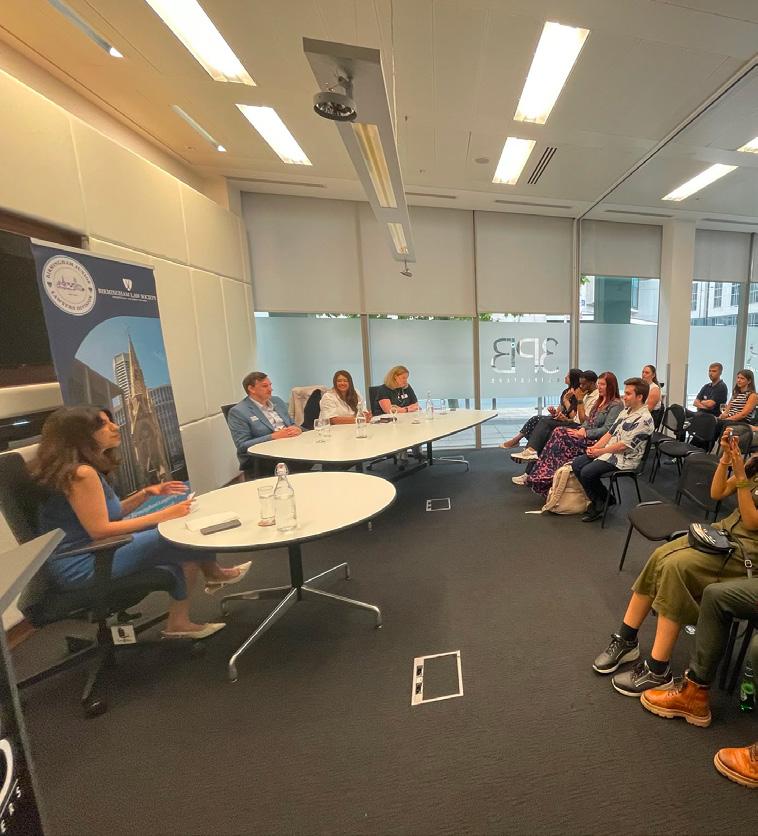
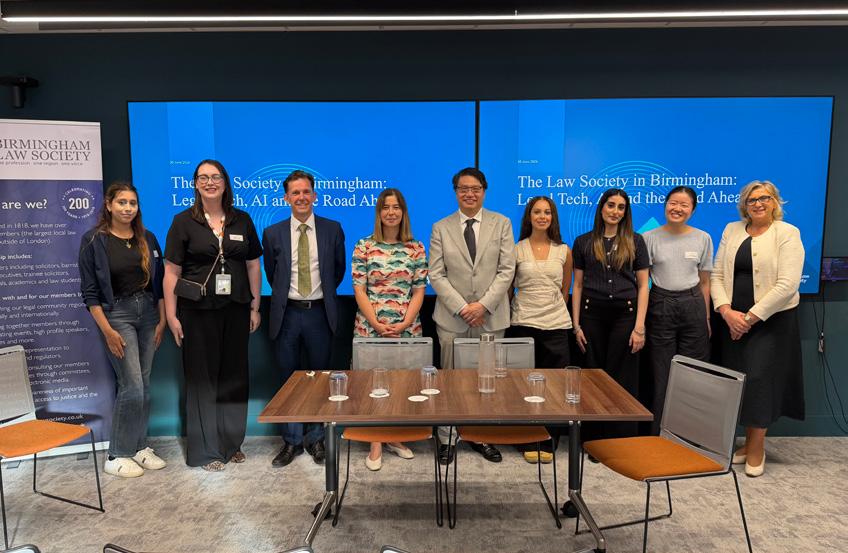
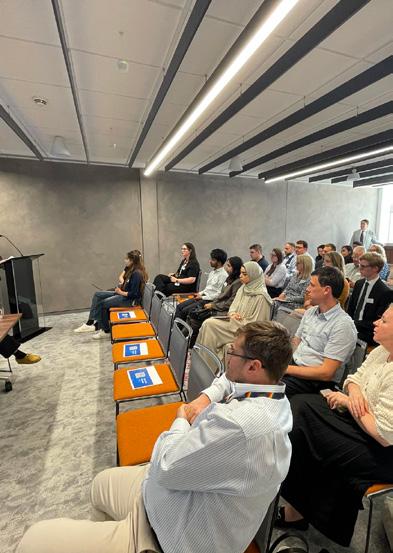
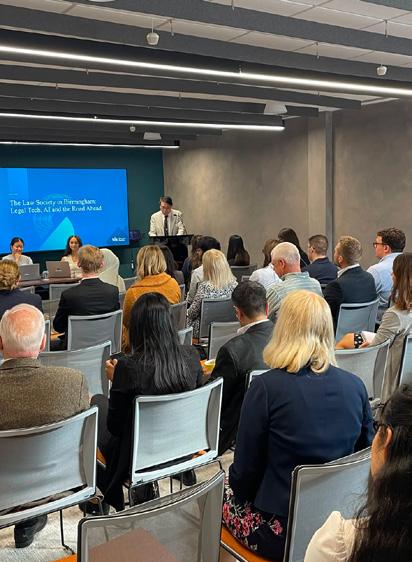
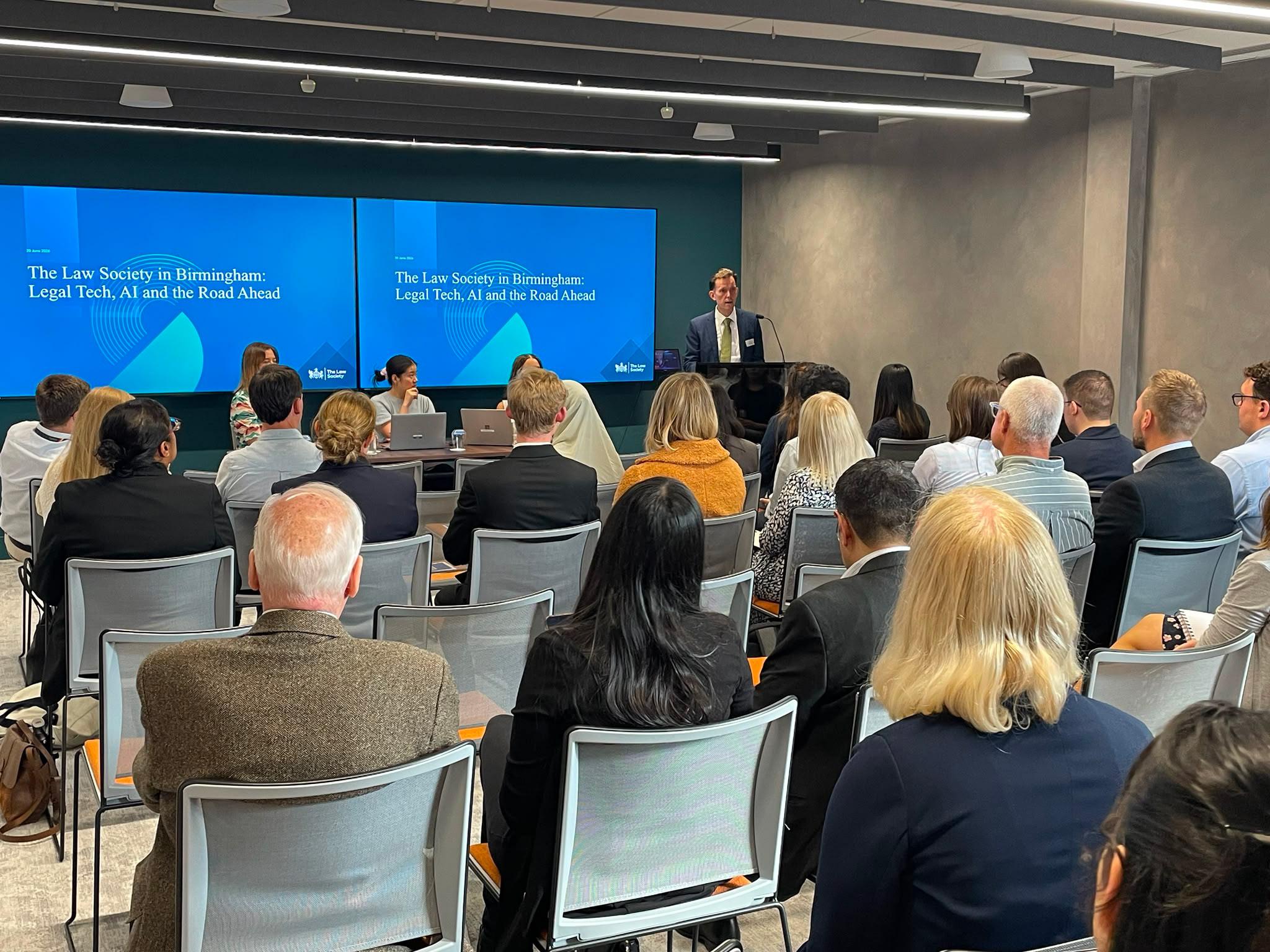
On 30 June 2026, Birmingham Law Society’s Legal Tech Committee hosted “The Law Society in Birmingham: Legal Tech, AI and the Road Ahead” at Gateley in Birmingham.
The event was fully booked in advance and brought together solicitors, legal professionals, students and others interested in the future of legal practice for an evening of discussion with speakers from The Law Society of England and Wales’s technology policy team.
The speakers were:
• Mary Towers, Policy Adviser in Technology Law and Responsible Innovation
• Mia Leslie, Technology Law and Digital Transformation Policy Adviser
• Dr Janis Wong, Policy Manager for Private Law, Technology and Sustainability
The evening opened with welcome
remarks from Matt O’Brien, President of Birmingham Law Society, and from Gateley as host venue. The discussion was chaired by Alan Ma, Chair of the Birmingham Law Society Legal Tech Committee.
The Law Society’s Wider Technology Mission
The presentation explained that technology is now treated by The Law Society as a core strategic issue for the profession, forming part of its wider corporate mission on “Technology, the practice of law and the experience of consumers.” The speakers emphasised that technological change and client expectations are reshaping legal services across all practice settings.
The Law Society’s technology policy work spans a broad range of areas, including:
• artificial intelligence
• cybersecurity
• data protection
• digital assets
• technology in the context of access to justice.
The speakers also explained that their work involves engagement with a wide range of the profession, including large firms, in-house lawyers, SME firms and individual solicitors.
Strategic Goals And Ai Strategy
The Law Society outlined four strategic technology goals:
1. supporting firms and organisations in technology adoption;
2. supporting members on cybersecurity;
3. AI regulation in support of legal practice; and
4. ethical use of justice technology.
Particular attention was given to The Law Society’s AI Strategy, which is built around three pillars:
• Innovation – AI should be used
Committee News Cont’d
across the legal sector in ways that benefit firms and clients;
• Impact – the legal sector should help inform and influence the wider AI regulatory landscape;
• Integrity – AI should be used responsibly and ethically in support of the rule of law and access to justice.
Practical Resources For The Profession
A useful part of the presentation focused on the practical resources that The Law Society is developing and publishing for members. These include general AI resources, procurement guidance and technology-related materials for firms. Particular interest was shown in The Law Society’s Buying New Technology Guide, which was presented as a step-by-step guide to buying and embedding legal technology, helping members avoid risk and make informed decisions, with downloadable templates to support each stage.
AI, regulation and the profession The event also explored the increasingly important relationship between AI and professional regulation. The speakers distinguished between:
• broader government regulation of AI;
• sectoral regulation by bodies such as the Legal Services Board and Solicitors Regulation Authority; and
• the Law Society’s own role in representing members and providing guidance and support.
The Law Society team noted that there are currently no plans for general AI regulation, but that government activity remains shaped by a growth and innovation agenda, including the AI white paper (2023) and work led by the Department for Science, Innovation and Technology.
The presentation also referred to ongoing work by the SRA and LSB, including research into consumer attitudes to AI in legal services and anticipated SRA resources on how AI and technology use map onto professional obligations.
AI Growth Lab And Opportunities For Input
Another important theme was
the developing legal services AI Growth Lab, being taken forward by government departments including DSIT and the Ministry of Justice, working with regulators and oversight bodies. The stated aim is to support responsible AI adoption in legal services.
The speakers made clear that local firms and practitioners can help shape that work by sharing:
• where AI could support practice;
• what regulatory questions are causing uncertainty;
• what regional firms need in order to engage confidently; and
• how lessons from pilot activity should be shared across the profession.
That point was especially welcome in Birmingham, where there was clear interest in ensuring that regional voices are heard in national conversations on legal innovation.
AI And The Justice System
The event also addressed the use of AI in the justice system, including developments in both civil and criminal justice. On the civil side, discussion included AI in court documents, transparency and the Civil Justice Council consultation response. On the criminal side, the presentation referred to the Leveson recommendations, Crown Court use of AI, and engagement with HMCTS, the Ministry of Justice and other relevant bodies.
Emerging Themes
One of the most valuable slides in the presentation identified a set of emerging themes that are likely to shape future discussion across the profession:
1. liability and accountability;
2. responsible and ethical AI use;
3. the changing relationship with clients;
4. change management and transition;
5. understanding what AI is and how it should be used;
6. access to justice and the rule of law;
7. collaboration and agility.
These themes resonated strongly with the audience and helped frame the Q&A that followed.
Legal Education, Training And The Next Stage Of Guidance
The latter part of the presentation also highlighted the importance of education and training in the age of AI, linking the future of legal services to wider questions of sector guidance, regulation, delivery expectations and the voice of the profession.
Finally, the speakers referred to planned work on an AI Practice Note, which is intended to:
• explain how existing professional duties apply to AI;
• provide practical guidance and examples; and
• support informed and responsible adoption and use of AI.
The audience also heard that user testing is planned for August 2026, and that The Law Society is actively inviting input into the final guidance.
A valuable Birmingham discussion
The event prompted a lively discussion on the practical implications of AI for firms, the challenge of technological competence, the needs of junior lawyers, the position of smaller and medium-sized firms, and the relationship between legal education and evolving professional expectations.
The Birmingham Law Society Legal Tech Committee is grateful to The Law Society speakers for travelling to Birmingham and contributing to such an informative session, to Gateley for hosting the event, and to Birmingham Law Society colleagues for their support in organising and promoting it.
The evening showed clearly that there is strong appetite within the Birmingham legal community for informed and practical discussion about legal technology, AI and the future direction of the profession.
Paralegal to Chartered Legal Executive: New Funded Apprenticeship
Are you working in a law firm and want to gain your practice rights? You can. There is a government-funded route to a solicitor-level qualification that lets you keep earning while you train. The Chartered Legal Executive apprenticeship takes experienced paralegals and fee-earners from their current role to fully qualified CILEX Lawyer status. This article explains how the route works, why it can be a faster path than qualifying as a solicitor, and how Datalaw supports both individuals and employers, with a cohort starting on 19 August 2026.
Paralegal to practice rights: how the Chartered Legal Executive Apprenticeship works
In January 2026, the funding rules for Level 7 apprenticeships changed. Government funding was withdrawn for anyone aged 22 or over, and that includes the Level 7 Solicitor Apprenticeship. For many people already working in a law firm, the route to becoming a solicitor
suddenly looked daunting: with no funding to cover the SQE exams and solicitor training, the cost of qualifying landed back on the individual or their employer. This is where the Chartered Legal Executive apprenticeship comes in. It is a Level 6 programme, so it is not affected by the Level 7 funding changes. It sits at the same academic level as an honours degree, it lets people already working in the sector qualify on the job, and allows them to gain their practice rights in a chosen specialism.
The qualification is approved by CILEx Regulations who have recognised Datalaw as an approved training and exam centre for this qualification. If you are a paralegal, a legal assistant, or a fee-earner supporting a caseload, much of your day-to-day work feeds straight into your training.
Who the programme is designed for
• Paralegals and legal assistants who want to formalise their skills and
move up to a regulated, lawyer-level qualification.
• Employers looking to grow and retain talent by training existing staff into solicitor-level practitioners that can specialise in your firms area of law.
• Anyone put off by the cost of the traditional university-then-exams route to qualifying.
If you are looking to become a trainee solicitor, the Level 5 Advanced Paralegal Apprenticeship route is a natural first step that can lead on to this Level 6 programme, and prior qualifications such as a law degree can earn exemptions that shorten your training.
No SQE: specialise and earn practice rights sooner
This is where the Chartered Legal Executive route differs from becoming a solicitor. The traditional solicitor
to Gain Practice Rights
pathway runs through the Solicitors Qualifying Examination (SQE), a set of centralised assessments that cover the full breadth of legal practice. The CILEX route does not require you to sit the SQE at all. Instead of proving broad competence across every area of law, you train and qualify in the specialism you actually work in and take your exams as part of your apprenticeship.
That focus is an advantage. Because you are not spread across every practice area, you can build real expertise where it matters to your firm and work towards the specific practice rights (such as the rights to conduct litigation or advocacy) that CILEX Lawyers can hold.
What you gain as a CILEX Lawyer
• Gain Chartered Legal Executive status, the same professional level as a solicitor.
• Regulated professional status, with
the protected title of CILEX Lawyer.
• The ability to specialise deeply in one area of law rather than qualifying as a generalist.
• A pathway to practice rights in your chosen field, gained through CILEX rather than the SQE.
• No tuition-fee debt, because the training is government-funded through the apprenticeship.
Want the solicitor title too? You can dual-qualify
For some people, being recognised at the same level as a solicitor is enough. For others, the solicitor title itself matters, whether that is with clients, with employers, or to them personally. The two are not mutually exclusive. Once you have qualified as a CILEX Lawyer, you can choose to dual-qualify and go on to become a solicitor.
The Solicitors Regulation Authority already treats qualified CILEX professionals as lawyers, which streamlines the process. CILEX Lawyers may also be eligible to apply for exemptions from parts of the SQE, based on the qualifications and experience they have already built (the detail is on the SRA’s Chartered Legal Executive pathway page). So the Chartered Legal Executive apprenticeship does not lock you out of becoming a solicitor. It is a funded, lower-risk way to reach lawyer status first and then step up to solicitor when you want to.
How Datalaw supports you and your employer
Enrolling onto an apprenticeship can feel like a lot of work however the qualification duration matches the same time it would take to do it privately. It can also feel daunting, especially when funding, eligibility, and employer sign-off are all part of the picture. That is where Datalaw comes in. We support everyone through the process, from individuals weighing up their options to employers who want to train several members of staff at once.
Every apprentice and employer we work with is given their own dedicated apprenticeship training manager. You are never left to
work out the paperwork or the apprenticeship rules on your own.
What happens when you get in touch
• We explain how apprenticeship funding works for your situation, whether you are an individual or an employer.
• We check eligibility and map any exemptions from prior qualifications or experience, which can shorten your route.
With a cohort beginning on 19th August 2026, there is comfortable time for interested candidates and employers to get their questions answered, complete enrolment, and begin training with the group. When you are ready to take the next step, register your interest in the Chartered Legal Executive apprenticeship to get access to the next steps.
Key Takeaways
• From January 2026, government funding for Level 7 apprenticeships, including the Level 7 Solicitor Apprenticeship, was withdrawn for anyone aged 22 or over.
• The Chartered Legal Executive apprenticeship is a degree equivalent programme now providing as an alternative route for the Level 7 Solicitor pathway.
• It is designed for people already working in a law firm, including paralegals and legal assistants, who can train while they earn.
• There is no SQE. You specialise in your chosen area of law and progress towards practice rights as a qualified CILEX Lawyer.
• If the solicitor title matters to you, you can dual-qualify after becoming a CILEX Lawyer, often with SQE exemptions.
• Next cohort for the Chartered Legal Executive Apprenticeship is 19th August 2026.
AI Use- Regulatory And Compliance Considerations
The use of AI in law firms is never far away from the headlines these days and the recent Pinsent Mason’s case brought into sharp focus the risk of unchecked AI writes Rebecca Atkinson, Solicitor and New York Attorney at McArthur Akinson.
In that case, Pinsent Masons were found by the Insolvency and Companies Court to have misled them not once but astonishingly twice; once by providing references which featured AI hallucinations, then a second time by using AI to produce a letter explaining the misuse of AI that was still wrong.
The judge commented that an unnamed junior lawyer seemed to have ‘almost entirely outsourced the thinking process’ to an AI program, while a solicitor and partner had failed to supervise the junior properly. One could argue that no one was supervising the AI.
The judge also commented that it would be disproportionate to consider contempt proceedings but added that there was, a prima facie case of a breach of the duty not to mislead the court and the duty not to waste court time.
This must be a highly embarrassing case for Pinsent Masons but they will not be the first and last, there will be others who have not got to grips with the weaknesses of AI and implemented frameworks for its use. In this article we will go through the key considerations law firms should be thinking about when implementing AI to ensure as far as possible the risk of incorrect output is mitigated.
Understanding need, choosing AI and ensuring client confidentiality
The first step any firm should take is understanding the need they are trying to meet whether that be using AI to help draft, research or summarise amongst other activities. Firms need to consider what it is that they are trying to achieve. Generally speaking, that will be efficiencies in relation to client work or internal activities.
With a plethora of AI platforms on the market, it is important to carefully
choose a platform that provides a firm and its staff the output sought. Of paramount importance is the preservation of client confidentiality. No client data should be uploaded into a platform where that data can be utilised or reproduced for those outside the firm to see or use. ChatGPT for example is an opensource platform and whilst it may not reproduce client data in the same way as it is put in, feeding it client data would be a breach of confidentiality. Loss of legal privilege also needs to be considered.
Thoroughly testing and understanding the AI platform
No technology in a firm should be blindly implemented. It must be thoroughly tested and understood. Whilst such testing may be undertaken centrally in a firm, it is always best to include the people who will be using the technology to test and feedback on it. Firms could select a few lawyers to pilot a new platform with guiderails for what is and is not permissible for its use.
As far as possible firms should understand how the platform works. Not the inner coding and such like but generally what it does and how it does it. This will help with understanding the risks.
Recognise the risks and address them
No technology is perfect and AI is most certainly not. We have all seen the many stories of AI hallucinating (see Damien Charlotin’s excellent website where he logs AI hallucination cases https://www.damiencharlotin. com/hallucinations/) and the ways in which lawyers are not checking the AI output properly landing them in rather hot water.
Most if not all AI output that is being used for client work needs to have some form of human interaction and judgement applied to it. Yes, it can help with a first draft but that draft must then be reviewed, checked over and amended.
Firms should consider what, if any, SRA Standards and Regulations could be breached with the use of AI and consider how they will mitigate that possibility. This includes considering whether the use of AI is in the client’s best interests and whether its use
upholds the trust and confidence in the solicitor’s profession. In addition, firms should consider AI as something which it must supervise closely much like a junior lawyer whose output must be checked.
Firms should not view AI as a way to expand into practice areas they do not normally practice and ultimately under the SRA regime, lawyers remain accountable for the work carried out.
Firms should consider discussing their use of AI with their PI insurer to understand coverage in the event that AI is not used appropriately. AI is likely to feature in any renewal discussion and so firms should be ready to explain what AI they use, what it does and how it is checked. Clients should be informed about the firm’s use of AI and this would normally be provided in the firm’s terms of business. However, if the use of AI is dominant in the work being undertaken, it may be prudent to highlight this issue to the client at the beginning of the retainer.
Firms should consider completing a risk assessment document for each AI technology adopted considering the risks and outlining how they will be addressed.
Having a clear framework for how AI should be used, policy and training
It must be absolutely clear to users of AI in the firm that it is not a magical cure. Nor will it, in the writer’s opinion, put people out of jobs, instead it will change how people work.
AI must be used properly and treating an AI product like one might treat a browser search engine will not work.
All firms that use any AI platform should have an AI policy which sets out what the AI does, how it should be used and not used, that checking the output in respect of client work is an absolute must and that no other AI technology that has not been approved by the firm can be used (this should have attached to it a warning that breach will lead to disciplinary action).
All those who are using AI in a firm must be trained on how it should be used for maximum output. Using AI is a skill that needs to be learnt. Training should cover the risks of hallucinations and how to prompt the AI to undertake the task required.
Master of Laws and Legal Practice (LLM)
Academic excellence. Professional preparation. One integrated Master’s.
Prepare for qualification as a solicitor through Aston University’s Master of Laws and Legal Practice (LLM), combining academically rigorous postgraduate study with integrated SQE1 and SQE2 preparation delivered in partnership with BARBRI
Everything you need. One integrated Master’s.
Integrated SQE1 & SQE2 Preparation
Everything you need for both stages of the SQE in one integrated Master’s programme.
Academic Excellence + BARBRI Expertise
Benefit from Aston University’s academic rigour combined with BARBRI’s recognised SQE expertise.
Guaranteed Internship Opportunity
Gain valuable workplace experience and apply your legal knowledge in a professional legal environment before you graduate.
20% Aston Graduate Discount*
Exclusive tuition fee discount for eligible Aston graduates.
*Terms and conditions apply.
Also includes
Flexible Blended Learning
Combine face-to-face teaching at Aston with BARBRI’s flexible online SQE learning platform.
In partnership with
APPLICATIONS NOW OPEN September 2026 Entry
Aston Global Advantage
Develop the commercial awareness, leadership and professional skills today’s legal employers value.
Funding Your Future
Government Postgraduate Master’s Loan available for eligible UK students.
Scan to learn more
More Than SQE Preparation: Aston’s New LLM Equips Future Solicitors for Modern Legal Practice
As the route to qualification as a solicitor continues to evolve, Aston Law School has launched a new postgraduate programme designed to meet the changing needs of aspiring lawyers, legal employers and the profession more broadly.
The new Master of Laws and Legal Practice (SQE1 and SQE2 Preparation), commencing in September 2026, combines a full academic LLM with integrated preparation for both stages of the Solicitors Qualifying Examination (SQE) through a partnership with leading legal education provider BARBRI.
While a growing number of providers offer SQE preparation, Aston’s programme is distinctive in combining professional exam preparation with academic rigour, employability development and practical legal skills within a single master’s degree. Students develop the legal knowledge required for SQE1 and the practical legal skills assessed in SQE2, while also undertaking advanced study in legal research, legal analysis and contemporary legal issues.
A key differentiator is Aston University’s longstanding commitment to employability. Every master’s student is guaranteed an internship opportunity, while the University’s flagship Aston Global Advantage module helps students develop the professional, commercial and leadership skills increasingly sought by law firms and in-house legal teams.
The programme has been developed in partnership with BARBRI, which brings more than 55 years of legal education expertise and a global community of over 1.4 million alumni. Students benefit from BARBRI’s evidence-based learning methods, personalised study plans, extensive practice-question banks, simulated examinations and advanced learning technology, alongside dedicated support from Aston academics and professional staff.
Importantly, the programme has been designed to fit around the realities of modern legal careers.
Although students will attend Aston’s Birmingham campus, SQE preparation materials are delivered online through BARBRI’s learning platform, creating a flexible blended-learning model that supports different learning styles and commitments.
This flexibility also creates opportunities for legal employers. Law firms and organisations seeking to support paralegals, trainee legal professionals or junior members of staff towards qualification may find the blended structure particularly attractive, enabling employees to combine professional development with specialist SQE preparation and postgraduate study.
Dr Kristie Thomas, Head of Aston Law School, said:
“The introduction of the SQE has created new opportunities, but
also new challenges, for aspiring solicitors. We wanted to design a programme that goes beyond exam preparation to develop well-rounded legal professionals who can thrive in a competitive and rapidly changing sector.
“What makes Aston’s LLM distinctive is the combination of academic excellence, integrated SQE preparation, personalised support, employability development and guaranteed internship opportunities. Students will graduate not only with a master’s degree and preparation for qualification, but with the broader skills, confidence and professional experience that employers increasingly value.
“The programme is also an exciting opportunity for legal employers looking to invest in existing staff and support future talent development. Our flexible approach means students can benefit from highquality postgraduate education while preparing for professional qualification through a structured and supported pathway.”
The programme is open to applicants with a 2:2 UK honours degree or equivalent qualification in law or a related discipline, with applicants from other academic backgrounds considered on an individual basis.
For the 2026/27 academic year, tuition fees for UK students are £14,000, with SQE examination fees paid separately to the Solicitors Regulation Authority. Aston University graduates will automatically receive a 20% alumni loyalty scholarship as a tuition fee discount, reducing the cost of study for those progressing directly from Aston undergraduate programmes. Eligible students may also be able to access UK postgraduate loan funding to support both tuition fees and living costs.
Applications are now open for the September 2026 intake, offering aspiring solicitors a unique opportunity to combine postgraduate study, professional development and SQE preparation within a single integrated programme. Further details and a link to apply can be found at: https:// www.aston.ac.uk/study/courses/ master-laws-and-legal-practice-llm or any questions about the programme can be sent to Kristie Thomas at k.thomas5@aston.ac.uk
The Over-Compliance Problem in UK Law Firms
Three-quarters of firms seeking investment now favour private equity as sector faces a “once-in-a-generation” transformation according to survey of UK law firm leaders
Private equity has overtaken merger and partnership as the preferred growth strategy among UK law firms seeking investment, according to new research from leading legal technology provider Dye & Durham. According to the results: Among firms seeking investment, 75% now favour private equity, while only 52% cite the traditional route of merger or partnership. The finding is among several key insights from the extensive research that appear to signal a oncein-a-generation shift in firms’ attitudes to investment, technology, and growth.
The data suggests the market shift may be more advanced than many in the profession realise. While previous research has tracked private equity deal volumes and the extent to which firms have been approached by investors, this is believed to be among the first studies to measure law firms’ own investment preferences, finding a marked shift toward private equity and away from the traditional merger or partnership route.
Speaking about the release of the report today, Colin Bohanna, Managing Director of Dye & Durham UK, said: “This research confirms what many in the profession are increasingly alert to, and which many more have yet to realise: there is a monumental shift taking place in the UK legal market, and it will affect every part of the profession.
“While the traditional merger and partnership model is in no danger of going away, there is a remarkable transformation taking place in UK law,
one that is changing how law firm leaders operate and which will have a growing influence in years to come. We hope this research will be a useful tool to the industry in navigating a way forward.”
Other key findings of the research include:
● 86% of legal professionals polled in a live survey agreed that the business model of UK law firms has evolved more in the past 10 years than in the previous 20
● 88% of senior leaders agreed their technology platform signals their firm’s maturity to external investors
● 80% said financial performance expectations are higher today than five years ago
● 45% cited talent recruitment and retention as the single biggest barrier to scaling
The report draws on an independent survey of 200 senior leaders at mid-sized and large UK law firms, conducted by Arlington Research, with 80% of respondents from firms with 50 or more fee earners. Dye & Durham supplemented this with a live poll at the British Legal Technology Forum and an in-depth interview with Adrian Jaggard, CEO of Taylor Rose and AIIC Group.
Market analysis
The complete whitepaper of the research findings – The Future of UK Law Firms 2026: Changing Leadership, Capital, and Operating Models – also draws attention to what is likely driving these changing attitudes, specifically a
“trifecta” of forces driving the shift: the growth of the consultant model (now over 4,000 practitioners) , the rise of alternative business structures (from 8% of SRA-regulated firms in 2017 to 13% by 2022/2023) , and an unprecedented influx of private equity (£1.2bn invested over five years, with a record £534m in 2024 alone) with 70% of mid-sized UK law firms approached by private equity investors in 2025. Together, the paper argues, these forces are reshaping not just how firms are financed, but how they operate and compete.
The full report can be found at: dyedurham.co.uk/resources/ebooksreports/
About the research
The Future of UK Law Firms 2026: Changing Leadership, Capital, and Operating Models is based on:
● An independent survey of 200 senior leaders and technology decisionmakers at mid-sized and large UK law firms, conducted by Arlington Research between 20 January and 4 February 2026. Respondents included equity partners, salaried partners, C-suite executives, practice managers, and consultant lawyers. 80% were from firms with 50 or more fee earners.
● A live poll of 51 attendees at the British Legal Technology Forum (BLTF) 2026, one of Europe’s largest legal technology conferences.
● An in-depth interview with Adrian Jaggard, co-founder and CEO of AIIC Group and Taylor Rose, one of the UK’s largest consumer-facing law firms.
Anti-money laundering compliance, in
theory, is mandated and designed to help firms identify risk and to counteract legitimate concerns about criminals who may be hiding or moving illegally obtained money. Increasingly, in practice, those legal professionals working in compliance or who are obligated to perform compliance checks report that is becoming timeand resource-heavy and a major stress for the industry.
That was the central concern raised at a recent Dye & Durham-Modern Law roundtable on AML in conveyancing, which brought together conveyancers, compliance leads and legal technology specialists from across the sector.
Chaired by Founder and CEO of Teal Compliance Amy Bell, the discussion set out a problem that will be familiar to most firms handling residential property work: compliance processes that keep expanding, without a corresponding increase in confidence that they’re actually catching the right things.
The 3 Major Compliance Challenges Law Firms Face
Dye & Durham partnered with Modern Law on this roundtable to capture the sentiment of diverse legal practitioners and the issues they face in relation to meeting compliance demands and regulation. Three distinct compliance challenges were identified by the 13 conveyancers, compliance leads, and technology specialists in discussion.
The first was the sentiment that documentation has become a substitute for judgement rather than a way to understand one’s clients. Many of those in attendance report that they are collecting more evidence not because it clarifies risk, but because it’s easier to defend a thick file than a thin one if a regulator asks questions later. In short, firms may be collecting documents in anticipation of a regulator review rather than to fully understand a client.
The second was the increasing stress levels and toll this over-compliance was taking on staff with fee earners absorbing growing volumes of compliance work, much of it unbillable, on top of caseloads that were already stretched. As several participants reported, a culture of over-documenting has become the safer default, even when it adds nothing to the risk assessment itself, with newer lawyers in particular entering a profession where the fear of getting AML wrong shapes almost every decision.
The final issue reported was the inefficiency of duplication of processes
and document collection with clients routinely asked to provide the same identity and source of funds evidence to multiple firms during a single transaction.
Advice on Compliance From Legal Practitioners
What can conveyancing firms do to cut down on these concerns and the practice of over-compliance? In the roundtable discussion, several pragmatic fixes emerged that firms can act on now without waiting for further regulatory clarity.
● Apply a proportionality test to every request. Before adding a document to a file, ask whether it changes the firm’s understanding of the client’s risk. If it doesn’t, ask where it needs to be collected or whether it is being collected out of overcaution.
● Set an internal and agreed bar for collection before any matter starts. Deciding in advance what “sufficient” looks like for each risk tier prevents requests escalating ad hoc once a file is already underway and a fee earner is under pressure to be seen as meeting (or exceeding) requirements.
● Redesign training around reasoning, not repetition. Annual, box-ticking AML training was singled out in the roundtable as ineffective. Instead, shorter, scenario-based formats were favoured, on the basis that staff who understand why a check exists apply it more sensibly than staff who are simply following a script.
● Review checklists on a fixed schedule. Requirements added in response to a specific past incident tend to outlive their relevance. A periodic review keeps checks tied to actual risk rather than accumulated caution.
● Explain the reasoning to clients. When clients understand the purpose of a firm’s checks, they are much more likely to comply. Much of the friction clients raise (and frustration that might result) isn’t about the existence of AML checks; it’s about the lack of explanation for why the same information keeps being requested.
Where Technology Can Help to Minimise Necessary Compliance Checks
The consensus at the roundtable was that automation has moved from a nice-to-have to close to a necessity, but only once a firm has already worked out what proportionate looks like.
Applied on top of a checklist that already over-collects, any technology that is used will just result in a faster over-collection. In contrary, when
used well, technology can effectively remove the parts of the process that add cost without adding insight. Dye & Durham’s Unity® platform, for example, integrates biometric ID and liveness checks, Safe Harbour verification for vendors and purchasers, and source of funds checks through open banking, directly into the case file, so results return in real time and the audit trail builds itself as the matter progresses, rather than being reconstructed after the fact. Layer on PEPs and Sanctions checks and you can identify clients on sanctioned lists or as a politically exposed person immediately. That kind of integration addresses the duplication problem in a limited but meaningful way too: firms triggering checks from data they already hold spend less time re-requesting information the client has already provided elsewhere in the same transaction.
What technology doesn’t do, however, is replace the judgement that tells an experienced conveyancer when something isn’t quite lining up with a client. Honing those instincts and using checks to verify remains an important skillset for anyone in compliance.
Final Takeaway
For any professional fielding these checks day to day, the roundtable’s conclusion will likely match your own experience: the volume of AML work has grown faster than anyone’s confidence that it’s catching the right things.
The way to challenge that reality isn’t necessarily to collect more documentation; rather, it’s ensuring that the processes and technology you and your firm adopts matches the compliance need, in a way that makes both firms and regulators confident that a firm truly knows their client.
This piece draws on discussion from the Modern Law roundtable series, hosted by Dye & Durham and chaired by Amy Bell. Read the full roundtable in Modern Law Issue 82.
About Dye & Durham Limited
Dye & Durham Limited provides premier practice management solutions empowering legal professionals every day, delivers vital data insights to support critical corporate transactions and enables the essential payments infrastructure trusted by government and financial institutions. The company has operations in Canada, the United Kingdom, Ireland, Australia and South Africa. Additional information can be found at www.dyedurham.co.uk