

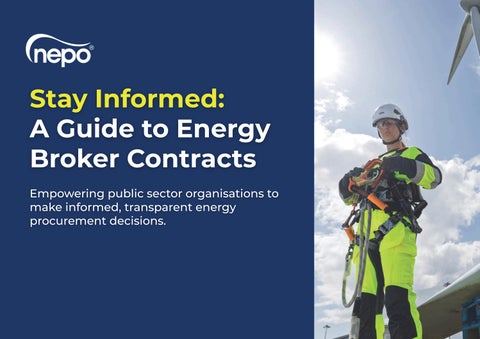
Making an informed decision starts with asking the right questions.
Public sector consumers have a responsibility to ensure transparency, value for money, and regulatory compliance when procuring energy.
When working with a third party to purchase your energy requirements, asking the right questions is critical to securing the best deal and avoiding hidden costs or conflicts of interest.
What this guide covers:
The role of brokers (TPIs)

Key differences between brokers and Public Sector Buying Organisations (PSBOs)
Questions to ask brokers
Risks, fees and transparency considerations
How to stay compliant with procurement regulations
What is a Third Party Intermediary (TPI)?
A TPI, also referred to as an energy broker, consultant or agent, is an intermediary party who helps energy consumers find and secure energy supply contracts, typically for electricity and natural gas.
What are the payment terms that will be offered?
This is important to check, as the payment terms must be appropriate for your organisation. TPIs will usually offer payment terms of 10 days by Direct Debit. While many public sector bodies offer varied payment terms and payment methodologies, with some offering discount for faster payment.
What is the difference between a TPI and a Public Sector Buying Organisation (PSBO)?
While TPIs and PSBOs may both help public sector bodies purchase energy, they are very different in structure, purpose, and accountability.
A PSBO is a non-profit body that aggregates buying power for public sector clients, who are legally required to be transparent and auditable in all procurement activity they carry out.
A TPI is a private, profit driven business that is not obligated to follow public procurement regulations.
Is the TPI able to provide full transparency on contract terms and conditions?
It is important to determine any undisclosed fees, auto-renewal clauses or termination penalties. Some TPI’s will also include clauses that allow them to access your information beyond the life of the contract which could cause problems when transferring to a new contract provider.
Can the TPI provide a full breakdown of their commission or fees in writing in advance?
Commission-based TPIs may have incentive arrangements with certain suppliers, potentially compromising your best interests. If the fee is built into the supplier’s rate, you could be paying more than you realise. Hidden fees reduce transparency and accountability.
How much will the commission cost p/kWh and over the full contract period?
You should ask the TPI how much commission they will charge p/kWh, and what this will equate to over the life of the contract period being agreed.
Are there any penalties for early termination?
You could be locked into an expensive or unsuitable contract if the terms are too rigid.
Does the TPI use a competitive tender process aligned with public procurement regulations?
Public sector procurement is legally bound to be fair, open and transparent. Non-compliance could lead to legal challenges or procurement delays.
Does the TPI offer fixed, variable, or flexible purchasing contracts, and what are the pros and cons for each?
Each type carries different levels of price risk and budget certainty. A TPI should help you align contract type with your risk appetite and financial planning requirements.
Will ongoing support / an account manager be provided with a TPI?
You may not receive the full service that is typically offered by a PSBO, such as contract management and support with billing disputes. In addition, if your organisation leaves NEPO’s energy frameworks, it can also prevent your local authority from being able to deliver the energy management Service Level Agreement (SLA) within budget, as these services are designed and resourced on the basis of framework participation.
Will a TPI monitor usage and alert us to anomalies?
Changes in usage could indicate equipment issues, leaks, or inefficiencies. Early detection helps avoid unnecessary costs. You will need to check with the TPI if this is something they provide, if not you may need to be more vigilant in monitoring your usage and equipment.
If the supplier fails to supply, how will a TPI support continuity?
It is imperative to know how quickly and effectively a TPI can respond to ensure your energy supply isn’t disrupted. The terms and conditions you are offered should have clauses in to cover these types of events.
Will access to supplier portals be included within their offer?
You should try and ensure that you will continue to get full access to any available supplier portals, to ensure that you can have better control and transparency of data including half-hourly consumption data.
TPIs may play a role in the energy market, but they are not all created equal.
Choosing the right partner protects your budgets, data and public duty.
Print off our useful toolkit on the next two pages to use when dealing with TPI brokers.
Use NEPO’s compliant energy solutions for trusted, transparent procurement. Get in touch:
energy@nepo.org
nepo.org/energy
At times, brokers or other third parties may submit Freedom of Information (FoI) requests to find out what customers are paying for their gas and electricity. While you are legally required to respond to these requests, you are not obligated to disclose all the information they seek. Some details may be classified as exempt, meaning they do not need to be released. For example, when it comes to FoI requests about energy expenditure, the rates charged under the NEPO framework are considered commercially sensitive and are therefore exempt from disclosure. If you have any questions regarding this, please don’t hesitate to contact NEPO direct using email address above.
While both Third Party Intermediaries (TPIs) and Public Sector Buying Organisations (PSBOs) help organisations buy energy, the way they operate, and who they’re accountable to, is fundamentally different.
Transparency
A TPI is a private, commercial business, often operating independently with minimal oversight. They are not tied to public service goals.
TPIs may not always provide clear information about fees, supplier relationships, or contract clauses. Some operate with low disclosure.

Regulations
TPIs are not obligated to follow public procurement legislation and are not governed by the Public Contracts Regulations.
A TPI’s business model is typically commission-driven, which may result in biased advice or limited supplier options based on profit.
A PSBO is a publicly funded or not-for-profit consortium established to support public sector procurement specifically.
PSBOs are required to operate with full transparency, providing clear information about costs, processes, and supplier terms.
PSBOs are fully compliant with public procurement law, ensuring fairness, openness, and accountability in every procurement.
PSBOs act in the best interests of the public sector, without incentives from suppliers. Their goal is best value and compliance.
Before signing any contracts, make sure you’re asking the right questions. This handy checklist will help you get the transparency, support and value your organisation deserves. Use it to guide conversations and keep record of the answers your receive, so you can make confident, informed decisions.
Can you provide a full breakdown of your commission or fees in writing in advance?
How much will the commission cost p/kWh and over the full contract?
What are the payment terms?
Can you share full contract Ts&Cs upfront?
What is the termination period?
Are there early termination penalties?
Are there clauses that allow continued access to data post-contract?
Do you use a competitive tender aligned with public procurement regulations?
Do you offer fixed, variable, or flexible contracts?
Print this page to have on hand whenever you’re approached by an energy broker.
Can you explain which contract type fits our risk profile?
Will we have a named account manager?
Will you validate bills and support with billing disputes?
How often will you validate bills?
Will you monitor usage and alert us to anomalies?
What happens if the supplier fails to supply?
Will we get access to supplier portals and consumption data?
If your TPI cannot clearly answer these questions, reconsider your procurement approach.