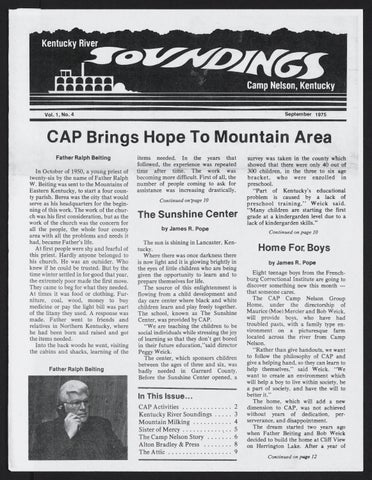
CAP Brings Hope To Mountain Area Father Ralph Beiting In October of 1950, a young priest of twenty-six by the name of Father Ralph W. Beiting was sent to the Mountains of Eastern Kentucky, to start a four coun ty parish. Berea was the city that would serve as his headquarters for the begin ning of this work. The work of the chur ch was his first consideration, but as the work of the church was the concern for all the people, the whole four county area with all the problems and needs it had, became Father’s life. At first people were shy and fearful of this priest. Hardly anyone belonged to his church. He was an outsider. Who knew if he could be trusted. But by the time winter settled in for good that year, the extremely poor made the first move. They came to beg for what they needed. At times it was food or clothing. Fur niture, coal, wood, money to buy medicine or pay the light bill was part of the litany they used. A response was made. Father went to friends and relatives in Northern Kentucky, where he had been born and raised and got the items needed. Into the back woods he went, visiting the cabins and shacks, learning of the Father Ralph Beiting
items needed. In the years that followed, the experience was repeated time after time. The work was becoming more difficult. First of all, the number of people coming to ask for assistance was increasing drastically, Continued on'page 10
The Sunshine Center by James R. Pope The sun is shining in Lancaster, Ken tucky. Where there was once darkness there is now light and it is glowing brightly in the eyes of little children who are being given the opportunity to learn and to prepare themselves for life. The source of this enlightenment is flowing from a child development and day care center where black and white children learn and play freely together. The school, known as The Sunshine Center, was provided by CAP. “We are teaching the children to be social individuals while stressing the joy of learning so that they don’t get bored in their future education,’’said director Peggy Weick. The center, which sponsors children between the ages of three and six, was badly needed in Garrard County. Before the Sunshine Center opened, a
In This Issue... CAP A c t iv it ie s .................................. 2 K entucky River S o u n d in g s ...........3 M ountain M i l k i n g ............................. 4 Sister of M e r c y .......................... . 5 T he Cam p N elson S t o r y ................... 6 A lton Bradley & Press .................. 8 T he A t t i c ................................................9
survey was taken in the county which showed that there were only 40 out of 300 children, in the three to six age bracket, who were enrolled in preschool. “Part of Kentucky’s educational problem is caused by a lack of p reschool tra in in g ,” W eick said. “Many children are starting the first grade at a kindergarden level due to a lack of kindergarden skills.” Continued on page 10
Home For. Boys by James R. Pope Eight teenage boys from the Frenchburg Correctional Institute are going to discover something new this month — that someone cares. The CAP Camp Nelson Group Home, under the directorship of Maurice (Moe) Mercier and Bob Weick, will provide boys, who have had troubled pasts, with a family type en vironment on a picturesque farm located across the river from Camp Nelson. “Rather than give handouts, we want to follow the philosophy of CAP and give a helping hand, so they can learn to help themselves,” said Weick. “We want to create an environment which will help a boy to live within society, be a part of society, and have the will to better it.” The home, which will add a new dimension to CAP, was not achieved without years of dedication, perserverance, and disappointment. The dream started two years ago when Father Beiting and Bob Weick decided to build the home at Cliff View on Herrington Lake. After a year of Continued on page 12