CAMP NELSON STORY PART II by Ralph Betting
As the dream began to unfold in my mind, the possibilities of something special happening at Camp Nelson became more real to me. But. I realized l could not do this alone. Paul Kissel, an architect friend of many years stand ing. seemed to be a logical choice. I called Paul at his office in Lexington and he became most enthusiastic. Étefore, long, we had an architect’s mrawing of what was to be our master plan for Camp Nelson. Work began on new developments. Our dream was now made up of such things as a Camp Grounds. Marina, miniature golf course, Swiming Pool. Laundry Mat, General Store, Post Of fice, Restaurant. Recreation Center, Motel, Shops, Filling Station, etc. So far. all of our activities had been on the G arrard County side, or south side, of the River. Each day as I looked across the river, I could see Boone’s K noll, the giant stone castle-like building that belonged to the old Fitz gerald Distilling Corporation. A little up-stream, and occupying the highest hill in the vicinity was Fort Bramlette. From Fort Bramlette, the Union Army at Camp Nelson guarded the River and protected the coverd bridge at the mouth of Hickman Creek. The stone piers still stood quietly at the river bank, a majestic tribute to what had been one of the truly great bridges of pioneer America. Daniel Boone’s Cave .w as only a short distance up Hickman ■Creek. Here the great pioneer lived in ^the winter of 1770. For years. I had heard stories of the Civil W ar and the camp that had been there. I knew it had sprawled over 4000 acres of this land, but beyond this, I knew nothing. It was a land of mystery.
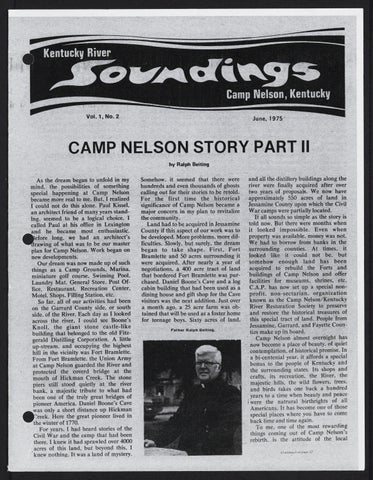
Somehow, it seemed that there were hundreds and even thousands of ghosts calling out for their stories to be retold. For the first tim e the historical significance of Camp Nelson became a major concern in my plan to revitalize the community. Land had to be acquired in Jessamine County if this aspect of our work was to be developed. More problems, more dif ficulties. Slowly, but surely, the dream began to take shape. F irst. Fort Bramlette and 50 acres surrounding it were acquired. After nearly a year of negotiations, a 400 acre tract of land that bordered Fort Bramlette was pur chased. Daniel Boone’s Cave and a log cabin building that had been used as a dining house and gift shop for the Cave visitors was the next addition. Just over a month ago, a 25 acre farm was ob tained that will be used as a foster home for teenage boys. Sixty acres of land, Father Ralph Belting.
and all the distillery buildings along the river were finally acquired, after over two years of proposals. We now have approximately 550 acres of land in Jessamine County upon which the Civil W ar camps were partially located. It all sounds so simple as the story is told now. But there were months when it looked impossible. Even when property was available, money was not. We had to borrow from banks in the surrounding counties. At times, tf looked llikefi it could notjjbe, but Somehow enough land has been acquired to rebuild the Forts and buildings of Camp Nelson and offer facilities for museums, shrines, etc. C.A.P. has now set up a special non profit, non-sectarian, organization known as the Camp Nelson/Kentucky River Restoration Society to preserve and restore the historical treasures of this special tract of land. People from Jessamine. Garrard, and Fayette Coun ties make up its board. Camp Nelson almost overnight has now become a place of beauty, of quiet contemplation, of historical promise. In a Jbi-centenial year, it affords a special bonus to the people of Kentucky and the surrounding states. Its shops and crafts, its recreation, the River, the majestic hills, the wild flowers, trees, and birds takes one back a hundred years to a time when beauty and peace i were the natrural birthrights of all Americans. It has become one of those special places where you have to come back time and time again. To me. one of the most rewarding things coming out of Camp Nelson s rebirth, is the attitude of the local "ti'puiic 12