Æ g-
CAM P N ELSO N H A S “R ISE N ”.. A G A IN ! by Ralph Beiting The Christian Com m unity has just celebrated the age-old m ystery o f Easter. Rejection, death, and frustration born of despair are the seeming victors in the sto ry. But resurrection and new life re wrote the ending and mankind was given a hope and faith that no one would ever be able to take from it. I, like most of you, often wondered how I might apply the lesson learned and continue in our tim es the message and hope o f Easter. A little over two years ago, I found the opportunity I was look ing fo r. Like most opportunities, it was close to home. It bore the name of Camp Nelson, a small com m unity thirteen miles north of Lancaster, where U .S . Highway 27 crosses the Kentucky R iver. From the earliest of pioneer days,
Camp Nelson had been an im portant center. In the w inter o f 1770, Daniel 8oone lived in a cave at Camp Nelson. From this base, he hunted and explored K entu cky. The inform ation he gained would result in the form ation o f Boonesborough five years later. There was a natural break in the palisades along the river at Camp Nelson and a fording place fo r travelers was q u ickly established. N e x t, the V irginia Legislature established a fe rry across the river at th is p o int, years before Kentucky was declared a state. When the first bridge across the Kentucky River was b uilt in 1838, it was located at Camp Nelson. In tim e, it would become the most fam ous wooden bridge in the w orld. The first com m ercial vineyard in Am erica was established at Camp Nelson in 1798.
In 1805, W illiam Orlando Butler was born at Camp Nelson. In tim e, he would run for the vice-presidency o f the United States. When the C ivil War threatened to break our Republic apart, the first Union recruiting camp in Kentucky was es tablished at Camp Nelson. It became the great storage depot in Kentucky fo r the Union arm ies, also fo r the states of Tennessee, and parts of Alabam a, and M ississippi. The present name of Camp Nelson was taken from General W illiam Nelson, the first commander of the camp. John Fee, the founder of Berea College, came to Camp Nelson during the C ivil War and established a college and pre paratory school here fo r the new ly freed blacks. A gricultural products o f all kinds, tobacco,' hemp, w heat, pigs, molasses, etc., were stored here and when a "tid e " came on the R iver, the produce was sent to New Orleans and other distant parts. In 1817, the first steam boat ever to journey down the Kentucky River was b u ilt and sailed from Camp Nelson. A rtists came to this tru ly spectacular spot. Jenny Lin d , the "Sweetest Nighting a le ", called it the "Sw itzerland of Am er ica ". Paul Saw yer, one o f Kentucky's most famous painters lived on a houseboat here and at High Bridge fo r five years. During this period, his finest work was done. Because o f an unusual subterranean stream of water that surfaced at Camp Nelson, another activity was established. Th is was the distilling of spirits. No where else was there so pure a supply of water as here and the d istillery business flourished here until 1973. The Kentucky River d istillery would give way in tim e to Canada D ry and then to Old Fitzgerald. Despite so many claim s to fame and a
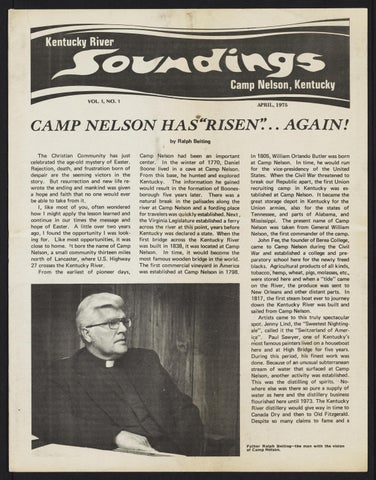
Father Ralph Beiting—the man with the vision of Camp Nelson.