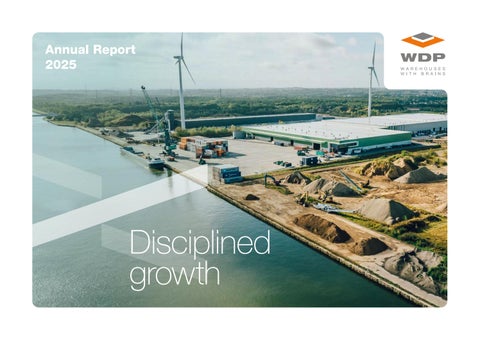
Disciplined growth

WDP is listed on Euronext Brussels (BEL 20) and Amsterdam (AEX 30), and is part of several indices, including EPRA, MSCI, STOXX, and the Dow Jones Best-inClass Index. WDP NV/SA has REIT status and is subject to the prudential supervision of the FSMA.
Our clear, pure player strategy, supported by extensive in-house expertise, ensures that we provide sustainable value to our customers and shareholders, as we have for over 25 years.

WDP is a leading European logistics real estate player operating in core locations along key logistics axes in Benelux, France, Germany and Romania.
We develop, acquire and lease logistics properties that play a crucial role in our clients’ supply chains. Thanks to our strong local presence and deep market insight, we proactively respond to changing needs and contribute to our clients’ growth, efficiency, and resilience. Our response systematically leverages sustainability and innovation. Energy-efficient buildings, renewable energy and charging infrastructure for electric transport help us build more self-sufficient sites and collaborate with our clients to accelerate the decarbonisation of their operations.
Today, WDP is the market leader in Benelux and Romania with a high-quality, diversified real estate portfolio valued at approximately 9 billion euros. Our discipline, focus and proven ability to execute drives our ambition to grow into a European logistics real estate platform of €10+ billion.
Realising what matters
In 2025, we focused on investment pipeline execution and leases to achieve the EPRA target for 2027. With success
With a clear strategy, a fully funded pipeline and strict capital discipline, WDP consistently translates its ambitions into earnings per share growth in line with #BLEND2027.
Cover image: Gosselin site, Genk (BE).
Disciplined
Capital discipline, balance sheet quality and earnings per share growth drive every decision. In 2025, WDP operated within a strict operational and financial framework focused on sustainable value creation.
Focused
After securing and financing the investment pipeline, WDP focused on execution and leasing in 2025. Purpose-driven, with a focus on quality and returns.
Deliver
For more than 25 years, WDP has been building a robust and scalable platform for profitable growth, driven by entrepreneurship, client focus and long-term earnings-per-share growth. In 2025, WDP once again translated these drivers into tangible results in line with the earnings target towards #BLEND2027.
In memoriam - Tony De Pauw

Together, we have achieved a story greater than ourselves.

Tony De Pauw was a builder. He built places, trust, and a business that he helped shape with vision, calm determination and conviction. His unexpected passing leaves a great void and his legacy lives on within WDP.
Tony De Pauw (1954-2025)
By Joost Uwents, CEO WDP
Tony De Pauw was, to me, first and foremost a partner in leadership. His vision, values and passion formed the heart of WDP's DNA and will continue to inspire the company’s ambitions.
For more than 25 years, we have built WDP together, step by step, with trust, a clear division of roles and a shared belief that sustainable entrepreneurship starts with people.
This way of working took shape with WDP’s IPO in 1999, when Tony took over the reins from his father, founder Jos De Pauw. Tony gave direction to the company during a period of growth and professionalisation. He had a real feel for real estate and a keen understanding of what works long term. He focused on long-term value, driven by discipline, a client-centric approach and a close-knit team.
Our collaboration was complementary. Tony contributed his entrepreneurial outlook, his experience in the field and his natural authority as a builder. I could count on his trust and ability to always get to the crux of the matter, even as we scaled up and circumstances became more complex. Together, we formed a tandem that helped WDP grow from a family business into an international group, without losing its identity.
After stepping down as co-CEO, Tony continued to be closely involved as a director and reference shareholder. Letting go did not come naturally to him, but he did it consciously. He knew that WDP is supported by a strong team and a clear vision for the future.
Tony never saw business as separate from family. He carefully guarded the balance between family continuity and the responsibilities of a listed company. He remained present for both his family and #TeamWDP, with respect and thoughtfulness.
Tony’s legacy lives on in the passion, integrity and entrepreneurial spirit that continue to characterise WDP. With gratitude for everything he has meant to us, we continue to grow WDP with Tony’s dedication and vision, in the same ambitious, thoughtful and positive spirit.
His vision lives on in how we work today.
Word from the Chair and CEO
Discipline in execution, scale in growth
#BLEND: delivering today with a vision for tomorrow
Dear shareholders,
Looking back at 2025, we can conclusively state that WDP delivered another strong year. In a world of omnipresent volatility - recent events in the Middle East underscore this once again - our focus remained unchanged: profitable growth per share, strong operational execution and continued financial discipline.
2025 was more than a solid year. It was a year that demonstrated the strength of the ‘multi-driver’ model we launched in 2024. It was a year of execution and achievement: doing what we announced and delivering what we promised. It was a year of fortification: preparing the platform’s foundations for the next phase in our development as a leading European logistics real estate platform. And it was a year that once again clearly demonstrated what WDP stands for: discipline, focus and a consistent long-term vision.
Everything we have purposefully built upon over the past few years translated into visible achievements in 2025. WDP maintained its operational fundamentals with continued high occupancy rates – significantly above the European market average – and realised 600 million euros in new investments at very attractive yields. Despite more complex market conditions, our profitability remained stable, with an EPRA Earnings per share of 1.53 euros – an underlying increase of 7% year-on-year.

Delivering today, with a vision for tomorrow is, for us, a mindset: doing what is needed today with a clear focus on what matters tomorrow.
Rik Vandenberghe, Chair and Joost Uwents, CEO
We aim to scale into an integrated European top-tier company with above-average growth and a below-average risk profile.
That discipline and predictability was also externally confirmed in 2025 through Moody’s upgrade to A3. This places us among the most creditworthy listed real estate companies in Europe. This strength was also confirmed with our debut in the public bond market: our 500 million euros Green Bond achieved one of the lowest debut spreads ever for a European REIT at 80 basis points.
Today, WDP manages a logistics property portfolio valued at approximately 9 billion euros. As we continue to grow into a fully-fledged €10 billion+ European platform – with the same DNA of client-centricity and innovative entrepreneurship – strong governance is essential. To this end, targeted steps were taken to support operational and commercial excellence and to move decisively into the next growth phase.
Consistent execution, discipline takes the lead
The year 2025 called for control rather than acceleration. A normalised market with a higher cost of capital required consistent and high-quality execution. WDP kept occupancy high and built upon strong leasing performance. More than 550,000 m² of new lettings confirmed clients’ confidence in the platform’s quality and scale.
Investments were made within clear financial frameworks. We focused on pre-let projects and selective acquisitions in line with the group’s cost of capital and financing strategy. Discipline was the key, both in decision-making and priority-setting.
This approach translates into predictable cash flows and a platform that is resilient to market fluctuations.
Impact beyond 2027
Although WDP is on track with its #BLEND2027 growth plan towards 2027, WDP is deliberately looking beyond. The impact of strategic choices made today extends beyond that horizon. Investments, commercial decisions and platform development require sufficient time to realise their full impact. This is why WDP is already extending its horizon towards 2030.
The goal is clear: further scale WDP into an integrated real estate European platform with above-average growth and a below-average risk profile. WDP can grow from its strong existing platform into a top European company by 2030. In this sense, growth is not a leap into the unknown, but the next step beyond where we already are today.
Scale as a strategic lever in Europe
The role of logistics real estate within our strategy is clear. The redrawing of supply chains, the need for strategic stocks and the proximity of production and consumption remain fundamental drivers of demand. Logistics real estate is not a cyclical opportunity but rather part of the critical infrastructure that forms the backbone of European supply chains, day in, day out. That structural relevance allows for continued targeted investment even in a normalised market.
WDP combines scale with diversification, and actively manages its portfolio, including via optimisation, energy solutions and decarbonisation. This creates a platform that is less dependent on a single growth driver, and more resilient to fluctuations.
Integrated all-round solutions as standard
Projects are growing in size and complexity, and require integrated, comprehensive solutions. In this context, scale is essential. WDP is committed to becoming a partner that offers solutions across the entire value chain with strong local anchoring, on a single integrated platform.
Moreover, this scale has a distinctly European dimension. WDP continues to scale into an integrated European real estate platform with logistics hubs within reach from North-West to Southern Europe.
In growth markets, such as Romania, we see a natural flow of new project developments, precisely because infrastructure is still being developed there, and economic conditions remain favourable. In France, WDP is leveraging the momentum to further scale up and drive value creation. But in mature core markets, such as Germany, a selective approach focuses on reliability and execution. This aligns with WDP’s selective growth approach: investing where it makes sense, economically and strategically.
Sustainability and energy as an integrated value proposition
Sustainability and innovation are not just a framework, they are structural drivers of growth. WDP is building more self-sufficient sites with targeted investments in energyefficient buildings, renewable energy, battery systems and charging infrastructure. WDP Energy plays an increasingly important role in this regard. It is an integrated part of the value proposition and provides a solution to the increasing electrification of logistics transport.
At the same time, client focus remains at the heart of everything we do. WDP stays close to its clients and understands their operational realities, enabling it to respond effectively to their needs. This approach results in strong long-term relationships, high retention rates, and a significant share of growth through repeat business.
Governance, continuity and the future generations
The year 2025 was also a year of reflection. The passing of Tony De Pauw left an indelible mark on the organisation. His entrepreneurship, long-term vision and commitment have helped shape WDP into what it is today. That legacy lives on in the way the company makes choices and takes responsibility.
We also bid farewell to directors Anne Leclercq and Cynthia Van Hulle this year as their final terms of office are expiring at the forthcoming Annual General Meeting. For more than a decade, they have made a highly valuable contribution to the further professionalisation of WDP and the strengthening of its international governance structure.
At the same time, the next generation is poised to carry on those values within a governance framework tailored to WDP’s scale and ambitions as a European platform.
Looking ahead, from a position of strength
Looking ahead, the direction remains clear. WDP is building on what it has consistently delivered in recent years: sustainable earnings per share growth, discipline in capital allocation and a client-focused investment approach that holds up across market cycles.
The market environment is evolving, but our foundation is solid. WDP is well placed to continue creating value in its next phase with a diversified portfolio, a strong financial position, and an organisation that has mastered its business model.
The ambitions for the future rely on a team effort. The progress achieved is the result of strong teams, supported by the trust of clients and partners, the continued engagement of shareholders. With this confidence, WDP continues on its course, step by step, with a continued focus on quality, continuity and long-term value.
Rik Vandenberghe, Chair of the Board of Directors
Joost Uwents, CEO
#BLEND2027
Execution of growth plan on track: ready to extend our horizon
New growth initiatives mainly drive cash flow growth beyond 2027 creating pathway for new long-term ambitions.

2025 at a glance Discipline
Consistency as a compass for sustainable earnings growth
In 2025, WDP transitioned into a new phase in the execution of its growth plan. With a fully funded investment pipeline and clear financial outlines, WDP’s continued discipline makes it ready for the next step in sustainable and predictable earnings per share growth.
Focus
Growth that matters
WDP is committed to qualitative growth with a clear priority and focus: increasing our earnings per share. Growth is not an end in itself, but a means to realise sustainable value.
Deliver
Executing a proven strategy
The #BLEND blueprint – a scalable and proven multidriver model – creates room for further earnings growth beyond 2027 and lays the foundation for raising our ambitions towards 2030.
Essential


8.6 bn €
8.8 mio m2


Building a € 10+ billion European logistics platform


A thoughtful and consistent history
The family-owned group started out as a vinegar brewery, but soon diversified into a variety of activities, including sand mining and inland shipping. Jos De Pauw recognised the potential of older industrial factory buildings that could be modernised into lettable warehouses – an idea that led to today’s WDP.
In 1999, WDP went public with a property portfolio valued at 100 million euros. WDP has since experienced strong growth, both in size and expertise, with a clear focus on developing modern and sustainable logistics buildings that play a vital role in its clients’ supply chains.
Today, WDP has grown far beyond being a real estate player. It is a reference for logistics infrastructure and an established player
Portfolio growth
in the European logistics market. WDP continues to reinforce its position in European markets with its clear long-term strategy, ambitious and transparent growth plans, a solid financial policy with sustainable access to capital markets, and a proven ability to consistently deliver on its strategic objectives.
And above all, this growth story bears the hallmark of Tony De Pauw. His vision, values and passion helped lay the foundation for our development and international anchoring. These are at the core of our DNA and continue to inspire the company’s ambitions as we continue to build our future in Europe with discipline, client orientation, and a clear focus on sustainable long-term value.

2025, building on strong foundations
With a clear pure-play strategy, supported by deep in-house expertise, we have been building sustainable value for our clients and shareholders for more than 25 years.
Building on WDP’s strong foundations, 2025 marks a year of further scale-up and execution with a continued focus on earnings per share growth, capital discipline and long-term value creation.
Portfolio of 1 billion euros
Achievements since IPO in 1999
>50 x >97 %
Portfolio growth Occupancy rate (average)
Annual growth (CAGR)
+8 % EPRA
Earnings per share +8 % Dividend per share +8 % NAV
From real estate
SICAF to Belgian REIT (GVV/SIR).
Growth plan 2013-16 +50% portfolio growth and +20-25% EPS increase (cumulative)
Growth plan 2019-23
Annual increase of 10% portfolio growth and 6% EPS
Inclusion in BEL 20
Expansion into Germany
First ABB by REIT (GVV/SIR)
Issuance of first Green USPP as Belgian company and GVV/SIR
WDP named Entrepreneur of the Year®
Growth plan 2016-20 1 billion euros portfolio growth and +25% EPS increase (cumulative)
Entry into Luxembourg
Historic portfolio growth of 1 billion euros and 1.1 billion euro investment pipeline under execution

Growth plan 2024-27
Annual EPS growth of 6% by combining multiple drivers
ABB of 300 million euros and historically strong balance sheet: foundation for the future
Delivery of first Green Mobility Hub
Growth plan 2022-25
Annual increase in EPS of 8% | External growth+
First-time issuer credit rating by Fitch (BBB+) and Moody’s (Baa1), both with Stable Outlook
Inclusion in DJSI Best-in-Class Europe (world in 2022)
Launch of WDP Climate Action Plan
Moody’s A3 Credit Rating and strong debut on public bond market (500 million euros green benchmark bond)
Governance reinforced towards €10+ bn platform
#BLEND&EXTEND2030 by 2030 min. annual increase of >6% in EPS and dividend and +10% annual total return1
Our impact along the value chain
Mining for production of construction materials and energy solutions
Production of construction materials and energy solutions
Energy and water supply
Procurement of construction materials, solar panels and energy solutions
Upstream Supply chain employee
Planning and design
Redevelopment
Development and acquisition of projects Financing Leasing and active asset management
The double materiality analysis identified and assessed certain impacts, risks and opportunities (IROs) as material, as well as where these IROs are situated in our own operations or value chain.
Read more in 8. Sustainability report – Material impacts, risks and opportunities
Throughout the value chain, WDP interacts with various stakeholder groups, notably Clients, #TeamWDP, Investors, Financial Institutions, Suppliers, Policymakers and the Community. As part of the double materiality analysis, their interests and views were identified.
Read more in 8. Sustainability report – Stakeholders’ interests and views
Renovation
The home for the supply chain
Purpose

Warehouses are a vital link in the supply chain of a sustainable society. They serve as the silent backbone for food, healthcare, technology and all the goods we rely on every day. By centralising inventory and supporting operations, they contribute to robust and resilient supply chains. Our warehouses are smart, flexible environments that enable customers to achieve their operational, social and climate objectives. At the heart of their supply chain, customers feel at home.
We provide a home for the supply chain through our warehouses with brains.
Vision
Our warehouses with brains empower clients in their growth, at the heart of their supply chain.
Mission
WDP develops, leases and manages logistics real estate as the backbone of the supply chain. Our smart warehouses build a sustainable layer around logistics processes.
Driven by #TeamWDP, a client-centric focus and innovative entrepreneurship, we create value for clients, shareholders and society.
Our strategy
#TeamWDP
The strength of our employees
Sound governance
Client Focus
Our team is the beating heart of WDP. Expertise, entrepreneurship and client focus drive every decision. Short lines of communication and strong oversight help employees create space for initiative, realise solutions with impact and build lasting relationships with clients and stakeholders.
Sustainable real estate
Geographical diversification
Innovative entrepreneurship
Smart financing
Innovative solutions
WDP combines energy-efficient real estate with strategic locations to strengthen processes and support the growth of our clients and their supply chains. Our diversified portfolio includes tailor-made real estate solutions for several sectors and activities, spread across key logistics axes in North-West Europe and Romania, thereby optimising supply chains. WDP Energy integrates renewable energy and infrastructure for long-term decarbonisation and contributes to the transition to a more sustainable future.
WDP anticipates future needs with smart financing and innovative solutions. A balanced mix of equity and debt capital, supplemented by green financing and retained earnings, supports sustainable investments. Each project starts with a client analysis, leading to future-proof real estate solutions that create long-term value for all stakeholders.
03
Strategy and value creation
Value creation for all stakeholders built on focus and discipline
WDP provides smart logistics solutions that make supply chain infrastructure more sustainable while creating value for clients, shareholders and society. Three pillars form the foundation: #TeamWDP, Client Focus and Innovative Entrepreneurship

A consistent and ambitious growth trajectory
Blueprint for growth
For years, WDP has applied a targeted approach to deliver sustainable earnings per share growth through multi-year growth plans. These plans are rooted in the long-term strategy, while their multi-year horizon allows WDP to respond to market trends and client needs in the supply chain. As a structured approach, each growth plan provides a clear roadmap – from strategy to action plan – aimed at delivering earnings per share growth while maintaining a consistently strong capital structure.
Doubling of portfolio value
Growth through leasing, acquisitions and sustainability
Growth through acquisitions and our pre-let projects in existing core markets
Growth from pre-let projects supplemented by acquisitions and energy investments
Deepening of core markets and geographical expansion via pre-let projects and energy investments
External Growth+: supply chain investments reinforced by value creation within the existing portfolio and scaling up sustainability investments
#BLEND2027: earnings growth by combining multiple drivers in multiple (geographical) markets
#BLEND&EXTEND2030: earnings growth based on the proven ‘multiple drivers in multiple markets’ approach
Whereas logistics real estate once revolved around simply providing storage space, today’s market is more complex and innovative. At WDP, earnings growth and value creation stem from an integrated combination, or ‘blend’, of elements: technologically innovative buildings, high-tech automation, sustainable energy solutions, actively contributing to clients’ often complex logistics processes, and continuous renewal within the existing portfolio.
This approach is built on multiple value pillars and is strengthened by seizing opportunities across a broader geographical playing field, with a focus on profitability and strong execution. Further strengthening its international footprint.
WDP is well positioned to deliver on its growth ambition. With a solid financial foundation, strategic investments and an ambitious vision, the company is set to further strengthen its position as a leading European logistics platform.
Stable growth with a proven track record of long-term earnings per share growth
Value creation at every stage of the market cycle
Stable growth with a focus on long-term value creation
WDP continues to maintain a stable capital structure, with a net debt/EBITDA (adj.) of approximately 8x, in line with the strict capital discipline the company has applied for over a decade. This financial stability was maintained in 2025, with a net debt/EBITDA (adj.) of 7.5x and a loan-to-value of 40%. Moreover, the robustness and liquidity of the balance sheet were confirmed by an upgrade to an A3 credit rating by Moody’s, followed by a successful debut on the public bond market.
Net debt / EBITDA (x, adj.)
• Integrated developer-investor model: The majority of WDP’s portfolio consists of in-house developments. This is complemented by value-add acquisitions and strategic platform expansion.
• Net investor managing the entire value chain: WDP strategically navigates the risk spectrum of investment opportunities, aligned with price trends within the real estate cycle.
• Selective capital deployment at each stage of the cycle.
Strong liquidity and robust funding
profile
Liquidity remained very strong throughout 2025. In 2025, WDP strengthened its equity by 279 million euro1 of new capital, issued a 500 million-euros public bond, and maintained a liquidity buffer of 1.7 billion euro in unused, committed credit lines.
A forward-looking pipeline
WDP has all the elements in place to achieve its #BLEND2027 earnings targets with an investment pipeline in execution of 708 million euros, a robust balance sheet and full funding. WDP can fully focus on the execution of its growth plan.
1 Through the
#BLEND2027: on track to reach its 2027 target
As of 31 December 2025, #BLEND2027 is in full execution and the plan’s “multiple drivers in multiple markets” approach is delivering the expected results. Launched in early 2024, the four-year growth plan aims to deliver EPRA EPS growth of +6% annually by leveraging growth opportunities both internally and externally through investments in new development projects, selective (value-add) acquisitions and energy solutions. To this end, WDP focuses on its existing core markets and the further expansion of its activities in France and Germany.
With all building blocks in place, and subject to the qualitative execution of the 708 million euros investment pipeline and the successful leasing of the limited available space, WDP will achieve an EPRA Earnings per share target of 1.70 euros by 2027. The pipeline is fully financed, supported by a strong liquidity position and strong self-financing capacity, and will be neutral to the capital structure upon completion.
Looking ahead: ready to extend the horizon with new growth ambitions
Given the inherent lead times of development and energy projects, new growth initiatives are expected to contribute to additional cash flow growth primarily beyond 2027. In light of the progress of #BLEND2027, WDP is therefore ready to extend its horizon with new ambitious targets.
Building the platform of tomorrow, based on the proven multi-driver approach
WDP extends its horizon to 2030 with a clear goal: further scaling WDP into an integrated European platform of more than €10+ billion by offering end-to-end supply chain infrastructure solutions to both new and existing clients.
The focus remains unchanged: above-average growth with a below-average risk profile, with growth defined as EPRA Earnings per share growth combined with strong total returns.
With #BLEND&EXTEND2030, the five-year growth plan spanning from 2026 to 2030, WDP builds on its proven multi-driver #BLEND model across multiple (geographical) markets. In this context, WDP looks beyond its existing core markets and intends to enter two countries: Spain and Italy

Ready to extend horizon with new growth ambitions
GROWTH PLAN TARGETS FOR 2027
Status: on track
› Leasing up limited available space › Investment pipeline in execution › Balance sheet capacity and liquidity in place
Building the platform of tomorrow

New targets for 2030
We extend our horizon to 2030 with new long-term targets
WITH A CLEAR GOAL
To scale into an integrated European platform, offering end-to-end supply chain infrastructure solutions within a single integrated European network.
WITH AN UNCHANGED FOCUS
Above-average growth with a below-average risk profile. Growth is defined as EPRA Earnings per share growth, combined with strong total returns.
targets are based on:
Ambitious, sustainable cash flow growth of 6% per year by 2030

% annual growth rate compared to the base year 2025
The drivers of the extended #BLEND plan
Internal growth
Project developments and acquisitions
Energy solutions
Cost of debt reset
Annual EPRA Earnings per share growth by 2030 +6%
› Internal growth | 100% CPI-linked leases, rent reviews (rent reversion), cost efficiency and active asset management
› Project developments & acquisitions | annual investment volume of 500 million euros with return targets aligned with the cost of capital
› Energy solutions | revenue from energy investments will double towards 50 million euros by 2030
› Cost of debt reset | This assumes a moderate and gradual increase in the cost of debt, with a cumulative impact of +85 bps by 2030, based on a constant debt level as at 31 December 2025, mainly due to the expiry of interest rate hedges, partially offset by credit spread optimisation supported by the A3 rating, with only half of this impact applying from 2030 onwards, based on the swap curve as at 31.12.2025 and an A3 credit rating from Moody’s.
Underlying assumptions and hypotheses for achieving the 2030 targets
› A gradual recovery in demand in the short term, with structurally strong demand drivers in the long term.
› Stable operational metrics, including high occupancy rates, long lease terms and high client retention.
› Maintenance of a high operating margin of >90% through cost discipline
UILD_robust structural demand drivers OAD developments and acquisitions
Structural demand drivers

ROBUST DEMAND DRIVERS FOR LOGISTICS SPACE CAPITALIZE ON INTERNAL & EXTERNAL GROWTH OPPORTUNITIES
Short term
demand normalises with a gradual recovery in take-up
Structural omnichannel growth, supply chain reconfiguration and infrastructure-driven growth through electrification
Markets characterised by scarcity low vacancy rates, limited speculative development, and scarcity of land and grid capacity
A broader country mix
Existing markets (with Romania <20%)
Further increase in market share in France & Germany
Building up a presence in Spain & Italy
500 MILLION EUROS ANNUAL INVESTMENT VOLUME AT ATTRACTIVE RISKADJUSTED RETURNS1
XTRACT_capturing internal growth
EUTRALISED_decarbonising logistics supply chain
Attractive total return potential

INFLATION-PLUS LIKEFOR-LIKE RENTAL GROWTH EMBEDDED VALUE CREATION THROUGH INTERNAL GROWTH DRIVERS
Indexation through fully CPI-linked leases and the capture of rent reversion potential (9% underrented portfolio)
Cost efficiency maintaining an operating margin of >90%.
Active asset management initiatives
On-site energy production (solar panels) maximising rooftop capacity
On-site efficiency solutions a.o.others, LED lighting, electric heat pumps and intelligent energy monitoring systems
Energy storage behind-the-meter batteries and front-of-the-meter grid-support storage
Mobility solutions including smart EV charging infrastructure
More than a warehouse: the logistics powerhouse
ENERGY-AS-A-SERVICE DOUBLING REVENUE BY 2030 TO APPROXIMATELY 50 MILLION EUROS1
1 Includes annual revenue of 7 million euros from green energy certificates for projects in Belgium delivered before 2013, which will gradually expire in the period 2028-2032. The contribution to outcomes will be gradual and non-linear, reflecting the high complexity of the projects, as well as external factors such as authorisation procedures, lead times for grid connections and lower energy prices.
ISCIPLINED_strong financial position
Strong financial position and disciplined capital allocation

Strong and recurring equity strengthening in place of 250–300 million euro per year
Through retained earnings, optional dividends and contributions in kind
This enables internally funded capex of 500 million euro per year, including debt within WDP’s targeted leverage levels
A manageable and gradual increase in the cost of debt: +85 bps in financing costs by 20301
500 MILLION EUROS OF INTERNALLY FUNDED CAPEX PER YEAR STRONG SELF-FINANCING CAPACITY
1 This includes a manageable and gradual cost of debt reset: an organic impact (i.e. calculated at constant debt level as at 31 December 2025) of cumulatively +85bps in cost of debt towards 2030 due to hedge maturities, partly offset by the positive effect of A3-rating credit spread optimisation with half of the impact only effective as from 2030. Based on the forward interest rate curve as at 31.12.2025 and A3 Moody’s credit rating.
Based on high credit quality
Building the platform of tomorrow
Scale & cross-border solutions
>FOR BOTH EXISTING AND NEW CLIENTS
>PROFITABILITY & EFFICIENCY
>ENABLES STRONG TOTAL RETURNS
>EXCELLENT ACCESS TO CAPITAL (MARKETS)
Value creation
Waardecreatie
Vision
Our warehouses with brains support our clients in their growth, at the heart of their supply chain
Input Throughput
Output and outcome
Sustainable growth
WDP aims to achieve balanced growth within a framework of transparent and fair governance, responding to economic, social and environmental needs.
Future logistics
The high-quality logistics infrastructure we offer facilitates and optimises our clients’ activities and provides quality, sustainability and continuity.
Vitally engaged
#TeamWDP is the driving force behind our value creation. We focus on their well-being, safety and development, as well as on the environment of our operations and the local communities.
Impact by responsibility
We are committed to a strong and reliable value chain, with a focus on health, safety and integrity. We take responsibility for risk management, including human rights.
Market insights
The logistics real estate market is finding a new equilibrium, with low vacancy rates and gradually recovering tenant demand.
Belgium
France
1 Trailing twelve months. Source: Broker reports.
Existing markets New markets #Blend&Extend2030
Romania
Take-up (000 m²)1
Rent (€/m²/year)
StructuralTransformation
Redevelopment of industrial heritage into sustainable urban logistics
WDP has acquired the iconic Renault site in Vilvoorde, a strategically and multimodally located site of approximately 19 hectare on the outskirts of Brussels.
Through a sustainable redevelopment, the site will be transformed into a future-proof urban logistics hub, while preserving the activities of the current tenants. In close cooperation with the City of Vilvoorde, WDP focuses on efficient land use and strong multimodal connectivity, thereby creating sustainable value for customers, the city and the region.

Multimodal location: E19, Brussels ring road, airport, rail & port
Multiple customers active on the site

Redevelopment with economic, logistics and spatial impact
Renault site, Vilvoorde
Sustainable Growth
WDP aims to achieve balanced growth within a framework of transparent and fair governance, responding to economic, social and environmental needs. This makes us a reliable partner for all our stakeholders and leads to sound financial metrics and attractive, recurring returns.

1.53
1
#BLEND: delivering today, with a vision for tomorrow
In 2025, WDP successfully continued to build on client centricity, discipline and sustainable growth. Through its “multi-driver” approach, #BLEND, the blueprint for long-term earnings per share growth, WDP is already laying the foundations for sustainable value creation beyond 2027.
At the same time, WDP achieved important milestones: a broader European footprint, a strengthened organisation and continued capital discipline — reflected in the A3 credit rating upgrade by Moody’s and the successful debut on the public bond market. These steps underscore WDP’s ambition to grow into a leading European logistics real estate platform.
In 2025, underlying EPRA earnings per share increased by +7% year-on-year. WDP secured 600 million euros in new investments across all regions (75% in Western Europe), at a weighted average NOI yield1 of 6.8%. With over 550,000 m² of new lettings, WDP confirmed its ability to structurally capture demand through its commercial platform.
In light of the progress achieved under #BLEND2027, WDP is ready to extend its horizon with new ambitious targets. To this end, WDP introduces #BLEND&EXTEND2030, a five-year growth plan built on the same “multi-driver” approach and focused on further long-term value creation.
600
550,000
708
Funding in place
#BLEND2027 | achievements
WDP confirms its position as an organisation that executes its growth plan with conviction and discipline. At the halfway point of #BLEND2027, not only the strength of the multi-driver strategy is evident, but above all its ability to consistently create value through high-quality execution. Growth is not an end in itself, but a means, guided by a clear priority: sustainable earnings per share growth.
Over the past two years, a solid foundation has been laid to deliver the 2027 earnings target, with a consistent focus on profitability. The required investment volume has been achieved, internal growth and sustainability investments have been structurally embedded, while full financing has been secured within a strict financial framework. With all building blocks in place, 2025 marked a clear shift in focus towards high-quality execution: delivering the projects in the pipeline and maintaining a strong occupancy rate through targeted leasing of the limited available space.
Building on the results delivered over the past years, WDP looks to the future with confidence. The combination of strong commercial strength, in-depth market expertise and disciplined execution forms the foundation for sustainable value creation.
Supported by a healthy balance sheet and ample financial flexibility, WDP has the self-financing capacity to deliver on its strategic ambitions, capture new opportunities and further strengthen its leading position. These fundamentals underpin the ambition to scale beyond 10 billion euros.
Disciplined European expansion with a focus on profitability
+6 %
EPRA Earnings per share CAGR 2024-25 (underlying)
1.6 bn €
New investments
Secured under #BLEND2027 in 2024-25
6.5 %
Profitable growth
Average NOI yield on new investments under #BLEND2027
A3
Credit rating (Moody’s)
Consistent execution of financial policy & focus on cash leverage
~98 %
Average occupancy rate maintained at a strong and high level through a focus on client centricity
80 %
Western Europe of the new investments under #BLEND2027
Strong local presence across 6 countries, supported by 5 offices
Alignment
Long-term commitment of family reference shareholder reconfirmed
• Profitable growth: capturing rental growth with selective capital deployment focused on robust (future) cash flow growth and a stable capital structure.
• Navigating the entire value chain: under #BLEND2027 through value-add acquisitions, pre-let projects and energy investments.
• Expansion of platforms and market share: a total investment volume of 1.6 billion euros over 2024–25, deployed across core platforms (Benelux and RO ~60%), with successful expansion in France and Germany (~40%), alongside further scaling of local teams and commercial capabilities.
• Value creation: robust operational KPIs and high occupancy rate; strong EPRA Earnings per share, dividend and return on equity; and an upgrade to top-tier A3 credit rating.
Sustainable Growth
Operating activities in 2025
EPRA Earnings per share amounted to 1.53 euros in 2025, representing an underlying year-on-year increase of +7%, fully in line with the 2025 target 2. The business performance is driven by a combination of projects and acquisitions, as well as organic rental growth (+2.3%), supported by a stable and sharp financing cost of 2.4%3. Based on this, WDP confirms the proposed dividend of 1.23 euros per share, payable in May 2026.
that reached expiry in 2025). In 2026, 10% of the lease contracts reach their next expiry date, of which 64% have already been renewed.
In 2025, WDP exceeded expectations in terms of leasing activity, achieving over 550,000 m² of GLA in new lettings at market rents 4. This underscores the commercial strength of the WDP platform in capturing new demand. Moreover, contractual rents across the total portfolio are 9% below market rental levels.
Property investments
Profitability was further supported by a consistently high occupancy rate (97.7% as at 31 December 2025, +30 BPS q/q) and high retention levels (90% of the 13% of lease contracts
Projects completed in 2025
Pre-let projects delivered: around 200,000 m² lettable area
Investment volume: 121 million euros
Return: 6.2% average NOI yield4
Average lease term: 14 years
WDP completed pre-let projects during 2025 with a total lettable area of approximately 200,000 m². The NOI yield for all of these completed projects amounts to 6.2%, with a total investment volume of approximately 121 million euros. The average lease term is 14 years.
Acquisitions completed in 2025
New investments: around 515,000 m² of lettable area + 510,000 m² of land reserves
Investment volume: 600 million euros
Return: 6.8% average NOI yield5
Type: Pre-let developments projects, acquisitions, energy initiatives and land bank
2 EPRA Earnings per share totalled 1.50 euros in FY 2024 (1.47 euros recurring and +0.03 euros per share due to a one-off break fee) and will rise to 1.53 euro in 2025, representing +2% y/y reported and an underlying increase of +7% y/y, adjusted for the one-offs in 2024 and the impact of the abolition of the FBI regime in the Netherlands as of 2025.
3 The existing portfolio, projects under execution and new pre-let development projects (i.e. excluding renewals within the existing portfolio). The pre-letting rate of projects under execution is characterized by a significant year-on-year increase to over 80% (Q4 2024: 60%).
4 This corresponds to approximately 5.5% in Western Europe and 8.3% in Romania.
5 Excluding energy projects and land reserves. This represents 6.3% in Western Europe and 8.3% in Romania.
reaching expiry in 2026
renewed as of 31 December 2025
6
Sustainable Growth Projects delivered
Joint venture
New pre-let development projects, acquisitions and energy initiatives
In 2025, WDP secured approximately 600 million euros of investments across its activities in all WDP regions (75% in Western Europe), at an average NOI yield6 of 6.8%. This includes the acquisition of 514,000 m² of existing buildings and 508,463 m² of land reserves, representing an investment budget of 461 million euros. Projects still in execution are included in the ongoing investment pipeline as at 31 December 2025.
In 2025, WDP also added approximately 42 million euros of new energy investments to its pipeline, primarily aimed at expanding onsite solar energy capacity. For these investments, an IRR of ~8% is targeted. In addition, WDP started the construction of two charging hubs, representing an investment of approximately 4 million euros and an expected IRR of ~10%.
An overview of the acquisitions completed over 2025 is included in the Annual Results press release of 30 January 2026.

Sustainable Growth
New pre-let development projects, acquisitions and energy initiatives
BE
BE Asse - Mollem Lactalis 3Q26
NL Ridderkerk Kivits
NL Raamsdonkveer
RO Deva HAVI
RO
RO
RO Cluj-Apahida
RO
RO
Sustainable Growth
Investment pipeline in execution
Overview of the 708 million euros investment pipeline in execution, with an expected NOI yield of 6.8%7. The cost to come amounts to 514 million euros. This relates to investments secured in 2025 that remain in execution as at 31.12.2025.
Joint venture 7 Excludes projects in
Sustainable Growth
Projects in execution represent an investment volume of approximately 410 million euros and a lettable area of about 480,000 m². They are currently 81% pre-let. This represents a significant increase compared to 60% at year-end 2024, even after the delivery of approximately 200,000 m² of fully pre-let projects in 2025, reflecting excellent commercial execution.
WDP continues to apply its policy of initiating developments only upon pre-leasing, with limited exceptions such as the expansion of existing sites or clusters, projects with remediation and construction obligations, and multi-tenant projects with smaller units in specific locations. In a market characterised by continued scarcity of land and supply, as well as declining development activity, WDP remains confident in the successful commercialisation of these projects upon delivery.

8
New pre-let development projects in 2025
Belgium
Mollem (Asse)
WDP is expanding the existing site by approximately 1,500 m² for its client Lactalis, a French multinational dairy company. The extension takes place on land owned by WDP.
Ghent
At the WDPort of Ghent, WDP is expanding BeerSelect’s warehouse by approximately 4,000 m², bringing the total lettable area to around 14,000 m². The extension, developed on WDP-owned land, is scheduled for completion in Q3 2026.

The Netherlands
Raamsdonkveer
WDP is developing a Grade A, BREEAM-certified distribution centre equipped with an integrated energy system, including on-site solar panels and battery energy storage (BESS). This system supports off-grid applications, reduces grid dependency and ensures a continuous energy supply for the client.
• Lettable area: 10,000 m²
• Investment: 13 million euros
• Delivery: Q3 2026

Ridderkerk
Bucharest – Dragomirești
WDP is expanding its Park Bucharest – Dragomirești with two high-quality, EDGE Advanced-certified buildings: a circa 47,000 m² climate-controlled warehouse with refrigerated and freezer areas, and an ambient warehouse of approximately 11,000 m². The buildings are leased to logistics service providers with a lease term of 10 years. The total investment amounts to approximately 52 million euros. In addition, approximately 16,000 m² of GLA remains available for future development.9
• Lettable area: 58,000 m²
• Investment: 52 million euros
• Delivery: Q1 2027
WDP is developing a BREEAM-certified conditioned logistics warehouse for Kivits Logistics Group at Dutch Fresh Port, the international AGF (Potatoes, Vegetables and Fruit) cluster. The site will include 25 cold stores, value-added logistics activities and solar panels. Kivits will lease the site for a 20-year period and will also extend the lease of the adjacent WDP buildings to 20 years.8
• Lettable area: 35,000 m²
• Investment: 55 million euros
• Delivery: Q1 2026
Romania
Bucharest – Ștefănești
In 2025, WDP entered the next growth phase of WDP Park Bucharest – Ștefănești. In less than ten years, the park has grown to over 400,000 m² of lettable area — WDP’s largest cluster to date.
With two projects for FAN Courier Group and Aggreko, the first cluster phase was completed. Subsequently, WDP launched the second phase with a state-ofthe-art distribution centre for Action. Together, these three developments, initiated in 2025, add a total of 91,000 m² of new lettable area.
WDP now focuses on further cluster expansion around Bucharest, leveraging both newly acquired land and existing land reserves as a foundation for sustainable growth.
FAN Courier Group: development of a distribution centre for an existing client and leading logistics player in Romania. The building is leased under a long-term 10-year triple-net lease and supports the client’s parcel operations.10
• Lettable area: 32,000 m²
• Investment: 22 million euros
• Delivery: Q3 2027
Expansion Aggreko: extension of approximately 5,000 m² on existing land reserves. Construction has started, with delivery scheduled for early 2026.
Action: WDP is developing, on its existing land reserves (site of approximately 150,000 m²), a pre-let distribution centre for Action, an international non-food retailer and long-term WDP client. The building is leased under a triple-net lease of at least 15 years. The project will meet the highest sustainability standards, targeting a BREEAM Outstanding certification, and offers approximately 20,000 m² of additional expansion potential.11
• Lettable area: 54,000 m²
• Investment: 40 million euros
• Delivery: Q4 2026
Deva
WDP is developing a build-to-suit logistics warehouse for Havi, an international 3PL player in the food industry. The warehouse, designed for chilled and frozen operations, will be developed on WDP’s existing land reserves and leased under a 10-year lease agreement.
• Lettable area: 5,900 m²
• Investment: 4 million euros
• Delivery: Q1 2027
Cluj-Napoca
WDP is developing a distribution centre for Dr. Max, a leading pharmaceutical group in Central and Eastern Europe. The building will be developed on WDP’s land reserves and leased under a 10-year lease agreement.
• Lettable area: 11,000 m²
• Investment: 9 million euros
• Delivery: Q2 2027
Sustainable Growth
New acquisitions in 202512
Londerzeel
WDP completed an add-on acquisition of a logistics site including outdoor storage and redevelopment potential. The fully leased property strengthens WDP’s presence in the Londerzeel business park, with direct access to the A12 motorway between Antwerp and Brussels.13
• Lettable area: 9,000 m² on a site of 21,000 m²
• Investment: 7 million euros
• Acquired through a contribution in kind
Mechelen
WDP completed an add-on acquisition, further strengthening its presence within the cluster along the E19 axis Antwerp-Brussels, a land-scarce location with redevelopment potential.17
• Lettable area: 12,000 m² + outdoor storage of 4,000 m², on a site of 25,000 m²
• Investment: 11 million euros
• Acquired through a contribution in kind
12 The acquisitions were realised at fair value prices as per valuation reports prepared by the independent property experts.
13 See the press release of 19 February 2025.
14 See the press release of 16 April 2025.
15 See the press release of 19 September 2025.
16 See the press release of 11 June 2025.
17 See the press release of 5 November 2025.
Lokeren
In April 2025, WDP and KDL concluded a real estate transaction in the Lokeren E17 industrial park, with a total investment of approximately 60 million euros.14 The transaction comprises three components:
• the sale-and-leaseback of a high-bay of approximately 25,000 m² with a clear height of 26 metres and an automated MOVU pallet storage system;
• the development of a sustainable warehouse of approximately 18,000 m²;
• a temporary lease in Zele of approximately 4,500 m² pending completion of the new-build facility.
In September 2025, WDP completed the sale-and-leaseback through a contribution in kind of 40 million euros.15
The transaction illustrates WDP’s ability to build out clusters and provide tailored solutions to its clients. WDP creates added value across the full breadth of its activities and further strengthens its presence in the Lokeren E17 industrial park.

Courcelles
In a logistics hub along the E42 motorway Liège-Mons, WDP acquired a distribution centre of approximately 30,000 m² on a site of 85,000 m², located near three other WDP properties on Rue de Liège.
Five urban sites in Antwerp, Namur, Sint-Katelijne-Waver, Wevelgem and Evergem
WDP acquired five urban distribution sites, fully leased to Sligro and Horeca Van Zon with long-term triple-net lease agreements of at least of 10 years. Thanks to their strategic locations, the sites reinforce clustering within WDP’s portfolio and support efficient urban distribution for the food sector.16
• Lettable area: 25,000 m² on a site of 75,000 m²
• Investment: 30 million euros
• Acquired through a contribution in kind
New acquisitions in 2025
Luxembourg
Hautcharage and Foetz
WDP acquired two sites accounting for 57,000 m² of GLA on a total land area of 140,000 m² through the acquisition of the shares in the companies owning the sites.18
• An innovative multi-tenant hub in Hautcharage of approximately 40,000 m² GLA on concession land along the E44, leased to several clients active across various sectors.
• Three buildings in Foetz of over 17,000 m² GLA on a 40,000 m² owned plot of land, located near WDP’s cluster in Eurohub Sud and with direct access to the A4 motorway.
Romania
Timisoara
WDP acquired a standalone logistics site of approximately 26,000 m². The acquisition, driven by its strategic location and attractive pricing, supports sustainable urban logistics and last-mile distribution; approximately 60% is currently in use, with advanced negotiations ongoing for the remaining space.
France
Loudéac
WDP completed the acquisition of a fully leased distribution centre in the heart of Brittany. The Class A warehouse is BREEAM Excellent-certified, equipped with solar panels and leased to ID Logistics under a fixed triple-net lease agreement until at least 2030. The site is strategically located along the Atlantic Arc.19
• Size: 50,000 m² + outdoor storage van 3,500 m²
• Investment: 41 million euros
Le Havre
WDP acquired a fully leased, high-quality logistics site in the port of Le Havre.
The Grade A, BREEAM-certified buildings are leased to Seafrigo under a fixed triple-net lease until the end of 2033. Thanks to its direct quay and rail access, this acquisition further strengthens WDP’s presence in France within a key European port cluster. 20
• Size: 65,000 m² + container yard of 40,000 m²
• Investment: 58 million euros
Divestments in 2025
Belgium
Liège
WDP completed the disposal of two vacant logistics buildings in Liège, generating approximately 35 million euros in total proceeds, at a price above the most recent fair value. The transaction reflects continued end-user interest in well-located, modern logistics assets. 21
Romania
Bucharest – Ștefănești
In 2025, WDP completed the disposal of a land bank of approximately 185,000 m² in Bucharest – Ștefănești, generating total proceeds of approximately 12 million euros and a significant capital gain compared to the most recent fair value.
21 See the press release of 6 January 2026.
18 See the press release of 27 February 2025.
19 See the press release of 9 July 2025.
20 See the press release of 6 January 2026.
Sustainable Growth
Further potential within the existing portfolio
WDP not only leverages a robust investment pipeline comprising pre-let projects, acquisitions and energy solutions, but also continues to build on its growth.
In the short term, indexation of lease agreements supports higher rental income, while the current rental reversion potential of +9% (contractual rent compared to market rent) contributes to further growth and value creation over the longer term.
With a strategic land reserve representing 2.1 million m² of potential lettable area (5.1 million m² total land area), spread across all regions in which the company operates, WDP creates room for future developments.
This combination of short-term actions and long-term strategies further strengthens its position in the market.

Our land reserve in Europe
2.1 mio m² Potential lettable area
5.1 mio m² Total surface area
The continued structural growth in the logistics and industrial real estate market enables WDP to further support its clients in expanding critical logistics infrastructure across multiple sectors. WDP identifies investment potential across its existing platform and in the external market, through new development projects, selective value-add acquisitions and integrated energy solutions.
Long-term
100 %
CPI-indexation of leases
+42 mio €
Reversionary potential +9%
480 m² GLA
Projects under development (x 1,000 m²)
708 mio €
Investment pipeline in execution
22 The information in this chart is not construed as an earnings forecast or guidance of any kind and should thus not be read as such and is thus solely intended for illustrative purposes. It depicts the short- and medium-term impact of indexation based on economic forecasts and the impact of the already committed development pipeline, the potential of further lettings and the theoretical potential of rental growth and rent from buildable surface of uncommitted projects on the land bank.
23 Assumption based on 5y inflation swap of 2%.
Sustainable Growth
Integrated energy solutions for future-proof logistics
Electrification and the decarbonisation of the supply chain are reshaping the energy profile of transport, logistics and industrial real estate. As consumption patterns change and e-transport becomes more widespread, demand for reliable and sustainable energy, as well as for more advanced solutions and supporting infrastructure, continues to grow.
By upgrading existing warehouses into energy hubs and embedding the required infrastructure across its portfolio, WDP helps its clients bring down emissions, optimise energy use, reduce grid dependence and ensure operational continuity as electrification accelerates.
WDP ENERGY expects revenues to double towards approximately 50 million euros by 2030. Earnings contribution will be gradual and non-linear, reflecting the high project complexity and external factors such as permitting, grid-connection lead times as well as lower energy prices.
WDP currently has a solar energy capacity of 261 MWp. In addition, 97 MWp was under construction as at 31 December 2025, representing an investment budget of approximately €68 million. WDP targets an IRR of around 8% and a yield on cost of 10–15%, with the ambition of reaching a total capacity of 350 MWp by the end of 2027.
In Belgium (Genk), WDP will invest on an existing site in a large-scale front-of-the-meter battery park with a capacity of 60 MW and an energy storage capacity of 240 MWh. The total investment amounts to approximately 40 million euros, with expected completion by the end of 2029. In addition, WDP is rolling out behind-the-meter battery projects at selected sites with solar installations and customers with high energy consumption.
Examples of Green Mobility Solutions and Green Retrofit are outlined in Chapter 4 Performance and trends – Future Logistics
More than a warehouse: the logistics powerhouse
As a real estate partner, WDP plays a crucial role in developing efficient, future-proof and cost-effective supply chains.
WDP’s approach is built on different pillars:
• on-site energy production (solar PV),
• on-site efficiency solutions (e.g., LED lighting, electric heat pumps and intelligent energy management systems),
• mobility solutions (e.g., smart EV charging facilities) and
• energy storage (behind-the-meter batteries and front-of-the-meter grid-support storage systems).
Breakdown of the existing real estate portfolio
WDP offers a broad range of building types within the logistics real estate segment. From storage to distribution: each type of warehouse is tailored to client’s specific activities. The robust, high-end construction quality of our buildings is combined with sustainability and flexibility, with lifecycle performance as a key priority.
Breakdown of fair value by age1 56 %
Breakdown of fair value by quality division of the property
Share of the real estate portfolio suitable for urban logistics
Share of real estate portfolio with a sustainability certificate The share of certified buildings increased significantly in 2025 to 72% (compared to 56% in 2024). WDP is on track to increase the share of green-certified warehouses in its total portfolio to at least 75%. 1 Buildings that undergo significant renovation are considered new upon completion of the works.
35% <5 years
29% 5 to 10 years
16% 10 to 15 years
11% 15 tot 20 jaar
10% Older than 20 years

Urban logistics properties are general warehouse or cross-dock buildings located near large, densely populated urban areas, enabling short delivery times.

% General warehouse
Sustainable Growth
Historical occupancy rate of the WDP portfolio
In 2025, 90% of the 13% expiring leases were renewed. For 2026, 64% of the 10% of leases expiring in that year have already been renewed per 31 December 2025. Typically, this renewal rate is around 50% at the start of the year, confirming that the retention rate, or lease renewal rate, has normalised.
Top 10 tenants
100%
client-centric approach
WDP’s long-term client relationships underpin consistently high occupancy rates and a 90% retention rate over the past decade.
5.5% Ahold Delhaize
4.2% Solar panels
3.0% Kuehne + Nagel
2.4% ID Logistics
2.4% Greenyard
1.9% Pirelli
1.9% Distrilog Group
1.8% Carrefour
1.5% Lidl
1.8% Ceva 1.4% Action
WDP has a diversified client base with mainly (inter) national corporations. Our top 10 tenants represent 24% of the total real estate and use multiple WDP locations, often spread across different countries.
Long-term average since the IPO
Rental income expiry dates (until the first option of termination)
Rental income by category of end user
Our warehouses accommodate a broad range of client sectors, with a balanced mix of end users and logistics service providers.


The share of e-commerce in WDP’s portfolio (14%) matches the e-commerce penetration rate in the countries in which WDP operates.
Sustainable Growth
1 The fair value at which the property investments are measured consists of the investment value less transaction costs. The theoretical local transaction costs deducted from the investment value amount on average per country to: Belgium: 2.5%, the Netherlands: 10.6%, France: 4.1%, Luxembourg: 7.0%, Germany: 7.8% and Romania: 1.0% Historic gross rental yield of the WDP portfolio Change in the property portfolio during 2025
Sustainable Growth
Portfolio statistics by country
1 Financial performance indicator calculated according to EPRA’s (European Public Real Estate Association) Best Practices Recommendations. Please see www.epra.com.
2 Excluding solar panels.
3 Calculated by dividing the annualised contractual gross (cash) rents and the rental value of the unlet properties by fair value. The fair value is the value of the property


Towards a 10+ billion euros European platform
Sustainable Growth WDP’s network in Belgium and Luxembourg
WDP holds a unique position in Belgium and Luxembourg,
% Market share
LUXEMBOURG
Sustainable Growth 6 % Market share WDP’s netwerk in the Netherlands
The Netherlands is a core market with strong infrastructure and serves as a key gateway to Europe, where WDP
THE NETHERLANDS
Sustainable Growth WDP’s netwerk in France
In just two years, WDP expanded its French platform from 150 million euros to 700 million euros. Today, the portfolio comprises 21 sites and delivers an occupancy rate of 96.7%. From its Paris office, a dedicated local team continues to strengthen WDP’s long-term presence and drive further growth in this market.
Top 3 locations in France
route de Lapalud 1790
route de Lapalud 1786
Le Havre, Port 3196, Chaussée de quai de la Moselle
Sustainable Growth WDP’s netwerk in Germany
WDP strengthened its presence in Germany through the further development of its local platform, supported by the appointment of a Country Manager for Germany. With a portfolio of 150 million euros across 3 sites and an occupancy rate of 100%, WDP is establishing a focused platform in this market.
High-quality and diversified real estate
Locaties in Germany
Sustainable Growth WDP’s netwerk in Romania
WDP has a well-diversified presence in Romania, with a 1.6 billion euros portfolio and a total lettable area of 2.0 million m². The portfolio comprises 83 strategically located sites across key logistics regions. With a market share of 25%, WDP confirms its strong position in this growth market.
3 locations in Romania
Suceava
Bucharest
Craiova
Arad
Timisoara
Oradea
Executing disciplined growth
In an industry where scale and speed have long been the norm, growth today is primarily a matter of making the right choices. Not only at a strategic or financial level, but above all on the ground.
WDP faces the same question across countries and projects: where does growth create sustainable value, and under what conditions? The logistics real estate platform takes shape through permitting, energy constraints, client expectations and long-term return requirements.
This is executed by the country teams in close collaboration with operations and the executive committee. Their mission is always the same: turning European ambitions into a local, achievable, and profitable reality.
Strategy only becomes valuable in execution
Disciplined growth may sound strategic, but only becomes truly relevant when translated into concrete decisions on the ground. Not every project works out at all times, and timing is at least as decisive as scale.
In the past, speed and volume were key in earlier growth phases. In today’s more complex world, the focus is
more than ever on high-quality, profitable growth. This is why we consciously choose quality, feasibility and profitability. Not because speed and scale have lost importance, but because growth is only sustainable when it also remains financially sound. For example, licensing processes, energy infrastructure and technical feasibility weigh more heavily in operational decisions and require more preparation and coordination.
Sometimes the greatest discipline is just in the phasing or careful management of projects.
Complexity as both structural reality and competitive advantage
That shift is not a temporary correction. In almost all countries, project development encounters similar challenges: scarce land, mobility pressures, lengthy permitting procedures and grid capacity constraints.
This context also affects our clients. Stricter sustainability requirements, geopolitical uncertainty and changing supply chains influence their operational choices. WDP
Sale-and-leaseback allows clients like KDL (Lokeren) to release capital without operational disruption. They remain on their site, expand next door and we continue to build a sustainable long-term relationship.
Kristof De Witte, Country Manager Belgium and Luxembourg
takes this reality into account in its decisions because projects must be sound not only from a real estate perspective, but also operationally and in a futureoriented context.
This is exactly where our scale plays a decisive role: thanks to our 50-year track record, WDP can absorb more complexity, engage faster with local stakeholders and build upon deep local know-how in each of its core countries.
Upgrading the existing portfolio as an established approach
In a context where development is becoming structurally more complex, this increasingly translates into selective new construction, redevelopment and targeted upgrades of existing sites. At WDP, upgrading is not an ad hoc solution but a structural approach aligned with clients’ operational realities.
Buildings are never considered in isolation within the process. Energy supply, infrastructure and building usage are also key in our considerations about the logistics processes at the site. This requires targeted investments and technical interventions closely tailored to clients’ operational needs. This safeguards the long-term usability of the portfolio.
So, today, a significant part of our disciplined growth occurs within the existing portfolio, which goes beyond traditional growth logic. Not through visible expansion, but through targeted investments in sites and client relationships that are already part of the platform.
“It may be less visible, but it’s at least as valuable,” said Kristof De Witte, Country Manager Belgium. “Existing clients deserve full attention, especially in an increasingly challenging market.”
Growing as a logistics property platform with local anchoring
Even though WDP functions as a single European logistics property platform, the interpretation of disciplined growth differs from country to country. Local market conditions, regulations and client requirements determine the pace and focus within a shared approach to acquisition, development and active management.
Belgium – optimisation and customisation
In Belgium, the focus is on further strengthening and optimising the existing portfolio. Targeted investments in renovation, sustainability and customisation support clients’ growth, while sale-and-leaseback remains an important tool to combine operational continuity with financial flexibility.
For example, our partnership with KDL in Lokeren illustrates how WDP satisfies practical growth needs without disrupting operations by using a combination of new construction, existing assets and temporary solutions.
It also acquired the former Renault site in Vilvoorde in 2025, a site covering approximately 19 hectares. The site will be redeveloped in phases, maintaining existing operations while focusing on urban and multimodal logistics. The project illustrates how WDP can complete complex redevelopments of industrial heritage in a
context of broader urban development in a controlled way. There will be significant challenges in terms of permits, mobility, infrastructure and technical feasibility, as well as a development horizon of more than ten years. WDP’s scale, local anchoring and integrated expertise can absorb and manage that complexity without having to take on above-average risk.
Although part of a listed group, we operate with the dynamics of a start-up. Responsibility and trust locally make all the difference when it comes to implementation.
François Le Levier, Country Manager France
France – acceleration through local anchoring and redevelopment
Operationally, 2025 was a particularly active year for France. WDP opened its own office in Paris and built a local team that handles acquisitions, property development and asset management. Over a two-year
period, the portfolio was quadrupled in the direction of 800+ million euros (including the investment pipeline).
France is also in a challenging market phase with pressure on the rental market and rising vacancy rates. Nonetheless, the investment market remains active as it is buoyed by ample availability of capital. This context creates opportunities for players with a long-term vision and operational clout. For WDP, this represents clear momentum for further growth in this region.
The focus is increasingly on redevelopment and value creation within existing assets with a focus on flexibility and repositioning.
Germany – controlled growth through incremental anchoring
Today, the German logistics and industrial real estate market is among the most competitive in Europe. A large number of active players, sharp initial returns in the investment market and, at the same time, structurally limited supply create a challenging playing field. This is complicated by complex regulations and lengthy licensing procedures. In that context, WDP is deliberately taking a thoughtful, step-by-step approach aimed at sustainable anchoring in a core market.
The focus is on building a local platform with strong presence in core locations. WDP is creating room to deliver growth where and when market conditions allow by investing in phases and building local expertise. Sustainability and profitability go hand in hand.
Despite the many international and national uncertainties, 2025 was ultimately a very good year for WDP Romania, where we managed to enter into some major new leases for build-tosuit projects.
Jeroen Biermans, Country Manager Romania
The German market calls for carefully considered choices rather than quick decisionmaking. A local presence and investing step-by-step allows us to build a platform that offers reliability and continuity to our clients and investors.
Christoph Telker, Country Manager Germany
WDP remains focused on quality in a market where competition and price pressure are high from build-to-suit developments with existing and new clients to projects with clear long-term added value. This discipline supports consistent execution, even in a complex market context.
Romania – growth market and development focus
Romania remains a clear growth market within the portfolio and is evolving ever stronger, both as a logistics gateway to south-eastern Europe and as a regional economic hub. Sustained economic growth, a still relatively limited but rapidly professionalising logistics supply and accelerating investments in road, rail and port infrastructure (including via EU funds) create structural room for further development.
The country is building on its role as a (nearshoring) manufacturing and assembly hub, complemented by rapidly growing local consumption resulting in increasing demand from retail, e-commerce, food and FMCG. This combination strengthens the entrenchment of international supply chains, which keeps demand for modern logistics infrastructure high.
WDP has been operating in Romania since 2007 and has, step-by-step, built a scalable local platform there. Today, it is among the leading players in the market with a strong position in strategic locations and a proven ability to grow in a controlled way in a less mature environment. And here too, there is also a continued focus on returns.
Given the structural shortage of quality logistics space and thanks to land availability, the focus in Romania is on pre-let developments at strategic locations. Unlike more mature markets, new construction here is often necessary to meet the needs of international clients and growing supply chains. So, WDP supports the further development of regional logistics networks embedded in broader European international supply chains.
The
expansion of the Country Management team is strengthening our local presence in markets crucial to our European growth. This is how we continue to build a scalable platform close to the client and with a continued focus on a healthy balance between returns and risk
Joost Uwents, CEO

Front row, from left to right
Mickael Van den Hauwe (CFO), Joost Uwents (CEO), François Le Levier (Country Manager France)
Back row, from left to right
Jeroen Biermans (Country Manager Romania), Joan Lacosta (Country Manager Spain, started 2 March 2026), Kristof de Witte (Country Manager Belux), Jurgen Bevelander (Country Manager the Netherlands, started 2 March 2026), Christoph Telker (Country Manager Germany)

Future Logistics
Our ‘warehouses with brains’ are an essential link in our clients’ supply chain. The high-quality, futureproof logistics infrastructure we offer facilitates and optimises their operations, ensuring quality, sustainability and continuity.
Future Logistics
WDP Energy
Scaling up renewable electricity production is essential to deliver our integrated energy solutions. Smart grids, batteries and EV charging infrastructure enable better alignment and optimisation of energy production and consumption.
Green Mobility Hubs
WDP provides Green Mobility Hubs as a solution to the accelerated electrification and decarbonisation of transport. These charging hubs optimise clients’ energy use with an intelligent combination of on-site energy production with solar panels, smart charging infrastructure and battery storage. Electric heavy-duty transport is reaching a breakthrough. That is why we are investing today in future-proof charging infrastructure that enables transport companies to take that step without compromising speed, capacity or reliability.
f Read more in 8. Sustainability Statement

1,600 kW
Charging infrastructure
In 2026, construction will start in Dudelange, Luxembourg, on a fully integrated charging hub equipped with Kempower high-power chargers, comprising eight charging points for trucks and four for passenger cars, with a total capacity of 1,600 kW. This project will deliver a scalable and cost-effective solution contributing to the transition to zero-emission logistics.
6x330 kW
Charging infrastructure
In 2026, WDP and Einride will jointly develop a next-generation electric truck charging hub in Bleiswijk, the Netherlands, including a driver lounge. The site will be operated by Einride, a pioneer in electric and autonomous freight transport. This partnership combines WDP’s infrastructure expertise and green investment capacity with Einride’s digital EV truck optimisation, supporting further electrification through higher utilisation, lower emissions and improved total cost of ownership. The site will be equipped with six highpower charging points, providing 600 kW of simultaneous capacity and enabling heavy logistics operations to charge with minimal downtime.
Green electricity production
During 2025, 27 MWp of additional capacity was realised. This will give WDP a total solar capacity of 261 MWp by the end of 2025. WDP is aiming for a capacity of 350 MWp by 2027 despite the increasing complexity and longer lead times of these projects. This is how we contribute to the decarbonisation of our entire warehouse site and customer energy consumption (scope 3 downstream).
261 MWp
Total capacity
272 PV installations
216,370 MWh of energy generated 41,354 T CO2e-Avoidance thanks to local green electricity
69 MWp In progress
13 PV installations
Future Logistics
WDP DECARB+
WDP believes that greater impact can be achieved by making buildings and sites more sustainable in close, solution-oriented collaboration with clients, while respecting their operational activities. At the same time, WDP recognises the environmental impact of its construction and development activities and therefore prioritises a substantial reduction in greenhouse gas emissions.
The DECARB+ track within the Climate Action Plan focuses on the key dimensions of WDP’s ecological footprint: land and material use, buildings’ climate resilience, energy consumption, biodiversity, air, water and soil quality.

Green retrofit in action: decarbonising heating at the logistics campus in Bornem with electric R290 technology.
The logistics campus in Bornem covers approximately 120,000 m². Together with DHL, WDP is replacing all gas-fired heating installations at the site with electric heating based on heat pump technology.
Central to this project is an R290 heat pump with low GWP (3 versus 675 for R32). The heat pump uses electricity to generate heat efficiently and delivers it to air heaters via a hot water circuit. Unlike conventional refrigerants, R290 has negligible climate impact in the event of any loss, which makes the system both energy-efficient and future-proof.
The heating system is intelligently controlled through building management systems and aligned with the site’s actual usage. Combined with solar energy and battery storage, the campus can better distribute and optimise its energy consumption. This combined approach reduces both CO2 emissions and operational heating costs, and prepares the site for further electrification and future low-carbon technologies. Compared to conventional gas-heated logistics buildings, this solution significantly reduces heating emissions and structurally lowers the site’s fossil energy consumption.
Future Logistics

f Read more in 8. Sustainability Statement
Green Certified Buildings
WDP is committed to the sustainable certification of its buildings – primarily through BREEAM and EDGE certificates – to structurally strengthen its real estate portfolio. Since 2022, every new construction project has been delivered with a BREEAM In-Use certificate of at least ‘Very Good’ or with an EDGE certificate.
WDP also started a process in the same year to certify its existing property portfolio in phases. This established the ambition that more than 75% of the portfolio’s fair value would consist of green-certified buildings by 2025.
The certification process has proved to be highly time- and capital-intensive for the internal property management teams. Moreover, the real estate portfolio has grown faster than expected since 2022. This is mainly due to acquisitions of existing sites, which temporarily put pressure on the share of green-certified buildings.
Nevertheless, WDP reaches a share of 72% green-certified buildings by the end of 2025. With an eye on further growth and continuity, WDP is sticking to its ambition to further certify its real estate portfolio. From 2026 onwards, WDP will apply an annual target under which more than 75% of the portfolio, based on fair value, is green-certified.
WDP Corporate emissions
In 2022, WDP committed to reducing scope 1 and 2 emissions by 42% by 2030 compared to the 2020 baseline year. These net-zero targets were validated and approved by the Science Based Targets initiative (SBTi) in April 2022. As part of the interim, entity-specific targets set out in our Climate Action Plan, WDP has already achieved an 89% reduction in Scope 1 and Scope 2 market-based emissions for its corporate offices (tCO2e) compared to 2020. This means that the net-zero target defined in the Climate Action Plan has effectively already been achieved. WDP will maintain this performance and continue to monitor progress in line with the SBTi-validated reduction pathway.
Total Scope 1 and 2 emissions (T CO2e market-based)
24 Under this validation procedure — applicable at the time of WDP’s submission in April 2022 — the SBTi considers WDP a small or medium-sized enterprise (<500 employees), as a result of which only the near-term scope 1 and 2 targets were initially validated, while WDP was required to commit to measuring and reducing scope 3 emissions. The Climate Action Plan also includes a net-zero target for scope 3, likewise defined in line with these Science Based Targets.
25 See section 8. Sustainability Statement, for further details on the Climate Action Plan and the entity-specific targets defined therein.
Future Logistics


What does a BREEAM In-Use certificate cover?
BREEAM in-use is an internationally recognised assessment framework that evaluates the sustainability performance of existing buildings in their day-to-day operation. The certificate goes beyond design or construction and focuses on how a building operates today, is managed and performs over its entire life cycle. In this way, BREEAM In-Use provides an objective and comparable measure of the quality and future-proofing of real estate.
The assessment framework consists of several assessment categories related to the sustainability performance of a building. These assess factors such as energy and water consumption, health and comfort, mobility and accessibility, material use, pollution, biodiversity and climate resilience. The integrated approach helps us make sustainability efforts measurable and track progress in a consistent way over the entire life cycle of our buildings.
WDP consciously emphasises Asset Performance within this process. This component assesses the intrinsic performance and quality of the building and is closely aligned with our role as a long-term investor. This allows us to focus on elements that we, as owners, can directly influence, such as energy efficiency, monitoring readiness, water management, comfort and safety, and future-proof infrastructure.
The validity of the certificate is limited (typically three years), which encourages recertification. This aligns with our vision of continuous improvement: implemented measures can be reassessed and further optimisations are systematically monitored.
This process ensures we can continue to build on the quality, reliability and long-term value of our logistics sites as a solid foundation for our clients and stakeholders.
Biodiversity
By systematically integrating biodiversity into the development of its real estate projects, WDP contributes to a healthy and resilient living environment. This not only benefits nature, but also enhances the quality of life and well-being of the users of WDP’s buildings.
Biodiversity and Deforestation Commitment
WDP explicitly includes biodiversity in its Biodiversity & Deforestation Policy. In the development and renovation of projects, WDP consistently complies with local laws and regulations based on relevant EU directives, including the Habitats Directive and the LULUCF Directive.
During the permitting, design and construction phases, WDP works closely with landscape architects, contractors, ecologists and biodiversity experts, ensuring that biodiversity is not treated as a separate element but is fully integrated into the development of each project.


Ștefănești
WDP Park Bucharest - Romania
In less than a decade, WDP Park Bucharest – Ștefănești has grown into the largest cluster within the WDP portfolio, with more than 400,000 m² of lettable area. The park combines both small-scale units and big-box distribution centres and has grown into a major logistics hub.
However, Ștefănești is much more than a logistics project. From the outset of the development, biodiversity and landscape integration were a key focus: green areas around the buildings, water infiltration instead of full surface paving, and natural habitats for birds and wildlife all enhance local biodiversity.
The park is thus fully integrated into its surroundings and serves as a reference project for biodiversity within the WDP portfolio. Today, the site is Romania’s largest biodiversity project, including 10,000 trees and 5,000 shrubs spread across more than 150,000 m² of green space. In addition, the park has more than 12 MWp of installed solar capacity, contributing to the decarbonisation of the site’s energy use.
Future Logistics
Automation
Lokeren - integrated real estate solution for KDL’s automated logistics operations
WDP and logistics service provider Kris De Leeneer (KDL) realised an integrated real estate transaction of approximately 60 million euros in the Lokeren E17 industrial park, with a clear focus on vertical logistics and technology-driven optimisation.
The collaboration includes the development of a new sustainable warehouse of approximately 18,000 m2, the sale-and-leaseback of an existing automated high bay of around 25,000 m², and a temporary lease in Zele pending the completion of the new building. The new building will be BREEAM-certified and leased on a long-term 15-year contract, while the high bay will remain in use by KDL on a 20-year lease.


The existing high bay offers 46,000 pallet positions, supported by a clear height of 26 metres and a highly automated layout. MOVU pallet storage technology is used to maximise vertical space utilisation. This enables high storage density and efficient logistics processes.
This solution within the DECARB+ framework contributes to the structural decarbonisation of logistics activities. The sustainable warehouse is designed to be energy-efficient, with natural cooling provided by the concrete structure and renewable energy production via solar panels. The charging infrastructure for passenger cars and e-trucks supports the electrification of transport. The sale-and-leaseback transaction – an investment of approximately 40 million euros – anchors this infrastructure in the long-term.
This customised solution further expands WDP’s vertical cluster in Lokeren to over 165,000 m². This case illustrates how future-oriented logistics real estate supports scalable operations, efficient use of space and sustainable value creation in the supply chain.
Future Logistics
Value-add logistics
Schiphol – multimodal location and sustainable building principles for Kintetsu World Express
At the Schiphol Logistics Park (Schiphol-East), WDP is developing a new, high-quality distribution centre including offices for Kintetsu World Express (KWE), one of the world’s leading international freight forwarders. The project addresses to the scarcity of logistics space near airports and creates additional value through efficient, intelligent and vertical design.
The building is designed for high-performance air cargo logistics with large spans, minimal columns, and infrastructure for handling ULD systems and temperature-controlled environments. This enables KWE to further scale up its operations within a limited footprint.
Sustainability is an integral part of the design. The warehouse will be delivered with a BREEAM® Excellent certification and uses timber trusses and XCarb™ steel, significantly reducing CO2 emissions during construction. The roof will be covered with solar panels. The demolition of the existing buildings also prioritised the circular reuse of materials.
This WDP project combines value-add development, multimodal location, and sustainable building principles in a future-proof logistics building.
• An intelligent, vertical design creates additional usable space at a highly constrained airport location.
• Operational customisation for air cargo, including ULD handling, large spans, and minimal columns.
• Low-carbon construction choices with timber trusses and XCarb™ steel to significantly reduce construction emissions.
• Circular demolition and construction process, where materials are given a second life in other projects at home and abroad.
• Long-term partnership with a global freight forwarder, where sustainability and efficiency go hand in hand.

Vitally Engaged
#TeamWDP is the driving force behind our value creation. We are actively committed to the well-being, safety, and development of our employees. We aim to create a positive impact through our activities in the communities in which we operate and contribute to local needs.

Our response to these key risks
Supply chain ESG targets
Each employee has at least one ESG objective within their individual performance targets.

Accomplishments in 2025
44,050 €
#WeEducate
1,070 hours for 154 students
Support for training programmes that are in line with the WDP vision
86 %
#WeAreConscious
Through utility monitoring, we support our clients’ sustainable operational management by providing insight into their energy consumption.
275,000 €
#WeCare
Financial and/or material support to local projects and vulnerable groups, including financially favourable terms for MaatWERKbedrijf BWB and Werkvoorzieningschap Oostelijk Zuid Limburg.
Vitally Engaged
An attractive employer

From the #TeamWDP
satisfaction
survey
Employee survey by Great Place To Work ® via Trust Index:
• credibility
• honesty
• respect
• pride
• camaraderie
AMBITION 2026
Maintain or increase the average #TeamWDP satisfaction score.
Results in line across regions
Response ratio: 95%
Basis for action plan
Annual measurement in month of May
8.4/10
Overall employee satisfaction score

Great Place To Work
In 2025, WDP was certified as a Great Place To Work® for the second year in a row. Great Place To Work® is the global authority when it comes to workplace culture. An anonymous employee survey assesses staff experiences, how they perceive the workplace, their level of trust and the encouragement given to develop both personally and professionally. These insights help WDP continue to improve and make strategic business decisions in line with the global standards for great workplaces. The insights gained from the Great Place to Work® assessment provide tangible tools to improve our organisational culture and inspire our people to reach their full potential.
Vitally Engaged
#TeamWDP
As a growing organisation, the right talent needs to be attracted and integrated into the company and its culture. This is essential to ensure the long-term resilience of WDP and to support its continued growth.
In 2025, #TeamWDP expanded with 25 new employees, representing an 18% increase in workforce.

Development and well-being of our employees
WDP Academy

Over two days, we welcomed new colleagues from across different countries to explore WDP’s core activities. This year, three themes were central, including 1) sustainability: we are building a responsible and sustainable future; 2) automation: we develop smart solutions for intelligent warehouses, and 3) employee well-being: as our people are key to everything we do.
On the first day, we visited several of our warehouse sites in the Netherlands. On the second day, we explored the world of logistics real estate with a fascinating introduction and discovered the essence of WDP’s DNA through interesting sessions from the various departments.
The WDP Academy highlights the strength of #TeamWDP as one team that learns, grows and connects across borders and functions.
1,092 € training fee per FTE (100% coverage)
26.75 hours of training on average per FTE (100% coverage)

HRHUB
In 2025, the HRHub (based on SAP Success Factors) was further optimised. The online onboarding programme was integrated into the HRHub using the Learning Management System module. This enables both new and existing employees to access online training, including Code of Conduct, Cybersecurity and other internal content. The HRHub was also expanded to include the onboarding and offboarding modules, making these processes more efficient and digitally accessible.
HSES
• focus on ergonomics: organisation of information sessions in the different countries, purchase of ergonomic office equipment, adaptation of offices to the latest standards of ergonomics and workplace experience.
• focus on mental well-being: organisation of workshops, offering individual coaching, psychosocial risk assessment.
International Teamday 2025
We organised a three-day team event in Bucharest with all employees from the different countries to celebrate our achievements and embrace the team spirit of #TeamWDP. We started the team event with an introduction to Romania: its history, culture, explanation and analysis of the logistics property business in the country


To gain insight into local logistics real estate activities, we visited two warehouses in Ștefănești, a prime logistics location near Bucharest. Time was also made available for active cross-country workshops to maintain alignment within the group and facilitate team engagement across all teams. In collaboration with three students from the Vlerick Business School, a general workshop zoomed in on a specific AI business case. The workshop focused on developing a solar prediction model for the solar panels on our warehouses. Of course, there was also room for relaxation and team building in the vibrant setting of Bucharest.
124
Number of participants
5
Number of participating countries
5
Number of workshops on cross-country topics
Vitally Engaged
#WeMakeADifference
Our #WeMakeADifference corporate citizenship strategy starts with a long-term vision and is embedded in the DNA of who we are as an organisation. The strategy is built on three pillars: #WeCare, #WeAreConscious and #WeEducate. We use targeted initiatives to make a positive and sustainable impact both within and outside our core business.
#WeEducate
We actively invest in the training and development of young talents and new professionals within the logistics real estate sector. Through training programmes and partnerships aligned with our corporate values, we promote inclusion and help young people access the labour market.
In 2025, we reached over 132 students through guest lectures in logistics real estate-related courses in Belgium and the Netherlands.
Within the framework of EBRD financing, we also organise an annual theoretical and practical training programme for students from the Oil and Gas University of Ploiești. In 2025, 22 students participated, including site visits to various WDP locations under the guidance of our Romanian colleagues.
Education is also given a practical turn within #WeCare. For example, in 2025, we welcomed 20 children from TADA to an introduction to the world of logistics real estate. Supported by our partner Distrilog, they discovered how logistics works and were introduced to themes, such as sustainability, safety and automation. These are core values central to both Distrilog and WDP.

#WeCare
We strengthen our connection with the local communities in which we operate with financial and material support to local projects and vulnerable groups. In 2025, #TeamWDP raised 10,000 euros for TADA (ToekomstATELIERdelAvenir), a Belgian non-profit organisation that addresses inequality through long-term and high-quality educational programmes. TADA supports young people from socio-economically vulnerable backgrounds across Belgium to find their place in society.
In addition, we offer financially favourable conditions to the social enterprise MaatWERKbedrijf BWB. In doing so, we support sustainable employment for persons with disabilities and contribute to inclusive job opportunities.
Impact by responsibility
We are committed to a strong and reliable value chain, from our suppliers, who help shape WDP’s core product, to our clients, who distribute their goods worldwide. Our strong relationships with our business partners enable us to respond effectively to their needs and challenges. We contribute to the health, safety, and integrity of their staff. Moreover, we take on our responsibility in terms of risk management in our supply chain, including human rights. In this way, we further strengthen WDP’s value creation.

Accomplishments in 2025
5.6 years
Impact by responsibility
Long-term client partnerships
Our successful long-term client relationships enable us to support them in their activities.
By listening carefully to our clients’ needs and combining this with our expertise, in-depth knowledge of the logistics market and its processes, and in-house project and property management, we can offer the most suitable building in the right location and support the development of their cross-country strategy. The long-term leases, high occupancy rate, strong retention rate and high share of repeat business reflect our clients’ satisfaction.
Customer engagement
• Open Warehouses: during these exclusive viewing days, we open one of the available warehouses in our portfolio to interested parties. The idea is inspired by the open-house approach used in residential real estate. Visitors include estate agents, potential clients and, of course, neighbours living near the site. They are given a tour of the warehouse and offices, which is followed by an informal moment for chats and questions.

• WDP Brain Talks: exclusive, small-scale dinner events where up to 15 logistics professionals discuss the future of smart warehousing. In an inspiring setting, insights are shared on sustainability, innovation, and people and organisation. The talks are guided by a moderator and provide valuable input for WDP and its clients.
MyWDP combines ease of use with operational efficiency
The MyWDP digital client portal is the intelligent link between our clients and #TeamWDP. This tool transforms real-time data into valuable insights and provides reporting and troubleshooting at the click of a button. It is the one-stop shop that gives access to all crucial information about each warehouse in the portfolio. For example, clients gain insight into their energy consumption through real-time energy monitoring. In this way, our clients have a clear view of their utility consumption and can use this data as a basis for their sustainability strategy.

Services with Brains
WDP Services with Brains help clients combine sustainable operational efficiency with excellent user experience and branding. Working closely with its trusted partners, WDP offers a tailor-made full-service solution that supports clients from design to implementation and takes the burden off their operations. This platform facilitates branding solutions, supports well-being and safety, and optimises mobility. It also includes renewable energy and energy solutions, while further supporting clients through the Handyman service.
f Find out more about
Services with Brains
Impact by responsibility
WDP re:GEN: transforming a region into a future-proof industrial hub
WDP and HMO launched re:GEN in 2025: a strategic programme for the redevelopment of industrial sites in Overijssel, the Netherlands. Space for industry is becoming increasingly scarce in the Netherlands. re:GEN therefore focuses on future-proofing existing sites, supporting a strong manufacturing base, creating additional employment and reducing environmental impact.
f Find out more about Re:gen
Around 60% of all Scania trucks worldwide are manufactured here. Development in the area will create additional space for logistics, truck assembly and suppliers. The new production line employs about 300 people and positions Zwolle as a hub for sustainable transport.


TenCate Grass in Nijverdal Intertwined with the region for more than a century. The site will be redeveloped by revitalising existing industrial property and building a new factory. The site is transforming from an ageing environment into an attractive campus with a strong identity. This will preserve around 300 jobs and create 50 to 100 additional indirect jobs in the supply chain.
Scania in Zwolle
Impact by responsibility
Healthy, safe and respectful
Everyone’s working environment must comply with applicable health and safety regulations and WDP’s #HealthyAndSafe Statement.
The annually revised HSES Corporate Action Plan, developed by the WDP HSES Team, includes a thorough analysis of the working environment for all stakeholders, defines improvement actions where needed and ensures that an annual external audit is carried out.

Our client’s safety and well-being WDP’s Services with Brains offers a full-service solution that enhances the safety and well-being of our clients’ employees on WDP warehouse sites.
We share tips with our clients on a regular basis about the efficient use of the warehouse. These tips range from cooling the warehouse in hot periods to optimising fire safety.
f Discover our blogs
HSES awareness across the supply chain WDP actively invests in safety training and awareness. Following the roof safety scans conducted across the entire real estate portfolio in 2024 and 2025, WDP implemented an international ‘working at height’ toolbox. This toolbox consists of an animated video and an accompanying test, developed by WDP-HSES in collaboration with an external specialist partner. The use of this toolbox is mandatory for all contractors and property managers who have access to WDP roofs.
f Find out more about the roof safety scan
Audit
Of all the WDP offices in Wolvertem,
and Bucharest.
AMBITION 2025
Periodic safety audits by external certified parties for projects, including EV and PV projects.
AMBITION 2025
Periodic safety audits by external certified parties for all (energy) projects.
AMBITION 2026
Accomplished On track
Breda
Impact by responsibility
Towards a resilient supply chain
WDP relies on a strong network of business partners and suppliers of materials, products and services. Selecting these partners, WDP strives for long-term partnerships rather than one-off collaborations. Such relationships, built on trust, guarantee quality, continuity and proactivity in project development and renovation works, ensure high-quality client service and support the continuous exchange of knowledge and best practices. This also supports the further decarbonisation of our core product: the WDP warehouse and its infrastructure.
Supply chain
Supplier Code of Conduct
At a minimum, critical suppliers are required to sign this code, thereby formally endorsing its principles. AMBITION 2025


Value creation based on clearly defined objectives
Sustainable growth
Growth plan 2024-27
EPRA Earnings per share: 1.70
EPRA EPS in 2030: min. 2.00 euros (min. annual growth of +6%)
Dividend per share in 2030: min. 1.60 euros (min. annual growth of +6%)
Total return: min. 50% cumulative (double-digit return on equity of min. +10% annually)
GREEN Green certified assets: >75% annual target Green financing: >75% annual target Compliance EU legislation by 2027
WDP ENERGY Renewable energy capacity: 350 MWp by 2027 Renewable energy capacity: 261 MWp
Compliance training
Reporting standards, ratings en indexen
Training via the Learning Management System on behavioural principles and values in the Code of Conduct (including discrimination, harassment, human rights, anti-corruption and bribery), Corporate Governance Charter, HSES, Risk Management, etc.
EPRA: Gold
GRI: Core
MSCI: A
ISS ESG: Prime C
DJSI Europe: inclusion
CDP: A-
Impact by responsibility
EPRA: Gold
GRI: Core
MSCI: AA
ISS ESG: Prime C+
DJSI Europe & world: inclusion CDP: A-
Future logistics
WDP DECARB+ Scope 3 leased assets (downstream): net-zero by 2040 Scope 3 capital goods (upstream): net-zero by 2050
WDP ENERGY. WDP electricity procurement green: 100% - annual target
Vitally engaged
ESG
For more information, visit WDP.eu

Where customers grow, WDP builds efficient supply chains alongside them
Outstanding

15 year
Triple-net contract
Action scales its operations with a new logistics
hub in Bucharest
For Action, WDP is developing a distribution centre of approximately 54,000 m² in Romania, representing an investment value of around 40 million euros.
WDP Park Bucharest – Ștefănești is WDP’s largest cluster, with more than 400,000 m² of lettable space, strategically positioned as a logistics hub for Romania and Southeast Europe. The site serves as a strategic logistics hub for Romania and Southeast Europe.
This partnership with Action highlights the strength of WDP’s scalable, future-oriented clusters that evolve in line with our clients’ growth. With a 15-year triplenet lease and a BREEAM Outstanding certification, the site represents a strong example of sustainable value creation.
Impact in figures
54,000 m2
Pre-let development
40 mio €
Investment
1 This chapter describes how the EPRA core performance indicators are defined and reconciled.

Financial results
Consolidated key figures
per share (in euros)
and write-down
1 Defined as the
2 IFRS NAV: Net Asset Value before profit distribution for the current financial year as per the IFRS balance sheet. The IFRS NAV is calculated by dividing the shareholders’ equity as per IFRS by the number of shares entitled to dividend on the balance sheet date.
Financial results
Result (in million euros)
result (excluding change in the fair value of
in the fair
and write-down on solar panels –
1 This includes the fair value measurement of investments in solar panels.
2 The total land area includes concession land.
3 Calculated by dividing the annualised contractual gross (cash) rents by fair value. The fair value is the value of the property portfolio after deduction of transaction costs (mainly transfer tax).
Some figures are subject to rounding adjustments. Consequently, totals shown in certain tables may not correspond exactly to the sum of the preceding figures.
The Alternative Performance Measures (APM) used by WDP, including the EPRA Key Performance Indicators, are accompanied by a symbol (♦). Further in this chapter, the EPRA Key Performance Indicators are presented together with their definitions and reconciliations. The other Alternative Performance Measures are presented in section 10. Appendices – Alternative Performance Measures, including their definitions and reconciliations.
Financial results
Notes to the earnings statement
results (analytical scheme)
on the portfolio -
Change in the fair value of financial instruments -
and writedown on solar panels -
Dividend payout ratio
average number of
1 Calculation based on the weighted average number of shares.
2 Calculation based on the number of shares entitled to dividend.
3 The dividend payout ratio is calculated in absolute terms based on the consolidated result. Dividend is distributed based on the statutory result of WDP NV/SA.
4 Based on standard withholding tax deduction of 30%.
Property result
The property result amounts to 470.4 million euros for FY 2025, an increase of +12.7% compared to the same period last year (417.5 million euros). Excluding a one-off lease termination fee of 11 million euros received in Q4 2024, the property result increased by 15.7%. This strong increase is mostly from pre-let new construction projects and acquisitions combined with organic rental growth. The like-for-like rental growth amounts to +2.3%.
The property result also includes 25.5 million euros in solar panel income, compared to 22.8 million euros last year, up +11.7%. This evolution is driven by increased solar capacity and more favourable weather conditions. The solar production capacity will be further expanded. However, the contribution to the income statement will be gradual due to external factors such as increased complexity and longer lead time of these projects (e.g. grid connection challenges), as well as lower energy prices.
Operating result (before the result on the portfolio)
The operating result (before the result on the portfolio) amounts to 425.0 million euros for FY 2025, an increase of +12.8% compared to the same period last year (376.6 million euros). Property and other general expenses amount to 45.4 million euros for 2025 (40.9 million euros in 2024). At +11%, this increases in line with the property result, such that the operating margin remained high at 90.3%, compared to 90.2% in 2024. WDP expects to maintain a high annualised operating margin of above 90%.
Financial results
Financial result (excluding changes in the fair value of the financial instruments)
The financial result (excluding changes in the fair value of financial instruments) increased to -77.3 million euros over FY 2025, compared to -40.7 million euros over 2024. This increase was predominantly driven by the cost of incremental debt drawn to finance growth opportunities and is in line with the budget of the growth plan – with the total financial debt (as per IFRS) increasing to 3,504.7 million euros per 31 December 2025, compared to 3,063.8 million euros as at 31 December 2024.
WDP’s proactive financial management ensures the average all-in interest cost remains low at 2.4% over FY 2025 and is still based on a high hedging ratio of 89%.
This result includes +7.8 million euros of capitalised interest on development projects. This financial result also includes the recurring interest cost for land under concession of -5.3 million euros, which are recognised through the Financial result in accordance with IFRS 16.
Along with the increase in the operating result (before the result on the portfolio), the Interest Coverage Ratio remains high at 5.0x (6.9x at the end of 2024).
Share in the result of associates and joint ventures
The result of 21.3 million euros mainly relates to the contribution from the participation in Catena.
Taxes
As of 1 January 2025, the Dutch REIT regime or FBI status no longer applies to WDP’s Dutch operations due to a change in legislation excluding real estate investments from the FBI regime. This change results in an additional annual tax burden on EPRA Earnings of approximately -11 million euros from 2025 onwards, equivalent to -0.05 euros per share. However, this impact is already included in the earnings target of the growth plan.
This change also means a deferred tax liability must now also be recognised on the portfolio result for the Dutch property portfolio. While this deferred tax has no impact on cash flows or EPRA Earnings, it reflects the tax effect on revaluations and fiscal depreciation (see below Result on the portfolio).
EPRA Earnings
WDP’s EPRA Earnings for FY 2025 amount to 352.6 million euros, up +6% against the result of 333.7 million euros over 2024. This growth was driven by investment activity and organic rental growth of +2.3%, combined with persistently strong operating efficiency (90%+ operating margin) and a competitive cost of debt of 2.4%. Additionally, in early 2025, WDP acquired the remaining 15% stake in WDP Romania, which led to the elimination of the minority interest line item in the income statement.
Underlying EPRA Earnings per share increased by +7% to 1.53 euros, with the published result up +1,4% from 1.50 euros in 2024. Comparability is limited, as Q4 2024 included a one-off positive lease termination fee of around +0.03 euros per share (11 million euros in Q4 2024, contributing for around +8 million euros to EPRA Earnings after deducting the tax impact and the minority interest).
As of 2025, the EPRA Earnings per share figure also includes a negative impact of -3% (or -0.05 euros) per share from the abolition of the FBI regime in the Netherlands. The combined effect of a higher tax burden from 2025 onwards and the Q4 2024 positive one-off, results in Q4 2025 EPRA Earnings per share of 0.38 euros, compared to 0.40 euros in Q4 2024 (-6% y/y).
Financial results
Result on the portfolio (including the share of joint ventures) – Group share
The portfolio revaluation (excluding deferred taxes on the portfolio result and the result on disposal of investment properties) is +71.1 million euros (H1 2025: +18.9 million euros), an increase of +0.8% year-to-date based on a stable EPRA Net Initial Yield of 5.4%.
This breaks down by country as follows: Belgium (-4.4 million euros), the Netherlands (+48.6 million euros), France (+13.9 million euros), Romania (+8.6 million euros), Germany (+1.8 million euros) and Luxembourg (+2.5 million euros).
The result on disposal of investment properties amounts to +5.6 million euros in FY 2025. This result mainly relates to the sale of two vacant logistics buildings in Liège and a land reserve in Bucharest– Ștefănești. Both assets were sold at a premium to their latest fair value.
The portfolio result (including the share of joint ventures and after tax) – Group share for FY 2025 is 26.1 million euros or 0.11 euros per share. For the same period last year, this result amounted to 140.3 million euros or 0.63 euros per share.
Changes in the fair value of financial instruments – Group share
Changes in fair value of financial assets and liabilities –Group1 share totals -12.4 million euros for FY 2025 or -0.05 euros per share (versus -27.5 million euros or -0.12 euros per share for 2024).
The fair value variation has no impact on cash and is an unrealised item, so it is excluded from the financial result in the analytical presentation of results and presented separately in the income statement.
Depreciation and write-down on solar panels – Group share
The solar panels are valued on the balance sheet at fair value based on the revaluation model as per IAS 16 Property, Plant and Equipment. In compliance with IAS 16, WDP must include a depreciation component in its IFRS accounts according to the residual service life of the solar panel parks. The depreciation is calculated based on the fair value from the previous balance sheet date. This newly calculated net book value is subsequently revalued at the fair value. This revaluation is recognised directly in equity, insofar as it exceeds the historical cost the historical cost price, plus accumulated depreciations. If it does not, it is accounted for in the income statement. The depreciation component and write-down is -12.5 million euros. Since the impact of the depreciation and amortisation of solar panels involves a non-cash and unrealised item, it is excluded from the operating result in the analytical presentation of the results and is shown separately in the income statement.
Net result (IFRS) – Group share
The EPRA Earnings, along with the result on the portfolio, changes in the fair value of financial instruments and the depreciation and write-down on solar panels, result in a net result (IFRS) – Group share for FY 2025 of 353.9 million euros (compared to 435.5 million euros for the same period last year).
The difference between net income (IFRS) – Group share of 353.9 million euros and EPRA Earnings of 352.6 million euros is driven by the positive portfolio revaluation, offset by the deferred tax liabilities, the depreciation of the solar panels and the slightly negative variation of interest rate hedging instruments
1 Changes in the fair value of financial assets and liabilities – Group share (a non-cash item) is calculated based on the mark-to-market (m-t-m) value of interest rate hedges.
Financial results
Note to the balance sheet
Financial results
Key ratios
Premium/Discount with respect
(in euros x million)
Fair value of the portfolio (including solar panels)¹
Net debt / EBITDA (adjusted)
1 Based on 100% of the fair value for the fully consolidated entities (including WDP Romania) and the proportional share for the joint ventures (in particular 55% for Luxembourg, 50% for WDPort of Ghent Big Box) and 29% for Gosselin-WDP).
2 For the method used to calculate the gearing ratio, see the Royal Decree of 13 July 2014 on the GVV/SIR.
Property portfolio2
According to the independent real estate experts Stadim, JLL, CBRE and BNP Paribas Real Estate, the fair value 3 of WDP’s property portfolio as per IAS 40, as at 31 December 2025 amounts to 8,395.0 million euros compared to 7,685.1 million euros at the start of the financial year (including the heading Assets held for sale). Together with the fair value of the investments in solar panels4, the total portfolio value amounts to 8,584.0 million euros compared to 7,869.8 million euros at the end of 2024.
This value of 8,584.0 million euros includes 7,902.8 million euros in completed properties (standing portfolio).5 Projects under development account for a value of 280.1 million euros. Moreover, WDP has land reserves with a fair value of 212.1 million euros.
The investments made in solar panels as at 31 December 2025 are valued at a fair value of 189.0 million euros.
Overall, the portfolio is valued at a gross rental yield of 6.2%6. Currently, the portfolio is valued at an EPRA Net Initial Yield of 5.4%. The current contractual rent is approximately 9% lower than the market rent. The net reversionary yield is 6.1% based on full letting at market rent.7
NAV per share
The EPRA NTA per share amounted to 21.9 euros as at 31 December 2025. This represents an increase of 0.8 euros (3.6%) versus an EPRA NTA per share of 21.1 euros as at 31 December 2024 due to EPRA Earnings generation (+1.53 euros), dividend payment (-1.20 euros), portfolio revaluation (including solar panels) (+0.23 euros) and other (+0.20 euros). This translates into a total return (incl. dividend) of 9% in 2025.8
IFRS NAV per share9 is 21.3 euros at 31 December 2025 versus 21.0 euros as at 31 December 2024.
2 Under IFRS 11 Joint arrangements, the joint ventures are incorporated using the equity accounting method. With regard to portfolio reporting statistics, the proportionate share of WDP is shown for the portfolio in WDPort of Ghent Big Box (50%), WDP Luxembourg (55%) and Gosselin-WDP (29%).
3 For the exact valuation method, see the BE-REIT press release of 9 July 2025.
4 Investments in solar panels are measured in accordance with IAS 16 using the revaluation model.
5 Including a right-of-use asset of 108 million euros related to land held through a concession in accordance with IFRS 16.
6 This is calculated by dividing the annualised contractual gross (cash) rents and the rental value of the unlet parts by the fair value. The fair value is the value of the investment properties after deducting transaction costs (mainly transfer tax).
7 The reversionary yield is calculated by dividing the estimated market rental value, less non-recoverable property operating costs, by the market value of the property, including (estimated) acquisition costs. The reversionary yield relates to the expected return to which the net yield will rise (or fall) once rent reaches the full estimated rental value.
8 The return on equity or total accounting return includes the annual growth in EPRA NTA, including the gross dividend distributed.
9 The IFRS NAV is calculated as equity in accordance with IFRS divided by the total number of dividend-entitled shares at the balance sheet date. This represents the net asset value in accordance with the BE-REIT legislation.
Financial results
Contribution to the treasury
In 2025, WDP and its subsidiaries contributed a total of 116.9 million euros in social, fiscal and sector-specific taxes to the treasury.
SuccessfulFinancing Sustainable financing as a driver of growth and value creation

For more information, visit WDP.eu
Green Bond
Capital market debut with a 500 million euros Green Bond

In 2025, WDP successfully completed its first public issue of a 500-million euros Green Senior Unsecured Bond under the new Euro Medium Term Note (EMTN) programme.
Interest from the market was overwhelming: the order book peaked at almost 7 times oversubscribed at its peak and 3.5 times at the time of final pricing. The bond, issued under the new EMTN programme, has a maturity of 5.25 years and a fixed interest rate of 3.175%.
The issuance follows Moody’s A3 rating and confirms investors’ confidence in WDP’s strategy and financial strength. With this Green Bond, WDP explicitly links its long-term financing to sustainable projects within the portfolio.
This places WDP among the limited group of listed A-rated real estate players in Europe. This rating strengthens access to capital markets and supports competitive financing conditions, contributing to sustainable value creation and profitability.
Impact in figures
500 mio
5. 25 years
3.175
Forward-looking financing to enable disciplined growth
Mickaël Van den Hauwe, CFO WDP

WDP is in the middle of the implementation phase of its #BLEND2027 growth plan. In past years, preparation and reinforcement were key. Today, the focus is resolutely on execution, returns and discipline. CFO Mickaël Van den Hauwe explains how a forward-looking financing strategy and well-considered choices form the basis for sustainable value creation.
Financing ahead of growth
For Van den Hauwe, financing is a strategic cornerstone. “We are a capitalintensive company, both in terms of our sector and our growth ambitions. That requires a zero risk tolerance approach to funding,” he says. “At WDP, a growth plan basically means it is quasi fully pre-financed. In today’s market, characterised by structurally higher costs of capital and increased volatility, this is a deliberate choice and a sign of strength.”
WDP consistently applies that logic. In 2022 and 2023, the balance sheet was deliberately strengthened, with high liquidity and strong financial metrics, even before the effective execution of the growth plan. “The first phase consists of securing the building blocks. That creates the space to execute with confidence.” This strong foundation resulted in a record investment volume of 1.6 billion euros within the #BLEND2027 growth plan, at an average NOI yield of 6.8%.
Today, WDP is firmly in the execution phase, with a clear horizon towards 2027. At the same time, the focus is shifting further ahead. “In capital markets, 2027 is effectively just around the corner. We don’t wait for the market to force us into action. Wherever possible, we prepare ahead of time. In fact, the market runs on forward earnings, which is why we are already working on a ‘blend & extend’ towards 2030.
This forward-looking approach also reflected into practical steps on the financing side. Moody’s recent A3 credit rating, the establishment of an EMTN programme and the successful issuance of a first benchmark green bond of 500 million euros further strengthen WDP’s funding position. “These instruments were not necessary for the current growth plan,” Van den Hauwe says. “But they are building blocks for the next phase.”
A3 -rating
WDP belongs to a select group of A-rated listed real estate players in Europe.
A3 Credit Rating (Moody’s)
This places WDP among the limited group of listed A-rated real estate players in Europe. The A3 rating confirms the strength of our balance sheet, consistent execution of long-term financial policies and capital discipline with a relentless focus on cash generation.
Discipline in a normalising market
The logistics real estate market has normalised after the exceptional supercycle of the pandemic years. This did not mean a change in direction for WDP, but rather a shift in emphasis. “Our strategy remains the same: focus, entrepreneurship and client-centricity. Our value creation model has become broader.”
Funding in a capital-intensive business like ours must always be ahead. Without a strong balance sheet and liquidity, even the best strategy cannot be executed.
Where previously project development was the primary growth driver, today, WDP relies on several additional drivers: rent indexation and reversion, optimisation of the existing portfolio, selective acquisitions and energy projects. This multi-driver approach broadens value creation and makes WDP less dependent on a single growth driver.
In this respect, the occupancy rate remains the absolute foundation and the key performance indicator. “You can do whatever you want, but if the occupancy rate falls, everything follows. This is why we monitor it with utmost discipline,” says Van den Hauwe. “Top quality, flexibility, energy performance and re-lettability of buildings remain crucial. This is our core business: the occupancy rate is the result of all our work.”
Proven operational strength >
Occupancy rate
Average occupancy rate >97% (25+ year track record)
Profitability as a compass
Growth remains important, but never at the expense of profitability or financial discipline. “If a project is truly strategic, we can sometimes price more competitively. But it should never increase our leverage or dilute our earnings per share.”
That focus is deeply embedded in the organisation. “The primary responsibility of a company is to generate returns for its shareholders. This means assessing decisions over a horizon of for 10, 20 and even 30 years.” For a European portfolio of approximately 9 billion euros, any deviation from these principles must be exceptionally well justified.
“In the past, virtually every investment contributed directly to earnings per share. That is no longer self-evident today,” says Van den Hauwe. “The cost of capital is structurally higher and remains a determining factor, which requires a consistently disciplined approach.”
This makes the playing field more challenging, while also creating opportunities. “It requires a more dynamic approach, but more than ever we can make a difference through our scale and high degree of specialisation, further strengthened by our multi-driver approach.”
Scale, organisation and personal reflection
The recent A3 rating underlines WDP’s financial strength. “We are among a very limited group of listed real estate players in Europe with an A rating. That is a competitive advantage and a clear quality label,” says Van den Hauwe. “It also represents an important lever for value creation, as it broadens our access to capital markets and strengthens confidence, including among more generalist investors. Furthermore, it increases our ability to finance at more
favourable terms in the future and achieve more competitive spreads in refinancing, further supporting profitability.”
This financial strength is a clear asset as we continue to grow into a 10 billion euros European platform. At the same time, that growth brings additional complexity. The role of the CFO is also evolving. “Today, it’s as much about building the organisation, allocating resources and safeguarding culture as it is about numbers. But alignment between shareholder, Board of Directors, management and teams is still essential.”
He concludes on a personal note: “There’s never a dull moment at WDP. The challenges have increased, as have the responsibilities. Balancing discipline and entrepreneurship together is still key. That makes the work fascinating.”
WDP looks ahead with confidence: top-tier credit quality, excellent liquidity and focus on execution. “The strategy is clear. Now it comes down to continuing to do what we do best: delivering disciplined growth and creating sustainable value.”
Green Public Bond
Management of financial resources
Capital discipline
Robust self-financing capacity while maintaining a loan-to-value of approx. 40% (based on current portfolio valuation) and net debt / EBITDA (adj.) of approx. 8x.
Credit rating
An upgrade to an A3 rating by Moody’s, combined with a successful debut on the public bond market, confirm WDP’s top credit quality among European listed real estate companies.
Robust liquidity position
Liquidity buffer and strong cash flow generation support WDP’s financial capacity to finance and execute the BLEND&EXTEND2030 growth plan.
Moody’s Stable Outlook
Management of financial resources
Financing policy
The WDP Group financing policy is aimed at ensuring the company is optimally financed with an ideal mix of debt and equity, and that sufficient resources are available to execute ongoing projects and capitalise on potential opportunities.
The key objectives within this context are the following:
• a proactive management of the capital structure;
• a balanced issuance of at least 50% equity and maximum 50% debt over time;
• diversification of the various sources of financing;
• a well-spread maturity profile of the debt;
• a strong liquidity position;
• a sustainable long-term relationship with all financing partners;
• active financial risk management, including interest risk, liquidity risk and counterparty risk.
The Alternative Performance Measures (APM) used by WDP are accompanied by a symbol (♦) and are defined and reconciled in the annexes to this document.
1 Defined as operating result (before the result on the portfolio) divided by interest charges less interest and dividends collected less the fee for financial leasing and other.
2 Remaining term of debt at fixed rate and interest rate hedges entered into to hedge the debt against interest rate fluctuations.
Management of financial resources
Debt structure
Matching assets and liabilities
As far as possible WDP endeavours to guarantee a matching of its assets and liabilities throughout the cycle. The chart below shows that a minimum of 50% of the portfolio growth over the period 2014-2025 is financed by equity.
The portfolio generates a gross yield of 6.2% based on very high visibility with an average lease term of 5.6 years to first maturity and 6.8 years to final maturity. Debt financing today bears an average cost of 2.4%, based on a high hedging ratio with long-term hedging instruments (4.2 years on average). This wide margin between yields and costs ensures adequate support to cover the costs of financing, resulting in an interest coverage ratio of 5.0x. Moreover, the visibility on both income and costs results in a robust income stream.
Gearing ratio
The use of debt is legally limited via the Belgian GVV/SIR Royal Decree. For instance, the gearing ratio cannot exceed 65% (both on a consolidated and statutory level), and no distributions to shareholders are permitted if this limit is exceeded, as funds must then be used to reduce the debt ratio below 65%. Debt is used to optimise returns for shareholders, but must be applied with prudence taking numerous factors into account, such as access to refinancing capital, capacity to cover interest costs, quality of the portfolio, the term of the leases and the portion of projects under development.
Total financial debt (as per IFRS) increased to 3,504.7 million euros as at 31 December 2025, compared to 3,063.8 million euros at the end of 2024, due to the implementation of the investment programme. The balance sheet total evolved from 8,203.2 million euros as at 31 December 2024 to 8,914.4 million euros as at 31 December 2025.
Loan-to-value – which balances net financial debt compared to the fair value of the portfolio10 – remains low at 40.1% as at 31 December 2025 compared to 38.3% as at 31 December 2024. The gearing ratio (proportional) is 42.2% as at 31 December 2025 compared to 40.5% as at 31 December 2024. Moreover, net debt / EBITDA (adj.), the key capital structure metric, which measures the actual debt repayment capacity, is very strong at 7.5x.
Management of financial resources
Debt composition
The scale at which WDP operates, combined with the strict regulatory framework applicable to a GVV/SIR and the high degree of visibility on rental income, gives WDP a competitive advantage in accessing appropriate sources of financing.This is extremely important in a continuously evolving financing environment, where high creditworthiness and diversification are key. The graph below shows a breakdown of the outstanding consolidated financial debt across funding sources as at 31 December 2025.
Maturity dates
The majority of the debt instruments used are bullet-type instruments, which implies that interest is payable on the principal drawn during the term and that full repayment of the capital is due at final maturity.The maturity dates are evenly distributed over time. 55% of the debt matures between one and five years and 45% matures after more than five years. The remaining current financial debt of 262.2 million euros includes the commercial paper programme (112.5 million euros), short-term straight loans (29.2 million euros) and long-term financing maturing within the year (120.6 million euros). The weighted average maturity of outstanding financial debt is 4.3 years11 as at 31 December 2025.
Composition of the debt portfolio
Maturity dates of credit lines
Management of financial resources
Green financing
Green Financing Framework
The WDP Green Financing Framework defines which green projects are eligible to finance and/or refinance, i.e. projects within the Green Buildings, Renewable Energy, and Clean Transportation categories. In October 2025, WDP’s Green Financing Framework was last reviewed and received an “Excellent” score from Sustainable Fitch as a Second Party Opinion.12
Green Financing Framework Impact Report
WDP has committed to maximum green financing within the framework of the WDP Climate Action Plan. This ambition for more sustainable capital and operations is integrated into the WDP Green pillar of the WDP Climate Action Plan. This sets clear targets for green financing and green certified warehouses. Thus, WDP aims to increase the proportion of green-certified assets in the total property portfolio and the proportion of green financing to a minimum of 75%.
Pursuing sustainable growth requires diversification of funding, with a focus on green financing. As a capital intense real estate company, we must secure our access to financing (debt and equity). The clear regulatory shift towards green financing implies increased demand from investors and financial institutions for green investments and green-certified assets. 83 %
12 See the Green Financing Framework of October 2025 and the Second Party Opinion of Sustainable Fitch.

WDP reports annually on the allocation of the green financing instruments, which is externally verified by independent auditor KPMG. The auditor has verified the allocation of the outstanding green financing instruments and has found no evidence to suggest that these instruments were not allocated in accordance with the criteria set out in the Green Financing Framework.
For more information about the Green Financing Framework impact indicators, see Chapter 8. Sustainability Report. All indicators marked with a 4 were reviewed by Deloitte as part of a limited assurance engagement for 2025.
Management of financial resources
Hedges
WDP’s risk policy regarding interest rates aims to minimise fluctuations in interest rates and to optimise the cost of debt. This is done through a centrally managed macro-hedging policy, in which interest derivatives are used solely to hedge financial debt. The Group does not use derivative financial instruments for speculative purposes and does not hold derivatives for trading purposes.
The hedge ratio, which measures the percentage of financial debt at a fixed or floating interest rate and subsequently hedged via Interest Rate Swaps (IRS), is 89% as at 31 December 2025, with a weighted average hedging term of 4.2 years.
Cost of debt
WDP’s proactive financial management keeps interest costs particularly competitive with an all-in cost of debt expected of 2.4% over 2025. Together with the increase in the operating result (before the result on the portfolio), this implies a continued high interest coverage ratio of 5.0x (6.9x as at 31 December 2024).
Evolution of hedge ratio at constant debt position
Evolution of average cost of debt
Management of financial resources
Simulation cost of debt (at constant debt position as at 31 December 202513
The average cost of debt is expected to gradually increase due to existing interest rate hedges. The chart below shows the organic impact (i.e. based on a constant debt level as at 31 December 2025) of a cumulative +85 bps increase in the cost of debt by 2030, resulting from the expiry of interest rate hedges and partially offset by credit spread optimisation following the A3 rating, with only half of this impact applying from 2030 onwards14
Convenants
The contractual terms of the credit facilities generally stipulate that WDP remains qualified as a regulated real estate company (GVV/SIR) in Belgium.Moreover, a number of covenants were agreed, including a maximum gearing ratio of 65%, a minimum Interest Coverage Ratio of 1.5x, a maximum of 15% for the value of speculative (i.e. without pre-letting) development projects relative to the book value of the portfolio (i.e. Development Property Ratio), and a maximum of 30% for financial debt at subsidiary level relative to total outstanding financial debt (i.e. Subsidiary Financial Debt Ratio).
WDP confirms that all of these conditions were met throughout the 2025 financial year. The table below summarises the covenants.
13 This simulation reflects the rollover of existing debt and hedging instruments over the next five years. It assumes a constant debt level and uses the forward yield curve as of 31 December 2025. The simulation is intended solely to illustrate the organic impact of extending the existing debt and hedging instruments and does not assume any additional increases in debt occur during the growth plan.
14 Based on the forward interest rate curve per 31.12.2025 and A3 Moody’s credit rating.
Gearing ratio (proportional) (in line with the GVV/SIR Royal Decree) (in %)
Financial Debt Ratio
Management of financial resources
Credit rating
• Moody’s upgrades WDP’s rating from Baa1 to A3 with a Stable Outlook15
In September 2025, Moody’s raised WDP’s long-term rating to A3 from Baa1, with a Stable Outlook. This new rating confirms WDP’s position as one of the highest-rated listed real estate companies in Europe and reflects the company’s strong operational and financial performance, the consistent execution of its prudent financing policy, as well as its solid and liquid balance sheet.
• Fitch affirms WDP’s BBB+ Long-Term Issuer Rating with Stable Outlook and A-senior unsecured debt rating.
Fitch affirmed WDP’s Long-Term Issuer Default Rating at BBB+ with a Stable Outlook in June 2025. The rating is supported by continued demand for modern logistics and industrial hubs and rental growth driven by annual indexations of the lease contracts.
The charts below illustrate WDP’s prudent, proactive and disciplined capital management as the foundation of its solid investment grade rating.
Track record of cash flow-based leverage ratio target
Investments’ funding mix
A3
Investment grade and Stable Outlook
• High-quality portfolio in Western Europe and Romania
• Sustained structural demand and high occupancy rates in the sector
• Focus on generating long-term cash flows
• Diversified client base
• Continued high occupancy rates and stable rental income (linked to indexation)
• Prudent financial policy and strong interest coverage ratios
• Solid access to capital through the cycle
Management of financial resources
Implementation of the financing strategy
In the third quarter of 2025, WDP’s leading credit quality was reflected in the upgrade to an A3 rating (Stable Outlook) by Moody’s. This positions WDP among the most creditworthy real estate companies in Europe.
In addition, WDP’s debut on the public bond market – through a 500 million euros Green Bond issuance – marked a key milestone. The strong investor demand enabled WDP to achieve one of the lowest debut spreads ever for a European REIT, at just 80 basis points. This reflects investor confidence in WDP’s credit quality, solid fundamentals and disciplined execution, and supports its long-term ambition to deliver consistent earnings growth based on a strong and liquid balance sheet.
WDP’s financial strength was further underscored by a recent contribution in kind, the optional dividend and the retained earnings, highlighting the group’s strong self-financing capacity – with total equity strengthening of 279 million euros over the course of 2025.
In 2025, an investment volume of approximately €600 million was identified, including new pre-let project developments, as well as acquisitions, energy initiatives and land reserves. Besides financing net capital expenditure, liquidity was strengthened in 2025 to a buffer of 1.7 billion euros16 of undrawn and confirmed long-term credit lines. This provides the company with ample liquidity to execute at least the investment pipeline of 708 million euros (with cost to come: 514 million euros) and funding maturing debt until the end of 2027 (700 million euros), while maintaining a buffer to act on attractive investment opportunities. This does not take into account the expected self-financing capacity, nor any potential refinancing of credit facilities.
New financial resources in 2025
• Successful issuance of a 500 million euros Green Bond under the newly established Euro Medium Term Note (EMTN) programme17
WDP successfully issued a 500-million euros Green Senior Unsecured Bond with a maturity until 2031. This issuance highlights WDP’s debut on the public bond market under the newly established Euro Medium Term Note (EMTN) programme. The strong demand from a broad base of high-quality investors meant the order book was almost 7 times oversubscribed at its peak and 3.5 times at final pricing. This allowed WDP to price at a spread of 80 basis points – one of the lowest debut spreads ever realised by a listed European REIT. The bond has a fixed interest rate of 3.175% and a maturity of 5.25 years. Proceeds from the bond will be allocated according to WDP’s updated Green Financing Framework, which received an “Excellent” score from Sustainable Fitch.18
• Capital increase through contribution in kind of 11 million euros19
WDP has completed an acquisition of a site on the logistics hotspot along the E19 motorway between Antwerp and Brussels via a contribution in kind, which strengthens its equity by 11 million euros. The transaction was completed against a payment of 525,865 new shares at an issue price of 20.90 euros. The add-on acquisition comprises a total surface area of approximately 25,000 m², with a lettable area of over 12,000 m² and approximately 4,000 m² of additional outdoor storage.
• Capital increase through contribution in kind of 40 million euros20
WDP completed a sale-and-leaseback with logistics service provider Kris De Leeneer (KDL) to strengthen equity by 40 million euros. The transaction was realised through a contribution in kind of the site to WDP against a payment of 1,959,823 new shares at an issue price of 20.41 euros. The high bay in Lokeren with a 20-year lease remains a strategic location within WDP’s network.
17 See the press release of 8 October.
18 See the section Green Financing Framework of October 2025.
16 Excluding credit facilities to hedge the commercial paper programme.
19 See the press release of 5 November 2025.
20 See the press release of 19 September 2025.
Management of financial resources
• Optional dividend amounting to 103 million euros21
WDP shareholders opted for approximately 57% of their shares to contribute dividend rights in exchange for new shares instead of receiving the dividend in cash. This result led to a capital increase of around 108 million euros for WDP by way of the creation of 5,339,550 new shares at an issue price of 20.16 euros per share.
• Capital increase through contribution in kind of 30 million euros22
WDP reinforced its logistics portfolio by acquiring five urban distribution sites dedicated to B2B supply for food professionals. This acquisition was realised through a contribution in kind of the sites against payment of 1,468,380 new WDP shares at an issue price of (rounded) 20.43 euros. This transaction resulted in a reinforcement of equity by 30 million euros.
• Capital increase through contribution in kind of approximately 6.5 million euros23
The sale-and-leaseback transaction of a site in Londerzeel (Belgium) was realised on 19 February 2025 via a contribution in kind against payment of 311,295 new WDP shares at an issue price of (rounded) 20.77 euros. This transaction resulted in a reinforcement of equity by 6.5 million euros.
Financial risks
In 2025, WDP has again continuously monitored the potential impact of financial risks and has taken the necessary measures to manage these risks. These risks include counterparty risk (insolvency or credit risk affecting financial partners), liquidity risk (non-availability of financing or very expensive financing options), negative changes in the fair value of buildings, and risks related to interest rates, budgets, covenants and exchange rates.
Significant events after the balance sheet date
• WDP subscribed to a capital increase of Catena that was carried out through an accelerated book building procedure. On 23 January 2026, a total of 604,204 shares were allocated to WDP Invest NV/SA for an amount of approximately SEK 276 million (approximately 26 million euros), maintaining its 10% shareholding.
21 See the press release of 21 May 2025.
22 See the press release of 11 June 2025.
23 See the press release of 19 February 2025.
Outlook
The forecasts described below reflect expectations for the 2026 financial year regarding WDP’s consolidated EPRA Earnings and consolidated balance sheet. They have been prepared on a basis consistent with the 2025 and 2024 financial years and in accordance with WDP’s accounting policies under IFRS24
These forecasts were made based on information available on 31 December 2025.
The forecasts with regard to the consolidated balance sheet and the EPRA Earnings are predictions that will depend on changes in the economy, the financial markets and property markets. This prospective information and these forecasts, opinions and estimates prepared by WDP relating to its currently expected future performance and the market in which WDP operates do not constitute a commitment by the company. By their very nature, ‘forward-looking statements’ imply inherent risks, uncertainties and assumptions (both general and specific), including the risk that these statements will not prove to be accurate.
This outlook for the 2026 financial year is part of #BLEND&EXTEND2030, the five-year growth plan for the period 2026–2030.With this growth plan, WDP’s targets EPRA Earnings of at least 2.00 euros per share by 2030, supported by a diversified investment pipeline, robust internal and external growth drivers, and based entirely on self-financing and a balanced capital structure. The #BLEND&EXTEND2030 growth plan is explained in detail in Chapter 3 – Strategy and value creation within this annual report.
Assumptions concerning elements that WDP cannot influence directly
• Organic growth:
• like-for-like rental growth of approximately 2%.
• a stable and strong occupancy rate of at least 97%.
• Interest rates: an average level of one, three and six-month Euribor rates of 1.92%, 2.05%, and 2.16% respectively.
• Financial hedging instruments: given their volatility, variations in their market values were not taken into account. These changes are irrelevant to the forecasts associated with the EPRA Earnings.
• Electricity prices: an energy price of 80 euros per MWh – based on the 1-year forward market for electricity – is used as a basis for solar energy revenues as of the end of 2025.
• Valuation of real estate portfolio and solar panels: no forecasts are made regarding changes in the fair value of the real estate portfolio and solar panels. This would be unreliable and subject to many external factors over which the company has no influence. These variations are also not relevant to the outlook for EPRA Earnings.
• External events: it is assumed that no material changes will occur in the (geo)political and/or economic climate which could have a material impact on the Group.
• Regulatory and tax framework: it is assumed that no material changes occur in tax legislation or regulatory requirements that would affect the Group’s results or its accounting methods.
• Risks: the outlook may be affected, inter alia, by market, operational, financial and regulatory risks as described in Chapter 7. Risk factors
24 For the auditor’s report on the EPRA Earnings forecast, see Chapter 10. Appendices - External verification.
Outlook
Assumptions that are within WDP’s direct control
• Net rental result: the increase is mainly driven by external growth and organic growth through indexation of leases and the impact of rent reviews. The net investment volume of around 650 million euros achieved in 2025 will largely contribute to the result during the 2026 financial year. Moreover, WDP today has a total investment pipeline under development of another 708 million euros, some of which will also contribute to its results as early as 202625. Regarding organic growth, the indexation of the leases is taken into account (see above). In 2025, 10% of the contracts came to maturity, of which 64% could already be renewed at the time of the publication of the 2025 results and for which the current rent is therefore known. For the remaining 36%, lease extensions and/or renewals after a possible vacancy period are taken into account. WDP assumes a minimum average occupancy rate of 97% for 2026 and stable client payment behaviour.
• Solar power revenue: estimated at approximately 26 million euros, slightly higher compared to 2025. This increase is due to higher capacity, but is partly tempered by lower electricity prices and the fact that 2025 saw higher-than-normalised solar irradiation, while the budget assumes normalised irradiation levels.
• Other operating income/expenses: this item includes the net effect of property taxes, the property management fee charged by WDP as well as some non-recurring income.
• Property outgoings: these are mainly the net costs (i.e. after any recharges) for maintenance and repairs, insurance contracts and commission. They have been estimated for 2026 based on the current portfolio, the expected investments, and the evolution of the figures from previous financial years.
• General costs: these costs evolve in line with the growth of the portfolio, enabling the operational platform to be further developed in a cost-efficient way, while maintaining a high operating margin greater than 90%. These costs include WDP’s operating costs, mainly salaries, office rent, fees to external advisors and costs related to the stock exchange listing and external communication.
• Financial result: the evolution of financial debt is assumed to be dependent on the investment programme. Taking into account the short-term interest rate changes and an 89% hedge ratio as at 31 December 2025, an average cost of debt of 2.5% is assumed for 2026 (based on the current interest rate curve). It is assumed that no loans will be repaid early, nor that existing IRS contracts will be terminated prematurely. The total financial costs are reduced by capitalised interest included in the investment cost of existing project developments, calculated at an interest rate equivalent to the estimated marginal financing cost. Additionally, financial charges include the recurring cost of concessions amounting to 6.5 million euros (for sites where WDP holds usufruct rather than full ownership).
• Taxes: these include the annual corporate income tax payable according to the tax status of each entity, and mainly relate to the Netherlands and Romania, where no REIT regime applies.
• Share of the result of joint ventures and associates: this result mainly includes the contribution from the participation in Catena, as well as the result of joint ventures.
25 For an overview of the investment pipeline of 708 million euros, refer to Chapter 4. Performance and trends
Outlook
Forecast of consolidated results
Based on the current outlook and the above assumptions, WDP expects EPRA Earnings per share of 1.60 euros for 2026 (approximately 382 million euros). This represents an increase of +5% y/y. Based on this outlook, WDP intends to distribute a gross dividend per share of 1.29 euros for the 2026 financial year (payable in 2027), based on a payout ratio of 80%.
These forecasts for 2026 are based on current knowledge and circumstances and are subject to unforeseen developments within a volatile macroeconomic and geopolitical environment.
results (analytical scheme)
Forecast of the consolidated balance sheet
In preparing the projected balance sheet, account has been taken of factors that could reasonably be estimated. The following assumptions were taken into account:
• Assets - property portfolio: the investments as mentioned above were taken into account.
• Assets - energy assets: energy assets consist mainly of investments in solar panels. The solar panels are valued at fair value. The outlook uses the same assumptions dated as at 31 December 2025, except for the rolling over of the valuation model by one year 26
• Liabilities - equity capital increase: the 2025 dividend distribution was taken into account, assuming a 50% uptake in shares in the form of an optional dividend, as well as the evolution of EPRA Earnings during the 2026 financial year.
• Liabilities - financial debt: evolution based on the expected investment volume and the part that is expected to be financed through equity (via retained earnings and the optional dividend). We also expect a loan-to-value – based on the current valuation of the portfolio – of around 40%, a net debt / EBITDA (adj.) of around 8x and an average cost of debt of 2.5% for 2026. As at 31 December 2025, the total undrawn and confirmed long-term credit lines are approximately 1.7 billion euros. This means WDP has sufficient liquidity to finance its investment pipeline.
Outlook
Sensitivity
The following table provides a non-exhaustive overview of external and internal factors that impact the company’s key parameters, namely EPRA Earnings, the gearing ratio and shareholders’ equity.
Sensitivity analysis based on the consolidated figures as at 31 December 2025 ∆
∆
∆ Gearing
Shares and bonds
The share
Figures per share
The Alternative Performance Measures (APM) used by WDP, including the EPRA key performance indicators, are accompanied by a symbol (♦) and are defined and reconciled in Chapter 5 – Financial results and outlook and Chapter 10 – Annexes.
1 The number of shares traded during the year divided by the total number of free float shares at the end of the year.
2 IFRS NAV: the IFRS NAV is calculated as equity in accordance with IFRS divided by the total number of dividendentitled shares at the balance sheet date. This represents the net asset value per share of the public GVV/SIR in accordance with GVV/SIR legislation
3 On the basis of the pro-rata-temporis basis for the weighted average number of shares over the period.
4 On the basis of the number of shares entitled to dividend at the end of the period.
5 On the basis of the standard withholding tax rate of 30%.
Dividend
WDP remains committed to generating strong cash flow as the basis for an attractive dividend. The GVV/SIR also firmly believes that the quality of the property portfolio and its tenants continue to provide strong prospects for the future. WDP’s dividend policy is based on offering an annual attractive and recurring dividend yield, based on a low payout ratio of 80%, with the remainder reinvested in profitable growth.
WDP achieved average annual dividend growth of 8% over the period 2015-2025 based on strong EPRA Earnings per share growth of 8%. In 2025, WDP realised EPRA Earnings per share of 1.53 euros (+2% year-on-year reported27 and an underlying increase of +7% year-on-year adjusted for one-offs in 2024 and the impact from 2025 of the abolition of the FBI regime in the Netherlands) and proposes a gross dividend per share of 1.23 euros (payable in 2026).
WDP expects EPRA Earnings per share of 1.60 euros for 2026. This represents an underlying increase of +5% year-on-year. Based on this outlook, a gross dividend per share of 1.29 euros is projected for 2026 (payable in 2027), taking into account a low payout ratio of 80%.
EURONEXT Brussels and Amsterdam
IPO: 28|06|1999
Listing: continuous
ISIN-code: BE0974349814
Liquidity provider: Kempen & Co and KBC Securities


Shares and bonds
Share price performance
In 2025, WDP’s share price increased to a closing price of 22.1 euros on 31 December 2025 (compared to a closing price of 19.0 euros on 31 December 2024).
The total return28 of WDP shares for 2025 is +22.7% compared to an average return of +6.8% in the sector (EPRA index of European real estate shares).
The long-term evolution of WDP’s share return
With its robust balance sheet, strong liquidity position and diversified property portfolio with inflation-proof resilient cash flow profile, EPRA figures show that, since its IPO at the end of June 1999, WDP has achieved a total annualised return of +9.6%, significantly outperforming European real estate indices (+5.7%), eurozone real estate indices (+6.4%) and Belgian real estate indices (+6.5%).
Share price versus EPRA NTA
28 The share return over a specific period is equal to the gross yield. This gross yield is the sum of the following:
• the difference between the share price at the end and at the start of the period;
• the gross dividend (i.e. the dividend before deduction of the withholding tax);
• the gross yield of the dividend received when reinvested in the same share.
WDP share return versus EPRA indices
Shares and bonds Shareholding
The overview below shows share ownership as at 31 December 2025.
Bonds
WDP also relies on the capital market to finance its investment projects. This financing as at 31 December 2025 is composed as follows:
Investment Managers
shareholders under the
Jos De Pauw (reference
1 The percentage is determined on the assumption that the number of shares has not changed since the most recent transparency notification, taking into account the total number of outstanding shares of WDP.
2 The number of publicly held shares was determined on the assumption that the total number of shares held by shareholders required to notify major holdings pursuant to the Belgian Law of 2 May 2007 on the disclosure of major holdings in issuers whose shares are admitted to trading on a regulated market and containing various provisions has not changed since their most recent transparency notification.
3 On 26 October 2012, the Reference Shareholder, the Jos De Pauw family, contributed all of its shares, held in concert, into the family partnership structure RTKA, in which the existing concerted action was institutionalised. The holders of the voting rights are the members of the management body of RTKA, to the exclusion of any other holders of rights relating to the participation.
Financial calendar
15 April 2026
Record date for shares for participation in the Annual General Meeting of 29 April 2026
23 April 2026 Deadline to confirm participation in the Annual General Meeting on 29 April 2026
24 April 2026 Announcement of Q1 2026 results
29 April 2026 Annual General Meeting for the financial year 2025
30 April 2026 Ex-date dividend 2025
4 May 2026 Record date dividend 2025
20 May 2026 Divident payment date 2025
29 July 2026 Publication of HY 2026 results and the Interim Report
23 October 2026 Announcement of Q3 2026 results
29 January 2027 Publication of 2026 annual results
EPRA key performance indicators
The statutory auditor confirms that the EPRA Earnings, the EPRA LTV, the EPRA NAV indicators, and the EPRA cost ratio were calculated in accordance with the definitions of the EPRA Best Practices Recommendations and that the financial data used to calculate these ratios matches the bookkeeping data from the consolidated financial statements.
EPRA key performance
I. EPRA Earnings Recurring earnings from the core operational activities. A key measure of a company’s underlying operating results from its property rental business and an indicator of the extent to which current dividend payments are supported by earnings.
II. EPRA NAV metrics EPRA Net Reinstatement Value (NRV): the aim of the metric is to also reflect what would be needed to recreate the company through the investment markets based on its current capital and financing structure, including real estate transfer taxes.
EPRA Net Tangible Assets (NTA): this is the NAV adjusted to include properties and other investments at their fair value and exclude certain line items that are not expected to take shape in a business model with investment properties over the long term.
EPRA Net Disposal Value (NDV): the EPRA Net Disposal Value provides the reader with a scenario of the disposal of the company’s assets resulting in the settlement of deferred taxes and the liquidition of debt and financial instruments.
Initial Yield (NIY) Annualised rental income based on the cash rents passing at the balance sheet date, less non-recoverable property operating expenses, divided by the market value of the property, increased with (estimated) purchasers’ costs.
This measure incorporates an adjustment to the EPRA NIY in respect of the expiration of rent-free periods (or other unexpired lease incentives such as discounted rent periods and step rents).
IV. EPRA vacancy rate Estimated Market Rental Value (ERV) of vacant spaces, divided by ERV of the whole portfolio.
V. EPRA cost ratio
Administrative/operating costs including or reduced by the immediate vacancy costs, divided by gross rental income.
The EPRA NAV set of metrics make adjustments to the NAV per the IFRS financial statements to provide stakeholders with the most relevant information on the fair value of the assets and liabilities of a real estate investment company, under 3 different scenarios.
A comparable measure for portfolio valuations within Europe. In the past, discussions were held on portfolio valuations in Europe. This measure should make it easier for investors to judge themselves, how the valuation of portfolio X compares with portfolio Y.
Providing detail on the calculation that reconciles the difference between EPRA NIY and EPRA TOPPED-UP NIY.
A pure (in %) measure of investment property space that is vacant, based on ERV.
An important criterion to make a meaningful measurement of changes in the operating costs of a property company possible. Including direct vacancy costs
EPRA LTV Debt divided by market value of the property. A key (shareholder-gearing) metric to determine the percentage of debt comparing to the appraised value of the properties.
VI.
EPRA key performance indicators
I. EPRA Earnings
(x 1,000)
Adjustments to calculate the EPRA Earnings, exclude:
I. Changes in value of investment properties, development properties held for investment and other investment interests
XI.
XII.
Adjustments with a zero value were not included in this table in line with the EPRA Best Practices Recommendations.
EPRA key performance indicators
II. EPRA NAV indicators
Diluted NAV at fair value (after the exercise of options, convertibles and other equity interests)
Exclude:
Deferred tax in relation to fair value gains of investments properties
Intangibles
Include:
Adjustments with a zero value were not included in this table in line with the EPRA Best Practices Recommendations.
EPRA key performance indicators III.
EPRA key performance indicators
IV. Investment properties
– Rental dates and vacancy
Reconciliation to the consolidated IFRS profit and loss account
Rental
EPRA key performance indicators
V. EPRA cost ratio
in euros (x 1,000)
Include:
I. Administrative/operating expenses (IFRS)
I-1. Impairments of trade receivables
I-2. Recovery of property charges
I-3. Recovery of rental charges and taxes normally paid by the tenant on let properties
I-4. Costs payable by tenants and paid out by the owner for rental damage and refurbishment at end of lease
I-5. Property charges
III. Management fees less actual/estimated profit element
V. Administrative/operating expenses of joint ventures expense
Exclude (if part of the above):
Adjustments with a zero value were not included in this table in line with the EPRA Best Practices Recommendations.
The EPRA cost ratio reflects operating expenses after deduction of administrative and operating costs capitalised in accordance with IFRS, amounting to 8.9 million euros. The capitalised costs mainly relate to internal personnel costs of employees directly involved in the development of the property portfolio.
EPRA key performance indicators
VI. EPRA LTV
EPRA key performance indicators
VIII. Investment properties – Valuation data
Reconciliation to the consolidated IFRS balance sheet
EPRA key performance indicators
IX. Investment properties – Data related to rental contracts
1 For WDP Luxembourg (55%), WDPort of Ghent Big Box (50%) and Gosselin-WDP (29%) the proportionate share of WDP in the passing rent is indicated.
EPRA key performance indicators
X. EPRA Capital expenditure analysis1
1 The overview above shows which investments increased in the balance sheet over the course of 2025. For an overview of all transactions and realisations that were identified in 2025, see chapter 4. Performance and trends.
2 This represents the net investment of purchases and disposals realised.
3 This concerns the capitalised interests activated for the project developments.
4 The adjustment for non-cash items of -65.6 million euros for the Group (excluding joint ventures) includes not only the ‘accrual to cash basis’ adjustment, but also an adjustment of -88.0 million euros related to acquisitions realised through contributions in kind. More information on acquisitions realised in 2025 through contributions in kind is provided in Chapter 5 – Financial results and outlook.
5 The reconciliation with the cash flow statement (see chapter 9. Annual accounts) can be made by excluding the capitalised interest in the table above, as capitalised interest is not considered as an investment activity in the cash flow statement, but is presented as interest paid. Additionally, the reconciliation is influenced this year by the acquisition of several real estate companies. In some cases, not only the real estate but also the liabilities of these companies were acquired. This results in a lower amount presented under ‘Investments’ in the cash flow statement.
Adjustments with a zero value were not included in this table in line with the EPRA Best Practices Recommendations.
SuccessfulRedevelopment
Transforming obsolete sites into economically vital areas while respecting the environment and the community

For more information, visit WDP.eu
re:GEN, the future of industrial building with well-considered and sustainable use of space
Increasing scarcity of space makes intelligent land use essential. In collaboration with regional development company HMO, WDP revitalises obsolete and underused industrial zones in the province of Overijssel.
re:GEN stands for regeneration: redeveloping existing sites and contributing to sustainable, future-proof logistics property. The project contributes directly to climate goals with multiple uses of space, smarter processes, renewable energy, lower water consumption and a reduction in CO2 emissions. It also creates value for the local community by creating new jobs and reducing the impact of industry on the environment.

Impact in figures
3 Projects ±350 Direct jobs ±87,000 m²
2 Clients and sites
50-100 Indirect jobs
Corporate Governance Statement
Corporate Governance Statement Governance principles
WDP has prioritised honest and proper business practices, always based on our core values. WDP strives to meet the highest of standards in the area of corporate governance, out of a firm belief that this contributes to (i) the long-term success of the company and (ii) to protecting the interests of all stakeholders. The Board of Directors monitors to ensure that the corporate governance principles and processes developed for this purpose are suitable for the Company and meet the applicable corporate governance rules or standards.
The Corporate Governance Charter contains full information on the applicable corporate governance rules, including the principles and processes of the governance structure, the remuneration policy, the Dealing Code and the policies for preventing conflicts of interest and promoting good conduct. This charter is available on our website as are other internal policies.
Reference Code | 2020 Corporate Governance Code
WDP applies the 2020 Belgian Corporate Governance Code per Article 3:6 (§2) CCA, and the Royal Decree of 12 May 2019 concerning the mandatory corporate governance code for listed companies, taking into account the particulars of the GVV/SIR legislation. The 2020 Code is available online at website www.corporategovernancecommittee.be
Regulations
• Code of Companies and Associations (CCA)
• Corporate Governance Code 2020 (Code 2020)
• GVV/SIR legislation
• EU accounting regulations
• IFRS
• EU Market Abuse Regulation
• EU Prospectus Regulation
• Euronext Rulebook
Internal policies
• Corporate Governance Charter
• Dealing Code
• Delegation Matrix
• Employee Code of Conduct
• Supplier Code of Conduct
• Remuneration Policy
• Anti-Bribery and Corruption Policy
• Diversity policy
• Grievance Management Procedure
• Corporate Citizenship
• Enterprise Risk Management Policy
• Information Security Policy
• Biodiversity Policy
• Privacy Statement
• Human Rights Policy
The 2020 Code follows the comply-or-explain principle where deviations from the recommendations must be justified. As of the date of this Annual Report, WDP is in compliance with the provisions of the 2020 Code, except for the following principles:
Principles 3.19 to 3.21 of the 2020 Code cover the appointment of secretaries in the company.
EXPLAIN | Given the rather small size of the Board of Directors, and to use the strengths within the company with maximum efficiency, for the time being the Board of Directors has opted not to assign the position of secretary to one specific person. At WDP, the position is performed by the CFO, who is also present at the Board of Directors’ meetings, and the General Counsel. Both possess the necessary skills and knowledge regarding governance:
• supporting the Board of Directors and its committees in all governance matters;
• preparing the Corporate Governance Charter and Corporate Governance Statement;
Corporate
Governance Statement
• ensuring a proper flow of information within the Board of Directors and its committees as well as between the executive management and the non-executive directors;
• accurately recording the essence of the discussions and decisions in the board meetings in the minutes; and
• facilitating initial training and supporting professional development where necessary.
Each director may contact the CFO or General Council individually.
Principle 7.6 of the 2020 Code states that non-executive directors should receive part of their remuneration in the form of shares in the company.
EXPLAIN | WDP deviates from this principle and does not provide remuneration in shares to non-executive directors. Taking into account the current remuneration amounts of the non-executive directors, WDP is of the view that providing part of the remuneration in shares would not necessarily contribute to the objective of the 2020 Code to have these directors act with the perspective of a long-term shareholder. As a GVV/SIR, WDP strives for robust earnings and dividend per share, in line with the perspective of a long-term shareholder. WDP focuses on creating stable cash flows over the long-term which, in combination with its high disbursement obligation as a GVV/SIR, makes WDP a fully-fledged, profitable and liquid alternative to direct investments in real estate based on rental income. This is the basis of its strategy, as determined by the Board of Directors, which is also clearly reflected in its growth plan.
Principle 7.9 of the 2020 Code states that the Board of Directors must set a minimum threshold for shareholdings of members of the Executive Committee.
EXPLAIN | WDP deviates from this principle and does not set any explicit minimum threshold for WDP shareholdings for Executive Committee members. As a GVV/SIR, WDP strives for robust earnings and dividend per share, in line with the perspective of a long-term shareholder. WDP focuses on creating stable cash flows over the long-term which, in combination with its high disbursement obligation as a GVV/SIR, makes WDP a fully-fledged, profitable and liquid alternative to direct investments in real estate based on rental income. This is the basis of its strategy, as determined by the Board of Directors, which is also clearly reflected in the growth plan that must be rolled out operationally by the Executive Committee members. WDP therefore believes that its remuneration policy establishes (i) a clear link with the creation of stable long-term cash flows and (ii) that the Executive Committee members act from the perspective of a long-term shareholder.
WDP encourages Executive Committee members to accrue and maintain shareholdings in WDP. Several executive committee members have since accrued such shareholdings. The remuneration report summarises each Executive Committee member’s own accrued shareholding in the Company.
Corporate Governance Statement
Board of Directors
Unitary board
WDP has a unitary board (one-tier governance structure) as stipulated in section 7:85 et seq. of the CCA. At least once every three years, the Board of Directors will evaluate the governance structure it has chosen to determine whether it is still suitable, and if not, it will propose a new governance structure to the General Meeting. A final review of the governance structure by the Board of Directors took place in December 2025 where it was decided that the choice of a unitary board is still the appropriate governance structure for WDP today.
Composition Principles
The Company states that it will be run by a Board of Directors consisting of at least three directors appointed by the General Meeting for up to four years. The majority of the Board of Directors consists of non-executive directors, with at least three independent according to the criteria listed in the Code 2020 and the Corporate Governance Charter. Moreover, WDP strives for the majority of the Board of Directors to be independent.
The membership of the Board of Directors enables the management of WDP in accordance with its Articles of Association and its permitted activities (as described in Article 4 of the GVV/SIR Act). The Board of Directors members must meet the requirements set out in the applicable GVV/SIR legislation, such that membership exclusively comprises of natural persons meeting the requirements of Articles 14 and 15 of the GVV/SIR Act (fit-and-proper test for directors).
Board of Directors
Shared Services
Corporate Governance Statement
The membership of the Board of Directors as a whole must provide a combination of experience, knowledge and skills from individual members that enables optimal fulfilment of the role of the Board of Directors. Thus, on the whole, the Board of Directors must have at least the following characteristics:
• a proper balance in terms of knowledge, competencies and experience, beginning with the requirements for doing business efficiently in the markets where the company operates;
• must function as an agile and effective body at all times, driven by an entrepreneurial spirit;
• in decisions regarding its membership, the Board of Directors also strives to achieve diversity (in terms of gender, age, background and nationality) as well as to minimise present or future conflicts of interest between members and the WDP Group (legal, business, economic and ethical conflicts of interest).
The Corporate Governance Charter also sets out the specific qualitative requirements on individual members, including an independent and enterprising personality, an impeccable reputation and proper business ethics.
Moreover, the following principles must also be applied:
• conformity with diversity requirements (Article 3:6 CCA);
• conformity with specific gender diversity requirements (Article 7:86 CCA);
• subject to the age limit set at 70 years, whereby a director’s term of office expires at the close of the Annual General Meeting in the year in which they turn 70, unless the Board of Directors decides otherwise on the recommendation of the Nomination Committee;
• for the non-executive directors: up to five appointments as director of listed companies (including their WDP mandate), subject to approval from the Board of Directors (with application of the comply or explain principle).
Today – in keeping with the applicable regulations – no employee representatives are serving on the Board of Directors.
Binding nomination right
The articles of association of WDP provide for a binding nomination right for any natural person, legal entity or company (with or without legal personality) that individually and directly holds at least 10% of the shares in the company, under specific conditions as described in Article 15 of the Articles of Association.
Tony De Pauw was (re)appointed as a director by the Extraordinary General Meeting of WDP in 2019 and 2023 on the nomination of the Company's current Reference Shareholder, the partnership RTKA. Tony De Pauw’s directorship ended on 6 August 2025 when he passed away. In keeping with its binding right of nomination, the RTKA partnership nominates Bernard Boel to serve as a non-executive director on the WDP Board of Directors. This proposal will be submitted to the Annual General Meeting on 29 April 2026. Further details about this nomination are available under the topic ‘Terms expiring at the 2026 Annual General Meeting’.
Corporate Governance Statement
Board of Directors

Rik Vandenberghe
Born in 1961
Rik joined as independent non-executive chair of WDP’s Board of Directors in April 2019.
Experience:
A 30-year career at ING in various management positions, followed by experience as CEO of Besix Group, a leading international construction and real estate company.
Other active terms on 31 December 2025: T.P.F., New Vision, Next Day Capital Holding, Next Day Asset Management (chair), Next Day Investment Management (chair), Orientalis Next Day Smart Living (chair), High Five Next Day Smart Living (chair)
Terms ending on 31 December 2025, but held in the period from 2020 onwards: Multiple companies within the BESIX group, Compagnie Belge de Bâtiment (chair), Etablissements Jean Wust, Les News 2å4, Olympic Invest, Van den Berg, Vanhout, Watpac, Six Construct
WDP shareholdings as of 30 March 2026: 11,291
From left to right: Joost Uwents, Rik Vandenberghe, Cynthia Van Hulle, Patrick O, Anne Leclercq, Jürgen Ingels.
Board of Directors
Anne Leclercq
Born in 1956
Anne has been an independent non-executive director at WDP since April 2015 and will step down from her board mandate at the 2026 Annual General Meeting.
Experience:
40 years of experience in the banking and financial sector in various management positions, including as Director Treasury and Capital Markets at the Belgian Debt Agency.
Other active terms on 31 December 2025: Fluxys Belgium, De Warande, AZ Sint-Maria-Ziekenhuis Halle, BNP Paribas Fortis (chair risk committee), Helios Foundation
Cynthia Van Hulle
Born in 1956
Cynthia has been an independent non-executive director at WDP since February 2015 and will step down from her board mandate at the 2026 Annual General Meeting.
Experience:
Over 30 years of experience as a professor at the Faculty of Economics and Business at KU Leuven.
Jürgen Ingels
Born in 1971
Jürgen has been an independent non-executive director at WDP since April 2018.
Patrick O
Born in 1958
Patrick has been an independent non-executive director at WDP since April 2024.
Joost Uwents
Born in 1969
Joost has been a WDP director since 2002 and an executive director and CEO since 2010.
Terms ending on 31 December 2025, but held in the period from 2020 onwards: KU Leuven (chair audit committee), UZ Leuven (chair audit committee), LRD (chair audit committee), Z.org Leuven (chair audit committee), Argenta Bank- en Verzekeringsgroep, Argenta Assuranties, Argenta Spaarbank, Plexus
WDP shareholdings as of 30 March 2026: 0
Other active terms on 31 December 2025: Miko (chair audit committee) (listed), Argen-Co, Argenta Bank- en Verzekeringsgroep, Argenta Assuranties, Argenta Spaarbank, Rega
Experience: Career of over 30 years as a venture capitalist and entrepreneur, including currently as managing partner of SmartFin, a venture capital fund that finances and supports growing European technology companies.
Other active terms on 31 December 2025: Materialise (listed), Willemen Groep, Ghelamco, SmartFin, Bright Analytics, Projective, Startups.be/Scaleups.eu, Akinon, Deliverect, Mensura, Royal Antwerp FC, Vyncke
Terms ending on 31 December 2025, but held in the period from 2020 onwards: ASL
Terms ending on 31 December 2025, but held in the period from 2020 onwards: GS Pledge Co., Itineris, Itiviti, Finsight Solutions, Innovis, NG Data, Unifiedpost Group, Pay-Nxt, The Glue, Vavato, Exellys, Maria DB, Recharge.com
Experience: Over 30 years of experience in technology companies specialising in heating, cooling and ventilation, with in-depth expertise in energy transition, electrification and investments in sustainability as a result.
Other active terms on 31 December 2025: Climafed
Experience: 15 years of experience as CEO of WDP and previously more than 10 years as CFO of WDP. He started his career as a banker.
Other active terms on 31 December 2025: Xior Student Housing (listed), Catena (listed), nanoGrid, EPRA (member Advisory Board), VBO (member strategic committee), multiple mandates in subsidiaries
Terms ending on 31 December 2025, but held in the period from 2020 onwards: Viessmann Belgium, Harol-Diest
Terms ending on 31 December 2025, but held in the period from 2020 onwards: Logistics in Wallonia, Unifiedpost Group, UPPayments
WDP shareholdings as of 30 March 2026: 0
The full biography of each director is available on our website at the
WDP shareholdings as of 30 March 2026: 238,321
WDP shareholdings as of 30 March 2026: 440
WDP shareholdings as of 30 March 2026: 313,776
Corporate Governance Statement
Composition
of
the Board of Directors in the financial year 2025
1 Within the meaning of Article 7:87 §1 CCA.
2 Date of first appointment within WDP Comm.VA/SCA. On 1 October 2019, WDP changed its legal form from a partnership limited by shares (‘Comm.VA/SCA’) with a
board. Each director, except for Patrick O, has been appointed for the first time in WDP NV/SA in October 2019.
3 Tony De Pauw passed away in August 2025. Twelve meetings of the Board of Directors were held in 2025 prior to his passing.
Terms expiring at the 2026 Annual General Meeting
The directorships of Joost Uwents, Jürgen Ingels, Anne Leclercq and Cynthia Van Hulle will expire at WDP’s Annual General Meeting to be held on 29 April 2026. The Board of Directors proposes to renew the directorships of Joost Uwents and Jürgen Ingels based on the positive opinion of the Nomination Committee. WDP expressly thanks Anne Leclercq and Cynthia Van Hulle for their dedicated commitment and valuable contribution over more than a decade.
In line with its consistent role as Reference Shareholder, the RTKA partnership has nominated two representatives of the next generation of the Jos De Pauw family to serve on the WDP Board of Directors: Bernard Boel (pursuant to the binding nomination right of the Reference Shareholder) and Isabelle De Pauw, both as non-executive directors. This transition follows the passing of director Tony De Pauw on 6 August 2025. The proposed appointments received a positive opinion from WDP’s Nomination Committee and approval by its Board of Directors.
Moreover, the Board of Directors – also based on the positive opinion of the Nomination Committee – nominates Gwenaëlle de la Raudière and Barbara Bajorat as non-executive directors. They are independent within the meaning of section 7:87 CCA.
The appointment of all prospective directors was approved by the FSMA on 13 January 2026. Their appointment will be submitted for approval at WDP’s Annual General Meeting to be held on 29 April 2026. If approved, their mandates will run until the Annual General Meeting held in 2030. If the mandates are approved, the Board of Directors proposes that Gwenaëlle succeed Cynthia as the chair of the Audit Committee and that Jürgen resume his role as the chair of the Remuneration Committee.
Corporate Governance Statement
Proposed directors

Barbara Bajorat
Born in 1976
Proposal to appoint Barbara as an independent and non-executive WDP director.
Barbara is an international business executive with more than 20 years of experience in operational and strategic leadership within large multinationals in the FMCG sector, including Mars and Diageo. After serving as Global Chief Customer Officer and General Manager at Mars, she is currently Managing Director EMEA for Champion Petfoods (Mars), where she is responsible for scaling up a recent acquisition, with strong focus on team build-up and market expansion.
Barbara brings a strong commercial, executiondriven perspective, with expertise in business development, international expansion and operational effectiveness. With her German background and professional experience in Germany, the UK and the US, Barbara will add a valuable international dimension to the Board of Directors in support of WDP’s ambition to grow into a core European platform.

Bernard Boel
Born in 1981
Proposal to appoint Bernard as a non-executive WDP director.
Bernard is an entrepreneur with in-depth sector knowledge of logistics and supply chains accrued with his hands-on work as managing partner of companies within the Shipit Group, that operates in inland shipping, water-bound transport and related terminal, transhipment and storage activities. He also brings an extensive understanding of multimodal freight flows and logistics operators, an entrepreneurial mindset and a background as a commercial engineer.
Bernard’s hands-on perspective anchored in the logistics sector will provide the Board of Directors with a valuable perspective that supports WDP’s long-term strategy and close collaboration with customers. He is the son of the late Anne De Pauw, daughter of founder Jos De Pauw and sister of the late Tony De Pauw.

Gwenaëlle de la Raudière Born in 1969
Proposal to appoint Gwenaëlle as an independent and non-executive WDP director.
Gwenaëlle has extensive expertise in finance, audit and governance within large, complex and highly regulated international listed groups. Over nearly three decades at Airbus, she held senior finance, controlling and leadership roles, including Senior Vice President and Head of Group Controlling, and contributed to investor relations, financial communications, M&A, corporate strategy and transformation. She currently serves as a non-executive director and audit & risk committee member of several AXA Insurance entities, as well as a non-executive director and chair of the audit & risk committee of Naval Group.
Gwenaëlle’s expertise is particularly valuable as WDP continues to roll out its growth strategy and international expansion. This requires disciplined investment decisions, high-quality reporting and strict governance policies. Gwenaëlle will succeed Cynthia as chair of WDP’s Audit Committee.

Isabelle De Pauw Born in 1987
Proposal to appoint Isabelle as a non-executive WDP director.
She is the founder of Paveau, a company that manufactures and wholesales high-end glassware. In this role, she combines practical experience in entrepreneurship, business development and product development with a clear commitment to sustainable business.
She brings a strong commercial and customerfocused perspective to the Board of Directors following her day-to-day management of a rapidly growing company, which is complemented by her experience in sales and marketing. This aligns closely with WDP’s focus on long-term tenant relationships, keen market insight and long-term value creation. Moreover, her sustainability expertise will support WDP’s ESG ambitions and further strengthen WDP’s positioning as a sustainable player in logistics real estate. Isabelle is the daughter of the late Tony De Pauw.
Corporate Governance Statement
Roles and responsibilities of the Board of Directors
The Board of Directors strives for sustainable value creation on the part of the Company by defining the strategy of the Company, establishing effective, responsible and ethical leadership and supervising the performance of the Company. For example, the Board of Directors defines WDP’s core values, decides on investment and financing strategy and monitors the quality of management.
The Board of Directors, acting as a collegial body, represents the company in all judicial and extrajudicial acts. The company is legally represented by two directors acting jointly in all judicial and extrajudicial acts. The Board of Directors has delegated the day-to-day management to the CEO, who can only act within the meaning of Article 7:121 CCA. The Company may also be represented by a special proxy.
The role, responsibilities and operating rules of the Board of Directors are detailed in WDP’s Corporate Governance Charter.
Activity report of the Board of Directors
IN 2025 | the Board of Directors held 17 meetings to discuss, among other things, the items listed below:
• operating and financial reporting;
• communications policy;
• strategy and investment policy;
• financing policy;
• risk management policy;
• the composition and evaluation of the Board of Directors, including the preparation of succession within the Board of Directors and the approval of the nomination of new directors, as well as the proposal to adjust directors’ remuneration given the new composition of the Board of Directors;
• analysis and approval of the 2025 budget;
• following up on the implementation of the #BLEND2027 growth plan and preparing #BLEND&EXTEND2030;
• following up on WDP’s entry into Euronext Amsterdam’s AEX index and Moody’s upgrade of WDP’s credit rating to A3;
• following up on the ESG Roadmap, including the concrete targets of the WDP Climate Action Plan (including the ESG benchmarks);
• discussion on action plans for the implementation and compliance with CSRD, ESRS, EU Taxonomy;
• confirmation of the dual materiality analysis under CSRD;
• analysis and approval of the KPMG Bedrijfsrevisoren BV nomination to the Annual General Meeting as auditor;
• analysis and approval of investment, divestment and development dossiers (approx. 600 mio euros investment), also including the buyout of the stake JB TOP Pro Invest Sarl and Vuurkruisenbizz NV in Warehouses De Pauw Romania SRL;
• analysis and approval of credit agreements and the EMTN programme (incl. inaugural Green Bond issue of 500 mio euros);
• note and discuss results and action points of internal audit and Great Place to Work® assessment;
• discussion of action plans for digitalisation and business process optimisation;
• discussion and approval of changes to the Delegation Matrix and the Corporate Governance Charter pertaining to the new organisational structure, the expansion of the teams in France and Germany and new legislation;
• analysing, evaluating and taking certain actions regarding specific risks such as information security (incl. cybersecurity) and the general macroeconomic environment (including on the basis of regular scenario stress-testing of the financial position). In this context, directors are provided with inhouse risk management training and a webinar on NIS2;
• drafting of the Board of Directors reports related to the contribution in kind of a claim (in the context of the optional dividend);
• capital increases via contribution in kind of immovable property within the authorisation of authorised capital, including in Londerzeel, Antwerp, Namur and Lokeren, within the authorisation of authorised capital;
• completion of the aforementioned transactions and calculation of the resulting capital increase within the authorised capital; and
• drafting and approving of the 2024 Universal Registration Document.
Evaluation
At least once every three years, the Board of Directors evaluates its own performance, its interaction with the Executive Committee and its members, as well as its size, membership and operation and that of its committees. The evaluation process and its objectives are detailed in the Corporate Governance Charter.
Corporate Governance Statement
IN 2025 | The Nomination Committee came to the joint conclusion for 2025 that the current collaboration between the directors is satisfactory and proactive. The Committee also believes that the interaction between the Board of Directors (via its chairman) and the Executive Committee is working extremely well, and that there is a steady flow of information. The governance structure appears to have a sound basis. As in previous years, the Board of Directors managed to hold physical or remote regular consultations and, as needed, on an ad hoc basis, to respond to changing market conditions and opportunities, and changing organisational circumstances (given the sudden passing of Tony De Pauw). Issues with a significant impact were adequately prepared and discussed.
This was possible thanks to WDP’s coherent and lean governance structure, and also to each director’s significant degree of involvement and flexibility. The Board of Directors, at the recommendation of the Nomination Committee, has concluded that each director individually has fulfilled the role of director in a proper and constructive manner. Discussions and decisions show a high level of commitment, with adequate interest in risk identification and management. Moreover, thanks to their mutually complementary skills, the directors form a formidable collective whole. When searching for the new directors, the Nomination Committee took the foregoing points into account to ensure that the Board of Directors continues to function properly in 2026.
Declarations
Based on the information at its disposal, the WDP Board of Directors states that:
• the Executive Committee members are not related by family in any way;
• none of the directors or Executive Committee members have been convicted of any fraud-related offences, at least during the past five years;
• none of the directors or Executive Committee members, at least for the last five years, have been the subject of official and public allegations and/or penalties imposed by a statutory or supervisory authority (including a recognised professional association), or have ever been declared by a court to be unfit to act as a member of a managerial, supervisory or oversight body of a company or to act within the framework of the management or performance of the activities of a company;
• no director and no member of the Executive Committee – at least for the past five years – has held an executive position as a senior manager or as a member of the administrative, management or supervisory bodies of a company, at the time of
bankruptcy, receivership or liquidation, with the exception of Mickaël Van den Hauwe, who was a director of I Love Hungaria NV/SA. By notarial deed dated 30 January 2026, this joint venture was dissolved and put into liquidation given that the object of the company was completed; and
• none of the directors or Executive Committee members have concluded any management or employment contract that provides for a severance payment at the end of the contract, with the exception of what is listed below in the Remuneration report.
Committees of the Board of Directors
The Board of Directors has formed specialised committees to (i) advise on decisions to be taken, (ii) ensure that certain matters are adequately addressed and (iii), if necessary, bring specific matters to the attention of the board. However, decision-taking remains the collective responsibility of the Board of Directors.
The Board of Directors has formed four specialised committees within WDP: the Audit Committee, the Nomination Committee, the Remuneration Committee and the ESG Committee. Each committee has its own internal rules. The composition of these committees fulfils the conditions imposed to the extent required by the CCA and the 2020 Code. Each committee’s operating rules are detailed in the Corporate Governance Charter.
Rik Vandenberghe
Anne Leclercq
Cynthia Van Hulle
Jürgen Ingels
Patrick O
Joost Uwents
Chair Member
Board of Directors AuditCommittee Nomination Committee Remuneration Committee ESG Committee
Corporate Governance Statement
Attendance rate
Attendance
Cynthia Van Hulle | chair * 5/5
Anne Leclercq 5/5
Rik Vandenberghe 5/5
Jürgen Ingels 4/5 Patrick O 5/5
* At least one member of the Audit Committee must possess the necessary expertise in the field of accounting and auditing and, as an independent director, must meet Article 7:87 CCA. As of the date of this annual report, Cynthia Van Hulle meets these requirements. As of the General Meeting in 2026, these conditions will be met with Gwenaëlle de la Raudière as part of the composition of the Board of Directors.
Role and responsibilities
The Audit Committee supports the Board of Directors in the fulfilment of its monitoring responsibilities, ensuring control in the broadest sense, including risk control.
Activity reports
IN 2025 | the Audit Committee mainly discussed the following items in the performance of its duties:
• quarterly review of accounts, periodic press releases and financial reports;
• analysis of internal management procedures and independent control function along with effective management (based on the internal audit by the external internal auditor and the audit by the statutory auditor), also with a view to the required reporting to the FSMA;
• quarterly follow-up on key risks and material IROs;
• regular stress-testing of the financial position with respect to the various economic scenarios;
• recommendation to nominate KPMG Bedrijfsrevisoren BV as supervisory director;
• monitoring of changes in the law and regulations.
Number of meetings 4
Attendance rate 93%
Attendance
Rik Vandenberghe | chair 4/4
Anne Leclercq 4/4
Cynthia Van Hulle 4/4
Jürgen Ingels 3/4
Patrick O 4/4
Joost Uwents 4/4
Tony De Pauw* 1/2
* Tony De Pauw passed away in August 2025. Two meetings of the Nomination Committee took place in 2025 prior to his passing.
Role and responsibilities
The task of the Nomination Committee is to advise the Board of Directors on appointments of directors, CEO and other members of the Executive Committee (on the proposal of the CEO).
Activity reports
IN 2025 | the Nomination Committee mainly discussed the following items in the performance of its duties:
• evaluating the composition of the current Board of Directors;
• preparing the succession planning within the Board of Directors;
• nomination of Gwenaëlle de la Raudière, Barbara Bajorat, Isabelle De Pauw and Bernard Boel as directors;
• annual evaluation of the members of the Board of Directors.
Corporate Governance Statement
Role and responsibilities
The role of the Remuneration Committee consists of assisting and advising the Board of Directors on all issues concerning the remuneration policy and remuneration techniques for the directors and members of the Executive Committee.
ESG Committee
Activity reports
IN 2025 | the Remuneration Committee mainly discussed the following items in the performance of its duties:
• preparation of the remuneration report of 31 December 2024;
• update remuneration policy in line with the new governance structure with an Executive Committee;
• evaluation of the achievement of the Management Committee members’ objectives for the 2024 financial year;
• proposal of the targets for the members of the Executive Committee per their variable remuneration for 2025;
• proposal of the individual remuneration for the directors and members of the Executive Committee for the 2025 financial year;
* ESG expertise
** Tony De Pauw passed away in August 2025. One meeting of the ESG committee took place in 2025 prior to his passing.
Role and responsibilities
The role of the ESG Committee is to support and advise the Board of Directors on a wide range of ESG-related topics (including but not limited to good governance, risk management, cybersecurity, programmes on talent development, diversity and inclusion, use of materials, climate, biodiversity, environmental management systems, energy efficiency, etc.)
Activity reports
IN 2025 | the ESG Committee mainly discussed the following items in the performance of its duties:
• advice with respect to the implementation of the Climate Action Plan;
• monitoring the implementation of the Climate Action Plan and updating some KPIs;
• analysis and monitoring of the implementation of the CSRD, ESRS and EU Taxonomy (in the light of Omnibus I).
Corporate Governance Statement
Executive Committee
By a decision of the Board of Directors, an Executive Committee was formed on 1 January 2025 which acts as an advisory body to the Board of Directors.
Composition
Principles
The Executive Committee is composed of the CEO, the CFO and the COO. The CEO acts as the chair of the Executive Committee.
The Executive Committee members are appointed by the Board of Directors on the recommendation of the Nomination Committee. The Board of Directors decides the term of office of each Executive Committee member at the time of their appointment. The remuneration, term and conditions for dismissal of a member of the Executive Committee are governed by an agreement between each Executive Committee member and the Company (with approvals by the Board of Directors and on the recommendation of the Nomination Committee and Remuneration Committee).
The following pages shows the composition of the Executive Committee as of 31 December 2025 where the Executive Committee members selected the address of the registered office of WDP NV/SA as their office address, with a view to their role in WDP. Since the end of January 2026, Michiel Assink is no longer a member of the Executive Committee. Pending the appointment of his successor, the CEO and the CFO will continue to carry out his duties. The full biography of the Executive Committee members is available on our website.
Role and responsibilities of the Executive Committee
The role of the Executive Committee is to consult with the Board of Directors and advise them on the day-to-day management of WDP. This is always in accordance with the values, strategy, general policy and business plan determined by the Board of Directors. The Executive Committee is also responsible for implementing internal controls within the framework approved by the Board of Directors and without prejudice to the board’s control function. As a committee, the Executive Committee has no other responsibility than to act as an advisory body to the Board of Directors.
The Executive Committee meets when convened by its chair, in principle, at least once a month. When necessary, the Committee can be convened at any time by the chair or at the request of at least two members. Although decision-making is assigned to the CEO acting jointly with another member of the Executive Committee, the aim is to reach consensus on the various decisions.
Each member of the Executive Committee is individually responsible for the tasks delegated to them by the Executive Committee. This does not derogate the duty of each member of the Executive Committee to ensure that, before taking any decision in their authorised capacity relevant to the day-to-day management of the Company, it is first proposed and discussed at an Executive Committee meeting or minimally directly with the CEO.
The role, responsibilities and operating rules of the Executive Committee are detailed in WDP’s Corporate Governance Charter.
Evaluation of the Executive Committee
The Executive Committee will conduct an annual review to assess its own operations, powers and responsibilities. The Chairman of the Executive Committee will discuss the results of this evaluation with the Board of Directors, which can take any appropriate measures. The Executive Committee will also act on the results of this review by recognising its strengths and addressing its weaknesses.
Corporate Governance Statement
Executive Committee
Joost Uwents
Born in 1969
Joost has been Chief Executive Officer (CEO) at WDP since 2010.
Role:
• Leads the Executive Committee.
• Directs WDP’s organisational vision and strategy.
• Focuses on the development of new activities in Europe and major deals.
Experience and terms:
We refer to the description under ‘Board of Directors’ above.
Mickaël Van den Hauwe
Born in 1981
Mickaël has been Chief Financial Officer (CFO) at WDP since 2011.
Role:
• Responsible for strategic planning and its implementation at WDP.
• Manages all financial activities of WDP.
• Heads the Finance, Corporate Legal, Investor Relations and Digital departments.
Experience:
Experience in the financial sector, followed by nearly 15 years as CFO of WDP.
Michiel Assink
Born in 1977
Michiel has been Chief Operating Officer (COO) at WDP since 2025.
Role:
• Focuses on implementing the business strategy in day-to-day operations.
• Leads and connects WDP’s country teams and specific operational teams at head office, such as Project Development, Property Management, Energy & Sustainability and Marketing.
Experience:
Over 20 years of experience in the real estate sector, including as Country Manager for the Netherlands at WDP since 2017 and previously as a real estate agent at CBRE in various management positions.
Other active terms on 31 December 2025:
BE-REIT Association (chair), EPRA (member Regulatory and Taxation Committee), nanoGrid, YUME Projects, multiple mandates in subsidiaries
Terms ending on 31 December 2025, but held in the period from 2020 onwards: /
WDP shareholdings as of 30 March 2026: 124,310
Other active terms on 31 December 2025: / Terms ending on 31 December 2025, but held in the period from 2020 onwards: /
WDP shareholdings as of 30 March 2026: 0
Corporate Governance Statement
Diversity policy
Diversity in all of its facets (cultural, gender, language, professional experience, etc.), equal opportunity and respect for human capital as well as human rights are intrinsic to the WDP company culture. The company firmly believes that these values contribute towards balanced interaction, enrichment of vision and thinking, innovation and an optimal working environment.
Diversity within the Board of Directors and Executive Committee
WDP has set some diversity guidelines for members of the Board of Directors and the Executive Committee. These guidelines are reflected in the internal rules of the Board of Directors and the Nomination Committee, describing the procedure for the nomination
and evaluation of directors and members of the Executive Committee. The selection process for members of the Board of Directors and Executive Committee strives to ensure complementary skills, knowledge, expertise, and diversity in terms of education, knowledge, gender, age, experience, nationality, etc.
This results in a Board of Directors that is highly balanced in its skills, knowledge and experience. The membership of the Board of Directors (two women and four men as of 31 December 2025) also meets the legal provisions on gender diversity (Article 7:86 CCA). The Executive Committee members also represent a balanced team, each with their required expertise (see above), although gender is not entirely representative. Also note that the Executive Committee is assisted by a dedicated team of managers within corporate Shared Services.
Board of Directors
#6
Executive Committee
#3 Expertise
Corporate Governance Statement
Remuneration report
Introduction
This remuneration report was drafted according to the provisions of Article 3:6 (§3) CCA and is a special part of the WDP Corporate Governance Statement. It was also prepared in the spirit of the current draft of the non-binding guidelines of the European Commission for the standardised presentation of the remuneration report.1 This remuneration report describes the remuneration of and the application of the remuneration policy to the members of the Board of Directors and Executive Committee, as well as the actual performance of the members of the Executive Committee compared to the targets set and covers the period from 1 January 2025 to 31 December 2025.
On 30 April 2025, the General Meeting of WDP approved the current remuneration policy by a large majority (89.79% of those present voted to approve the motion). This remuneration policy went into effect as of 1 January 2025 and is fully aligned with the #BLEND2027 growth plan and is reflected in the Corporate Governance Charter.
In addition, on 30 April 2025, the General Meeting approved the remuneration report for the performance year 2024 with a large majority of 92.02% of the votes present. Moreover, there were no specific comments to be taken into account in the remuneration for the performance year 2025.
Changes in the course of the 2025 financial year
Given the passing of Tony De Pauw in August 20252, this remuneration report for performance year 2025 reports Tony De Pauw’s remuneration in his capacity as a director for the period from 1 January 2025 to the date of his passing and special advisor for the period from 1 January 2025 to 30 June 2025.
Implementation of the remuneration policy in 2025
IN LINE WITH CORPORATE STRATEGY
Focusing on sustainable business as a long-term real estate partner for the logistics sector
TRANSPARANT
Just like WDP’s strategy of open and transparent communication towards all of its stakeholders
SIMPLE
Just like WDP’s business plan, it is always based on defined targets
The total remuneration of the non-executive members of the Board of Directors corresponds to the amounts approved by the General Meeting of 26 April 2023. These amounts are in line with WDP’s remuneration policy: a fixed directors’ fee that takes into account each individual director’s responsibilities, and is considered sufficient to attract the right profiles to contribute to WDP’s strategy.
The total remuneration in 2025 of the members of the Executive Committee is also in line with the remuneration policy. This remuneration consists of a fixed remuneration and a variable remuneration.
• The fixed remuneration is in line with the provisions of the remuneration policy and with the amounts set by the Board of Directors (on the recommendation of the Remuneration Committee) in January 2025.
• The short-term and long-term variable remuneration is also in line with the provisions of the remuneration policy. The criteria for the short-term and long-term variable remuneration is linked to WDP’s financial performance and ESG performance. In this way, the remuneration policy emphasises the creation of stable and sustainable cash flows.
1 Draft guidelines on the standardised presentation of the remuneration report under Directive 2007/36/EC, as amended by Directive (EU) 2017/828, with regard to the promotion of long-term shareholder engagement.
2 See press release dated 6 August 2025.
Corporate Governance Statement
Executive Committee remuneration policy
Fixed remuneration
The Board of Directors sets the fixed remuneration annually, taking into account factors such as:
• position and corresponding responsibilities
• social security status, experience, competencies
• local regulations
• benchmark provided by the Remuneration Committee
The annual remuneration may be reviewed based on changes in the preceding parameters.
Short-term
(variable) | 2025
Each year, the Board of Directors determines the variable remuneration as a percentage of the annual fixed remuneration.
The annual variable cash remuneration (i.e. the amount linked to 100% achievement of targets) for Executive Committee members is 100% of the annual fixed remuneration.
An overview of the performance targets for 2025 (short-term) and 2024-2027 (long-term) is shown below.
Min. 1 ESG KPI Min. 1 Risk management policy KPI 2025
• Investments of 1.1 billion euros under development across the breadth of our operations
• Climate Action Plan review
• Implementation of new organisational structure with Executive Committee
• Further roll-out of WDP Group cybersecurity action plan
Long-term
(variable) | 2024-27
partly deferred payment 125% cap
• Expanding leadership in TeamWDP
• Progression in net-zero scope 3 downstream 2040
• Digital and cyber-secure organization+
• Implementation of non-financial reporting in line with CSRD
Corporate Governance Statement
Total remuneration (in euros)
The table below sets out the total remuneration of the directors, CEO, and, on a collective basis, other members of the Executive Committee.
Leclercq
Ingels
Committee (excl. CEO) (in aggregate)
1 Directors that are a member of the Executive Committee are remunerated only in such capacity and not in their capacity as member of the Board of Directors.
2 For 2025 this reflects the total remuneration paid to Tony De Pauw in his following capacities: (i) director till his passing away in August 2025, (ii) special adviser during the period 1 January 2025 to 30 June 2025.
3 The base salary for the members of the Executive Committee and the non-executive directors includes a fixed expense allowance of 5,000 euros per year.
4 The amounts stated here therefore relate to employer contributions to the WDP group insurance (Defined contribution plan) for the year 2025, and are in addition to the variable remuneration received.
5 These additional benefits consist of e.g. a company vehicle and a smartphone, for each of which a benefit in kind is calculated.
6 For 2024, this represents 40% of the total variable remuneration as foreseen over several years within the 2022-25 growth plan. Given the early realisation of the growth plan 2022-25, the long-term variable remuneration for each member of the Management Committee has been granted and equated to 125% of the long-term bonus initially provided over four performance years in the plan. This was paid out for 60% in 2024 and the remaining 40% was paid in 2025 (given that the main targets of that plan 2022-25, namely EPS (1.40 euros) and net debt/EBITDA (<8), were achieved).
7 For 2024, Patrick O received a remuneration proportional to the base remuneration for nine months, given that his mandate began in April 2024.
Corporate Governance Statement
Explanation of the performance of the members of the Executive Committee
The fixed remuneration of the members of the Executive Committee for 2025 as shown in the above table Total Remuneration is equal to the remuneration as approved by the Board of Directors on the recommendation of the Remuneration Committee in January 2026.
The annual variable remuneration for Executive Committee members is 100% of the annual fixed remuneration in each case upon 100% achievement of performance targets.
Short-term variable remuneration – 2025
Quantitative performance targets
The short-term targets set by WDP in its #BLEND2027 growth plan are supported by linking the short-term performance targets of the members of the Executive Committee to the Company’s financial and sustainable performance, more specifically, at least each of the following criteria: EPS, portfolio growth, occupancy rate, net DEBT/EBITDA, amount of investment in renewable energy projects. These weigh in at 40%.
PERFORMANCE
2025 | WDP’s financial performance criteria were adopted by the Audit Committee in January 2026. Based on this, the Board of Directors – based on the advice of the Remuneration Committee – determined in January 2026 that the short-term quantitative performance objectives were achieved, overall slightly above target.
The following performance thresholds and ceilings were used:
Occupancy rate 2025: 98%
Net debt/EBITDA (adj.) 2025: approx. 8x
Investment in renewable energy projects 2025: +40 mio euros
Qualitative
performance targets
The Board of Directors set at least one performance target for the Executive Committee members regarding the implementation of the WDP ESG Roadmap and at least one regarding the implementation of WDP’s risk management policy. Furthermore, objectives were also set for operating activities and business lines (this at both the group and individual level). These weigh in at 20%.
Corporate Governance Statement
PERFORMANCE 2025 | Based on the achievements in 2025, as explained in detail in this annual report, the Board of Directors – based on the advice of the Remuneration Committee – assessed in January 2026 that the following short-term qualitative performance objectives were achieved.
Target Achievement
Operations See 4. Performance and trends from page 31
ESG – Implementation
CSRD Framework & Climate Action Plan review174
ESG – Implementation of new organisational structure with Executive Committee
ESG – Demonstrable progress towards achieving net-zero Scope 3 downstream by 2040 and upstream by 2050
ESG – Further roll-out within WDP Group of the cyber security action plan
See 8. Sustainability Statement from page 174
See 6. Corporate Governance Statement on page 128
See 8. Sustainability statement on page 195
See 4. Performance and trends on page 69
See 8. Sustainability statement on page 215 and 223
Other Realisation of individual and group objectives
Vitally engaged Sustainable growth
Future logistics
Long-term variable remuneration – 2024-27
Long-term performance targets were linked to achieving the #BLEND2027 business plan using both quantitative and qualitative sustainability and financial targets.
As explained in the remuneration report for financial year 2024, no accrual of long-term variable remuneration occurred in financial year 2024. This was because the long-term performance targets for 2024 were included in the settlement of the 2022-25 growth plan, which was settled early. Starting in financial year 2025, a long-term variable remuneration is accrued under the growth plan #BLEND2027.
Achieving the quantitative and qualitative performance targets led to the payout for performance year 2025 (i.e. the short-term variable remuneration for performance year 2025) as shown in the following table. Joost Uwents and Mickaël Van den Hauwe utilised the option to compensate part of their total variable remuneration in shares per the remuneration policy. To this end, on 30 January 2026, WDP purchased its own shares in accordance with the provisions of Article 7:215, §1, paragraph 3 of the CCA, which allows the Board of Directors to purchase its own shares so it can offer them to staff.
Corporate Governance Statement
Performance of CEO and other members of the Executive Committee
Corporate Governance Statement
Share-related information
Shareholdings of members of the Executive Committee and directors – for its own account 31.12.2025
Joost Uwents1
Rik Vandenberghe
Jürgen Ingels
Cynthia Van Hulle 0
Anne Leclercq
Patrick O
Mickaël Van den Hauwe
Michiel Assink 0
For the sake of completeness, please refer to the explanation of the deviation from the recommendations of Code 2020 – principles 7.6 and 7.9.
1 This number corresponds to a multiple of 8 times his base remuneration for 2025 (WDP share closing price on 31.12.2025, namely 22.12 euros).
Severance pay
In 2025, there were no departures from the Board of Directors.
The remuneration policy gives an overview of the various departure times and contractually provided severance payments for members of the Executive Committee.
Use of clawback rights
No use was made in 2025 of the contractually provided clawback mechanism in the agreements with the CEO and the CFO.
This mechanism entitles WDP to reclaim a variable remuneration from the beneficiary, in full or in part, up to one year after its payment, if it turns out during that period that the payment took place based on incorrect information about meeting the performance targets on which the variable remuneration is based, or about the circumstances on which the variable remuneration was made dependent, if such incorrect information was also due to fraud on the part of the beneficiary.
Deviations from the remuneration policy
In the implementation of the 2025 remuneration policy, there were no material deviations from the procedures provided for therein, nor were any deviations granted as referred to in Article 7:89/1, §5 CCA.
Corporate Governance Statement
Evolution of the remuneration and performance of WDP
remuneration other members Executive Committee (excl. CEO) –annual change in %³
highest remuneration of member of the Executive Committee / lowest remuneration
1 The negative fluctuations at the level of the CEOs are entirely due to the fact that an extraordinary bonus was given in 2019 and a settlement took place according to the old remuneration policy. Moreover, as of 2020, a new remuneration policy was in place with a deferred long-term variable remuneration.
2 This increase is explained by the fact that Patrick O received a remuneration for 2024 proportional to the base salary for nine months because his mandate commenced in April 2024.
3 As the Executive Committee was only formally instituted as of 1.1.2025, the evolution of the total remuneration of the Executive Committee is reported as from the financial year 2025.
4 The average employee remuneration is calculated based on Remuneration and direct social benefits divided by the Average number of staff (in FTE) as shown in Note XXIV. Average workforce and breakdown of personnel costs to the financial statements (i.e. on a consolidated basis).
5 The highest remuneration at present is the remuneration of Joost Uwents. The lowest remuneration of employees is calculated based on the workforce (in FTE) as shown in Note XXIV. Average workforce and breakdown of personnel costs to the financial statements (i.e. consolidated basis).
6 The large surges are attributable entirely to the fact that there is a settlement according to the remuneration policy for the growth plan 2019-2023 where the long-term variable remuneration for each member of the Management Committee was set to 125% of the long-term bonus initially planned over the three performance years in the plan. This will be paid out at a rate of 66% in 2022 and 34% in 2023 in accordance with the same remuneration policy. There was no such long-term variable remuneration in performance year 2020 because the performance period to acquire it was still ongoing at that time.
7 The large surges are attributable entirely to the fact that there is a settlement according to the remuneration policy for the growth plan 2022-25 where the long-term variable remuneration for each member of the Management Committee was set to 125% of the long-term bonus initially planned over the four performance years in the plan. This will be paid out at a rate of 60% in 2024 and 40% in 2025 (the latter provided the main targets of that plan, namely EPS (1.40 euros) and net debt/EBITDA (<8), are met). The surges of 10% (total remuneration directors) and 11% (base salary CEO's) result from the one-off indexation of salaries across the entire workforce, including members of the Management Committee and independent directors (as approved by the General Meeting of 26 April 2023).
Corporate Governance Statement
Proposed remuneration policy as of 1 January 2026
As part of its annual analysis of the remuneration policy and in line with the decisionmaking process provided for in the remuneration policy, the Board of Directors – on the advice of the Remuneration Committee – decided on 26 January 2026 to make limited changes to the remuneration policy and submit it for approval at the General Meeting on 29 April 2026. This is primarily due to the internationalisation of the Board of Directors, which requires a number of adjustments in terms of remuneration (proposal for additional remuneration of the chairman of the Audit Committee and the reimbursement of travel expenses for foreign directors). We are also introducing clarifications to ensure the compatibility of the remuneration policy with new (future) business plans. This means the description is now formulated in more abstract terms. The proposed remuneration
policy – which is part of the Corporate Governance Charter – is still based on the same principles on remuneration as before and is therefore fully in line with WDP's strategy.
Performance targets 2026
The performance targets for 2026 onwards were approved by the Board of Directors –based on the advice of the Remuneration Committee – on 26 January 2026. Remuneration will remain linked to metrics that support WDP in its plan to further differentiate itself within the logistics property market. The long-term performance targets – in particular, as set in #BLEND2027 – are also retained and will be reviewed and adjusted in January 2027 per the #BLEND&EXTEND2030 growth plan.
Short-term (variable)
|
2026
Min. 1 ESG KPI Min. 1 Risk management policy KPI 2026
• Implementation of #BLEND2027
• Completion of renewable energy projects
• Demonstrable progress in the development of a climate transition plan
• Implementation of new Board of Directors set-up
• Further roll-out of WDP Group cybersecurity action plan
Long-term
(variable) | 2024-27
• Expanding leadership in TeamWDP
• Progression in net-zero scope 3 downstream 2040
• Digital and cyber-secure organization+
• Implementation of non-financial reporting in line with CSRD
Corporate Governance Statement
Regulations and procedures
Preventing conflicts of interest
To prevent conflicts of interest, the Company is subject to the provisions of the CCA and the special provisions of the GVV/SIR legislation relating to its integrity policy and the transactions referred to in Article 37 of the GVV/SIR Act. The directors and members of the Executive Committee must adhere to all statutory and customary principles relating to conflicts of interest and comply with the prevention policy for conflicts of interest.
Moreover, WDP requires that each director and Executive Committee members, as much as possible, avoid any conflict of interest or the perception of such a conflict. The directors or Executive Committee members must not pursue their personal interests when making a decision. Moreover, they will never use business opportunities intended for the Company for their own benefit.
The directors have a duty to protect the interests of all shareholders equally. Each director acts according to the principles of reasonableness and fairness. Moreover, the directors nominated by a Reference Shareholder (on the basis of the binding nomination right) must ensure that the interests and intentions of said shareholder are sufficiently clear and are made known to the Board of Directors in a timely manner.
The rules on the prevention of conflicts of interest are described in detail in the Corporate Governance Charter
Conflicts of interest involving directors (Article 7:96 CCA)
IN 2025 | An excerpt from the minutes of the Board of Directors meeting of 27 January 2025 regarding the determination of the remuneration of the CEO and the repurchase of own shares
‘‘Proposal to award variable remuneration for performance year 2024 to co-CEOs.’
The Board of Directors took note of the statement of Mr Joost Uwents per Article 7:96 of the CCA, regarding the interest of a patrimonial nature that could conflict with the decisions mentioned under this agenda item. Joost Uwents refers in his statement to the potential conflict of interest of a proprietary nature in the context of the allocation of the
variable remuneration for performance year 2024, the allocation of 40% of the long-term bonus over the growth plan 2022-2025 and the determination of the remuneration for performance year 2025. A copy of Joost Uwents’ statement is attached to these minutes. Joost Uwents left the meeting before the deliberation and decision on this item began.
The Board of Directors also refers to the statement of Mr Tony De Pauw dated 22 July 2024 in view of Article 7:96 CCA pertaining to a conflict of interest of a proprietary nature that might affect their decisions mentioned under this agenda item. Tony De Pauw refers in his statement to the potential conflict of interest of a proprietary nature in the context of the award of the variable remuneration for the 2024 performance year and the allocation of 40% of the long-term bonus over the 2022-2025 growth plan. A copy of Tony De Pauw’s statement is attached to these minutes. Tony De Pauw was not present at this meeting and therefore could not take part in the deliberation and decision on this item.
The chairs of the Remuneration Committee and the Nomination Committee respectively explained the proposals they made regarding the allocation of the variable remuneration for performance year 2024 and the allocation of 40% of the long-term bonus over the 2022-2025 growth plan to the co-CEOs, as well as regarding Joost Uwents and the fixed (and consequent variable) remuneration for performance year 2025 with the corresponding short-term and long-term performance targets.
‘‘Proposal to establish terms for the acquisition of own shares.’
Per the clarified remuneration policy as approved on the occasion of the Board of Directors meeting dated 11.12.2024, Executive Committee members may elect to have all or part of their variable remuneration paid out in WDP shares. At this time, the Board of Directors will determine the amount of variable remuneration to be paid out. Two members of the Executive Committee, notably Joost Uwents and […] opted (per email dated 22 January 2025 (Joost) and […]) to have their remuneration in respect of the short-term variable remuneration component over performance year 2024 and the deferred portion (40%) of the long-term variable remuneration growth plan 2022-2025 paid out in WDP shares (adjusted for contribution to IPT, group insurance, directorship remuneration included for the WDP group). This would amount to 1,068,716.25 euros for Joost Uwents […].
Corporate Governance Statement
After discussion, the Board of Directors decided on:
• Awarding a variable short-term remuneration for performance year 2024 in line with the remuneration policy in the amount of 489,222.09 euros for Joost Uwents and in the amount of 244,611.04 euros for Tony De Pauw; hereby taking into account the achievement of short-term performance targets where the CEOs achieved the above target.
• Allocating 40% of variable long-term remuneration due to the early achievement of the 2022-2025 growth plan given that the two conditions for the acquisition of 40% of long-term variable remuneration have been achieved (as analysed and approved during the Audit Committee meeting preceding this deliberation): (i) EPS for 2024 at least equal to 1.47 euros (de facto 1.50 euros) and (ii) net debt/EBITDA (adj.) < 8 (de facto 7.2). This amounts to a total variable long-term remuneration of 611,139.16 euros for Joost Uwents and 305,569.58 euros for Tony De Pauw.
• Setting the following performance targets for performance year 2025 as regards Joost Uwents: EPS, portfolio growth, occupancy rate, adjusted (published) net debt/ EBITDA, ESG targets and other quantitative and qualitative performance targets.
• Setting the fixed remuneration for performance year 2025 at 817,316.52 euros (i.e. 789,067.89 euros indexed at 3.58%) for Joost Uwents (and thus 817,316.52 euros variable as the target amount, i.e. 100% of the fixed remuneration).
Functional conflicts of interest within the context of Article 37 of the GVV/SIR Act
IN 2025 | Acquisition of 15% in Warehouses De Pauw Romania SRL
Potential functional conflicts of interest may have arisen, particularly in connection with the acquisition of 15% of the shares in Warehouses De Pauw Romania SRL by WDP Invest NV, as a result of which Warehouses De Pauw Romania SRL has become a 100% subsidiary of WDP Invest NV. A conflict of interest exists as J.B. Top Pro Invest Srl and Vuurkruisenbizz BV – co-shareholders in a perimeter company of WDP – acted as counterparties in the share transfer described above. The acquisition of the shares took place on 28 January 2025 under normal market conditions.3
IN 2025 | Optional dividend Functional conflicts of interest may have arisen. In particular, in the context of the optional dividend offered on 30 April 2025 to the shareholders and under which certain directors as well as the Reference Shareholder derived some capital benefit from it, because of their capacity as shareholders of WDP. The Board of Directors approved the optional dividend offer. This is because this transaction was carried out in WDP’s interest. Specifically, the capital increase associated with the transaction strengthens WDP’s equity and thus reduces its (legally capped) gearing ratio. This transaction was also carried out under normal market conditions, with all shareholders treated equally.4
Rules in the area of confidentiality
The Corporate Governance Charter clearly states that the directors and Executive Committee members must treat all information and documentation acquired in such capacity with the necessary discretion and, in case of insider information, confidentially.
Rules to prevent market abuse
The code of conduct for financial transactions is included in a separate business code: the Dealing Code. This is intended to inform its readers of the regulations on market abuse and the resulting obligations on (i) WDP in its capacity as the issuer of financial instruments and (ii) everyone carrying out activities within or for the WDP Group who have access to sensitive information. WDP implements this policy to prevent market abuse by the involved persons.
Every employee, director and Executive Committee member who fulfils a role within or on behalf of WDP receives an explanation of this Dealing Code by the compliance officer as part of the onboarding procedure and will also be asked to sign this Dealing Code as read and agreed.
3 As communicated in the press release dated 21 May 2025.
4 As communicated in the press release dated 30 January 2025.
Corporate Governance Statement
The compliance officer monitors compliance with the rules contained in the Dealing Code to reduce the risk of insider market abuse. To this end, insider lists are maintained as stipulated by European regulations, and procedures are followed regarding the reporting of transactions by executives or in the event of requests to trade during closed periods. The compliance officer performs this task in consultation with the Market Disclosure Committee. Moreover, the Corporate Governance Charter also provides for a reporting procedure should anyone wish to report an actual or potential breach of the Dealing Code or other regulations.
Risk management and internal control
Role and responsibilities
To achieve its overall strategic objectives and manage the associated risks, WDP follows the COSO Three Lines Model that establishes a clear division of roles and responsibilities regarding internal control and risk management.
WDP has five operating platforms: Belgium/Luxembourg, France, the Netherlands, Germany and Romania. Each platform performs the following operational functions: Business Development, Portfolio Management, Property Management, Project Development, Energy & Sustainability, Legal, Marketing, and Back Office. These teams can count on the support of the following group shared services: Finance, IT, Investor Relations, Corporate Legal, Marketing, Human Resources, as well as functional support in the various operational areas as explained at the beginning of this chapter. This structure is also set out in an organisation chart that delineates a clear internal division of tasks.
As also required by the GVV/SIR legislation, WDP recruits individuals into each independent control position in an appropriate and commensurate manner according to the nature, magnitude and complexity of WDP’s activities.
• The independent compliance function is performed by WDP General Counsel Johanna Vermeeren, appointed for an indefinite term. The compliance officer reports directly to the CEO, Joost Uwents.
• At WDP, CFO Mickaël Van den Hauwe serves in the role of risk manager, appointed for an undetermined period. The risk manager reports directly to the Audit Committee.
management
environment Executive Committee Board of Directors / Audit Committee
line of defence2nd line of defence3rd line of defence
manager, compliance officer, financial controller and shared services (information security, health and safety, energy & sustainability, sustainable procurement, HR)
Corporate Governance Statement
• WDP has entrusted the internal audit function to an external legal entity through the appointment of an independent consultant, namely BDO Advisory BV, permanently represented by a single natural person, Mr Steven Cauwenberghs. In his role as manager bearing final responsibility for the internal audit, Rik Vandenberghe is responsible, on behalf of WDP, for supervising the internal audit function assigned to the external internal auditor.
Joost Uwents and Mickaël Van den Hauwe in their role as effective leaders are responsible for organising internal controls under the supervision of the WDP Board of Directors.
Internal control
WDP takes an integrated approach to risk management and internal control. In this context, the ‘‘COSO Internal Control – Integrated Framework’ is the foundation for establishing, maintaining and improving its internal risk management and control system. To this end, it focuses on further developing the five key components of its internal control system: (i) internal control environment, (ii) risk assessment, (iii) control activities, (iv) information and internal communication and (v) monitoring and follow-up. These components form the basis for a consistent, effective and sustainable internal control system.
Internal control environment
The internal control environment comprises the standards, processes and structures that underpin the internal control system within which WDP and its employees carry out their activities. This environment reflects the ‘‘tone at the top’ of the Board of Directors, which clearly establishes and communicates the importance of internal controls and expectations of ethical and responsible behaviour. WDP’s practical implementation of its internal control environment observes the following principles:
• WDP has drawn up policies applicable to the Board of Directors, the Executive Committee and its employees. For example, the Employees Code of Conduct is available on the WDP website. In turn, this policy refers to underlying policies (e.g. anti-bribery and anti-corruption, anti-money laundering, conflicts of interest, etc.).
All employees are provided regular training in these areas. For more details, see 8. Sustainability Statement – Governance Information.
• Corporate governance rules are complied with. For example, as of the date of this annual report, the Board of Directors has six directors, five of whom are independent members within the meaning of Article 7:87 §1 CCA. The directors possess the required competences for the performance of their directorship (for more info, see the description of the directors and respective CVs above).
• The Executive Committee is responsible for the day-to-day management of the Company and implementing the strategy as outlined by the Board of Directors. Moreover, the Executive Committee is also responsible for implementing and evaluating internal control activities and the risk management systems. In turn, the Board of Directors monitors the effectiveness of measures taken by the Executive Committee regarding internal control and risk management. Besides the Executive Committee, the Board of Directors has also set up its own Audit Committee, Remuneration Committee, Nomination Committee and ESG Committee.
• Standardised processes and controls apply, including delegations of authority and signature rules (four-eyes principle), as well as the principle of segregation of duties for financial and sustainability-related activities and transactions. The implementation of its Delegation Matrix, and associated delegations of authority, also ensures WDP can hold individuals accountable for their role in the internal control system.
• A recruitment and selection process ensures that the appropriate profiles are attracted. It also focuses on employee development and fair remuneration. For more details, see 8. Sustainability Statement – Social Information
Risk assessment
This is a dynamic and iterative process of identifying and analysing risks that could affect the achievement of the overall strategic objectives. It is the basis for determining appropriate measures to manage these risks.
• WDP describes its objectives in its growth plan #BLEND2027. For more details, see 4. Performance and trends. WDP’s overarching risk management process takes into account its strategic objectives and the results of the dual materiality assessment.
• This risk management process systematically identifies, analyses and assesses impacts, critical risks and opportunities (‘IROs’). The risk of fraud is explicitly included in the risk analysis and evaluation. Changes that could have a significant impact on the internal control system are also identified and assessed. This risk assessment is used to develop appropriate risk mitigation measures and assign these to the
Corporate Governance Statement
responsible risk managers. The operation and effectiveness of these measures are monitored periodically to ensure that risks are adequately and sustainably managed.
• In this context, the Audit Committee supports the Board of Directors in managing risks and assesses the efficiency of the risk management process and internal control processes at regular intervals throughout the year. For more details, see the WDP Enterprise Risk Management Policy, 5. Risk factors and 8. Sustainability statement –Material impacts, risks and opportunities
Control activities
Control activities are the specific activities established by procedures and measures that are carried out to mitigate risks and ensure compliance with management-specified guidelines. The following is a summary of the most important control activities within WDP.
Operational control activities
• Lease: constant monitoring of the lease vacancy rate, end dates of lease agreements and the risks and opportunities related to rental income, constant monitoring of the client portfolio and regular analysis of customer solvency. Monthly screening of the amounts and validity of the lease deposits of all tenants.
• Property portfolio: maintenance of a healthy portfolio diversity in various dimensions, such as clients, building types, locations and also continuous monitoring of portfolio quality and sustainability. This is managed based on frequent internal reporting as well as collaboration with renowned construction partners, architects and engineering firms.
• For each commitment of the Company towards third parties, the principle of double signature (four-eyes principle) is followed within the limits of the delegations of power. This occurs for property purchases, rentals, and for all orders or approvals of invoices and payments.
• An ad hoc KYC check occurs prior to initiating the commercial relationship with a potential tenant or supplier. This exercise is repeated as needed on a regular basis throughout the existence of the commercial relationship.
• Operational processes, both for the existing portfolio and for new investments, are based on workflows that are harmonised within the WDP Group and are audited regularly.
Financial control activities
• Budget: conducting an extensive quarterly variation analysis (actual versus the preceding period) and updating of this by the Audit Committee and Board of Directors.
• Purchasing policy: all orders must be preceded by a purchase order and must then be approved by validation of the invoice via a digital approval flow with audit log and application of the four-eyes principle (in accordance with the provisions of the Delegation Matrix).
• ERP package: WDP uses SAP Real Estate for accounting, control activities and reporting. SAP contains all accounting and financial aspects and all aspects related to WDP property activities (such as follow-up on lease agreements, settlement of charges, orders, purchases, budget follow-up for new construction projects, etc.)
• Financing cost: follow-up on the sensitivity of the cost of debt associated with the interest rates based on internal models and using software.
Control activities regarding financial and non-financial reporting
• Financial reporting follows a strict and documented closing and consolidation process based on a comprehensive checklist with allocation of responsibilities, deadlines and SAP transactions, complemented by systematic variance analysis. These analytical controls are validated by the CFO and discussed in detail with the CEO. The quarterly, semi-annual and annual reports, including corresponding press releases, are submitted to and analysed by the Audit Committee and Board of Directors, which approve them for publication. The statutory auditor performs audits of the half-yearly and annual figures.
• Non-financial reporting follows a documented process based on a checklist with assigned responsibilities, deadlines, supplemented by variance analyses, trend analyses and ad hoc analyses according to materiality. A subsequent validation is performed by the Group Head of E&S in joint consultation with the General Counsel and CFO. These annual reports are submitted to and analysed by the Audit Committee and the Board of Directors, who approve them for publication. The statutory auditor performs a limited audit of the annual reporting.
Corporate Governance Statement
IT control activities
WDP has set up an integrated set of IT control activities per the Information Security Framework. Led by the risk manager, the Digital Team oversees the implementation, compliance and monitoring of these measures. IT control activities safeguard access and user management, vulnerability management, endpoint, information classification, third-party management, acceptable use controls, central log management, and incident detection and response.
Information and internal communication
Relevant information is identified, captured and communicated in a manner and within a timeframe that enables employees to carry out their responsibilities.
• WDP has an integrated and scalable system landscape to support its operational, financial, commercial and energy-related processes. These processes are managed through specialised applications. SAP is the central basis for core registrations and transaction flows. On the one hand, information flows and reports are executed directly using the different applications. On the other hand, some of these systems are accessed via a central data platform, which allows internal reporting to be structured and visualised via standardised dashboards for employees and management. Clear responsibilities and embedded control processes safeguard the quality, completeness and timeliness of the information flow.
• Internal control information is communicated internally and transparently within the Company to ensure everyone clearly understands the policies, procedures, objectives, roles and responsibilities are within the organisation. Communication is tailored to the size of the company and consists mainly of general staff communication, work meetings, mail traffic and communication via WDPConnect (intranet).
• WDP attaches great importance to transparency and conducts a very regular and extensive dialogue with its shareholders and other stakeholders. External communication about internal controls and risk management is both ad hoc and via periodic reporting in quarterly press releases. The annual report also covers internal control processes and specific and material risk factors.
Monitoring and follow-up
Monitoring involves the continuous evaluation of the quality of the internal control system, including the five components on which it is built. This ensures that it continues to function effectively and is adjusted as needed. The quality of internal control is assessed by various parties during the financial year. Their recommendations help adjust particular processes when needed.
• WDP hired an external internal auditor as a third-line function in the internal audit structure. All critical business processes are audited as part of a three-year cycle. In addition, the compliance function, the risk management function and at least one additional specific process are subject to an annual internal audit. In 2025, an internal audit was performed on the insurance cycle for both the buildings and the solar panel parks, as was a follow-up audit on interest rates and hedging costs.
• The Audit Committee also has a specific internal control task. It supports the Board of Directors in the fulfilment of its monitoring responsibilities, ensuring control in the broadest sense, including risk control. The responsibilities, membership, powers and functioning of this Audit Committee are described in the Internal Rules of the Audit Committee, available in the Corporate Governance Charter. The Board of Directors supervises Audit Committee tasks, using tools that include reports from the Audit Committee to the full Board of Directors.
• The auditor assesses the quality of internal control, on the one hand, in the context of the audit of the half-yearly and annual figures, and, on the other hand, in the context of the annual review of the underlying processes and procedures. For more details, see 10. Appendices – Commissioner's report. The internal control systems for the key audit matters, i.e. the valuation of the property investments, have been analysed.
• If the monitoring and controls identify any deficiency in the internal control system, these are reported to the responsible persons in a timely manner to ensure they can take the necessary corrective measures according to the division of roles and responsibilities.
Corporate Governance Statement
Risk management
WDP is convinced that risk management should be an integral part of the company culture to foster an environment in which people are motivated to identify and address risks and ensure the necessary transparency with regard to any possible risks. To this end, WDP has drawn up and implemented a risk management policy that applies equally and fully to its entire operations (i.e. across all WDP entities, geographies, operations, etc.) Risk management policy is based on the principles of the Enterprise Risk Management (ERM) model developed by COSO.
Every quarter, the CFO, acting as the risk manager, conducts an analysis and evaluation of the risks that the company may face across departments and different countries with attention to the potential negative impact, the expected value in terms of the realisation of the risk, as well as the degree of control of the risk. This analysis is done in collaboration with the compliance officer and the different risk ambassadors across the business, supported where necessary by specialised (external) advisors. WDP uses a risk assessment tool to ensure risks are consistently evaluated. Within this context, a scenario analysis is also drawn up based on which (i) the expected value of each scenario is estimated and (ii) the avoidance or mitigation of a risk is focused on as much as possible. Based on the above evaluation, the implementation of risk management can be done through different methods: prevent, mitigate, share, preserve.
The result of the quarterly analysis, the evaluation of the risks as well as the formulation of concrete recommendations to the other departments of WDP, is formalised in a risk dashboard under the supervision of the risk manager, which is discussed in detail in the Executive Committee. Where necessary, the risk dashboard is further adjusted for subsequent submission by the risk manager to the Audit Committee and Board of Directors for pointing out the most significant risks affecting WDP’s strategic goals. Taking into account the input of the risk manager, the Audit Committee and Board of Directors conduct quarterly evaluations of the risks to which WDP is exposed and take the necessary decisions based on these evaluations (such as with regard to setting the interest rate hedging strategy, evaluation of tenant risks, etc.)
A detailed explanation is provided in the WDP Enterprise Risk Management Policy. For more information regarding identified risks, see also 7. Risk factors
Risicobeheerproces
Assessment and identification of (emerging) risks in the risk register
Risk identification
Analysis and evaluation of identified risks, taking into account their likelihood and impact
Risk evaluation
Risk management
Active risk management through prevention, mitigation, risk sharing and/or retention of risks
Continuous monitoring of risk impact and possible changing risks
Risk monitoring
Corporate Governance Statement
Information as per Article 34 of the Belgian Royal Decree of 14 November 2007
In accordance with Article 34 of the Belgian Royal Decree of 14 November 2007 on obligations on issuers of financial instruments admitted for trading on a regulated market, WDP gives a summary and, if applicable, explanation of the following items, to the extent that these items, due to their nature, will have an impact in cases of a public acquisition bid.
The capital structure (Article 7 of the articles of association)
As of 31 December 2025, the capital of WDP comes to 269,401,825.03 euros, represented by 235,139,589 ordinary shares, each representing 1/235,139,589 th of the capital. All shares are fully paid up and are either registered or dematerialised. None of these shares provides special voting or other rights. Each share confers the right to one vote at the General Meeting.
The current amount of WDP capital and number of WDP shares can be found on our website at www.wdp.eu
Share transfer provisions under the law, the Articles of Association or by convention
The transfer of shares in WDP is not subject to any provisions under the law or the Articles of Association. All WDP shares are listed on Euronext Brussels and Amsterdam.
Special rights of control
Special rights of control are not granted to any (categories of) shareholders. The articles of association of WDP provide for a binding nomination right for any natural person, legal entity or company (with or without legal personality) that individually and directly holds at least 10% of the shares in the company, under specific conditions as described in Article 15 of the Articles of Association. Currently, WDP has only one Reference Shareholder who enjoys this binding nomination right as set out in the Corporate Governance Statement.
Mechanism for auditing a share scheme for employees when rights of control are not exercised directly by employees
WDP does not have a share scheme for employees.
Voting restrictions under the law or the Articles of Association
The law and the Articles of Association do not set any restrictions on voting rights.
Shareholder agreements known to WDP that may give rise to restrictions on share transfers and/or voting rights
As far as WDP is aware, no shareholder agreements exist which could result in restrictions on share transfers or voting rights.
Rules for appointment and replacement of members of the management body and for the amendment of the Articles of Association of WDP
For the rules on appointing and replacing directors, please refer to the notes in this chapter 6. Corporate Governance Statement, as well as to Article 14 of the Articles of Association of the company, which states that directors are appointed by the General Meeting for a period of four years in principle and that the General Meeting may remove them at any time. Where applicable, the binding nomination right of the Reference Shareholder(s) must be applied in the nomination, as per Article 15 of the Articles of Association.
With regard to the amendment of the Articles of Association of the company, please refer to the GVV/SIR legislation, which provides that any draft amendment of the Articles of Association must be submitted to the FSMA for approval in advance. Moreover, Article 31 of the Articles of Association and the provisions of the CCA apply.
The powers of the management body, particularly with regard to the option to issue or purchase shares
Except for the option to use authorised capital by a decision of the Board of Directors, and taking into account the mandatory provisions in the applicable company law and the GVV/SIR legislation, only an Extraordinary General Meeting can decide to increase or decrease the capital, in the presence of a civil-law notary. Article 12 of the Company’s articles of association describes the principles of capital increases in cash, capital increases by contribution in kind, mergers, demergers and similar transactions.
Corporate Governance Statement
In accordance with Article 8 of the Articles of Association of the Company, the Board of Directors is authorised, within the constraints of the mandatory provisions contained in the applicable company law, to increase the share capital on the dates and subject to the conditions that it specifies, in one or more increments, up to a maximum amount of:
• I. 129,377,016.05 euros, if the capital increase to be realised is a capital increase by cash with the possibility for the shareholders of the company to exercise their preferential right or the irreducible allocation right (as referred to in the GVV/SIR legislation); and
• II. 129,377,016.05 euros, if the capital increase to be realised involves a capital increase in the context of paying an optional dividend; and
• III. 25,875,403.21 euros, if the capital increase to be realised (a) is a capital increase via a contribution in kind, or (b) a capital increase in cash without the possibility for the Company’s shareholders to exercise the preferential right or the irreducible allocation right (as referred to in the GVV/SIR legislation), or (c) any other form of capital increase; with the proviso that the capital under this authorisation may not be increased by an amount higher than the amount of the capital on the date of the Extraordinary General Meeting which approves the authorisation, being 30 April 2025.
This authorisation is valid for a period of five years commencing as of 16 May 2025 (being the date of publication in the Annexes to the Belgian Official Journal of the decision on the approval of the authorised capital). This authorisation is renewable. The Board of Directors submitted a report to the General Meeting describing the special circumstances in which it could make use of the authorised capital with an explanation of the intended objectives.
Up to the date of this annual report, the Board of Directors has used the authorisation granted to it three times to increase the capital, and thus the available balance of the authorised capital still amounts to:
• I. 129,377,016.05 euros, if the capital increase to be realised is a capital increase in cash with the option of the company’s shareholders to exercise their preferential right or irreducible allocation right (as referred to in the GVV/SIR legislation);
• II. 129,377,016.05 euros if this capital increase is performed in the context of paying an optional dividend;
• III. 21,345,187.17 euros if this capital increase is (a) performed by a contribution in kind or (b) performed by a contribution in cash without the option for company shareholders to exercise their statutory preferential rights or irreducible allocation rights (as referred to in the GVV/SIR legislation) or (c) any other form of a capital increase; with the understanding that in the context of the authorised capital, for the five-year authorisation period, the capital can never be increased beyond an amount of 269,401,825.03 euros.
Under Article 11 of the Articles of Association, WDP may acquire, accept in pledge, and sell its own shares and associated depository receipts in accordance with the applicable company legislation.
In addition, the Board of Directors is authorised to perform the following actions for five years starting on 3 May 2024:
• acquire shares in the Company and associated depository receipts and accept these in pledge, at a minimum price or countervalue equal to 0.01 euros and at a maximum price or counter value equal to 125% of the closing price on the trading day before the date of the transaction, where the Company shall not be permitted to possess shares in the Company or associated depository receipts that represent more than 10% of the total number of shares;
• transfer shares in the Company and associated depository receipts, such as to one or more specific persons who are not employees, at a minimum price or countervalue equal to 75% of the closing price of the trading day before the date of the transaction.
On 31 December 2025, and as of the date of this annual report, WDP does not possess any of its own shares.
Corporate Governance Statement
Major agreements to which WDP is a party that come into force, undergo amendments or expire in cases of a change of control over WDP after a public acquisition bid
The General Meeting held on 30 April 2025 approved the change of control clause under (i) credit agreement dated 14 May 2024 between the Company and Agricultural Bank of China Luxembourg, (ii) credit agreement dated 30 November 2024 between the Company and ABN AMRO, (iii) credit agreement dated 6 November 2024 between the Company and Belfius, (iv) credit agreement dated 25 July 2024 between the Company and EIB, (v) credit agreement dated 4 December 2024 between the Company and KBC, (vi) credit agreement dated 19 December 2024 between the Company and Banque De Luxembourg and (vii) credit agreement dated 6 January 2025 between the Company and Manulife.
Agreements concluded between WDP and its directors or employees that provide for remuneration if a public acquisition bid results in the resignation of directors or their forced departure without a valid reason or the end of employment of an employee.
The agreements concluded with the CEO and the CFO include a clause stating that if the management agreement with the person in question is terminated by either party within six months after a public acquisition bid, in the absence of a serious error, the person in question is entitled to a severance payment of 18 months for the CEO and 12 months for the CFO.
The agreements concluded with other Executive Committee members and WDP employees do not include any contractual clauses of this kind.
Corporate Governance Statement
Risk factors
The strategy of WDP is aimed at creating long-term value for its clients, shareholders and all stakeholders. WDP aims to create a robust and growing income stream and dividend while safeguarding the long-term value of its properties and solid operational and financial KPIs. WDP’s operations are exposed to a number of internal and external risks or uncertainties that could impact the Group’s ability to achieve its overall strategic objectives.
WDP Group’s risk management focuses on risk awareness and control and/or mitigation of real risks or threats while allowing controllable risks (combined with opportunities) in pursuit of generating and protecting value for its shareholders, clients and other stakeholders. Risk management is performed on a continuous basis. Risk management is embedded in the Company’s day-to-day business operations so that it can easily adapt to changes that may occur in the environment in which it operates.
For more information on and an explanation of the practical implementation of the risk management process, and its integration into WDP’s internal control system, see 6. Corporate Governance Statement
Risk appetite
WDP works within the contours of a cautious-to-balanced risk appetite. The near-zero tolerance or cautious appetite relates to legal, regulatory, HSES, compliance and financial risks. The Group has a limited-to-balanced risk appetite in pursuing the achievement of its strategic and operational objectives.
The Board of Directors determines the risk level which is acceptable to WDP in order to achieve its strategic objectives and annually reviews the Group’s risk appetite.

Risk factors
f WDP Enterprise Risk Management Policy in 6. Corporate Governance Statement
Risk factors Key risks
Per Regulation (EU) 2017/11291, WDP reports annually on its key risks, which are defined based on their specificity and materiality, taking into account their impact and likelihood. Of course, WDP also faces general risks, which are considered in its risk management assessment, and mapped and monitored within WDP’s risk management system. These risks are not considered as the most significant risks because they are not specific or because their net risk value 2 is not considered to be material.
These key risks are presented on the following pages based on their net materiality, i.e. after mitigating actions, ranked per category from high to low and are discussed in detail in this chapter. WDP is aware of the fact that other risks may occur, which are unknown, not significant and/or material at the publication date of this annual report.
To clarify WDP’s risk management process, each of the main risks includes some of their Key Risk Indicators. These Key Risk Indicators can provide an early indication of risk exposure and offer concrete guidelines for risk assessment. The classification and identification of key risks are based on WDP’s Enterprise Risk Management Policy..
1 For more information about the impacts, risks and opportunities determined for the material sustainability themes in line with CSRD, please refer to 8. Sustainability Report.
2 Net risk value (taking into account the mitigating factors) represents the impact x likelihood of each risk.
Risk factors
Key risks
In 2025, as part of the ongoing risk assessment, the net materiality of the identified risks was updated, especially on their potential impact and probability. The outcome of this update confirms that the risks included remain relevant and material without giving
rise to additional new key risks or the deletion of existing key risks. This means that the most significant risks for WDP in 2025 are unchanged from those included in the 2024 annual report.
Climate transition Risk appetite: limited
Risks related to tightening climate policies and regulations to shift towards a lower-carbon economy
Across the world, we see a tightening of climate policy and regulations to shift the economy away from fossil fuels towards a low-carbon economy.
The consequential requirements may result in restrictions on project development, leases or sale of buildings that do not comply with minimum standards. The same goes for technologically obsolete buildings which may require higher maintenance costs or CAPEX requirements to meet minimum efficiency standards and modern work trends.
Tightening climate policies and regulations can cause shifts in the Company’s entire value chain, going from investors to clients’ demands as this might lead to a reduction in available capital and revenues.
Why is this risk significant to WDP?
• As a capital-intensive real estate company, we must secure our access to financing (debt and equity). The clear regulatory shift towards green financing implies a higher demand from investors and financial institutions for green investments and green-certified assets. The WDP Climate Action Plan defines concrete targets for green-certified assets and green financing. For example, we aim to increase the share of green certified assets in the total property portfolio from the current 71% to at least 75% and to ensure that at least 75% of total debt is green financing (a target already achieved in 2025 with 83% green financing).
• More stringent energy performance and efficiency requirements and ambition to reduce embodied carbon in project developments will incur increasing CAPEX.
• Land use is critical for logistics development projects. In 2025, WDP will have completed 198,000 m² of developments, representing a land area of approximately 400,000 m².
How does WDP mitigate this risk?
• Various actions are taken as a part of the WDP Climate Action Plan:
• analysis of the portfolio’s exposure to transition risk;
• WDP as a provider of integrated energy solutions;
• the implementation of an energy monitoring system in the entire property portfolio.
• WDP participates in various specialised industry organisations, keeping the Company up to date on changes affecting EU and global regulations.
Which Key Risk Indicators help WDP to monitor this risk?
• Percentage of green-certified assets.
• Percentage of green funding.
• Greenhouse gas emissions (scopes 1, 2 and 3).
• Percentage of electricity consumption from renewable energy sources for WDP corporate offices and property portfolio.
Risk factors Compliance
Urban planning
Risks related to zoning, permits, expropriation
The increasing complexity and uncertainty for obtaining permits, complying with zoning requirements, the lead time of procedures, the opposition of potential stakeholders and the complicated legislation within multiple policy levels and in different regions related to zoning and implantation, pose a risk to WDP.
This might affect the duration of a development project and can therefore lead to significant cost overruns and disruption to the planning of the developments.
Why is this risk significant to WDP?
• WDP’s growth targets have been driven primarily by investments in pre-let property developments and energy and infrastructure, both of which are subject to permitting processes.
• In 2025, WDP developed approximately 198,000 m², representing an investment volume of approximately 121 million euros.
On 31 December 2025, an area of approximately 480,000 m² was under development, i.e. an investment volume of approximately 410 million euros.
• WDP targets an energy capacity through solar panels of 350 MWp by 2027. As of 31 December 2025, the existing capacity was increased to 261,234 MWp (2025: +27 MWp) and the installation of a capacity of 97 MWp is under development. Moreover, WDP is investing in complementary energy infrastructure and batteries.
How does WDP mitigate this risk?
• Intensive dialogue and proactive cooperation with stakeholders (authorities, local residents, clients) in both the preparatory and implementation phases of developments.
• Continuous monitoring of applicable laws and regulations by in-house specialists supplemented by external specialised consultants, if applicable.
• Long-term partnerships with architects and construction partners.
Which Key Risk Indicators help WDP to monitor this risk?
• Different and/or longer lead time for permits.
• Number of appeals filed in a licensing process.
• Divergent and/or delayed delivery of real estate and energy projects.
Regulatory risks related to noncompliance with and loss of REIT status WDP has Real Estate Investment Trust (REIT) status in Belgium and France (as GVV/SIR and SIIC respectively).
To maintain the REIT status – and their fiscally transparent regime – WDP must take into account certain activity restrictions, diversification requirements, restrictions on the level of its subsidiaries, restrictions on its gearing ratio, requirements on earnings distribution, requirements on its shareholder structure, procedures for conflicts of interest, requirements related to corporate governance and other specific requirements as set out in the relevant national REIT legislations.
Why is this risk significant to WDP?
• Potential loss of the fiscally transparent regime causing a significant negative impact on the net result and NAV.
• On 31 December 2025, WDP had a total of 3,504.7 million euros in outstanding credit facilities. The contractual provisions of these credit facilities generally stipulate that WDP NV/ SA must remain qualified as a regulated real estate company (GVV/SIR) in Belgium.
How does WDP mitigate this risk?
• Rigorous internal control procedures. See Chapter 6. Corporate Governance Statement
• Continuous monitoring of statutory requirements and compliance, assisted by specialist external consultants.
• Intensive dialogue with the regulator as part of the prudential regulation of REIT regimes.
• Representation of the Company in organisations that represent the REIT industry.
Which Key Risk Indicators help WDP to monitor this risk?
• Changes in the government’s position related to the REIT status.
• A regulatory warning for inadequate compliance with REIT regulations.
• Legal ratios imposed by REIT regulations.
REIT status
Risk factors Financial
Negative variations in the fair value of the buildings
The fair value of the real estate investments of the WDP Group is subject to change and depends on various factors. Some of these are exogenous and thus potentially beyond the control of the WDP Group (such as decreasing demand or occupancy rates in the respective sub-markets in which the WDP Group is active, and changes in expected investment returns or increases in transaction costs related to the acquisition or disposal of real estate).
Why is this risk significant to WDP?
• A negative impact on net result and EPRA NAV. A 1% decrease in the occupancy rate implies a 5.0 million euros decrease in the EPRA Earnings.
• A negative change in debt ratio. A 5.0% decrease in the fair value of real estate investments boosts the gearing ratio by 2.1%. See Chapter 5. Financial results and outlook.
• (Partial) inability for dividend distribution if the cumulative negative change in fair value exceeds the distributable reserves.
See Chapter 9. Annual accounts
How does WDP mitigate this risk?
• Investment policy that focuses on highquality property in strate gic logistics hubs or secondary locations with growth potential.
• Highly diversified portfolio with a maximum risk per building of less than 2% in terms of fair value.
• The property portfolio is evaluated by independent experts on a quarterly basis to identify trends and take timely proactive measures.
• Prudent, clearly defined management of capital structures. See Chapter 5. Financial results and outlook.
• Sufficient distributable reserves amounting to approximately 1,727 million euros (after payment of the proposed dividend for 2025).
Which Key Risk Indicators help WDP to monitor this risk?
• Fair value of each building vs. fair value of the total portfolio.
• Occupancy rate.
• Average age of the portfolio.
• Average lease duration.
• Gearing ratio.
• Cumulative unrealised profit/loss of the investment property portfolio.
• Distributable reserves.
Financing risk
As a capital-intensive growth company, WDP’s strategy depends largely on its ability to attain financial resources, in the form of either debt or equity capital, so that it can finance its activities and investments. Various negative scenarios (such as disruptions in the international financial debt and share capital markets, a reduction in banks’ lending capacities, a deterioration in the WDP Group’s creditworthiness and a negative investor perception towards real estate companies) may occur, resulting in difficulties in accessing funding under the existing or new credit facilities or within the capital markets. A material increase of the financing costs of the Company may have an impact on the profitability of the Company as a whole and on new investments.
Why is this risk significant to WDP?
• An inability to finance acquisitions or projects (both from shareholders’ equity capital and loan capital). As of 31 December 2025, an amount of 514 million euros of identified investments remained to be invested.
• The non-availability of financial resources (via cash flow or available credit facilities) for interest and operating costs and repayment of outstanding capital on loans and/or bonds on the expiry date.
• Financing at an increased cost resulting in a decrease in targeted profitability. An increase of 100 basis points in Euribor interest rates implies a negative effect on EPRA Earnings of -4.0 million euros.
• Potentially increased funding risk for current debt. 142 million euros or 4% of the outstanding debt is commercial paper and short-term straight loans.
How does WDP mitigate this risk?
• Conservative and prudent financing strategy with a balanced spread of maturity dates for debt. See 5. Financial results and outlook.
• Securing sufficient credit lines to finance operating costs and planned investments. As of 31 December 2025, the total amount of undrawn and confirmed long-term credit facilities amounted to approximately 1.7 billion euros after coverage for the commercial paper programme. See Chapter 5. Financial results and outlook
• WDP’s investment-grade ratings (Moody’s A3, Stable Outlook; Fitch BBB+, Stable Outlook) structurally support access to capital markets and competitive financing conditions.
• Protection against interest rate rises with hedging instruments so that 89% of the debt could be hedged. If the rise in interest rates is the result of higher inflation, the indexation of rental income is also a mitigating factor.
• Continuous dialogue with investors and banking partners to build solid long-term relationships.
• The commercial paper is fully covered by the backup lines and unused credit facilities that serve as a guarantee for refinancing if the full placement or extension of the commercial paper proves impossible. Backup lines and unused credit facilities also required periodic reviews.
Which Key Risk Indicators help WDP to monitor this risk?
• Remaining duration of all drawn and undrawn credit lines.
• Amount of undrawn and confirmed credit lines.
• Rating outlook/changes (Moody’s/Fitch)
• Diversification rate of financing sources.
• Hedge ratio.
• Average financing costs.
• Cost of capital
Risk factors Market
Investment market cycle
Risks related to the investment market cycle
The investment market for logistics property may be negatively impacted by reduced investor demand for real estate. Structural drivers, such as omni-channel, supply chain revision or sustainability, may lead to significant (negative or positive) changes in the companies’ logistics strategy, hence their real estate.
In addition, an inappropriate response towards an evolving property market will result in investments or disposals by WDP taking place at unfavourable prices or time in the cycle.
Why is this risk significant to WDP?
• Every 5% decrease in the value of the property portfolio can lead to a -1.8 million euros decrease (-8.4%%) in the EPRA NAV and a +2.1% increase in the gearing ratio.
• Acquisitions or divestments at unfavourable yields may affect the profitability of the Company and negatively impact the targeted EPRA Earnings per share.
How does WDP mitigate this risk?
• Investment strategy aimed at high-quality buildings that generate stable long-term income, embedded in a multi-year growth plan with defined guidance and yield expectation.
• Continuous monitoring of property market cycle and possible changing market conditions.
• High percentage of land reserve in the valuation of the property portfolio (28%), which has withstood decreases in value in the past.
Which Key Risk Indicators help WDP to monitor this risk?
• Geographical diversification for the entire property portfolio.
• Initial rental yield of realised acquisitions and project developments.
• Transactions’ prime yields and take-up volumes in relevant regions.
Volatility in capital markets
Extreme volatility and uncertainty in international markets may negatively impact the cost of capital and can lead to more difficult access to funding, both to share markets to acquire new capital/shareholders’ equity and to debt financing through existing and/or new loans.
Why is this risk significant to WDP?
• More difficult access to share markets to retrieve new capital/shareholders’ equity and limitations in the availability of debt financing with regard to existing and/or new credit facilities. On 31 December 2025, total financial debt was 3,504.7 million euros with an appropriate spread of maturities.
• Volatility and uncertainty in international markets can lead to sharp fluctuations in share price.
• Financing at an increased cost resulting in a decrease in targeted profitability.
How does WDP mitigate this risk?
• Extensive and frequent dialogue with capital markets and financial counterparties and transparent communication with clear targets.
• Strict monitoring and control of any risk which could negatively affect perceptions of the Company by investors and financiers.
• Aim to build long-term relationships with financial partners and investors.
• Buffer of 1.7 billion euros of unused and confirmed credit lines in addition to unused credit facilities to cover the commercial paper programme.
• The Company’s creditworthiness is highlighted by a recent upgrade by Moody’s to A3 (Stable Outlook) and a confirmation by Fitch at BBB+ (Stable Outlook).
Which Key Risk Indicators help WDP to monitor this risk?
• Remaining duration of all drawn and undrawn credit lines.
• Amount of undrawn and confirmed credit lines.
• Rating outlook/changes (Moody’s/Fitch)
• Diversification rate of financing sources.
• Hedge ratio.
• Average financing costs.
• Cost of capital.
• Credit rating scores.
Cost of capital
Risk appetite: cautious
Risk factors
Rental market cycle
Risks related to the rental market cycle
The rental market may face declining demand for logistics property possibly leading to an oversupply. This may impact the occupancy rate of the property portfolio, which is the main driver of our Company’s operating activities. Additionally, this may have an impact on the ability of pre-letting the project development pipeline and therefore also on the targets predetermined by WDP in its 2024-27 growth plan.
Why is this risk significant to WDP?
• A decrease in the occupancy rate will affect rental income and vacancy charges. A 1% decrease in the occupancy rate would result in a 5.0 million euros decrease in EPRA Earnings.
• A decrease in the fair value of the property portfolio and, thus, also of the NAV. Every 5% decrease in the value of the property portfolio decreases the EPRA NAV by 1.8 euros (-8.4%).
• Inability to pre-let projects and to further develop and yield land potential within the portfolio. As of 31 December 2025, WDP owns a land reserve of approximately 2.1 million m² of lettable space (GLA) with a fair value of 212.1 million euros.
How does WDP mitigate this risk?
• Diversified client base with a maximum exposure per client and a wide spread across various tenant sectors (as well as tenants’ clients, especially if they are thirdparty logistics service providers).
• Thorough integration in the real estate and logistics market thanks to years of experience and in-house commercial teams.
• Focus on high-quality sites in strategic logistics hubs or secondary locations with growth potential.
Which Key Risk Indicators help WDP to monitor this risk?
• Occupancy rate.
• Pre-let rate for development pipeline.
• Diversification of the client base.
Risk factors
Operational
Property developments
Risks related to the Company’s development activities
Several risks are inherent to developing projects and the rolling out WDP ENERGY: budget, timing, quality and counterparty.
For example, the quality of the work delivered by the construction partner may pose a risk to the value of the project. Delays can occur during the implementation of the works that lead to a loss of potential revenue. Given the focus on pre-let developments, the time lag between the commercial agreement and the commitment of the construction partner may result in the unavailability of the construction partner and may cause a delay in the implementation of the work. Moreover, the required materials may increase in price due to scarcity, inflation, etc. Subsequently, this may lead to not achieving the intended returns on developments or exceeding investment budgets.
Why is this risk significant to WDP?
• Within the growth plan, investments are prioritised by the pre-let property developments and roll-out of WDP ENERGY.
• In 2025, WDP developed approximately 198,000 m², representing an investment volume of around 121 million euros. As of 31 December 2025, an area of approximately 480,000 m² was under development, i.e. an investment volume of about 410 million euros.
• WDP targets an energy capacity through solar panels of 350 MWp by 2027. As of 31 December 2025, the existing capacity was increased to 261 MWp (or +27 MWp in 2025) and the installation of a capacity of 97 MWp is under development. Moreover, WDP is investing in complementary energy infrastructure, such as batteries and EV charge points.
How does WDP mitigate this risk?
• Long-term partnerships with construction partners with attention to solvency and quality.
• Strict monitoring of projects under development with the implementation of penalty clauses for non-compliance with contracts by third parties.
• Specialised internal development team with a strong track record and in-house Energy & Sustainability Team and collaboration with external advisors to mitigate risks.
Which Key Risk Indicators help WDP to monitor this risk?
• Outstanding development pipeline.
• Timely delivery of project developments and sustainability investments.
• Budget overrun.
• Financial situation of partners participating in these realisations.
Risk factors
Vacancy
Portfolio vacancy risk
WDP holds a strategy of long-term leasing of developments and/or acquisitions. WDP keeps the buildings in its portfolio to generate a stable cash flow through leasing, whereby a high and constant occupancy rate is essential for the growth of the Company. Vacancy may arise when expiring lease agreements are not renewed and when lease agreements are terminated before the end date. The occupancy rate of the WDP portfolio at the end of the year was 97.7%. Given the high occupancy rate, the risk of future rental vacancies is higher than the potential to increase the occupancy rate.
Why is this risk significant to WDP?
• A decrease in the occupancy rate will affect rental income and vacancy charges.
A 1% decrease in the occupancy rate would result in a 5.0 million euros decrease in EPRA Earnings.
How does WDP mitigate this risk?
• Internal property management team and commercial teams.
• Quality and multi-purpose buildings located at strategic logistics crossroads that facilitate re-letting.
• Preference for realistic rent levels and long-term rental contracts.
• Diversified client base with limited exposure towards one tenant and wellspread sector base.
Risk appetite: limited
Which Key Risk Indicators help WDP to monitor this risk?
• Occupancy rate.
• Solvency of customer portfolio (percentage of rent collection and doubtful debt).
• Buildings’ spread (geography, building type, age) within the property portfolio.
• Average lease duration and lease renewal rate.
Client solvency risk
(Partial) default of payment by clients can significantly affect the Company’s rental income, cash flow, the portfolio’s occupancy rate, and EPRA Earnings per share.
Why is this risk significant to WDP?
• As of 31 December 2025, outstanding trade receivables amounted to 41 million euros. An increase of bad debt of 2 million euros would result in a 0.6% decrease in EPRA Earnings.
How does WDP mitigate this risk?
• Extensive tenant solvency check by internal specialists and external rating agencies before inclusion in the portfolio.
• Rigorous internal procedure for invoicing and rent collection.
• Lease strategy that aims for long-term contracts with high-quality stable, solvent tenants and client diversification throughout the property portfolio.
Which Key Risk Indicators help WDP to monitor this risk?
• Percentage of rent collection.
• Days Sales Outstanding.
• Tenant’s financial situation.
• Tenants’ diversification throughout the property portfolio.
Risk factors
Supply Chain Risk appetite: cautious
Supply chain risks related to business continuity, quality, resilience, labour regulations and working conditions
WDP maintains contact with all kinds of stakeholders who contribute to the operational activities of the Company at various levels within the supply chain. The (re-)development projects (real estate and energy projects) are the focal point of our supply chain. Here, we call on a wide range of service providers (architects, engineering firms, construction companies, etc.), which entails risks in terms of financial stability, ethical misconduct, geopolitical instability, e.g. in certain purchasing regions. Moreover, we are also dependent on the supply chains of (construction) material (potentially disrupted by scarcity, price increases, regulatory changes and quality control issues). This interaction does not only affect business processes or services, but also entails corporate responsibility and reputation risks.
Why is this risk significant to WDP?
• Of the projects under development as of 31 December 2025, 81% were pre-let.
• In 2025, WDP developed approximately 198,000 m², representing an investment volume of approximately 121 million euros. On 31 December 2025, an area of approximately 480,000 m² was under development, i.e. an investment volume of approximately 410 million euros.
• WDP targets an energy capacity through solar panels of 350 MWp by 2027. As of 31 December 2025, the existing capacity was increased to 261 MWp (or +27 MWp in 2025) and the installation of a capacity of 97 MWp is under development. Moreover, WDP is investing in complementary energy infrastructure and batteries.
How does WDP mitigate this risk?
• By requiring our suppliers to abide by the WDP Supplier Code of Conduct, we involve them as important stakeholders in achieving our sustainability objectives.
• The WDP Grievance mechanism ensures awareness about inappropriate and unlawful practices with the goal of ending and resolving such grievances.
• Critical suppliers to the Company are subject to regular due diligence.
Which Key Risk Indicators help WDP to monitor this risk?
• Reported breaches of the Supplier Code of Conduct
• Changes in regulations related to the Company’s supply chain.
SuccessfulInnovation

Integrated solution at a strategic location
In Lokeren, WDP and KDL joined forces to execute an integrated real estate transaction amounting to 60 million euros.
The deal includes the new construction of a BREEAMcertified warehouse (18,000 m²), a temporary bridging solution until the end of 2026, as well as the sale-andleaseback of a high bay (25,000 m²) with 46,000 pallet spaces. This was made possible by MOVU’s automated pallet storage system.
The energy-efficient high bay with e-mobility infrastructure reinforces WDP’s cluster approach at this strategic E17 location, where MOVU also operates as a WDP customer. Therefore this project integrates technology, real estate and collaboration. The in-kind contribution reinforces a solid balance sheet and supports capital-efficient growth.
60

18,000
25,000
46,000
General information
General disclosures
Since the announcement of the EU Clean Industrial Deal, amendments have been proposed and introduced via the Omnibus I package regarding the entry into force and the scope of the Corporate Sustainability Reporting Directive (CSRD) and the accompanying European Sustainability Reporting Standards (ESRS). On 26 February 2026, the European Parliament and the Council1 published the directive limiting the scope of mandatory sustainability reporting to companies with a net turnover exceeding 450 million euros and an average of more than 1,000 employees over the financial year. Companies falling below the specified thresholds, including WDP, may still carry out sustainability reporting on a voluntary basis. Pending the sustainability reporting standards for voluntary use, which are yet to be developed by the European Commission in the course of 2026, and in accordance with the legislation in force at the date of this annual report, WDP has chosen – as it did last year – to base the preparation of this Sustainability Statement on the ESRS, which remains in force today (published in the Official Journal on 22 December 2023). In the list of reporting requirements, we clearly indicate which information we do not yet have at our disposal. Naturally, we will continue to monitor all further legislative developments in this area and will reconsider this approach for our annual report on the 2026 financial year.
General basis for preparing the sustainability statements ESRS 2 BP-1
Consolidation
This Sustainability Statement was drawn up based on a consolidated view. The scope of the consolidation is the same as that used for the financial statements.
Value chain
The Sustainability Statement covers our upstream and downstream value chain as per the results of our double materiality analysis. Our policies, actions and goals also extend, where relevant, to our upstream and downstream value chain.
External assurance
Sustainability Statement
as regards certain requirements relating to corporate sustainability reporting and corporate due diligence.
Certain parts of this Sustainability Statement and, by extension, the annual report have been audited. The audited information and data points are clearly marked with a 4. For the sake of clarity, the external verification has not yet occurred as per the requirements of the Corporate Sustainability Reporting Directive. The auditor’s assurance report, which provides a limited degree of assurance, is included in Chapter 10. External verification, and provides more information about the criteria and audit standards used.
Disclosures in relation to specific circumstances ESRS 2 BP-2
Disclosures stemming from other legislation or generally accepted sustainability reporting pronouncements
Some data points or themes previously reported on fell below the threshold for materiality under the double materiality analysis. Some stakeholders or ESG ratings expect such information, so we have tried to align the representation of such data points with the ESRS reporting structure. More specifically, this concerns:
• EPRA and GHG environmental performance indicators
• EPRA social performance indicators
• EPRA governance performance indicators
• CAP performance indicators
• GFF (Green Financing Framework) Impact Report
• GRI indicators
• TCFD reporting
References to other parts of the annual report
The principle of incorporation by reference is used when information from other parts of this annual report is included. Cross-references are added where relevant.
General information
List of disclosure requirements in ESRS complied with in preparing the Sustainability Statement ESRS 2, IRO-2; BP-2
The following table lists all ESRS reporting requirements in ESRS 2. The tables for the three thematic standards relevant to WDP can be found in the sections Environmental Information and Governance Information. These reporting standards led to the preparation of our Sustainability Statement. We have omitted all reporting requirements in thematic standards E2, E3, E5, S1, S2, S3 and S4 because these fall below our materiality thresholds. For E2, E3 and E5, we identified and assessed the impacts, risks and opportunities using the same methodology and process as for the topics considered material. None of the identified IROs were assessed as material for these topics. There were therefore not included in the Sustainability Statement.
Strategy, business model and value chain
ESRS 2, SBM-1
WDP has a clear mission: to provide smart logistics solutions that make the critical infrastructure of the supply chain more efficient and more sustainable, while also creating value for clients, shareholders and society. As a commercial real estate company that puts the client at the heart of its strategy, we build and manage crucial infrastructure via developments, acquisitions, renovations and energy solutions. Development, long-term leasing and stable cash flow are pivotal in our business model.
GOV-2
GOV-4 Statement on sustainability due diligence
GOV-5 Risk management and internal controls over sustainability reporting
SBM-1
Double materiality analysis
Goal and approach
The double materiality analysis is used to identify the most relevant sustainability themes for reporting purposes in line with the CSRD and ESRS. This involves assessing the impact of potential material sustainability themes from a two-dimensional perspective:
• a financial perspective to examine the risks and opportunities for WDP arising from sustainability themes,
• a social and environmental perspective to measure the impact of WDP's business activities on wider society and the environment.
SBM-2
SBM-3 Material impacts, risks and opportunities and their interaction with strategy and business model
IRO-1 Description of the process to identify and assess material impacts, risks and opportunities
IRO-2 Disclosure requirements in ESRS covered by the undertaking’s sustainability statement
Information (fully or partially) incorporated by reference //ESRS2 BP-2 / = information not yet included or not relevant
f See 2. This is WDP for the value chain
f See 3.
General information
The results are used to form WDP's strategy and are thus reflected in WDP's value creation model.
Process
1. Analysis of the business model and value chain
We mapped WDP's value chain in workshops with internal stakeholders. We analysed the chain upstream and downstream, as well as our own operations. Potential impacts, risks and opportunities were identified at each stage in our value chain. The value chain was used to determine which stakeholder groups we would involve in the dialogue. We then drew up a concrete plan for stakeholder engagement. Specifically, we clarified stakeholder involvement in identifying sustainability themes and the impact-materiality assessment, financial materiality assessment and/or validation and reporting.
The following stakeholders were found to be representative of the entire value chain and were included in the dialogue. These include every stakeholder involved.
• #Team WDP - core group: panel discussion
• Senior management team: business impact workshop
• Customers: interviews, desk research
• Investors: interviews, desk research
• Financial institutions: interviews, desk research
Methodology
From February 2024 to May 2024, WDP conducted a double materiality analysis for the first time. This project was led by an internal project team consisting of the ESG team, which was supported by the CFO.
Scope
This assessment covered the WDP Group and all geographical regions in which the Company operates. It takes into account each part of WDP’s value chain: upstream, own operations and downstream.
• Suppliers: interviews, desk research
• Policymakers: desk research
• Communities: desk research
2. Update on the definition of material topics (sustainability themes)
A long list of potential sustainability themes was compiled using various sources, in particular (1) relevant third-party ESG ratings, reporting standards and trend reports (EFRAG, SASB, Sustainalytics, European Commission, Deloitte, MSCI, S&P Global ratings, TCFD, World Economic Forum and WBCSD), (2) material topics reported by peers (Dexus, CTP, Landsec, Prologis, Segro and Gecina), and (3) material topics in WDP’s corporate documentation (such as strategy, materiality matrix 2022, etc.). This involved redefining sustainability themes from previous materiality assessments to ensure alignment with identified (sub-) thematic ESRS sustainability themes and the current environment in which WDP operates.
f See 2. This is WDP for the value chain
2
General information
Based on internal workshops, this longlist was narrowed down to a shortlist of 15 sustainability themes that were approved by the internal project team.
3. Identification and analysis of impacts, risks and opportunities (IROs)
In workshops with internal stakeholders, we identified the potential opportunities and risks and positive and negative impacts at each stage in the value chain. We also identified the level of stakeholder engagement, the time horizon (short (1 year), medium (>1 year and <5 years) or long-term (>5 years)) and the potential influence WDP can exert on them. The financial risks and opportunities were then measured against the IIRC Capitals2, which is taken into account by WDP in its value creation model.
4. Stakeholder engagement to quantify material impacts, risks and opportunities
The interviews, the business impact workshop and the panel discussion were the basis for polling the relevant stakeholders about the shortlist of 15 sustainability themes. This meant that input was collected about stakeholder relevance, especially the importance stakeholders attach to the selected sustainability themes. Moreover, each sustainability theme was scored on both dimensions: the scoring during the business impact workshop drilled down to the level of the underlying criteria for calculation, and during the interviews and panel discussion we drilled down to the level of materiality. This approach takes into account the stakeholders’ level of expertise.
Materiality
Negative/positive Scale
Negative/positive Scope
Analysis of magnitude of impact based on WDP’s geographical distribution across society
Analysis of the scope of WDP's impact on society
Negative Irreversible nature Estimation of ability to recover from negative impact
Negative/positive Probability
Financial
Risk/opportunity Scope
Risk/opportunity Probability
Analysis of expected frequency of impact
Analysis of the potential financial impact of risks and opportunities
Analysis of expected frequency of financial impact
From 5 to 0: based on total impact (at global level) to no impact
From 5 to 0: based on absolute impact to no impact
From 5 to 0: from non-repairable/irreversible to easily fixable
From 4 to 0: from very high impact (5+ times per year) to very low impact (< 1 time over 10 years)
From 4 to 0: from very high impact (>10% on EPRA Earnings/ balance sheet) to very long impact (<1% on EPRA Earnings/ balance sheet)
From 4 to 0: from very high impact (5+ times per year) to very low impact (< 1 time over 10 years)
General information
5. Composition of materiality matrix
The combination and consolidation of information obtained through stakeholder engagement was the basis for quantifying and qualitatively assessing the impact and financial materiality for each sustainability theme. The weight assigned to each stakeholder in this exercise was determined based on the Salience Model in which power, urgency and legitimacy were contrasted for each stakeholder group.
6. Threshold
A threshold was determined to distinguish between material and non-material sustainability themes. Topics that fall below the set threshold are considered ‘non-material’ for ESRS reporting. WDP set a threshold for financial materiality and for impact materiality:
• For financial materiality, the threshold relies on two criteria: scope (from very low to very high) and probability (from very low to very high). To this end, we built on the methodology used in WDP's Enterprise Risk Management Policy.
• For impact materiality, the threshold relies on three criteria: scope (from absolute impact to no impact), scale (based on geographical distribution; from total impact (at a global level) to no impact) and irreversibility (from non-repairable/irreversible to easily remediable).

General information
Double materiality analysis
Financial opportunity
1 Energy efficiency and renewable energy production reduce clients’ costs and emissions and increase WDP’s future resilience and appreciation as a reliable business partner.
2 Decarbonisation strategy reduces costs (e.g. carbon tax) and demonstrates WDP’s commitment to sustainability, which may lead to greater appreciation and loyalty from clients and partners.
4 Resilient buildings for climate resilience, cost savings and strengthening investor and client confidence.
5 Ensuring best practices boosts our reputation and shareholder trust, as well as alignment with all employees and partners.
3 An innovative warehouse design to maximise available space and increase flexibility for clients.
Financial risk
2 Not aligned with standards, norms and regulations, resulting in financial penalties, increased operational costs and potential reputational damage.
1 The use of non-renewable energy and lack of in-house renewable energy production causes higher energy procurement costs and possible client loss.
5 Ethical misconduct leads to serious damage to the WDP brand, including reputational damage, fines and legal consequences.
Attracting and retaining talent
Occupational health, safety & well-being
Water Stewardship
Local community involvement
Employee Diversity & Inclusion
Material Selection and Scarcity
Human rights
Privacy and Data Security
Biodiversity
Waste management
Positive impact
2 Decarbonisation of the construction process, warehouse operations and WDP’s own operations, reduces the company’s CO2 footprint and benefits the environment.
1 Use of green energy and monitoring ensure avoidance of GHG emissions and lower operational costs.
3 Redevelopment projects for conservation of natural habitats and minimisation of impact on the environment in combination with economic and ecological benefits for the surrounding area.
4 Resilient buildings to mitigate the impact of climate change on the properties’ surroundings and safeguard our strong position in the capital market.
5 Ensure best practices to mitigate the risk of corruption and ensure compliance with financial obligations. Minimises legal and financial risks and strengthens stakeholder trust.
Negative
impact
2 Inability to reduce emissions accelerates climate change and negative environmental effects.
3 Breaking ground for development leads to loss of green space, habitat fragmentation, and increased vulnerability of ecosystems to external influences.
General information
Stakeholders’ interests and views ESRS
2 SBM-2
To achieve our objectives, we depend on a strong network of business partners, and through our activities we interact with numerous stakeholders. WDP likes to stay abreast of their expectations.
As explained above, we also consulted - as part of our double materiality analysisrepresentatives of key stakeholder groups about the sustainability themes and the associated impacts, risks and opportunities. We incorporate these insights into
our strategy and business model. For more details, please refer to our Stakeholder Engagement Policy
The overview below lists how we engaged with these stakeholders in 2025, what goal we wished to achieve by doing so and the outcome of this engagement.
Key stakeholders and their relationship with the strategy and business model
Clients
• Client contact
• Interviews
• Desk research
• Market research
• Webinars
• Panel discussions
• Supporting sustainable property in strategic locations with a focus on wellbeing, safety and the environment
• Optimisation and increased energy efficiency of the supply chain and operational activities
• Reliable partnership with a clear understanding of client expectations, such as timely project delivery
• Positioning as a competent business partner with expertise and know-how
• Low-threshold contact between WDP and the client
• Supports clients’ contribution to the climate issue
• 90% lease renewal
• 41% repeat business
• Dialogue with the client:
• each client meets with the property team at least twice a year
• each client meets with the sales team at least once a year
• WDP Climate Action Plan
• MyWDP, an online and responsive client portal and mobile app
• Development of sustainable critical client supply chain infrastructure that supports transport decarbonisation
• Project developments delivered as agreed
• Short, knowledge-driven webinars in which WDP, together with experts, shares practical insights and solutions to strengthen clients' logistics operations - topics: aqua security, automation, system implementations, trends in warehouse management
• Organisation of eight “Open Warehouse” days in Belgium: exclusive viewing days where we open up a warehouse from our portfolio, partly to attract logistics neighbours.
• Hospitality events for WDP clients with an eye on networking and crosspollination.
• Organisation of two WDP Brain Talks: exclusive, small-scale dinner events where logistics professionals discuss the future of smart warehousing.
General information
Key stakeholders and their relationship with the strategy and business model
Investors
via
• Roadshows
• Property tours
• Real estate events
• 1-to-1 and group discussions
• Interviews
• Desk research
• International investor events
• Long-term value creation and earnings generation per share
• Stable partnership and mutual dialogue
• Good ESG ratings score and objective performance benchmarking using reputable ESG questionnaires
• Transparent communication and complete information about WDP and its business plan
• Development of sustainable properties to ensure high occupancy rates
• Land bank for future developments
• Ensuring an international presence in capital markets
Financial institutions
• 360° consultation with partner banks
• Interviews
• Desk research
• Value creation and earnings generation
• Stable partnership and mutual dialogue
• Good ESG ratings score and objective performance benchmarking using reputable ESG questionnaires
• Transparent communication at regular intervals with publications containing accurate and complete information on WDP and its business plan
• Contribution to climate issue and clear ESG strategy
• Safeguarding human capital
• Good rapport between WDP and the environment so that projects can be launched and the client’s activities can be carried out
• Profitable growth in line with targets within business plan: earnings target for 2027 confirmed
• Stringent capital discipline
• One-on-one and group discussions with approximately 400 institutional investors at international roadshows, real estate events, and multiple calls
• Property tours
• Dialogue with the existing shareholder via the General Meeting
• Online video call with live Q&A on publication of quarterly results
• Shareholder rights
• Benchmark performance and proactive interaction with ISS ESG, MSCI, DJSI and CDP
• Transparent communication on consensus and analyst expectations
• 84% Class A warehouses
• WDP Climate Action Plan:
• 72% green certified warehouses
• all projects under development certified at least BREEAM in-use Very Good
• 261 MWp of renewable energy capacity installed
• Land bank of ~2.1 million m² of GLA
• Targeted attraction of new investors and expansion of investor network
• Profitable growth in line with targets within business plan: earnings target for 2027 confirmed
• Stringent capital discipline and maintaining strong liquidity position as reflected in a Moody's rating upgrade to A3
• Annual 360° consultations with each partner bank
• Biennial Capital Markets Day
• Online video call with live Q&A on publication of quarterly results
• Benchmark performance and proactive interaction with ISS ESG, MSCI, DJSI and CDP
• WDP Climate Action Plan
• ESG strategy and results: see 8. Sustainability Report.
• 6.3% total employee turnover of which 3% voluntary employee turnover
• Regular neighbourhood consultations in collaboration with the relevant authorities and the area surrounding the development
• 57 building applications in 2025
General information
Key stakeholders and their relationship with the strategy and business model
#TeamWDP
via
• Interviews
• Panel discussions
• Online questionnaires (internal and external)
• Business impact workshop
Suppliers
• Supplier contacts
• Interviews
• Desk research
• Good work/life balance and a focus on health and safety
• Space for personal and professional development
• Attractive salary package
• Responsible operations with correct and ethical conduct
• Good understanding of any employee concerns
• Safeguarding human capital
• Minimum score of 8/10 in employee satisfaction score
• Ethical conduct
• Reliable and long-term partnership
• Proper and fair business practices
• Safe working environment for suppliers commissioned by WDP
• Reducing greenhouse gas emissions
• Training plan for each employee
• 26.75 hours of training on average per FTE in 2025
• Average score of 8.4/10 in employee satisfaction score
• Annual feedback in open dialogue and interaction for all employees
• #SpeakUp related to the Employee Code of Conduct: no reports
• Annual international #TeamWDP Day and WDP Academy for newcomers
• Digital HRHub: online HR platform for all employees including an internal and external learning platform
• 6.3% total employee turnover of which 3% voluntary employee turnover
• Corporate governance policies
• Long-term relationships supported by framework contracts with a selection of existing contractors and mirrored by collaboration with a permanent pool of contractors, architects, engineering firms, and legal advisors
• Open Warehouse: exclusive viewing day of a warehouse to provide real estate agents with a great overview of our product
• Organisation of a biannual hospitality event at which WDP brings together all its lead generators (from real estate brokers and consultants to architects and engineering firms) to boost networking and cross-pollination
• Supplier Code of Conduct: due diligence for our most critical suppliers
• #SpeakUp in connection with the Supplier Code of Conduct: no notifications
• WDP Climate Action Plan:
• 72% green certified warehouses
• All projects under development certified at least BREEAM in-use Very Good
• 261 MWp of renewable energy capacity installed
• WDP Decarb+
Policymakers
• 1-to-1 and group discussions
• Desk research
• Knowledge of and compliance with prevailing regulations
• Long-term partnership and mutual dialogue
• Neighbourhood consultation or information meeting (including in the context of project developments and remediation) in collaboration with the competent authorities
• 57 building applications in 2025
• Proactive interaction and dialogue with FSMA and AFM
• Proactive consultation with competent authorities
• WDP did not make any monetary contributions to political parties or campaigns
General information
Key stakeholders and their relationship with the strategy and business model
Community
via
• 1-to-1 and group discussions
• Desk research
• Minimal negative impact of WDP’s activities on the immediate environment
• Clear communication regarding (the possible impact of) WDP development projects
• Measures to reduce ecological impact
• Economic growth and job creation
• Sustainable operational management
• Mutual dialogue
• Supporting the community through a corporate citizenship strategy
• Sharing knowledge:
• Joost Uwents teaches at AMS, is a member of the general council of Vlerick Business School, and is a jury member for a graduation project at ASRE
• Joost Uwents is a member of the Advisory Board of EPRA and a member of the strategic committee of VBO
• Frank Van Cauwenberge is a member of EPRA’s PropTech Committee
• Mickaël Van den Hauwe is Chairman of the BE-REIT Association and a member of the Regulatory & taxation committee of EPRA
• Regular neighbourhood consultations (including in the context of project developments and remediation) in collaboration with the competent authorities and the area surrounding the development
• Collaboration with the Dutch Industrial & Logistics Association (DILAS) and the National Logistics Real Estate Forum that brings together innovative and sustainable stakeholders in the logistics and industrial real estate chain in the Netherlands
• 57 building applications in 2025
• Support for students and charities
• Membership in associations and companies
General information
Material impacts, risks and opportunities
2, SBM-3
The following tables list our impacts, risks and opportunities (IROs) identified and assessed as material in our double materiality analysis. Each ESRS sustainability theme lists which sub-thematic ESRS relates to the IROs, for example, in ESRS ‘E1 Climate Change’ the subtopics ‘climate mitigation’, ‘climate adaptation’ and ‘energy’ are relevant. A brief description of material IROs is included here and an indication of where
these IROs are located in our own operations or value chain. For impacts, we also show whether they are positive (+), negative (-), actual or potential.
More information on each IRO, including how we manage them, is included in the thematic sections under ‘Environmental Information’, ‘Social Information’ and ‘Governance Information’.
1-E1-Climate
2-E1-Climate
3- E4-Biodiversity and ecosystems Impacts on the extent and condition of ecosystems
4-E1-Climate change
5-G1-Business conduct
culture / protection of whistleblowers / management of relationships with suppliers
Land-use
Consumption and production of non-renewable energy
Renewable energy consumption and monitoring
Misalignment with regulations
reduction in GHG emissions
strategy
of available space
Degradation and fragmentation of habitats
and brownfield developments
Adjustment to climate change
Corporate governance & business ethics
General information
Sustainability governance ESRS 2 GOV-1, GOV-2; ESRS G1 ESRS 2-GOV 1
ESG is fully embedded in the company’s day-to-day organisation and governance structure with clear roles and responsibilities assigned to the relevant teams and governing bodies. The continuous interaction between the different levels that unifies a top-down and bottom-up approach is inherent in this governance structure. We refer to 6 . Corporate Governance Statement for more information about the role, responsibilities, and composition of the Board of Directors, the ESG Committee, and the Executive Committee, and also about the risk management policy applicable within WDP.
Board of Directors ESG Committee
• Approves the proposed ESG strategy (including targets and commitments) and policies.
• Monitor the implementation of the ESG strategy as well as material IROs.
• Twice a year, the Board of Directors receives a progress update on material IROs and strategic priorities and objectives, and delves further into specific ESG topics via deep dives when necessary.
• The directors’ expertise in our material IROs is shown in the competences listed in 6. Corporate Governance Statement
• Acts as a liaison between the ESG team and the Board of Directors.
• Ensures information and education on ESG-related issues are propagated upstream.
• Advises the Board of Directors – and if applicable, the Audit Committee – about ESG subjects and formulates proposals, recommendations, and reports on these topics, such as target setting, assessment of non-financial information, or information required by prevailing legislation with regard to ESG, material impacts, risks, and opportunities related to the Audit Committee and the Board of Directors.
• Aligns the various operational initiatives and the ESG strategy.
• Meets at least twice a year.
Executive Committee
• Submits proposals for the ESG strategy (including targets and commitments) to the ESG Committee based on input from the ESG team.
• It is responsible for the continuous evaluation of the ESG strategy and for monitoring its implementation.
• It is also responsible for the follow-up and monitoring of material impacts, risks and opportunities.
• Forum for the development of the ESG strategy (including objectives and commitments) to be approved by the Executive Committee and Board of Directors.
• Ensures complete coordination and necessary interaction between the environmental, social, and governance tracks.
• Ensures the information, non-financial or otherwise, required by prevailing ESG legislation is prepared (and reported) to both internal and external stakeholders.
• Monitors the progress of ESG strategy implementation.
• Composition: Sustainability Manager, Head of Human Resources, General Counsel. This composition ensures coverage of WDP’s broad ESG topics and, more specifically, the following material IROs: Climate change, Land use, Business behaviour.
• Meets monthly.
• Responsible for implementing the ESG strategy.
• An integrated approach is guaranteed by dedicated interdepartmental working groups focused on specific ESG themes. This is how we make the most of the knowledge of our specialist employees and also ensure ownership of the initiatives and the planned targets.
General information
List of datapoints in cross-cutting and topical standards that derive from other legislation
ESRS E1-9
Exposure of the benchmark portfolio to climate-related physical risks
ESRS E1-9 66 (a); 66c Disaggregation of monetary amounts by acute and chronic physical risk; Location of significant assets at material physical risk
ESRS E1-9 67c Breakdown of the carrying value of its real estate assets by energyefficiency classes
ESRS E1-9 69 Degree of exposure of the portfolio to climate-related opportunities
ESRS G1-1
Fines for violation of anti-corruption and anti-bribery laws
ESRS G1-1 24(b) Standards of anti-corruption and anti-bribery
Environmental information
WDP’s material sustainability themes from the double materiality analysis:
Climate Change Adaptation
Implementation of climate-related risk assessment and adaptation measures to increase the resilience of buildings against climate change and associated severe weather events that can impact WDP facilities.
Energy efficiency
Secure efficient use of energy in our own operations as well as by our tenants through energy monitoring systems, insulation and LED lighting, as well as increasing renewable energy generation. Harnessing the power of batteries and energy storage leading to creation of Logistics Powerhouses. Thereby, providing affordable clean energy for clients to help transition to a lower-carbon economy.
GHG emissions
Adopt strategies to decarbonise WDP’s business and reduce direct and indirect greenhouse gas emissions in our corporate office, fleet and our buildings. This includes procurement of green electricity, expanding our renewable energy generation capacity, and decarbonise our upstream (i.e. building processes and redevelopment) and downstream (i.e. client operations).
Land use
Efficient land use to lower the pressure on the environment, as well as dedicating site space towards green space. Ensuring limited changes to land-use, such as fragmentation of habitats.
and mix
E1-6 Gross Scopes 1, 2, 3 and total GHG emissions
E1-7 GHG removals and GHG mitigation projects financed through carbon credits
E1-8 Internal carbon pricing
E1-9 Anticipated financial effects from material physical and transition risks and potential climate-related opportunities
ESRS E4 - Biodiversity and ecosystems Chapter Page Additional information
E4-1 Transition plan and consideration of biodiversity and ecosystems in strategy and business model /
ESRS 2, SBM 3 Material impacts, risks and opportunities and their interaction with strategy and business model
ESRS 2, IRO-1 Description of processes to identify and assess material biodiversity and ecosystem-related impacts, risks, dependencies and opportunities
E4-2
E4-3
E4-4 Targets related to biodiversity and ecosystems
E4-5 Impact metrics related to biodiversity and ecosystems change / / /
E4-6 Anticipated financial effects from biodiversity and ecosystems-related risks and opportunities / / / Information (fully of partially) incorporated by reference //ESRS2 B-2 / = information not yet included or not relevant
Environmental information
Material impacts, risks and opportunities and their interaction with strategy and business model
WDP’s Material
Sustainability matter IRO
1 Energy efficiency Energy efficiency measures and renewable energy production
Financial opportunity
Downstream & Upstream
Non-renewable energy consumption and production
Financial risk
Downstream & Upstream
Renewable energy consumption and monitoring
Positive impact
Downstream & Upstream
2 GHG emissions
Decarbonisation strategy
Financial opportunity
Downstream & Upstream + Own operations
Misalignment with regulations
Financial risk
Downstream & Upstream + Own operations
No reduction of GHG emissions
Negative impact
Downstream & Upstream + Own operations
Description IRO
(i) We reduce our client’s operational costs and contribute to reducing GHG emissions using energy efficiency measures in our warehouses and integrated energy solutions.
(ii) Renewable energy production reduces our dependence on fossil fuels, lowers costs and reinforces our position as a reliable business partner. Concurrently, we contribute positively to the climate and strengthen our resilience to current and future energy challenges. Short term
Reliance on non-renewable energy increases energy procurement costs, makes operational costs volatile and can deter clients seeking energy efficiency and sustainability in warehouses. A lack of renewable solutions may also damage WDP’s reputation. Investing in renewables and energy efficiency is essential to control costs, maintain competitiveness and ensure customer satisfaction. Medium term
Using renewable energy combined with monitoring systems benefits both WDP and the environment. This avoids GHG emissions and reduces dependence on fossil fuels. By investing in renewable energy sources, such as solar power and smart monitoring, WDP contributes to optimising energy consumption, reduced operational costs and a smaller carbon footprint.
Connection to WDP’s strategy: #FutureLogistics #ClimateActionPlan
Long-term
Decarbonisation strategy
Positive impact
Downstream & Upstream + Own operations
Implementing the decarbonisation strategy can reduce some costs, such as a possible carbon tax. This can also contribute to a stronger position in both logistics and capital markets. Reducing WDP’s carbon footprint demonstrates commitment to sustainability and can increase client and partner appreciation and loyalty. Short term
Failure to reduce emissions can lead to misalignment with different standards, norms and regulations. This increases the risk of significant financial penalties (such as a carbon tax), higher operational costs, and reputational damage.
Failure to reduce emissions within WDP will further accelerate climate change. If WDP does not reduce greenhouse gas emissions, it contributes to global warming and the associated negative environmental impacts, such as more extreme weather events, loss of biodiversity and disruption of ecosystems. So, WDP believes proactive measures are crucial to reduce emissions and contribute to global efforts to slow climate change. This includes implementing sustainable practices, investing in renewable energy sources and optimising energy efficiency in all business activities.
Connection to WDP’s strategy: #FutureLogistics #Decarb+
Using the right strategies to decarbonise the construction process, warehouse operations, and WDP’s own operations is essential to reduce the company’s CO2 footprint. In recent years, the focus has been on WDP Energy’s downstream decarbonisation strategy. In the coming years, the Decarb+ strategy will be further developed and optimised to also impact upstream decarbonisation. Continued reductions in GHG emissions benefit both WDP and the environment.
Medium term
Connection to WDP’s strategy: #FutureLogistics #Decarb+ Long-term
Environmental information
WDP’s Material
Sustainability matter IRO Description IRO
3 Land-use Optimisation of available space
Financial opportunity
Upstream
Habitat degradation and fragmentation
Negative impact
Upstream
4 Adjustment to climate change
Redevelopments and brownfield developments
Positive impact
Upstream
Resilient buildings
Financial opportunity
Upstream + Own operations
Resilient buildings
Positive impact
Upstream + Own operations
New solutions, such as layout optimisation and multi-storey warehouses, maximise the available space without cutting extra ground. Clients then have more flexibility in handling the growing demand for storage space.
Changes in land use degrade habitats, accelerate the loss of green space and cause fragmentation, creating significant pressure on the environment. Developing new land for warehousing increases the vulnerability of ecosystems to external influences, such as pollution and climate change. Sustainable land use strategies are essential to minimise environmental impacts and preserve the integrity of natural habitats.
Connection to WDP’s strategy: #FutureLogistics #Decarb+
WDP makes optimal use of available space without developing additional land by redeveloping existing buildings and sites. This helps preserve natural habitats and minimise environmental impact. Moreover, redevelopment projects can help revitalise urban areas and improve infrastructure, bringing economic and environmental benefits.
Connection to WDP’s strategy: #FutureLogistics #Decarb+
WDP investing in sustainable and climate-resilient construction methods and adequate adaptation measures helps reduce the impact of natural disasters and extreme weather events and saves significantly on costs. This also strengthens investor and client confidence, which is essential for maintaining a strong position in capital markets.
Adopting the right strategies and investments to adapt our buildings will help mitigate the impact of climate change on the environment and residents living near our properties. Targeted investments and proactive measures can help us reduce the impact of natural disasters, such as floods or hurricanes, and strengthen the resilience of the surrounding community.
Connection to WDP’s strategy: #FutureLogistics #WDPGreen Long-term
Strategy ESRS E1-1
WDP has a tradition of pursuing sustainability in its developments. For example, we launched a comprehensive solar panel programme in 2007. In January 2022, we further reinforced that programme. WDP also formally announced its ambition to achieve netzero emissions in Scope 1, Scope 2 and Scope 3 by 2050 at the latest. This is in line with a 1.5°C scenario and the ambitious targets of the EU Green Deal. So, we do not limit our goals to our own business activities. Rather, we wish to decarbonise our real estate portfolio – WDP’s core product – across the entire life cycle (from development through the operational phase to end-of-life) in close cooperation with stakeholders, both upstream (our suppliers) and downstream (our clients).
We have formalised multiple action points in our Climate Action Plan. Moreover, at that time, the validation procedure was carried out at SBTi to validate our scopes 1 and 2 near-term targets. WDP also commits to reducing scopes 1 and 2 emissions by 42% by 2030 compared to the baseline year 2020.3

Meanwhile, since the summer of 2024, new evolutions in the regulatory landscape and new initiatives occurred in the real estate sector, including SBTi’s Building Sector Criteria. The latter provides an interpretation of the calculation of our emissions related to the development, acquisition and use of our buildings. Obviously, we want to exploit these new opportunities. So, WDP has set up workflows with internal and external stakeholders that will lead to an update of our Climate Action Plan. We will communicate about this in due course.
We believe we create added value with our core product by starting from a businessrelevant context: solution-centric building tailored to the client. Besides years of experience, our employees have real estate expertise and – just as important – an understanding of our clients’ business. We want to play our role as a real estate partner in the global energy and sustainability transition towards a fully sustainable supply chain. That is why we focus on making our sites more sustainable.
WDP building standard
The WDP building standard for a new-build warehouse is reviewed and updated annually with its energy efficiency being a priority consideration. We are committed to full insulation of walls and roofs, LED lighting with dimming and motion detection, the greenest and most energy-efficient insulation and heating and air-conditioning systems, and the installation of solar panels and e-mobility.
As part of our Climate Action Plan, we deliberately choose to link the use of the building to practical initiatives. For example, green energy procurement, smart monitoring of energy, water and the circulation of our clients’ employees in the building itself, and implementation of sustainable maintenance strategies. Moreover, since January 2022, every new-build warehouse must be built with (at least) a BREEAM in-use Very Good certificate.
More than a warehouse: the logistics powerhouse
WDP can take a crucial role in its client’s energy transition by tuning its warehouse sites into charging hubs that optimise the client’s energy profile. In doing so, WDP provides the required infrastructure for the further electrification of warehouses. This is a consequence of increased automation, equipment use (such as refrigeration and industrial applications) and the switch to electric transport (for cars, vans and lorries). A solution to this need is a sophisticated combination of on-site energy generation by solar panels and smart charging facilities and batteries.
3 In this validation procedure – valid at the time of notification by WDP in April 2022 – SBTi considers WDP to be a small or medium-sized enterprise (<500 employees). So, initially, only our scopes 1 and 2 near-term targets were validated. A commitment is requested regarding the measuring and reducing of scope 3 emissions. The Climate Action Plan also includes a net zero target for scope 3, which is also defined in line with these Science Based Targets.
Environmental information
Green electricity production
Scaling up renewable energy production through the installation of solar panels is one driver within our Climate Action Plan. Local energy generation through solar panels creates a solid foundation for the further roll-out of sustainable measures at the warehouse site of the future. For example, smart grids, batteries and electric vehicle charging infrastructure to match and optimise energy consumption and production. Maximising the capacity of our rooftops via renewable energy production help us contribute in the near term to the decarbonisation of the entire warehouse site and our client’s energy consumption (Scope 3 Downstream). It also means that WDP contributes to the EU’s climate ambitions.
nanoGrid: our powerful tool for in-depth insight into client consumption and electricity production
In 2018, WDP resolutely put forward the ambition to measure the electricity, water, and gas consumption of the entire WDP portfolio using nanoGrid, a digital real-time utilities and energy monitoring system made by the eponymous energy proptech company. This tool measures the consumption of utilities, such as electricity, gas, and water, as well as solar panel performance, and provides insight into the client’s consumption. Given the increasing importance in the real estate sector of accurate energy monitoring and data analytics, WDP entered into a strategic partnership in 2021 with the energy proptech company nanoGrid by acquiring a 25% stake. We believe that we can make a sustainable difference in energy efficiency when we can assess the total impact of the consumption in our buildings. That includes the tenant’s consumption governed by the utility contracts they entered into.
The nanoGrid data provides our clients with an overall view of their consumption. It also allows us to offer increasingly targeted and integrated solutions and services to our clients, including through MyWDP, the digital client portal. It will also allow us to further address GHG emissions associated with client consumption in our warehouses (Scope 3 Downstream – Leased assets).
Currently, nanoGrid has been rolled out across 86% of WDP's property portfolio. This means we have not reached the initially proposed 100% target for relevant properties in WDP's property portfolio. We remain committed to the rollout of nanoGrid given its importance for further sustainability. But, it is not realistic for some properties where
implementing an energy monitoring system is pointless (e.g. if destined for demolition or renovation in the foreseeable future). Accordingly, WDP is recalibrating this unrealistic 100% ambition. We will now strive to achieve an annual target where nanoGrid is rolled out across more than 85% of the relevant properties in WDP's property portfolio.
The data we acquire through nanoGrid is the perfect basis for reliable reporting under EPRA’s sustainable Best Practice Recommendations (sBPR). For more information on and interpretation of the EPRA environmental performance indicators, see the appendices of this chapter.
Environmental information
Actions
WDP Green
Green electricity production | In 2025, an additional 27 MWp was realised giving us a total solar capacity of 261 MWp at year end. Within the context of our #BLEND2027 growth plan, we are aiming for a total capacity of 350 MWp by 2027. This is a challenging project, especially given the increased complexity and lead time of these projects (e.g. grid connection).
By 2025, our solar panel installations delivered 60,406 MWh of energy (out of the total 216,370 MWh of renewable energy generated) directly on-site to our clients. This corresponds to about 13% of the total electricity demand of all clients (including the consumption by properties that do not have solar panels today). This local consumption is the equivalent of 11,545 T CO2e scopes 1 and 2 emissions avoided by our clients and our own Scope 3 Downstream. The GHG intensity (location-based) of our property portfolio is approximately 12% lower with these solar panel parks (taking into account a calculation based on absolute figures).
Green electricity procurement | In our Climate Action Plan, we set a target to have 100% green electricity contracts for that part of the property portfolio where WDP directly enters into electricity contracts (instead of with the client). This part of WDP represents an estimated 29% of the total measured electricity needs of clients (based on the total electricity consumption in our clients’ covered assets). WDP has signed 100% green electricity contracts by the end of 2025, once again achieving one of its targets. Naturally, WDP will continue to pursue this 100% green energy procurement in the coming years.
1
WDP Decarb+
Green certified buildings | We are committed to sustainable certification of our buildings, specifically through the BREEAM and EDGE certificates. This is a very time-consuming and capital-intensive process for our internal (property management) teams. So, we are very pleased with the positive progress we made this year: an increase of +8 % in the number of certified assets compared to 2024. In fact, the share of the fair value of green certified assets in the total property portfolio rose to 72%. We note two reasons why we will not reach our target of at least 75% green certified assets by 2025: 1) the certification process proved to be very time- and capital-intensive for our internal (property management) teams, and 2) our property portfolio has grown more than expected since 2022, mainly through acquisitions of existing sites. We remain focused on further greening our property portfolio. Starting now, we have set the annual target to >75%. We remain convinced that this is crucial in the context of our green financing targets, also in view of the requirements of the EU Taxonomy Regulation.
Brownfield projects | WDP breathes new life into older underused sites. Brownfield developments meet the scarcity of free space. In addition to redeveloping such sites into modern new-build warehouses with new, sustainable technologies, such projects often also involve cleaning up the (formerly) polluted site. This will reduce the site’s environmental footprint and also contribute to the health of employees who will make use of the premises and surrounding area.
Multimodal sites | WDP believes that the future of logistics lies in multimodal solutions. This is why WDP strategically plans its warehouses to be sited at locations where road, shipping, rail and air traffic hubs can be or have already been developed. WDP aims to generate added value from these multimodal locations through the creation of synergies between clients, regions, cities, ports, public services, etc. to achieve smart logistics (such as bundling or agrologistics). In the future, this could provide opportunities to create energy communities.
Biodiversity | Local laws and regulations are observed in the development of projects and renovations. Biodiversity provisions are based on the EU directives, such as the Habitat Directive and the LULCF Directive. Moreover, WDP works closely with landscape architects, contractors, ecologists and biodiversity experts during the permitting process, and design and construction phases of a warehouse.
f Read more in 4. Performance and trends
#BREEAM New Construction
In-use
Environmental information
Multilayer warehouse | Vertical development offers a sustainable, efficient and innovative solution to the scarcity of available logistics plots and rising land prices. This vertical innovation minimises the footprint of the buildings and optimises storage and distribution capacity.
Automation | The optimal design of our buildings contributes to more efficient use of warehouse volume. WDP is researching an investment in automation with more and more clients: storing more within the same volumes.
Green leases | WDP makes green investments in its property portfolio at the client’s request or on its own initiative. This is combined with an adjustment to lease terms and reduced energy consumption. This is how relighting projects regularly occur in existing buildings.
Metrics & Targets
ESRS E1-4, E1-6
The actions and pathways outlined in the current Climate Action Plan should result in the net-zero targets for scopes 1, 2 and 3 (base year 2020). So, we map out our entire footprint. And not only our own activities (consumption in our offices and fleet), but also the downstream (consumption by our clients in our premises) and upstream (embodied carbon in project developments, renovations and solar panel installations). For the methodology that we used to calculate our WDP climate footprint, we refer to the explanation of the reporting per the GHG Protocol as explained in the appendices of this chapter.
The majority of WDP’s greenhouse gas emissions are contained in the scope 3 emissions linked to the construction and operation of our properties and solar panel installations. Compared to 2024, fewer new construction projects were delivered. This accounted for the decrease in the embodied carbon share from 64% to 52% of WDP’s total emissions. Furthermore, 47% is linked to the energy consumption of our customers and 0.29% is linked to scopes 1, 2 and 3 emissions from WDP's corporate offices, vehicle fleet and business travel.
* Extrapolated value to a coverage of 100% based on EPRA Total GHG (market-based).
WDP’s total GHG emissions are 178,937 T CO2e (market-based). This is a -14% decrease compared to 2024. This is primarily due to the reduction in new construction projects and renovations (7 in 2025 compared to 12 in 2024) and solar panel installations (27 MWp in 2025 versus 52 MWp in 2024).
Corporate emissions
Scope 1 & 2 | Lead by example
WDP committed in 2022 to reduce scope 1 and scope 2 emissions by 42% by 2030 compared to the baseline year 2020. The net-zero targets were validated by SBTi and approved in April 2022.4 To reach these targets, we set ourselves, in our Climate Action Plan, intermediate entity-specific net-zero targets, including under scopes 1 and 2 for our corporate offices and fleet.
4 In this validation procedure – valid at the time of notification by WDP in April 2022 – SBTi considers WDP to be a small or medium-sized enterprise (<500 employees). So, initially, only our scopes 1 and 2 near-term targets were validated. A commitment is requested regarding the measuring and reducing of scope 3 emissions. The Climate Action Plan also includes a net zero target for scope 3, which is also defined in line with these Science Based Targets.
f Read more in 4. Performance and trends
Environmental information
WDP’s absolute emissions linked to office use (scopes 1 and 2) remained stable in 2025 (6.9 T CO2e). Our headquarters in Wolvertem has been fully CO2-neutrally heated and cooled since the summer of 2021. The remaining Scope 1 emissions are from central gas heating in the Romanian office. The remaining Scope 2 emissions are due to the district heating in the office in the Netherlands, which runs on low-carbon biomass. For scopes 1 and 2 market-based emissions (T CO2e) for the corporate offices, we can proudly demonstrate an 89% reduction since our base year 2020. If we look at the GHG intensity (kg CO2e/m²) of our corporate offices, the reduction comes to as much as 96%. We therefore consider the net-zero target set out in our Climate Action Plan to have been achieved and will continue to adhere to this target in the future, in line with the SBTi-validated reduction pathway.
WDP already implemented a car policy in early 2022 where only hybrid or full-electric company cars can be chosen. As of 2025, the only option is fully electric company cars. We believe this choice will allow us to achieve the target of a net-zero fleet by 2030.
f Read more in 4. Performance and trends
Scope 3 | More insights
Business travel emissions increased by +56 % – due to a higher number of flights compared to 2024 – and are now 130 T CO2e. This represents about 25% of total corporate emissions, but remains negligible compared to the other scope 3 emissions (0.07%). For WDP, business travel mainly involves travel to and from our Bucharest office and Investor Relations travel. Smooth collaboration with international teams requires regular travel.
The most substantial categories that WDP can directly impact within corporate emissions are linked to transport: our car fleet and business travel, such that this must also occur (partly) within the context of a carbon removal strategy.
Value chain emissions
Scope 3 embodied carbon | Improved data management
We chose to extrapolate the results of the 2022 embodied carbon analysis – of some reference projects in Belgium, the Netherlands, Romania, Luxembourg and Germany –to the 2025 new construction projects, renovations and solar panel parks. This explains the unchanged CO2 intensity of our buildings and solar panel parks.
By 2025, WDP completed 7 new construction projects and 30 new PV installations (of which 24 on existing properties and 6 via acquisitions of properties). In 2025, solar projects account for just over 60% of total embodied carbon.
Maximising embodied carbon reduction in our new construction projects, renovations and PV installations requires a deeper analysis not only of our construction process and related supply chain, but also of the entire life cycle of the buildings and PV installations. So, we committed in 2023 to hiring an additional Sustainability Manager who developed a roadmap in 2024 for WDP DECARB+. It was drawn up based on pilot projects and the testing of various calculation tools. Our objective here is to move away from the current methodology that relies on extrapolation based on reference projects and progress towards rigorous data management so we can calculate the embodied carbon for each new development, renovation and solar panels project separately. This not only improves the accuracy of our data, but also provides a foundation for detailed studies and improvements in the buildings with a view to decarbonisation, climate adaptation, biodiversity, and circularity. In 2025, we continued to work on this issue taking into account evolutions in the regulatory landscape. We will communicate our next steps in due course.
Environmental information
Scope 3 downstream | Client awareness
This year, we once again noted that our clients have become more aware of their energy consumption. Analysis of Heating Degree Days (HDD) – calculated from the difference between average outdoor temperatures and an indoor temperature of 15 degrees Celsius – showed that heating requirements increased in 2025 compared to 2024. This is 8-9% higher for Belgium and the Netherlands and 7% higher for Romania.
Nevertheless, the Like-for-Like figures show a further decrease in heating energy consumption (-9% energy intensity for heating). This resulted in a 2% decrease in the intensity of greenhouse gas emissions in the portfolio (Like-for-Like comparison of market-based emissions intensity). This could be seen as reaffirming that our clients are more conscious of their energy consumption for heating.
Like-for-Like Intensity
Environmental information
Climate Action Plan performance indicators
Adoption of recommendations Compliance with TCFD by 2024 Compliance EU legislation by 2027, pending implementation Omnibus I package
¹ Total capacity (in MWp) of solar panel parks on WDP property (land or building).
² Emissions associated with the combustion of fuels and/or production of electricity used in WDP’s fleet (leased and owned vehicles) divided by the number of employees with a company car (in kg CO2e/employee).
³ Total fair value of green certified buildings (currently BREEAM, EDGE, DGNB, HQE) divided by the total fair value of WDP's entire portfolio (counting 100% fair value of joint ventures) (in %).

Environmental information
EPRA and GHG environmental performance indicators
Methodology
Organisational perimeter
WDP uses the operational control approach for sustainability reporting. WDP manages all of the warehouses in its property portfolio. These warehouses as well as all of the offices where #TeamWDP works (for Belgium in Wolvertem, for the Netherlands in Breda, and for Romania In Bucharest) are included in our sustainability reporting.
Operational perimeter
WDP measures and reports both scope 1, 2, and 3 emissions related to its activities across its value chain.
Interpretation of scopes 1, 2, and 3
Scope Included Application
Scope 1: Direct greenhouse gas emissions
Scope 2:
Indirect greenhouse gas emissions
Scope 3: Indirect greenhouse gas emissions
All direct emissions that result from our activities and are caused by the local combustion of a primary energy source (natural gas, fuel oil, diesel, petrol, etc.)
All indirect emissions that result from our activities and that occur at another location during the combustion of a primary energy source. Possible applications are electricity, heating and cooling (DH&C), steam, etc.
All other indirect emissions in our value chain, i.e. the emissions during the production and delivery of building materials and the direct emissions that are caused by the consumption of gas and fuel oil by the tenant, as well as the indirect emissions that are caused by the consumption of electricity and/or district heating and cooling by the tenant. As well as the indirect emissions linked to the electricity consumption of #TeamWDP in the corporate offices and to the business travel of #TeamWDP. The Greenhouse Gas Protocol defines 15 categories of scope 3 emissions. These are further explained below.
• Offices where #TeamWDP is active
• The car park of WDP
• Offices where #TeamWDP is active
• The car park of WDP
• Warehouses in the WDP property portfolio
• Offices where #TeamWDP is active
• Business travel #TeamWDP
Note on the EPRA environmental performance indicators
Since 2017, WDP reports in accordance with the EPRA Best Practice Recommendations for Sustainability Reporting (EPRA sBPR). The EPRA sBPR guidelines are based on the recommendations and methodology of the internationally used Greenhouse Gas Protocol (GHG Protocol). This provides a consistent manner in which listed real estate
companies can measure sustainability performance, which contributes to transparency in sustainability reporting. WDP has received a Gold Award for EPRA sBPR every year since 2017.
WDP reports on each relevant EPRA performance indicator for its property portfolio and the offices where #TeamWDP works.
For our data coverage, we report the performance indicators according to their Absolute Performance and their Like-for-Like performance:
• Absolute performance (Abs): The absolute performance indicators represent the total of the available consumption data for a specific period (reporting year) and a specific utility (e.g. Elec-Abs, DH&C-Abs). WDP's reporting includes just those buildings where complete and reliable consumption data for a given utility is available for the entire reporting year. Moreover, as of 2025, for EPRA and GHG reporting purposes, the absolute scope has been further limited to a selection of buildings for which complete and reliable consumption data is available for all relevant energy supplies within a single building (i.e. electricity, gas, fuel oil or any other heating source) for the entire year 2025. This means the scope only includes buildings where it can be established with certainty that full energy consumption is measured.
• Like-for-Like performance (LfL): The Like-for-Like performance indicators reflect the evolution of performance that is not due to changes in portfolio size (constant perimeter) (e.g. Elec-LfL, DH&C-LfL). WDP's reporting only includes buildings for which complete and reliable consumption data are available for a specific utility for both 2024 and 2025. For energy and GHG indicators, the Like-for-Like scope is further limited to a selection of buildings where complete and reliable consumption data are available for all relevant energy supplies within a single building (i.e. electricity, gas, fuel oil or any other heating source) over the entire years of 2024 and 2025. Indirect greenhouse gas emissions (both scopes 2 and 3 emissions) are reported according to the location-based and market-based accounting method.
• For the location-based accounting method, a country-average emission factor from the IEA report5 is used in the calculation.
• Under the market-based accounting method, calculations are based on an inventory of the WDP portfolio in which some issues are tracked, such as the responsibility for managing the utilities (whether contractually through WDP or the customer); the origin
5 IEA stands for International Energy Agency. IEA works with countries around the world to shape energy policies for a secure and sustainable future.
Environmental information
of the electricity (green or grey/unknown). If no specific data is available for utilities, the country-average emission factor is used (as with the location-based method). As of 2024, we calculate the total area of the Belgian office based on the actual building plans prepared by an architectural firm. This working method provides more detailed calculations.
Data-driven consumption and emission data
Reporting on the water and energy consumption and CO2 emissions of the covered assets in the property portfolio figures is solely based on actual data without estimating or extrapolating consumption data over time. This is possible because WDP has installed an energy monitoring system (nanoGrid) for its property portfolio. Consequently, we use a proprietary data model with consumption data as the source: data from the energy monitoring system. To provide an overview of the energy consumption and CO ₂ emissions across the entire property portfolio (100% data coverage), we extrapolate the data from the covered assets.
Reporting on water and energy consumption and CO2 emissions for the offices where #TeamWDP works is based on actual data. If the sources for consumption data were not yet available as at 31 December 2025, last year’s consumption data will be used to fill in the missing data. As soon as the actual consumption data for the missing period in 2026 becomes available, it will be included retrospectively in the 2025 reporting data to support a consistent like-for-like analysis. These sources are the invoice data that WDP receives from the office owners and the data from the energy monitoring system (nanoGrid) for the Belgian office.
Limited assurance
All EPRA environmental performance indicators marked with an 4 have been reviewed by KPMG Bedrijfsrevisoren as part of a limited assurance engagement for 2025. For further details on the scope of this limited assurance engagement, see Chapter 10. Appendices – External verification. Any reference to ‘limited assurance’ in this annual report refers to the limited assurance engagement.
The table below shows the distribution of energy in 2025 per landlord-obtained and tenant-obtained, by origin.
Distribution of Landlord-obtained and Tenant-obtained utilities
(kWh)
Heating (kWh)
Environmental information
Note on reporting according to the GHG Protocol GHG PROTOCOL categories (scope 1, 2, and 3)
Starting with the publication of the Annual Report 2021, WDP annually reports its full GHG climate footprint according to the GHG Protocol methodology.This protocol provides a systematic framework for measuring, managing, and reducing the emissions in our value chain and is a tool for WDP to manage and respond to the risks and opportunities related to these emissions.
GHG Scope Category Included
Scope 1 Scope 1 Yes Emissions from the combustion of fuels used in corporate offices, carpark and service activities of WDP.
The table below provides an overview of the methodology used at WDP and its activiteits throughout the value chain for scope 1, 2, and 3.
Methodology / Justification for exclusion
Berekeningsmethode volgens GHG Protocol
The emissions are calculated according to category by multiplying fuel consumption with a specific emission factor per application. (1) For our utilities, we refer to our EPRA sBPR methodology on a market-based approach.
(2) For the vehicle fleet, a fuel-based method is applied, combining consumption data provided by leasing companies with fuel-specific tank-to-wheel emission factors.
Comment regarding model scope: the calculation model is based on a snapshot approach, whereby the final number of vehicle-related FTEs (according to the IFRS definition) directly determines the total reported fuel consumption. Vehicle-related employees who are not included in the refuelling or charging data provided by the data supplier at the end of the reporting period (e.g. due to temporary vehicle use or use of a pool vehicle) are automatically assigned an estimated full-year fuel consumption, irrespective of their effective employment duration during the reporting year. Estimated annual consumption is expressed in liters of fuel or kWh of electricity per FTE and is calculated based on employees for whom actual consumption data is available. This mechanism may result in an overor underestimation of total fuel consumption for the relevant reporting period. To ensure data completeness, a shifted reporting period is applied, covering the period from 1 December of year Y-1 to 30 November of year Y.
(1) Consumption data of invoices (BE and RO); in NL there are no direct emissions
(2) Actual consumption data regarding fuel filled, directly from the leasing companies. To reduce extrapolated records, we aim to centralize fleet services with a single provider, limiting the number of separate fuel supply sources and improving fuel consumption data coverage and accuracy.
(1) Location-based: IEA-emissionfactors “IEAEmission Factors: Database Documentation (2025 edition)”
(2) Fuel-specific emissionfactors from “DEFRA 2025” database.
Environmental information
GHG Scope Category Included
Scope 2 Scope 2 Yes Emissions from the production of electricity and DH&C consumed in corporate offices and car park of WDP.
Methodology / Justification for exclusion Berekeningsmethode volgens GHG Protocol
The emissions are calculated per category:
(1) For the utilities in the offices, we refer to our EPRA sBPR methodology for a market-based approach.
(2) For the vehicle fleet, electricity used for charging at WDP offices is considered green and is therefore reported as emission-free. For charging taking place outside WDP offices, market-based emission factors are applied. For model scope limitations, please refer to Scope 1.
(1) Consumption data from invoices (BE, NL and RO) supplemented with monitoring data (BE) based on nanoGrid data.
(2) Actual data on the number of kilowatt-hours (kWh) charged, directly provided by leasing companies and supplemented, where available, with invoicing data and data from nanoGrid. To limit the use of extrapolated data, WDP aims to centralise fleet services with a single service provider. This approach reduces the number of individual fuel suppliers and improves the completeness and accuracy of fuel consumption data.
(1a) Market-based factors: if green electricity (as far as known): no emission; otherwise see 1b
(1b) Location-based: IEA-emissionfactors “IEAEmission Factors: Database Documentation (2025 edition)"
(2) No emissions for the charged kWhs in WDP offices, otherwise countryspecific emissionfactors from “IEA 2025”.
Environmental information
GHG Scope Category Included
cat.2 Capital goods Yes All upstream (cradle-to-gate) emissions released during the construction of our warehouses (including a solar panel project) via the building materials (embodied carbon), transport of building materials as well as energy consumption on the construction sites.
cat.3 Fuel- and energyrelated activities
Yes All upstream losses and emissions linked to transport of electricity to the site (being WDP offices).
Methodology / Justification for exclusion Berekeningsmethode volgens GHG Protocol
The emissions are calculated from a number of reference projects (including a solar project) in BE, NL, RO, LU and DE on the basis of a detailed life cycle assessment in cooperation with an external expert. The listing of material types and quantities is combined with the material-specific emission factor from various material databases. An extrapolation to the total developed area gives the total emission. This analysis is repeated annually, applied to new developments as well as renovations.
Emissions indirectly linked to electricity production of our offices, for example grid losses.
source
Bill of materials from reference projects in BE, NL, RO, LU and DE, based on buildings specifications and BREEAM assessments.
source
Emissionfactors (EF) are based on a combination of two calculation methods: (1) expenses (spent-based): “EXIOBASE 3” and (2) quantity of materials (quantity-based): “Ecoinvent v3.6”.
Consumption data from invoices (BE, NL and RO) supplemented with monitoring data (BE).
Market-based factors: if green electricity (as far as known): no emission; otherwise application of Location-based factors: IEA-emissionfactors “IEAEmission Factors: Database Documentation (2025 edition)”.
cat.4 Upstream transportation and distribution
cat.5 Waste generated in operations
No n/a
Yes Emissions related to the waste collection and processing of the activities in the offices of WDP.
cat.6 Business travel Yes All flights executed by WDP employees related to their professional activities.
These emissions are included in cat. 2 Capital goods because of the cradle-to-gate definition where both the production of construction materials and transport to the site are included.
All waste streams from our head office in Wolvertem (Belgium) are recorded based on the Veolia waste register. For paper and cardboard waste, residual waste, and PMD waste from our Belgian head office, actual consumption data are used. Based on the number of FTEs, these waste quantities are extrapolated for our two other offices in Breda (NL) and Bucharest (RO) (snapshot method is applied).
As it is not possible to determine the exact waste treatment method (incineration or recycling) for all countries, it is assumed that the waste treatment method applied in Belgium is also applicable to Romania and the Netherlands.
The methodology is linked to accurate and specialized data, based on the calculation tool of the ICAO (International Civil Aviation Organization). In this way, a detailed calculation is performed for each flight to precisely determine the kilograms of CO ₂ e generated, taking into account the type of flight and the cabin class. As from 2025, ICAO emission factors are reviewed annually and, where necessary, adjusted.
(1) Waste data in Belgium are fully based on supplierprovided data. The Veolia waste register serves as the basis for the calculations.
(2) For the offices in the Netherlands and Romania, total waste quantities are calculated by extrapolating the recorded waste quantities of our head office in Wolvertem (BE) based on the total number of FTEs.
Internal WDP business travel register.
Emission Factors 2025 Condensed Set
The ICAO (International Civil Aviation Organization) calculation tool.
DEFRA
Environmental information
GHG Scope Category Included
cat.7 Employee commuting Yes Emissions from commuting travel by employees with private transport (car owned by employee).
cat.8 Upstream leased assets No n/a
Downstream
cat.9 Downstream transportation and distribution No n/a
cat.10 Processing of sold products No n/a
cat.11 Use of sold products No n/a
cat.12 End-of-life treatment of sold products No n/a
cat.13 Downstream leased assets Yes Emissions caused by energy consumption in WDP's property portfolio: electricity, DH&C and fuel.
Methodology / Justification for exclusion Berekeningsmethode volgens GHG Protocol
Excluded because of: (1) data not yet available Not yet available. n/a
These emissions are already included in scope 1 and 2. n/a
WDP is a logistics real estate player with a focus on development and renovation for long-term ownership and rental, not on development with the intention of selling.
The emissions are calculated according to category by multiplying energy consumption with a specific emission factor per application. For the specific calculation we refer to our EPRA sBPR methodology for a market-based approach, which is extrapolated to 100% of the portfolio.
cat.14 Franchises No n/a
cat.15 Investments No n/a
Monitoring data (nanoGrid). Market-based factors: if green electricity (as far as known): no emission; otherwise application of Location-based factors: IEA-emissionfactors “IEAEmission Factors: Database Documentation (2025 edition)”.
WDP is a logistics real estate player with a focus on development and renovation for long-term ownership and rental, not on development with the intention of selling. n/a n/a
WDP is a logistics real estate player with a focus on development and renovation for long-term ownership and rental, not on development with the intention of selling.
Environmental information
EPRA environmental performance indicators – WDP corporate offices
WDP corporate offices – Energy & Greenhouse gases
Environmental information
WDP corporate offices – Water
1 In 2025, the water consumption data for our corporate offices for the reporting years 2024 and 2025 were revised, following the identification of a data issue that affected both reporting periods (2,299 m³ overreported in 2024).
WDP corporate offices – Waste1
Environmental information
EPRA environmental performance indicators – property portfolio
Environmental information
Scope 1+2+3 (extrapolated to 100% portfolio)
1 The figures for Absolute scope in 2024 for Electricity cover 80%. This is due to the fact that in 2024 there was not yet a comprehensive scope for all energy-related data.
2 The figures for Absolute scope in 2024 for Heating cover 84%. This is due to the fact that in 2024 there was not yet a comprehensive scope for all energy-related data.
Environmental information
WDP property portfolio – Certification1
Environmental information
Upstream
Environmental information
Green Financing Framework Impact Report1
Social information
The results of the dual materiality assessment do not identify social sustainability themes as material for reporting. Nevertheless, social sustainability themes are and remain a fundamental part of WDP’s strategy. Obviously, this relevant social information is included in this annual report. However, this is outside the scope of the statutory auditors’ audit and does not adhere to ESRS reporting requirements. #TeamWDP #142
• Belgium
• France
• The Netherlands
• Germany
Heads of #11
• Romania of the 142 employees of the 142 employees
Social information
Diversity in all its facets (cultural, gender, language, professional experience, etc.), equal opportunity, and respect for human capital, as well as human rights, are intrinsic to the WDP company culture. WDP relies on a fairly small team with a flat structure, so it is more appropriate to consider diversity across the entire group. At the Team WDP level, there is a good diversity in terms of gender, nationality, age, seniority and educational background.
WDP's policies comply with local laws and labour agreements, as well as International Labour Organisation recommendations.
As an employer, WDP does not discriminate based on race, colour, sex, religion, political opinion, national origin or social origin. WDP is looking for employees with the right skills that best fit the company culture and activities, with due regard to objective selection procedures and diversity. Our recruitment and selection process is fully aligned with WDP’s Diversity Policy and Human Rights Policy
An attractive employer
As a growing organisation, the right talent needs to be attracted and integrated within the company and its company culture. This is the only way to guarantee that the WDP Group is future-proof, to increase the company's resilience and facilitate its continual growth. A good mixture of different talents, cultures and personalities is of utmost importance.
Organisational structure
The family atmosphere within the company ensures that employees are regarded as individuals and are not purely seen in terms of their professional performance. It is vital that everyone on the team feels good and valued and has space to deploy their talents. WDP employees receive leeway to take their own initiative, and Management does its utmost to feed and stimulate the ideas of its people, rather than pushing through top-down decisions. The innovative, flat organisational structure ensures a continuous dynamic and fosters involvement, responsibility and ownership.
All of our Belgian employees, representing 51% of the total workforce, are covered by a collective bargaining agreement. Our employees in the other countries are not covered by any collective bargaining agreement.
New talent
The search for new talent is supported by an ongoing employer branding campaign that spotlights WDP as an attractive employer via the website, LinkedIn or other communication tools within recruitment.
A brief but thorough selection process, clear information and attention to the right match are the basis of successful recruitment.
Recruitment will be followed by an extensive onboarding procedure intended to provide a very in-depth understanding of WDP’s business:
• an extensive onboarding procedure, a well-equipped workplace and the right tools;
• an onboarding package for each new employee with attention to the Employee Code of Conduct;
• allocation of a mentor for each new employee to show them around the company informally;
• personal introductory talks with colleagues from all departments, including a talk with the compliance officer for a further explanation and a formal introduction to the WDP policies (e.g. Dealing Code, Employee Code of Conduct, #SpeakUp procedure);
• a visit to construction sites and/or a visit to clients together with one of the project managers or property managers; and
• feedback interviews about the quality of the onboarding after one month and with the HR person responsible after six months.
• feedback interview on the first months after 6 months with the supervisor.
Fair and balanced remuneration
WDP applies a remuneration policy that is based on three principles: straightforward, transparent and in keeping with the corporate strategy. As is the case with the remuneration of the members of the Executive Committee, the remuneration of employees consists of a fixed and a variable remuneration, where relevant supplemented with non-statutory benefits such as a company car, a smartphone and group insurance (defined contribution). How these three components are granted in practice always
Social information depends, among other things, on the position and employment status of the person in question, as well as on the local regulations to which the employee is subject. Obviously, the remuneration is based on the “equal pay for equal work” principle. On an annual basis, WDP uses a salary survey to compare its remuneration policy with that of other listed and non-listed property companies and other non-property companies with a similar scope and interest. To this end, we are currently using the services of an internationally recognised HR agency. WDP does so to ensure we offer market-based remuneration packages to employees.
Variable remuneration for employees consists of:
• remuneration linked to individual short-term performance targets, at least one of which must be an ESG target.
• a fee linked to collective short-term performance targets directly arising from WDP’s #BLEND2027 growth plan. The EPRA Earnings per share and the occupancy rate determine the extent of the collective variable remuneration to be awarded and paid to employees.
• remuneration linked to the collective long-term performance targets from WDP’s growth plan #BLEND2027. Pertinent metrics include financial targets, such as EPRA Earnings per share, occupancy rate, net debt / EBITDA (adj.), as well as non-financial metrics, such as WDP Climate Action Plan targets, collaborative, ownership and entrepreneurship programme targets, etc. These objectives apply to all employees.
Payment of short-term variable remuneration is made depending on the place of employment, taking into account local legislation and the employee’s position and employment status: in cash, by the granting of warrants as part of a warrant plan, by a non-recurring result-related benefit, and/or by a contribution to the group insurance scheme. Long-term variable remuneration is paid in cash.
As is the case with the directors and the members of the Executive Committee, there is no share or share option scheme in 2025 for WDP employees.
In principle, all our employees are employed based on a permanent employment contract; a fixed-term contract for temporary replacement is provided in exceptional cases. WDP also offers opportunities for part-time work or adapted employment plans.
Development and well-being of
our employees
Training and development
The continuous development, growth and motivation of all employees ensure that they feel good within the company and that they can continue to expand their skills. WDP strives to boost the abilities of its employees to facilitate a sustainable team and increase capabilities and continuity. However, employee development should not be focused purely on the job-related skills, but also on the development of soft skills. All training is recorded and monitored through the Learning Management System module within the HRHub.
Personal development plans
Personalised development plans and opportunities for internal mobility promote strong performance and development for both employees and the company. Moreover, WDP also provides individual coaching projects to develop specific abilities, both technical and soft skills.
In 2024 a leadership training program was launched for the group management positions in Belgium. Through various workshops, different leadership skills could be further developed. This process was further rolled out in 2025 for the group management positions. A similar leadership programme was designed and implemented for the local management positions. In 2026, training in leadership skills will continue.
In 2025, WDP also further invested in digitalisation training. October was declared Cybersecurity month. Additional attention was placed on cybersecurity for the entire month with a promotional video, phishing simulations and a specific training programme via the HRHub. There was an additional focus on AI: during the annual International #TeamWDP Days, a general workshop on AI was held for all employees. In addition, a country-by-country learn@lunch session entitled “From Policy to Practice – How WDP Secures Information & Embraces GenAI” was organised. Following these learn@lunch sessions, workshops were organised for key-users of each team, to delve into the use of AI in day-to-day work.
Social information
Further development workshops are also organised during the annual International #TeamWDP Days. The team days are aimed at fostering broad cooperation between the countries, strengthening team spirit, inspiring each other and collaborating as one team on the key themes of the long-term growth plan.
Feedback moments
Formal feedback moments are organised annually for all employees with the direct manager. These are organised via the HRHub environment. These annual feedback moments apply to employees working at the time of the annual review period and have been employed for more than six months. In addition to the evaluation and assessment of individual performance targets, these also pay extensive attention to job performance, team atmosphere, work resources, training and further personal development. The year 2026 will start with a formal interim feedback moment. Two such moments are planned with the Mid-Year Review occurring via the HRHub tool. Furthermore, everyone will have the opportunity to give or receive additional feedback in regular informal consultations.
Health, well-being and safety
A safe, healthy and stress-free working environment
A safe and healthy living and working environment for #TeamWDP, clients, investors, suppliers and the wider community is essential to WDP’s operational management. WDP continues to systematically improve health, physical and mental well-being and safety at work, taking into account specific risks and hazards, always in the spirit of WDP’s #HealthyAndSafe Statement. In each country, the internal health & safety service and HR collaborates with an external health & safety service to carry out an analysis of the working environment, which includes a proposed local action plan.
All employees, regardless of their position, are expected to help in the identification and prevention of safety and health hazards to create a safe, healthy and stress-free working environment for #TeamWDP and all stakeholders. The #SpeakUp procedure provides everyone with the opportunity to report any irregularities.
The Great Place To Work® survey conducted in May 2025 identified the aspects of the psychosocial risk assessment in areas, such as work organisation, work content, employment terms, working conditions and interpersonal relationships at work.
Each year, an HSES Corporate Action Plan is rolled out step-by-step by the WDP HSES Team, which consists of the Health & Safety Manager, property managers (at least one from each platform), a representative of the project managers in countries in which WDP operates, and the health & safety advisor. The Health & Safety Manager has a leading role in implementing and refining the HSES Corporate Action Plan. Meetings are held with the WDP HSES Team at least on a quarterly basis to implement and discuss the further roll-out of the HSES Corporate Action Plan. There is also quarterly consultation with the CEO, COO and Group Head of HR on specific HSES topics. In 2026, security policies will be implemented locally for the new offices in France and Germany.
Good work/life balance
WDP offers adapted employment plans or part-time work opportunities to support an appropriate work/life balance. In Belgium, the Netherlands, Germany, France and Romania, periods of maternity leave, adoption leave, paternity leave, parental leave, care leave and career break (in Belgium only) are provided for by law.
Flexible working is permitted using a hybrid between office work (at least three days a week) and remote work.
Good health
Every year, staff have the option to get the flu vaccine from the company doctor.
From #TeamWDP, the initiatives of the Office Well-being Team and the Move Team contribute to a healthy and sporty atmosphere in the office – and, of course, to team spirit.
Social information
#WeMakeADifference: our social contribution
WDP has a corporate citizenship strategy – #WeMakeADifference – divided into three pillars, #WeCare, #WeAreConscious and #WeEducate. This strategy is fully aligned with the WDP corporate strategy and focuses on initiatives linked to the property portfolio to contribute to the UN Sustainable Development Goals.
#WeCare
We strengthen our connection with local communities and profile ourselves as a reliable partner and company by providing financial and/or material support to local projects and vulnerable groups.
#WeAreConscious
We encourage our clients to increase their awareness of sustainable consumption patterns. We take our sustainable property portfolio and client engagement to the next level by sharing our knowledge on energy monitoring tools and promoting better recycling rates.
#WeEducate
We support young students and new workers in the logistics property market. WDP strives to provide training programmes that align with our corporate culture and we support inclusion projects to provide opportunities for new young workers and combat youth unemployment where possible.
In dialogue with the local community
WDP is aware of the impact that property development has on the surrounding environment and strives to minimise the negative impact of its activities on the immediate surroundings. Thus, WDP shows a clear engagement with the local community, both concerning the impact of activities and to support local well-being and economic growth. To this end, continuous and mutual dialogue between the clients, neighbourhoods and WDP are paramount.
Actions
For all metrics related to #TeamWDP, please refer to 4. Performance and trends – Vitally engaged and 6. Corporate Governance Statement.
The following significant actions were taken in 2025 and will continue in the coming years:
An attractive employer
• Great Place To Work ® 2025: WDP was certified for the second year in a row with the Great Place To Work® label based on an anonymous employee survey – Satisfaction Score 8.4/10.
• HRHub: the full implementation of the digital HRHub where SAP Success-Factors were integrated into HR processes, including those from feedback interviews (annually and after six months in service), variable pay targets, training and on/off-boarding.
• WDP Academy: annual organisation of two-day training for new employees in WDP Group.
Development and well-being of our employees
• Training and development:
• our employees received an average of 26.75 hours of training 6, including 19.70 hours of mandatory training (e.g. code of conduct and non-discrimination compliance) and 7.05 hours of voluntary training. Mandatory training courses concern the sharing of expertise. These are organised in various ways, including in-house Learn@lunch sessions.
• Leadership training for managers.
• Annual International #TeamWDP Days: The team days took place in Bucharest, with some time for relaxation. Workshops were organised (general workshop on AI and several workshops on cross-country topics) to continue the alignment within the group and facilitate team engagement from all teams.
6
Social information
• Health and safety:
• zero safety and health irregularities reported.
• One HSES Manager for WDP Group, one internal health & safety advisor for WDP Belgium.
• AED device in every WDP office, coupled with a first aid course that was attended by several employees.
• Fire evacuation drill for the various offices.
• HSES Corporate Action Plan.
• 32 employees opted to get the flu vaccine.
• Work-life balance: 16% of employees work part-time. 4 employees benefit from an adapted end-of-career employment plan.
• Sport and health: participation in Immorun by some Belgian and Dutch colleagues and in the Color Run Night in Romania. During the summer, #TeamBE aligned sports with the charity #WeCare campaign.
#WeMakeADifference
• #WeCare: 247,000 euros in financial and/or material support went to local projects and vulnerable groups, including financially favourable terms for MaatWERKbedrijf BWB.
• #WeEducate: support for 154 students for training programmes that are in line with the WDP vision.
Metrics & Targets
For 2026, we set clear and ambitious goals that will strengthen and support our social commitment, employees and organisation. In our #WeEducate project, we commit to support and mentor at least 100 students. In our #WeCare project, we provide at least 100,000 euros annually in financial and/or material support for local projects and vulnerable groups.
We also intend to further increase or minimally maintain the average satisfaction score of 8.4 out of 10 within the #TeamWDP employee survey
We also remain committed to training and development with each employee attending an average of 25 hours of training, and continued efforts to strengthen interpersonal leadership skills. For performance management , we will introduce a mid-year review via the HRHub.

Social information
EPRA social performance indicators
Governance information
WDP’s material sustainability themes from the double materiality analysis:
Corporate governance & business ethics Ensure good governance practices to effectively manage sustainability risks and impacts. Maintain a culture of integrity to establish ethical business practices and prevent corruption, insider trading and code of conduct violations.
ESRS 2, Gov-1 The role of the administrative, supervisory and management bodies
ESRS 2, IRO-1 Description of the processes to identify and assess material impacts, risks and opportunities
G1-1
G1-2
G1-3
G1-4
Information (in whole or in part) incorporated by reference // ESRS 2 BP-2 / = information not yet included or not relevant
Material impacts, risks and opportunities and their interaction with strategy and business model
WDP’s Material Sustainability
5 Corporate Governance & Business Ethics
Ensuring best practices around ethics and business practices
Financial opportunity
Upstream + Own operations
Ethical misconduct
Financial risk
Upstream + Own operaties
Ensuring best practices around ethics and business practices
Positive impact
Upstream + Own operations
WDP’s best practices in business ethics and operations, and aligning management’s financial incentives with shareholders’ interests help strengthen our reputation and increase investor confidence. This is essential for maintaining a strong position in capital markets.
Promoting a culture of honesty, integrity and responsibility helps WDP ensure that all employees and partners adhere to high ethical standards.
Ethical misconduct within its own operations and in the value chain can seriously damage the WDP brand. Such risks entail reputational damage, fines and legal consequences. Strict compliance with ethical standards and maintaining consistently high standards is crucial, both internally and with value chain partners. WDP protects its reputation by proactively promoting ethical behaviour and ensuring compliance.
These efforts help eliminate unethical behaviour, reduce the risk of corruption and ensure compliance with financial obligations, such as taxes. Transparent operations and strict ethical standards minimise legal and financial risks, contribute to a fair business environment and strengthen both stakeholder trust and WDP’s reputation in the market.
Connection to WDP's strategy: #VitallyEngaged #ImpactByResponsibility #SustainableGrowth
Governance information
Policy
Policy on corporate culture and business conduct G1-1
WDP believes that sustainable growth can only be achieved with good governance and ethical business practices. We are regarded as a reliable business partner and continue to safeguard this reputation. This is essential for achieving long-term success and making further progress with the various stakeholders.
The principles of ethics, good governance and corporate social responsibility are formally enshrined in various codes and charters.
The WDP Employee Code of Conduct defines the expectations of staff regarding their actions for or on behalf of the company. The Employee Code of Conduct, in conjunction with the Human Rights Policy and the Anti-Bribery and Corruption Policy, reinforces the commitment of everyone within #TeamWDP, regardless of contract type or work location, to help build a strong company culture. A culture built on mutual respect, integrity and ethics.
Our Corporate Governance Charter covers and supplements the corporate governance provisions set out in the Belgian Corporate Governance Code. It also describes the role and authority of the compliance officer and risk manager.
The Grievance Mechanism provides a low-threshold for employees, members of the Board of Directors, members of the Executive Committee, suppliers and all other stakeholders to report violations of legal rules and conduct that violate the ethical standards WDP stands for (including zero tolerance for harassment, discrimination and corruption). Concerns can be reported here about (possible) violations of the law, ethical standards or procedures, such as the Corporate Governance Charter, the Employee Code of Conduct, the Supplier Code of Conduct or the Human Rights Policy.

Grievance mechanism
#SpeakUp
• Online hotline for issues or violations in the workplace, more specifically concerns about (possible) violations of the law, ethical standards or procedures, such as WDP’s Corporate Governance Charter, Employee Code of Conduct, Supplier Code of Conduct, Human Rights Policy, Anti-Bribery and Corruption Policy.
• Compliance with the requirements of the European Whistleblowing Directive.
• Available to WDP employees and employees of WDP suppliers, among others.
#ShareYourThoughts
• Online hotline for complaints regarding WDP (in the broad sense). This is not limited to reporting improper and/or illegal practices, but can also serve to report any dissatisfaction with the activities of WDP and/or its employees.
• Available to all stakeholders.
Governance information
Compliance with it or any breaches of the aforementioned codes and charter is closely monitored to prevent any negative impact. This includes annual feedback moments. Furthermore, all new employees follow an extensive onboarding procedure intended to provide a very in-depth understanding of WDP’s business and corporate culture. This includes personal introductory talks with colleagues from all departments, including a talk with the compliance officer for a further explanation and a formal introduction to the WDP policies (e.g. Dealing Code, Employee Code of Conduct, and #SpeakUp procedure). To increase awareness and knowledge on compliance-related issues, we have developed specific training courses that are available to every employee via the HRHub on topics, such as the Employee Code of Conduct and the Dealing Code. These also cover topics, such as anti-corruption, cybersecurity, and discrimination. These involve courses developed in-house and by an external learning provider. The HR Hub also allows us to monitor course attendance.
f Read more in 4. Performance and trends
Moreover, the compliance officer is tasked with promoting the company’s compliance with the laws, regulations and code of conduct applicable to the company. And in particular, the rules relating to the integrity of the company’s activities (as set out in its codes, charters, etc.). WDP’s risk management policies also cover potential compliance risks. These apply to all its activities (i.e. across all WDP entities, geographical areas, operations, etc.). This process involves intense cooperation within WDP between the risk manager, the compliance officer, local risk ambassadors, and if necessary, supported by specialised (external) advisors. The compliance officer also provides regular reports to the Board of Directors on the main compliance risks identified, the measures taken to better manage them and the progress of their implementation.
f Read more in 6. Corporate Governance Statement
Managing supplier relationships G1-2
To achieve our goals, we depend on a strong network of business partners, suppliers of materials, products and services. WDP works every day with construction partners, such as contractors, architects, and engineering firms as well as with specialist consultants and financial partners.
The WDP selection process here is aimed at finding long-term partnerships rather than one-off collaborations. Such trusting relationships guarantee quality, continuity and proactivity in project development and renovation execution, ensure high-quality client service and establish a continuous exchange of knowledge and best practices. In principle, WDP chooses partners with relevant experience (e.g. construction partners familiar with the logistics development sector, with a long history, and a solid track record). WDP works with financially and operationally sound suppliers and – as needed – selects partners experienced with guarantees (e.g. 10-year construction warranty) and financial guarantees. WDP screens its potential partners in advance and not just from a financial perspective. It also screens their activities, quality, reputation, and track record in terms of operations, clients, activities, safety instructions, and corporate social responsibility. More information is available in WDP’s Supply Chain Management process.
The WDP Supplier Code of Conduct focuses on both health and safety and human rights. Some suppliers – based on an internal risk assessment of business, social and environmental risks – are asked to formally sign and thus adopt and comply with this code. The principles of this code are recommended to other suppliers.
As clearly stated in the code, WDP aims to take further steps with suppliers through collaboration, dialogue, and support to ensure compliance with the principles. That is why WDP maintains its very close contact with the suppliers while they are performing their services (whether or not on the construction site). One of the ways we monitor suppliers is with on-site visits by our project manager during the construction of a project. The topics of health and safety and code compliance are also monitored during project site meetings. Safety inspections are carried out on a regular basis by certified external partners. This applies to brownfield redevelopments, construction activities, EV & PV, and BESS projects. The WDP Grievance Mechanism allows employees, clients, suppliers and all stakeholders to formally report concerns or breaches in the
Governance information
workplace. A paramount and crucial link in the supply chain is respect for human rights in our operations or by suppliers and clients. WDP strives to avoid all exposure to human rights risks and has formally reflected its commitment in the Human Rights Policy. These risks are identified through a due diligence procedure that is integrated into WDP's risk management policy.
We are vigilant in our choice of materials upstream of our operations. Once again, respect for human rights and health comes into play as well as the possible negative impact certain materials have on ecosystems or biodiversity. The choice of sustainable materials should occur at the design stage of a project in the manner of their origin, transportation, and production impact on water usage, emissions or potential pollution. These materials should be implemented as efficiently as possible while allowing for their sustainability and recyclability. The measures contained in the Supplier Code of Conduct, Human Rights Policy and Climate Action Plan should be adhered to by all stakeholders.
Prevention and detection of corruption or bribery G1-3
WDP’s Anti-bribery and corruption policy emphasises WDP’s commitment to its high corporate standards and zero-tolerance approach to fraudulent activity or corrupt behaviour. The policy provides guidelines for detecting corruption and bribery, and outlines clear procedures for dealing with incidents, including a specific complaints procedure (#SpeakUp) that ensures a proper assessment is carried out with due discretion and confidentiality.
In accordance with the aforementioned grievance management procedure, irregularities can be reported to the compliance officer and/or to the chair of the Board of Directors using a specific form available on the WDP website and on WDPConnect! or in person. Following the investigation of the report, the complaints handler provides a recommendation to the Board of Directors, or to the Audit Committee or the Nomination Committee with a conclusion on the merits of the report. Further actions are then outlined in accordance with the grievance management procedure.
Internally, this policy is communicated during the onboarding procedure and via the HR Hub. Externally, the policy is shared with the Supplier Code of Conduct and signed by critical suppliers. Standard suppliers are informed of the policy in their contract with WDP.
Actions
The following significant actions were taken in 2025 and will continue in the coming years:
Awareness
Initiatives were taken to raise employee awareness of the Employee Code of Conduct, both via online training and learn@lunch sessions. All new employees are educated about the Employee Code of Conduct during a personal talk given by the Compliance Officer. Moreover, targeted sessions are organised for the pertinent departments about anti-money laundering, sanctions legislation, etc. The corporate legal department also provided two sessions for all WDP group employees to explain the Delegation Matrix. This covers WDP’s internal decision-making authority and its external representation authority (four-eyes principle). Online training, practical workshops and learn@lunch were also organised about cybersecurity and the use of AI systems within WDP.
Supply chain management
Every year, we review our supplier portfolio and determine the most critical suppliers per the criteria defined in our Supply Chain Management framework. We focused heavily on our relationship with the new suppliers we have identified as critical suppliers in 2025 (Supplier Code of Conduct, close monitoring of recruitment, and communication about #SpeakUp).
By 2025, all new employees have participated in introductory sessions explaining the principles behind ethics, anti-corruption, market abuse, respect, #SpeakUp, etc.
In 2025, there were no convictions for breaches of anti-corruption and bribery laws. This also means that there are no fines of any amount to report for such infringements or any notifications of associated penalties. Moreover, we can report that in 2025 there were no breaches to WDP policies, competition law, insider trading, applicable data regulations (including the General Data Protection Regulation, in particular, for all personal data collected by WDP within
EPRA governance performance indicators
the context of its commercial and employer-employee relations), information security, conflict of interest regulations, and no reports of discrimination or harassment received. We received no reports under the grievance management procedure. Obviously, our 2026 ambition is zero violations of WDP policies, competition law or insider trading, and no convictions, data breaches, or reports of discrimination or harassment. We continue to work on reinforcing our supply chain processes, taking into account the due diligence requirements in the value chain.
Governance
TCFD
In 2017, the Task Force on Climate-related Financial Disclosures (TCFD) established a framework to provide investors and other stakeholders with useful decision-making information on climate-related risks and opportunities relevant to the business. The TCFD has structured its recommendations around four thematic areas that represent the core elements of how organisations operate: governance, strategy, risk management, and metrics & targets.
In our WDP Climate Action Plan, we set ourselves the clear target of implementing the recommendations of the TCFD by 2024. With the introduction of the Corporate Sustainability Reporting Directive and the integration of TCFD’s recommendation into these regulations, we decided to include this target in the track within WDP that will align our reporting with CSRD. In the meantime, we will continue to report per TCFD’s recommendations.
In 2021, the focus when beginning this reporting was on the themes of governance, risk management and metrics & targets. With respect to strategy, we carried out an initial identification and analysis of the climate-related risks and opportunities facing WDP in the short, medium, and long term, as well as the impact of these risks on our operations. In the future, we will continue to develop this subject area by further testing the resilience of our strategies based on various climate-related scenarios, and further describing and quantifying the impact of climate-related risks and opportunities on our operations, strategy, and financial planning.
Governance
We refer to:
• Chapter 8: Sustainability statement – General Information for further clarification about the decision-making process
• WDP’s Climate Action Plan
• Chapter 6. Corporate Governance Statement for WDP’s remuneration policy
• WDP’s Enterprise Risk Management Policy
Description of the Board of Directors’ monitoring of climate-related risks and opportunities
In 2022, in combination with the announcement of our Climate Action Plan, the Board of Directors established a dedicated ESG committee to ensure we had a more future-proof approach to ESG. Given the current relevance of sustainability in the European real estate world, it was decided to have the entire Board of Directors sit on the ESG Committee. Note that the chairman of the ESG Committee, Rik Vandenberghe, is the primary liaison with the ESG team within WDP.
The Board of Directors considered climate as an opportunity and even a driver in WDP’s 2022-25 (Energy as a Service) growth plan and in the new #BLEND2027 growth plan and #BLEND&EXTEND2030. Moreover, in the remuneration policy for the members of the Executive Committee and by extension for #TeamWDP, which is fully in line with the aforementioned growth plan, a clear link has been made to ESG with very concrete short-term and long- term climate-related targets (net-zero targets).
The Board of Directors receives a regular ESG policy update (at least twice a year) that addresses the most relevant sustainability themes. This is the basis used for discussing (climate-related) sustainability risks and opportunities. The reporting is combined with that of the risk management policy and includes a dashboard showing progress on the different tracks embedded in the Company to achieve the ESG objectives.
Description of management’s role in assessing and managing climate-related risks and opportunities
The primary responsibility for identifying and assessing climate-related risks and opportunities lies with the Head of Energy & Sustainability. At least quarterly, a risk assessment is carried out within the different WDP departments, which also includes climate-related risks. The Head of Energy & Sustainability can rely on input from their team, the risk manager, the risk ambassadors, and the ESG team.
Governance information
WDP has anchored ESG in the entire organisation for years. The role of the ESG team is to ensure the alignment and necessary interaction between the environmental, social, and governance tracks within WDP. The Head of Energy & Sustainability has ownership over the environmental component, the Head of HR over the social component, and the General Counsel over governance. Specifically for the environmental component, the focus is on evaluating and managing climate-related risks and opportunities, following up on the objectives in our Climate Action Plan, evaluating the performance on those objectives, and communicating to internal and external stakeholders.
Our risk management policy includes a reporting process where risks are assessed with our risk assessment tool and reported to the Executive Committee via a risk dashboard. Once the Executive Committee has reviewed the proposed risk strategy, the Energy & Sustainability team jointly with other relevant WDP teams will be responsible for the operational implementation of that strategy and continued monitoring of the risk.
Risk Management
We refer to:
• Chapter 7 Risk factors for an overview of WDP’s main risks
• Chapter 6. Corporate Governance Statement for further explanation about the WDP risk management policy
• WDP’s Enterprise Risk Management Policy for more information regarding the risk assessment process used in WDP
• WDP’s Climate Action Plan
Description of WDP's processes for identifying and assessing climate-related risks
Climate change risks are identified and assessed within our overall risk management policy. This identification is part of a continuous process where the Energy & Sustainability team plays a crucial role with the support of the ESG team and risk ambassadors.
Climate change, both transitional and physical, is considered an increasing risk to WDP’s operations. As previously explained, we consider the risk of climate transition to be one of the key risks for WDP (i.e. both a specific and material risk).
Description of WDP's processes for managing climate-related risks
The responsibility for and management of climate-related risks is assigned to the Head of Energy & Sustainability and their team, which ensures the operational implementation of risk response plans, the risk strategy, and continued monitoring of the risk.
For actions related to managing climate-related risks, we refer to the Climate Action Plan where concrete actions are proposed per track (Decarb+, Green, Energy) to achieve our targets. Here, the input of project managers, property managers, sustainability engineers, and external advisors is essential.
Description of how the processes for identifying, assessing, and managing climate-related risks are integrated into WDP's overall risk management Climate change risks are an integral part of our risk management policy and are subject to the same system of identification, control, and monitoring.
Metrics & Targets
We refer to:
• WDP’s Climate Action Plan
• Chapter 6. Corporate Governance Statement for WDP’s remuneration policy
• Chapter 8: Sustainability Statement – Reporting according to recognised standards for the 2024 and 2025 metrics (sBPR and GHG protocol)
Governance information
Disclosure of the metrics WDP uses to assess climate-related risks and opportunities in line with its strategy and risk management process.
Climate change and mitigation % green-certified assets (as % portfolio value) See p. 197
Brownfield projects under developments m² See p. 193
Energy % electricity consumption from renewable energy sources
Renewable energy production
GHG
See p. 192
Energy intensity property portfolio per m² See p. 207
Total solar energy generated in MWh See p. 192
GHG intensity property portfolio per m² See pp. 207 and 210
GHG intensity WDP corporate offices per m² See p. 204
Water Water intensity buildings per m² See p. 208
Disclosure of Scope 1, Scope 2, and Scope 3 GHG emissions in line with the Greenhouse Gas Protocol
See Chapter 8. Sustainability Statement - Reporting according to recognised standards
Description of WDP’s targets for managing climate-related risks and opportunities and its performance against targets For the targets, we refer to the Climate Action Plan
Governance
Strategy
As a real estate company, our operations are exposed to both physical and transitional risks and opportunities with respect to climate change.
Risk due to climate transition
Description Across the world, we see a tightening of climate policy and regulations to shift the economy away from fossil fuels towards a low-carbon economy. Here, WDP takes into account the obligations and upcoming changes arising from the EU Green Deal, including the EU Taxonomy, EU Directive on sustainability reporting by companies (CSRD), EU Energy Performance of Buildings Directive (EPBD), and EU Emission Trading System.
This can result in restrictions being imposed on the letting or the sale of buildings that do not comply with minimum standards, which can have a negative impact on the Company’s income. The same goes for technologically obsolete buildings which may require higher maintenance costs or CAPEX requirements to meet minimum efficiency standards and modern work trends.
Tightening climate policies and regulations can cause shifts in the Company’s entire value chain, going from investors to clients’ demands as this might lead to a reduction in available capital and revenues.
How does WDP mitigate this risk?
We consider it one of the key risks that WDP is exposed to. It is described - both in terms of its specificity and materiality (financial impact), and our current risk mitigation measures - in Chapter 7. Risk factors.
Physical climate-related risks
Description As a long-term property owner, we must ensure that our buildings can withstand extreme weather conditions (floods or droughts, rising sea levels, extreme winds, hurricanes, etc.) because such events can result in local closures, asset damage, and repair costs. Assets located in risky locations may be subject to higher insurance premiums and higher maintenance and investment costs to increase the resilience of the assets.
How does WDP mitigate this risk?
WDP's strategy of developing and investing in high-quality assets in the best locations fits perfectly with our objective of developing a resilient portfolio. We currently take specific aspects of climate change into account in our development process. For example, all (legally required) measures regarding the flooding risk in the Netherlands (where 40% of WDP's assets are currently located) are embedded in the construction and maintenance process.
Climate-related opportunities
Description WDP considered climate as an opportunity when drawing up its growth plan, currently known as #Blend&Extend2030. Here, WDP focuses on the energy transition in which the Company wishes to play an important role with its warehouses that can function as future decentralised energy plants.
How does WDP incorporate this opportunity into its strategy?
M.A.D.E. for FUTURE
See WDP’s Climate Action Plan, as well as Chapter 4. Performance and trends.
Moreover, changes in weather patterns associated with rising average temperatures must be taken into account, which can result in higher operating costs (higher cooling requirements, more wear and tear on the building, higher recurring operational costs, and possible property devaluation).
In this context, WDP focuses on the energy transition, in which the Company aims to play an important role through its warehouses, which can act as decentralised energy hubs of the future.
GRI
For the period from 1 January 2025 to 31 December 2025 2025, WDP has reported the information presented in this GRI table of contents with reference to the GRI standards.
GRI 1: Foundation 2021
Disclosure Location
GRI 2: General Disclosures 2021
2-1 Organisational details 9, 317
2-2 Entities included in the organisation’s sustainability reporting 160, 174, 198, 242 - Same entities for financial and sustainability reporting
2-3 Reporting period, frequency and contact point 315 - Reporting period for financial and sustainability reporting is 1 January 2025 to 31 December 2025 - Annual reporting - This annual report was published on 30 March 2026
2-4 Restatements of information n/a
2-5 External assurance 174, 297-306
Corporate Governance Charter
2-6 Activities, value chain and other business relationships Front inside flap, 9, 14, 16 - No significant changes from previous reporting year, except for page 160, 174
2-7 Employees 140, 213, 219
2-8 Workers who are not employees 215
2-9 Governance structure and composition 128-137
2-10 Nomination and selection of the highest governance body 128-137, 224
Corporate Governance Charter
2-11 Chair of the highest governance body 128-131, 224
2-12 Role of the highest governance body in overseeing the management of impacts 134, 180-185
Corporate Governance Charter
2-13
Delegation of responsibility for managing impacts 128-137, 185
Corporate Governance Charter Delegation matrix
2-14 Role of the highest governance body in sustainability reporting 185, 134
2-15 Conflicts of interest 150-152
2-16 Communication of critical concerns 221-224 Grievance mechanism 0 critical concerns reported
2-17 Collective knowledge of the highest governance body 128-137, 140
2-18 Evaluation of the performance of the highest governance body 135
Corporate Governance Charter
2-19 Remuneration policies 141-149
Corporate Governance Charter
2-20 Process to determine remuneration 141-142
Corporate Governance Charter
2-21 Annual total compensation ratio 143
2-22 Statement on sustainable development strategy Statement by the Board of Directors and the CEO on sustainability
2-23 Policy commitments WDP policies
2-24 Embedding policy commitments WDP policies
2-25 Processes to remediate negative impacts Supplier Code of Conduct
Human Rights Policy Grievance mechanism
GRI
Disclosure Location
2-26 Mechanisms for seeking advice and raising concerns Grievance mechanism
2-27 Compliance with laws and regulations 223-224
Grievance mechanism 0 breaches reported
2-28 Membership associations Membership in associations and societies
2-29 Approach to stakeholder engagement 180-183
2-30 Collective bargaining agreements Our commitment to equality
GRI 3: Material Topics 2021
3-1 Process to determine material topics 175-179
3-2 List of material topics 179
Material sustainability matters
Disclosure Location
Corporate governance & business ethics
GRI 3: Material Topics 2021
3-3 Management of material topics 220-224 Dealing Code
GRI 205: Anti-corruption 2016
205-1 Operations assessed for risks related to corruption Anti-bribery and corruption policy
205-2 Communication and training about anti-corruption policies and procedures Anti-bribery and corruption policy
205-3 Confirmed incidents of corruption and actions taken 0 breaches reported
GRI 415: Public Policy 2016
415-1 Political contributions Membership in associations and societies
Disclosure
Energy Efficiency
GRI 3: Material Topics 2021
3-3 Management of material topics 187-212
GRI 302: Energy 2016
302-1 Energy consumption within the organisation 204
302-2 Energy consumption outside the organisation 206-208
302-3 Energy intensity 204, 207 302-4 Reduction of energy consumption 198-209
302-5 Reductions in energy requirements of products and services 188-209
TCFD
Energy 226-227
Greenhouse gas emissions
GRI 3: Material Topics 2021
3-3 Management of material topics 187-212
GRI 305: Emissions 2016
305-1 Direct (Scope 1) GHG emissions 210 305-2 Energy indirect (Scope 2) GHG emissions
305-3 Other indirect (Scope 3) GHG emissions 210
305-4 GHG emissions intensity 204, 206-207
305-5 Reduction of GHG emissions 197, 210
TCFD
Climate change and mitigation 226-228
Renewable energy production 226-227
GHG 226-227
Land use
GRI 3: Material Topics 2021
3-3 Management of material topics 193-194
TCFD
Brownfield developments in progress
Material sustainability matters vs EPRA sBPR and GRI
Material sustainability matters EPRA indicator GRI/CRESD standard disclosure
- 205-1 Operations assessed for risks related to corruption
within the organisation
WDP Group¹ All stakeholders
outside the organisation Corporate governance & business ethics
- 205-2 Communication and training about anti-corruption policies and procedures
- 205-3 Confirmed incidents of corruption and actions taken
- 415-1 Political contributions
Energy efficiency
Cert-Tot CRE8
Greenhouse gas emissions
WDP Group¹ All stakeholders
WDP Group¹ Clients
Elec-Abs 302-1 Energy consumption within the organisation WDP Group¹ -
Elec-Abs 302-2 Energy consumption outside the organisation - Clients
Elec-LfL 302-1 Energy consumption within the organisation WDP Group¹ -
Elec-LfL 302-2 Energy consumption outside the organisation - Clients
Heat-Abs 302-1 Energy consumption within the organisation WDP Group¹ -
Heat-Abs 302-2 Energy consumption outside the organisation - Clients
Heat-LfL 302-1 Energy consumption within the organisation WDP Group¹ -
Heat-LfL 302-2 Energy consumption outside the organisation - Clients
DH&C-Abs 302-1 Energy consumption within the organisation WDP Group¹ -
DH&C-Abs 302-2 Energy consumption outside the organisation - Clients
DH&C-LfL 302-1 Energy consumption within the organisation WDP Group¹ -
DH&C-LfL 302-2 Energy consumption outside the organisation - Clients
Fuels-Abs 302-1 Energy consumption within the organisation WDP Group¹ -
Fuels-Abs 302-2 Energy consumption outside the organisation - Clients
Fuels-LfL 302-1 Energy consumption within the organisation
WDP Group¹ -
Fuels-LfL 302-2 Energy consumption outside the organisation - Clients
Energy-Int 302-3 Energy intensity
Energy-Int CRE1
- 302-4 Reduction of energy consumption
- 302-5 Reductions in energy requirements of products and services
GHG-Dir-Abs 305-1 Direct (Scope 1) GHG emissions
GHG- Indir-Abs 305-2 Energy indirect (Scope 2) GHG emissions
WDP Group¹ Clients
WDP Group¹ Clients
WDP Group¹ Clients
WDP Group¹ Clients
WDP Group¹ -
WDP Group¹- 305-3 Other indirect (Scope 3) GHG emissions - Clients
GHG-Int 305-4 GHG emissions intensity
GHG-Int CRE3
Climate change adaptation
Land use
WDP Group¹ Clients
WDP Group¹ Clients - 305-5 Reduction of GHG emissions
Cert-Tot CRE8
Energy-Int 302-3 Energy intensity
Energy-Int CRE1
WDP Group¹ Clients
WDP Group¹ Clients
WDP Group¹ Clients
WDP Group¹ Clients - 302-4 Reduction of energy consumption
GHG-Int 305-4 GHG emissions intensity
GHG-Int CRE3
WDP Group¹ Clients
WDP Group¹ Clients
WDP Group¹ Clients
SuccessfulExpansion Building the platform of tomorrow
Team WDP France
WDP expands its team in France and continues to build its 10 billion euros platform
WDP’s French portfolio is growing, both in size and in strategic importance
With the appointment of François Le Levier as Country Manager of WDP France, the expansion of the French team and targeted investments, WDP is laying the foundations for a strong local platform. WDP is thereby laying the foundations for a strongly anchored local network that responds to the needs of both national and international clients. France plays a key role in our ambition to build a 10 billioneuros platform. The focus is on sustainable growth in existing clusters, with particular attention to strong client relationships, locally anchored projects and long-term value creation.
Impact in figures
Portfolio (approximately)
Dedicated team of professionals (local organisation)
Achievement Platform value heading towards 800 million euros
For more information, visit WDP.eu
1. Consolidated financial statements for the financial year 2025
Consolidated financial statements for the financial year 2025
Earnings statement
Consolidated financial statements for the financial year 2025
Consolidated statement of the overall result in
II. Other elements of the comprehensive result
G. Other elements of the comprehensive result, after
Reserve for the balance of changes in fair value of authorised hedging instruments subject to hedge accounting as defined by IFRS (+/-)
1 Including deferred taxes on portfolio result.
Consolidated financial statements for the financial year 2025
sheet – Assets
Consolidated financial statements for the financial year 2025
2 This is only the cash-out: after all, in 2025 and 2024 an optional dividend was offered, with 57% and 60% of the shareholders, respectively, opting for payout of the dividend in shares instead of cash.
Consolidated statement of changes in the shareholders’ equity 2025
of results from the 2024 financial year
Reserves for the balance of variations in the fair value of permitted hedging instruments that are not
for the balance of changes in fair value of authorised hedging instruments subject to hedge accounting as defined by
for
Reserves for conversion differences arising from the conversion of a foreign
for deferred taxes related to property located abroad
Net result of the
shareholders’ equity attributable to shareholders of
Profit for the previous financial year Transfer of result on portfolio1
Transfer of the result of the participations which are not held for 100% by the mother company
Dividend payments from participating interests that are not held for 100% by the mother company Transfer of variations in the fair value of financial instruments Other
1 This includes the variations in the fair value of the portfolio of WDP NV and of the portfolio of the participation interest held for 100% by the mother company.
2 At the beginning of 2025, WDP acquired the remaining 15% shares in Warehouses De Pauw Romania, which resulted in the elimination of the minority interests item from equity. See the press release dated 30 January 2025.
Consolidated statement of changes in the shareholders’ equity 2024
of results from the 2023 financial year
for the balance of variations in the fair
Reserve for the share in the profit or loss in the unrealized results of the participating interests that are not held for
Reserves for the balance of variations in the fair value of permitted hedging instruments that are not subject to hedging accounting as defined in IFRS
Reserve for the balance of changes in fair value of authorised hedging instruments subject to hedge accounting as defined by IFRS (+/-)
for the balance of exchange
Reserves for conversion differences arising from the conversion of a foreign activity
for deferred taxes related to property located
for the previous financial year Transfer of result on portfolio1
Transfer of the result of the participations which are not held for 100% by the mother company
Dividend payments from participating interests that are not held for 100% by the mother company Transfer of variations in the fair value of financial instru ments
the
D. Net result of the financial
Total shareholders’ equity attributable to shareholders of the Group
1 This includes the variations in the fair value of the portfolio of WDP NV and of the portfolio of the participation interest held for 100% by the mother company.
2. Notes
I. General information on the Company
WDP NV/SA is a public regulated real estate company under Belgian law and has the form of an NV/SA under Belgian law. Its registered office is at Blakebergen 15, 1861 Wolvertem (Belgium). The phone number is +32 (0)52 338 400.
The annual consolidated financial statements of the company of 31 December 2025 include the company and its subsidiaries. The financial statements were prepared and released for publication by the Board of Directors on 25 March 2026.
WDP is listed on Euronext Brussels and Amsterdam.
II. Basis of presentation
The annual consolidated financial statements are drawn up in accordance with the IFRS (International Financial Reporting Standards) as adopted in the European Union and with the legal and administrative regulations applicable in Belgium. These standards include all new and revised standards and interpretations issued by the International Accounting Standards Board (IASB) and the International Financial Reporting Interpretations Committee (IFRIC) that apply to the Group’s activities and apply to the financial years beginning as of 1 January 2025.
The annual consolidated financial statements are presented in thousands of euros, rounded to the nearest thousand. The financial years 2025 and 2024 are listed. For historical financial information about financial year 2023, please refer to the annual reports for 2024 and 2023.
Accounting methods were consistently applied to the financial years shown.
The Dutch-language version of the annual report was drawn up in accordance with the ESEF (European Single Electronic Format) reporting requirements. According to ESEF requirements, the primary annual accounts are tagged with XBRL tags and the notes to the annual accounts are also block tagged. You can find the annual report in the iXBRL standard at w ww.wdp.eu. See also 10. Appendices – Report of the statutory auditor on the annual financial statements.
Standards and interpretations applicable for the financial year beginning on or after 1 January 2025
• Amendments to IAS 21 The effects of changes on exchange rates: lack of convertibility, issued on 15 August 2023, clarify when a currency is exchangeable into another currency (and when it is not). When a currency is not exchangeable, a company needs to estimate a spot rate. The company’s objective when estimating a spot rate is that it reflects the rate at which an orderly exchange transaction would take place at the measurement date between market participants under prevailing economic conditions. The amendments contain no specific requirements for estimating a spot rate. Under the amendments, companies will need to provide new disclosures to help users assess the impact of using an estimated exchange rate on the financial statements.
New or amended standards and interpretations that are not yet effective
Some new standards, amendments to standards and interpretations were not yet in force in 2025, but could have been applied earlier. Unless stated otherwise, WDP has not yet adopted these. Below is a description of the potential influence of any new standards, amendments or interpretations relevant to WDP on the consolidated financial statements for 2026 and beyond.
The standards have no or only immaterial impact on the consolidated financial statements, except for IFRS 18. WDP is assessing the attendant impact.
• Amendments to the Classification and Measurement of Financial Instruments— Amendments to IFRS 9 and IFRS 7, issued on 30 May 2024, will address diversity in accounting practice by making the requirements more understandable and consistent. The amendments include:
Notes
• Clarifications on the classification of financial assets with environmental, social and corporate governance (ESG) and similar features—ESG-linked features in loans could affect whether the loans are measured at amortized cost or fair value. To resolve any potential diversity in practice, the amendments clarify how the contractual cash flows on such loans should be assessed.
• Clarifications on the date on which a financial asset or financial liability is derecognized. The IASB also decided to develop an accounting policy option to allow a company to derecognize a financial liability before it delivers cash on the settlement date if specified criteria are met.
The International Accounting Standards Board has also introduced additional disclosure requirements to enhance transparency for investors regarding investments in equity instruments designated at fair value through other comprehensive income and financial instruments with contingent features, for example features tied to ESG-linked targets.
The amendments are effective for annual reporting periods beginning on or after 1 January 2026 with early adoption permitted. These amendments have been endorsed by the EU.
• Contracts Referencing Nature-dependent Electricity - Amendments to IFRS 9 and IFRS 7, issued on 18 December 2024, will help entities better report on the financial effects of nature-dependent electricity contracts, which are often structured as power purchase agreements (PPAs). Nature-dependent electricity contracts help entities to secure their electricity supply from sources such as wind and solar power. The amount of electricity generated under these contracts can vary based on uncontrollable factors such as weather conditions. Current accounting requirements may not adequately capture how these contracts affect an entity’s performance.
The amendments include:
• clarifying the application of the ‘own use’ requirements;
• permitting hedge accounting if these contracts are used as hedging instruments; and
• adding new disclosure requirements to enable investors to understand the effect of these contracts on a company’s financial performance and cash flows. The amendments are effective for annual reporting periods beginning on or after 1 January 2026 with early adoption permitted. These amendments have been endorsed by the EU.
• Annual Improvements Volume 11, issued on 18 July 2024, include clarifications, simplifications, corrections and changes aimed at improving the consistency of several IFRS Accounting Standards. The amended Standards are:
• IFRS 1 First-time Adoption of International Financial Reporting Standards;
• IFRS 7 Financial instruments: Disclosures and its accompanying Guidance on implementing IFRS 7;
• IFRS 9 Financial instruments:
• IFRS 10 Consolidated financial statements; and
• IAS 7 Statement of Cash Flows.
The amendments are effective for annual reporting periods beginning on or after 1 January 2026 with early adoption permitted. These amendments have not been endorsed by the EU.
• IFRS 18 Presentation and Disclosure in Financial Statements, issued on 9 April 2024, will replace IAS 1 Presentation of Financial Statements. The new standard introduces the following key new requirements:
• Entities are required to classify all income and expenses into five categories in the statements of profit and loss, namely the operating, investing, financing, discontinued operations and income tax categories. Entities are also required to present newly defined operating profit subtotal. Entities’ net profit will not change.
• Management-defined performance measures (MPMs) are disclosed in a single note in the financial statements.
• Enhanced guidance is provided on how to group information in the financial statements.
In addition, all entities are required to use the operating profit subtotal as the starting point for the statement of cash flows when presenting operating cash flows under the indirect method.
The standard is effective for annual reporting periods beginning on or after 1 January 2027 with early adoption permitted. The standard has not yet been endorsed by the EU.
• IFRS 19 Subsidiaries without Public Accountability: Disclosures, issued on 9 May 2024, and the amendments, issued on 21 August 2025, will allow eligible subsidiaries to apply IFRS Accounting Standards with reduced disclosure requirements. A subsidiary will be to apply the new standard in its consolidated, separate or individual financial statements provided that, at the reporting date:
• it does not have public accountability; and
• its parent produces consolidated financial statements under IFRS Accounting Standards.
The standard (and its amendments) is effective for annual reporting periods beginning on or after 1 January 2027 with early adoption permitted. The standard (and its amendments) has not yet been endorsed by the EU.
• Translation to a hyperinflationary presentation currency - Amendments to IAS 21, issued on 13 November 2025, clarify how entities should convert financial statements from a non-hyperinflationary currency to a hyperinflationary one. To reduce diversity in practice and improve the usefulness of information for investors, the amendments clarify that:
• an entity with a non-hyperinflationary functional currency uses the closing rate at the latest reporting date when translating all the financial statement amounts (including comparatives) into its presentation currency; and
• an entity uses the closing rate on the last reporting date when translating all amounts (excluding comparatives) of a foreign operation with a non-hyperinflationary functional currency and applies the general price index to restate comparatives. The amendments are effective for annual reporting periods beginning on or after 1 January 2027 with early adoption permitted. The standard has not yet been endorsed by the EU.
III. Material accounting principles
Consolidation principles
Subsidiaries
Subsidiaries are entities over which the company exercises control. A company exercises control over a subsidiary if, and only if, the parent company:
• has control over the shareholding;
• is exposed to, or has rights to variable revenues, by virtue of its involvement in the participation; and
• has the ability to use its control over the shareholding to influence the amount of investor returns.
The companies in which the Group has control over the financial and operational policy in order to benefit from its activities are included in full in the Group’s annual consolidated financial statements.
This means that the Group’s assets, liabilities and results are indicated in full. All intragroup transactions and profits are fully eliminated.
Minority interests are holdings in subsidiaries that are not held directly or indirectly by the Group.
Joint ventures and associated companies
Joint ventures are companies over which the Group has joint control, as specified by contractual agreement. Such joint control is applicable when the strategic financial and operational decisions with regard to the business require unanimous agreement from the parties that share the control (the shareholders in the joint venture).
Associated companies are the companies over which it is established that the Group has significant control.
As set out in IAS 28 Investments associates and joint ventures, the results and balance sheet impact of the joint ventures are incorporated using the equity accounting method. WDP’s proportionate share in the portfolio is still shown in the statistics in the reporting on the portfolio.
The result from transactions with the above joint ventures is not eliminated in the amount of the share of the WDP Group, but rather fully recognised in the result (under the heading General expenses of the Company and Financial result).
Business combinations and goodwill
If WDP acquires control over an integrated set of activities and assets, as defined in IFRS 3 Business combinations, the identifiable assets, liabilities and contingent liabilities of the acquired company are booked at fair value on the acquisition date. Goodwill is the positive difference between the acquisition costs and the share of the Group in the fair value of the acquired net asset. If this difference is negative (negative goodwill), it is immediately booked in the result after revaluation of the values.
Foreign currency
The individual financial statements of each Group member are presented in the currency of the primary economic environment in which the entity operates (its functional currency). For the preparation of the annual consolidated financial statements, the results and the financial position of each entity are expressed in euros, which is the functional currency of the parent company, and the currency used for the presentation of the annual consolidated financial statements.
Foreign currency transactions
Transactions in foreign currency are immediately booked at the exchange rate on the transaction date. Monetary assets and liabilities in foreign currency are converted at the closing price.
Realised and unrealised exchange rate differences are recognised in the earnings statement, except when they relate to intra-group borrowing that meets the definition of a net investment in a foreign activity. In that case, the exchange rate differences are included in a separate component of shareholders’ equity and recognised in the earnings statement after disposal of a net investment.
Foreign activities
Assets and liabilities are converted at the closing rate, except for properties, which are converted at the historical rate. The earnings statement is converted at the average rate over the financial year.
The resulting conversion differences are included in a separate component of shareholders’ equity. These conversion differences are included in the earnings statement when the foreign entity is disposed of, sold or liquidated.
Investment properties
Land and buildings held to generate (future) rental income over the long term are included as investment properties. On initial recognition, investment properties are valued at the purchase price, including transaction costs, financing costs (per IAS 23) and directly attributable expenses.
Land held for the purposes of initiating property developments with a view to subsequent leasing and long-term increase in value, but for which no specific construction plans or project developments (as referred to in the definition of project development) have been initiated (land reserves), is also deemed to be investment property.
The usage rights recognised in the balance sheet for the concession, ground lease or similar leases (due to entry into force of IFRS 16) are also considered investment properties.
After initial recognition, the investment properties are valued at fair value, in accordance with IAS 40. From the seller’s perspective, the valuation is after deduction of the registration fees. These transaction costs depend on the geographical area where these properties are located.
This entails that the transaction costs are incorporated into the earnings statement as per IAS 40. According to the GVV/SIR Royal Decree, this must then be included in the designated reserves at the end of the financial year.
Notes
After initial recognition, the projects are valued at fair value. The fair value takes substantial development risks into account. In this respect, the following criteria must be met: there must be a clear understanding of the project costs, all permits required for the project development must have been obtained and a substantial part of the project development must be pre-leased (finalised and signed lease). This fair value valuation is based on the valuation of the independent valuation expert (using the usual methods and assumptions) and takes into account the costs yet to be incurred (including an estimate for contingencies) for the full completion of the project.
The earnings/losses realised on the sale is included in the earnings statement under Result on disposal of investment properties. The result is determined as per IAS 40 and is the difference between the sale price and the fair value from the most recent valuation. This achieved result is recognised at the time of execution of the notarial deed for the sale.
Other tangible fixed assets
Solar panels
These are valuated under the revaluation model as per IAS 16 Tangible fixed assets
After initial recognition, assets whose fair value can be reliably established must be booked at the revalued value, which is the fair value at the time of the revaluation, less any subsequent accumulated depreciation and special impairments. The fair value is determined based on the discounting method for future revenues.
The useful life of the solar panels is estimated at thirty years, without taking into account any residual value.
The capital gain when starting a new site is recognised in a separate component of shareholders’ equity. Capital losses are also recognised in this component, unless they have been realised or the fair value drops below the original cost less cumulative depreciation. In the latter case, they are included in the result.
Lease
WDP as lessee
At the start of the lease period, the leases (except for leases with a maximum term of twelve months and leases whose underlying assets are of low value) are recognised on the balance sheet as rights of use and lease liabilities at the present value of the future lease payments. Next, all rights of use that qualify as investment properties are valuated at fair value, in accordance with the valuation rules detailed under Investment properties. The minimum lease payments are recognised in part as financing costs and in part as settlement of the outstanding liability, in a manner resulting in a constant periodic interest rate on the remaining balance of the liability. The cost of financing is offset directly against the result. The cost of financing is offset directly against the result. Conditional lease payments are incorporated as costs in the periods in which they were made.
WDP as lessor
If a lease meets the conditions of a financial lease (according to IFRS 16), WDP as the lessor will recognise the lease from its start date as a receivable in the balance sheet at an amount equal to the net investment in the lease. The difference between this latter amount and the book value of the leased property (exclusive of the value of the residual right held by WDP) at the start of the lease will be recognised in the earnings statement for that period. Each periodic payment made by the lessee will be partly recognised by WDP as a repayment of the capital and partly as financial income based on a constant periodic return for WDP.
The residual right held by WDP will be recognised at its fair value on each balance sheet date. This value will increase every year and will correspond to the market value of the full right of ownership at the end of the lease. These increases will be recognised in Changes in the fair value of investment properties in the earnings statement.
Notes
Financial instruments
Financial assets
All financial assets are recognised or no longer recognised in the balance sheet on the transaction date if the purchase or sale of a financial asset is based on a contract prescribing conditions for delivery of the asset within the term generally prescribed or agreed on the market in question and initially valued at fair value, plus transaction costs, except for financial assets at fair value with changes in value in the earnings statement, which are initially valued at fair value.
The financial assets are classified in one of the categories provided for in IFRS 9 Financial instruments based on both the business model of the entity for management of the financial assets and the properties of the contractual cash flows of the financial assets and are recorded on their initial recognition. This classification determines the valuation of the financial assets on future balance sheet dates: amortised cost or fair value.
Financial assets at fair value through profit or loss
Financial assets are classified at fair value with changes in value through profit or loss if they are held for trading purposes. Financial assets at fair value with changes in value through earnings or loss are valued at fair value, with all resulting income and expenses recognised in the result. Derivatives are also included in the category at fair value with changes in value through earnings or loss, unless they are considered to be hedges and are effective.
Financial assets at fair value through shareholders’ equity
Financial assets are classified at fair value with changes in value through shareholders’ equity if they are held for hedge accounting. Financial assets at fair value with changes in value due to shareholders’ equity are valued at fair value, with any resulting income or expenses recognised in shareholders’ equity. Derivatives also belong to the category at fair value with changes in value through shareholders’ equity if they were designated and effective as hedges.
Financial assets at amortised cost
Financial assets at amortised cost are not derivatives and are retained within a business model geared towards retaining financial assets to receive contractual cash flows (Held to collect) and on certain dates, the contractual conditions of the financial asset give rise to cash flows that are exclusively for settlement of and interest payments on the outstanding principal (Solely Payments of Principal and Interest – SPPI). This category includes cash and cash equivalents, non-current receivables and trade receivables.
Cash equivalents are short-term, very often liquid investments that can be immediately converted to cash of a known amount, have an original term of no more than three months and entail no significant risks of impairment. The cash equivalents held by WDP consist of bank deposits and are therefore fully valuated at amortised cost.
Financial liabilities
Financial liabilities are classified as financial liabilities at fair value through profit or loss or as financial liabilities at amortised cost.
Financial liabilities at fair value through profit or loss
Financial liabilities are classified at fair value through profit or loss if they are held for trading purposes. Specifically, for WDP, these are Interest Rate Swaps for which hedge accounting is not applied to the extent that they have a negative fair value. Financial liabilities at fair value through profit or loss are valued at fair value, with all resulting income and expenditures recognised in the result. A financial liability is included in this category if it is primarily acquired for sale in the short term. Derivatives are also included in the category at fair value through earnings or loss, unless they are considered to be hedges and are effective.
Financial liabilities at fair value through shareholders’ equity
Financial liabilities are classified at fair value through shareholders’ equity if these are held for hedge accounting. Financial liabilities at fair value through shareholders’ equity are valued at fair value, with all resulting income or expenses recognised in shareholders’ equity. Derivatives also belong to the category at fair value through shareholders’ equity if these were designated as hedges and are effective.
Notes
Financial liabilities valuated at amortised cost
Financial liabilities valuated at amortised cost, including debt, are initially valuated at fair value after deduction of the transaction costs. After initial recognition, they are valuated at amortised cost. The Group’s financial liabilities valued at amortised cost include the non-current financial debt (bank debt, lease debt, bond loans), other non-current debt, current financial liabilities, accounts payable and payable dividends in the other current liabilities.
Revaluations as a result of variations in the foreign currency of the financial obligations valued at amortised cost in foreign currency are a non-cash item and are considered unavailable as such.
Equity instruments
Equity instruments issued by the Group are classified based on the economic reality of the contractual agreements and the definitions of an equity instrument. An equity instrument is any contract that includes the remaining interest in the assets of the Group, after deduction of all liabilities. The accounting policies with regard to equity instruments are described below.
Equity instruments issued by the company are recognised for the sum of the amounts received (after deduction of directly attributable issue costs).
Derivatives
The Group uses derivatives to limit risks related to unfavourable interest rates resulting from the operational, financial and investment activities within the framework of its operational management. The Group does not use these instruments for speculative purposes, does not hold any derivatives and does not issue derivatives for trading purposes.
Changes in the fair value of derivatives that do not qualify as hedging transactions are recognised immediately in earnings or loss under the heading Changes in fair value of financial assets and liabilities. Changes in the fair value of derivatives allocated specifically to hedge the variability of cash flows of a recognised asset or liability or a forecast transaction are recognised in Other components in the overall result
Revenue
Rental income includes rents and revenues directly related to these, such as compensation for early lease termination.
Revenue is valued at the fair value of the received or receivable compensation. Revenue is only recognised if it is likely that the economic benefits will befall the entity and can be determined with sufficient certainty.
Rental income, and other income and expenses, are recognised in the earnings statement in the period to which they pertain.
The fees for premature lease termination are recognised immediately in the result for the financial year.
The proceeds from the sale of green energy to the tenant, the sale of green energy to the lessor and green energy certificates are recognised when the green energy is generated.
Costs
Lease-related costs pertaining to write-downs and decreases in trade receivables that are recognised in the results if the book value is higher than the estimated realisation value and the rent to be paid on leased assets.
Rental charges and tax on leased buildings and the recovery of these costs that fall to the tenant or lessee by law or custom. Depending on the contractual agreements, the owner may or may not pass these charges on to the tenant.
Other lease-related income and expenses include the passing of management fees on to tenants as well as other revenues that do not fall under rental income (including revenue from investments in energy).
The Overhead costs of the Company are expenses related to the management and general operation of WDP. This includes expenses such as general administrative costs, staff costs for general management and depreciation of assets used for general management.
Costs related to works performed in the buildings are booked in various ways depending on the type of works:
• maintenance and repair: maintenance and repair costs are booked as property outgoings for the accounting period, given that these do not increase the expected future economic benefits of the building and do not add any functionality or improve the level of comfort in the building;
• improvement and renovation: these are works carried out occasionally to add features to the property and considerably increase the expected future economic benefits of the building. The costs of these works (materials, contractor remuneration, technical studies, internal expenses, architect remuneration and interest during the construction period) are capitalised. Examples: installation of a new air conditioning system, new roof, thorough renovation of all or part of the building. Worksites for which costs are being capitalised are identified beforehand according to the above-mentioned criteria.
Net interest expense shows the net interest on permitted hedging instruments. They are also shown net in the cash flow statement under Interest paid
Tax on results
GVV/SIR status offers a fiscally transparent status, given that a GVV/SIR is only subject to tax on specific components of the result, such as disallowed expenses and exceptional and gratuitous advantages. No corporate income tax is paid on earnings from leases or realised capital gains.
Tax on the result for the financial year includes taxes due and deductible taxes for the current and previous reporting periods, the deferred tax and the exit tax due. The tax charge is recognised in the earnings statement unless it pertains to components recognised directly in the shareholders’ equity. This latter case also includes the tax on shareholders’ equity.
To calculate the tax on the year’s taxable profit, tax rates applicable on the balance sheet date are used.
Exit taxes – tax on capital gains resulting from a merger of a GVV/SIR with a non-regulated real estate company – are deducted from the established revaluation surplus at merger and if applicable are recognised as a liability.
In general, deferred income taxes (tax receivables) are recognised for all taxable (deductible) temporary differences. Such claims and liabilities are not recorded if the temporary differences result from the initial recognition of goodwill or the initial recognition (other than in a business combination) of other assets or liabilities. Deferred tax liabilities are recognised to the extent that it is likely that a taxable profit will be available against which the deductible temporary difference can be offset. Deferred tax receivables are reduced when it is no longer likely that the associated tax benefit will be realised.
Notes
IV. Significant accounting estimates and key uncertainties affecting estimates
Significant estimates in the drawing up of financial statements
• Determining whether control, joint control or significant influence is being exercised over investments (see explanatory note III. Material accounting principles). No physical audit was performed on new investments in 2025.
• Determining whether an entity holding investment property is a business, and thus also determining, in the acquisition of control over an entity of this kind, whether the acquisition is regarded as an IFRS 3 Business combination, is a significant assessment. The acquisitions of Alcovil NV, Matemco NV, Pielon BV, Site Industriel SA, Sisa Foetz SA, Sisa Energy SA and WDP Brownfieldlaan BV are not considered a business combination. Upon the acquisition of the above-mentioned companies, management concluded that these transactions do not qualify as a business combination within the meaning of IFRS 3. This conclusion is based on the assessment that the processes in place cannot be considered substantive and that the fair value of the acquired assets is almost entirely concentrated in a single portfolio of similar assets.
Determining the fair value of investment property
The fair value of investment properties is determined by independent valuation experts in accordance with the GVV/SIR regulations (see note XII. Investment properties).
V. Segmented information – Operating result
VI.
Result on disposals of
in
1 In 2025, income from investments in energy totalled 25.500 million euros against 22.830 million euros in the year 2024. This income was generated in Belgium (10.368 million euros), the Netherlands (10.831 million euros), France (0.003 million euros), Luxembourg (0.322 millions euro) and Romania (3.976 million euros). The joint ventures WDP Luxembourg, WDPort of Ghent Big Box and Gosselin-WDP generated 0.311 million euros, 0.713 million euros and 0.004 million euros in the year 2025. In addition to the income from investments in energy, the property management fees and other operating income/costs are part of the Other income and charges related to leases
2 At the beginning of 2025, WDP Invest acquired 100% of the shares in the Luxembourg companies Site Industriel SA (owner of the site in Hautcharage), Sisa Foetz SA (owner of the site in Foetz) and SISA Energy SA.
3 The joint ventures are incorporated using the equity accounting method, as per IFRS 11 Joint arrangements. The table shows the operating result based on the proportionate share of WDP and then gives the reconciliation with the proportionate share in the results of these entities, as reported under the equity accounting method as per IFRS.
V. Recovery of rental charges normally paid by the tenant on
VI. Costs payable by tenants and paid out by the owner for rental damage and refurbishment at end of lease
VII. Rental
1 In 2024, income from investments in
euros) and Romania (3.448 million euros). The joint ventures WDP Luxembourg and WDPort of Ghent Big Box generated 0.281 million euros and 0.708 million euros in the year 2024. In addition to the income from investments in energy, the property management fees and other operating income/costs are part of the Other income and charges related to leases
2 At the beginning of 2025, WDP Invest acquired 100% of the shares in the Luxembourg companies Site Industriel SA (owner of the site in Hautcharage), Sisa Foetz SA (owner of the site in Foetz) and SISA Energy SA.
3 The joint ventures are incorporated using the equity accounting method, as per IFRS 11 Joint arrangements. The table shows the operating result based on the proportionate share of WDP and then gives the reconciliation with the proportionate share in the results of these entities, as reported under the equity accounting method as per IFRS.
Notes
The basis for reporting per segment within WDP is the geographical region. This segmentation basis reflects the geographical markets in Europe in which WDP is active. WDP’s activity is divided into six regions. Luxembourg is shown twice because the Luxembourg companies Site Industriel SA, Sisa Foetz SA and SISA Energy SA are 100% owned by the WDP group and are included in full in the IFRS figures. WDP Luxembourg is a joint venture and is accounted for under the equity method.
More information on which subsidiaries are located within the geographical regions can be found in the group structure, see note VII. Information on subsidiaries
This segmentation is important for WDP given that the nature of its business, its clients, etc. represent similar economic characteristics within these segments. Business decisions are taken at this level and different key performance indicators (such as rental income, occupancy rates, etc.) are monitored in this manner.
VI. Segmented information – Assets
Fair value (as determined by IFRS 13) is defined as the price that would be received to sell an asset or paid to transfer a liability in an orderly transaction between market participants at the measurement date, in the principal market for the asset or liability. From the seller’s perspective, this is the investment property value net of transfer taxes. In Belgium, the effective amount of this tax depends on the transfer method, the status
of the buyer and the geographical location of the asset. The first two elements, and hence the full amount of the taxes due, are therefore only known when the transfer of ownership has been completed.
More information regarding the transfer tax applied in the Belgian market can be found under note XII. Investment properties – Valuation methodology.
VII. Information on subsidiaries
NV
WDP France SARL
WDP Nederland N.V.
WDP Development NL N.V.¹
WDP Services NL
Eurologistik 1 Freehold
WDP Invest NV/SA
Warehouses De Pauw Romania SRL4
I Love Hungaria NV/SA5
WDPort of Ghent Big Box NV/SA6
Gosselin-WDP NV/SA7
nanoGrid BV8
WDP Luxembourg
WDP Deutschland Services GmbH¹³
Matemco NV14
Alcovil NV14
Pielon BV15
Site Industriel SA16
Sisa Foetz SA16
Sisa-Energy SA16
WDP Brownfieldlaan BV17
1 WDP Development NL N.V. was founded in August 2011 as a permanent development company for own account of WDP Nederland N.V.
2 WDP Services NL B.V. was created in June 2023 and is a 100% subsidiary of WDP Nederland NV. The company merged with WDP Nederland NV on 1 October 2025.
3 On 7 June 2013 WDP acquired 100% of the shares in Eurologistik 1 Freehold BVBA, holding the rights to an existing logistic site in Vilvoorde.
4 As part of the streamlining of the Group and its foreign non-REIT participations, the shares of Warehouses De Pauw Romania SRL and WDP Luxembourg SA held by WDP NV/SA were contributed to WDP Invest NV/SA on 22 December 2020 by way of capital increase by contribution in kind. WDP Invest acts as an autonomous investment and financing vehicle for the international activities of the Group as from the aforementioned date. At the beginning of 2025, WDP Invest NV became 100% owner of Warehouses De Pauw Romania SRL.
5 This is a joint venture founded in May of 2015 between WDP NV/SA and project developer L.I.F.E. NV/SA with a view to redevelopment of the Hungaria building in Leuven. By notarial deed dated 30 January 2026, the company was dissolved and placed into liquidation, as all residential units had been sold and the company’s purpose had therefore been completed.
6 The joint venture was set up in December 2020 between WDP NV/SA and the co-shareholders Sakolaki and Vendis Capital (shareholders of Exterioo, Juntoo and X²O Badkamers), with regard to the realization of a site in the Port of Ghent that is leased by two of these retailers. In 2023, WDP acquired 21% of the shares from Sakolaki NV, bringing its total ownership to 50%. The company WDPort of Ghent Big Box is jointly controlled.
7 The joint venture was set up in June 2023 between WDP NV/SA and the co-shareholder Warehousing & Warehouse Related Services Belgium NV/SA in the context of real estate transactions. Based on the decisionmaking rules within the Board of Directors, this company is managed under joint control.
8 In the last quarter of 2021, WDP took a 25%+1 stake in the energy proptech company nanoGrid (founded by Joost Desmedt). The consolidated result before tax of nanoGrid BV amounts to 0.01% of the consolidated result before tax of WDP NV. The consolidated assets of nanoGrid BV amounts to 0.02% of the consolidated assets of WDP NV.
9 This is a joint venture, of which the Luxembourg government owns 45% and of which WDP acquired 55% of the shares on 13 October 2017. Based on the decision-making rules within the Board of Directors, this company is managed under joint control.
10 On the 18th of December 2019 WDP NV/SA bought, through its fully subsidiary WDP Invest NV/SA, a participation in of 50% in WVI Gmbh, a joint venture with VIB Vermögen. From July 2022, WVI GmbH is a 100% subsidiary of WDP Invest NV, forming WDP Deutschland GmbH. This transaction is not deemed to be a business combination.
11 At the beginning of April 2022, WDP and Catena AB realized a stategic partnership. Joost Uwents was appointed as a director on Catena’s Board of Directors at Catena’s annual General Meeting.
12 At the end of March 2024, Warehouses De Pauw Romania acquired 100% of the shares in the company Expo Market Doraly SRL, which owns a high-yield urban logistics cluster in Bucharest. This transaction is not considered as a business combination. In addition to the real estate, 4 million euros in current assets and 55 million euros in liabilities were acquired.
13 WDP Deutschland Services GmbH was created in November 2024 and is a 100% subsidiary of WDP Invest NV.
14 In January 2025, WDP NV acquired 100% of the shares of the companies Matemco NV and Alcovil NV, which own the iconic Renault site in Vilvoorde. In addition to the real estate, 9 million euros in cash and cash equivalents and 19 million euros in liabilities were acquired. This transaction is not considered to be a business combination.
15 On 19 February 2025, WDP NV acquired the company Pielon BV by means of a contribution in kind of shares. This company owns a logistics site in the Londerzeel business park. In addition to the real estate, 1 million euros in liabilities were acquired. This transaction is not considered to be a business combination.
16 Early 2025, WDP Invest acquired 100% of the shares of the companies Site Industriel SA, Sisa Foetz SA and Sisa Energy SA. As a result, WDP became the owner of an innovative multi-tenant hub in Hautcharage and three buildings in Foetz. In addition to the real estate, 44 million euros in debt was assumed, 10 million euros in deferred taxes on the real estate, and 27 million euros in working capital. This transaction is not considered to be a business combination.
17 In the last quarter of 2025, WDP NV acquired 100% of the shares in the company WDPBrownfieldlaan BV. As a result, WDP became the owner of a strategically located plot of land in Willebroek. The purchase price consisted mainly of the real estate. This transaction is not considered to be a business combination.
Notes
The group structure is shown visually under 6. Corporate Governance Statement
I love Hungaria NV/SA, WDPort of Ghent Big Box NV, Gosselin-WDP NV/SA, nanoGrid BV and WDP Luxembourg SA are joint ventures in the Group and are consolidated under the equity accounting method. The stake in the associated company Catena AB is also accounted for in the consolidated accounts using the equity accounting method.
In the segmented information, WDP Luxembourg is shown separately, given its geographic distance. I Love Hungaria NV/SA, WDPort of Ghent Big Box NV, Gosselin-WDP NV/SA and nanoGrid BV are shown under Other joint ventures
VIII. Overview of future rental income
in euros (x 1,000)
Future rental income
less than one year
one to two years
two to three years
three to four years
four to five years
five years
Total
This table contains an overview of the future rental income under the current agreements. It is based on the non-indexed rents received up to and including the first due date, as set out in the leases.
The impact of the applied indexing of rents in the financial years 2025 and 2024 amounts to an average of respectively 2.7% and 3.0%.
The future rental income with respect to the previous year rose by 7.1%. This mainly stems from the strong portfolio growth (see also 5. Financial results and outlook ) as well as the impact of the indexation of 2025 and 2024 as explained above.
WDP relies on an inflation-resistant cash flow profile thanks to indexation clauses in the leases combined with rising market rents.
Type lease agreement
Rents are normally paid monthly in advance (sometimes quarterly). They are indexed annually on the anniversary date of the lease.
According to the contractual provisions, taxes and charges (including withholding tax), insurance premiums and collective charges are passed on to the tenant. The tenant must pay a monthly (or quarterly) charge for this. The tenant receives an annual invoice for the actual expenses.
To ensure compliance with the duties that the contract imposes on the tenant, the latter must provide a deposit, usually in the form of a bank deposit equivalent to six months of rent.
At the start of the lease contract, a joint property survey is conducted between the parties by an independent expert. On expiry of the contract, the tenant must return the leased space in the same condition as described in the move-in inspection report, apart from normal wear and tear. A move-out inspection report is prepared. The tenant must pay for repairing any damage that is determined, and should the premises be unavailable during repair.
The tenant is not permitted to carry out any high-risk activities in the spaces it rents, without the prior written approval of WDP. In such cases, WDP may demand that the tenant take certain precautions. Before the end of the contract, tenants who have performed a risk activity during the lease period must have an exploratory soil inspection carried out, and if soil pollution is established, pay for any clean-up operations and consequential damage.
Notes
The tenant is responsible for obtaining operational and environmental authorisation. Refusal or withdrawal of such authorisation will not be cause for dissolution or annulment of the contract.
The tenant may not transfer the contract or sublease the leased premises without prior written authorisation from WDP.
If approval is granted to transfer a lease, the original tenant shall remain jointly and severally liable to WDP.
The tenant is obligated to register the agreement at its own expense.
IX. Result on the disposal of investment properties
(x 1,000)
A capital gain of 5.6 million euros was achieved. In 2025, the sites in Liège – Trilogiport (Belgium), a plot of land in Bucharest (Romania) and part of the site in Leuven –Vaart 25-35 (Belgium) were sold.
X. Financial result
The comments on the financial result are available under 5. Financial results and outlook.
The financial result (excluding variations in the fair value of financial instruments) improved to -77.3 million euros in financial year 2025, compared to -40.7 million euros in 2024. This increase was predominantly driven by the cost of incremental debt drawn to finance growth opportunities and is in line with the budget of the growth plan – with the total financial debt (as per IFRS) increasing to 3,504.7 million euros per 31 December 2025, compared to 3,063.8 million euros as of 31 December 2024.
Notes
WDP’s proactive financial management kept the average total interest rate low at 2.4% for FY2025 (down from 1.9% in 2024), supported by a high hedging ratio of 89%, equal to the 2024 level.
WDP’s risk policy with respect to the financial policy is explained in 7. Risk factors
XI. Taxes
(x 1,000)
As of 1 January 2025, the FBI regime will no longer apply to WDP’s Dutch operations. This is because the Dutch government changed the law that excluded real estate investments from the FBI regime. As of 2025, the impact of this change was -11 million euros, representing -0.05 euros per share.
Deferred tax expense increased by 35 million euros. WDP The Netherlands has been excluded from the FBI regime, which means that deferred tax on the portfolio result must now also be booked for the Dutch portfolio. In 2025, this amounted to 32 million euros. This deferred tax has no impact on cash flows or EPRA Earnings, but reflects the tax effect on revaluations and tax depreciation. This explains the sharp increase in deferred taxes.
Prior to 2024, WDP drew up its accounts applying the FBI regime for its Dutch operations.
WDP has a REIT status in Belgium and France (GVV/SIR and SIIC respectively). More information about these tax transparent statuses can be found in 10. Appendices
1 This concerns the deferred tax that was deducted from the purchase price upon the acquisition of real estate companies.
The section Deferred taxes – Liabilities amounts to 136 million euros. Besides deferred taxes related to real estate, there is also a short-term tax liability amounting to 29 million euros.
Notes XII. Investment properties
Acquisition of investment properties by means of sharebased payment transactions (contribution in kind)
Investment properties from associated companies and jont ventures that became a wholly owned subsidiary during the financial year
Acquisition of investment properties by means of sharebased payment transactions (contribution in kind)
Investment properties from associated companies and joint ventures that became a wholly owned subsidiary during the financial year
Transfers to
Capital expenditures pertain to investments made as part of new acquisitions, in-house project developments, and investments within the existing portfolio (for more information, see 4. Performance and trends).
Investments and new acquisitions totalled 586 million euros in 2025. In the cash flow statement, the section Payments regarding acquisitions of real estate investments amounts to 358 million euros. Of the difference of 228 million euros, 213 million euros is due to investment properties acquired through the purchase of real estate companies.
The difference between the 213 million euros above and the 137 million euros as shown in the Payments for acquisitions of shares in real estate companies less net cash
acquired section of the cash flow statement is accounted for by the current assets and liabilities of the companies that were acquired in addition to their real estate.
The property portfolio is valued at fair value as determined directly by independent valuation experts. Fair value is based on non-observable inputs, which means assets in investment properties fall under level 3 of the fair value hierarchy as defined in IFRS. No changes in the fair value hierarchy level took place in 2025. For information: level 1 of the fair-value hierarchy specifies that the fair value is based on listed (non-adjusted) prices in an active market for identical assets or liabilities, while level 2 is based on different information from level 1, which can be determined directly or indirectly for the assets or liabilities in question.
Notes
No assets are not valued according to their highest, optimum use, as no assets are being used for less than their optimum use.
The gross rental yield, after adding the estimated market rental value for the non-leased portions, is 6.2% as of 31 December 2025. This has remained flat compared to 6.2% at the end of 2024.
In 2025, WDP achieved a total investment volume (consisting of new pre-let projects under development, acquisitions and investments in energy projects) of approximately 600 million euros, accounting for a NOI1 yield of 6.8%.
New pre-let projects under development amounted to around 204 million euros with an expected NOI of 7.5%. One third of these new development projects was built on WDP’s existing land reserves.
Over the course of 2025, new acquisitions (covering both buildings and new land reserves) were secured for a total of approximately 320 million euros with a 6.3% NOI yield.
WDP has added approximately 42 million euros in new energy investments to its investment pipeline over 2025, expanding its capacity for on-site solar power generation. WDP targets an IRR of ~8% for these investments, corresponding to a yield on cost of ~10-15%. In addition, WDP started the construction of two charging hubs with a total investment of circa 4 million euros and an expected IRR of ~10%.
For a detailed description of the various individual acquisitions and the pre-leased and other projects completed and under construction, please see 4. Performance and trends.
Purchased properties
The following table compares the annual rental income for purchased properties and the rental income actually received since the purchase of the properties in 2025 and 2024 (in particular the year of purchase of these properties).
euros (x 1,000)
Nijverheidsstraat 18
Vilvoorde, Schaarbeeklei 245-625
rue de Liège 80
Antwerpen, Kielsbroek 44
rue de l’Artisanat 16
Kortrijkstraat 345
Sint-Katelijne-Waver, Mechelsesteenweg 84
Noorwegenstraat 39
Bouwstraat 2
Blarenberglaan 19
Habitatsingel 59
Thiolon
Russenweg
Zwolle, Grote Voort 5
Reims, chemin de Vrilly
Saint-Caradec, Parc d’activités du Bel Air
Le Havre, Port 3196, Chaussée de quai de la Moselle
Site Industriel, Rue Bommel 5, Bascharage
Sisa Foetz, Rue de l’industrie 12, 3895 Foetz
Timisoara 3, Calea Stan Vidrighin 5D, 300571 Timisoara-Timis
in euros (x 1,000)
Willebroek, Brownfieldlaan 39 BE 443 361
Willebroek, Brownfieldlaan 15 BE 344 270
Waregem, Roterijstraat 141, 205 BE 2,977 943
Sint-Katelijne-Waver, Fortsesteenweg 19 BE 27 13
Saint-Martin-sur-le-Pré, rue Charles Marie Ravel 25 FR 3,004 2,303
Saint-Martin-sur-le-Pré, rue Charles Marie Ravel 25 FR 1,950 0
Longvic, Parc d’activité de Beauregard FR 430 215
Rombas, rue Poincaré 24 FR 715 359
Rombas, rue Poincaré FR 314 157
Montataire, rue Dheishehrue Finsterwalde FR 633 317
Verson, rue du Sault de la Mare 245 FR 537 198
Evreux, rue Jean Monnet 676 FR 368 184
Puceul, Avenue du coeur de l’ouest 29 FR 1,754 90
Bollène 1, ZAC Pan Europarc 11780 Route de Lapalud FR 1,475 75
Bollène 2, ZAC Pan Europarc 21786 Route de Lapalud FR 2,958 0
Bollène 3, ZAC Pan Europarc 31790 Route de Lapalud FR 4,762 68
Zülpich, Mercatorstraße 1 - 1a DE 4,406 392 Aricestii Rahtivani RO 797 626
Boekarest (Expo Market Doraly) RO 14,356 10,773
Chitila - Constanta - Targu Mures RO 101,899 3,342
Total 144,150 20,685
In 2025, the decision was also taken to sell some non-strategic sites in Liège (BE), a plot of land in Bucharest (RO) and Leuven (BE). These sites did not generate any rental income in 2025.
Valuation method
The independent valuation experts determine fair value as the price at which a property asset could be traded on a given date in an orderly transaction between market participants who are knowledgeable and acting without compulsion, taking into account the characteristics of the relevant principal market in which the property is located. As part of their valuation assignment, independent valuation experts usually start with an investment value, which is the total price a market party would be willing to pay for the property asset. In determining fair value under IFRS, they then take into account their estimated transaction costs and any VAT, to the extent that these costs are inherent in a sale in the relevant market and are consistent with IFRS 13. To calculate the changes in the fair value, the hypothetical local transaction costs are deducted from the investment value. The estimate of these transaction costs is an integral part of the fair value determined by the independent valuation experts and is not calculated or adjusted separately by WDP. The average transaction costs applied per country are as follows: Belgium: 2.5%, the Netherlands: 10.6%, France: 4.1%, Germany: 7.8%, Luxembourg: 7% and Romania: 1.0%.
In 2006, 2016 and more recently 20252, a panel of independent property appraisers analysed a representative number of transactions to determine the average impact of transfer taxes within the Belgian market. The panel found that there were no material differences by subsector and that the average transaction costs for properties above 2.5 million euros were approximately 2.5% in line with previous exercises. Below this threshold, it could be observed that the standard rate of registration duties was applied. The final responsibility for determining the fair value for each individual appraisal lies with the independent valuation expert who determines it according to the specific property situation.
Based on their professional assessment of the Belgian real estate market and the characteristics of the assets in question, WDP’s independent valuation experts took into account estimated transaction costs of around 2.5% when determining the fair value of the Belgian properties with an investment value above 2.5 million euros. The independent valuation experts took into account 12.5% transaction costs for the individual properties with an investment value below 2.5 million euros (three properties).
2 For the exact valuation methodology, see the BE-REIT press release dated 9 July 2025.
Non-observable inputs in the determination of fair value1
3
3
3
3
3
1 For other non-observable inputs not shown in the above table, please refer to section 5. Financial results and outlook and 4. Performance and trends. The summary above shows the non-observable inputs used to determine the fair value of the existing property portfolio and for the projects under development.
2 For the ERV, only the rents for the available warehouse spaces are taken into account. The wide range (min./max.) is due to the different kinds of storage premises (from outdoor storage to refrigerated warehouses).
Sustainability- and climate-related factors are incorporated by independent valuation experts into the determination of input parameters for property valuations at fair value. This is reflected, among other things, in differences in capitalisation rates depending on the energy performance of buildings, adjustments to future operating costs, and a revised assessment of lettability and vacancy risk.
Notes
Sensitivity of valuations
The sensitivity of the fair value with regard to changes in significant non-observable inputs used in determining the fair value of objects classified as level 3 according to the IFRS fair-value hierarchy, is as follows (ceteris paribus):
Non-observable inputs
Impact on fair value at:
Decrease Increase
ERV (in euros/m²) negative positive
Discount rate positive negative
Required yield positive negative
Remaining lease duration (until first break) negative positive
Remaining lease duration (until expiry date) negative positive
Occupation rate (EPRA) negative positive
Projected growth in rent (inflation) negative positive
In addition, it is usually the case that an increase (decrease) in the remaining period of a rental agreement leads to an increase (decrease) in the discount rate (and required yield). An increase (decrease) in the occupancy rate may result in a decrease (increase) in the discount rate (and required yield).
In addition, the sensitivity of the fair value of the portfolio can be estimated as follows (based on a ceteris paribus approach): the effect of an increase (decrease) of 5% of rental income leads to an increase (decrease) in the fair value of the portfolio of approximately 393 million euros (ceteris paribus) with an impact on the decrease (increase) in the gearing ratio of 1.8% and 1.9%.
The effect of an increase (decrease) in the required return of 50 basis points gives rise to a decrease (increase) in the fair value of the portfolio (and also equity) of -606 million euros and 717 million euros respectively with an impact on the gearing ratio of around 3.1%
The above sensitivity is a reasonable estimate taking into account all parameters known to date.
Valuation process
The valuation process at WDP follows a centralised approach where the policy and procedures with regard to property estimates are determined by the CEO and CFO, after approval by the audit committee. In addition, it is determined which independent valuation expert will be appointed for the various parts of the property portfolio. Contracts will typically be signed for a renewable term of three years subject to a double rotation obligation according to the Law of 12 May 2014 in the scope of a GVV/SIR. Some examples of the selection criteria would be local market knowledge, reputation, independence and insurance of the highest professional standards. Valuation experts fees are set for the period of their appointment and are not related to the value of the objects appraised.
Independent valuation experts are appointed for each country to ensure proper consideration for the special characteristics of each geographical region and thus also the diversified, pan-European nature of the property portfolio. The property portfolio is valued externally by independent valuation experts on a quarterly basis. The valuation method is determined by the external expert and is based on a multi-criteria approach. The independent valuation expert determines the fair market value based on a discounted cash flow model, an income capitalisation method and/or comparable market transactions. In addition, estimates determined in this way are compared to
the initial yield and available points of comparison via recent market transactions for comparable objects (including those purchased by WDP itself during that year). The valuation cycle reported covers one financial year. This involves a site visit after which a detailed estimate report is drawn up for each object as well as three desktop reviews in which new information provided by WDP on the lease situation, including any vacancy (with the valuation typically assuming 3 to 12 months of vacancy depending on the market situation and the specificity of the building and the region), and where the most important assumptions about significant non-observable inputs are recognised.
The independent valuation expert has full access to all quantitative and qualitative information related to the property portfolio. The Controllers are responsible for continuous contact with and provision of information to the relevant valuation experts (such as all leases, information on occupancy rate, maturity dates, investments, age of buildings and maintenance and repair costs). Twice a year, the CEO and Country Manager also discuss the asset management plan (such as capital investments and redevelopments) for each object in detail with the valuation expert. When estimate reports are handed in quarterly, all material differences (positive and negative) are compared in absolute and relative terms with the previous four quarters and analysed by the Controllers and the CFO. Based on this, the CEO and CFO then conduct a detailed discussion with the respective valuation experts to ensure that all site data is reflected accurately and exhaustively in the estimate, with specific attention to property development projects. The valuation experts draw up an independent estimate of the future cash-flow profile and reflect the risks via a combination of cash-flow projections (rental growth, vacancy, incentives, investments, etc.) as well as the applied required yields or discount rates. Next, the final property estimates are submitted to the Audit Committee.
1 Including the proportionate share of the portfolio in I Love Hungaria NV, Gosselin-WDP NV and WDPort of Ghent Big Box NV.
2 Including the share of the portfolio in WDP Luxembourg SA.
Notes XIII. Other tangible fixed assets
1 The energy assets mainly consist of investments in solar panels. Consequently, only these investments are discussed in the notes to the financial statements.
2 Other means: Plants, Machinery and equipment, Furniture and rolling stock and Other tangible fixed assets.
Valuation method – Solar panels
Capacity The capacity (the installed capacity in MWp) is periodically adjusted according to the operational solar panel installations.
Implicit number of sunshine hours
Green Energy Certificates (GECs)
The model assumes an implicit sunshine duration of 960 to 1.020 hours per year, depending on the year of construction of the installation. This is based on weather statistics.
Green Energy Certificates (GECs) in Flanders are issued to each project by the Flemish Electricity and Gas Market Regulator (the ‘VREG’) at a fixed price per certificate for a fixed period of twenty years. The price of certificates for operational sites vary between 0-450 euros per MWh.
Green energy certificates in Wallonia are issued by the Wallonia Energy Commission (the 'CWaPE') for each project at a guaranteed price per certificate for a fixed period of ten years. The price of certificates for operational sites varies between 0 and 185 euros per MWh.
No certificates were granted for the most recent installations.
The capacity (the installed capacity in MWp) is periodically adjusted according to the operational solar panel installations.
The model assumes an implicit sunshine duration of 950 to 970 hours per year, depending on the year of construction of the installation. This is based on weather statistics.
The subsidy is granted by the Netherlands Enterprise Agency (the ‘RVO’) for a period of fifteen years. The maximum subsidy amount allocated per MWh produced depends on the time of request and is set so the minimum yield including subsidy is 63 to 148 euros per MWh. No subsidies were granted for the most recent installations.
The capacity (the installed capacity in MWp) is periodically adjusted according to the operational solar panel installations.
The model assumes an implicit sunshine duration of 1.020 hours per year. This is based on weather statistics.
Each project receives a subsidy from Creos for a period of fifteen years. The subsidy amount granted per MWh depends on the monthly market price. The subsidy provides a minimum income between 102 and 326 euro per MWh.
The capacity (the installed capacity in MWp) is periodically adjusted according to the operational solar panel installations.
The model assumes an implicit sunshine duration of 1.200 to 1.275 hours per year, depending on the year of construction of the installation. This is based on weather statistics.
The subsidy is granted by the ANRE (Romanian Energy Regulatory Authority) with 6 GEC per MWh of green energy produced for a fixed period of fifteen years. These certificates can then be sold on the regulated market at a price of 29 euros per certificate. Given the limited liquidity on the market, WDP curently does not expect these GSC to be sold.
Energy price For the energy-price, long-term expectations based on the available forward prices (Endex) are used. The average Endex price CAL t+1, CAL t+2 and CAL t+3 are selected as starting point, after which a market-based inflation rate per year is applied.
Selling price of energy produced For each installation, a ratio of electricity injected and sold to an end user is determined, for which a specific sales price applies according to a formula based on the base energy price.
Discount rate The required yield is calculated as the weighted average cost of the capital according to long-term interest, market risk premium and country-specific risk.
Decrease in yield The yield of the PV installation has decreased by 0.5% per year and will be decommissioned after thirty years. No account was taken here of any possible residual value of the installation, nor of the costs of dismantling the installation.
Maintenance and CapEx
Account is taken of the various operational costs related to exploitation as well as a ten-year maintenance cost in order to keep the expected evolution of the operational condition intact.
Tax rate The effective tax rate on solar income is applied to obtain cash flows after tax.
For the energy-price, long-term expectations based on the available forward prices (Endex) are used. The average Endex price CAL t+1, CAL t+2 and CAL t+3 are selected as starting point, after which a market-based inflation rate per year is applied.
All energy produced is sold to an end user or an electricity producer, for which a specific sales price applies according to a formula based on the base energy price.
The required yield is calculated as the weighted average cost of the capital according to long-term interest, market risk premium and country-specific risk.
The yield of the PV installation has decreased by 0.5% per year and will be decommissioned after thirty years. No account was taken here of any possible residual value of the installation, nor of the costs of dismantling the installation.
Account is taken of the various operational costs related to exploitation as well as a ten-year maintenance cost in order to keep the expected evolution of the operational condition intact.
The effective tax rate on solar income is applied to obtain cash flows after tax.
For the energy-price, long-term expectations based on the available forward prices (Endex) are used. The average Endex price CAL t+1, CAL t+2 and CAL t+3 are selected as starting point, after which a market-based inflation rate per year is applied.
All the energy produced is fed into the electricity grid.
For the energy-price, long-term expectations based on the available forward prices (Endex) are used. The average Endex price CAL t+1, CAL t+2 and CAL t+3 are selected as starting point, after which a market-based inflation rate per year is applied.
For each installation, a ratio of electricity injected and sold to an end user is determined, for which a specific sales price applies according to a formula based on the base energy price.
The required yield is calculated as the weighted average cost of the capital according to long-term interest, market risk premium and country-specific risk.
The yield of the PV installation has decreased by 0.5% per year and will be decommissioned after thirty years. No account was taken here of any possible residual value of the installation, nor of the costs of dismantling the installation.
Account is taken of the various operational costs related to exploitation as well as a ten-year maintenance cost in order to keep the expected evolution of the operational condition intact.
The required yield is calculated as the weighted average cost of the capital according to long-term interest, market risk premium and country-specific risk.
The yield of the PV installation has decreased by 0.5% per year and will be decommissioned after thirty years. No account was taken here of any possible residual value of the installation, nor of the costs of dismantling the installation.
Account is taken of the various operational costs related to exploitation as well as a ten-year maintenance cost in order to keep the expected evolution of the operational condition intact.
The effective tax rate on solar income is applied to obtain cash flows after tax. The effective tax rate on solar income is applied to obtain cash flows after tax.
Notes
Sensitivity of valuations
The sensitivity of the fair value with regard to changes in significant non-observable inputs used in determining the fair value of objects classified as level 3 according to the IFRS fair-value hierarchy, is as follows (ceteris paribus):
Non-observable inputs decrease increase
Implicit number of sunshine hours negative positive
Green Energy Certificates (GECs) negative positive
Energy price negative positive
Discount rate positive negative
Efficiency of solar panels negative positive
Maintenance and capex positive negative
In addition, the sensitivity of the fair value of the solar panels can be estimated as follows (based on a ceteris paribus approach): the effect of an increase (decrease) of the required yield of 25 base points leads to a decrease (increase) in the fair value of the solar panels of approximately 3 million euros.
Valuation process
There is no standardised valuation model for investments in solar panels. The fair value of these assets is calculated by WDP according to a discounted cash flow model based on future cash flows.
The valuation cycle within a financial year consists of a fully detailed estimate update per year end of all assumptions and the expected cash flows as well as three desktop reviews in which a roll forward of the model is performed and the most important assumptions with regard to significant non-observable inputs are recognised.
The data and input with regard to the expected future cash flows are continuously verified with the available statistics over the totality of the PV systems, whereas a consistent, comparable analysis is made of the financial return requirements of investors. The Audit Committee validates the definitive fair value calculations on a quarterly basis.
XIV. Financial instruments
assets Assets at fair value through result Permitted hedging instruments
deferrals on
and deferrals on the liabilities: interest charges on loans and permitted hedging instruments
Notes
Valuation of financial instruments
The entirety of the financial instruments of the Group corresponds to levels 1, 2 and 3 in the hierarchy of the fair values. Valuation against fair value occurs regularly.
In the event of bankruptcy of one of both contracting parties, the net position of the derivatives will be considered for the counterparty.
Level 1 in the hierarchy of fair values excludes money investments, funds and cash equivalents regarding which the fair value is based on the share price.
Level 2 in the hierarchy of fair values concerns the other financial assets and liabilities of which the fair value is based on observable inputs and other data that can be determined, directly or indirectly, for the assets or liabilities concerned. The valuation techniques concerning the fair value of the financial instruments at level 2 are as follows: the fair value of the financial assets and liabilities above are valued at the book value, except for bond loans and fixed-rate loans, where fair value is determined under a discounted cash flow model based on quarter-end market interest rates since they are not traded frequently. Because the other financial debt is incurred at a floating interest rate, the fair value is very close to the book value.
Level 3 in the fair value hierarchy retains the property portfolio and financial liabilities recognised in accordance with IFRS 16 whose fair value is determined using non-observable inputs.
Determining the financial liability in accordance with IFRS 16
For some of its investments, WDP does not have full ownership, but rather only usufruct through a concession, ground lease or similar arrangement. Specifically, a financial liability is recognised for this in accordance with IFRS 16. Thi s financial liability is included under Other non-current financial liabilities and Other current financial liabilities. The financial liability is the present value of all future lease payments. The discount rate applied in determining this liability was based on a combination of the interest curve plus a spread according to the WDP credit risk, both in line with the remaining duration of the underlying right of use.
The sensitivity of the calculation of this financial liability can be estimated as follows (based on a ceteris paribus approach): the effect of an increase respectively a decrease in the discount rate of 50 basis points would give rise to a decrease (increase) in the financial liability of 4.4 million euros, respectively 5.1 million euros, with an impact of approximately 0.05% on the gearing ratio (in accordance with the GVV/SIR Royal Decree).
Liquidity requirement on maturity dates associated with non-current loans (contractual cash flows and non-updated interest) in euros (x 1,000)
31.12.2025
31.12.2024
Between one and two years 636,930 662,491
Between two and five years 1,879,686 1,259,469
More than five years 1,534,986 1,706,609
Total 4,051,602
Financial instruments at fair value (as per IFRS 9)
The Group uses derivative financial instruments to hedge the interest rate risk on its financial debt to reduce the volatility of EPRA Earnings (which forms the basis for the dividend) while minimising the cost of debt. Given the high hedge ratio as of the year end 2025, both the interest rate risk and the volatility of the EPRA Earnings are limited. These hedges are managed centrally through a macro-hedging policy. The Group does not use derivative financial instruments for speculative purposes and does not hold derivatives for trading purposes.
The hedge ratio, which measures the percentage of financial debt at a fixed or floating interest rate and then hedged via Interest Rate Swaps (IRSes) is 89% with a weighted average hedging term of 4.2 years.
Changes in the fair value of derivatives that do not qualify as hedges are recognised immediately in earnings or loss. Changes in the fair value of derivatives allocated specifically to hedge the variability of cash flows of a recognised asset or liability or a forecast transaction are recognised in the section Other components in the overall result
Notes
In January 2022, the Group entered into two pre-hedges (interest rate swaps) for a total nominal amount of 500 million euros each, which enable the Group to convert the variable interest rate for its expected future debt issues into a fixed interest rate. The pre-hedges were settled on the issuance of the debt (the placement of 500 million euros of green bonds through US private placement3 and the syndicated loan of 440 million euros 4). Their fair value was settled in cash at that time.
The Group has determined that these financial instruments meet the conditions for hedge accounting. These instruments were initially recognised at fair value on the date in which the derivatives hedging interest rate risk were entered into, and subsequently valued at their fair values on subsequent closing dates. The pre-hedges were viewed as hedging instruments in a cash flow hedging relationship of a highly probable expected future transaction (debt issuance), changes in the fair value of the pre-hedges were included in the section Other components in the overall result for the period until the pre-hedges were settled. This positive value will be distributed over the profit and loss over the life of the loans issued. These hedges are considered fully effective given that the terms of these pre-hedges are consistent with the characteristics of the debt issued and the pre-hedges were settled on or around the date of issuance of the debt.
The contracts are valued at fair value as per IFRS 9 on the balance sheet date. This information is received from the various financial institutions and verified by WDP by discounting the future contractual cash flows based on the corresponding interest rate curves.
Fair value is based on observable inputs, and as such, the IRS contracts fall under level 2 in the fair value hierarchy as defined in IFRS. The fair value is calculated based on a discounted cash flow model using the relevant market interest rates indicated in the forward interest curve on the balance sheet date. No changes in the fair value hierarchy level took place in the past year. During this period, no hedging instruments were arranged prior to the maturity date. A number of existing hedging instruments were extended by flattening them over time in a cash-neutral manner.
31.12.2025
Classification according to IFRS Level (IFRS)
3 See the press release dated 14 April 2022.
4 See the press release dated 28 November 2022.
Classification according to IFRS Level (IFRS) Notional amount in euros (x 1,000) Interest rate (in
Rate
(in
The changes in fair value and the valuation of the hedging instruments at fair value on the balance sheet date are as follows:
The table below gives an overview of the impact of the fair value of the IRS if the interest rate rises or falls by maximally 2.00%
Besides the above, -16 million euros was also included via Other components in the overall result for pre-hedging instruments.
For the impact of interest rate changes on EPRA Earnings, please refer to 5. Financial results and outlook
Liquidity requirement on the maturity dates linked to the derivatives in euros (x 1,000)
and two years
For a detailed overview of financial and other risks, their limiting factors and control, see Chapter 7. Risk factors. For a discussion of the management of financial risks (including credit risk, liquidity risk, interest risk, counterparty risk), see Chapter 5. Financial results and outlook. Please also refer to the sensitivity analysis in Chapter 5. Financial results and outlook and explanatory note XX. Statement of financial debt.
XVI. Trade receivables and doubtful debtors
Trade receivables
Trade receivables are payable prior to the regular lease period. The table below shows the past due trade receivables.
An additional provision of 2.142 million euros was made in 2025 compared to 0.393 million euros in 2024. This amount represents 0.5% and 0.1% respectively of the rental income. The historical default rate since the IPO in 1999 has been around 0.25%.
A clear procedure is followed to determine provisions to be created for doubtful debt with quarterly estimates of the expected losses on outstanding trade receivables and with the application of corresponding write-downs. Under this method, the book value of the trade receivables approaches their fair value. With regard to the policy on accounts receivable, WDP ensures a regular screening of the creditworthiness of its tenant portfolio. In addition, outstanding customer balances are reported internally on a monthly basis to portfolio management, business development management and property management. They can ensure adequate follow-up on rent in arrears by means of their direct contact with the client.
More generally, credit risks are limited by the fact that WDP guarantees an adequate distribution among its tenants. Besides the legal standard of 20%, an in-house goal has been set that no more than 10% of the rental income may come from one client (currently 5.5%). For the main tenants, see 4. Performance and trends. Moreover, credit risks are limited to a maximum risk of 5% per site (currently 2%).
1 This concerns the historical amount of outstanding trade receivables and not the provision for doubtful debts that was established in the 2025 and 2024 financial years.
Notes
XVII. Participation in associated companies and joint ventures
XVIII. Tax receivables and other current assets
of associated companises and joint ventures
in associated companies and joint ventures
Allocation of capital in associated companies and joint ventures
Associated companies and jont ventures that became a wholly owned subsidiary during the financial year
Share in the result of associated companies and joint ventures¹
the end of the financial year
1 The share in the result of associated companies and joint ventures mainly comes from Catena (15.5 million euros), WDP Luxembourg (3.0 million euros), Gosselin-WDP (2.5 million euros) and WDPort of Ghent Big Box (1.1 million euros). In addition, -0.2 million euros comes from the other associated company and the joint ventures.
Participation in associated companies and joint ventures is 391 million euros of which approximately 312 million euros consists of the participation in Catena AB. More information on our associate company’s financial information can be found at https://www.catena.se
Tax receivables in 2024 are mainly related to the recovery of French VAT for purchases during the fourth quarter of 2024.
Other current assets in 2025 as well as in 2024 are mainly related to short-term receivables from joint ventures and prepaid payments for acquisitions.
1
2 See the press release of 19 February 2025.
3 See the press release of 11 June 2025.
4 See the press release of 19 September 2025.
5 See the press release of 5 November 2025.
Capital
1 Calculated on the weighted average number of shares.
0 0
WDP has only one class of shares, namely ordinary shares (without face value). Holders are entitled to receive the declared dividend and have one vote per share at the Annual General Meeting of Shareholders.
All shares are fully paid up and are either registered or dematerialised.
The Board of Directors is authorised, within the limits of the mandatory provisions of the applicable company law, to increase the capital in accordance with the authorisation granted to it regarding authorised capital. As of 31 December 2025, the Board of Directors made three uses of the authorisation granted to it on 30 April 2025 for in-kind contributions by Wholesale Real Estate Belgium NV, Kris De Leeneer BV and HINO MOTORS (EUROPE) NV. For more information on authorised capital authorisation, see chapter 6. Corporate Governance Statement
For the shareholder structure as of the balance sheet date and the proposed dividend payment, see Chapter 5 Financial results and outlook.
Notes
XX. Statement of financial debt
The purchase of the shares of the subsidiaries Site Industriel, Sisa Foetz and Sisa-Energy included 44 million euros of debt in addition to the real estate. This explains the difference with the sum of loan acquisitions and repayments in the cash flow statement.
For further background information on the financial debt, please refer to Chapter 5. Financial results and outlook
For further information on the applicable financial covenants, see Note XXIV. Rights and obligations not recognised on the balance sheet. For a complete overview of sensitivity, please refer to the relevant table in Chapter 5. Financial results and outlook
For the calculation of the gearing ratio according to the GVV/SIR legislation, please refer to 10. Appendices
XXI. Other current and non-current financial liabilities
XXII. Average workforce and breakdown of staff costs
For some of its investments, WDP does not have full ownership, but rather only usufruct through a concession, ground lease or similar arrangement. The financial liability is the present value of all future lease payments. The table below shows the maturity dates for this liability.
1 FTE stands for Full-Time Equivalents.
For its permanent personnel, WDP has taken out a group insurance contract with a defined contribution plan with an external insurance company. The Company makes contributions to this fund, which is independent of the Company. The company funds the insurance plan contributions. The group insurance contract applies the Vandenbroucke Law on pensions. The insurance company confirmed on 31 December 2025 that the shortfall for guaranteeing the statutory minimum yield is not substantial.
XXIII. Transactions with affiliated parties
The fees in 2025 for the non-executive directors in the amount of 330,000 euros (versus 316,2505 euros last year), the remuneration of Tony De Pauw in the amount of 224,766.97 euros (versus 974,590 euros last year), the remuneration of Joost Uwents in the amount of 1,312,140.67 euros (versus 1,894,001 euros last year) as well as the remuneration of the members of the Executive Committee amounting to 1,459,214.10 euros (excluding the CEO’s remuneration) are explained in the remuneration report in chapter 6. Corporate Governance Statement
In 2025, transactions also occurred between WDP and its joint ventures I Love Hungaria NV/SA, WDPort of Ghent Big Box NV, Gosselin-WDP NV/SA, nanoGrid BV, WDP Luxembourg SA and its associated company Catena AB. The table below provides an overview of the WDP outstanding receivables for the joint ventures. This primarily involves the long-term receivables, short-term receivables, charged management fee, and financial income booked in WDP and received from I Love Hungaria NV/SA, WDPort of Ghent Big Box NV, Gosselin-WDP NV/SA, nanoGrid BV and WDP Luxembourg SA. The transactions were effected on market terms.
XXIV. Rights and obligations not included on the balance sheet
WDP has undertaken several commitments as a part of its ongoing investment programme related to projects and acquisitions, as stated in 4. Performance and trends
Parent company WDP NV/SA has extended the following sureties for its various subsidiaries:
• A security for the commitments of WDP Nederland S.A. amounting to 25 million euros for ABN AMRO (for the short-term amounts financed through a straight loan of max. 25 million euros, 9.2 million euros of which has been drawn).
• A security for the commitments of WDP Luxembourg SA amounting to 25.6 million euros in favour of Banque et Caisse d’Epargne de l’Etat.
• A guarantee as security for the commitments of Gosselin-WDP NV/SA for 15.2 million euros in favour of KBC Bank NV.
The WDP financing agreements include the following covenants:
• An Interest Coverage Ratio 6 of at least 1.5x. For 2025, this is 5.0x.
• A statutory and consolidated gearing ratio below 65% in line with the GVV/SIR Law. As of 31 December 2025, these are 42.2% and 41.6% respectively.
• Limitation on projects that have still not been pre-let (development property ratio) to 15% of the book value of the portfolio (excluding land reserves). As of 31 December 2025, this ratio is 0.2%.
• A maximum of 30% of the financial debt with the subsidiaries compared to the financial debt of the group. As of 31 December 2025, this subsidiary financial debt ratio is 1.6%.
WDP has entered into the following commitments with financiers7:
• Commitment not to burden the assets with collateral, such as mortgages (negative pledge). WDP confirms th at as of 31 December 2025, no mortgages or other collateral are outstanding in the property portfolio or other assets.
• A commitment that it will continue to qualify as a GVV/SIR. For the conditions on this, please see the Belgian Act of 12 May 2014 and the Royal Decree of 13 July 2014. For more information, see 10. Appendices
6 Defined as the operating result (before result on the portfolio), divided by interest rates, minus interest and dividend collection, minus compensation for financial leasing and others.
5 Includes Patrick O’s remuneration
7 The term ‘financiers’ means the credit institutions as well as financiers through debt capital markets, such as bondholders or investors in the commercial paper programme.
• For some financiers, WDP has agreed to repay the credit if a change of control occurs and the financier consequently asks for repayment.
As of 31 December 2025, WDP complies with all covenants with and commitments to all financiers.
XXV. Financial relations with third parties
The statutory auditor(s) and the people with whom they
Pursuant to Article 3:64, §1-5 CCA: without prejudice to the prohibitions arising from Article 3:63 CCA, the statutory auditor may not perform any services other than the assignments entrusted by law or European Union legislation to the statutory auditor, insofar as the total amount of the fees for these services amounts to more than seventy percent of the total amount of the fees referred to in article 3:65, § 2 of the CCA. The 70% rule must be calculated as an average over the duration of the current mandate. The fees for services invoiced by KPMG Bedrijfsrevisoren BV are considered with regard to this calculation, with the exception of fees for legal assignments entrusted to the statutory auditor of the company. WDP NV has not exceeded the 70% rule as of 31 December 2025.
Notes
XXVI. Climate transition
Across the world, we see a tightening of climate policy and regulations to shift the economy away from fossil fuels towards a low-carbon economy. This may result in restrictions being imposed on the rental of buildings that do not meet minimum standards. The same goes for technologically obsolete buildings which may require higher maintenance costs or CAPEX requirements to meet minimum efficiency standards and modern work trends. This could potentially impact how the market views such risks and how this is reflected in property sales and rentals. The independent property expert include sustainability factors and climate regulations as factors in determining the input parameters of property valuations.
The management of these climate-related risks is an integral part of the WDP group’s risk management approach, see Chapter 7. Risk factors. So, WDP launched its ambitious climate plan in January 2022, the WDP Climate Action Plan. The WDP Climate Action Plan is a clear and transparent framework addressing both climate risks and business opportunities (see 4. Performance and trends). In the meantime, WDP has continued to prepare for the implementation of CSRD and thus include Chapter 8. Sustainability statement included in the annual report. WDP is also preparing for reporting obligations given evolutions currently underway at the European level (including the Omnibus I package) and will further align its Sustainability Statement accordingly.
XXVII. Significant events after the balance sheet date
• WDP subscribed to a capital increase of Catena that was carried out through an accelerated book building procedure. On 23 January 2026, a total of 604,204 shares were allocated to WDP Invest NV/SA for an amount of approximately SEK 276 million (approximately 26 million euros), maintaining its 10% shareholding.
3. Condensed version of the statutory financial statements for the financial year 2025
The statutory auditor has issued an unqualified opinion on the statutory annual accounts of WDP NV/SA. These are drawn up in accordance with IFRS as adopted within the European Union and as per the Belgian Royal Decree of 7 December 2010. The statutory financial statements had not yet been submitted at the time of publication of this annual report.
Condensed version of the statutory financial statements for the financial year 2025
Consolidated statement of the overall result in euros (x 1,000)
Revaluation on solar panels of the participating interests accounted according to the equity method
Currency translation differences linked to conversion of foreign activities 15,254 -48 Reserve for the balance of changes in fair value of authorised hedging instruments subject to hedge accounting as defined by IFRS (+/-)
hedging instruments that are not subject to hedging accounting as defined in IFRS
Share in the profit or loss and in the unrealised results of subsidiaries, associated shareholding, joint ventures that are administratively processed according to the ‘equity’-method
Condensed version of the statutory financial statements for the financial year 2025
Addition to/withdrawal from reserves
1. Addition to/withdrawal from the reserve for the (positive or negative) balance of the variations in the fair value of investment properties¹
2. Addition to the reserve for the balance of variations in the fair value of permitted hedging instruments that are not subject to hedging accounting as defined in IFRS
3. Withdrawal from the reserve for the balance of variations in the fair value of permitted hedging instruments that are subject to hedging accounting as defined in IFRS
Financial year
4. Addition to the reserve for the balance of variations in the fair value of permitted hedging instruments that are not subject to hedging accounting as defined in IFRS
5. Withdrawal from the reserve for the balance of variations in the fair value of permitted hedging instruments that are not subject to hedging accounting as defined in IFRS
Financial year
6. Addition to/withdrawal from the reserves for the balance of exchange rate differences for monetary assets and liabilities
7. Addition to/withdrawal from deferred tax reserves in relation to foreign property
euros (x 1,000)
8. Addition to/withdrawal from reserves for the receipt of dividends intended for financial debt repayment
9. Addition to/withdrawal from other reserves² 39,887 89,819 Financial year 39,887
10. Addition to/withdrawal from results carried forward from previous financial years
C. Compensation for capital in accordance with Article 13 (§1) (1) GVV/SIR Royal Decree
D. Compensation for capital other than C
E.
1 This item consists out of the result on the portfolio of the 100%-affiliates. Deferred taxes on investment properties are not taken into account.
2 This item mainly includes the result on the portfolio of the participating interests of which WDP holds less than 100%.
WDP applies the look-through approach in its statutory financial statements. This means that as far as 100% subsidiaries are concerned, EPRA Earnings (being the underlying cash earnings of the core activity) are considered to be available and distributable at the level of the parent company, regardless of whether these earnings have flowed up to the parent company as dividends. In this context, the share in the results of these 100% subsidiaries is not fully allocated to the unavailable reserves. Instead, the different elements that make up these results are considered separately. The share in the result of these 100% participations is allocated to the unavailable and available reserve items as if it were the results of the parent company-GVV/SIR itself (there is, as it were, a consolidation approach in the separate annual accounts at the level of the result processing). The results of non-100% subsidiaries are fully allocated to the unavailable reserves.
Condensed version of the statutory financial statements for the financial year 2025
Distribution obligation in accordance with the GVV/SIR Royal Decree of 13 July 2014 in euros (x 1,000)
Reversals of write-downs (-)
Reversals of transferred and discounted rents (-)
The mandatory distribution in the GVV/SIR legislation only relates to the adjusted net result as shown in the separate annual accounts for the GVV/SIR (drawn up in accordance with the IFRS). The FSMA circular of 2 July 2020 recommends that the look-through approach, when applied, should also be taken into account in determining the mandatory distribution amount. WDP has applied this in the above table for its 100% subsidiaries, which means, in concrete terms, that the EPRA Earnings of these subsidiaries have been included in the calculation of the mandatory distribution amount (also taking into account the company-law rules applicable to the subsidiary concerned; in other words: the parent GVV/SIR is not obliged to distribute any results that cannot be distributed by the subsidiary due mainly to differences between the IFRS and local accounting rules).
received from non-100% shareholdings that are administratively processed via the ‘equity’ method
result (A)
Capital gains/losses on property realised during the financial year (+/-)
Capital gains realised during the financial year that are exempt from the mandatory distrubution provided they are reinvested within a period of four years (-)
Capital gains on property previously exempt from mandatory distribution that is not reinvested within a period of four years (+)
capital gains on completion of properties not exempt from mandatory distribution (B)
Condensed version of the statutory financial statements for the financial year 2025
Non-distributable shareholders’ equity as per Article 7:212 of the Belgian Code of Companies and Associations in euros (x 1,000)
Paid-up capital or, if it is higher, called-up capital
Issue premiums not available according to the Articles of Association¹
Reserve for the positive balance of the variations in the fair value of properties²
Reserve for the balance of changes in fair value of authorised hedging instruments subject to hedge accounting as defined by IFRS (+/-)
Reserves for the balance of variations in the fair value of permitted hedging instruments that are not subject to hedging accounting as defined in IFRS (+/-)
Reserve for the translation differences resulting from the conversion of a foreign activity (+/-)
Reserve for the share in the profit or loss and in the unrealised results of non-100% shareholdings that administratively processed according to the ‘equity’method
Other reserves declared unavailable by the General Meeting³
Non-distributable shareholders’ equity as per Article 7:212 of the Code of companies and
1 The issue premiums issued from 2020 were not included here as these are booked on an available account.
2 It relates to the reserve for the positive balance of the variation in the fair value of properties from the mother company and the 100% subsidiaries.
3 Based mainly on the revaluation reserves for the solar panels and the related deferred tax (including variations in the fair value of subsidiaries with regard to solar panels and the related deferred tax) and the impact of IFRS 16 on shareholders’ equity (including variations in the fair value of subsidiaries with regard to IFRS 16), given that these are a non-distributable reserves. This pertains to a non-cash item.
WDP applies the look-through approach in its statutory financial statements. This means that as far as 100% subsidiaries are concerned, EPRA Earnings (being the underlying cash earnings of the core activity) are considered to be available and distributable at the level of the parent company, regardless of whether these earnings have flowed up to the parent company as dividends.
After all, the subsidiaries of the WDP parent company generally draw up their separate financial statements in line with local accounting standards, which often deviate from the IFRS rules applicable to the consolidated (and separate) financial statements of the parent company as a GVV/SIR. As a result, the net result of the subsidiary in its separate annual accounts (on which its distribution of dividends is based) often differs from the contribution of that subsidiary to the consolidated net result. In addition, restrictions apply under local legislation, meaning the full cash earnings of the subsidiaries cannot flow up as dividends, with the latter also effectively being distributed with a one-year delay. Based on the look-through approach, these earnings are considered to be distributable at the level of the parent company, even though they have not yet effectively been realised at the parent company from a statutory perspective.
Given the international character of the WDP group, the company considers it important to be able to apply the look-through approach in the context of its dividend policy. In that context, WDP pays out more as dividends on a consolidated level than what it generates on a statutory level as cash earnings (but realises on a consolidated group level, whereby it has a low pay-out ratio on a consolidated level), by using the look-through approach to view the cash earnings (including distributed profits) of the 100% subsidiaries as distributable at the group level. WDP believes that this does not constitute a problem neither for the parent company nor for the subsidiaries, since they are fundamentally sound and this cash has been effectively realised in the subsidiaries and is also fully available in the parent company (among other things, by accrual through interest, dividends, repayment of loans, etc.).
Condensed version of the statutory financial statements for the financial year 2025
for the balance of variations
Reserve for the share in the profit or loss and in the unrealised results of non-100% shareholdings that are administratively processed according to the ‘equity’
Reserves for the balance of variations in the fair value of permitted hedging instruments that are not subject to hedging accounting as defined in IFRS
Reserve for the balance of changes in fair value of authorised hedging instruments subject to hedge accounting as defined by IFRS (+/-)
Result carried forward from previous financial years
1 This concerns the changes in fair value of the real estate of WDP NV/SA and the real estate of the participations held for 100%.
2 Including the deferred tax on variations in the fair value of the solar panels.
Condensed version of the statutory financial statements for the financial year 2025
of shareholders’ equity prior to payment of dividends but after allocation of results in
This
the
Condensed version of the statutory financial statements for the financial year 2025
Reserve for the share in the profit or loss and in the unrealised results of non-100% shareholdings that are administratively
Reserves for the balance of variations in the fair value of
Reserves for the balance of variations in the fair value of permitted hedging instruments that are subject to hedging accounting as defined in IFRS (+/-)
Result carried forward from previous financial
D. Net result of the financial year
1 This concerns the changes in fair value of the real estate of WDP NV/SA and the real estate of the participations held for 100%.
2 Including the deferred tax on variations in the fair value of the solar panels.
External verification
Conclusions of the property experts
WDP NV appointed eight independent property experts (as defined in art. 26 of the GVV/SIR Law) to determine the fair value of various properties within its property portfolio Estimates were made taking into account the assumptions, observations and definitions mentioned in the reports, and the guidelines of the International Valuation Standards issued by the IVSC.
The fair value is defined by the International Accounting Standards Board (IASB) in IFRS 13 as the price that would be received to sell an asset or paid to transfer a liability in an orderly transaction between market participants at the measurement date. IVSC deems these conditions to be met if the above-mentioned definition of fair value is respected. The fair value must reflect the current lease contracts, the reasonable assumptions relating to potential rental income and the expected costs, as well as the estimated transaction costs.
Each independent property expert confirms that, for the properties allocated to him or her, he or she possesses relevant and recognised credentials as well as up-to-date experience with properties of a type and location similar to those of the properties in WDP’s property portfolio.
In giving an estimate of the properties, the property experts took into account both the current rental agreements and all rights and obligations arising from these agreements. Each property was valuated separately, using comparable recent market transactions on arm’s length terms. The estimates do not account for any potential capital gain or loss that might be realised by offering the portfolio on the market in its entirety. The estimates also do not account for marketing costs specific to a transaction, such as estate agents’ fees or publicity costs. In addition to an annual inspection of these properties, the estimates are also based on the information provided by WDP regarding the rental situation, surface areas, sketches or plans, rental charges and taxes associated with each property concerned, compliance and environmental pollution. The information provided was deemed accurate and complete. The estimates assume that undisclosed items are not such that they would affect the value of the property.
Each independent property expert values only a part of WDP’s portfolio and is therefore only responsible for valuing the part of the portfolio that was contractually assigned to him or her. The valuation expert therefore signs only for the accuracy of the figures of the assets he or she values. No further liability for any other valuation expert will be accepted.
Based on the above statements and on the estimates of each individual property expert, we can confirm that the fair value of the property portfolio of WDP (excluding solar panels but including assets held for sale), as set out in the table below, amounted to 8,395,027,982 euros (eight billion three hundred and ninety-five million twenty-seven thousand nine hundred and eighty-two euros).
Country Property Expert (represented by) Fair value of the portfolio as of 31 December 2025 (x 1,000) Belgium Stadim (Céline Janssens)
Jones Lang LaSalle Belgium (Greet Hex)
The
The
Germany
Jones Lang LaSalle Netherlands (Justin Stortelers)
CBRE Netherlands (Devin Ummels)
BNP Paribas Real Estate (Caroline Hussenot) 695,228
Romania (Ovidiu Ion)
Germany (Kristine Kühn)
Luxembourg Jones Lang LaSalle Luxembourg (Greet Hex)
External verification
Statutory auditor’s report to the general meeting of Warehouses De Pauw NV on the consolidated financial statements as of and for the year ended 31 December 2025
In the context of the statutory audit of the consolidated financial statements of Warehouses De Pauw NV (‘the Company’) and its subsidiaries (jointly ‘the Group’), we provide you with our statutory auditor’s report. This includes our report on the consolidated financial statements and the other legal and regulatory requirements. Our report is one and indivisible.
We were appointed as statutory auditor by the general meeting of 30 April 2025, in accordance with the proposal of the Board of Directors issued on the recommendation of the audit committee. Our mandate will expire on the date of the general meeting deliberating on the annual accounts for the year ended 31 December 2027. This is the first year that we have performed the statutory audit of the consolidated financial statements of the Group.
Report on the consolidated financial statements
Unqualified opinion
We have audited the consolidated financial statements of the Group as of and for the year ended 31 December 2025, prepared in accordance with IFRS Accounting Standards as issued by the International Accounting Standards Board, as adopted by the European Union, and with the legal and regulatory requirements applicable in Belgium. These consolidated financial statements comprise the consolidated balance sheet as of 31 December 2025, the consolidated earnings statement, consolidated statement of the overall result, consolidated statement of changes in equity and consolidated cash flow statement for the year then ended and notes, comprising material accounting policies and other explanatory information. The total of the consolidated balance sheet amounts to KEUR 8.914.399 and the consolidated income statement shows a profit for the year of KEUR 353.918.
In our opinion, the consolidated financial statements give a true and fair view of the Group’s equity and financial position as of 31 December 2025 and of its consolidated financial performance and its consolidated cash flows for the year then ended in accordance with IFRS Accounting Standards as issued by the International Accounting Standards Board, as adopted by the European Union, and with the legal and regulatory requirements applicable in Belgium.
Basis for our unqualified opinion
We conducted our audit in accordance with International Standards on Auditing (‘ISAs’) as adopted in Belgium. In addition, we have applied the ISAs as issued by the IAASB and applicable for the current accounting year while these have not been adopted in Belgium yet. Our responsibilities under those standards are further described in the ‘Statutory auditors’ responsibility for the audit of the consolidated financial statements’’ section of our report. We have complied with the ethical requirements that are relevant to our audit of the consolidated financial statements in Belgium, including the independence requirements.
We have obtained from the Board of Directors and the Company’s officials the explanations and information necessary for performing our audit.
We believe that the audit evidence we have obtained is sufficient and appropriate to provide a basis for our opinion.
Key audit matter
Key audit matters are those matters that, in our professional judgment, were of most significance in our audit of the consolidated financial statements of the current period. These matters were addressed in the context of our audit of the consolidated financial statements as a whole, and in forming our opinion thereon, and we do not provide a separate opinion on these matters.
External verification
Valuation of investment properties available for lease
We refer to section C. ‘Investment properties – property available for lease’ of the consolidated balance sheet, note 2.III ‘Material Accounting Principles’ and to note 2.XII ‘Investment properties’ of the consolidated financial statements.
Description
On 31 December 2025, the value of the portfolio of investment properties available for lease amounts to KEUR 7.721.268 which represents 87% of total assets.
Investment properties available for lease are recorded at fair value on the balance sheet date. In accordance with the law applicable to regulated real estate companies, investment properties are valued by external real estate experts on a quarterly basis. Valuing investment properties is complex and requires a high degree of judgment. The fair value is determined by defining the appropriate valuation technique and depends on the assumptions used in the application of this valuation model by the external real estate experts. Factors such as the current market rents, rental situation, investment budgets and related transaction costs as well as the nature, condition and location of the investment property have a significant impact on their fair value.
We have identified the valuation of investment properties available for lease as a key audit matter of the audit because it represents a significant part of the consolidated balance sheet and requires a significant degree of judgment.
Our audit procedures
With the assistance of our real estate valuation specialists, we have performed the following audit procedures:
• Consultation of recent independent property market reports to develop our understanding of the prevailing market conditions of logistic properties in which the Group invests.
• Obtained an understanding of the valuation process established by the external real estate experts, including valuation methodologies applied and the manner in which management reviews and challenges the work performed by the external real estate experts. We assessed the design and implementation of internal control measures to evaluate the appropriateness of the valuation techniques used.
• Assessed the competence, independence and integrity of the external real estate experts engaged by management.
• Obtained valuation reports prepared by the external real estate experts for all investment properties available for lease and reconciled the fair values with accounting records and the consolidated financial statements.
• Challenged the appropriateness of key assumptions used for a sample of selected properties, including yields and estimated rental values, by benchmarking these assumptions with available external sector data.
• Reconciled, on a sample basis, key data used by the external real estate experts in determining the fair value, with rental income and other key characteristics of the underlying renting and occupancy agreements.
• Tested, on a sample basis, the arithmetical accuracy of the valuation model used by the different external real estate experts.
• Assessed the appropriateness and completeness of the disclosures in the consolidated financial statements relating to investment properties available for lease and whether these appropriately reflect the exposure to valuation risk, including the valuation methodologies applied and key assumptions used.
Other matters
The consolidated financial statements of the Group as of and for the year ended 31 December 2024 have been audited by another auditor who issued an unqualified opinion on those consolidated financial statements.
Board of Directors’ responsibilities for the preparation of the consolidated financial statements
The Board of Directors is responsible for the preparation of these consolidated financial statements that give a true and fair view in accordance with IFRS Accounting Standards as issued by the International Accounting Standards Board, as adopted by the European Union, and with the legal and regulatory requirements applicable in Belgium, and for such internal control as the Board of Directors determines, is necessary to enable the preparation of consolidated financial statements that are free from material misstatement, whether due to fraud or error.
External verification
In preparing the consolidated financial statements, the Board of Directors is responsible for assessing the Group’s ability to continue as a going concern, disclosing, as applicable, matters related to going concern and using the going concern basis of accounting unless the Board of Directors either intends to liquidate the Group or to cease operations, or has no realistic alternative but to do so.
Statutory auditor’s responsibilities for the audit of the consolidated financial statements
Our objectives are to obtain reasonable assurance as to whether the consolidated financial statements as a whole are free from material misstatement, whether due to fraud or error, and to issue an auditor’s report that includes our opinion. Reasonable assurance is a high level of assurance but is not a guarantee that an audit conducted in accordance with ISAs will always detect a material misstatement when it exists. Misstatements can arise from fraud or error and are considered material if, individually or in the aggregate, they could reasonably be expected to influence the economic decisions of the users taken on the basis of these consolidated financial statements.
When performing our audit, we comply with the legal, regulatory and professional requirements applicable to audits of the consolidated financial statements in Belgium. The scope of the statutory audit of the consolidated financial statements does not extend to providing assurance on the future viability of the Group nor on the efficiency or effectivity of how the Board of Directors has conducted or will conduct the business of the Group. Our responsibilities regarding the going concern basis of accounting applied by the Board of Directors are described below.
As part of an audit in accordance with ISAs, we exercise professional judgment and maintain professional scepticism throughout the audit. We also perform the following procedures:
• Identify and assess the risks of material misstatement of the consolidated financial statements, whether due to fraud or error, design and perform audit procedures responsive to those risks, and obtain audit evidence that is sufficient and appropriate to provide a basis for our opinion. The risk of not detecting a material misstatement resulting from fraud is higher than for one resulting from error, as fraud may involve collusion, forgery, intentional omissions, misrepresentations or the override of internal control;
• Obtain an understanding of internal controls relevant to the audit in order to design audit procedures that are appropriate in the circumstances, but not for the purpose of expressing an opinion on the effectiveness of the Group’s internal control;
• Evaluate the appropriateness of accounting policies used and the reasonableness of accounting estimates and related disclosures made by the Board of Directors;
• Conclude on the appropriateness of the Board of Directors’ use of the going concern basis of accounting and, based on the audit evidence obtained, whether a material uncertainty exists related to events or conditions that may cast significant doubt on the Group’s ability to continue as a going concern. If we conclude that a material uncertainty exists, we are required to draw attention in our auditors’ report to the related disclosures in the consolidated financial statements or, if such disclosures are inadequate, to modify our opinion. Our conclusions are based on the audit evidence obtained up to the date of our auditors’ report. However, future events or conditions may cause the Group to cease to continue as a going concern;
• Evaluate the overall presentation, structure and content of the consolidated financial statements, including the disclosures, and whether the consolidated financial statements represent the underlying transactions and events in a manner that achieves fair presentation;
• Obtain sufficient appropriate audit evidence regarding the financial information of the entities or business activities within the Group to express an opinion on the consolidated financial statements. We are responsible for the direction, supervision and performance of the group audit. We remain solely responsible for our audit opinion.
External verification
We communicate with the audit committee regarding, among other matters, the planned scope and timing of the audit and significant audit findings, including any significant deficiencies in internal control that we identify during our audit.
We also provide the audit committee with a statement that we have complied with relevant ethical requirements regarding independence, and to communicate with them all relationships and other matters that may reasonably be thought to bear on our independence, and where applicable, related safeguards.
For the matters communicated with the audit committee, we determine those matters that were of most significance in the audit of the consolidated financial statements of the current period and are therefore the key audit matters. We describe these matters in our auditor’s report unless law or regulation precludes public disclosure about the matter.
Other legal and regulatory requirements
Responsibilities of the Board of Directors
The Board of Directors is responsible for the preparation and the content of the Board of Directors’ annual report on the consolidated financial statements and the other information included in the annual report on the consolidated financial statements.
Statutory auditor’s responsibilities
In the context of our engagement and in accordance with the Belgian additional standard which is complementary to the International Standards on Auditing as applicable in Belgium, our responsibility is to verify, in all material respects, the Board of Directors’ annual report on the consolidated financial statements, and the other information included in the annual report, and to report on these matters.
Aspects concerning the Board of Directors’ annual report on the consolidated financial statements and other information included in the annual report on the consolidated financial statements
Based on specific work performed on the Board of Directors’ annual report on the consolidated financial statements, we are of the opinion that this annual report is consistent with the consolidated financial statements for the same period and has been prepared in accordance with article 3:32 of the Companies’ and Associations’ Code.
In the context of our audit of the consolidated financial statements, we are also responsible for considering, in particular based on the knowledge gained throughout the audit, whether the Board of Directors’ annual report on the consolidated financial statements (i.e. the required sections of Warehouses De Pauw NV’s annual report in accordance with articles 3.6 and 3.32 of the Belgian Companies Code, as set out in the following sections of the annual report: Performance and trends, Financial results and outlook, Corporate Governance Statement and Risk factors) and other information included in the annual report on the consolidated financial statements, being:
• Chairman’s letter
• This is WDP
• Strategy and value creation
• Sustainability statement contain material misstatements, or information that is incorrectly stated or misleading. In the context of the procedures carried out, we did not identify any material misstatements that we have to report to you.
Information about the independence
• Our audit firm and our network have not performed any engagement which is incompatible with the statutory audit of the consolidated accounts and our audit firm remained independent of the Group during the term of our mandate.
• The fees for the additional engagements which are compatible with the statutory audit referred to in article 3:65 of the Companies’ and Associations’ Code were correctly stated and disclosed in the notes to the consolidated financial statements.
External verification
European Single Electronic Format (ESEF)
In accordance with the draft standard on the audit of compliance of the annual report with the European Single Electronic Format (hereafter ‘ESEF’), we have also audited whether the ESEF-format is in accordance with the regulatory technical standards as laid down in the EU Delegated Regulation nr. 2019/815 of 17 December 2018 (hereafter ‘Delegated Regulation’) and the Royal Decree of 14 November 2007 on the obligations of issuers of financial instruments admitted to trading on a regulated market (hereafter the ‘Royal Decree of 14 November 2007’).
The Board of Directors is responsible for the preparation of an annual report, in accordance with the ESEF requirements, including the consolidated financial statements in the form of an electronic file in ESEF format (hereafter ‘digital consolidated financial statements’).
It is our responsibility to obtain sufficient and appropriate information to conclude whether the format of the annual report and the XBRL tagging of the digital consolidated financial statements comply, in all material respects, with the ESEF requirements under the Delegated Regulation and the Royal Decree of 14 November 2007.
In our opinion, based on our work performed, the digital format of the annual report and the tagging of information in the official Dutch version of the consolidated financial statements as per 31 December 2025, included in the annual report of Warehouses De Pauw NV and which will be available in the Belgian official mechanism for the storage of regulated information (STORI) of the FSMA, are, in all material respects, in compliance with the ESEF requirements under the Delegated Regulation and the Royal Decree of 14 November 2007.
Other aspect
• This report is consistent with our additional report to the audit committee on the basis of Article 11 of Regulation (EU) No 537/2014.
Zaventem, 26 March 2026
KPMG Bedrijfsrevisoren
Statutory Auditor represented by Filip De Bock Bedrijfsrevisor
External verification
Report of the independent auditor to the Board of Directors of Warehouses De Pauw NV on the consolidated forecast of the EPRA result for the period of 12 months ending on 31 December 2026
Mission
We report to you on the consolidated forecast of the EPRA result (as defined in the most recent September 2024 edition of the Best Practices Recommendations Guidelines of the European Public Real Estate Association) of Warehouses De Pauw NV (‘the Company’) and its subsidiaries (together ‘the Group’), for the 12-month period ending on December 31, 2026 (the ‘Forecast’’). The Forecast and the significant assumptions on which they are based are set out on pages 110 to 114 of the group’s 2025 annual report (the ‘Annual Report’). We do not report on the other elements of the net result, nor on the dividend outlook or the projected consolidated balance sheet.
This report has been prepared voluntarily at the request of the Board of Directors of the Company for the purpose to confirm that the profit forecast has been prepared and compiled in accordance with elements (a) and (b) as defined under item 11.2 of Annex 1 of the Commission Delegated Regulation (EU) 2019/980 supplementing Regulation (EU) 2017/1129 of the European Parliament and of the Council as regards the format, content, scrutiny and approval of the prospectus to be published when securities are offered to the public or admitted to trading on a regulated market and repealing Commission Regulation (EC) No 809/2004 (the ‘Commission Delegated Regulation’).
Our report is intended solely for the use of the Company, to whom it is addressed, in connection with the Profit Forecast prepared in accordance with the elements (a) and (b) as defined in item 11.2 of Annex 1 to the Commission Delegated Regulation and should not be used for any other purpose. We do not accept or assume and deny any liability or duty of care to any other party to whom this report may be shown or into whose hands it may come.
Responsibilities of the Board of Directors
The Board of Directors of the Company is responsible for the preparation and presentation of the Forecast, in accordance with Annex 1, section 11 of the Commission’s Delegated Regulation (EU) 2019/980, including the assumptions on which the Forecast is based as well as the preparation and presentation of the Forecast based on the Group’s financial reporting framework.
Responsibilities of the independent auditor
It is our responsibility to examine the Forecast, included in the Group’s annual report, in accordance with the International Standard for Assurance Engagements for the Review of Forecast Financial Information (ISAE 3400). Accordingly, we must plan and perform our work to obtain a limited assurance about whether the assumptions provide a reasonable basis for the Forecast.
Since the level of assurance obtained in a limited assurance engagement is substantially lower than the assurance that would have been obtained had a reasonable assurance engagement been performed, the nature and timing of the procedures that the independent auditor performs within a limited assurance engagement vary and are less extent than an engagement with a reasonable level of assurance.
On this basis, we have performed procedures we considered necessary in the given circumstances in order to conclude. As part of this limited assurance engagement, we place greater emphasis on inquiries from the Company personnel and analytical procedures, and less emphasis on testing internal controls and obtaining evidence from external sources than would have been in reasonable assurance engagement.
We must also plan and perform our work to obtain a moderate level of assurance that the Forecast has been properly prepared on the basis of assumptions and it presented in accordance with the relevant financial reporting framework of the Group.
We believe, based on the work performed and evidence obtained, that this provides a reasonable basis for our conclusion.
External verification
We have complied with all ethical requirements relevant to the audit of this engagement in Belgium, including those relating to independence. Our firm applies the International Standard on Quality Management (ISQM) 1, which requires our firm to establish, implement and operate a system of quality management, including policies or procedures relating to ethical requirements, professional standards and applicable legal and regulatory requirements.
Conclusion
Based on our examination of the evidence supporting the assumptions are based, as described in the ‘Responsibilities of the independent auditor’ section of this report, nothing has come to our attention which causes us to believe that these assumptions do not provide a reasonable basis for the Forecast. Further, in our opinion, the forecast is properly prepared on the basis of the assumptions and is presented in accordance with the Group’s financial reporting framework.
Actual results are likely to be different from the Forecast since anticipated events frequently do not occur as expected and the variation may be material.
Zaventem, 26 March 2026
KPMG Bedrijfsrevisoren
Independent auditor represented by Filip De Bock
Bedrijfsrevisor / Réviseur d’Entreprises
Report of the auditor on environmental, social and governance performance indicators
Independent Auditor’s Limited Assurance Report
To the Board of Directors of Warehouses De Pauw NV
Report on selected sustainability information included in the Annual Report of Warehouses De Pauw NV for the year ending 31 December 2025
Conclusion
We have performed a limited assurance engagement on whether Warehouses De Pauw NV (‘Warehouses De Pauw’) selected sustainability information as of and for the year ended December 31, 2025 marked with the symbol 4 in Chapter 8. Sustainability Statement of the Annual Report 2025 of Warehouses De Pauw (the ‘Selected Information’) has been prepared in accordance with the applied reporting criteria as disclosed in Chapter 8. Sustainability Statement of the Annual Report 2025 of Warehouses De Pauw, which are based on the Sustainability Best Practices Recommendations for the European Public Real Estate Association (EPRA sBPR), and the Green Bond Principles 2025 by the International Capital Market Association (ICMA) and the Green Loan Principles 2025 by the Loan Market Association (LMA) as delineated in Warehouses De Pauw’s Green Financing Framework dated October 2025 (hereafter the ‘Reporting Criteria’).
Based on the procedures performed and evidence obtained, nothing has come to our attention to cause us to believe that Warehouses De Pauw’s Selected Information as of and for the year ended 31 December 2025 is not prepared, in all material respects, in accordance with the Reporting Criteria.
Our conclusion on the Selected Information does not extend to any other information that accompanies or contains the Selected Information and our assurance report.
Basis for conclusion
We conducted our engagement in accordance with International Standard on Assurance Engagements (ISAE) 3000 (Revised), Assurance Engagements other than Audits or Reviews of Historical Financial Information issued by the International Auditing and
Assurance Standards Board (IAASB), as adopted in Belgium. Our responsibilities under this standard are further described in the ‘Our responsibilities’ section of our report.
We have complied with the independence and other ethical requirements of the International Code of Ethics for Professional Accountants (including International Independence Standards) issued by the International Ethics Standards Board for Accountants (IESBA). We are the statutory auditor of Warehouses De Pauw and therefore independent from Warehouses De Pauw in accordance with the Belgian independence rules and other relevant ethical requirements applicable in Belgium.
Our firm applies International Standard on Quality Management (ISQM) 1, Quality Management for Firms that Perform Audits or Reviews of Financial Statements, or Other Assurance or Related Services Engagements, issued by the IAASB. This standard requires the firm to design, implement and operate a system of quality management, including policies or procedures regarding compliance with ethical requirements, professional standards and applicable legal and regulatory requirements.
We believe that the evidence we have obtained is sufficient and appropriate to provide a basis for our conclusion.
Restriction on use of our report
Our report is intended solely for the use of Warehouses De Pauw, to whom it is addressed, in connection with the Selected Information as of and for the year ended 31 December 2025 and should not be used for any other purpose. We do not accept or assume and deny any liability or duty of care to any other party to whom this report may be shown or into whose hands it may come.
Responsibilities of the Board of Directors for the Selected Information
The Board of Directors of Warehouses De Pauw is responsible for:
• designing, implementing and maintaining internal control relevant to the preparation of the Selected Information that is free from material misstatement, whether due to fraud or error;
• selecting or developing suitable criteria for preparing the Selected Information and appropriately referring to or describing the criteria used;
External verification
• selecting and applying policies, making judgments that are reasonable in the circumstances and maintaining adequate records in relation to the Annual Report and the Selected Information contained herein; and
• preparing the Selected Information in accordance with the Reporting Criteria.
Our responsibilities
We are responsible for:
• planning and performing the engagement to obtain limited assurance about whether the Selected Information is free from material misstatement, whether due to fraud or error;
• forming an independent conclusion over the Selected Information, based on the procedures we have performed and the evidence we have obtained; and
• reporting our conclusion to the Board of Directors of Warehouses De Pauw.
We exercised professional judgment and maintained professional scepticism throughout the engagement. We designed and performed our procedures to obtain evidence about the Selected Information that is sufficient and appropriate to provide a basis for our conclusion. Our procedures selected depended on our understanding of the Selected Information and other engagement circumstances, and our consideration of areas where material misstatements are likely to arise. In carrying out our engagement, we:
• interviewed relevant staff responsible for providing the information, for carrying out internal control procedures on the Selected Information, and aggregating and reporting the data in the Annual Report 2025 of Warehouses De Pauw;
• reviewed relevant internal and external documentation, on a limited test basis, in order to determine the reliability of the Selected Information;
• evaluated for a selection of measurements and calculations included in the Selected Information the plausibility of the identified methods and selected assumptions, as well as the relevance and reliability of selected data sources used for their determination, and verifying the mathematical accuracy of the underlying calculations; and
• performed analytical procedures to confirm our understanding of trends in the Selected Information.
The procedures performed in a limited assurance engagement vary in nature and timing from, and are less in extent than for, a reasonable assurance engagement. Consequently, the level of assurance obtained in a limited assurance engagement is substantially lower than the assurance that would have been obtained had a reasonable assurance engagement been performed.
Zaventem, 26 March 2026
KPMG Bedrijfsrevisoren – Réviseurs d’Entreprises BV/SRL
Steven Mulkens Filip De Bock Bedrijfsrevisor Bedrijfsrevisor
Alternative performance measures
Result on the portfolio (including the share of joint ventures) – Group share
This relates to the realised and unrealised capital gains/losses with respect to the latest valuation by the property expert, taking into account the effective or deferred capital gains tax due, including WDP’s proportionate share in the portfolio of associated companies and joint ventures and excluding the minority interests.
Changes in gross rental income with an unchanged portfolio
This is the organic growth of the gross rental income year-on-year on the basis of an unchanged portfolio, excluding development projects, acquisitions and disposals during both periods of this comparison.
To be excluded:
Operating margin
The operating margin, obtained by dividing the operating result (before the result on the portfolio) by the property result. Operating margin is a measure of profitability that can indicate how well the company is managing its operating property operations.
result (before the portfolio result) (excluding
and
Alternative performance measures
Average cost of debt
This refers to the weighted average yearly interest rate for the reporting period, taking into account the average outstanding debt and the hedging instruments during that same period.
Financial result (excluding change in the fair value of the financial instruments)
This is the financial result according to IFRS exclusive of the change in fair value of financial assets and liabilities, and reflects the actual financial expenses of the company.
To be excluded:
Hedge ratio
Percentage of fixed-rate and floating-rate debts hedged against interest rate fluctuations by means of derivatives. This economic parameter is not an obligatory parameter under the Belgian regulated real estate investment companies Law (Wet betreffende de gereglementeerde vastgoedvennootschappen or ‘GVV-Wet’).
Alternative performance measures
Gearing ratio
To be excluded:
– I. Non-current liabilities A. Provisions
– I. Non-current liabilities C. Other non-current financial liabilities – Permitted hedging
– I. Non-current liabilities F. Deferred taxes – Liabilities
– II. Current liabilities A. Provisions 0 0 0 0
– II. Current liabilities E. Other current liabilities Other: Hedging instruments 0 0 0 0
– II. Current liabilities F. Accruals and deferred income
To be excluded:
– E. Financial fixed assets – Financial instruments at fair value through profit and loss –Permitted hedging instruments
Total assets taken into account for the calculation of the gearing ratio B
1 Conform GVV-KB.
Alternative performance measures
Loan-to-value
The loan-to-value is obtained from the IFRS statements by dividing the net financial liabilities by the sum of the fair value of the property portfolio, the fair value of the solar panels and financing to and holdings in associated companies and joint ventures.
of and participations in associated companies and joint ventures
Alternative performance measures
Net debt / EBITDA (adjusted)
The net debt / EBITDA (adjusted) is calculated starting from the proportional accounts (WDP’s joint ventures are included for their proportionate share): in the denominator taking into account the trailing-twelve-months normalized EBITDA and adjusted to reflect the annualized impact of external growth; in the numerator taking into consideration the net financial indebtedness adjusted for the projects under development multiplied by the loan-to-value of the group (as these projects are not yet income contributing but already (partially) financed on the balance sheet). For associated companies only the dividends are taken into account.
(before the result on the portfolio) (proportionate) (TTM)¹
1 For the calculation of this APM, it is assumed that the operating result (before the result on the portfolio) is a proxy for EBITDA. TTM stands for trailing 12 months and means that the calculation is based on financial figures for the past 12 months.
2 On a normalised basis and including the annualised impact of organic growth (such as indexation) and external growth (in function of realised disposals, acquisitions and projects).
ESG benchmark performance
Active participation in assessments, ratings and reporting according to recognised international standards underlines our ambition to take on a prominent role in all aspects of sustainability. Our selection always keeps in mind the complementarity and versatility of the benchmarks so we can communicate as reliably and transparently as possible to the widest possible audience. We are also considering the added value for WDP itself: our participation should enable us to monitor our progress and better assess our performance in the sector as a whole.
Reporting standards, ratings and indices


Reporting with reference to GRI standards


The EPRA reporting standards are closely aligned with the (real estate) activities of WDP and ensure transparent and consistent reporting on sustainability by real estate companies. Their alignment with the GRI international standard emphasises their relevance.
Reputable standard for relevant stakeholders – investors, policymakers, capital markets and the community. EPRA aligns its reporting with this standard.
MSCI analyses and scores companies on environmental issues. It also does a thorough analysis on governance and social issues. This rating is very well known within the investor community and links it with CDP.
The ISS ESG Corporate Rating provides investors with a clear picture of the strengths and weaknesses in terms of the sustainability strategy of the companies they have analysed. This rating is widely supported within the investor community. The link with GRI and TCFD is considered a plus by WDP.

Inclusion in Dow Jones Best-in-Class World and Dow Jones Best-in-Class Europe Score 66
Inclusion in Dow Jones Best-in-Class World and Dow Jones Best-in-Class Europe provides autonomous credibility on sustainability and how WDP invests in ESG. The versatility and thorough analysis of all aspects of ESG help WDP to further develop its ESG strategy. A- (Climate)
Participation in a CDP (Climate Change Plan) is in keeping given WDP’s efforts towards achieving the objectives of the EU Green Deal. This is how (potential) investors can benchmark WDP’s climate approach in an independent and transparent manner.
Historical financial information by way of reference
Information included by way of reference
Operating activities
Document1
2024 Annual Report
2. This is WDP (p. 4-8)
3. Strategy and value creation (p. 10-17)
4. Performance and trends (p. 19-60)
7. Financial results and outlook (p. 62-100)
Annual Report 2023
2. This is WDP (p. 4-10)
3. Strategy and value creation (p. 11-19)
4. Performance and trends (p. 20-63)
7. Financial results and property portfolio – High quality portfolio (p. 97-108)
Main markets
2024 Annual Report
2. This is WDP – Our position in Europe (p. 5)
7. Financial results and property portfolio – High quality portfolio (p. 31-40)
4. Performance and trends – Sustainable growth (p. 19-44)
11. Annual accounts – 2. Explanatory notes – V. Segmented information – Operating result (p. 232-234)
11. Annual accounts – 2. Explanatory notes – VI. Segmented information – Assets (p. 235)
11. Annual accounts – 2. Explanatory notes – XII. Investment properties (p. 240-246)
Annual Report 2023
2. This is WDP – Our position in Europe (p. 6)
7. Financial results and property portfolio – High quality portfolio (p. 97-108)
7. Financial results and property portfolio – High quality portfolio (p. 97-100)
11. Annual accounts – 2. Explanatory notes – V. Segmented information – Operating result (p. 228-230)
11. Annual accounts – 2. Explanatory notes – VI. Segmented information – Assets (p. 231)
11. Annual accounts – 2. Explanatory notes – XII. Investment properties (p. 236-241)
Investments
Financial condition
2024 Annual Report
Annual Report 2023
2024 Annual Report
Annual Report 2023
4. Performance and trends – Sustainable growth (p. 19-44)
4. Performance and trends – Sustainable growth (p. 21-31)
4. Performance and trends – Sustainable growth (p. 19-44)
7. Financial results and outlook (p. 62-100
12. Appendices – External audit – Conclusions of the valuation experts (p 277)
10. Reporting according to recognised standards – EPRA key performance indicators (p. 90-100)
11. Annual accounts (p. 218-275)
12. Appendices – External audit – Statutory auditor’s report on the financial statements (p. 272-276)
12. Appendices – Alternative Performance Measures (p. 288-293)
4. Performance and trends – Sustainable growth (p. 21-31)
7. Financial results and property report. (pp 76-113)
12. Appendices – External audit – Conclusions of the valuation experts (p 271)
1 Reference is always made to the online versions of the documents, as available at https://www.wdp.eu/publications.
Historical financial information by way of reference
Information included by way of reference Document1
Historical financial information 2024 Annual Report
Annual Report 2023
Statement of the statutory auditor 2024 Annual Report
Annual Report 2023
10. Reporting according to recognised standards – EPRA key performance indicators (p. 169-178)
11. Annual accounts (p. 212-269)
12. Appendices – External audit – Statutory auditor’s report on the financial statements (p. 272-276)
12. Appendices – Alternative Performance Measures (p. 282-287)
11. Annual accounts – 1. Consolidated financial statements for the 2024 financial year – Earnings statement (p. 218-219)
11. Annual accounts – 1. Consolidated financial statements for the 2024 financial year – Balance sheet (p. 221)
11. Annual accounts – 1. Consolidated financial statements for the 2024 financial year – Cash flow statement p. 222)
11. Annual accounts – 2. Explanatory notes (p. 225-265)
11. Annual accounts – 1. Consolidated financial statements for the 2023 financial year – Earnings statement (p. 214-215)
11. Annual accounts – 1. Consolidated financial statements for the 2023 financial year – Balance sheet (p. 217)
11. Annual accounts – 1. Consolidated financial statements for the 2023 financial year – Cash flow statement (p. 218)
11. Annual accounts – 2. Explanatory notes (p. 221-259)
12. Appendices – External audit – Statutory auditor’s report on the financial statements (p. 278-282)
12. Appendices – External audit – Statutory auditor’s report on the financial statements (p.
Declarations
The annual report is available at the Company’s registered office and can be consulted on the website www.wdp.eu in three language versions (Dutch, French and English).
The Dutch-language version of the annual report was drawn up per the ESEF (European Single Electronic Format) reporting requirements and is therefore the official version of the annual report. This version in ESEF can also be found at the website www.wdp.eu
The electronic versions of the annual reports may not be copied or made available anywhere. It is also prohibited to print the text for further distribution.
Contact persons and additional information:
Joost Uwents, CEO
Mickaël Van den Hauwe, CFO
Alexander Makar, Group Head of Investor Relations and Capital Markets investorrelations@wdp.eu
Universal Registration Document
WDP declares that:
• the 2025 Annual Report was filed with the FSMA as a Universal Registration Document on the date 30 March 2026, as the competent authority under Regulation (EU) 2017/1129 without prior approval under Article 9 of Regulation (EU) 2017/1129;
• the Universal Registration Document may be used with a view to offering securities to the public or the admission of securities to trading on a regulated market, provided that it is approved by the FSMA, where applicable, along with any amendments and a securities note and summary approved in accordance with Regulation (EU) 2017/1129.
The information made available via the website is not part of this Universal Registration Document unless such information is included as a reference.
People responsible for the content of the annual report
The members of the Board of Directors of WDP NV/SA, the composition of which is described in Chapter 6. Corporate Governance Statement, are responsible for the information provided in this annual report.
Declarations
Joost Uwents, Managing Director and CEO, hereby declares, on behalf of the Board of Directors, the composition of which is described in Chapter 6. Corporate Governance Statement, after taking all measures to guarantee the same, that to their knowledge, the data in this annual report are a fair presentation of reality, and that no information has been omitted which would, if reported, alter the effect of this annual report, and that as far as they are aware:
• the annual accounts, which have been drawn up in accordance with the applicable standards for annual accounts, give a true and fair view of the group’s equity, financial position and of the results of the issuer and of the companies included in the consolidation;
• the annual report gives a true overview of the development and the results of the company and of the position of the issuer and the companies included in the consolidation, as well as a description of the main risks and uncertainties they are faced with;
• no significant changes have occurred in the financial position or financial performance of the Group since 31 December 2025; and
• subject to what has been publicised with regard to the Dutch REIT status, no government interventions, lawsuits or cases of arbitration exist – or have recently occurred – that could influence WDP’s financial position or profitability. He also declares that, to his knowledge, there are no circumstances or facts that could give rise to such government interventions, lawsuits or arbitrations.
Available documents
WDP hereby declares that, at least during the period of validity of the Universal Registration Document, the following documents are available for consultation on its website at www.wdp.eu:
• the latest deed of incorporation and Articles of Association of WDP;
• the annual reports;
• the reports, and respectively, the conclusions of the statutory auditor and the valuation experts;
• press releases and mandatory financial information. The company’s financial reporting is published in the financial press where required by law;
• the Corporate Governance Charter;
• The obligations of the Company and the rights of the shareholders with regard to the General Meeting are published on the Investors section of WDP’s website from the meeting notice until participation and voting in full. This information remains available on the Company website for a period of at least five years starting from the date of the General Meeting to which it pertains.
In accordance with the relevant provisions of the law, the separate and consolidated financial statements of the Company are deposited with the National Bank of Belgium.
Decisions related to the appointment and dismissal of directors are published in the Annexes to the Belgian Official Journal.
Information from third parties
WDP declares that the information provided by the valuation experts and the statutory auditor was correctly reproduced. To WDP’s knowledge, and based on what it has been able to deduce from the information published by the valuation experts and the statutory auditor, no facts were omitted that would render the information provided by the valuation experts or the statutory auditor incorrect or misleading. WDP also confirms that the statutory auditor and valuation experts have given their approval for the content of their report and conclusions respectively to be included in the annual report.
For confidentiality reasons, the full report of the valuation experts has not been included and cannot be consulted.
Required components of the annual report
In accordance with Articles 3:6 and 3:32 of the CCA, the required components of the WDP annual report appear in the following chapters:
4. Performance and trends;
5. Financial results and outlook;
6. Corporate Governance Statement;
7. Risk factors; and
9. Financial statements.
This annual report provides an overview of the activities and financial statements for the financial year ending on 31 December 2025.
Permanent document
Basic information
Overview Articles of Association
Name Warehouses De Pauw (abbreviated WDP)
Legal form Public limited company
Duration Unlimited
Registered office Established in the Flemish Region – seat transfer within Belgium is possible by decision of the Board of Directors, provided that the agreedupon applicable language regulation does not require a change in the language of the statutes.
Registration Crossroads Bank for Enterprises, Brussels jurisdiction, Dutch-language division.
Company number 0417.199.869
Identification code (LEI) 549300HWDYC5JXC85138
1
1
2
3
Incorporation The Company was incorporated as a limited liability company under the name Rederij De Pauw on 27 May 1977. Certificate of incorporation
Relevant amendments to the Articles of Association
On 20 May 1999, the Company's name was changed to Warehousing & Distribution De Pauw and it was converted into a limited partnership limited by shares (Comm. VA).
On 25 April 2001, at the Extraordinary General Meeting, the company name was changed to Warehouses De Pauw. On 11 September 2019, the legal form of WDP was changed to a public limited company with entry into force on 1 October 2019.
On 11 September 2019, it was decided at the Extraordinary General Meeting to split the share by a factor of seven. The Articles of Association of WDP were last amended on 5 November 2025.
Any amendments to the Company’s Articles of Association shall require the prior approval of the FSMA.
Website & email address Website: www.wdp.eu
Amending deeds
Email address: shareholdersmeetings@wdp.eu Article 4
Company objective (Article 5 of the Articles of Association)
Article 5 of the Articles of Association states that the sole objective of the Company is to:
a. make immovable property available to users, directly or through a company in which it holds an interest in accordance with the provisions of the GVV/SIR legislation and its implementing decrees and regulations; and
b. possess real estate as referred to in Article 2(5°)(i to xi) of the GVV/SIR Act, within the limits of the GVV/SIR legislation.
Real estate shall be understood to mean:
i. immovable property as defined in article 517 and thereafter of the Civil Code and rights in rem to the said immovable property, excluding the immovable property of a forestry, agricultural or mining nature;
ii. shares with voting rights issued by real estate companies, of which the Company directly or indirectly retains more than 25% of the capital;
iii. option rights on real estate;
iv. shares in public or institutional GVV/SIRs, provided in the latter case that the Company holds over 25% of the share capital, directly or indirectly;
v. rights arising from contracts giving the Company leasehold of one or more assets, or other analogous rights of use;
vi. holding rights in public and institutional real estate investment funds;
vii. holding rights in foreign institutions for collective investment in real estate registered in the list referred to in Article 260 of the Act of 19 April 2014;
viii. holding rights in institutions for collective investment in real estate based in a different Member State of the European Economic Area and not included in the list referred to in Article 260 of the Act of 19 April 2014, insofar as they are subject to equivalent supervision as public real estate investment trusts;
ix. shares or holding rights issued by companies (i) with a legal personality; (ii) governed by the law of another Member State of the European Economic Area; (iii) whose shares may or may not be admitted to trading on a regulated market and which may or may not be subject to a regime of prudential supervision; (iv) the principal activity of which consists of the acquisition or construction of immovable property with a view to placing it at the disposal of users, or the direct or indirect holding of shares in the capital of companies with a similar activity; and (v) which are exempt from tax on income from profits resulting from the activity referred to under (iv) above, subject to compliance with certain legal obligations, and which are obliged to distribute at least part of their income to their shareholders (‘Real Estate Investment Trusts’ (or ‘REITs’ for short);
x. mortgage debentures as referred to in Article 5(§ 4) of the Act of 16 June 2006;
xi. holding rights in a FIIS/GVBF;
xii. as well as any other goods, shares or rights defined as real estate by the GVV/SIR legislation.
Real estate as referred to in (vi), (vii), (viii), (ix) and (xi) that constitute holding rights in alternative investment funds within the meaning of Directive 2011/61/EU of the European Parliament and of the Council of 8 June 2011 on managers of alternative investment funds and amending Directives 2003/41/EC and 2009/65/EC and of the Regulations (EC) no. 1060/2009 of the European Parliament and the Council of 16 September 2009 on credit rating agencies and (EU) no. 1095/2010 of the European Parliament and of the Council of 24 November 2010 establishing a European supervisory authority (European Securities and Markets Authority) amending Decision no. 716/2009/EC and repealing Commission Decision 2009/77/EC cannot be qualified as voting shares issued by real estate companies, regardless of the amount of the shareholding held directly or indirectly by the Company.
c. the long-term conclusion of or accession to one or more of the following, with a public contractor and either directly or by means of a company in which it holds a stake in accordance with the provisions of the GVV/SIR legislation, where applicable in collaboration with third parties:
i. DBF agreements, so-called ‘Design, Build, Finance’ agreements; ii. DB(F)M agreements, i.e. ‘Design, Build, (Finance) and Maintain’ agreements; iii. (DBF(M)O agreements, so-called ‘Design, Build, Finance, (Maintain) and Operate’ agreements; and/or
iv. contracts for public works concessions relating to buildings and/or other real estate infrastructure and associates services, and on the basis of which:
i. the company is responsible for the provision, maintenance and/or operation for a public entity and/or citizens as end users, in order to satisfy a social need and/or to allow the provision of a public service; and
ii. the company, without necessarily having rights in rem, can assume, in whole or in part, the associated financing risks, availability risks, demand risks and/or operating risks, in addition to any construction risk.
d. the long-term development, incorporation, management and operation, possibly by means of third parties, and provision of the following, either directly or by means of a company in which it holds a stake in accordance with the provisions of the GVV/SIR legislation, where applicable in collaboration with third parties:
i. utilities and storage facilities for the transport, distribution or storage of electricity, gas, fossil or non-fossil fuels and energy in general and associated assets;
ii. utilities for transport, distribution, storage or purification of water and associated assets;
iii. installations for the generation, storage and transport of renewable or non-renewable energy and associated assets; or
iv. waste and incineration plants and associated assets.
In the context of the provision of immovable property, the Company may exercise all activities related to the incorporation, construction (without infringing the prohibition on acting as a property developer, except for occasional transactions), alteration, fitting out, renovation, development, acquisition, sale, letting, subletting, exchange, inclusion, transfer, subdivision, bringing real estate assets into a system of co-ownership or joint ownership, as described above, the granting or receipt of the right of superficies, the right to the usufruct, long-term lease or other real or personal rights, management and running of immovable property.
In accordance with the GVV/SIR legislation, the Company may also:
• rent immovable property with or without a purchase option;
• let immovable property, with or without a purchase option, with the understanding that it is only permitted to let immovable property with a purchase option as a secondary activity;
• invest in securities other than properties within the meaning of the GVV/SIR legislation, on an occasional or temporary basis. These investments are made in accordance with the risk management policy adopted by the Company and shall be diversified to ensure suitable risk diversification. The Company may also possess unallocated liquid assets. The liquid assets may be held in any currency in the form of demand or term deposits or by any money market instrument susceptible to rapid mobilisation;
• offer mortgages or any other securities or guarantees for the financing of the real estate activities of the Company or its Group;
• grant loans;
• perform transactions on permitted hedging instruments (as defined in the GVV/SIR legislation) to the extent that these transactions are part of a policy defined by the Company to hedge financial risks, with the exception of speculative transactions.
The Company may acquire, lease or rent, transfer or exchange any and all movable or immovable property, materials and necessities, and in general perform all commercial or financial operations directly or indirectly related to its objective and the exploitation of all intellectual rights and commercial properties pertaining to these.
Taking GVV/SIR legislation into account, the Company may obtain a share by contribution in cash or in kind, merger, demerger or other restructuring under company law, subscription, shareholding, financial intervention or by any other means, in all existing companies and enterprises, or those yet to be formed, in Belgium or abroad, whose company objective is similar to its own or which, by its nature, seeks to accomplish or facilitate the accomplishment of its own objective.
REIT status
BELGIUM: Regulated Real Estate Company (GVV/SIR) status (Article 1 of the Articles of Association)
Since 28 June 1999, WDP has been registered with the Belgian Financial Services and Markets Authority, (the ‘FSMA’), as a fixed-capital Belgian REIT (a ‘‘Real estate investment trust’ (Vastgoedbevak/SICAF)). On 16 October 2014, in order to better meet the economic realities, and due to the changes in the legal framework related to our capacity as an operational and commercial real estate company, WDP changed its status to that of a public regulated real estate company under Belgian law (public ‘GVV/SIR’). Therefore, WDP is subject to the legal system as determined in the GVV/SIR legislation.
Generally speaking, a public regulated real estate company under Belgian law, and therefore also WDP since 16 October 2014, must satisfy a number of crucial conditions in order to be able to make use of the favourable regime while guaranteeing greater transparency and a limitation of risk for the investor.
A public regulated real estate company under Belgian law:
• is a real estate company that (i) mainly makes immovable property available to users, (ii) may possess other types of property within the statutory limits (holding rights in fixed capital Belgian REITs (a ‘Real estate investment trust’ (Vastgoedbevak/ SICAF), holding rights in certain foreign ICBs, shares issued by other REITs, property certificates and holding rights in a FIIS/GVBF), and (iii) within the framework of making immovable property available, may perform any and all activities associated with the construction, conversion, renovation, development (for the company’s own portfolio), acquisition, disposal, management and operation of immovable property and (iv) within the legal limits, may also invest in the infrastructure sector (including through PPPs) and the energy sector (including renewable energy);
• has a statutory maximum gearing ratio of 65% of its assets;
• must distribute at least 80% of its earnings to its shareholders;
• has the obligation of periodic and occasional valuation of the fair value of the property by an independent valuation expert;
• diversifies its properties in such a way as to spread the risks appropriately, by type of property, geographic area and category of user or tenant, and no single transaction shall result in more than 20% of its consolidated assets constituting a single property;
• is subject to corporate income tax at the standard rate, although only on a limited taxable base (i.e. non-deductible professional expenses, abnormal or gratuitous benefits and special assessment of secret commissions). When a GVV/SIR participates in a merger, a demerger or a similar transaction, this transaction shall not benefit from the tax neutrality regime but will give rise to the application of the exit tax at the rate of 15% as of 1 January 2020. Dividends paid by a GVV/SIR to a shareholder are subject to Belgian withholding tax of 30%. Partial/full exemption from withholding tax on dividends can be obtained by shareholders who meet specific conditions imposed by law;
• follows a strategy intended to retain possession of its properties over the long term;
• prioritises active management in the performance of its activities, which specifically entails that the company itself is responsible for the development and day-to-day management of the immovable property, and that all other activities that it performs provide added value for these same immovable property or their users, such as offering services that supplement the provision of the immovable property;
• for performance of the aforementioned activities, has its own management structure, administrative, accounting, financial and technical organisation and suitable internal control;
• is subject to the provisions of the GVV/SIR Act and of the Royal Decree on GVVs/ SIRs;
• must be incorporated in the form of a public limited company (‘NV/SA’);
• is listed, and at least 30% of the shares must be distributed in the market;
• cannot act (directly or indirectly) as a property developer (other than occasionally);
• may possess companies in which it owns, directly or indirectly, over 25% of the shares (‘perimeter’ companies), which may or may not take the status of an institutional GVV/ SIR;
• must adhere to strict rules regarding conflicts of interest and internal auditing structures.
Public or institutional GVV/SIRs fall under the supervision of the FSMA. For more information on the GVV/SIR status, please refer to our website.
Aside from Articles 7:96 (conflicts of interest of directors) and 7:97 (conflicts of interest of affiliated companies) of the CCA, which apply to all listed companies, special rules apply to GVVs/SIRs regarding functional conflicts of interest (by virtue of Article 37 of the GVV/SIR Act).
For further information on each of these procedures, please refer to Chapter 6. Corporate Governance Statement
To ensure optimal management of the property portfolio abroad, WDP has subsidiaries and sub-subsidiaries in a number of European countries (these companies do not have the status of an institutional GVV/SIR).
THE NETHERLANDS: Fiscal Investment Institution (Fiscale Beleggingsinstelling) (FBI)
In the period between 1 November 2010 and 1 January 2025, WDP Nederland S.A. was subject to the FBI (Fiscale Beleggingsinstelling) regime2 where the applicable corporate income tax rate is 0%. The company must satisfy the following conditions in order to benefit from this regime:
• WDP The Netherlands must be a B.V., N.V. or a mutual fund.
• The statutory objective as per the Articles of Association and the actual activities of WDP Nederland S.A. are limited to the investment of capital.
• Only 60% of the financing of the funds for investment (fiscal book value) can be loan capital, in the case immovable property. For other investments (not related to immovable property), only 20% of the fiscal book value of financing can be loan capital.
• The operating profit of WDP Nederland S.A. must be provided to the shareholder of WDP Nederland S.A. starting from application of the FBI regime within eight months after the end of the financial year.
• The distributed profits must be distributed evenly across all shares.
2 As of 1 January 2025, the FBI status has expired, given a legislative amendment implemented by the Dutch government that excludes real estate investments from the Dutch FBI regime. See also 5. Financial results and outlook
• 75% or more of the shares in WDP Nederland S.A. must be held by a body that is not subject to a tax based on earnings.
• Five per cent or more of the shares cannot be held directly or indirectly by natural persons.
• 25% or more of the shares cannot be held by funds based abroad for persons residing or legal entities domiciled in the Netherlands.
For more information on the evolution of the FBI status, we refer to Chapter 5. Financial results and outlook - Notes to the earnings statement (Taxes)
FRANCE: Société d’Investissement Immobilier Cotée (SIIC)
Since 2005, given its permanent establishment in France and its subsidiary WDP France SARL, WDP has opted for the SIIC regime (Société d'Investissement Immobilier Cotée), which allows it to benefit from an exemption from corporate income tax at the level of (i) earnings from property rentals, (ii) capital gains realised on the sale of properties, (iii) capital gains realised on the sale of shares of companies or subsidiaries subject to corporate income tax and opting for the SIIC regime, (iv) the dividends distributed by subsidiaries opting for the SIIC regime, (v), and the share in the profits of companies not subject to corporate income tax. The company must meet the following conditions to qualify for this tax regime:
• The parent company must have the structure of an NV/SA or any other form of company limited by shares that can be listed on the stock market. The parent company must be listed on a regulated market with the registered office or head office registered or located in the European Union or a member state of the European Economic Area.
• The company must have a capital of at least 15 million euros.
• The main activity of the SIIC must be the acquisition of real estate for the purpose of leasing or the direct or indirect holding of participations in partnerships or companies subject by operation of law or by choice to corporate income tax and having the same object. Ancillary activities are allowed with the proviso that, according to the doctrine of the tax authorities, the value of gross assets used for carrying out ancillary activities does not exceed 20% of the gross value of the total assets of the company.
• A single investor or a group of investors acting in concert may not continuously hold – directly or indirectly – 60% or more of the capital and voting rights of WDP during the financial year.
• The distribution obligation is 95% of the tax exempt profit originating from the rental of real estate, 70% of tax exempt profit derived from the sale of real estate and securities of companies and subsidiaries opting for the SIIC status, and 100% of dividends paid to them by their subsidiaries subject to corporate income tax and opting for the SIIC status.
• Payment of an exit tax at a rate of 19% on the unrealised capital gains on immovable property owned by the SIIC or its subsidiaries subject to corporate income tax and opting for the SIIC status, and on the securities of companies not subject to corporate income tax.
Statutory auditor (Article 23 of the coordinated Articles of Association)
At the annual General Meeting on 30 April 2025, the mandate of Deloitte Bedrijfsrevisoren BV as statutory auditor of WDP came to an end. The mandate had reached the legal maximum term of 18 years. On the proposal of the Board of Directors and on the recommendation of the Audit Committee, the same annual General Meeting subsequently appointed KPMG Bedrijfsrevisoren BV, a member of the Belgian Institute of Registered Auditors, with its registered office at Luchthaven Brussel Nationaal 1K, 1930 Zaventem (Belgium) and registered in the Crossroads Bank for Enterprises under company number 0419.122.548 (RPR Brussels, Dutch-language division), as statutory auditor of WDP for a renewable term of three years, which will end after the annual General Meeting to be held in 2028. KPMG Bedrijfsrevisoren BV appointed Filip De Bock as permanent representative.
The duties of the statutory auditor include auditing the consolidated and separate financial statements of WDP NV/SA and other Belgian subsidiaries.
In France, KPMG SA – represented by Régis Chemouny – with offices at 2 Avenue Gambetta Tour Eqho 92066 Paris la Défense Cedex (France), was appointed auditor of the subsidiary WDP France SARL.
In the Netherlands, KPMG Accountants N.V. – represented by Johan Kleijn – with offices at Laan van Langerhuize 1, 1186DS Amstelveen (Netherlands), was appointed as statutory auditor (accountant) of the subsidiary WDP Nederland S.A.
In Luxembourg, KPMG Audit SARL – represented by Gaultier Saussine – with offices at 39, Avenue John F. Kennedy, L-1855 Luxembourg (Luxembourg), was appointed as statutory auditor of the subsidiary WDP Luxembourg S.A.
In Romania, KPMG Audit SRL – with offices at 89A Bucuresti - Ploiesti Road, Sector 1, Bucharest (Romania) – was appointed auditor of the subsidiaries Warehouses De Pauw Romania SRL and Expo Market Doraly SRL.
The fees of the statutory auditor are determined on the basis of prices in line with market conditions and independently of WDP as per the code of conduct and the standards of the Belgian Institute of Registered Auditors and in accordance with the applicable provisions with regard to the independence of company auditors set out in the Belgian CCA.
For further information on statutory auditor fees, please see Chapter 9 Annual accounts – 2. Explanatory Notes – XXV. Financial relations with third parties
Financial service (paying agent)
ABN AMRO Bank N.V. Corporate Broking & Issuer services team Gustav Mahlerlaan 10, P.O. Box 283 (HQ 7212), 1000 EA AMSTERDAM (The Netherlands) +31 20 628 0647 corporate.broking@nl.abnamro.com
The fees for the financial service are determined based on market conditions and the particular transaction (such as dividend payments, optional dividend, etc.) and are independent of the Company.
For further information on financial service fees, please see Chapter 9. Annual accounts – 2. Explanatory Notes – XXV. Financial relations with third parties
Valuation experts
Per the GVV/SIR legislation, the independent valuation expert values all the real estate of the GVV/SIR and its subsidiaries at the end of each financial year. The book value of the real estate appearing on the balance sheet is adjusted to these values.
Moreover, at the end of each of the first three quarters of the financial year, the expert updates the overall valuation made at the end of the previous financial year based on market trends and the individual characteristics of the properties. The expert also values the properties of the GVV/SIR and its subsidiaries if the GVV/SIR wishes to perform transactions such as share issues or mergers.
All property that the GVV/SIR or its subsidiaries want to acquire or transfer shall be valued by the valuation expert before the transaction takes place. The valuation of the expert shall apply as a minimum price (in cases of disposal), or maximum price (in cases of acquisitions) for the GVV/SIR when the counterparty is a person that is closely involved with the GVV/SIR (as determined in the GVV/SIR legislation) or if such persons receive any benefits from the transaction in question.
The GVV/SIR legislation formulates legal obligations to safeguard the necessary independence of experts. So their remuneration may not be related to the value of the property under their scrutiny.
An obligation is also imposed on the GVV/SIR to ensure replacement of the expert(s) that it appoints under a double rotation requirement. Thus, the GVV/SIR may only appoint the expert for a renewable term of three years. Moreover, an expert may only be entrusted with the valuation of a particular property for a maximum period of three years, after which a cooling-off period of three years must be observed. Therefore, an expert who has already served a three-year term may only be appointed for a new three-year term if, for this period, the expert is responsible for valuing a different part of the assets of the GVV/SIR or its subsidiaries. Special rules apply if the expert is a legal entity.
The valuation experts and their representatives (within the meaning of section 24 of the GVV/SIR Act) appointed by WDP NV/SA on 31 December 2025 are:
• Stadim BV, Mechelsesteenweg 180, 2018 Antwerp (Belgium), represented by Céline Janssens;
• Jones Lang LaSalle BV, rue Montoyer 10, 1000 Brussels (Belgium), represented by Greet Hex;
• Jones Lang LaSalle B.V., Parnassusweg 727, 1077DG Amsterdam (the Netherlands), represented by Justin Stortelers;
• CBRE Valuation & Advisory Services B.V., Anthony Fokkerweg 15, 1059 CM Amsterdam (the Netherlands), represented by Walter de Geus;
• BNP Paribas Real Estate Valuation France SAS, 50 Cours de l'Ile Seguin, at 92100 Boulogne-Billancourt (France), represented by Caroline Hussenot;
• CBRE Real Estate Consultancy SRL, One Tower, 165 Calea Floreasca, 14th Floor, Bucharest (Romania), represented by Ovidiu Ion;
• Jones Lang LaSalle Luxembourg SCS, rue du Puits Romain 37, L-8070 Bertrange (Luxembourg), represented by Greet Hex;
• CBRE GmbH, Große Gallusstraße 18, 60312 Frankfurt am Main (Germany), represented by Kristine Kühn.
Remuneration for valuation experts is independent of the property value and is based on a fixed fee per property valued and/or a variable fee according to the surface area valued. The agreements with valuation experts comply with applicable regulations.
For further information on the division of the property portfolio or valuation expert fees, see Chapter 9. Annual accounts – 2. Explanatory Notes – XXV. Financial relations with third parties.
Insurance cover
WDP and its subsidiaries must take out adequate insurance cover for all of their immovable property. The insurance cover must be in line with customary market conditions.
All WDP buildings are insured for their new construction value.
For further information on the insured value and the premiums paid for insurance cover, we refer to Chapter 9. Annual accounts – 2. Notes – XII Investment property; XIII Other tangible fixed assets; and XXV. Financial relations with third parties
Glossary
Financial and operating results
Acquisition price
This refers to the value of the property at the time of purchase. Any transfer costs paid are included in the acquisition price. See also Transfer costs
Initial yield
The ratio of the (initial) contractual rent of a purchased property to the acquisition price. See also Acquisition price
Accelerated bookbuild (ABB)
An exempt accelerated private placement with international institutional investors with the composition of an order book.
APM (Alternative Performance Measure)
Financial measurement of historic or future financial performance, financial position or cash flow of a company that has not been defined in the customary reporting guidelines.
The Alternative Performance Measures (APM) adopted by WDP – including the EPRA key performance indicators – are always accompanied by a symbol () and are provided with their definition and reconciliation in the appendices to this report.
CAGR
Compounded annual growth rate.
Contractual rent
The gross rental prices as contractually stipulated in the lease agreements on the date of conclusion.
Derivatives
As a borrower, WDP would like to hedge itself against any interest rate increases. The interest rate risk can be hedged in part by using derivatives (such as interest rate swaps).
Discounted cash flow
This is a valuation method based on a detailed projected revenue flow that is discounted to the current net value at a specific discount rate according to the risk of the asset to be valued.
Due diligence
Extensive investigation conducted within the framework of all acquisitions and/or financial transactions in the areas of real estate, economics, taxation, law, bookkeeping and administration, possibly in association with specialist external advisors.
Fair value
The fair value is defined in IAS 40 as the amount for which the property could be exchanged between two well-informed, willing parties in an arm’s length transaction. The market value must additionally reflect the current rental incomes, the current gross margin for self-financing (or cash flow), the reasonable assumptions regarding potential rental income and the expected costs.
Estimated rental value (ERV)
The estimated rental value is the rental value determined by the independent property experts.
IAS/IFRS
The IAS (International Accounting Standards) and IFRS (International Financial Reporting Standards) apply to the preparation of annual accounts and are drafted by the International Accounting Standards Board (IASB).
IAS 16 Tangible fixed assets
IAS 16 is an IAS/IFRS that applies to the administrative treatment of tangible fixed assets unless a different standard requires or permits different treatment. The main issues arising in the administrative treatment of tangible fixed assets is the recognition of assets, calculation of their book value and depreciation costs and special impairment losses to be recognised in relation to the assets.
IAS 40 Investment properties
IAS 40 is an IAS/IFRS that applies to recognition and measurement of and the provision of information on investment properties. This standard therefore provides the treatment method for investment properties and the corresponding disclosure requirements.
IFRS 9 Financial instruments: recognition and measurement
IFRS 9 is a standard that determines how a company must classify and measure the financial instruments on its balance sheet. Among other things, this standard provides for the obligation that all derivatives must be booked in the balance sheet at their fair value.
Contribution in kind
The assets contributed when a company is incorporated or when its capital is increased, other than by depositing money.
Indexation
The rent is contractually adjusted for inflation annually on the anniversary of the contract start date based on the reference index in each specific country.
Income capitalisation
This is a valuation technique used for valuing real estate where the income stream is discounted in a perpetuity at a certain required rate of return. Subsequently, certain corrections are applied to account for deviations in full occupancy under market conditions (subletting, incentives, vacancies, etc.).
Interest Rate Swap (forward)
An IRS where the start date is in the future.
Interest Rate Swap (IRS)
An interest rate swap is an instrument in which parties exchange interest payments with one another for a set term. WDP uses Interest Rate Swaps to convert floating interest payments into fixed interest payments, to hedge against interest rate increases.
IVSC (International Valuation Standards Council)
An independent body that develops global standards regarding valuations that investors and other third parties or stakeholders should be able to trust.
Quality distribution of the properties in the property portfolio
The quality distribution of the properties within the property portfolio is based on a classification according to Class A green-certified warehouse, Class A warehouse, Class B warehouse and Class C warehouse. This classification is based on the following parameters: age and location of the property, clear height, prospects for expansion and/or development, equipment and parking.
NOI yield
The NOI yield is defined as the annualised net operating result (gross rental income minus the non-recoverable operating costs for property) compared to the total investment.
Optional dividend
The transfer of ownership of a property is, in principle, subject to the collection by the state of transfer rights that constitute the bulk of the transaction costs. The amount of these rights depends on the method of transfer, the capacity of the buyer and the geographical location of the property.
Partial demerger
A partial demerger is a legal transaction in which part of the assets of a company (both rights and obligations) is transferred to an existing or new company without dissolution, in exchange for transfer of shares in the acquiring company to shareholders in the demerging company.
Property portfolio
The portfolio value is composed of investment properties, investment properties under development for own account with the purpose of being rented out, assets held for sale and the fair value of the solar panels.
Glossary
Interest hedging
The use of derivative financial instruments to protect existing debt positions against an increase in interest rates.
Wault
Weighted average unexpired lease term.
The share
Gross dividend
The gross dividend per share is the dividend before deduction of the withholding tax. See also Immovable property tax.
Dividend yield
Gross dividend divided by the share price.
Ex-date
Start date of trading the share on the stock market without entitlement to the next dividend distribution, in other words, the cut-off date of the coupon.
Free float
Percentage of shares owned by the public. According to the definition of EPRA and Euronext, this means every individual shareholder that possesses 5% of the total number of shares.
Optional dividend
With an optional dividend, the dividend claim linked to an established number of existing shares provides the right to a new share, at an issue price per share that may include a discount compared to the share price (whether or not an average share price over a certain period). The issue of shares within the framework of the optional dividend is subject to standard company law on capital increases. If, in addition to a contribution in kind within the framework of the distribution of an optional dividend, a contribution in cash is made, the special provisions of article 26, § 1 of the GVV/SIR Act concerning capital increases in cash cannot be declared applicable in the Articles of Association,
insofar as this optional dividend is effectively made payable to all shareholders. The special rules on contribution in kind to a GVV/SIR, as provided for by Article 26, § 2 of the GVV/SIR Act, do not apply either, provided certain conditions are met.
Liquidity
This is the average number of shares traded per trading day measured over a specific period of time.
Market capitalisation
Closing price on the stock market multiplied by the number of shares in circulation on that date.
Net dividend
This is equal to the gross dividend after deduction of the 30% withholding tax. See also Immovable property tax
Record date
The date on which the positions are closed for identification of shareholders entitled to dividends, also known as the ex-date for short.
Immovable property tax
An advance levy deducted by a bank or financial intermediary on the payment of a dividend. The standard rate of the immovable property tax on dividends in Belgium is fixed at 30%.
Environmental results
BREEAM (Building Research Establishment Environmental Assessment Method)
BREEAM is a sustainability certificate related to the performance of a building over its complete life cycle. BREEAM is the main and most commonly used sustainability label for buildings in Europe. Unlike other standards, BREEAM applies a multi-criteria approach. The certification process examines not only the energy consumption of a property, but also land use, ecology, the construction process, water use, waste, pollution, transport, materials, health and comfort. As a total score, a building is rated
Glossary
Acceptable (only applicable to BREEAM In-Use), Pass, Good, Very Good, Excellent or Outstanding.
Greenhouse gases (GHG)
Greenhouse gases are a collection of gases expressed in CO2 equivalents that absorb heat from the sun and trap it in the Earth’s atmosphere.
Carbon removal
Carbon removal is a process where residual emissions (CO2) are removed from the atmosphere and stored for long periods of time. The removal of GHGs means the removal of greenhouse gases from the atmosphere by deliberate human activities. In other words, in addition to the removal that would occur via the natural carbon cycle or atmospheric chemical processes. Carbon removal is integrated as a part of the strategy to move – after the maximum reduction of greenhouse gas emissions – towards net-zero emissions.
Cradle-to-Grave:
Refers to a full life cycle inventory, including all emissions and disposals of a given product or material starting from its acquisition up to the end of its useful life.
Cradle-to-Gate:
Refers to a partial life cycle inventory, including all emissions and disposals starting from the purchase of the material up to the moment the material reaches the WDP worksite (and thus excluding the use of the end product and end of useful life).
EDGE (Excellence in Design for Greater Efficiencies)
Certification programme for green buildings that focuses on the efficient use of resources. EDGE supports developers and builders to quickly and cost-effectively reduce energy and water consumption or energy absorbed by materials. EDGE certificates are issued worldwide and are an initiative of IFC, part of the World Bank Group.
Embodied carbon
Greenhouse gases released during the production, transport and construction of building materials as well as during the demolition of buildings.
Green Energy Certificates (GECs)
These are granted by the Flemish Electricity and Gas Market Regulator (the ‘VREG’) in Flanders, the Wallonia Energy Commission (the ‘CWaPE’) in Wallonia and the Romanian Energy Regulatory Authority (the ‘ANRE’) in Romania for alternative energy projects, including solar power, with a minimum price per certificate.
Carbon dioxide (CO2 )
A greenhouse gas produced by the decomposition of plant-based or animal matter.
PV installation
Photovoltaic or solar panel system.
Scope 1
Direct greenhouse gas emissions caused by sources owned or under direct control of the Group, such as office and transport-related activities.
Scope 2
Indirect greenhouse gas emissions from the generation of purchased electricity or heat. This energy generation occurs outside the Group’s control but results in the emission of greenhouse gases.
Scope 3
Indirect greenhouse gas emissions caused by the operating activities of another organisation in the value chain, both from suppliers and customers of the Group.
TCFD
The Task Force on Climate-related Financial Disclosure is a reporting standard that allows companies to report on the financial impact of climate factors on business operations.
Governance and regulations
Corporate Governance Code 2020
Belgian code drawn up by the Corporate Governance Committee with practices and provisions on good governance that must be met by companies under Belgian law whose shares are traded on a regulated market.
EPRA (European Public Real Estate Association)
EPRA is a pan-European association of listed real estate companies that aims to promote the sector, introduce best practices for bookkeeping, reporting and corporate governance, provide qualitative information to investors and serve as a think tank for challenges facing the sector.
FBI (Fiscale Beleggingsinstelling)
Special fiscal status in the Netherlands available if specific requirements are met. See also 10 Appendices – Permanent document.
FSMA (Financial Services and Markets Authority)
Along with the National Bank of Belgium (the NBB), the FSMA supervises the Belgian financial sector. The powers of the FSMA fall into the following six areas: supervision of financial markets and listed companies, conduct supervision, product supervision, supervision of financial service providers and intermediaries, supervision of supplementary pensions and facilitation of better financial education.
GVV/SIR (Regulated Real Estate Company)
A regulated real estate company is a listed operational real estate company that specialises in making immovable property available to users and meets the legal requirements as set out in the GVV/SIR legislation. It positions itself in an international context as a REIT, characterised by a regime of fiscal transparency. The GVV/SIR is subject to the prudential supervision of the FSMA. See also the GVV/SIR legislation.
GVV/SIR Royal Decree
Royal Decree of 13 July 2014 on regulated real estate companies and, together with the GVV/SIR Act, i.e. the GVV/SIR legislation. See also GVV/SIR Act, GVV/SIR legislation and REIT
GVV/SIR Act
Act of 12 May 2014 on regulated real estate companies and, together with the GVV/SIR Act, i.e. the GVV/ SIR legislation. See also GVV/SIR Royal Decree, GVV/SIR legislation and REIT
GVV/SIR legislation
The Act of 12 May 2014 (GVV/SIR Act) and the Royal Decree of 13 July 2014 (GVV/SIR Royal Decree).
Reference shareholder
Any natural person, legal entity or company (possibly with a legal personality) that holds at least 10% of the shares in the Company individually and directly, in accordance with Article 15 of the Articles of Association of the Company.
Regulated Property Companies (GVVs/SIRs)
International designation for listed real estate investment funds with a special tax status (such as in Belgium (see also GVV/SIR), the Netherlands (see also FBI) and France (see also SIIC)).
SIIC (Société d’Investissement Immobiliers Cotée)
Special tax status available in France that listed real estate companies can opt for if the specific requirements are met. See also 10. Appendices – Permanent document.
WDP NV


Blakebergen 15, B-1861 Wolvertem T. +32 (0)52 338 400 investorrelations@wdp.eu | www.wdp.eu www.facebook.com/WDPwarehouses linkedin.com/company/wdp Company number: BE 0417.199.869 (Register of legal entities of Brussels, Dutch section)
Design and realisation: CF Report I Text and photography: WDP I Translations: ElaN Translations This report has been printed on FSC certified paper.