01
ISLANDSCAPE AND AQUATIC URBANISM
01 ISLANDSCAPE AND AQUATIC URBANISM Nomadic, Amphibious, and Resilient Ecosystem for Small Island Developing States
Graduate Thesis_ The Cooper Union_ 2023 Fall Advisor: Susannah C. Drake Site: Kiribati, the Pacific Ocean
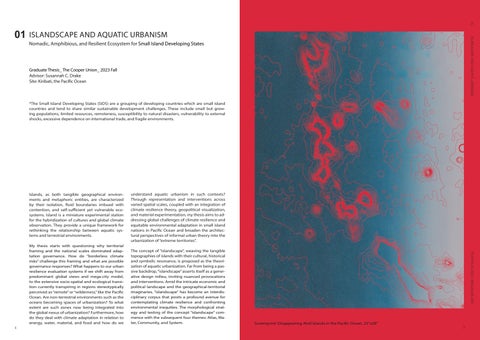
*The Small Island Developing States (SIDS) are a grouping of developing countries which are small island countries and tend to share similar sustainable development challenges. These include small but growing populations, limited resources, remoteness, susceptibility to natural disasters, vulnerability to external shocks, excessive dependence on international trade, and fragile environments.
Islands, as both tangible geographical environments and metaphoric entities, are characterized by their isolation, fluid boundaries imbued with contention, and self-sufficient yet vulnerable ecosystems. Island is a miniature experimental station for the hybridization of cultures and global climate observation. They provide a unique framework for rethinking the relationship between aquatic systems and terrestrial environments.
4
The concept of “islandscape”, weaving the tangible topographies of islands with their cultural, historical and symbolic resonance, is proposed as the theorization of aquatic urbanization. Far from being a passive backdrop, “islandscape” asserts itself as a generative design milieu, inviting nuanced provocations and interventions. Amid the intricate economic and political landscape and the geographical-territorial imaginaries, “islandscape” has become an interdisciplinary corpus that posits a profound avenue for contemplating climate resilience and confronting environmental inequities. The morphological strategy and testing of the concept “islandscape” commence with the subsequent four themes: Atlas, Water, Community, and System.
PORTFOLIO 2023 | MINGXUAN QIN
My thesis starts with questioning why territorial framing and the national scales dominated adaptation governance. How do “borderless climate risks” challenge this framing and what are possible governance responses? What happens to our urban resilience evaluation systems if we shift away from predominant global views and mega-city model, to the extensive socio-spatial and ecological transition currently transpiring in regions stereotypically perceived as “remote” or “wilderness,” like the Pacific Ocean. Are non-terrestrial environments such as the oceans becoming spaces of urbanization? To what extent are such zones now being integrated into the global nexus of urbanization? Furthermore, how do they deal with climate adaptation in relation to energy, water, material, and food and how do we
understand aquatic urbanism in such contexts? Through representation and interventions across varied spatial scales, coupled with an integration of climate resilience theory, geopolitical visualization, and material experimentation, my thesis aims to addressing global challenges of climate resilience and equitable environmental adaptation in small island nations in Pacific Ocean and broaden the architectural perspectives of informal urban theory into the urbanization of “extreme territories”.
Screenprint: Disappearing Atoll Islands in the Pacific Ocean, 23’’x28’’
5