04.11.2026 SNR Harnish Program Notes

Page 1


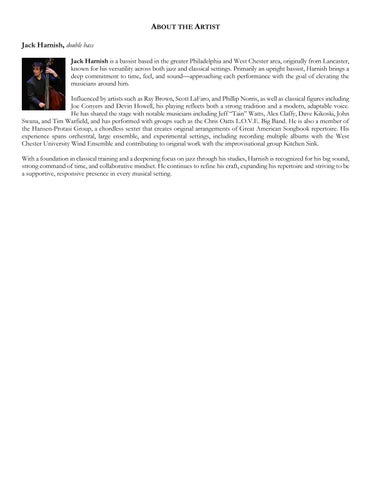
Jack Harnish, double bass

ABOUT THE ARTIST

Jack Harnish is a bassist based in the greater Philadelphia and West Chester area, originally from Lancaster, known for his versatility across both jazz and classical settings. Primarily an upright bassist, Harnish brings a deep commitment to time, feel, and sound approaching each performance with the goal of elevating the musicians around him.

Influenced by artists such as Ray Brown, Scott LaFaro, and Phillip Norris, as well as classical figures including Joe Conyers and Devin Howell, his playing reflects both a strong tradition and a modern, adaptable voice. He has shared the stage with notable musicians including Jeff “Tain” Watts, Alex Claffy, Dave Kikoski, John Swana, and Tim Warfield, and has performed with groups such as the Chris Oatts L.O.V.E. Big Band. He is also a member of the Hansen-Protasi Group, a chordless sextet that creates original arrangements of Great American Songbook repertoire. His experience spans orchestral, large ensemble, and experimental settings, including recording multiple albums with the West Chester University Wind Ensemble and contributing to original work with the improvisational group Kitchen Sink.

With a foundation in classical training and a deepening focus on jazz through his studies, Harnish is recognized for his big sound, strong command of time, and collaborative mindset. He continues to refine his craft, expanding his repertoire and striving to be a supportive, responsive presence in every musical setting.

NothingPersonal, DonGrolnick(1947-1996)

First recorded in 1987 by Michael Brecker, Nothing Personal is a fusion/post-bop composition built on a 24 bar minor blues structure. A distinctive low-register bass vamp that comes and goes throughout the performance, providing a palette for improvisation and textural contrast

Fee-Fi-Fo-Fum,WayneShorter(1933-2023)

Fee-Fi-Fo-Fum, featured on Wayne Shorter’s landmark 1964 “Speak No Evil” album, Follows a 24 bar ABA form. The 8 bar B section draws heavily on blues language, with the surrounding 8 bar A sections being more harmonically fluid, referencing John Coltrane’s Giant Steps, both melodically and harmonically. The floating melody incorporates many color tones such as the 9, b9, and #11, adding to the flowing nature of the composition.

Bolivia,CedarWalton(1934-2013)

Opening with one of the most recognizable bass ostinatos in standard jazz repertoire, Bolivia is one of Cedar Walton’s most famous compositions. The 16 bar G7 vamp punctuates the form, allowing for extended improvisation before transitioning into the second portion of the form, a contrasting 16 bars with shifting harmonic and rhythmic feel November15,KennyGarrett(b. 1960)

From Kenny Garrett’s 1997 album “Songbook”, November 15 features a “singable”, mostly pentatonic melody underneath a beautiful weaving chord progression. The form is an odd 27 bars, with a modulation to A minor from Bb minor highlighting the middle of the form.

BluesforMr.Bill,TimWarfield(b. 1965)

Blues for Mr. Bill comes with a memorable backstory – As Warfield recounts:

“This is a composition that I actually wrote for – Bill Cosby, who had the audacity – we were performing with Shirley Scott – to walk on the bandstand, tell her to get up from the organ, and started to play the organ – looked at her like she couldn’t play the organ. But, the only person that couldn’t play the organ, was Bill Cosby. So, I felt compelled to write a song that depicts what it sounded like when Bill was playing the organ.”

Turn static files into dynamic content formats.

Create a flipbook