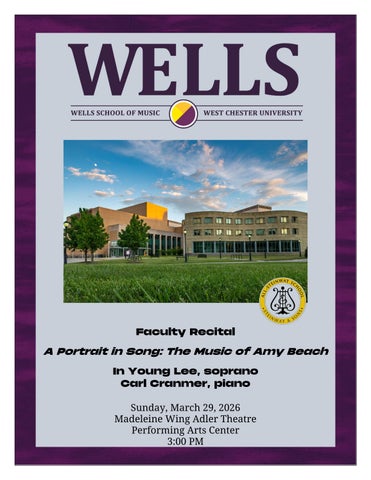
03.29.2026 FAC In Young Lee

Page 1


PROGRAM

Three Shakespeare Songs, Op. 37 ..............................................................................................................................Amy Beach (1867-1944)

O Mistress Mine

Take, O Take Those Lips Away Fairy Lullaby

Four Songs, Op. 51

Ich sagte nicht Wir drei

Juni Je demande à l’oiseau

Amy Beach (1867-1944)

Three Songs, Op. 21 .......................................................................................................................................................Amy Beach (1867-1944)

Chanson d’amou r Extase

Elle et moi

Ovidiu Marinescu , cello

Three Songs, Op. 78 .......................................................................................................................................................Amy Beach (1867-1944)

Meadow-Larks

Night Song at Amalfi In Blossom Time

Three Browning Songs, Op. 44 ...................................................................................................................................Amy Beach (1867-1944)

Ah, Love but a Day I Send My Heart Up to Thee The Year’s at the Spring

Please silence all cell phones and electronic devices.

Nae Yoon Kang , violin

PROGRAM NOTES AND TRANSLATIONS

Songs of Amy Beach (1867 –1944)

Amy Beach has only recently been recognized as one of the most influential American composers of the late nineteenth and earl y twentieth centuries, celebrated for her lyrical vocal lines, expressive harmonic language, and sensitive response to poetry. Her art songs reveal a wide spectrum of moods, from playful charm and intimate conversation to profound introspection and spiritual devotion. They demonstrate her skill in integrating the text, vocal line, and piano accompaniment into a unified, expressive whole. Beach’s songs are notable not only for their melodic inventiveness but also for their careful attention to text setting, harm onic color, and, in selected works, the imaginative use of instrumental obbligato.

The recital opens with Three Shakespeare Songs, Op. 37, which set texts attributed to William Shakespeare. “O Mistress Mine” comes from Twelfth Night, Act II, Scene 3, where the clown Feste sings a lively, celebratory song about love and the joys of the present moment. “Take, O Take Those Lips Away” draws on Renaissance -style lyric poetry associated with Shakespeare, expressing tender longing and unful filled love, set with carefully balanced vocal phrasing over harmonically supportive piano accompaniment. “Fairy Lullaby” evokes the nocturnal, enchanted world of fairies, using delicate melodic gestures and subtle harmonic colorati on to convey serenity and magic. In these songs, Beach transforms the Elizabethan texts into Romantic -era art-song form.

Following Shakespeare, the Four Songs, Op. 51 illustrate Beach’s growing mastery of harmonic sophistication, and ability to also set poems in French and German. “Ich sagte nicht” conveys unspoken emotion through gently chromatic piano harmonies supporting a tender, expansive vocal line, while “Wir drei” with its shifting major and minor tonalities and subtle modulation reflect the poem’s gentle contemplative tone. “Juni” evokes the brightness and freshness of early summer through its rhythmic vitalit y and sparkling harmonic textures. In “Je demande à l’oiseau”, the piano employs block chords under the lyrical and flowing vocal, and highlights Beach’s skill in balancing vocal prominence with harmonic color.

Ich sagte nicht (I did not say)

I did not say, “I love you,” Yet shyly I broke a rose And offered it to you To wear upon your breast, While gazing faithfully into your eyes.

You did not say, “I love you,” Yet smiling, you gave me your hand, And a kiss besides A bliss-bestowing pledge.

We did not say, “I love you,” Yet our hearts proclaimed it loudly As, breathing in springtime And drunk with its fragrance, We stood silently, dreamily gazing at one another.

Wir drei (We Three)

Where hidden deep below The brook rushes past, In a quiet hour Young Spring overheard us. He asked what we were doing And nodded kindly to us; We looked at one another and laughed Spring, and I, and you.

At his side we wandered Through the wide world. There was blooming and singing In meadow, forest, and field. On all our paths I cried out to you in delight: “We journey toward happiness Spring, and I, and you!”

The highest heights shine, The deepest valley gleams; Your eyes, moist with happiness, Shine like the rays of the sun. The lark spreads its wings And soars toward heaven, And love -songs are singing Spring, and I, and you!

Juni (June)

O June days in the sunshine, In the flooding, cloudless light! Meadows bright with flowers, and blooming vines! And in gardens far and wide, everywhere, Sweet cherries and roses!

Sweet cherries and roses, and blooming on the hillside The fragrant mignonette vines! The nights so soft, the days so long! So cheerful the faces, so bright the song! So blissful is life!

The honeysuckle arbors full of secret sound, Of soft, whispering caresses. And every breath of air a wave of fragrance, And everywhere blessing, everywhere Sweet cherries and roses!

Je demande à l’oiseau (I Ask the Bird That Passes)

I ask the bird that passes Over the trees without alighting To carry to you across the distance The caress of my kiss.

I ask the breeze, filled With the fading soul of flowers, To take a little of your breath And come to dry my tears.

I ask the blazing sun, That drinks the sap and ripens the wine, To draw forth all my soul And pour it at your divine feet.

The three French poems used in Three Songs, Op. 21 by Amy Beach form a compelling emotional progression, moving from intimate romantic longing, to spiritual contemplation, to a vivid celebration of passionate love. Although each song stands independently, together they create a subtle dramatic arc that reflects Beach’ s sensitivity to poetic imagery and emotional nuance. The first song, “Chanson d’amour,” presents the voice of a lover standing outside the beloved’s door at dawn. The imagery evokes the tradition of the serenade, where the lover addresses the beloved beneath her window. Beach’s musical setting enhances this sense of lyrical intimacy, and the work is especially distinctive because it was originally composed with a cello obbligato , which interacts with the vocal line and piano accompaniment. The second song, “Extase,” shifts dramatically in atmosphere and scale. Instead of addressing a beloved directly, the speaker contemplates the vastness of nature on a star -filled night beside the sea. In Beach’s musical setting, this sense of awe is reflected in expansive harmonic writing and a heightened dramatic intensity that evokes the vastness and mystery described in the poem. The final song, “Elle et moi,” returns to the theme of love, but with greater confidence and exuberance. The poem celebrates the beloved through vivid images drawn from nature: the many colors of spring, the swallow flying ahead of the season, flowers blooming in the fields, and the bu tterfly drawn irresistibly toward a flame. Beach’s music captures this vitality through lively rhythms and an animated, expressive vocal line.

Chanson d’amour (Song of Love)

Dawn is breaking, yet your door is closed! My beautiful one, why do you still sleep?

At the hour when the rose awakens, Will you not awaken too?

O my lovely one, Listen here

To the lover who sings And also weeps!

All knock upon your blessed door: The dawn says, “I am the day!”

The bird says, “I am harmony!” And my heart says, “I am love!”

O my lovely one, Listen here

To the lover who sings And also weeps!

I adore you, angel, and I love you, woman. God, who made me whole for you, Fashioned my love through your soul And my gaze for your beauty.

O my lovely one, Listen here

To the lover who sings And also weeps!

Extase (Ecstasy)

I was alone beside the waves on a starry night. Not a cloud in the sky, not a sail upon the sea. My eyes gazed beyond the visible world. And the woods, and the mountains, and all of nature

Seemed to question, in a confused murmur, The waves of the sea and the fires of the heavens.

And the golden stars, infinite legions, In loud voices, in soft voices, in a thousand harmonies,

Said, as they bent their crowns of fire; And the blue waves, which nothing rules nor restrains, Said, curling the foam upon their crests:

It is the Lord, the Lord God!

Elle et moi (She and I)

Spring with its thousand colors, The seductive flame with its vivid spark, The privet of the fields with its white flowers, With their sweet fragrance It is she! Ah, it is she!

The swallow that flies ahead of spring, The young goat that lingers by the privet in the fields, Drawn to its blossom, its beautiful blossom Ah! It is she!

The butterfly that fearlessly Flies to the flame to burn its wings Ah! That is I.

Three Songs, Op. 78 showcases Beach’s mature compositional voice, with a refined harmonic palette and sophisticated textural control. In “Meadow-Larks”, the vocal line is buoyant and accompanied by piano textures that suggest natural vibrancy, capturing the song’s pastoral i magery. “Night Song at Amalfi” is emotionally intense and dramatic from the outset, featuring sustained tremolos and repeated octave figures in the piano. " In Blossom Time” the text celebrates the renewal of spring, in a joyous and flamboyant 6/8 meter characterized by abundant grace notes, and expressive ornamentation. The vocal line soars with exuberance, while the piano provides rhythmic vitality and harmonic support, conveying a celebration of love’s joy intertwined with the blessings of nature , creating an effervescent, festive atmosphere. Across the set, Beach demonstrates mastery of tone color, texture, and expressive musical imagery.

The recital culminates with Three Browning Songs, Op. 44 , settings of poems by the English poet Robert Browning . These songs, presented here in the sequence “I Love, but a Day!” , “I Send My Heart Up to Thee!” , and “The Year’s at the Spring" are among the most frequently performed and widely recognized works in Amy Beach’s song repertoire . In this set, Beach the piano functions not merely as harmonic support but also as an active expressive partner. In “I Love, but a Day!”, the vocal line unfolds with passionate lyricism while the accompaniment reinforces the emotional intensity of Browning’s text, creating an atmosp here of ardent devotion and fleeting love. First published in 1899 and arranged with a violin obbligato in 1920. “I Send My Heart Up to Thee!”moves toward a more intimate and inward expression, with the piano shaping the harmonic space in which the voice unfolds, suggesting a ges ture of spiritual offering and emotional sincerity. The final song, “The Year’s at the Spring,”bursts forth with rhythmic vitality and brilliant piano writing, capturing the exuberant optimism of Browning’s poetry. Here, the piano ’s energetic figurations and bright harmonic gestures amplify the celebratory character of the text, bringing the set to an uplifting conclusion. Throughout these songs, Beach’s piano writing is particularly striking. The accompaniment is dramatically responsive to the poetry , often shaping the emotional trajectory of each piece through rhythmic drive, harmonic color, and textural contrast. As a result, the piano assumes a full y collaborative role with the voice, creating a dynamic musical dialogue that hei ghtens the expressive impact of Browning’s poetry. This synthesis of lyrical vocal writing and vividly characterized piano accompaniment exemplifies Beach’s mature artistic voi ce and helps explain why the Three Browning Songs remain among the most beloved and enduring works in her vocal output.

Taken together, these five sets demonstrate Amy Beach’s artistic evolution, from early lyrical elegance and French -inspired charm to mature harmonic sophistication, expressive text -setting, and imaginative use of instrumental color. They illustrate her fac ility with multilingual texts, her ability to shape vocal lines with precise harmonic and rhythmic support, and her innovative use of optional obbligato instruments to enhance tonal color and emotional resonance. This program presents a comprehensive surve y of Beach’s vocal artistry, offering the audience a journey through love, nature, devotion, and poetic imagination.

UPCOMING WELLS SCHOOL OF MUSIC EVENTS

For full event details visitwcupa.edu/music or call (610) 436-2739

Monday, March 30, 2026 , 7:30 PM

Faculty Recital: Dali Quartet

Madeleine Wing Adler Theatre

Performing Arts Center

Thursday, April 2, 2026 , 7:30 PM

Trilovati Flute Ensemble Concert

Kimberly Reighley, director

Madeleine Wing Adler Theatre

Performing Arts Center

Wednesday, April 8, 2026 , 7:30 PM

Faculty Recital:

Elizabeth Pfaffle, horn & Jonathan Fowler, tuba

Philips Autograph Library

Philips Memorial Building

Thursday, April 9, 2026 , 7:30 PM

Vocal Honors Recital

Emily Bullock, director

Ware Family Recital Hall

Swope Music Building

Tuesday, March 31, 2026 , 11:00 AM

Madeleine Wing Adler Concert Series: S. Powell Middleton Freshman Instrumental

Scholarship Competition

Ware Family Recital Hall , SMB

Tuesday, April 7, 2026 , 7:30 PM

Spring Choral Festival

Kimberly Adams & Ryan Kelly, directors

Madeleine Wing Adler Theatre

Performing Arts Center

Wednesday, April 8, 2026 , 7:30 PM

Woodwind Chamber Recital

Henry Grabb, director

Ware Family Recital Hall

Swope Music Building

Friday, April 10, 2026 , 7:30 PM

Sounds of the Caribbean:

Steel Band & Latin Jazz

Madeleine Wing Adler Theatre

Performing Arts Center

*Ticketsarerequired for this event.

†For weekday daytime events, please RSVP tomusicinfo@wcupa.eduto obtain a parking pass via email

Interested in supporting the Wells School of Music?

Scan the QR code and choose the ‘Wells School of Music Excellence Fund ' to direct your donation towardsustaining and enhancing the overall programs and musical excellence at the Wells School of Music.

For further information, please call (610) 436-2868 or visitwcufoundation.org

A majority of performances are available to watch via live stream atVimeo.com/WSOM

Mr.Jonathan Lightcap, Directorof Recording Services and Digital Media

Steinway & Sons Piano Technical, Tuning and Concert Preparations by Gerald P. Cousins, RPT

If you do not intend to save your program, please recycle it in the baskets at the exit doors.

The Wells School of Music | West Chester University of Pennsylvania

Dr. Christopher Hanning, Dean

Turn static files into dynamic content formats.

Create a flipbook
03.29.2026 FAC In Young Lee by WCU Wells School of Music - Issuu