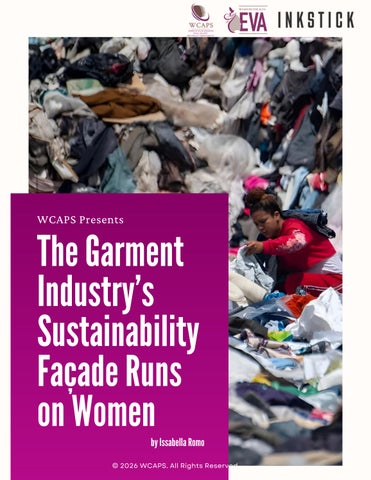
The Garment Industry’s Sustainability Façade Runs on Women

Page 1


WCAPS Presents

The Garment Industry’s Sustainability Façade Runs on Women

About Our Author Issabella Romo

Issabella Romo is a second year Master of Public Policy Candidate at Georgetown University where she is also completing a Certificate in Gender, Peace and Security. She is an organizational capacitybuilding, policymaking, and community-building strategist with experience in human rights, gender issues, education, and civic engagement spanning all levels of government and various nonprofits

As Deputy Director of Research at Climate Cardinals, Issabella is analyzing international challenges in climate event responses and writing reports highlighting opportunities for technology applications to address gaps in climate preparedness infrastructure. She is also conducting Congressional relations and legislative research on tech, trade, and energy policy as the Graduate Fellow at Whitmer & Worrall. At Georgetown, she leads a pro-bono international development policy consulting group and provides tailored impact evaluation services to NGOs in Latin America and the Caribbean seeking to elevate their community impact.

Issabella previously served as Programming Coordinator for the Social Equity through Education Alliance, helping scale the youth-led non-profit and its youth engagement initiatives in local and state education policy. While an undergraduate, Issabella spearheaded intergenerational dialogue at Commonwealth Club World Affairs, represented and advocated for the UC Berkeley student body's legislative priorities as the student government’s Director of Federal Government Affairs, and conducted rigorous qualitative and open-source research on international democracy promotion, femicide and machismo, and human rights violations.

A California native, she graduated with highest honors from the University of California, Berkeley where she earned degrees in Legal Studies and Political Economy and a minor in Human Rights. Issabella strives to use her policy expertise to protect human rights through evidence-based and sustainable policymaking, and to make governments more accessible and accountable to their constituents globally.

In Bangladesh, floods and cyclones are common, but when the water rises, so do the toxic “forever chemicals” which women are disproportionately exposed to in garment factories before the chemicals contaminate surrounding communities’ water supplies. The country’s ready-made garment industry employs about four million workers - mostly women - who endure low wages, harassment, unsafe working conditions, and poor sanitation.(1) Fast fashion’s sustainability façade hides an undercurrent of exploitation. Global retailers such as Zara, H&M, and Shein market “eco-friendly” collections while outsourcing production to countries with weak labor and environmental protections. Fast fashion has become the norm, with up to 20 billion garments sold every year.(2) Behind every so-called sustainable collection lies a workforce of exploited women - 75% of the global garment labor forcemost earning below a living wage.(3)

The women of Bangladesh run the full life cycle of the textile and garment industry, powering both garment construction and environmental protection. Bangladesh’s garment factories create approximately 577,000 metric tons of textile waste, or “jhut,” every year, and it is women who sort through jhut to repurpose it into mattresses, pillows, and other goods. It is estimated that each woman saves approximately 240 tons of greenhouse gases per year through this practice, in addition to their contributions to preventing textile waste from entering the country’s drainage networks.(4)

Investigations show the hypocrisy runs deep. The U.S. Department of Labor found 80% of garment contractors violated wage laws, some paying as little as $1.58 per hour in California.(5) In Bangladesh, workers face chemical exposure from per- and polyfluoroalkyl substances contamination in drinking water, far exceeding EU and U.S. limits.(6) Fast fashion companies regularly neglect safeguards, with the most disadvantaged populations facing the harshest consequences of these violations.

Predominantly women consumers aged 18-24 are targeted through fast fashion marketing campaigns that promote overconsumption.(7) In an effort to head off criticism, major retailers like H&M and Zara have introduced donation drop-off bins in stores, inviting shoppers to recycle old clothes, often in exchange for a discount on their next purchase. These “conscious” collections, donation bins, and recycling programs promise circularity and responsible consumerism but deliver an illusion. Their stated goal is to move toward a closed-loop system where old textiles are recycled into new garments.(8) In reality, “recycled” garments are polluting the environment and consumers are incentivized to continue acquiring new products

1 Akbar, 2025

2 Vatz, 2021

3 Helm, 2025

4 Shröder & Singhal, 2024

5 Rosalez, 2023

6 Johnson, 2024

7 Cardona, 2025

8 Sustainable Fashion Forum, 2023

Clothes recycled at H&M stores have been known to be resold, destroyed, or discarded in a landfill,(9) and a study found that “half of H&M’s sustainability profiles portrayed products as being better for the environment than they actually were and, in some cases, were allegedly completely untrue.”(10) Industry-wide, the environmental costs of fast fashion remain staggering. The fashion industry’s garment production alone produces 10% of annual global carbon emissions, consumes 141 billion cubic meters of water, and generates 35% of ocean microplastics.(11) Each pair of jeans, for example, requires nearly 2,000 gallons of water to produce.(12)

Garment production’s environmental consequences are compounded by the fact that clothing is being discarded faster than ever. On average, garments are worn only seven to ten times before being thrown away.(13) Less than one percent of clothing is recycled into new garments, with most “recycled” fabrics derived from ‘virgin’ plastics rather than old textiles.(14) Since 2017, over 11 million tons of textile waste have ended up in landfills annually - an 80% increase since 2000.(15) Landfills themselves are disproportionately located in communities of color and low-income neighborhoods, reinforcing existing environmental injustices. Much of what is discarded in the Global North is simply exported to the Global South, where it overwhelms local waste systems and economies. Countries like Rwanda, Kenya, and Uganda have taken a proactive approach to the issue and attempted to ban secondhand clothing imports entirely, recognizing the strain they impose.(16)

Fast fashion has been lauded and ultimately popularized for its accessibility to low-income consumers, making a diverse range of styles affordable and disrupting the fashion industry’s “exclusivity” to the elite. However, its affordability is an illusion built on disposability and exploitation. Garments are cheaply produced and designed to fall apart after only a few wears, trapping low-income consumers in a costly cycle of replacement. Rather than promoting inclusivity, fast fashion perpetuates economic and environmental inequality through poor quality, waste, and deceptive marketing.(17)

The scale of harm has not been effectively reduced or counteracted by the guilty corporations. One example of an isolated effort to limit harm is Shein’s $15 million commitment in the form of an extended producer responsibility (EPR) fund to Ghana’s Or Foundation to manage textile waste. The Foundation works to clean Ghana’s beaches and to separate and collect textile waste, but this should be the responsibility of the companies that produce the waste.(18) Such localized interventions underscore that the global fashion system remains structurally unsustainable. It should not fall on local organizations to manage the fallout of global overproduction.

9 Osborn, 2023

10 Sustainable Fashion Forum, 2022

11 Cardona, 2025

12 UN Environment Programme, 2021

13 UN Environment Programme, 2021

14 Sustainable Fashion Forum, 2023

15 U.S. Environmental Protection Agency, 2025

16 Lundberg & Devoy, 2022

17 LaBelle, 2024

18 Cernansky, 2023

The multifaceted detrimental impacts of fast fashion can only be adequately addressed through holding companies accountable and preventing them from exploiting laborers and the environment. At the country level, officials must pass legislation similar to California’s FABRIC Act, which sets a minimum wage for garment workers.(19) Given that women garment workers - including in Bangladesh- face heightened risks of domestic violence linked to gender-role backlash at home, employers and governments should adopt measures outlined in the International Labour Organization’s Violence and Harassment Convention Recommendation 206 - such as flexible work arrangements, paid leave for survivors, and temporary protection against dismissal.(20)

To address the industry’s environmental impacts, companies should reduce production and use highquality materials free of chemical additives. Steps to reverse existing environmental damage through community-informed EPR funds and other investments in local community initiatives are critical. More countries should also follow suit in banning secondhand clothing imports, and companies should invest in waste and recycling processing centers that can accommodate the industry’s demand. Public-private partnerships and a universal commitment to protecting human rights and the environment must serve as a baseline for a responsible garment industry. Above all, community voices must be centered in policymaking around this issue to understand how justice can best be served in the immediate future and sustainably long-term.

Fast fashion’s sustainability promises are little more than a marketing strategy built on women’s labor, natural resources, and human rights violations. True sustainability means valuing the women who sustain the system - not as cheap labor or marketing tools, but as the leaders who can reshape it. Until fashion brands reckon with the human and environmental cost of their “green” image, their sustainability efforts will remain exactly what they are today - a façade.

19 Kim, 2024

20 Khojasteh, 2024

Akbar, M. (2025, March 11). Achieving gender equality in Bangladesh’s garment sector.

https://www.ethicaltrade.org/resources/blog/achieving-gender-equality-bangladeshs-garment-sector

Cardona, N. (2025, May 28). Fast fashion statistics 2025. UniformMarket. https://www.uniformmarket.com/statistics/fast-fashion-statistics

Cernansky, R. (2023, August 10). Cleaning up fashion’s waste is dirty work. Why is Shein the only one paying? V ogue Business.

https://www.vogue.com/article/cleaning-up-fashions-waste-is-dirty-work-why-is-shein-the-onlyone-paying

Helm, M. (2025, September 12). Beneath the seams: The human toll of fast fashion. Earth Day https://earthday.org/beneath-the-seams-the-human-toll-of-fast-fashion/

Johnson, S. (2024, May 29). Alarming levels of “forever chemicals” found in water near Bangladesh garment factories. The Guardian.

https://www.theguardian.com/global-development/article/2024/may/29/alarming-levels-of-foreve r-chemicals-found-in-water-near-bangladesh-garment-factories#:~:text=1%20year%20old-,Alar ming%20levels%20of%20’forever%20chemicals’%20found%20in,water%20near%20Banglades h%20garment%20factories&text=Rivers%2C%20lakes%20and%20tap%20water,issues%2C%2 0according%20to%20new%20research

Khojasteh, N. M. (2024, November 19). The overlooked crisis of domestic violence in the workforce. Human Rights Watch. https://www.hrw.org/news/2024/11/19/overlooked-crisis-domestic-violence-workforce

Kim, I. (2024, August 6). The fight for fair wages in fast fashion. NBCU Academy. https://nbcuacademy.com/fighting-fast-fashion/

LaBelle, C. (2024, February 16). The Fast Fashion Epidemic. UCLA Sustainability https://sustain.ucla.edu/2024/02/16/the-fast-fashion-epidemic/#:~:text=The%20Environmental% 20Impact%20Since%20the%20quality%20is,more%20and%20are%20harder%20to%20clean%20up.

Lundberg, D., & Devoy, J. (2022, September 22). The aftermath of fast fashion: How discarded Clothes Impact Public Health and the environment. Boston University. https://www.bu.edu/sph/news/articles/2022/the-aftermath-of-fast-fashion-how-discarded-clothesimpact-public-health-and-the-environment/

Osborn, D. (2023, June 15). Investigation exposes H&M’s ineffective recycling solution. Professional Clothing Industry Association Worldwide. https://pciaw.org/investigation-exposes-hms-ineffective-recycling-solution/

Rosalez, R. (2023, March 21). The Exploitation of Garment Workers: Threading the needle on fast fashion. U.S. Department of Labor Blog.

https://blog.dol.gov/2023/03/21/the-exploitation-of-garment-workers-threading-the-needle-on-fastfashion

Shröder, P., & Singhal, P. (2024, March 21). Postcard from Dhaka: The women battling the scrap heap Chatham House.

https://www.chathamhouse.org/publications/the-world-today/2024-02/postcard-dhaka-women-ba ttling-scrap-heap

Sustainable Fashion Forum. (2022, August 17). H&M is Being Sued For “Misleading” Sustainability Marketing. What Does This Mean for the Future of Greenwashing? Sustainable Fashion Forum. https://www.thesustainablefashionforum.com/pages/hm-is-being-sued-for-misleading-sustainabil ity-marketing-what-does-this-mean-for-the-future-of-greenwashing

Sustainable Fashion Forum. (2023, November 16). Why Can’t We Just Recycle Our Old Clothes? Sustainable Fashion Forum. https://www thesustainablefashionforum.com/pages/quick-question-why-cant-clothes-just-be-rec ycled

UN Environment Programme (2021, June 28). Putting the brakes on fast fashion. https://www.unep.org/news-and-stories/story/putting-brakes-fast-fashion

U S. Environmental Protection Agency. (2025, October 23). Textiles: Material-Specific Data. U S Environmental Protection Agency. https://www.epa.gov/facts-and-figures-about-materials-waste-and-recycling/textiles-material-spe cific-data

Vatz, S. (2021, February 17). Why America stopped making its own clothes. https://www.kqed.org/lowdown/7939/

Thank You.

Thank you to our partner, Inkstick Media for their continuous support to WCAPS programs. Thank you to Editor, Laicie Heeley, for her support to En Voz Alta (EVA) and the author!

Laicie Heeley is the founding CEO of Inkstick Media, where she serves as Editor in Chief of the foreign policy magazine Inkstick and Executive Producer and Host of the PRX- and Inkstick-produced podcast, Things That Go Boom. Heeley’s reporting has appeared on public radio stations across America and the BBC, where she’s explored global security issues including domestic terrorism, disinformation, nuclear weapons, and climate change.

Prior to launching Inkstick, Heeley was a Fellow with the Stimson Center’s Budgeting for Foreign Affairs and Defense program and Policy Director at the Center for Arms Control and Non-Proliferation. Her publications include work on sanctions, diplomacy, and nuclear arms control and nonproliferation, along with the first full accounting of US counterterrorism spending after 9/11.

In her role at the Center for Arms Control and Non-Proliferation, Heeley served as part of the independent Sustainable Defense Task Force, formed in response to a request from Members of Congress to explore possible defense budget contributions to deficit reduction efforts in the wake of the 2008 financial crisis.

Her work has appeared in well-known newspapers, journals, and periodicals including Foreign Policy, The Washington Post, The Wall Street Journal, and Associated Press, and she has appeared as an expert on CNN, MSNBC, and Fox News.

Heeley currently serves as a trustee of the British American Security Information Council (BASIC) and on the board of the Herbert Scoville Jr. Peace Fellowship. She also serves on the advisory committee of the War Prevention Initiative. She is a Partner with the Truman National Security Project and a Fellow with N Square. She previously held positions at Physicians for Social Responsibility, The Counter Terrorist Finance Organization, and Global Green USA where her research focused on nuclear, chemical, and biological weapons in addition to the financing and structure of terrorist organizations. She holds a BA from George Washington University and an MA from St. Mary’s University.

Turn static files into dynamic content formats.

Create a flipbook
Issuu converts static files into: digital portfolios, online yearbooks, online catalogs, digital photo albums and more. Sign up and create your flipbook.
The Garment Industry’s Sustainability Façade Runs on Women by Women of Color Advancing Peace & Security - Issuu