Honthorst_EN_LR_bladerpdf

Page 1


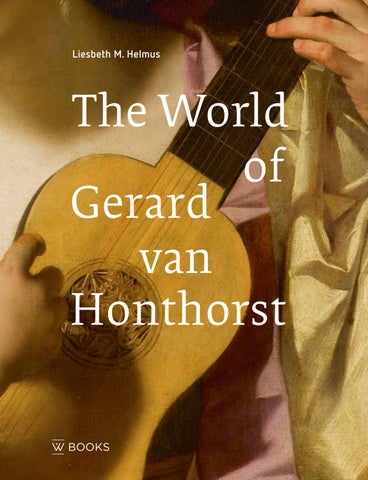
The World of Gerard van Honthorst

The World of Gerard van Honthorst

9 preface

17 chapter one

Beginnings

– Honthorst versus Rembrandt 17

– Early Life in Utrecht 22

– Bloemaert, Wtewael and Moreelse 26

– The Guild of St Luke and Training to Become a Painter 40

– The Drawing Academy 42

– Karel van Mander's Encouragement 52

61 chapter two

Rome

– Rome Around 1600 63

– Renovatio Romae 66

– The Journey to Rome 68

– Where Did Honthorst Live? 70

– Artist Friends in Rome 71

– The Bentvueghels 73

– Honthorst Draws and Reflects 74

– The Earliest Paintings 79

– Santa Maria della Scala 84

– Francesco Maria del Monte 91

– The Ecstasy of Mary Magdalene 93

– Vincenzo Giustiniani 93

– Giulio Mancini 101

– The Final Major Commission in Rome 107

– In Conclusion 109

117 chapter three Urecht

– Albano 118

– Honthorst's Stock 121

– Home Sweet Home 122

– The First Eighteen Months 124

– The Workshop in Utrecht 127 – Earthly Pleasures 135

– Verses Accompanying Prints 143

– The Moral Lessons From Jacob Cats 143

– The Beautiful Zavonnare 150

– Pieter Corneliszoon Hooft 152

– Painting the Passage of Time 155 – The Meaning of Music 158 – Peter Paul Rubens 164

171 chapter four

International Recognition

– London 174

– George Villiers 175

– Persuaded by the British Court 177

– The Journey 178

– Apollo and Diana 179

– The Court Masquerade 184

– An Exemplary Family Portrait 184

– The Reward 187

– Frederik V en Elizabeth, King and Queen in Exile 188

– A Portrait Like a Story 190

– The Odyssey 193

– Antoon Triest 194

– The Lamentation of Christ 199

– The Five Wounds 204

– Christiaan IV of Denmark 206

211 chapter five

The Hague

– Ceremonial Portraits 214

– Frederick Henry, Conqueror of Cities 216

– Queen Marie de Medici 218

– The Stadtholder's Palaces 221

– Elizabeth of Bohemia 232

– Honthorst Teaching the Children of Bohemia 235

– Willem van Honthorst 242

– Court Painter in Cleves 246

– Amalia van Solms-Braunfels 248

– Huis ten Bosch Palace and the House of Orange Hall 254

263 chapter six

The End

– A Wedding Gift for Eva 263

– The Final Self-Portrait 267

– The Beautiful Susanna 271

– Final Word 274

279 bibliography

291 index

300 exhibited works

316 photograph credits

320 colophon

Gerard van Honthorst occupies an exceptional position in the artistic landscape of the seventeenth century. Born in Utrecht, the cultural heart of the Northern Netherlands in the early Dutch Republic, he learned the art of painting from Abraham Bloemaert, the most prominent teacher in Utrecht at the time. This laid the foundation for a career that would resonate not only nationally but also internationally. Like many ambitious artists of his generation, Honthorst moved to Rome, where he stayed between about 1613 and 1620. In the Eternal City, he became acquainted with Caravaggio’s gritty naturalism and revolutionary chiaroscuro: an encounter that would change his art forever.

In Rome, Honthorst managed to gain access to an exclusive circle of patrons. He was one of only a few non-Italians to receive prestigious commissions for altarpieces. Influential collectors such as Benedetto and Vincenzo Giustiniani and Cardinal Francesco Maria del Monte appreciated his work. Honthorst’s fame was particularly linked to his nocturnal scenes: dramatic scenes illuminated by a single artificial light source in which light not only sets the mood but also structures the composition and deepens the psychology of the representation. These paintings earned him the nickname ‘Gherardo delle Notti’, or Gerard of the Nights, an honorary title that underlined his international reputation.

When Honthorst returned to Utrecht in 1620, he proved remarkably flexible. He adapted his style and themes to the demands of the market and developed a versatile oeuvre. His lively genre paintings, with their playful, sometimes slightly erotic undertones, his musical ensembles and pastoral scenes were all in high demand. At the same time, he emerged as an innovator in portraiture. Honthorst played a key role in the development of both the pastoral and allegorical portrait, as well as the so-called portrait historié, in which the subjects are portrayed as mythological or historical figures. In this way, he managed to subtly combine representation, imagination and propaganda.

Biographers from his time describe him as an artist who was friendly, modest and diplomatic, qualities that undoubtedly helped him navigate between diverse clients. His talent for empathising with their wishes made him particularly successful. In 1628, he travelled to London, where he worked for King Charles I of England and his court. In the years that followed, he acquired a prominent position in The Hague as court painter to Elizabeth Stuart and her husband, Frederick V. The portraits Honthorst produced for

Beginnings

Dozens of archival documents bear witness to the life of Gerard van Honthorst (15921656), who was born and raised in Utrecht, travelled to Rome and, upon his return to the Netherlands, settled in his home town, where he married, had children and, after a long and successful life, died and was buried. We paint a picture of Honthorst on the basis of these archival documents, and reconstruct his life based on testimonies by his contemporaries and his letters. We know his handwriting and we know what he looked like. However, he would have been anonymous, like so many others, were it not for the hundreds of paintings and drawings he left behind, which are spread across the world and form his legacy. Ultimately, it is this legacy that concerns us but, at the present time, we as art historians attempt to look further and to carefully draw a connection between the artist’s work and historical events, which may be major, such as the end of the Twelve Years’ Truce, or minor and personal, like the death of a parent or child. We examine Honthorst’s early life as the eldest child of his family, his education and his adventures in Italy and move to Rome, where he spent possibly the most successful and happiest years of his life. Subsequently, we look at his return to Utrecht, where he started a family and reinvented himself; his national and international success; and his second career in The Hague, which brought him prosperity and standing.

Honthorst versus Rembrandt

Until 1650, Gerard van Honthorst was one of the most successful and influential painters of the Northern Netherlands. He made a name for himself both nationally and internationally. The question of how he related to Rembrandt (1606-1669), who was fourteen years his junior, is unavoidable but, at the same time, difficult to answer. No doubt they were aware of each other’s existence, yet it is unclear whether they were in contact with each other. To date, there is no source that proves this. Since the nineteenth century, Rembrandt van Rijn, Johannes Vermeer (1632-1675) and Frans Hals (1582/83-1666) have led the canon of world-famous seventeenth-century Dutch painting. Rembrandt was born in Leiden, died in Amsterdam and lived his life within a radius of about seventy kilometres from where he resided. Vermeer lived and worked in Delft, a city he never left, as far as we know. It was only in the mid-nineteenth century that his talent was noticed outside Delft. Hals was an immigrant. Born in Antwerp, he moved to Haarlem at a young age, where he lived,

069
Gerard van Honthorst, The Ecstasy of Mary Magdalene, ca. 1618-20. Canvas, 146 ◊ 119 cm
Centraal Museum, Utrecht (purchased with support from the John & Marine van Vlissingen Art Foundation)

070

Gerard van Honthorst, Christ in the Garden of Gethsemane, ca. 1617

Canvas, 113 ◊ 110 cm State Hermitage Museum, St Petersburg

071 | a

Wybrand de Geest (after Caravaggio),

The Ecstasy of Mary Magdalene, 1620

Canvas, 114 ◊ 91.6 cm. Fries Museum, Leeuwarden (purchased with support from the FB Oranjewoud Foundation and the Rembrandt Association, partly thanks to its Saskia Fund)

094

Gerard van Honthorst, The Adoration of the Shepherds, 1622 Canvas, 164.5 ◊ 191.1 cm. Wallraf-Richartz-Museum, Cologne

painting to fit the location in which it would be hung, such as a panelled wall. This supports the hypothesis that this specific painting is identical to the one mentioned in the 1632-33 inventory of Noordeinde Palace in The Hague: Op het cabinet van Zijn Excellentie. Een schoorsteenmantel, vergult met biesen, den gront groen gelijck mede de solderinge; daarinne een schilderie, daer de herders Christus comen begroeten, door Honthorst gedaan. (‘In His Excellency’s cabinet. A mantelpiece with gilt borders, its surface green like the ceiling; on it a painting of the shepherds coming to greet Christ, done by Honthorst.’) 41

The original depiction of the cheerful, colourful musical ensemble on a balcony playing to us from above was actually larger, with a balustrade along all four sides of the painting.

This alteration was made by a later owner of the ceiling painting. It is the earliest known example of an illusionist scene painted on a ceiling in the Netherlands (Fig. 095). It is not known for whom or in whose house Honthorst painted the ceiling.42

The fact that Honthorst’s paintings were already being copied during his lifetime is evident from an inventory of the household effects of Lambert Jacobsz from Leeuwarden, in the north of the Netherlands, from 3 October 1637: Een coninck Davit spelende op de harp en singende na Mr J. Houthorst (‘A King David playing the harp and singing, after master J Ho[n] thorst’).43 David is best known for the heroic tale in which he, as a shepherd boy, defeated the fearsome giant Goliath with his slingshot, resulting in the victory of the Israelites over the Philistines. He beheaded the giant with the giant’s own sword and took the huge head

095
Gerard van Honthorst, Musical Group on a Balcony, 1622. Panel, 309.9 ◊ 216.4 cm. J. Paul Getty Museum, Los Angeles

201

Gerard van Honthorst, A Woman Drawing Surrounded by Figures, ca. 1640. Paper, black chalk, brush and brown ink, white chalk, 250◊224 mm. Private collection (courtesy Nicolas Schwed)

202

Gerard van Honthorst, The Drawing Lesson, ca. 1640 Paper, black and red chalk, pen in black ink, heightened with opaque white paint. 209◊252 mm Teylers Museum, Haarlem

It shows a young woman at a table with a sheet of paper in her hand, studying the female model she is drawing. Honthorst must have made this sketch of his noble pupils on the spot.

Of the four princesses who were taught by Honthorst, only a few paintings by Louise Hollandine have survived.68 In 1643, when she was 21 years old, Honthorst painted a portrait of her as Diana, the goddess of the hunt (Fig. 203).69 In her left hand, she is holding a bow while with her right she is drawing an arrow from a quiver. She is accompanied by two greyhounds. Her dark eyes, long dark curly hair, the feathers in her hair and her shiny golden dress make her a ravishing figure. On 16 December 1657, when Louise Hollandine was 35 years old, she left The Hague and went to Paris, home to her brother Eduard and his wife, who had previously converted to Catholicism. On 25 January 1658, Louise Hollandine was also admitted to the Roman Catholic Church, and in 1659 she became a novice at the Maubuission Abbey near Pontoise, northwest of Paris. A year later, she took her vows, and in 1664 she was appointed Abbess. She continued to paint until her death on 11 February 1709. Twenty-five of her paintings have been preserved and thirty more attributed to her, although their whereabouts is unknown.70 Her work includes mostly portraits and paintings with religious themes that hung in the convent or that she gifted to family and friends. Sir Robert Anstruther (1578-1645), a diplomat at the English court, took two of her paintings to her uncle, King Charles I: a full-length portrait of a falconer accompanied by a white dog surrounded by a landscape, and Tobias and the angel, also in a landscape.71

203
Gerard van Honthorst, Portrait of Louise Hollandine of the Palatinate as Diana, 1643 Canvas, 207◊144.5 cm. Centraal Museum, Utrecht

This book was published to accompany the exhibition Gerard van Honthorst – Different to Rembrandt at the Centraal Museum in Utrecht, 25 April to 13 September 2026.

Publisher

wbooks, Zwolle info@wbooks.com wbooks.com in collaboration with Centraal Museum, Utrecht info@centraalmuseum.nl

Text

Liesbeth M. Helmus

Translation

Susan Ridder

Graphic Design

DeLeeuwOntwerper(s), Victor de Leeuw, The Hague

isbn 978 94 625 8745 8 (English) isbn 978 94 625 8742 7 (Dutch)

© 2026

wbooks Zwolle / Dr. Liesbeth M. Helmus / Centraal Museum, Utrecht

All rights reserved. Nothing from this publication may be reproduced, multiplied, stored in an electronic data file, or made public in any form or in any manner, be it electronic, mechanical, through photocopying, recording or in any other way, without the advance written permission of the publisher.

The publisher has endeavoured to settle image rights in accordance with legal requirements. Any party who nevertheless deems they have a claim to certain rights may apply to the publisher.

This publication was funded by:

– Boellaard Fonds

– De Gijselaar-Hintzenfonds

The English translation of The World of Gerard van Honthorst was made possible by financial contributions from:

– Johnny van Haeften

– Salomon Lilian Dutch Old Master Paintings

– Adam Williams Fine Art

This book will be published in French by Cohen & Cohen, éditeurs à Paris.

The exhibition Gerard van Honthorst – Different to Rembrandt has been made possible with the support of the Dutch government: the Cultural Heritage Agency of the Netherlands has granted an indemnity guarantee on behalf of the Minister for Education, Culture and science. Other sponsors include:

Turn static files into dynamic content formats.

Create a flipbook
Honthorst_EN_LR_bladerpdf by WBOOKS - Issuu