
![]()


Hoe is het om sangoma te zijn in Nederland?
De moeilijkheid is dat ik niet kan praktiseren zoals ik dat thuis zou doen. Sangoma-zijn is sterk cultureel bepaald, het komt voort uit tradities. Ik moet omringd zijn door mensen die begrijpen wat ik doe, door planten en medicijnen. Als dat niet kan, moet je een nieuwe manier vinden. Mijn essentie verandert niet, die verandert nooit, alleen hoe je de dingen doet. De wereld verandert telkens weer, en daar moet ik, net als iedereen, me op aanpassen.
Is sangoma worden iets wat je kiest?
Nee. Het is geen keuze. Net als dat je niet kiest om sjamaan te worden. Het gebeurt. Het is een roeping. Bij sommige mensen weten de ouders het, sommige mensen ontdekken het zelf op een bepaalde leeftijd.
Laten we het hebben over de werken die je speciaal voor de tentoonstelling hebt gemaakt. Wat betekent de serie Lilitha?
Het woord Lilitha betekent licht. Ik ben sinds een tijdje geobsedeerd door kerken en hun architectuur. Kerken zijn immens, groots en overweldigend. Daarna ging ik naar het Caribisch gebied en zag ik begraafplaatsen. Ik voelde dat er een relatie was tussen kerken en begraafplaatsen. Kerken herbergden vroeger ook lichamen. De kerk is de plek waar het lichaam aan zijn vertrek begint, de begraafplaats is de laatste plek waar je het lichaam ziet. Ik wilde die relatie onderzoeken, maar ook hoe mensen offers achterlaten voor hun voorouders en hoe altaren bestaan binnen verschillende culturen, zoals Hoodoo [een vorm van Afro-Amerikaanse volksmagie met wortels in West-Afrika, red.] en Samo [volksislam gecombineerd met traditionele Afrikaanse spirituele tradities uit Burkina Faso,
What is it like to be a sangoma in the Netherlands?
The difficulty is that I cannot practise in the way I would at home. Being a sangoma is deeply culturally embedded; it comes from traditions. I need to be surrounded by people who understand what I do, by plants and medicines. If that is not possible, you have to find a new way. My essence does not change – it never changes – only how you do things. The world is constantly changing, and like everyone else, I have to adapt to that.
Is becoming a sangoma something you choose?
No. It is not a choice. Just as you do not choose to become a shaman. It happens. It is a calling. For some people, their parents know; others discover it themselves at a certain age.
Let’s talk about the works you created specifically for the exhibition. What does the series Lilitha mean?
The word Lilitha means light. For some time now, I have become obsessed with churches and their architecture. Churches are immense, grand and overwhelming. Then I went to the Caribbean and saw cemeteries. I felt there was a relationship between churches and cemeteries. Churches used to house bodies as well. The church is the place where the body begins its departure; the cemetery is the last place where you see the body. I wanted to explore that relationship, but also how people leave offerings for their ancestors and how altars exist within different cultures, such as Hoodoo [a form of African-American folk magic with roots in West Africa, ed.] and Samo [folk Islam combined with traditional African spiritual traditions from Burkina Faso]. I wanted to build an altar that speaks to all these cultures at once.

iZono (Zonden) | 2026
hout, heilige as, imphepho, lavendel
450 x 300 x 15 cm
bruikleen van de kunstenaar foto’s Peter Tijhuis
iZono (Sins) | 2026
wood, holy ash, imphepho, lavender
450 x 300 x 15 cm
courtesy the artist photos Peter Tijhuis


umKhululeko
(Een gebed) | 2026
wol, textiel, koper
bruikleen van de kunstenaar
foto’s Peter Tijhuis
umKhululeko
(A Prayer) | 2026
wool, textile, copper
courtesy the artist
photos Peter Tijhuis


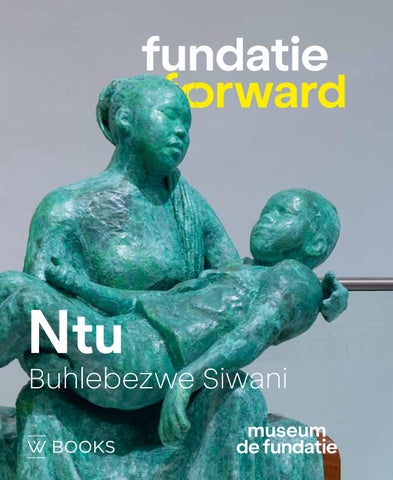
Dit boek is uitgegeven ter gelegenheid van de tentoonstelling Buhlebezwe Siwani – Ntu, te zien van 21 februari tot en met 20 september 2026 in Museum de Fundatie Zwolle.
This book is published on the occasion of the exhibition Buhlebezwe Siwani – Ntu, held at Museum de Fundatie Zwolle, from 21 February to 20 September 2026.
uitgave / publisher
WBOOKS, Zwolle info@wbooks.com wbooks.com
in samenwerking met/ in collaboration with Museum de Fundatie info@museumdefundatie.nl museumdefundatie.nl
auteurs / authors
Beatrice von Bormann
Sanne van de Kraats
redactie/ edits
Sanne van de Kraats
fotografie / photography
Lauren Theunissen
Peter Tijhuis
ontwerp / design
Erlend Schenk | BurOgraphic
iSBN 978 94 625 8740 3
Nur 646
© 2026 WBOOKS Zwolle / de auteurs
Alle rechten voorbehouden. Niets uit deze uitgave mag worden verveelvoudigd, opgeslagen in een geautomatiseerd gegevensbestand, of openbaar gemaakt, in enige vorm of op enige wijze, hetzij elektronisch, mechanisch, door fotokopieën, opnamen of op enige andere wijze, zonder voorafgaande schriftelijke toestemming van de uitgever.
De uitgever heeft ernaar gestreefd de rechten met betrekking tot de illustraties volgens de wettelijke bepalingen te regelen. Degenen die desondanks menen zekere rechten te kunnen doen gelden, kunnen zich alsnog tot de uitgever wenden.
Buhlebezwe Siwani – Ntu is onderdeel van Fundatie Forward, de reeks van eerste museale solotentoonstellingen van hedendaagse makers die (deels) in Nederland wonen en werken. Met deze reeks zet Museum de Fundatie kunst in beweging en biedt het makers een podium om te experimenteren.
© 2026 WBOOKS Zwolle / the authors
All rights reserved. Nothing from this publication may be reproduced, multiplied, stored in an electronic data file, or made public in any form or in any manner, be it electronic, mechanical, through photocopying, recording or in any other way, without the advance written permission of the publisher.
The publisher has endeavoured to settle image rights in accordance with legal requirements. Any party who nevertheless deems they have a claim to certain rights may apply to the publisher.
Buhlebezwe Siwani – Ntu is part of Fundatie Forward, a series of first solo museum exhibitions by contemporary artists who live and work (partly) in the Netherlands. With this series, Museum de Fundatie sets art in motion and offers artists a platform to experiment.
Buhlebezwe Siwani – Ntu wordt ondersteund door / is supported by
Museum de Fundatie wordt ondersteund door: Museum de Fundatie is supported by:


