
Discipleship in a Divided Age: A Lenten Journey through Matthew’s Gospel
LIVING FAITHFULLY AMID DIVISION AND UNCERTAINTY
WRITTEN BY TERI MCDOWELL OTT
WRITTEN BY TERI MCDOWELL OTT
The Gospel of Matthew feels strikingly contemporary. Matthew’s first audience was seeking a faithful path in a turbulent, confusing time. Scholars believe this early church was young and fragile, formed of Jewish followers of Jesus who had recently left—or been pushed out of—their synagogues. Tensions were high, beliefs deeply rooted, divisions painful. Matthew’s Gospel includes harsh rhetoric about Jews that should never be removed from context or applied to all Jews; it reflects the heartbreak of a community in conflict and the sharp feelings that arise when good people disagree on matters of deep conviction. This church also lived in a diverse urban setting, sharing space with Gentiles — people they had long been taught to avoid.
Into this setting Matthew proclaims a kingdom breaking in — a way of life grounded in humility, compassion, and courage. As we walk through Matthew during Lent, we too are invited to follow Jesus on the narrow path, confront our own divisions, and seek God’s kingdom amid today’s fractures.
Westminster Bible Companion, by Thomas G. Long, (Westminster John Knox Press, 1997.)
Westminster Study Bible (Westminster John Knox Press, 2024)

ASH WEDNESDAY
God’s story breaks barriers.
Matthew 1:1-17
Focus verse:
Matthew 1:1
An account of the genealogy of Jesus the Messiah, the son of David, the son of Abraham.
If you or I were writing a knockout bestseller, we wouldn’t open with a long list of names. Matthew clearly didn’t take a literary workshop on “hooking the reader.” In our age of distraction, the average attention span hovers around eight seconds — just enough to read the first two or three names before our eyes glaze over. Yet Matthew begins his Gospel with a lengthy genealogy. Why?
Matthew’s original audience needed roots. In a fragile new church, the Jewish Christians, recently separated from their synagogues, felt lost and vulnerable as they ventured into unfamiliar territory. This genealogy tethered them to a lineage – their larger story –stretching back to Abraham, through Ruth and Jesse, David and the prophets, to Jesus, the Son of David. These names weren’t filler. They were family.
And tucked inside this family tree is a surprise. Matthew includes five women: Tamar, Rahab, Ruth, “the wife of Uriah” (Bathsheba), and Mary. Biblical commentator Thomas G. Long compares this to paging through a 1949 West Point yearbook and suddenly seeing five women’s portraits among rows of men. In a patriarchal culture where genealogies listed only fathers and sons, this would have shocked Matthew’s audience. We may never know precisely why Matthew included these women, but his opening chapter signals that with Jesus, we should expect the unexpected. God’s story keeps breaking barriers and including those the world overlooks.
And maybe, at the start of Lent, we need the same. The world feels like a hot mess. Churches are shrinking, faith feels like wishful thinking, and the needs of the world scream for a Savior. Lent invites us into the wilderness, but we don’t go alone. Like Matthew’s community, we belong to a lineage of faith that stretches far beyond our individual lives. Lent grounds us, roots us, and calls us back into God’s story of redemption.
Reflection
Prayer
Where do you feel “rootless” right now — in your faith, your work, your church, or your life? How does remembering the great cloud of witnesses (ancestors, mentors, saints — including surprising ones) steady you as you begin Lent?
Holy God, at the start of this Lenten journey, steady our wandering hearts. Remind us that we belong to your story, woven across generations. As we step into this season, ground us in your grace, and let your love take root in us as we follow Jesus. Amen.

THURSDAY
God is doing something new.
Matthew 1:18–25
Focus verses:
Matthew 1:22-23
All this took place to fulfill what had been spoken by the Lord through the prophet: “Look, the virgin shall become pregnant and give birth to a son, and they shall name him “Emmanuel,” which means, “God is with us.”
Reflection
Joseph was a righteous man. In his world, righteousness meant keeping the law. When he discovered Mary was pregnant – presumed unfaithful – Mosaic law gave him only one path: cast her aside. Joseph, however, was also a kind man. He didn’t want Mary publicly disgraced or harmed, so he chose to obey the law, but quietly.
Then the angel appeared. Mary’s pregnancy was not a violation of God’s will, but the fulfillment of it. God was doing something new.
How often do we miss the new thing God is doing? How often do we cling to the old patterns because they are familiar, safe, or socially acceptable? How often do we default to what we know instead of opening to the newly possible? Like Joseph, we can confuse obedience with faithfulness. Lent gives us a chance to pause, look, and listen — to become alert to the holy disruptions in our own lives and the lives of others.
Matthew does not linger over the details of the birth. Instead, he emphasizes the name. Emmanuel: “God is with us.” This is another unimagined turn — that God would become so humble, so vulnerable, to not only be with us but to take on the flesh of a newborn child. God is not distant. God is with us, surprisingly, shockingly, lovingly, in the here and now.
Where might God be inviting you to release an old pattern, habit, or assumption to make room for something new? How might “God is with us” change your understanding of your current circumstances?
Prayer
Emmanuel, God-with-us, open our eyes to the new thing you are doing. When we cling to old habits, loosen our grip. When we resist your surprising grace, soften our hearts. Help us to trust that your presence is always with us, even in the unexpected. Amen.
Matthew 2:1-12
Focus verse:
Matthew 1:1
An account of the genealogy of Jesus the Messiah, the son of David, the son of Abraham.
In the time of King Herod, after Jesus was born in Bethlehem of Judea, magi[a]from the east came to Jerusalem, asking, “Where is the child who has been born king of the Jews? For we observed his star in the east[ and have come to pay him homage.”
If you’ve ever looked at a nativity set on a windowsill or lawn, you’ve seen everyone gathered: Mary, Joseph, and baby Jesus; a shepherd or two with sheep; maybe an ox or donkey; and always the magi with their camels, kneeling before the Christ child. It’s a beautiful scene, but also a mash-up. Luke gives us shepherds. Matthew gives us magi. Our Christmas crèches put them all together.
Matthew tells the story his way: The magi appear sometime after Jesus’ birth, and Matthew gives us almost no details about their origin or character. People have interpreted them as astrologers because they follow a star, but all Matthew says is they were “from the East”— meaning, not from around here. It’s safe to assume they were not Jews, yet here they are paying homage to “the one born king of the Jews.”
This is the surprising power of Matthew’s story: the insiders – the religious authorities and scholars in Jerusalem – do not come to Bethlehem to worship. Those closest to the Scriptures, the priests and scribes who can quote the prophecies, stay put. Instead, it’s outsiders, strangers, those farthest away geographically and religiously, who kneel at Jesus’ feet. God’s kingdom breaks boundaries, and Jesus draws unexpected people into his story. Lent is a good time to ask ourselves: who is showing up at the manger today, and are we willing to join them? God may be revealing Christ through people, places or practices far outside what and who we know.
Reflection Where might God be appearing in unexpected people or places in your life? What might it look like for you to “travel” beyond the familiar to meet Christ there?
Prayer God of the unexpected, expand our hearts and imaginations. Help us notice the “outsiders” who reveal your presence. Lead us, like the magi, to seek and honor Jesus wherever he may be found. Amen.
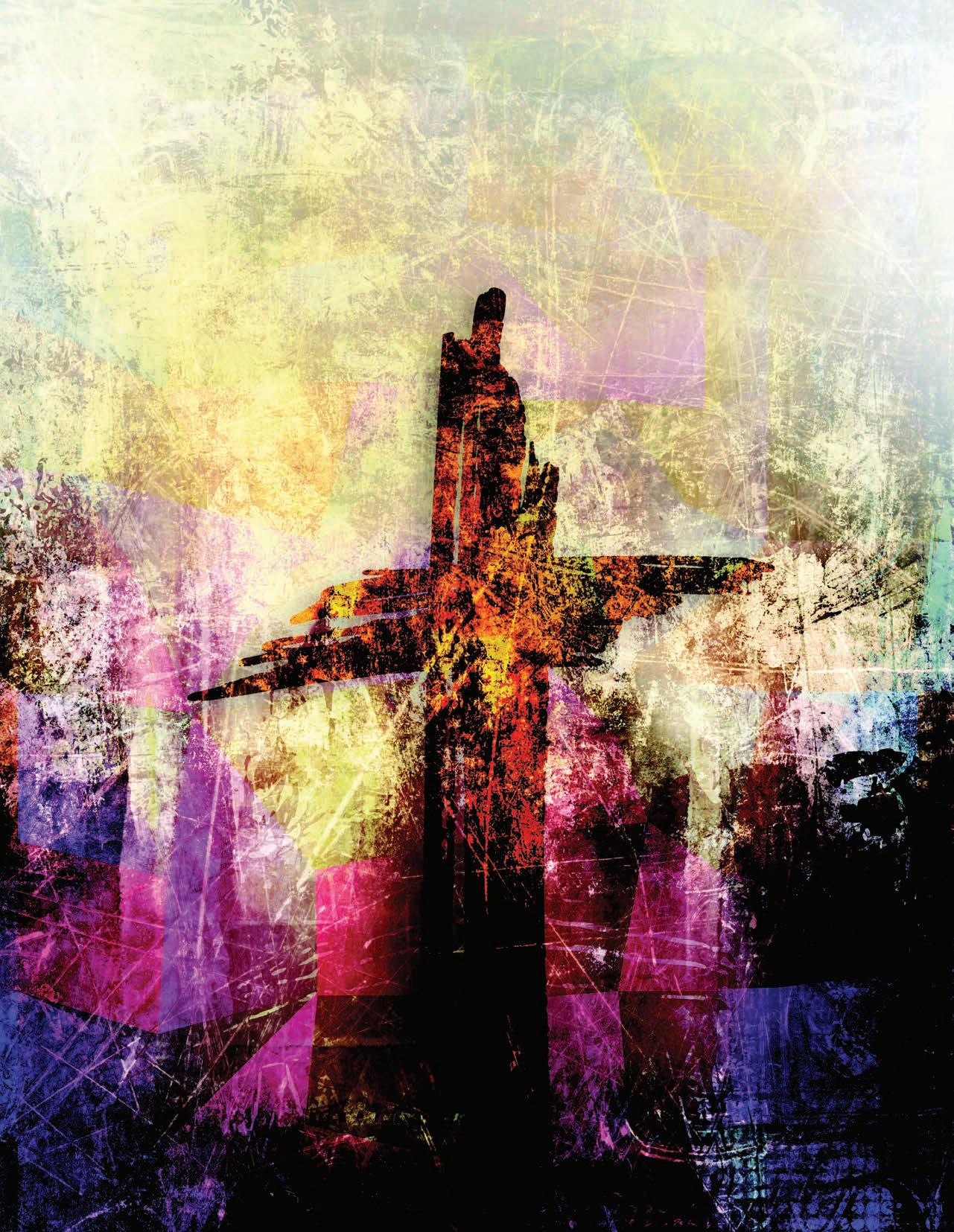
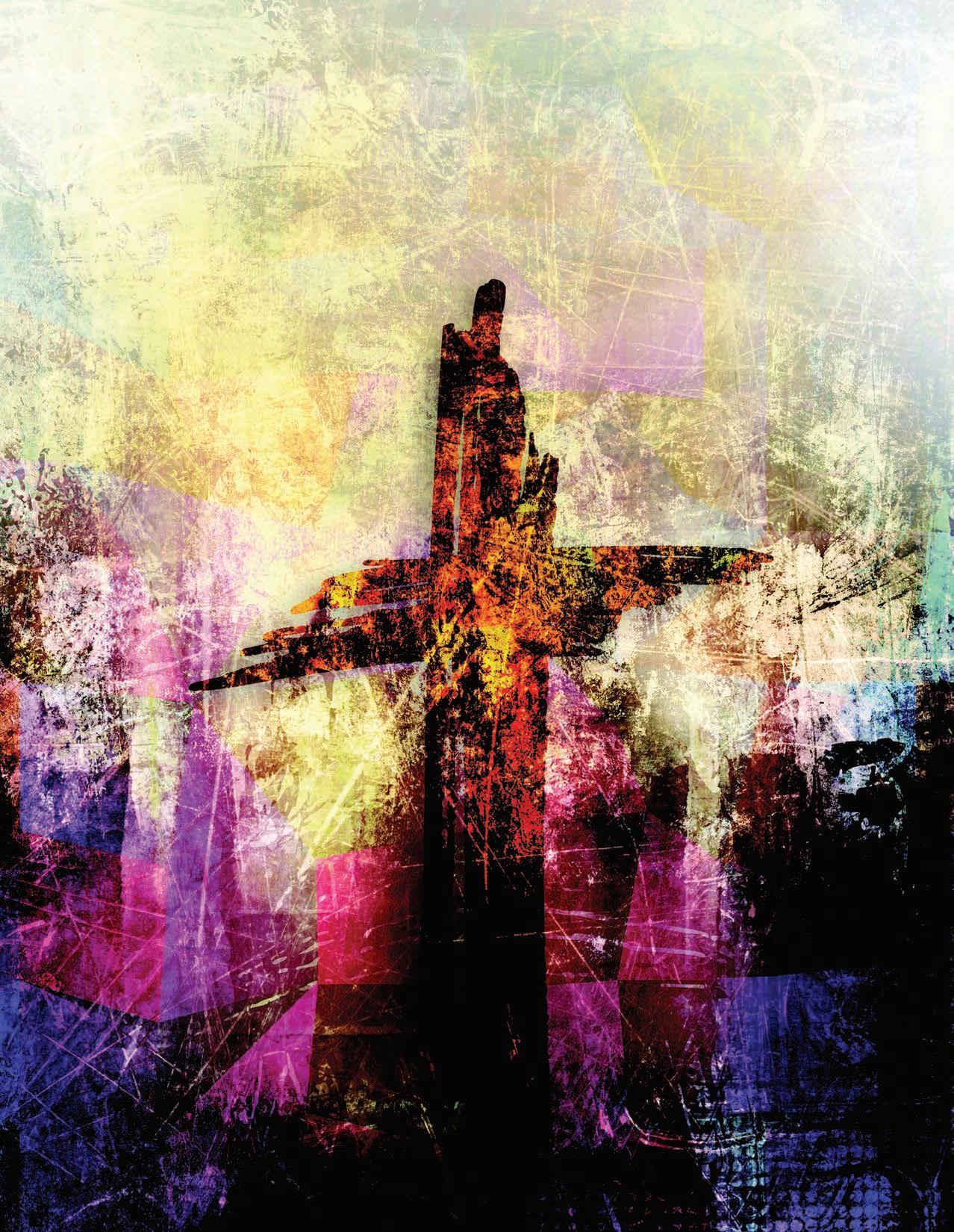
Visio divina, or “divine seeing,” is a prayer practice that invites us to encounter God through art. Just as lectio divina guides us to listen deeply to Scripture, visio divina encourages us to slow down and see with the eyes of faith. Rather than analyzing the artwork, we allow it to speak to us through color, light, texture and emotion. As you gaze upon the image, notice what draws your attention, what stirs your heart, and how the Spirit might be inviting you to see God’s story in a newway.
Inspired by Matthew 4:1-11
By The Rev. Lauren Wright Pittman
A Sanctified Art, LLC. sanctifiedart.com

Reflection
• Take time to sit with the image before you.
• What do you notice first? What details draw your attention the longer you look?
• How does this artwork make you feel — calm, curious, unsettled, inspired?
• Do any of the themes from this week’s reflections — finding roots, welcoming the unexpected, noticing God’s work beneath the noise — emerge for you in a new way through this image?
• Where might you sense God’s quiet, steady presence in what you see?
Prayer
Creator God, open our eyes to the ways you speak through beauty, color, and form. As we journey through this first week of Lent, help us to see your hand at work in all things, in stories ancient and new, in moments ordinary and sacred. Root us in your grace, awaken us to your presence, and prepare our hearts for the unfolding of your redemptive story. Amen.