
Day 40
PALM SUNDAY
The one who changes everything.
Matthew 21:1-11
Focus verse:
Matthew 21:10
When he entered Jerusalem, the whole city was in turmoil, asking, “Who is this?”
As Matthew tells the story, the world shakes whenever Jesus draws near.
At his birth, all Jerusalem shakes with fear (2:3).
At his death, the earth itself trembles, and rocks split open (27:51).
Now, in this Palm Sunday moment, as Jesus enters Jerusalem, Matthew says the whole city is in “turmoil” – which in Greek can also be translated as “shaken” – by his arrival.
The ground is rumbling not with the thunder of war horses or the heavy march of soldiers – the kind of royal parade the people were used to – but with something stranger, deeper. A different kind of power is entering the city.
Jesus doesn’t ride in as kings usually do, mounted high on stallions, wrapped in armor, flanked by troops announcing their dominance. He plods on a donkey. Yet Matthew suggests the earth responds to him with the same seismic force, as though creation itself knows: This is the one who changes everything.
No wonder the crowds cry out. No wonder the city shakes with questions. Jesus’ entry announces a kingdom that conquers not by fear, weapons or spectacle — but by truth, mercy and the kind of sacrificial love that shakes things up. This love unsettles injustice, disrupts the comfortable order and rattles the powers that rely on quiet compliance. This love trembles through the world like a holy earthquake, shifting what we think is immovable.
As we stand at the start of Holy Week, we too may feel the rumbling: in our churches, our neighborhoods, our strained relationships, our hopes for the world. Christ’s entry into our lives unsettles us because he calls us to a different way.
The question that shakes Jerusalem’s people still shakes us: “Who is this?”
This Holy Week invites us to answer not just with words, but with our lives.
Reflection
Prayer
Where do you sense holy rumbling in your life: places where Christ’s presence unsettles, challenges or reorients you? What might Jesus be riding into and asking you to see or surrender or receive anew?
Humble King, as you enter Jerusalem, enter also the trembling places of our hearts. Shake loose what needs to fall away, and steady us for the road ahead. Give us courage to follow your way of peace, even when you unsettle our expectations. Let your gentle strength reshape our lives, our communities and our world. Amen.

Day 41
MONDAY
Our loyalty is to God.
Matthew 22:15-22
Focus verse:
Matthew 22:21
Give therefore to Caesar the things that are Caesar’s and to God the things that are God’s.
The tension around Jesus is rising. His authority is now unmistakable, and those who fear losing power scramble to trap him. The Pharisees and the Herodians (groups who normally wouldn’t be caught dead agreeing on anything) join forces in a desperate attempt to discredit him. They pose him a political landmine of a question: Is it lawful to pay taxes to the emperor?
It’s a cruel setup. If Jesus says yes, he alienates his Jewish followers who loathe the Roman tax: a denarius stamped with Caesar’s face and the blasphemous claim that he is divine. If Jesus says no, he hands Rome the evidence it needs to arrest him as a revolutionary threat.
But Jesus doesn’t take the bait.
“Show me the coin,” he says — revealing, with exquisite subtlety, that he doesn’t carry one. They do. They’re the ones carrying Caesar’s propaganda in their pockets.
Give to Caesar what is Caesar’s, Jesus answers. Give to God what is God’s.
It’s brilliant. And it’s also easily misunderstood.
Sometimes people quote this verse to shut down protest or critique: Just obey the government. Jesus said so. But that isn’t Jesus’ point. Caesar’s image is on the coin, so he tells them to let the coin go. Whereas God’s image is on us. Our whole life belongs to God: our allegiance, our conscience, our courage, our hope.
Thus, when earthly power contradicts God’s justice, God’s compassion and God’s vision for human flourishing, we don’t shrug and submit. We remember whose image we bear. We speak. We protest. We resist. Our loyalty is not to emperors, parties or systems but to the God whose imprint is on every human life.
Reflection
Where do you sense a tension between the demands of earthly authorities and the call of God? What would it look like this week to live as one who bears God’s image?
Prayer God of all authority, claim my heart again. When lesser powers demand my fear or my silence, remind me whose image I bear. Give me courage to honor you with my choices, my voice and my life. Amen.
Day 42
TUESDAY
Let God shape your life and leadership.
Matthew 23:1-12
Focus versse:
Matthew 23:8, 10, 12
But you are not to be called rabbi, for you have one teacher. ... Nor are you to be called instructors, for you have one instructor, the Messiah. ... All who exalt themselves will be humbled, and all who humble themselves will be exalted.
By this point in Matthew’s Gospel, Jesus has faced every trap the religious and political leaders can devise. Now he turns — not to attack them, but to teach the crowds and his disciples a better way. The Scribes and Pharisees, he says, love titles, honor and the performance of authority. They take the best seats. They speak as experts. They carry the law but do not carry its heart.
Jesus’ words here do not pertain only to religious leaders. He identifies the temptation that lurks in every human heart: the desire to be seen as important, competent, impressive. To lead with ego instead of humility, to speak when we should listen, to treat certainty as a badge of honor rather than to admit what we don’t know.
There is another way.
Zen Buddhism has a term, the “beginner’s mind”: a posture of openness, curiosity and willingness to learn. It contrasts with the “expert’s mind,” which believes it has nothing left to receive. Jesus’ teaching echoes this wisdom: the truly wise remain teachable. The truly great remain grounded. The truly faithful remain humble, willing to serve.
I’ve learned to trust leaders who can say “I don’t know,” because they’re honest enough to keep learning. They resist the urge to take up all the space in the room; they leave space so others can breathe, speak and be heard. Jesus calls this posture greatness.
In a world that equates leadership with domination, visibility and expertise, Jesus offers a different model: Kneel low. Listen deeply. Stay teachable. Serve freely. Let God be the one who shapes your leadership and your life.
Reflection
Where might God be inviting you to lead with humility rather than certainty? How could adopting a “beginner’s mind” open you to deeper wisdom or more compassionate leadership?
Prayer Teacher, humble our spirits and widen our hearts. Keep us curious, open and willing to learn. Guard us from the pride that closes us off from others and from you. Shape us into leaders who listen, serve, apologize and grow so that in all things, we reflect the gracious leadership of Christ. Amen.
Day 43
WEDNESDAY
Jesus calls us to endure, keep loving, stay tender.
Matthew 24:1-13
Focus verses:
Matthew 24:12-13
And because of the increase of lawlessness, the love of many will grow cold. But the one who endures to the end will be saved.
Jesus’ prediction of the Temple’s destruction (24:1-2) would have sounded painfully familiar to Matthew’s community. By the time they heard the words of Matthew’s Gospel, Rome had already crushed the Jewish revolt of 70 CE, leveling the beloved Temple and tearing apart families and communities. These early Christians were trying to survive political upheaval, religious conflict, internal disagreement and a deep uncertainty about their future.
In that chaos, Jesus’ apocalyptic speech was not meant to terrify — it was meant to steady. Yes, the world was shaking. Yes, trouble would come. But Jesus urged them: Do not let your love grow cold. Endure.
That might be the hardest command of all.
When life feels harsh, we can become harsh. When the world grows cruel, our hearts are tempted to protect themselves by hardening. Exhaustion breeds callousness. Fear sharpens into suspicion. Hope thins into cynicism.
Yet Jesus says: Hold fast. Keep loving. Stay tender in a brutal world. This is not naïve optimism — it’s defiant faith. Trust that the God who brings life out of death is still at work, still making all things new, even when destruction and division seem to have the upper hand.
To endure in love is its own kind of resistance. Enduring is choosing compassion when indifference would be easier; it means refusing to mirror the cruelty around us. Enduring is keeping our hearts open to Christ when everything in the world encourages us to shut down.
Matthew’s church needed this reminder. So do we.
Reflection
Where do you feel the pull toward cynicism, weariness or hard-heartedness? What would it look like for you to endure in love this week?
Prayer Steady God, when the world feels unmoored and our love feels thin, hold us fast. Keep our hearts open, our compassion alive and our hope grounded in you. Help us endure not with fear, but with love that refuses to grow cold. Amen.
Day 44
MAUNDY THURSDAY
Jesus will strengthen you for the road ahead.
Matthew 26:17-29
Focus verse:
Matthew 26:26
While they were eating, Jesus took a loaf of bread, and after blessing it he broke it, gave it to the disciples, and said, “Take, eat; this is my body.”
On this night, Matthew invites us into the Upper Room — not simply to witness a meal, but to receive the heart of the Gospel. By the time Matthew wrote his Gospel, Communion had already become a liturgy, not a full meal. So in this account, Matthew leans into theology. He places Jesus’ words in the middle of the Passover supper, drawing our attention to the center of Jesus’ identity and the center of God’s saving story.
When Jesus takes bread, blesses it, breaks it and says, “Take, eat; this is my body,” Matthew wants us to hear more than a ritual formula. This account shows us Jesus offering his whole life — everything he has taught, healed, lived, suffered, promised and fulfilled. The bread and cup gather the entirety of Matthew’s Gospel:
• Jesus as God’s long-awaited promise in the genealogy.
• Jesus as teacher on mountainsides and in fishing boats.
• Jesus as healer, boundary breaker and rest giver.
• Jesus as mercy poured out, as forgiveness embodied.
• Jesus as the one who points us toward God’s coming kingdom, where all creation is restored and every relationship is made right.
“This is my blood of the covenant.” Not a symbol alone, but a pledge. A commitment. A life offered so that ours might be reconciled, healed and made whole.
Tonight, we sit at the table with this long story behind us, the costly road to the cross before us, and Christ’s love – steadfast, inexhaustible – given freely into our hands.
Reflection
What part of Jesus’ story feels most alive to you tonight: promise, teaching, mercy, forgiveness or hope? How might receiving his life again strengthen you for the road ahead?
Prayer Jesus, on this holy night you give yourself to us completely. In bread and cup, in promise and presence, you offer your life for our healing. As we remember your story and receive your love, draw us into the mercy you embody and the future you promise. Strengthen us for the way of the cross, and make us ready for the dawn of resurrection. Amen.
Day 45
GOOD FRIDAY
Jesus’ death shakes and reshapes the world.
Matthew 27:1-54
Focus verse:
Matthew 27:54
Now when the centurion and those with him, who were keeping watch over Jesus, saw the earthquake and what took place, they were terrified and said, “Truly this man was God’s Son!”
Good Friday brings us to the heart of the story: Jesus’ crucifixion. But Matthew tells this story differently from the other evangelists. He focuses less on the physical details of Jesus’ crucifixion and more on the impact of his death: the way it shakes the world and reshapes human hearts.
At the start of the story, the Roman soldiers are anything but sympathetic. They are the mockers, the taunters who dress Jesus in a scarlet robe, twist a crown of thorns and kneel before him in cruel parody. Their derision spreads like wildfire. Passersby join in. Religious leaders sneer. Even the rebels who are crucified beside him revile him. Matthew wants us to see the scene clearly: the whole machinery of society – empire, religion and the crowds –standing against Jesus.
But something begins to shift.
In the middle of the noise, the soldiers sit down to keep watch (27:36). Theirs is an ordinary military assignment. Yet as Thomas G. Long notes in his commentary on Matthew, “keeping watch” is also a posture of faith: waiting for God’s kingdom, attending to what God is about to do.
And under their watch, the world begins to quake.
After Jesus takes his last breath, the earth shakes. The Temple curtain tears from top to bottom, signaling the end of the old order and the opening of access to God for all people. Then comes an astonishing moment: the very soldiers who scorned Jesus, who hammered the nails, who laughed at his pain, are the first to proclaim: “Truly this man was God’s Son!” (27:54).
The executioners become witnesses. The tormentors become truth tellers. The hardened become transformed.
Good Friday is many things: tragic, brutal, holy. But it is also a story of transformation. The love Jesus offers on the cross is more powerful than mockery, cruelty and violence. His love is strong enough to shake the earth, strong enough to change the human heart.
Reflection Where in your life do you need the transforming power of Christ’s love? Where might God be softening a hardened place in you, or inviting you to see an enemy with new eyes?
Prayer Crucified Christ, your love reaches farther than our cruelty and rises higher than our fear. Shake loose what keeps our hearts hard. Tear open whatever separates us from you. Transform us as you transformed the soldiers at your cross, until we confess with our lives as well as our lips: Truly, you are God’s Son. Amen.
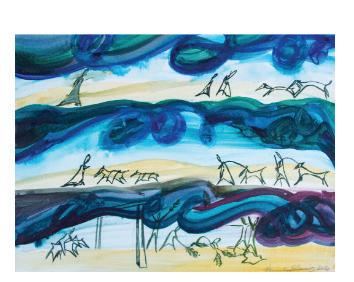
About visio divina
Visio divina, or “divine seeing,” is a prayer practice that invites us to encounter God through art. Just as lectio divina guides us to listen deeply to Scripture, visio divina encourages us to slow down and see with the eyes of faith. Rather than analyzing the artwork, we allow it to speak to us through color, light, texture and emotion. As you gaze upon the image, notice what draws your attention, what stirs your heart, and how the Spirit might be inviting you to see God’s story in a newway.
Palms Journey
Inspired by Matthew 21:1-11
By Hannah Garrity
A Sanctified Art, LLC. sanctifiedart.com
Reflection
• Take time to sit with the image before you.
• What do you notice first? A contrast of light and dark? Stillness or motion? A gesture, a shadow, a figure?
• As you linger, what emotions begin to surface — sorrow, longing, ache, hope?
• Do you sense echoes of this week’s journey — Jesus entering a city shaken by expectation and fear, his courage before those who sought to entrap him, his teaching on humility and servant leadership, his call to endure in love even as the world grows harsh, his breaking of bread and offering of himself, or the shattering sorrow of the cross and the unexpected confession of faith that followed?
• Where might this image invite you to wait with God in the silence of Holy Saturday — to hold the ache of what was lost, the uncertainty of what comes next and the quiet hope that something new is already stirring beneath the surface? Listen for the places where mercy is still unfolding, even when unseen.
Prayer
God of the in-between days, meet us in this Holy Saturday silence. Hold us in the tension between grief and hope, between what has been and what will be. When the world feels hushed and heavy, draw us into your steady compassion. Prepare our hearts for the dawn only you can bring. Amen.
Day 47
EASTER SUNDAY
We do not walk this road alone.
Matthew 28:1-20
Focus verse:
Matthew 28:20
And remember, I am with you always, to the end of the age.
Before the sun even rises, the earth shakes. Not for the first time in Matthew’s Gospel — and not for the last time in God’s story. Creation trembles at the death of Jesus, and now it quakes again as the stone rolls back and life breaks open where death once ruled. The women arrive expecting to tend a grave. Instead, they are met with an angel, an empty tomb and a message that shakes them even more: “He is not here; for he has been raised.”
This is the climax of the story we’ve walked through all Lent. Yet not even Easter morning is tidy. Fear mixes with joy and disbelief. A parallel narrative is fabricated by the chief priests to deny what God has done. And the disciples, entrusted with the next chapter, come to the risen Jesus with both worship and doubt. Matthew names it plainly, almost tenderly. Jesus does not rebuke them. He commissions them.
Go. Make disciples. Teach, baptize, bless. Tell the story.
Easter does not remove the difficulty of discipleship. The world still groans. People still suffer. Faith still wavers. There are always more hungry people to feed; there is always more mercy to show, more courage needed for justice, more growing for us to do. But Easter does give us the promise we need most: that we do not walk this road alone.
“I am with you always,” Jesus says. Not just on mountaintops or in neatly folded moments of certainty — he is with us in doubt, exhaustion, confusion and the ordinary Tuesdays of your life. The Christ who conquered death walks beside us into every room, every grief, every calling. Nothing – not empire, not cruelty, not despair, not even the grave – can obstruct the love of God.
Resurrection is not the end of the Gospel story. It is the beginning of ours.
Reflection
Where do you need to hear Jesus’ Easter promise – “I am with you” – in your life right now? How might that assurance reshape the way you move into the work God is calling you to do?
Prayer Risen Christ, meet us in our fear and in our joy, in our doubt and in our hope. As you called the women and the disciples, call us again into courage, compassion and faithful witness. Walk with us as we share your love in a weary world. Stay close to us, now and always, to the end of the age. Amen.