
Day 12
SUNDAY
Love and pray for your enemies.
Matthew 5:21-48
Focus verses:
Matthew 5:43-45
You have heard that it was said, “You shall love your neighbor and hate your enemy.” But I say to you: Love your enemies and pray for those who persecute you, so that you may be children of your Father in heaven.
This passage from the Sermon on the Mount contains six examples – six teachings – each of which addresses problems within the early church community. Jesus speaks about anger, jealousy, adultery, divorce, oaths and retaliation. Through each teaching, he deepens the law, showing that righteousness is not about rule-following but about living in right relationship with God and with one another.
Then Jesus brings it all to a startling conclusion: “Love your enemies and pray for those who persecute you.”
This sentence may be the most demanding teaching of all. We find it easy enough to love our friends and to show kindness to those who show kindness to us. But Jesus calls us to love the ones who frustrate us, the ones who have wronged us, the ones who don’t think or believe like we do. If we love only those who love us back, Jesus says, we merely imitate the world. But if we love those who do not love us, we imitate God.
That’s where the transformation happens.
I know what it feels like to meet ugly with ugly, to answer harsh words with more harshness. I’ve fallen into this behavior too often, and it never satisfies. It just leaves me feeling ugly too, because in that moment I’m not living into my potential as a child of God. I’m not acting in love.
To love our enemies isn’t to excuse their behavior or pretend harm doesn’t hurt. Instead, loving our enemies means choosing a different way – the way of God – whose compassion extends to all, even those who don’t deserve it. Including me. Including you.
Reflection
Prayer
Whom do you find it hardest to love right now? What would it look like to pray for that person — not to change them, but to keep your own heart open to God’s transforming grace?
Merciful God, when anger rises and grudges take root, soften our hearts. Teach us to love as you love, to pray for those who wound us and to see every person as your beloved child. Make us instruments of your peace, that your kingdom may take shape in us. Amen.

Day 13
MONDAY
Practice does not mean perfection.
Matthew 6:1-18
Focus verse:
Matthew 6:1
Beware of practicing your righteousness before others in order to be seen by them, for then you have no reward from your Father in heaven.
Jesus reminds his followers that faith isn’t just something we believe; it’s something we practice. In this passage, he names three familiar practices: giving to the poor, praying and fasting. These weren’t new ideas. They were already familiar to Matthew’s first audience. Almsgiving, prayer and fasting were central to Jewish faith and life, and they became foundational to Christian discipleship as well.
But Jesus adds an important warning: Don’t do these things for show. Don’t pray, give alms or fast to impress others or to prove your piety. Do them for God alone. Spiritual practices are not about earning approval. They’re about cultivating relationships. Practicing faith helps us grow into the likeness of Christ, not to glow in the admiration of others.
I love that we call these spiritual disciplines “practices.” The word takes the pressure off perfection. Practice implies progress, effort, humility — and grace. Practice assumes we’ll stumble and start again.
My own prayer life is far from perfect. I go through some seasons when prayer feels steady and sustaining, but during others it’s sporadic and distracted. I pray most faithfully in times of crisis, when “Help!” or “Why?” are the only words I can manage. Yet even then, the practice keeps me tethered, reminding me that God’s attention doesn’t depend on my performance. God sees me, hears me and loves me — always.
Lent invites us to keep practicing — not to be flawless, but to be faithful.
Reflection
Prayer
What spiritual practice helps you feel closest to God right now? How might you reengage in that practice this Lent — not for perfection, but for presence?
Gracious God, thank you for meeting us in our imperfect practices. When our prayers falter, our giving feels small or our fasting fails, remind us that you see the heart behind the effort. Help us keep practicing faith not for show but for love of you. Amen..
Day
14
TUESDAY
Jesus invites us to decide whom to serve.
Matthew 6:19-34
Focus verse:
Matthew 6:24
No one can serve two masters, for a slave will either hate the one and love the other or be devoted to the one and despise the other. You cannot serve God and wealth.
This passage from the Sermon on the Mount isn’t about financial planning. It’s about the orientation of our hearts. Jesus is asking us: What shapes the way we live? Whom or what do we serve?
Do we see our abundance and possessions as gifts from God, blessings to be held lightly and shared freely? Or do we see life as a competition, a struggle between winners and losers over limited resources? When our creed becomes “Where’s mine?” we are no longer free. We’re bound by fear of not having enough, chained to the illusion that our worth or security depends on what we own.
A family I know recently lost their home and everything in it as a result of a California wildfire. The fire moved so fast that they barely escaped with their lives. Their grief was – and still is – real and raw. But in the days that followed, what struck me most was their clarity. Amid the ashes, they said, “We’ve lost so much, but we still have what matters most — each other, our community, our faith.” Their possessions were gone, but their hearts remained anchored.
God and wealth are two demanding masters, each with different messages. The master of wealth whispers, Go ahead and indulge — you’ve earned it. God says, Blessed are the poor in spirit, for theirs is the kingdom of heaven.
One promises control. The other offers freedom. Lent invites us to decide whom we will serve..
Reflection What gives you a false sense of security? How might loosening your grip on possessions – or fear – make room for deeper trust in God’s abundance?
Prayer
Generous God, remind us how fragile the treasures of this world can be. Teach us to hold lightly what we have and to cling tightly to you. Free us from the illusion of control, and ground us in your steady love, the one possession we can never lose. Amen.
Day 15
WEDNESDAY
Jesus calls us to transform.
Matthew 7:1-5
Focus verse:
Matthew 7:3
Why do you see the speck in your neighbor’s eye but do not notice the log in your own eye?
In this passage from the Sermon on the Mount, Jesus isn’t telling us to ignore wrongdoing or to stay silent in the face of injustice. Accountability matters. Truth-telling matters. But before we call for the transformation of others, Jesus requires that we attend to our own. None of us stands unmuddied on pure moral ground.
This teaching feels especially urgent today, when outrage is our reflex and social media rewards quick judgment. We are fast to condemn and slow to listen. I recognize this pattern in myself. When a reader responds with biting criticism of something I’ve written, my instinct is to fire back. How tempting I find it, in those raw moments, to hurl Jesus’ words back at my critic – “Do not judge, so that you may not be judged” – not as wisdom to live by or as a shield for my feelings, but as a sword against my critics.
But then I remember: I must also recite these words to myself. Because I have times when I am loath to get close enough to my neighbor to see clearly, to listen with compassion, to understand why they believe or act differently than I do. Self-righteousness blinds me to my own need for grace.
Jesus’ invitation is not to suspend discernment but to practice humility: to look inward before we look outward, to remember that transformation begins at home and to understand that the same grace we hope for ourselves must extend to others.
Reflection
Prayer
Where and when do you find yourself tempted to judge quickly or harshly? What might change if you paused first to examine your own log of wrongdoing and to listen for God’s transforming grace?
Merciful God, forgive us when we judge before we understand. Teach us humility, patience and compassion. Help us to see ourselves and others through your eyes of grace and to seek transformation that begins within. Amen
Day 16
THURSDAY
Compassion is divine.
Matthew 7:12
Focus verse:
Matthew 7:12
In everything do to others as you would have them do to you, for this is the Law and the Prophets.
With this single sentence, Jesus brings the Sermon on the Mount to its center of gravity. These words summarize all that has come before: every teaching about humility, mercy, forgiveness, generosity and love.
What’s striking is that this teaching is not unique to Christianity. Versions of the Golden Rule appear in nearly every major faith tradition:
• Judaism: “What is hateful to you, do not do to your neighbor.” —Talmud, Shabbat 31a
• Islam: “None of you truly believes until he wishes for his brother what he wishes for himself.” —Hadith, Sahih Muslim 45:71
• Hinduism: “This is the sum of duty: do not do to others what would cause pain if done to you.” —Mahabharata 5:1517
• Buddhism: “Treat not others in ways that you yourself would find hurtful.” —UdanaVarga 5:18
• Confucianism: “Do not impose on others what you do not wish for yourself.” — Analects 15:23
Across centuries and cultures, humanity seems to understand that compassion is the truest expression of the Divine.
At the close of the Sermon on the Mount, Jesus asks us to remember what we most desire as citizens of God’s kingdom – mercy, compassion and peace – and to live those desires outwardly. To treat others not with suspicion or superiority but with the same grace we hope to receive. To work for a world where everyone can live in peace.
Reflection
What would change – in your family, your church, your community – if this single rule guided every decision? What small action could you take today to treat someone as you long to be treated?
Prayer God of all peoples, your mercy spans every border, every belief. Teach us to live by your rule of love. Let our words, our choices and our relationships reflect your compassion until all creation lives in the peace you desire. Amen.
Day 17 FRIDAY
Our hope is built on Christ, our rock.
Matthew 7:24-27
Focus verse:
Matthew 7:24
Everyone, then, who hears these words of mine and acts on them will be like a wise man who built his house on rock.
I n the aftermath of Hurricane Katrina, I joined a group from my church on a mission to the devastated coastline of New Orleans. For miles and miles, where homes and neighborhoods once stood, we saw nothing. Gone was any evidence of community. All that remained were the concrete slabs. The wind and water had taken everything but the foundations. The flat, empty landscape was a wordless testimony to sudden, tragic loss.
Life brings many storms — some literal, others deeply personal. Grief, illness, conflict, fear ... all of these batter us and reveal what our lives are built upon. When Jesus concludes the Sermon on the Mount with the image of two houses, one built on rock and one on sand, his words are both promise and warning. Storms will come, but if you ground your life in my teaching, you will stand.
To build on rock is to root our lives in the way of Christ, the way of mercy, humility, forgiveness, generosity and love. These aren’t abstract virtues; they are daily practices that form the structure of a resilient life. Put them into practice, Jesus says, and you will build a home for your soul that can withstand the storm.
The crowds who have listened to Jesus preaching from the hillside must now rise and follow him. The sermon is over, but discipleship is just beginning. This moment is when faith gets real, when the words we’ve heard must take shape in our living, when belief becomes practice, when we sustain ourselves, like all the saints who walked this road before us, singing the truth of the old hymn “My Hope Is Built on Nothing Less”: “On Christ, the solid Rock, I stand: / all other ground is sinking sand.”
Reflection On what foundation are you building your life right now? Which of Jesus’ teachings in the Sermon on the Mount most strengthens – or most challenges – your faith?
Prayer
Steadfast God, when life’s storms rise around us, anchor us in your love. As we leave the mountain, help us carry your Word into our daily living. Teach us to build our lives upon your truth, to practice what we’ve heard and to trust your solid ground beneath our feet. Amen.
About visio divina
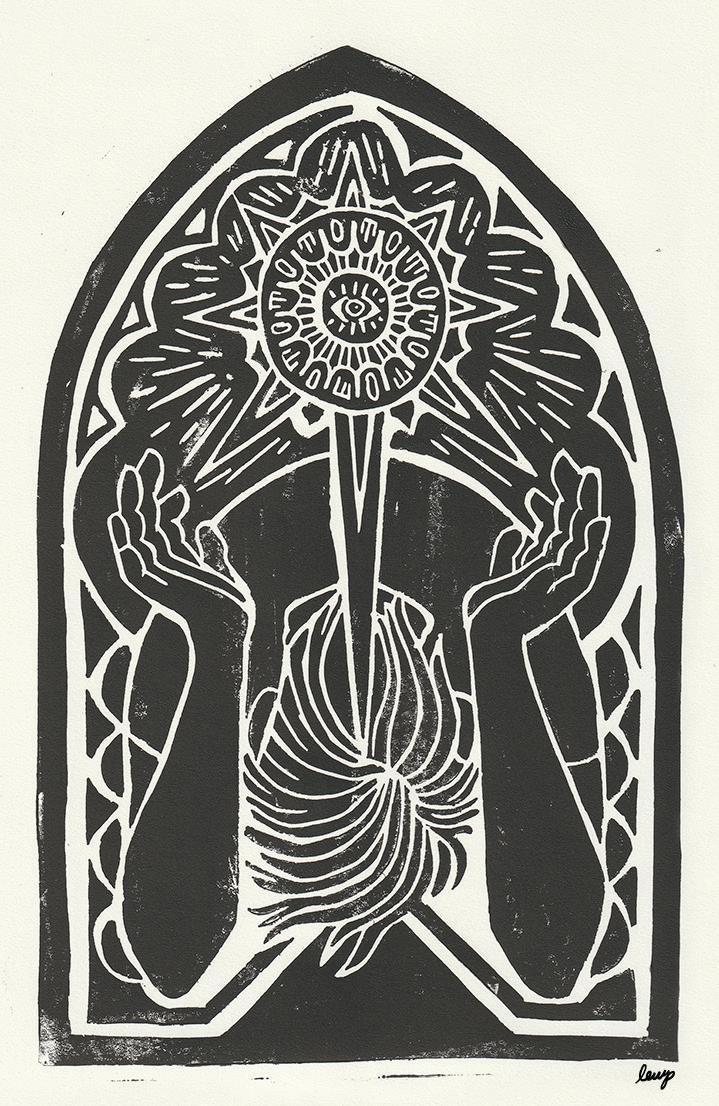
Visio divina, or “divine seeing,” is a prayer practice that invites us to encounter God through art. Just as lectio divina guides us to listen deeply to Scripture, visio divina encourages us to slow down and see with the eyes of faith. Rather than analyzing the artwork, we allow it to speak to us through color, light, texture and emotion. As you gaze upon the image, notice what draws your attention, what stirs your heart, and how the Spirit might be inviting you to see God’s story in a newway.
Invited In
Inspired by Matthew 4:1-11
By The Rev. Lauren Wright Pittman
A Sanctified Art, LLC. sanctifiedart.com
Reflection
• Take time to sit with the image before you.
• What do you notice first? What colors, forms or movements stand out?
• As you linger, what emotions begin to surface — conviction, compassion, longing, peace?
• Do you see reflections of this week’s journey — Jesus calling us to love even our enemies, to practice faith not for show but from the heart, to serve God rather than wealth, to withhold quick judgment, to treat others as we wish to be treated and to build our lives on solid ground?
• Where might this image reveal God shaping your inner life into outward action, and teaching you to live mercy, humility and love in real, embodied ways?
Prayer God of steady grace, open our eyes to the ways you are shaping us from the inside out. When we are tempted by judgment, pride or self-reliance, turn our gaze back to you. When storms rise or foundations tremble, remind us to stand firm on your Word. May what we see in this image – and what we practice in daily life – draw us deeper into your mercy until our lives become reflections of your love. Amen.