IRIS
October 2025 ISSUE 7
The WGGS Classics Newsle er
Welcome to Iris! Welcome to Iris, the WGGS Classics newsle er. Our aim is to shed a li le light on the ancient world, and on the wide and diverse range of topics we encounter in our study of La n and Classical Civilisa on. In this issue, we are celebra ng achievements of some of our students who took part in the annual joint Classics essay compe on, held between WGGS and WBGS over the summer holidays. Students in Years 10 and 11 had a choice of 4 essay tles to research and write, with the winners winning a book token each. The overall winner was Henry from WBGS. Maya from WGGS was highly commended, and her excellent essay is featured here. We will share some of the other entries in this issue and the next. Well done to all the par cipants! We hope you enjoy reading their efforts. Also in this issue, Rachel in Year 12 reviews our recent visit from Dr Antony Makrinos, an Associate Professor in Classics at UCL, who spoke to the Senior Classics Society on Homer in film. Claudia in Year 11 discusses the lives of women in ancient Greece, and several Year 8 and 9 students share their poems inspired by the works of Sappho, a project they worked on last year in Junior Classics Society. If you would like to contribute to the next edi on of Iris, please email your idea to: h.long@wa ordgirls.herts.sch.uk . We would love for you to be involved and for your voices to be heard!
Inside this issue Do museums have a responsibility to decolonise their exhibi ons? - Maya, Year 11 To what extent did the Greeks and Romans use mythology to explain the real world? - Marley, Year 11 A Woman’s Life in Ancient Greece—Claudia, year 11
Ms Long
Homer in Film—Rachel, Year 12
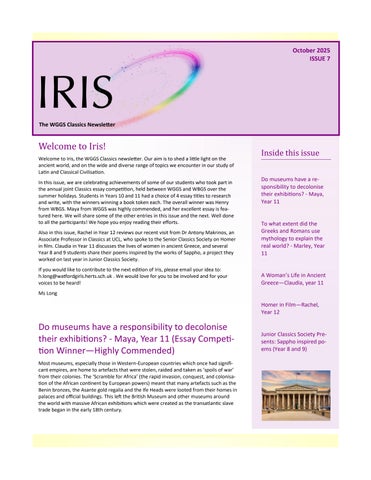
Do museums have a responsibility to decolonise their exhibi ons? - Maya, Year 11 (Essay Compe on Winner—Highly Commended) Most museums, especially those in Western-European countries which once had significant empires, are home to artefacts that were stolen, raided and taken as ‘spoils of war’ from their colonies. The ‘Scramble for Africa’ (the rapid invasion, conquest, and colonisaon of the African con nent by European powers) meant that many artefacts such as the Benin bronzes, the Asante gold regalia and the Ife Heads were looted from their homes in palaces and official buildings. This le the Bri sh Museum and other museums around the world with massive African exhibi ons which were created as the transatlan c slave trade began in the early 18th century.
Junior Classics Society Presents: Sappho inspired poems (Year 8 and 9)