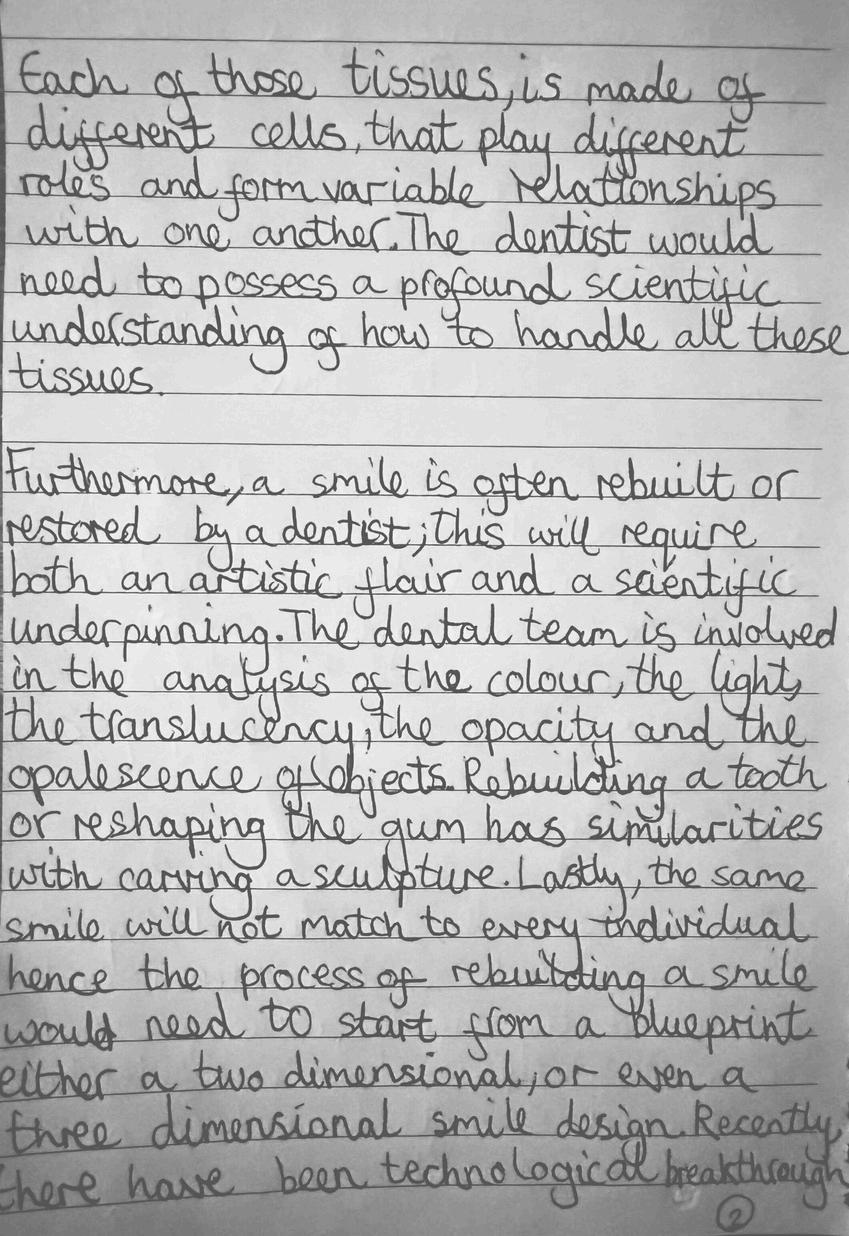
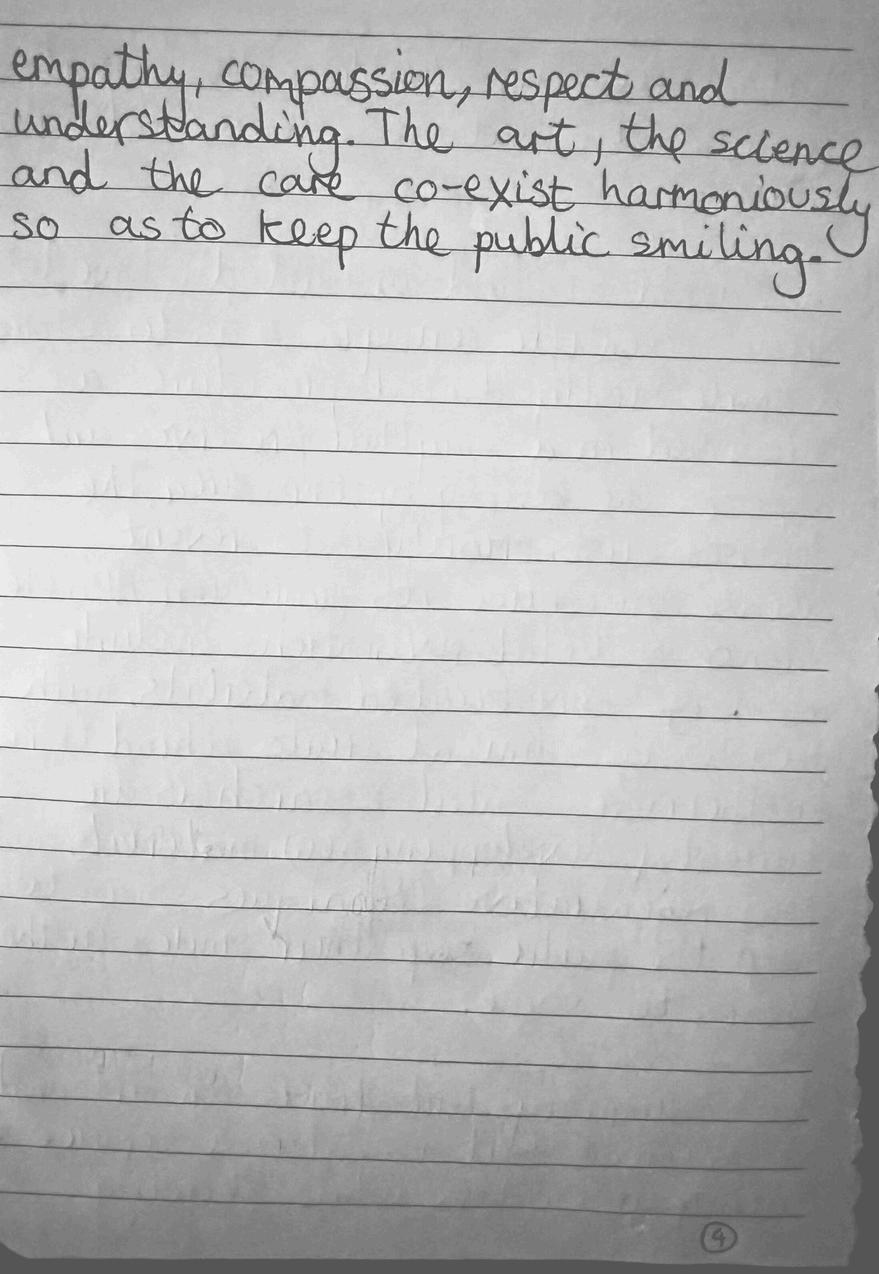
P a r t i c i p a n t s o f “ t h e a r t & s c i e n c e o f a s m i l e ” c o m p e t i t i o n
S a h a n A 1 3 E E d i t o r
Welcome to the 2nd edition of Dental dispatch!
g i n g p r o c e s s .
A f t e r r e v i e w i n g t h e e n t r i e s , h e s h a r e d “It was a real pleasure to read them & the standard was exceptionally high - expected for WGGS!”
C o n g r at u l at i o n s t o o u r w inners: Stuti, Macey & HaAsini! f o r t h e i r o u t s ta n d i n g a r t i c l e s , w h i c h s t o o d o u t f o r t h e i r clarity, creativity & impact. T h a n k yo u t o e v e r yo n e w h o t o o k pa r t ! W e h o p e yo u e n j oy r e a d i n g !
Sahana President of Dental Soc. 2024-26
Ragas, Rhythms, and Radiant Smiles:
How Indian Classical Music Shapes the Art and Science of Dentistry
- STUTI
1 P L A C E s t
Can the gentle strains of a sitar make a dental visit less stressful and a smile more radiant?
At first glance, Indian classical music and dentistry seem worlds apart one emerging from centuries-old artistic tradition, the other grounded in modern clinical science. Yet growing research and clinical observations reveal a compelling intersection Indian classical music, with its flowing melodies and cyclical rhythms, can ease anxiety, regulate emotions, and trigger measurable physiological changes. In the dental setting, music becomes more than soothing background it enhances patient comfort, reduces perceived pain, and subtly supports the emergence of a healthier, more confident smile.
The Neurobiology of a Smile
A smile is far more than a facial expression; it is a coordinated neurobiological event Genuine smiles involve synchronized activation of muscles such as the zygomaticus major and orbicularis oculi, under cortical and subcortical control. This process triggers the release of neurotransmitters, including dopamine, serotonin, and endogenous opioids, which regulate mood, stress, and emotional expression.
Dental anxiety disrupts this balance. Activation of the hypothalamic–pituitary–adrenal elevates cortisol and sympathetic activity, causing muscle tension, jaw clenching, heightened pain sensitivity, and suppression of natural facial expressions For aesthetic and restorative dentistry, managing this neurophysiological stress is essential
Indian Classical Music as a Neurotherapeutic Modality
Indian classical music offers a unique therapeutic framework through its ragas melodic structures designed to evoke specific emotional states. Ragas such as Ahir Bhairav, Yaman, and Bageshri are associated with calmness and introspection Their slow tempos, smooth microtonal transitions (meend), and predictable rhythmic cycles (taal) encourage physiological entrainment, aligning respiration and heart rate with a relaxed parasympathetic state.
The timbre of instruments such as the bansuri, sitar, and veena gently masks aversive dental sounds, thereby reducing sensory overload For patients familiar with these forms, cultural resonance further activates limbic pathways linked to memory and emotional comfort, deepening the anxiolytic effect
Research supports the therapeutic potential of Indian classical music In a randomised trial with patients undergoing invasive procedures, listening to Indian classical instrumental music for ten minutes significantly reduced anxiety, heart rate, and blood pressure Though conducted outside dentistry, these mechanisms parallel dental anxiety, which similarly affects pain perception, cooperation, and facial muscle relaxation
Aesthetic Dentistry and the Psychology of a Smile
Modern aesthetic dentistry depends not only on technical skill but also on emotional authenticity. Evaluating smile arc, dental proportions, facial symmetry, and gingival display requires relaxed musculature. Musicinduced anxiolysis reduces rigidity, allowing dentists to observe genuine smiles This mirrors the artistic philosophy of rasa, where emotional harmony enhances beauty paralleling dentistry’s pursuit of smiles that feel as natural as they look
Conclusion
Indian classical music emerges as a powerful adjunct in dental care, influencing neurophysiological regulation, psychological comfort, and aesthetic expression By calming the mind and body, it supports both the scientific foundations and artistic goals of dentistry. Ultimately, a radiant smile is shaped not only by clinical expertise but also by rhythm, emotion, and harmony—proving that sometimes, the path to healing begins with a melody.
The Biological Foundation
Aesthetic dentistry has always dependedon therelationshipbetween biologicalunderstanding and artistic judgement A visually appealing smile does not result from surface adjustments alone, but instead depends on the strength and understanding of the tissues that support each tooth As clinical science shifts toward biologically guided approaches, regenerative biology is offering new possibilities that may influence both cosmetic andrestorative practice.
Regenerative Dentistry’s
Principles
Regenerative dentistry is the field of rebuilding oral tissues using the body’s natural biological processes as opposed to relying on artificial materials. Current research explores how the body’s stem cells can generate new bone, periodontal ligament, dentin, and enamel like structures. These developments carry significant implications for aesthetic outcomes because the form and stability of the underlying foundation influence gingival contour, tooth position, symmetry, and the way light interacts with natural surfaces When the foundation is compromised, even carefully created restorations can achieve only limited results. Regenerative strategies present an opportunity to restore this foundation in a manner that reflects the patient’s own biology.
Genetic Regulation of
Odontogenesis
Scientific progress in this field is strongly connected to the study ofthe genetic signals that shape craniofacial growth and tooth formation.
Small regulatory molecules such as microRNAs influence gene expression during key stages of development MicroRNA twenty six b contributes to pathways that direct stem cell differentiation, while transcription factors such as Lef one help organise the formation and maturation of early tooth structures
Growing understanding of these molecular indications allows researchers to direct stem cells toward the creation of tooth specific tissues with increasing care. This work suggests a future in which enamel like layers, entire tooth units, or lost supporting tissues may be regenerated rather than replaced with synthetic substitutes.
Biomimetic
Approaches
The cross of art and science within this field is harmonious. The practice of aesthetic dentistry aims to achieve a natural aesthetic balance and harmony within the form of the tooth and the face, as well as the expression and personality of the patient. The possibility of regenerating tissue that reflects a patient’s natural shade, translucency, surface character, and gingival form could elevate this harmony far beyond what artificial materials can achieve. Biomimetic dentistry already attempts to reproduce the behaviour of enamel and dentin through advanced materials Regenerative science extends this ambition by enabling nature to create the material itself while the clinician guides the overall design
Although many regenerativetechniques remain incontrolled research, progress continues.
The challenges involve cost, safety evaluation, regulatory demands, and the difficulty of directing living systems. Even with these constraints, principles that have transformed other medical fields are gradually moving into dental applications.
A New Vision Limitations and Advancements
Earlier periods of cosmetic dentistry reliedon ceramic expertise and digital planning, but the emerging era will be established by biological regeneration. In this future, clinicians design the intended outcome, whereas the body completes the work through its own capacity for renewal. The result is a smile that feels genuinely natural, because it is a product of bodily processes, not an external imitative reconstruction
Studies in the well-preserved towns Pompell and Herculaneum have shown that the 'Mediterranean diet' is incredibly similar to the typical foods that ancient Romans ate daily,due to the large proportion of alkaline foodstuffs consumed,lacking the granulated sugar brought to Europe in later centuries
They did,however,take excellent care of their teeth as archaeological remains exist as early toothbrushes. These were frayed sticks or abrasive materials designed to remove remains of food from the enamel.
You may also notice whilst visiting museums that many ancient skulls have incredibly straight teeth without need for orthodontic services. This is because introducing harder foods early in a child's life often results in a larger jaw developing,with more space for the teeth that subsequently grow in adulthood
Whilst being restricted to beliefs and misconceptions of the time,oral hygiene is better than many would expect,even giving rise to some modern practices like teeth brushing.
It will be shocking for many readers to realise that, alongside inventing anaesthetics and root canal surgery, humans have also introduced ultra-processed foods and sugar-packed fizzy drinks. The very real fact that 80% of adults in the UK have at least one filling (as discovered by a government-run survey in 2021) strongly suggests that our society has created dental problems to solve through state-of-the-art innovation. Maybe as a society today,we could learn to implement some ancient habits to protect our teeth for years to come - it could do more good than you think.
ByAfrin10A
Wherever you go, whether it is in public, at your house or at school, you look around and what do you see? Smiles! Smiling is a common act done my practically everyone, but do you ever stop to wonder the reason why Well, you may think it is because of happiness and joy, but this isn't the only reason. Allow me to enlighten you with the real reasons on why we smile
First, before we discuss why we smile, we need to understand the anatomy of a smile
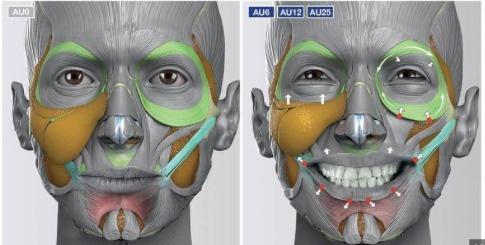
Smiling would involve the coordination between several of your facial muscles, primarily the zygomaticus major (lifts the corner of the mouth) and the orbicularis oculi (which crinkles your eyes)
A genuine smile would involve both the mouth and the eye muscles This would result in a heartfelt genuine expression and feeling of happiness.
This is also called a Duchenne smile However, when you see someone, you know on the other side of the street you would smile and say hello, right? Well, this also triggers a smile, but this time the smile only engages the mouth muscles This is called a nonDuchenne smile So now that we understand the basic anatomy of a smile why we don't dive into the reasons why
Smiling, is the most universal way to show joy, amusement, or relief This makes it an emotional expression, and it is used by nearly anyone. An example of when you use a smile as an emotionless expression is when you are watching Marvel and the Avengers manage to beat Ultron.
Another reason of why we smile is because it is used as a trick against the brain This might seem strange, but it is true Generally, when people are stressed or scared, they force themselves to smile and this sends signals to the brain saying, "We are happy!" This has a chain reaction and so in turn your brain responds by releasing neurotransmitters that help to reinforce your emotional state
The neurotransmitters released are mainly: endorphins (natural painkillers and stress relievers), Dopamine (linked to the brains reward and pleasure centres making us feel rewarded and motivated) and Serotonin (stabiliser of mood and contributer that helps to regulate anxiety and depression) From this, we can tell that smiling is also used to trick your mind into feeling calm and uplifted Furthermore, some people smile because it is a form of social bonding From a BUPA social experiment in 2024, 46% of the 2000 people said that they felt happier when a stranger smiled at them
So, there you have it Smiling is not just about happiness - it's a multifunctional human tool that will not only have a positive impact on us, but others as well. Whether your smile is Duchenne or non-Duchenne, every smile connects us and heals us
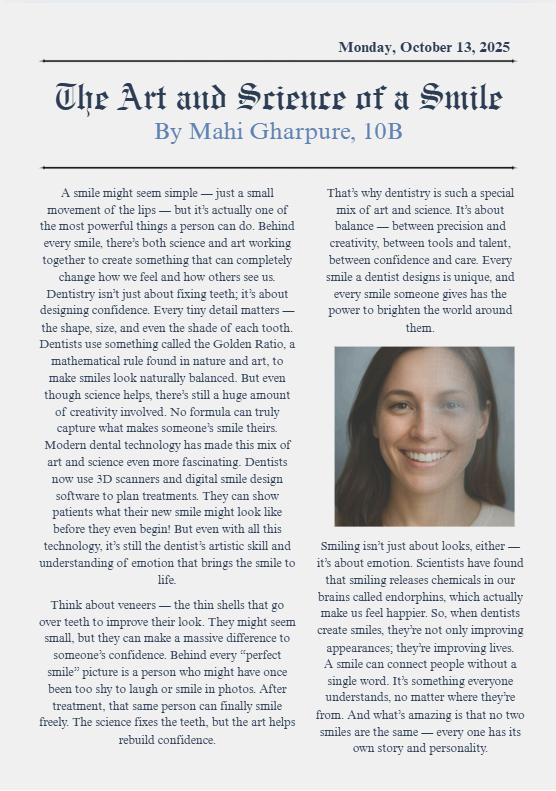
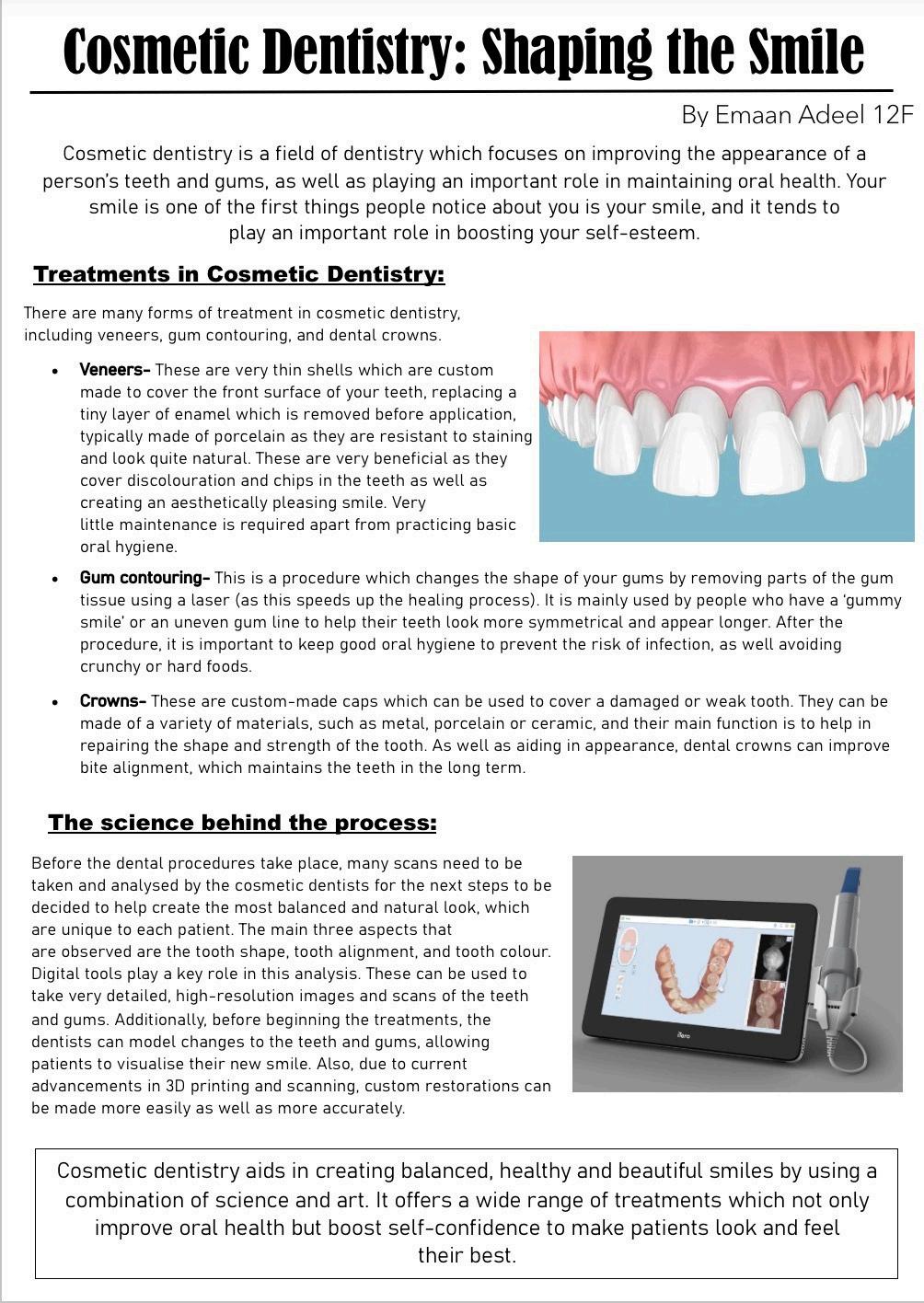
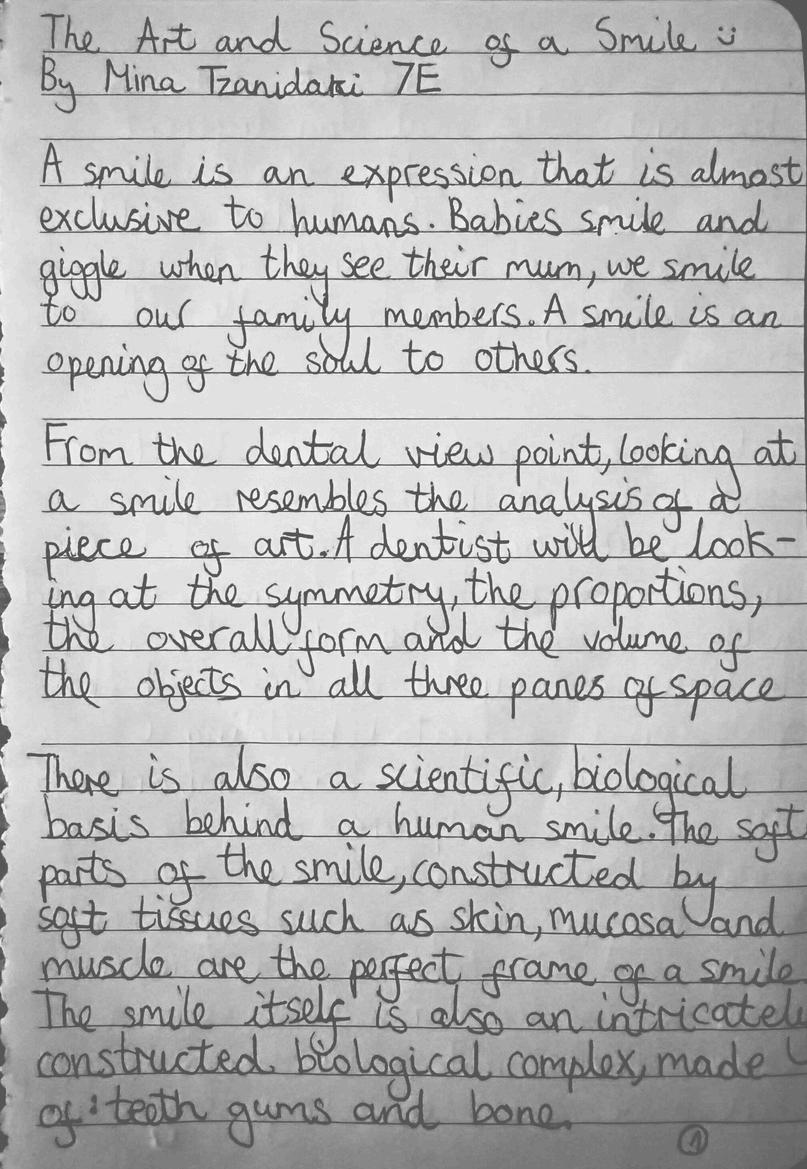
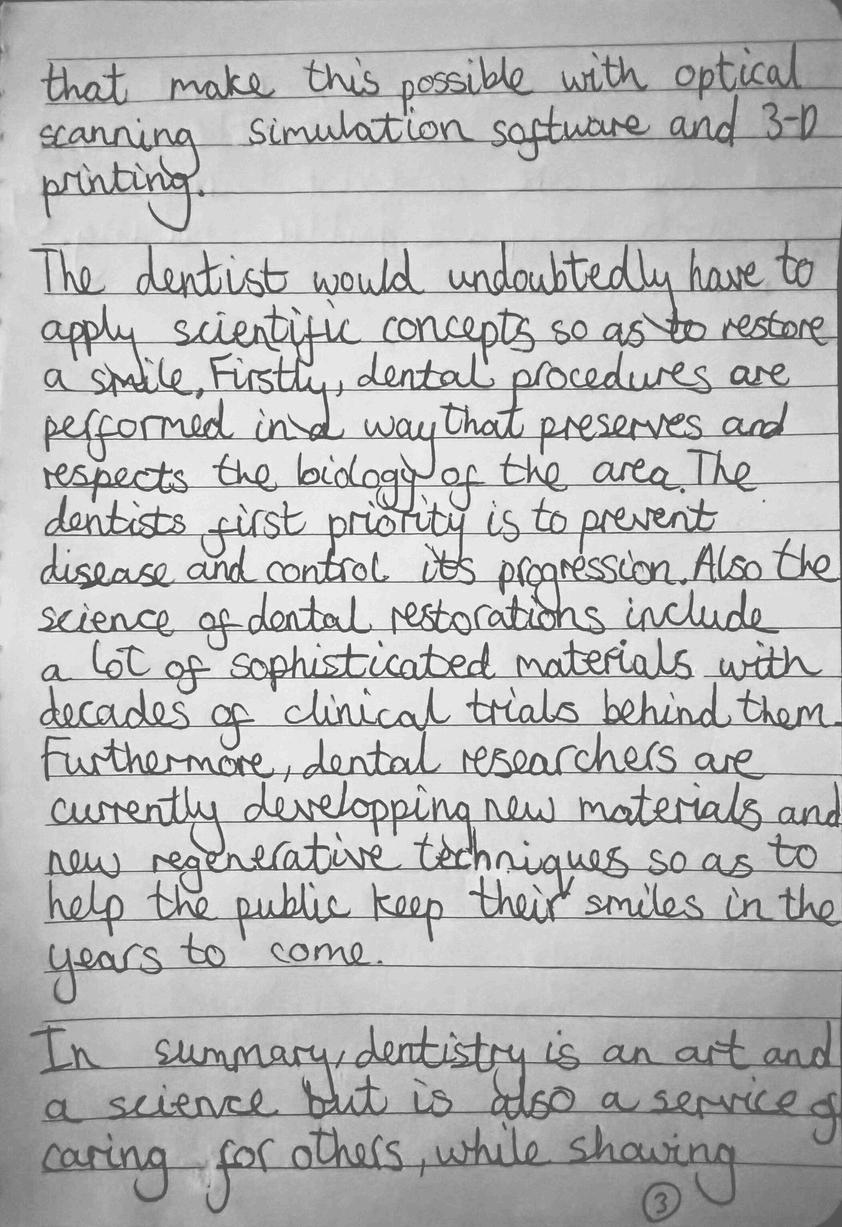
THE ART AND SCIENCE BEHIND A SMILE
When you meet someone for the first time what’s the first thing you notice? Their smile, of course. Humanity’s common language despite no two smiles ever being the same. It is both the spontaneous expression of emotion and the result of intricate biological and artistic design. Behind something so instinctive lies a junction where psychology, anatomy and creativity entwine.
THE SCIENCE PERSPECTIVE
A smile is far more than a fleeting facial gesture; it is a complex combination of emotion and connection, beginning in the brain When we feel happiness or connection, endorphins are released and neuronal signals are transmitted to your facial muscles, particularly the zygomaticus muscles, which lifts the corners of the mouth This movement is not only a means of conveying joy; but the start of a positive feedback loop Studies in psychology suggest that smiling can reinforce positive feelings, demonstrating how closely emotion and the body are linked This means that a smile is not only an outcome of happiness but also a contributor to it
THE ART PERSPECTIVE
Science alone doesn’t create a memorable smile. This is where art comes into play; transforming the face into a canvas of emotion Dentists and artists alike understand how each smile is shaped by the combination of: light on the enamel, symmetry of teeth and the balance of lips within the facial structure Through utilising technologies such as digital imaging, dentists are able to visualise how the effect of subtle changes eg: changes in tooth shape or size can interact with facial features This allows dentists to consider proportion, balance and individuality creating a final result that looks natural Cultural and personal perception also shape the art of a smile What is considered as beautiful can vary across societies and cultures For example, in Japan yaeba (slightly crooked and overlapping teeth) are perceived as the beauty standard, as they are a sign of natural beauty and youthfulness. This highlights how the art behind a smile is subjective, shaped by cultural values, aesthetic traditions, and the unique ways societies define charm and beauty
THE DENTAL PERSPECTIVE
This is where the two worlds of science and art collide Dentistry is not just about correcting teeth but harmonising health with aesthetics The anatomy of teeth, gums and jaw alignment all influence how a smile appears Advances in cosmetic dentistry such as orthodontics and whitening techniques also rely on detailed biological understanding Dentists must also consider facial symmetry, bite mechanics and oral health to ensure a smile is both aesthetic and functional In this way, dentistry becomes both a science of function and an art of expression
Ultimately, a smile is never just the result of teeth and muscles working correctly Though science provides the structure allowing a smile to function, art provides it with meaning and individuality When balanced, a smile becomes more than an expression - it becomes a story told without words, a signature of identity igniting a spark connecting one person to another
BY ZAHRA 12F
p e o p l e c a n u n d e r g o m a n y t r e at m e n t s . Teeth whitening u s e s h y d r o g e n p e r ox i d e t o d e c o m p o s e s ta i n s i n e n a m e l , l i g h t e n i n g t h e t e e t h F u r t h e r m o r e , veneers a r e t h e iconic blend o f a e s t h e t i c s a n d d e n t i s t r y, a c h i e v e d by b o n d i n g c u s t o m p o r c e l a i n l ay e r s t o t h e t e e t h t o correct misalignments a n d p r o v i d e t h e façade o f a p e r f e c t s m i l e T h i s t r a n s f o r m s b a s e t e e t h i n t o a n i n t r i c at e ly a r r a n g e d s m i l e W h i l e
dentists are the engineers , a d va n c e d t e c h n o l o gy a n d AI p l ay m a j o r r o l e s t o o -
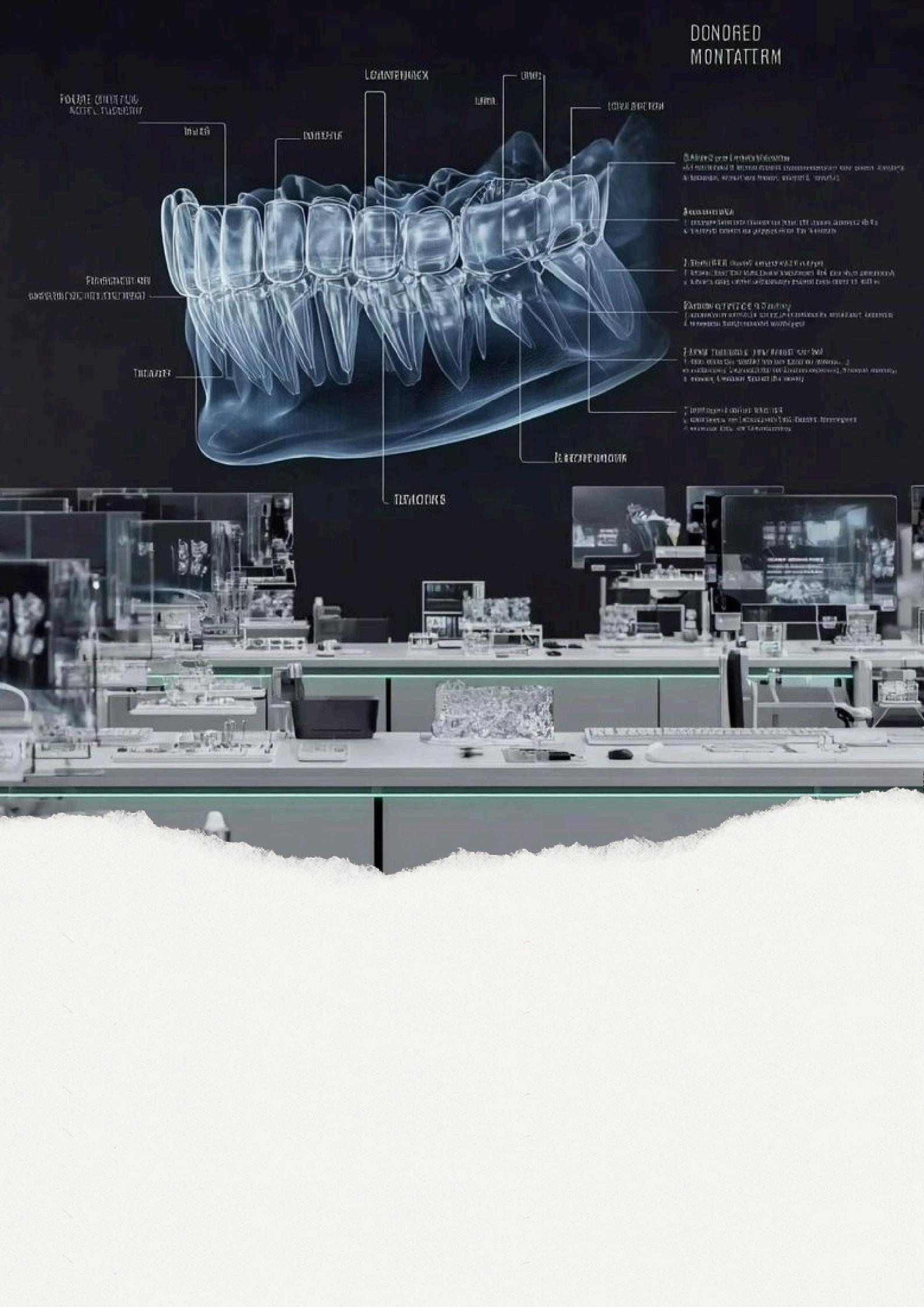
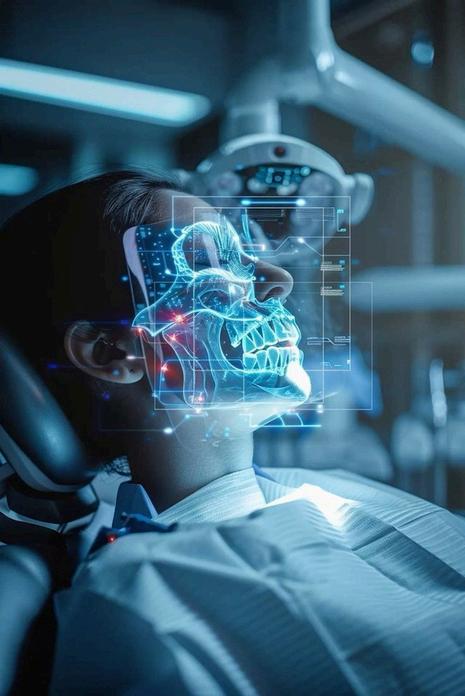
D i g i ta l- S m i l e - D e s i g n a n d A I h av e b e e n c o m b i n e d t o r e v o l u t i o n i s e h o w d e n t i s t s p l a n a n d produce picturesque smiles , m a x i m i s i n g satisfaction a n d efficiency
T h e development of technology h a s u n d o u b t e d ly b e n e f i t e d t h e c o s m e t i c d e n t i s t r y
i n d u s t r y, b u t m a n y c o m m u n i t i e s l a c k a c c e s s t o t h i s n e w t e c h n o l o gy, a n d m a n y m o r e p o p u l at i o n s c a n n o t e v e n access dental education T h i s c r e at e s a d e n ta l
d i v i d e , s e pa r at i n g d e n ta l t r e at m e n t i n t o b a n d s o f l u c k , i n f l u e n c e d by class , money , a n d , m o s t s i g n i f i c a n t ly, geography F o r e x a m p l e , i n r u r a l a r e a s o f t h e U K , s u c h a s C u m b r i a , r e s i d e n t s r e p o r t difficulty a c c e s s i n g e v e n basic dental services , w h i l e i n d i v i d u a l s i n wealthier L o n d o n b o r o u g h s c a n e a s i ly r e c e i v e advanced cosmetic procedures . T h i s s e pa r at i o n h i g h l i g h t s w h o h a s t h e privilege o f s p e n d i n g m o n e y o n a e s t h e t i c t r e at m e n t s , w h i l s t t h e l e s s f o r t u n at e c a n n o t a c c e s s n e c e s s a r y t r e at m e n t M o r e o v e r , t h e marketing of cosmetic dentistry o f t e n targets women , s u b c o n s c i o u s ly r e i n f o r c i n g unrealistic beauty standards f o r w o m e n
T h e s e inequalities , s e w n i n t o d e n t i s t r y, n o t o n ly i m pa c t o r a l h e a lt h b u t a l s o perceptions a n d responses to smiles R e s h a p i n g s m i l e s c a n a lt e r t h e p h y s i c a l a n d b i o l o g i c a l r e s p o n s e s t o s m i l e s a n d c h a n g e h o w e f f e c t i v e ly a s m i l e t r i g g e r s s o c i a l c o n n e c t i o n C o s m e t i c d e n t i s t r y i s i n t e g r a l i n s h a p i n g i n t e r p e r s o n a l r e l at i o n s h i p s , e x t e n d i n g t o t h e p h y s i o l o g i c a l a n d p s yc h o l o g i c a l r e s p o n s e s t o a s m i l e
T o c o n c l u d e , s m i l e s a r e a n at u r a l way t o e v o k e e m pat h y a n d f o r m b o n d s , b u t c o s m e t i c d e n t i s t r y, a s w e l l a s t h e s c i e n c e b e h i n d i t, b e a u t i f i e s t h i s b i o l o g i c a l f u n c t i o n , e n h a n c i n g o n e ’ s c o n f i d e n c e a n d s e l f - e s t e e m , m a k i n g t h e n at u r a l a r t f o r m o f a s m i l e e v e n m o r e p o i g n a n t H o w e v e r , w i t h t h e a d va n c e m e n t o f d e n ta l t e c h n o l o gy, t h e d i v i d e b e t w e e n d e n ta l c a r e a n d c o s m e t i c a c c e s s d e e p e n s , a n d t h e u n j u s t d i s t r i b u t i o n o f c a r e w o r s e n s T h i s c o n v e y s h o w s o m e t h i n g a s s m a l l a s a s m i l e c a n r e f l e c t n o t o n ly s o m e o n e e l s e ’ s h a p p i n e s s b u t a l s o t h e g e o g r a p h i c i m b a l a n c e i n c a r e a s t e c h n o l o gy a d va n c e s
A smile is one of the first things you notice about a person, one of the first things other people notice about you A person’s smile is a unique part of their identity and their looks It is different from other facial features because it’s not just a facial feature; it’s a sign of joy, happiness and warmth – not just the warmth you feel, but also the warmth you bring other people simply by smiling, because of how contagious smiles are
What makes them even more interesting is the fact that they are a blend of both art and science This makes the dentist not only a technician but also an artist As our understanding of smile aesthetics evolves, so does the technology and tools used Technology is rapidly transforming aesthetic dentistry with extraordinary precision, efficiency, and patient care through digital tools like DSD software, 3D scanners, and CAD/CAM
One of the most innovative tools leading to this transformation is Digital Smile Design (DSD) DSD is a modern cosmetic dentistry approach that uses digital photos, video analysis, and 3D scans to design a patient’s ideal smile DSD allows dentists to ensure a patient’s treatment complements their individual facial features, and the patient isn’t left to just imagine their results but also preview them! This process provides a precise blueprint for treatments such as veneers or implants, resulting in more favourable and predictable outcomes
However, tools like DSD rely heavily on 3D scanners, which have become essential in modern aesthetic dentistry Intraoral scanners – also known as 3D scanners – are devices that use optical imaging to create high-definition 3D models of a patient's mouth, using light or laser to scan the surface of the teeth and soft tissue The data is then processed and displayed as a digital model on a screen and the scans are shared, saved, or directly integrated into CAD/CAM systems - digital systems dentists use for designing The computer creates a 3D model of your tooth (CAD), then a machine shapes the real restoration from it (CAM) In every scan lies the promise of a smile that not only looks perfect but also feels like you, making this method highly suitable for procedures like veneers, implants, aligners, and full smile makeovers, providing natural and better results
After these digital models are captured, Computer-Aided Design (CAD) and Computer-Aided Manufacturing (CAM) technology is used to design the final restorations These methods are commonly used for veneers, crowns, and implants, due to their incredible precision and consistency They positively impact patient experience, looking strikingly natural, blazing through time, and being luxuriously comfortable – far surpassing old, traditional methods like manual impressions and lab made restorations that take weeks!
The evolution of technology has revolutionized aesthetic dentistry, and this change is so important because it improves the patient’s experience and provides better results Technology in aesthetic dentistry has not only enhanced artistry, but also self-esteem and confidence, and will continue to do so as it advances, changing lives by blending innovation and artistry
ByGhadeer10C
One of the world’s most toxic beauty standards is fitting in Sure, it can sometimes be healthy, speaking of topics like obesity and tackling it, though is it truly just about helping? It is found that 67 5% of bodybuilders have an eating disorder, which not only encourages it, though it showcases how having the perfect body means not eating which can lead to many health issues Now, you might be asking, what does thi shave to do with the Art and Science Behind a Smile? Well, I’ll tell you A beautiful, white, clean smile is something everyone strives to have, like a beauty standard now, but why? Shouldn’t we just be happy our teeth are clean and healthy? Some of the most dangerous procedures that can harm the teeth's first layer of defence –the enamel- is done often. Of course, when done by a professional, this rarely happens, only cleaning the teeth, though because of the uprise in whitening the teeth, people now use at home kits that can permanently harm the enamel and cause sensitivity to the gums and teeth, making it harder to eat
Now let’s talk about the smile A smile is an important part of our lives; we are taught from a very young age to smile at strangers to be polite, but smiles can hide many truths, take the picture on the right for example It was painted by Ignasius Pedo from Indonesia, titled, “Sad Smile” which would confuse many, “How can a smile so white and straight be sad?” The pain we feel in the inside is not always the way we want to portray ourselves on the outside The use of darkness in the background illustrates the hardship and the darkened past the girl has though it contrasts with the whiteness of her teeth and how they are closer to us, symbolizing the innocent front she is putting on for the world and the beauty they see, with her unblemished toned skin. The stress on her muscles in her mouth shows us how hard she is trying to seem happy and unaffected and the toll that it is having on her, slowly down the painting, the shadows get darker, connoting to what we said earlier about her troubled past or/and present
On the other hand, we can argue that the ugliest smiles hold the most joy, the girl to the left is not draw as the stereotypical beautiful girl on social media or in dentistry commercials for a matter of fact, though she is drawn happy It is hard to tell from the image though the shading of her rosy cheeks presents the warmth the girl is feeling, both emotionally and maybe to whatever she is laughing about The lack of stress on her cheek muscles also gives us the impression that the smile is genuine and unforced Also, the artist decided to draw the girl as youthful, symbolizing the innocence and purity of the girl which contrasts sharply with the previous artwork but also Ignasius. The girl is shown to be innocent and pure though ugly to the eyes of the stereotypes of the world, with her imperfect, gap-filled teeth, to her small, pointed chin, though the art isn’t to convey beauty, it is to show pure happiness and joy without the need for validation in a world so full of influencers telling you the latest product to have the perfect teeth
Even though both images show young girls, beautiful in their own way, one has been tainted with a past that forced her to follow the stereotypes of the world with porcelain skin and white, straight teeth Whereas the other girl defies these stereotypes though is brimming with genuine happiness creating a lively and beautiful image without the need of physical beauty
The Art and Science behind the Smile is not about how beautiful it looks, or how much someone envies you for being able to afford teeth whitening, though it is about the joy of being you Humans are able to tell a fake smile from a real smile simply because faking a smile is almost impossible as real smiles come from the limbic system (the brain's emotional centre) which is when the muscles around the eyes contract, creating crow's feet and pulling the skin in whereas the cheeks are pulled upwards, often creating bulges below the eyes with the skin above the eye pulls down and inward a little, interestingly enough, a real smile also fades naturally, not abruptly switching off like a fake smile All these tiny differences are what makes a real smile beautiful and creates a warm atmosphere Most people can spot fake smiles, a study by the newspaper The Independent recently (29th May 2025) says that SMILES ARE FAKE 60-70% OF THE TIME!
In conclusion, a smile is not only the thing that people wear on their faces as they walk around Nor is it the beauty standards we, as a society have created, though it is the general joy of human interaction and the brain’s limbic system giving us a sense of happiness Remember, the ugliest smile can be the most honest.