
Volunteers restoring waterways

Cotswold Canals: The return of the Missing Mile
2026 Canal Camps launch: Sites, dates, leaders


Volunteers restoring waterways
Cotswold Canals: The return of the Missing Mile
2026 Canal Camps launch: Sites, dates, leaders


The winter might not be a busy time for week-long Canal Camps, but the regional mobile groups have been out and about doing a lot of scrubbashing among other things. These pics by the editor show a joint WRG Forestry, KESCRG and London WRG weekend on yet another worksite on the Wilts & Berks Canal at Moredon, just north of Swindon, where they were cutting down, logging and chipping overhanging trees that were in danger of blocking the canal and towpath - as well as taking a tea-break on Moredon Aqueduct

For latest news on our activities visit our website wrg.org.uk
See Facebook group: WRG Follow us on @wrg_navvies
Intro London WRG, Forestry and KESCRG on the Wilts & Berks 2
Editor’s Welcome and some thoughts on connectedness of restorations 4-5 Chairman’s Comment
Comingsoon Spring camp, Canalway Cavalcade, Training weekend and more 8-11 CanalCamps2026 dates and leaders 12-13
Restoration feature the ‘Missing Mile’ on the Cotswold Canals 14-19
Diary Camps and working weekends 20-21
Digreport London WRG on the Chelmer22-23 Camp report Buckingham Christmas 24-28
Progress around the network 29-35
PLEASE NOTE: subscriptions renewal cheques should be made out to The Inland Waterways Association. Note our new address (above right)
Editor: Martin Ludgate, 35 Silvester Road, East Dulwich London SE22 9PB. 020-8693 3266 martin.ludgate@wrg.org.uk
Contributions welcome, by email or post, to the address above. If sending a lot of large picture files, please contact the editor first. Pressdateforissue335:15January.
Subscriptions: Ayear'ssubscription(6issues) isaminimum of £5.00 (please add a donation if you can) to WRG, Hardy House, Northbridge Road, Berkhamsted HP4 1EF. Cheques must be made out to The Inland Waterways Association (although the proceeds will be put to WRG / Navvies use).
Distribution: John Hawkins, 4 Links Way, Croxley Green WD3 3RQ 01923 448559 john.hawkins@wrg.org.uk
Navvies is published by Waterway Recovery Group and is available to all interested in promoting or supporting the restoration and conservation of inland waterways by voluntary effort in Great Britain. Articles may be reproduced in allied magazines provided that the source is acknowledged.
WRG may not agree with opinions expressed in this magazine, but encourages publication as a matter of interest. Nothing printed may be construed as policy or an official announcement unless so stated - otherwise WRG and IWA accept no liability for any matter in this magazine.
Waterway Recovery Group is part of The Inland Waterways Association, (registered office: Hardy House, Northbridge Road, Berkhamsted HP4 1EF), a non-profit distributing company limited by guarantee, registered in England no 612245, and registered as a charity no 212342. VAT registration no 342 0715 89.
Directors of WRG: Rick Barnes, George Eycott, Helen Gardner, John Hawkins, Dave Hearnden, Nigel Lee, Mike Palmer, George Rogers, Jonathan Smith, Harry Watts, Mike Wills.
ISSN: 0953-6655
© 2026 WRG
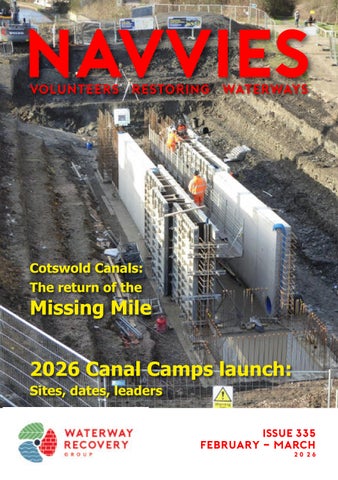
Cover picture: Not actually a volunteer project, but still good to see progress on the Chesterfield Canal’s new Keith Ayling Lock - see report on pages 29-31. (picture by Chesterfield Canal Trust) Back cover (top): ‘All pulling together’ on the Christmas Camp at Cosgrove on the Buckingham Canal - see report on pages 24-28 (picture by the editor) Back cover (bottom) channel profiling by Shropshire Union Canal Society volunteers continues in muddy winter conditions on the Crickheath South project on the Montgomery Canal - see report on pages 32-34 (picture by SUCS)
The editor looks forward to some summer Canal Camps and other activities, and to some more connected canal restoration…
…to another issue of Navvies, the magazine written by and for Waterway Recovery Group and other ‘mobile’ canal restoration volunteers, and named in honour of our hard-working predecessors, the original navvies who travelled the country from worksite to worksite 200plus years ago, building the country’s canals.
You’ll see that a large part of this issue is looking forward to what our 20th century navvies will be doing this year: in our ‘Coming Soon’ pages we’ve got a spring camp, a festival site services camp, a couple of useful training events, and then a whole summer of week-long Canal Camps. See pages 8 to 13 for all the details that were available as we went to press.
And then turn over to pages 14 to 19 for an in-depth look at what’s going to be our biggest single commitment this summer with three weeks of back-to-back Canal Camps, and take up a fair amount of our time in the coming years. This is the Cotswold Canals Trust’s project to reinstate the ‘Missing Mile’ length of canal. Our work this summer to build canal basin walls below John Robinson Lock will help to kick-start the Missing Mile project, leading (hopefully) to its completion in a few years, and to the restored sections either side of it being connected together and to the rest of the national waterways network…
And that made me think…
I’ve quite literally lost count of the number of magazine articles I’ve written, either for Navvies or other waterways magazines, where I’ve had to start by explaining something along the following lines to the readers…
“Yes, I know, many of you are canal boaters and are ‘champing at the bit’ to get boating on some new sections of restored canal. And I know you’d really like to see the first section of canal reopened which leads on from where you can get to now, so you can cruise that length while we restore the next section and so on… But actually, rather than do that, it makes far more sense for us to start by restoring some godforsaken lock in the middle of nowhere, on a section which probably won’t be connected to the canal network for decades, and most of us won’t live to see restored…”
OK, I might not always have put it quite that bluntly, but you get the idea. And the thing is, there invariably is a good reason. The canal restoration movement aren’t just a bunch of killjoys out to spoil things for boaters, nor are we (as I’ve occasionally seen intimated) a clueless bunch who don’t know how to go about things the right way. It might be political reasons to do with local authority boundaries or land ownership. (For example the Chesterfield Canal Society couldn’t start from the near end because the then British Waterways flatly refused to let them. So they went and worked on the far end, which BW had sold off to the Council, and couldn’t stop them restoring.) Or it might well be that the ends of the route where it joins the national network have obstructions which are going to be so difficult and expensive to deal with that the only hope is to first restore an isolated but much easier section, so you can then say to the Lottery (or local authority, or whoever): “Look at this length of canal we’ve restored for small boats and local use - now wouldn’t it be even better if you gave us a grant to restore the difficult bit, and connect it up?” (The Wilts & Berks seems a good example of this, with Melksham, Abingdon and Cricklade all obstructing its extremities where it meets navigable waterways, but miles and miles of restorable canal in between.)
But now take a look at the projects we’re supporting on this summer’s Canal Camps. As I mentioned at the start, there’s the Cotswold Canals - and we’re not restoring the “lock in the middle of nowhere”, with the aspiration of one day linking it up to something else. No, we’re actually helping to do the linking up. In a little over three years’ time, what we’re doing should be part of a ten-mile extension of the national waterways network.
And then there’s the Lichfield Canal. Our work is helping to link together sections of canal that have already been completed at Tamworth Road, Darnford Lane, Gallows Wharf and Fosseway Heath. And whilst there isn’t the same imminent reopening to visiting boats from the Coventry Canal (there’s the small matter of the A38 trunk road to cross), there’s definitely a move towards more connectedness.
And likewise the Wey & Arun: this year’s camps will be connecting last year’s site at Rooks Hill Bridge to the previous one at Birtley Bridges. And there are plans to extend it further, reducing the gaps between restored sections of canal.

Sure, on our other summer Canal Camps project, at Pewsham on the Wilts & Berks Canal, there’s less of an obvious sense of ‘joining the dots’. But elsewhere on the same canal, at this very moment work is going on to connect together two lengths (one original, the other a diversion on a new route) in the Wichelstowe development on the south side of Swindon. And our WRG Reunion site from last November at Grove Locks might seem like the middle of nowhere, but it’s the start of one of the Trust’s four strategic objectives for the medium term to connect it to the Thames near Abingdon.
There will still be ‘middle of nowhere’ work sites, and I will continue to write articles defending this approach where necessary. But it’s good to have a few examples like the above ones where it’s a bit more self-evident that some connected progress is being made.
…you might just be wondering, following the success of the 2025 event, whether we’re going to have one again this year. And the answer is “Yes, if we can find a suitable site.”
“But hang on,” I hear you say, “If last year’s was such a success, why don’t we just go back to the Wilts & Berks and do some more of the same?” Well, the answer is that it was such a success in uncovering the locks and bridges that the Wilts & Berks Canal Trust has plenty to get on with, inspecting the structures in detail and planning their restoration, so we won’t be needed to go back there and uncover any more for a little while.
So in the meantime, if you’re involved with a canal restoration society or trust, and you’ve got a site (and can find accommodation) that will take perhaps 80 to 100 volunteers on a weekend’s work (preferably scrub clearance or similar) in late autumn, WRG would like to hear from you.
Martin Ludgate
We have moved house again!
Asof7JanuarytheheadofficeofWRGand itsparentbodytheInlandWaterways Association(andtheofficialregisteredoffice ofIWA)hasmovedto:
HardyHouse,NorthbridgeRoad, Berkhamsted,HP41EF.
Thetelephonenumberremainsthesame: 01494783453
…on the Llangollen Canal bursting its banks, and what the key messages fromthismajorincidentareforthewaterwaysandtherestorationmovement
There is an old saying that “there is no such thing as bad publicity”. I think the wisdom goes that it’s not bad publicity, just an opportunity to build on / correct / mould the current message to give the accurate (honest?) message that you wanted everyone to hear anyway. But so far this year has proven to be quite trying in the world of waterways, hasn’t it?
The incident at Whitchurch (OK actually it was last year, just) where the Llangollen Canal embankment breached and the rush of escaping water drew two boats into the resulting hole, was just so dramatic (and photogenic!) that it was bound to create a lot of media interest both in the waterways sector and the wider world.
Now, given the adage stated above, what was needed to take this “opportunity” and build on it to give an honest account of the situation?
This is obviously just my rather hasty and certainly incomplete summary, but I would suggest that those key messages would be:
(1) Although rare, the nature of the nationwide waterways network means that these dramatic incidents could occur at anytime, anywhere.
(2) As with anything built a few hundred years ago, the situation that network finds itself in has changed.
(3) It is a symptom of undervaluing (hence underfunding) that network.
In my opinion the waterways sector did indeed rise to the challenge in the national press:
• From the closest canal restoration scheme (the Montgomery Canal), Michael Limbrey was an excellent advocate of why all waterways provide benefits for all of the UK and should be valued as such.
• From the national voice of the waterways (WRG’s parent body the Inland Waterways Association), Charlie Norman gave an excellent analysis of the modern-day issues such as the drought / heavy rain cycles that climate change brings.
• From the Navigation Authority (the Canal & River Trust) Julie Sharman gave excellent explanations of the engineering challenges that such a diverse network brings.
Given all of that it is a pity that, despite all those good words usually making it into the text of the various reports / articles / broadcasts, the headlines almost always included phrases like “crumbling / collapsing / deteriorating waterways network”.
What can the Waterway Restoration Sector (that’s us folks) get out of this? Well, it might not have gone 100 percent as we hoped for, but I think the wonderful waterways network that we all love did get a pretty good advocacy when it was propelled into the headlines this time. That, in itself, is worth celebrating but I would suggest there is a lesson for all of us…
The real reason that they were all able to put across their messages with confidence is that they had the evidence that backed those messages up.
• Michael had confidence from (amongst other things) IWA’s Waterways for Today report that gave clear evidence as to why the Network should be valued,
• Charlie had confidence from (amongst other things) the IWA’s Waterways Watch surveys that give clear evidence as to the recent state of the Network,
• Julie had confidence from (amongst other things) CRT’s reports on the engineering state of the Network.
Now I’m not stupid enough to say that all that evidence was comprehensive, totally accurate or even complete. However, it does give them a huge advantage, not just to put their message across, but to put their message across WELL.
All of the above seems to me to be reinforcing a simple message:
Make sure you have evidence from before, during and after your work. Whether you are planning a complete Lock chamber rebuild, or just installing a fence post the issue is just the same – at some point someone is going to ask “how was this done?”. Make no mistake – this will not be out of casual interest; there will be a genuine reason for them to need the answer. It might be your current treasurer (trying to work out when they will need to schedule/fund its replacement), or it might be the organisation you hope will take over the operation of your restored waterway (also trying to work out when they will need to schedule/fund its replacement). Either way they need to be given accurate answers.
I am not saying you must have all the answers before you start anything. But you certainly should have them when you have finished a job.
Most restoration projects already have enough “uncertainties” on the sections that have not yet been tackled. If current work is just adding to the total of uncertainties, then it’s not really helping is it?
Mike Palmer
PS Martin will no doubt be pleased that this amounts to 700 words – I could have just cut it down to two words – NO BODGING.

Dramatic picture of the Llangollen Canal breach - but what are the key messages from it?
Fancyaweekrepairinghistoricwater-savingside-pondsatHanwellLocks? Orhelpingtorunoneofthecountry’smostcolourfulwaterwaysevents?
By the time you read this, the annual week of dragging junk out of the nether regions of the Birmingham Canal Navigations system will be almost upon us - but in fact as we go to press its already pretty much booked up as far as people staying overnight for the weekend are concerned. It might be worth a call to Head Office enquiries@wrg.org.uk or 01494 783453 just in case there’s been a cancellation, or joining us on site just for the day.
The first of this year’s week-long Canal Camps may well actually be more than a week - and will be on a new site - or for those with long memories, a very old one, as we did some work there around the early 1990s…
Hanwell Locks are a flight of six locks (or eight if you include the two at Norwood) where the Grand Union Canal climbs steeply away from the Thames on the western fringes of London. As it’s a steep climb they’re deep locks, which (combined with this being a busy length of waterway in the days of the working boats, with a lot of local trade) meant that they used a lot of water.
To help make the most of the available stocks of water they were later fitted with ‘side-ponds’. These are separate brick-built chambers built alongside each lock, into which a part of each lockful of water could be emptied (by a special side-pond paddle) before emptying the rest of the lock into the canal below; this part of the water could then be reused to fill the first part of the lock before filling the rest of it from the canal above. This saved a fair proportion of the water, at the expense of taking more time and being a bit of a faff.
To save even more water (and be even more of a pain for boaters in a hurry) you could put two side-ponds by each lock, each with its own paddle. So now you had to empty as much water into the first side-pond as it would take, then close the first side-pond paddle, open the second paddle, empty as much into the second side-pond as it would take, and finally empty the rest into the canal below. And then the same in reverse to fill it.
But Hanwell Locks were the only place in Britain (at least as far as I know) where triple side-ponds were ever built. Which makes them an interesting historic featurebut one that’s been allowed to decay since their watersaving function was last really needed some 50 or 60 years ago, and as a feature that isn’t necessary for the operation of the locks, they aren’t a high priority for the Canal & River Trust’s limited resources.

Now, however, a project to restore them has gained Heritage at risk: rare triple side-ponds by one of the Hanwell locks
funding from the National Lottery Heritage Fund and support from WRG’s parent body the Inland Waterways Association, and we’re spending a ‘long week’ over Easter carrying out some of the work. We’ll be taking down decayed brickwork, and rebuilding it.
As well as getting the structures off the official Heritage at Risk list, the work will also strengthen the canal’s future resilience. They won’t immediately be put in operation, but given the extremes of weather the waterways have suffered (as I write this the rain has been hammering down for what seems like weeks - but still the last of CRT’s canal reservoirs haven’t quite recovered from last year’s drought) there’s a distinct possibility that they might in the future.
Please note that as we went to press the exact dates for this Camp were not finalised but it’s likely to be around 21 to 29 April i.e. running for over a week: see wrg.org.uk or contact Head Office for confirmation. Volunteers should book online at wrg.org.uk or via head office - see Diary pages.
The Call for Volunteers is now open to help support Canalway Cavalcade, WRG’s parent body the Inland Waterways Association’s premier fund-raising event of the year. Held at London’s Little Venice, this is one of the most colourful events of the Inland Waterways calendar. Find out more about the event via: waterways.org. uk/support/ways-to-getinvolved/events/iwacanalway-cavalcade-2026
This year the event is being held over the May Day holiday weekend 2nd – 4th May 2026 and we need plenty of volunteers to make sure it runs smoothly and safely. Volunteers are required both during the event and setting up beforehand and taking down afterwards.
During the event: Could you spare some time to help with roles including...
• Running information stands
• Collecting donations
• Distributing programmes

• Assisting the teams of commercial and children’s Activities
Whatever time you can offer will be greatly appreciated, even if it’s just a couple of hours. Navvies readers are ideal for helping on the Information Stands. Potential questions are "what time is the puppet show?" or "where can I get a boat trip" or "what's all this in aid of?". So, it's beneficial to know a little bit about either IWA, WRG, canals, boating, or just the festival in general – however, event details can be found in the event programme, so experience is not essential. To register your interest to please scan the QR code on this page or visit forms.office.com/e/8uKxQiKx5W, for queries please email cavalcade.volunteer@waterways.org.uk

Scanthecodetogetinvolved
Before and after the event: If you can spare some time before or after the festival, the IWA/WRG Work Camp volunteers are always happy to welcome an extra pair of hands to help build the event on the Thursday and Friday and especially to dismantle the festival on
the Monday evening and Tuesday morning. If you fancy building market stalls, gazebos and putting up banners please email pete.fleming@waterways.org.uk to register your interest.
Committee roles: the jobs described above take place on site around the event weekend, however there are several opportunities for volunteers to help on our Organising Committee, such as Publicity, Marketing, Commercial, and Social Media. If you have skills or interest in these areas, please get in touch!
We require all volunteers to complete a Booking Form prior to arrival so that we have essential medical and emergency contact information and can thoroughly plan for the event, even if you have discussed attending with any of the team leaders.
Thank you for your continued support.
Emma
Greenall, Cathleen Taylor, Pete Fleming,
We are very grateful to be able to return to Fosseway Heath at Lichfield for the 2026 Training Weekend. Many thanks to our friends at the Lichfield & Hatherton Canals Restoration Trust who have made it possible for us to use this fantastic site once again. All training sessions will take place on Saturday 16th and Sunday 17th May, with accommodation available from Friday evening for those wishing to stay over.

The training weekend, for those who have never been to one, is exactly as it sounds: two days dedicated to providing our volunteers with an introduction to the wide range of skills that are often used on working weekends and camps. Our aim is to provide initial or refresher training in those areas which have been identified as priority for projects in the coming year, as well as instructor training for those with years of regular operator experience. Training will be available in the following areas: 360-degree excavators (categories 30 and 31 on the WRG Driver Authorisation Scheme), articulated dumpers, ride-on rollers, minibuses, Training on various machines under way during last year’s Training Weekend
trailers, site tools, bricksaws, bricklaying, as well as any other useful sessions identified by leaders over the next few months.
For those of you who have never attended a WRG Training Weekend, it is ideal for anyone who will be attending a Canal Camp this year where specific skills have been identified as useful to have by your leaders. For those who volunteer regularly, it may be that certain skills are needed for a particular local project to progress. Equally, returning volunteers may feel they need refresher sessions before the Canal Camps season starts. Perhaps you are considering becoming an instructor? Or, if you are already an instructor and able to volunteer and share your knowledge over the two days, please do get in touch.

It’s not just about driving big machines: the training weekend also offers training in bricklaying and power tools such as bricksaws
If you would like to book on, discuss opportunities or volunteer as an instructor, please do contact me via email:wrgtraining@wrg.org.uk
I look forward to hearing from you soon,
Ali Bottomley
We’ll have more information in the next isssue of Navvies, so this is just to flag up a date for your diary for WRG’s annual Leadership Teams Day. This annual event is aimed at anyone who is or is interested in being a leader, assistant leader or cook on WRG Canal Camps or mobile groups’ weekend working parties - and especially those who have been appointed to the leadership teams for this summer’s Canal Camps, who are very strongly encouraged to attend if they possibly can. Subjects covered will be based around updating leaders’ knowledge and skills relevant to running camps that are happy, successful and safe.

Bythetimeyoureadthis,thebookingsshouldbeopenforthissummer’s week-longCanalCamps-sohere’sthelatestinfoonsites, datesandleaders
Summer WRG Canal Camps programme 2026: All the confirmed dates and leaders so far
Hopefully the previous four page of ‘coming soon’ events will have served to whet your appetite for the main course: the summer programme of week-long Canal Camps.
As usual we will be advertising the Camps via the WRG website wrg.org.uk and Facebook group, as well as printing the Camps Brochure when everything’s been confirmed, but in the meantime here is everything that had been agreed at the point when this issue of Navvies went to press.
But first, a few things to note:
• You will need to book via the WRG website wrg.org.uk (or contact Head Office on enquiries@wrg.org.uk or 01494 78345)
• Week-long Canal Camps (as opposed to regional groups’ weekend working parties) do tend to book up very quickly. Book early to avoid disappointment!
• There may be more Camps added to the programme - we will announce them in Navvies
• …and conversely, although we are pretty confident that these Camps will happen, there is always the chance that something beyond our control might go wrong. Head Office or the website will confirm
The programme kicks off with two weeks supporting the Wey & Arun Canal Trust at Rooks Hill. If you were on one of last year’s Camps (or read the reports in Navvies) you’ll be aware that we spent the fortnight working on a new site at Rook’s Hill, beginning building a new bridge to carry a bridleway / cycleway over the canal, as well as extending a culvert that carries a stream under the adjacent canal embankment, and creating a channel wall. This work there is now approaching completion (with the bridge deck due to go on as this issue goes to print), and we’re moving to a length of canal immediately to the north, which will link up with the already restored section (including two new lift bridges) at Birtley which you may recall us working on a couple of years ago. The original channel has been filled in and is not available, so we’re working on creating brand new channel walls on a slightly different route. There are two weeks of Canal Camps: 11 to 18 July (led by the regional group NWPG under Bill Nicholson), and 18 to 25 July (led by Dave ‘Evvo’ Evans). Arch formwork in place at Rooks Hill Bridge, site of 2025’s camps

Simultaneously with the second Camp on the Wey & Arun, we will be starting work on a second site, where the Lichfield & Hatherton Canals Restoration Trust are linking up restored sections of canal on the outskirts of Lichfield.
The Tamworth Road worksite (also known as Borrowcop Locks Canal Park) has been a regular venue for WRG and other visiting volunteers for many years, as LHCRT have led the restoration of two locks, the conversion of a third into a ‘feature’ and the removal of a big concrete land drain pipe that was half-buried in the canal bed. A little way further west, our volunteers have also supported the re-creation of the Gallows Wharf length of canal. And further east, we’ve helped with the restored and rewatered section at Darnford Lane.
The exact details of our work this summer are still being worked out, but it’s likely to involve either channel work leading on from the Darnford site, or constructing the missing length of channel (at a new, lower level to enable it to pass under a road via a new bridge) that will connect the Gallows Wharf and Tamworth Road sections together.
We have two weeks of Canal Camps, on 18 to 15 July and 25 July to 1 August, both led by Colin Hobbs.
Our next Canal Camp will be working on the Wilts & Berks Canal Trust’s project to restore the three Pewsham Locks. This is one of WBCT’s four main objectives for the medium term (the other three are the Melksham Link project to reconnect the canal to the Kennet & Avon Canal, the Bringing Boats Back to Wantage project to open the eastern end of the canal where it meets the Thames; and the project to connect Swindon to Wootton Bassett). As well as eventually being part of a restored canal, ‘Pewsham Waterside’ (as WBCT have named it) will in the meantime create a local amenity and community heritage resource for walking, cycling, small boats, education and picnicking, based around the locks and other historic features (including a restored roofed dry-dock where wooden working boats were once built
Our contribution will be restoration work on the bottom lock of the three, and we’ll be there for the week of 1 to 8 August. Regional group KESCRG led by Ed Walker and Stephen Davis will be leading this week.

Finally we will be heading for the Cotswold Canals and our biggest commitment on this summer’s programme with a series of three weeks on the tail of John Robison Lock where it meets the start of the Missing Mile: a brand new length of canal being built to replace a section lost to road construction 50-plus years ago.
But I won’t say any more about this here, as there’s an entire six-page feature about it on the following page - other than to say that the first Canal Camp is on 8 to 15 August (led by Mike Palmer and Becky Parr); the second on 15 to 22 August (led by Stephen ‘Ricey’ Rice and Sandra Horner); and the third on 22 to 29 August (leaders still to be confirmed).
WRG Camps return to the western Cotswold Canals this summer with three
Three years ago in the summer of 2023, WRG volunteers were hard at work rebuilding John Robinson Lock on the west end of the Cotswold Canals, with no fewer than six weeks of consecutive week-long Canal Camps working on this important part of the Cotswold Canals Connected project, which is linking the restored sections of the Stroudwater and Thames & Severn canals back to the waterways network.
But then in 2024 and 2025, WRG work at John Robinson Lock took a rest: while the Cotswold Canals Trust dealt with land access, funding and other behind-the-scenes issues, WRG volunteer work on the Cotswold Canals concentrated on another project adjacent to Weymoor Bridge, installing a stream culvert under the canal bed and then building a reinforced concrete canal channel above it. Now, however, we’re back at John Robinson Lock for another three weeks this summer – but things have moved on a little since we were last there. And it’s all to do with the Cotswold Canals Connected project, and in particular the ‘Missing Mile’ section.

In fact our work for this year, rebuilding channel walls that form the sides of a canal basin just below Westfield Bridge (which spans the tail end of John Robinson Lock, is at the exact point where the surviving restorable section of canal comes to an end, and the Missing Mile begins. Our work is not only an important contribution to reopening the western lengths of the canal, but also a symbolic point where old will meet new.
In 1970-71, just too early for the then Stroudwater Canal Society (founded in 1972) to do anything about it, the M5 motorway was extended in two sections from Junction 10 to Junction 13, and then from Junction 13 to Junction 15 – and unfortunately it made rather a mess of the then derelict Stroudwater Navigation. Firstly the M5 itself created a major obstacle to restoration (it didn’t provide any kind of bridge for the waterway). But making matters much worse, its construction and various changes to existing roads in connection with access to the M5 resulted in the obliteration of a mile of original canal, including one lock (Bristol Road Lock) and the adjacent main road bridge carrying the A38 (Bristol Road) over the canal. All of these represented significant construction work that would be required
weeksatthestartoftheMissingMilelength.Sowhatisitandwhyisitmissing?
to reopen the canal –once a viable route had even been found for it. Which wouldn’t be easy, given that the M5 went through at a completely unsuitable height for creating a new canal crossing on or near the original route. This difficult section became known as the Missing Mile.
Not surprisingly, the canal society and its successors (today’s Cotswold Canal Trust) didn’t kick off the restoration by tackling construction of a mile of brand new canal including a motorway crossing. Instead they concentrated on more achievable projects elsewhere along the 36-mile Cotswold Canals route, which runs from Saul Junction via Stonehouse, Stroud, South Cerney and Marston Meysey to the Thames at Inglesham. WRG has supported them on many projects along the route over the years, and a great deal has been achieved (and continues to be achieved –most recently for example at Weymoor Bridge and Inglesham Lock).

Even 20 years ago when the restoration had reached the stage where bids to the National Lottery Heritage Fund for opening up some significant lengths at the west end of the canal stood a decent chance of success, it wasn’t yet time to tackle the Missing Mile. NLHF (and its predecessors) made it clear that they would look much more favourably on a bid for funding for reopening an isolated disconnected length of canal through Stroud (because it would involve plenty of heritage restoration and regeneration), rather than one that

actually linked the canal to the national network (but consisted largely of tricky new engineering jobs to get around a motorway blockage rather than heritage conservation). However once the isolated length from Stonehouse through Stroud to near Brimscombe Port (known as ‘Phase 1a’ – see our list of terminology) had been funded and was well on the way to completion (with a great deal of input from volunteers including WRG and other visiting teams) around ten years ago, NHLF took a different view of supporting the restoration of the connecting section (known as ‘Phase 1b’) from Saul to Stonehouse. Yes, it would still be largely new construction work (including an entirely new section of canal to replace the Missing Mile) – but it would be providing access to the already restored heritage structures on the Phase 1a length, which fitted with its objectives of providing public access to heritage. A funding package worth around £20m was put together for the Phase 1b length (now referred to in publicity as the Cotswold Canals Connected project) which would combine a £10m Lottery grant, several million from Stroud District Council, a chunk from CCT, and some significant volunteer input including visiting groups.
Cotswold Canals: canal restorers’name for the Stroudwater Navigation from Saul Junction on the Gloucester & Sharpness Canal to Stroud, and the Thames & Severn Canal from Stroud to the River Thames at Inglesham, which between them form a route across the South of England between Severn and Thames.
Phases 1, 2 and 3: sections that the Cotswold Canals Trust divided the route into, as a way of prioritising work towards reopening the entire route. Phase 1, to come first, would comprise the western section from Saul Junction through Stroud to Brimscombe Port.Attention would then switch to the eastern end, where Phase 2 would run from Inglesham on the Thames to the Cotswold Water Park near South Cerney. The final, most difficult section would be Phase 3, running from Brimscombe Port up the Golden Valley through the long (and collapsed) Sapperton Tunnel to the Cotswold Water Park.Although major work would generally follow this sequence, that wouldn’t prevent progress on individual projects elsewhere if opportunities arose (for example a legacy was given specifically for Weymoor Bridge, while an IWAappeal supported Inglesham Lock).
Phases 1a and 1b: When it became clear that funding the entire Phase 1 length as a single package was beyond the resources of the Lottery and other sources, it was split into two. Phase 1a is the isolated six-mile Stonehouse-Stroud-Brimscombe Port section, whose heritage and regeneration interest meant it was able to get funded first (and which has been completed apart from the Brimscombe end). Phase 1b, now under way, is the four-mile connecting section from Saul Junction to Stonehouse.
Cotswold Canals Connected: the name used in publicity, funding bids etc for the current Lottery-funded project to complete the restoration and reopening of the Phase 1b length.
The Missing Mile: one mile of the Phase 1b section of canal, from Bristol Road Bridge at Whitminster to just below John Robinson Lock near Eastington, which was destroyed by the construction of the M5 motorway in the early 1970s and is to be bypassed by a new route.
Phase1bSaultoStonehouse: Lotterygrantconfirmed2020 Phase1aStonehouseto Brimscombe:complete(except BrimscombePortlength)
Totallengthtoberestored: 36 miles
Locks: 56 originally, at least one more needed
Dateclosed: in stages from 1927 to 1946 / 2025
Phase3BrimscombetoWaterPark:Some restorationcompletedmainlyaroundCerney
Phase2WaterParktoInglesham: Someworkcompletedaround Eisey.IngleshamLockrestored
To Gloucester
Saul Junction
To Sharpness
Walk Bridge: to be rebuilt
Work started very promisingly with a £4m grant from Highways England (from a funding pot specifically targeted at environmental projects putting right damage caused by previous national road construction schemes) that paid for two new road bridges to take the restored canal under the A38 / A419 roundabout on the site of the old Bristol Road Bridge at Whitminster. The Lottery grant was approved, and a schedule was put together which would see boats from all over the canal network cruising the restored canal from Saul through Stroud and arriving for a reopening to Brimscombe Port in 2024. “I’ll see you all in the Ship Inn for a pint”, I quipped in Navvies 289, published in June 2018…
Whitminster Lock: restoration to be completed
Channel work / dredging needed plus new foot crossings
A38 roundabout: two new bridges built
Missing mile: see following pages
John Robinson Lock: under restoration
Basin below JR Lock: WRG Canal Camps 2026 project
Dock Lock: restoration mostly complete Ocean rail bridge: replaced Pike, Blunder, Newtown Locks: restored
Various things prevented that schedule from being followed. Complications arising from the pandemic; planning consent issues which weren’t necessarily directly related to the canal but impinged on the area where the new route was to be built; and most seriously the rampant inflation in the construction sector (which has been impacting on the whole restoration movement - see also our Chesterfield progress report) which meant that the £20m would be completely inadequate for finishing the job – even after Stroud District Council had generously chipped in with a couple of extra million quid. Despite this, there were some major success stories. We have already mentioned the pair of bridges carrying the A38 roundabout and replacing the missing Bristol Road Bridge. Over Christmas 2021, the Ocean Railway Bridge (it’s named after a 50ft wide stretch of canal named ‘The Ocean’, presumably ironically!) – a railway bridge carrying the Birmingham to Bristol main line, which had been replaced by an earth embankment and small unnavigable culvert – was reinstated as a fully navigable concrete bridge. So that’s two of the big three obstacles dealt with (the third being the M5). Volunteers have made progress

Bonds Mill Bridge: needs new deck
To Stroud, Brimscombe and the Thames

The new length of canal bypassing the Missing Mile will share this existing bridge under the M5 with the River Frome
at John Robinson Lock – as mentioned, the chamber walls were a major WRG project in 2023; more recently CCT teams have been rebuilding the top end of the lock including the aqueduct / culvert taking the canal over the Oldbury Brook immediately above the lock. But up to now, other than the A38 roundabout bridges (which were separately funded through Highways England) there’s been no actual practical work on the Missing Mile. However that’s all about to change…
In November 2025 the National Lottery Heritage Fund awarded a further £6.46m, which will put the whole Cotswold Canals Connected project back on track and mean work can get going on reinstating the Missing Mile.
Following the route from the largely restored John Robinson Lock westwards: Immediately below Westfield Bridge (which spans the tail of John Robinson Lock), the canal will pass through a small basin. Where it used to continue straight on towards the old Bristol Road Lock but has been obliterated, it will instead turn left on a new route. It will descend through a new lock (currently being referred to as Lock 9a or the ‘New M5 Lock’), bringing it down to the right level for the M5 crossing, as it bears to run parallel to the River Frome. The new canal will pass under the M5 by sharing the existing bridge which already carries the motorway over the river; canal and river channels will run side-by-side, separated by a concrete barrier wall.
On the far side of the motorway, the canal will continue to run roughly parallel to the river for some distance before turning sharply to the right. It will broaden out into a larger basin (to be used for moorings) as it runs alongside the A419 road. A second new lock (Lock 10, which will take the name Bristol Road Lock from the old lock that was nearby) will lower the canal further, to match the level of the original canal below Bristol Road Lock. The new lock will lead directly into the first of the two already completed bridges taking it under A419 / A38 roundabout. Beyond the second bridge it will rejoin the original alignment where the surviving canal channel reappears at the end of the Missing Mile.

The Missing Mile length: (1) largely intact before 1970
Bristol Road Bridge and Lock
Week 1: 8-15August, leaders
Mike Palmer & Becky Parr
Initially during this summer’s Canal Camps (and probably some weekend working parties by visiting WRG and other mobile groups) we will be rebuilding the walls of the basin where the new route will leave the original alignment. We currently have three weeks of Canal Camps planned for 2026 – see above). Other volunteer work on the Missing Mile isn’t entirely decided yet: some jobs (such as constructing the concrete channel passing under the M5 bridge alongside the River Frome) will clearly be done by professional contractors, but it’s been proposed that we may work on building one of the two new locks.
Week 2: 15-22August, leader Stephen Rice
Week 3: 22-29August, leader
Is that all that’s needed to get boats back to Brimscombe
No, there is still other work elsewhere on the Phase 1b length. This includes replacing the low-level Walk Bridge (a minor road crossing near Saul) with a new full height bridge, replacing the deck of Bonds Mill Bridge (the unsuccessful ‘plastic’ liftbridge installed some 20-odd years ago for access to an industrial site), a couple of smaller bridges including a lift bridge, plus channel works and dredging. And at the top of the Phase 1a length, there is still work to be done to get through from the current limit (by the Stroud Brewery below Hope Mill Lock) to Brimscombe Port – including finding a replacement development partner for the council at the Port site, after the last developer pulled out in 2025.
So when will the editor be drinking with boaters at the Ship Inn?
Sorry, I’ve learned my lesson, I’m not making any rash promises this time! But seriously… following the announcement of the new Lottery funding, Cotswold Canals Trust said that its new programme to complete the Cotswold Canals Connected project would provide for a canal reopening in 2029 – not necessarily to Brimscombe Port (see above), but to an interim terminus by the Stroud Brewery, where the Trust’s team are busy planning a new winding hole to enable boats to turn. So perhaps I’ll see you in the brewery taproom for a pint instead!
Martin Ludgate
The Missing Mile length: (2) blocked by M5 in 1970s
A38 Bridge and Lock demolished
One mile of canal destroyed by road works
River Frome
To Saul To Stroud
M5
A419
Westfield Bridge and Lock filled in Canal blocked by M5
Dock Lock
A38
New length of canal to be built
The Missing Mile length: (3) reinstatement under way
Two new bridges built under roundabout
New Bristol Road Lock to be built
A419
New canal to share existing M5 bridge with River Frome
New ‘M5 Lock’ to be built Mooring basin planned River Frome
M5
To Saul To Stroud
Basin walls needed: WRG Canal Camps 2026 site
Westfield Bridge restored, lock restored as John Robinson Lock
Dock Lock
Week-long Canal Camps cost £90 or as stated. Booking for events labelled Road, Berkhamsted, HP4 1EF. Tel: 01494 783453, enquiries@wrg.org.uk.
Feb28-Mar1 London WRG
Shrewsbury&NewportCanals
Feb28-Mar1 wrgBITM MaidenheadWaterways:BrayCut
Mar7-8 KESCRG Wilts&BerksCanal.BankprotectionatRusheyPlatt
Mar7-8 wrgFT BuckinghamCanal
Mar14-15 IWA/BCNS/WRG BCNCleanup:ontheDawEndBranch.Seepage8
Mar14-15 London WRG SupportingtheBCNCleanup
Mar21-22 MBBCS Manchester,Bolton&BuryCanal:NobEndLocks
Mar21-22 wrgBITM Tobearranged
Mar22 NCA NorthernCanalsAssociation:MeetingonChesterfieldCanal
Apr11-12 KESCRG CotswoldCanals(Thames&SevernCanal),Weymoorbridge,hopefullyfinishing
Apr18-19 London WRG CotswoldCanals
Apr18-19 wrgBITM Tobearranged
Apr18-19 MBBCS Manchester,Bolton&BuryCanal:NobEndLocks
Apr21-29TBC WRG Canal Camp GrandUnionCanal:HanwellLocksside-ponds. Date to be confirmed,seepage8.
Apr29-May5 IWA/WRG SupportcampforIWACanalwayCavalcadefestivalatLittleVenice,London.
May9-10 KESCRG CotswoldCanals(StroudwaterNavigation),JohnRobinsonlockarea,progressing
May16-17 WRG TrainingWeekendontheLichfieldCanal:seepage10
May16-17 wrgBITM Tobearranged
May16-17 MBBCS Manchester,Bolton&BuryCanal:NobEndLocks
May30-31 London WRG Tobearranged,possiblyCotswoldCanals
Jun6-7 KESCRG Wey&ArunCanal,RooksHill:channelprofiling,edgeprotection,gabions,etc.
Jun13 WRG LeadershipTeamsDay:seenextissuefordetails
Jun20-21 wrgBITM Tobearranged
Jun20-21 MBBCS Manchester,Bolton&BuryCanal:NobEndLocks
Jun27Sat MBBCS Manchester,Bolton&BuryCanal:eventatMiddlewoodLocks
Jul4-5 KESCRG Wilts&BerksCanal:CamppreparationatPewshamLocks
Jul5Sun MBBCS Manchester,Bolton&BuryCanal:eventatNobEndLocks
Jul11-18 WRG Canal Camp
Wey&ArunCanalCamp:ChannelconstructionatRooksHill.LedbytheNWPGregional Jul18-19 wrgBITM Tobearranged
Jul18-25 WRG Canal Camp
Wey&ArunCanalCamp:ChannelconstructionatRooksHill.LeaderDave‘Evvo’
Jul18-25 WRG Canal Camp LichfieldCanalCamp:ChannelconstructioninLichfield.LeaderColinHobbs
Jul25-Aug1 WRG Canal Camp LichfieldCanalCamp:ChannelconstructioninLichfield.LeaderColinHobbs
Aug1-8 WRG Canal Camp Wilts&BerksCanalCamp:PewshamLocksLedbytheKESCRGregionalmobile
Aug8-15
WRG Canal Camp Cotswold Canal Camp: John Robinson Lock. See pages 14-19. Leaders: Aug15-22 WRG Canal Camp Cotswold Canal Camp: John Robinson Lock. See pages 14-19. Leaders: Aug22-29 WRG Canal Camp CotswoldCanalCamp:JohnRobinsonLock.Seepages14-19.
Sep12-13 KESCRG Wilts&BerksCanal:ChannelprofilingatDauntsey
Sep19-20 MBBCS Manchester,Bolton&BuryCanal:NobEndLocks
Sep26-27 wrgBITM
MaidenheadWaterways:BrayCut
Oct10-11 London WRG Shrewsbury&NewportCanals
Oct17-18 MBBCS Manchester,Bolton&BuryCanal:NobEndLocks
Oct17-18 wrgBITM BasingstokeCanal:Tobeconfirmed
Oct23-30 wrgFT Tobearranged
Nov21-22 wrgBITM Tobearranged
Nov21-22
Dec12-13
Dec12-13
MBBCS Manchester,Bolton&BuryCanal:NobEndLocks
London WRG
KESCRG
Dec12-13 wrgFT
Dec12-13 wrgBITM
JointChristmasdigwithKESCRGandWRGForestryontheChelmer&Blackwater
JointChristmasdigwithWRGForestryandLondonWRGontheChelmer&Blackwater
JointChristmasdigwithLondonWRGandKESCRGontheChelmer&Blackwater
MaidenheadWaterways:BrayCut
Dec19-20 MBBCS Manchester,Bolton&BuryCanal:NobEndLocks
‘WRG Canal Camp’ should go to: WRG Canal Camps, Hardy House, Northbridge DiarycontributionstoDaveWedd,Tel07816175454,dave.wedd@wrgbitm.org.uk
Tim Lewis
07802-518094 london@wrg.org.uk
Dave Wedd 07816-175454 dave.wedd@wrgbitm.org.uk
Ed Walker
07887-568029 ed@edwalker.org.uk
Clive Alderman 01494783453 enquiries@wrg.org.uk
Tim Lewis 07802-518094 london@wrg.org.uk
Sam Kennion 07843-394161 samklancs@yahoo.com
Dave Wedd 07816-175454 dave.wedd@wrgbitm.org.uk
Ivan Cane northern.canals2021@btinternet.com upthelandscaping Ed Walker 07887-568029 ed@edwalker.org.uk
Tim Lewis 07802-518094 london@wrg.org.uk
Dave Wedd 07816-175454 dave.wedd@wrgbitm.org.uk
Sam Kennion 07843-394161 samklancs@yahoo.com LeaderDave‘Evvo’Evans.Cost£115.00 01494783453 enquiries@wrg.org.uk Seepages9-10
Pete Fleming pete.fleming@waterways.org.uk theworkonthelock Ed Walker 07887-568029 ed@edwalker.org.uk
Ali Bottomley wrgtraining@wrg.org.uk
Dave Wedd 07816-175454 dave.wedd@wrgbitm.org.uk
Sam Kennion 07843-394161 samklancs@yahoo.com
Tim Lewis 07802-518094 london@wrg.org.uk
Ed Walker 07887-568029 ed@edwalker.org.uk 01494783453 enquiries@wrg.org.uk
Dave Wedd 07816-175454 dave.wedd@wrgbitm.org.uk
Sam Kennion 07843-394161 samklancs@yahoo.com
Sam Kennion 07843-394161 samklancs@yahoo.com
Ed Walker 07887-568029 ed@edwalker.org.uk
Sam Kennion 07843-394161 samklancs@yahoo.com mobilegroup 01494783453 enquiries@wrg.org.uk
Dave Wedd 07816-175454 dave.wedd@wrgbitm.org.uk Evans 01494783453 enquiries@wrg.org.uk 01494783453 enquiries@wrg.org.uk 01494783453 enquiries@wrg.org.uk group 01494783453 enquiries@wrg.org.uk
Mike Palmer&BeckyParr 01494783453 enquiries@wrg.org.uk
Stephen ‘Ricey’ Rice & Sandra Horner 01494783453 enquiries@wrg.org.uk 01494783453 enquiries@wrg.org.uk
Ed Walker 07887-568029 ed@edwalker.org.uk
Sam Kennion 07843-394161 samklancs@yahoo.com
Dave Wedd 07816-175454 dave.wedd@wrgbitm.org.uk
Tim Lewis 07802-518094 london@wrg.org.uk
Sam Kennion 07843-394161 samklancs@yahoo.com
Dave Wedd 07816-175454 dave.wedd@wrgbitm.org.uk
Clive Alderman
Dave Wedd 07816-175454 dave.wedd@wrgbitm.org.uk
Sam Kennion 07843-394161 samklancs@yahoo.com
Navigation
Tim Lewis 07802-518094 london@wrg.org.uk
Navigation Ed Walker 07887-568029 ed@edwalker.org.uk
Navigation Clive Alderman
Dave Wedd 07816-175454 dave.wedd@wrgbitm.org.uk
Sam Kennion 07843-394161 samklancs@yahoo.com
AsmallbutperfectlyformedLondonWRGworkingpartymakesitsannual visittoasmallbutperfectlyformed(andnavigable)Essexrivernavigation…
London WRG on the Chelmer & Blackwater: Jan 2026
Only five intrepid London WRGies braved the January cold for our weekend dig on the Chelmer and Blackwater Navigation. But we were pleased to welcome a completely new volunteer, Mick, who has a lot of volunteer experience from other projects. We were well supported by a good crowd of locals from Essex Waterways who shared with us all the local gossip. The latest news is the burning down of one of the old eel fishermen’s huts alongside the moorings along the non-towpath side of the waterway from Heybridge Basin. It was only by good luck that this fire didn’t spread along the closely-moored boats. Our task for the
weekend was to try to cut back some of the vegetation surrounding the surviving huts to create a firebreak in the event of any future incidents. The site of the burnt-out hut actually made a good clear space for us to burn the trimmings on a bonfire.
The bonfire was welcome as the temperature hovered around zero all weekend, but we were pretty lucky to stay dry. With the fire going well and a lot of heaters in the church hall which was our accommodation, I was surprisingly warm all weekend. I did notice however the gentle crunch of icebreaking under the bow when we took the work boat along the navigation to our worksite!
As we were such a small team, for dinner we finally found a use for the LWRG
Length:14 miles Locks:13 Dateclosed:never (except final length in Chelmsford shut 1970ish-1993)
The Chelmer & Blackwater Navigation,unlike most of the waterways that WRG volunteers work on, isnotaderelictcanal underrestoration,itisanavigable waterwayundergoingalongprocessofgradualimprovementbyitsownersEssexWaterways.
The navigation, which links Chelmsford to the Blackwater estuary (and so to the Essex coast) is largely based on the River Chelmer but includes a short section of canal at the Chelmsford end and a rather longer section from near Langford to Heybridge Basin. It remained in use for freight until the late 1960s, after which most of it was opened up to leisure boating, but the uppermost length in Chelmsford was allowed to fall derelict. This was restored and reopened in 1993 in a project led by the Chelmsford branch of WRG’s parentbodyTheInlandWaterwaysAssociationand supported by WRG. Adecade later the original navigation company, which was still responsible for running the waterway, went bankrupt. To save it from the threat of being closed and allowed to revert to being an unnavigable river, operation of the waterway was taken over by Essex Waterways, originally set up as an IWAsubsidiary but now an independent charity (although still largely with the same IWAteam in charge). It hadbeenallowedtofallintoapoorconditionunder the original company,andEssex Waterways hasbeenworkinghardtoputthingsright.Butasabodywithnoregularpublicfunding(unliketheCanal&RiverTrust andsomeothernavigationauthorities),itreliesonvolunteersupportotherwiseitwouldstruggletokeepthenavigation open -letalonetoimproveit.Hencetheuseofvolunteers including visiting WRG teams.
slow cooker. It was extremely handy to be able to maximise time on site and still come home to a hot meal. We tried to enjoy the twin pubs of Heybridge basin, but things were a bit too lively at times for our liking on both the Friday and Saturday nights. For such a small place it’s got a very vibrant night life.
Our local contacts told us all about the wildlife on the waterway. They have ongoing challenges with invasive species such as mitten crab, mink and American floating pennywort. But there are success stories too which show how clean the water is. We could see for ourselves the freshwater mussel shells left by otters. Apparently a seal also visited the navigation recently and escaped by belly flopping over the lock gates out into the estuary.

We enjoyed our dig a lot but it was frustrating not to have a bigger crew. We generally only dig on the Chelmer & Blackwater once a year and always in January, but we’ve approached Essex Waterways about doing a second date there later in the year.
It’s unusual for London to have such a
modest turn out but we’re expecting a much larger crowd in February on the Shrewsbury and Newport where we always get a good turnout, then in March we’re supporting the BCN Cleanup (see ‘coming soon’ pages), and for our April and May weekends we’re heading for the Cotswold Canals. The challenge for us at the moment is getting dig leaders to run our weekends.
We welcome new volunteers: see the Diary pages for forthcoming digs and contact details.
Sophie Smith

For the third year, the Buckingham Canal Society hosted our Christmas Canal Camp. The editor reports a week of tree-bashing, tugs and tinsel
Buckingham Canal 26 Dec - 1 Jan Christmas / New Year at Cosgrove
On the 1st day of Christmas camp…
…a select crew of around 15 hardy volunteers turned up at the Christmas Canal Camp accommodation for the third consecutive year, The Quarries Scout Campsite near Cosgrove, very well-appointed with BEDS (we’re getting seriously spoilt, we had beds on the November Wilts & Berks Reunion dig too!) It’s also very handy for the work site, also for the third consecutive year, the Buckingham Canal (or for pedants: the Buckingham Arm of the Grand Union Canal (or for real hardcore pedants: the Old Stratford and Buckingham branches of the Grand Junction Canal)).
I wasn’t one of the 15 hardy volunteers, I was one of a number of slightly less hardy volunteers who turned up a day or two later rather than being there for the entire camp, with various excuses including the time it takes to get there on a train from Bristol / Cornwall / Germany after the Christmas shutdown. So I’m reliant on what information I could cajole / beat out of the early arrivals for the first bit of this report…
And the first snippet of information in my notebook is that Maria, the cook, cooked “chicken cockup” on the first evening for the newlyarrived team. It was followed by the first of the late arrivals as David M rolled up from Devon, just in time for the apple strudel for pudding. My (second-
hand and clearly not very reliable) notes also say that some “safety words” were “muttered” by “Moose”, which I think means that the usual full introductory safety talk and video was provided by the leader Mr Dave ‘Moose’ Hearnden, that “Paul inflated his chainsaw” which suggests a novel approach to tree-felling safety, and (in case folks had shown any signs of getting over their astonishment at the level of luxury) that the volunteers were in “ACCOM WITH BEDS AGAIN!!!”
On the 2nd day of Christmas camp…
…the team had breakfast and turned up on site at Cosgrove Junction where the Buckingham Canal meets the Grand Union Main Line for the first day’s work on a chilly morning. First job was to use the Buckingham Canal Society’s workboat to smash enough of the ice that had formed on the surface of the Grand Union to get the

Trimming the stumps: note how much is ivy and how little is actual tree
boat (Loaded with tools and kit) up the start of the Buckingham Canal which is used for moorings, through the rebuilt Bridge No 1, and on to the actual worksite a few hundred yards beyond along the restored length of the canal, near a new landing stage that has been built. This trip appears to have been a bit of a struggle in the ice: my notes include the expressions “crab-wise”, “backwards”, and that while Pete was struggling on the tiller, David was doing “a poor Kate Winslet” on the bows – although this apparently had more to do with him “not having the legs” than any lack of boatmanship skills.
And so the work began, as the volunteers “cut stuff down and made fires”, as well as the all-important job - “tidied
enough of the boat for a secure Burco hole”. By the end of the day, a decent start had been made on removing diseased, leaning and hazardous trees (including “the curvy cracked tree”) from the tree-line / towpath hedge on this length of canal. Several trained chainsaw operators from the WRG Forestry Team mobile group were doing the serious felling and logging, while the rest of the volunteers followed at a safe distance cutting up the smaller branches and brush, and burning it. And there had been three good bonfires.
A return to the accommodation revealed that the showers unfortunately weren’t providing much in the way of hot water, but spirits were revived by Maria’s
Length: 10 miles Locks: 2 as built (more will be needed)
Dateclosed: 1944 (but see below)
The Canal Camp project: Clearing trees on the restored length of canal west of the rebuilt Bridge 1
Why? Because they were either diseased with ash die-back, leaning over the canal or being throttled by creepers, in danger of falling and a hazard. Safe trees were left.
The wider picture: What canal restorers call the Buckingham Canal was built as two branches of the Grand Junction Canal (now the Grand Union): the Old StratfordArm opened in 1800 from a junction with the main line at Cosgrove to Old Stratford, followed the next year by the Buckingham Arm which continued for another nine miles from Old Stratford via two narrow locks to Buckingham. It fell into disuse and was dammed at Cosgrove in 1944, but although the BuckinghamArm was officially closed in 1964 (and subsequently suffered infilling, blockages and demolition of structures) the Old StratfordArm was never legally abandoned. This didn’t prevent the demolition of Bridge 1 or the construction of the newA5 from blocking it, but might just help the case for reopening it. Buckingham Canal Society has been in discussions with the road authorities regarding a new route around Old Stratford and under theA5, using one of the side-spans of the bridge that carries the road over the Great Ouse river, and incorporating new locks and a marina development. The work on the Cosgrove toA5 section of canal (including the Canal Camp site) is crucial to these plans. And if a diversion around Old Stratford can be achieved, that’s the trickiest problem on the whole canal dealt with.
Hyde Lane Lock partially restored
Bourton Meadow restored length
Grand Union to Birmingham Bridge 1 rebuilt
A5 To London Cosgrove
Milton Keynes
Proposed canal diversion using existing A5 bridge over Great Ouse
Original canal route blocked by A5 and A422 roads
River Great Ouse (unnavigable)

Final length not currently proposed for restoration
lasagne with garlic bread followed by trifle with “sprinkles from Nigel” (!) This turned out to be a packet of sprinkles that he’d been presented with at the end of the Christmas 2024 camp after he “threw a wobbly” because there weren’t any…
On the 3rd day of Christmas camp… …David M “sat in the digger all day”, levelling the visitor carpark site which had been cleared on the previous camp. Meanwhile Nigel “checked the water temperature - with his foot!” And quotes from the tree-bashing team include the following: “It was dead at the top.” “Like some WRGies…” “It hit the ground and exploded.” “Like some WRGies…” But seriously… everyone cracked on with the main work of cutting down / cutting up / burning trees and vegetation – and there were four bonfires.
Back at the accommodation, more volunteers arrived – myself, bringing minibus SAD with Emma G and Fran who I had picked up from Paddington station. Terry Cavender from the Buckingham Canal Society gave several of us ‘Terry’s Tug Talk’the ‘theory’ part of some training on handling tugs and workboats – with the plan being to provide us with the practical part individually on site over the rest of the camp. My notes don’t say what Maria cooked

us for dinner, but they do note that “Tim arrived just in time for food. Just like the old days!” With the pub being some distance away down a dark lane, we spend the evening in the accommodation, where several jigsaws were tackled, there were games of Othello and a particularly hardcore version of Uno supplied by Emma, and large quantities of cider available for a donation. Sadly, while all the navvies were happy to play, the water-heater wasn’t. Showers were to be taken quickly before the tiny bit of lukewarm water had run cold. Not that we’re blaming the Scouts for this – their man did his best to get someone out to fix it, which isn’t easy at that time of year.
On the 4th day of Christmas camp… …we “fished out the big tree and burned it”. One problem with taking out trees that are overhanging the canal is that (even with WRG Forestry’s power winch available) there’s really only one way that they’re going to fall – into the water. So there was a fair amount of work (using both the winch and a fair bit of manual hauling on ropes) to do to get them out onto the bank for cutting up. This also meant that some care had to be taken to keep the tree-felling at a safe distance from the tug and hopper boat, which were being used for the first training


When was the last time that there was a boat traffic jam on the Buckingham Canal?
sessions following on from ‘Terry’s Tug Talk’. Having first pumped out large quantities of water from the hopper, and then poled it all the way from Bridge 1 to site (the tug having been in use elsewhere at the time), we then took turns to attach and detach it from the tug (in ‘push-tug’ mode), push it up and down the canal, turn it around at the junction, and more. David, Charlotte and Sue all received some training.
Meanwhile, the rest of us having cut the “big tree” into logs, they were all loaded onto the hopper, as they were to be sold to an adjacent landowner (for onward sale as firewood), and this was in fact paying the cost of our luxury accommodation.
My final scribbled note before we left site for the accommodation reads “Cake! Lots!” – which implies that even by the normal generous standards of cake provision, we were being well supplied.
Stew and dumplings were followed by fruit salad and Angel Delight (What? Do they still make it? Or have we travelled back to the 1970s?) and the daily discussion of whether the showers’ hot water supply would be fixed. Once again I must point out that the Scouts were no way to blame; neither was the chap who’d come out to fix it. But you try getting spares at this time of year…
On the 5th day of Christmas camp…
…disaster struck! We couldn’t get the combination padlock undone to get us into the work boat, where we’d left sufficient important bits of kit locked up as to make it impossible to start work – or, more importantly, to get the tea on. Yours Truly eventually managed to somehow persuade the reluctant lock to open (just as someone was threatening it with a set of bolt-croppers) so we could resume our cutting and burning.
My notes say “no tug training - Terry’s toe” (which wasn’t a mis-spelling ‘tow’ as far as I can tell), and “Pete went off and did van stuff”. But it was still a productive day, with large quantities of big logs (the product of the felling so far) being shifted.
And even better, when we got back to the accommodation, the WATER HEATER HAD BEEN FIXED. Not only were the showers warm, but so were the drinks –Fran found a recipe for mulled cider, which produced satisfactory results. Meanwhile Maria produced curry followed by pineapple upside-down cake.
In a continued burst of festiveness Fran also produced several smaller branches salvaged from felled trees on site, which were assembled into a ‘Christmas tree’ of sorts (in the face of a certain amount of
grumpiness from a Grinch/Scrooge contingent) – although we stopped short of actually decorating it.
On the 6th day of Christmas camp…
…we headed for site for the final time, on a cold and frosty morning, and it was my turn and David’s to get the practical training on the tug, followed by Adrian, Fran and Emma. In addition to finishing off the cutting and burning there was a big sort-out of equipment and tools, including shifting everything back to Cosgrove Wharf on the workboat. This led to the inevitable meeting at Bridge 1, just as one boat went aground –possibly the first traffic-jam of boats on the Wendover Canal since before the War!
But it was all sorted in time for us to get back to the accommodation where preparations were underway for a final night (New Year’s Eve) party. My contribution was a quiz of the year 2025, Terry’s daughter Clare had appropriate presents for everyone, the ‘tree’ got decorated and lit (and I don’t mean ‘lit’ as in bonfire!) and Maria and assistants supplied a delicious roast dinner with choice of starters (Editor’s tip: when it’s half-a-roast-Camembert per person, there are benefits to being the last one of an odd number of people choosing this starter!) choice of puddings and cheese board (and the final round of the quiz was “Identify the country that the cheese came from”)
The sound of Big Ben on the radio

David takes a lesson at tug skippering
welcomed in 2026, and we persuaded the breakfast crew to give us a slightly late start in the morning.
On the 7th day of Christmas camp…

The New Year party: here’s to another successful year of canal digging in ‘26
…we all helped tidy up, packed up, and went home. Thanks to Moose for leading us as ever, to Nigel and the Forestry guys for the chainsaw work, to Maria and assistants for delicious food, to Terry and Clare for excellent local support, and to all the volunteers for turning up, working hard and making it a good camp. Happy New Year everybody! Martin Ludgate
George Rogers looks back on a quiet first nine months of 2025, then a burst of activity in the autumn on the Staveley Town Deal project
Chesterfield Canal: New growth to large holes A review of progress in 2025 on the Staveley Town Deal project
Various challenges have meant that there were very limited visual changes on site at times, and in many cases I couldn’t write about them either. But in this report, I want to focus on the positives and show more of the physical progress.
The first picture, taken at the end of November, shows the area of the site to the west of the new bridge installed in late 2024 to carry the Trans Pennine Trail (TPT, a footpath / cycleway based on a former railway line) over the canal. The existing rebuilt length of canal towards Staveley Town Basin is at the top of the picture, with the site compound to the left. In the foreground is the excavation for the new Keith Ayling Lock, and

Excavation under way for the new Keith
the
Length: 46 miles Locks: originally 65 Closed: in stages from 1907
Staveley to Chesterfield restored: 6 miles 6 locks (including new Staveley Town Lock)
Worksop to Kiveton restored and reopened in 2002: 6 miles 31 locks (including 1 extra added)
Staveley Town Deal project
Kiveton to Staveley unnavigable ‘missing link’ including current restoration sites: 8 miles 14 locks (originally)
West Stockwith to Worksop saved from closure in 1960s: 26 miles 16 locks
The Staveley Town Deal project, supported by £5m from the Towns Fund, is rebuilding the length east of Staveley Town Lock (which was added in 2012 to get the canal under a railway), including the new Keith Ayling Lock (to return the canal to its original level) and Trans Pennine Trail Bridge
the isolated sections of canal are between the abutments of a bridge which carried another railway across the canal here. The access track to the left of the excavation heads towards Bellhouse Lane.
In March, the new TPT bridge embankments were seeded with a mixture of wildflowers and grass. This used a process called hydroseeding and the ground looked frozen initially, but over the year the planting has taken hold. Our new maintenance volunteer group have been busy looking after this and watering the trees - in a very hot summer, we’ve only had a few failures, which is testament to their dedication.
Then in April, a new temporary path was constructed by Fitzwise to keep access open during the main works. New benches were installed by Bolsover Woodlands Enterprise, and we took delivery of more benches for the next phase.

The biggest story of the year was the selection of O’Brien Contractors Ltd to carry out the remainder of the project. Having constructed the TPT Bridge last year, it was clear from the tender submissions that O’Briens were keen to return and that they had an excellent knowledge of the site, so it really wasn’t a difficult decision to select them once again. That tender exercise was completed in March, but costs had once again risen beyond the funding available, and so finalising the appointment took several months whilst the scope was revised and designs updated. The biggest casualties from that process are firstly that we had to postpone moving any of the clay (donated by Suon Ltd, landowners of a former brickworks site where it had been stockpiled) that will be used to raise subsided sections of canal and embankment, until after the Towns Fund scheme, and secondly that the


construction of Bellhouse Bridge has been removed from scope.
O’Briens were finally able to start on site at the end of September, and initially focussed on moving the earth stockpiles generated in the previous phase. These have been moved into new stockpiles at Bellhouse Lane and will be used for construction of the canal embankments around Bellhouse Basin, where the ground needs to be raised. A lot of that area has been reworked to make the ground strong enough, but the weather is making more progress tricky!
The stone narrows at Bellhouse Lane bridge site has been dismantled, as has the abutment of the smaller former railway bridge (which carried yet another line across the canal) to the east of Bellhouse Lane. Both of these will be rebuilt when the ground is raised so that they remain visible.

Alongside the earthworks, the main visible progress has been on the construction of Keith Ayling Lock. The site has been excavated and the reinforced concrete base has been poured. This was left to harden over Christmas, before works to construct the lock chamber walls and the sluice chambers were due to start in January. As the walls are built, the hole will steadily be backfilled.
We had hoped that June would see the diversion of the Severn Trent water main which runs under the canal near Bellhouse Lane, but this got delayed following access issues and in the end started at the end of October. This is making life challenging for O’Briens, as it limits the access to Bellhouse Basin and means they are having to use pumps rather than gravity to try and keep the site dry (with only limited success!).
Severn Trent has dug a very large hole to the north of the canal line and started connecting the new pipe, and we expect the southern side to be done early in the New Year.
All in all, site was a quiet place for the first 9 months of 2025, and now is anything but! It is brilliant to see such rapid progress on the construction, and we look forward to it all being complete in the summer of 2026. With more to see, there should be updates more regularly in Navvies, and for more, do keep an eye on our website (go to chesterfield-canaltrust.org.uk, then from the ‘restoration’ pull-down menu select “Staveley Town Deal Restoration Work – photographic record”).
January update: since the above was written, the contractors have indeed cracked on with putting up the lock chamber walls on the new Keith Ayling Lock, as seen in this picture (right) and also on our front cover.
George Rogers, Project Director

Shropshire Union Canal Society’s volunteers have moved on, and are working on the length from Schoolhouse Bridge to Malthouse Bridge
“Muddy. The weather lately has been making up for the dry summer, but we finish the year with a flourish”, said Tom Fulda, restoration project manager for the Shropshire Union Canal Society.
The main activities for the 5-7 December SUCS work party on the Montgomery Canal were towpath construction, channel profiling and hedgelaying.
Each day two to three teams of volunteers worked on towpath construction in Phase 3 section (southwest of Schoolhouse Bridge) of the Crickheath South project (rebuilding the channel south westwards from the new limit of navigation as of June 2023 at Crickheath Wharf) with
separate teams positioning and fixing towpath boards and others delivering and compacting aggregate over a geotextile membrane. Whereas the previous month we had worked from the far end back towards the compound at Schoolhouse Bridge delivering materials along the channel, this was no longer an option due to heavy and prolonged rainfall in the meantime. With access only possible via the towpath itself, work progressed from the compound end, aggregate being delivered along the newly constructed towpath. Progress was so exceptional – path edging boards were completed all the way to Malthouse Bridge –that we ran out of aggregate. The boards were filled and compacted to half height. The final fill and compacting was due to be done from the far end back to the compound to avoid excessive tracking by plant on the newly finished surface. Further space was

created in the compound for extra deliveries of aggregate, ready to resume the following month.
On Friday we were joined once again by volunteers from Aico who did sterling clearance work in preparation for hedge laying until rain stopped play mid-afternoon.

Over November and December Aico volunteers cleared a 75metre length of brash and undergrowth in front of the hedge line. An enormous help –thanks go to them all. With the site cleared, hedge laying could commence and by Sunday afternoon 25 metres had been completed. Two new volunteers practised their craft under the expert supervision of Margaret – the Society’s hedge laying guru –and the result looks impressive.
Unlike Phase 3, the site in Phase 2 was not under water although it was pretty muddy in places. However, some profiling could continue. 45 metres is now ready for lining and blocking when weather conditions permit.
As can be seen from the three previous
work party reports, much clearance has been done at Waen Wen in preparation for Canal & River Trust tree work contractors to come on site. They now have! A full report will be published separately. A small area remains which the contractors will return to before long. The 8-tonne digger spent Friday of this work party creating the required access for the tree contractors.
Thanks are due to all the volunteers for achieving such great progress over the whole of 2025.
“Snow stopped play” (on Friday).

Channel profiling under way on the relatively dry Phase 2 section
Although other areas fared far worse, the effects of Storm Goretti brought us different conditions each day: Friday snow; Saturday frosty but bright; Sunday cold, damp and breezy. The Friday work party was abandoned apart from four volunteers in the locality who made it to site in the afternoon for some housekeeping and prep jobs.

Continued significant rainfall since the December work party kept the channel southwest of Schoolhouse Bridge out of bounds, but plant activities in the channel north of the bridge remained possible, though muddy. However, most volunteers retreated to higher ground and more great progress on towpath and hedging works was achieved. Continuing on from last month’s work on the towpath in Phase 3, the remaining 100 metres of base layer aggregate type 3 was completed and compacted. Attention then turned to laying and compacting aggregate up to the top of the path edge boards. With three deliveries of aggregate squeezed into the compound since
December, there was no risk of running out of material. It was wet and claggy, making raking it even both hard work and somewhat ineffective. Instead, it was manually levelled between the boards. Working from the far end at Malthouse Bridge back to the compound, 175 metres have now been completed, half the length required. Completing the job will become progressively quicker and easier as the distance from the compound reduces.
In the Phase 2 section, north of the compound, a mini digger was used to level off the towpath area which greatly simplified the task of installing the towpath boards. By the end of the work party, 65 metres of boards have been laid in readiness for filling with aggregate.
Channel profiling continued in Phase 2, also in readiness for lining (installing a waterproof channel liner) and blocking (laying concrete blocks to protect the liner) to commence when weather conditions permit. Hedge laying and planting whips in gaps continued in Phase 2. Brash and arisings from both the hedge works and also overhanging branches on the off-side bank were removed and burned. Also in Phase 2, a number of ash trees by overhead power lines were removed by Scottish Power Energy Networks contractors before Christmas as they were suffering die-back.
Despite the cold weather and some being snowed in, there was no shortage of volunteers and much was achieved. Fresh air is the common theme, but activities are as diverse as the volunteers – there is something for everyone, just come suitably dressed.

Offside vegetation is removed, including trees suffering from ash die-back disease
Meanwhile over in East Anglia the River Gipping Trust have received an award for balsam bashing above and beyond the call of duty…
The River Gipping Trust has been presented with the Kingfisher Award for the Best Essex and Suffolk Water community-focused Bluespaces project. The award took place at the Trust’s Baylham site with Bluespaces Officer Emily Baldock presenting the award to the Trust’s Restoration Manager Ian Petchey.
The Bluespaces Himalayan Balsam and Footpath Improvement Project entailed the shifting of many stretches of the Ipswich to Stowmarket Navigation towpath closer to the river to improve public access and the elimination of over one million invasive Himalayan Balsam plants growing between the river and the towpath, to improve biodiversity and counter bankside
erosion. A fantastic achievement by the RGT volunteers. Implementation of the project also prompted the Trust to investigate a possible total Himalayan Balsam elimination project along the river starting at the upper end and its tributaries and it is working with Bluespaces on this for a possible start this May with a target of one mile of total balsam elimination each year.


