The Watershed Agricultural Program (Program) of the Watershed Agricultural Council (Council) is a comprehensive, source water protection program in the New York City Watershed. The Program focus is to improve, maintain and protect local and New York City water supplies through extensive whole farm and nutrient management planning, conservation practice implementation, education and economic development of the local agricultural industry.
The Program is a collaborative effort between the Council, local Cornell Cooperative Extensions, Soil and Water Conservation Districts, the USDA Natural Resource Conservation Service and Farm Service Agency. Together, we engage landowners in this voluntary Program that uses extensive environmental assessments, whole farm planning (farm-specific, water-quality protection plans) and Best Management Practices (BMPs) to reduce the risk of pollutant runoff and to protect drinking water.
In 2011, the Program implemented 317 BMPs at a total investment over $3 million. Farm participants are actively following over 343 Whole Farm Plans and 263 Nutrient Management Plans, a percentage of which are reviewed and updated annually. Funding provided by New York City Department of Environmental Protection (DEP), the USDA and other sources helped the Program realize its goals.
In April of 2011, four farmer participant meetings were held around the region to discuss how changes in the WAP would benefit their farms. Over 79 participants learned about the accomplishments of the WAP and the BMP Prioritization Methodology. A stronger emphasis will be put on the Annual Status Reviews that are conducted on each active participant farm to determine the needs of that particular business relating to management and water quality issues.
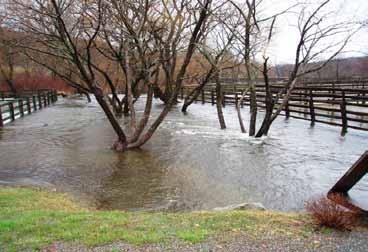
In August and September the region was hit with hurricane Irene and tropical storm Lee which devastated the region and damaged participants farms and crop land along with many BMPs. Please refer to the Flood Response on Page 2 of this report for more details. In 2009, the Watershed Agricultural Program entered into a four-year agreement with the USDA NRCS to encourage conservation of natural resources through provisions of the Agriculture Water Enhancement Program (AWEP). AWEP BMP monies awarded to date total $1,244,891. Another AWEP grant began in 2010 with a five-year agreement in which $83,953 was awarded in 2011 to assist in the development and compliance of farm nutrient management plans. The AWEP monies are specifically targeted to provide financial assistance for water-quality improvement projects. The AWEP funding provides partial funding for structural BMPs, primarily waste storage structures. The AWEP funds also allow monies to be allocated to nutrient management plan expenses. This creative approach to financing allowed the Program to immediately employ third-party contractors throughout the watershed.
Couple the USDA NRCS AWEP and NYC DEP monies with additional financial support from the USDA Conservation Reserve Enhancement Program (CREP) and the Watershed Agricultural Program really takes on momentum. With these combined resources, many projects were installed through a vibrant watershed management industry. Planners, technicians, engineers, farmers, construction professionals of all walks -- gravel haulers, concrete pourers, carpenters, electricians, plumbers and general contractors -- worked to provide clean water solutions to participating watershed farms throughout the year.
Respectfully submitted on behalf of the Watershed Agricultural Program staff by:
Larry R. Hulle, Watershed Agricultural Council
Jan Surface, USDA Natural Resource Conservation Service
Rick Weidenbach, Delaware County Soil & Water Conservation District
Dale Dewing, Cornell Cooperative Extension
TABLE OF CONTENTS
Flood Response and the Agricultural and Community Recovery Fund (ACRF)
Project Profiles and Photos 2-18
Cover Photo: Nate Townsend
Report Photos: WAP Staff
PRIMARY FUNDING SOURCES
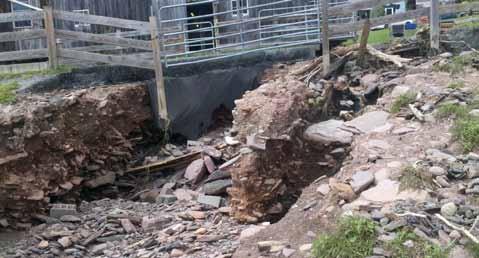
In 2011, our watershed region was devastated by flooding left from the storms and rains of Hurricane Irene and Tropical Storm Lee. Many Watershed Agricultural Program (WAP) farms, cropland and Best Management Practices (BMPs) were severely damaged. Fortunately, the WAP staff was granted permission to engage in an immediate farm flood assessment to determine the extent and amount of damage. The two storms back to back within one week severely damaged farming operations in Delaware, Greene and Schoharie Counties leaving behind rerouted streams, major gullies and gouges as well as an immense amount of flood debris left throughout fields and cropland. Many BMPs were also damaged and/or destroyed. The Council has thus far funded the repair of 7 BMPs on 4 farms for a total investment of $35,227. We anticipate repairing another 14 BMPs on 13 farms for $116,204 in the 2012 construction season.
The WAP and local participants were also fortunate for the announcement and implementation of the Agricultural and Community Recovery Fund (ACRF) program by New York State Governor, Andrew Cuomo and Commissioner of Ag and Markets, Darrell Aubertine. This $15 million program provided up to $5 million to assist farmers in returning streams to their channels, clearing and removing gravel and debris from crop fields while filling in gullies and gouges to return active farm land to viable production. These funds were provided to the NYS Soil and Water Conservation Committee for implementation by local county Soil and Water Conservation Districts (SWCD). The WAP, consisting of staff from the Delaware County SWCD, Cornell Cooperative Extension (CCE), USDA NRCS, and the Watershed Agricultural Council, successfully wrote damage survey reports/applications for $505,090 and was awarded $412,879 for 18 participants in various areas of the NYC watershed region. The WAP assisted the SWCDs in survey, design and construction inspection of ACRF projects and to date all 28 projects on the 18 farms have been completed at a total investment of $388,827.
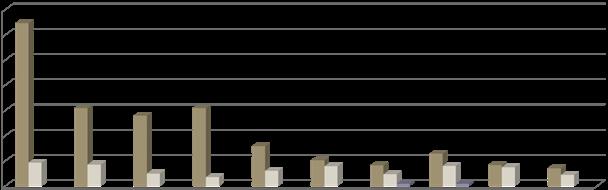
2011 Implementation Accomplishments - Number of BMPs
USDA Conservation Reserve Enhancement Program (CREP) 2011 Accomplishments
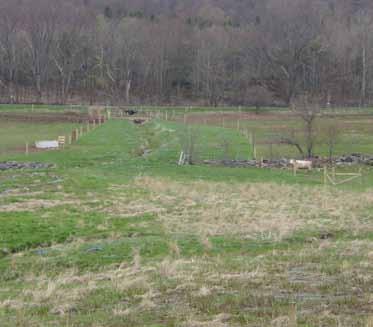
The USDA CREP Program within the NYC Watershed Agricultural Program utilizes the talents found within the multi-agency team assigned to work in the Watershed to promote, design and establish both Riparian Forest Buffers and Vegetative Buffers along watercourses. This year marked the 13th full year of the New York City Watershed Conservation Reserve Enhancement Program (CREP) Memorandum of Agreement between New York City, New York State and the United States Department of Agriculture (USDA). In 2011, seven Riparian Forest Buffer contracts (six new and one renewal) enrolled an additional 42.2 acres, increasing the total number of enrolled acres to 2,047.7.
2011 Total Implementation Expenditures
Total Rental Payments (USDA)
$55,690
Sign-Up Incentive Payment (SIP-FSA) $ 3,890 Practice Incentive Payment (PIP-FSA)
BMP Cost (FSA)
BMP Cost (WAP)
$80,640
$51,519
$51,519
Watershed Agricultural Program Historic CREP BMP Implementation
Nutrient Management Program 2011 Accomplishments
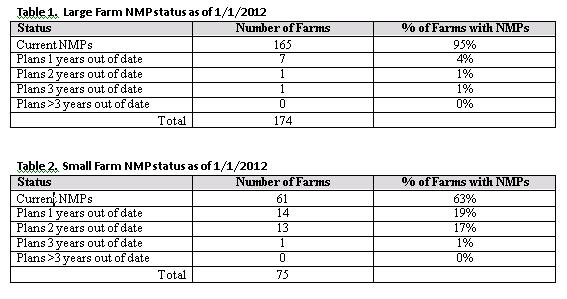
The Nutrient Management Team (NMTeam) is a multi-agency team that assists farmers in improving phosphorus and pathogen management. Nutrient Management Plans (NMPs) are designed to manage the amount, source, placement, form and timing of the application of nutrients from fertilizer, manure, and other organic sources. All plans comply with the NRCS 590 Standard and use the NY Phosphorus Index and Cornell University guidelines to ensure environmental soundness and crop productivity. The NMTeam supports the farmer in implementing a NMP, which results in protection of water quality and produces optimum yields. In planning year 2011, the NMTeam completed 99 nutrient management plans (77 large farms and 22 small farms).
Catskill/Delaware Large Farms
Catskill/Delaware Small Farms
Croton Watershed
Nutrient Management Credit (NMCredit)
The NMCredit Program encourages heightened stewardship of manure resources to improve water quality and provides the WAP a means to enhance implementation of NMPs. In 2011, 81 farms participated in the NMCredit Program and earned $327,893 in credits that they can utilize to reimburse nutrient management related expenses. The WAP also reviewed and approved manure spreading records for the first 10 farms participating in the NRCS Agriculture Water Enhancement Program (AWEP), which is similar to NMCredit and has similar benefits as NMCredit, but extends beyond the Cannonsville Basin. These farms earned a total of $59,584 in federal funds for implementing their nutrient management plans. The WAP received an AWEP award from the NRCS to extend the program to 11 additional farms in 2011, with the opportunity to add more farms through 2012.
Other Accomplishments
During 2011 the NMTeam contributed to the WAP in several other ways in 2011, including:
• Adapting manure transportation credit to semi-solid manure, to accommodate the growing number of semi-solid manure storages.
• Researching new NMCredit rate proposals for review by the NM Sub Committee.
• Assisting NRCS and participating farms fulfill AWEP nutrient management contracts. This included summarizing and reviewing manure spreading records, providing training for participating AWEP farms required NM record keeping, and providing NRCS with AWEP reporting requirements.
• Contributing to Farmer Education and Precision Feed Management educational as well as efforts to secure funding to implement dairy feed management into the future in the NYC Watershed.
• Providing support to whole farm planning teams at various times throughout the year. Efforts typically were related to manure management BMP planning and operations and maintenance.
• Updating soil sample status for program farms, developing the annual farm soil sample list, and training and supervising the soil sample interns. Over 2,077 samples were taken and sent out for analysis, our most productive year to date.
Stamford, Delaware County
Covered Manure Storage & Access Road
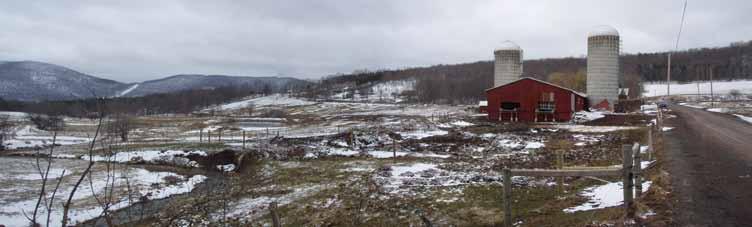
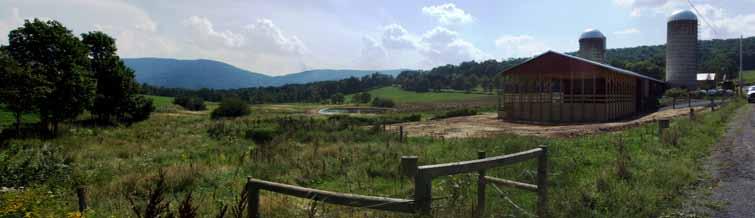
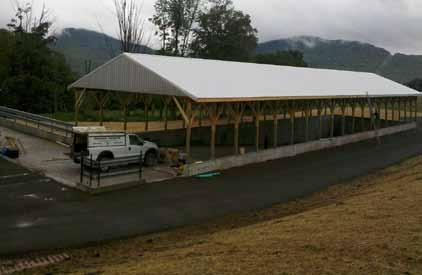
In May 2011, the Watershed Agricultural Program began construction on a 40’x150’ covered manure storage, one of the largest built to date in the region. The structure addressed water quality issues of manure quantity, storage capacity and potential phosphorus load that impacted the nearby Cannonsville Reservoir.
Located at Eklund Farm--a 400-cow organic dairy farm on 2,700 acres in the Town of Stamford, Delaware County--the project addressed water quality issues in a sensitive basin while providing an outdoor storage for manure until its scheduled Spring spreading.
To remedy the stockpiling of manure inside the barn, the team originally proposed locating the manure storage directly behind the dairy barn. However, the landowner preferred the storage unit be built to the back-right of the existing barn. “We installed a scrape pad and alley to improve efficiency of clean up and collection to the outdoor storage area,” explains Pete Steenland, P.E., Engineering Specialist for the Watershed Agricultural Council. “The farmer uses a tractor to clear manure out of the barn and on top the scrape pad. From the scrape pad, the farmer continues pushing the load down a graded ramp, known as the scrape alley. The ramp from the access road leads right into the manure structure. The concrete is sloped and grooved to direct manure and fluids directly into the covered storage area. We built a new access road with a solar powered electric fence that helps the farmer access the barn, animals and covered unit. This work also improved drainage in, around and behind the structure.”
Local contractor, John LaFever of Bovina, performed the excavation work, and shared the job with two subcontractors. Ben Reynolds Construction of Walton poured over 300 cubic yards of concrete, creating the structure’s base. Roofer Kevin Bender, a first-timer to the WAP contractor pool, outfitted the treated lumber frame with tin roof in record time. “These guys came in under cost estimate, got right to work, and did a great job on this straight-out-of-the-box project,” noted Steenland. “The landowner, Bill Eklund, was easy to work with and provided us guidance throughout the planning stage. By late July, we completed the project, including reshaping, regrading and reseeding of the surrounding area. This is a textbook construction project that mitigated water pollution issues quickly and effectively.”
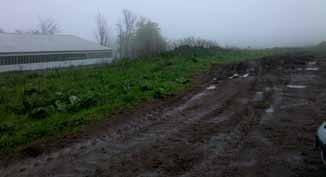
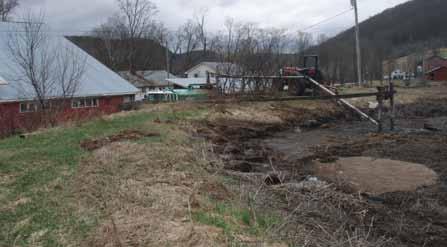
TOP: This muddy area, just right of the existing daibarn, set the stage for a future access road leading to a covered manure storage unit. At the farmer’s request, the team planned new construction catty-corner from the barn’s rear right corner.
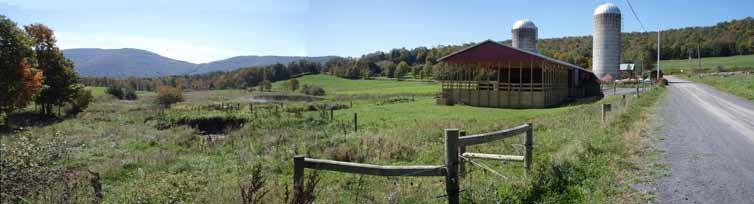
BOTTOM: This 40’x150’ covered manure storage unit is one of the largest built by the Program. Compare the man on the ladder and truck to the structure. At its deepest point, the manure bay is 10 feet down; the roof is 12 feet high at the truss header. Oneinch-minus gravel lines the laneway. An underground drain alongside the exterior concrete wall funnels roof runoff behind manure storage unit. This project infused over $200,000 into the local economy through job creation and materials purchases.
Delhi, Delaware County Manure Storage
AWEP Funding
This project was partially funded by USDA NRCS Agricultural Water Enhancement Program.
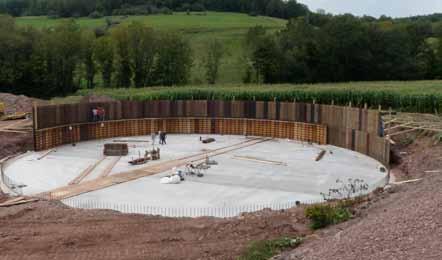
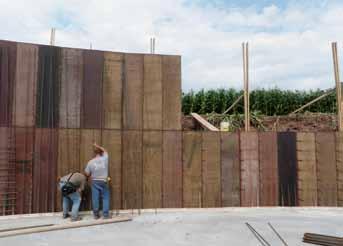
The Clark Farm milks 130 Holsteins and is located on Elk Creek Road in the town of Delhi NY, in the Cannonsville Watershed. The project’s goal was to eliminate two earthen manure lagoons: one at the main milking facility and one at the heifer facility. Both lagoons had water infiltration issues; the new storages allow the producer to follow the farm’s nutrient management plan to help limit the run-off possibilities. Three challenges arose at the project site. First, the project site was divided by Dry Brook. Second, the distance separating the two barns made it cost-prohibitive to install one storage used by both facilities. Third, a high water table, due to the proximity to Dry Brook, posed fluctuating water variables. The Planning Team recommended constructing two cast-in-place, in-ground concrete storages. The main barn storage is 120 feet across in diameter and 16 feet deep, capable of storing 1.3 million gallons. The heifer barn storage is 60 feet across by 16 feet deep and can hold 338,000 gallons. The project also required a new manure pump system to handle the manure at the main barn. The Team accomplished this by changing an existing gutter-style barn cleaner to a gravity-gutter that feeds the new hydraulic-style piston pump that pumps to the 120-foot storage. A stand-alone pump building was set up so the pump could be in a central location for the gravity gutter, and not interfere with current farm access. The milkhouse waste along with the parlor waste is now pumped to storage. Manure at the heifer facility is now scraped directly into the 60-foot storage which is located off the end of the barn. A newly purchased lagoon-style agitation pump facilitates agitation and manure removal from the new storage tanks. Once the new storage tanks were constructed and operational, the old earthen lagoons were decommissioned. The heifer facility lagoon was decommissioned by having the dams removed and leveled out to match existing ground. The main barn lagoon was decommissioned using a combination of dam removal and fill dirt to match grades around the former lagoon site. LaFever Excavation was the General contractor for the project and sub-contracted Ben Reynolds Construction for the concrete work. The project cost $598,288.
Stamford, Delaware County
Covered Barnyard, Access Road
Animal Walkway, Watering
At this 140-acre beef farm in Stamford, Delaware County, farmer John Trovato raises 30 cows, grows garlic and tends bees. During the spring and summer, the herd grazes on pasture according to a rotational grazing plan created by WAC Small Farms Coordinator Dan Flaherty. In winter, the farmer brings the herd closer to the barn which posed a feeding area problem. The water quality issue was simple: address the winter feeding area adjacent to stream just eight feet away.
The project was designed by WAC Assistant Whole Farm Planner, Nate Townsend, with construction oversight by WAC Engineering Specialist Don Hebbard. “This project’s challenge revolved around a feeding area doubling as manure storage through winter,” noted Townsend. “There also wasn’t a lot of room to work with or around.” Organic build-up at the site made for interesting excavating and foundation grading. “We moved out the organic matter and used it in other places on the farm to fill holes and bolster the garden,” added Hebbard. “We even filled in a dried-up channel near an underground outlet installed last year.”
The Small Farms Team began implementation in June and completed construction in August. Lil’ Dave Excavating provided project oversight with Mike Mason subcontracting the build-out. At $66,000, the solutions of covered barnyard, water trough, drainage and animal walkway from barn to pasture was a textbook case.
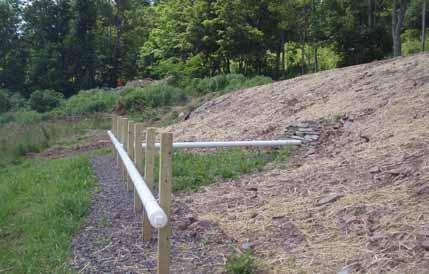
Many water seeps and drainage issues around the barn had to be addressed during the first part of construction. Those identified were laid with cobbles; buried perforated pipes directed drainage into the Conservation Reserve Enhancement Program (CREP) area. An underground drip trench lined with PVC pipe and gravel also surrounded the barnyard to allow roof water to flow into the CREP area behind the barn. The Plan called for a CREP riparian forest buffer. Last year, roughly eight acres and necessary fencing were installed to keep animals out of the stream. This year, additional fencing connected with the CREP fencing, thus protecting a hydrologically sensitive area.
Construction was neat and simple. Sun-sky panels dotted the tin roof. Laminated poles, comprised of three-treated-then-glued-together 2x6s, supported the 40-foot by 60-foot structure. These new laminated poles offer better strength and protection from rot than standard 6x6 posts. Built off the existing barn, the new construction allowed farmer access to two existing manure push-offs that he wanted to utilize. “The water trough tapped into an existing spring development we installed in 2010,” added Flaherty. “The gravity-fed, continuous flow set-up provided year-round watering to the feeding/manure storage area.” As part of the overall Whole Farm Plan, the Council also purchased a bucket loader for the farmer’s tractor to help with barnyard clean-up. “Thanks to the farmer and his farm manager, we trouble-shooted the issues and breezed through this project in record time,” added Flaherty.
Kortright, Delaware County
Covered Barnyard
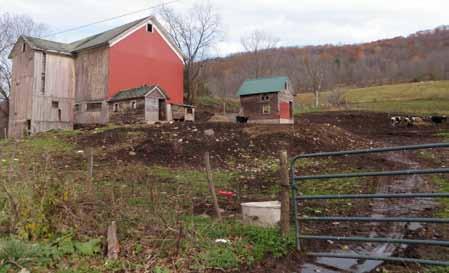
On the Allan and Dave Swantak Farm, the farmers run a milking dairy at the home farm and a replacement heifer operation down the road. Betty Brook runs through this 425-acre property en route to the West Branch River and Cannonsville Reservoir. NRCS Planner Suzanne Baker juggled the water quality issues at the heifer barn. Water was running downhill, through composted manure, through a road culvert and into the river.
Project construction began mid-August. Three days later, regional flooding threatened to sidetrack the job. While this property was unaffected, huge demand for construction and heavy equipment drew contractors away from scheduled projects for higher wages and community support. The site’s long-term compost pile posed the greatest challenge. The Planning Team was unsure how deep it actually was until they started removing manure. Most area dump trucks filled flood demand, leaving few for carting manure from this site. Eventually, several local contractors removed the majority of the free highquality compost for unrelated landscaping projects.
Contractor David E. Stanton, Stanton Excavating of Walton, oversaw the $186,000 project. Lancaster Poured Concrete addressed the foundation work and in turn subcontracted the building to Pine Creek Builders. “Once the leveling and earthwork was complete, the Pennsylvania group raised the structure in the quickest time I’ve ever seen,” noted Paula O’Brien, Soil & Water Engineering Technician. “These young Amish guys wanted to get done before the marrying season started. That motivation carried them forward quickly.” The covered barnyard measures 100 feet by 54 feet. Laminate-treated lumber posts were set on concrete posts and lagged with brackets. “This new post composite prevents rot,” noted O’Brien. “This is only the second building we’ve done with these materials and we’ll see how they pan out. They’re a challenge to set in line, but the long-term benefits make the extra work worth it.” Foundation curbing allows the farmer to collect manure easily and provides a stable support for the new posts. Cable fencing runs from steel plates on each post with chainlinks welded to the plate, a design created by Engineer Jason Skinner. Other structure amenities include skylight roof panels to allow sunlight into the feeding area; 14-foot high to trusses to accommodate large machinery; and stone-lined drip trenches surround the structure diverting roof rainwater to the culvert.
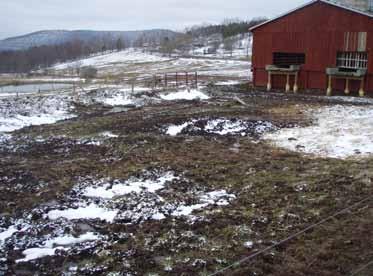
TOP: Youngstock area with drainage issues
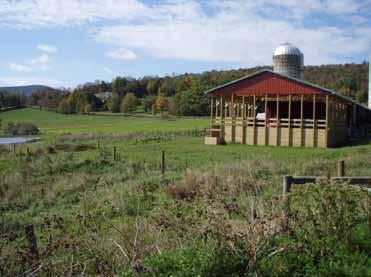
BOTTOM: Covered Feed Area with concrete push-off in foreground
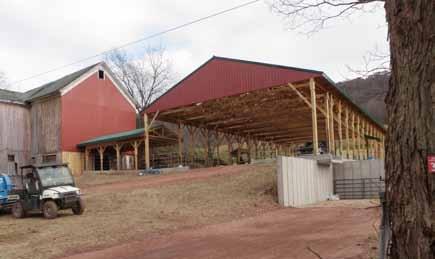
The youngstock building accommodates two different aged animals. Through a gated system, the farmer can corral older heifers in the open, covered feeding area and gate off younger animals in a separate, safer area. Normally, the farmer used an I-beam feeding trough along the outside of the building. The new structure, with feed dispersed down the center, allows the two groups to be separate but eat from the same pile. This center feed alley posed a new challenge for the farmer to relearn how to navigate the Bobcat in order to clear away the feed area. “By making the feed area wide enough for a skid steer turning radius, we now have an issue for the cow reaching out for feed, something we’ll troubleshoot going forward” added O’Brien. Two watering facilities, one on each side for the separated animals, provide water from an original gravity system installed 8 years prior. “With no electricity out to the heifer barnyard, we chose continuous overflow, gravity system as we had no ability to heat the water,” added O’Brien.
Space constraints dictated where the Team located the covered structure. “Because of the barn’s orientation, we couldn’t tuck the covered facility in there any closer,” said O’Brien. “A breezeway connects the existing barn to the new heifer area.” Just below the covered area is a push-off into a manure spreader parked on a concrete pad. Two short access roads connect the barn and the push-off; a third road exits the barnyard’s far end heading out to pasture. The Team also consulted with the State Department of Transportation to coordinate culverts and ditches along the County road farm.
Farmer Education Program
The Farmer Education Program supports the water quality protection and farm viability mission of the Watershed Agricultural Council by providing educational programs that enhance farmers’ abilities to manage their operations more profitably and in a way that nurtures their natural resources. In total, 17 educational programs were offered during 2011 with a total attendance of 471. Transition and change were important topic areas for our programs this year. These included programs for new farmers, intergenerational transitions, responding to high grain prices, emergency flood response, and new production practices for calves and crops. The Farmer Education staff was in transition, as well, with two new educators added to vacant positions during 2011.
Stamford, Delaware County
Concrete Barnyard, Heavy Use Area Pad, Drainage, Diversion, Watering Facility
At Guerrino and Maria Dianich’s 300acre farm in Stamford, Delaware County, the couple raises 30 beef cow-calf pairs. Water quality issues at the farm included water flowing downhill from a mountainside directly into the barnyard. Its momentum muddied up the outdoor feeding area, creating sedimentation and phosphorus issues within the watercourse below. “We had to address the project’s location challenges,” noted Dan Flaherty, Small Farms Coordinator for the Council. “Because of the barnyard’s location, many acres drained directly into the winter feeding area. We were working with steep slopes and the barnyard was right up against the mountain. Question was, how do we best control water flow and slow it down in the process to reduce its impact?”
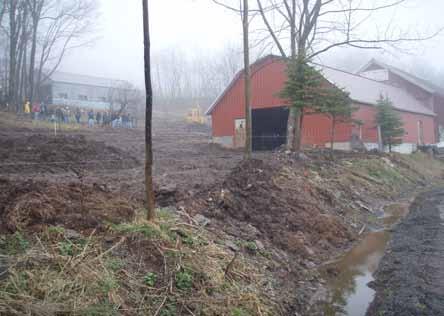
The Planning Team proposed a concrete barnyard, animal walkway, fencing, watering facility and a series of water control measures on the road’s uphill side. On the downhill side, the Team designed a heavy use area pad (HUAP) for storing manure short term and a significant maze of drainage solutions. Construction contractor Sam Byler of Bainbridge oversaw the $98,000 project including concrete, watering trough, fencing, and gravel. “He was very accommodating and a good listener,”
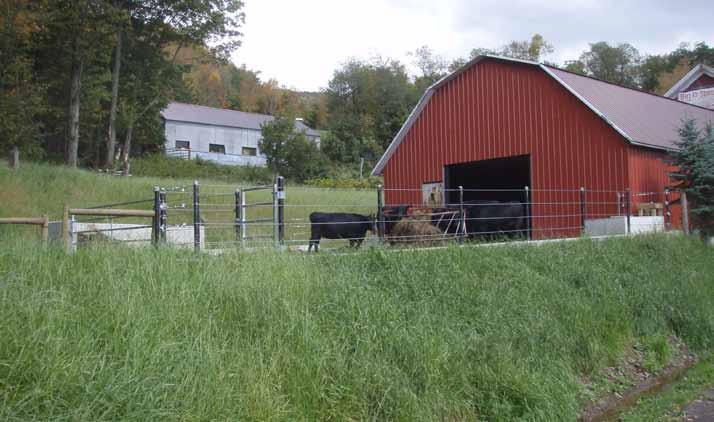
noted Flaherty. “When the landowner had concerns, Sam would do whatever it took to make it right.” In the 53’x57’ concrete barnyard, a corner buck wall serves as backstop for manure clean-up. From the barnyard, a 400-foot gravel walkway leads animals to pasture up the hill. Acting as a blanket, erosion-control rip-rap on the banks above a stone-lined ditch reduces sedimentation. To further diffuse runoff, the animal walkway consists of highly porous 1-inch-minus gravel over geotextile topped with compacted gravel to limit loose dirt from animal traffic.
“To address the influx of downhill clean water, we crafted a series of diversion and water control measures,” adds DCSWCD Civil Engineering Technician Chris Savage. “Clean hillside drainage now enters a diversion ditch uphill of the barnyard. Water is channeled through a series of plunge pools. This helps dissipate water speed and energy, again lessening the impact of fast waters and erosion, keeping clean water separate from the manure.”
The concrete barnyard’s dirty water now drains into a settling basin with three screens that further filter runoff. This first filtration step allows cleaner water to enter an underground settling tank where additional solids (or those that make it past the first screen set) are filtered out. The first tank settles out solids; a second tank stores water temporarily while the filter strip recharges. After a brief rest period, water from the flout tank enters an above-ground distribution pipe. This pipe diffuses runoff across the grassy filter area located across the road. Near the distribution pipe is a 30’x30’ gravel manure storage pad for tempoarary storage. The farmer spreads the manure every 2-3 months according to his Nutrient Management Plan.
South Salem, Westchester County Heavy Use Area Protection Structure for Water Control Fencing
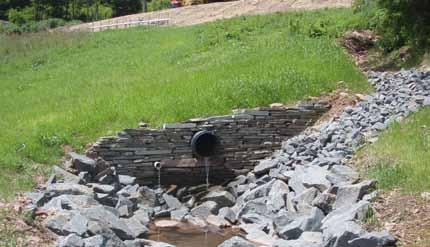
JT Farm is a horse boarding and training facility located within the Cross River drainage basin. Prior to implementation, the paddocks flooded often when the adjacent streams crested. As the stream receded, waste from inside the paddocks as well as footing material would often be transported downstream. BMPs installed at this project location included heavy use area protection and structure for water control. The paddocks adjacent to the stream were raised 3 feet in elevation to prevent the crested stream elevation from encroaching on the existing paddocks. In addition to the increase in elevation of the paddocks, a rip-rap lined channel was installed to collect water flowing over the existing access road. Also, 60 red osier dogwoods were planted on the side slopes of the stream bank for further stabilization.
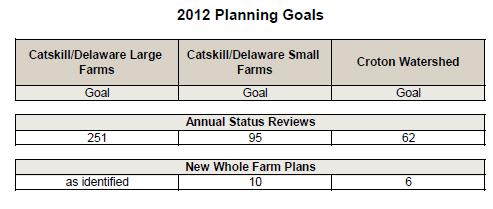
2012 Projected Workload
* The Total Projected Workload represents BMPs in various stages of implementation. Not every BMP will be implemented (certified and paid) in 2012. For the calendar year 2012, the Catskill/Delaware Watershed Agricultural Program projects total BMP implementation in the amount of $2,500,000.
Walton, Delaware County Emergency Stream Restoration
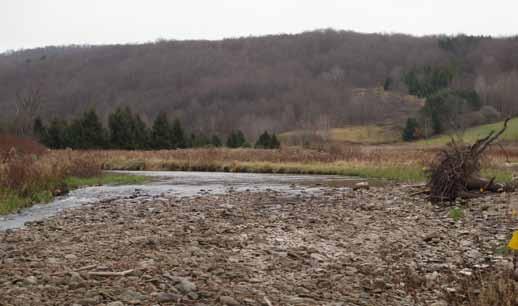
Hurricane Irene left a sizable debris pile on the 12-acre mixed livestock farm of Todd and Lillian Burdick in August 2011. Horse, sheep, goats, pigs and poultry depend on the pastures for feed, forage and open space. Summer flooding deposited gravel throughout the streambed. As waters rose, the stream jumped its banks into adjacent pasture, rendering grass wet, unusable and inedible. High-velocity stream waters carved a large gouge out of the pasture, further stripping away precious top soil, impacting the field’s long-term usability, and hampering its pending enrollment into CREP (Conservation Reserve Enhancement Program). This farmer planned to enroll 35 feet from the top of the streambank into the pasture; and 840 feet running the length of the stream for a total of 1.5 acres enrolled.
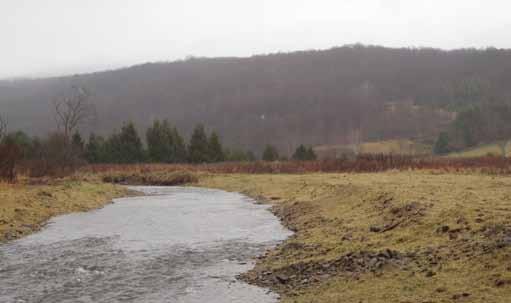
The Planning Team had two priorities. First priority was to rechannel the water flow. Second, once the stream was restored to its original course, the reclaimed land area was to be enrolled in CREP. In November 2011, the Watershed Agricultural Program used $5,000 from the Watershed Agricultural Council to redirect the stream to where it ran before the flood. The Planning Team surveyed the streambank with Delaware County Soil & Water District’s Stream Team. Stream Technician Gale Neale instructed the Team on how to the design rehabilitation project so water would be put back in its original channel. However, to fix any watershed stream requires a DEC Permit. NYS DEC liaison Steve Swenson worked with the Planning Team to obtain the needed permit quickly. He also outlined the steps needed to make the restoration process river-friendly such as dewatering prior to working in the stream. Bank berming was also forbidden as water needs access to flood plain. Don Tweedie excavated and bulldozed rock and earth out of the stream. He also insured the use of a temporary small berm to channel water away from the construction site. Once dewatering was in place, a bulldozer and excavator removed debris, pushing it to the side, regrading and reseeding as they put the stream back to its natural course. After three days of work, the streambank was ready for rock stabilization and tree plantings in 2012 and for its CREP agreement.
Roxbury, Delaware County
Roofed Barnyard, Milkhouse Waste System, Silage Leachate Collection System, Animal Trail & Walkway
The 70-cow dairy VanValkenburg Farm presented water quality issues across the board. Nutrient runoff from the barnyard flowed directly into the stream seven feet away, with this small tributary off Johnson Hollow Brook draining into the Schoharie Reservoir. Milkhouse waste discharged into a dry well also located along the stream. Silage leacheate trickled from the existing tower silo.
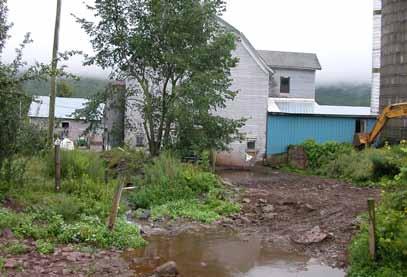
“This location was tough,” noted Tim Hebbard, Engineering Technician for the Watershed Agricultural Council. “There was hardly any room to work. Constrained by space and elevations, technically, it was the most difficult covered barnyard I’ve ever built. We had to account for the existing barn, silo, stream, electric and utility wires. There was a lot going on in a little area.” To accommodate elevation variations, the Planning and Engineering Team proposed a ramp out of the barn door that went up to a grade feasible for construction. Dave Parker of Parker Excavating oversaw the $180,000 project. He removed 475 cubic yards of excavation material that was stockpiled for later use. Ron Peplinsky poured concrete and Jim Cole completed the timber fabrication. The Team laid out the entire project first to make sure they had accounted for the many, different interacting pieces in elevation changes in the barnyard, ramp, crossing, road access, existing barn and existing silo. Electric powerlines were moved out of the right of way to accommodate farm equipment and its turning radius.
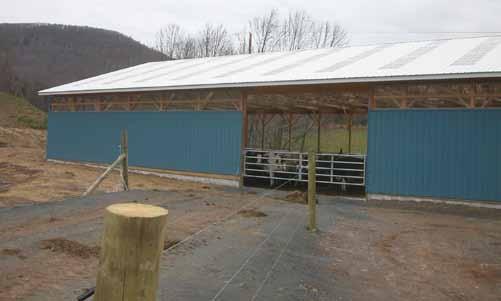
Construction included composite-laminated PermaColumns, tin roof and sun-sky panels to allow light into the 52-foot by 104-foot covered barnyard. Fourteen-foot-high trusses and a 19-foot by 16-foot long, 4-foot-high corner buckwall with a 10-foot high retaining wall permit large machinery entry for barnyard clean-up. A gravity-fed spring provides continuous winter water on the pad. Tin exterior walls block prevailing winds and reduce drifting snow. A 289-foot diversion ditch surrounding the foundation addresses drainage issues. The covered walkway runs 12 feet wide by 65 feet long from the existing dairy barn to the new barnyard. The barnyard is configured to allow a tractor and wagon to drive onto and through the barnyard to unload corn sileage to a tower silo. A concrete apron around the silo collects leachate and diverts it to a 2,000-gallon pre-cast, below-ground milkhouse waste tank away from the stream. A stream crossing to nightly pasture removes animals from the stream. Per the landowner’s request, the 400-foot walkway is stone dust instead of gravel for better hoof health, compacted surface and manageability.
Purdys, Westchester County
Heavy Use Area Protection, Diversion
Vegetative Treatment Area
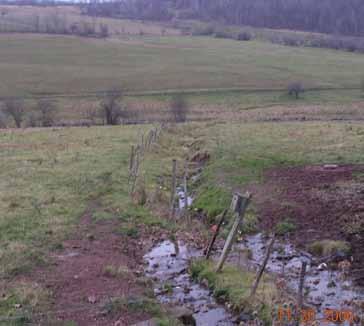
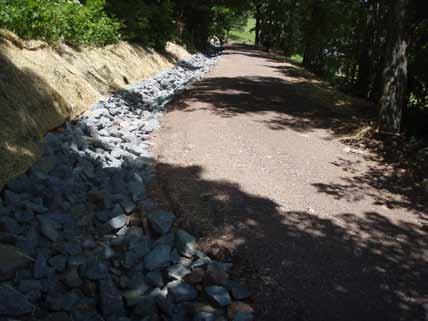
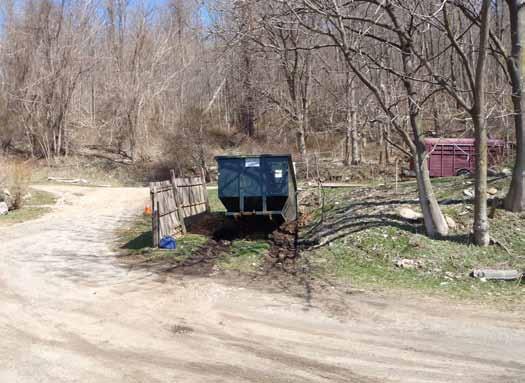
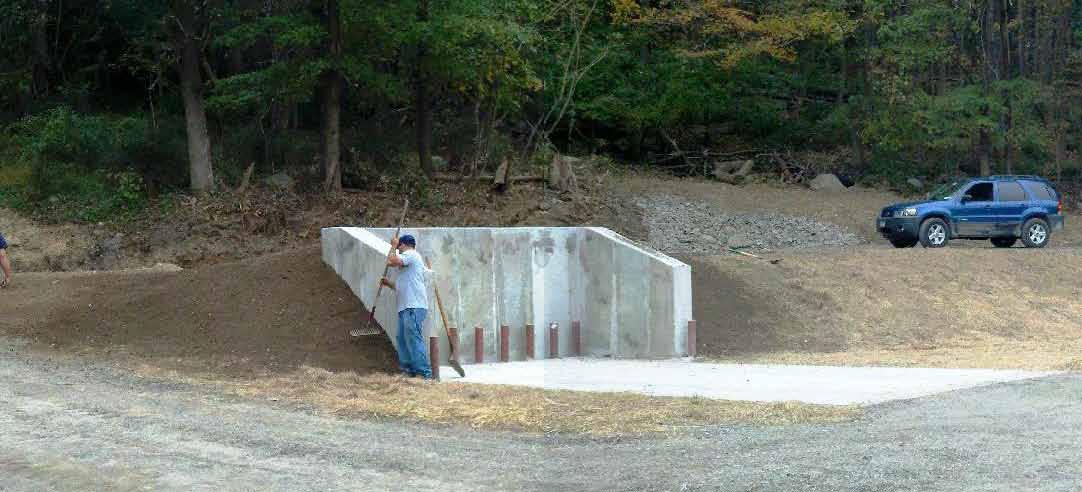
Purdys Farm leases the barns and property to a horse boarding operation located within the Muscoot Reservoir drainage basin. Prior to implementation, wastewater generated from the horse manure and bedding in the dumpster flowed over the existing access road and found its way to an existing stream offsite which flows into the Muscoot reservoir. In addition, a large drainage area contributed high volumes of stormwater flow transporting sediment and wastewater as it flowed over the existing paddocks. Implementation of BMPs included a heavy use area protection (dumpster pad), vegetated treatment area, diversion channel and underground outlet for water control. The dumpster pad was pitched toward a vegetated treatment area adjacent to the pad that will serve to contain runoff and filter out pollutants. A diversion channel and outlet for water control was also installed to capture stormwater from a large drainage area and diverted away from the dumpster pad, vegetated treatment area, and paddocks. New gutters and downspouts were also installed on the existing barn to exclude clean water from potential areas of pollution. The BMPs implemented on this farm were successful in separating wastewater from stormwater thus preventing any wastewater runoff into the Muscoot Reservoir. Major gully erosion was occurring on this site.
Brewster, Putnam County Streambank and Shoreline Protection
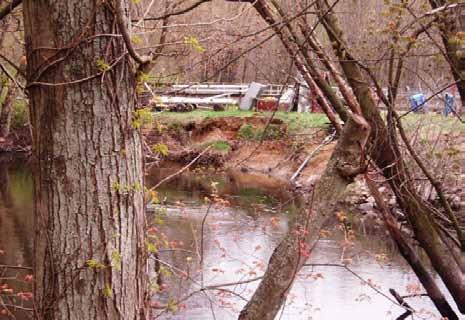
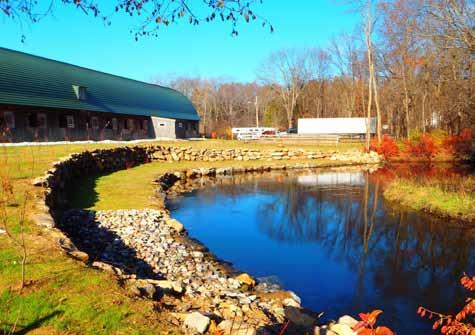
River Run farm is a horse boarding and training facility located in Brewster within the East Branch Reservoir drainage basin. The East Branch of the Croton River travels through this property with its nearest flow path 38 feet from the existing horse barn. Over time, this river has eroded the banks adjacent to the barn. To prevent further erosion and sloughing from occurring, streambank stabilization measures were installed at the banks of the river.
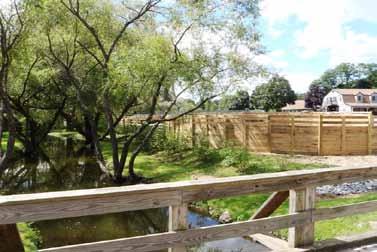
The streambank stabilization included the utilization of large 3-4 foot long oblong rocks from local sources. Larger rocks were used as keystones and were installed as a base for the remaining stones that were placed above the keystones. These rocks were utilized to build two sections of walls with each wall five feet high. A onefoot wide flood plain bench was installed for higher flow conditions. In addition to the rock stabilization, 60 red osier and flowering dogwoods were planted for further stabilization.