In its attempt to protect drinking water for 9 million New Yorkers, the New York City Department of Environmental Protection presents a discussion draft of new regulations to upstate watershed communities, including requirements that affect agriculture and put the livelihood of farmers at risk.
Log On
Foresters
With The Green Book of policy recommendations, the Watershed Forestry Task Force lays out a blueprint for the Watershed Forestry Program, promoting best management practices to train loggers in preventing nonpoint source pollution. Outreach and Economic Development Programs are put in place to support the efforts of the Watershed Agricultural Council. 1996
An Ad Hoc Task Force on Agriculture and New York City Watershed Regulations convenes representing upstate and downstate interests.
A collaborative plan of policy recommendations called The Brown Book is created to protect water and “do no harm” to farm operations in the watershed.
Phase I of the Watershed Agricultural Program begins with Whole Farm Planning on ten pilot farms dispersed geographically throughout the Catskill/Delaware watersheds.
WAC and New York City implement a Conservation Easements Program to purchase the development rights on watershed farms. This effort provides long-term watershed protection through a good balance of watershed land use activities. In the same year, New York City, the USDA and WAC enter an agreement for increased federal financial incentives for farmers to establish riparian buffers through the CREP.
The Watershed Agricultural Council incorporates as a not-for-profit organization to administer the voluntary, incentivebased Watershed Agricultural Program, fully funded by New York City’s Department of Environmental Protection. A Board of Directors oversees the Council programs, which are administered by Office and Field Staff. An Advisory Committee guides the Council.
Phase II of the Watershed Agricultural Program begins with the development of Whole Farm Plans for watershed farms based primarily on nationwide USDA standards. The goal of 85% participation by farmers becomes a milestone in the USEPA’s Filtration Avoidance Determination for New York City’s Catskill/Delaware water supply. Participation today is 91%.
Research efforts begun in Phase I continue to test and validate best management practices and study the source, fate and transport of pathogens and phosphorus.
The urban/rural partnership in the New York City watershed exemplifies a model for the nation in conflict resolution and watershed management. Word spreads about the Council’s successes and accomplishments.
Throughout the watershed, Watershed Agricultural Council (WAC) programs are at work. In these pages, you'll see accomplishments in every area, from farmer sign-ups to forest management planning. The Board, staff and partners of WAC are on the job every day fulfilling our goals in the region: to promote wellmanaged farms and forests. Why? Because we see this as the future of both a thriving rural economy and long-term water quality protection.
As we enter our second decade of watershed planning, it’s clear to WAC that holistic watershed management is the right way to sustain two of our most important natural resources: water and people. Every best management practice we implement means work for people in our communities. Our fifteen million dollar annual funding yields both comprehensive pollution prevention and a positive economic impact on the watershed. As our research continues to bring national experts together to test and validate our work, our success is quantified and the impact of our work grows.
With the expansion of our Whole Farm Planning effort to small operations in the Catskill/Delaware watershed, we’ve doubled the number of farms that will now have access to the same water quality protection as the hundreds of larger farms already in the Watershed Agricultural Program. Since many of these small operations are just starting up, Whole Farm Planning becomes part of their business plan – what better way to grow the economy in a sustainable way? As our daily contact with these landowners increases, so does our excitement about developing innovative ways to increase net farm income.
For farms in the Croton watershed, we now have a blueprint for prioritizing watershed management on those distinctive operations, many of which have important environmental issues vital to keeping the water clean. As agricultural and forestlands are the largest remaining unplanned open space in this watershed, landowners here have an immediate need for technical assistance.
But perhaps our greatest milestone this year was the closing of our first two conservation easements on watershed farms, which took place in December. This unique tool for farmland protection gives us the ability to be a truly multifaceted program and, with funding from New York City, is quite possibly the only easement in the country that’s directly tied to water quality.
More and more, we hear about the challenges of urban sprawl, food and water supply security and the survival of small family farms. In order to meet the increasing interest in our accomplishments, we’ve revamped our internet web site at www.nycwatershed.org. Who knows exactly what the watershed will look like ten, twenty, or even a hundred years from now? WAC is strong, our programs are succeeding and it’s our hope that people will still care enough about farms, forests and clean water to support our efforts.
- Richard I. Coombe, Chair & CEO
Wa tershed Agricultural Program
As the Whole Farm Planning effort continued to meet its water quality goals, the focus this year was on finding ways to increase the pace of implementation. The creation of a “pre-qualified” engineer’s list was a major effort to engage consultants from private industry, a concept that WAC has proved successful in prior years with nutrient management planning.
“I don’t think farmers in general are going to do a bad job intentionally, but with an incentive, they’ll be able to do a really good job.”
page from the Conservation Reserve Enhancement Program (CREP), WAC is exploring ways to match City funds with federal sources to improve the economic viability and, ultimately, the effectiveness of this practice.
- Dave Cammer, dairy & maple farmer
A successful nutrient management plan usually involves spreading manure more frequently on fields further from the barn, creating higher fuel and equipment costs for the farmer. Taking a
WAC initiated a pilot program which gives farmers a means to gain credits through compliance with their nutrient management plan and access funding to help defray the cost of their equipment needs. In this way, the farms maintain economic viability while providing effective water quality protection.
Smaller farm operations in the watershed vary widely and grow a range of products from meat, eggs and vegetables to Christmas trees and maple syrup. Within its first year, WAC’s program for small farms began implementing Whole Farm Plans on ten pilot farms throughout the West-of-Hudson watershed, and is currently surveying hundreds more to identify envi-
Small Farms
ronmental priorities for source water protection. Sixteen additional farms have been selected for the next phase of this growing program. While learning about best management practices for water quality, these participating farmers are also gaining new access to technical assistance through contact with WAC.
East-of-Hudson
In the East-of-Hudson watershed, WAC established a field office this year and is currently in the early stages of farmer signups, planning and design of Whole Farm Plan implementation. The East-of-Hudson group developed a Croton Agricultural Plan as a “blueprint” for delivering the program and a new priority ranking methodology to be utilized in conjunction with the St ate’s Agricultural Environmental Management (AEM) Program to identify farms with the highest pollution potential in the Croton watershed. WAC has identified over one hundred program participants in the
“Watershed planning for farms and forestland in the region is a void that needed to be filled, for the benefit of water quality, open space and keeping farmland viable.”
- Mike Saviola
East-of-Hudson Program Manager
Croton watershed and is currently surveying the needs of these farms for water quality protection. While WAC’s Whole Farm Planning program helps protect water quality, many communities benefit directly from this conservation of resources. A growing population is responding to the need for farmland conservation for the future. The growth in farmer’s markets and t he sustainable food movement over the last ten years adds impact to the consumer’s view of small farms throughout the Northeast region.
Filtration Avoidance Determination Goals
Farmer Sign-ups
Goals 12/2001:
Accomplishments:
Whole Farm Plans Summaries Approved
Goals
Accomplishments:
Whole Farm Plans Commenced Implementation
Goals
Accomplishments:
Farms Substantially Complete
Goals 12/2001:
Accomplishments:
Annual Status Review/Follow-up
Goals 12/2001:
Accomplishments:
Nutrient Management Plans
Goals 12/2001:
Accomplishments:
CREP Accomplishments
Stream Buffers Implemented/Complete:
Stream Buffers Planned/Under Contract:
Whole Farm Plan - BMP DescriptionNo. Implemented
Diversion
Fencing
Filter Strip
Grasses & Legumes in Rotation
Grassed Waterway
Irrigation System /Micro-irrigation Trickle
Lined Waterway
Use Exclusion
Forage Harvest Management
Pasture & Hayland Planting
Prescribed Grazing
Roof Runoff Management System
Access Road
Heavy Use Area
Spring Development
Whole Farm Plan - BMP DescriptionNo. Implemented
Animal Trails & Walkways
Streambank Stabilization
Subsurface Drain
Tree & Shrub Planting CREP
Watering Facility
Underground Outlet
Waste Transfer System
Agri-Chemical Mixing Facility
Barnyard Water Management System
Roofed Barnyard
Calf Greenhouse
Ventilation
Milkhouse Waste - Backflow Safety Valve
Farm Fuel Facility
BMP Equipment Components
Anaerobic Fixed Film Digester/Separator
Solid Aerobic Bio-Dry Compost Building
Sanitary Sewer Connection & 5 Year Fee
Greenhouse Irrigation System
Bridge - Animal Trails & Walkways
Riparian Forest Buffer CREP
Nutrient Management Plan
Waste
Total No. of BMPs
Small Farms - BMP DescriptionNo. of BMPs
Animal Trails & Walkways
Tree & Shrub Planting
Total No. of BMPs
Implementation Cost - NYC Funds
Implementation Cost - Federal
Wa tershed Qualified Loggers and Foresters
The Watershed Forestry Program trains and recommends “watershed qualified” loggers and foresters to landowners managing their forests with timber harvests. These professionals are trained in water quality BMPs and are eligible for cost-shares on a range of traditional BMPs and innovative tools to help them do their job with watershed protection as the goal. Free samples of BMP tools such as the open-topped pipe culvert, geotextile fabric and organic bar and
- “Watershed Qualified” logger
chain oil, are made available by WAC field staff. In another program, fourteen portable bridges were loaned to loggers for temporary stream crossings this year, yielding water quality protection on harvests throughout the region. A full range of workshops run by WAC, from Chainsaw Safety to “Getting To Know Your New York State BMP Field Guide,” help timber harvesters gain know-ledge and skills they can apply on every job.
Watershed Qualified Forestry Professionals
T imber Harvesters:
Foresters:
Forest Roads Contractors:
.149
.34
.12 “ The bottom line is that on every job, we want to come back again. BMPs make the road better and that’s our investment in the future.”
T imber Harvest Roads/Forest Roads
Properly built forest roads protect soil and water and last a lifetime. WAC offers loggers cost-sharing and other incentives for properly designing and installing timber harvest roads using erosion control best management practices such as water bars, culverts and broadbased dips. This year, the Forestry Program initiated a successful costshare pilot for the remediation of existing forest roads with erosion problems due to poor layout and design. Fourteen roads were rehabilitated with erosion control BMPs and properly stabilized.
Number of Timber Harvest Road BMP Projects
To date:
Miles of Road Designed and Installed
To date:
Waterbars Installed
To date:
Broad-based Dips Installed
To date:
Forest Road Remediation Pilot Program
Number of Road BMP Projects Completed:
Miles of Road Remediated:
Acres Stabilized:
Water Bars Installed:
Broad-based Dips Installed:
Forest Management Planning
To encourage voluntary stewardship of private forestland, the Forestry Program pays for the development of a forest management plan for landowners with ten or more acres in the watershed. Through the process of working with a forester to plan the future of
t heir forest land, owners learn what’s there and how to actively manage it using best management practices. As they gain technical knowledge about these resources, their commitment to keeping the land forested grows.
Riparian Area Planning
On land adjacent to streams, r iparian area management has become a valuable tool in maintaining and protecting water quality. This year the Forestry Program incorporated the USDA Forest
Service’s standards for delineating and managing riparian areas into ten pilot management plans, adding another tool in working with private landowners in the watershed.
Forested Acres Under Management
To date:
Riparian Area Planning – New!
Acres Under Management:
The WAC Easement Program was initiated in 1996 as a component of t he Watershed Memorandum of Ag reement (MOA) with New York City. A WAC easement is distinctive in that it is designed to protect water quality through environmentally sound management of farms and forestland. The easement addresses water quality issues by identifying sections of a farm as resource protection areas and further delineates which parts of a farm can be used for agricultural production. Agriculture and forestry activities on the land are carried out in accordance with Whole Farm Plans and forest management plans approved by WAC.
“ The easement is exactly what I need: a means for the farm to stay a farm and not be developed.”
- Jim Lamport, dairy farmer
WAC acquired its first conservation easements this year on two
Program Statistics
Whole Farms with Easement:
Acres under Conservation Easement::
farms totaling 770 acres. This program is designed to pay landowners for a permanent agreement limiting the development of the farm while allowing the continued use of the land for agriculture, forestry and recreation. WAC has signed contracts to purchase conservation easements on an additional four farms representing 1,500 acres. The acquisition of these easements will take place in early 2002. During 2001, the program opened the process to more landowners and selected ten additional farms. Appraisals of these farms are currently establishing the value of these conservation easements, and it is projected that easements will be acquired on these properties over the next two years.
Whole Farms Under Easement Contract:
Acres under Contract:
Whole Farms Under Appraisal:
.2
.770
.1,500
.10
Town Brook Research Group
Research in Town Brook is a cooperative effort with two main objectives: 1) Develop, implement and evaluate BMPs for minimizing phosphorus loss from farms represented by those farms in the Town Brook basin; and 2) Apply and improve field-scale and farm-scale indices and models to support nutrient management planning within the Town Brook basin. The findings of this project will be applied in the Cannonsville watershed and other Catskill watersheds.
A gricultural Research
There are several research projects ongoing in the Town Brook basin including: monitoring stream flow and water quality, collecting meteorological data, evaluating the effectiveness of milkhouse filter str ips through experimentation, quantifying the relationship between soil phosphorus and runoff phosphorus for soils on site, and determining phosphorus leaching from intact soil cores through laboratory study. WAC’s Town Brook Research Group includes farmers from the basin plus representatives from USDA Agricultural Research Service, USGS, Cornell University and DEP. The group is currently under the leadership of Dr. William J. Gburek and Dr. Andrew N. Sharpley, two world experts in the transport of phosphorus through watersheds.
The group’s major goal for the coming year is to add comprehensive pathogen research to projects in this watershed, taking advantage of overlaps with Town Brook phosphorus research where possible. This includes testing and validating the program’s current best management practices that are intended to reduce pathogen transport from farms.
Paired Watershed Research
This study, led by the NYState DEC, aims to test the ability of the Whole Farm Plan to correctly identify significant sources of on-farm pollution, and then recommend and implement cost-effective management practices that substantially reduce pollutant losses from those sources. A pair of watersheds is monitored, in this case one dairy farm and one non-agricultural control site, of similar size, shape, elevation and soils. The agricultural watershed consists almost entirely of the farm itself and is at the headwaters of a small tributary that arises on the farm. The control site is also a headwater watershed and is composed of forest land, abandoned field returning to forest and shrub land.
Both sites were monitored for two years prior to any best management practice installation on the farm in order to establish an accurate relationship between the hydrologic responses of the agricultural watershed and the control watershed. The farm was then treated with all prac-
tices recommended in its Whole Farm Plan. These include a 9-month capacity manure storage, a rotational grazing system, barnyard water management, manure spreading schedules, farm road improvement, milkhouse waste diversion to the manure storage, stream diversion away from the barnyard area, tile drainage, relocation of the silage storage area and upland diversion installations. Monitoring began again in November 1996 and will continue for five years.
The results of the first two years of post-implementation sampling indicate a decrease in concentrations loads of dissolved phosphorus leaving the farm. This would be consistent with storage of manure during critical runoff periods in winter and spring. There is also some evidence of reductions in ammonia loads and concentrations. Results of macroinvertebrate sampling show clear-cut improvements at the farm in the diversity of the stream biota (important indicator species).
In conjunction with Cornell University and New York State Energy Research and Development Association (NYSERDA), WAC dairy farms are demonstrating two innovative systems for treating and handling dairy manure to manage volume, nutrients, pathogens and odor. One farm was selected to demonstrate an anaerobic fixed-film digestion manure handling system constructed for reducing the foot-
print and construction cost of a full scale, complete-mix digester. The end product allows for the application of manure on land adjacent to neighbors, and at the same time, gives the farmer the ability to distribute available nutrients to these fields. A second farm was chosen to demonstrate an aerobic composted or “biodrying” system for reducing manure mass and volume.
Solar Calf Greenhouse Study
Researchers from Cornell University are investigating solar calf housing to determine its effectiveness in reducing the transport of Cryptosporidium parvum oocysts off farms. Three different approaches will be attempted to analyze the effect of solar calf housing. First, a comparison will be made of the number of infected animals before and after installation of the solar
Pathogen Action Plan
A conference focussing on pathogens was held by WAC in Philadelphia this fall, bringing together the nation’s leading experts on this field of research. The result of the meeting was the adoption of a Pathogen Action Plan to guide WAC’s future efforts in this area including the formation of a Professional Advisory Committee, chaired by Dr. Ronald Fayer, to help
Phosphorus in the form of dried manure is more economical to transport out of the watershed. Both of these innovative manure handling systems will be evaluated to determine their effectiveness in managing phosphorus and pathogens as well as the economic viability of these BMPs to be used on other watershed farms. Construction of both projects was completed in July.
calf barn was installed. Second, the survivability of C. parvum will be tested at three locations inside and outside of the solar calf barn. Finally, the transport of the pathogen off the farm will be studied by sampling runoff, streams and soil most likely affected by the calf housing. Initial farm sampling began this summer.
develop research, review proposals and monitor research projects; the convening of a group to develop new BMPs for composting calf manure on small dairy farms in New York City watersheds; and the initiation of a pilot study to monitor calf manure compost in independent laboratories. Additional research projects to test and validate current BMPs were also identified by the group.
Forestry Research
The Watershed Forestry Program coordinates four model forests that integrate research, demonstration, continuing education and public outreach. Water quality monitor ing gages help researchers study the effects of various silvicultural treatments on stream flow and water quality. The four sites ref lect different types of land ownership and are spread out East and West of the Hudson. Once complete, each model forest will contain a permanent forest inventory plot system, experimental treatment blocks, a demonstration access road with best management practices(BMPs) and interpretive signs with educational scripts. Research at all four model forests is coordinated by Dr. René Germain of SUNY College of Environmental Science and Forestry.
“A tour through the model forest teaches about the complexity of forest management and the value of long-term planning.”
- Tom Alworth, Executive Director, Catskill Center for Conservation and Development
Lennox Memorial Forest Delhi, Delaware County. A 70-acre site owned and operated by Cornell Cooperative Extension of Delaware County and affiliated with their 4-H Camp Shankitunk (Cannonsville watershed).
The Lennox Memorial Forest hosts hundreds of landowners and natural resource managers from as near as the surrounding Catskills and New York City and as far as the U.K., Korea and Pakistan. An educational kiosk on-site connects healthy forests to clean water and a two-mile demonstration road highlights erosion control best management practices (BMPs).
Pre- and post-harvest data from this Model Forest will provide the
basis to study the role of coarse woody debris on the forest floor and its role in how nutrient cycling impacts water quality. City University of New York researchers are also sampling bark at this forest in a study tracking airborne PCB transport from the Hudson River to the Catskills.
Frost Valley Model Forest
Denning, Ulster County. A 240-acre site owned and operated by Frost Valley YMCA and affiliated with their environmental education facility in Ulster County (Neversink watershed).
Forest inventory plots were completed in this mini-watershed while SUNY-ESF and USGS monitors the stream. The next step is to observe the effects of harvesting and road building on nutrient cycling and macroinvertebrates (important indi-
Mink Hollow Model Forest
cator species) living in the stream. A harvest operation is scheduled for the winter of 2002, followed by the construction of a two-mile forest road with appropriate BMPs will begin.
Woodstock, Ulster County. A 250-acre site is owned and operated by NYCDEP and affiliated with the SUNY New Paltz field campus in Ulster County (Ashokan watershed).
At Mink Hollow, a USGS streammonitoring gage samples stream flow and water quality in conjunction with NYCDEP’s comprehensive watershed monitoring program.
Ninham Mountain Model Forest
The USGS stream gage will provide five years of baseline data from an undisturbed forest, followed by five years of data from a managed forest in the fifth year.
Kent, Putnam County. A 150-acre site owned and operated by NYSDEC in Putnam County (West Branch watershed).
Similar to the Frost Valley Model Forest, researchers at Ninham Mountain will examine the effects of forest harvesting on nutrient cycling and macroinvertebrates.
WAC has occupied a spot in cyberspace since its first website was designed in 1998. Since then, national and international attention on watershed planning and its effects on farms have grown a great deal. The WAC website gets thousands of hits per month from users all over the world, including many students searching for the latest information on how watershed programs are developing. The site is meant to reach both upstate residents and program participants as
well as downstate residents who may also be watershed landowners. There are two “virtual tours” to illustrate BMPs on a farm and in the Lennox Model Forest. Over time, the site will be developed further as a resource for WAC participants, but right now the goal is to get the word out about best management practices and how they’re working here on the ground. To access the site, go to www.nycwatershed.org.
Cleansweep Chemical Disposal Day
Fourteen farms participated in the fourth annual Cleansweep Chemical Disposal Day. Nearly twice the volume of material was collected this year over last year from area households, farms and businesses. Over three hundred vehicles passed
through the Cornell Cooperative Extension parking lot in Hamden. Many volunteers stepped forward to help with the event, which has become a successful partnership effort. Plans for the fifth annual event are underway.
Model Forest Interpretive Exhibit
Installation of interpretive signs at the Lennox Model Forest took place this summer, offering a permanent exhibit of forestry best management practices to loggers, foresters and forest landowners, plus a steady stream of school-age children from 4-H Camp Shankitunk. At the bequest of John A. Lennox, a former 4-H director and American Tree Farmer, the forest is a working demonstration to show how timber harvests can be managed in the New York City watershed. Both good and
poor forestry practices exist side by side in this living classroom, along with water bars, culverts and other water quality best management
practices. An interpretive kiosk at the trailhead links healthy forests to favorable conditions in the stream below.
WA C Celebrates Growth
It’s been over a decade since upstate farmers and New York City put down the roots for Whole Farm Planning in the watershed with The Brown Book. A celebration took place in June to mark the Council’s achievements and recognize those whose dedication and hard work laid a solid foundation for the program. There was reminiscing about
negotiations with the City, efforts to set up risk assessment on farms, and how the farmer sign-up goal was successfully reached. Retiring Council members Gail Dale, Sandra Dawson and Dave Taylor were honored with thanks for their many years of dedication to the organization
O’Connor Foundation F arm Beautification Projects
WAC administered $12,000 this year in funding from the O’Connor Foundation to six farm operations in Delaware County for beautification of their farmsteads. Now in its fourth year, this effort helps Catskill region farms by jump-starting projects that have long been on the “to do” list and renews everyone’s pride in the beauty of rural culture. Dairy farms in the New York City watershed are the focus of worldwide
Accomplishments
In Progress:
attention, with hundreds of visitors coming each year to view implementation of Whole Farm Planning for watershed protection. Other agricultural tourism in the region includes activities like “on the farm” visits, maple sugar days, and wholesale and direct marketing of livestock, vegetables, wool, meat and eggs. These events connect consumers with those who help conserve land and water resources.
Forestry Education Initiatives
Green Connections
The Watershed Forestry Program continued its urban/rural education and outreach activities targeted to forest landowners, water consumers, and environmental groups with “Green Connections,” a youth education project for 120 upstate/downstate students. Supported with a USDA Forest Service grant, it partnered urban students in Brooklyn and Queens with rural students in Ellenville and South Kortright during an interactive learning experience including
Watershed Forestry Teacher’s Institute
The third annual Watershed Forestry Institute for Teachers was sponsored at the Frost Valley YMCA Straus Center in Ulster County for 16 teachers from New York City and the watershed. To date, this popular program has provided 43 high school and middle school teachers
Landowner Outreach
An informational newsletter for watershed forest landowners was published this year and mailed to over 20,000 people owning forestland in the Catskill/Delaware and Croton watersheds. Also, a watershed forest science symposium was held for natural resource managers to bolster sound science initiatives in water quality protection. The
email, letters, art projects and field trips. Participating students grew seedling trees in the classroom, which they later planted as a riparian buffer along the Neversink River during a watershed field trip. A second field trip to New York City included visits to Inwood Park in Manhattan, South Street Seaport, Alley Pond Environmental Nature Center in Queens and the New York Hall of Science where the students camped overnight in sleeping bags.
with forestry curriculum materials (i.e., Project Learning Tree, Project WILD Aquatic, and Ways of the Watershed) and hands-on environmental instruction. Four days were spent exploring a watershed model forest, water supply reservoir and an active timber harvest site.
Forestry Program also sponsored three major educational workshops and site visits for almost 300 watershed forest landowners living in the Catskills and the New York metropolitan area. These one-day workshops covered the topics of agroforestry, timber theft, and proper forest management for watershed protection.
Custom Service Survey
In an effort to help farmers control production costs and maximize efficiency, WAC is currently surveying farmers about their interest in custom field services and equipment leasing. For many small operations typical to the Catskill region, increasing costs of labor and equipment may make custom field services or leasing a smart economic alter-
“We can’t all afford to buy every piece of equipment and custom service works well out west. I think it’s worth a try.”
- dairy farmer
native to purchasing expensive but seldom-used machinery. Reliable professional providers, using modern equipment might be more efficient, timely and productive. By exploring this management tool, farmers could potentially choose a way to remain competitive that eases the need for capital purchases in uncertain times.
Economic Action Program: R ural Development Through Forestry
Since June 2000, the USDA Forest Service awarded two grants totaling $1.2 million to support the Watershed Forestry Program’s Rural Development through Forestry Grants Initiative. This year, an expert grants committee made 22 awards to Catskillbased wood products businesses exceeding $960,000 for a range of projects from comput-
“We are fully prepared on a professional level to take our business forward.”
er upgrades and apprenticeship programs to new woodworking equipment and research on kiln drying methods. The Watershed Forestry Program hired an administrator for the grants initiative in October and anticipates awarding funds through 2004. The program is successful because many viable wood-based industries in the region are
unable to secure adequate expansion funding from traditional sources and with this grant, a business can expand without going deeply into debt. The results are improved efficiencies, cutting-edge
wood technologies, and innovative marketing campaigns, all of which underscore WAC’s goal of ensuring that forestry remains a viable enterprise to protect water and to bolster economic vitality in the Catskills.
Ca tskill Farmstead Cheese Project
Some day, farmstead cheese makers may be to the Catskills Mountains what wineries are to New York’s Finger Lakes. “ The farmstead specialty cheese industry is poised for t he same take-off t hat farm wineries enjoyed twenty years ago,” notes Mike Chamberlain, a business consultant who completed a feasibility study and business plan for two Catskill mountain dairy farms on behalf of WAC this year. All of the necessary ingredients are here: cli-
“Consumers are interested in identifying where their food is coming from. Farmstead cheese production would add value to our milk and help us meet our goal of having this farm support a second family in the future.”
- PaulDeysenroth, dairy farmer
mate, lush mountain pasture, and dedicated family farmers who have the skill, patience and intelligence to grow their businesses slowly while they master t his ancient craft. There are already several excellent goat cheese farms and one new cow cheese maker in the area. The conversion of some traditional dairy far ms in the region would create more momentum, providing food tourism and marketing opportunities similar to those found in other parts of the country.
Innovation in Agriculture Conference
Farm entrepreneurs and business development specialists gathered at a conference arranged by WAC in December to discuss marketing opportunities and the resources available to help keep area farms growing. The agenda highlighted a variety of ways that local farmers are
meeting the challenges of competing in the modern marketplace, with presentations from Catskill Family Farms Cooperative (specialty potatoes) and Meadow Raised Meats Association (pastured meats and poultry), as well as farm market retailers, an “on-farm” bed and breakfast and value-added projects for milk – like farmstead cheese pro-
duction. The conference made clear that new business and marketing skills are needed to take these ideas to the next level. WAC’s goal is to provide assistance by coordinating the tools and services they need, whether it’s marketing education, regional promotion or business development services.
Representatives of The Food Alliance, a highly-respected westcoast environmental label, met with WAC to explain its program’s eastern expansion and what it could mean for watershed farmers maintaining best management practices.
An eco-label identifies products made in an environmentally conscious way, recognizing and rewarding farmers for environmental stewardship. It can also help producers gain market access and consumer attention.
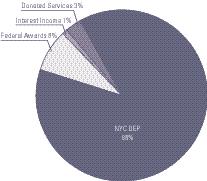
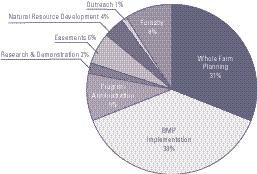
Watershed Agricultural Council of the New York City Watershed, Inc. Schedule of Activities by Program - Unrestricted fo r the Years ending June 30, 2001 and 2000
Revenue:
Program Services:
Whole farm planning
BMP implementation & construction
Program administration
Forestry
Economic development
Natural Resource Development
Education and outreach
Easements
Research & Technical
20012000
.$2,048,203$1,805,185
.2,277,7273,009,392
.633,162746,992
.542,753291,47
.057,975
.78,909
.110,51036,822
.682,898446,008
.235,001113,000
Total Program Revenue6,609,1636,506,846
Other Revenue:
Federal awards
Foundation grants
Economic development and other grants
Acquisition of plant equipment
Donated Services
Expenditures:
.316,826141,347
.79,18551,398
.289,052204,299
.00
Total Program and Other Revenue7,574,5497,188,688
Whole farm planning
Depreciation
Economic development
Natural Resource Development
.231,478279,126
.(31,122)(65,225) Total Expenditures6,574,7326,012,996
Excess (Deficiency) of Revenues over (Under) Expenditures999,8171,175,692 Net Assets, Beginning3,253,0452,077,353 Net Assets, Ending$4,252,862$3,253,045