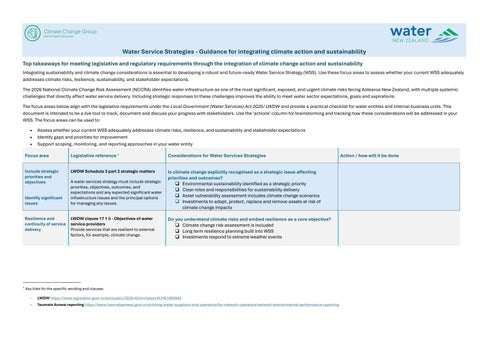
Water Service Strategies - Guidance for integrating climate action and sustainability Top takeaways for meeting legislative and regulatory requirements through the integration of climate change action and sustainability Integrating sustainability and climate change considerations is essential to developing a robust and future-ready Water Service Strategy (WSS). Use these focus areas to assess whether your current WSS adequately addresses climate risks, resilience, sustainability, and stakeholder expectations. The 2026 National Climate Change Risk Assessment (NCCRA) identifies water infrastructure as one of the most significant, exposed, and urgent climate risks facing Aotearoa New Zealand, with multiple systemic challenges that directly affect water service delivery. Including strategic responses to these challenges improves the ability to meet water sector expectations, goals and aspirations. The focus areas below align with the legislative requirements under the Local Government (Water Services) Act 2025/ LWDW and provide a practical checklist for water entities and internal business units. This document is intended to be a live tool to track, document and discuss your progress with stakeholders. Use the ‘actions’ column for brainstorming and tracking how these considerations will be addressed in your WSS. The focus areas can be used to: • • •
Assess whether your current WSS adequately addresses climate risks, resilience, and sustainability and stakeholder expectations Identify gaps and priorities for improvement Support scoping, monitoring, and reporting approaches in your water entity
Focus area
Legislative reference 1
Considerations for Water Services Strategies
Include strategic priorities and objectives
LWDW Schedule 3 part 2 strategic matters
Is climate change explicitly recognised as a strategic issue affecting priorities and outcomes? ❑ Environmental sustainability identified as a strategic priority ❑ Clear roles and responsibilities for sustainability delivery ❑ Asset vulnerability assessment includes climate change scenarios ❑ Investments to adapt, protect, replace and remove assets at risk of climate change impacts
Identify significant issues Resilience and continuity of service delivery
1
A water services strategy must include strategic priorities, objectives, outcomes, and expectations and any expected significant water infrastructure issues and the principal options for managing any issues. LWDW clause 17 1 ii - Objectives of water service providers Provide services that are resilient to external factors, for example, climate change.
Do you understand climate risks and embed resilience as a core objective? ❑ Climate change risk assessment is included ❑ Long term resilience planning built into WSS ❑ Investments respond to extreme weather events
Key links for the specific wording and clauses -
LWDW https://www.legislation.govt.nz/act/public/2025/42/en/latest/#LMS1008943
-
Taumata Arowai reporting https://www.taumataarowai.govt.nz/drinking-water-suppliers-and-operators/for-network-operators/network-environmental-performance-reporting
Action / how will it be done
Community outcomes and stakeholder expectations – including on climate change
LWDW Schedule 3 part 1 A water services strategy must include any community and stakeholder outcomes that are relevant to providing water services or as specified in the organisation’s statement of expectations.
Does your strategy respond to community expectations on environmental protection and climate action? ❑ Significance and Engagement Policy includes consultation on sustainability, climate change, and environmental outcomes ❑ Outcomes of community engagement on environment and sustainability are included ❑ Alignment with stakeholder Council climate goals and expectations, including integration of climate targets set through Letters of Expectation
Identify significant impacts, including on levels of service (LoS)
LWDW Schedule 3 part 2 strategic matters Must identify factors that will have a significant impact on the provider, including the ability to maintain existing levels of service to consumers and to meet additional demands for water services.
Have you assessed how climate change may impact current levels of service? ❑ Indication of the impacts of climate change on current LoS ❑ Current demand and supply balance including whether there are water supply restrictions
Identify changes to levels of service and costs of delivering water services
LWDW Schedule 3 part 3 operational matters Any intended changes to the level of service and the reasons for the changes; and the reasons for any material change to the cost of water services.
Do you understand the cost and service-level implications of climate change? ❑ Analysis of climate impacts on future level of service ❑ Climate change projections and impacts on water services cost related to flooding, water availability and overflows.
Consider climate related financial risk and sustainable finance opportunities
LWDW Schedule 3 part 5 financial matters A water services strategy must include the water service provider’s intended approach to funding, revenue, and pricing.
Have climate risks been included in funding, revenue and pricing scenarios? ❑ Analysis of funding requirements under climate change scenarios ❑ Identification of revenue implications associated with extreme weather events such as droughts ❑ Integration of XRB’s Climate related financial disclosure into financial planning Have sustainable finance opportunities been considered within the funding approach? ❑ Discussion with LGFA regarding Green Loans for water, stormwater, and wastewater projects ❑ SWALe product for entity financing.
Reporting requirements include sustainability expectations
Taumata Arowai Network Environmental Performance reporting requires a response on: Including drinking water loss, water conservation programmes, energy efficiency/use, emergency response planning, water security, overflows, WW process GHG emissions, Biosolids production and disposal.
Do your resourcing, strategic objectives, and performance frameworks incorporate these requirements? ❑ Inclusion of sustainability, resource recovery, circular economy, water efficiency section of strategy ❑ Identification of roles and resourcing to meet requirement areas ❑ An understanding of stakeholder Council(s)’ climate change and strategic targets ❑ Integration of climate-related considerations for the Commerce Commission’s information disclosure requirements
Performance metrics from stakeholders Stakeholder Councils can set targets aligned with their strategic goals through Letter of Expectation.
Useful links: • • • • • •
WSDP guidance - Integrating Climate Risk into Water Service Delivery Plans : Water New Zealand Embodied emissions framework - https://www.waternz.org.nz/Article?Action=View&Article_id=3091 Infrastructure NZ climate change guidance- https://infrastructure.org.nz/wp-content/uploads/2024/11/Infrastructure-NZ-Policy-Postions-Climate-Adaptation-19.11.24.pdf https://nzinfrastructure.nz/climate-change-and-infrastructure/ National Climate Change Risk Assessment 2026 - https://environment.govt.nz/news/second-national-climate-change-risk-assessment-for-new-zealand/ LGFA sustainable lending options- https://www.lgfa.co.nz/sustainability/sustainable-lending