water MAY 2015 | ISSUE 189
SEPTEMBER/OCTOBER 2026 ISSUE 246
Conference preview Nitrate: Implications for water suppliers How AI can transform water services delivery On-site wastewater systems: The case for a WoF
PROVEN SMART METERING Measuring our precuous resource? Make it count with SENSUS RF
Control Valves
Filtration
Sensus CORDONEL DN 50-80-100-150-200-300 R1000 - Extremely low flow registration (DN50 12l/h) 0U / 0D - Installation flexibility Extensive communication options: Sensus RF / wM-Bus/ NBIoT Hub / Pulse Long asset life - 20 year internal batteries Exceptional accuracy for leak detection / monitoring 12 user configured alarms Integrated pressure & temperature logging
Scan me for more info
www.deeco.co.nz
Air Valves
Backflow Prevention
CONTENTS WATER NEW ZEALAND
President: Tim Gibson Board Members: Bruce Balaei, Stephen Burton, Tim Gibson, David Hogg, Paddy McNamara, Soltice Morrison, Suzanne Naylor, Priyan Perera Chief Executive: Gillian Blythe Internal Events and Logistics Co-ordinator: Katrina Guy Head of Corporate Services: Mumtaz Parker Membership Administrator/Office Manager: Pip Donnelly Technical Lead – Regulatory and Policy: Tega Ogbuigwe Technical Lead – Drinking Water Quality and Education: Belinda Cridge Communications Manager: David Miller Marketing Lead: Frances Sheriff Executive Assistant to the CE and Association Secretary: Caroline Lewin Accounts Administrator: Michelle Davies OUR SPECIAL INTEREST GROUPS Backflow Climate Change Drinking Water Quality Diversity, Equity and Inclusion Smart Water Infrastructure Modelling Onsite Wastewater Management Stormwater Te Ama | Aukaha te Wai Water Services Managers’ Group Water Efficiency and Conservation Action Network (WeCan) Wastewater
Issue 246 SEPTEMBER/OCTOBER 2026
INSIDE 04 President’s comment 09 Celebrating Māori language week 12
Billing is about customer relationships
13
Report from Singapore Water Week
126 Magnetic invention removes PFAS and microplastics 128 The future of desalination
14 Update on water authorisations
130 Project: Creating an artificial reef in Wellington Harbour
23 The future of water services regulation 24 20 years of conference evolution
134 How an eco-dye artist is revealing the hidden story of water
FEATURES
136 A small subsidy with a big impact
28 Profile: Chris Dyhrberg 30 Profile: Becky Macdonald 32 Watercare to spend $15.2 billion 48 The forgotten infrastructure beneath our feet 52 Nitrates in drinking water and the link with pre-term birth
WATER JOURNAL Editor: Mary Searle Bell, Contrafed Publishing M: +64 21 676 034 Advertising Sales: Debbie Laing M: +64 27 455 0223 Design: Jonathan Whittaker M: +64 21 147 5591 Publishing: Contrafed Publishing, General Manager: David Penny, 1 Grange Road, Mount Eden, Auckland 1024 PO Box 67131, Mt Eden, Auckland, 1349 P: +64 21 190 4078 www.contrafed.co.nz Distribution: Pip Donnelly, enquiries@waternz.org.nz P: +64 4 472 8925
70 Project: Practical solutions to a complex project at Paremuka Dam
Water is printed on environmentally responsible paper, sourced from PEFC certified fibre from sustainably managed and legally harvested forests, and manufactured under strict ISO 14001 environmental management systems.
124 Hidden danger of nanoplastics in water systems
06 Source water protection critical
Young Water Professionals: Chapters in Auckland, Wellington and Christchurch. For information contact: Katrina Guy 04 495 0891, email: Katrina.guy@waternz.org.nz
DISCLAIMER: Water New Zealand reserves the right to accept or reject any editorial or advertising material submitted for publication. The opinions expressed in contributions to Water are not necessarily those of Water New Zealand. The information contained in this publication is given in good faith and has been derived from sources believed to be reliable and accurate. However, neither Water New Zealand, nor any person(s) involved in the preparation of this publication accept any form of liability whatsoever for its content including advertisements, editorials, opinions, advice or information. This extends to any consequences from its use. No part of this publication may be reproduced, stored in any retrieval system, or transmitted in any form or by any means electronic, mechanical, photocopying, recording or ink–jet printing without prior written permission of the publishers. ISSN 1179-2949 (Print) ISSN 2382-1906 (Online) www.waternz.org.nz
120 Bacteria convert uranium into a stable chemical compound
34 What Watercare’s FLOW 2026 could mean for the water sector 36 The fuel crisis should prompt a rethink on how we procure infrastructure
56 Dealing with nitrate contamination of groundwater
74
CASE STUDIES, PAPERS, AND COMMENT PIECES
38 Reform must not put infrastructure on pause 40 Why the industry is losing young talent 42 Is NZS 3910 always the best contract?
Arapuni Hydro Dam: Standing the test of time
62 Interpreting NPSNH 2025 through H1–H6 flood hazard ratings
80 Nature is good for business
66 Taumata Arowai’s role in stormwater management
82 The secret life of adult whitebait revealed 85 How an influx of salt may affect microbial ecosystems
78 Legal update 94 How AI can help fill the gap
86 The fast-moving ‘butterfly effect’ of the deep ocean
98 From asset management to organisational capability
88 How the far south can show the world a better datacentre
110 When temporary systems become critical infrastructure
90 How AI can transform the delivery of water services 100 Water sector sustainable water action loans launched 103 Project: Waikouaiti Water Intake Upgrade 114 How nanobubbles can be used on dying seas and lakes 116 Nature-based solutions better for cleaning water features 118 Looking to wastewater for alternative energy materials
103
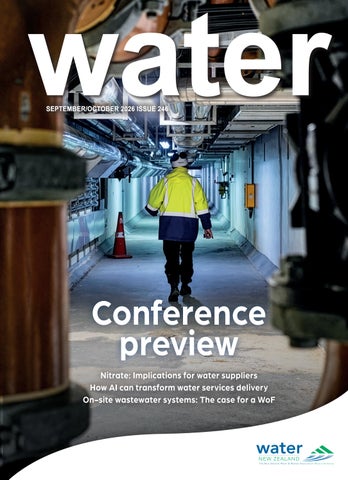
Cover photo: Congratulations to our photo competition winner Ramsay Huang, Christchurch City Council, capturing behind the scenes at a wastewater treatment plant.
‘Ka ora te wai, ka ora te whenua, ka ora nga- tangata’ ‘If the water is healthy, the land is healthy, the people are healthy’ The official journal of Water New Zealand – New Zealand’s only water environment periodical. Established in 1958, Water New Zealand is a non-profit organisation. SEPTEMBER/OCTOBER 2026 WATER NEW ZEALAND
3
WATER NEW ZEALAND FROM THE PRESIDENT
Reflections from Tim
Tim Gibson President, Water New Zealand
T
his is my final column as president of Water New Zealand, and what an eventful and defining two years it has been. Last month marked 10 years since the Havelock North drinking water contamination event, a tragedy that had a huge impact on a community and became a catalyst for the reform journey we have been on ever since. While the lessons were hard-learned, they have driven significant change for the better. We now have a dedicated water regulator in the Water Services Authority – Taumata Arowai and a more transparent and robust funding and delivery model with oversight from the Commerce Commission. I feel privileged to have been able to play a role in both Water New Zealand and the wider water sector itself as we have gone through this period of transformation. Supporting our members as we navigate to the new environment has remained at the heart of Water New Zealand. Ensuring a healthy and sustainable water future continues to guide our strategy. It also depends on trusted technical expertise, strong relationships and a willingness to collaborate, work together and share knowledge. That’s what the water sector is about. The credibility that has seen our organisation continue to grow is built on the expertise of our members and your willingness to share knowledge and expertise. Our special interest groups continue to provide the technical backbone of our organisation, helping shape our advocacy, informing submissions and ensuring Water New Zealand is seen as a trusted and influential adviser. To everyone who has contributed their time, knowledge and energy, thank you. Looking to the future, we know there are many challenges. Climate change is already testing the resilience of our communities and infrastructure. The Climate Change Commission’s National Climate Change Risk Assessment identified water infrastructure as one of the country’s most
4 www.waternz.org.nz
significant climate risks over the coming decades. Whether responding to floods and droughts, protecting drinking water supplies, or safeguarding our waterways and environment, our sector is increasingly at the frontline of building resilience. Yet I’m optimistic that we can meet those challenges. Across the country I see people with the expertise, drive and determination needed to create lasting solutions for future generations. As I write this, final preparations are underway for the Water New Zealand Conference & Expo 2026 in Kirikiriroa Hamilton. Once again, the programme promises to be exceptional, with keynote speakers, technical presentations, panel discussions, and workshops tackling the critical issues facing our sector. Our preconference workshop, Lifting Productivity within Local Water Done Well, will bring together sector leaders, practitioners and experts to explore practical ways to strengthen strategy and leadership, workforce capability, procurement, asset data standards, technology and innovation. There’ll also be plenty of opportunities to catch up with friends and colleagues and to help us celebrate success at the Downer Gala dinner – one of the highlight events at the conference. If you have not yet registered, I encourage you to do so. It promises to be another outstanding event and one you will not want to miss. Finally, thank you to my fellow board members, chief executive Gillian Blythe and the Water New Zealand team for their support throughout my time as president. I would also like to wish my fellow board officer Priyan Perera every success as he takes over the role in September. Water New Zealand will be in capable hands. As for me, I look forward to continuing to serve on the board as past president over the next year and, as such, supporting the important work that lies ahead. Ngā mihi maioha Tim Gibson
22–24 September 2026
Claudelands, Kirikiriroa Hamilton
Join us and be part of the biggest Three Waters conversation of the year This is the must-attend event for anyone interested in the future of water. At a time of major change, this conference provides a vital opportunity to learn, share knowledge, challenge thinking and help shape what comes next. Join us and hear from leading keynote speakers and technical experts, explore cuttingedge discussions on AI and digital innovation, mātauranga Māori, asset management, water reform, global research and plenty more. Connect with industry leaders and partners, visit our exhibition sites, and take part in discussions to support resilient communities and protect water for generations to come. Go to our website to register and find out more
www.waternzconference.org.nz THANK YOU TO OUR PREMIER PARTNERS
WATER NEW ZEALAND UPFRONT
Source water protection critical to drinking water security Water New Zealand is calling for stronger protection of drinking water sources, warning that communities face increasing costs from the impact of climate change, population growth, and changing land use if source water is not adequately safeguarded. Chief executive Gillian Blythe says protecting source water catchments such as rivers, lakes, and aquifers is the most effective and cost-efficient way to ensure reliable drinking water supplies for communities. The Water Services Authority – Taumata Arowai’s Network Environmental Performance Report has revealed that almost half of all drinking water consents will require renewal within the next decade, while around 10 percent are operating on expired consents and many others are not fully compliant with consent conditions. “These findings highlight the consent renewal challenges facing drinking water providers and the potential risks to both the security and affordability of future water supplies.” She says international research shows that treating contaminated source water is significantly more expensive than sourcing water that requires less treatment. “Strong source water protection is the foundation of safe drinking water. If we fail to protect the environment that provides our drinking water, communities will face higher treatment costs and greater risks to supply. “It is essential that the wider regulatory framework, including the new Natural Environment and Planning Bills and the pending National Policy Direction, recognises the importance of protecting drinking water sources. “We are reviewing the proposed legislation alongside the existing National Policy Statements. While there are positive elements, we are not
yet convinced that the current National Policy Statement for Infrastructure provides sufficient direction to ensure the sustainable management and protection of water services. “As we invest in new water infrastructure and adapt to climate change, source water protection must be given greater priority. “It is one of the most effective investments we can make in the long-term health, resilience and affordability of our drinking water systems.” She says the report also highlights the urgent need for sustained investment in water infrastructure. “It provides compelling evidence that we need to continue to accelerate investment in drinking water, wastewater, and stormwater infrastructure if the sector is to support growth, improve resilience, and meet future challenges.” The report identifies that around 15 percent of assessed drinking water and wastewater pipes are in poor condition. However, it also highlights that the condition of a large proportion of the country’s water infrastructure remains unknown. “For many years there has been a lack of nationally consistent information about the condition of our assets and closing the gaps in this knowledge is still a work in progress. “Understanding the condition of underground assets is essential for councils and water service providers to make informed decisions about maintenance, renewals, and upgrades. “You cannot effectively manage what you do not understand. Better asset information enables better investment decisions, and ultimately better outcomes for communities.”
Policy and regulatory engagement It’s been a busy few months for Water New Zealand’s policy and regulatory work, with a strong focus on ensuring the sector’s voice is heard as new regulatory settings take shape.
Submissions and regulatory engagement We’ve responded to a significant pipeline of consultations, including: • Economic regulation: Information Disclosure, ring-fencing, Watercare’s Price-Quality Path and related Commerce Commission proposals. • Resilience: Engaging on the Commission’s Draft Resilience Principles and what workable resilience investment expectations look like for water services. • Wider reform: Bringing a sector perspective to other policy proposals affecting the sector, including cybersecurity and firefighting water supplies.
Policy and Regulatory Taskforce We have established a new Policy and Regulatory Taskforce to bring together expertise from across the sector and strengthen how Water New Zealand identifies, prioritises and responds to regulatory change.
6 www.waternz.org.nz
The Taskforce is currently focused on finalising an interactive policy and regulatory roadmap dashboard to highlight upcoming regulatory requirements, key milestones and available guidance, helping the sector navigate change and reduce compliance burden. You can find the dashboard under Research and Insights on the Water New Zealand website. Members will need to log in to access it. We’ll also be hosting a sector show-and-tell to walk through the dashboard, demonstrate how it can be used and hear feedback on how we can continue to improve it.
National direction and planning reform We’re working with members to capture the sector’s RMA pain points and build the evidence for change under the new planning regime. This sector story will support our advocacy on national direction by clearly articulating the problems, the outcomes water services need and what good looks like, including opportunities for nationally consistent permitted activities and standards. See the Parliamentary Commissioner for the Environment’s response to RMA law reform in Helen Atkin’s legal column on page 78.
Tawara o te Wai: Shifting from discussion to action Water infrastructure is perhaps the single most significant climate risk, according to the National Climate Change Risk Assessment released by the Climate Change Commission. The report says that climate risks are already affecting everyday life and that delaying adaptation will increase costs substantially. The Commission has identified priority risks across infrastructure, communities, ecosystems, governance, and funding systems, arguing that targeted investment now will be cheaper than repeated disaster recovery later.
In this edition of the Water New Zealand podcast, Tāwara o te Wai, Jon Reed and Hannah Edmond discuss how this impacts the water sector with climate change adaptation specialist at Tonkin + Taylor, James Hughes. They explore what we need to do as a sector to strengthen infrastructure resilience and respond to the challenges of urban development, drought, and flood risk. You can listen to the full discussion on the Water New Zealand website, Spotify, or wherever you get your podcasts.
Thank you Debra After 10 years with Water New Zealand, we say farewell to our communications manager Debra Harrington. Debra joined Water New Zealand on the very day the Havelock North water contamination story broke; an extraordinary introduction to both the organisation and the importance of clear, timely communication across the water sector. Since then, she has played a significant role in shaping how Water New Zealand communicates with members and the wider sector. Whether through this journal, newsletters, our website, social media, the Tawara o te Wai podcasts, conference communications, or annual reviews, her work has helped keep members informed, connected and engaged. Over the past decade, Debra has witnessed and helped
communicate some of the most significant changes the water sector has experienced. From reform and regulation through to celebrating innovation, sharing technical knowledge and promoting the people who make up our sector, she has ensured these stories reached our members with professionalism, clarity, and care. She has also been a valued colleague, bringing creativity, a collaborative approach and a genuine commitment to Water New Zealand’s purpose. Her contribution has extended well beyond communications, and her knowledge of the organisation and the sector will be greatly missed. On behalf of the Board, staff and our members, we thank Debra for everything she has contributed over the past 10 years and wish her every success as she embarks on the next chapter.
Resources to help with onboarding new staff With new water services organisations being established, workforce numbers growing and people joining the sector from local government, infrastructure, overseas, and other industries, effective onboarding has never been more important. The pace of change across the sector means many people are navigating not only a new job, but also a new operating environment, new relationships, and a whole new language of acronyms, legislation, and technical terminology. The good news is that onboarding doesn’t need to be complicated. A few simple steps can help new starters quickly understand both their role and the wider sector they have joined. Water New Zealand has a range of resources designed to help. Our free ‘Welcome to Water’ course is an ideal starting point, particularly for people working in communications, customer service, finance, HR, and other corporate services roles. It provides an accessible introduction to the sector without requiring technical expertise. For technical staff, especially those arriving from overseas or from other industries, our Drinking Water 101, Wastewater 101 and Stormwater 101 digital badges provide valuable Aotearoa New Zealand-specific context.
New learning opportunities continue to expand, including the recently launched Cultural Significance and Importance of Wai badge and specialist digital pins covering topics such as emerging contaminants, chemicals in drinking water and lead. Managers and team leaders can benefit from the Water 101 suite too. Even experienced professionals often find value in better understanding how the different parts of the water system connect. Asset managers can combine these introductory programmes with the specialist development opportunities available through Āpōpō. Stormwater professionals can also access our established Erosion and Sediment Control training, alongside the recently launched Blue-Green Infrastructure course. A simple onboarding plan could be as straightforward as: Learn the basics, meet the right people, join the relevant networks, and identify one or two learning opportunities for the first few months. With so many people finding their feet in new organisations and roles, taking the time to get onboarding right is a worthwhile investment. And if you’re looking for a place to start, many of the building blocks are already available.
SEPTEMBER/OCTOBER 2026 WATER NEW ZEALAND
7
WATER NEW ZEALAND UPFRONT
New STEM pathways for senior students welcome Water New Zealand says the new industry-led STEM subjects for Year 12 and 13 students will give students greater exposure to career opportunities in fast-growing areas such as the water sector. A range of future-focused, industry-led secondary school subjects was launched recently and will give young New Zealanders more opportunities to connect what they learn at school with the jobs, training, and careers of the future. Chief executive Gillian Blythe has welcomed the development of the new subjects, saying they will help students better understand how what they study at school connects with future careers. “There is a huge range of career opportunities in the water sector – from engineering and hydrology to environmental science, data science, ecology, planning, communications, customer service and many more. “The new STEM pathways are an exciting step because they’ll help students discover that breadth of opportunity much earlier.” The Department of Internal Affairs’ Water Sector Working Group report has identified an estimated shortfall of 10,000 skilled workers over the next decade to deliver the increased investment signalled in councils' Water Services Delivery Plans. “With around $48 billion of infrastructure investment expected over the next 10 years, the sector will require people with a wide range of skills and backgrounds.” While recent employment figures show some industries are facing more challenging conditions, water remains a sector with strong long-term demand. “The water sector needs people with all sorts of interests and talents. Whether someone enjoys science, technology, working outdoors, problem-
solving, or working with communities, there are many different ways to contribute. Although the new subjects are still being developed, students currently selecting subjects for study should consider exploring how different school subjects relate to careers in the water sector. Water New Zealand has developed career information and an online subject selection tool to help students understand the range of roles available and the pathways into them. “Helping students make informed subject choices is exactly what these new STEM pathways are designed to support. The more young people understand the opportunities available in sectors like water, the better placed they’ll be to make decisions about their future.” The new subjects include next-gen manufacturing, applied intelligent systems, construction and built environment, energy and infrastructure, engineering technology, food and fibre systems, health services and care, hospitality food and beverage, and tourism. The move introduces students to a range of careers available across energy, water, civil infrastructure and extractives, from apprenticeships and entry-level training through to specialist technical and operational roles. Education Minister Erica Stanford says the subjects will have parity of esteem with traditional subjects such as English and Maths and count towards students’ secondary school qualifications, and support pathways into university, trades, training or the workforce. “We know students are more engaged when they can see the purpose of what they are learning and how it connects to their aspirations, making staying at school relevant for every child, no matter what career pathway they choose,” she says.
Your sustainable water management partner
GRAF’s German engineered solutions set the benchmark for water management. We turn plastic waste into water treatment products, creating a pattern of reuse, recycling and regeneration, in turn protecting the waterways of Aotearoa New Zealand.
8 www.waternz.org.nz
0800 082 201 info@grafnz.co.nz grafnz.co.nz
Seeing water through a different lens How the Cultural Significance and Importance of Wai module changed the way one stormwater specialist approaches his work. For Zach Rutherford, healthy waters specialist at Auckland Council, the decision to enrol in Water New Zealand’s Cultural Significance and Importance of Wai module was an easy one. After completing the introductory Stormwater 101 Digital Badge as part of his onboarding, he was inspired by facilitator Troy Brockbank’s approach to water and te ao Māori. “I was so blown away by it,” Zach says. “When I saw there was a full multiday course, I knew I had to attend. Troy was such an inspirational speaker and really got me even more passionate about stormwater.” Today, Zach works across Tāmaki Mākaurau Auckland’s southern stormwater network, helping care for infrastructure and waterways. The course has given him a new perspective that influences the way he approaches that work every day.
Looking beyond the water itself One of the biggest takeaways for Zach was learning to see wai as more than a physical resource. The module introduced the concept of mauri – the life force that exists within all living things – and challenged participants to think about the health of waterways in a more holistic way. Now, when responding to stream blockages, rubbish removal or undertaking field work, Zach consciously considers the condition of the waterway and the health of the surrounding environment before making decisions. “The course reinforced that water isn’t just water. Streams aren’t simply bodies of water – they have a life force behind them.”
Bringing te ao Māori into everyday practice The learning has also strengthened Zach’s work collecting water quality samples across the Ōtara-Waikōwhai catchment. Alongside scientific monitoring, the project incorporates cultural indicators to better understand the health of waterways through a te ao Māori lens. The concepts explored throughout the course helped connect this work with a deeper understanding of what makes a waterway healthy. For Zach, healthy waterways are about much more than water quality results. “When you visit a thriving stream, you notice the difference. The water is clear and flowing, the banks are full of vegetation, birds are singing and there’s life all around you. You can feel the mauri of that place.”
Zach Rutherford.
A course for everyone working with water While Zach works directly with stormwater every day, he believes the learning extends well beyond technical water roles. The module provides a broader appreciation of the role water plays in our communities, our environment and our everyday lives, helping people understand why protecting water matters. “It’s a real eye-opener. Water is so much more than something that flows to the ocean. It’s a huge part of our lives, whether we realise it or not, and it’s something we all have a responsibility to care for.” For Zach, the course didn’t just expand his knowledge, it changed the way he sees water, and the role he plays in protecting it for future generations. Go to the training section of the Water New Zealand website to find out more about the newly revamped Cultural Significance and Importance of Wai module.
You can listen to Troy and senior healthy waterways specialist at Auckland Council, Sarah Nolan talk about the Cultural Significance and Importance of Wai on our latest Tāwara o te Wai podcast. Check it out wherever you get your podcasts from.
SEPTEMBER/OCTOBER 2026 WATER NEW ZEALAND
9
WATER NEW ZEALAND UPFRONT
Wāhi Whakarite ReoParahia mō te wai, Parahia mō te reo Māori Making room for water, making room for the Māori language By Troy Brockbank (Te Rarawa, Ngāti Hine, Ngāpuhi, Ngātiwai, Ngāti Kahu) This Te Wiki o te Reo Māori 2026, Water New Zealand Waiora Aotearoa is proud to share Making Room for Water, a poster that explores the language of rivers, floodplains, flooding, and flood resilience through a te ao Māori lens. The timing is fitting. This year’s official Te Wiki o te reo Māori (Māori language week) theme is, ‘Ake, Ake, Ake – A Forever Language’. It focuses on ‘Te Reo Towns’, celebrating communities that have kept te reo Māori alive while encouraging every town, workplace, school, marae, and neighbourhood to make te reo visible, heard, and valued in everyday life. In many ways, rivers offer an important lesson for language revitalisation. A healthy river needs room to move. It needs floodplains, wetlands, side channels, and natural spaces where water can spread, slow down, and reconnect with the land. When we constrain rivers too tightly, pressures build and impacts are often felt elsewhere. Likewise, te reo Māori flourishes when it is given space to be spoken, seen, learned, and lived in daily life. Our poster celebrating Māori language week (on facing page) illustrates a river catchment from the mountains to the sea, introducing kupu Māori (Māori words) and technical terms associated with flood management and river systems. It includes mānia waipuke (floodplain), repo/kūkūwai (wetland), ngā horohoro (erosion), waipara (sedimentation), māra wai (raingarden), and whakawhaiao wai (daylighting streams). These features help communities
10 www.waternz.org.nz
adapt to floods while improving environmental outcomes. At the same time, each kupu (word) expands our pātaka kupu (vocabulary) and strengthens our ability to talk about water using the language of this place. Te reo Māori contains generations of environmental knowledge, observation, and connection to the taiao (natural world). By learning and using these words, we gain more than vocabulary; we gain new ways of understanding our relationship with rivers and water. The poster also reflects the interconnected whakapapa of wai, acknowledging Ranginui, Papatūānuku, Parawhenuamea, Kiwa and Hinemoana (the foundational primordial parents and elemental deities in Māori mythology), and reminding us that rivers are part of a living system linking mountains, land, people, and sea. As communities across Aotearoa New Zealand strive to become ‘Te Reo Towns’, this resource invites us to make room for both water and language. When rivers are given space to thrive, communities become more resilient. When te reo Māori is given space to thrive, our communities become richer, stronger, and more connected. Te Wiki starts on Monday, 14 September. You can download our poster to print and hang on your office wall, in either A3 or A4. It's available on the resources section of our website www.waternz.org.nz. You can find out more about Te Wiki o te Reo Māori by going to Te Taura Whiri I te Reo Māori – Māori Language Commission website, en.tetaurawhiri.govt.nz/ te-wiki-2026.
Āwhā
Ranginui
Storm
Parahia mō te wai Parahia mō te reo Māori
Papatūānuku
Parawhenuamea
ahuriri
Pāpuni
Making room for water Making room for the Māori language
Weir
Dam
Ngāhorohoro Wawae/Rakunga
Erosion
Scour
Maioro Oneone Stopbanks
Kurawai
Reservoir
waipara
Sedimentation
Repo/kūkūwaI Wetland
Taupuni Whakatika Wai-inu Water treatment plant
Farm
Drain
PARA
Sediment
Mānia waipuke Floodplain
Horowhenua Landslides
Pū Hekewai
Puna Wai
Culvert
Kōkīkī
pāmu/ahuwhenua
Waikeri
Spring
Forest debris
Rua Pupuru Taupua Detention basin
Turaki Piriti/ Turaki Arawhata Bridge washout
Waimanga
Rī Kōpuku
Tributary
Scruffy dome
Rohe Mate Waipuke Flood prone areas
Whakawhaiao Wai Daylighting streams
Pātū Kirikiri
kurawai marangai Rainwater tanks
Ara Rerewai ā-Whenua Overland flowpath
Sandbagging
Awa
WAIPUKE
River
Flood
Pokenga Waiāwhā
Stormwater surcharge
Arawai
Waterway, water course
Toka Parahau Rock armour
Māra Wai
Raingardens
Taupuni Whakatika Waiparu
Wastewater treatment plant
Pukenga Waitai Stormsurge
Ngutuawa/Pūaha River mouth
Pārua Hekewai Swale
Heke Waiparu
Toka Kai Ngao
Wastewater flows
Riprap apron
Kiwa
Hinemoana
Ka ora te wai,
If the water is healthy,
ka ora te whenua,
the land is healthy,
ka ora ngā tāngata
the people are healthy
Scan to explore Ngā Momo Ua further
WATER NEW ZEALAND UPFRONT
Billing is about customer relationships;
it’s not a technology project Billing is fundamentally about customers, trust, and organisational capability, not simply about getting an invoice out the door. Many water services providers are about to embark on billing customers for the first time and with that comes reputational risk, especially around customer trust. A recent Water New Zealand webinar brought together Contact Energy operations manager Brook Barrington, Watercare’s head of customer insights Teresa Malloy, and Utility Disputes chief executive and commissioner Neil Mallon to discuss how organisations can avoid and resolve potential billing problems. For water services providers preparing to introduce, replace, or expand customer billing, it is tempting to view the task primarily as a technology project: Get the meter data right, configure the billing platform, issue the invoice, and collect the payment. But experience from across the utility sector suggests the real challenge is much broader. Billing, they said, was much more than a technology or finance function. It is one of the most important and regular interactions an organisation has with its customers and can significantly influence trust, reputation, and an organisation’s social licence to operate. Watercare’s experience indicates that customers who believe they are receiving value for money are substantially more likely to report trusting the organisation. Teresa highlighted Watercare’s focus on understanding its different customer groups and deliberately measuring customer trust. Clear and transparent bills, she said, are critical. Customers need to understand what they are paying for, how charges have been calculated, and what value they receive. Improving water literacy and communicating proactively, particularly before price changes, can help customers understand their bills and strengthen trust. Frontline staff are equally important. When
12 www.waternz.org.nz
they have good information and have authority to resolve issues, they can prevent problems escalating into formal complaints. Customer vulnerability and affordability need to be designed into billing and customer service processes from the outset. She said these measures include priority assistance, outage alerts for medically dependent customers, translation services, free meter checks, financial hardship support, and flexible payment arrangements. It’s critical to identify and offer support early, rather than waiting until a customer is already in significant difficulty. Brook shared some of the lessons learned when Contact Energy changed its billing system in 2014. Following the changes, there were complaints and more cases taken to Utility Disputes. He said the lessons were clear. Despite significant preparation ahead of the changes, it’s important to also prepare for problems that may emerge months later. Billing problems often take time to surface. Customers don’t necessarily complain the first day a new system goes live. It may take several billing cycles before missing invoices, incorrect information, meter-reading issues or accumulated balances become apparent. For Contact Energy, the effects became increasingly visible several months after implementation and continued well beyond the initial go-live period. Brook said that implementation plans need to extend beyond the technical launch and organisations need the capacity to respond quickly when first signals begin to emerge. Neil emphasised that even with well-designed billing systems there will be complaints. Affordability pressures, infrastructure investment and increasing utility costs make
it particularly important to have effective complaint-management processes and escalation pathways in place. In effect, the presenters agreed that there are vital steps to reduce the potential of fishhooks disrupting a smooth transition to water billing. These include: • Ensuring that billing is seen as part of the overall customer relationship. Know your customers and ensure you are meeting their needs, particularly tenants and landlords, commercial and vulnerable customers. • Make bills clear and transparent. Customers should be able to understand what they are being charged, why, and how their usage and charges have been calculated. • Communicate before change happens. Price changes, new billing arrangements and other significant changes should be explained proactively rather than first appearing on a customer’s bill. • Build vulnerability and affordability support from day one. Accessible communications, hardship arrangements, and flexible payment options should form part of the core service model. • Plan for complaints even when things go well. Establish complaint categorisation, escalation pathways, independent dispute-resolution relationships, and contingency arrangements before implementation. • Ensure visible leadership, cross-functional collaboration, and a willingness to prioritise pragmatic customer outcomes when problems arise. In the end, getting billing right is fundamentally about trust. Technology matters, but successful billing depends equally on people, communication, customer understanding, organisational culture and the ability to identify and resolve problems quickly.
Lessons from Singapore International Water Week:
Water resilience is economic resilience
Senior hydrogeologist and member of the Water New Zealand Drinking Water Quality Special Interest Group, Helen Rutter received a Water New Zealand scholarship to attend the Singapore International Water Week in June. This is her report. The Singapore International Water Week (SIWW) is a leading water and climate conference. It is held every two years and brings together governments, utilities, researchers, investors, and technology companies to tackle global water challenges such as water scarcity, flooding, resilience, and sustainable urban development. The conference attracts a broad cross-section of the global water sector from 50+ countries. It is organised by Singapore’s national water agency (PUB) as part of the country’s strategy to advance water technology and position Singapore as a global water innovation hub. SIWW is designed to achieve several goals: • Share knowledge and best practice on managing water resources and urban water systems. • Accelerate innovation including new technologies in water treatment, reuse, desalination, digital water management, AI, and flood resilience. • Create partnerships between governments, utilities, businesses, researchers and investors. • Generate commercial opportunities. • Influence policy by bringing together senior decision-makers to discuss strategies for water security and climate resilience. The conference is quite different to many others, with a wide range of events and forums, including leadership forums where ministers, utility CEOs, and city leaders discuss policy; technical sessions covering the latest research and engineering solutions; networking events; and technical site visits illustrating Singapore’s water infrastructure. The forward-thinking involvement of the government in the water sector was evident throughout the conference, with addresses from the Deputy Prime Minister and other ministers, revealing their awareness of key issues, including climate change, and the consequent impacts on hazards and resources. Throughout the conference, there was considerable emphasis on resilience and water security with links to climate change, urbanisation, industrial growth and economic resilience. The Deputy Prime Minister identified three key themes: investment, innovation and cooperation. • Investment: There is a need to plan early and not simply react. There is a need for confidence in getting investment. • Innovation: Singapore needs to be innovative about water use, including re-use, managing contaminants and sustainable solutions. There is a need to develop better water use for cities around the world. • International collaboration: Many cities around the world face the same issues and we can learn from each other.
Various main points stood out: • Water resilience is an economic crisis. The costs of inaction will be huge and there is a need to act with urgency. This is clearly recognised by the Government of Singapore. The focus is on recognising the costs of inaction and implementing projects to avoid future costs. In some cases, avoiding costs can be balanced with increasing value. For example, mitigation of flood risks for an area can lead to increased land value. • A major barrier is insufficient capital. There need to be strong alliances between institutions, and between private and public organisations. • We need strong partnerships between organisations and communities. Without community buy-in, it is hard to implement solutions. • Data needs to be available. Too much data is held in silos and not usable. • Digital twins and real-time sensing and modelling are the way forward to move from information to insight. • Emergency responses need to be fully thought through. Important factors include risk awareness, information delivery (observations and warnings) and response to warnings. A repeated theme was that water is not a resource/hazard in isolation. It needs to be discussed across all disciplines and fiscal decisions. There was an identified need to move from projects to systems, with big picture thinking and strong governance to support water. Overall, it was highlighted that the priorities need to be conservation of water resources, better allocation and utilisation, and stronger disaster risk management, all framed within the context of much more integrated water information systems. The key message was that water will certainly shape our future, and we need to control exactly how it shapes it.
SEPTEMBER/OCTOBER 2026 WATER NEW ZEALAND
13
WATER NEW ZEALAND UPFRONT
Authorisations: What we heard, and what happens next By Belinda Cridge, technical lead, drinking water quality and education, Water New Zealand. Earlier this year, we reopened the conversation about authorisations. As outlined in the April issue of Water, the Water Services Act requires local authorities and council-controlled organisations operating drinking water supplies to be authorised by 2031. It also enables regulations requiring drinking water and wastewater operators – and potentially people carrying out other specified activities – to be authorised or to hold prescribed skills, qualifications, or experience. The legislation establishes the destination, but many of the important details remain to be worked through. What should be authorised? How should competence be demonstrated? How can requirements be applied proportionately across large metropolitan operations, rural providers, private contractors and small or volunteer-run supplies? Most importantly, how can a framework improve safety and capability without creating barriers that drive experienced people out of the sector? To help answer these questions, Water New Zealand has spent the past several months listening. Through workshops, online discussions, and conversations, people from every part of the sector have contributed their ideas, concerns and practical experience. We are grateful for the time, openness and generosity with which people have engaged. It has been a privilege to hear such honest and constructive feedback from those working across the industry every day. While the final framework will be developed by the Water Services Authority – Taumata Arowai, our role has been to ensure that the sector’s experience, knowledge and practical realities are reflected in the early stages of its development. The interim findings show a strong degree of convergence. There are still matters to resolve, but participants were remarkably consistent about the purpose, principles and practical characteristics they believe should underpin authorisations.
Start with the problem The clearest message was that the underlying problem is not simply a lack of qualifications. It is the absence of a consistent and demonstrable way to confirm competence for people undertaking work that can directly affect public and environmental health. Terms such as ‘trained’, ‘competent’, ‘certified’ and ‘authorised’ are currently used in different ways. Similarly, descriptions such as ‘suitably qualified’ can be too broad to provide meaningful assurance. Before detailed standards are developed, participants want a shared vocabulary so everyone understands what each term means and what evidence sits behind it. There was also strong agreement that the purpose of authorisation
14 www.waternz.org.nz
should extend beyond compliance. Participants saw an opportunity to improve water safety while raising the status and recognition of operational roles, creating clearer careers and helping retain the experienced people on whom the sector relies. In other words, success in 2031 should not be measured by the number of certificates issued. It should be visible through safer services, greater workforce capability and a professional system that people want to join and remain in. The process used to develop that system will matter. One of the most memorable workshop messages was: ‘Nothing about operators without operators’. Participants want the workforce to remain closely involved as the framework moves from broad concepts into detailed design.
Organisations and people, but with different responsibilities The most widely supported structural approach was a two-tier model. Under this concept, the regulator would authorise and audit the organisation. The organisation would then be responsible for authorising its people against nationally consistent requirements and maintaining evidence that the right competencies are available for the services and assets it operates. This approach recognises that competence does not sit solely with an individual. Organisations also shape outcomes through their governance, systems, staffing, supervision, training, maintenance, resourcing and operational culture. Participants were equally clear that requirements should reflect complexity and risk rather than relying only on population served, organisation size or a fixed number of operators per plant. A relatively small supply may use technically complex treatment processes, while a larger system may have different risks and extensive organisational support. The framework therefore needs enough flexibility to respond to what is actually being operated. A common water-sector hygiene or foundation requirement was suggested for everyone working around drinking water and wastewater systems, with role-specific requirements layered above it. Operators, samplers, designers, certifiers and other roles would then be considered according to the risk and responsibility attached to their work. The preferred sequence was to begin with drinking water organisations and operators, before extending the approach into wastewater. This would allow the framework to be tested and refined rather than attempting to cover every activity at once. However, phasing must not mean forgetting those at the edges of
the system. Participants repeatedly raised small supplies, volunteer arrangements, and organisations that depend heavily on external service providers. One option may be to authorise a designer, contractor or specialist provider operating across several small supplies, rather than placing an unrealistic burden on each community individually. Contractors and support crews must also be explicitly considered. They already carry out essential operational, technical and compliance functions across many supplies and cannot be treated as an afterthought.
Competence must be demonstrated in practice The strongest criticism of a purely examination-based approach was simple: passing a test demonstrates knowledge, but not necessarily the ability to operate a plant safely. Participants preferred practical assessment through observed work, portfolios, workplace evidence, and competency matrices that can be adapted to the plant, process, and operating context. Academic learning remains important, but it should support – not substitute – demonstrated capability. There was also emphatic support for recognising the capability already present in the sector. Experienced operators should be assessed against agreed standards without being required to unnecessarily repeat learning they have already completed. Existing qualifications, unit standards and recognised prior learning should be incorporated wherever possible. New entrants, meanwhile, need a clear and achievable pathway, including a reasonable timeframe in which to reach the required level while working under appropriate supervision. Participants did not want a new system to duplicate structures that already exist. Connexis qualifications and unit standards, NZQA processes, IANZ accreditation, ISO-aligned systems and the Chartered Professional Engineer model were among the foundations identified as worth building on. Accessibility will be just as important as technical rigour. Water operations include highly capable practical people who may not perform well in conventional written examinations or lengthy classroom programmes. Training and assessment will need to recognise different learning needs, including literacy and dyslexia, without lowering safety or competency expectations. As one participant warned, if the process becomes too complex or prolonged, smallsupply workers may simply leave.
AVK UNIVERSAL PIPE COUPLING Quickly and easily connect pipes of different diameters. Designed to simplify maintenance and repair work, AVK Universal Couplings save time on site while delivering reliable, long-lasting performance. No loose components or special pipe preparation required. Installs without disassembly for faster, easier fitting. Ideal for maintenance, repairs and retrofit applications. Fusion Bonded Epoxy (FBE) coating applied to AS 4158 for dependable corrosion protection.
Make it workable on the frontline Any authorisation system will need documentation and assurance, but participants warned against allowing paperwork to become the system’s defining feature. The framework must be simple enough to use in real operating environments. Requirements that are difficult to understand, repeatedly duplicate information or absorb excessive frontline time will reduce the capacity available to operate and maintain assets. Continuing professional development received particularly strong support. Rather than viewing authorisation as a one-off hurdle, participants favoured an active process through which people maintain, update, and demonstrate their capability over time. There was less agreement on the precise renewal cycle. Three years was commonly discussed, while others considered five or six years more realistic. Some preferred continuous professional development and ongoing evidence over periodic re-examination. This will need further design work, but the principle is clear: Competence cannot be assumed to remain current indefinitely. The sector will also need enough people who can deliver and assess training. Participants supported work-based and apprenticeship-style approaches that allow people to earn while they learn, alongside suitable oversight of trainers and assessors. Done well, authorisation could also help attraction and retention. Portable recognition, visible career progression and greater professional status would make it easier for people to move between employers and regions without having to repeatedly prove the same capability.
Talk to your rep at your local Humes branch or call us on 0800 502 112.
WE’LL MAKE IT HAPPEN
SEPTEMBER/OCTOBER 2026 WATER NEW ZEALAND
15
WATER NEW ZEALAND UPFRONT
Independence, accountability, and proportionate enforcement There was strong support for separating training, certification, and regulation. Participants favoured independent certification rather than allowing the same body to deliver training, assess competence, and enforce compliance. Comparisons were made with the separation of functions in health and safety regulation and with professional engineering systems. Exactly where the national certification function should sit remains unresolved. Possible homes raised during the workshops included the Water Services Authority, an existing or new government entity, IANZ, or a sector body. Whatever arrangement is chosen, there will need to be clear accountability, including assurance that those administering and overseeing the framework are themselves competent and operating consistently. Enforcement should also protect public health without jeopardising continuity of service. Participants distinguished between an administrative nonconformance, regulatory non-compliance, and an immediate safety concern. They supported graduated responses rather than blunt measures that could leave a town or city without a suitable drinking water supply. Potential responses could include improvement requirements, public notification, additional oversight, statutory management, or caretaker arrangements. Responsible people must also have the authority within their organisations to act on the risks they identify. Funding will need to be predictable and proportionate. Participants generally preferred an organisation-based levy over open-ended individual fees, particularly where high costs could disadvantage small providers or encourage outsourcing purely to meet an administrative requirement.
Building the workforce evidence base One message came through consistently during the authorisations workshops: We cannot plan the future workforce if we don’t first understand the workforce we have today. Whether we are considering future authorisation requirements or the wider challenge of delivering around $48 billion of water infrastructure investment over the next decade, we need a clearer picture of the people who will deliver that work. At present, we simply don’t have it. To establish that baseline, Water New Zealand has commissioned Cogo to undertake the Water Services Workforce Insights Project. The project will develop a comprehensive picture of Aotearoa New Zealand’s drinking water and wastewater workforce, identifying workforce size, demographics, qualifications, experience, occupational roles and geographic distribution. It will also identify gaps in the information currently available and establish a methodology for maintaining that evidence into the future. Importantly, this is an evidence project, not a policy project. It will not determine authorisation requirements or redesign qualifications – it will provide the information needed to make informed decisions. But understanding the challenge is only the first step.
16 www.waternz.org.nz
Conference sessions to help shape strategy The Workforce Insights Project, together with everything we have learnt through the authorisations workshops, provides the evidence base to tackle a much bigger question: How do we build the workforce we will need over the coming decade? That question will be explored during both the Water New Zealand Conference pre-conference workshop and the dedicated thought leadership session, helping to shape a sector-wide workforce strategy in 2027. The aim is not simply to produce another report, but to build sector-wide commitment to a shared direction and a programme of practical initiatives that make a measurable difference. Taking inspiration from the electricity sector’s Re-Energise programme, the focus will be on collective action, sustained investment and measurable outcomes. The broad priorities are already emerging: Attracting more people into water careers, strengthening training and professional recognition, and coordinating investment so the sector tackles workforce challenges collectively rather than organisation by organisation. The next conversation is therefore less about identifying the problem and more about deciding what we will do together. Developing a sustainable approach to funding sector-wide workforce initiatives, and agreeing where to focus our collective effort first, will shape the next stage of this work. These are questions that no single organisation can answer alone. If you have ideas or experiences to contribute, please email training@ waternz.org.nz or join the discussion at the workforce thought leadership session during the Water New Zealand Conference.
The no-regrets investment The Water Services Authority – Taumata Arowai will continue developing the authorisations framework over the coming year, with a proposed model expected to be released for public consultation in 2027. That consultation will be another important opportunity for the sector to test the detail and help shape a framework that is practical, proportionate and fit for purpose. While the regulatory detail is still to come, there is one action every organisation can take today: make workforce development part of your planning and put training into your budgets. We don’t yet know which roles will ultimately require authorisation, how competence will be assessed or what ongoing requirements may apply. What we do know is that every credible model discussed through this process is built on the same foundation; a capable, well-trained workforce that continues to develop throughout its career. Whether you are setting next year’s budget or planning your organisation’s longer-term investment programme, funding training, professional development and leadership capability is a no-regrets investment. It will deliver value regardless of the final regulatory settings. Throughout the workshops the sector consistently demonstrated that it values competence, professionalism and the critical role people play in protecting public and environmental health. As the water sector enters its next phase of reform, developing and supporting our workforce cannot be seen as optional; it is fundamental to delivering safe, resilient and trusted water services. The message from the workshops was remarkably consistent. We know where we need to head. Now is the time to start building the workforce that will get us there.
Factory Automation Solutions Positioning | Process Sensors | Network & Control | Plant Condition Monitoring ifm offers the most comprehensive range of industrial digital sensors and field-bus interface modules, available today - ex-stock NZ! IP69k, IO-Link technology required by advanced water and waste water treatment plants globally. German quality - supported by local automation engineers.
Time to upgrade - speak to our engineers
Free freight on your
orders >$100
Purchasing via ifm's webshop is fast, convenient and open 24/7 www.ifm.com/nz | ph: 0800 803 444 | sales.nz@ifm.com
22–24 September 2026
Claudelands, Kirikiriroa Hamilton
Keynote, guest speakers and panellists We’re bringing together an outstanding line-up of national and international speakers, water industry leaders, regulators, infrastructure experts and practitioners to explore the challenges and opportunities ahead. We’ll reflect on the lessons of Havelock North and strengthening public health protection, addressing infrastructure investment, regulation, industry partnerships along with iwi and environmental stewardship. These discussions will challenge conventional thinking, showcase leadership in action and provide valuable perspectives on how we can deliver safe, resilient and sustainable water services for future generations.
Guest speakers Donna Flavell – Chief Executive of Te Whakakitenga o Waikato Inc (Waikato-Tainui) Donna’s impressive background has seen her work on many iwi initiatives in the freshwater space. She managed Waikato’s negotiation of the Waikato River Settlement and, following the settlement, was the general manager of the Waikato Raupatu River Trust. Currently, she is also the chair of the Iwi Advisors Group for Freshwater, a director of Te Wai Māori Trust and a member of the Indigenous Advisory Council for The Nature Conservancy.
Raveen Jaduram – Chair – Water Services Authority – Taumata Arowai Raveen is a dedicated infrastructure leader, with 40 years of experience in the water environment and infrastructure. He is the chair of the boards of the New Zealand Infrastructure Commission Te Waihanga, Water Services Authority – Taumata Arowai and Fire and Emergency New Zealand. Raveen is a past President of Water New Zealand and has held chief executive and directorships in private and public sectors in Australia and in New Zealand.
Guest speakers Dr John Small – Chair – Commerce Commission John was appointed chair in December 2022 and has been a commissioner since June 2020. He is the founding director of the economic consultancy firm, Covec, and is also the former head of the University of Auckland’s Economics Department. John was also previously a lay member of the High Court of New Zealand and in May 2024 John was appointed as an associate member of the Australian Competition and Consumer Commission.
Robert Bilott – Environmental Lawyer – The Story Behind the Environmental Legal Battle Exposing Corporate Cover-Up Robert is the environmental lawyer who became “DuPont’s worst nightmare,” according to The New York Times. The story in his book, Exposure: Poisoned Water, Corporate Greed, and One Lawyer’s Twenty-Year Battle Against Dupont, inspired the major motion picture, Dark Waters. Bilott was a corporate defence attorney until he exposed a brazen, decades-long history of chemical pollution. He shares the story of his epic 25-year legal battle against DuPont that exposed the worst case of corporate coverup and environmental contamination in modern history. Robert was selected as one of the best lawyers in America for several years running and in 2017 received the Right Livelihood Award, commonly known as the “Alternative Nobel Prize.”
Panel: 2026 – 10 Years On From Havelock North, What Next? Priyan Perera (Facilitator) – Chief Strategy and Planning Officer - Watercare Priyan is a recognised water industry leader with over 20 years of experience shaping Auckland’s water infrastructure. As chief strategy and planning officer at Watercare, Priyan drives long-term planning and investment strategies to ensure sustainable, resilient water and wastewater services for Tāmaki Makaurau.
Allan Prangnell – Chief Executive at the Water Services Authority – Taumata Arowai Allan first entered the water world as a director at the Department of Internal Affairs managing the government response to the Havelock North Drinking Water Inquiry. Following the Inquiry, Allan led a team at the department bringing the critical public infrastructure conversation to the fore. A key aspect of this response was setting up a dedicated drinking water regulator, the Water Services Authority – Taumata Arowai, which Allan has been at the helm of for the last four years.
Dr Caroline McElnay - Chief Health Officer – State of Victoria, Australia Caroline has extensive experience responding to a variety of health emergencies, including leading Aotearoa New Zealand’s COVID-19 response in her role as director of public health for New Zealand from 2017 to 2022. A former president of the New Zealand College of Public Health Medicine, Dr McElnay is highly regarded in the field with a strong background in communicable diseases, environmental health and epidemiology.
Panel Discussion: Tackling the Investment Challenge – How We Can Help Soltice Morrison (Facilitator) – Pou Rautaki Māori – Māori Strategy Lead at Aurecon (Te Arawa, Ngāti Whakaue; Tainui, Ngāti Rereahu-Maniapoto) Soltice has a technical background as a geologist, contaminated land practitioner, and environmental research scientist enabling her to navigate both technical and cultural complexities. Recognised as a Next Generation Leader finalist at the Infrastructure NZ Building Nations Awards and one of ‘25 Trailblazing Women’ by YWCA Aotearoa NZ, Soltice also contributes to iwi and Māori advisory boards and advocates for environmental protection as a BLAKE Ambassador.
Dr Sara McFall – Head of Systems, Strategy and Performance, The Water Services Authority – Taumata Arowai Originally from the UK, Sara has been working in the New Zealand public service for the last 20 years. Much of this time has been in the health system, including working on the recent health reforms in Aotearoa New Zealand. She has been on the executive team at the Water Services Authority for the last two and a half years, where she has overseen the development of many of the Authority’s new functions, including Aotearoa New Zealand’s first national wastewater standards
Marlon Bridge – Project Director, National Infrastructure Funding and Financing Ltd Marlon is a senior water industry executive of Pākehā and Māori descent. He has been in the water industry for 20 years in senior executive roles including as deputy chief executive of Watercare. He was heavily involved in the establishment of Manukau Water Limited as a CCO in 2006 as well as the creation of the ‘new’ Watercare in 2010 as part of the Auckland “supercity” establishment. Marlon is currently a director of Northland Waters Ltd, responsible for delivering water and wastewater services to Northland.
Peter Nunns - General Manager of Strategy, New Zealand Infrastructure Commission – Te Waihanga Peter oversees the Commission’s strategy, research and policy advice functions. He led development of the National Infrastructure Plan and contributed to Aotearoa New Zealand’s first Infrastructure Strategy in 2022. He is an economist with experience in consultancy, local government, and central government.
Richard O’Reilly – General Manager of Policy, Property and Business Development at Crown Infrastructure Delivery Ltd Richard manages the company’s engagement with central and local government organisations and business development as well as ensuring a practical delivery perspective is included in key infrastructure strategy and policy work across government. Richard also oversees CID’s business case team and property functions which includes looking after Te Pae the Christchurch Convention Centre that CID built and owns, as well as other asset management capability and services.
Andy Burgess – General Manager, Infrastructure Regulation at the Commerce Commission Andy joined the Commission in 2019 after having held senior regulatory roles in the UK including managing the energy transition, network regulation and enforcement and competition policy at Ofgem. He has also been on the bureau of the OECD’s Network of Economic Regulators and on the board of the Agency for the Cooperation of European Energy Regulators, the General Assembly of the Council of European Energy Regulators (CEER), and has been vice chair of the CEER Distribution Systems working group.
Political perspectives Hon Simon Watts – Minister of Local Government and Climate Change Simon has served as MP for North Shore since 2020. He also holds the portfolios of Minister for Building and Construction, Revenue and is Minister for Auckland. Simon is a Chartered Accountant and also holds a Bachelor of Health Science (Paramedicine) from the AUT. He has more than twenty years of international banking and finance experience in the private and public sectors.
Hon Rachel Brooking - MP for Dunedin Rachel is a member of the Environment Committee and has previously been a member of the Finance and Expenditure, and Regulations Review select committees. In April 2023, she was made a Minister, holding the portfolios of Oceans and Fisheries, Food Safety, Associate Environment and Associate Immigration in the Labour Government. Rachel is a resource management and local government lawyer. She is Labour’s Spokesperson for Environment, Food Safety and Space.
Panel discussion: CEO Perspectives Louise Dudley (Facilitator) – Strategic Advisor, Water at Aurecon Louise works with industry, government and community leaders to shape resilient, sustainable infrastructure solutions for the future. She was previously chief executive officer of Urban Utilities, one of Australia’s largest water utilities and led the organisation through a period of significant transformation, innovation and customer-focused growth. She has also held leadership roles with the Australian Water Association (including serving as president) and the Water Services Association of Australia (including serving as chair).
Jamie Sinclair – Chief Executive, Watercare Services Limited Prior to stepping into his current role in June 2025, Jamie had been deputy chief executive and chief corporate services officer at Watercare, where he led finance, people and culture, legal, and health and safety functions. Jamie is now leading the organisation through a period of significant change as it becomes a financially independent and fully regulated utility with a multi-billion dollar investment plan over the next decade.
Michael Brewster – Chief Executive, Tiaki Wai Michael is a senior infrastructure leader with extensive experience across Tasmania’s energy and water sectors and Aotearoa New Zealand’s water reform programme. He served as the inaugural Chief Executive Officer of TasWater, guiding the organisation through major transformation and strengthening its focus on safety, customer service, and environmental outcomes. In 2023, Michael joined the Department of Internal Affairs as Chief Executive of the proposed South Island water services organisation ‘Entity D.’
Peter Winder – Chief Executive, IAWAI – Flowing Waters Limited Peter brings extensive leadership experience spanning local and central government and the private sector, including chief executive roles at Auckland Regional Council, Local Government New Zealand and Te Pūkenga. He has also contributed at a national level through his appointment to the Three Waters National Transition Unit Board, and most recently served as Programme Director for Hamilton City Council’s Waters CCO development.
PREMIER PARTNERS
BROUGHT TO YOU BY
REGULATORY PARTNER
GALA DINNER SPONSOR
22–24 September 2026 22–24 September 2026
Claudelands, Kirikiriroa Hamilton Claudelands, Kirikiriroa Hamilton
PR ECONFERE N C E W ORKSH OP | M O N DAY, 21 S E PTE M B E R 2026 P RE CO NFERENCE WORKS HOP | M O N DAY, 21 S E P TE M BE R 2026
Lifting Productivity within Local Water Done Well Lifting Productivity within Local Water Done Well Kick-start your conference experience with this interactive Preconference Workshop and explore the
opportunities andconference challengesexperience of improving across Aotearoa New Zealand’s Kick-start your withproductivity this interactive Preconference Workshop and water exploresector. the opportunities and challenges of improving productivity across Aotearoa New Zealand’s water sector. The workshop will bring together sector leaders, practitioners and experts to discuss practical The workshop will bring together sector leaders, practitioners experts to discuss practical solutions for strengthening strategy and leadership, workforceand capability, procurement, asset data solutions for strengthening strategy and leadership, workforce capability, procurement, asset data standards, and technology and innovation. standards, and technology and innovation. Participants will identify tangible actions that we can take to deliver better outcomes for communities Participants will identify tangible actions that we can take to deliver better outcomes for communities across Aotearoa New Zealand. across Aotearoa New Zealand. Whether you’re involved in governance, operations, planning, engineering or service delivery, this Whetheroffers you’reainvolved governance,tooperations, engineering or of service delivery, this workshop valuableinopportunity contributeplanning, to the future direction the sector while workshop offers a valuable opportunity to contribute to the future direction of the sector while connecting with peers facing similar challenges. connecting with peers facing similar challenges. You can add this workshop when registering for the conference or register for the workshop You can add this workshop when registering for the conference or register for the workshop separately if you are already attending or only wish to participate in the workshop. separately if you are already attending or only wish to participate in the workshop.
Calling Callingall allYoung Young Water Water Professionals Professionals Join usus forfor a preconference function Join a preconferencesymposium symposiumand and networking networking function Monday, 2121 September Monday, September9am 9am––4:30pm 4:30pm Location: Brooklyn Location: Brooklyn1,1,Claudelands, Claudelands,Kirikiriroa Kirikiriroa Hamilton Hamilton Cost: member $287.50,non-member non-member––$345.00 $345.00 Cost: member – –$287.50,
Plus AccionaYWP YWPNetworking NetworkingFunction Function – free of Plus Acciona of charge chargeand andopen opentotoallallYoung Young Water Professionals Water Professionals Monday, September4:30 4:30––5:30pm 5:30pm Monday, 2121 September Location: HeaphyFoyer, Foyer,Claudelands, Claudelands,Kirikiriroa Kirikiriroa Hamilton Hamilton Location: Heaphy Thanks to our sponsor, Acciona Thanks to our sponsor, Acciona
F IN D O U T M ORE A N D R EG I ST ER W W W.WATERNZCONFERENCE.ORG.NZ F I N D O U T M OR E A N D R E G I ST ER W W W.WATER N ZCO N F ER EN C E.O RG.N Z THANK YOU TO OUR PREMIER PARTNERS THANK YOU TO OUR PREMIER PARTNERS
CONFERENCE WATER NEW ZEALAND
Join the conversation on the
future of water services regulation The Water New Zealand Conference & Expo 2026 will be a great opportunity for delegates to catch up with the team from the Commerce Commission. Team members will be at the conference, ready to discuss and answer questions on a range of regulatory issues including information disclosure, supplier performance, and risk prioritisation. As well, commission chair John Small will deliver a keynote address while chief adviser Elloise Kidd will present on a crosssector resilience investment framework, and general manager, infrastructure regulation, Andy Burgess will join the panel discussion on the final day of the conference.
Economic regulation of water services Over the past year, the Commerce Commission has continued implementing the economic regulation for water supply and wastewater services. As the water sector continues to evolve, economic regulation has an important role to play in promoting transparency, accountability, and supporting efficient investment in the infrastructure communities rely on. Consumer protection is an important part of the regime. The Commission can act to help safeguard consumer interests by promoting accountability, improving consumer focused outcomes, and supporting effective processes for managing and resolving complaints.
Building the foundations with information disclosure We reached a significant milestone when the Water Services Information Disclosure Determination came into force on February 27, 2026. Information disclosure is the foundation of the economic regulation regime, requiring regulated suppliers to publish certain information about their performance in a prominent place. These disclosures improve transparency and accountability by making information available to stakeholders. For example, on August 1 we required regulated suppliers to publish their prices, dividend and growth policies. Over time, information disclosure will build a clearer picture of the challenges and opportunities facing the sector. Information disclosure requirements will continue to evolve as the regime matures. Future rounds of information disclosure are expected to introduce additional reporting requirements and provide further insight into supplier performance, risks, and longterm planning. This will help strengthen transparency across the sector and support more effective regulation over time.
Developing regulation for Tiaki Wai We have been considering appropriate options for the economic regulation of Tiaki Wai, the new water services entity for Porirua, Hutt Valley and Wellington. We have considered additional information disclosure requirements tailored to Tiaki Wai’s circumstances. These requirements will provide earlier transparency and further assurance in areas of highest risk. These areas are asset management, delivery, financial sustainability and nonfinancial performance.
Looking ahead to Watercare’s first price-quality path One of the Commission’s key priorities is developing Watercare’s first price-quality path (PQP28) under the Commerce Act, which will apply following the expiry of the Watercare Charter in 2028. Under a price-quality path we can set the maximum amount of money that Watercare can recover from consumers, and the quality of service it needs to provide for that money. We can also set a minimum amount of money it can recover, if we think this helps consumers in the long term.
Applying the right regulatory tool Recently, we published guidance on our approach to applying the regulatory toolkit available for water services. The paper, ‘Which tool when: Our approach to applying our regulatory toolkit for water services’, explains how we monitor supplier performance, identify and prioritise risks, and determine when additional regulatory intervention may be appropriate. It also describes the range of tools available to the Commission, ranging from information disclosure through to performance requirements, quality regulation and price-quality regulation. A key theme of the paper is our commitment to a proportionate, risk-based approach to regulation. Information disclosure provides the foundation of the regime, and in many cases may be the only form of regulation that applies. Where additional concerns are identified, we will seek to use the least intrusive regulatory response that can effectively address the issue and promote better outcomes for consumers.
Come and talk to us at conference Members of our Water team will be attending the Water New Zealand Conference & Expo. Whether you’d like to discuss information disclosure, emerging sector issues, or simply learn more about the Commission’s role, come and have a chat with us at our stand at #120. We look forward to seeing you there. SEPTEMBER/OCTOBER 2026 WATER NEW ZEALAND
23
WATER NEW ZEALAND UPFRONT
From paper abstracts to virtual programmes:
20 years of conference evolution Long-serving Water New Zealand Conference Technical Committee member, Ian Garside, stepped down as Chair following the successful delivery of the joint Water New Zealand and IWA-ASPIRE Conference & Expo in 2025, after serving in that role for 14 years. Ian joined the Technical Committee in 2007 and in this time has been pivotal in ensuring the ongoing success and growth of the annual Water New Zealand Conference & Expo. He has been instrumental in ensuring that technical standards for paper selection and presentation have reflected the expanding scale and depth of the conference. Here are some of his reflections from his time on the committee: The Water New Zealand Conference Technical Committee quietly drives one of the sector’s most important annual events. Behind every technical session, keynote speaker, conference stream, and award-winning paper lies a dedicated group of volunteers who have evolved alongside the industry itself, embracing new technologies, changing audience expectations, and an increasingly complex water sector. Today, the committee reviews more than 250 abstracts annually, helps shape the premier water conference in the country, and contributes expertise to major international water events across Australasia.
The unsung engine behind the conference For most conference delegates, the experience begins with the programme. They see the keynote speakers, technical papers, workshops, panel discussions, and networking events. What they seldom see is the work undertaken months earlier by the Conference Technical Committee. Comprised of volunteers drawn from utilities, consultancies, suppliers, regulators, contractors, researchers, and industry organisations, the committee is responsible for reviewing abstracts, shaping technical content, identifying emerging themes, and ensuring the conference remains relevant to the challenges facing the country’s water sector. Over the past two decades, the committee has not only reflected changes in the industry but has also adapted its own processes in response to rapid technological advancement, helping transform the conference into one of the most respected water industry events in the Southern Hemisphere.
The early years: A manual and time-intensive process Years ago, conference planning was a largely manual exercise. Abstract submissions arrived by email, spreadsheets were the primary organisational tool, and programme development often relied on lengthy face-to-face meetings, extensive document sharing, and lots of paper. Reviews were collated manually, and communication with authors frequently required significant administrative effort. The committee’s focus was straightforward: Identify quality technical papers and build a programme that delivered practical value to water professionals. Yet as conference attendance grew and the range of technical topics
24 www.waternz.org.nz
expanded, these methods became increasingly difficult to sustain. The Water New Zealand Conference & Expo itself has evolved significantly over time, growing from a traditional technical gathering into one of the country’s largest infrastructure sector events.
Digital transformation of the submission process One of the committee’s most significant achievements has been the streamlining of the conference paper and abstract management process. Much of this progress has been supported by Avenues Event Management, which has managed the conference since 2005 and worked closely with the committee to modernise conference administration. Online submission platforms replaced email-based systems, providing a centralised environment for authors, reviewers, and organisers. This shift delivered several benefits: • Improved consistency in abstract evaluation; • Faster allocation of papers to reviewers; • Better tracking of review outcomes; • Reduced administrative workload; • Enhanced transparency in decision-making. The scale of the review process has also grown substantially. Today, the committee typically receives more than 250 abstract submissions each year, with only approximately 80 presentations selected for inclusion in the conference programme. This highly competitive process ensures delegates are exposed to the most relevant, innovative, and technically robust content available from across Aotearoa New Zealand and internationally. What once required extensive spreadsheet management can now be completed through integrated conference management systems that track submissions from initial abstract through to final presentation. This has enabled the committee to focus more on content quality and less on administration.
Expanding the scope of technical excellence As technology reduced administrative burden, the committee was able to widen its focus to reflect the changing priorities of the industry. Over the past two decades, the conference programme has expanded well beyond traditional drinking water and wastewater engineering topics to include:
• Asset management; • Climate resilience; • Smart infrastructure; • Data analytics; • Regulatory reform; • Environmental outcomes; • Māori perspectives and mātauranga Māori; • Digital transformation; • Artificial intelligence applications; • Water sector governance and reform. The result has been a more diverse and multidisciplinary programme that better reflects the modern water sector. Recent conferences have featured discussions on artificial intelligence, digital innovation, advanced asset management, and international research, demonstrating how both the industry and the committee’s outlook have evolved.
The rise of virtual collaboration Perhaps no technological shift altered committee operations more dramatically than the widespread adoption of virtual collaboration tools. Committee members are drawn from organisations all over the country. In earlier years, geographic separation often limited engagement and increased travel requirements. Video conferencing platforms, cloud-based document sharing, and collaborative review systems have transformed participation. Members can now contribute effectively regardless of location, allowing the committee to access a broader range of expertise and perspectives. This capability proved particularly valuable during the Covid-19 era, when conference planning and industry engagement had to adapt rapidly to changing circumstances. The experience demonstrated that a committee spread across the country could continue operating effectively through digital collaboration while maintaining programme quality and continuity.
The people behind the programme Technology may have transformed the way the Technical Committee operates, but it is the people behind the process who have shaped the conference’s success. Over the past 15 years, more than 70 water industry professionals have served on the Technical Committee. With members generally serving a two-year tenure, the committee benefits from a continual injection of fresh ideas while retaining sufficient experience and institutional knowledge to maintain consistency and quality. This rotating membership model has helped develop leadership across the sector and ensured the conference remains responsive to emerging issues and technologies. Committee members have volunteered countless hours reviewing abstracts, debating programme themes, mentoring presenters, identifying emerging trends, and ensuring the conference maintains the high technical standards for which it is known. Drawn from utilities, consultancies, contractors, regulators, researchers, suppliers, and Water New Zealand itself, the committee represents a unique cross-section of the Kiwi water industry.
Voices from the committee Long-serving committee members have witnessed first-hand the dramatic changes in both the conference and the wider water sector. “In the early days, we would arrive at meetings carrying folders full
of printed abstracts and review notes. Today everything is digital, which allows us to spend more time discussing content and less time managing paperwork.” “The biggest change hasn’t just been the technology. It’s been the breadth of topics. The water sector is far more interconnected than it was 20 years ago, and the conference programme now reflects that.” “Virtual collaboration has opened the door for a much broader range of people to participate. We can bring together expertise from around New Zealand without requiring hours of travel.” “Despite all the technological advances, the strength of the conference still comes from people sharing experiences, challenging ideas, and learning from each other.” “Every committee member is a volunteer. People contribute because they care about advancing the industry and creating opportunities for others to learn and connect.”
Contributing beyond the annual conference Beyond playing an important role in supporting the organisation and technical delivery of the IWA-ASPIRE and Water New Zealand Conference & Expo 2025, committee members routinely assist the Australian Water Association’s Ozwater Conference by reviewing and assessing technical paper submissions, contributing Kiwi expertise to one of the largest water conferences in the Southern Hemisphere. These contributions highlight the reputation the committee has earned through years of reviewing hundreds of technical papers, identifying emerging industry trends, and maintaining high standards of professional knowledge exchange. They also demonstrate the committee’s growing influence beyond Aotearoa New Zealand’s shores.
A legacy of adaptation Together, our volunteers have helped ensure that the Water New Zealand Conference & Expo remains the country’s premier platform for sharing knowledge, fostering innovation, developing future leaders, and connecting the professionals responsible for safeguarding one of our most precious resources – water.
Message from Gillian Blythe, Water New Zealand chief executive On behalf of the board, staff and membership of Water New Zealand, I thank Ian for his dedication and generosity in sharing his time and knowledge to help to build a sustainable and resilient water sector. Beyond his contribution to Water New Zealand, Ian is the managing director of ProjectMax, a pre-eminent specialist water infrastructure consultancy recognised for its expertise in pipeline condition assessment, asset management, and water infrastructure strategy. ProjectMax has authored Water New Zealand’s widely used Pressure Pipe Inspection Manual and Gravity Pipe Inspection Manual, industryleading guidance documents that have helped establish best practice approaches for pipeline inspection and condition assessment. Ian’s leadership and commitment to advancing industry knowledge have been recognised through numerous contributions to the water sector. Water New Zealand acknowledged this service through the award of Honorary Life Membership, citing his long-standing leadership of the Technical Committee and dedication to professional knowledge sharing.
SEPTEMBER/OCTOBER 2026 WATER NEW ZEALAND
25
WATER NEW ZEALAND PROFILE
Introducing
Chris Dyhrberg Central Districts Water, the new publicly owned water services organisation established by Horowhenua District Council, Palmerston North City Council, and Rangitīkei District Council, has appointed Chris Dyhrberg as its founding chief executive. A career in the private sector and civil service, including many years in telecommunications then local council, has given him a firm foundation from which to lead the new water entity. By Mary Searle Bell. Raised in Tuatapere in rural western Southland, “about as far south west as you can go”, Chris left school at 17 to join the Post Office as a trainee telephone technician. This was the early to mid-80s, when the Post Office offered postal, telephone, and banking services. “I was mostly working in telephone exchanges – it was the start of digital telephone exchanges but we still had a lot of electro-mechanical exchanges. It was a world away from where we are today. “It was a good place to start my career. Back then, you could walk around the exchange to track and find the fault, which taught me to solve problems logically.” In 1987, the Post Office was split into three entities, Telecom, Post Bank, and New Zealand Post. Chris says there were a lot of redundancies, moving, and retraining among the employees. “They offered to send me off to do an engineering degree but I said no, I wanted to be a manager – I wanted to run it, not work in it.” Instead, he started doing the first few papers of a Commerce Degree. However, after 12 months, he and his wife took a year’s sabbatical to travel to the UK. When they returned, it was to Dunedin for his scientist wife to do a Ph.D. while Chris did a law degree and a Bachelor of Commerce in finance. “My wife then got a post-doctorate position in Levin, so we moved to Kapiti, where I did my final year at Victoria University while working part time at Russell McVeagh.” When he was done, he knew he didn’t want to be a lawyer. So he started working for Transpower as the pricing manager. “It sounds grand, being a manager, but in reality I had two subordinates and together we ran the pricing model – we hadn’t developed the model, we were just cranking the handle. “I had no idea what I was doing.” What it did introduce Chris to was the politics of a big organisation and the intricacies of managing people. Then, when a position came up managing the big commercial maintenance contracts for the network, which utilised his law degree, he took it. But a year later, he was offered a job he couldn’t refuse. “The National Government had introduced a new health system and were turning hospitals into more commercial entities. My job with the Central Region Health Authority was to buy services
28 www.waternz.org.nz
from hospitals on behalf of the people in the region. We’re talking $100 million contracts to buy various services. It was all about adding commercial rigour to hospitals. “Then Labour came into power and scrapped it, replacing it with DHBs.” He spent two years there, and then another two at Capital Coast health, however, and says it involved a lot of complicated commercial agreements and a lot of different personalities to manage. “It was good training.” In 1999, Chris ended up back in Telecom, negotiating and managing contracts in the mobile business. “I had only been out of the industry for six years but in that time, everything had changed. We now had fibre optics and mobile. “We were dealing with massive contracts and managing complex commercial stuff. It was a very interesting time and I worked with some very smart people. “I then moved from mobile to wholesale, selling services to what most of the organisation considered to be the enemy. There had been a big war between Telecom and Clear during the early to mid-90s over the rules for passing calls between their networks – competition law relating to telecommunications was still cutting its teeth and having a big impact on how we did business in wholesale. “In 2008, David Cunliffe came in to regulate Telecom’s access network, and we had to negotiate around the rules for the industry access to the network. I was in the middle of it all – leading the Telecom team and trying to find practical solutions and maintain relationships with everyone.” Chris was still ‘middle management’ but says he was starting to build executive experience, working closely with senior leadership and the board. It was a pivotal time for building knowledge and credibility. During this time, Telecom had to set up a separate internal entity to manage third party access to its copper network, and so Chorus was born. “I think I was employee number two. Introducing ultrafast broadband to the country was my next challenge. “Crown Fibre Holdings, now National Infrastructure Funding and Finance (NIFF), was set up by the Crown to negotiate with industry to bring fibre to homes. This lead to the demerger of Telecom and Chorus, and I was the lead for that for Chorus.
“It was similar to what councils are going through currently with water – looking at how to split an organisation and who owns what when we’re finished. It was an interesting experience and one I am able to draw on now.” By 2013 Chris says he was burnt out, so took a break for a couple of years, filling his time with consulting work. But in 2016 he was “sucked back in to telecommunications”, this time for Spark. In what he describes as a standout project, he was involved in setting up the Rural Connectivity Group (RCG), using 4G mobile networks to deliver broadband to rural properties. “We agreed with our competitors to work together to get the economics to work. I led a joint bid from Spark, Vodafone, and 2degrees, to build and run the network, which meant only one set of towers, antennae, and base station equipment. It was really important for New Zealand. RCG has now built close to 600 mobile sites across the country, making a huge difference.” He took it through the set-up phase and a year later handed it over to the inaugural general manager. “I love the set-up process – working out how to get it to work. Working with people, selling the dream, getting them to agree. It’s what gets me out of bed. “Setting up a water entity has similar challenges, but in this case, the service is vital for Kiwis – if we get things wrong, people get sick.” In 2018, Chris was approached to work for the Palmerston North City Council, and took a role as chief customer officer, a
job he describes as rewarding and interesting. “I said I’d stay for two years. Currently, I’m seven years into that two year stint!” Over this time, Chris has also served as acting chief executive, chief infrastructure officer, and deputy chief executive. “Then the water reform came along, and they suggested I lead the setup of the new water entity for the Central Districts. “Water is familiar to me in a way as it is a utility, is regulated, and I know the challenges the industry faces. It feels like a natural home to me. “It’s a job I can get behind – it has a real purpose. We’ve got a lot of relationships to build and maintain with communities and mana whenua. “I am fortunate that I also have a really good team and a good board to work with.” And while Chris has never been a chief executive before, he has reported to boards and sat on boards so he know what’s expected of him from that side of the table. Right now, he’s counting down to Day 1 when water services transition from council control to Central Districts Water. “I feel a real responsibility for the success of the entity. We have promised the community that this is going to be awesome, so we better bloody be. “We need to be engaged and involved with the community, and prove they were right to put their faith in us. If people can see we are genuine, then we’ll be ok.”
SEPTEMBER/OCTOBER 2026 WATER NEW ZEALAND
29
Volunteering to
save the
world Dr Becky Macdonald is saving the world, one wastewater treatment plant at a time, and giving almost all of her spare time to support the industry she loves. By Mary Searle Bell. As a teen, Becky was thinking of perhaps becoming a pilot or becoming a scientist, but when she saw an advert in the local newspaper for an engineer in a chocolate factory, she thought, ‘that’s the career for me!’. She did some research and discovered that chemical engineers were the ones who worked in chocolate factories, so promptly enrolled at the University of Canterbury and got to studying toward a degree in chemical and process engineering. “I started studying my degree and then discovered I was, in fact, a bit of a greenie. I was passionate about the environment, and I wanted to save the world. I wanted to make an actual positive difference to planet Earth. “I also discovered the degree I was studying was a good starting point: chemical engineering is all about liquids in pipes – whether that liquid is chocolate or wastewater it doesn’t matter. It is all liquid flowing from one place to another.” “My chemical engineering degree positioned me really well for a career in environmental engineering. At the end of my studies I was offered a graduate role at Beca.
30 www.waternz.org.nz
“Since then, I’ve been saving the world by cleaning up one ‘poo plant’ at a time.” Becky started in Beca’s water team in Christchurch, where she worked on “all sorts of projects from water pipelines to wastewater treatment plants”. After four years she got the opportunity to go back to Canterbury University to study part-time towards a Ph.D. in chemical engineering while also working at AgResearch on its biopolymer research programme. “We were looking at the things people throw away, things like vegetable processing waste and wood bark chips and so on, and using them to create sustainable, plant-based biomaterial alternative to petrochemical based products. “My Ph.D. investigated naturally occurring biopolymers, specifically the proteins and starch molecules in oats. I explored how these can be extracted and modified for use as renewable raw materials in a variety of speciality chemical applications.” Finishing up her doctorate in 2009 became a race against time as Becky was expecting her son. “I finished my Ph.D. and three weeks later my son arrived – talk about cutting it fine! “I took two years off to be a full-time mum, which I loved, but following the Christchurch earthquakes my arm was twisted to go back to work, and I returned part-time to the workforce as an engineer.” Her worked focused on the Christchurch wastewater treatment plant, which had been badly broken and battered in the quake and in need of a lot of repairs. “The whole city was in such a mess – I felt I had to help. “We had to fix the trickling filters, which was quite tricky as they couldn’t simply be turned off. While we fixed the plant it had to stay operational, so each trickling filter had to be taken offline for a year while the internal damage was repaired. “It was a three-year programme in total.” In 2019, she joined Jacobs. “They were some phenomenal engineers that I got work with as part of the CH2M Beca partnership and I wanted to carry on working with them. So when Jacobs bought CH2M Hill, I accepted a role with Jacobs in Christchurch as a principal engineer. “What is particularly great is the company operates a global model
– you can work on projects anywhere in the world. Also, I can tap into international expertise for my projects in New Zealand with just a quick phone call. “Just this morning I was chatting with Russell Ford, global water and reuse solutions director, based in New Jersey about a water treatment solution.” In 2021, the Christchurch wastewater treatment plant caught fire, completely destroying the trickling filters that Becky had lovingly repaired only a few years earlier, and taking out 60 percent of the plant’s treatment capacity. She was called in while the fire was still burning. “Because I’d worked there so much and had invested so much in the plant, I think I was the obvious choice to go back and help. I knew the design of the trickling filters better than anyone and how to isolate them for repairs. “From the moment I arrived at the plant it was clear the trickling filters weren’t going to be fixed anytime soon. So we had to figure out a solution that would provide treatment without them. The wastewater wasn’t going to stop coming in, so we had to figure out how to modify the existing infrastructure to get the most treatment that we could. “Working collaboratively with Christchurch City Council staff, including the treatment plant operations team, as well as with the contractors and equipment suppliers, we got a temporary treatment process up and running in six months.” The plant has been running on this temporary process since then and will continue to until the project’s expected finish date in 2029. However, as regional solutions director for water infrastructure across Australia and New Zealand, Becky is involved in a wide range of other projects, and has a few side quests on the go. “Last year I was involved in a project in Australia investigating the feasibility of using pure oxygen, a by-product from hydrogen fuel production, to enhance wastewater treatment. “I am currently involved in the design of a water treatment plant to remove PFAS from drinking water. The location is constrained and complex – it’s a tricky and challenging problem. I’m drawing on our global expertise to develop the solution for this one.” Becky also describes herself as a committed volunteer – she loves putting her hand up for things. “As well as working with Water New Zealand I’m an adjunct associate professor at the University of Canterbury; a trustee on the Richard and Mary Earle Technology Trust, which offers scholarships to bioprocessing students; and was previous Chair of the New Zealand board of the Institution of Chemical Engineers. “I joined Water New Zealand years ago, and when they were asking for people to join the technical committee, I put my name forward.” As part of this, she was helping Ian Garside on the Water New Zealand Conference Programme Committee. And when he recently decided to step back, Becky volunteered to take over as technical chair. “I’m enjoying seeing how everything comes together for the conference – reading abstracts and final papers. I get to see a huge variety of work that is going on around New Zealand. I love it.”
Talk to one of our consultants today office: +61 7 5445 1646 mob: +61 0413 436 683
TRUSTED SUPPLIER TO THE WATER & WASTEWATER INDUSTRY FOR OVER 30 YEARS.
Odour Control Filter Plants
Safety Access Covers
DESIGN MANUFACTURE CONSTRUCT MAINTAIN
www.mcberns.com SEPTEMBER/OCTOBER 2026 WATER NEW ZEALAND
31
WATER NEW ZEALAND INVESTMENT
Watercare adopts alliance model as part of
next decade of works Watercare's new Waikato Water Supply Programme will be delivered through an alliance model as part of its new $15.2 billion, 10-year infrastructure investment programme. Unveiled at its inaugural FLOW infrastructure forum, it's the first time the utility has adopted this collaborative approach for major infrastructure delivery. The programme is the largest long-term infrastructure programme in its history and is designed to provide customers, contractors, and the wider infrastructure market with greater certainty. The initiative includes around $4 billion of new and accelerated investment. The balance comprises continuing investment in Watercare’s existing capital programme, including renewals and major infrastructure projects that support Auckland’s growth and resilience. In total, the programme includes more than 1000 projects across nine major infrastructure programmes and marks a significant shift in how Watercare plans and delivers infrastructure, from managing individual projects to delivering coordinated programmes of work. The Waikato Water Supply Programme will be delivered using an alliance model, the first time Watercare has adopted this delivery approach. The company says that by bringing Watercare, designers, and contractors together as one integrated team, the alliance model promotes innovation, collaboration and shared accountability while providing greater certainty for delivery partners and customers. This will be the first time Watercare has brought its major infrastructure priorities together into one integrated long-term programme. It says this will provide an unprecedented visibility of future investment and give customers, delivery partners and the wider infrastructure sector greater confidence to plan, invest and grow together. Speaking at the forum, chief executive Jamie Sinclair said the programme represented a significant milestone for Tāmaki Makaurau Auckland. “This is the largest infrastructure investment programme Watercare has ever undertaken and represents a step change in how we plan and deliver infrastructure.
32 www.waternz.org.nz
Watercare announced it's 10-year $15.2 billion investment programme at its inaugural FLOW infrastructure forum.
“Auckland is dealing with decades of underinvestment while continuing to grow. We are renewing ageing assets, strengthening the resilience of our network and building the new infrastructure needed to support future growth – all at the same time. “This programme brings those challenges together in one integrated investment plan so we can direct investment where it will deliver the greatest long-term value for Auckland. “Rather than looking at projects in isolation, we’re managing nine coordinated programmes that provide greater certainty for our customers, our delivery partners and the wider infrastructure sector.” Jamie says the programme would also deliver significant economic and employment benefits. “[In July] we celebrated the completion of the Central Interceptor, which supported more than 4000 jobs during construction. That was one project. Today we’re announcing nine major infrastructure programmes. “Think about the opportunities that creates, not just for Watercare, but for
contractors, consultants, suppliers, manufacturers and innovators. “It represents opportunities for employment, apprenticeships and skills development, while giving businesses the confidence to invest in people, capability and innovation. This programme isn’t just an investment in Watercare’s assets, it’s an investment in Auckland’s future.” Chief programme delivery officer Mark Crowle says the programme fundamentally changes how Watercare delivers infrastructure. “Instead of managing hundreds of individual projects, we’re coordinating nine major programmes comprising more than 1000 projects over the next decade. That allows us to better sequence investment, improve efficiency, strengthen collaboration and provide much greater visibility to contractors, consultants, suppliers and delivery partners. “The alliance model we’ve announced for the Waikato Water Supply Programme is one example of how we’re adopting new ways of working to deliver complex infrastructure more effectively.” Content provided by Watercare.
WATER NEW ZEALAND COMMMENT
What Watercare’s
FLOW 2026
could mean for the water sector Recent unemployment figures have understandably focused attention on the need to create more jobs. Against that backdrop, Watercare’s recently announced FLOW 2026 programme, with more than 1000 projects, $15.2 billion of planned investment over the next 10 years, and around 2000 new jobs, represents one of the most significant infrastructure commitments we’ve seen in decades, particularly around the three waters space. While the headline numbers look impressive, they are not, in my view, necessarily the most important part of the announcement. At a time when employment is dominating the national conversation, it is easy to assume that creating jobs is the primary challenge. In reality, our industry’s greatest constraint may be ensuring we have the depth of specialist capability needed to deliver the work ahead. For me, FLOW 2026 is significant because it may represent something much bigger than Auckland’s next 10 years of water infrastructure investment; it may also be the first indication that our water sector is entering a fundamentally different phase.
an abundance of specialist capability. We now have arguably the appropriate level of capability for the amount of work currently available. The question, however, is what happens if demand changes rapidly? This, I believe, is the conversation our industry needs to start having.
Meeting future demand
Without doubt, the FLOW 2026 announcements represent a substantial increase in forward workload for the Auckland region, some with very short leadAndrew Carline, Environmental manager, CKL. in times. However, I think it would be a mistake to view it in isolation because at the same time, the Local Water Done Well legislation is More than an infrastructure programme reshaping water service delivery throughout the country. Having worked in the consulting industry for more than three The new water services entities will all face significant investment decades, I have seen our market move through many cycles requirements in drinking water, wastewater and, where applicable, (some might call it ‘boom and bust’). When workloads are strong, stormwater infrastructure over the coming decades. businesses recruit, invest in technology and develop their inThe scale and timing will vary from region to region, but they house capability. When work becomes uncertain, those same will all be looking for the same things: experienced consultants, businesses become understandably more cautious. Some people specialist contractors, project managers, planners, environmental leave the industry altogether, while many of our most experienced professionals, designers, modellers, suppliers and manufacturers. professionals follow opportunities overseas, particularly to That leads to what I believe is the most interesting question Australia, where governments have generally provided longerarising from the Watercare programme announcements: where will term certainty around infrastructure investment. that capability come from? In many respects, this reflects a challenge that has been discussed here for years; our tendency to defer difficult infrastructure investment decisions in order to avoid short-term costs for Jobs are only part of the story ratepayers and consumers. Much of the discussion surrounding FLOW 2026 will The situation we could now find ourselves in is largely due to understandably focus on the creation of around 2000 jobs. From the way professional markets function: opportunity attracts people, an engineering perspective, however, those are not simply 2000 and capability follows opportunity, and if opportunity lacks in one positions waiting to be filled. space, the talent will follow it to where it is more abundant. Our industry depends upon experienced hydraulic engineers, flood modellers, wastewater process engineers, environmental scientists, planners, construction managers, commissioning Capability takes time to build specialists, and technical leaders. After a couple of very tight years, our market has finally begun to Those capabilities are not created by simply advertising find a bit more of a balance, based on the available workload. vacancies, they are developed through years of practical While recent unemployment figures have highlighted broader experience, mentoring and professional growth. challenges across the economy, they should not be confused with
34 www.waternz.org.nz
Understanding our planning and regulatory environment and its relationship to existing and new infrastructure is knowledge built from years of delivering projects from conception through to completion. Capability cannot simply be switched on when demand arrives.
Long-term certainty matters That is why I think the publication of a transparent 10-year programme is perhaps the most significant aspect of Watercare’s announcement. Whether every individual project proceeds exactly as currently programmed is almost secondary. The real value lies in the confidence that such visibility provides to the wider industry. Confidence allows consulting firms to recruit graduates with a longer-term outlook rather than simply filling immediate gaps. It allows contractors to invest in people, equipment and innovation with greater certainty. It encourages universities and training providers to develop programmes aligned with future demand, and perhaps even provides an incentive for experienced New Zealanders currently working overseas to consider bringing that expertise home. To me, that confidence may prove every bit as valuable as the projects themselves, provided – and this is key – that the programme is allowed to remain largely unchanged through different election cycles.
Building a stronger water sector If FLOW 2026 proves to be the first visible sign of a broader national investment cycle, every part of our sector has a role to play. Consultants, contractors, educators, industry organisations, regulators, government, and the new regional water entities will all contribute to determining whether Aotearoa New Zealand has the capability to deliver, what I hope will be, the beginning of a sustained and sustainable long-term programme of investment, rather than another short-lived infrastructure cycle. If, 10 years from now, we have not only delivered the infrastructure, but also developed a stronger, deeper and more resilient water sector, attracted talented people back here, inspired a new generation of engineers and environmental professionals, and given businesses the confidence to invest for the long term, then it will have achieved something far greater than the projects themselves. It will have helped rebuild the capability of an entire industry. Andrew Carline is environmental manager at CKL and has more than 35 years’ experience in the consulting engineering industry. He has worked on major infrastructure, land development, and environmental projects across Aotearoa New Zealand, giving him extensive experience in the planning and delivery of complex infrastructure programmes.
SEPTEMBER/OCTOBER 2026 WATER NEW ZEALAND
35
WATER NEW ZEALAND COMMENT
Pipes
– a good time to open the discussion
The current fuel crisis, however long it lasts, should force a rethink on how we select and procure infrastructure materials, says Hugh Goddard from Pipeline & Civil. Escalated fuel costs are often discussed as a transport issue. For the infrastructure sector, it is much broader. It is a reminder that the economics of construction can change quickly, and that the way we select materials, design projects, and procure work needs to be more flexible than it has traditionally been. Fuel sits behind almost everything we do. It affects earthworks, haulage, quarry production, manufacturing, materials transport, and site operations. When fuel prices move sharply, the impact does not show up neatly in one line of a project budget. It spreads through the entire supply chain. Recent data highlights just how material this shift has been. Stats NZ reported that, as at March 2026, diesel prices had risen by 42.6 percent. That means the discussion needs to move beyond simply asking who carries the cost increase. The more important question is whether we are still building the right solution, with the right materials, in the right way, for the conditions we are operating in now.
The pipe discussion Pipes are a good starting point – but this is a wider issue. Pipe materials are often locked in early at design stage. Selections are made based on technical performance, standards, whole-of-life expectations, installation methods, availability at the time, and historical preference. All of these are valid considerations. The challenge is that the assumptions behind those decisions can change. This is particularly evident for polyethylene (PE) pipes. PE prices have increased significantly, driven by higher global resin supply costs and increased energy and fuel inputs into resin production, manufacturing, and transport. When combined with sharp diesel price increases, those upstream pressures can materially change the delivered cost and availability of PE products compared with what was assumed at design stage. That does not make PE a poor choice. PE remains a proven and highperforming material in many applications. However, it does reinforce the need to reassess assumptions when market conditions shift. A pipe material that looked like the best value option 12 months ago may now face longer lead times, higher freight exposure, or greater delivery risk. Conversely, an alternative material or installation method may now be more readily available, faster to install, easier to transport, or lower risk once the total installed cost is properly assessed. While pipes are an obvious example, the same question applies more broadly across infrastructure. Precast concrete, aggregates, steel, fittings, valves, imported mechanical equipment, pavement materials, and treatment plant components are all exposed to fuel and energy inputs. Any material with high transport intensity, imported supply chains or
36 www.waternz.org.nz
long manufacturing lead times deserves a second look. The question should not be, “What did the original design specify?” It should be; “Given current market conditions, what is the most compliant and buildable solution available now?”
We need earlier, more honest conversations In a difficult market, there is a real risk that everyone retreats into their contractual corner. Contractors price in risk. Clients resist change. Designers stick with what has already been approved. Suppliers protect their positions. The outcome is slower delivery, higher costs and more friction with potential conflicts arising as a result. That helps no one. Where material costs, availability, or lead times, have genuinely changed, contractors should be encouraged to raise that early. Clients should be open to understanding the implications. Designers need to be supported to reassess options quickly. Suppliers should be part of the conversation, because they often have the best realtime insight into capacity constraints, lead times and substitution options. This is not about giving contractors a free pass. It is about practical, evidence-based conversations that keep projects moving.
Procurement should enable solutions, not lock them out Traditional procurement models can make this harder than it needs to be. Highly prescriptive specifications with limited scope for alternatives often leave contractors with only one realistic option: price the risk and hope it does not materialise. A more resilient approach is to focus on performance outcomes rather than specific products. Clients can specify the required hydraulic performance, durability, pressure ratings, installation constraints, quality assurance and design life, while allowing the market to propose the most suitable compliant solution. For pipe projects, that may mean reconsidering material selection, jointing systems, local stock availability, trenchless versus opencut installation, or staging aligned with realistic supply. For other projects, it may involve reassessing pavement design, modular construction, local manufacturing options, or construction methodologies that reduce haulage and plant intensity. This approach encourages innovation without compromising asset quality. The real cost is not just the supply rate. Material decisions are still too often judged on unit rates alone. In the current environment, that is a mistake. Fuel price increases of this magnitude, particularly for diesel, amplify the impact of material price movements such as PE resin costs and freight.
A slightly higher supply cost can be offset by better availability, quicker installation, reduced transport, or lower programme risk. Lead times matter. Availability matters. Programming certainty matters. If a critical pipe, fitting or valve is delayed by months, the knock-on effects can include extended traffic management, idle crews, remobilisation, temporary works, redesign, and disruption to communities and clients. Those costs are real, and they should form part of material selection decisions. Total installed cost and delivery risks need more weight than they often receive.
Practical reset point for live projects For projects already underway, clients should consider whether there is a practical opportunity to pause and reassess key materials against current market conditions. That does not need to be complex. A simple review could ask: Are the specified materials still available within the programme? Have lead times or freight assumptions materially changed? Are there compliant alternatives that reduce cost, delay or delivery risk? And, what approvals are required, and can they be made quickly enough to protect delivery? Timeliness is critical. Being theoretically open to alternatives is not enough if approvals take so long that the opportunity passes.
The opportunity The lesson for future projects is clear. Procurement models need to acknowledge uncertainty as a normal condition, not an exception. That may mean allowing alternative tender submissions, early contractor involvement, clearer material review gateways, performance-based specifications and more transparent risksharing mechanisms. Contract provisions matter, but they should be a backstop rather than the primary strategy. The best outcomes will come from collaboration before issues become claims. The fuel crisis has been uncomfortable, but it also creates an opportunity. It forces the sector to think harder about resilience, constructability, local supply and design flexibility. It challenges the assumption that the material selected at design stage will always remain the best answer at construction stage. It encourages clients, designers, contractors and suppliers to operate as a project team rather than as separate parties protecting separate positions. For pipes, that means being open to alternative compliant materials and installation methods where they make sense. For the wider infrastructure sector, it means recognising that material selection is no longer just an engineering decision, it has significant commercial consequences. If we want to keep infrastructure projects moving, we need to create space for the market to respond. That requires confidence from clients, agility from designers and a willingness from contractors and suppliers to put practical solutions on the table early, either at a project level or an overall client level where standard specifications dictate the direction of travel. The projects that succeed in this environment will be the ones where people are prepared to think differently before the problem becomes unavoidable. This article first appeared in Contractor magazine. SEPTEMBER/OCTOBER 2026 WATER NEW ZEALAND
37
WATER NEW ZEALAND COMMENT
Reform must not put water infrastructure on pause By Alan Pollard, chief executive, Civil Contractors New Zealand
Our infrastructure debate often focuses on the biggest and most visible projects: rail links, harbour crossings, major highways, and other headline-grabbing investments. These projects matter. But the real test of our infrastructure system is more immediate and personal. It is whether people can turn on a tap and trust the water. Whether wastewater systems work. Whether stormwater is managed when severe weather arrives. Whether roads remain open and communities stay connected. That is why we need to pay close attention to the Cost of Stopping. Civil Contractors New Zealand, Infrastructure New Zealand, and Water New Zealand recently commissioned economist Shamubeel Eaqub to examine the consequences of delaying, deferring and cancelling infrastructure construction and maintenance. The resulting Cost of Stopping report estimated that stop-start infrastructure decision-making has cost the country at least $11.8 billion (and perhaps more than $17 billion) between 2000 and 2025. This is a conservative estimate, excluding substantial client-side sunk costs and many wider economic opportunities foregone when projects do not proceed. This is not an argument for building every proposed project, regardless of affordability or value. Difficult funding choices are unavoidable. Nor is it principally an argument about any one megaproject. It is about how we think about infrastructure day to day, and about improving the quality of our decisions. We need to recognise that stopping work also has a price. And that price is too often overlooked. Councils may, for example, fund the design of several projects but proceed to construct only a few. Design is often necessary to assess options, but when no delivery follows, ratepayers have paid for work without receiving its intended public benefit. The renewal, treatment or resilience problem remains unresolved. The costs arise in several ways. Planning effort and equipment investment may be wasted or redirected. Construction costs inflate during delays. Capability and productivity are lost when work becomes intermittent. Perhaps most importantly, citizens wait longer for the infrastructure they need. The report identifies inflation from deferral, productivity penalties and deferred benefits as the main channels through which stop-start decisions impose costs. For water, the issue could not be clearer. Aotearoa New Zealand can redesign institutions, establish new entities, and alter governance arrangements. But an organisational chart or management structure does not replace a failing pipe, improve a treatment plant, or manage stormwater flow and water quality in a growing community. Water reform and local government reform matter. But they must not become another reason to pause physical work. Delivering water
38 www.waternz.org.nz
infrastructure costs money, but the costs of not delivering it are much harder for society to bear. Through every transition, we still have to renew pipes, maintain existing networks, upgrade treatment capacity and build the infrastructure needed for growth. Good reform should support delivery, not distract from it. That means new water organisations need more than a legal mandate. They need live, funded, long-term capital programmes, clear asset-management priorities and procurement practices that enable the market to respond. They need to engage early with contractors and suppliers, understand regional capacity, and make decisions that sustain work rather than create unnecessary gaps. Contractors are relatively agnostic about the organisational form of their client. It is not our role to prescribe whether services should be delivered through councils, council-controlled organisations, or regional entities. Our concern is whether those organisations can make sound, timely decisions and maintain a reliable programme of work. Contractors physically construct and maintain infrastructure on behalf of central and local government clients. This includes pump stations and pipes, but also dams, wetlands, culverts, drains, and stopbanks. They see the effects of stop-start decision-making directly. When programmes are paused, workforce, plant, subcontractors, and supply chains cannot simply sit idle until a client is ready to restart. Specialist teams are not assembled at the flick of a switch. They are developed through continuity, experience, repeated work and knowledge of regional ground and water conditions. A prolonged pause can mean companies lose people, equipment is moved elsewhere, and regional capability disappears. When projects eventually return to market, clients may face less competition, higher costs and longer delivery timeframes. That is why pipeline certainty is so important. A credible, multiyear, funded pipeline gives firms confidence to invest in skills, equipment, apprenticeships and better ways of working. There are positive signals, such as Watercare’s recently announced $15.8 billion plan. But we need to set a direction and stay the course. One recommendation in the ‘Cost of Stopping’ report is to publish and commit to a multi-year pipeline. A more certain programme enables the construction sector to build capacity and efficiency, reducing costs to government and society. It also gives contractors the certainty needed to purchase the right equipment and train a skilled workforce. We must also stop treating maintenance and renewals as the discretionary part of infrastructure spending. They are not glamorous, but they are central to affordability and resilience. Much of the infrastructure we will rely on in the future already exists; it must be looked after. The report notes that deferring maintenance can cost between two and
five times more later, and recommends that renewal and maintenance spending be the last area cut. Decades of underinvestment cannot be solved through governance reform alone. Our colleagues at Water New Zealand have observed that providers face significant investment challenges during the transition to Local Water Done Well, with some communities likely to require decades to address renewal backlogs. The National Infrastructure Plan from Te Waihanga New Zealand Infrastructure Commission reaches a similar conclusion: maintenance and renewals are among the greatest investment challenges, while fragmented planning, regulatory inefficiencies and complex approvals undermine value for money. The risk now is transition fatigue. Local government is navigating water reform alongside resource-management change, pressure on rates, fuel cost uncertainty, housing and growth demands, and wider debates about council structures. These are substantial challenges. But the worst outcome would be years spent debating institutional arrangements while the networks beneath our streets continue to deteriorate. The answer is not to avoid reform. It is to judge reform by whether it improves delivery for communities. That requires accountability: not just for announcing plans, but for delivering practical programmes of renewals, maintenance and projects on time and at a reasonable whole-of-life cost. It requires procurement that allocates risk fairly and values whole of life asset
performance, rather than lowest initial price. It requires regulators and decision-makers to work coherently, so safety, environmental obligations, economic regulation and delivery realities do not operate in separate silos. Most of all, it requires renewed focus on the basics. Communities do not experience infrastructure through institutional or governance design. They experience it through safe water, functioning wastewater systems, resilient stormwater networks and reliable transport connections. We should reform where reform is needed. But while we do, crews must stay in the field, contracts must keep moving, renewals must remain funded and essential maintenance must continue. The worst outcome here is to spend public money on delay and cancellation without achieving the public benefit. Now, we have a shared direction through a national infrastructure plan. Now we understand the real numbers behind the Cost of Stopping. The goal we can all share is well-constructed, well-maintained water networks that meet the needs of our towns, cities and communities. We cannot use the latest cost pressure or reform package as an excuse to press pause on the physical work that keeps the country healthy, connected and resilient. So, let’s make the most of the opportunities we have in infrastructure construction, and deliver the physical networks our society truly needs to foster health, wealth and well-being.
SEPTEMBER/OCTOBER 2026 WATER NEW ZEALAND
39
WATER NEW ZEALAND COMMENT
Head loss
Retaining the next generation of water professionals is critical to the sector’s future. Ōtautahi Christchurch Young Water Professionals chair Bradley Jervis shares his thoughts on why the industry is losing young talent. If you’re reading this, you’re already aware that the water sector is facing down some issues. Amid climate change, and aging infrastructure failures making the news more frequently, there is one problem that hits close to home for me: all the young professionals are leaving. Who will be here to do all the work in the coming decade? Will they come back, or will we not have enough resources to finally do all the work when the water infrastructure hits its critical breaking point and spending? I can’t answer those questions and I’m certainly not able to create any solutions. So, here are my own opinions of what is pulling me overseas.
Pay The most common point of discussion both in media and my own circles is pay. Aotearoa New Zealand has a shockingly high cost of living, coupled with lower wages (particularly for young professionals but this is applicable across the board) compared to international salaries. I understand this is a symptom of the smaller economy and, in reality, the actual dollar figure itself in isolation means nothing without accounting for the cost of living and purchasing power argument. Let’s look at the most common move for young professionals: Australia. Australia has a cost of living score of 71.4 compared to our 60.2, so about an 11 percent higher average cost of living. However, their purchasing power scores 134.8 (11th global) compared to our 119.4 (18th global)1. This means the average Aussie has around 15 percent more purchasing power than the average Kiwi.
Ease of travel Perhaps one of our biggest features is also one of its biggest bugs. We are SO far away from everyone and everything.
40 www.waternz.org.nz
seen the Dolomites?! (I haven’t... yet.) It’s a shared sentiment amongst us all that Aotearoa New Zealand is and forever will be one of our favourite places, no matter where we end up in the world.
In a while, crocodile
Bradley Jervis.
Be damned if we don’t love our isolation here, and so does every billionaire in the world apparently, but that isolation comes at a cost, both monetarily and figuratively. We yearn for the planes and trains, the new sights and the new cultures. I, for one, would froth at the prospect of jumping on a train in the Netherlands and being able to visit Belgium, Germany, France, Switzerland, whatever. Or even finding a flight from the UK at the right price to go to, say, Greece for a long weekend. Bathing in the Mediterranean sounds real nice during our frigid winter. I think living for a time in a big city would be awesome, with so much to do! (I’m excluding Auckland here... I mean a BIG city.) Many of the young professionals you see around have likely been here most of their lives. Some 20-odd years in one country and one culture is enough for most. Now, don’t get me wrong. New Zealand is beautiful. And I have heard from many a weary traveller that they will pay some $4000, travel to the other side of the world, just to go see views that we have down in Queenstown. I get it. But I mean... have you
We’ll never stop young professionals running away overseas. But I think something we can influence is whether they come back. I said I wouldn’t bring any solutions to the table, but there is an option I would most certainly take if it were handed to me. So, looking at this through my consulting lens, what if companies sponsored young professionals to work in their global offices elsewhere in the world? Send them to the UK, Australia, Europe, America, whatever, for a few months or a year with the end goal of bringing them back to their home office. And they’ll bring some fresh opinions and learnings with them! Yes, this might just end in disaster when they depart on company coin and then sever their contracts while overseas, but if that’s happening then perhaps nothing we do will stop them from leaving. I don’t think the general consensus is against our young professionals leaving our shores temporarily for their OE. I think there can be so much gained from spending some time overseas, learning about new cultures and how businesses and asset owners operate differently. Gaining this professional experience and bringing it home could be seen as the lifeblood of our country’s future, particularly in the water industry. I mean, why should we, here in the bottom corner of the globe, settle for ‘it’s good enough’? 1 - numbeo.com/cost-of-living/rankings_by_country.jsp (2026-06-24)
Shaping Enduring Infrastructure EXPERIENCE INDUSTRIAL PIPING IN BIM
AGRUCHEM Industrial pressure pipes and fittings DIGITAL PIPING DESIGN WITH BIM AGRUCAD libraries for Revit and AutoCAD Plant 3D MAINTENANCE-FREE PIPING SYSTEMS Welded joints and materials for high operational reliability DOUBLE OPERATIONAL SAFETY Compact Poly-Flo double containment piping system HIGH RESISTANCE TO MEDIA Pipes and fittings made of PE 100-RC, PP, PVDF and ECTFE
AGRU New Zealand Ltd | 12 Croskery Road, Papakura, Auckland 2110, New Zealand Phone (09) 299 3640 | Email admin@agru.co.nz | admin@huerner.co.nz
WATER NEW ZEALAND COMMENT
NZS 3910 is used all the time.
It must be good, right? GHD senior water engineer Andrew Blow questions whether the NZS 3910 default option for contracts is always the right approach. Furrowed brows often follow the inevitable follow-up question, “are you sure you don’t want to use another contract type?”. NZS 3910 is far and away the default contract for the New Zealand water industry. A search of 10 recent water jobs from the Government Electronic Tender Service (GETS) shows a unanimous use of NZS 3910 or its offspring NZS 3916. Despite such unanimity, our industry is wise to periodically contemplate and question its use in building our future.
Custom install For our neighbours across the ditch, the opposite is true. In my experience, contracts in Victoria are mostly bespoke, with each water authority using their own templated contracts and associated scope of works to match. The parties act accordingly. Lengthy negotiations are typical. All parties have lawyers involved. Organisational structures are built around identifying and managing contract risks. Poker faces are honed. To us, working on this side of the Tasman, this this can appear inefficient. More time is spent reviewing terms, negotiating risk allocation and obtaining legal advice. However, organisations that regularly use bespoke contracts develop the capability to do so. Commercial, legal and project teams become accustomed to actively considering contract structure and risk allocation on every project. What appears inefficient from the outside is, in practice, a wellrehearsed system. They become efficient with the inefficiencies.
The terms and conditions nobody reads An industry-standard contract that is well known, understood, and backed by an abundance of training courses and case law brings immense time efficiencies to the New Zealand industry. Most organisations have individuals that specialise in the application and interpretation of NZS 3910, such is the frequency of its use. Where there are negotiations to be had, they are normally confined to the special conditions, allowing a narrow, familiar set of points on which to focus. The foreword of the 2023 revision of 3910 calls out a specific objective of the revision being to “lessen the need to add Special Conditions of Contract”. Only time will tell if this objective has been met. The foreword also concedes that the document aims to be suitable for “most contracts most of the time”. So, when is it not? Adopting a standard form reduces the need to explicitly revisit many of the risk-allocation and governance questions that bespoke contracting demands. So, in reaping the advantages a standardised approach provides, the difference between a conscious decision and an inherited decision
42 www.waternz.org.nz
can be opaque. Are we using the contract because it’s genuinely the best possible approach? Or are we using it absent-mindedly? The trouble is, you rarely find out which one you choose until things get spicy and by then you’re testing the answer in dispute process with lawyers who, some might argue, enjoy putting engineers in their rightful place.
Are you sure? (Yes/Yes) Who actually decides the contract type? It’s a surprisingly difficult question to answer, largely because, at almost every point in the chain, the individual incentive is to leave the setting well alone. I’ve seen many a consultant’s brief arrive with NZS 3910 already nominated. Great, no mental energy to spend on that decision! A flippant call, a reasonable guess, an unchecked copy-paste from the last document, or a considered choice, and the decision is effectively final in most minds. Such early decisions can be notoriously sticky. In rarer cases a client may ask for the consultant’s advice. The same consultant whose water engineers are heads-down in drawings and calculations defining the project’s scope. With few true alternatives at hand, NZS 3910 is inevitably mentioned by someone and adopted without much further thought. Client procurement teams, for their part, are focused on extracting value from the market through, funnily enough, procurement processes. Contract type is often only one consideration amongst many. Investing significant time and effort developing a bespoke contractual framework on the assumption it might produce a better procurement outcome can be difficult to justify for many projects. Contract-specific issues can often be addressed through special conditions or subsequent negotiations, reducing the perceived need to fundamentally challenge the starting point. That future project manager may indeed have a say. But they too are well used to NZS 3910, are time-poor, and are managing many jobs at once; suggesting an unfamiliar contract type that demands more time and administration would seem a needless risk. Best to leave the placeholder where it is. Contractors, of course, may hold a view. But how do you have those discussions without giving advantage to one or more of the contractors competing to secure the project. On all but the largest of contracts, offering a wholly new and unfamiliar contract has the potential to decrease competitiveness or increase risk allowances included within tender submissions. So even at the level of the eventual parties to the contract, the incentives all point towards preserving the status quo, and a passive decision can endure entirely unchecked. After all, it’s the industry standard, right?
Clicking on success Given it’s been around since 1987, and even earlier in a different form, NZS 3910 seems to be a deeply ingrained arrangement, that provided it continues to stay current, is here to stay for many years yet. Which makes sense: it does fundamentally work in delivering infrastructure. This article does not seek to spark a revolution in contracting approach. It seeks only to highlight to our industry the potential malaise we find ourselves in. NZS 3910 is great, but we must be active in its application, updates, and fully understand what we are doing when we write special conditions, to keep it great.
Into the settings menu Taking a leaf from over yonder, test yourself and your organisation. When would it be better to use a bespoke contract instead of NZS 3910? How would we write that contract, and what legal support would be needed to avoid creating pitfalls? What would be the cost of producing the contract, in both time and treasure? Who in the organisation could approve it? How would we identify and communicate the risks? Who would manage a negotiation for any ‘suggested’ modifications, and how? Who would administer the contract and what skills would they need to make sure it is administered appropriately? Bespoke contracting is not the only alternative. What about other recognised forms of contract such as AS 2124, AS 4000, GC21, NEC4
Engineering and Construction Contract, or the FIDIC Red Book? Similar questions arise. In the fullness of time most, if not all, organisations will need to travel this road, so why not contemplate periodically how you would respond. Having a plan is better than no plan at all. A pertinent approach would be to actively decide to use NZS 3910. In doing so, look to articulate the logic used as to why NZS 3910 has been chosen for the particular works. A few dot points are plenty. At the same time consider and document any specific concerns with 3910 for the particular works. By asking the questions, and by establishing the framework of an approvals pathway per above, the choice is active and free from fear of unknown alternatives. If the decision should be revisited later, that can be stated. By doing this simple task it also gives all parties downstream the confidence that this has been considered and – importantly – the reasoning documented for future reference. Where a bespoke approach is preferred, work needs to begin on this early, with sufficient time and the right professionals allocated to develop it well. NZS 3910 is a very good default. But a default is only wise when someone has actually looked at the alternative and chosen it anyway. So next time the box is already ticked, pause before you click through. Not because the setting is wrong, but because a choice made is worth far more than a choice inherited.
Reliable Solutions for wastewater Tacklethe toughest wastewaterchallenges with KSB‘srangeofpumps and mixers, including theAmaRex Pro, AmarexKRT,Amamix,and AmaProp. Designed for efficiency, durability, and minimal maintenance, our products ensure smooth operation in all wastewater applications. AmaRex Pro
Amarex KRT
Amamix
AmaProp
Discover Now
SEPTEMBER/OCTOBER 2026 WATER NEW ZEALAND
43
WATER NEW ZEALAND COMMENT
Getting water treatment right from the start: The site risks that are still catching projects out By Todd Smith, business development manager, Kennards Hire Dunedin Many water management issues only become apparent once construction is underway. By then, project teams are often dealing with delays, rework, increased compliance scrutiny, or treatment systems that are struggling to cope with actual site conditions. A reactive approach can be both costly and time-intensive. Planning ahead before works even begin sets a stronger foundation for a successful project. Whether a project is managing groundwater, excavation water, or sediment-laden runoff, successful water treatment requires more than equipment. It needs a well-planned system that considers pumping, treatment, compliance, and discharge as one complete process, rather than separate components. When those elements are aligned from the outset, the site is more likely to keep moving, treatment results are more stable, and crews spend less time making constant adjustments. The alternative to planning from the get-go can be costly. Poor water management almost always costs more than getting it right up front. From industry experience, we have seen reactive approaches to erosion and sediment control increasing project costs by 10–30 percent or more, while major rain events can result in days or even weeks of delay on exposed sites. Failed inspections, unstable work areas, repeated mobilisation of labour and plant, and increased regulatory scrutiny can all follow when water management has not been properly planned. This is becoming increasingly important as expectations around freshwater management continue to evolve. Under the National Policy Statement for Freshwater Management and Te Mana o te Wai, councils are applying greater scrutiny to discharge quality, monitoring and environmental outcomes. For project teams, water management is no longer simply an environmental requirement, it is a project risk.
Start with discharge requirements One of the most common mistakes is approaching treatment equipment selection before understanding the discharge criteria that apply to the site. Too often, discharge requirements are treated as something to resolve later. In reality, this should be the starting point, as it influences everything that follows, from treatment selection through to monitoring and reporting requirements.
Keep chemistry within limits Reliable discharge results depend on keeping chemistry inside the required ranges. When pH and other key indicators are understood
44 www.waternz.org.nz
Todd Smith, Kennards Hire, Dunedin.
early and monitored consistently, treatment inputs perform better and compliance is easier to demonstrate. Monitoring chemistry should not be viewed as a compliance exercise alone. It is one of the most practical ways to identify potential issues before they become larger operational problems.
Ensure settlement capacity matches real-world conditions Strong water quality outcomes usually come from having enough settlement and clarification capacity for incoming flows. When settling time is adequate, turbidity control is more reliable, and performance is more likely to hold during wet weather or dewatering peaks. This is often where projects get caught out. Systems may appear adequate under normal conditions but become overloaded when rainfall or peak inflows arrive. Planning for those conditions up front can prevent costly redesigns and operational disruption later.
Match treatment to the water source Just as water sources vary, so should the treatment approach. Things like groundwater and sediment-laden runoff can all present different challenges. Better outcomes are achieved by tailoring processes to suit what is being treated, rather than applying a one-size-fits-all solution.
Build controls that keep small issues small Look out for early warning signs in the project that may escalate
problems down the line. Many projects provide early warning signs before problems escalate. A well-designed water treatment system includes practical safeguards such as level monitoring, alarms and shutdown procedures. These controls help prevent water discharge compliance failures and reduce downtime when site conditions change.
water source through to discharge – helps reduce risk, improve efficiency, and achieve more consistent outcomes. Getting it right up front is almost always less costly and timeintensive than fixing it later.
Make the system workable day-to-day Consistent results depend on a setup that crews can operate and service safely. When access and working areas are practical, routine checks and maintenance happen on time and performance continues as planned. Even a technically sound system can struggle if operators cannot easily access, monitor or maintain it. Practicality matters just as much as design.
Take a whole-of-system approach The best results come from a holistic approach where pumping, settlement, sediment control, turbidity management, chemistry, filtration and discharge are all aligned. An overall system view reduces rework, stabilises performance and supports ongoing compliance. Water treatment issues rarely come down to a single component. More often, they are the result of multiple parts of the system not working together as intended. Looking at the entire process – from
MacEwans Pumping Systems Ltd
0800 PUMPING
Designing a bespoke water treatment solution for Dunedin Hospital One of the challenges with water management is that no two sites are the same. When working on Dunedin Hospital, the team at Kennards Hire designed a bespoke water treatment solution around the site’s specific conditions and compliance requirements. The original treatment setup relied on multiple separate components and occupied a footprint of around 60 metres. By consolidating those processes into a single compact treatment unit, the project team reduced complexity, simplified operation and significantly reduced the space required on site. The system remains in place across multiple project phases while providing continuity throughout the groundworks and construction stages while meeting groundwater discharge requirements.
www.macewans.co.nz
J053977-02_MACEWANS PUMPS_Label Large.pdf
SEPTEMBER/OCTOBER 2026 WATER NEW ZEALAND
45
Water reform: Walking before we run What global experiences tell us about where we are now.
By Simon Drew National Water Manager Fulton Hogan Across Aotearoa, new water services entities are being established at pace. They are also working quickly to stand up safe, compliant water services within a new legislative and regulatory framework. In the current reform environment, a Minimum Viable Product (MVP) is the only realistic starting point. From my experience in the UK, Australia and New Zealand, the water reform pattern is consistent. Systems that are now held up as global exemplars didn’t jump straight to digital twins and advanced analytics. They started by walking – stabilising service, meeting regulatory requirements and improving data quality then moved to jogging – standardisation and integration and only later started running – optimisation. We’re at that walk stage and that’s OK. The water sector must build an MVP that can grow – getting the basics in place while making a few key decisions that keep the door open to better performance, productivity and transparency over the next decade and beyond. The important question for our sector now is: what are the decisions we make in the walk phase that avoid boxing ourselves in later? Designing a runway, not a dead-end. Early decisions, especially technology, define future capability. Smart metering is a good example. Starting with basic manifold meters focused on billing is appropriate at the walk stage, but systems must be able to evolve. The smarter approach is looking ahead to the upgrade path – selecting platforms and architectures that can later support inline metering, pressure monitoring, acoustic sensing and advanced analytics without starting again. It’s about designing a runway that allows you to accelerate when you’re ready, not locking yourself into a dead-end with nowhere to go.
SPONSORED CONTENT
Starting with essential data standards.
The water sector is under real pressure but that reflects our starting point.
The same applies to data. Nobody has capacity to design a perfect national standard in year one but minimum viable data standards are essential.
It’s already implementing a reform programme that comes once in a generation, a significant undertaking in itself. At the same time, it must keep pace with other reforms in resource management, infrastructure funding and local government that may shape its future.
Data collected now will form the performance baseline that regulators, boards and communities will rely on for years to come. The existing water data we manage now has consistent asset hierarchies, use shared definitions and all started from a small, stable set of KPIs. Getting the data structure right at the start avoids costly correction later and makes future benchmarking possible. Compliance today, productivity tomorrow. Internationally, the data you need for compliance is largely the same data you need for improving productivity. When systems and processes are designed properly, compliance becomes a by product of good operations, not a bolt-on burden. This means that the data, workflows and decision making we put in place now to satisfy Taumata Arowai and future economic regulation can also underpin better asset decisions, clearer trade offs and more transparent conversations with communities about cost and risk.
Complication and uncertainty can feel like a barrier to progress, yet experience shows us that high-performing water sectors aren’t built overnight or perfectly from day one. They develop over time as organisations build capability, establish consistent ways of working and create confidence in the systems and data that underpin decision-making. The challenge ahead is significant but so is the opportunity. The organisations that focus on progress, not perfection, will be the ones best placed to accelerate in the future. Supporting the journey from reform to performance. Our team brings global experience and insight combined with local understanding to support clients to walk well so they can jog and eventually run, tomorrow. We work alongside clients as a trusted advisor, helping them navigate reform, make practical decisions and build the foundations for long-term, high-performing water services. Walking is not a sign of caution, it’s how durable and disciplined water systems are built.
Using Fulton Hogan Rapid Capture on iPhone, Queenstown Lakes District Council is building better asset data to support reliable water services.
Connect with our team www.fultonhogan.com/water-done-well
Supporting the new era of water delivery
Partnering for the future of the awa Cambridge Wastewater Treatment Plant upgrade PDP was lead designer for the Cambridge Wastewater Treatment Plant upgrade, working closely with Waipā District Council, the Kaitiaki Group (Ngāti Korokī Kahukura, Ngāti Hauā and Waikato-Tainui), the wider community and project partners from concept through to commissioning. Bringing together expertise from across our disciplines, our team helped shape an integrated treatment solution that responds to the needs
Today shapes tomorrow
pdp.co.nz
of a growing community while delivering better outcomes for the environment. Every decision was tested against one simple question: what’s best for the awa. Serving Cambridge, Leamington, Hautapu and Karāpiro, the $108.5 million plant gives the district room to grow to 50,000 people by 2060, and protects the health of the Waikato River for generations to come.
WASTEWATER WATER NEW ZEALAND
The forgotten infrastructure beneath our feet The case for a national Warrant of Fitness for on-site wastewater systems. By Clint Cantrell, director of strategy, OwtSmart. Every day, millions of litres of domestic wastewater are treated beneath homes across the country. For the nearly one in five New Zealanders not connected to a reticulated wastewater network, their wastewater treatment relies on one of the country’s hundreds of thousands of onsite wastewater systems. While many continue to perform well, others – through age, poor design, inadequate maintenance, unsuitable site conditions or neglect – no longer provide the level of protection they were designed to deliver. Unlike public wastewater networks, these systems have no dedicated operator and are rarely subject to routine performance monitoring. Once installed, they are expected to protect public health and the environment for decades with little ongoing attention. Yet collectively they represent one of the largest and most important pieces of environmental infrastructure, despite fragmented oversight. Poorly performing systems can release pathogens, nutrients, and other contaminants into groundwater and surface waters, degrading drinking water supplies, freshwater and coastal ecosystems, recreational waters, and culturally significant wai. Because many failures remain hidden for years, their impacts often become apparent only once they are widespread and costly to remedy. There are numerous examples where poorly performing onsite wastewater systems have contributed to long-term environmental and public health impacts, including the Rotorua Lakes, Auckland’s bathing beaches and lagoons, shellfish waters in Northland and the Bay of Plenty, and groundwater in rural communities. In rare cases, poorly maintained systems have also created serious safety hazards, with recent coronial investigations in Aotearoa New Zealand and Australia highlighting preventable child fatalities involving unsecured septic tank lids. These tragedies reinforce the importance of regular inspection, maintenance and repair by suitably qualified professionals.
Little Oneroa Stream and Lagoon on Waiheke Island, is one example of a coastal catchment where on-site wastewater management has been identified as an important contributor to water quality concerns. The photograph illustrates how the impacts of aging or poorly performing onsite wastewater systems can remain largely hidden within otherwise attractive natural environments.
The framework for a solution already exists While we are yet to adopt a nationally consistent approach to onsite wastewater management, encouraging progress is already underway. One of the strongest examples is Auckland Council’s Safe Septic Programme, which supports homeowners and service providers to improve system performance through education, regular servicing, better record keeping and proactive inspections. The results speak for themselves. Over the past six years, compliance has increased from 25 percent to 75 percent across Auckland’s 41,349 on-site wastewater systems. Yet around 27 percent of properties have still not engaged, meaning the condition of their systems remains unknown. More importantly, proactive inspections identified 1879 faulty systems, compared with just 111 septic-related complaints, demonstrating that proactive monitoring was around 17 times more effective than relying on complaints alone. There is a significant opportunity to build on initiatives such as Safe Septic through a nationally consistent Warrant of Fitness (WoF) framework, supported by modern digital tools. A WoF would give homeowners greater confidence, reduce the administrative burden on councils, improve compliance, and deliver better environmental outcomes. It applies the same principle as vehicle
inspections: we routinely check cars for safety, yet many onsite wastewater systems operate for decades without confirming they continue to protect groundwater and waterways. Ireland has shown that a national approach can work. Through a national register, riskbased inspections, homeowner education and government grants covering up to 85 percent of eligible upgrade costs, more than 80 percent of systems that failed inspection have since been repaired. It demonstrates how regulation, education and financial support can work together to improve water quality and public health.
Twenty years ago, we nearly solved this In 2008, the Ministry for the Environment released a discussion document proposing a National Environmental Standard for onsite wastewater systems. It estimated that 10–20 percent of systems were performing poorly or failing, affecting around 42,000 homes and contributing to contamination of streams, coastal waters and groundwater. Among its recommendations was a nationally consistent Warrant of Fitness (WoF) framework, supported by regular inspections, maintenance requirements and improved record keeping. The goal was simple: to give homeowners, councils and communities confidence that onsite wastewater systems continued to
SEPTEMBER/OCTOBER 2026 WATER NEW ZEALAND
49
WATER NEW ZEALAND WASTEWATER
protect public health and the environment long after installation. Implementation, however, stalled due to fragmented responsibilities, paper-based records, and the administrative complexity of managing a national programme. Nearly two decades later, the landscape has changed. Tens of thousands of additional onsite wastewater systems have been installed, many existing systems have continued to age, and the barriers that existed in 2008 have been significantly reduced. Digital asset registers, mobile field applications, cloud-based records, automated maintenance scheduling, remote monitoring and real-time reporting have transformed what is now possible, while successful initiatives such as Auckland Council’s Safe Septic Programme have demonstrated that a proactive approach can deliver measurable results.
Turning vision into reality A nationally consistent approach will require leadership, collaboration and appropriate
policy settings. It will also require practical tools that make implementation efficient and affordable for councils, service providers and homeowners. One example is OwtSmart, a new digital platform developed to support the ongoing management of onsite wastewater systems. It brings together asset information, inspection and maintenance records, servicing schedules and compliance documentation into a single system, making it easier to manage performance throughout a system’s lifecycle. Developed in consultation with councils, wastewater professionals, service providers and homeowners, it reflects the broader shift towards digital asset management across the infrastructure sector. OwtSmart is expected to launch later this year.
A call to action Nearly 20 years ago, we recognised the need for nationally consistent standards for onsite wastewater systems. Today, that need is greater than ever.
The number of on-site systems has grown, environmental pressures are increasing, and the knowledge, technology and practical examples needed to support a national approach are now readily available. The question is no longer whether we should act, but how we work together to make it happen. A nationally consistent Warrant of Fitness framework would give homeowners greater confidence, support service providers, strengthen regulatory oversight, and help ensure on-site wastewater systems continue to protect public health and the environment throughout their operational life. The vision already exists. The technology is available. What is needed now is the collective leadership to bring them together. It’s time we stopped treating onsite wastewater as forgotten infrastructure and started managing it as one our most important environmental assets.
100 YEARS AT THE CENTRE OF WATER SOLUTIONS INNOVATION. It’s our smarter solutions, expert engineers and technical support, and long history of connecting New Zealand communities with water that makes Humes the trusted choice for your next project.
Learn more at humes.co.nz or call 0800 502 112.
50 www.waternz.org.nz
WE’LL MAKE IT HAPPEN
>/&d/E' d, >/ – E t D/ / Z/^ Z
Midi box too shallow and need to bring the lid up to ground level? No need to break ground and lift the entire box – simply fit a MIDI RISER into the existing lid recess and raise 50mm. Trafficable rated, the MID RISER compliments the Midi Trafficable Box which is now made entirely from SMC material – high strength and radio transparent! The perfect solution for those compact sites, where space is a premium. Supplied with manifolds, fully assembled & pressure tested, ready to connect to the rider main. Standard in 2 to 6 outlets, all in a single trafficable box. Solution oriented, we work with you for bespoke designs using AS4020 certified, 50NB, 316 SS distribution manifold & isolating valve and choice of AS2845 certified, lead free manifolds. Talk to us about your customised solutions
Dh>d/ͲWKZd KhE Zz KEE d/KE^
ϯϭ ZĞĞǀĞ ^ƚƌĞĞƚ͕ >ĞǀŝŶ ͮ WŚŽŶĞ Ϭϲ ϯϲϴ ϰϵϵϲ ͮ ƐĂůĞƐΛĂĐƵĨůŽ͘ĐŽ͘Ŷnj ͮ ǁǁǁ͘ĂĐƵĨůŽ͘ĐŽ͘Ŷnj
WATER NEW ZEALAND DRINKING WATER
New study on nitrate in drinking water and preterm birth:
What are the implications for water suppliers? By Tim Chambers, associate professor Ngai Tahu Research Centre, Canterbury University, lead author of nitrate and preterm birth study. Our recent study investigating the relationship between nitrate in drinking water and preterm birth (defined as birth before 37 weeks’ gestation) in Aotearoa New Zealand was published in Environmental Research. The study found that nitrate concentrations well below the current drinking-water maximum acceptable value (MAV) of 11.3 mg/L nitrate-nitrogen (NO₃-N) were associated with an increased risk of preterm birth. In this article, I provide an overview of the study and its findings, consider how they compare with the international evidence and discuss the potential implications for drinking-water suppliers.
Study overview and findings The study analysed 735,831 singleton births in Aotearoa New Zealand between 2008 and 2021, linking gestational age with estimated nitrate concentrations in drinking water at the mother’s usual residence during pregnancy. Nitrate concentrations for public drinking water supplies were derived from data obtained from Territorial Authorities, the Ministry of Health, and Taumata Arowai, which were cleaned, standardised, and harmonised into a national exposure dataset. For domestic self-supplies, we developed a national groundwater nitrate model to estimate meshblock-level nitrate concentrations. We analysed the data using two complementary approaches: (1) all singleton births (the individual cohort), and (2) singleton births to mothers with two or more births during the study period (the sibling cohort). For the individual cohort, analyses adjusted for maternal age, parity, ethnicity, body mass index, smoking status, and area-level deprivation. The sibling cohort allowed us to examine the association between nitrate exposure and preterm birth while largely controlling for maternal characteristics that remain relatively stable between pregnancies, such as long-term dietary patterns, alcohol consumption and genetic factors, for which individual-level information was unavailable. Compared with pregnancies exposed to <0.04 mg/L, pregnancies exposed to >0.66 mg/L had an eight percent higher risk of preterm birth. Stronger associations were observed for more severe outcomes, with a 10 percent higher risk of very preterm birth (28–31 weeks) and a 17 percent higher risk of extremely preterm birth (20–27 weeks).
52 www.waternz.org.nz
We also observed a dose-response relationship, with risk increasing across progressively higher nitrate exposure categories. The findings were robust across multiple sensitivity analyses, including the sibling cohort, exclusion of domestic self-supplies, exclusion of imputed nitrate values and analyses using five and 10 exposure categories. If the observed association is causal, these findings suggest that current nitrate exposure in drinking water could contribute to approximately four percent of preterm births nationally each year. The study also has important limitations. Nitrate concentrations above 5.65 mg/L were uncommon, representing only around one percent of pregnancies, limiting our ability to estimate risks at higher exposure levels. In addition, drinking water generally contributes a smaller proportion of total nitrate intake than food. However, vegetables and other dietary sources also contain compounds, including vitamin C and polyphenols, that inhibit the endogenous formation of potentially harmful N-nitroso compounds (compounds linking nitrate to adverse health outcomes). For this reason, organisations such as the World Health Organization (WHO) and the International Agency for Research on Cancer (IARC) assess nitrate exposure from drinking water separately from dietary nitrate. Finally, although prospective cohort studies generally provide stronger evidence than many other observational study designs, they cannot by themselves establish causality. Causal judgements are typically based on the totality of evidence across multiple studies using different populations and study designs. Consequently, our findings should be interpreted alongside the broader international literature rather than in isolation.
Comparison with the international literature Before our study, four other large epidemiological studies had investigated the relationship between nitrate in drinking water and preterm birth: California (4.6 million births; Sherris et al., 2021), four Midwestern US states (130,000 births; Stayner et al., 2017), Iowa (350,000 births; Semprini et al., 2025) and Denmark (1.0 million births; Coffman et al., 2022). Each reported an association between nitrate exposure and an increased risk of preterm birth at concentrations well below the
current MAV, although the apparent exposure thresholds differed (>5 mg/L, >1 mg/L, >0.1 mg/L and >0.45 mg/L NO₃-N, respectively). Overall, our findings are consistent with this growing international body of evidence suggesting that nitrate in drinking water may increase the risk of preterm birth. However, there are important methodological differences between the studies, and some inconsistency in the magnitude and shape of the reported relationships. Although our study focused on preterm birth, it adds to a broader body of epidemiological evidence linking nitrate in drinking water to adverse health outcomes. Prior to this study, much of the emerging concern centred on colorectal (bowel) cancer. In 2018, a large Danish cohort study reported an increased risk of colorectal cancer at nitrate concentrations approximately 13 times lower than the current MAV. In 2022, the New Zealand Office of the Prime Minister’s Chief Science Advisor concluded that the evidence regarding the carcinogenic effects of nitrate in drinking water remained inconclusive. Later that year, however, the French Agency for Food, Environmental and Occupational Health & Safety (ANSES) concluded: “There is an association between the risk of colorectal cancer and exposure to nitrites and/or nitrates, whether they are ingested via the consumption of processed meat or drinking water. The higher the exposure to these compounds, the greater the risk of colorectal cancer in the population.” (ANSES, 2022, p. 1) ANSES also recommended that: “in light of emerging epidemiological and toxicological evidence, the appropriateness of the current drinking water quality standard for nitrate should be reassessed”, although we are unaware of any subsequent formal review. In contrast, the Danish Government commissioned a series of reviews beginning in 2019 to determine whether the existing nitrate
MAV adequately protected public health. A 2024 expert review concluded that, despite remaining uncertainties, the epidemiological evidence indicates that nitrate in drinking water poses a risk of colorectal cancer. In 2025, an international expert group was commissioned to derive a revised health-based limit and recommended a value of 1.3 mg/L NO₃-N. Following the 2026 Danish general election, the incoming coalition government committed to implementing this recommendation alongside additional protections for nitratesensitive drinking-water catchments.
What does this mean for water suppliers? As highlighted in Helen Rutter’s article (see page 56) a handful of drinking water supplies have recently exceeded, or are approaching, the current nitrate MAV of 11.3 mg/L NO₃-N. However, many more supplies have nitrate concentrations near or above the guideline value recently proposed in Denmark (1.3 mg/L NO₃-N). The map shows territorial authority-owned drinking water distribution zones with nitrate concentrations approaching or exceeding the proposed Danish guideline using monitoring data available to 2024. Using our current dataset, 348 publicly owned drinking water supplies, serving almost four million people, have nitrate concentrations below 1 mg/L NO₃-N. By comparison, approximately 160,000 people receive water from 75 publicly owned supplies with nitrate concentrations at or above 1 mg/L NO₃-N. Although these supplies serve a relatively small proportion of the population, they represent a substantial number of drinking water systems that could be affected should lower health-based guideline values be adopted. SEPTEMBER/OCTOBER 2026 WATER NEW ZEALAND
53
WATER NEW ZEALAND DRINKING WATER
Territorial authority-owned drinking water distribution zones with nitrate concentrations approaching or exceeding the proposed Danish guideline using monitoring data available to 2024.
These estimates also exclude privately owned and communitymanaged drinking water supplies. The key question is whether the current weight of evidence supports a revision of our MAV for nitrate. The Ministry of Health is currently conducting a review of the evidence on the adverse health effects of nitrate in drinking water. This review is expected to inform the Water Services Authority Taumata Arowai’s next scheduled review of the Drinking Water Standards in 2027. Whether the current nitrate MAV is revised will be a matter for Taumata Arowai. As Helen Rutter discusses, treatment technologies capable of removing nitrate from drinking water are expensive and, for many supplies, unlikely to be economically or environmentally feasible. Consequently, source water protection remains the primary longterm strategy for managing nitrate contamination. Regional councils have primary responsibility for managing land and water use through regional planning, making them central to the protection of drinking water sources. Nevertheless, active engagement by water suppliers in regional planning processes is also essential. For example, Christchurch City Council made a persuasive, but ultimately unsuccessful, case for addition nitrate limits as part of Environment Canterbury (ECan) Plan Change 2 and 7 – which is now stronger in the context of the latest epidemiological research. While this submission was ultimately unsuccessful, failing to fully engage in planning processes can also have important consequences for source water protection.
54 www.waternz.org.nz
Conversely, failing to engage effectively in planning processes can also have long-term consequences for source water protection. A groundwater modelling report prepared to inform ECan’s Plan Change 5 Waitaki planning process (Etheridge, 2015) projected that approximately one-third of bores in the Northern Fan area, that included the Lower Waihao Scheme, could eventually exceed the nitrate MAV under future land-use scenarios. Waimate District Council (WDC) submitted on Plan Change 5, but seemly argued for less protections, stating: “it seems unfair that a farm that has not yet converted to intensive farming will have more stringent nutrient loss limits imposed than an established intensive farm.” Substantial land-use intensification subsequently occurred across the Northern Fan. Nitrate concentrations in the Lower Waihao Rural Water Scheme increased from approximately 0.6 mg/L NO₃-N in 2015 to exceeding the MAV by 2022. Although nitrate transport through groundwater can take decades in some aquifers, this example illustrates that deterioration in source water quality can also occur relatively rapidly where groundwater travel times are short. In conclusion, the emerging epidemiological evidence does not necessarily mean that our nitrate MAV will change. However, it reinforces the importance of protecting drinking water at its source. Once nitrate concentrations begin to increase, treatment options are limited and costly, making early engagement in catchment management and regional planning one of the most effective tools available to water suppliers for safeguarding drinking water quality and public health.
WATER NEW ZEALAND DRINKING WATER
Nitrate contamination of groundwater: Dealing with the problem and the potential role of drinking water suppliers By Helen Rutter, senior hydrogeologist at Lincoln Agritech and member of the Water New Zealand Drinking Water Quality special interest group
Nitrate contamination of groundwater is a concern to increasing numbers of water suppliers. The annual monitoring report from Canterbury Regional Council in 2024 (ECan, 2024) identified that one third of wells sampled were above half the maximum acceptable value (MAV) or above MAV, and two thirds showed a likely or very likely increasing trend. High nitrate concentrations are a problem for the environment, but, for a country where nearly half of drinking water supply is from groundwater, for human health as well. Recent examples illustrate the scale of the challenge facing us. In late 2024, nitrate concentrations at the Lower Waihao Rural Water Supply (Waimate District, Canterbury) breached the maximum allowable concentration for nitrate. In Gore (Southland), nitrate MAV was exceeded in the Coopers bores in July 2025. In Tinwald (Ashburton District, Canterbury) nitrate concentrations are high and rising, particularly in shallower wells (See graph), and it seems it is only a matter of time until concentrations in the drinking water supply well will exceed MAV. It is not only community supplies that are of concern: it is estimated that 18 percent of the population are supplied by an unknown number of domestic self-supplies, such as rainwater tanks and bores, and very small community supplies (health. govt.nz/system/files/documents/publications/annual-reporton-drinking-water-quality-2020-2021-mar22.pdf ). Rogers et al., (2025) surveyed rural, groundwater-sourced domestic supplies across the country and showed that, in Canterbury, 6.8 percent exceeded MAV, while 43.1 percent exceeded half MAV. Waikato and Southland were also impacted with the highest concentration sampled being 140 mg/L NO3-N in Southland. Identifying the source of contamination is a critical first step in developing effective mitigation strategies. Numerous studies have demonstrated that agricultural activities are a major contributor to nitrate contamination of groundwater, primarily through the application of nitrogen-based fertilisers and the leaching of animal waste (e.g., Foster et al., 2025) and it has been long-recognised that improving land use management can have positive results in groundwater quality.
56 www.waternz.org.nz
NO3-N stands for nitrate-nitrogen and irefers to just the nitrogen atom as opposed to the whole nitrate molecule.
To date, regional councils have been responsible for regulating agricultural and other land uses that affect groundwater quality, through implementing policy to comply with the Resource Management Act and national environmental standards. Recognition of the issue is increasing. In September 2025, Canterbury Regional Council declared a ‘Nitrate Emergency’, acknowledging the need to “take a leadership role to urgently address the issue of groundwater pollution impacting drinking water sources and supplies”. Other regional councils are also recognising the need for action to address nitrate contamination. Similar to many countries globally, under the current Aotearoa New Zealand policy/legislative model, drinking water suppliers have little control on activities within their catchment areas, including new consented or permitted activities, or compliance with existing consent conditions. A recent paper (Foster et al., 2025) discussed the case for water suppliers to take a greater role in groundwater management. In Europe, the EU Water Framework Directive and Nitrate
Nitrate concentrations in K37:0468, a shallow (10m deep) well in the Tinwald area.
Long-term groundwater nitrate concentrations at the Wessex Eagle Lodge source. Red line indicates the drinking water MAV of 50 mg:l NO3 or 11.3 mg:l NO3-N-clean.
Directive require catchment land-use measures targeted at improving groundwater quantity and quality (EC, 2007). However, the directives are not clear about the measures required nor who should be applying them, nor do they take into account the time for measures to have an effect on groundwater quality. One article (of the Directive) addresses water suppliers more specifically, obliging them to avoid advanced water treatment wherever possible, to avoid the high operating costs and larger carbon footprint associated with the use of advanced water treatment technology. This requirement, to consider avoiding treatment where possible, adds weight to considering whether water suppliers have a role in promoting land-use practices that will improve groundwater recharge quality. In this way they could avoid the need for treatment, both satisfying their obligations under the regulations, and potentially avoiding some of the major cost and logistical implications of installing treatment. One of the issues facing water suppliers is that efforts to
change land use practices may increase water quality, but this may take years or decades to see. This means any return on investment into these efforts may only be realised a long time into the future. However, Foster et al. (2025) point out that, in addition to overall long-term nitrate trends, seasonal peaks and stormdriven peaks are also a problem, especially if groundwater quality is already close to the drinking water standard and peaks take it over the MAV. ‘Cutting the peaks’ through land use management may provide more immediate benefit, particularly where peaks take the source to above the quality standard. One example provided in the paper is the work by Wessex Water in the UK. This utility provides drinking water to 1.2 million people, with 75-80 percent of the water being groundwater. Parts of the area supplied by Wessex Water have seen rising nitrate concentrations as a result of cereal cultivation and intensive use of nitrogen fertilisers over decades. Wessex SEPTEMBER/OCTOBER 2026 WATER NEW ZEALAND
57
WATER NEW ZEALAND DRINKING WATER
recognised that investing in treatment was costly and did not benefit the environment. As a result, instead they aimed to prevent deterioration of groundwater quality at source through a catchment management programme. For the past 20 years, Wessex Water has been working in partnership with farmers and landowners within the catchments of public supply sources, with the objective of stabilising/ reducing contaminant levels. The catchment management efforts have been targeted at eliminating seasonal and storm peaks through changes in farm management practices, for example, through improving fertiliser/manure spreading, reducing fertiliser inputs through advice on application rates, reverting high nutrient input arable cropping to low input grassland and re-location of specific high risk farming enterprises (such as outdoor pig operations). Funding was obtained for a total of 16,000 hectares across 56 farms, at a cost of £440,000. This approach, with the water supplier working with landowners to improve source water quality, has not yet been taken up here. With current changes to local government, the issues could possibly be worked through under new systems though this issue may not be identified as a priority. However, encouragingly, some of the same land use management approaches used in the ‘catchment measures’ instigated by Wessex Water are also being implemented in Aotearoa New Zealand albeit through different pathways. Some of these are farmer led (through, for example catchment groups, irrigation schemes and individual efforts) and some through regulation, such as implementing nitrate limits and ensuring that farmers manage their land use to meet the expected reductions in nutrient losses. This is largely achieved through modelling with ‘Overseer’, identification of key drivers of nutrient losses, and implementation of actions to manage losses through Farm Environment Plans (FEPs). In this way, farmers identify risks (e.g. areas that are vulnerable to nutrient losses), outline management strategies and plan to manage risks. The approach appears to be driving a change to land management, and modelling of nutrient losses has suggested that, across Canterbury, there has been a substantial reduction (Thompson et al, 2023). One of the larger irrigation schemes, Central Plains Water, has reported a reduction in total nitrogen loss of around 30 percent comparing pre-CPW land use to current (over a period of around a decade). At the same time, they have a rigorous monitoring regime to comply with consent conditions, and there are initial indications that there may be some positive results emerging from the groundwater monitoring data (Robb and Rutter, 2025). The challenge for us, as well as the rest of the world, is balancing productive land use against maintaining groundwater quality. The evidence is emerging that we can avoid drifting into the need for drinking water treatment, to some extent, by carefully managing land use. There may be several ways of encouraging management
58 www.waternz.org.nz
practices that allow productive use of land but minimise the adverse effects. The approach illustrated in the UK was to incentivise land use management change, but a fortunate knockon effect has been motivation of other farmers who did not have a financial incentive. In Aotearoa New Zealand, a successful approach has been through regulation and the need for farm environment plans. Another aspect to consider is that farmers and irrigation schemes are increasingly feeling the need for a social licence to operate. The public, shareholders and consumers want to know that good or best management practices are being followed. It is evident that improvements in land use management approaches are assisted by good leadership, education, incentives, and support of farmers and landowners. The impacts of land use management improvements will be most obvious with shallower, faster responding aquifers and to build trust with the farmers that their efforts are paying dividends, it may be worth thinking about targeting these first. With the high capital/operating cost, environmental concerns and large carbon footprint of water treatment, it is hoped that results such as illustrated by Foster et al (2025) could encourage more water suppliers to recognise their potential role in groundwater protection and be involved in catchment management programmes.
Dorchester tackles nitrate levels at catchment The benefits can be seen at the Dorchester supply (36,000 population) which supplies 1.9 million cubic metres per year of groundwater from the Chalk aquifer. The drinking water maximum acceptable value (MAV) is 50 mg/l nitrate (equivalent to 11.3 mg/l nitrate-nitrogen (see graphic). The bores exceeded 50 mg/l nitrate several times between 1999 and 2001 (see graph), with peak concentrations associated with high groundwater levels during high recharge (wet ) winters. A nitrate removal plant for the source was planned in 2004, but high construction costs and the land required, prompted consideration of catchment management options instead. Catchment measures commenced in 2005, following several drier than average years. Wetter winters since 2006 have not resulted in nitrate peaks exceeding the drinking-water standard and, in fact, they have remained well below those from before the introduction of catchment management measures. Although the actual funded land use measures were limited in the catchment area, engagement with farmers over the wider area resulted in widespread uptake of improved land management practices, rather than these just being focused on the farms that received funding.
The UK work showed that, by combining water supplier initiatives with good regulation and policies, suppliers can play a role in striving for ever higher standards in terms of land management. Take part in further discussion on nitrate in domestic drinking water supplies at the IWA NZ Committee Workshop at the Water New Zealand Conference & Expo 2026, Tuesday, 22 September, 4pm. References: Foster, S Chilton J, Kaergaard Bjerre T and Eichholz, M 2025. The approach of water utilities to groundwater management. Water Utility Journal 34: 13-24. Pp13-24. Environment Canterbury. 2024. Annual groundwater quality survey. EC 2007. Common implementation strategy for the EC Water Framework Directive (2000/60/EC): Guidance Document 16, Groundwater in drinking protected areas. European Communities Official Publication (Luxembourg). Thompson, F., A’mar, T., Berkenbusch, K., & Selvaraj, S. (2023). ‘Trends in nitrogen loss from Canterbury dairy farms’. Report prepared by Dragonfly Data Science for Overseer Limited. 32 p. Robb, L., and Rutter, H. K. 2025. CPW: Nitrate Analysis 2025. LAL Report 1265-04 R2.
Canterbury tackles nitrate levels through regulation In Canterbury, nitrate limits have been set through the sub-region sections of the Canterbury Land and Water Regional Plan (LWRP). Audited Farm Environment Plans (FEPs) are a key component of Canterbury’s strategy to mitigate farm environmental risks and drive the adoption of industry Good Management Practices (GMP). An FEP is required as part of a farming land-use consent, and farmers are encouraged to achieve either an A or B grade to remain compliant. In addition, for farmers with a low audit grade, they need to repeat their planning more frequently, meaning there is a self-imposed reason to improve management practices. An unintended consequence of the Canterbury approach has been that banks require farms to be compliant as a pre-requisite for lending, a factor which effectively connects meeting nutrient loss reductions with the value of the farm and therefore the equity of the farm business. There are therefore strong financial incentives to comply.
C500
Antimicrobial Crystalline Technology
C500
1. KILLS MICROBES
6. SULPHATE RESISTANCE
TREATED CONCRETE
Moisture
H 2S
H 2S
5. ACID RESISTANCE
2. HYDROGEN SULPHIDE PROTECTION
H2S
H 2S
H 2S
H2S
WASTEWATER 4. SELF-HEALS CRACKS
For maximum protection of concrete in severe sewage conditions P: 07 575 5410 E: info@demden.co.nz demden.co.nz
Magnified view
SO42-
ANAEROBIC CONDITIONS
H2S
3. PREVENTS INFILTRATION & EXFILTRATION
Ideal for pre-cast & cast-in-place concrete • Added to the concrete at �me of batching • No need for liners and coa�ngs • Saves �me in produc�on and installa�on • Extends the service life of concrete in wastewater structures
SEPTEMBER/OCTOBER 2026 WATER NEW ZEALAND
59
WATER NEW ZEALAND DRINKING WATER
Research tests local solution for
Tongan drinking water University of Canterbury engineering students are exploring coral sand as a low-cost material for household water filters in Tonga, with a pilot project underway to bring cleaner water to Tongan primary schools. Bachelor of Engineering with Honours students Derek Dossmann and Emmanuel Bourgeois investigated the use of coral sand in biosand filters as part of a final-year research project. The project tested coral sand, abundant in Tonga, as a potential replacement for conventional silica sand in biosand filters, with the aim of making household filters more affordable, easier to produce locally and better suited to the local communities. “Education is the only true solution, because real solutions only work when they belong to the people who use them,” Derek says. Through the university’s existing relationships in Tonga, Derek met local, university and government representatives to better understand the realities of introducing household biosand filters in Pacific Island communities. “I was looking at the practical side of introducing the filters in Tonga, including whether they could be made affordably, use local materials and fit community needs.” He says those conversations reinforced the importance of education and community ownership. “People want to become self-sufficient. They don’t want to have to be dependent on anyone else.” Emmanuel led the technical testing in Aotearoa New Zealand, building and assessing coral sand biosand filters. The tests showed the filter reduced E. coli bacteria in the water by more than 98 percent, indicating coral sand could be an effective filtration material.
“Testing in Tonga indicated pathogen levels in the untreated water were above safe limits, underlining the need for reliable household water treatment.The water may look clean, but you don’t know what’s in it or whether it’s harmful. That’s why filtration matters,” he says. The research, supervised by Associate Professor Ricardo BelloMendoza and with technical assistance from Siale Faitotonu, has prompted interest in Tonga with the Ministry of Education and the Tonga Health Promotion Foundation selecting nine schools to run a pilot called Clean Water for Primary Schools in Tonga. Emmanuel also applied a similar approach while volunteering in Nepal, where conventional sand could be used in an established biosand filter design. While the setting and materials were different, he says the focus was still on sharing knowledge, rather than simply building filters for people. “It doesn’t mean anything if whatever you set up falls down the day after you leave. This isn’t a project that will just sit on a shelf. It’s something that can be taken and used wherever it’s needed, and for me, that’s the coolest part.” For Derek, the project also reinforced the value of student research that responds to a specific, real-world need. “We can’t fix every problem everywhere, but we can find a specific example of a problem we can help solve, and that’s something I’m proud to have started.” Article provided by the University of Canterbury.
DESIGNERS OF NEW ZEALAND'S WATER INFRASTRUCTURE Site and operational assessment Hydraulic and transient assessment and mitigation Front end engineering design Process engineering, HAZOP and SID facilitation HSNO, chemical and hazardous area design Preliminary, developed and detailed design Digital and asset modelling Construction monitoring and contract administration Commissioning
HOLGER ZIPFEL MANAGING DIRECTOR holgerz@mtlnz.co.nz
BRAD RUDSITS ENGINEERING MANAGER - WATER bradleyr@mtlnz.co.nz
ENGINEERING ENDURING SOLUTIONS | WWW.MTLNZ.CO.NZ
60 www.waternz.org.nz
Previous screw screen
Modern Screening
Unique System Reduces Screenings Volume With Methven’s population growing, the local wastewater treatment plant required an inlet screening solution that could reduce landfill volume and simplify disposal for site operators. As Methven continues to grow, its wastewater infrastructure needs to keep pace. This included an upgrade to the incoming gravity sewer, increasing the pipe diameter from DN225 to DN375 and raising the potential inflow to the Wastewater Treatment Plant. A Growing Screenings Burden The existing screw screen had insufficient capacity for current operating conditions. During higher inflow periods, excess flows could pool beneath the emergency bar screen. Difficult-to-replace brush bristles were no longer performing effectively while screenings pin-holing through the 6 mm curved screen plate caused premature blinding, increased headloss and backing-up within the gravity inlet pipe.
Features & Benefits HAIGH ACE SCREENER
AFTER
• Screenings volume reduced by up to 94%, lowering landfill volume and everincreasing disposal costs per M3. • No external washwater required, reducing site water demand. • Compacted 40% dry solids plug, cleaner and easier to dispose of. • Local technical support through design, installation and commissioning, with NZ-held spares for ongoing service. biomass to the treatment stream. Unlike many wastewater screening systems, the Haigh ACE Screener requires no external washwater or re-use filtered washwater, helping reduce site service requirements while producing a drier end-product for disposal.
The old screen also produced wet, heavy, organics-laden screenings, with up to six 240 L wheelie bins removed From Six Bins to One Bag every eight weeks for further processing Since installation, screenings that at a larger wastewater treatment plant. previously filled up to six 240 L wheelie bins are now reduced to a single 120 L Reduced Volume, No Washwater bag, replaced every 10-12 weeks. The solution was a Haigh ACE 491 Screener, with a capacity of 50 L/s. The Haigh end-product is 98% free The unit reduces original screenings of organics, with the compacted plug volume by up to 94% by macerating achieving 40% dry solids. It is cleaner, captured solids, dewatering and lower in volume and needs no further compressing the residual material off-site treatment, reducing landfill into a compact plug, while returning volume to around one-sixth of the
08/26
previous output.
Scan for more details and the full project case study.
0508 4 BBENG www.brownbros.co.nz
DELIVERING PUMPING SOLUTIONS® since 1908
WATER NEW ZEALAND STORMWATER
From hazard to consequence:
Interpreting NPS-NH 2025 through H1–H6 Flood Hazard Ratings By the Stormwater Special Interest Group – Policy & Technical Sub-group Flood hazard mapping has long been used to describe the physical nature of flooding by using depth, extent, and velocity, or a combination of these, for a given event frequency. What has often been less clear in practice is how these hazard metrics should translate into meaningful consequences for people, property, and the environment and informed land-use decision-making. The National Policy Statement for Natural Hazards 2025 (NPS-NH) shifts this conversation from hazard description to riskinformed outcomes in a land development context. It requires councils and practitioners to clearly articulate how flood hazards translate into actual consequences for life safety, property damage and community resilience. The NPS-NH primarily influences subdivision and land-use consenting decisions. Consequence classifications can be used differently at district-wide hazard mapping and site-specific scales depending on data availability. This article explores how the commonlyused Australian Rainfall Runoff (ARR) guide ‘combined flood hazard curves’ could be systematically related to the NPS-NH 2025 consequence framework. The combined flood hazard curves also were recommended by the 2024 Water New Zealand National Stormwater Modelling Guide where no established local approach existed. These combined flood hazard curves use a combination of flood depth and velocity ranges to define categories of hazard from H1 (generally safe) to H6 (unsafe for vehicles, people and buildings). The intent of this article is to start a conversation that would ultimately support consistent interpretation, transparent decision-making, and defensible planning outcomes, relating to flood hazard, across the sector. The NPS-NH Implementation Guide clarifies that consequence is influenced by the characteristics of the natural hazard along with exposure and vulnerability of people/property.
62 www.waternz.org.nz
Figure 1. Combined flood hazard curves and H1-H6 hazard classifications (source – ARR Book 6 – Section 7.2.7).
The H1-H6 framework could be viewed as a baseline indication of likely consequence or as a trigger for more detailed assessment of receptor vulnerability. Factors such as building design, floor level, occupancy, age of occupants, evacuation constraints and critical infrastructure dependencies may justify adjustment of the consequence rating. Use of flood hazard classification also provides a bridge between ‘overland flow’ and ‘ponding’ type flood mechanisms. It provides a consistent and transparent framework for describing the severity of flooding irrespective of the mechanism.
Combined flood hazard curves These curves integrate flood depth, velocity and hazard classification into a simple index that communicates the severity of flooding for easy interpretation by a range of end users. While classification thresholds may vary
slightly between guidelines or jurisdictions, their practical interpretation is generally consistent: • H1–H2 represents low hazard flood environments; • H3 -H4 represents moderate hazard for buildings but major hazard for people; • H5-H6 represents extreme hazard conditions with major threats to life and assets. Under NPS-NH 2025, these hazard classes must now be explicitly linked to consequence levels to inform district planning rules, land development, investment, and risk communication. The combined flood hazards curves were recommended by the Water New Zealand National Stormwater Modelling Guide as they provide a scientific basis for the conversion of modelled depth and velocity results to realworld impacts on people and place.
The NPS-NH consequence framework The NPS-NH applies to flooding, landslips, coastal erosion, coastal inundation, liquefaction, active faults and tsunami. It requires local authorities to apply a proportionate, risk-based approach when managing subdivision, use and development under the Resource Management Act 1991. Risk under the NPS-NH is determined by combining likelihood of the hazard occurring and consequence of the hazard (as defined in Appendix 1 of the NPS-NH and shown in Figure 2). The consequence table distinguishes five levels of impact from negligible to catastrophic. These consequence levels explicitly consider damage to property and potential for injury or loss of life, rather than physical flood parameters alone. This introduces a structured, consequence-based approach that distinguishes between damage to property and potential for injury or fatalities.
A key challenge for practitioners is determining how modelled flood hazards should be mapped into these consequence categories in a way that is robust, transparent and defensible. The NPS-NH implementation guide clarifies that risk assessments must consider: • Mitigation measures and residual risk where design thresholds are exceeded. Developments relying on mitigation measures should be assessed against protected and exceedance scenarios. • That climate change may alter the likelihood and consequence profile of flood hazards over time. Hazardto-consequence conversions should be undertaken using climate changeadjusted data where available.
Converting combined flood hazard curve classifications into NPS-NH consequences The combined flood hazard curves provide a practical conversion methodology between hazard classifications and NPS-
Figure 2. Likelihood and consequence matrix from NPS-NH 2025 HR.
NH consequence levels. This conversion can explicitly link flood velocity and depth relative to impacts including property damage and human safety. A proposed conversion methodology is outlined below. Catastrophic consequence Flood hazards classified as H5 or H6 are proposed to be assessed as Catastrophic in NPS-NH consequence terms. In these scenarios, impacts include: • Severe damage to land and buildings, with potential collapse or total destruction; • Buildings requiring demolition, rebuild or relocation; • A high threat to life safety, with probable fatalities or critical injuries. From a planning perspective, Catastrophic consequence areas sit well beyond tolerable risk thresholds for new development and prompt strong avoidance or retreat-based responses. Major consequence H3 to H4 hazard environments typically align with Major consequences. Key characteristics include: • Structural damage to buildings and land, electrical systems inundated; • Loss of use and substantial repair requirements; • Conditions unsafe for people, with potential for multiple injuries or fatalities. These areas typically trigger the highest level of regulatory control and suggest rigorous mitigation or adaptation measures where development is contemplated. Moderate consequence H2 to H3 flood hazards generally translate to Moderate consequence outcomes. Impacts may include: • Non-structural building damage and limited land impacts; • Localised sediment intrusion;
ecoLogical
Experts in water quality and ecological assessments for consenting and compliance monitoring of 3Waters.
Environmental Consultants
Phone: Richard Montgomerie 021 806 933 Website: www.ecologicalsolutions.co.nz
Solutions
SEPTEMBER/OCTOBER 2026 WATER NEW ZEALAND
63
WATER NEW ZEALAND STORMWATER
• A risk of minor injuries to people (except in relation to vehicle trafficable areas where cars can be mobilised by flood waters). Moderate consequence areas occupy a critical middle ground. They are often suitable for carefully controlled development but require informed design responses, floor level controls, active management of egress routes and robust disclosure of residual risk. In particular, since roads are often used as secondary flow paths, there can be a significant increase in practical risk associated with car floatation and mobilisation down slopes that should be specifically considered.
Minor consequence Flood environments mapped as H1 with typically little or no water above floor levels, align with Minor consequences. These conditions are characterised by: • Minor or cosmetic land and building damage; • No loss of use and minimal repair requirements; • Low likelihood of injury, although isolated minor injuries remain possible. Importantly, the assessment recognises
that even low hazard flooding can never fully exclude risk due to factors such as debris, hidden hazards, missing manhole lids, or contaminated floodwaters.
Negligible consequence Flood environments modelled as less than 50mm depth and less than 2m/s velocity are proposed to be considered negligible in the NPS-NH context. Example: Auckland Council Plan Change 120 (Housing Intensification and Resilience) Auckland Council notified Plan Change 120 (PC120) in November 2025. Some parts of the Plan Change had immediate effect – this included implementation of a revised approach for interpreting and assessing flood hazard and risk categories. This approach was developed through learnings from the significant flood events experienced in Auckland during 2023. These events are reported to have impacted more than 10,000 properties, caused approximately $2.2 billion in damages and four fatalities. PC120 and the supporting published flood hazard information use a similar approach to that outlined above for mapping of hazard classification to potential impacts.
Table 1 presents a summary and comparison of the classifications used. The proposed consequence correlations represent typical outcomes for urban development. Site-specific factors may justify a higher consequence classification where vulnerable populations, critical access routes or vulnerable structures are proposed.
Why this conversion matters Improves consistency across councils Clear linkage between hazard classes and consequences supports national consistency and would help councils to interpret model outputs in comparable ways and reducing variability in plan provisions and consent decisions. The framework proposed in this article is intended as a nationally consistent reference point rather than a mandatory methodology. Councils may adopt more conservative approaches where local risk tolerances, planning provisions or community expectations justify this. Supports transparent risk communication Hazard maps alone can be abstract.
Table 1: Comparison of consequence levels NPS-NH 2025 CONSEQUENCE LEVEL
Catastrophic
Major
Moderate
DAMAGE TO PROPERTY
POTENTIAL FOR INJURY OR FATALITIES
Severe damage to land and building(s), potential for collapse or total destruction of structures. Building(s) need to be demolished, rebuilt or relocated.
High threat to life safety, with probable fatalities and/ or critical injuries.
Major damage to land and building(s), including structural damage. Loss of use and substantial repair required.
Unsafe for people, with potential for many injuries, or critical injuries and/or fatalities.
Some damage to land and non-structural damage to building(s). Limited loss of use, repairs required.
Unsafe for people, with potential for injuries, although expected to be minor.
Proposed combined flood hazard curve classification
H5-H6 (unsafe for all people and vehicle – significant damage to buildings).
H3-H4 (Unsafe for people and vehicles – moderate to major damage to buildings).
H2 (unsafe for smaller vehicles and some vulnerable people – limited damage to buildings).
Auckland Council PC120 mapping (for 1% AEP incl. climate change event) Very High Hazard (depth >1.2m or D*V >= 0.8m2/s) – Approx. H4 to H6 range. OR High Hazard (depth 0.5m to 1.2m or D*V between 0.4 and 0.8m2/s) – Approx. H3 range. “Significant Risk” to activities sensitive / potentially sensitive to natural hazards. Medium Hazard (depth 0.3m to 0.5m or D*V between 0.24 and 0.4m2/s) – Approx. H2 range. OR Low Hazard (depth <=0.3m or D*V <= 0.24m2/s – Approx. H1 range.
Minor
Minor damage to land and building(s). No loss of use, minimal repairs required.
Isolated minor injuries possible.
H1 (generally safe for people, vehicles and buildings).
Negligible
No loss of use, no building repairs required.
No injuries.
Less than 50mm depth and less than 2m/s velocity.
64 www.waternz.org.nz
“Potentially Tolerable Risk” to activities sensitive / potentially sensitive to natural hazards.
Translating H1–H6 into tangible consequences (such as building damage, loss of use, or risk to life) greatly improves public understanding and community engagement. Enables proportionate planning controls This approach enables councils to apply graduated policy responses. This ensures regulatory burden aligns with actual risk, rather than treating all flood-prone land uniformly.
Implications for flood risk practice under NPS-NH 2025 For planners, engineers and infrastructure advisors, the practical implications are clear: • Flood hazard modelling could explicitly state how hazard classes map to consequences; • Planning provisions could reference consequence thresholds (not just hazard extents); • Risk communication must move beyond maps to explain what flooding means for people and property; • Provides opportunities to link hazard
to receptor vulnerability in the future without revising the baseline framework. These shifts are central to achieving the NPS-NH objective of limiting exposure to unacceptable natural hazard risk while enabling proportionate development. Disclosure and communication of residual risk remain essential, even in low hazard environments.
Linkages to other processes While the NPS-NH specifically excludes infrastructure and primary production, there is merit in applying similar logic with industry-specific damage thresholds. Specific consideration of building floor levels and height to electrical components could enhance the wider application of similar hazard-to-consequence assessment processes. This conversion methodology may also benefit other regulatory regimes such as considering the application of hazard notations on titles under sections 71-74 of the Building Act 2004.
Conclusion Establishing an agreed transition from hazard-based to consequence-based flood risk management under NPS-NH 2025 would represent a significant step forward. By clearly relating the already commonlyused combined flood hazard curve classifications to defined consequence levels, practitioners could support better decisionmaking, clearer communication, and more resilient outcomes for communities. The conversion framework outlined above provides a starting point for a discussion leading to a practical, defensible bridge between technical flood modelling and the policy intent of NPS-NH. This would help ensure that flood risk is understood not just in terms of where water goes, but the impacts of what it means for people, places and property.
Feedback The Stormwater SIG encourages feedback on this proposed conversion framework. Please send comments to Susan Willis at Water New Zealand, susan.willis@waternz.org.nz.
Stormwater done well With shifting mandates and tight budgets, New Zealand’s Councils are facing a critical balancing act. Tonkin + Taylor can help provide the strategic roadmap. From catchment planning and blue-green infrastructure to strategic financing and asset management, we ensure your stormwater networks are resilient, funded, and fit for purpose.
Find out more
www.tonkintaylor.com
SEPTEMBER/OCTOBER 2026 WATER NEW ZEALAND
65
WATER NEW ZEALAND COMMENT
Stormwater management:
Current challenges and the Authority’s role As stormwater pressures grow across the country, the Water Services Authority – Taumata Arowai is considering how national oversight can support stronger, more consistent stormwater management. Severe storms are becoming more frequent, placing growing pressure on the capacity and resilience of stormwater networks. Dr Sara McFall, the Authority’s head of systems, strategy and performance, says stormwater networks are a vital part of our water infrastructure and are under increasing strain. “Heavy rainfall can quickly overwhelm systems, leading to flooding, overflows, contamination of waterways and risks to public health. At the same time, many networks are ageing and were not designed for the scale and intensity of today’s weather events.” These pressures are making stormwater management an important part of wider national conversations about infrastructure, resilience and growth. Effective stormwater management has direct implications for public health, community well-being, environmental protection, economic development, urban growth and insurance affordability.
How can the Authority support stormwater management? Recent changes to the Water Services Act 2021 give the Authority new tools to improve how stormwater networks perform and are managed. “Our stormwater role is about national oversight. That means making system performance more visible, setting standards and targets, and encouraging robust risk management. “We are also considering how we can use our tools to have the greatest impact for the sector and for communities affected by ongoing issues such as flooding.” The Authority has recently published a ‘Stormwater Engagement Paper’ seeking
66 www.waternz.org.nz
Dr Sara McFall
sector input on the national direction needed for stormwater management, and on how the Authority can contribute to practical solutions. The engagement paper builds on early conversations with the stormwater sector, including a pre-conference workshop at the Water New Zealand Stormwater Conference and Expo 2026. That session gathered feedback on what matters most to the sector and tested early thinking on tools the Authority could use to support stormwater network oversight and performance.
The case for greater national consistency A key theme in the paper is that some stormwater challenges may benefit from a stronger national approach. Stormwater has historically been managed in different ways across the country, with varying design approaches, discharge consents and monitoring practices. While this reflects local context, it has also contributed to inconsistency, information gaps and uneven performance.
The paper identifies several opportunities for the Authority to support improvement: • Oversight: The Authority’s tools can help build a clearer national picture of stormwater infrastructure performance. • Risk-based planning: Risk-based planning can help identify network risks and support strategic investment decisions by water service providers. • Network design: Upgrading and maintaining stormwater systems is costly. The Authority is seeking input on National Engineering Design Standards (NEDS) to support more consistent approaches to stormwater design and planning. The Authority is proposing a staged approach, starting with efforts to develop a stronger evidence base, engineering design standards, and then considering whether additional tools (such as national environmental standards and targets) are needed.
Feedback from the sector will help shape this approach The Authority is seeking feedback to help shape its next steps between now and November 2026. The engagement paper is available in the stormwater section of the Authority’s website (taumataarowai.govt. nz/stormwater-sector). A short survey is open to gather views on the challenges and opportunities facing the stormwater sector. The survey is available at surveymonkey.com/r/6R68JDC. Stakeholders are also encouraged to engage directly with the Authority. Please email stormwater_wastewater@ taumataarowai.govt.nz. Article provided by the Water Services Authority – Taumata Arowai.
Advertorial
Building a Water Workforce for the Future With New Zealand’s water sector undergoing a period of significant change, having the right people with the right skills will be a critical enabler to the substantial future investment in pipes, plants and other infrastructure.
Connexis Water Advisory Board member, Nick Hewer-Hewitt, says training programmes and qualifications developed in line with industry needs are essential to meet future growth and development of water services. Hewer-Hewitt heads up of treatment operations at Tiaki Wai, which provides water services to Greater Wellington, “Fit-for-purpose training that builds a highly skilled, expert workforce will be key to the successful delivery of Local Water Done Well initiatives, he says.”
Local Water Done Well is the Government framework for ensuring councils deliver safe, reliable and financially sustainable drinking water, wastewater and stormwater services over the long term. The programme is now in its implementation phase.
LEARNING SKILLS ON THE JOB For employers, Connexis work-based training provides an opportunity to build that capability within existing teams while also creating pathways to retain the existing workforce and attract new people into the sector.
Supporting the workforce capability behind that implementation is Connexis, New Zealand’s industry training provider to the water sector, as well as other critical infrastructure sectors including civil, energy and telecommunications.
Connexis offers specific training programmes, developed in partnership with industry, that lead to nationally recognised NZQA qualifications covering water treatment, infrastructure and asset inspection.
Connexis works closely with existing and newly established water entities and their contractors to develop and deliver nationally recognised, industry-developed water qualifications that can largely be completed on the job.
CURRENT PROGRAMMES INCLUDE: • NZC DRINKING WATER TREATMENT (L4)
The scale of the water workforce challenge is significant. Water New Zealand has previously estimated that an additional 6,000 to 9,000 skilled workers could be needed over 30 years to meet drinking water and environmental standards. Just last month, Auckland’s Watercare alone shared details of its $15.2b ten-year capital investment programme.
• NZC IN PIPELINE CONSTRUCTION AND MAINTENANCE (L4)
- skills for operating and monitoring drinking-water treatment systems.
• NZC IN WASTEWATER TREATMENT (L4)
- skills for operating and monitoring wastewater treatment. - training in constructing and maintaining water infrastructure.
• NZC IN CCTV INSPECTION OF WATER SERVICE ASSETS (L4) - specialist training in inspecting and assessing water assets.
• NZ DIPLOMAS IN DRINKING-WATER TREATMENT AND WASTEWATER TREATMENT (L5) – advanced pathways.
Skill-Up Developing New Zealand’s water sector workforce through work-based water qualifications
Grow your workforce capability through flexible work-based learning programmes leading to nationally recognised water qualifications. Invest in your people, strengthen operational performance, and build a future-ready workforce.
Enrol Now 0800 486 626 askus@connexis.org.nz connexis.org.nz
SEPTEMBER/OCTOBER 2026 WATER NEW ZEALAND
67
WATER NEW ZEALAND INFRASTRUCTURE
Practical solutions to a
complex project
1
3
70 www.waternz.org.nz
2
4
Pipeline & Civil has delivered a project that demonstrates the type of practical problemsolving, technical judgement, and disciplined delivery that is required on high-risk infrastructure renewals. Their works on the Paremuka Dam Culvert Rehabilitation project was recently awarded a top civil construction prize. The project in Henderson, Tāmaki Makaurau Auckland, was not straightforward – it was delivered in a live water environment beneath Paremuka Dam and in an active KiwiRail corridor. On top of this, original design details had to be challenged and refined, temporary works were adapted to changing water conditions, and biosecurity and environmental requirements were incorporated into the final solution. Pipeline & Civil was contracted by Tāmaki Makaurau Auckland Council to rehabilitate a deteriorating double-barrel culvert within a confined and irregular structure, while managing fluctuating winter water levels, constrained inlet and outlet access, rail interface risks, environmental and biosecurity requirements, and rescue planning for confined-space works.
Constraints shaped the project setup from the outset. Rather than treating the works as a standard culvert renewal, Pipeline & Civil established the project around early risk identification, controlled access planning, constructability review, environmental compliance, and stakeholder coordination. Site inspections, survey checks, design review, resource consent review and coordination with land owner KiwiRail were used to confirm the key risks and opportunities before works progressed. This planning informed the site establishment strategy, access controls, constructability checks, environmental planning and temporary works approach needed to deliver the project safely. These constraints were compounded by the need to keep one culvert barrel active while the other was isolated, requiring water to be diverted and controlled throughout construction.
on this side, as well as resource consent constraints that required a reduced-footprint methodology that avoided entering the lake and minimised works in sensitive areas. The outlet side operated as the main site yard within KiwiRail land and a busy maintenance yard, with other contractors and rail activities operating around the site. The existing culvert geometry was tight, irregular, and difficult to work within, with limited room to manoeuvre DN1500 steel and HDPE liner sections. But by carrying out its own survey and 3D modelling before installation, Pipeline & Civil identified constructability issues, which confirmed that elements of the original fabricated pipework would not fit as intended. Working with the designer, the team amended the design, resolving issues with pipe fit, flange details, seepage connections, and the steelto-HDPE transition before they became site delays. This constructability review also prompted several practical design refinements, including simplifying the steel pipe profile to reduce internal welds, redesigning complex flange details, replacing the impractical PE flange with an in-situ concrete flange, and modifying seepage connections where the original couplers could not be used due to constant water flow. The complexity of the construction work was heightened by the culvert’s location beneath an operational rail corridor. Any settlement, uplift or structural movement could have affected KiwiRail’s live track above. This was mitigated by securing KiwiRail access approvals, installing track monitoring prisms, undertaking regular settlement checks, and coordinating the works around KiwiRail’s active maintenance yard.
Construction complexity and challenges
Managing weather risks
The project saw the installation of DN1500 steel and HDPE liners within the existing double-barrel culvert. The pipe installation was done with steel rollers, pulling heads, and winching systems to move each section into position with precision. The works included internal welding, jointing, seepage pipe connections, annulus grouting, flange construction and reinstatement, all while managing live water conditions, restricted access, pipe movement, welding access and emergency response requirements within the culvert environment. Works were sequenced around two work fronts: The inlet side supported scaffold access, winch control, power supply and rescue arrangements – made more difficult because of the limited space
Rain events created one of the most significant live-water risks, particularly as the works extended through winter, when water levels were more difficult to predict and control. The dam could surcharge quickly, especially when flows were being channelled through one culvert barrel while the other was kept dry for works. This created a serious flood and evacuation risk for workers inside the culvert. When initial sandbagging proved insufficient for flow control, the flood management methodology was revised to include timber barriers and engineered inlet controls designed by a temporary works engineer to manage water levels up to 1.8 metres. They also used standovers to monitor water levels and trigger evacuation when required.
Risk management
1. The works included internal welding, jointing, seepage pipe connections, annulus grouting, flange construction and reinstatement, all while managing live water conditions and restricted access. 2. Working in the river was one of the many risks to be mitigated on this project. 3. The inlet side supported scaffold access, winch control, power supply and rescue arrangements – made more difficult because of the limited space on this side. 4. To complete the work, one culvert barrel remained active while the other was isolated, requiring water to be diverted and controlled throughout construction.
SEPTEMBER/OCTOBER 2026 WATER NEW ZEALAND
71
WATER NEW ZEALAND INFRASTRUCTURE
Flooding was a big risk on the project.
Protecting the environment
Communication is key
Environmental controls were planned early due to requirements around the dam, downstream creek, surrounding reserve, and biosecurity. And environmental risk was managed as an active construction control, rather than a one-off planning requirement. The team managed fish rescue, lizard management, vegetation controls, resource consent compliance and protection against grout entering the downstream environment. The team also supported Auckland Council’s biosecurity objectives by designing and installing a bespoke fish grill at the culvert inlet, helping contain carp introduced to manage Cabomba weed while preventing them from escaping downstream. Early planning also allowed Pipeline & Civil to reduce the original consented vegetation removal by approximately 60 percent, significantly reducing the project footprint around the dam environment and limiting disturbance around the inlet.
Pipeline & Civil maintained close communication with Auckland Council through weekly, then fortnightly, meetings covering programme, risks, forecasting, environmental controls, quality records and design changes. The client later noted that Pipeline & Civil’s involvement marked a turning point after years of earlier project delays, with the team’s planning and practical problem-solving helping move the project into successful delivery. Through careful planning, constructability review, responsive methodology changes and strong collaboration with Auckland Council, consultants Stellar Projects, KiwiRail and environmental stakeholders, Pipeline & Civil delivered a high-quality renewal ahead of the revised programme and within the final $1.9 million contract value. Pipeline & Civil won the Category 1 award, for projects up to $2 million, in the 2026 CCNZ Construction Excellence Awards for this project. The content of this article was taken from their award entry.
The Singer® control valve advantage Singer® control valves are not new to New Zealand and Hynds Water are proud to now be the supplier of this well established and trusted brand. Tested & third party certified to AS5081 - Hydraulically operated automatic control valves for waterworks. This ensures you are getting a quality product that meets local standards requirements. Local Support • Large stock holding of complete valves, valve bodies and components • Spare parts and refurbishment kits available • In-house workshop service for existing valves and custom build assemblies
“For asset owners, control valve pressure management can be one of the most cost-effective methods in reducing water loss which can lower operating and maintenance costs. Singer’s unique rolling diaphragm technology provides operators unparalleled control and stability at all flow levels.” – Richard Morron, BDM, Hynds Water
Contact your local Hynds Water Business Development Manager to find out more about Singer® control valves and how they can help you in your network. Northern Region Richard Morron 027 628 4607
Central Region Cullen Commerer 027 520 1895
Capital Region Brent Merritt 027 294 1881
South Island Dan Conaghan 027 478 9540
Photo: Three Singer DN600 Pressure Reducing Valves, PN16 In-Situ
72 www.waternz.org.nz
Lowes Pit
Lake Tekapo
Auckland
30 Years of Experience Designed Into Every Filterra® Bioscape® Three decades of innovation and research have made Stormwater360 a trusted leader in stormwater design, backed by deep technical expertise and extensive industry experience.
From constrained urban retrofits to large-scale catchment, the Stormwater360 team works with you to select and adapt the right solution for what your site actually needs.
Filterra® Bioscape® — our flagship green infrastructure solution — integrates proven biofiltration performance into the landscape, engineered to align with New Zealand water sensitive design and stormwater management guidelines. It’s one part of a wider range built to meet the compliance and performance requirements of every site.
That same depth of experience supports the wider Stormwater360 Group, delivering trusted stormwater solutions across the US, Canada and Australia.
Come and talk to us at the Water New Zealand Conference & Expo. Find us at Stand 55 & 56 | Stormwater360.co.nz
Smarter Stormwater Solutions — Proven Since 1996
WATER NEW ZEALAND HYDROPOWER
Standing the
test of time The Arapuni Hydro Dam has been standing strong for close to a century. Modern engineering solutions are being applied to ensure it remains operational for many more years to come. Just over 100 years ago, work began on the first Governmentconstructed high dam on the Waikato River. The Arapuni Hydro Station and Hydro Dam in South Waikato were built between 1924 and 1929. The project pioneered the Waikato Valley Hydro Electric Power Programme, the first coordinated step towards constructing a chain of hydro stations to harness the river for electricity generation. Arapuni has been generating renewable energy for 97 years. It is
74 www.waternz.org.nz
now the oldest among Mercury’s portfolio of nine hydro stations and eight hydro dams that comprise the Waikato Hydro System, which generates up to 10 percent of the country’s energy. An engineering study, undertaken as part of Mercury’s Dam Safety Assurance Programme, has revealed Arapuni Hydro Dam requires significant enhancement on its left abutment. The abutment is where the valley wall contacts and forms part of the dam, and where work needs to be done to protect it from water seepage. Mercury’s programme manager – major civil, Tom Newson, says a controlled amount of seepage – small amounts of water soaking around and through the abutment area – is expected in dams and is managed via a “seepage cutoff wall and relief drainage” within the left abutment. “The original seepage cutoff wall and control elements have reached the end of their effective life, and we have to replace them
The Arapuni Hydro Station is a few hundred metres downstream of the dam, and will keep operating during the three year programme of works on the dam. Looking down to the bottom of the dam where a relief drainage was used to help reduce pore water pressure in the dam foundation and abutments.
varied layers of earth settled in place at Arapuni. “In the history of the soil and rock layers, during the eruptions, a big layer of ignimbrite [volcanic rock] came down and as it cooled, it split and cracked. “Because it was a riverbed, those cracks filled up and washed in with erodible clays.” In the left abutment, there’s a layer of sediment sandwiched between the volcanic rock that’s comprised of sand and gravel, which are susceptible to internal erosion. It was in this area – known as the cavity – that concentrated leakage was observed during the first lake filling. “The thinking is that when the lake was filled, the pressure led to movement of the sediment in those cracks running underneath the dam, which led to water seeping through,” says Jane. Over the dam’s lifetime, there have been many improvements to seepage controls – most recently was when seepage cut-off elements were built to treat the cracks under the dam between 2004-2007. Performance monitoring shows that the remediation work was very effective. “Then, in 2016, two distant earthquakes resulted in seepage pressure changes in specific geology of the left abutment,” says Tom. This led to a period of investigation, which made it apparent that the left abutment’s seepage cut-off elements need to be replaced with a new, modern equivalent and relief drainage controls installed. To investigate the options and implement solutions, the Arapuni Hydro Dam Enhancement Project was launched in 2023, with the first phase focused on defining project scope and the broader programme of work.
Mana whenua and community with a new modern equivalent to protect the dam from the risk of seepage and internal erosion and to ensure its long-term performance and stability.” Mercury assembled a specialist project team of local and international experts to research, design, and execute an enhancement plan for the dam, to ensure it can keep operating for many more years to come.
Rocks and eruptions Seepage in the dam’s left abutment isn’t a new issue, says Mercury’s acting head of projects – Generation, Jane Ganley. “The left abutment has been troublesome right from the get-go. When the lake was first filled back in 1929, there was some seepage, so they had to lower the lake to install seepage cut-off treatments.” The underlying cause of the left abutment’s seepage issue stems from much longer ago – during the pre-dam geological era, when
The project moved into its second phase in mid-2024, with a key focus being engagement with stakeholders, and the Arapuni community. “The essence of this project is dam safety, good asset management, and sustainable practice, while working together with our iwi partners and community,” says Tom. The project team met with wider community stakeholders including Waikato Regional Council, South Waikato District Counci, Waipā District Council, and Pukeatua School. Drop-in info sessions for the Arapuni community have been held, with more planned throughout the course of the project. The project team has been working closely with Ngāti Koroki Kahukura, Raukawa, and Ngāti Hauā to understand the cultural and environmental impacts of the enhancement work. “Building enduring relationships with iwi and hapū is fundamental to the project’s success. It improves our knowledge and understanding of te ao Māori and the history of the iwi and hapū we’re working with. “One of the things we’re trying to achieve, is to embed our iwi SEPTEMBER/OCTOBER 2026 WATER NEW ZEALAND
75
WATER NEW ZEALAND HYDROPOWER
A closer look at the left abutment; an underground cutoff wall will be constructed where the dam connects to the valley wall.
partners in the decision-making. We want them across all aspects of what is being planned, so they can have input and awareness of where the project is travelling.”
Design investigations The second phase of the project, from mid-2024 to the end of 2025, focused on a geotechnical investigation, to inform the design and construction methodology of the enhancement measures needed for the dam. Vegetation was cleared from the dam’s left abutment so the team could complete detailed geological mapping and improve visibility of the area. A drilling rig was used to relocate and install more subsurface sensors, to help the project team detect any changes in the geology. All up there are now about 200 sensors providing real-time information on any changes in the abutment. The project team ran a jet grouting trial from July to September 2025. This is a soil improvement technique used to strengthen and stabilise the ground, and has been used in several hydro dam enhancement projects around the world. The positive results of the trial confirmed jet grouting can be used to help prepare the abutment to construct a new underground cutoff wall, to reduce seepage entering the left abutment. In January 2026, the focus changed from work at the top of the dam to the bottom, where a relief drainage work programme began. Relief drainage is used to help reduce pore water pressure in the dam foundation and abutments and prevent uplift pressure that could destabilise the dam base. With the design investigation completed, the project team submitted a business case to Mercury’s Board of Directors, which was approved, paving the way for the construction phase at the end of winter 2026.
Moving to construction Main works construction started in August 2026 and will run for 24-36 months. It will deliver a new seepage cut-off wall which will extend to a depth of 70-80 metres and be 60 metres in length. “The methodology we’re looking at is to drill pilot holes down to 70-80 metres below the surface and then opening them to one metre wide to form a continuous wall. It’s a delicate operation,” says Jane. “It’s a bit like doing heart surgery – keeping the patient alive and monitoring vitals while we drill the holes.
76 www.waternz.org.nz
“So there is risk, which is why the design and construction methodology is so important. “The expertise that we have on board is vital for us to understand, mitigate and control the risks.” The goal is to keep nearby Arapuni Hydro Station operating during construction. Jane and Tom have worked hard to bring together a strong project team – a dynamic mix of internal Mercury people and external consultants with diverse experience and internationallyrecognised expertise. “We’ve got a technical advisory team, which includes international peer reviewers, a specialist foundation grouting geotechnical engineer, and a specialist hydraulic structures and dam safety consultant. “We’ve also got abseilers, a drilling team, and instrumentation and surveying specialists,” says Tom.
Forming an alliance Trevi is the lead construction partner – an international specialist geotechnical company based in Italy – which Mercury is working with for a second time. “When we did the previous repairs on Arapuni in 2004-2007, we engaged Trevi. It’s the company who was responsible for the stabilisation of the Leaning Tower of Pisa and has also done a number of other amazing projects throughout the world,” says Tom. Trevi confirmed that its Aotearoa New Zealand construction partner will be Brian Perry Civil, which was also involved in the previous Arapuni mid-2000s project. Damwatch played a central technical and dam safety role in the mid-2000s project and is involved again with the current project. All of the organisations have come together to work under an alliance structure for the main works of the project. Jane says the Arapuni project naturally aligns with key elements of Mercury’s Generation Strategy’s purpose, vision and mission. “We’re embracing our value of kaitiakitanga by protecting this historic asset – looking after what we’ve got. “We’re making meaningful connections with iwi and the wider community, as well as our local and international partners. “I see this project as a continuation of the Arapuni dam’s life story. It’s carrying us forward by extending the life of the dam for future generations.” Article provided by Mercury.
WATER NEW ZEALAND LEGAL
Environmental law reform
reaches the next stage By Helen Atkins, commissioner/barrister, Atkins Law The Select Committee released its report on the Planning and Natural Environment Bills on 20 July 2026. The versions of the Bills incorporating the Committee’s recommended changes were included in the report, but it is important to note that the final version of the Bills are likely to contain further changes. This article does not provide a forensic review of the Bills as reported back by the Select Committee. Rather, it provides some high-level comments which have been greatly assisted by a ‘Note’ the Parliamentary commission for the Environment (PCE), Simon Upton, did for Members of Parliament on 21 July. A later edition of Water will provide a more forensic review focussing on matters relevant to the water services sector. The PCE prefixed his Note to Members of Parliament with the following: “During the last Parliament’s encounter with resource management law reform, I made a submission to the Select Committee. I also provided advice to the Committee at its request. “On this occasion, when the Committee once again sought my assistance, I decided not to submit on the basis that it is better to be either a submitter or an advisor, but not both. As a result, I have – together with a team led by my General Counsel, Rebecca Thornley – carefully followed
78 www.waternz.org.nz
the submissions made to the Committee and the advice tendered in departmental reports. “I, in turn, offered the Committee my own advice on both what they had heard from submitters and the Ministry. That advice and report is now available to all Members on my website.” Given the PCE’s role in the development and enactment of the Resource Management Act 1991 (RMA) in the late 1980s and early 1990s it is not surprising to consider the basis for the reform in his note. He says: “… it is worth recalling that a wide cross-section of New Zealanders have convinced themselves that ‘the RMA is broken’”. The PCE notes that he has always been sceptical of these claims. He reflects on what existed in the real world before the enactment of the RMA compared to what we see today. It is a very insightful and apt reflection. The PCE comments on the positive elements of the proposed reform, which are, largely, uncontested: • More permitted uses: Easier to build and maintain the essentials of modern life, infrastructure and housing and easier to electrify and decarbonise the economy. • More consistent zoning and fewer plans across the country: Easier for developers and builders to navigate the web of
different rules when operating across local authority boundaries. • Standardised rules and methodologies: Reduce costs and improve consistency of outcomes (the stop ‘reinventing the wheel mentality’ that we have been plagued with forever). • Mandatory national policy direction and national instruments. • Spatial plans will support better rollout of infrastructure and enable a proactive approach to providing for a future in which climate change will pose significant risks to communities. • Greater diversity in the range of compliance and enforcement tools available to regulators. • The creation of a Planning Tribunal should make it easier to resolve smaller disputes. • Joint planning processes will facilitate local authority collaboration and regulatory plan-making will be streamlined with clear timeframes. • Formal recognition of the role of adaptive management in primary legislation, providing a recognised framework for dealing with uncertainty. • Levies may be charged for the use of resources to raise revenue for the specific purpose of environmental management (and improvement). • Temporary and future provisions in
plans can be switched off and on without further plan changes. A particular focus of the PCE has been, for many years, the long-overdue recognition by the Government of the need to improve the quality of environmental data and access to it. The Bills should facilitate this occurring. On the other side of the ledger are those matters that the PCE raises caution about. Matters that communities have long considered contribute to the ‘feel’ or ‘liveability’ of a place, will no longer be a matter councils can control. By way of example, the protection of local landscapes, amenity, the contribution of private trees and green space, and basically anything regarded as ‘aesthetic’ or providing ‘character’. The PCE notes that this is a major change, as a requirement to provide for ‘amenity’ made its first appearance in the statute book in 1926 and, exactly a century later, it is being removed. Where the RMA constrained the
scope for regulation to managing the environmental effects of activities, the Bills give complete discretion to Ministers to strike whatever environmental or developmental balance they prefer. In short, the PCE warns that Parliament can have no certainty about the outcomes that are to be achieved by these Bills. He describes the breadth of ministerial discretion as sweeping and concludes that everything is tradeable. His concern is that: “With broad and unchecked ministerial discretion, there is a greater risk that direction will flip-flop as political tides ebb and flow.” The PCE notes that volumes of national instruments (policy direction and standards) will be necessary to implement the system, including the particularisation of the goals set out in Bills. These national instruments will determine whatever enjoyment of property rights there may be. The PCE aptly notes that “one person’s ‘enjoyment’ can be another person’s loss of enjoyment”. As he says, in most of
urban Aotearoa New Zealand, we do not start with a blank sheet of paper: the restrictions imposed by zoning long ago have become internalised in property values. People have paid for dwellings in places with particular densities and particular characteristics and services (or their absence). Liberalising those restrictions may deliver greater ‘enjoyment’ for some while imposing a loss of enjoyment on others. In conclusion the PCE notes: “I do not think that the Bills before the House come close to providing the basis for a ‘broad and enduring consensus across society’. For that reason, I consider that the Bills would benefit from more consideration.” It is notable that there is not bi-partisan support of the Bills. As this publication went to print, the Bills were waiting for their third reading prior to Royal Assent. Numerous amendment papers (previously called SOPs) had been prepared.
Pressure sewer expertise for the real world. Global market-leading E/One grinder pump technology, backed by nearly 20 years of Ecoflow experience in New Zealand. We’ve designed, supplied and operated pressure sewer systems in a wide range of environments and conditions. Our experience isn’t theoretical. It’s built from years of practical involvement at every stage of the lifecycle. If you’re looking to reduce inflow and infiltration, overcome challenging site conditions, and deliver a reliable long-term outcome, Ecoflow knows how to make pressure sewer systems work. In the real world.
Visit us at Water New Zealand Conference & Expo Stand 001 & 002 ecoflow.co.nz
info@ecoflow.co.nz
SEPTEMBER/OCTOBER 2026 WATER NEW ZEALAND
79
WATER NEW ZEALAND ENVIRONMENT
Nature is good for business – and we now have numbers to show it By Paul Griffin, distinguished emeritus professor of management, University of California, Davis and Martien Lubberink, associate professor of accounting and capital, Victoria University of Wellington. When rivers degrade, pests spread or drought hits crops, nature sends a bill. Yet it’s one rarely itemised on any balance sheet, because nature’s contribution to business remains genuinely hard to quantify. One major obstacle is data. Businesses rarely disclose their precise operating locations, while detailed ecological information that can be linked to specific firms is scarce in most countries. This is despite healthy ecosystems underpinning large parts of the economy, from agriculture and forestry to tourism and food production. As the US economist Herman Daly famously put it, the economy is “a wholly owned subsidiary of the environment, not the reverse”. As part of a growing body of global research now trying to put hard numbers on what nature actually contributes to the economy, we looked at Aotearoa New Zealand’s case. Our newly completed research turned up a compelling finding: firms operating in areas with richer biodiversity are measurably more productive.
Measuring nature’s value We chose Aotearoa New Zealand because it publishes detailed sets of business and environmental data. That allowed us to compare company performance with local ecological conditions across different regions. We combined measures of sales and employment with biodiversity indicators – including river health, drought risk, land use and invasive species – used as part of international reporting obligations. We also drew on the Cobb-Douglas economic model, commonly used to estimate how labour and investment drive economic output, to help get a clearer picture of nature’s economic contribution as a factor of production. We found businesses operating in areas with healthier ecosystems tended to generate higher sales and profits. Across more than 117,000 observations spanning 2009 to 2022, a one percent increase in natural capital was associated with sales about 0.13 percent higher and profits about 0.15 percent higher on average. The relationship remained consistent across multiple measures of biodiversity and ecosystem health. We also found a trade-off. Areas with more roads, buildings and commercial activity tended to have lower biodiversity scores but higher sales. In other words, businesses can still grow while degrading nature – but may lose some of the productivity benefits healthy ecosystems provide.
When green policy boosts productivity We also tested whether major environmental policies changed this relationship. One was the Predator Free 2050 programme. The other was a broader package of reforms introduced from 2017, including freshwater rules, tree-planting incentives, restrictions on offshore oil and gas exploration, limits on single-use plastics and the Zero Carbon Act. Because these policies targeted ecosystems rather than directly
80 www.waternz.org.nz
subsidising firms, they helped us test whether improvements in nature were linked to changes in business performance. We found the relationship between healthy ecosystems and business performance became even stronger following both interventions, with the productivity effect associated with one percent more natural capital increasing business performance by a further 0.05 percent. The effect was strongest in the year immediately afterwards. This suggests investment in ecological restoration and protection can generate economic benefits beyond the environmental sector itself. The strongest effects appeared in agriculture and forestry, where business outcomes are closely tied to the health of surrounding ecosystems. Farms and forestry operations in less intensively developed areas, with lower population density and less infrastructure, showed markedly stronger productivity gains linked to natural capital. In these primary industry regions, a one percent increase in natural capital was associated with sales that were additionally higher by 0.71 to 0.81 percent above the economy-wide average. This is unsurprising. Healthy soils, clean water, fewer pests and intact native vegetation can support food and fibre production while lowering costs. The benefits were also evident in service industries, construction and retail, although spread more evenly across a broader range of ecological factors.
An unseen benefit These Kiwi insights are important for the growing global effort to better understand the economic value of nature. Globally, the services ecosystems provide to business are estimated to be worth trillions of dollars annually. While new frameworks such as the international Taskforce on Nature-related Financial Disclosures are beginning to emerge, hard evidence linking ecological conditions to firm-level productivity has remained limited. Our study suggests biodiversity is not simply an environmental concern. Differences in ecosystem health across regions and industries are associated with measurable differences in business performance. Businesses should view the natural environment as a productive asset every bit as real as machinery or labour, not just background scenery. And for policymakers – particularly in countries reliant on primary industries, such as ours and Australia – ecological investment and economic productivity shouldn’t be taken as opposing goals. Nature, it turns out, has been doing more economic work than some have given it credit for. This article first appeared in The Conversation, theconversation. com/nature-is-good-for-business-and-we-now-have-numbers-to-showit-283052.
New Zealand’s No.1 platform of choice Trusted Industry Leader Greatest Value Best Supported 100% Kiwi Owned
And introducing our revolutionary new software that takes a monumental step forward in managing your operations Compliance Scheduling Delivers Accountability and Clarity Build The Logic Once See Everything On One Calendar
Come and see us at: Water New Zealand Conference & Expo 2026 22-24 September 2026 – Stands 008 & 009 For more information contact Pat Wall
pat@wateroutlook.com +64 21 198 4732 wateroutlook.com schedulehub.com
WATER NEW ZEALAND FISH
Secret life of adult whitebait
revealed by new research New research is looking beyond whitebait to the secretive adult fish living upstream in West Coast waterways. Kokopu is a whitebait species that can live for 10 years or more. Whitebait is the collective term for the juveniles of six species of freshwater fish. Nocturnal, territorial, and competitive, the three kōkopu species have received less research attention than īnanga, which make up most of the whitebait catch. University of Canterbury School of Biological Sciences researcher Dr Ben Crichton has spent two years surveying Te Tai Poutini West Coast streams after dark, counting, catching, and tagging the fish, often into the early hours of the morning. “The whitebait stage is only one part of the life cycle. We wanted to understand what happens after juvenile fish move upstream, and how juvenile supply and habitat conditions together shape adult populations.” The research compared streams that were open to whitebaiting with streams that were closed to whitebaiting. Across eight streams, Dr Crichton surveyed 150-metre reaches every two months, tracking individual fish to better understand their survival, growth and population patterns. The research showed that unfished streams had more juveniles migrating upstream, while adult numbers were similar across both fished and unfished streams. “Even though more juveniles reached unfished streams, indicating that fishing was influencing juvenile availability, adult kōkopu populations were often already near the maximum capacity of the habitat. This highlighted that the availability of quality adult habitat can be just as important as the number of juveniles arriving each year.” School of Biological Sciences Professor Angus McIntosh says the work provides
82 www.waternz.org.nz
University of Canterbury School of Biological Sciences researcher Dr Ben Crichton with a giant kōkopu.
rare insight into a fish species many New Zealanders have never seen. “I think if you ask most people who have eaten a meal of whitebait, they would be surprised that they could have eaten six different fish species,” he says. “Some of those tiny juveniles can grow into big, chunky adult kōkopu, 30 or 40 centimetres long. Most people don’t associate a large fish like that with whitebait.” Ben says the research highlights important differences between whitebait species and why management cannot focus on a single life stage alone. “Īnanga have a short life cycle, so their adult populations depend heavily on juveniles migrating upstream each year. Kōkopu live longer and need fewer juveniles to maintain their numbers; all species still rely on quality habitats to survive, grow, and spawn. “If the management of these species only focuses on the whitebait stage and ignores adult habitats upstream, juvenile fish may swim upstream into rivers that can’t support them.” Angus says the findings show
why managing whitebait is complex, particularly when the harvested species have different life cycles and habitat needs. “What happens at the river mouth during the whitebait fishery is connected to what happens upstream. Managing the fishery is important, especially for īnanga, but we need to improve the availability of habitat for adult kōkopu.” Ben and his supervisory team agree that the aim is not to stop people from catching and eating whitebait, but to encourage a better understanding of the adult fish behind the catch. “I think people should ask themselves, in the spirit of knowing what you’re eating, what sort of fish could be in here? What do they turn into?” Angus says. “These are old, typically rare fish. They are the key to this wonderful harvest that people love. “We owe it to the fish, and to that part of New Zealand lifestyle, to do a better job of understanding the fish and their needs so we can manage them better.” Article provided by the University of Canterbury.
Better wastewater management starts here.
0800 654 112 or 03 349 1350 orders@43south.co.nz | www.43south.co.nz Offices in Christchurch and Auckland. Nationwide Delivery.
HYDROPLATE LININGS
SGNINIL ETALPORDYH
Premier protection for water and wastewater assets. Next-generation Hydroplate lining formulations provide long-lasting protection of existing and new-built steel and concrete infrastructure.
Key Hydroplate benefits:
All are certified for potable water to NSF/ANSI/CAN 61andNSF/ANSI/CAN 600. No or very low solvents meet strict environmental rules and protect applicator and end user health. Rapid return to service formulas minimize (and sometimes eliminate) disruptive service interruptions. Low-temperature curing options minimize coldrelated project delays and extend the painting season. Superior resistance to highly aggressive wastewater exposures ensures long-term corrosion protection.
nz.carboline.com
SEA LEVEL RISE WATER NEW ZEALAND
How an influx of salt may affect microbial ecosystems As sea levels rise and saltwater seeps into freshwater, stressed aquatic populations may retain overall growth even as diversity declines, MIT scientists find. As sea levels rise due to climate change, encroaching sea water will likely make freshwater environments saltier. In a new study, MIT researchers have shown how that increase in salinity might affect microbial ecosystems found in environments such as rivers and estuaries. These microbial communities play important roles in the carbon cycle, and they also help to decompose organic matter such as algae. The MIT team found that when salt levels rise, these populations lose diversity as faster-growing strains tend to take over the community, but they maintain their overall growth rate. “At higher salinity, you lose diversity, which is ultimately not good for an ecosystem. But what we were surprised at is that in the meantime, even though diversity decreases, the growth of the community and the production of biomass is not impacted that much,” says Jana Huisman, an MIT postdoc and the lead author of the new study. Jeff Gore, an MIT professor of physics, is the senior author of the paper, which appeared in Nature Microbiology in July. Martina Dal Bello, a former MIT postdoc who is now an assistant professor of ecology and evolutionary biology at Yale University, is also an author of the study.
Rising salt levels Microbes that live in aquatic environments are typically adapted to thrive in fresh or salt water, or somewhere in between. Microbes that live in higher salt environments have cell walls that are optimised to resist osmotic pressure, and membrane transporters that can pump sodium ions out of the cell. Freshwater lakes and rivers have salt concentrations around one gram of salt per litre of water (g/L), while oceans can reach 35 g/L. As the climate warms and sea levels rise, those oceanic waters may seep into estuaries and other inland bodies of water, increasing their salinity. “When you think about climate change, you can think about rising temperatures, which is very common, but also a lot of other environmental stresses are going to increase,” Jana says. Jana is from the Netherlands, a country with an extensive coastal delta, and she was interested in exploring how changes in salinity might affect microbial ecosystems in those aquatic habitats. The new study builds on previous work from Gore’s lab showing that higher seawater temperatures tend to favour slowergrowing bacteria. For the new study, the researchers took samples from three aquatic environments with varying salinity: the Charles River near the MIT Sailing Pavilion (4 g/L), Boston Harbor (30 g/L), and a beach in Nahant, Massachusetts (35 g/L). Each community
contained hundreds of species of microbes. The researchers then grew each population in three environments of varying salinity – 16, 31, or 46 g/L. Over two weeks, the researchers measured the communities’ growth rates and found that overall, each community maintained the same growth rate at each of the three concentrations. However, in the communities exposed to higher salt environments, the overall composition became less diverse. Further studies showed that these communities tended to be dominated by faster-growing species. “We saw that those communities that had been propagated at higher salinity had reached a markedly different composition than the ones at lower salinity,” Jana says.
Natural ecosystems To explore whether their lab results might correspond to what happens in natural ecosystems, the researchers analysed publicly-available genomic data from microbes found in different aquatic ecosystems, including the Chesapeake Bay, the Gulf of Mexico, and the Baltic Sea. For this portion of the study, the researchers focused on a genetic marker called the 16S rRNA gene copy number, which can be used as a proxy for the maximum growth rate that a species can attain. The more copies of this gene that a species has, the faster its intrinsic growth rate. The researchers found that in these natural communities, environments with higher salinity also tended to be dominated by faster-growing species. “When we first saw that, it was very exciting; that, indeed, what we found in the lab seems to also be represented in data from natural communities, sampled across a range of different environments. You see the same signatures in such data, and that’s highly suggestive that what we found in the lab might also be true in natural environments.” One potential drawback to this loss of diversity is a reduction in microbial populations’ ability to withstand other types of environmental stress, the researchers say. In this study, the researchers did not investigate the functions of the individual bacterial strains that ended up becoming more prevalent. Some of them may play beneficial roles, but it’s also possible that some of them might be pathogenic strains. “Whether you want faster-growing species to take over or not might also be related to what the identity of those species is. That is something that I’m interested in looking at in the future.” Article provided by Massachusetts Institute of Technology.
SEPTEMBER/OCTOBER 2026 WATER NEW ZEALAND
85
WATER NEW ZEALAND OCEANS
Scientists unravel the fast-moving
‘butterfly effect’ of the deep ocean
Tiny, invisible swirls and twirls – not much bigger than a coin – deep below the ocean’s surface are silently shaping some of the biggest forces steering our climate: sea level rise, fisheries collapse, extreme flooding, and how much carbon dioxide the ocean absorbs. An international research team, led by the University of Cambridge, found that deep ocean turbulence – the process that distributes heat, nutrients and carbon from the surface to the seafloor and back – affects our lives not on a scale of thousands of years as was previously thought, but within the span of a human lifetime. However, the tools used to predict these effects and inform policy do not adequately represent this turbulence, or the speed at which it moves. The findings come at a time when global ocean research of this kind is at risk. In May, the US National Science Foundation announced the dismantling of the Ocean Observatories Initiative, a US$368 million
New Zealand’s leading supplier of:
FLANGES
DISMANTLING JOINTS
VALVES
COUPLINGS/GIBAULTS
FLANGE ADAPTORS
CERTIFIED TO AS/NZ STANDARDS Large Stock Holdings
Reliable Delivery
Exceptional Service
Proudly the Exclusive HIWA Agent for New Zealand & the Pacific Islands
Get in touch to learn more about how we can support you with your infrastructure needs. 07 886 4118 | sales@nzappletons.co.nz | www.nzappletons.co.nz
86 www.waternz.org.nz
ocean observation network that provides vital oceanographic data worldwide, although the plans were later reversed. Changing turbulence patterns could affect our climate in tangible ways, which is why this type of ocean monitoring is key: if nutrients are not being pulled from the deep ocean to the surface, it could cause marine food chains to break down, which would in turn cause fisheries to collapse. The way that heat is transferred from the deep ocean to shallower waters and back affects how Arctic and Antarctic ice melts, which affects sea level rise, storm intensity and flooding levels. Using a combination of previously collected physical and chemical measurements, the researchers identified several fastmoving climatic processes affected by small-scale turbulence, including the distribution of heat, nutrients, and carbon. When compared with how climate models predict how turbulence in the deep ocean will affect life on land, the researchers found these models require significant improvements. “There is a microphysics of the ocean, similar to cloud physics, that is extremely difficult and expensive to observe, but it governs our lives on human-relevant timescales – from ocean circulation changes to ecosystem dynamics, with implications for fisheries and food security, to coastal flooding and heatwaves,” said lead author Dr Laura Cimoli from Cambridge’s Department of Applied Mathematics and Theoretical Physics (DAMTP). “We need the tools we use to predict these effects to be as accurate as possible, and we found that’s currently not the case. “If I think about what matters most on human timescales, it’s three things: marine nutrients and ecosystems, which impact food security; Arctic changes, which have direct geopolitical implications and almost immediately affect extreme weather and flooding in the UK; and mixing of the deep southward flows feeding warm water to Antarctic ice shelves, which drive sea level rise,” said co-author Dr Ali Mashayek from Cambridge’s Department of Earth Sciences. One of the tracers the researchers used to test the accuracy of climate models was CFC (chlorofluorocarbon) concentration. CFCs were released into the atmosphere in large quantities before being banned in the 1980s under the Montreal Protocol, due to the damage they caused to the ozone layer. The researchers tracked how far and how fast CFCs have
travelled over the past six decades by measuring their concentration at depth. They found some deep waters have carried CFCs all the way from Antarctica to the mid-Pacific and north Indian Ocean in just 40 years. The same waters also carry carbon, oxygen, and heat. As they travel, they mix with other waters, and so turbulence is key to how much tracers, heat, and carbon remain trapped in the deep ocean and on what time scales. “We’re learning that the deep ocean can exchange carbon, nutrients, heat and pollutants with the atmosphere on timescales relevant to our own lives” says Ali. Another experiment involved injecting dye into the deep ocean at known locations and depths and tracking its movement. In a deep canyon in the Rockall Trough, not far from UK waters, the dye rose as much as 100 metres per day: roughly 10,000 times faster than models predicted. However, when comparing the CFC, dye, and other observational data with climate models, the team found that the models’ output often deviated significantly from the observational data. “This shows that climate models are not reliably capturing key effects of deep ocean turbulence,” said co-author Professor Colmcille Caulfield, also from DAMTP. “If we’re going to make these models more useful for decisionmakers, we will need to understand the underlying fundamental physical processes much better, develop better approximations that capture all those processes in computationally efficient ways
that can be embedded in climate models straightforwardly, and test and constrain the outputs of the approximations with much more observational data. “All aspects of this pipeline are now at risk as science budgets are cut. “It used to be that turbulence in the ocean interior was thought of as deep, distant and too slow to matter on human-relevant timescales, but there is increasing evidence that’s not always the case,” said co-author Professor Alberto Naveira Garabato from the University of Southampton. “The deep ocean can interact with the atmosphere on short timescales, and we need reliable tools to help us measure it.” Read the paper: Laura Cimoli et al. “Climatic Reach of SmallScale Turbulence in the Ocean Interior.” Nature Communications, nature.com/articles/s41467-026-73809-3 Article provided by the University of Cambridge.
SEPTEMBER/OCTOBER 2026 WATER NEW ZEALAND
87
WATER NEW ZEALAND WATER USE
DRY BY DESIGN:
How the far south can show the world a better datacentre AI datacentres have earned a reputation for extraordinary thirst, and communities around the country are questioning what impact they’ll have on our environment and resources. Benjamin Black, head of technology at Datagrid, which is developing a datacentre near Invercargill, explains the physics behind that reputation and why the proposed AI datacentre will use no water at all for most of the year. Why datacentres drink Everything a datacentre does ends up as heat, and every kilowatthour the racks draw has to come back out through the cooling plant, all year round. There are three ways to do it. You can blow outside air across a radiator, which the industry calls a dry cooler. It costs little, but it only works while the air is cooler than the fluid. You can run compressors, ordinary refrigeration, which works in any weather but burns a lot of electricity. Or you can evaporate water, whose latent heat is enormous. One litre carries away roughly 0.68 kilowatt-hours. Evaporation also cools toward the wet-bulb temperature, the lower reading a thermometer gives when its bulb is kept wet, rather than the ordinary dry-bulb temperature a weather forecast reports. The drier the air, the wider that gap, which is how a cooling tower can supply water cooler than the surrounding air on a 40-degree afternoon at almost no electrical cost. The catch is, that the litre is gone. Those three options sit behind the industry’s two headline metrics: PUE, the electrical overhead of the site, and WUE, litres consumed per kilowatt-hour of computing. In a hot climate the two pull against each other. An operator can cut water by leaning on compressors, accepting a worse PUE for a better WUE, or cut power by evaporating more, and for two decades most operators chose to spend the water. Most of the recent build-out has also gone to places with cheap land, cheap power, and punishing summers, running older aircooled servers that need supply air in the low 20s. Hence the headlines about campuses drawing millions of litres of treated municipal water or groundwater a day from basins already under stress. One large site can get through more than a billion litres in a year. None of this is a law of nature. It is a stack of choices, and every one of them can be made differently.
The chips changed first The biggest recent change in datacentre water use happened on the chip rather than in the cooling plant. Modern AI accelerators put out so much heat that air can no
88 www.waternz.org.nz
longer carry it away, so they are liquid-cooled: sealed cold plates bolted to the silicon, fed by a closed loop that is filled once and left to circulate. The surprising part is that the liquid does not need to be cold. The latest platforms are specified to ASHRAE’s warm-water classes and will run on facility water as warm as 45°C, though a practical design targets an inlet nearer 35°C. That changes the whole problem, because the limit on any heat exchanger is its approach temperature: how close it can bring its coolant to the temperature it is working against, which is the drybulb for a dry cooler and the wet-bulb for anything evaporative. No exchanger closes that gap completely. A well-sized dry cooler, in effect a very large radiator, gets within five to eight degrees, so 20-degree air gives you water in the mid-20s. Even at the conservative 35-degree target, dry coolers alone can carry the entire load, with no evaporation and no refrigeration, whenever the outside air is below the high 20s.
Then there’s the climate Which brings us to Invercargill: mean annual temperature about 10°C, typical January afternoons peaking in the high teens, only a handful of days a year past 25°C, and an all-time record near 32°C. Even on those days the air stays dry enough that wet-bulb temperatures seldom leave the teens. Combine that climate with warm-water chips and an eightdegree approach, and dry cooling covers just about every hour of the year. The compromise that defines the industry elsewhere, water versus watts, does not apply here: with no compressors and no evaporation we get a leading PUE and a near-zero WUE at the same time. In normal operation the facility consumes no water for cooling at all. On well over 360 days in a typical year, the cooling system’s water meter will not move. There is a useful side-effect too. Fans rejecting 40-degree heat into 12-degree air run slowly almost all of the time, which makes the plant a quiet neighbour rather than the droning presence some overseas communities live beside.
An artist's rendition of Datagrid's proposed datacentre near Invercargill.
The water we will actually use Good engineering carries margin, and Southland does get the occasional hot nor’west spell. For those hours the dry coolers are fitted with adiabatic assist: a fine mist sprayed into the intake air that evaporates before the coil, so the coil briefly works against the wet-bulb rather than the dry bulb. Because Southland wet-bulbs are so low, a little water buys a lot of cooling exactly when it is needed, and for a few hours a year that is a far better bargain than a hall of chillers standing idle. We expect assist to run for tens of hours in a typical year, trimming peaks rather than carrying load. The arithmetic is straightforward. For every 100 megawatts of computing, if assist runs a hundred hours a year and displaces a quarter of the heat rejection while it does, annual consumption comes to around four million litres, less than a mid-sized dairy shed uses. The same facility on cooling towers in a hot climate would evaporate a billion. Annualised, that is a WUE of well under a 100th of a litre per kilowatt-hour, more than two orders of magnitude below the 1.8 litres commonly cited as the industry average. Beyond that, our water use is irrigation for the site landscaping, the staff kitchen, and the bathrooms.
So we filter the harvested water, demineralise it by reverse osmosis and disinfect it, well past drinking-water standard, and then it evaporates completely as pure vapour. There is no coolingtower blowdown, no chemical bleed stream, and no thermal discharge to water.
From the roof to the sky
A different path
A datacentre is, among other things, an enormous roof, and Invercargill’s roughly 1100 millimetres of rain arrives dependably across more than 150 days a year. Each thousand square metres of roof yields close to a million litres a year after collection losses, so the building harvests many times its own worst-case spray demand, and on-site storage bridges the gap between when the rain falls and when a hot spell arrives. The design requires nothing from rivers, aquifers, or the city’s network. None of it is sprayed straight off the roof, though. Water aimed at heat exchangers has to be very pure, because dissolved minerals would scale the coils and any aerosolised system must be managed for Legionella.
Monstrous, noisy, thirsty, polluting datacentres are a choice, not a destiny. Warm-water chips, simple climate arithmetic, rain off the roof, renewable Southland electricity, and open books add up to a different kind of facility, and the world’s datacentre map is being drawn right now. Global operators are only beginning to announce closed-loop, zero-water designs. A facility in the far south can simply open as one and set the standard others are measured against. Aotearoa New Zealand is too small to out-build the hyperscalers, but we are well placed to out-design them. The questions communities everywhere should keep asking this industry are the right ones: how much water, from where, and who reads the meter. In Invercargill our answers are: very little, our own roof, and everyone.
Meters, not mystery The backlash in American communities is about secrecy as much as volume. Consumption has been hidden behind non-disclosure agreements, and one Oregon city spent more than a year in court defending the confidentiality of its largest water user before the figures finally emerged. The facility was taking more than a quarter of the town’s supply. Elsewhere, campuses racing ahead of their grid connections have installed banks of on-site gas turbines. That model would not survive Aotearoa New Zealand’s consenting system, and we have no wish to import it. Our water balance will be examined publicly through Environment Southland, every stream on site will be metered, and we will publish our WUE and PUE regularly.
SEPTEMBER/OCTOBER 2026 WATER NEW ZEALAND
89
WATER NEW ZEALAND ARTIFICIAL INTELLIGENCE
Untapped potential:
How AI can transform the delivery of water services
Used well, AI can be a powerful tool that water organisations can harness to deliver on the intent of the water reforms, which is to provide communities with water services that are safe, reliable, and affordable. By Jarred Griffiths, lead – AI transformation, MartinJenkins It would be an understatement to say change in the water sector has been relentless over the past five to six years. This July, five water service companies were established, and next year another 13 will follow. Organisations are being established quickly, under a lot of public scrutiny, and with increasing interest from regulators. The regulatory framework that’s taking shape is designed to lift the standard of planning, asset management, and performance, and to provide more accountability right across the sector. The question worth asking early on is how the tools now available to water organisations, including AI, can help them achieve those goals.
Immediate focus on operational readiness is necessary In this context, it makes sense that new water organisations are focused on being operationally ready. They need to make sure that, from Day 1, the water runs and maintenance programmes continue without pause. We know this is complex work and it needs close attention. These new companies are inheriting assets, data, contracts, and often people from multiple councils, and integrating all this requires a structured approach through until launch day and well after.
Reform opens a window we can’t afford to miss However, as well as that short-term priority, the new companies need to keep sight of the opportunity the water reforms create for a more fundamental, longer-term transformation. Identifying that transformation opportunity early on ensures it doesn’t fall completely off the short-term agenda, and sets it up to be a North Star to orientate strategy development and early investment choices. Early decisions about systems, data, and
90 www.waternz.org.nz
processes can set the new water organisations up for the future service model they want. If the longer-term opportunity is considered early, then the initial activity to set up the new organisations can enable future work, rather than baking in systems and practices that will be much harder to change course further down the track.
AI is a tool to help achieve the purpose of the reforms One of the opportunities new organisations should be considering early on is the significant potential for AI to transform how water services are delivered. The pace and scale of AI development means this is no longer an abstract future opportunity. Generative AI moved from novelty to mainstream use remarkably quickly, and the level of investment now being poured into AI infrastructure is enormous. The technology is improving quickly, spreading across more tools and business processes, and already changing the way work is done across most sectors. With water services, many of the key business processes are highly amenable to AI. Managing complex assets, leveraging large volumes of data, automating repeatable operational processes, speeding up planning decisions, supporting field work, and supporting regulatory reporting – they’re all areas AI can support. AI can help the new water companies to make better use of information, to strengthen their operational performance, and to build more resilient and responsive services over time. The fundamentals of service delivery will remain, but the way work is done could potentially be dramatically different. Now, as the new entities are being formed, it’s the right time to look hard at current processes
and ways of working and to start to reimagine them.
International examples show what better outcomes can look like Some compelling overseas examples are giving a sense of a possible AI future for water and other key services, especially the scope to improve how assets are managed. The Government’s view is that the wider public sector has a poor track record of asset management, with numerous high-profile failures and a growing evidence base of unacceptable asset management practices. In the context of that pressure, the overseas examples can help our water sector respond and do better. In drinking water networks, AI is being used overseas to detect leaks and identify unauthorised use. In Queensland, Unitywater’s deployment of AI has reportedly detected more than 10,413 million litres of leakage and unauthorised use since 2013, equivalent to AUD$27.9 million in savings. In London, a Thames Water project worked with technology vendors to monitor 350 kilometres of network and saved 2,376 million litres of water in its first year. The same pattern is evident in wastewater and treatment plant operations. In South Bend, Indiana, AI and smart technology have transformed the management of overflows. Smart sewer technology, sensors and realtime controls have helped to reduce combined sewer overflow volumes by more than 70 percent avoiding around one billion gallons of overflow each year. This has helped defer the need for hundreds of millions of dollars in traditional capital works. In a number of treatment plants around the world, the technical services and engineering firm Jacobs has been successfully using AI and machine learning to recommend chemical dosing, aeration and operating setpoints.
In case studies, plants adopting this approach report chemical savings of 10 to 30 percent while continuing to be compliant. These concrete examples show how service delivery can be transformed through better use of data, providing an opportunity to reduce capital spend and support staff to make better decisions and improve operations – all outcomes that our water reforms are trying to achieve.
Wider opportunities to explore AI benefits at home AI can strengthen asset management by turning fragmented data on assets, maintenance, telemetry, GIS, and operations into better intelligence for planning and investment. Pipe failure models can help prioritise inspection and renewal programmes. Pump analytics can identify early signs of failure before emergency call-outs are needed. Digital twins can bring live and static data together to support operational decisions, emergency response and lifecycle planning. The common thread is that AI tools can improve the management and long-term stewardship of assets. They can give better visibility of risk and stronger evidence for investment choices. They can also allow more targeted maintenance, helping operators to shift from reactive fixes to more predictive management of critical infrastructure. Beyond infrastructure and operations, AI can potentially help with customer service and community engagement. From intelligent virtual assistants and proactive outage notifications, to demand forecasting and personalised communications, AI can help organisations respond more quickly, improve service quality and build stronger customer relationships. Those applications may seem less tangible and central than innovations in managing assets, but they can have a direct impact on customer experiences and public trust.
Low-quality data makes it harder to realise large-scale benefits For many leaders, the promise of AI is now easy to see. The harder task is translating that into large-scale use, sustained capability and measurable benefits. New water organisations should approach this as an operating model challenge, not simply a technology choice. We should acknowledge up front that
complex high-value applications of AI, like the examples I’ve described, are unlikely to be achievable in the short term. This is partly because new water organisations are inheriting low-quality data in many respects, particularly around the condition of assets. Data maturity tends to be low right across the wider public sector. While organisations hold vast amounts of data, it’s often not managed as a strategic asset – that is, it’s not structured in a way that allows it to be fully utilised, and it’s not integrated across core business processes. AI can only be as useful as the data and processes it draws on. For example, leak detection, predictive maintenance, digital twins and renewal planning all rely on accurate asset registers, integrated telemetry, consistent maintenance histories, and clear operational processes and workflows. If we advance AI use cases without a strong data foundation, this risks automating current gaps, inconsistencies and workarounds. In that situation, the technology is unlikely to prove its value.
Data and technology are core enabling infrastructure This is where it will be important for newly formed water organisations to consider how to get ahead of these risks, and position themselves for a longer-term transformation. The priority must absolutely be data management and data capability. In practical terms, this means the new organisations should be deliberate about the data capability they build from the start. They need a clear data strategy that identifies the data that matters most, how it will be governed,
and how it will support decision-making around operations, assets and investments. The new water companies also need the capability to make use of that data. So as well as investing in modern platforms, this means investing in people who have the right technical and analytical skills and who understand how to turn insights into action. As well as that broad data capability, work should be done in parallel to ensure there’s a clear view of the broader technology system architecture, so that asset registers, GIS, telemetry, maintenance systems, customer information and finance systems are not isolated systems. Where organisations inherit legacy systems that can’t support integration, there should be a swift, planned move to modern cloud-based platforms. That won’t happen by accident. It will require a coordinated programme, dedicated funding, and strong leadership willing to treat data and technology as core enabling infrastructure.
Start now with "no regret" opportunities Because of the need for that enabling work on data and technology, realising the benefits from AI is going to be a medium-term project. However, there are still immediate opportunities to use AI, and to build each organisation’s AI posture to be ready for this bigger shift. There are two broad ways AI could support organisations in the short term. The first is by improving the productivity and capacity of the teams doing the hard work of establishing the new organisations.
INTEGRATED PLANNING, SURVEYING, ENGINEERING, AND ENVIRONMENTAL SOLUTIONS THAT WORK. Providing expertise for projects across New Zealand
ckl.co.nz
SEPTEMBER/OCTOBER 2026 WATER NEW ZEALAND
91
WATER NEW ZEALAND ARTIFICIAL INTELLIGENCE
Used well, AI can help project teams move faster through common tasks like drafting, summarising, planning, analysing feedback, preparing briefings and managing large volumes of information. AI adoption done well can support busy teams in practical ways, building their confidence and helping them find additional capacity when the work programme is demanding. The second use is adopting AI broadly in the corporate environment. Back-office application of AI tools can be broadly transformative. My practical experience at Hutt City Council showed me that even relatively simple use cases can generate real productivity gains across an organisation, if supported by the right training, governance and leadership. The council’s programme reclaimed around 44,000 hours a year, with staff using AI to speed up routine tasks and free up capacity for higher-value work. AI also improved drafting and analysis. Both of those uses of AI – supporting establishment and project teams, and supporting back-office functions – are essentially ‘no regret’ opportunities. They
require only off-the-shelf tools that are readily available and easy to buy, like CoPilot, ChatGPT and Claude. What matters here is strong leadership and a structured adoption programme, with clear expectations for use. This helps teams build AI capability and translate the tools into everyday productivity gains.
The immediate establishment pressures aren’t a reason to wait It would be tempting to say that the shortterm pressures of establishing the new water organisations mean that longer-term transformation has to wait. In reality, the opposite is true. While the new entities are being set up, this is the critical window for making the foundational choices that will make future transformation easier. Every leadership team should be asking what AI means for its operating model. It will affect how work is designed, how decisions are supported, and how services are delivered. I heard it said recently that it could take 10
years to adopt the AI capability that’s already available today, even if the technology stopped developing tomorrow. That gives a sense of how early we are in this shift, and how much opportunity still sits in front of us.
We have a rare opportunity The creation of the new water organisations gives Aotearoa New Zealand a rare opportunity to build the digital, data and technology foundations that are needed to change how water services are planned and managed into the future. In that context, AI can, if used well, help water entities to improve their performance and productivity and to make better decisions. For chairs, chief executives, and establishment teams, AI adoption shouldn’t be seen as an optional innovation project, but as part of the core work of delivering the water reforms. The opportunity is real, the tools are already available, and there’s no better time to start than now.
POWERING AOTEAROA’S POTENTIAL From factories to workshops, KAESER compressors, blowers, and intelligent controllers are the dependable link between your business and seamless performance. KAESER keeps businesses running efficiently across Aotearoa, minimising downtime and maximising productivity. With a nationwide network of authorised Service Technicians, expert support and maintenance are always close at hand. KAESER — the reliable connection.
nz.kaeser.com 0800 447 820
92 www.waternz.org.nz
“THINK THERE’S ONLY ONE OPTION WHEN IT COMES TO INLINE CHECK VALVES FOR FLOOD PROTECTION?” WELL THINK AGAIN! The Cla-Val Series RF-DBI-LH offers distinct advantages that make it worth consideration.
1. No rivets to fail! 2. Wide variety of elastomer materials 3. 100% Customizable size wise including “Stepped” designs 4. Extremely low headloss and cracking pressure with matching independently verified sizing calculators 5. Widest size range 50 mm through 2,200 mm 6. Fast delivery / If it’s not ex stock then it’s 8 weeks delivery 7. Very effective pricing 8. Superior performance against “wave action” 9. Backed by Cla-Val thirty plus years experience with Duckbill checks in the NZ Market
Learn more about Duckbill. Scan QR Code
Cla-Val Asia Pacific:
45 Kennaway Road Woolston Christchurch New Zealand 8023 Phone: +64-3-9644860 | Email: info@clavalpacific.com | www.cla-valpacific.com
WATER NEW ZEALAND ARTIFICIAL INTELLIGENCE
Nobody knows why it’s set at
6.7
Most of what I know about water treatment is not written down anywhere. Thirty years of it lives in my head. That is not unusual. By Jason Colton, co-founder, Qrtr. The best operators I have worked with knew their plants in a way no manual described. Most plants I have worked on had at least one setpoint nobody could account for. It is 6.7 because it has always been 6.7. Someone set it years ago and the reasoning left with them. Somebody made that call once, and calls like it get made every day. Someone changes a chemical, changes a backwash regime, works out whether the plant will cope with increased demand or decides how many people it takes to run a site safely. That is process engineering and supply management. The tools for working those decisions through have mostly been built for specialists, and the people making the decisions have rarely had them to hand. The gap is widening at both ends. The sector is losing experience faster than it is replacing it, and an operator with a problem at two in the morning needs someone to escalate to who is increasingly not there. I stopped working on treatment plants a while ago and moved into software full time. That is not new ground. I have built and sold water industry software before and have since started other things that went nowhere. What is different now is the impact that AI has had on software development.
What drew me to AI was what it does with knowledge. One person’s experience can be encoded and put in front of people who will never meet them. That is not automation, it is amplification. The AI startup community showed me what was achievable, and it shares what it knows in a way our own sector could learn from. Borrowing that ethos, I built the tools I had always wanted and never had the time to make, so that 30 years of knowledge could be shared, even if I couldn’t pass that on in person.
What it is Watercalcs.com is a suite of around thirty browser-based tools and models for drinking water treatment, covering operations, design, hydraulics, and chemistry. The tools proving most popular so far follow what the sector is dealing with: a sampling programme planner and an assurance rule tool for the DWQAR 2026 transition, treatment designers for arsenic and for nitrate and an operational staffing and on-call roster model. Everything runs in a browser. There is nothing to install, and the tools work on a phone, fat fingers permitting.
Staffing-comparison-three-way.
94 www.waternz.org.nz
How it works Every tool shows its methodology, assumptions and limitations. Take staffing. Most organisations I have observed have too few frontline operations staff. The more useful thing the model does is show the cost of policy. What does a lone worker policy cost you? How many people must attend a potentially risky task? Are non-rostered staff expected to be contactable? Those are organisational decisions rather than engineering ones, and each of them moves the headcount and the risk the supplier is carrying at the same time. The model reports both, so the trade-off is visible when the decision is made instead of after something has gone wrong. I am not a developer and I do not write code. This suite was built AI-first, which invites an obvious objection: AI produces plausible nonsense, so why trust the numbers? The engineering did not come from the AI. The specification, the choice of method, the assumptions and the stated limits came from 30 years of doing the work, and so did the checking and review. Most of the effort goes into that checking and review, and the discipline for it came from the other work I have been doing. Qrtr (qrtr.ai), which shortens the review of technical reports, took 12 months to build because making a non-deterministic LLM produce repeatable, auditable output is genuinely difficult. The same approach applies here. The DWQAR assurance tool, the most rule-heavy of the suite, is tested against roughly 1500 assertions covering every rule in scope before release, and the others against scripted tests and hand calculations.
Even so, the tools give estimates for comparison and preliminary screening, not final design.
Why use it An operator judging whether a filter is deteriorating, a plant manager testing a staffing case before a budget round, a small supplier working out whether a treatment concept is even viable: all of them have had the same two options, which are to pay a specialist or to trust a spreadsheet of uncertain origin. The gap is worst early on. You need a rough answer before you can tell whether the question is worth pursuing, and paying a specialist for that is not good value for money. Doing the first pass yourself also makes for a better brief if you do bring one in, because you know what you are asking and what you have assumed. Someone three months into the job can work out why the model asks for more people than the plant’s size suggests, and take that reasoning into a meeting. Before, they would have had to find somebody with 20 years behind them, and there is a shortage of those. Calculators do not solve the escalation problem. The next step is Opmate, an assistant for operators, which is in development. It carries the same 30 years of diagnostic reasoning, reads a plant’s own documentation so its answers fit that site and can run the calculations. It will also get better at a site the longer it works there. None of this replaces professional judgement. It gives the people already making these decisions something better than an inherited spreadsheet or guestimate, and it puts 30 years somewhere other than my head.
About Us Steel Mains is a leading manufacturer and supplier of complete steel pipeline systems into the New Zealand market for the transportation of water and wastewater, offering a total solutions approach to our customers.
Contact Us NEW ZEALAND SALES OFFICE A: 59-63 Forge Road, Silverdale, Auckland 0932, New Zealand Peter Summers (NZ Sales Manager) P: +64 027 387 8619 E: petersummers@steelmains.com
Market Brochure
Watercare Approved Supplier SEPTEMBER/OCTOBER 2026 WATER NEW ZEALAND
95
Sponsored Content
A Smarter Approach to Inflow & Infiltration Monitoring The Dunedin company delivering smarter wastewater and stormwater monitoring solutions across Australia and New Zealand.
When flooding hit Dunedin in 2015, it exposed a challenge shared by many councils. There was limited visibility into how stormwater and wastewater networks were performing between major rainfall events. Issues with pipes, manholes and catch pits remained largely unseen until heavy rain revealed blockages or capacity constraints. By then, the response was reactive rather than preventative. That challenge led Mark Butler and Jesse Teat to establish HiLo in Dunedin in 2017. Their goal was simple: give councils continuous visibility of network performance so issues could be identified before they became emergencies. “Nobody had any information on how the network was performing, and by the time a storm showed you the problem you were already cleaning up after it." Mark Butler, Director, HiLo Originally launched as Waterwatch, the business focused on stormwater monitoring. As the technology expanded into wastewater, fuel, chemical and environmental applications, the company evolved into HiLo Level Monitoring, reflecting its broader range of industrial monitoring solutions.
Deployed across New Zealand and Australia Today, HiLo supports councils and water utilities across New Zealand and Australia, delivering projects ranging from targeted inflow and infiltration investigations through to large-scale sewer monitoring programmes. One of HiLo's largest sewer monitoring projects is a 2,000-site programme with a victorian water utility, with approximately 800 sites deployed to date as part of an ongoing rollout. The programme demonstrates the company’s ability to deliver accurate and consistent sewer level data across complex wastewater networks. The same technology is supporting councils throughout New Zealand. In Gisborne, HiLo monitors form part of the council’s DrainWise programme, helping identify where stormwater is entering the wastewater network and confirming the effectiveness of remediation works. HiLo continues to expand across both markets, providing councils and utilities with data to support operational response, asset management and long-term planning. “Smaller councils like Gisborne are taking real load off their networks by finding and fixing stormwater inflow, and the data shows the difference each repair made. The bigger utilities are doing the same thing across thousands of sites. That measurable improvement is what these programmes are for”. Mark Butler, Director, HiLo
Smarter interpretation with ADA™ HiLo manufactures industrial-grade radar level sensors, and believes reliable monitoring depends as much on data interpretation as it does on the hardware itself. Inside access chambers, radar signals encounter ladders, pipework, turbulence, condensation and irregular surfaces, creating multiple reflections. Many sensors ignore sections of the returned signal that are difficult to interpret. HiLo takes a different approach.
Co-founders Mark Butler & Jesse Teat
Its Adaptive Detection Algorithms (ADA™) analyse the complete radar return, identifying the true liquid surface even when reflections are noisy or ambiguous. Rather than discarding complex data, the algorithms adapt to the conditions within each individual site, ensuring measurements remain reliable in challenging environments.
HiLo LS1-R Plus installed in a sewer manhole
"Hardware alone isn't enough. Give two sensors the exact same radar data, and they’ll often disagree on the location of the water. Interpreting those signals correctly is what sets HiLo apart." Jesse Teat, Director, HiLo For utilities, this means fewer false alarms, fewer unnecessary callouts and dependable level data that operations teams and asset managers can confidently use for day-to-day decisions and long-term planning. That performance has also helped HiLo win competitive trials against incumbent technologies at Tier 1 Australian water utilities, where measurement accuracy and consistency proved to be key factors.
councils to build a detailed understanding of network behaviour without permanently instrumenting every location. Reliable, comparable data across multiple sites gives councils greater confidence when assessing network performance, supporting better prioritisation of investment and funding decisions. Continuous monitoring also provides early warning of developing blockages and capacity constraints before issues escalate into overflows. Alerts can be delivered via SMS, email or directly into SCADA systems, allowing maintenance teams to respond proactively. During storm events, real-time visibility helps councils prioritise resources where the network is under the greatest pressure. Following events, recorded level data provides evidence to support reporting, investigate customer complaints and evaluate remediation outcomes.
Beyond wastewater Although wastewater remains a major application, HiLo’s radar platform is also used across stormwater, flood monitoring and fuel storage. The stormwater challenge that inspired HiLo’s founding continues to drive innovation today, with councils deploying the technology in catch pits, open channels, floodways and rivers to better understand changing conditions. HiLo LS1-R mounted on bridge as flood gauge
Turning monitoring into better decisions While continuous monitoring provides ongoing operational benefits, temporary deployments have become an important tool for inflow and infiltration (I&I) investigations. Councils can deploy monitors across a catchment to capture the response to rainfall events and identify where unwanted stormwater is entering wastewater networks. Following remediation, the same monitoring approach confirms whether improvements have been achieved. Monitors can then be relocated to other catchments, allowing
Engineered and supported from Dunedin HiLo remains proudly New Zealand owned and operated, with engineering, product development and customer support all based in Dunedin. As water networks become more complex and regulatory expectations continue to increase, access to reliable, continuous data is becoming essential. HiLo is helping councils move from reacting to failures after they occur to identifying issues earlier, making better-informed maintenance decisions and investing with greater confidence.
https://www.hilomonitoring.com
SEPTEMBER/OCTOBER 2026 WATER NEW ZEALAND
97
WATER NEW ZEALAND WATER MANAGEMENT
Beyond compliance: From asset management to organisational capability While often associated with reporting and compliance, economic regulation is having a much broader impact, reshaping how water utilities plan, invest and demonstrate value to the communities they serve. By Pauline Orquillo and Theresa Wells, GHD For many utilities, the challenge is no longer identifying what needs to be done, but how to prioritise competing needs in an environment of finite funding and increasing scrutiny. Renewing aging assets, maintaining levels of service, responding to climate risks and meeting community expectations all require careful investment decisions, while economic regulation is raising expectations around the evidence that sits behind them. For decades, asset management was viewed primarily as a technical discipline, with asset managers, engineers, finance and operational teams often working through separate systems and processes. Today, those boundaries are blurring as asset management becomes the thread connecting customer outcomes, risk, investment decisions, resilience, and long-term value. In this environment, success is no longer defined by the ability to produce compliant reports, but by the ability to make informed decisions, retain organisational knowledge and adapt to changing challenges over time.
Why economic regulation changes the game Economic regulation raises the standard of evidence required to support investment decisions. Historically, many infrastructure decisions relied heavily on professional judgement, technical assessments and strategic intent. Those elements remain critically important, but they are increasingly being complemented by a need for clear, auditable evidence that demonstrates why decisions are being made and how they deliver value. Regulators, boards, investors and customers are asking similar questions: • What evidence supports this investment? • How does this expenditure improve customer outcomes? • Which risks are being mitigated? • What assumptions underpin the decision? • How confident are we in the underlying asset information? • Why has one investment been prioritised over another? For water utilities balancing affordability with significant infrastructure needs, these are not simply reporting questions. They are increasingly becoming everyday business questions. Answering them requires more than a well-written document. It requires connected information, strong governance, organisational knowledge and confidence in the data that underpins decisions. In this environment, the quality of evidence becomes just as important as the quality of technical expertise, creating a much stronger link between information, investment and accountability.
Beyond ISO 55001 and ISO 19650 Standards such as ISO 55001 and ISO 19650 have helped advance asset and information management across the infrastructure sector,
98 www.waternz.org.nz
providing valuable frameworks for governance and consistency. However, standards are frameworks, not outcomes. Compliance asks whether a process exists; capability asks whether that process consistently supports better decisions. The greatest value comes when organisations move beyond compliance and embed the principles of asset and information management into everyday planning, governance and operations.
Information as strategic infrastructure Every major investment decision depends on information. Whether deciding when to renew a critical pipeline, respond to growth or manage emerging service risks, utilities rely on asset condition data, performance information, maintenance histories, customer insights, risk assessments and financial modelling to inform decisions. The challenge is that this information often sits across multiple systems, databases and teams, making it difficult to access, verify or connect. As economic regulation increases the focus on evidencebased investment, the ability to clearly link asset condition, risk, expenditure and customer outcomes is becoming increasingly important. Information is no longer simply a by-product of asset management; it is becoming a strategic asset in its own right.
Dynamic Asset Management Plans: From documents to living ecosystems One of the clearest examples of this shift can be seen in the evolution of the Asset Management Plan (AMP) itself. Traditional AMPs bring together asset data, condition information, investment forecasts, financial analysis and risk assessments. While they remain an essential planning tool, they are often static snapshots in time that can become disconnected from the systems and decisions they are intended to support. Increasingly, utilities are exploring how AMPs can evolve from periodic planning documents into connected planning environments that link information, evidence and decision-making in real time. Sometimes referred to as a Dynamic Asset Management Plan, this approach brings together inspections, asset information, analytics, investment planning, supporting evidence and decision records within a connected ecosystem. Rather than asking only ‘What have we planned?’, it helps organisations answer a broader set of questions: • What is happening? • Why is it happening? • What are we doing about it? • What evidence supports that decision? The value lies in creating a clearer line of sight between asset condition, risk, investment decisions and customer outcomes, helping utilities build confidence in both their planning processes and the decisions that flow from them.
From inspection to investment decisions A recent coastal infrastructure project demonstrated how connected information can strengthen the link between inspection activities and investment decision-making. Inspectors recorded observations such as corrosion, cracking, spalling and delamination using a standardised digital capture tool. The information was structured to align with the organisation’s asset hierarchy before being integrated into asset management systems and reporting dashboards, creating a clear connection between field observations and strategic decisions. Decision-makers could move from portfolio-level condition insights to individual asset records and supporting evidence, enabling a deeper understanding of risk, performance and investment needs. A defect identified during inspection could be traced through condition assessments, risk evaluations, renewal forecasts and ultimately investment decisions, allowing decision-makers to understand not only what investment was being proposed, but why. Perhaps the most significant outcome was not technological but organisational. Knowledge became embedded within systems and processes rather than residing solely with individuals. As utilities navigate workforce change and the retirement of experienced staff, preserving institutional knowledge is becoming an increasingly important part of resilience. Put simply, knowledge that exists only in people’s heads creates risk; knowledge that is captured, connected and accessible creates resilience.
Building independence through digital capability Digital transformation is often framed as a technology programme. In practice, the most successful utilities tend to view it as a capability programme. The objective is not simply to deploy new systems, dashboards or artificial intelligence tools, but to improve how information is captured, connected and used to support decision-making. Historically, utilities have often relied on consultants, contractors and specialist experts to interpret historical decisions, locate
information or reconstruct planning assumptions. While external expertise remains invaluable, overreliance on individuals creates risk because organisational capability can leave with people when contracts end or key staff move on. To address this challenge, many utilities are investing in connected information environments that bring together asset information, planning tools, governance frameworks and knowledge repositories within a common structure. Emerging AI technologies are accelerating this shift by making information easier to discover and use, allowing users to identify supporting evidence, technical guidance and historical decisions through natural language queries rather than lengthy manual searches. The significance of this transition extends well beyond efficiency. It enables organisations to become less dependent on finding the right expert and more capable of accessing the right information when decisions need to be made.
From compliance to capability Economic regulation, climate pressures, customer expectations and funding constraints are reshaping what good looks like for water utilities. While the immediate focus may be on meeting new requirements, the longer-term opportunity is to strengthen organisational capability, improve information management and create stronger links between evidence and decision-making. The organisations that thrive will not necessarily be those with the largest budgets or the most sophisticated technology. They will be those that consistently make informed decisions, retain critical knowledge and build trust in the way investment decisions are made. Ultimately, economic regulation is not simply changing what utilities report. It is changing how they think about planning, investment and long-term stewardship of community assets. The question facing water leaders is no longer whether they can produce a compliant Asset Management Plan, but whether they can build the capability needed to make confident decisions today while preparing for the challenges of tomorrow.
SEPTEMBER/OCTOBER 2026 WATER NEW ZEALAND
99
WATER NEW ZEALAND FINANCE
Water sector sustainable water action loans
launched In July 2026, New Zealand Local Government Funding Agency (LGFA) launched its Sustainable Water Action Loan (SWALe) Lending Programme, a new sustainable finance initiative designed specifically for water Council-Controlled Organisations (CCOs) that are being established through the water-sector reforms. LGFA specialises in financing the local government sector, with the primary purpose of providing more efficient financing costs and diversified financing sources for councils and council-controlled organisations. LGFA finances 77 councils, eight CCOs, and four Water CCOs. LGFA has loans to the sector of $24.1 billion and, in the past year, had 98 percent market share of sector borrowing. The programme expands LGFA’s sustainable finance offerings at a pivotal time for the sector, giving Water CCOs access to targetbased lending that gives a financial incentive for achieving measurable environmental outcomes. LGFA has extended its existing CCO lending framework to financially supported water CCOs, and they will have access to LGFA’s existing suite of financial products. As well as the new SWALe product, this includes the Green and Social Loan lending programme that incentivises council and CCO borrowers to undertake specific projects that deliver environmental and social benefits. A SWALe rewards water CCO borrowers through a financial incentive if they adopt and achieve science-based targets that have been aligned with the Planetary Boundaries framework – a scientific framework that defines a ‘safe operating space for humanity’ by identifying the critical global environmental limits needed to avoid irreversible and catastrophic environmental change (see image). “In this time of change, water CCOs have the opportunity to build on the sector’s history of protecting the natural environment into the future, through their establishment and water service strategies,” says Chris Thurston,
100 www.waternz.org.nz
director of Little Brown Duck Sustainability Advisory and LGFA Sustainability Committee member. “SWALe KPIs are a perfect opportunity to champion sustainability and access competitive financing arrangements, while being aligned to Local Water Done Well requirements. “For the sector, the programme gives clear guidance on material sustainability issues and a framework to enable real progress. It may just provide the biggest opportunity for real, positive, sustainable change that our water sector has seen in recent history.” To qualify for a SWALe, water CCO borrowers must commit to adopting and achieving targets that use a science-based approach aligned with the Planetary Boundaries. Borrowers must meet two key performance indicators. The first one is compulsory
By Helen Mahoney, senior manager sustainable finance, New Zealand Local Government Funding Agency.
and focusses on nitrogen and phosphorus discharge, and then a selection is made from one of three optional KPIs which cover biogenic GHG emissions, embodied carbon, and water efficiency. Each KPI has a Sustainable Performance Target and specific reporting and verification requirements.
Compulsory Nitrogen and phosphorus: Reduction in concentration of total nitrogen and phosphorus per litre of wastewater discharged for each treatment plant receiving a new consent that discharges to land and freshwater receiving environments. The target is based on the most stringent of Wastewater Environmental Performance Standards 2025 limits (WEPS limits) or a percentage reduction in alignment with the Planetary Boundaries,
Optional (select one) 1. Biogenic GHG emissions: Implementation of Level 2 Measurement of Biogenic GHG Emissions within two years, using the Water New Zealand Carbon Accounting Guidelines. Level 3 Measurement of Biogenic GHG Emissions has been implemented by 2040. 2. Embodied carbon: Assessment of embodied GHG emissions in borrower’s Infrastructure Capital Spend Programme for at least 80 percent of anticipated spend in the following threefive year period. 3. Water efficiency: At least a seven percent reduction in gross water consumption per capita achieved across the network (including withdrawals and losses) per five-year period. Full details of the criteria and reporting requirements for each KPI can be found at lgfa.co.nz/sustainability/sustainablelending/sustainable-water-action-loans. To create these KPIs and associated targets, LGFA worked with the Planetary
Accounting Network. Their main focus was a materiality assessment for the water sector and alignment to scientific limits. Stakeholder engagement was also an important part of the process and ensured local regulations and consent conditions, feasibility, and transition periods were factored into the targets. A report summarising how the KPIs and targets were developed as well as planetary boundaries assessment of the water sector can be found on LGFA’s website. “As far as we are aware, the SWALe is the first lending product globally that is underpinned by Planetary Boundaries science,” says Dr Kate Meyer, founder and CEO of Planetary Accounting Network. “We were delighted to support this project using Planetary Accounting, an internationally recognised framework that translates the Planetary Boundaries – the gold standard for environmental sustainability – into practical action. “This is an exceptional demonstration of leadership by LGFA that will add immense value to the water sector as water CCOs are
Reliability experts since 1929.
established, by providing lending criteria that is scientifically robust, ambitious, and critically, of high materiality to the sector.” The SWALe Criteria was developed with assistance from Westpac New Zealand. “Given the strategic importance of water infrastructure, the increasing focus on environmental outcomes and the growth of dedicated water-sector borrowing entities, we see considerable potential for further development of water-related sustainable finance in the years ahead” says Kate Archer, head of sustainable finance at Westpac. With a significant focus on infrastructure investment to achieve Local Water Done Well outcomes, LGFA sees sustainable finance as a powerful catalyst for accelerating positive outcomes for Water CCOs and the communities they serve. The SWALe product gives water services organisations (WSO’s) access to reduced lending costs alongside achieving sustainability outcomes. For more information contact Helen Mahoney at helen.mahoney@lgfa.co.nz or Nick Howell at nick.howell@lgfa.co.nz.
PLEUGER submersible pumps and motors are designed, engineered and manufactured for absolute reliability and outstanding longevity. For almost 100 years, the PLEUGER brand stands for true craftsmanship, combining vision, precision, and attention to detail. Pump Supplies are New Zealand’s exclusive distributor of PLEUGER. Our qualified engineers can assist with technical enquiries, sales, service, on-site commissioning and tailored engineered pumping solutions.
ENGINEERED PUMPING SOLUTIONS SALES | SERVICE | TECHNICAL SUPPORT EXCLUSIVE NZ DISTRIBUTOR OF PLEUGER
0800 PLEUGER (753 8437)
PUMPSUPPLIES.CO.NZ
SEPTEMBER/OCTOBER 2026 WATER NEW ZEALAND
101
INFRASTRUCTURE WATER NEW ZEALAND
River intake
upgrade excellence
Excavation underway for the intake structure.
The Waikouaiti Water Intake Upgrade Project, located 30 kilometres north of Dunedin, involved the complex construction of a new river intake structure within the active bed of the Waikouaiti River and was delivered under extreme programme pressure. The resource consent allowed only one month for the in-river works, necessitating multidisciplinary coordination, innovative temporary works, and seamless integration with the existing water treatment plant, all while maintaining uninterrupted water supply to the community. The project involved the design and construction of a new freshwater intake and complete refurbishment of the existing pump station under a Design and Build contract. McConnell Dowell Constructors delivered the project as lead contractor for the Dunedin City Council. The works included the temporary diversion of about 300 metres of the river to facilitate construction, which was a complex task requiring detailed planning and diligent environmental controls. Key components of the scope included construction of a river diversion with a river bund that functioned as access for plant
SEPTEMBER/OCTOBER 2026 WATER NEW ZEALAND
103
WATER NEW ZEALAND INFRASTRUCTURE
and equipment during the in-river works, and reinstatement of the river flow after works were complete. Excavation and dewatering was involved for the placement of the custom prefabricated Hynds box culverts that were used for the new intake structure, and the installation of a new access stairway. Mechanical works involved construction and implementation of a monitored temporary pumpstation to continue to supply the water treatment plant during the project's works; and demolition of existing infrastructure along with the installation of new Grundfos pumps, intake screens, pipework, air burst cleaning system, and sampling equipment. Electrical works involved the installation of new power infrastructure, switchboard replacement, Supervisory Control and Data Acquisition (SCADA) integration, and Programmable Logic Controller (PLC) systems for monitoring and control.
Community and cultural perspective Temporary pumpstation installation.
The upgrade project carried significant community and cultural weight with it in the public spotlight from the outset. Just three years prior to construction, Waikouaiti made national
River diversion work in progress.
104 www.waternz.org.nz
headlines following the discovery of elevated lead levels in the town’s water supply. This triggered the council to do a fullscale emergency response regarding public health. While the contamination was traced back to the aging pipe network, the dilapidated condition of the existing intake and water treatment plant also came under scrutiny. As a result, the intake upgrade formed a critical part of the wider commitment to restore public confidence and improve the town’s water infrastructure to modern health and safety standards. The project was also of cultural importance to local Māori, who are among the earliest settlers of this area and have a number of settlements along the eastern Otago Coast. They are recognised by the Crown as having mana whenua over the river. This meant a construction methodology that also aligned with their strict guidelines for the preservation of the mauri of the river. For instance, there were clear restrictions on the use of temporary structures like culverts, flumes, or imported materials such as riprap rock or aggregates, which could disrupt the natural balance of the river. Additionally, altering the riverbanks was prohibited. To address this, the contractor developed a temporary works methodology that balanced both construction needs and the cultural values of the runaka (tribal council) that led to diverting the river within its existing channel using existing in situ gravels.
Accurate, reliable chemical dosing Blue-White peristaltic and double diaphragm pumps designed for safe, consistent treatment.
®
Working in the river A significant safety and environmental challenge during the project was the potential for the Waikouaiti River to flood. It is the largest catchment area in the country and, while its flow during the summer months is typically around one cubic metre per second (cumec), it can experience significant flooding, with peak flows reaching up to 200 and even over 350 cumecs. Additionally, this river floods on average three times a year, with the likelihood of a flood event occurring during the project estimated to be about one in four. All temporary works, including the river diversion, had to withstand typical flow levels and, more importantly, be quickly dismantled and removed from the river area in the event of a flood. The river diversion was designed to handle flows up to six cumecs, which was sufficient to manage normal river conditions. The rationale for this design was to limit the amount of material disturbed during construction and to ensure that any washout during a flood would not result in the displacement of more material than naturally occurs in the river system. However, with flood events capable of carrying massive flows, the temporary works had to be robust enough to be safely disassembled and relocated without causing significant downstream sedimentation or disruption. Monitoring river levels and weather forecasts became part of the daily health and safety checks throughout the project. Should the river levels rise significantly, workers were 3 and all plant and trained to quickly evacuate the river area,
Key benefits 10,000:1 turn down 5-year warranty Tube & Diaphragm failure detection
Diaphragm benefits
Peristaltic benefits
Low cost of ownership
Won’t lose prime or vapor lock
Diaflex Diaphragms last the lifetime of the pump
9m of suction lift
Talk to us about your chemical dosing needs.
templewater.co.nz SEPTEMBER/OCTOBER 2026 WATER NEW ZEALAND
105
WATER NEW ZEALAND INFRASTRUCTURE
equipment could be safely reassembled or moved to higher ground to avoid being impacted by rising floodwaters. Ironically, reality took an unexpected turn when a drought was declared during construction and river levels dropped to as little as 0.3 cumecs, in stark contrast to the anticipated high-flow conditions. As a result, the Dunedin City Council implemented emergency water conservation measures, while the project works adjusted to accommodate the drastically reduced water availability. Instead of using the temporary pump station as planned, at the upper end of the water take consent, and only pumping during the day when on-site, workers had to switch to a continuous, 24/7 pumping schedule at a reduced flow rate. This sudden change required them to be very agile and responsive with on-call roster for workers, who would refuel the pumps during the night and work alongside treatment plant operators to monitor and adjust the pumping schedule, ensuring that the water take limits were adhered to without compromising the supply to the treatment plant and the township.
Highly technical Construction used GPS guided full 3D-enabled excavators and a detailed 3D model of the riverbed, which was developed using a survey drone. This prevented over-excavating and allowed the contractor to complete a 300-metre channel from existing in situ materials with less than 0.3 percent grade. The map of the existing channel also meant that when the river was reinstated the excavator operators were able to put the river back in its exact original location with under 100mm tolerances.
106 www.waternz.org.nz
Another significant technical difficulty was the installation of new mechanical and electrical systems within the existing pump station building: an 18-metre-tall cylindrical concrete structure originally built in the 1950s. This structure was retained and integrated into the new intake system and presented unique spatial and engineering constraints. The mechanical scope included the installation of two Grundfos CR-125 vertical multistage pumps; the largest of their kind currently operating in the country. Pumps of this size and capacity were required due to the 109 metre of hydraulic head loss (up from 89m) that would be present on the rising main once the overall water treatment plant upgrade had been completed. Lowering these pumps into the dry well of the building required meticulous planning and execution with millimetre accuracy.
A successful project The works were delivered on time, without environmental incident, and to the highest standards of quality and the community now benefits from a robust, future-proofed intake structure that meets both public health expectations and cultural considerations. The intake upgrade was the first step in restoring trust in the town’s water supply and affirming the project’s long-term importance to all stakeholders, including a satisfied council client. This article was taken from McConnell Dowell Constructors' entry into the 2025 Civil Contractors New Zealand construction excellence awards. Temporary pumpstations and electric fishing next to the diversion.
WATER NEW ZEALAND WASTEWATER
Central Interceptor
fully live The $1.66 billion project – the country’s largest-ever wastewater infrastructure investment – will dramatically reduce wet weather overflows, improve the health of Auckland’s waterways and harbours, and support growth across the region for decades to come. Watercare says the Central Interceptor has already delivered significant environmental benefits. The southern half of the tunnel went live in early 2025, preventing an estimated 741,000 cubic metres of wastewater and stormwater from overflowing into the environment by 1 July this year. “The Central Interceptor provides the backbone for future projects that will further improve environmental performance, increase network resilience, and support Auckland’s growth,” says Watercare chief executive Jamie Sinclair. The first of these projects, the Herne Bay Collector, is underway – a wastewater tunnel that will connect to the Central Interceptor when completed and contribute to further reducing wet weather overflows. Jamie says the completion of the 16.2-kilometre Central Interceptor tunnel is a transformative moment for Auckland. “The Central Interceptor is a game changer for our city. This project is at the heart of our commitment to improving water quality across the region. “Bringing together world-class engineering, long-term planning and strong partnerships, it delivers benefits for Aucklanders now while enabling a new generation of projects that will further reduce wastewater overflows and make a real difference to the health of the Waitematā Harbour and other waterways into the future.” Running from Point Erin in Herne Bay to the Māngere Wastewater Treatment Plant, the 4.5-metre-diameter tunnel sits between 15 and 110 metres below ground and passes beneath the Manukau Harbour.
108 www.waternz.org.nz
Auckland is set to reap the environmental benefits of Watercare’s Central Interceptor wastewater tunnel, which is now fully operational.
Watercare's Central Interceptor was blessed and opened in July.
Together with its link sewers in Mt Roskill, Blockhouse Bay and Mt Albert, it captures and transfers wastewater and stormwater flows that would otherwise contribute to wet-weather overflows. With the northern section now in service, the full tunnel is operational and positioned to deliver even greater environmental improvements across the city. Mayor Wayne Brown, who is also an engineer, says the completion of the project is a significant achievement that will benefit Aucklanders by reducing wet weather overflows and helping to improve the health of our harbours and local streams. “This is Auckland’s largest wastewater infrastructure project, taking seven years to complete using a tunnel boring machine to build the gravity driven tunnel across the isthmus between Māngere in the south and the central city,” he says. “Aucklanders want cleaner waterways and to be able to enjoy the likes of Browny’s pool, local beaches, and the marine environment. “Delivering these outcomes while creating a smarter, more resilient network
is exactly what we are committed to providing for the future of Auckland. This project shows what’s possible when we invest in the right infrastructure at the right time.” The project’s successful delivery also reflects the power of collaboration between Watercare, delivery partner the Ghella Abergeldie Joint Venture, mana whenua, Auckland Council and local communities. Construction began on the project in 2019. Despite challenges including the Covid-19 pandemic, major weather events and unprecedented inflationary pressures, the team delivered the project on schedule and close to its original budget. “Mega projects of this scale rarely stay so close to programme and budget, particularly given the challenges faced throughout delivery,” says Jamie. “Working together has enabled one of the country’s most complex infrastructure projects to be delivered safely, efficiently and with a strong focus on environmental and community outcomes. We’re incredibly proud of what has been achieved.” Article provided by Watercare.
Advertorial
Still testing yesterday’s water? Water users are at risk from harmful bacteria every day. Invisible to the naked eye, it can flow into our coastal waters, rivers and inland waterways from untreated sewage, agricultural runoff and wastewater infrastructure. When it does, contamination can spread fast.
The revolution in rapid water testing is now in New Zealand
Bactiquick is the revolution in rapid water quality testing – and it’s in New Zealand now. Traditional lab testing can take 24-72 hours to deliver results that tell you what was happening when the sample was taken – not what’s happening now. For water professionals making operational decisions that threaten public health, tourism and recreation, that delay creates a critical blind spot. Bactiquick real-time environmental water testing closes that gap. It’s a truly portable, field-deployable water-testing device that gives clear, lab-spec results at the water’s edge – in just 15 minutes.
The lab in your pocket
Bacterial risk indication is displayed via a simple traffic-light system, with results logged simultaneously in the Bactiquick app for a time-stamped testing history. Your early warning system: know sooner – act faster Bactiquick is designed to complement – not replace – accredited laboratory testing. It’s a vital operational tool that detects a broader range of bacteria than conventional tests, including E. coli, Salmonella, Vibrio and Pseudomonas and gives water professionals the ability to: • Screen water at the point of concern • Investigate contamination risks as they emerge • Identify where further lab testing may be required • Support more frequent monitoring across multiple locations • Make better-informed decisions while lab results are pending Already relied on by users across the UK and USA, Bactiquick is now being introduced to councils, water organisations, environmental consultants and other water-quality professionals in New Zealand.
“A rapid, quantitative test for faecal coliforms is a game-changer for assessing bathing water quality because it gives real public health protection”
George Sharpson, Principal Environmental Health Officer, Fingal County Council, Republic of Ireland
See Bactiquick in action We’re arranging demonstrations throughout September and October. Book yours now to see the full process, discover how Bactiquick can enhance your water-quality programme and take advantage of our New Zealand introductory offer. Adrian Sole Director of Sales & Marketing 021 866 338 adrian@bactiquick.co.nz www.bactiquick.co.nz
Bactiquick – your 15-minute water quality insight, right when and where you need it most.
Test water quality, protect public health & local economies. The 15-minute early-warning system for: Councils Water organisations Environmental consultants Water-quality professionals
Why wait up to 72 hours for water-quality results?
Patented technology
Real-time data
Know sooner – act faster
BACTIQUICK.CO.NZ
SCAN TO DISCOVER MORE
Better decisions
WATER NEW ZEALAND CONSTRUCTION
When temporary systems become
critical infrastructure 110 www.waternz.org.nz
By Craig McClelland, Prime Fluid Management
Above: Temporary bypass pumps operating beside SH2 during Western Trunk sewer works in Lower Hutt. Left: Wellpointing used to control tidal groundwater and help keep excavation works dry in New Brighton, Christchurch.
performance, groundwater conditions, alarm response, and reporting are increasingly central to how civil jobs are planned, monitored, and delivered. Experienced contractors know fluid problems aren’t always dramatic. But on many sites, they quietly determine whether work can continue.
The hidden complexity in temporary works
The gap between temporary and critical infrastructure on civil construction sites is narrowing. Across the country, bypass, treatment, dewatering, and water take systems are carrying more operational risk than ever. A wellplanned temporary setup can keep a live wastewater network operating, make discharge possible, or protect an excavation. These solutions may be temporary, but the consequences of failure are not. As performance, environmental control, and record-keeping come under closer scrutiny, contractors need to manage temporary water and wastewater systems with the same care as other critical parts of project delivery.
Why ‘just pump it somewhere else’ is no longer a plan On modern civil projects, the challenge with moving water is understanding where it comes from, what it carries, where it can go – and how to design a system that will keep working if (or when) site conditions change. Those details matter because discharge quality, bypass
A finished road, new bridge, or completed subdivision is only part of the job on any larger project. Much of the unseen work is about keeping the site operating while crews work around live networks, variable flows and environmental controls. Take a live sewer bypass as an example. Once flow is diverted, the bypass effectively becomes the operating network. It must keep working while crews complete repairs, upgrades or relining. Redundancy – effectively a bypass for the temporary bypass – monitoring, alarms and a clear backup plan need to be in place before the system goes live.
When the bypass becomes the live network Recent bypass work in Lower Hutt shows how temporary systems need to adapt as staged works move along a network. The system had to maintain high flows near State Highway 2, with critical infrastructure, a river environment, and access constraints all shaping the setup over multiple stages. Once flow was diverted, the bypass became the live network – so redundancy had to be factored-in from the start. The work wasn’t simply to move wastewater. It was to protect the live network as the bypass moved through each stage of the project. In that environment, contingency isn’t a backup thought – it’s built into the setup. SEPTEMBER/OCTOBER 2026 WATER NEW ZEALAND
111
WATER NEW ZEALAND CONSTRUCTION
Water take across a 24km corridor
Custom systems for constrained sites
Water take and discharge systems bring a different kind of complexity. On the Ōtaki to North of Levin (O2NL) State Highway 1 project, the solution had to work across multiple sites along a 24 kilometre route – with varying consent conditions, pond transfers, controls, and telemetry. The work was about keeping enough water in ponds for dust suppression, supporting earthworks and maintaining visible compliance. “Prime provided a system that would check stream flows against the consent conditions and start pumps when the ponds required topping up and the stream flows were within the consented range. This allows us to provide the maximum stored volume of water to fill watercarts during low stream flows,” says Mark Barr, drainage production manager at Goodmans.
In another recent example, the available site space called for a custom sewer bypass solution. A temporary pumping system was built offsite, then transported into place to work around difficult access, changing inflows and a constrained operating area. The details change, but the pattern remains – temporary works often carry more operational complexity than most people realise.
Groundwater under tidal pressure Groundwater brings its own challenges. In New Brighton, Christchurch, tidal groundwater shaped a dewatering strategy from the start. The excavation had to be kept dry while also treating water before discharge – with tide movement and beachside ground conditions influencing how the work could be done. CentrePort in Wellington added another layer – contaminated groundwater with strict discharge limits. The system had to manage tidal influence, hydrocarbons, sludge and high flows while treating water before discharge. In that case, dewatering and treatment had to work together to keep water levels controlled while meeting consent requirements.
Dewatering and treatment setup controlling tidal groundwater and contaminated discharge at CentrePort, Wellington.
112 www.waternz.org.nz
What this looks like on site On recent civil projects, the growing role of temporary systems can be seen in: • Monitored bypasses protecting live networks; • Staged treatment before discharge; • Water take and transfer systems across multiple locations; • Tidal dewatering and large submersible setups; • Rapid response when weather or shutdown events change site conditions. The real value isn’t always visible. It can be in the operation – systems running, flow moving, telemetry monitoring, and the project staying out of trouble.
What well-planned temporary systems actually protect Well-thought-out fluid solutions protect programme continuity, reduce the risk of unplanned shutdowns and help maintain environmental compliance when conditions change. They protect live infrastructure, surrounding public areas and contractor confidence that the work can keep moving. For civil contractors, that kind of operational reliability is increasingly important – even when the infrastructure delivering it is only temporary. This article first appeared in Contractor magazine.
Smart Metering Starts with a Smart Move. The Oplex stack is built to evolve with your technology strategy. HARDWARE AGNOSTIC Buy direct. Integrate new or existing hardware seamlessly. Change vendors anytime. MODULAR DEPLOYMENT Enjoy total flexibility to migrate or swap layers later. Your investment is always protected. Head End System Meter Data Management Customer App
One Stack, Total Agility, Complete Control.
Scan here to contact Us:
SOVEREIGN BY DESIGN Keep your data in NZ. Your investment stays in the local economy. 100% NZ owned, hosted, and operated. Oplex | New Zealand’s Sovereign Metering Platform | www.oplex.nz
Photo courtesy of: Tsado:Alamy.
WATER NEW ZEALAND TECHNOLOGY
Nanobubbles cleaned up the
Lincoln reflecting pool: Here’s how they could be used on dying seas and lakes
By Gang Pan, professor of environmental sustainability, York St John University Ahead of the 250th anniversary of the Declaration of Independence in the US, an ozone nanobubble system has been used to keep the Lincoln Memorial Reflecting Pool clear. Months before the celebrations a massive clean up of the pool had taken place, but despite this, an algae bloom had turned the water bright green. To deal with this, a US$1.7 million (NZ$2.95 million) ozone ‘nanobubbler’ injected microscopic bubbles into the pool. Nanobubbles are extremely small gas bubbles, often made with oxygen, air or ozone, that can remain in water far longer than ordinary bubbles. In a pool, ozone nanobubbles can act as a strong oxidising treatment, attacking algae and organic matter. But the more important question is whether this state-of-the-art technology can help solve one of the hardest problems in aquatic restoration: getting oxygen to places where lakes, reservoirs and coastal seas are dying from the bottom up.
Clearing the Lincoln Memorial reflecting pool The famous Lincoln Memorial reflecting pool in Washington DC is shallow, hard bottomed and man-made. It has no natural sediment bed like that of a natural lake, and its primary goal is to look clear. In this context, ozone nanobubbles can be useful, provided the water is circulated artificially and the treatment is maintained. This is much easier than restoring a natural body of water, where the main problem is often not obvious, and can be complex to resolve. In a eutrophic lake or sea, one that has become overloaded with nutrients such as phosphorus and nitrogen, algal blooms are a visible symptom of a wider problem. When algae die, they sink. Bacteria decompose organic matter and consume oxygen. The water at the bottom of the lake can become hypoxic
114 www.waternz.org.nz
(oxygen-poor) or anoxic (essentially oxygen-free). Under these conditions, sediment can release nutrients, and the nutrients can cause eutrophication. The worst syndrome of this is algal bloom, which can kill fish and create dead zones within the lake. A vicious circle develops: blooms deplete oxygen, oxygen depletion releases nutrients, and nutrients create more blooms. This is why oxygen delivery is so important. The challenge is not simply to add oxygen somewhere in the lake or sea. It is to deliver oxygen precisely to the thin layer of bottom sediment, where phosphorus is released, methane produced, and other processes occur. So, there are two types of nanobubble use. The first is bulk nanobubbles: bubbles dispersed through the water by machines. These can work well in tanks, aquaculture systems, wastewater treatment, pools and small bodies of water which can be continuously circulated. But in large natural waters, bulk treatment faces practical limitations. The machines must keep running, and the oxygen distribution depends on pumps, cables and pipes. In a large lake or sea basin, that means high energy demand and uncertain delivery to the bottom. The second type is what are called interfacial oxygen nanobubbles. These are oxygen nanobubbles attached to the surfaces and pores of solid particles, such as modified clay or other porous natural materials. Oxygen is loaded onto particles that sink. The particles then deliver oxygen directly to the area where the water meets the sediment. This could reduce energy requirements and avoid some of the ecosystem disturbance associated with large-scale artificial mixing. The potential impact is significant. If oxygen can be delivered cost-effectively to surface sediments, it may help reduce internal
A plankton bloom in the Baltic Sea.
phosphorus release, suppress methane generation, and generally make conditions more favourable for life at the bottom of the ocean. These go to the heart of whether a degraded lake or coastal basin can recover. This is a very different engineering idea. It does not aim to oxygenate the entire volume of the lake. However, if sewage or fertiliser runoff continue, any oxygenation technology will not be effective. This strategy for lake restoration is to remove algae and nutrients from the water, lock nutrients into the seabed sediments, and oxygenate the sediment surface to reduce nutrients re-release.
RAINSMART® GUARANTEED. GPIL, your exclusive Rainsmart® distributor delivering genuine Rainsmart® products, proven stormwater solutions, technical support and dependable local service.
Baltic Sea project The importance of this targeted approach becomes clearer when we look at the Baltic Sea, one of the world’s bestknown examples of oxygen-depleted ‘dead zones’. The Baltic is naturally vulnerable due to limited water coming in and out of the sea as it connects through very narrow waterways. It also has distinct deep water and surface layers that don’t tend to mix. Nutrients are constantly released from the sediment into the water, causing oxygen levels to drop dramatically. One of the most ambitious engineering responses to tackle this kind of dying sea was the deep-water oxygenation project in the Baltic. The principle was straightforward: pump oxygen-rich surface or upper-layer water down into deep oxygen-depleted water. This process used wind-powered pumping to move oxygen-enriched water from around 50 metres down to much deeper, about 125 metres, using around 100 offshore wind-powered pumps. An alternative to the process used in the Baltic project would be to use nanobubble-clay materials to deliver oxygen onto the deep water sea bottom by gravity and reduce the energy cost and negative impact to the aquatic ecosystem. The project, which began work in 2009, showed why fixing the problem is so difficult. Pumping can increase oxygen levels, but it requires extensive infrastructure and can alter the hydrology and ecology of the whole lake or sea. There are unresolved questions about cost, energy, maintenance, ecological side effects and other environmental effects. In a shallow hard-bottom pool, nanobubbles are judged by whether the water looks clear. Oxygen nanobubbles attached to porous particles could become a lake or sea restoration tool, but with limitations. Nanobubbles' greatest environmental value may be in helping oxygen reach the dark, thin, neglected layer, the dead zone, at the bottom of lakes and seas. But this may be a costly, and complicated, exercise. This article first appeared in The Conversation, theconversation.com/nanobubbles-cleaned-up-the-lincolnreflecting-pool-heres-how-they-could-be-used-on-dyingseas-and-lakes-286680
RAINSMART ELLIPSE WITH UCS TO 26T/m2
RAINSMART STORMVAULT-R WITH UCS TO 45T/m2
RAINSMART STM-02-R WITH UCS TO >85T/m2
LAURIE VERCOE
+64 21 936 730 CONTACT THE GPIL TEAM National BDM FOR DESIGN SUPPORT AND YOUR NEAREST BLAKE WILLIAMSON +64 212 235 342 RAINSMART® STOCKIST Central North Island
TONY LOCKE +64 212 232 138 Lower North Island MIKE VAN DEN AREND +64 212 238 602 South Island
www.gpil.co.nz geosynthetic-partners-international-ltd
SUSTAINABLE ENGINEERED SOLUTIONS
SEPTEMBER/OCTOBER 2026 WATER NEW ZEALAND
115
Inset: Daphnia are a genus of hundreds of species of tiny, seethrough crustaceans that happen to be voracious algae eaters. A female Daphnia magna’s eggs are visible in this magnified image.
A National Park Service employee uses a vacuum to clean the Lincoln Memorial Reflecting Pool on June 20, 2026.
When your local reflecting pool or pond turns green, don’t reach for chemicals – nature has
better solutions By Eric Palkovacs, professor of ecology and evolutionary biology, University of California, Santa Cruz When the Lincoln Memorial Reflecting Pool turned green with algae just days after a US$15 million renovation, the US government scrambled for chemicals and expensive technical solutions to fix the iconic landmark. Trying to kill algae with chemicals is a common response when community ponds or other water features go green. But as a scientist who studies freshwater ecology, I can tell you there are better solutions that cost far less, last longer and carry less risk of harm to pets and wildlife. Rather than battling against nature, these alternatives work with nature for long-term solutions.
What went wrong on the National Mall The algal bloom that turned the Reflecting Pool a vibrant green shouldn’t have been a surprise. The pool is big, more than a third of a mile long and around 165 feet wide (619 by 51 metres). But it’s shallow, meaning it warms up quickly in the sun. When it was repainted “American flag blue” during the renovations in spring 2026, the new colour darkened the pool, and darker colours absorb more heat. On top of those conditions, the pool was refilled with water from the nutrient-rich tidal basin of the Potomac River. The combination of warm water and nutrients created prime conditions for algae to bloom, turning the water pea soup green. As the national conversation over the Reflecting Pool shifts to political finger-pointing, an important environmental question deserves careful scrutiny: What is the best approach to maintain water quality in a case like this, whether for a national monument or a community water feature or pond? Trying to chemically or mechanically remove algae can damage
116 www.waternz.org.nz
the structure of a water feature and may harm species in the water that could actually help solve the problem. Importantly, chemical and mechanical solutions are only temporary fixes. When the Reflecting Pool is drained and filled again, there’s a good chance that algae will bloom again.
Natural algae control Limnologists – scientists like me who study inland water bodies – have spent many decades learning why lakes and ponds turn green and how to clear them up. Often, nutrient-rich waters fuelled by fertiliser runoff from farm fields or sewage from cities are the sources that stimulate algal growth. However, natural ponds also host grazing zooplankton, which eat algae. For example, a type of zooplankton called Daphnia, known as water fleas because of the way these tiny crustaceans swim, can control algae by consuming it before it becomes a pea soup nuisance. Thus, a thriving Daphnia population can help maintain good water quality in a lake, pond or community water feature, even when nutrient levels spike. In addition to being highly effective grazers, Daphnia have another superpower – they can evolve rapidly. Urban waterbodies are often harsh environments with a variety of challenges, including high temperatures, low levels of dissolved oxygen, and pollutants. Daphnia can adapt to tough conditions, making these creatures an ideal source of algae control in many urban ponds. Rooted aquatic plants are also useful for algae control in ponds because they absorb nutrients. Thus, shallow ponds with thick beds of aquatic plants can often resist algal blooms when nutrient levels rise.
Photo courtesy of: Mark Schiefelbein
Hajime Watanabe, PLoS Genetics, March 2011, CC BY
WATER NEW ZEALAND NATURE-BASED SOLUTIONS
Why draining might not be the best solution One downside to draining and refilling a pond or urban water feature to try to clean it is that doing so resets the aquatic ecosystem, erasing the signature of any past evolution that has taken place. Imagine Daphnia in a shallow pond that experiences periodic heat waves throughout the summer. Through repeated exposure to high temperatures, natural selection favours heat-resistant genotypes that can thrive in an urban pond. Daphnia and other grazing zooplankton can also evolve resistance to some types of cyanobacteria, also known as blue-green algae, which produce compounds that are toxic to people and pets. Daphnia that evolve resistance to those toxins can help control harmful cyanobacterial blooms. If a Daphnia population that evolved to tolerate warm temperatures, low oxygen levels or cyanotoxins is removed, the new population likely won’t be ready to handle those local challenges. This evolutionarily naive population will perform poorly in its new environment, reducing its effectiveness at controlling algal blooms. As a result, traditional mechanical and chemical approaches may actually work against the goal of minimising algae in ponds and other water features.
Nature-based solutions The use of Daphnia to control algal blooms is just one example of solving environmental challenges with nature-based solutions. Growing urban forests to provide cooling and improve air quality to help reduce the need for more energy-intensive air conditioning is
another example. Maintaining urban wetlands can help reduce flooding, protect property and recharge groundwater more effectively and for less money than building and maintaining levees. Coastal marshes similarly reduce erosion, buffer storm surges and support fisheries. All these urban ecosystems protect biodiversity and support human health and well-being. From national landmarks to city parks and backyard ponds, projects of all sizes can take advantage of nature-based solutions. While each specific project is unique, some general principles apply. Ecosystems are most resilient when they are diverse and connected. So, it is beneficial to use a variety of species and genotypes and provide corridors that support the movement of organisms and their beneficial genes. Urban climates are changing rapidly, so it helps to use species and genotypes that will thrive under future conditions, including rising temperatures.
Not every solution has to be engineered The hubbub over the Reflecting Pool holds a mirror up to assumptions about how to solve pressing environmental challenges. The idea of just engineering one’s way out of any environmental crisis has limits. Understanding ecology and nature’s mechanisms of ecosystem resilience can achieve sustainable solutions that benefit both nature and people. This article first appeared in The Conversation, theconversation. com/when-your-local-reflecting-pool-or-pond-turns-green-withalgae-dont-reach-for-chemicals-nature-has-better-solutions-286003
Visibility underground, protection above it.
NEW
RELEASES FOR 2026
We provide the equipment councils, contractors and inspection teams rely on to locate, capture and safely manage water loss, above and below ground.
CCTV INSPECTION CAMERAS CONNECTED GAS DETECTION LEAK DETECTION CONFINED SPACE ENTRY F.A.S.T. PipeMic Flex
MSA ALTAIR io™ 6
Acoustic leak detection, pipe location and end detection in one system.
Connected 6-gas detection with real-time visibility.
FREEPHONE 0800 500 380 | www.accurate.kiwi Accurate is a 100% Kiwi owned company and the master distributor in NZ for a number of international instrument manufacturers.
SEPTEMBER/OCTOBER 2026 WATER NEW ZEALAND
117
WATER NEW ZEALAND WASTEWATER
Looking to wastewater for alternative
energy materials In the coming decades, the demand for critical materials needed for alternative energy technologies such as solar, wind, nuclear, batteries, and fuel cells is expected to significantly increase. If these materials could be recovered from the wastewater of municipalities, power plants, and other underexplored nontraditional water sources, it could go a long way toward meeting that demand. To get a better understanding of how abundant these alternative resources might be and which are the most promising, Professor Lea Winter led a team of researchers in examining multiple sources of data. Their results are published in Joule, cell.com/joule/abstract/S25424351(26)00214-X.
Why it matters The global transition to clean energy technologies depends heavily on the availability of key materials. Current projections indicate that the availability of these materials may not be able to meet the rapidly growing demand by 2040. Further complicating the limited supply is that often these materials are found only in certain parts of the world, potentially causing supply chain problems. For the most part, these materials are collected from mining and other primary sources, as well as from recycling. Due to potential ecological and health impacts of mining projects on local communities, though, the researchers write in their paper that finding alternative sources is crucial. Examples include the acidic and metal-rich drainage from mines and the brackish groundwater processed in water treatment facilities. “These are typically viewed as waste and sent back out into the environment, but many of them are actually enriched in a number of critical materials,” says Lea, assistant professor of chemical and environmental engineering.
Where to find the critical materials In their survey of the data, the researchers found that magnesium and lithium were
118 www.waternz.org.nz
Materials important to decarbonised energy technologies.
the most abundant in the water sources considered. After that, in the medium to high category are uranium, titanium, fluorine, and silicon. As a result, the researchers said, recovery of these materials may be possible using readily available technologies. It’s easier to recover materials when there are high concentrations of it. One challenge, though, is that sources with high concentrations of one material are likely to also have other materials. “So we need ways to target not just one material,” Lea says. “Maybe we can extract a few materials together and then further process the stream with finer separations to address a number of critical material needs.” They also found that rare earth elements, which are commonly used in permanent magnets for such technologies as wind turbines and electric vehicle batteries, were much scarcer in non-traditional water sources. However, expanding the search for the materials to seawater would lead to more rare earth elements. “Once you include seawater resources, you start to see materials like rare earth
elements showing up in more significant amounts. You also see an increase in a number of materials across the board.” The study also looked at which elements were most likely to turn up in specific non-traditional water sources. Municipal wastewater, for instance, has very high concentrations of copper, titanium, and nickel. In groundwater, they found a fairly even distribution of many materials, such as magnesium, lithium, and transition metals like nickel, copper, cobalt, and manganese. On a more granular level, they found a high amount of platinum in dentistry waste streams. Overall, Lea says she and her colleagues hope that their work will point to highlevel directions for approaching the issue. “A lot of researchers in the community are starting to think about developing these recovery technologies. So we want to set priorities both in terms of which materials are the most promising to focus on and also which water streams might be the most valuable.” Article provided by Yale Engineering
Industrial. Fluid. Conveyance. This is
Tailored solutions keeping New Zealand in Motion. A name that brings together New Zealand’s most trusted industrial brands – and a business that’s been supporting the nation’s industry for generations. From mining to manufacturing, agriculture to aquaculture, transport to energy – Motion has built a reputation for keeping industries productive, safe, and always moving. motion.co.nz
SCAN TO LEARN MORE
WATER NEW ZEALAND SCIENCE
Bacteria convert uranium into a stable chemical compound The radioactive heavy metal uranium is usually found in the soil in a mineral-bound form but can be converted into soluble forms by environmental influences or mining activities. If it enters the environment, this poses a problem due to its toxic properties. Now, researchers at the Helmholtz-Zentrum Dresden-Rossendorf (HZDR), together with Wismut GmbH and Spanish scientists from the University of Granada, have demonstrated for the first time that bacteria can convert uranium dissolved in water into a stable chemical compound when they have access to glycerol as a food source. In the process, uranium assumes a chemical state that had only previously been known as a transient state. The results have been published and the authors say the findings are relevant to future research on the use of bacteria for environmental remediation. Bacteria in the environment, in soil or water, play an important role in ecosystems. Some of them specialise in breaking down harmful substances. “There are bacteria that can metabolically utilise the heavy metal, uranium, which is toxic for humans,” says Dr. Evelyn KrawczykBärsch, scientist in HZDR’s Terrestrial Microbiology research group and co-author of the study. “Our group’s investigations had already revealed that bacteria can use uranium dissolved in water for their metabolism when they have access to glycerol as a food source.” Glycerol is a basic component of plant and animal fats. In nature, for example, it is formed when wood is decomposed by fungi. But to what extent can bacteria reduce the amount of dissolved uranium in the water? And into which chemical forms is free uranium converted by bacterial metabolic processes? These were the questions the researchers addressed in the new study.
Uranium in cell walls For their experiments, they used mine water from a flooded uranium mine in the Ore Mountains belonging to Wismut GmbH. In laboratory experiments conducted in an oxygen-free environment, the research team added a specific amount of glycerol to the water samples. “We wanted to create natural conditions for the bacterial community already existing in the mine water because at a depth of approximately 2000 metres there is usually little or no oxygen in the mine,” explains Dr. Antonio M. Newman-Portela, former doctoral candidate at both HZDR and the Microbiology Department at the University of Granada (Spain), and the lead author of the study. Under conditions favourable for bacterial growth, the bacteria accepted glycerol as a source of food. “After 130 days, only around five percent of the uranium dissolved in the water remained in the samples. We suspected that the bacteria had incorporated the uranium in their cell walls. We already knew about accumulation processes from the literature.” And, indeed, the researchers were able to prove the existence of uranium in the bacteria’s cell walls.
120 www.waternz.org.nz
Unusual chemical state
Stable, even under the influence of oxygen
But precisely which chemical compounds were involved? In order to establish this, the team used advanced microscopic and spectroscopic methods. The studies comprised experiments at the Rossendorf Beamline (ROBL), operated by HZDR at the European Synchrotron Radiation Facility (ESRF) in Grenoble, France, as well as complementary studies at the University of Granada. Initially, the scientists explored the bacterial membrane to establish in which chemical states the uranium was present. In chemical terminology, the term ‘valency’ is used to describe how many ‘hands’ an atom has to hold onto other atoms within a chemical compound. “Uranium usually occurs with a valency of four or six. Pentavalent uranium does exist, but it is rare or only transient. Until now, it had been seen in an unstable oxidation state,” explains Antonio. “So, the findings of our study were extremely surprising because in the biomass analysed from our experimental runs, an unusually high proportion of the uranium identified was also pentavalent uranium.”
Furthermore, the researchers found that the pentavalent uranium formed the compound FeU(V)O4 with iron and oxygen. “This uranium compound doesn’t have a name yet as it is comparatively new. It was first demonstrated in a study in 2020 in which soil samples from parts of Croatia contaminated by uranium ammunition were analysed,” says Evelyn. “It was found that even under the influence of atmospheric oxygen this uranium compound had remained stable for more than 25 years. But until now, we didn’t know how this compound is formed in nature or that bacteria play a role in its formation.” In further experiments, the HZDR research team observed that the amount of FeU(V)O4 actually increased when the dried biomass was exposed to oxygen. “Our study has revealed for the first time that bacteria supplied with glycerol as a carbon source can convert toxic uranium dissolved in water into a stable chemical compound. “We still have to investigate to what extent bacteria might help to render uranium harmless for remediation purposes.” In future work, the HZDR team aims to gain further insides into uranium-binding bacteria as well as to better understand the underlying biochemical and geochemical processes. To read the paper, visit nature.com/articles/s41467-026-72560-z This article was provided by HZDR
Top left: Formation of different nanoparticles in the cell membranes of bacteria from mine water. Source: HZDR/J. Raff/E. Krawczyk-Bärsch/edited with AI. Below left: HAADF-STEM micrograph of U nanoparticles (UNPs) from the collected black precipitate shows electron-dense clusters formed during incubation and induced by biostimulation of the native microbial community with glycerol (A, B). Enlarged SAED pattern (C) and HRTEM images (D, E) correspond to the interior of the accumulation and reveal several aggregated UNPs. Lines drawn in the magnified circles indicate lattice spacings corresponding to crystallographic planes. Uraninite NPs are marked in green and FeU(V)O₄ NPs in orange circles.
SEPTEMBER/OCTOBER 2026 WATER NEW ZEALAND
121
WATER NEW ZEALAND CHEMISTRY
Researchers develop innovative new method to recycle fluoride from long-lived
‘forever chemicals’ Oxford Chemistry researchers have developed a method to destroy fluorine-containing PFAS (sometimes labelled ‘forever chemicals’) while recovering their fluorine content for future use. PFAS – which stands for poly- and perfluoroalkylated substances – have been produced in large quantities for over 70 years. They are found in a wide variety of products including textiles, food packaging, non-stick cookware, and medical devices. Their unique properties come from multiple carbon-fluorine chemical bonds, a particularly strong chemical motif that also explains their resistance to degradation. This longevity has led to PFAS sometimes being referred to as ‘forever chemicals’. Their persistence has resulted in widespread contamination around the world. Traces of PFAS have been found in drinking water and livestock, and have been associated with negative human health effects after chronic exposure. This global problem urgently needs innovative technologies for the detection, recovery, and destruction of PFAS, as well as responsible pipelines to manage PFAS waste. Now, a team of chemists at the University of Oxford and Colorado State University have shown it is possible to destroy a wide variety of these fluorine-containing PFAS chemicals while also recovering their fluorine content for reuse in industrial processes. Our method not only eliminates waste from PFAS chemicals but also contributes to a circular fluorine chemistry by transforming persistent pollutants into valuable fluorochemicals. This operationally straightforward method works by reacting PFAS samples with potassium phosphate salts in the solid state. The reactants are ground together with ball bearings, which breaks down the longlasting PFAS chemicals and allows the researchers to extract the fluorine content from the resulting product. In the study, the recovered fluoride was then used to generate common fluorinating reagents, which worked effectively in industrial reactions. This recovery of fluoride, for re-entry into the fluorochemical industry, goes towards enabling a circular fluorine economy. This is particularly important given that fluorspar, the mineral from which essentially all fluorochemicals are manufactured, is categorised as critical for many industrial processes by nations around the world. Furthermore, the phosphate used as an activator in the PFAS destruction process was recovered and reused, implying no detrimental impact on the phosphorus cycle. The team’s method enables the mechanical destruction of all PFAS classes, including those commonly found in products such as nonstick coatings, electrical insulation, and industrial tubing. This means that the fluorine content from everyday waste such as Teflon tape could be recovered and used to generate important fluorine-containing chemicals, including precursors to pharmaceutical and agrochemicals such as cholesterol-lowering statin medications (Lipitor), anti-seizure agents (Rufinamide), and herbicides (Triaziflam).
122 www.waternz.org.nz
Dr Long Yang extracting the fluorine content from degraded PFAS materials at Oxford’s Chemistry Research Laboratory. Photo, Department of Chemistry, University of Oxford.
A serendipitous observation made in the course of a previous study served as a starting point for the team’s investigation. In an earlier set of experiments using a similar ball-milling method, they noticed that the PFAS-containing sealing rings of the ball-milling jars were degraded during the reaction, resulting in higher fluoride yields than expected. They concluded that their process must be breaking down the PFAS in these sealing rings and liberating fluoride. They wondered if the method may be able to break down and upcycle other examples of PFAS, and have now demonstrated that the method does indeed have broad applicability across a wide range of PFAS. Professor Véronique Gouverneur (Department of Chemistry, University of Oxford), who led the study, said: "Fluoride recovery is important because our reserves of Fluorspar, essential for the manufacturing of e.g. life-saving medicines, are rapidly depleting due to extensive mining. This method not only eliminates PFAS waste but also contributes to a circular fluorine chemistry by transforming persistent pollutants into valuable fluorochemicals." Dr Long Yang (Department of Chemistry, University of Oxford), one of the lead authors of the study, added: “The mechanochemical destruction of PFAS with phosphate salts is an exciting innovation, offering a simple yet powerful solution to a long-standing environmental challenge. With this effective PFAS destruction method, we hope to shift away from the notion of PFAS as ‘forever chemicals.” The study, “Phosphate–Enabled Mechanochemical PFAS Destruction for Fluoride Reuse”, has been published in Nature, nature. com/articles/s41586-025-08698-5. This is accompanied by a summary research briefing: ‘Recovery of fluoride from ‘forever chemicals’ could lead to circular economy for fluorine’, nature.com/articles/d41586025-00882-x. Article provided by the University of Oxford.
C O OM N W ST E A C ate AN ND on r fe Ne D O VIS re w 14 IT nc Z U e ea at t S & la he Ex nd po
WORLD-CLASS WATER INDUSTRY SOLUTIONS CSL’s innovative water/waste water solutions: Technology from leading global brands, tailored to New Zealand’s water sector
MILLTRONICS REBORN
SITRANS LT500 is an advanced level, flow and pump controller compatible with legacy ultrasonic, radar and standard 2-wire 4–20 mA devices.
The next exciting evolution of legacy Milltronics equipment is here: A complete pump-station in one innovative architecture The Siemens SITRANS LT500 delivers unmatched performance, modern network insights and a low whole-of-life cost without the upheaval of a full system rebuild.
The Siemens SITRANS LT500 wastewater pump station control system: A simple retrofit solution that delivers unmatched performance, control and insights with a low total cost of ownership. THE SIMPLE RETROFIT SOLUTION
Proven Heritage: Next-generation 80 GHz radar integration backed by trusted Milltronics technology.
Upgrade to the LT500 if you need to: • Replace aging or unsupported Milltronics gear
Complete Architecture: Local intelligence, standalone or fully networked, with one vendor point of accountability.
• Eliminate the risk of hard-to-source spare parts • Avoid the downtime and cost of full panel rewiring
Operator Friendly: Simple HMI interface & Bluetooth connectivity designed to reduce operational complexity and maintenance costs.
• Modernise controls in hard-to-reach 40m well locations
VERIFY & MAINTAIN WITH WORLD-CLASS PRECISION Comprehensive process calibration tools for NZ Water & Wastewater from FLUKE Ensure total signal integrity from sensor to screen. CSL supplies Fluke’s complete line of multi-functional bench and handheld calibration tools. Built rugged, reliable, and field-ready for New Zealand’s toughest water environments.
Loop & mA Calibration Troubleshoot 4–20 mA control loops, transmitters, and I/O modules fast. Pressure Calibration Precision testing for pumps, valves, hydrostatic level sensors, and line pressure. Temperature & Multifunction Field-ready documenters for RTD/ thermocouple verification and total system calibration.
Fluke 729 Automatic Pressure Calibrator
Fluke 789 ProcessMeter
Fluke 754 Documenting Process Calibrator
Fluke 773 Milliamp Process Clamp Meter
Documenting & Precision Calibration Simplify compliance, streamline calibration routines and reduce downtime.
Built for the bench or harsh remote sites. High accuracy for loop, pressure, and temperature testing where reliability matters most.
0800 288 423 | support@csl-online.nz | www.csl-online.nz
WATER NEW ZEALAND NANOPLASTICS
The hidden
dangers of
“It is very important to better understand the adverse effects of the nanoplastics on human health, and not just in humans but also in the environment, which indirectly influences human health,” says Jingqiu Liao, assistant professor of civil and environmental engineering at Virginia Tech. “The nanoplastics can make the antimicrobial-resistant pathogens better survive, which could be harmful to the environment and would have public health implications.” In the study, the authors note this resistance to disinfectants has the potential to create great challenges for water treatment and distribution systems. “When the nanoplastics interact with the biofilm and the bacteria inside them, they can strengthen the biofilm and make it more resistant to any kind of measures that are going to keep the water clean.” Nanoplastics are a subset of microplastics and include particles ranging in size from roughly one to 1000 nanometers, all of which are too small to be seen by the naked eye. The researchers looked at the effects nanoplastics have on the biofilm formation in drinking water systems. Biofilms are communities of different bacteria that attach to surfaces, such as water pipes, and form a protective matrix that shields them from environmental stress. In some locations, biofilms can be beneficial, removing potentially harmful elements, but in drinking water distribution systems, they can be hazardous to humans. According to Jingqiu, this is rooted in the pathogenic nature of certain bacteria within biofilms as well as the fact that bacteria are also hosts to bacteriophages, which are viruses. How these potentially problematic microorganisms interact with nanoplastics was largely unknown prior to the study. “The primary process that we were
124 www.waternz.org.nz
Image courtesy of: Jingqiu Liao.
nanoplastics
A study has found that nanoplastics’ interactions with environmental microbes may pose indirect dangers to people, specifically by way of water systems.
An illustration of the three responses from the bacteria when the nanoplastics come into contact with the biofilm.
particularly interested in is how the bacteria and the bacteriophages interact with each other during the process when the nanoplastics influence the biofilm as a whole.” Jingqiu’s expertise with microbial ecology and metagenomic analysis made her ideal for the study – she has published studies on the role of soil in the spread of antibiotic resistance. She says the researchers discovered that when the biofilm composed of E. coli and Pseudomonas aeruginosa is exposed to nanoplastics, several responses from the bacteria are triggered: • Different bacteria ‘talk’ with each other and secrete substances that make the biofilm thicker, heavier, and more protective. • Prophages – phages that integrate their own genomes (DNA) into their bacterial hosts’ genomes – are activated, destroying the bacterial cells they live in and creating many new virus particles. • Bacteria fight the prophages using clustered regularly interspaced short palindromic repeats (CRISPR) of DNA or RNA cells to target them as an antiviral defence system.
In the study, the authors conclude that “the increased mechanical strength of the biofilm and its resistance to the disinfectants highlight a potential challenge for water treatment and distribution systems, as nanoplastics may increase the formation of difficultto-eradicate biofilms on the surface of some water treatment and distribution systems.” Jingqiu believes more research is needed to better understand the molecular mechanisms underlying the ecological responses of complex multispecies biofilms to nanoplastics. She also suggests that the size of the plastics matters. She points out that microplastics, which are larger than the nanoplastics, may have different effects on the bacteria-phage interactions within the biofilm. “Overall, our findings provide novel insights into the interplay between nanoplastics and bacterium-phage dynamics, highlighting increased microbial risks associated with waterborne nanoplastics.” Read the study at doi.org/10.1016/j. watres.2025.124712 Article provided by Virginia Tech.
Process improvement is increasing efficiency whilst ensuring compliance. The water & wastewater industry must balance the opposing pressures of improving water safety and shrinking budgets. With our comprehensive portfolio of instruments, expert services, and industry expertise, we support you in protecting, conserving water sources, and improving processes throughout the water cycle.
Do you want to learn more? nz.endress.com/water-wastewater
Visit us at Water New Zealand Conference & Expo, 22–24 Sept. 2026, Stand 134
WATER NEW ZEALAND WATER TREATMENT
Magnetic invention removes ‘invisible’
microplastics plus some PFAS Researchers at RMIT in Melbourne have developed a water treatment material that rapidly removes micro and nano plastics and some PFAS, bringing the technology closer to real world use. The invention, a dark adsorbent material that can be added to wastewater and separated with a magnet, builds on the team’s 2022 breakthrough in microplastics removal, extending performance to much smaller particles and more complex wastewater. Microplastics are an increasing global concern, with growing evidence of their presence in water systems. The researchers say the ability to remove micro and nano plastics under practical conditions sets this work apart. Tests also showed removal of large molecules of PFAS compounds, which researchers say may be another promising application, though that part remains at an early stage. First author Muhammad Haris from RMIT’s School of Engineering said the advance addressed a key gap in water treatment, which was the inability to remove nano-plastics at scale. “Our material is designed to remove micro and nano plastics quickly,” he says.
Putting removal to the test In lab testing, the material removed more than 95 percent of micro and nano plastics, including particles as small as 30 nanometres, within one hour. The material also removed more than 95 percent of tested contaminants including mercury, chromium, copper, dyes, and ibuprofen. About 80 percent were removed in the first 15 minutes, aligning with contact times used in treatment plants. The material performed across common plastics such as polyethylene, polypropylene and polyester, and in both fresh and saline water.
From lab to wastewater The team tested the material in industrial laundry wastewater, a major source of microplastic pollution from synthetic fibres. It removed more than 88 percent of polyester microfibres along with dyes, maintaining performance despite surfactants and organic matter. A prototype system combining the adsorbent with magnetic separation technology from One Eye Industries in Canada showed the material could be recovered quickly after treatment and reused. Co-lead researcher Nasir Mahmood from the School of Science says the results supported practical use: “It worked in realistic water conditions, handled mixed pollutants and could be recovered efficiently’. Roger Simonson, founder and inventor of One Eye Industries, says recovery of treatment material remained one of the biggest barriers to bringing new water treatment technologies out of the laboratory. “Industry has been waiting for a practical way to move microplastics and emerging contaminants removal out of the laboratory and into real treatment environments,” he says. “The challenge isn’t only capturing these particles, it’s recovering the treatment material quickly and reliably after it has done its job, without creating a new waste stream.
126 www.waternz.org.nz
“Combining high-performance pollutant capture with proven magnetic separation creates a much stronger pathway to real world deployment.”
Taking the technology to market The team is working with Indigenous-owned company Fire and Test Australasia, based in Geelong, Victoria, to explore the possibility of treatment of stormwater and wastewater, including in community settings. Lead researcher Nicky Eshtiaghi from the School of Engineering said the partnership reflected a shared focus on water stewardship. “Cleaning and protecting water are deeply important for Indigenous communities as custodians of land and waterways,” she says. The researchers are also collaborating with Australian company Star Water Group, which has clients in the United States, including California, where tightening regulations are increasing demand for improved microplastics treatment. Governments in Europe and the US are placing tighter limits on microplastics entering waterways, increasing pressure on industry. Roger says the technology showed strong potential for textile and industrial wastewater, municipal treatment systems, stormwater and decentralised water treatment. “Professor Eshtiaghi and her team have brought deep scientific expertise and a clear grasp of the operational challenge, and we see real potential for this technology in textile and industrial wastewater, municipal treatment and other settings where microplastics and cocontaminants defeat conventional approaches.”
A step change since 2022 Since 2022, the team expanded the material’s capability, capturing particles from nanoscale plastics through to larger fibres while also removing dissolved contaminants in the same process. Testing showed up to 90 percent removal of mixed contaminants, with complete removal of fibres in textile wastewater.
Scaling up and improving affordability Output increased fivefold through a room temperature manufacturing process using fewer costly inputs. Early analysis suggested costs reduced by about 75 percent compared to earlier versions. The material can also be reused multiple times, supporting cost-effective use. “Our goal was to make the technology effective, practical and affordable at scale,” Nicky says. “This includes ensuring the material can be recovered, reused and integrated into existing treatment systems.” ‘Scalable room-temperature synthesis of a MOF-based magnetic adsorbent for rapid simultaneous removal of PFAS and micronanoplastics’ is published in Chemical Engineering Journal, DOI: 10.1016/j.cej.2026.178141. Article provided by RMIT. Author Will Wright.
RENEWING A 90-YEAR-OLD SEWER MAIN BENEATH LIVE RAIL AND 11KV POWER WITHOUT DIGGING A TRENCH
HOW IT WAS DONE Day 1 – Access pits were opened at the pump station end. Over-pumping kept wastewater flowing from the Mason Road Wastewater Pump Station (WWPS) while the main was exposed, cleaned, and prepared for the pull. Day 2 – Foam pigs cleared debris and scale. A full CCTV inspection verified internal condition and confirmed the line was fit for the 750 m pull-through. Day 3 – The liner was winched into place across the full alignment in a single continuous pull, passing safely beneath the railway and 11kV corridor. End terminations were fitted, a pressure test confirmed integrity, and the site was reinstated with minimal disruption.
Three days. One continuous pull. Zero excavation beneath the corridor’s most critical infrastructure.
LINEAR PREPARATION
OFFSHORE PLUMBING & PIPELINE Tawhiti Road Sewer Main, South Taranaki District Council
THE CHALLENGE IN CONTEXT Beyond the zero-excavation constraint, the corridor was
TRENCHLESS REHABILITATIcongested ON with stormwater, water, gas, and other utilities. Limited shutdown windows for the WWPS and traffic THE PROBLEM disruption on Tawhiti Road (with an alternative route via O FS EWER MAIN ASSET A 750 m DN150 concrete-lined steel rising main beneath Glover Road) had to be tightly managed throughout. Tawhiti Road, Hāwera, had been in service since the 1930s.
OFFSHORE PLUMBING & PIPELINE Nine decades of corrosion, lining failure, and joint degradation Tawhiti Road Sewer Main | South Taranaki District Council
had left it in an advanced state of deterioration – and the risk wasn't just the pipe. The main runs beneath a live railway PROJECT OVERVIEW and twin 11kV power cables tied to oil and gas network infrastructure, with shallow in places. A failure here The rising main along Tawhiti Road, Hāweracover had reached an advanced state of age-related with corrosion, failure, and jointcabling and rail would mean deterioration, excavating next tolining high-voltage weaknesses identified through condition assessment. The 750m long infrastructure. Open-trench was possible, but DN150 concrete-lined steel pipeline, installedreplacement in the 1930s, presented increasing leak and and failure dangerous risks, particularly where it crossed beneath slow, costly, in a corridor that couldn't tolerate a live railway and twin 11kV power cables. Given the presence of prolonged disruption. brief: critical infrastructure, shallow coverThe in places, and rehabilitate a busy transport the main in place, corridor, open-trench replacement carried significant safety, cost, and with zero excavation. operational challenges. A trenchless rehabilitation method was required.
THE SOLUTION
Pressure integrity restored – tested to 6 bar, exceeding normal operating demand. Minimal surface disruption – one access pit; the liner launched through an existing manhole. Cost and time savings – deep excavation, utility diversions, and reinstatement avoided entirely. Environmental protection – leakage risk near a creek and homes eliminated by renewing the pipe wall internally. DN150 CLS SEWER MAIN Safety by design – no excavation around live rail or highvoltage infrastructure.
Offshore Plumbing & Pipeline specified PipeTech’s ASOE Fabric Reinforced Flexible Pipe (FFRP) – a close-fit liner folded into a U-shape, winched through the host pipe, then expanded with air. It forms a new watertight inner wall while drawing ring stiffness from the host pipe, ideal for pipelines that are structurally sound but no longer watertight. This was the second ASOE FFRP deployment in New Zealand, building on a proven track record under local pressure conditions.
CONTACT US
06 755 0309 office@pipetech.net.nz www.pipetech.net.nz
THE RESULTS
CONCLUSION By pairing Offshore Plumbing & Pipeline’s drainage expertise with PipeTech’s 1 ASOE technology, South Taranaki District Council achieved a fast, low-disruption renewal of a critical sewer main in one of its most constrained corridors – setting a strong precedent for rehabilitating similar pressure mains elsewhere in Aotearoa.
WATER NEW ZEALAND DESALINATION
The future of desalination:
Generating electricity while creating drinking water In the Middle East, Africa, and elsewhere, regions with severe water shortages make extensive use of desalination facilities that process seawater into usable freshwater. The Japanese city of Fukuoka, which has no major river nearby, has also adopted desalination technology to solve its frequent water supply issues. But Fukuoka’s desalination plant is very different from other facilities around the world: along with freshwater, it also generates electricity. How did Japanese engineers put two previously unused wastewater streams to work creating renewable energy through osmotic power generation? The Uminonakamichi Nata Seawater Desalination Center (Mamizupia) has served the Greater Fukuoka metropolitan area since 2005. The plant was built to address the lack of readily-available freshwater in Greater Fukuoka, which has 2.6 million residents but no large rivers nearby. Mamizupia can produce around 50,000 cubic metres of freshwater daily – enough to meet the needs of some 250,000 people. Even before construction on Mamizupia began, a potential problem was identified: What should be done with the concentrated seawater created as a byproduct of the desalination process? Hirokawa Kenji heads Mamizupia for the Facilities Department at the Fukuoka District Waterworks Agency, which manages Greater Fukuoka’s water supply. According to Hirokawa, concentrated seawater, which contains the salt and impurities caught by filters that allow only water molecules to pass, is roughly eight percent salt – more than twice the 3.5 percent salt content of regular seawater. Because discharging concentrated seawater directly into the sea could damage marine ecosystems, Mamizupia initially disposed of it by mixing it with the discharge from a nearby sewage processing plant. Before Mamizupia went into operation, however, researchers were already exploring possibilities for using concentrated seawater instead of simply discarding it. Given global trends toward energy conservation and decarbonisation, osmotic power generation was pursued as the best option. One key player in the osmotic generation project was Kyowakiden Industry Co, a water processing plant construction firm that was involved in building Mamizupia. Dr Ueyama Tetsuro of Kyowakiden explains the phenomenon of osmosis utilised in osmotic power generation: When two bodies of water with different salt content, like saltwater and freshwater, are separated by a semi-permeable barrier known as an osmotic membrane, water from the side with lower salt content crosses the membrane to the other side, seeking an equilibrium in salt concentration. Osmotic power generation harnesses the kinetic energy of this flow to turn turbines and generate electricity. Osmotic power generation at Mamizupia has two main strengths. First, it puts two previously unused wastewater streams, one from the nearby sewage treatment plant, to work generating power. Second, it can generate power 24 hours a day, virtually unaffected by the weather, with extremely high utilisation rates of around 90 percent. Mamizupia is expected to generate around 880,000 kWh per year,
128 www.waternz.org.nz
Inside the Mamizupia Seawater Desalination Plant. The facility uses a desalination method in which seawater is pressurised and passed through osmotic membranes to produce pure freshwater.
which is enough to power 300 average households. Given the virtues of the technology, Ueyama is optimistic about its broader possibilities. “A system like this could be deployed in any densely populated region with the necessary infrastructure nearby – a desalination plant, like Mamizupia, and a sewage treatment facility – which gives it high potential for global expansion. “Our initial target is the Middle East. Not only does the region have more desalination facilities than anywhere else in the world, but many of those facilities are very large. For example, the United Arab Emirates is home to one of the world’s largest desalination plants, which produces around 909,000 cubic metres of water daily. “The utilisation rate of osmotic power generation rises in proportion to the facility’s size. So compared to Mamizupia, which generates around 110 kW from 20,000 cubic metres of water per day, we can expect vast amounts of electricity to be produced.” Hirokawa chimes in again on the ultimate objectives of the project. “Eventually, we hope to achieve osmotic power generation using ordinary, non-concentrated seawater. Since seawater makes up some 97.5 percent of all water on the planet’s surface, this would be a major contribution to building a sustainable world.” To achieve this breakthrough, Hirokawa adds, the most urgent necessity is more efficient osmotic membranes. Japan is among the world’s leaders in water treatment technology, with a roughly 60 percent share of the global market for desalination membranes. The day when a next-generation membrane enables osmotic power generation with regular seawater may not be far away. As a key facility for verifying advances in that field, Mamizupia is sure to attract notice from around the world. Article and images provided by JapanGov.
WATER NEW ZEALAND INFRASTRUCTURE
Creating an
artificial
REEF
An artificial reef has been built in Wellington Harbour using 56, 23-tonne concrete pyramids, shaped to bring nutrients to the surface and installed in clusters to best allow marine life to establish itself. The first of its kind in this country, the Te Ara Tupua Reef enhancement project was part of the consent conditions imposed on the Transport Agency to support the Petone to Ngauranga shared pathway on the Te Ara Tupua pathway project (which will make it possible to safely cycle and walk from Wellington to Eastbourne when it is not too windy). Now covering five hectares, the artificial reef mirrors the natural rocky reef that was lost during the construction of the walking and cycling pathway, enabling this project to be completed without compromising the balance of the capital’s sensitive harbour environment. The reef ‘pyramids’ were designed by the Australian firm MMA, which commissioned Brian Perry Civil (BPC) to project manage and provide the civil engineering works to make and install the concrete structures in Wellington’s harbour. They now form an artificial reef to attract fish and enhance the surrounding marine habitat. Restoring and protecting the environment is a key goal of the pathway project and this reef is an essential component in ensuring the future health and well-being of the harbour.
Pyramid making Brian Perry Civil set up a satellite precast yard by Wellington’s harbour edge to construct the pyramids to MMA’s design. BPC has a marine project team made up of project engineers, construction managers, and foremen who are experts in marine construction. This team oversaw all aspects of the pyramid precast
130 www.waternz.org.nz
construction, transport logistics, and seabed installation. The precast yard was set up on reclaimed land, where the ground conditions posed a significant challenge for the 100-tonne crane to lift a 23-tonne concrete pyramid. As a result, the crane’s lifting capacity was reduced to 80 percent, leading to a decreased lifting radius and storage challenges. The contract period for this precast stage was three months with no possibility of extension because the pyramids needed to be transported to the marine location based on BPC’s barge availability. Despite a tight timeline, the pre-cast construction was completed two weeks ahead of schedule, and pyramids installed in 61 days, finishing four weeks ahead of schedule.
The making of the reef The installation of the pyramids posed logistical and safety challenges due to weather and positioning risks. The precast pyramid structures were first transported to a marine site by truck, then carried on BPC’s floating barge via a tugboat to the Manahau jack-up barge with its 400-tonne deck loading capacity and 250-tonne crane, which lowered the concrete units to the bottom of the seabed using GPS to place them within 300mm of their designed position. BPC’s meticulous planning of transport and barge movements, and communication between on-shore and off-shore crews, enabled the team to maximise the good working days by starting early and getting up to 12 pyramids installed.
The precast pyramid structures were first transported to a marine site by truck, then carried on BPC’s floating barge via a tugboat to the Manahau jack-up barge.
Loading reefs onto dumb barge.
SEPTEMBER/OCTOBER 2026 WATER NEW ZEALAND
131
WATER NEW ZEALAND INFRASTRUCTURE
The original project scope included the installation of 54 pyramids, each measuring four metres by five metres and weighing 23 tonnes. Two additional units were made in case of any quality issues during construction and were designated for demolition if not used. In the end, these ‘spare’ pyramids were not needed, so BPC offered to also position them on the reef. The client accepted this no-cost variation as a goodwill gesture that was well received. The final reef comprises 56 concrete structures, submerged in clusters of three across five hectares, that now mirror the natural rocky reef lost during the construction of the walking and cycling pathway.
Challenges A site-specific Health and Safety Management Plan was developed, specifically for working on a jack-up barge in the harbour. It focused on understanding and reducing the main risks, including working over water, lifting operations, and crushing hazards. Weather and sea conditions were closely monitored throughout the project to avoid operating in unsafe conditions. BPC hired a subcontractor to provide a safety boat with a trained captain during marine operations to protect workers if anything went wrong. Geotechnical reports were uncertain about the quality of the ground conditions where the pyramids were positioned, and the risk was the pyramids toppling over and failing to function as intended – their shape acts like a chimney to bring nutrients to the surface, which wouldn’t be as effective if overturned. To manage this, the pyramids were carefully placed and held by the crane for a few seconds while the load was released, allowing them to sink slowly and under controlled conditions. Overall, BPC says installing the reefs was a logistical challenge due to weather and positioning risks. Weather and sea states in the harbour are subject to continuous
132 www.waternz.org.nz
Above: Placing the first reef. The installation of the pyramids posed logistical and safety challenges due to weather and positioning risks. Right: Concrete pour setup. The precast yard was set up on reclaimed land. A challenge for the 100-tonne crane was to lift a 23-tonne concrete pyramid.
change, with strong southerly winds capable of transforming calm seas into two-metre-high swells within a few hours. Effective planning and communication were critical to ensuring the safety of the crew on board. This was equally important for any movement involving marine equipment, such as the floating barge and jack-up barge. Since the barge had to operate in almost perfect floating conditions, BPC maximised good weather, with low wind and swell, to install 12 pyramids over one long day, which was double the planned amount. This involved starting the working day early to move the barge into position, placing three pyramids, moving the barge again to place three more, then sending the floating barge back to the precast yard to reload another six pyramids and repeat the process. Smooth execution and communication among the barge crew, landside crew, precast yard, and transport company were critical. This complex operation was successfully managed on four occasions, resulting in early completion of the programme and positive outcomes for all parties. One of the main contract conditions was the accuracy of the pyramids’ positioning. They were deliberately placed in clusters of three within 10 metres of each other and each cluster was 50 metres apart. This offered the most ideal habitat for the marine life to establish itself. This article was sourced from Brian Perry Civil’s entry into the 2025 CCNZ Construction Excellence Awards, where it received a Highly Commended.
YOUR PARTNER FOR WATER PROJECT SOLUTIONS
Te Kauwhata WWTP
From early project concepts to final project success, our mission is to make your life easier with support that’s always one step ahead
0800 478 335 steelandtube.co.nz
Scan to find out more about our products and services
SEPTEMBER/OCTOBER 2026 WATER NEW ZEALAND
133
WATER NEW ZEALAND ART
How an eco-dye artist is revealing the
hidden story of
water
Artist and eco-dyer Felicity Chapman brought a unique perspective to Ozwater’26, using natural dyeing processes to explore the relationship between water quality, ecosystems and creativity. By Cecilia Harris. A proud Aboriginal weaver, textile artist and visual storyteller, Felicity lives on Ngaro Country in the Whitsundays. Her practice combines traditional knowledge, environmental observation, and scientific inquiry, translating the characteristics of different water sources into visible, tactile records through eco-dyeing and fibre art. Felicity participated in Ozwater’26 thanks to the generous support of Arup and Regional Arts Australia, through a crosssector partnership aimed at connecting the water sector with creative practice and First Peoples knowledge systems. The collaboration aimed to encourage new ways of thinking about environmental challenges by bringing together artists, engineers and water professionals. Drawing on laboratory testing, field observations and years of working with natural fibres and dyes, her work highlights the influence of minerals, contaminants and environmental conditions on both waterways and artistic outcomes. Felicity demonstrates how artistic practice can reveal subtle environmental changes that may not always be evident through data alone. Her presence at Ozwater’26 challenged delegates to consider water not only through technical and scientific frameworks, but also through creative and cultural lenses. “Artists and creatives have an important role to play in industry, contributing to new ways of thinking, observing and solving complex problems,” she says. “Art and creativity are important parts of every industry we work in. For some reason, they’ve become separated. Creativity is often treated as one of those fluffy subjects because it’s not science, technology or maths. “But creativity is really about thinking skills. It’s about learning how to think outside the box and solve problems. “Different approaches at the beginning can make a huge difference to outcomes, not just in problem-solving, but from a sustainability perspective. If you have healthy waterways, that reflects through healthy people. It’s not something that can be looked at in isolation.”
134 www.waternz.org.nz
Felicity Chapman
A lifelong connection to water “Water has always been a huge part of my life. “I was born on freshwater country and now live on saltwater country. Water has always been my form of stress management. Whenever I felt unsettled, I would go to the water because it grounded me.” Through her weaving practice, Felicity became aware that water influences the quality of fibre. And, during Covid, she started creating a range of her own natural dyes from fibre plants. This turn led her through a series of discoveries that led to her current practice. “While experimenting, I discovered that some of the dye materials I was using were incredibly pH-sensitive. Depending on the mordants or modifiers in the water, I would get dramatic colour variations. “I was then fortunate to study with a wonderful Maltese silk dyer, who really started my dyeing obsession. “Later, I was invited to Woorabinda to do some training with local Aunties. The area has strong red dirt rich in iron. We didn’t need mordants, we simply used the water. “That experience showed me just how much influence water had on the final outcome. It made me curious about the science. I wanted to know what was actually in the water that was creating these variations.”
Creative revelations Felicity’s current practice centres on collecting water from diverse environments and using it as a key variable in her eco-dyeing process. Samples are gathered from locations including freshwater creeks, mangrove systems, bore water sources and tanninrich billabongs, before being tested in laboratories to better understand their chemical and mineral composition. She then uses the water to dye natural fibres and create botanical prints, documenting how differences in water chemistry influence colour, clarity, texture and detail. The resulting textiles become environmental records, providing a visual and sensory representation of the conditions within a particular waterway. By combining scientific analysis with creative experimentation, Felicity’s work creates a bridge between data and lived experience, revealing environmental changes through outcomes that people can see and touch. “I love paperbark billabongs because the water is very rich in tannins and produces excellent results. One particular billabong was exceptionally black and incredibly gritty. I knew there was
going to be a lot more happening in that water than I could see. “When I submitted samples to the laboratory, I actually wrote a note saying: ‘I’m not drinking this water, it’s for an art project’. Twenty-four hours later, the lab technician rang me in a panic, telling me not to drink it. “The results showed high levels of heavy metals, including nickel, titanium, and arsenic. The location was quite remote, so this wasn’t industrial contamination. These were naturally occurring mineral and metal deposits within the landscape.” Another sample came from mangrove water collected after the first major rain of the wet season, Felicity says. “Normally, mangrove water is tannin-rich with a beautiful reddish tone and relatively clear appearance. This water didn’t feel right. It didn’t look right and it definitely didn’t smell right. “The mineral and metal content was relatively normal, but the overall quality was not what I would usually expect. “What I concluded was that the heavy rainfall had flushed chemicals and other pollutants from surrounding farmland and residential areas into the system. Something within that runoff appeared to neutralise the water’s ability to produce the strong, detailed prints I would normally achieve. “With mangrove water, I can often produce prints that appear almost three-dimensional. That simply didn’t happen with this sample. It reinforced the idea that the surrounding environment has a direct influence on outcomes.”
Seeing water differently During her time spent at Ozwater’26, Felicity dedicated time to discussing her practice with delegates on the Exhibition Hall floor. “People told me it was very different and that they’d never considered looking at water through an artistic lens and seeing those kinds of outcomes. “What I found particularly interesting was how excited the engineers became when I handed them the laboratory test results. They’d light up and start looking through the data.” Creative practice often picks up subtle differences that can be missed through straight data collection, she says. “Artists and creatives tend to look at the world differently. We focus on relationships. When you become deeply embedded within an industry, you can become narrowly focused on one element and forget that there’s always a domino effect. “You may not see the data in one place, but if you look elsewhere, you’ll see the consequences or impacts of what’s happening. “Looking ahead, particularly when it comes to industry, I’d encourage people to connect with artists and creatives. We are definitely not the fluffy side piece. We can be part of the solution.” This article first appeared in Water Source and is reprinted here with the permission of the Australian Water Association.
GREEN DOME ODOUR FILTERS
at th Sta See e n u Co Wa ds s at nf ter 95 er en Ne & 9 ce w Z 6 & ea Ex la po nd !
Eliminate sewage odours from pump stations, air release valves, sewers & tanks with Armatec. RANGE OF OPTIONS
MOBILE RENTAL UNITS
EASY INSTALL, EASY MAINTENANCE
MODIFIABLE
Flow ranges, 1-500+ L/s. ARV odour control. Circular or rectangular. Buried, partially buried or above ground. Customisable.
Delivered ready to install. Compatible with standard carbon pellets, no proprietary cartridges.
Temporary odour control. Mounted on a lifting platform for easy delivery. Respond to complaints and mitigate odours.
Upgrade when your network needs change. From passive to active, to 2-stage BTF+CB. Maintenance services available.
Working with industry to reduce emissions to the environment for 40+ years Ph +64-6-755-0410 | enquiries@armatec.co.nz | armatec.co.nz
SEPTEMBER/OCTOBER 2026 WATER NEW ZEALAND
135
WATER NEW ZEALAND HUMANITARIUM
A small subsidy with a
BIG impact Access to safe drinking water is fundamental to healthy communities and thriving economies. Yet for many rural families in Cambodia, this basic service remains beyond reach, not because water networks are unavailable, but because the cost of connection is unaffordable. Across Cambodia, piped water is supplied by public and private utilities in urban areas and by more than 400 private piped water operators (PWOs) serving peri-urban and rural communities. While network coverage has expanded significantly in recent years, low-income households are often unable to afford the upfront connection fee required to access these services. To help address this challenge, WaterAid has partnered with local authorities and private water operators in Cambodia on a piped water subsidy programme. Since 2020, the initiative has enabled more than 1600 low-income and marginalised households to connect to safe, reliable water supplies, ensuring that financial hardship does not prevent families from accessing an essential service. The programme works by partnering with local authorities to identify eligible households and providing an 80 percent subsidy towards the cost of a new connection. The remaining costs are shared between households, local commune authorities and the piped water operators themselves, creating a collaborative approach that supports both affordability and long-term service delivery.
Removing a critical barrier Tumpoar Meas Commune is a predominantly rural area where many families depend on farming, seasonal agricultural work and smallscale livelihoods. During the dry season, water scarcity becomes a significant challenge, particularly for low-income households that rely on distant water sources or purchase water from neighbours and vendors. Although piped water networks have expanded into many rural communities, including Tumpoar Meas, one-off connection fees
136 www.waternz.org.nz
remain a substantial barrier, costing one months’ income for some households. For households struggling to meet everyday expenses such as food, healthcare and education, investing in a water connection often falls out of reach. Recognising these barriers, WaterAid partnered with commune authorities to establish a targeted subsidy programme that specifically supports low-income and vulnerable households to connect to existing water networks.
A chance to connect The experience of Eang Sophiep and her family demonstrates how targeted support can create lasting change. Eang is a resident of Tumpoar Meas Commune and holder of a Level II Equity Card, a government card identifying her household as low-income. She supports her family through seasonal work on mango farms and cares for seven family members, including a daughter living with a mental disability. Before accessing piped water, daily life was exhausting and uncertain. Eang relied on distant water sources that required significant time and physical effort to access. Collecting water often meant carrying heavy containers long distances in the heat while balancing work and caregiving responsibilities. When a private water operator extended a pipeline to her village, it appeared to offer a solution. However, the connection fee of around US$70 was far beyond what her family could afford. Instead, she relied on purchasing water from a neighbour who had already connected to the network. “When my neighbour wasn’t home, I had to wait until they returned,” she says. “Sometimes I needed water urgently, but I couldn’t get it. It made me worried.” Her experience highlights a common challenge in rural water service delivery; infrastructure may exist, but affordability can still prevent vulnerable households from benefiting.
A life-changing subsidy The turning point came when local authorities organised a community meeting supported by WaterAid. The session focused on hygiene, health and the benefits of connecting to piped water systems. During the meeting, residents learned that poor households could access a subsidy that dramatically reduced the connection cost. For Eang, the opportunity felt transformative. “When they told us poor families only needed to pay 20 dollars, I felt so happy. I didn’t hesitate at all. I knew this was my chance. I could never afford the full price, but this amount was possible for my family.” After completing the registration and verification process, the local water operator installed a household connection. For the first time, the family had reliable access to clean, treated water directly at their home.
Benefits beyond water The impact has extended far beyond convenience. Today, Eang no longer spends hours collecting water or waiting for neighbours to return home. Household expenses have decreased
Photo courtesy of: Remissa Mak53
because the family no longer relies on more expensive alternative sources. Having water available at home has also made caring for her daughter easier and improved hygiene practices across the household. “We have safe water right at home. My family is healthier and my life is easier. This support really changed our daily life.” Her story reflects the broader benefits being experienced across the commune. Families with children, older adults and people with disabilities enjoy greater safety, independence and comfort. Women gain valuable time that can be redirected towards income-generating activities, caregiving responsibilities or rest. The programme is also producing wider public health benefits. Increased access to safe water supports improved hygiene and
sanitation practices while reducing reliance on potentially unsafe sources. Importantly, the programme demonstrates how social inclusion and service sustainability can go hand in hand. By making connections affordable, more households join existing water networks, increasing customer numbers for private operators and strengthening the long-term viability of rural water systems. Beyond the households directly supported, the programme has also contributed to sector-wide learning. WaterAid’s experience implementing targeted subsidies is informing other water supply agencies’ use of subsidies for piped water connections, helping shape approaches to inclusive water service delivery across Cambodia. Article provided by WaterAid.
Wayne Telfer General Manager
HAS A NETWORK OPERATING IN
NEW ZEALAND
We are the leading royal chartered professional body dedicated to sustainable management of the environment, globally. We aim to build a global community of water and environmental professionals dedicated to work for the public benefit.
If you’d like to explore how to become a chartered professional in New Zealand, please visit: website: www.ciwem.org
Mobile: 027 491 4697 Office: 09 278 7109 Email: wayne@conhur.com Web: www.conhur.com 34 Oakleigh Avenue, Takanini, Auckland 2112 PO Box 204021, Highbrook Mail Centre, Manukau 2161 Dredging, Dewatering, Biosolids Cartage and Beneficial Reuse, Sludge Surveys, Wet / Dry Hire of Mechanical Dewatering Equipment Member Water NZ Member PWWA Member ANZBP Member AWA Member WIOA
Contact: Dan Stevens: dan.stevens@beca.com | Justine Jones: justine.jones@ghd.com
SEPTEMBER/OCTOBER 2026 WATER NEW ZEALAND
137
WATER NEW ZEALAND ADVERTISER'S INDEX 43South ��������������������������������������������������������������������������83 Accurate Instruments ��������������������������������������������117 Acuflo Industries Ltd ������������������������������������������������51 Aeris Global..............................................................OBC Agruline ���������������������������������������������������������������������������41 Altex Coatings – Carboline ����������������������������������84 Appletons ����������������������������������������������������������������������86 Applied Instruments Group Ltd �������������������������39 Armatec �����������������������������������������������������������������������135 Arthur D Riley & Co Ltd ������������������������������������������55 Bactiquick �������������������������������������������������������������������109 Brown Bros ��������������������������������������������������������������������61 Cableways ��������������������������������������������������������������������09 CKL ����������������������������������������������������������������������������������� 91 Cla-Val Asia Pacific ��������������������������������������������������93 Connexis ������������������������������������������������������������������������� 67 Contech ������������������������������������������������������������������������102 Corde �������������������������������������������������������������������������������99 CSL ���������������������������������������������������������������������������������123 Deeco Services Ltd ������������������������������������������������ IFC Demden ��������������������������������������������������������������������������59 Detection Services ��������������������������������������������������� 77 Ecoflow ���������������������������������������������������������������������������79 Ecological Solutions ������������������������������������������������63 Endress + Hauser ����������������������������������������������������125
Fulton Hogan ������������������������������������������������������� 46-47 Geosynthetic Partners International ����������� 115 Graf NZ ���������������������������������������������������������������������������08 Hall Machinery ���������������������������������������������������������� 121 HiLo Monitoring ������������������������������������������������� 96-97 HTC Specialised Tools and Equipment ���������33 Humes �����������������������������������������������������������������������15,50 Hynds �������������������������������������������������������������������������������72 ifm electronic ����������������������������������������������������������������17 Interflow ������������������������������������������������������������������������� 87 Kaeser Compressors �����������������������������������������������92 KSB Pumps �������������������������������������������������������������������43 MacEwans ���������������������������������������������������������������������45 McBerns Pty Ltd ���������������������������������������������������������31 Motion ��������������������������������������������������������������������������� 119 MTL ����������������������������������������������������������������������������������60 Oplex ������������������������������������������������������������������������������ 113 Pattle Delamore Partners ������������������������������������48 Pipe Technologies Ltd ������������������������������������������127 Pipeline & Civil �������������������������������������������������������������37 Prime Fluid Management �����������������������������������129 Pump Supplies ���������������������������������������������������������� 101 Pump Systems �����������������������������������������������������������29 Reliant Solutions ������������������������������������������������������107 Steel & Tube Ltd ������������������������������������������������������133
Steel Mains �������������������������������������������������������������������95 Stormwater360 ����������������������������������������������������������73 Swan Analytical ������������������������������������������������� 26-27 Taggle ���������������������������������������������������������������������68-69 Teltherm Instruments ���������������������������������������������� 78 Temple Water ������������������������������������������������������������105 Tonkin + Tayler ������������������������������������������������������������65 UDL (Utilities Disputes Limited) ������������������������35 Water Outlook �������������������������������������������������������������81 Water Supply Products ����������������������������������������IBC CLASSIFIEDS Australasia Moulding Ltd �����������������������������������������������137 Backflow Prevention ��������������������������������������������������������137 CIWEM �������������������������������������������������������������������������������������137 Conhur ��������������������������������������������������������������������������������������137 Detection Solutions ����������������������������������������������������������138 Huerner Welding Technology Ltd ������������������������������138 Hydra-Care ���������������������������������������������������������������������������138 Jonassen Industrial Projects Ltd �������������������������������138 The Mighty Gripper Company Ltd ����������������������������138 Pacific Technologies (NZ) Limited ����������������������������138
Aeration, Mixing Mixing,, • Waste Treatment Ponds • Marinas • Dams • Lagoons • Lakes
07 868 1129
SBRs, Dewatering ◆ DESLUDGING ◆ DESILTING ◆ EXCAVATING
admin@hydracare.co.nz
138 www.waternz.org.nz
Aeration Blowers Aeration Diffusers High Efficiency Mixers Sludge Conditioning
SBR Process Systems Thickening Systems Dewatering Systems Consultancy
JONASSEN INDUSTRIAL PROJECTS LIMITED
Process, Design & Environmental Engineers
P: 09 479 3952
E: info@jipl.co.nz
www.jipl.co.nz
Proven smart water metering technology Arad’s advanced smart and digital water meter solutions maximize management by providing a real time feed and web-based data collection, critical alerts that allow for an immediate reaction, and integrate seamlessly into your current systems.
The Gladiator LR Digital
The Sonata LR9
The Octave
Arad’s super sensitive positive displacement LoRaWAN water meter with a fully integrated under the glass radio, providing vast online data and supports rich alarm options. The only ISO concentric manifold meter available for converting existing networks to smart metering.
An advanced and highly accurate ultrasonic LoRaWAN water meter and data endpoint for residential applications. With no moving parts, the Sonata’s robust design ensures reliable and long-lasting precision. Its technology enables the measurement of even the lowest flow rates, making it the best solution for addressing NRW.
A revolutionary, precise and ultra reliable ultrasonic bulk water meter with no moving parts. With superior hydraulics and batteries that last up to 15 years, the Octave is today’s best choice for bulk meters. Flexible data formats including flow directions, flow rates and volumes make the Octave the logical choice for large projects, as key meters in grids and DMA (District Metered Areas). Coupled with Arad’s XTR Universal LR9 fully integrated LoRaWAN solution the Octave connects to any AMI network.
Harmony Encore A next-gen MDM platform built for performance, insight, and customer empowerment. Built on Microsoft® Azure™, it delivers speed, scalability, and security – while supporting nearly any AMI network.
Gladiator
Ultrasonic Residential Water Meter
For more information contact Water Supply Products: Auckland: 09-916 0094 Christchurch: 03-348 1293 Jay Yuen Technical Sales North Island 021 760 822 jyuen@watersupply.co.nz Antony Francis Technical Sales South Island 021 228 5258 afrancis@watersupply.co.nz wsp@watersupply.co.nz www.watersupply.co.nz