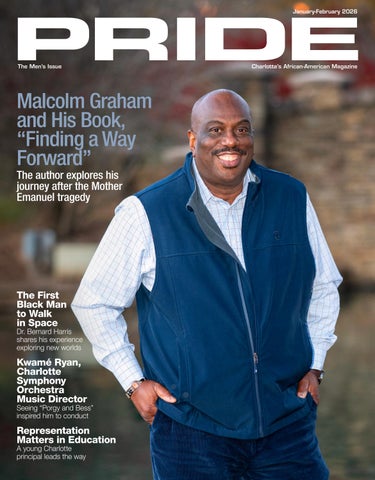
January-February 2026
The Men’s Issue
Malcolm Graham and His Book, “Finding a Way Forward” The author explores his journey after the Mother Emanuel tragedy
The First Black Man to Walk in Space
Dr. Bernard Harris shares his experience exploring new worlds
Kwamé Ryan, Charlotte Symphony Orchestra Music Director
Seeing “Porgy and Bess” inspired him to conduct
Representation Matters in Education A young Charlotte principal leads the way
Charlotte’s African-American Magazine
Warm up this winter with the Symphony. The Music of Motown Jan 23 & 24 KNIGHT THEATER Christopher James Lees, conductor Chester Gregory, Michael Lynche & Shayna Steele, vocalists Get down to the irresistible rhythms of Detroit’s iconic pop-soul sound with hits by Diana Ross, Stevie Wonder, and more.
Prokofiev & Schumann Jan 30 – Feb 1 KNIGHT THEATER Kwamé Ryan, conductor · Ran Dank, piano IVES PROKOFIEV R. SCHUMANN
The Unanswered Question Piano Concerto No. 3 Symphony No. 2
VALENTINE'S WEEKEND
Tchaikovsky’s Symphony No. 5 Feb 13 & 14 BELK THEATER Kwamé Ryan, conductor · Gabriel Kahane, piano & vocals Dani HOWARD Argentum Gabriel KAHANE Pattern of the Rail: Six Orchestral Songs TCHAIKOVSKY Symphony No. 5
KWAMÉ RYAN
MUSIC DIRECTOR
Get your tickets today! 704.972.2000 · charlottesymphony.org
COMING THIS SUMMER!
Jun 5 & 6 BELK THEATER
BREAK INTO YOUR DREAM CAREER WITHOUT BREAKING YOUR BUDGET. At Central Piedmont our programs give you skills to land a job, not massive debt. It’s just one more way we help you conquer possibility. Visit cpcc.edu/possible to learn more.
IMPORTANT ANNOUNCEMENT!
Pride Magazine and Title Sponsor Truist are excited to announce that the 2026 Pride Awards Luncheon is moving from its traditional February date to a dynamic new date in July 2026. This strategic shift positions the Pride Awards for greater impact, visibility, and innovation. After listening to our sponsors, partners, and community—and reviewing the momentum around emerging technologies—we’re confident this move will elevate the event and create new opportunities for engagement. Our focus on Generative AI and its impact on culture, business, and community remains central to the 2026 program. July is also the publication month of our Multicultural Issue, creating a powerful synergy between our print edition and the luncheon’s content, promotions, and thought leadership. For more information, email Dee@pridecommunications.net
January – February 2026
Departments 8
From the Publisher
16
22
25
36
10 Notable Names 11 Book Review 12 By Faith 13 The Vegucator 14 The Mindful Parent
Features 15 From Hip-Hop to Jazz
NC musical pioneers influence music worldwide
17 Finding a Way Forward
Malcolm Graham’s book explores loss and resilience
20 Charlotte Symphony
Orchestra Music Director Kwamé Ryan Sharing himself through the music
22 Trade School
or College? Skilled trades offer solid opportunities
23 The First Black Man to
Walk in Space Dr. Bernard Harris shares his experience exploring new worlds
25 Representation
Matters in Education A young Charlotte principal leads the way
27 The Mint
Museum’s Designing Dynamism Exhibit Exploring the rich history of Kuba textiles from the DRC
Log on to pridemagazineonline.com for more features.
32 Leaving Bad
Credit Behind Taylor Made Associates CEO helps people repair credit
35 From the Heart to
the Liver 10 amazing facts about the human body
36 Paul Robeson —
the Actor, Scholar and Fighter He paid a price for fighting injustice
On the Cover Malcolm Graham, author of the book, “The Way Forward: Keeping the Faith and Doing the Work Amid Hatred and Violence” Photo courtesy of Malcolm Graham
January-February 2026 | Pride Magazine
5
WE ARE ALL
WHEN WE
Place ONLY these SIX items in your curbside recycling!
1. PLASTIC BOTTLES & JUGS with Necks
2.CARDBOARD & SMALL BOXES (Clean Pizza Boxes - Okay)
3. EMPTY METAL CANS
4. MILK & JUICE CARTONS
5. PAPER & MAGAZINES
6. GLASS BOTTLES & JARS (Lids On - Okay)
M
A
G
A
Z
I
N
E
Charlotte’s African-American Magazine
CEO/Publisher Dee Dixon
Editor
Alicia Michele Benjamin
Copy Editor
Sonja Whitemon
Lead Writer Angela Lindsay
Creative Director Larry Preslar
Design & Production SPARK Publications www.SPARKpublications.com
Distribution Watch Dog Entertainment® LLC Digital Content Distribution
©
Account Executive Nikelle Fesperman
Public Relations
Nepherterra Estrada Best
Subscribe to Pride
$13.25. Please subscribe online at www.pridemagazineonline.com, mail to P.O. Box 30113, Charlotte, NC 28230 or call 704-375-9553
Letters to the Editor
Please send an e-mail to info@pridemagazine.net fax to 704-375-9550 or mail to Pride Magazine 8401 University Executive Park Drive, Ste. 122, Charlotte, NC 28262 www.pridemagazineonline.com
Copyright© 2026 Pride Magazine All rights reserved. Copying or reproduction, in part or in whole, is strictly prohibited. Pride Magazine reserves the right to deny any advertisement, listing or feature that does not meet Pride Magazine standards or that is outside the scope or mission of our magazine. Pride Magazine assumes no responsibility for information, products, services, or statements made by advertisers or editorial contributors.
Pride Magazine prints with soy ink. Vol. 34 No. 1 January–February 2026 All rights reserved for PRIDE Communications Inc. Find us on Facebook: Facebook.com/PrideMagazineNC Find us on Instagram: @pridemagazinenc Find us on LinkedIn: Pride Communications, Inc. January-February 2026 | Pride Magazine
7
FromTheCEO
Change Is on the Horizon Pride Awards 2026 Luncheon Moving to July By Dee Dixon
D
ear Pride family, As we step into a new year full of possibility, I want to share an exciting update about our beloved Pride Awards luncheon. After much reflection (and quite a bit of prayer and conversation!), we’ve decided to move the event from February — where it has lived for the past several years — to July. Why the change? Simply put, we want to give this signature celebration the time, space and energy it deserves. July offers a fresh moment in the year, a chance to gather when the calendar is less crowded, and a perfect opportunity to highlight our theme around Generative AI in a way that sparks curiosity rather than competing with everything happening during Black History Month. Most importantly, this move allows us to deliver the high-quality experience you have come to expect — something we could not do while sponsors are still finalizing their early-year budgets. July gives everyone room to breathe, plan and show up strong.
Dr. Sunil Erevelles, Belk College of Business at the University of North Carolina at Charlotte
In addition, just so you know, it’s always been challenging to produce an event like ours during first quarter. Some of you may recall the Pride Awards originally began as an upscale gala in January during Martin Luther King week for many years. (I’m currently ridding my closet of numerous
8
Pride Magazine | www.pridemagazineonline.com
ball gowns that have been gathering dust since 1993.) We subsequently moved it to a February luncheon in honor of Black History Month, which we have enjoyed, but it’s time to move on. I’m excited about this new chapter, and I hope you’ll mark your calendars and come celebrate with us this summer on July10 at the Ritz Carlton. We are building something bold, thoughtful and uniquely Pride. We are set to spotlight one of the most transformative topics of our time. Our theme “Future Forward with AI” will be a dynamic, interactive experience regarding the impact of Generative AI across Charlotte industries, people and communities. Truist Bank is on board as our title sponsor once again and Dr. Sunil Erevelles, Belk College of Business at the University of North Carolina at Charlotte, will bring the keynote. The missing element now is you. We need you to purchase your tables, tickets as soon as possible. Call the office at 704-375-9553, or log on to www.pridemagazineonline.com for more information. Socrates said, “The secret of change is to focus all of your energy, not on fighting the old, but building the new.” Thank you for growing and changing with us.
MILLS AUTOMOTIVE GROUP Driven by Family, Built for You
CELE
BRATING
For over 20 years, Mills Automotive Group has been more than a place to buy a car—we’ve been a part of the community. As a proud family-owned business with more than 35 dealerships and 29 trusted brands, we make it easy to find the right vehicle for every stage of life. YEA
RS IN BUSINESS
What sets us apart is simple: we put people first. From your very first test drive to years of trusted service, our team is here to treat you like family and make sure you drive away with confidence. Whether it’s a reliable first car, a family SUV, or that dream ride you’ve been working toward, we’re committed to helping you get there. Because at Mills Automotive Group, your journey matters.
Official Automotive Group Partner of the Charlotte Hornets
VISIT US AT MILLSAUTOGROUP.COM
NotableNames By Alicia Michele Benjamin
McColl Center Names Artist-inResidence Alumnus as Next President McColl Center has selected Asa Jackson as its new President and Chief Executive Officer, effective January 6, 2025. Jackson, a multidisciplinary artist and accomplished arts leader, comes to the McColl Center as a former artist-in-residence with the arts center. “I am deeply honored and excited to join McColl Center at this pivotal moment. My experience as a resident artist here was transformative, and I look forward to leading an organization that has been a cornerstone in empowering artists and fostering creativity,” Jackson said. He co-founded and served as Executive Director of the Contemporary Arts Network (CAN) Foundation, an arts nonprofit in Newport News, Virginia, that pioneered programs like the CAN Residency, professional development workshops and collaborative exhibitions that connect artists with resources and networks to support their long-term career growth. “Asa Jackson’s dedication to fostering artistic talent, paired with his experience as a nonprofit leader, makes him an extraordinary choice for McColl Center’s future,” said Vicki Block, Chair of McColl Center’s Board of Directors. “We’re excited to see him carry forward our mission and deepen our impact in the arts community.” As an artist, Jackson has exhibited at acclaimed venues throughout the U.S., with recent showings at MoCA Arlington, the Virginia Museum of Contemporary Art, Hodges Taylor Gallery in Charlotte and the Harvey B. Gantt Center. His works are also part of prestigious collections, including the Virginia Museum of Fine Arts, the Capital One Corporate Collection and the Rockwell Museum. Born in Washington, D.C., and raised in Hampton Roads, Virginia, Jackson has lived and worked in New York, Los Angeles and U.S. cities. After studying at Boston University, he pursued his art career full-time
Dr. Jennifer Thomas Named New Executive Director of Teen Health Connection Teen Health Connection, the leading provider of integrated medical and behavioral health services for adolescents and young adults in the Charlotte region has selected Dr. Jennifer Thomas as the new Executive Director. Thomas brings more than 15 years of experience as a behavioral health care leader and licensed psychologist focusing on adolescents and their families. Currently, Thomas serves as the Chief Psychologist with Teen Health Connection. In her current role, Thomas and her team provide behavioral health triage, assessments for youth involved with child welfare and social work services for teens receiving specialized medical care. Teen Health Connection provides a safe space for all adolescents to receive the medical and behavioral health services they need,” Thomas said. “I look forward to working alongside a fabulous team of health experts who care tremendously about supporting the unique strengths and needs of teens and their families as they journey through the joys and challenges of adolescence,” said Thomas. “Teen Health Connection is needed now more than ever.” Thomas received her Doctor of Philosophy in Clinical Psychology from the University of North Carolina at Chapel Hill.
“I am deeply honored and excited to join McColl Center at this pivotal moment. My experience as a resident artist here was transformative, and I look forward to leading an organization that has been a cornerstone in empowering artists and fostering creativity.” —ASA JACKSON
10
Pride Magazine | www.pridemagazineonline.com
BookReview
By Angela Haigler
Black History Winter Reading List From the Harlem Renaissance to Dick Gregory
“Not Without Laughter”
“Burn Down Master’s House”
by Langston Hughes
by Clay Cane
When Not Without Laughter hit the scene in 1930, Langston Hughes was already shining bright—one of the Harlem Renaissance’s most electric voices, celebrated for poetry that broke rules and opened doors. His first novel, this book is like sitting on a front porch listening to a family’s whole heart laid open—tender, raw and humming with truth. Hughes paints Sandy’s coming-of-age with the same lyric pulse that made his poetry iconic. Every character carries their own dream, flaw and fight, creating a tapestry that feels lived-in and deeply familiar. The novel captures the sweetness and sting of growing up Black in early-20thcentury America.
Burn Down Master’s House hits like a match to dry grass—slow at first, then unstoppable. Clay Cane threads together scattered acts of rebellion and turns them into a chorus of courage that refuses to stay quiet. The characters feel lived-in and luminous, each carrying their own spark toward freedom. What unfolds is brutal, tender, and fiercely human. The book is a sweeping reminder that resistance doesn’t start with armies—it starts with the brave decision to rise.
“Chain of Ideas: The Origins of Our Authoritarian Age”
“A Black Queer History of the United States” by C. Riley Snorton and Darius Bost
by Ibram X. Kendi Writer Ibram X. Kendi digs into the roots of great replacement theory with the precision of a historian and the urgency of someone who knows the stakes are real. Chain of Ideas reads like someone finally turning the lights on in a room we’ve all been stumbling through. He shows how a fringe lie grew legs, crossed oceans, and walked right into the center of global politics. It’s uncomfortable, necessary and clarifying in all the right ways.
Feeling like a long-overdue spotlight turned toward stories that were always there, A Black Queer History of the United States just pushes readers to the margins. Snorton and Bost stitch together a lineage of brilliance, defiance and survival that reshapes how we understand the Black freedom struggle. These lives—complex, courageous, and too often erased—take their rightful place at the center. The book reads like both a reclamation and a revelation. It’s history that informs and insists we see the whole truth.
Children’s Choice “Seven Million Steps: The True Story of Dick Gregory’s Run for the Hungry” by Derrick Barnes Seven Million Steps blazes with the spirit of a man who refused to stand still while others went hungry. Derrick Barnes, Frank Morrison and Dr. Christian Gregory bring Dick Gregory’s mission to life with rhythm, reverence, and fire. Each page pulses with motion—one man’s body as protest, his steps as prayer. The art and words move together like a heartbeat for justice. This is more than history—it’s a challenge to keep running for what’s right. P
January-February 2026 | Pride Magazine
11
ByFaith
By Rev. Dr. Dwayne Bond
When Favor Feels Like an Unfair Fight
T
here are seasons in our lives when walking with God doesn’t feel like living in divine favor; it feels like fighting for your life. Belonging to Christ often puts us at odds with the world, with those who oppose Christ, and sometimes even with people who share our faith but hold conflicting convictions. Too often, we assume that “favor” means a peaceful, trouble-free life. It’s not!
Scripture repeatedly shows that God’s favor and a life without suffering rarely occupy the same space. Christians are different because they belong to Christ.
12
Pride Magazine | www.pridemagazineonline.com
And because of that, we will experience hardship. But we must also be honest: sometimes suffering comes not simply because we belong to Christ, but because we mishandle the very favor He’s given us. When Christians act superior, treat others as if they’re spiritually beneath us, or flaunt God’s blessings, it stirs up the worst in people. God has not chosen us at the expense of others but for the sake of others. We are not believers because of anything in us; we are believers only because of God’s redeeming grace toward us. That means we don’t flaunt favor; we steward favor in humility. We’re not better; we’re just, by grace, better off. Genesis 37 is a masterclass in this truth. Joseph, still a naive teenager, mishandled the favor in his life. He flaunted it. He didn’t read the room. He shared his dreams with brothers who already resented him, and he wore his father’s handmade multi-colored robe like a badge of superiority. Joseph’s immaturity fanned flames that were already burning. His father’s visible favoritism, coupled with Joseph’s pride, stirred up conflict in the family. And that conflict grew into hatred. Yet, even through Joseph’s naivete, immaturity, and the brokenness of his brothers, God’s providence never faltered. His purposes marched forward, even through sin, jealousy, deception, and suffering. Joseph’s pride led him into a pit. His brothers stripped him, betrayed him, and sold him into slavery. The favored son became the forsaken brother. But the pit was never punishment; it was preparation. God was unfolding
a story that Joseph couldn’t yet see. The very suffering that felt like abandonment was actually the pathway to redemption, not only for Joseph but also for the brothers who betrayed him. This is the beautiful tension of the believer’s life: flaunting favor leads to conflict, but God’s favor, rightly understood, leads to redemption. And all these points lead us to Jesus. Like Joseph, Jesus was the beloved Son sent by the Father. His obedience stirred up opposition. But Jesus did not flaunt His favor; He poured it out. He was betrayed by His own, stripped, rejected, and placed in the pit of death. But what looked like defeat was God unfolding His greatest act of redemption. On the third day, the pit gave way to resurrection. So, when your life feels like Genesis 37, dark, confusing, unfair, remember this: God’s favor does not shield you from suffering; it secures you through it. The God who governed Joseph’s pit governs yours, too. And every pit in the hands of God becomes a pathway to redemption. Here are four takeaways for men to consider from Joseph’s life: Favor is not something to flaunt; it’s something to steward. Conflict doesn’t mean that God isn’t working. Your immature decisions and actions can create suffering, but God can redeem it. God’s faithful promises hold firm even when people don’t.
1 2 3 4
May the Lord encourage you as you trust His good heart for you. P
TheVegucator
When Circulation Fails Below the Belt By Dawn Hilton-Williams
Erectile function, Black men and the power of lifestyle change
E
Scan the QR code below to view the recipe for Curry Roasted Cabbage by chef Dawn Hilton-Williams.
rectile dysfunction (ED) isn’t an aging issue and it isn’t a private embarrassment men should carry in silence. It’s a warning sign that the body’s vascular system is struggling to do what it was designed to do. The truth is that ED is often resolvable. In many cases it improves when we address the habits that shape circulation, blood pressure, blood sugar and hormone balance. ED often shows up as a warning bell for deeper vascular problems that need attention before they progress. A systematic review published through PubMed found that erectile dysfunction commonly precedes heart disease and is strongly associated with modifiable lifestyle risk factors. Research from the Physicians Committee for Responsible Medicine shows that low-fat, whole food plant-based diets can support restored function and improved vascular health. A 2025 case report even documented a complete resolution of ED after a man adopted a whole food plant-based pattern. The case report reinforces the well-established science on plant-rich diets and circulation. Doctors Dean Ornish, MD, and Caldwell Esselstyn, MD, have shown for decades that practicing a whole food, plant-based lifestyle improves endothelial function, increases nitric oxide, lowers inflammation and helps the arteries relax, which directly supports erectile function. This carries particular weight for Black men, as national data from the American Heart Association shows that 56% of Black men have hypertension by age 55 and experience diabetes-related complications at rates about 70% higher than other groups. When ED is shaped by daily patterns and long-term habits, the body often
responds once consistent changes begin and that shift is where hope and empowerment take root.
What is a whole food plant-based lifestyle? A whole food plant-based lifestyle centers foods from the earth eaten close to their natural state. Beans, lentils, whole grains, fruits, greens, nuts and seeds become the foundation, while avoiding ultra-processed foods and animal products, which create inflammation and constrict blood vessels. This lifestyle is nourishing, affordable, culturally aligned and scientifically grounded.
Four steps that helps strengthen circulation
1
Eat for circulation Leafy greens, beets, berries and sweet or purple potatoes help strengthen circulation by increasing nitric oxide, lowering inflammation and supporting healthier artery function. Research shows that adding these foods to daily meals can improve vascular function within weeks and continue progressing over time with consistency. This same pattern of improvement continues when whole fruits are part of the meal. A common myth claims that fruit spikes insulin but science shows that intact fruit doesn’t behave that way in the body. The fiber in whole fruit slows absorption and keeps blood sugar steady. Fruit juices don’t have that fiber, so they move through the bloodstream fast, spiking levels more quickly. Choosing whole fruit keeps the body balanced and supports healthier circulation. Reduce foods that harm the arteries High-sodium meals, fried foods, processed meats and dairy
2
are loaded with saturated fats, strain circulation and increase inflammation. Lightening the load gives the blood vessels space to repair and recover. Choosing more whole, minimally processed plant foods shifts the body toward balance. Move with intention Daily movement improves blood flow, hormone balance and vascular tone. Walking, dancing, yardwork, hooping or simple strength exercises help regulate circulation. Even 30 minutes a day, done consistently, makes a meaningful difference. Talk about it early and get checked ED can be one of the earliest signs of high blood pressure, diabetes or vascular strain. Addressing it early protects long-term health and gives men the chance to correct the root causes before they progress.
3
4
What about resources?
Evidence-based resources are available at nutritionfacts. org and pcrm.org, along with culturally aligned whole food plant-based education programs at powerisgiving.org. Erectile dysfunction doesn’t define any man’s story, it simply serves as a reminder that the body is calling for care and that change becomes possible when we answer with intention and honor our right to live well. Black men have carried enough weight. It’s time to carry knowledge and a lifestyle that restores strength, clarity and confidence. Every step toward better circulation is a step toward a fuller life, a deeper legacy and a future powered by optimal wellness. P
January-February 2026 | Pride Magazine
13
TheMindfulParent
By Shavonda Bean
Moving Forward, but Still Behind: The Silent Crisis
H
ave you noticed more people openly discussing mental health, chatting about suspected diagnoses or recent therapy sessions? More children approach their parents about evaluations or starting therapy, and parents are responding. This gradual shift of acceptance and openness is monumental in normalizing mental health. These conversations and improved access to healthcare build stronger support systems and keep the momentum going; however, women are still more likely to seek treatment than men. This leaves men less likely to be diagnosed and treated for symptoms like depression and anxiety, although one in ten men will be affected. The other startling fact is that men in the United States die by suicide at a rate four times higher than women. In 2023, suicide was the third leading cause of death for Black Americans ages 15 to 34.
and societal pressures worsen the matter. There is a lot of work to do. While it is not unusual to have brief thoughts of death or suicide, planning and contemplating are more serious. Some men are likely to keep up their typical routines and activities while suffering in silence. Others will exhibit warning signs. Take them seriously. Signs might include withdrawal, increased irritability, increased use of alcohol and drugs, problems in school, unusual decline in academic performance, significant changes in behavior like increased sleeping, significant mood swings, and/or hopelessness. Also, the loss of meaningful relationships or significant failures can worsen suicidal thoughts. Others might consider engaging in risky behaviors that prompt harm by others or openly talk about death and plans to end their lives. Be aware of sudden improvements in mood for a couple of reasons. Mood can improve as the decision to end one’s
The hidden threat of suicide requires the same type of exposure, conversation and attention as dispelling the overall stigma of mental illness. As a culture, we have considered suicide to be someone else’s problem for too long. Suicide is extremely difficult to talk about as it is often intermingled with fear and confusion; nevertheless, we must face it. Our communities have limited access to culturally competent providers. This fact, combined with mistrust of the medical system, creates barriers to care that leave men’s needs unaddressed. In many cases, men are expected to mask emotions and show a level of strength that might make it difficult to admit to mental health challenges or suicidal thoughts. Added factors like systemic racism, identity conflicts, discrimination,
14
Pride Magazine | www.pridemagazineonline.com
life brings relief and because an elevated mood can provide just enough energy to follow through. Diagnoses such as post-traumatic stress and bipolar disorder are also associated with increased suicidal risk. Seek professional help as soon as possible. Treatment approaches such as cognitive-behavioral therapy address negative thought patterns and behaviors, while mindfulness-based stress reduction teaches exercises and strategies to manage the physiological reactions to stress, anxiety and trauma. Problemsolving skills are often pivotal in helping individuals consider alternatives to managing life’s temporary setbacks without considering death. Providing our Black men and boys with heavy doses of love, validation, openness,
family support and access to resources is invaluable. Create safe spaces for conversations without being dismissive or minimizing, and often more importantly, be direct. If you are worried that someone is considering suicide, ask. Asking does not plant the idea of suicide; it instead creates space for open dialogue. Have resources like 988 Lifeline readily available. It is a national hotline that provides 24/7 support for mental health, suicide and problems related to substance use. Do not assume that success, athleticism, beauty or the appearance of a perfect family will provide immunity from this type of thought. Suicidal thoughts are like unwanted guests, and one should guard and protect their minds and thoughts, just as they would protect their homes. Check on our boys and men. Let’s keep the conversations going that bring them towards healing. P
PeopleImages / shutterstockcom
Providing our Black men and boys with heavy doses of love, validation, openness, family support and access to resources is invaluable.
From Hip-Hop to Jazz:
North Carolina Musicians Influence Music Worldwide By Alicia Benjamin
These legendary Black men from North Carolina are pioneers in the jazz, R&B and hip-hop musical genres. Over the last 100 years, these musicians have elevated the artform of music, not only during their lifetimes, but for generations in the future.
John Coltrane • Jazz (1926 – 1967)
Thelonious Monk • Jazz
Max Roach • Jazz (1924 – 2007)
Jazz saxophonist, band leader and composer John Coltrane was born in Hamlet, N.C. in 1926. He moved with his family to Philadelphia when he was a teenager and that’s where he started playing saxophone in high school. After playing with such legends as Miles Davis and Thelonious Monk, and overcoming a heroin addiction, Coltrane wrote his four-part masterpiece, “A Love Supreme” in 1965. He experienced a spiritual awakening after quitting drugs and asked to be given “the means and privilege to make others happy through music.” Coltrane moved some of his fans so deeply that some of his followers started a spiritual community in 1969 that was inspired by his music. Known today as Saint John Coltrane Church in San Francisco, its members use lyrics and music from “A Love Supreme” as part of their church service.
Credited as one of the innovators of modern jazz, Thelonious Monk played with jazz giants Charlie Parker, Dizzy Gillespie, Coleman Hawkins and many others beginning in the 1940s. Monk, born on October 10, 1917, in Rocky Mount, N.C., moved to Manhattan with his family in 1922. He began studying classical piano when he was 11 years old, but he had already learned to play the piano from watching his sister practice during her music lessons. Monk has composed some of the most recorded jazz standards including “Straight, No Chaser,” “Blue Monk,” “Round Midnight,” and “I Mean You.” Monk was known for his eccentric piano playing style which sometimes included forceful banging on the piano keys, long pauses and playing dissonate chords that created strange harmonies. Monk retired in the early 1970’s after battling mental illness. He died from a stroke in New York City in 1982.
Max Roach was born in Pasquotank County, N.C in 1924 and moved to Brooklyn, N.Y. with his family when he was four years old. He studied classical percussion at the Manhattan School of Music and co-founded Debut Records with bassist Charles Mingus in 1952. Roach formed one of the most respected quintets in jazz history in 1954 with the legendary jazz trumpeter Clifford Brown, who died when he was 25 in a car accident on the Pennsylvania Turnpike. Roach and his second wife, singer and actress Abbey Lincoln, often performed together and helped to create the critically acclaimed “We Resist!” which was released in 1960. A protest piece and artistic expression of the vibrant civil rights movement of the time, “We Resist!” consists of experimental songs that incorporate screams, frantic drumming, instrumental improvisations and forceful singing by Lincoln.
Coltrane moved some of his fans so deeply that some of his followers started a spiritual community in 1969 that was inspired by his music. Known today as Saint John Coltrane Church in San Francisco, its members use lyrics and music from “A Love Supreme” as part of their church service.
(1917 – 1982)
January-February 2026 | Pride Magazine
15
From 2012-2013, Patrick Denard Douthit served as a Harvard University Fellow and taught at the University’s Hiphop Research Institute.
Chuck Brown • Go-Go (1936 – 2012)
Known as the Godfather of Go-Go, Chuck Brown was born into poverty in Gaston, N.C. on Aug. 22, 1936. His family moved to Washington, D.C. when he was 7. It was after he was released from prison, where he traded cigarettes for a guitar, that he became passionate about music. Although he’s not a drummer, Brown is known as one of the pioneers of Go-Go, which draws from Afro-Latin percussive beats. His musical palate was influenced by his work with a band called Los Latinos that his childhood friend from Central America started. Go-Go originated in D.C. in the mid-1970s and is deeply entrenched in the culture of the city, but the music has traveled worldwide and has influenced both hip hop and rhythm and blues. Brown’s mega 1979 hit, “Bustin’ Loose,” was even used in a national TV commercial for Chips Ahoy in 2010. Brown died in May 2012 in Baltimore after a long hospitalization. The city of Washington, D.C. commemorates Brown’s life and legacy every August with a musical concert held at Chuck Brown Memorial Park in Northeast, D.C., featuring — you guessed it — Go-Go.
9th Wonder (a.k.a., Patrick Denard Douthit) • Hip-Hop
Although he’s known as a hip-hop producer, 9th Wonder is nominated for a 2021 Grammy Award in the Best Progressive R&B Album category. He and Kamasi Washington, Robert Glasper and Terrace Martin are nominated for their work on the album “Dinner Party: Dessert.” Born in Winston Salem, N.C. in 1975, DJ/Producer 9th Wonder met two rappers while he attended North Carolina Central University (NCCU), Phonte and Big Pooh, and they formed the group Little Brother. While working with Little Brother, 9th Wonder was also producing for other artists including Nas, Jay-Z and Destiny’s Child. He left Little Brother in 2007, but has continued to produce acclaimed recordings for Mary J. Bilge, Kendrick Lamar, Erykah Badu and many others. Also known as a hip-hop professor, 9th Wonder has taught music-related classes and workshops at NCCU, Duke University, Long Island University and elsewhere. From 2012-2013, he served as a Harvard University Fellow and taught at the University’s Hiphop Research Institute.
The city of Washington, D.C. commemorates Brown’s life and legacy every August with a musical concert held at Chuck Brown Memorial Park in Northeast, D.C., featuring — you guessed it — Go-Go. 16
Pride Magazine | www.pridemagazineonline.com
J. Cole (a.k.a., Jermaine Lamarr Cole) • Hip-Hop
When J. Cole performed his song, “Be Free,” in 2014 on the Late Show with David Letterman, it was clear that Cole was not just singing a song – he was conveying a serious message. The song was a response to Michael Brown’s death in Ferguson, Mo., that year. When he sang: All we wanna do is take the chains off/All we wanna do is be free — We knew he was speaking on our behalf, and we knew that he cared deeply. Cole was born on a U.S. army base in January of 1985 in Germany, but his mother moved with him and his brother Zach to Fayetteville, N.C. later that year. Living in a home with a mother, stepfather and other adults who were addicted to drugs, Cole used music to escape. He joined a local orchestra as a violinist and started rapping and producing music. Cole graduated magna cum laude from St. John’s University in 2007 and eventually signed to Jay-Z’s Roc Nation. Since then, he has been nominated for 12 Grammys (he won in the Best Rap Song category in 2019) and has produced music for Kendrick Lamar, Janet Jackson and other artists. Cole started his record label Dreamville Records in 2007. P This article previously appeared in the January/ February 2022 issue of Pride Magazine.
>
>>>> Finding a Way Forward
Malcolm Graham writes about his journey after the Mother Emanuel Church shooting By Angela Lindsay
W
Photos courtesy of Malcolm Graham
hen a young white man walked into the historical Mother Emanuel African Methodist Episcopal Church in Charleston, S.C.,under the guise of joining church members in their Bible study and shot and killed nine of them, the shock across the nation was palpable. For those in the Charlotte area, the event took an even more tragic turn when it was discovered that one of the victims, Cynthia Graham Hurd, was the sister of long-time local public servant and current Charlotte City Council member, the Hon. Malcolm Graham. I sat down with Councilman Graham to discuss his new book, “The Way Forward: Keeping the Faith and Doing the Work Amid Hatred and Violence,” wherein he channels his pain, perspective and perseverance in a way that he hopes will help and heal others as it has himself. Angela Lindsay: How did the decision to write this book come about, and why was it important for you to do so? Malcolm Graham: I decided to write “The Way Forward” to observe the 10th anniversary of the tragedy that forever changed my life and the lives of so many others . . . Cynthia dedicated her life to learning and literacy as a librarian, and today, the Cynthia Graham Hurd St. Andrews Regional Library (in Charleston) stands as a testament to her legacy of service, compassion and knowledge. In addition, I felt a deep calling to honor her memory in a way that would both preserve history and offer perspective. I wanted a book about her — and about that moment in time — to have a permanent place in the library that bears her name.
Charlotte City Council member Malcolm Graham, author of “The Way Forward: Keeping the Faith and Doing the Work Amid Hatred and Violence”
More than that, I wanted to provide future generations of my family, including my grandsons Carter and Ashton, and others who will never have the chance to know Cynthia personally, with a firsthand account of what happened and how our family journeyed through grief, resilience and purpose. Lindsay: What did the writing journey look like? Graham: The journey to writing “The Way Forward” was both emotional and deeply personal. It took about a year to complete, but in many ways, it was 10 years in the making. There were several starts and stops along the way — moments when I had to pause, reflect and gather the emotional
strength to continue. Writing about such a painful chapter of my life required space, grace and time. Much of the process involved research and conversations. I interviewed many individuals who were directly and indirectly connected to the tragedy — family members, friends, clergy, community leaders and others who played a role in the events that unfolded in Charleston. I also revisited newspaper clippings, editorials and video footage from that period to ensure accuracy and context. Those materials brought back powerful memories, but they also reminded me how far we’ve come as a family and as a community. My approach to writing was rooted in honesty and transparency. I didn’t want to polish or perfect the pain. I wanted to tell the truth — my truth — about the experience, the loss and ultimately, the resilience that followed. Writing “The Way Forward” was not just about recounting events; it was about finding meaning, purpose and hope through the process of reflection. Lindsay: How would you describe the writing process for you — therapeutic, cathartic, revelatory or something else? Graham: For me, the writing process was deeply therapeutic. In the years following the tragedy, I never took time for formal counseling. There was simply too much happening all at once — first, the shock of losing my sister, Cynthia, then the responsibility of helping plan her homegoing
January-February 2026 | Pride Magazine
17
>>
service, and soon after, being thrust into a national conversation about forgiveness, justice and reconciliation. There were public debates about the Confederate flag, family matters to attend to, and even moments on the national stage, including meeting President Obama and the First Lady. Lastly, it was the trial where I testified as a character witness for my sister. In the midst of all that, I never truly paused to process my own grief. My focus was always outward — on keeping my family strong, supporting my community, and doing the work necessary to honor Cynthia’s life and legacy. I poured myself into service and leadership, but rarely into self-reflection. Writing “The Way Forward” changed that. It became a safe space for me to slow down; to look back and to face the emotions I had quietly carried for nearly a decade. Through the process of writing, I was finally able to grieve, to heal and to make peace with moments I hadn’t allowed myself to fully feel before. Lindsay: What did writing the book teach you about yourself? Graham: It taught me more about myself than I ever expected. For nearly 10 years, I had been so focused on moving forward — keeping my family strong, serving my community and honoring Cynthia’s legacy — that I never really stopped to ask how I was doing. Through the writing process, I learned that healing doesn’t come from constant motion; it comes from allowing yourself to be still long enough to feel, to remember and to process.
I discovered that I had carried a great deal of unspoken pain — not because I wanted to hide it, but because I felt a responsibility to be strong for everyone else. Putting those emotions on paper helped me understand that vulnerability is not a weakness; it’s a form of courage. It takes strength to confront your own heart. I also learned that forgiveness, which I had spoken about publicly for years, is not a single act — it’s a journey. Writing forced me to revisit difficult moments and emotions I thought I had already resolved. In doing so, I realized that forgiveness continues to evolve; it grows with you as you grow. Lindsay: How did you initially feel when you first heard the news about what happened at Emanuel AME Church? Can you describe how your family — immediate and extended — were and still are affected? Graham: I wrote about this moment in the book — the exact instant when I knew something was happening back home. I was getting ready for bed when the television, tuned to CNN, interrupted its broadcast with breaking news. There had been a shooting at Mother Emanuel AME Church in Charleston, and reports were saying that several people were dead. I froze. Emanuel isn’t just any church to me — it’s my family’s spiritual home. I was born and raised in Charleston, and for more than 50 years, my family has been connected to that church. My grandmother and my mother sang in the choir there, and my brothers Robert, Gilbert and Melvin, and sisters Cynthia and Jackie, and I grew up
Lindsay: How have your views on loss, grieving and forgiveness been changed or expanded through this process?
Photos courtesy of Malcolm Graham
Malcolm Graham, Gilbert Moultire, Melvin L Graham, Jr., Robert Moultire, Averill “Jackie” Graham Jones (front), Cynthia Graham (far left)
within those very walls. It was a sacred place — a place of love, community and faith. My first instinct was to call Cynthia to find out what was going on. She didn’t answer. I told myself she was probably trying to make sense of everything or helping others. But as the minutes passed, the news coverage grew more alarming. About 40 minutes later, I received a call from my niece, Megan. Her voice was trembling. She told me they couldn’t find Aunt Cynthia and that she had likely attended Bible study that night. From that moment forward, our family’s tragedy began to unfold. I felt stunned — almost outside of myself. Even though I was miles away from Charleston, I could feel the weight of what was happening as if I were standing right there in that church. I remember feeling both helpless and heartbroken, yet somehow focused, trying to process the unthinkable. For my family, the loss of Cynthia was — and still is — immeasurable. She was the heart of our family; the one who connected everyone, who remembered every birthday, who showed up for everyone. Her absence created a void that can never be filled. Over the past decade, we’ve each carried that grief in our own way. But we’ve also carried her spirit — her kindness, her intellect and her belief in service. The pain of losing her never disappears, but our love for her and the way she lived her life, continues to guide us. The tragedy shattered us, but her legacy has helped us rebuild.
Cynthia Graham Hurd, Malcolm Graham’s sister
>>>>>> Graham: My views on loss, grieving and forgiveness have evolved in complex and, at times, uncomfortable ways. I’ve come to understand that forgiveness is not simple — it’s not a single act or a moral performance. It’s a deeply personal journey, and one that I’m still on. People often ask if I’ve forgiven the man who murdered my sister and eight others that night. The truth is, I can’t. How do you forgive hatred — not just an individual act, but the centuries of racism, discrimination and violence that made such an act possible? What happened at Mother Emanuel wasn’t only an attack on nine innocent people; it was an attack on an entire race of people. The shooter himself said he wanted to start a race war. Ten years later, as I look at where we are as a nation, I can’t help but ask: has that war already begun, and we simply refuse to call it what it is? We see attacks on diversity, equity and inclusion. We see attacks on truth in education, on voting rights, on the very progress that generations before us fought and died to achieve. These are not isolated moments — they are reflections of a deeper struggle for justice and equality that continues. Grieving for me has also meant reckoning with that reality — understanding that my sister’s death is tied to a much larger story about America’s unfinished work. But even amid that pain and anger, I’ve also learned that love and purpose can coexist with grief. My faith tells me that I may not be able to forgive today, but I can still work for healing, justice and hope. My way of honoring Cynthia — and the eight others — is by continuing the fight for a world where such hate has no place. That, to me, is a form of grace. Lindsay: How has Mother Emanuel AME Church changed since the incident? Do you ever go to the church to visit? Graham: Yes, I visit Mother Emanuel quite often. For me, it’s not just a church — it’s sacred ground. Every visit is emotional, but it’s also grounding. It’s a place where tragedy and triumph coexist, where faith continues to rise above hate. Over the past 10 years, Mother Emanuel has remained a symbol of resilience, grace and unwavering faith. The church continues to welcome worshippers from around the world who come to pay their respects, to pray, and
to draw strength from the congregation’s remarkable spirit of perseverance. The members have carried on the legacy of their ancestors — turning pain into purpose, and sorrow into service. On June 12 of this year, I hosted a national town hall meeting at Mother Emanuel to commemorate the 10th anniversary of the tragedy. It was a moving and powerful evening that included live music, heartfelt tributes, and a panel discussion led by my good friend Bakari Sellers. The event was not about reliving the pain of that night — it was
and personal way. I know what it feels like to have your world suddenly turned upside down, to have to find faith in the middle of heartbreak, and to try to make sense of something that can never fully be explained. Because of that, I try to approach those moments with both compassion and conviction — to show them that faith in God can sustain us, but also that faith requires work. James 2 tells us that “faith without works is dead,” and I believe that to my core. We can pray for peace, but we also have to create policies that make
From left to right: First lady Michelle Obama, Steve Hurd, Averill “Jackie” Graham Jones, President Barack Obama, Melvin Graham Jr., and Malcolm Graham in 2015 — after the funeral of Rev. Clementa C. Pinckney, who was also a South Carolina state senator.
about celebrating how Cynthia lived, not how she died. We honored her legacy and the legacies of all nine victims by focusing on their faith, their service and the light they brought into the world. Mother Emanuel continues to stand as a living testament to that light — a place where the doors remain open, and the message remains clear: Love is stronger than hate, and faith is stronger than fear. Lindsay: How has this experience shaped who you are going forward as a public servant and your views on how to best serve our community? Graham: This experience has profoundly shaped the way I serve and the way I lead. It has made me more empathetic, more present, and more deeply aware of the pain that so many families in our community live with every day. When I meet with families who have lost loved ones to violence — whether through gun violence or other acts of senseless tragedy — I can relate to their grief in a very real
peace possible. We can lean on our faith for strength, but we must also act — to strengthen gun safety laws, to support victims of domestic violence, to invest in community programs that prevent violence before it begins. Going forward, I’m committed to serving with both faith and action — helping families heal, helping communities find hope and doing the hard work necessary to make Charlotte a safer, more compassionate city for everyone. Lindsay: What do you want readers to take away from this book? What advice would you give them on how to cope in the face of adversity and tragedy? Graham: Coping with tragedy isn’t just about enduring the pain — it’s about finding ways to honor it through meaningful action. My advice to readers is to let your grief or your fear fuel your purpose. Stand up, show up and work toward change, whether in your family, your neighborhood or your community. P
January-February 2026 | Pride Magazine
19
Photo courtesy of Valentin Behringer
Maestro Kwamé Ryan’s Symphony of Belonging By John Burton Jr.
Photo courtesy of Genesis Photography
B
y the time seven-year-old Kwamé Ryan looked up from his seat at Ontario Place in Canada that summer evening in 1977, his fate was sealed. The Houston Grand Opera’s production of “Porgy and Bess” was unfolding before him — that quintessentially Black American opera about the fictional Catfish Row in South Carolina, love and loss, and Black resilience. But young Kwamé wasn’t just moved by the story. His eyes were locked on the man at the front with the baton in his hand, summoning magic from musicians. “I want to do what that guy is doing,” he told his mother. She believed him. When the family returned to Trinidad from their Toronto vacation, she bought him a used piano. Nearly 50 years later, Ryan stands as music director of the Charlotte
Top Right: Kwamé Ryan, music director of the Charlotte Symphony Orchestra; Above: Charlotte Symphony Orchestra conductor, Kwamé Ryan; Below: Kwamé Ryan conducts the Charlotte Symphony Orchestra
“My artistic self-belief or lack thereof has always been completely de-coupled from my ethnicity or heritage.”
Photo courtesy of Genesis Photography
—KWAMÉ RYAN
20
Pride Magazine | www.pridemagazineonline.com
Symphony Orchestra. He is one of the few Black conductors leading a major American orchestra. But his journey to the podium reads less like a story of barrier-breaking and more like a masterclass in trusting one’s artistic compass — even when the path seems improbable. His father was a university political science professor. His mother was a secondary school English teacher who lived a second life on stage as an actress. The young Ryan spent countless evenings at her rehearsals, scribbling notes and sending “suggestions” to directors through his
The Charlotte Symphony’s new CSO 360 series places the orchestra in the round, dissolving the traditional wall between musicians and listeners. and air fryer, turning out curries and stews that combine his Trinidadian heritage with his love of efficient kitchen technology. Ryan’s dream for Charlotte is elegantly simple: “A CSO playing at the height of its technical and creative powers for a large, faithful and appreciative audience that considers it the musical heart of our region.” It’s the same vision that seven-yearold boy had watching Porgy and Bess — a belief that great music belongs to everyone, that the podium is exactly where he’s meant to stand, and that the most powerful performances emerge when artists stop proving themselves and start sharing themselves. The conductor’s baton rises. Charlotte listens. And the music — oh, the music, speaks for itself. P
Photo courtesy of Genesis Photography
Photo courtesy of Valentin Behringer
mother. “I think I must have been a pretty precocious child,” Ryan said. It was the theatrical environment — the collaboration, the creative problemsolving, the communal pursuit of something greater imprinted on his artistic DNA. Another formative moment that shaped his sonic imagination was the movie “Star Wars” that debuted in the summer of 1977. It wasn’t the story or special effects but John Williams’ orchestral score that felt otherworldly to him. Watching Zubin Mehta conduct the New York Philharmonic on television with Leontyne Price and Itzhak Perlman— an Indian maestro, a Black soprano and a Jewish violinist creating art together. “It planted the happily misguided idea that it was entirely normal for an Indian conductor to lead a worldclass orchestra and a Black diva to be performing alongside him,” Ryan said.
Ask Ryan about being one of the few Black conductors in his position, and his answer disrupts the expected narrative. “My artistic self-belief or lack thereof has always been completely de-coupled from my ethnicity or heritage,” he said. It’s not defiance or denial—it’s a man who has always measured himself against the music, not the room. Which brings us to Charlotte. Ryan wasn’t even looking for the job when he first guest-conducted the orchestra. Post-covid, he was reimagining his career from “a place of maximum freedom.” But Charlotte had other plans. The city’s warmth embraced him. The orchestra’s musical chemistry with Ryan was undeniable. And crucially, he genuinely liked his colleagues as human beings. “A workplace environment filled with mutual respect, trust and affection was so attractive to me that saying yes was easy,” he said. What Ryan brings to Charlotte goes beyond his baton technique or interpretive brilliance. When he conducts Brahms’ First Symphony — a piece he led at his first concert after his appointment was announced — he guides audiences through darkness into luminous joy. But his vision extends further. The Charlotte Symphony’s new CSO 360 series places the orchestra in the round, dissolving the traditional wall between musicians and listeners. At home, Ryan finds grounding in the everyday. He cooks with his Thermomix
January-February 2026 | Pride Magazine
21
Choosing Skilled Trades Over Years in College and Debt By Derik Hicks
W
hen Jalen Hinton sat in his high school guidance counselor’s office and contemplated a four-year college degree, he said he felt the pressure to go to college and get a bachelor’s degree that many high school students face. But for many Black men, that path now feels increasingly uncertain. According to the American Institute for Boys and Men, there has been a decline in the enrollment of Black men. “Black men account for only 26% of the students at historically Black colleges and universities, which is down from 38% in 1976. In fact, there are fewer Black men enrolled at HBCUs today than in 1976.” “At the same time, Black male enrollment at predominantly white institutions has also struggled. Black men represent a small share of total enrollment, and their six-year graduation rate hovers around 34–36%, compared to about 60% for all students,” according to the National Center for Education Statistics. At Goodwill Industries of the Southern Piedmont in Charlotte, Director of Construction and Trade Training Marvin Kelley Jr. is watching this shift closely — not as a crisis, but as a chance to recalibrate how young Black men build their futures. “We’re not saying college is bad,” he said. “We’re saying there’s another credible route — hands-on, debtfree, with a real job at the end.” Many Black men are choosing not to enroll in college or they enroll but never finish, citing financial pressure, lack of belonging and mounting debt. At a time when overall college attendance is slipping nationwide, this trend raises a larger question: How do Black men find meaningful, sustainable work when college isn’t the path it used to be?`
The skilled trades offer solid opportunities
Certification programs in carpentry, electrical and HVAC are now the most
22
Pride Magazine | www.pridemagazineonline.com
Jalen Hinton, 23, is a recent graduate of Goodwill Industries of the Southern Piedmont skilled training program.
that — it’s about doing something meaningful,” said Hinton, who is a recent graduate of Goodwill’s HVAC training program and employee at Jim Dickerson Company. Goodwill offers no-fee training programs, Kelley said. Donations, grants and corporate partnerships fund them. “You walk out in six months, certified and ready for work. College can set a student back four years and tens of thousands in debt, but this route puts them to work quickly,” he said. For many young Black men, Kelley said, the opportunity to earn while learning feels more attainable. “They may have seen no one in their family go to a four-year school. Here, we just ask, ‘Are you willing to work hard? Do you want a career you can see, touch, build?’ ” Goodwill’s outreach happens in high schools, barbershops, churches and recreation centers — they meet young men where they are. And the results are tangible: Roughly 70% of graduates secure employment within six months.
Trades, not trade-offs
Marvin Kelley Jr., Director of Construction and Trade Training at Goodwill Industries of the Southern Piedmont
popular at Goodwill’s Charlotte training center, Kelley said. He points to a national construction labor shortage of 400,000 to 500,000 workers as a major draw. The demand for the aforementioned skilled workers and plumbers is booming, offering solid wages without student debt. “I chose a trade school because I wanted hands-on experience. I’ll be financially stable, but it’s more than
Choosing a trade isn’t a fallback — it’s a strategy. “These young men aren’t denying college,” Kelley said. They’re choosing a different kind of education that puts them to work quickly, with no debt, he said. Electricians, HVAC techs, carpenters and plumbers aren’t just clocking in to work, they’re involved in jobs that could serve as launchpads for business ownership and long-term careers, Kelley said. “An HVAC technician could be making $60,000–$70,000 within three years,” he added. The trades also align with Charlotte’s booming construction and infrastructure economy. Kelley’s five-year vision for Goodwill’s Charlotte center is to double its training capacity, welcome graduates back as instructors and build a pipeline from students to workers to leaders. What looks like a drop in college enrollment, he said, may just be Black men redefining success. P
Photo courtesy of NASA
she wanted her children to grow up. But Gussie had a safety net – she had a college degree. “[This is when] I learned one of my first big lessons — the importance of education,” said Harris. “Education gave her options. And she exercised those options. And that was to get her children out of that environment,” he said. At a time when few Black women completed high school, Harris’ mother graduated from Prairie View University, the oldest HBCU in Texas, with a teaching degree prior to beginning family life. Harris said his maternal family’s emphasis on education began even generations before his mother. “Education was instilled in all of us,” Harris said. “There was no choice. It wasn’t ‘Are you going to college?’ or ‘If you’re going to college?’” After his mother accepted a job teaching third grade for the Navajo Nation, the family relocated from Texas to the largest Native American reservation in the Four Corners region of the American Southwest.
Astronaut Bernard A. Harris Reached for the Stars and Made History By Charles K. Harris
W
Photo courtesy of NASA
hen astronauts Neil Armstong and Buzz Aldrin journeyed into space and became the first astronauts to walk on the moon in 1969, they inspired the young Bernard A. Harris Jr. to literally “reach for the stars.”
Astronaut Bernard A. Harris (right) and fellow astronaut Michael Foale aboard Space Shuttle Discovery just before beginning his historic spacewalk in February 1995
“At 13, I watched Neil Armstrong and Buzz Aldrin land on the moon and inspire the whole world with the notion that the human race could travel to another heavenly body,” Harris said. “That was the foundation of my desire to become an explorer of space.” Then and there, Harris adopted unwavering confidence that despite the world he lived in and the color of his skin, he could, indeed, make a grab for the stars. “Even though I didn’t see anyone who looked like me in the space program, I wasn’t going to let that deter me,” he said. Harris was born to Bernard Sr. and Gussie Emanuel Harris in Temple, Texas in 1956. Harris Senior was a military man from Philadelphia and Gussie was an East Texas native. Together they had three children. But their marriage was short-lived. Faced with raising three children on her own, Harris’ mother determined that poor, inner city Houston was not the place
Photo courtesy of Bernard A. Harris Jr.
Dr. Bernard A. Harris Jr. with the crew of the STS-63 mission
Bernard A. Harris Jr. is now the CEO and Managing Partner of Vesalius Ventures, Inc.
He said spending his formative years living in the vast and colorful expanse of the Southwest broadened his scope. “It allowed me to be in a place where I could dream and visualize myself becoming the man I am today. When you are out in the middle of nowhere and you look up in the heavens, you don’t need a telescope,” he said. “As I was stargazing, I was also looking at the little black and white television… watching the space program [unfold],” Harris said. “Imagine being able to look at the heavens and see the Milky Way
January-February 2026 | Pride Magazine
23
24
Pride Magazine | www.pridemagazineonline.com
Photo courtesy of Bernard A. Harris Jr.
Bernard A. Harris at age 6
Photo courtesy of NASA
Galaxy and at the same time see human beings doing something that had never been done before. I wanted to follow in their footsteps.” Despite his ambitions, Harris was aware of the realities surrounding him. “I watched the Civil Rights Movement on the same little black and white TV,” he said. He was profoundly impacted by both the great strides being made by his people and systemic racism facing them,” he added. “Many would say, ‘As a Black person during that time, why would you conceive that you could even be an astronaut?’” He said it was in part because of “that strong family history and spiritual history that taught me I could be and do anything I wanted to be.” Harris credits his mother with “enabling his dream. After the family moved to San Antonio, Texas when Harris was 15, he wrote to NASA expressing interest in becoming an astronaut. NASA responded with a letter detailing the requisites. “I realized I needed to find some kind of specialty or field. I couldn’t just become an astronaut and go to space,” Harris said. So, he decided to study medicine, blending his love of science with a deep desire to help the greater good. “I thought becoming an astronaut, particularly being Black and becoming an astronaut, was like being struck by lightning. So, I always had a backup plan. If I don’t go to space, I’ll still be in a profession that is very valuable here on earth,” he said. With the help of student loans, his parent’s savings and work study programs, Harris graduated from the University of Houston with a bachelor’s degree in biology in 1978, followed by four years at Texas Tech University Health Science Center of Medicine where he earned his medical degree in 1982. During his residency at the Mayo Clinic, Harris learned another important lesson. “I consider it divine intervention that my very first professor [at Mayo] was a doctor on the ships that picked up astronauts after landings,” Harris said, adding that his professor offered him invaluable insight and direction on his journey. “I learned the value of mentors and supporters.” Despite his driving ambition and laser focus on his goals, Harris still experienced moments of self doubt and discouragement.
Bernard A. Harris in his official NASA portrait in 1993
“Nobody came to me directly and said, ‘You can’t do that’” he said. “But [the message] comes in the form of the stereotypes you see on television. It comes in the form of not seeing anybody [who looks like me] doing it.” A particularly difficult setback came in 1987, when Harris’ first application to enter the NASA Astronaut Corp was denied. He wasted little time on self-pity. “I brushed off the disappointment and tried again,” said Harris. “Keeping in mind the destination.” After a successful second attempt, Harris was accepted into the next class.
In 1993, Harris’ lifelong dream reached fruition when he was selected to serve as mission specialist on the Columbia Space Shuttle STS-55 mission. “Blasting off in space is not the safest thing to do,” said Harris. He admits his excitement outweighed his fears. “I felt incredibly blessed.” Less than two years later, the blessings continued. During a mission on Discovery STS-63, Harris completed a spacewalk, becoming the first African American to do so. Connected to the spacecraft by a tether, Harris and another crewmate spent over four hours conducting experiments outside of the shuttle. Here — floating in open space, no longer beneath the stars, but among them — is when Harris’ journey came full circle. At just 39, the boyhood stargazer had become a space pioneer. Despite his achievements, Harris was hardly finished when he left NASA in 1996. In addition to a successful career helping to develop and promote telemedicine via his venture capital firm Vesalius Ventures, Inc., Harris is dedicated to paying it forward. “I’ve been blessed to accomplish a lot. Now my focus is in helping others reach their full potential,” he said. “That’s my mission and my passion.” Through various endeavors and the creation of The Harris Institute, Harris has successfully encouraged young people nationwide who are “underserved and underrepresented” to keep looking up. “If you look at my background [you might say], ‘Would this guy become an astronaut?’ No! Broken home, struggling Black family… How in the world did that happen?’ I’m an example of what you can do if you don’t let your external environment dictate who you are,” he said. Harris knows well that while most dreams are born in private, seeing them through requires outside support. “Sometimes what you need is for someone to tell you that despite your beginnings, despite the color of your skin, despite your sex… you can be and do anything that you want,” he said. In 2025, Harris published “Embracing Infinite Possibilities: Letting Go of Fear to Find Your Highest Potential.” In the book, he encourages “stargazers” of all kinds to maintain that same zeal and ambition in charting their own course. “Never give up on your dreams! Be assured that you are an infinite being with infinite possibilities.” P
A Young Charlotte Principal Leads the Way in Education
By Charles K. Harris
M
ovement Northwest Elementary School principal Kenneth Gorham is somewhat of an anomaly among educators. Gorham, who is in his fourth year as principal, is 28 years old. Reports from the National Center for Education Statistics show the average age among principals in the U.S. is 48. The report also shows that less than two percent of current principals are Black men.
Representation matters “Black male educators serve as powerful counter-narratives,” said Gorham.
duty to grow your brain. It is your right to understand the power of the education you are entitled to.” “This unwavering emphasis on education became my foundation,” he said. To Massey-Gorham, only one thing was more important than education — faith. Which “continues to guide” his life today. An active member of The Park Church in Charlotte, Gorham serves as the Worship Leader for the Young Adult Worship Team. That foundation of faith and reverence for education would provide valuable cushioning when Gorham’s life shifted indelibly at age 13, when his mother died from cancer. “The reality of losing a parent, living with relatives and appointed families through the system, healing from trauma and yearning to be protected by the adults around me shaped how I saw the world,” Gorham explained. For many young people in a similar situation, this might be the point where a love of learning, ambition and even faith begin to fizzle. Not so with Gorham. Following his mother’s death, Gorham’s custody was uncertain. Despite the disorientation and isolation of the experience, he found inspiration instead of despair.
“[They] don’t just teach academics, they teach identity.” For Black students, Black male teachers serve as mirrors, reflecting their potential, resilience and worth. For non-Black students, they serve as windows, offering authentic insights into Black experiences and perspectives,” he said. “[Black educators] embody excellence, intellect, compassion and leadership in spaces where Black men are often underrepresented or misrepresented.”
The love of a mother Gorham, who was raised by a single mom, Stephanie Massey-Gorham, credits her with sparking his passion for learning. He said she would often tell him: “It is your
Kenneth Gorham, Movement Northwest Elementary School principal with a student
January-February 2026 | Pride Magazine
25
Divine intervention
“I became eternally grateful to the Honorable Donald Cureton, the presiding judge during my [custody] hearing, who boldly advocated on my behalf for stability, protection and love. That moment stayed with me,” Gorham said. “I knew I wanted to dedicate my life to impacting the lives of other children. It inspired me to become the kind of advocate I once needed.” Despite his youth and difficult change of circumstances, Gorham set out to make his dreams of advocacy a reality. He knew doing so meant sticking to his mother’s reminders and refusing to allow personal tragedy to railroad his efforts. “I was constantly surrounded by educators and leaders who were intellectually prepared, passionate about their craft and intentional in creating nurturing, challenging and positive environments,” Gorham said. Mentors like these helped Gorham decide to bring his passion for advocacy into the education field.
Finding success in the field After graduating from North Carolina A&T State University in 2019 with a bachelor’s degree in political science and a minor in criminal justice, Gorham’s selfpropulsion started him on a career path that even he still marvels at from time to time. Working with Teach for America, Gorham was first placed at Movement Freedom Elementary School, teaching nonfiction reading and then science. After garnering top place End of Grade (EOG) scores in only his second year, he was promoted to the position of Founding Instructional Coach.
26
Pride Magazine | www.pridemagazineonline.com
An offshoot of that issue is fair representation, which Gorham said is another consistent professional struggle. “I have worked relentlessly to highlight the brilliance, resilience and success that exists within marginalized spaces — though it has not always been easy to make those stories heard.” He said his greatest reward is seeing students, who he refers to as “scholars,” achieving excellence daily. Inspiring and instructing his teachers is also a personal point of pride. “[It’s fulfilling] witnessing their growth as they begin coaching and developing teams of their own,” he said. “Each of these moments reminds me why I do this work — to build schools where excellence, belonging, and joy coexist for every scholar, every day.” When administrators noted Gorham’s deft ability to teach instructional practice and boost academic growth, he was quickly promoted to principal in 2022, first at Movement Freedom Middle School and since August of 2025 at Movement Northwest Elementary School.
Shutting down critics
During his tenure as principal, students showed marked growth in both English Language Arts and EOG proficiency. But Gorham said his meteoric rise has not been without challenges. “[One] challenge has been dismantling the perception that I was ‘too young to be a principal,’” Gorham said. “I often encountered doubt and hesitation from others who questioned whether my age or limited classroom experience qualified me for the role.” Gorham said falling back on his faith and allowing his career accomplishments to speak for themselves has gone far to silence critics.
Tackling the challenges
Another frequent obstacle is finding the resources needed for education. Gorham attributes this challenge to the larger issue of bias across all races and classes, calling property tax-based funding formulas “a modern reflection of segregation.” He said, “Equity begins with acknowledging that educational disparities are systemic, not accidental.” Gorham’s recommended solution is simple: “Shift from equal funding, the same for all, to equitable funding, more for those with greater need,” he said.
Future ambitions
Gorham said he wants to become a Superintendent at some point in his career, overseeing schools and supporting the development of other school leaders. “I’m also open to working with the Board of Education to help shape and navigate education policy,” he said. “In every role I take on, I plan to remain committed to advancing equity in education — particularly for Black and Brown students — and to shifting the narrative for scholars and families in low-income or Title I communities.”
Gorham’s Netflix adventure A few years ago, Gorham made a bold move and accepted an offer to participate in the Netflix reality show, “Love Is Blind.” He appears in Season 6 of the TV series. “Producers reached out to me on Instagram and asked me to consider joining the show. For weeks, I declined the opportunity, but on the final day to confirm, I decided to say yes,” he said. “My deciding factor was my genuine desire to find love in a different way, as I hadn’t been successful with traditional dating up to that point. “ Gorham said his life has definitely changed since being on the show. “I’ve received many questions and inquiries about education, which truly excites me because I’m passionate about the topic and I’m glad that came through during my time on the show,” Gorham said. “I still get recognized from time to time — something I don’t think I’ll ever fully get used to — but I’m very grateful for the experience and the opportunities it’s brought into my life.” P
The Beauty and Power of Kuba Textiles from the DRC
“Designing Dynamism” Mint Museum exhibit highlights this unique artform By Alicia Michele Benjamin
Photo courtesy of The Mint Museum
Photo courtesy of The Mint Museum
A
rtisans from what is now the Democratic Republic of Congo have been creating Kuba textiles for centuries. These elaborate pieces of art are revered and admired internationally by people such as celebrated artists Henri Matisse, Pablo Picasso and Paul Klee. Fashion and interior designers all over the world have also used Kuba textiles and Kuba-inspired art and fabric. Men have traditionally completed the initial step for making the Kuba fabric by weaving raffia (palm leaf) fibers to make a cloth. Women have traditionally continued with the next step in the process by using inventive and intricate embroidery techniques to create complex and highly creative geometric designs and patterns. In the modern era, men and women perform the stitching for the Kuba pieces, according to the Logan Museum of Anthropology website article, “Kuba Textiles: The Art of a Kingdom.” The
These Kuba textile pieces are part of the “Designing Dynamism” exhibit at The Mint Museum Randolph. Above: Kuba weaver and embroiderers. “Man’s Prestige Cloth” (detail), raffia. The Wesley Mancini Textile Collection; Below: Kuba weaver and embroiderers. “Man’s Prestige Cloth,” raffia. The Wesley Mancini Textile Collection.
article goes on to say that the Kuba cloth could show the wealth and status of the wearer. The cloth was also used in ceremonies and special occasions including burial ceremonies. The Mint Museum Randolph exhibit, “Designing Dynamism: Kuba Textiles from the DR Congo, The Wesley Mancini Collection,” which is scheduled to be on display from February 21 through August 23, 2026, will feature Kuba textile designs — specifically prestige squares that were created by artists from the Democratic Republic of Congo. Men and boys weave the raffia fibers, and then the women cover the cloth with flat embroidery stitches or cut pile, resembling velvet. “The rhythmic offbeat register of the pattern motifs is enlivened by the strong contrast of the dark and light natural colors,” according to The Mint Museum’s written exhibition profile for the exhibit. The design firm, Stepehen Burks Man Made, designed the exhibition, which includes four areas or spaces titled: “Introductory,” “Past,” “Present,” and January-February 2026 | Pride Magazine
27
Members of the Shoowa subgroup of the Kuba people created the prestige cloths that are included in the exhibit, which were worn or displayed on ceremonial occasions. The exhibit will also include women’s overskirts, a ceremonial skirt, two Kuba beaded belt designs and a few examples of Kuba-influenced modern textile designs, such as those by Wesley Mancini, a Charlotte-based textile designer and collector. Mancini collected the textiles
Photo courtesy of The Mint Museum
“Future.” The firm also designed furnishings for the Future section of the exhibit. Industrial designer Stephen Burks and Malika Leiper of the firm make the exhibit “come to life” by using ideas and objects to provide an “evocative visual context,” said Annie Carlano, Senior Curator of Craft, Design and Fashion at the Mint Museum. “They worked closely with me and the Mint’s own talented designers and installation team, and the end result is stunning.”
that will be on display at the Mint Museum, in the early 1980s, Carlano said. Burks named the exhibit “Designing Dynamism” because when he saw the textiles at the Mint for the first time “and how pulsating the designs were, he suggested making the title more dynamic, and so it became Designing Dynamism,” Carlano said. “What I like about the title is that it puts the emphasis on the makers, their process, and their designs.” She added, “Sadly, the names of the weavers and embroiderers are unknown to us. What we do know is that the men processed the raffia fibers and wove the ground cloth.” The women were extraordinary designers, creating these brilliant improvised geometric patterns — no two of which are alike, “They masterfully embroidered the textiles with painstaking impeccable needlework,” said Carlano. “The textiles are endlessly fascinating!” she said. “Kuba culture itself was textilecentric, and the textile patterns permeated everything from (tribal markings) on the body to wooden (decorative) carved objects and architecture.” These comments from a Michael C. Carlos Museum exhibit in 1998 at Emory University titled, “The Social Life of Kuba Cloth,” reveal the beauty of this art form. Writer William C. Arnet said, what makes Kuba textile design so distinctive is “the staggering and suspension of the pattern.” He continued to say that what makes the form different from European textiles, which have an “overall symmetry or continuous repeats of design,” is that “the offbeat repetitions found in Kuba designs have been likened by scholars to the improvisation and breaks found in jazz music.” P
Photo courtesy of the Brooklyn Museum
Above: Another piece from the “Designing Dynamism” exhibit at The Mint Museum. Kuba weaver and embroiderers. “Man’s Prestige Cloth,” raffia. The Wesley Mancini Textile Collection; Below: Raffia Cloth, Brooklyn Museum, November 2, 2012
28
Pride Magazine | www.pridemagazineonline.com
Charlotte Men of Vision & Impact
Charlotte Men of Vision & Impact
Erik Ortega
Tinzelow Baldwin
Meet Erik Ortega
Meet Tinzelow Baldwin
Erik Ortega, CWDP, serves as the Chief Program Officer for the Urban League of Central Carolinas, bringing more than 31 years of transformative leadership in workforce development. Known for designing high-impact programs, managing multimillion-dollar grants, and cultivating partnerships that drive employment outcomes as high as 94 percent, Erik has dedicated his career to breaking systemic barriers and expanding pathways to economic mobility. His experience spans government, communitybased initiatives, and reentry programs—always with a commitment to equity, access, and opportunity for all. A proud father, native New Yorker, and passionate sports fan, Erik pairs heart with expertise in every space he enters. His vision and leadership continue to strengthen the Urban League’s mission of empowering communities and changing lives across Charlotte.
Tinzelow Baldwin is the Director of Vocational Trades at the Urban League of Central Carolinas and a Licensed HVAC and Unlimited Electrical Contractor with more than 20 years of experience. As the owner of Mr. Charlotte Comfort, he brings deep technical expertise and business leadership to the Charlotte region. Tinzelow’s journey reflects transformation, resilience, and purpose. After serving 12.5 years incarcerated, he rebuilt his life through education, mastery of the trades, and a passion for mentoring others. Today, he leads workforce programs that create pathways to meaningful careers and serves on the Board of the Exodus Foundation, advocating for fair opportunities and effective reentry support. A dedicated father and grandfather, Tinzelow’s work elevates the trades while proving that redemption, opportunity, and legacy can redefine a future.
Urban League of Central Carolinas 740 W. 5th Street Charlotte, NC 28202 704.373.2256 ulcc@urbanleaguecc.org www.urbanleaguecc.org
Urban League of Central Carolinas 740 W. 5th Street Charlotte, NC 28202 704.373.2256 ulcc@urbanleaguecc.org www.urbanleaguecc.org
January-February 2026 | Pride Magazine
29
Charlotte Men of Vision & Impact
Charlotte Men of Vision & Impact
Dr. Kenny Robinson
Joseph Machicote
Dr. Kenny Robinson: Visionary of Second Chances Dr. Kenny Robinson, the driving force behind Freedom Fighting Missionaries (FFM), is a true Man of Vision and Impact in Charlotte. Having personally experienced the challenges of reentry after incarceration, Dr. Robinson founded FFM in 2020 to create pathways to self-sufficiency for formerly incarcerated and justiceinvolved individuals. His vision addresses critical barriers through comprehensive services focused on Identification, Healthcare, Employment, and Housing. FFM became the first reentry organization in Charlotte to receive Section 8 housing vouchers, and Dr. Robinson is now spearheading the development of affordable housing projects. He’s secured millions in funding and the support of key officials, demonstrating his profound impact on justice reform. Dr. Robinson champions hope, dignity, and opportunity for those rebuilding their lives. Freedom Fighting Missionaries Inc. Dr. Kenny Robinson, President 3711 Latrobe Dr Suite 550 Charlotte NC 28227 freedominfo@freedomfightingmissionaries.org 980-800-7415 www.freedomfightingmissionaries.org
30
Pride Magazine | www.pridemagazineonline.com
Meet Joe Machicote Joe Machicote is an organizational culture strategist, national bestselling author, and Board President of Mental Health America of Central Carolinas. He blends a deep passion for people, mental health, and healthcare with a strategic, human-centered approach that strengthens workplaces and communities. In his role at Mental Health America of Central Carolinas, Joe directs the board on efforts to advance mental health awareness, education, and advocacy, championing dignity and support for individuals and families impacted by mental illness. His national bestselling book, “Own Thy Stuff!”, amplifies his belief that healthy relationships and empowered people are the foundation of an extraordinary society. Through his leadership, writing, and advocacy, Joe inspires a future where mental “fitness” is embraced as essential to human potential, organizational success, and the vitality of the mental health ecosystem.
Board President, Mental Health America of Central Carolinas 3701 Latrobe Dr., Suite 140 Charlotte, NC 28211
Charlotte Men of Vision & Impact Harold Rice, Jr.
Meet Harold Rice, Jr. Through his roles as CEO of the Ada Jenkins Center in Davidson and the founder of the Black Social Capital Initiative, Harold Rice, Jr. uses his remarkable skills at building community, developing relationships, and leading organizations. He is strengthening one historic non-profit while creating another. The Ada Jenkins Center, which opened as a school for Black students in 1937, helps people create lasting solutions for economic stability. The Center’s core services are youth education, economic mobility (including financial assistance and services for the
unsheltered), healthy initiatives/food pantry, an asset building and homeownership program, and community engagement. The Center also prepares tax returns for free for low-tomoderate income households. Over the last few years, the Center expanded with a new gym renovation with support from Steph and Ayesha Curry and Summit Coffee, and a new cafeteria renovation. Through Rice’s programming successes, the Center’s budget grew from under $1 million in 2020 to $3.2 million today. As Rice honed his leadership skills, he saw a gap in training and connections for local
Ada Jenkins Center 212 Gamble St, Davidson, NC 28036 (704) 896-0471 www.adajenkins.org
Black non-profit professionals to become senior leaders, CEOs, and board members. The Black Social Capital Initiative, which he started in 2017, provides a complimentary mentoring and coaching curriculum for professionals to learn from current Black CEOs. Graduates have assumed top roles as CEOs, executive directors and board members at non-profits. “Mrs. Ada Jenkins was a role model - an extraordinary teacher and visionary for our community,” Rice said. “It’s an honor to lift up the organization named for her, and to do my part to nurture other Black leaders.”
Black Social Capital Initiative P.O. Box 36061, Charlotte, NC 28236 (980) 267-5375 www.blacksocialcap.org
credit: the power of borrowing, the difference between good and bad debt, and how access to funding can create opportunities, options, and stability. “People are stuck in prisons,” Taylor said. “Mental prisons. Financial prisons where they can’t get out of debt. Prisons of relationships. Or they’re just stuck in environments where they can’t grow because there’s no outlets.” He said his business aims to change that especially here in Charlotte. “People need service and not one-offs.” At Taylor Made Associates LLC, Taylor provides both credit repair and funding services, with a main goal being to help clients obtain access to lines of credit, loans and low-interest rates. He said the most common pitfall in credit and funding is the misuse of money, especially credit cards. Education and mindset are at the center of his approach.
Melvin Taylor is CEO of Taylor Made Associates
From Prison to Prosperity:
Leveraging Funding and Credit Repair By Kurtavia Burton
M
elvin Taylor Jr., a 33-year-old father of three, is quickly approaching six figures in his business, Taylor Made Associates LLC. Taylor, who is originally from Michigan, has been living in Charlotte since 2022 and has built his
32
Pride Magazine | www.pridemagazineonline.com
credit repair and credit funding expertise in less than one year. His work is rooted in the belief that “credit repair and credit teaching changes lives,” and that it’s “expensive to have bad credit.” Taylor Made Associates focuses on teaching credit helping people learn what they were never taught about
“People are stuck in prisons. Mental prisons. Financial prisons where they can’t get out of debt. Prisons of relationships. Or they’re just stuck in environments where they can’t grow because there’s no outlets.” —MELVIN TAYLOR JR. “Learn how to fish instead of having me fish for you,” said Tayor. It’s a philosophy reflected in the mentorship program he’s currently building. Clients pay 10% for his assistance in securing access to capital, but the long-term value comes from learning, investing and knowing how to navigate the system confidently. Taylor’s story is also one of transformation. He was incarcerated in Michigan from ages 21 to 30, a period shaped by community violence, generational conflicts and cycles he says were considered typical growing up. After
This foundation inspired his future program, From Prison to Penthouses — designed for individuals inside correctional facilities and extending into reentry. It covers credit basics, business startups, business credit, funding and the transition back into society. being released on his first parole, he worked as a door-to-door salesman for two years, becoming the top salesperson before leaving to pursue entrepreneurship full-time. While incarcerated, Taylor completed required programs such as earning his GED and taking a trade, but he also voluntarily participated in 16 self-help groups and classes — each ranging from 8 to 12 weeks. This foundation inspired his future program, From Prison to Penthouses — designed for individuals inside correctional facilities and extending into reentry. It covers credit basics, business startups, business credit, funding and the transition back into society. Another program, an upcoming mentorship created by Taylor, will be based in Charlotte and structured as a 12-week, self-paced course featuring lessons from Taylor and guest experts across industries like real estate, social media, finance and taxes. “This is more than just learning credit and funding,” he said. Students will receive lifetime access to the program. His mentorship step-by-step framework includes such focus areas as business structure, credit 101, relationship banking and building, how to use automation, marketing AI and more. Across all his work, Taylor emphasizes one key principle: discipline. He said, “Discipline is in everything. You can’t do anything without discipline. There’s no big secret; you have to put in the work and apply yourself.” For credit repair, Taylor begins with a pre-qualification form and a free audit, followed by a tailored package. For funding clients, he and his team run a credit audit before beginning a customized plan. “A lot of people who need funding need credit repair,” Taylor said. Through business funding and credit repair, lives are changing. P
Your Partner. Your Timeline. Your Home.
You may be eligible for special financing with HomeOwnership Now Mortgage, available only at HomeTrust Bank. REGGIE MILES Community Development Mortgage Loan Officer NMLS# 214972 6310 Fairview Rd., Charlotte, NC 28210 All loans are subject to credit approval. Talk to a HomeTrust Bank Loan Officer for more program information and requirements.
250929-1385145742
January-February 2026 | Pride Magazine
33
10
T 1
Your heart beats over 100,000 times a day
The human heart works continuously, pumping blood through an extensive network of vessels. Over the course of a day, it beats roughly 100,000 times without conscious effort. Even during sleep, it maintains the rhythm needed to supply oxygen to every cell. Its consistency and endurance make it one of the body’s most reliable organs. (American Heart Association)
Illustration by Eric Pierce
Amazing Facts About the Human Body
he human body is an incredibly intricate system, capable of performing countless functions every second without us even noticing. From the smallest cells to the largest organs — each part plays a specific role while working in harmony with the rest.
2
Your brain produces enough electricity to power a small lightbulb
The brain constantly generates electrical signals to manage every function in the body. Even during rest, the neurons remain active — creating electrical energy that’s strong enough to turn on a small lightbulb. (Scientific American)
Compiled by Alicia Michele Benjamin
34
Pride Magazine | www.pridemagazineonline.com
Even during rest, the neurons [in the brain] remain active — creating electrical energy that’s strong enough to turn on a small lightbulb.
3
Humans shed around 1.5 pounds of skin each year
Our bodies are constantly making new skin, which means the old layer naturally flakes off throughout the day. Most of this shedding is so small we don’t notice it, yet it adds up to about 1.5 pounds each year — and even makes up a large part of the dust in our homes. Skin renews itself about every month to stay healthy and protective. This steady shedding is a sign that the skin is working like it should. (Smithsonian Magazine)
4
The human nose can detect more than a trillion different scents
National Institutes of Health studies show that that when we smell something, a combination of neurons are activated. This activity forms a coded message that’s sent to the brain and is then perceived as a particular odor. The human nose can sniff out all kinds of smells from simple aromas to complex odors. This sensitivity to smell plays a key role in how we remember, feel and taste. (Science – the journal)
5
Bone is stronger than steel when compared by weight
6
The stomach replaces its lining every few days
They help us digest food, fight off harmful germs and support many body functions. In fact, there are more bacterial cells than human cells in the body. Together, they create a balanced system that helps keep us healthy. (National Institutes of Health)
9
Most people blink between 15 and 20 times per minute
Blinking is an automatic process that keeps the eyes lubricated and protected. People blink an average 15 to 20 times each minute. Over 24 hours, this adds up to thousands of blinks. These eye blinks help to maintain eye health and comfort. Blinking keeps our eyes clean, moist and protected. We blink so often that our eyes are actually closed for about 10% of the hours that we’re awake. (NIH Human Microbiome Project)
People blink an average 15 to 20 times each minute. Over 24 hours, this adds up to thousands of blinks.
Human bone can withstand significant force while remaining lightweight enough for easy movement. Though bones can fracture, they also have the unique ability to repair themselves. This combination of strength and adaptability makes the skeleton highly efficient. (Discover Magazine)
The stomach produces acid strong enough to break down food — and potentially damage the stomach itself. To prevent this, the stomach continuously renews its protective lining. This regeneration cycle occurs every few days. It’s a vital process that keeps the digestive system functioning safely. (Harvard Medical School)
7
Humans emit a faint natural glow
The human body releases trace amounts of bioluminescent light. This glow is way too weak for the naked eye to detect but can be measured with sensitive equipment. The light comes from biochemical reactions happening inside us. (LiveScience)
8
The body contains more bacterial cells than human cells The human body contains trillions of bacteria, and many of them are important for our health.
Image of the liver (highlighted in orange) in the human body
10
The liver has the ability to regenerate
The liver is one of the few organs in our body that can grow back after it’s been damaged. Even if a part of your liver is removed or injured, it can gradually rebuild to its full size. This ability to regrow is important because it helps the liver keep doing its many jobs, like filtering toxins and managing metabolism. Very few organs are as strong or adaptable as the liver. (Mayo Clinic) P January-February 2026 | Pride Magazine
35
Black History Spotlight
Photo courtesy of Gordon Parks
Gifted Performer and Humanitarian Paul Robeson Used His Voice to Fight Injustice By Alicia Michele Benjamin
I
f anyone in history deserves to be called a Renaissance Man, it’s actor, activist, singer, athlete and attorney Paul Robeson. That’s right – he did it all. Robeson was born on April 9, 1898, in Princeton, New Jersey, and died on January 23, 1976, in Philadelphia. His father, William Drew Robeson was enslaved in Marin Country, N.C., and escaped by way of the Underground Railroad to Pennsylvania when he was 15. He later became a well-respected minister and speaker. Robeson’s mother, Maria Louisa Bustill came from a family of free Black Quakers in Pennsylvania.
Paul Robeson in 1942
The athlete Long before he became a world-renowned artist and activist, Paul Robeson was a phenomenal athlete. At Rutgers University, he earned 15 varsity letters across four sports and became a two-time All-American in football. Robeson faced discrimination also on the field when he was benched when Rutgers played against Washington and Lee University because he was Black. He also was gifted in basketball, baseball and track, proving to be one of the most versatile athletes of his generation.
The performer
email: jeankfield@aol.com website: www.nexthomeparamount.com
704.301.1315 36
6
Pride Magazine | www.pridemagazineonline.com
Robeson captivated audiences with a voice so rich and resonant that people described it as something you felt as much as heard. His rendition of “Ol’ Man River” in Show Boat became iconic, and he later altered the lyrics to make the song a cry for defiance rather than resignation. In film, he starred in acclaimed titles such as “The Emperor Jones” (1933), “Sanders of the River” (1935), and “Song of Freedom” (1936). But his career in film didn’t stop him from criticizing the industry for perpetuating racist stereotypes. Robeson was a gifted stage actor as well. His 1943–44 performance as Othello on Broadway broke records and remains one of the most Scene from “Othello” with Paul celebrated Shakespearean Robeson as Othello and Uta Hagen as portrayals in American Desdemona. Theatre Guild Production, theater history. Broadway, 1943-44
The scholar and lawyer
The activist Activism was the force that sharpened Robeson’s art and painted his view of the world. He fought against racism in the U.S., supported anti-lynching campaigns, fought for workers’ rights and championed freedom movements throughout Africa. He campaigned against lynching Paul Robeson, his wife Eslanda and refused to perform for “Essie” Robeson and their son segregated audiences. He Paul Robeson Jr. traveled throughout Europe and the Soviet Union, not only to perform, but to work with global groups to advocate for causes like anti-fascism, anti-colonialism and civil rights. His bold political views made him a target during the Cold War, and in 1950, the U.S. government revoked his passport, cutting him off from international audiences and income for eight years. He survived with community support, royalties and determination — giving telephone concerts to audiences abroad. His British supporters devised a way to use the first transatlantic telephone cable, TAT-1, to help Robeson give his fans in the UK a chance to hear his powerful singing. A quote from Robeson’s 1958 autobiography, “Here I Sand,” gives a message that resonates through time: “The answer to injustice is not to silence the critic, but to end the injustice.” P
Photo courtesy of Connecticut History Museum
Robeson’s intellectual achievements were extraordinary. At Rutgers University, he earned top honors, became valedictorian, sang in the Glee Club and excelled on the debate team. After graduating, he attended Columbia Law School and briefly worked at a law firm, where he eventually resigned after they told him to perform menial tasks. Robeson remained a lifelong scholar, studying many languages, including Russian, Chinese, Arabic, Swahili and more, because he believed language was a gateway to understanding the soul of a culture.
Paul Robeson with cast members from the 1936 film “Show Boat.” Sources: “Paul Robeson,” by Martin Duberman; “The Undiscovered Paul Robeson” by Paul Robeson Jr.; “Here I Stand” by Paul Robeson; “Paul Robeson: Film Pioneer” by Scott Allen Nollen; “Paul Robeson: A Watched Man” by Jordan Goodman; Paul Robeson Archives – Rutgers University; Schomburg Center for Research in Black Culture; House Un-American Activities Committee transcripts.
January-February 2026 | Pride Magazine
37
PrideBusiness FYI News & Notes Compiled by John Burton Jr.
JCSU to Receive $5 Million from MacKenzie Scott’s $70 Million Gift to UNCF Johnson C. Smith University (JCSU), a member of UNCF were the beneficiaries of a landmark $70 million gift from philanthropist MacKenzie Scott to UNCF. The gift will be invested in the UNCF Members Pooled Endowment Fund, a groundbreaking initiative designed to strengthen the long-term financial health of all 37 private UNCF-member historically Black colleges and universities (HBCUs). Through this initiative, JCSU will receive a $5 million endowment stake from UNCF. The institution will work with UNCF to raise an additional $5 million in matching funds, creating a $10 million endowment that will be managed in perpetuity. These
Take your next step to home sweet home Get expert guidance from a Southern First Mortgage Executive and find the right mortgage for you with up to 100% financing and low down payment options available.
Apply now at southernfirst.com *Southern First Bank PO Box 17465 Greenville, SC 29606- 8465 (NMLS #754127). Applications are subject to underwriting, credit and property approval; additional terms and conditions may apply. Not all applicants will qualify. It is for advertising and informational purposes only, subject to change without notice.
38
Pride Magazine | www.pridemagazineonline.com
pooled funds will make annual distributions at a 4% payout rate, providing long-term financial stability and greater opportunities for JCSU students. “At Johnson C. Smith University, we are thrilled by the news of the Mackenzie Scott $70 million gift to UNCF,” said JCSU President, Dr. Valerie Kinloch. This investment affirms the critical role that HBCUs play in higher education and in shaping future leaders. Also, it strengthens the ability of HBCUs to provide scholarships to our students, especially as we work to further enhance our academic programs, build permanent resources and create professional opportunities that empower our students to thrive now and, in the future, “ Kinloch said.
TD Bank Lights Up the Night with The VAPA Center The VAPA Center announces that TD Bank as the new corporate sponsor for its monthly “Night Market.” This one-year partnership enables The VAPA Center to grow and enhance the monthly event, bringing even more art,
community and creativity to the heart of Uptown Charlotte. The Partnership amplifies the Center’s signature Night Market — a free, monthly showcase of art, music and community in Uptown. Held on the second Saturday of each month, the “Night Market” was inspired by VAPA artists and is a vibrant celebration of local art and talent. The event is free to the public, with free admission and parking, making it accessible to everyone. Night Market guests can explore the VAPA Center and discover a world of creativity, inspiration, and community. “We’re incredibly grateful for the support of TD Bank! Their commitment to the arts and community makes them a perfect partner for the VAPA Center,” said Arthur Rogers, Executive Director of The VAPA Center. More than just an art show, The Night Market is a vibrant cultural experience where visitors can wander through the studios of our talented tenant artists, get a behind-the-scenes look at their creative process, and purchase unique, handcrafted pieces.
Davidson College Honors Enslaved Laborers with Monument
In the fall, Davidson College unveiled a powerful monument, “With These Hands,” honoring the enslaved individuals who constructed key campus buildings like Elm and Oak Row. Approximately 1,000 people attended the ceremony in October, which included about 120 descendants and individuals impacted by Jim Crow laws. The sculpture, featuring two gigantic bronze hands, was created by African American artist Hank Willis Thomas in collaboration with Perkins & Will. Thomas stated he aimed to commemorate the labor, pain and struggle of the enslaved people.
“Knowing that these buildings were built with the hands of enslaved people... I wanted to commemorate that,” he said. College President Doug Hicks emphasized the importance of telling a “broader story” and properly acknowledging those who shaped Davidson’s history. This sentiment was echoed by Bnita Smith, a descendant who attended: “We all have history. We can’t erase history, whether it’s good or bad.” Former Charlotte Mayor and current Davidson Board of Trustees Chair Anthony Foxx reflected on the monument’s significance for unity, saying, “For us to become one as a country, as a community... We have to begin looking at each other and understanding those stories.” Community members, like Davidson resident Julia Turner, expressed relief and satisfaction that the college was confronting its painful past. The monument signifies a crucial step for college leaders in embracing and recognizing the history that has shaped Davidson’s future. P
January-February 2026 | Pride Magazine
39
Financial security is empowering. We’re here to help you get it. When you’re confident about your money, it can be life changing. So, we created Money and Mindset as a resource to help you—and your loved ones. Our tips and tools can help teach your family how to get your money and mindset right for your next chapter so you can make the most of life’s moments.
Check us out at Truist.com/Money-Mindset.
Truist Bank, Member FDIC. © 2026 Truist Financial Corporation. TRUIST, the Truist logo and Truist Purple are service marks of Truist Financial Corporation. All rights reserved.