September-October 2026
The Health and Education Issue
Charlotte’s African-American Magazine
Sponsored by
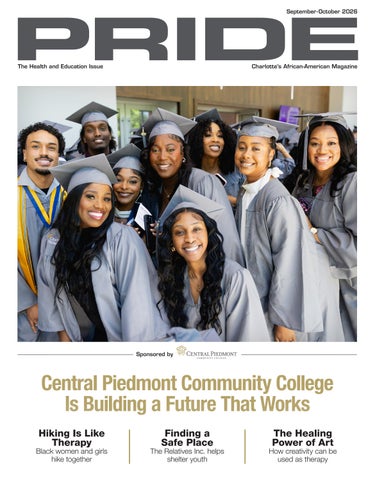
Central Piedmont Community College Is Building a Future That Works Hiking Is Like Therapy
Black women and girls hike together
Finding a Safe Place
The Relatives Inc. helps shelter youth
The Healing Power of Art
How creativity can be used as therapy
LET’S BUILD YOUR WORKFORCE TOGETHER Trying to stay ahead of the talent game? Need a partner who can build customized training? Looking for solutions to keep pace with workforce changes? Central Piedmont is here to help. We offer tailored training, talent development and strategic partnerships that deliver results you can measure.
OUR PROGRAMS CAN HELP YOU: • Fill talent gaps • Upskill employees • Improve leadership and processes • Recruit emerging talent • Strengthen employee engagement Contact us to learn how we can partner in developing your teams.
704-330-4660 | corporate.training@cpcc.edu
Corey Pemberton Living Well
September 19, 2026 – January 31, 2027 Mint Museum Uptown at Levine Center for the Arts
Corey Pemberton: Living Well is generously presented by PNC with additional support from the Ford Foundation and Windgate Foundation. The Mint Museum is supported, in part, by the Infusion Fund and its donors as well as by the North Carolina Arts Council. ABOVE: Corey Pemberton (American, 1990–). You know you see us (detail), 2021, acrylic and inkjet prints on canvas. From the collection of Yashua Simmons and Darnell L. Moore 500 South Tryon Street, Charlotte, NC | 704.337.2000 | mintmuseum.org | @themintmuseum
September – October 2026
Departments 8 From the Publisher 12 Book Review 14 Notable Names 15 By Faith 16 The Vegucator 54 FYI News and Notes
Central Piedmont Community College Special Section
27
29
43
46
7 Preparing Charlotte for
What Comes Next
18 Building a Future
That Works
20 Central Piedmont
Helps Career Builders and Career Changers Move Forward
21 Why More Families
Are Looking to Central Piedmont
Log on to pridemagazineonline.com for more features.
Features Black girls and women hike with pride
27
Central Piedmont Community College Students Photo courtesy of Central Piedmont Community College
in Charlotte Prepping students for the real world
22 Clearing a Path
25 Hidden in Plain Sight
On the Cover
33 Private Schools
43 Pride Goes to …
The 2026 Pride Awards
THC use hints at a growing mental health crisis
44
he Healing T Power of Art How creativity can be used as therapy
46 Caring for the Caregiver
29 Finding a Safe Place
The Relatives Youth Crisis Center helps shelter youth
ohn T. Schenck J Charlotte Pioneer Feature at Charlotte History Museum Honoring the legacy of the Frankie Mae Foundation
49
he Best of the T Best 2026 Recognizing outstanding professionals in our community
September-October 2026 | Pride Magazine
5
WE ARE ALL
WHEN WE
Place ONLY these SIX items in your curbside recycling!
1. PLASTIC BOTTLES & JUGS with Necks
2.CARDBOARD & SMALL BOXES (Clean Pizza Boxes - Okay)
3. EMPTY METAL CANS
4. MILK & JUICE CARTONS
5. PAPER & MAGAZINES
6. GLASS BOTTLES & JARS (Lids On - Okay)
Preparing Charlotte for What Comes Next
C Dr. Kandi Deitemeyer President, Central Piedmont Community College
harlotte is a city defined by momentum. Our community is growing, industries are evolving and residents across our region are asking important questions about what comes next for themselves, for their families and for the future of our workforce. At Central Piedmont, we believe our role is to help answer those questions with clarity, opportunity and action. Every day, we serve learners at important inflection points in their lives. Some are recent high school students trying to make a smart, affordable first move. Some are parents and families looking for an education option that keeps doors open while reducing debt. Others are working adults ready to gain new skills, pursue a promotion or change careers entirely. Across those audiences, one truth remains constant: people are not looking for empty promises. They are looking for a path that leads somewhere real. That belief is at the heart of our new strategic direction. Central Piedmont’s mission is to power the prosperity of our community by igniting exceptional talent, accelerating workforce readiness and preparing students to lead with purpose. Our vision is to stand as the nation’s most transformative community college — where future-ready talent, bold ideas and economic vitality take shape. To live out that mission, we are focusing on four commitments: being studentcentered, expanding opportunity, deepening partnerships and driving impact. Those commitments shape what we do and how we do it. We are working to help more students persist and complete credentials, strengthen transfer pathways, reduce financial barriers, expand transformative student services and align our programs even more closely with employer and regional needs. What inspires me most is that Central Piedmont is not just responding to change — we are helping shape what comes next for our region by investing in people. When a student earns a credential, when a parent sees a more affordable path for their child, when an adult learner finds a new beginning or when an employer gains access to skilled talent, our whole community benefits. As we move forward, we do so with a clear sense of purpose and a bold vision for what community colleges can achieve. At Central Piedmont, we are committed to leading boldly, thinking forward and preparing our students — and our region — for the future. Dr. Kandi Deitemeyer President, Central Piedmont Community College
September-October 2026 | Pride Magazine
7
Pain can’t wait. Neither should you. Walk in for same-day ortho injury care any day of the week. If your pup got a little too excited on the walk and your ankle or wrist paid the price, we’re here to help you feel better fast. Walk in today for same-day orthopedic injury care that treats sprains, strains and those surprise “pulled a bit too hard” moments. Now available on weekends at select clinics.
Visit us at NovantHealth.org/OrthoNow to find a location near you.
© Novant Health, Inc. 2026 7/26 • GCR-4512337606
Weekend pain? We’re open.
M
A
G
A
Z
I
N
E
Charlotte’s African-American Magazine
CEO/Publisher Dee Dixon
Editor
Alicia Michele Benjamin
Copy Editor
Sonja Whitemon
Lead Writer Angela Lindsay
Creative Director Larry Preslar
Design & Production SPARK Publications www.SPARKpublications.com
Distribution Tye Dixon Feimster Digital Content Distribution
Account Executive Nikelle Fesperman
Public Relations
Nepherterra Estrada Best
Subscribe to Pride
$13.25. Please subscribe online at www.pridemagazineonline.com, mail to P.O. Box 30113, Charlotte, NC 28230 or call 704-375-9553
Letters to the Editor
Please send an e-mail to pridemagazine@pridecommunications.net fax to 704-375-9550 or mail to Pride Magazine 8401 University Executive Park Drive, Ste. 122, Charlotte, NC 28262 www.pridemagazineonline.com
Copyright© 2026 Pride Magazine All rights reserved. Copying or reproduction, in part or in whole, is strictly prohibited. Pride Magazine reserves the right to deny any advertisement, listing or feature that does not meet Pride Magazine standards or that is outside the scope or mission of our magazine. Pride Magazine assumes no responsibility for information, products, services, or statements made by advertisers or editorial contributors.
Pride Magazine prints with soy ink. Vol. 34 No. 5 September–October 2026 All rights reserved for PRIDE Communications Inc. Find us on Facebook: Facebook.com/PrideMagazineNC Find us on Instagram: @pridemagazinenc Find us on LinkedIn: Pride Communications, Inc. September-October 2026 | Pride Magazine
9
FromTheCEO
By Dee Dixon
WE’RE TURNING THE PAGE 1993-2026
10
Pride Magazine | www.pridemagazineonline.com
More than
Years
of Serving Our Community. Proudly serving the communities we call home. What began as a family business over two decades ago has grown into a network of trusted dealerships - each rooted in the communities we serve. At Mills Auto Group, we combine the strength of multiple brands with a deeply personal approach to customer care. We believe in showing up, giving back, and creating experiences that feel welcoming, transparent, and built around you. Because when you choose us, you’re not just visiting a dealership - you’re becoming part of something bigger.
VISIT US AT MILLSAUTOGROUP.COM
North Carolina South Carolina Georgia Kentucky Louisiana Virginia West Virginia
Official Automotive Group Partner of the Charlotte Hornets
BookReview
By Angela M. Haigler
Explore Imaginative Storytelling and Provocative Nonfiction This Fall
“Cool Machine”
“Dèy”
by Colson Whitehead
by Edwidge Danticat
Harlem in the early 1980s comes roaring to life in a story of crime, family, ambition and a city undergoing dramatic change. In Cool Machine, Colson Whitehead reunites Ray Carney and Pepper for one final adventure as old loyalties and new dangers threaten the lives they’ve built. Blending humor, suspense and sharp social commentary, Whitehead captures a New York shaped by greed, displacement and reinvention while delivering a fitting finale to his acclaimed Harlem Trilogy.
“Dèy” is a moving exploration of grief, identity and belonging through Magnolia, a Haitian American woman forever changed after surviving a mass shooting. The tragedy forces her to examine the relationships, family history, and unspoken wounds that have shaped her life. Moving between Miami, Brooklyn, and Haiti, the novel asks what—and who—makes a place home. At its heart is a story about how trauma travels through families and communities, while love and memory hold us together. Timely and beautifully layered, “Dèy” reminds us of life’s fragility and resilience.
“Politics and Poetics” by Melba Joyce Boyd Frances E. W. Harper was a literary and political force whose contributions to Black intellectual thought deserve greater recognition. In “Politics and Poetics,” Melba Joyce Boyd examines Harper’s work as a poet, novelist, educator, abolitionist and feminist through the intersecting lenses of race, gender and class. Boyd reveals how Harper challenged slavery as well as racism within the women’s movement. Blending biography with literary analysis, this thoughtful study reclaims Harper’s radical voice and celebrates her enduring influence on African American literature and activism.
“Stop Living Paycheck to Paycheck:
The Proven Path to Break Free from Debt, Build Real Wealth, and Live Free on Any Income” by Anthony O’Neal “Stop Living Paycheck to Paycheck” offers a practical, encouraging roadmap for anyone ready to take control of their financial future. Drawing from his own experiences and years of financial coaching, Anthony O’Neal breaks wealth building into manageable steps— from eliminating consumer debt and creating an emergency fund to investing and paying off a home. Rather than focusing on financial shame, O’Neal emphasizes developing better habits, creating breathing room and moving forward with a plan. Straightforward and motivating, this book reminds readers that building financial stability and lasting wealth is possible on any income.
Children’s Choice “Seven Million Steps: The True Story of Dick Gregory’s Run for the Hungry” by Derrick Barnes and Christian Gregory In 1976, comedian and activist Dick Gregory turned an astonishing physical feat into a powerful statement about hunger and poverty in America. “Seven Million Steps” recounts his 3,200-mile run from Los Angeles to New York, fueled by determination and a commitment to justice. Derrick Barnes’ lyrical storytelling and Frank Morrison’s striking illustrations bring Gregory’s journey to life. Inspiring and thought-provoking, this true story challenges young readers to consider how far they might go for something they believe in. P
12
Pride Magazine | www.pridemagazineonline.com
M A K E YO U R R E TI R E M E N T EVEN MORE
Extraordinary
Windsor Run® has everything you need for vibrant senior living, including stylish floor plans, resort-style amenities, and additional levels of care should you ever need them.
Call 1-800-983-7609 for your free brochure.
2639800
Matthews WindsorRunCommunity.com
Canopy Housing Foundation
STRIDES FOR
SHELTER CELEBRATING
5K
YEARS
October 17, 2026 McAlpine Creek Park | Charlotte, NC stridesforshelter5k.com
BENEFITTING Proceeds from this year’s race will directly support a transformation of the Free Store, helping families access essentials with dignity and ease. Canopy Housing Foundation has raised more than $242,000 for local beneficiaries through this race.
SCAN TO REGISTER
Every step Creates Change. September-October 2026 | Pride Magazine
13
NotableNames ARDREY KELL SENIOR EARNS STEM SCHOLARSHIP TO PENN STATE
Audrey Kell High School class of 2026 graduate, Gabrielle Clemons, will attend Penn State University as a Millennium Scholar, a highly competitive program that supports highachieving students from underrepresented backgrounds through scholarships, academic enrichment, leadership development and STEMfocused professional opportunities. Gabrielle completed a nationally competitive NASA STEM Enhancement in Earth Science Internship, a collaborative program between NASA and the University of Texas at Austin. Through the internship, she conducted realworld climate and Earthsystems research, analyzed satellite data using professional scientific tools, collaborated with NASA scientists and contributed to peerreviewed research, gaining hands-on experience typically reserved for collegelevel students. At Penn State, Gabrielle plans to major in Industrial Engineering. As an Audrey Kell High School student, she was a studentathlete and campus leader, balancing rigorous coursework with athletics and leadership responsibilities.
Photo courtesy of Charlotte Mecklenburg Schools
By Alicia Michele Benjamin
NCCU ALUMNA RECEIVES YOUNG LAWYER OF THE YEAR AWARD
Alexandria Gwynn, North Carolina Central University School of Law and adjunct professor, received the 2026 Charles F. Blanchard Young Lawyer of the Year Award in June during the North Carolina Bar Association annual meeting in Charlotte. Gwynn teaches Negotiation and the Art of Transactional Lawyering at NCCU. The award recognizes a young attorney who has demonstrated outstanding leadership, service to the profession and commitment to the community. Gwynn serves as legal counsel for the U.S. West region at Parsons Corporation. Gwynn also serves on the board of directors and finance committee of Alliance Health, a state-funded managed care organization serving North Carolina residents with complex behavioral health and long-term care needs. She also chairs the Durham Human Relations Commission, helping guide initiatives focused on civic engagement, public trust and community relations. A leader within the North Carolina Bar Association, Gwynn serves as division director of Civic Engagement and Pro Bono for the Young Lawyers Division and co-created the NCBA Young Lawyers Division Pro Bono Leadership Cohort, an initiative designed to expand service opportunities for attorneys across the state. Gwynn earned her Juris Doctor from the NCCU School of Law after receiving her bachelor’s degree from Wake Forest University.
Clarice Surles has been a kindergarten teacher at Berryhill School for the past two years but, this year, took the role of teacher assistant, reaching students from kindergarten through eighth grade. The move was a strategic decision for Surles, whose focus is always on how best she can serve. “I don’t say I went down to a TA – I actually upgraded because look at where I am now,” said Surles, the 2025-26 CMS Teacher Assistant of the Year. “I believe that I went down to go up, to excel, to push past every barrier and every struggle that my students have.” A native of Garner, N.C., Surles has been working with children since she was in high school 26 years ago. She earned an associate degree in early childhood education from Johnston Community College, a bachelor’s degree in sociology from the University of North Carolina at Pembroke and is working toward a master’s degree in birth through kindergarten education. Surles also taught for 21 years with the MECK Pre-K and NC Pre-K programs before joining Charlotte-Mecklenburg Schools. “One of the things I saw is that being a TA, I’m able to go across the board and help more students that need more small-group time,” Surles said. “Also, I’m able to tutor in the afternoon, and I’m able to still work with my BA (autistic) students, which is amazing. You’re working with them on every skill, every goal, and you see so much growth in a short period of time. I love it.”
14
Pride Magazine | www.pridemagazineonline.com
Photo courtesy of Charlotte Mecklenburg Schools
CLARICE SURLES NAMED 2025-26 TEACHER ASSISTANT OF THE YEAR
ByFaith
The Bible Matters for Today
By Rev. Dr. Dwayne Bond
W
ith the emergence of social media, podcasts, selfhelp gurus and artificial intelligence, we are inundated with voices promising a healthier, prosperous and more fulfilling life. One guru says avoid lectins, while the other says lectins are good for you. Another says eight hours of sleep a night is sufficient, while the other says six hours is the sweet spot. Some say seed oils are bad for you, while others believe that they have no effect on the human body. One camp says the carnivore diet is God’s diet, while the other says the Mediterranean diet is the original diet. One psychologist tells us to look within to find happiness; another one tells us to rewrite our story. What should we believe? Information is everywhere, and yet we are more confused than ever. And we wonder why depression and anxiety are on the rise. People are worried they aren’t making the right choices in life. The real problem isn’t the lack of information; it’s that we are looking everywhere except to the One who created us. The God of the Bible offers something radically different than self-help, guru following and AI searches. It offers us an invitation to peer into one grand story about a God who made us, who knows what went wrong in us, and who knows that the true answers are revealed in His Son, Jesus Christ. The Bible isn’t an ancient and dusty book that is to live on our coffee tables, but God’s revelation of Himself to humanity and our invitation to true life in Him. If you are a genuine Christian, you understand this. But if you’re not a Christian, I invite you to consider that the Bible isn’t merely full of records of things that happened in the past, but wisdom on how to understand life today. For the Christian, the Bible is the lens by which we interpret all of life. It’s our authority for making sense out of life. Excuse me if the word “authority” wrongly stirs you. Every person builds their lives on some authority. Some trust politics, government,
science, personal experience, social media, research, and feelings. Christians believe that ultimate authority belongs to God and is revealed in the Bible. This truth doesn’t diminish politics, government, science, experience, social media, research and feelings, but puts them in their proper place. The Bible teaches us that there was an original design in the plan of God (Genesis 1-2). However, mankind rebelled against God (Genesis 3). The Bible calls this sin. And sin has impacted everything in Creation. It has impacted our relationships, thinking, bodies, emotions, and families. Something within every human needs healing and God has something to say about it. As we think about health and education, we must consider what the Bible says. Health is more than the body’s appearance; it’s more holistic. Gurus share tips and offer remedies for living a healthier life, but only God can give us holistic health. God knows that humans are integrated — body, mind, soul, spirit and relational (Genesis 1:2628). For example, this is why unresolved bitterness impacts our bodies. This is why
chronic stress shortens our lifespans. This is why relational tension grossly can lead to despair. Humanity is integrated. God alone speaks in the Bible on all of these integrated facets. Perhaps you’ve never ventured into the Bible. Maybe you’ve never owned a copy. Maybe you’ve had a bad experience with Christians who claim to live out the truths of the Bible. Maybe you’ve experienced or heard that it’s hard to understand. Perhaps you’ve resolved to believe that faith or reading the Bible has little relevance in the modern world. I hear you without judgment. However, I’d invite you to try it for yourself. And as you read it, look for Jesus. Try starting with the Gospel of Mark, asking yourself who Jesus is. As you read it, notice how it affects your mind, heart, body and relationships. When we look to the Bible, we find more than information about healthier living. We discover God, the Creator of the Universe, who created us in His image and likeness with a purpose — to glorify Him in all things. May you discover Him as He longs to transform all of you. P
September-October 2026 | Pride Magazine
15
TheVegucator
The Power of Choice
Creating the conditions for optimal wellness By Dawn Hilton-Williams
E
Scan the QR code below to view the recipe for Edamame Kalamata by chef Dawn Hilton-Williams.
16
very few months another study makes headlines, another health trend floods social media and another medication promises hope. Yet despite living in one of the world’s wealthiest nations, with unprecedented investments in and access to healthcare and more health information than any generation before us, millions of Americans continue to live with and die from lifestyle-driven chronic diseases that, in many cases, are influenced by the way we eat, move and live. The question I’ve been wrestling with isn’t whether we have enough healthcare; it’s whether we’ve mistaken managing disease for producing optimal health. We’ve built one of the largest healthcare systems in the world, yet somewhere along the way we’ve conflated access to medical care with the production of optimal wellness. Hospitals, physicians and medications play an indispensable role in treating disease, managing complex conditions and saving lives, but no healthcare system, no matter how advanced, was ever designed to produce optimal wellness. That work begins where we live, work, play and worship and in the repeated decisions that shape our health every single day. The truth is, by the time disease reaches the bedside, we’ve already missed countless opportunities to cultivate optimal wellness. The encouraging news is that our next opportunity begins with the very next decision we make. According to the Centers for Medicare & Medicaid Services, the U.S. spent $5.3 trillion on healthcare in 2024, accounting for nearly 18% of our economy, more than any other high-income nation. Yet despite that investment, chronic diseases continue to drive much of our healthcare spending while shortening
Pride Magazine | www.pridemagazineonline.com
lives and placing an enormous burden on families and communities. Here in Mecklenburg County, Black residents continue to shoulder a disproportionate burden of heart disease, hypertension, Type 2 diabetes and other lifestyle-driven chronic illnesses. Decades of unequal access to healthy foods, safe places to be active, quality education and economic opportunity have helped shape those outcomes. These realities shouldn’t just concern us. They should force us to ask: Why have we invested more in managing disease than in creating the conditions that produce optimal wellness? Part of the answer is that we’ve confused information with education and healthcare with health. Never in history have we had more podcasts, documentaries, influencers, wellness products and competing nutrition advice vying for our attention. Yet somewhere between marketing, misinformation and miracle promises, too many of us have become overwhelmed and retreated to familiar habits, even when those habits continue producing the very outcomes we’re trying to avoid. If everything claims to be healthy, how do we discern what truly produces optimal wellness? It begins with re-education rooted in evidence-based, peer-reviewed science, a willingness to challenge what we’ve accepted as normal and the courage to choose a path too often overlooked in favor of convenience and quick fixes. Every culture produces something. The question is whether the culture we’ve built around health is producing optimal wellness or simply managing disease. Creating healthier families and communities begins with three intentional choices. Stop chasing health and start producing optimal wellness.
1
Optimal wellness is something we intentionally cultivate through the choices we repeat every day. Every meal, every walk, every hour of sleep, every opportunity to move our bodies and every decision to nourish moves us closer to optimal wellness or farther away from it. Look beyond the marketing and start asking whether it consistently produces optimal wellness. Trends come and go and marketing changes but evidencebased, peer-reviewed science continues to point us toward the same core fundamentals: eat minimally processed, plant-based foods, move your body, sleep well, manage stress, build healthy relationships and create habits you’re willing to sustain for a lifetime. That’s not trendy, it’s transformational. Become the optimal wellness leader in your circle. Lasting change and culture shift often begin with one person you know who’s made a decision to live differently, ask more questions and invite you and others to come along. Whether it’s cooking with your children and grandchildren, organizing a walking group, bringing nourishing plantbased dishes to gatherings, your example has the power to influence far beyond your own plate. Our future won’t be determined by the number of hospitals we build, the medications we ingest or the dollars we spend managing disease; it’ll be determined by the choices we normalize every day for ourselves, our children, our loved ones and the communities we call home. Until we choose another path forward, we’ll continue traveling the same road and wondering why we keep arriving at the same destination. The good news is that cultures aren’t fixed because we create them, shape them and have the power to change them. The next choice is yours. P
2
3
WE’VE GOT
BIG PLANS... AND THEY’RE WORTH THE WAIT!
Call for details about BELMORE, the new apartments we’re planning for those 60+. A limited number of two bedroom + den units remain at pre-groundbreaking pricing.
ARTIST RENDERING
TheSharon.org/Belmore • 704-556-3231 5100 Sharon Road, Charlotte, NC 28210
September-October 2026 | Pride Magazine
17
Building a Future That Works
I
n a region growing as quickly and dynamically as Charlotte, opportunity rarely follows a straight line. A recent high school graduate weighing next steps. A working adult considering a career change. A parent balancing cost with long-term results. An employer searching for talent in a competitive market. These are inflection points — times when the next decision needs to lead to real outcomes. Central Piedmont Community College has built its approach around such inflection points. For more than 60 years, the college has served as a gateway to opportunity for Mecklenburg County. Today, it reaches nearly 60,000 learners annually across six campuses. That scale reflects something deeper than growth — it reflects a
18
Pride Magazine | www.pridemagazineonline.com
Today, Central Piedmont Community College reaches nearly
60,000
learners annually across six campuses. community looking for education that leads somewhere real. At Central Piedmont, the goal is not simply to help students enroll. It is to help them move forward with purpose, direction
and the skills needed to lead in a changing workforce, partnering with them every step of the way. That focus is captured in the college’s mission: to power the prosperity of the community by igniting exceptional talent, accelerating workforce readiness and preparing students to lead with purpose. And behind that statement is a clear ambition — to be among the most transformative community colleges in the nation, where future-ready talent and economic vitality take shape. You can see that mission come to life in how the college supports students from day one through completion and beyond. Central Piedmont offers nearly 300 degree, diploma and certificate programs aligned to the region’s most in-demand
Photos courtesy of Central Piedmont Communitiy College
Hands-on learning and bold leadership at Central Piedmont create pathways to what’s next
industries, including healthcare, information technology, public safety, skilled trades, transportation and advanced manufacturing. Programs are developed in close collaboration with employers, ensuring that students gain skills that translate directly into opportunities in the local workforce. But preparing students for the workforce today means more than offering programs. It requires helping them persist, completing credentials and building confidence along the way. That’s why Central Piedmont has placed a strong emphasis on helping more students succeed from enrollment through graduation. The college has streamlined processes to reduce barriers, expanded access to financial aid and scholarships, and strengthened support services designed to help students stay on track. More than half of students receive financial aid, and the college provides $5 million in scholarships annually. Just as importantly, students are supported beyond the classroom. Free tutoring, coaching and wraparound services help address the real challenges many students face — from balancing work and family responsibilities to navigating financial pressures. It’s a comprehensive approach designed to ensure that starting college is not the hardest part, and that finishing strong is the expectation. This focus on persistence and completion connects directly to a larger goal: preparing students to enter the workforce not just ready to work, but ready to lead. Central Piedmont is expanding opportunities for students to gain real-world experience before they graduate. Through apprenticeships, internships, and more than 250 work-based learning programs, students can apply what they are learning in practical settings, building confidence and professional skills that employers value. These experiences help bridge the gap between education and employment. They also give students a clearer sense of direction by transforming uncertainty into momentum. At the same time, the college continues to strengthen transfer pathways for students who want to pursue a bachelor’s degree. With more than 40 transfer and guaranteed admission programs, including strong connections to UNC Charlotte, students can begin their education locally, save significantly on tuition and continue seamlessly when they are ready. For many families, that flexibility is key. Students can explore their interests, gain
Parr Center at Central Piedmont Community College
Central Piedmont students save an average of
$46,000
in tuition and fees over two years compared to most four-year schools. foundational knowledge and build a pathway without feeling locked into a single decision too early. Affordability plays a critical role in that equation. Central Piedmont students save an average of $46,000 in tuition and fees over two years compared to most four-year schools, an advantage that allows more students to move forward without long-term financial strain. And for students who want to get an even earlier start, dual enrollment opportunities allow high schoolers to earn tuition-free college credit, giving them both a head start and greater confidence as they transition into what comes next. Pathways including early college, workforce training, continuing education and transfer reflect a shared belief: Talent exists everywhere, and when barriers are reduced, more people can access the opportunities needed to thrive. As Charlotte continues to expand as a hub for healthcare, finance, logistics,
advanced manufacturing and emerging technologies, the need for a skilled, adaptable workforce is only increasing. Central Piedmont is responding by evolving alongside the region — launching new programs, expanding training in highdemand fields and even introducing an associate degree in artificial intelligence to meet emerging needs. At every level, the focus remains the same: Prepare students for what comes next and ensure that what comes next is meaningful. Across its campuses, that work looks different for every student. A healthcare student practices in a simulation lab before entering clinicals. A working adult earns a certification that leads to a promotion. A high school student completes their first college course. A graduate steps into a highdemand role with confidence. Each story is unique. But together, they represent something larger. Central Piedmont is a place where people, workforce partners and the community navigate transition — not alone, and not without direction — but with support, clarity and a clear path forward. Central Piedmont is the go-to partner the region turns to in moments that matter for outcomes that deliver impact. In a time when the future can feel uncertain, that matters. Because when education is aligned with opportunity, it does more than prepare students for jobs. It prepares them to contribute, adapt and lead. And in Charlotte, that’s exactly what the future demands. P
September-October 2026 | Pride Magazine
19
Central Piedmont Helps Career Builders and Career Changers Move Forward
20
Pride Magazine | www.pridemagazineonline.com
F
or many adults, the decision to go back to school doesn’t happen all at once. It builds over time — in conversations at work, in moments of frustration, in the realization that the next opportunity may require new skills or a different path entirely. At Central Piedmont, those decisions are met with options designed to move people forward, whether that means advancing in a current role, stepping into a new industry or gaining the training needed to turn a job into a long-term career. The college serves working adults, career changers and lifelong learners who are navigating those transitions. Some are looking for higher pay or greater stability. Others want to build skills aligned with today’s job market or pursue work that better fits their interests and long-term goals. What they all share is a need for a next step that delivers real results. Central Piedmont offers a range of flexible, career-focused programs designed for that reality without having to put a pause on life. Through continuing education, certifications, short-term training and degree options, students can gain practical, in-demand skills, often in months rather than years. That shorter path makes it easier to act now instead of waiting for the “right time.” Flexibility is central to that experience. With online, evening and weekend options, the college allows students to continue working, caring for their families and managing their responsibilities while pursuing their education. The goal is simple: create pathways that fit into people’s lives, not ones that require them to start over. Jay Driver graduated from high school in 2016 and immediately entered the workforce. Although he appreciated earning money, he found himself unfulfilled, feeling work was just a “time-filler.”
Wanting more stability, Jay enrolled at Central Piedmont in 2024 and recently earned an Associate in Arts degree in communication. “Central Piedmont will help support you in every way they can,” he said. “The culture is very welcoming and everybody was eager to help me find my way.”
“Central Piedmont will help support you in every way they can. The culture is very welcoming and everybody was eager to help me find my way.” —Jay Driver Just as important is the connection to real career opportunities. Central Piedmont works closely with employers across the Charlotte region to align programs with current workforce needs. Whether students are entering healthcare, information technology, skilled trades, public safety or another high-demand field, they are building skills that translate directly into the workplace. For many, the biggest challenge isn’t deciding to make a change — it’s knowing where that change will lead. Central Piedmont helps remove that uncertainty by offering clear pathways, hands-on learning and support every step of the way. Because moving forward doesn’t have to mean starting over. Sometimes, it’s about building on what you already know, and taking the next step with confidence. P
Photos courtesy of Central Piedmont Communitiy College
Above: Central Piedmont Electrical Systems Technology student Below: Central Piedmont student in the school’s radiology lab
A Smart First Move:
Why More Families Are Looking to Central Piedmont
C
hoosing a college is one of the most important decisions a student — and their family — will make. It’s not just about where to enroll. It’s about cost, flexibility, future opportunities and whether that first step sets up a student for long-term success. For many families, Central Piedmont is becoming a clear and practical choice. Affordability is often the starting point. Students at Central Piedmont save an average of $46,000 in tuition and fees over two years compared with most four-year colleges. With $5 million in scholarships awarded annually and financial aid available to more than half of students, the college makes it possible for families to pursue higher education without taking on overwhelming debt. But value goes beyond cost. Families are also looking for options that give students flexibility and momentum. Central Piedmont offers a range of pathways that allow students to explore their interests while making meaningful progress toward a degree or career.
Central Piedmont is a smart investment. With an associate degree from Central Piedmont, you can earn $11,200 more each year than you would with a high school diploma alone. One of the most impactful opportunities is dual enrollment. Through programs like Career & College Promise, eligible high school students can earn college credit tuition-free, accumulating enough credits
to significantly shorten the time it takes to complete a degree. “The best part of the dual enrollment program is to experience college life as a high school student,” said Nyla Martin, a Northwest School of the Arts student took advantage of the program at Central Piedmont. “It’s great that I can take these classes and go to college for cheaper.” Last year alone, students earned more than 92,000 credit hours, helping them graduate high school already ahead. Beyond dual enrollment, students and families can choose from several options depending on their goals. Early college programs allow students to earn both a high school diploma and college credit — or even an associate degree — in the same timeframe. Middle college options give juniors and seniors the ability to complete their high school requirements while beginning their college coursework. These experiences provide a supported introduction to college-level learning while helping students build confidence early. Central Piedmont also keeps future pathways open. With more than 40 transfer and guaranteed admission programs, students can begin their education close to home and seamlessly continue to a four-year university when they are ready. The college’s strong transfer partnerships — including its role as UNC Charlotte’s largest transfer partner — help ensure that students can move forward with clarity and confidence. For parents, that combination of affordability, flexibility and strong outcomes offers something important: peace of mind. Students are not locked into a single path. They have the space to explore, grow and make informed decisions about their future — without unnecessary financial pressure. In a time when college decisions can feel overwhelming, Central Piedmont offers a straightforward approach: start smart, build momentum and keep every opportunity within reach. P
Above: Central Piedmont Physical Therapy Assistant student Below: Central Piedmont Massage Therapy student
September-October 2026 | Pride Magazine
21
Black Girls and Women Do Hike
H
iking is the most popular outdoor activity in America with more than 63 million people participating last year, according to the Outdoor Industry Association’s 2026 Outdoor Participation Trends Report. Despite its popularity, Black people have been underrepresented and often stereotyped as not interested in hiking or the outdoors in general. When Malika White hikes on a nature trail, it’s therapy. As the founder of Black Girls Do Hike, she’s a hiking enthusiast hoping to change narratives about Black people in nature. She didn’t anticipate its critical impact on her mental health during challenging times. “It’s always this sigh at the end of the hike,” said White. “It’s a moment of silence where nobody wants to talk, because we’ve been walking for a while. At the end, it’s like, ‘We did it!’ That’s the moment that I want them to experience.”
Photos courtesy of Malika White
Here are Black Girls Do Hike members on a hiking trek. Left to right: Latoya Jackson, Malika White, Unknown, Muriel Magloire and Toshia Sarkor (kneelig)
by Kallan Louis
22
Pride Magazine | www.pridemagazineonline.com
prior,” she said. “By the end of the hike, everybody has become best friends as if we’ve known each other forever.” White facilitates a program during the hikes–asking reflective prompts along the route. Ahead of the meetups, she scouts locations for the group to stop and journal or mediate and take in their surroundings. This inspired her to develop a guided hiking journal entitled, “Rooted & Rising: A Guided Hiking Journal for Black Women.” The journal includes a tracker, mindfulness exercises and prompts. The majority of hikes take place locally at places like Crowders Mountain and Reedy Creek Nature Preserve, but the group has hiked outside city limits. A few traveled to other parts of North Carolina and Tennessee to experience some new trails together.
Malika White
In 2018, White initially began hiking to exercise. She had some Black female coworkers lace up their shoes and join her. The camaraderie led her to developing a meetup group specifically for Black women. In this environment, the women could openly discuss topics important to them outside of the office while maintaining a healthy lifestyle. In 2020, White lost her job. Feelings of isolation and uncertainty consumed her. The covid pandemic exacerbated her situation as her relationships with her former coworkers dissolved and her financial situation grew worrisome. The hiking meetups stopped. This was not the first time White faced a traumatic life situation. In 2009, she moved to Charlotte from Charleston, South Carolina, to escape a bad relationship and rebuild her life. She and her two kids arrived with basically nothing. They navigated several challenges, including a period of homelessness. This time she was more mentally prepared to deal with her predicament.
“I went through a lot in the process of moving,” White said. “It was a struggle. I built myself just to lose it again. I dealt with anxiety and depression, so I knew that I did not want to break mentally. I refused to break.” White hiked by herself to escape the confines of her home. It was cathartic. She breathed fresh air and scents surrounding her. She felt the sun and breeze on her skin. She appreciated the trees, plants and flowers. This eco-therapy provided her with the physical and mental workout she needed to keep pushing. “Instead of looking at it like my life is over because I don’t know how to pay my water or light bill right now, I learned to see what this moment is doing for me, “she recalled. Now energized, she relaunched her hiking group and now operates it as a nonprofit. Her private Facebook group has nearly 2,000 members and averages more than 100 participants at the hikes annually. “What stands out the most about my hikes is how few people know each other
“What stands out the most about my hikes is how few people know each other prior. By the end of the hike, everybody has become best friends as if we’ve known each other forever.” —Malika White As the group continues to grow, White, who still operates Black Girls Do Hike by herself, is looking for more support to keep this movement going locally through volunteers and sponsors. She’s wearing multiple hats and taking on new projects including wrapping her memoir entitled “The Space Between Falling and Rising: A Journey of Loss, Healing, and Becoming.” It’s slated to be released this year. “After losing a 15-year career, I heard a voice that simply said, ‘Go write.’ Years later I found those pages and was in complete shock by what was on them. The same healing journey that led me to write this book is also what gave birth to Black Girls Do Hike.” P
September-October 2026 | Pride Magazine
23
The Premier Path to Mental Wellness
HopeWay is an accredited non-prot providing residential treatment for adults, day treatment for adults and teens, and outpatient services for all ages. Our renowned medical and clinical teams offer expert, evidence-based care that helps people heal and rediscover hope. HopeWay is a 501(c)3 organization.
hopeway.org • 1-844-HOPEWAY
SPONSORED CONTENT
Beyond the Baby Blues By Sierra Raven Johnson, MD Psychiatrist at HopeWay
T
he arrival of a baby is often described as one of life’s happiest milestones. But it’s also a time of profound biological, emotional, and relational change. For many parents, that includes shifts in mood and anxiety that deserve thoughtful attention. HopeWay psychiatrist Sierra Johnson, MD, explains that Perinatal Mood and Anxiety Disorders (PMADs) is an umbrella term covering postpartum depression, anxiety, OCD, and psychosis. PMADs are the most common complication of childbirth, yet they’re frequently missed because providers aren’t consistently screening for them. 80 to 85% of new parents experience the “Baby Blues” in the days after delivery: tearfulness and mood swings that are typically mild and resolve within two weeks. A diagnosable PMAD is distinguished by four factors: intensity
24
Pride Magazine | www.pridemagazineonline.com
of symptoms, duration beyond two weeks, level of distress, and interference with daily functioning. Postpartum anxiety is often underdiagnosed, sometimes mistaken for simply being an attentive parent. Postpartum depression can bring persistent sadness, hopelessness, and difficulty bonding, and can affect a baby’s development if left untreated. Postpartum psychosis, though rare, is a psychiatric emergency requiring immediate attention. Dr. Johnson notes that early intervention matters, and most PMADs are highly treatable with therapy and, when appropriate, medication. A simple starting point for providers is asking how a parent is sleeping - a question that can open the door to deeper conversations about mood and anxiety. PMADs are common, real, and treatable. With early identification, compassionate screening, and access to evidence-based treatment, most parents recover fully. To learn more about how HopeWay can help with PMADs and other mental health diagnoses, scan the QR code above.
Hidden in Plain Sight
Use of legal THC hints at a growing mental health crisis The names of the people mentioned in this article have been changed to protect their privacy. By Brenda Porter-Rockwell
J
ohn and his wife, Lindsey, were enjoying a weekend away from their Charlotte home in early 2026 when they received a disturbing call no parent wants to receive: “Your son George was hallucinating and acting paranoid.” Across Charlotte, Marilyn and her husband were trying to understand a similar pattern of delusional thoughts that their son Sam had been exhibiting as recently as 2025. Both young men had adverse reactions from using high-potency THC (tetrahydrocannabinol), the cannabis compound that causes marijuana’s “high,” which can be purchased at local vape stores in some states, including North Carolina. Later both men would be diagnosed by behavioral health specialists in North Carolina with marijuana-induced psychosis brought on by frequent, recreational use of THC, leaving both families confused and wondering how that could happen to their child.
Sam’s story
By the time Sam was diagnosed with marijuana-induced psychosis at 21, his mother Marilyn said he had exhibited five
years of moodiness, anger and volatility after having smoked THC as a teen. “He would tell me it was like a demonic voice that would tell him to kill himself,” Marilyn said. Even though Marilyn found Sam’s vape pen during one of his earliest psychotic episodes, Marilyn — nor hospital doctors — were able to definitively make the connection between THC and psychotic breaks. The Charlotte doctors diagnosed Sam as having bipolar disorder. “They gave him a medicine for bipolar [disorder] that kind of just sedated him. He didn’t like it, so he didn’t take it. And then an episode would happen again,” said Marilyn. Over five years, each of Sam’s episodes brought police visits to the home, hospital stays and transfer to a behavioral health center. At home, when Sam skipped his medication for bipolar disorder, he acted erratically and became confrontational with family members, Marilyn said. Eventually Marilyn and her husband faced a difficult question: What to do about Sam? “We gave him an ultimatum: Stop or leave.” The family decided Sam would move out temporarily to focus on his mental health. During that tough time, they said they leaned on faith and each other. “Knowing that God had my son and that he would be OK,” Marilyn said. Yet, for Marilyn, the small words about THC and marijuana-induced psychosis from nurses and police over the years kept coming back to her.
September-October 2026 | Pride Magazine
25
“I didn’t know any of this. But [the nurses and police] knew what was happening,” said Marilyn. It took until 2025 for behavioral health specialists to fully connect Sam’s experiences as THC-induced psychosis; not bipolar disorder.
George’s story
John said they didn’t see their son’s event coming. George, 22, was living on his own. George and his friends regularly smoked high-potency THC, John said. That day their son and his friends tried a new brand for the first time which sent George spiraling after a single use, John said. John and Lindsey ended their vacation and headed to their son’s Charlotte apartment. They monitored him for three days hoping his health would improve; it didn’t. “Finally … we went and took out the orders [to commit],” John said, choking through the memories of that difficult decision. George spent several weeks in a behavioral health facility in early 2026. “Each day in the facility, he just seemed like he became a little more normal. [The doctors] talked about seeing [the reaction] previously. They were not shocked at all,” said John.
The aftermath for both families
Both Sam and George’s families faced confusion, fear and guilt. They have not spoken publicly about their struggles. They said they do not plan to lead an advocacy campaign or spearhead legislation against high-potency THC. Both sets of parents said they wished they had recognized warning signs sooner — and want to help other parents avoid thinking, “not my child.”
26
Pride Magazine | www.pridemagazineonline.com
“One of the worst things is having your child committed,” John said. “You keep thinking, ‘Not my child, not my child.’ Then it is your child, and it shocks you to the core.” Marilyn and her husband directed Sam toward treatment for THC and behavioral health issues. When Sam returned home from living elsewhere, Marilyn said she knew that “God was all in,” bringing her family back together. Marilyn said she first saw her son’s behavior as typical teenage angst, not wanting to be that overbearing parent. “Don’t dismiss it as a stage, a mood or something they’ll grow out of. Pay attention to who they spend time with and what they’re doing,” said John.
Concentration levels and use of THC on the rise
One 2020 study published in the PLOS One journal, “Mapping cannabis potency in medical and recreational programs in the United State” found that THC regulations in the U.S. show that recreational cannabis now often exceeds 15% THC, far higher than in past decades. Another study published in the Adolescent Psychiatry journal in 2021, “Marijuana Legalization in Colorado: Increasing Potency, Changing Risk Perceptions, and Emerging Public Health Concerns for Youth” suggests the higher potency may intensify the “high” and increase health risks, especially in youth. Even as potency rises, there is still limited research on the health effects of THC. In May, “The Canadian Journal of Psychiatry” published findings from a McMaster University-led survey of 35,000 Canadians aged 15 and older from 2012 to 2022. The study found a correlation
between cannabis use and mental illness. Though not proof of causation, the data did show a 44% increase in suicidal ideation among teens. The National Alliance on Mental Illness highlights a 2022 “National Survey on Drug Use and Health,” which found that 47% of adults diagnosed with any mental illness and nearly 39% of adults with serious mental illness used marijuana in the past year. This was compared to the 18% of adults with no mental illness who reported using marijuana in the same period.
Why are certain THC products legal and available in NC?
In North Carolina, hemp-derived THC products are widely available in vape shops because of a legal gap created by the 2018 federal Farm Bill. That law legalized hemp and hemp-derived compounds if the plant contains no more than 0.3% Delta-9 THC by dry weight, according to an April 2026 report by the NC Department of Health and Human Services titled, “Advisory Council on Cannabis.” Because North Carolina hasn’t established a comprehensive regulatory system for these products, they can be sold in vape and smoke shops and other specialty hemp stores. According to the 2018 Farm Bill, passed by Congress and signed into law by President Donald Trump, the legal distinction between marijuana and hemp is based on THC concentration. Under federal law, hemp contains no more than 0.3% Delta-9 THC by dry weight. Hemp and marijuana are the same species of plant — Cannabis sativa. P
art as therapy can help reduce anxiety, depression and psychological distress while improving their quality of life. According to the American Art Therapy Association and the American Music Therapy Association, creative arts therapies are used in hospitals, counseling practices, schools, rehabilitation centers and senior care facilities. Research by both organizations has shown that art and music therapy can help people cope with mental health challenges and chronic illness. They can also support physical rehabilitation, stress management, communication and emotional expression. Two Charlotte-area therapists have built careers around that idea. Licensed Clinical Mental Health Counselor and Expressive Arts Therapist Akinlana Burrowes and board-certified music therapist Mason Swimmer use creative expression to help clients navigate challenges and improve their well-being.
Creativity as Medicine
“Being an artist first and experiencing the healing power of the arts in my life, I knew that if there was a way to inject any ounce of the same feeling to help transform someone else’s life, I’m all in.”
How the arts help people heal By Alicia Michele Benjamin
W
—Akinlana Burrowes
A calling through the arts Photo courtesy of Akinlana Burrowes
e all have the capacity to be creative. This is obvious when you visit a preschool classroom or watch a child at home freely expressing themselves with paint and crayons on paper — or sometimes even the walls! Somewhere along the line, creativity gets discouraged for lots of people. As a result, many adults lose confidence in their ability to make art or express themselves creatively. So, it makes sense that art is often used to treat patients facing mental health concerns or physical challenges. Patients are encouraged to tap into that joyful spirit of creation they knew as children. Positve energy is bound to flow from there. Consider the study in the journal “Supportive Care in Cancer” published in March 2024 that examined how art therapy was used to help cancer patients undergoing chemotherapy. Researchers found evidence that encouraging patients to explore creating
Akinlana Burrowes is a licensed clinical mental health counselor, expressive arts therapist and owner of Karibuni Counseling and Wellness in Charlotte
For Burrowes, owner of Karibuni Counseling and Wellness, the journey to expressive arts therapy began with her own work as an artist. A singer, songwriter, dancer and musician, Burrowes experienced the healing effects of creative expression firsthand. That personal connection inspired her career choice. “Being an artist first and experiencing the healing power of the arts in my life, I knew that if there was a way to inject any ounce of the same
September-October 2026 | Pride Magazine
27
feeling to help transform someone else’s life, I’m all in,” Burrowes said. Her path to becoming a therapist was not a straight one. She studied violin throughout childhood, attended Spelman College as a music major and completed a degree in radio, television and film at Howard University. She later attended Musicians Institute in Hollywood and earned a master’s degree in clinical mental health counseling with a specialization in expressive arts therapy from Lesley University.
unwilling to talk, only to leave feeling more hopeful after participating in music and movement activities. “I have witnessed clients come into session feeling depressed and not wanting to speak, and and after engaging in music and dance movement therapy, leaving with more hope in their hearts and a will to engage with life,” she said. She also has seen visual art help clients identify and express emotions they had difficulty recognizing. Creating artwork can provide a safe way to explore feelings and begin conversations that might otherwise be difficult. For Burrowes, the work is deeply personal. “Life as an expressive arts therapist is really a calling for me,” she said. “I take it as an opportunity to care for the minds, bodies and hearts of beautiful souls every day.”
Photo courtesy of Mason Swimmer
Music as a bridge
Mason Swimmer (right) is a board-certified music therapist and owner of Charlotte Music Therapy. Here he is with a patient.
Before entering counseling, Burrowes spent 20 years working as a sound engineer in Hollywood and as a missionary in Africa. She said those experiences helped shape her understanding of people, communication and creativity. Today, she uses music, movement, visual art and other creative techniques to help clients process emotions and experiences. She has seen clients arrive at sessions feeling depressed and
28
Pride Magazine | www.pridemagazineonline.com
For Swimmer, owner of Charlotte Music Therapy, his path to music therapy was also shaped by personal experience. As a teenager, he battled osteosarcoma, a type of bone cancer. During lengthy hospital stays, he said music was an important source of comfort and connection. “I have always had a deep connection to music,” Swimmer said. “I used music as my own therapeutic outlet and connection throughout this trying time.” After earning a degree from the University of North Carolina Wilmington, Swimmer observed a music therapy session at Queens University of Charlotte. The experience convinced him to pursue the profession. He later earned a bachelor’s degree in music therapy from Queens. Over the past 10 years, Swimmer has worked with patients in hospitals, behavioral health programs, memory care facilities and substance-use treatment programs. He has also worked with people who have developmental disabilities and acquired brain injuries. One challenge, he said, is that many people misunderstand what music therapy involves. “People often
mistakenly think of music therapy as entertainment without understanding the clinical nature of what it is we do.” He said greater public awareness and professional recognition could help expand access to services in North Carolina and beyond. Some of the most meaningful moments in his work occur in memory care facilities. He said residents who appear withdrawn or disengaged often respond almost immediately when they hear or make music themselves.
“More often than not, music is the motivating factor that promotes engagement and progress.” —Mason Swimmer “Music seems to immediately engage folks,” Swimmer said. “Those who were previously asleep begin engaging in interactive music making, smiling and singing along.” He also works with adolescents experiencing behavioral health challenges. Through songwriting, listening activities and other therapeutic techniques, some of them start to open up emotionally. Music often serves as a powerful motivator for progress in cognitive, emotional, social and physical goals, said Swimmer. “More often than not, music is the motivating factor that promotes engagement and progress.” The work of Burrowes and Swimmer shows that it’s never too late to explore the arts and creativity is not reserved only for so called “artists.” Whether through painting, dancing, singing, writing or making music, creative expression can help people communicate, process emotions, make connections and heal. P
Youth Crisis Center Helps Youth Find a ‘Safe Place’ By Charles K Harris
G
rowing up is hard to do. But some young people face more formidable challenges than others. Problems on the home front like abuse, neglect or parental substance abuse can turn an already chaotic time of life into a full-blown crisis. Fortunately, for Charlotte-Mecklenburg youth, there is a port in the storm.
Finding a Safe Place
“’Safe Places’ are vital because they provide youth in crisis immediate access to safety and a trusted adult when they may have nowhere else to turn,” explained Tamara Smith, Program Manager for The Relatives Youth Crisis Center on East Boulevard in Charlotte. These designated locations called “Safe Places” are marked by distinct yellow and black diamond-shaped signs and are designated, easily accessible locations (like fire stations, libraries and businesses) where youth in crisis can go to get immediate help. Young people in the county (ages 7-24) can enter a “Safe Place” and let a person affiliated with the business know they need help. The staff will immediately contact The Relatives and
Above: Tamara Smith, program manager for The Relatives Youth Crisis Center in Charlotte; Below: A group photo from the 2026 National Safe Place Week Walk, an event the Charlotte Knights team has hosted annually for the past five years
September-October 2026 | Pride Magazine
29
MORTGAGE SERVICES
Homeownership Is Closer Than You Think.
Howard Hanna Mortgage Services is proud to help individuals and families explore financing options with trusted guidance every step of the way.
Ask us about: • NC Housing Finance Agency Programs • SC Housing Programs • FHA Loans • VA Loans • Down Payment Assistance Programs • Conventional Loans • Jumbo Loans
Scan to connect with a loan officer and explore your options. NMLS: #101561. Contact Howard Hanna Mortgage Services for mortgage products and eligibility. Offer of credit is subject to credit approval. For full licensing information, visit www.nmlsconsumeraccess.org.
30
Pride Magazine | www.pridemagazineonline.com
trained personnel will arrive to transport the youth directly to a secure facility. Supported by National Safe Place Network, The Relatives now provides 680 designated Safe Place locations in the region. Some partners have multiple Safe Place locations, such as the Charlotte Fire Department, YMCA, QuickTrip, Charlotte-Mecklenburg Libraries and the Charlotte Area Transit System. The Charlotte Knights is the first professional team to register their stadium as a designated Safe Place site. Any young person 7 to 24 years old seeking help can call or text The Relatives’ 24-hour crisis hotline, 704-377-0602, or visit the Crisis Center or any other “Safe Place” location. Once their immediate needs are assessed, trained staff work to identify the best support for each youth’s specific situation. Continuing resources include emergency shelter, counseling and family support.
The Charlotte Knights’ mascot, Homer the Dragon, calls attention to an official Safe Place location in Charlotte.
Who are The Relatives?
The Relatives was founded in 1974 by members of the Dilworth United Methodist Church in response to a rising number of homeless adolescents in the area. Outgrowing the church’s basement, The Relatives relocated to East Boulevard where they have served some 20,000-area youth over 50 years. Since partnering with the National Safe Place Network (NSPN) in 1988, The Relatives has expanded services and reach. The NSPN works to ensure that “Safe Places” are accessible to youth no matter where they are. For over 40 years they have established official “Safe Places” across the country. “Through partnering with (NSPN), The Relatives exponentially expanded the safety net for youth in crisis,” Smith said. “[We’ve created] a local network of businesses, churches, schools, transportation services and other youth-friendly locations that were willing to post the “Safe Place” signs and identify as a place for youth to obtain immediate help,” she added. “We provide immediate access to safety and support for youth (ages 7-24) in crisis, including those who have run away, are experiencing homelessness, family conflict, abuse, neglect or other situations where they do not feel safe,” Smith said. Smith said she wants the public to understand that these are not just brick and mortar safe places, they also offer shelter from criticism or condemnation. “[Young people] are met with compassion, not judgment,” Smith said. But services don’t stop there.
Through their On Ramp Resource Center at 2219 Freedom Drive, The Relatives also offers youth ages 16-24, GED tutoring, resume building and life skill workshops.
Support for The Relatives
The organization’s annual budget of about $6 million dollars comes from three funding sources; the government, charitable foundations and private donors. With diverse sourcing, The Relatives can avoid overreliance on one entity, said Smith. “We’re able to maintain financial stability and continue serving even when economic conditions or funding priorities change.” But that doesn’t mean The Relatives organization doesn’t need support. “There are multiple ways to support our mission,” Smith said. “We welcome volunteers and donations at both our Youth Crisis Center and our On Ramp Resource Center.” She also urges residents to become familiar with the Safe Place program, its purpose and locations so a greater number of youth seeking help know they have options. “We need help raising awareness and increasing engagement,” Smith said. “[The goal is] creating a network of partners committed to protecting young people and connecting them to the support they need.” Individuals, organizations and businesses can also partner with The Relatives to become a designated location or ambassador.
First-Time Home Buyer Program Up to 100% loan-to-value maximum
You may be eligible for special financing with HomeOwnership Now Mortgage, available only at HomeTrust Bank. htb.com/homeownership-now All loans are subject to credit approval. Borrower must not have owned any dwelling in the past 3 years. Certain loan and property restrictions apply. Talk to a HomeTrust Bank Loan Officer for more program information and requirements.
Member FDIC
Equal Housing Lender
Reggie Miles Community Development Mortgage Loan Officer NMLS #214972 704.971.7058
260702-1476219735
Creating a family-like environment
The importance of organizations like The Relatives is readily apparent when hearing any one of the many true stories about the youth that have passed through their doors. Smith recounts a story about a young man who turned to marijuana to navigate the grief left in the wake of his mother’s death. “He had no family support and felt lost. But during his stay he opened up to staff, participated in activities, he began to heal.” Upon his departure, the young man’s expressions made what Smith calls an “emotional” experience for everyone, even more touching. “He told us he didn’t want to go,” she said. “Because for the first time in a long time, he felt like he had found a family.” Providing that “family” is the very essence of the original founders’ mission. According to The Relatives’ website, instead of telling friends and classmates they had run away or were homeless, the organization’s earliest young visitors would simply say they were “staying with relatives.” P
September-October 2026 | Pride Magazine
31
A Christ-centered, JK-8 school in Uptown Charlotte making high-quality education accessible.
What We Offer Academic Excellence Affordable Tuition Music, Art & Sports Small Class Sizes Bus Transportation Hot Lunches CONTACT US! (704) 392 - 6330
Schedule a Tour Now!
brookstoneschools.org
Volunteer opportunities available!
Carmel Christian
The Future Is Now
Prepping Students for the Real World
By Angela Lindsay
T
oday’s society is ever evolving and rapidly changing. What’s breaking news today is old news in 24 hours. It seems as soon as you get a handle on “new” technology, it has already been replaced by an updated version. Even the words and phrases we use are acceptable one day and outdated the next. The pressure to keep up can take a toll on students’ mental well-being and contribute to feelings of inadequacy. The rapid emergence of artificial intelligence and the ways it has transformed daily life have also heightened anxiety and stress for many people. In response to these shifts, and the uncertainty, pressure and stress that often accompany them, local private and independent schools are placing greater emphasis on developing students’ relational skills and emotional intelligence. Educators believe these qualities can prove to be
invaluable, even as the future becomes increasingly difficult to predict. “We strive to educate the whole child. That means intentionally balancing academic challenge with opportunities for connection, creativity, movement, service and reflection, said George Marshall, director of marketing and communications at Charlotte Preparatory School. Through community events, wellness initiatives, strong partnerships with families and a culture where students are known by name, we aim to create an environment where every child feels supported, challenged and empowered to grow.” Recognizing that student wellbeing extends beyond the school day, Charlotte Prep’s Prepped Parent Series brings nationally recognized experts to its community to help families navigate topics such as adolescent mental health, technology and healthy relationships. Experts have routinely touted counseling as a way to help youth and adolescents with
a variety of issues and concerns. Acceptance and Commitment Therapy (ACT), in particular, helps students shift from seeking external validation (grades, praise, peer approval) to building self-trust, identifying core personal strengths, and detaching selfworth from achievement instead, according to Empower Counseling and Coaching. Additionally, integrating social and emotional learning can help all young people thrive personally and academically, develop and maintain positive relationships, become lifelong learners and contribute to a more caring, just world, according to The Collaborative for Academic, Social, and Emotional Learning. However, it is sometimes the “missing piece” in education. Charlotte Latin’s advisory program in the Middle and Upper Schools helps fill that void. Gavin Edwards, editorial director in the marketing and communications department Continued on p. 36
September-October 2026 | Pride Magazine
33
WE UNLOCK EXTRAORDINARY FUTURES ONE STUDENT AT A TIME. • 6:1 Average
Student-Teacher Ratio
• K-12 Full College
Preparatory Journey
• 40+ Years Transforming
the Lives of Students with Learning Differences
• 100% College
Acceptance Rate
Different by Design. Exceptional by Intention.
A Closer look
Visit campus and experience the Charlotte Christian community JK - Kindergarten Thursday, Oct. 8 Thursday, Oct. 22
Grades 5-8 Tuesday, Nov. 3
Grades 9-12 Wednesday, Nov. 11
Scan the QR code to plan your visit.
Charlotte Preparatory School
at Charlotte Latin, said the program focuses on fostering relationships, building community and developing key socialemotional skills. “The school also prioritizes digital wellness through curricula from Common Sense Media and The Social Institute, pairing student lessons with parent forums on topics like anxiety and screen time,” said Edwards. Parent engagement is central to Latin’s wellness model, with year-round workshops and events designed to help families support their children’s emotional development at home, he said. After noticing the impact of anxiety, insecurity, friendship struggles and questions about faith among students, a staff member at Carmel Christian School created a space for conversation, community and Christcentered encouragement in the form of a girls’ Bible study. The staff member witnessed students growing in confidence and faith through God’s Word, said Jessica Landon, director of communications at Carmel Christian. The school also has a school guidance department with a counseling staff that meets with students one-on-one and conducts small group sessions. Carmel Christian’s elementary and middle school students learn to use various coping tools through interactive classroom activities and intentional discussions. In tandem with such methods is the reemergence of educators focusing on a back to basics strategy for students where practical, soft skills are prioritized even as the world around them becomes more digitized and complex. While AI can handle routine tasks, cultivating the uniquely human skills that will remain essential even in an AI-driven world helps better prepare students for the future they’ll actually encounter, according to “Rethinking Report Cards: Emphasizing
36
Pride Magazine | www.pridemagazineonline.com
Soft Skills in an AI World,” an April 25, 2025 from The School Superintendents Association website.
said Stephanie W. Griffin, assistant head of school for academics at Trinity Episcopal School. “When children are given the space to articulate their ideas and lead others, they discover that their perspectives have inherent value and develop the self-efficacy needed to navigate the world.” For example, students in their 8th Grade year at Trinity learn about advocacy and the role citizens play in effecting change. One of Trinity’s recent graduates — now a rising senior at Myers Park High School — recently put these advocacy skills to use by petitioning Charlotte-Mecklenburg Schools for a later start to the school day in order to let students sleep longer, boosting their physical and mental health. She has spoken at school board meetings and met with
Trinity Episcopal
Therefore, schools across the country are shifting away from rote memorization in the Artificial Intelligence era and leaning toward soft, socio-emotional and interpersonal skills, including creativity, critical thinking, collaboration, adaptability, compassion, reasoning and empathy — competencies that AI cannot replicate. Because artificial intelligence can instantly recall information, educators now highlight teaching students how to evaluate AI outputs, collaborate and apply uniquely human judgment to complex problems, according to the School Superintendents Association. Strengthening these abilities also fosters leadership and self-expression in students. “Developing a student’s voice transforms learners into active, confident citizens,”
Charlotte Latin
elected leaders, which is what Trinity 8th Graders learn to do as they research issues and how to advance change. “At Trinity Episcopal School, we intentionally cultivate these skills through Continued on p. 40
Did you know?
Ready. For. You. As a school, we seek to admit talented and motivated
•
100% of Country Day graduates are accepted to colleges and universities around the world; the Class of 2025 received $12.7 million total scholarship offers based on academic merit, athletic abilities, or special talents
•
21% of our enrollment comprises students of color
•
100% of our faculty engage in professional development each year including diversity, equity, and inclusion
•
Over 20% of our Board of Trustees comprises people of color
•
Learn more about diversity, equity, inclusion, and belonging at Country Day: charlottecountryday. org/about/deib
students from diverse backgrounds. Central to preparing our students for this world is creating an academic community that is diverse socioeconomically, racially, ethnically, and inclusive for all. In fact, research has proven that a diverse environment leads to better learning outcomes for all students. Families who feel the full tuition cost is out of their reach should not hesitate to visit or apply to the school. We are here to help you determine the best options for your family with this very important educational investment.
Call us today to learn more about the opportunities at Country Day! charlottecountryday.org | (704) 943-4530
Brookstone School
programs that challenge students to step forward,” Griffin said. Participating in student government is an effective way to prepare students for the real world because it replicates professional and civic environments and builds practical skills like budgeting, negotiation, public speaking and conflict resolution needed for the workforce, according to a September 2020 Aspen Institute article, “Building Student Governments That Put Students First.” Students learn to manage initiatives, collaborate with diverse stakeholders and advocate for their peers. According to research at the Aspen Institute, student government is a bridge between students and the adults who work to educate and prepare them for the real world. Dialogue and mutual respect are essential components of creating an educational experience that enables students to grow and prepare them for a world where they are entitled to treatment as equals. Active engagement in student governance amplifies youth voices and establishes networks needed for future societal and civic roles. In Charlotte Christian School’s student government system, nine student leaders in the Upper school are mentored by a faculty member and are charged with creating and leading a committee of student volunteers to help guide their specific area of oversight, said Macie Moseley, the school’s communications and marketing specialist. The student government representatives are “expected to function as servant leaders, humbly seeking to build up others and leading by example,” Moseley said Skills such as conflict resolution and managing pressure are intentionally woven throughout the student experience at Charlotte Prep rather than taught in isolation, Marshall said. “Students practice communication, perspective-taking, emotional regulation
40
Pride Magazine | www.pridemagazineonline.com
and problem-solving through classroom discussions. Learning how to navigate conflict and manage stress prepares students not only for academic success but also for healthy relationships and lifelong well-being,” he said. Middle School social studies teacher Lauren Manriquez at Charlotte Christian explained how she uses AI to engage students in her classroom. “I utilize AI to create immersive, interactive ‘spaces’ where students can engage in simulated interviews with historical figures or navigate complex moral dilemmas from our units,” she said. “These AI-driven experiences allow students to practice empathy and historical inquiry in a safe, controlled environment, turning passive history lessons into active, conversational learning.” Many of Charlotte Latin’s extracurricular programs provide avenues for students to find their voice, whether their interested in drama or the tech field. The school’s Speech and Debate program, ranked in the top 20 forensics programs nationwide, has boasted multiple national champions. “We know that when students start researching a topic, they won’t end up in the same place they started. When they find an interesting piece of information, it can
Charlotte Christian
become the center of their argument. The process is dynamic, so they learn fluidity,” said Bilal Butt, Charlotte Latin’s director of speech & debate. “This year, our focus has shifted from simply understanding AI to beginning to thoughtfully integrate it into teaching and learning,” said Shannon Drosky, director of marketing and communications at Charlotte Country Day School. “We view AI as a tool that can enhance creativity, critical thinking, and problem-solving when used responsibly.” Drosky said the faculty are exploring ways AI can support research, brainstorming and personalized learning while helping students develop digital literacy skills and ethical decision-making. “Our goal is to prepare students to navigate a rapidly changing world with curiosity, discernment and integrity,” Drosky said. “We are investing time and energy into creating a school-wide framework for how we integrate technology — including AI — in ways that serve our mission.” The Brookstone School piloted an AI platform for Upper School students and teachers called TrekAI this year. Sarah Boynton, director of stewardship and marketing at Brookstone School, said Trek’s knowledge base is built specifically for K-12 education with secure content guardrails. It uses Socratic teaching methods that guide learning rather than giving answers. Some features include a personalized “tutor” to help students study for upcoming tests and quizzes and an “editor” feature that proofreads essays without making the corrections for the student. By cultivating the whole student, elevating transferable skills and training them in the effective and ethical use of emerging technologies, Charlotte private and independent schools are being intentional in ensuring that their students will become the highly functional, well-adapted adults of tomorrow. P
Unique by design The only independent K-8 school in the heart of Charlotte, Trinity Episcopal School offers unique advantages for curious learners and young leaders. Trinity sees each child for who they are and challenges them to think deeply, welcome broadly, and live nobly.
TEScharlotte.org
Scan to register for an open house and see why your family belongs at Trinity Episcopal School. Kindergarten Open House Tuesday, Sept. 29 - 9:30 a.m.
K- 8 Open House
Thursday, Nov. 5 - 9:30 a.m. Tuesday, Dec. 1 - 9:00 a.m.
Pride Goes to...
September-October 2026 | Pride Magazine
43
John T. Schenck featured at Charlotte History Museum John T. Schenck’s portrait is part of the Path of Portraits exhibit at the Charlotte History Museum
By Kurtavia Burton
T
he city of Charlotte’s rich history reflects the lasting impact of contributors throughout its past and present. To better understand some of that history, I spoke with Starkey Jones, great-great-grandson of John Thomas Schenck, Charlotte’s first
44
Pride Magazine | www.pridemagazineonline.com
black policeman, to discuss what he called Charlotte’s original blueprint. Jones added to our city’s collective story and preserves the legacy of a man whose life is woven into the fabric of Charlotte’s history. John T. Schenck was born in 1823 in Lawndale, North Carolina, about 50 minutes from Charlotte. Biracial and the oldest sibling, Schenck grew up on a plantation.
His father was a slave master, and his mother was a slave. According to Jones, Schenck’s abilities were evident from a young age. Alongside his father and greatgrandfather, he helped build the first mill in Lincolnton, North Carolina, building skills that would follow him throughout his life. “He was skilled and could build anything,” said Jones. Known for his talents and determination, Schenck built a strong reputation and eventually owned a saloon. He was known for creating opportunities wherever he could, consistently overcoming adversity. Yet, his life was not without hardship. Schenck successfully overcame adversity as the child of a slave owner and an enslaved person and survived life as a soldier in the Union army during the Civil War. After being involved in a train accident, Schenck’s arm was amputated. “Resiliency was a defining characteristic of my great-great-grandfather’s life,” Jones said. He was elected alderman and served four terms. In 1868, then-governor of North Carolina William Woods Holden appointed Schenck to be the first African American police officer in Charlotte. John T. Schenck, his brother A. Burt Schenck and others were founding leaders of Paul Drayton Lodge #7 of the Prince Hall Freemasonry organization. During a pivotal period, the lodge notably helped foster and empower African Americans, creating opportunities for leadership, community advancement and support. The founding of Paul Drayton Lodge #7 had a pivotal impact on the Brooklyn neighborhood in Charlotte. “This is a man, my great-greatgrandfather, who worked hard and was very skillful,” said Jones. Schenck became a pioneer for Charlotte and a symbol of what was possible during a changing time. Today, Schenck’s portrait is displayed at the Charlotte Museum of History. Created by artist Kalin Davone, the portrait is featured in the Path of Portraits exhibit. According to Nolan Dahm, exhibits manager and historian, Schenck was one of the first portraits included in the exhibit, which honors prominent African Americans who have made history in Charlotte. The portrait was displayed alongside four other portraits featured in Charlotte’s African American Festival in 2021. Today, the Charlotte Museum of History includes 15 portraits in its gallery, and the exhibit continues to grow. Visit The Charlotte Museum of History, 3500 Shamrock Drive, Tuesday through Saturday, 11 a.m. – 5 p.m., to view the portrait. P
Build it. Fix it. Love it! Your dream home doesn’t have to stay a dream. Whether you’re buying your first home, renovating a fixer-upper, or starting fresh with new construction, SouthState is here to help. Our Construction & Renovation Loans make it easier to turn “just a house” into your home. •
Finance new build or renovations
•
Options for primary or secondary homes
•
Flexible payment solutions while you build
Ready to get started? Give us a call!
866.229.5628
Mortgage@SouthStateBank.com SouthStateBank.com/PrideMagazine All loans are subject to credit approval and program guidelines. SouthState Bank N.A. NMLS ID # 403455. Member FDIC. Equal Housing Lender.
Caring for the Caregiver
families together, are often left to navigate overwhelming challenges with too few resources, too little support and almost no recognition. I saw the truth up close. The caregiver is often the unsung hero. And heroes deserve care, too.
A daughter’s love became a lifeline
In the long nights, the medical appointments, the emotional weight and the whispered prayers, I felt a calling rise in my spirit. I remembered a quote that had shaped me since childhood: “We are blessed to be a blessing.” Once my mother passed in September 2020, those words became my mission. I realized that my experience, struggle, strength and compassion were not meant to be carried alone. It was meant to be shared. It was meant to become a gift to others walking the same path. From that revelation, the Frankie Mae Foundation was born out of lived experience, love and a deep desire to make sure no caregiver ever feels invisible again.
Photo courtesy of Venitra White
A mission rooted in humanity
Venitra White-Dean and her mother Frankie Mae Allen White
The legacy and love behind the Frankie Mae Foundation By Venitra White-Dean
C
aregiving is one of the purest expressions of love. It’s quiet work, often unseen, often unthanked and almost always carried by someone who refuses to let a loved one walk through hardship alone.≈For me, that calling began long before I ever imagined founding a nonprofit. It began at home, with my mother, the remarkable woman whose name now lives on through a movement of compassion —Frankie Mae Allen White.
46
Pride Magazine | www.pridemagazineonline.com
Frankie Mae was strength wrapped in grace. A mother whose faith anchored her family. Her presence made you feel safe, even on the hardest days. When her health began to decline, I stepped into the role so many daughters and sons eventually face, being a caregiver. I did it with devotion, with dignity and without a guidebook. But as the days grew heavier and the responsibilities multiplied, I discovered something that would change my life and ultimately change the lives of countless others. I realized that caregivers, the very people holding
The Frankie Mae Foundation exists for one purpose, and that is “Caring for the Caregiver.” It’s more than a tagline. It’s a promise to the daughter caring for her aging mother. To the husband supporting a wife through illness. To the grandmother raising grandchildren. To the neighbor who steps in when no one else can. To the family member who sacrifices sleep, finances and emotional energy to keep someone else safe. The foundation provides the basic resources caregivers often lack — education, emotional support, community connection and practical tools that lighten the load. But more than anything, it provides validation. It says, “We see you. We honor you. You matter.”
What we do
At the Frankie Mae Foundation, we provide comprehensive, wraparound support designed to meet caregivers where they are and ease the weight they carry every day. We welcome all caregivers, no matter what their loved one is living with.
The Frankie Mae Foundation exists for one purpose, and that is “Caring for the Caregiver.” Our signature monthly meetups create a safe and welcoming space where caregivers can connect, recharge, and access vital resources. During these gatherings, caregivers receive valuable information from trusted partners, enjoy a warm meal and take part in lighthearted activities like games that bring moments of joy and relief. Since our inception in January 2022, the Frankie Mae Foundation has experienced meaningful growth with our caregiver community more than tripling in size. Last year, we served an average of more than 90 caregivers at each monthly meeting. These meetups create consistent, trusted spaces for connection, support and relief. Even after their loved ones have passed, many caregivers continue to attend our gatherings. What they’ve found is more than support. They’ve found a village. We also provide essential items such as incontinence supplies and durable medical equipment. Last year, we distributed over 1,100 packs of incontinence supplies, helping to reduce the financial burden many caregivers face. To ensure caregivers can attend, we remove one of the biggest barriers: time. The Frankie Mae Foundation covers the cost of in-home respite care, allowing caregivers the opportunity to step away, breathe and be supported. We provided funding for over 800 hours of respite care last year alone. Each of these numbers represents more than a service. It represents a caregiver who felt supported, a moment of relief and a family strengthened.
September-October 2026 | Pride Magazine
47
Beyond our monthly meetings, we partner with community agencies to extend our impact. Through these collaborations, caregivers gain access to services like mental health therapy, grocery pickup and delivery, and other critical supports that strengthen both the caregiver and the family they serve. Together, these efforts form a holistic, wraparound model of care; one that recognizes that when you support the caregiver, you strengthen the entire family. All services are provided free of charge, because we believe every caregiver deserves care too.
Why this work matters
Caregivers are the backbone of our families and our communities. Yet they are often overlooked, overwhelmed and under-supported. Many give until they have nothing left to give. The Frankie Mae Foundation steps into that gap with compassion and dignity, offering caregivers the one thing they rarely receive, which is care
for themselves. This work is not optional — it’s essential. And it’s only possible because of people who choose to stand with them.
What began as one daughter’s devotion has grown into a movement of compassion, resilience and community. A future built on care
In the next 5 to 10 years, the Frankie Mae Foundation envisions a world where caregivers are no longer invisible but recognized, supported and prioritized as an essential part of our healthcare ecosystem. We see our reach expanding beyond Charlotte into communities across the region and eventually the nation, bringing our model of care, compassion and connection to caregivers everywhere.
How you can be part of the story
Every act of generosity, whether time, talent, or financial support directly strengthens a caregiver who is holding a family together. When you give to the Frankie Mae Foundation, you are not donating to an organization. You are investing in humanity. You’re helping a daughter breathe again. You’re helping a father find hope and a family stay whole. What began as one daughter’s devotion has grown into a movement of compassion, resilience, and community. I took my gift and my live experience, and transformed it into a lifeline for others. The Frankie Mae Foundation invites you to join this mission. To uplift the unseen. To strengthen the weary. To honor the heroes among us. Caring for the Caregiver is more than a mission. It’s a calling. And it’s one we answer together. Visit frankiemaefoundation.com for more information. P
SPONSORED CONTENT
Open the Door to Homeownership with Confidence at AJC
Ada Jenkins Center Asset Building Team
F
or many families, homeownership represents more than a place to live—it’s an investment in stability, financial security, and a brighter future. At Ada Jenkins Center, we believe no one should have to navigate that journey alone. Our Homeownership Education & Counseling Program provides the guidance, education, and personalized support individuals and families need to become
48
Pride Magazine | www.pridemagazineonline.com
successful homeowners and remain financially secure long after closing day. Whether you’re dreaming of buying your first home or already own one, our experienced team is here to help. Future homeowners begin with our free Get the Facts on Homeownership workshop, offered virtually in both English and Spanish every Monday (excluding holidays). From there, participants receive one-on-one counseling and coaching to
prepare for mortgage approval, understand credit, create a realistic budget, explore loan options, complete required homebuyer education, and identify programs that may reduce the cost of purchasing a home. Current homeowners can also benefit from personalized post-purchase counseling, covering topics such as home maintenance, refinancing, building equity, property taxes, and long-term financial planning. If you’re facing financial hardship or worried about foreclosure, we can connect you with trusted housing counselors who specialize in loss mitigation solutions, including repayment plans, loan modifications, and forbearance options. Homeownership is one of the most important financial decisions you’ll ever make. With the right information and support, it can also be one of the most rewarding. Take the first step today by attending a virtual workshop or contacting Ada Jenkins Center’s Homeownership Team at ab@adajenkins.org or 704-896-0471. Together, we can help you build a stronger financial future—one home at a time.
Access Services, Inc. Brittany Cabuno
Catherine Marrow
Vice President of Operations and Client Success Brittany manages operations, overseeing state contracts, large scale construction projects and specialized workforce solutions.
Associate Dean of Hospitality and Personal Services Catherine is a leader who empowers students and faculty through innovative education, workforce development and career pathways in Cosmetic Arts, Barbering and Massage Therapy.
Yanira Espada Business Development Manager Yanira helps companies build stronger workforces through strategic partnerships in manufacturing, light industrial and construction.
Alisa Garrett Senior Recruiting Manager Alisa leads the recruiting efforts for the company’s largest and most specialized clients.
Kali Lipford Recruiting Manager Kali provides support to multiple accounts, recruiting qualified professionals across several industries.
Kimberly Marquez Recruiting Manager Kimberly focuses on connecting our clients with bilingual talent for a variety of specialized roles.
Central Piedmont Community College Katrina Johnson Executive Director of Student Life Katrina leads programs that foster student engagement, belonging, leadership development, wellness and success across all Central Piedmont campuses.
Joe Little Associate Dean of Technology Joe is a passionate educator who inspires students and faculty through creative and forward-thinking opportunities designed to link technology curriculum directly to workforce development.
50
Pride Magazine | www.pridemagazineonline.com
Jacequeline Mitchell Dean of Business & Public Services Technologies A leader in business and public services education, Jacequeline has 20+ years of experience advancing workforce development and degree programs, supporting students and strengthening community partnerships.
Shantell Strickland-Davis Associate Vice President of Organizational Learning & Leadership Development Advancing employee growth and development by leading and designing impactful learning experiences, Shantell strengthens engagement and aligns talent strategies with Central Piedmont’s mission and culture.
Charlotte Country Day School Wendy Barber Middle School Nurse Wendy promotes student health and well-being through compassionate care, health education, and collaboration with families and faculty. Her expertise and steady leadership help students thrive.
David Sanders Middle School French and Science Teacher David inspires curiosity through language, science, and global learning. As co-leader of Country Day’s Quebec immersion program, he helps students become confident, culturally aware learners.
Charlotte Regional Visitors Authority Christa George National Sales Manager Christa develops relationships with meeting planners and hospitality partners to attract conventions and events that generate visitation and economic impact for Charlotte.
Debra L. Rhino-Gibbs
Tracy Russ
Director of Customer Experience Debra leads CRVA’s customer experience program by strengthening service standards, using customer feedback, and equipping teams to deliver exceptional experiences.
Senior Vice President, Civic Leadership Strategy & Impact Tracy leads FFTC’s civic leadership work, building partnerships and collaborative opportunities that help the region address critical community needs and shared priorities.
Fifth Third Bank Michelle Harley Retail Regional Manager Michelle leads retail banking teams, strengthening client relationships and community connections while delivering trusted, customer-focused financial guidance that supports individuals, families and local communities.
GEM Investments Rob Campos Manager, Compliance Rob helps oversee GEM’s compliance program and serves as Chair of GEM’s DEI Committee, leading the firm’s efforts to advance diversity, equity, and inclusion.
Femi Lamikanra
Amanda Gadsden
Wealth Management Advisor, CFP, MBA Femi simplifies financial complexity, advising clients on wealth strategies, lending, and long-term goals, leveraging extensive private banking experience and Certified Financial Planner expertise.
Associate Director, Communications Amanda helps shape and deliver GEM’s messaging and brand across internal and external communications. She is an active member of GEM’s DEI Committee.
Food Lion Ebony Thomas Merchandising Specialist Ebony drives merchandising strategies that support sales growth and customer engagement while serving as co-chair of the African American Business Resource Group.
Alicia Villalpando Associate, Investment & Executive Support Alicia provides essential support to GEM’s investment team and senior leadership. She is a longtime member of GEM’s DEI Committee.
Goodwill Industries of the Southern Piedmont Region
Kimberly Williams
Michelle Horton
Divisional Human Resources Operations Manager Kim leads HR support for the Mid-Atlantic Division, aiding in advancing business goals, strengthening workplace culture and serving as co-chair of the African American Business Resource Group.
Vice President, Talent Development Michelle Horton advances workforce services, organizational development, and mission-aligned talent growth.
Foundation For The Carolinas
Clarence Scott Director, GoodWork Staffing Clarence Scott leads staffing solutions that connect employers with skilled workforce talent.
Qiana Austin Senior Vice President, Community Investments and Programs Qiana leads FFTC’s scholarship, community grantmaking and Foundation For Black Philanthropy programs, partnering with donors and volunteer boards to expand opportunity and support local communities.
September-October 2026 | Pride Magazine
51
INLIVIAN
Cliff McNeely
Rudolph Nolley
Sr. Director, Product Development Cliff oversees third-party applications across all service lines including corporate custom applications, SharePoint and Power Platform, public safety, facilities, Governance Risk & Compliance, and content management.
Senior Floating Maintenance Supervisor For 36 years, Rudolph has proudly served INLIVIAN, leading maintenance operations and property standards while helping create safe, welcoming, and well-maintained communities for residents.
Nijah Wilson
Rodgers
Asset Manager Nijah leads INLIVIAN’s property operations with excellence, overseeing compliance, financial performance, and asset stewardship while strengthening communities and enhancing the value of our real estate.
Alan Glover Project Manager Alan oversees daily site operations, ensuring projects meet schedules, budgets, and quality standards while prioritizing safety, collaboration, and excellence in construction.
Mecklenburg County Public Health
Carbit “C.J.” Hough Foreman Building with Rodgers for 35 years, C.J. manages crews and subcontractors while enforcing safety and quality standards to ensure efficient project execution.
Keith Bailey Health Program Manager – Community Grants & Partnerships Keith oversees a capacity-building program that supports non-profit and faith-based organizations working to prevent and manage chronic disease.
Margaret Smith Sr. Health Program Manager – Fiscal Compliance Margaret monitors the overall Mecklenburg County Public Health budget and ensures fiscal compliance.
Novant Health Gina Fambrough VP, Health Equity Operations and Performance Gina leads health equity and community health strategy, turning vision into action to address community needs, advance equitable care, improve outcomes, and strengthen personalized care.
Vida C. Harvey SVP Deputy Chief Legal Officer (Transactions) Vida helps lead the legal department’s operations and strategy, overseeing mergers and acquisitions, physician contracting, litigation, certificate of need, managed care and real estate.
52
Pride Magazine | www.pridemagazineonline.com
U.S. Bank William R. Brown Vice President, Business Banking Relationship Manager Will advises and partners with businesses up to $50MM in revenue delivering lending, deposits, treasury, payments, and cards through long-term, relationship-focused strategy.
DeMarr Holmes Small Business Specialist DeMarr drives small business growth by delivering tailored banking solutions, building client relationships, and identifying opportunities to expand revenue, deposits, and lending within the local market.
Jose Jimenez Assistant Vice President, Branch Manager Jose helps consumer and small business clients achieve their financial goals, leads daily operations and drives team success at the University City location.
Aura Rodriguez Wealth Management Banker Aura provides a holistic approach to wealth management. She partners with a financial advisor to tailor personalized solutions for highnet-worth individuals and families.
WCNC Charlotte John Smith IV
Spencer Collins
Vice President, District Manager John leads Charlotte’s retail branch network. He drives sales performance, coaches branch managers, manages risks, develops staff, builds community relationships, and executes strategic growth initiatives.
Assistant News Director Overseeing newsroom operations, Spencer helps guide editorial coverage, supports producers and reporters, and ensures timely, accurate storytelling across WCNC platforms.
University of North Carolina at Charlotte Debra Smith Associate Professor of Africana Studies Debra champions authentic media representation, health communication, and education through interdisciplinary research examining how communication shapes perceptions, identity, wellbeing, and learning.
Kevin White Director of Athletics Fueled by championship experience, Kevin is energizing Charlotte Athletics with bold leadership, innovative thinking, and a focus on competitive excellence, student-athlete success, and a championship future.
Amiya Midgett Digital Sales Manager Amiya leads digital advertising sales strategies, working with clients and account teams to grow revenue across WCNC’s digital platforms and solutions.
Jesse Pierre Multimedia Journalist Jesse reports on local news stories impacting the Charlotte community, focusing on timely coverage and connecting viewers with relevant information.
Mike Wallace Supervisor of Technology Mike oversees broadcast and newsroom technology systems, ensuring reliable operations, maintaining equipment, and supporting production and digital platforms across WCNC.
NEWS THAT IMPACTS YOU WEEKDAYS STARTING AT 4:30 A.M.
DOWNLOAD ON YOUR TV. WATCH FOR FREE!
LISA WASHINGTON
BEN THOMPSON
September-October 2026 | Pride Magazine
53
FYI News & Notes Compiled by John Burton Jr.
Entrepreneur Launches Auntie Anne’s/Cinnabon Expansion Across the Carolinas Christopher Williams is a Carolina-based entrepreneur and Founder/CEO of STEM U and AINautics is launching a multilocation Auntie Anne’s/Cinnabon Christopher expansion across the Williams, Founder/ Carolinas, which began with CEO of STEM U a new store opening inside the Lake Wylie, N.C. Walmart in the summer of 2026. The location will create 10–15 jobs and introduce a community-centered business model designed to fuel both economic growth and educational opportunity. Williams confirmed that a portion of proceeds will support local STEM and literacy initiatives, expanding access to learning programs for students across the region. “This is more than opening a store — it’s about building a model that creates opportunity at multiple levels,” Williams said. “We’re focused on job creation, economic impact, and reinvesting into the next generation through STEM and education.” The co-branded concept pairs Auntie Anne’s fresh pretzels with Cinnabon’s signature cinnamon rolls. Its placement inside Walmart positions the business for strong engagement from both South Carolina and nearby North Carolina shoppers. Lake Wylie’s proximity to the Charlotte metro area makes it an ideal launch point for a broader rollout. Williams is exploring future locations in Charlotte, Columbia, and other hightraffic corridors across the Carolinas. “We see significant opportunity across the Carolinas,” he said. “This first location allows us to establish the model, refine operations, and expand strategically into other markets.” Beyond retail operations, Williams plans to use the business as a platform for workforce exposure, introducing young people to entrepreneurship, customer service, and daily business operations. The approach aligns with his decade-long work in workforce development and career pathway creation. A community-focused grand opening featured local partners, families, and stakeholders connected to education and economic development.
54
Pride Magazine | www.pridemagazineonline.com
New National Data Names CMS a Leader in Post-Pandemic Academic Recovery and Growth New data from the Education Scorecard, a research collaboration between Harvard, Stanford, and Dartmouth establishes Charlotte-Mecklenburg Schools (CMS) as a national leader in post-pandemic academic recovery. Analyzing data from 2022 to 2025, the study reveals that CMS students significantly outperformed both state and peer district averages. While North Carolina overall saw a slight decline in test scores (-0.02), CMS maintained a sharp positive trajectory, increasing overall scores by 0.07 grade levels annually. CMS students achieved an average learning rate of 1.03 grade levels per year, placing the district in the 66th percentile nationally for learning efficiency.
Key Recovery Benchmarks (2022–2025)
• Exceptional Literacy Rebound: CMS ranks in the 86th percentile nationally for reading growth, defying a broader national literacy recession.
• Strong Math Gains: Math improvement trends reached the 82nd percentile nationwide. • Bridging the Gap: Historically underserved students made the quickest progress; students from lower-income backgrounds improved by an extra 20% of a grade level each year. • Outperforming Peers: CMS outpaced its most socioeconomically similar peer districts in both reading and mathematics. “This data confirms that our focused efforts to accelerate learning are delivering exceptional results,” said Beth Thompson, chief strategy and innovation officer, highlighting the rapid progress of historically underserved students. The scorecard highlights CMS as a prime example of a “U-shaped recovery,” where urban districts leveraging targeted interventions and federal relief funding have driven some of the nation’s most substantial academic rebounds.
Atrium Health Starts Street Medicine Project Atrium Health has launched the Care Everywhere Street Medicine Project, marking Charlotte’s first street medicine program and one of the nation’s first initiatives led directly by an emergency medicine department. Managed by the Department of Emergency Medicine at Atrium Health Carolinas Medical Center, the project deploys medical teams directly to local encampments. By shifting care from traditional clinics to the field, the program delivers trauma-informed, patientcentered medical attention to individuals experiencing unsheltered homelessness who face significant barriers like lack of transportation or insurance. The initiative focuses on building trust, improving safety, and ensuring equitable health access for vulnerable populations. On-site teams provide comprehensive, compassionate services tailored to immediate and long-term needs, including:
• First aid treatment and essential acute care medications. • Targeted wound care to promote healing and prevent infections. • Insurance enrollment support for Medicaid or Medicare programs. • Preventive care education and critical harm reduction tools. • Distribution of everyday necessities like sunscreen and menstrual products. The program partners with Roof Above, a local nonprofit providing housing and street outreach services. This collaboration helps navigate patients toward sustainable community resources, including food assistance, phones, and housing. Additionally, the project functions as a vital clinical training ground, preparing future health care professionals to deliver culturally responsive, community-centered care. By meeting people physically, emotionally and socially where they are, the project bridges healthcare gaps with dignity and respect.
Ballantyne | Gaston | Huntersville | Matthews | Pineville | SouthPark | Steele Creek | Uptown | Waverly | Waxhaw | Women’s Center
New to Tryon Medical. But not to our community. Family Medicine. Sports Medicine. For you in Huntersville. Tryon Medical Partners welcomes Jason A. Boothe, MD, CAQSM, AT-R, to our growing team of award-winning physicians. Dr. Boothe provides high-quality care to patients 16 and older in Family Medicine, and ages 13 and older in Sports Medicine. While he is new to Tryon, Dr. Boothe is a respected physician who has lived and worked in Charlotte for several years. Dr. Boothe is now accepting new patients. Schedule an appointment with him today.
tryonmed.com
HUNTERSVILLE 9615 Kincey Avenue Suite 210 Huntersville, NC 28078
Take charge of your family’s financial future. Family life moves quickly, and financial decisions come just as fast. That’s why we’re here to help with the tips and tools you need, right when you need them.
Get started now at Truist.com/Money-Mindset.
Truist Bank, Member FDIC. © 2026 Truist Financial Corporation. TRUIST, the Truist logo and Truist Purple are service marks of Truist Financial Corporation. All rights reserved.