
WANG Chi Ming_UCL_portfolio

Page 1


MING WANG CHI

Tamsui Artists’ Residence

At night, standing by the Tamsui pier,I watched the ferry move slowly across the river.

What moved me was not the arrival,but the process of crossing —the in-between moment from one shore to another.

The dim lights, the wind, the reflections on the water created an atmosphere that revealed a sense of wabi-sabi —a beauty rooted in imperfection and transience.

Wabi-sabi

In Eastern philosophy, we call it the beauty of incompleteness.It is not a flaw, but a state shaped by time and impermanence — a quiet acceptance that everything exists in transition.

What appears unfinished is not lacking;it is simply still becoming.Weathered surfaces, fading light, shifting atmospheres — these are not signs of decay,but traces of time revealing themselves.

Art, I believe, shares the same quality.Even within imperfection, beauty can emerge —perhaps precisely because of it. The crack, the asymmetry, the unresolved moment create space for interpretation, for memory, for imagination.They allow emotion to inhabit the work.

With this reflection,I designed the Tamsui Creative House as a space that embraces incompleteness.Rather than pursuing closure or perfection,the architecture remains open —to light, to weather, to human presence.

It is conceived not as a finished object,but as a condition in flux.A place where creation exists in a state of becoming,where transitions are visible,and where time is allowed to leave its mark.

The façade is like a skin that is slowly revealed.It does not rush to be understood, but unfolds gradually through movement and the passage of time.

As creators approach the building, the vertical louvers allow the space to appear and disappear;the glass reflects the sky and the river, gently drawing the landscape into the interior;the tilted volume introduces a subtle imbalance, inviting one to pause and feel.

The building is no longer an object to be quickly read,but a presence that asks to be approached, lingered in, and rediscovered.Like a ferry crossing from one shore to the other at night,arrival is never sudden — the opposite shore slowly emerges through the journey.

Through this process, a relationship forms between the creator and the space.Changes in light and shadow, moments of concealment and openness, become part of daily life.The architecture does not pursue perfection or completion;instead, it preserves a sense of incompleteness,allowing time, memory, and creation to quietly accumulate within.

Delay keeps the space gentle.Incompleteness allows creation to happen.

Rain

Pearl

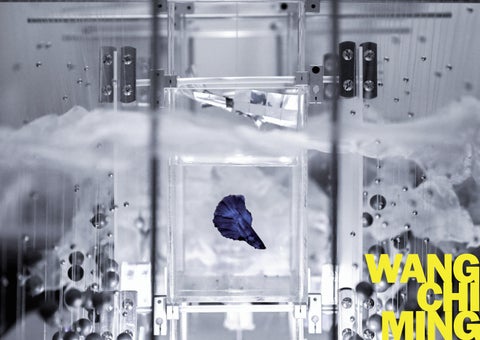
A betta fish inside a fish tank resembles a puppet. It is watched, fed, and controlled by people outside the glass. Although it appears to swim freely, it remains confined within transparent boundaries. This image embodies the role of the “Puppet” in the project.

Neon

Following the condition of being observed and controlled, the nature of influence begins to shift— from structural constraint to environmental infiltration.

Neon light is no longer understood as light alone, but as a medium that continuously falls, like rain. It covers the space, softening vision and destabilizing perception.

In this condition, objects lose clarity. Edges dissolve, and boundaries gradually fade.

Light and rain overlap, forming a persistent field of influence—

one that does not directly alter the object itself, but continuously reshapes how it is perceived.

Within low light, color slowly seeps into surfaces, as if being absorbed and redefined by the environment.

Perception is therefore reconfigured— no longer able to distinguish what belongs to the self and what originates from the outside.

In this state, the individual is not confined, but gradually transformed through continuous exposure.

Neon does not impose control, but exists as a constant, rain-like field of influence.

Neon

Through the experience of a long-distance relationship, I realized that metric time and space cannot clearly describe their essence.

I began to question both time and space

What defines them?

They are shaped through relationships, filled with contingency, with boundaries that are never fixed but constantly in flux.

Emotion is always elusive; yet it is precisely this ambiguity that allows time and space to transcend their original perception.

With the intervention of emotion, new modes of judgment and connection begin to emerge.

For this garden, I believe it has, through the shaping of emotion, already become a sitein itself.

What I have done is to endow this site with its own orientation— using the relationship between Taiwan and Spain as an axis to explore its environment.

In the physical world, the sun continues its natural course;yet within this site, it tilts along the emotional axis.

Here, light and shadow are no longer mere records of nature,but traces of memory, time, and the displacement of space.

Whisper

An Experiment with Time

In perceiving time, we experience emotion; yet in seeking to define it, we lose sight of that perception.

In the experiment, tin was maintained at 231 °C, then poured into water at three distinct temperatures: 0 °C, 50 °C, and 100 °C.

The differing thermal conditions created three distinct temporal reactions—three time differences—each resulting in a unique relational state between tin and water.

To further examine the essence of time, I conducted an experiment using molten tin and water as mediums. By observing the thermal differences between the two, I sought to capture the emergence of a “time difference”—a physical manifestation of the temporal gap shaped by heat exchange, material transformation, and emotional interpretation.

I consider the process of tin falling, colliding, and solidifying as three independent events, each representing a separate instance of the present.

Although their forms vary, they all share the same essence—tin.

Within this condition, I define each moment of solidification as “the present”, and further propose the idea of “non-simultaneous presents”—a coexistence of multiple presents unfolding in different temporal densities.

Through these experiments, I observed a phenomenon resembling“temporal inflation”—a state in which time itself seems to expand under the influence of different mediums, reflecting how perception, emotion, and material transformation intertwine in the construction of temporal experience.

As the ice begins to retrace its state,we start to mark and identify the original relationship between the ice and the tin.I regard this process as memory : a reconstruction of their initial connection.

When the ice finally melts, the relationship that arises between the ice, the tin, and ourselves becomes what I call “the sensation of nostalgia” .

From an initial point of departure, memory extends to form another coordinate —a process that awakens recollection of a specific place

Amid the temporal and spatial dislocations between these coordinates,

Could the sensation of nostalgia become a way to explore the essence of space itself ?

I’ve posed six spatial questions as starting points for reflection:

"Theswinginthecorner."
"Aconstructionworkersleepingonthescaffolding."
"Childhood castles"
"(red

Within the schema framework, the formation of an emotional space requires the fulfillment of the five conditions mentioned above in order to be truly recognized as such.

As the schema operates, these conditions begin to interact and relate to one another. Through continuous and evolving dynamics, the emotional space gradually takes shape and is defined.

deepen/feedback "extended expression of the loop"

"Relationship" "Constructed" A sudden glance back

"concretization" "to give meaning" "feedback loop I" feedback result start

deepen/feedback drive "dynamic reconstruction I"

constantly adjusted and reconstructed in a dynamic process. (external factors) (internal factors)

"Description " "Interaction" "emotional connection" I" "dynamic reconstruction II"

Scenery evokes emotion "feedback loop II" "dynamic loop" drive

Continuous reconstruction, generating new information each time.

The accumulation of multiple interactions gradually shapes a space with a "defined structure." "dynamic reconstruction III"

Some details are emphasized, while others dissolve

"a process of establishing clear coordinates."

If

one day " " were to vanish, would I still choose to return?

To respond to this question, I turn to the idea of “home.” If home were to disappear, would I still choose to return?

For this reflection, I focus on two places: my rented apartment in Tamsui and my family home in Zhongli. Through these two spaces, I attempt to explore the essence of home—and whether emotional attachment alone is enough to draw me back, even in the absence of its physical form.

In the film, I deconstructed my family home in Zhongli and discovered that the central staircase had become the emotional core of the entire space. Every emotional zone seemed to be anchored by this staircase—it supported the daily flow of events, each of which contributed to the constant reconstruction of emotional space. A similar phenomenon occurred in my rented apartment in Tamsui, where the emotional axis was often hidden within the most ordinary structures.

Eventually, I came to realize that emotional spaces may contradict one another or support each other. Through this ongoing process of reconstruction, they begin to crystallize—forming spatial structures that resemble crystalline formations.

My mom and I planned to go grocery shopping together, but I overslept. She chose to avoid waking me up.

At this moment, the emergence of emotion caused the original No. 55 to undergo a change.

1.Sometimes, when I had agreed to go grocery shopping with my family, I would be lazy and oversleep. They clearly could have chosen to come in and wake me up, but this is where emotion intervened (wanting me to rest more, not wanting to disturb me), and it started to cause a deformation of space—my room felt as if it had detached from the staircase.

2.When I was little and slacking off in the study room, the entire study would turn into my secret base. I would judge my mother’s footsteps based on the sounds coming from the staircase, and then pretend to be doing something proper so I wouldn’t be found out.

1 Hearing my mom's footsteps
Disguising the secret base to look serious.
Hiding the secret base through the sounds made by the staircase

Experimenting with Emotional Density

The Essence of motional space?

If the sensation of nostalgia represents the moment when emotion emerges,then what follows is an exploration of how emotion accumulates and takes form within space.

I used my rented room and family home as two points of origin—two coordinates of emotional space. Starting from the area of highest emotional density,I performed a series of rotations and overlaps,through which I observed that when emotional density reaches saturation,space naturally comes to a halt.

This moment of saturation becomes a boundary, defining both the limit and the shape of emotional space.

To further visualize this, I turned to ink as a medium.Through bubbles as an intermediary,I controlled the ink’s concentration and overlapping layers,allowing the medium itself to delineate the geometry of emotional space.

By using multiple perspectives, shifting viewpoints, and intentional voids,traces of time and memory began to emerge.

This process, more than painting, became an experimental tool for spatial construction,laying the foundation for the subsequent modeling phase.

The two experiments differ in their emotional prototypes —the home and the rented room.

In the upper experiment, based on the home,the emotional coordinates are relatively fixed and constrained.They carry the accumulation of family memory and long-term attachment,forming a space that is cohesive and inwardly condensed.

In contrast, the lower experiment takes the rented room as its model,where the emotional coordinates become more floating.Here, the relationship between emotion and space is no longer bound by stable borders,but instead unfolds in a transient and fluid structure.

On the material level, I soaked the entire sheet of xuan paper for the lower experiment,allowing the ink and bubbles to move and merge freely.This treatment embodies the diffusion and uncertainty of emotion in a floating state —a tangible expression of the floating coordinate.

At the very center, a metal structure pierces through all interfaces, becoming the pivotal vessel of emotional space.

It sustains the occurrence of different emotions and connects their continuous flow, allowing each emotional space to find its own point of support and axis within this structure,thus rendering the once -

Different emotions form interfaces between one another, and as emotions emerge and begin to intervene, an atmosphere slowly takes shape.

These interfaces are not static boundaries, but fields of permeability and relation, allowing emotions to interact and to reconstruct the order of space.

As the atmosphere gradually unfolds, we begin to realize that

SPACE is no longer merely a form or a container, but a structure organized and continually generated by emotion.

floating coordinates into tangible form.

The interfaces between the first and second layers of the model make the viewer aware of an inner world with its own dimensional depth, yet one that has not been fully entered.

Within this space, the internal components begin to establish structural relationships—emotion starts to take shape, and begins to emerge.

As one moves into the inner structure, the emotional space forms internal relations through its supportive nature; the materials are no longer static but sustain openness through mutual interaction.

The inner atmosphere gradually constructs emotion itself, ultimately giving rise to tangible spatial objects.

With the intervention of light, the original solidity transforms into an image, further blurring the boundary between the physical and the spatial.

From this perspective, light and shadow become an

Garden

The world is composed of endless events. Some trigger emotional spaces, understood and marked by individuals through schemas.Differences in density are revealed by shifts in perspective, forming identities like "garden-making."In the garden, objects connect and detach. Emotional relationships arise from personal experience, shaping an objective surrealism and a subjective reality — the garden merely masks these layers.

The garden section is understood as a structure of perception rather than a mere representation of terrain. Through walls, vegetation, rocks, and water, views are filtered and gradually revealed. Similar to the spatial depth in Chinese landscape painting, the section describes how space unfolds through movement, time, and layered perception.

The emotional source behind this small garden comes from a shared moment between my girlfriend and me in our room—one of us resting, the other working. In that moment, a subtle interface emerged within the single space, creating a silent division, yet both of us were still emotionally connected and affected by each other.

In this garden, the transitional interface is used to alter the perception of the semi-courtyard’s scale. This shift in scale is not a matter of literal enlargement or reduction, but rather a reinterpretation of the same spatial size through an interface that leads to a different understanding of scale. The semi-courtyard within the garden, once passed through the interface, is revealed to be a large timber deck.

This adjustment of the scale schema prompts recognition, which in turn evokes the sensation of nostalgia.

Turn static files into dynamic content formats.
Create a flipbook