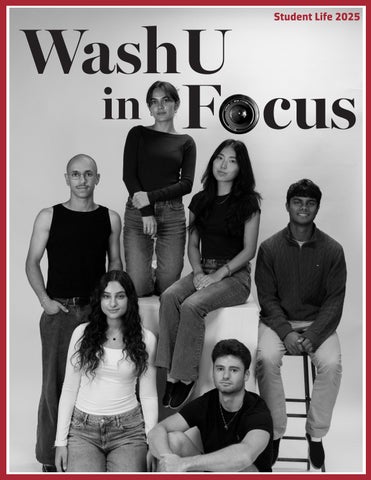
WashU in Focus
WashU in Focus | Student Life 1
Student Life 2025
2
Student Life | WashU in Focus
WashU in Focus | Student Life 3
4
Student Life | WashU in Focus
Table of Contents Roeder and 10 Maxine sustainable fashion
05 Letter from the editors
06 The rural student experience
08 Max Schreiber profile
16 Maya Iskoz profile 12 Humanities consolidation lookback
13 WashU in photos 14
18 Ivy reject culture Riley Herron Sydney Tran Editors-in-Chief editor@studlife.com Elizabeth Stump Managing News Editor news@studlife.com Will Rosenblum Managing Scene Editor scene@studlife.com Sylvie Richards Managing Forum Editor forum@studlife.com Matt Eisner Managing Sports Editor sports@studlife.com Kate Westfall Managing Design Editor designers@studlife.com Astrid Burns Special Issues Editor Mia Burkholder Managing Chief of Copy copy@studlife.com AnaElda Ramos Managing Illustration Editor Bri Nitsberg Managing Photo Editor photo@studlife.com
Yash Kshirsagar, men’s soccer walk-on
20 unconventional internships Oyster farming and
Masthead
Grayce Cooper Managing Social Media Editor
Ava Giere Chief of Copy
Quinn Moore Managing Newsletter Editor emailedition@studlife.com
Reeya Sharma Senior Social Media Editor
Alan Knight Managing Multimedia Editor Aliza Lubitz Zach Trabitz Investigative News Editors Elizabeth Grieve Zara Shariff Sophia Hellman Laurel Wang Senior Scene Editors Amelia Raden Dion Hines David Ciorba Kate Theerman Rodriguez Senior Forum Editors Tanvi Gorre Joel Swirnoff Coby Rinke Nina Laser Lauren Smith News Editors Lewis Rand Ian Heft Senior Sports Editors Sanchali Pothuru Multimedia Editor
love: 22 Coding WUCupid profile
Jack Warren Beatrice Augustine Amelia Spencer Design Editors Isabella Diaz-Mira Ella Giere Eran Fann Photo Editors
Jenise Fussell Tillie Szwartz Anna Kwok Hannah Dorval Mason Sutton Designers
Hannah La Porte Naomika Raveendran Regan Sakai Copy Editors Victor Haung Hadia Khatri DEI Editors
Sara Gelrud Sophie Schwartz Junior Scene Editors
Adrienne Levin Coleman General Manager a.coleman@studlife.com
Christian Kim Eliza Stulman Hannah Much Junior Sports Editors
Sarah Huff Advertising Sales Manager huffs@studlife.com
Lyn Wilkins Junior Forum Editor Tim Mellman Ashwin Nair Newsletter Editors Anna Dorsey Kevin Kan Illustration Editors Dijkstra Liu Jack Yang Web Editors
Cover Photo Bri Nitsberg Cover Design Bea Augustine
Layout Design Kate Westfall
Copyright © 2025 Washington University Student Media, Inc. (WUSMI). Student Life is a financially and editorially independent, student-run newspaper serving the Washington University community. Our newspaper is a publication of WUSMI and does not necessarily represent the views of the Washington University administration.
WashU in Focus | Student Life 5
Letter from the editors
Dear readers,
2025 has been a year full of attention and scrutiny to big-picture trends and issues across higher education. Over the past few months, we at Student Life have been dedicated to keeping the community informed about WashU and the continuously developing landscape of academia. So much of our coverage has been dedicated to these higher-level national issues, but at the same time, we want to ensure we are not losing sight of what’s happening on a more granular level on campus. WashU’s vibrant student body embodies a range of experiences, opinions, and stories. Many of us remember hearing about WashU’s commitment to knowing our community’s students by their
“name and story” when we first started our first year, and we want to use our platform as a student newspaper to share some of those stories. Through profiles of students using art as a tool for activism or walking on to a varsity sports team, opinion pieces on the potential consolidation of cultural studies departments and summer internship pressure, and more, this magazine showcases some of the students, and their stories, that make this campus community what it is. WashU in Focus is not a new concept — this special issue is rooted in Student Life tradition. WashU in Focus (or WU in Focus as it was previously titled) was created in 2018, in a time of heightened student activism and reflection, to emphasize the importance of diverse perspectives and backgrounds in our coverage
of WashU. Over the years, this special issue has highlighted a range of student experiences, touching on topics like the Abolish Greek Life movement, anti-WUPD protests, sexual assault prevention, and civic engagement. Four years since the last WU in Focus was published, and amidst a turbulent time in higher education, we wanted to bring this special issue back to shed light on the students who walk this campus alongside us. This issue is not, and never could be, exhaustive — the stories of WashU students are so varied and nuanced that it could never possibly fit in one magazine. However, we hope this magazine introduces you to some of the names and stories that make up this campus community and fosters curiosity about the diverse perspectives and experiences
BRI NITSBERG | MANAGING PHOTO EDITOR Seniors Riley Herron and Sydney Tran are this year’s Editors-in-Chief for Student Life. that your fellow students and WashU community members bring to campus.
Best, Syd and Riley
6
Student Life | WashU in Focus
Understanding the rural experience LYN WILKINS JUNIOR FORUM EDITOR
In our first week of college, we all got that talk about imposter syndrome. Our seminar leaders gathered us up and said, “You belong here.” It was a nice sentiment, but a bit harder to believe as a student from a rural area. As I tried to socialize that first week, every prospective friend brought up political issues I had never heard of. As I began my classes, I found myself fumbling in the dark as my professors brushed over academic standards, saying, “Well, you should already know that from high school.” I apparently belonged at WashU, but I didn’t know half of what anyone was talking about. I couldn’t imagine that I belonged when everyone I met spoke with such vitriol about the place I was from. I have always identified strongly with my rurality, so when peers turned up their noses at all those “backwater rednecks,” I believed I’d be next if I didn’t change who I was. WashU, despite being one of the few competitive colleges in the largely agricultural Midwest, admits very few rural students. For example, rural students make up only 8% of the Class of 2029. A rural student can be as social as possible and still very
rarely come across someone who shares their experience. Even when we do find each other, our shame often gets in the way of community-building. No amount of discussion about imposter syndrome can change the isolating nature of the rural experience. I grew up in a town of barely a thousand people that I had rarely left my whole life. Imagine living in a town where you knew everyone and every street; then, suddenly, you’re uprooted into a big city of strangers and Metros. It’s terrifying. It’s hard to explore St. Louis because you don’t know how to navigate a city. It’s hard to find people to go with you when it means admitting you have no clue what you’re doing. You can try to interpret the confusing signage on your own, but you’ll somehow keep taking the wrong train. On top of this geographical difference, you face cultural change. The first time I realized I was different, I was in the Bear’s Den with my suitemate, and she complained about how few WashU students recycled and valued sustainability. Back home, only schools had recycling bins, and we were never taught what to recycle. The bins always sat unused. I had two choices: ask for help (embarrassing) or
LUCIA THOMAS | STAFF ILLUSTRATOR hope I didn’t recycle the wrong things (risky). I could’ve told my suitemate that recycling costs money that we don’t have in rural towns. I could’ve told her that even my high school removed the recycling bins senior year because of budget cuts. I could’ve told her that there are so many economic barriers to sustainability that she doesn’t know. I could’ve told her that my ignorance came from a place of poverty, but it felt silly to say. There were plenty of people of lower economic status here, so what made me any different?
Rurality. Rural communities have significantly less access to education, resources, and even social interactions with diverse groups of people. We are geographically isolated from the rest of the world, and some of us don’t even have Wi-Fi to learn about different experiences on the internet. We aren’t taught the vocabulary of colleges and cities. Very few even make it to college from rural communities. We’re at WashU because we want to learn more than our underresourced hometowns could offer, but learning is a
LYN WILKINS | JUNIOR FORUM EDITOR Photos from Lyn’s hometown in Pendleton, Indiana, depicting the town square, farmers market, and farmhouse.
WashU in Focus | Student Life 7
PHOTOS COURTESY OF THE RURAL STUDENTS COLLECTIVE The Rural Students Collective allows rural students to connect with their roots and each other. trial-and-error process. It’s hard to put yourself in a position to learn when people get labeled and condemned for one error. The amount of side-eyes I got when I asked my classmates what “diaspora” meant in a group discussion nearly scared me off speaking altogether. A conversation about gun control got really awkward when I asked about hunting. In these conversations, people jumped to conclusions when I was genuinely asking. It’s hard to grow with the fear of people’s judgments hanging over your head. College is a place to learn. It is a miracle to people whose schools never had the money or geography necessary to effectively teach their students. The rural students of this school are
here to learn, but we can’t do it alone. The value of open-mindedness is immeasurable in the learning process. My suitemate listened to me about the inaccessibility of most environmental movements in rural communities, and she taught me how to recycle. When my friends trolled me for not knowing what a neopronoun was, I explained that any and all queer movements never made it to my hometown, and they caught me up without judgment. I finally swallowed my pride and asked how on Earth to work the Metro, and my friends didn’t belittle me. But the stigma goes beyond friendships, especially with the divisive nature of politics today. When I’m not around my
friends, I still hold my tongue for fear of people’s assumptions. Many people on campus resent rural folks for the current political state. They tend to have one view of the average Trump supporter, one that people in rural towns embody too well. I understand why it’s easy for people to reduce rural towns to this one stereotype, but I also understand the people in my hometown. Being a rural student requires a constant act of translation. I always have to be defending the people I care about. At school, I have to prove that rural people are more than reductive stereotypes. Back home, I have to prove that academia isn’t the oppressive force keeping us down. It’s an exhausting experience, and one most rural
students are all too familiar with. We try to build community with the Rural Students Collective, but it’s hard to do so when we make up such a small part of the student body. We can understand each other, but we need more than that. We need you to understand us. I know this is an experience most of you are unfamiliar with, but I assure you that you will learn something valuable if you take the time to listen. Rural students like me are adapting to a whole new landscape just to grow our perspective. All I ask is for you to put in the effort to listen to our perspective, too. The rural experience doesn’t have to be so isolating or overwhelming, at least not if you all take the time to understand it.
“Being a rural student requires a constant act of translation. I always have to be defending the people I care about. At school, I have to prove that rural people are more than reductive stereotypes. Back home, I have to prove that academia isn’t the oppressive force keeping us down.”
8
Student Life | WashU in Focus
Max Schreiber thinks we should all take more risks JOEL SWIRNOFF NEWS EDITOR
When he transferred into Sam Fox in his sophomore year, Max Schreiber had only ever taken one college-level art class. “Honestly, I was very intimidated when I got to Sam Fox,” Schreiber said. “I took [Intro to] Drawing second semester. I’d never drawn before, and it was something that I was very scared about.” But Schreiber seems to thrive in the uncertain and the uncomfortable. After all, he says, what else are we in college for? “My first goal when I got here was to try as many different things as possible,” Schreiber said. “I was just trying to try stuff out and see what stuck, and studio art definitely stuck.” Schreiber eventually decided to commit himself to studio art and tried a number of mediums. Now a senior, Schreiber likes to ask difficult questions of viewers through his art and enjoys seeing how they interact with his sculpture and video pieces. “I’m interested in how the public interacts with [my art],” Schreiber said. “I think it’s really cool to me when people are able to participate in it in their own way.” Schreiber has taken the idea of public interaction to great lengths. In one project, he displayed a 200-square foot canvas and had people answer questions about remembrance and memory by painting on it.
PHOTO COURTESY OF SONYA KOFFMAN Schreiber sits at a Rosh Hashanah dinner while wearing a keffiyeh, a traditional Palestinian headdress. “It was a sculpture, it was a painting, it was social practice, it was a community piece,” Schreiber said. “It’s always interesting when different mediums interact.” Similarly, in April of 2025, Schreiber placed a white sculpture that resembled a tent down in Tisch Park and allowed others to come and paint on it. The project made headlines after he was asked to remove the piece from campus. Schreiber said that the tent was a “reflection” on the events that took place in the same location on April 27, 2024, when over
100 protesters were arrested while setting up a pro-Palestine encampment. “We ended up getting threatened by the police and kicked off campus,” Schreiber said. “I had my studio searched, I received threats online, and I ended up with an academic sanction.” Schreiber, who is Jewish, considers himself an anti-Zionist and has included this theme in his works and as an activist. He cites discussions he had while at WashU for his current beliefs. “I really think it all goes back to just talking to people
and hearing different perspectives,” he said. Schreiber said he does not shy away from discussion and disagreement, while still holding his beliefs deeply. “We’re here to learn,” Schreiber said of college and his art courses. “I had a critique that was for a similar project I did [to the tent], and it was great. People didn’t necessarily have to agree with it, and they didn’t have to disagree with it.” Schreiber said he has had a number of difficult conversations with his family about Judaism and Zionism. While
WashU in Focus | Student Life 9 their perspectives differ, he said that those conversations taught him to articulate and be firm in his beliefs. “With my parents, even when we disagree, I still know that they’re proud of me for staying true to myself,” Schreiber said. “Even if I know that they don’t agree with the way I see a particular issue, like Israel, for example, I know that they still want me to stand up for what I think is right.” Schreiber said that committing to his beliefs helped him find community at WashU. He has begun hosting Shabbat dinners and other Jewish holiday events for like-minded Jews. “I think that at WashU, it can be hard to find communities of people who share your values and want to have a community outside of WashU,” Schreiber said. “Having people over for Shabbat dinner at my apartment has been a really great thing, because I want to have a Jewish space where people who maybe don’t feel like they’re accepted into the institutional Jewish spaces have a place to be.” Schreiber said that his art is a place where he has both found and tried to create community. He said that it has been a theme in his works, like in one series called “Memory Practice.” “I was interested in the idea of memory as an active rather than passive process,” Schreiber said. “I was interested in the act of remembering, and what it looks like individually, what it looks like in a group, and what social memory means.” In the first piece, a sculpture titled “I Am Not You,” Schreiber said he focused on the act of memory as an individual process. The piece is a metal sculpture depicting two figures welded together.
“This was about the negative space felt after loss and the idea of processing memory within yourself,” Schreiber said. Moving toward understanding memory alongside others, the series’ second piece, titled “Loss Cycles,” involved Schreiber recording a video of him and another Sam Fox student, senior Maya Iskoz, untangling a seemingly never-ending knot of rope. Voice messages from his late aunt can be heard in the video. “This piece was about the idea of memory, still as an individual practice, but when it includes this person who is no longer here,” Schreiber said. “It also ended up being about the idea of remembering someone by carrying on their memory by connecting with someone else.” While untying the rope, Schreiber said that he discussed his aunt’s life. He and Iskoz did not know each other well at the time, but Schreiber said that the process brought them closer. “We never finished untying it. So the piece became about how hard it is to untangle these relationships with people who pass and the legacies they leave behind,” Schreiber said. “I could only do that piece because Maya was willing to sit with me and talk about it for that long and commit to something many others wouldn’t.” In the third piece in the series, Schreiber took clothing and metal to create a sculpture of a peace sign, something he said is a common symbol among Palestinians as they call for liberation and survival. “In that piece, I included pledges that people in my community wrote to educate others on the Palestinian liberation movement,” Schreiber said. “The piece was about
having a shared goal, the power of the collective, and what can come from collectively remembering people.” Schreiber said that focusing on community has become even more important to him given the likelihood that this will be his last year in St. Louis and at WashU. “St. Louis is a great city for so many reasons, and I’m beyond grateful that I’ve gotten to spend my college years here,” he said. “I’m feeling pretty uncertain about what I’m going to be doing come this summer, so I’m just trying to make the most of the time I have here.” Schreiber said he and Iskoz have made plans to host an art show in his apartment. They have selected pieces from WashU students and will make his apartment into a temporary gallery. “Ideally, everyone will be welcome, and hopefully, a lot of students will show up,” Schreiber said. “Hopefully, a lot of people outside of WashU will show up, too, and it’ll be a nice space to see really cool work and get to know people in the community.” Schreiber and Iskoz got the idea for the show when they realized that there was not a lot of students’ art on display at Sam Fox. “It’s really hard to show your work as an artist without permission,” Schreiber said. “It’s increasingly more difficult to show the type of work you want to show wherever you want. One thing I’m excited about with hosting our own gallery is just having full control over that space.” Schreiber said that the show represents going out on a limb and trying something new, something that he said he wishes he had done more of earlier in his time at WashU. “Being in a university
setting, there’s just always more you could be trying,” he said. “I think if I could talk to freshman me, I would want myself to take those risks and put myself out there more. I think you have to really lean into being vulnerable sometimes, and it’s only ever served me well to do that.” He offered similar advice to readers. “If you’re able to, take a studio. Take one that scares you. Not even just studio, take a dance class, take a public speaking class,” Schreiber said. “Do something that you’re interested in, that you wouldn’t usually do, that scares you, but that you think you’ll get a lot from.”
BRI NITSBERG | MANAGING PHOTO EDITOR
10
Student Life | WashU in Focus
The intersectionality of sustainability and fashion: Maxine Roeder design SOPHIE SCHWARTZ JUNIOR SCENE EDITOR
Ever walked through the Danforth University Center (DUC) or Olin and seen piles of beads, string, fabrics, pins, and other accessories laying out on a table with someone meticulously weaving apparel? Behind these temporary setups is fifth-year dual-degree student Maxine Roeder. From sustainable fashion to artistic design, Roeder uses her creative talent to support sustainability measures. Roeder is a student fashion designer focused on making wearable art with sustainable techniques. She recently graduated in the Class of 2024 from the Sam Fox School of Design & Visual Arts and is currently finishing a Biology major in the School of Arts & Sciences. She has produced eight capsule collections, with each containing 6-30 different garments, accumulating University-wide recognition and setting herself apart as a sustainable designer. Her commitment to sustainability is demonstrated through her use of repurposed materials. “Sustainability is my design philosophy. I always will look for ways to upcycle things or reuse a lot of materials,” Roeder said.
Roeder began to weave sustainable creations into the picture when she realized her love for the outdoors could be more than just a daily stroll through nature. “I like to take lots of pictures of formations and stuff … I am very inspired by all the textures,” she said. Before she was releasing capsule collections or developing her design philosophy, Roeder was a curious young girl growing up in New York City. “My spark moment was getting calendars of Barbie drawings. They contained [drawings of] Barbie with fancy gowns,” Roeder said. “I then started to make clothes for Barbies and I switched to real people’s clothing when I was 13.” Since then, her creations have become increasingly complex, thematic, and influenced by conceptual and imaginative modern high fashion. “Alexander McQueen is one of my favorite designers,” she said. “I love how he takes a specific narrative and makes it into art.” Featherplight, created in 2024, is one of Roeder’s most well-known capsule collections. It was featured in The Vanilla Issue, a well known online fashion platform; Era Magazine, an
“Sustainability is my design philosophy. I always will look for ways to upcycle things or reuse a lot of materials.”
ISABELLA DIAZ-MIRA | PHOTO EDITOR Maxine Roeder works on a fashion design with sustainable materials. LA-based influence magazine; and the Sam Fox School’s 95th Annual Fashion Design Show. The collection is inspired by birds and contrasts their purity with their discomfort. The project seeks to shine a light on the shrinking bird population. What started as a senior thesis project with only eight pieces transformed into a much larger collection to be featured in a fashion show. Throughout Featherplight, Roeder communicates a narrative of joyfulness to sensitivity, ultimately ending with destruction, all reflecting the decline of birds. Each capsule collection has a unique name that shines a light on Roeder’s craftsmanship and ability to transcend the viewer. “I’ll try to think of a title that captures the essence of the collection. For Featherplight, it was literally about the birds and their flight. I try to find creative names.” Now for Roeder, fashion design is not just a career venture, but also a personal one. For her, it serves as an opportunity to step back from the hecticness of school and do something for personal enjoyment.
“Fashion design is a break. But also I multitask a lot. When I’m watching TV, I’ll work on these projects,” Roeder said. “Other times I’ll just hang out and I find the projects just following me.” Roeder advises that others interested in pursuing design of any form stay present in the world of art and culture and be innovators of their time. “It’s really important for people to see what else is going on. People need to be aware of the world and other designers,” Roeder said. Roeder’s ability to combine sustainability with flair while simultaneously crafting a narrative through the pieces is a cornerstone of her many projects. Her works are one of many examples of the creative and innovative talents of the WashU student body. Roeder’s story is still unfolding, so make sure to keep her name on your fashion radar and clothing wishlists. Along with Featherplight, Roeder’s seven other collections all capture a narrative of their own and are available for view on her website at www.maxineroeder.com.
WashU in Focus | Student Life 11
PHOTOS COURTESY OF MAXINE ROEDER Models show off Maxine Roeder’s sustainable fashion designs in St. Louis.
12
Student Life | WashU in Focus
A look back at the histories of the departments at risk for consolidation ASTRID BURNS SPECIAL ISSUES EDITOR
On Sept. 10, Student Life broke the news that the College of Arts & Sciences is considering consolidating six humanities programs — African & African American Studies (AFAS); Women, Gender, and Sexuality Studies (WGSS); Jewish, Islamic, and Middle Eastern Studies (JIMES); Education; Global Studies; and American Culture Studies (AMCS) — under one department. As of the week of Sept. 15, the “Social Transformations” task force has begun meeting to explore the departments’ organizational structures and the possibility of restructuring. The announcement of this task force startled many students in these programs, as well as other members of the WashU community. As rumors spread about departmental reorganization and the University’s motive for the change, students nervously talked about whether their major would still exist, if their favorite professors would lose their jobs, and what classes will look like in the coming years. While the task force representatives quoted the “innovative” interdisciplinary restructuring efforts New York University implemented in 2005, similar plans at peer institutions such as the University of Chicago cite cost cutting as a driving force behind their quick moves toward consolidation. Predicted effects at UChicago include cutting all programs with fewer than 15 tenure-track professors, scaling
back language instruction, and potentially ending certain Ph.D. programs, among others. The changes come as higher education faces a direct threat from federal government funding cuts, and as WashU’s administration leads an effort to “depoliticize” the University. Many of these programs were born out of social and political strife and were designed to uplift students while expanding interdisciplinary work, particularly AFAS and WGSS. While WashU’s task force has a stated aim to increase interdisciplinary collaboration, that work is already central to these programs. JIMES changed its name in 2019 from “Jewish, Islamic and Near Eastern Languages and Cultures” to highlight the interdisciplinary work of the program and make it more inclusive to a wide range of cultures throughout the Middle East, which were not represented under the outdated term “Near Eastern.” The Education department labels itself as “an interdisciplinary community that bridges the theoretical and research foundations of education, traditional academic disciplines … and the professional practice of education.” Interdisciplinary work is rooted in these programs; it does not need to be forced through administrative efforts that feel out of touch. Whether you’re frustrated by changes to higher education and WashU’s vague approach to adapting to these changes or think that consolidating these programs will bring about a new era of innovation in academia, lean into those emotions. At the
same time, it is important to recognize why these programs were created and why we should fight for their continuation. In December of 1968, the Association of Black Collegians (ABC) confronted the WashU administration at Brookings Hall during a takeover protest of racial issues on campus. Following the takeover, ABC put out The Black Manifesto, a list of demands for the University as well as a bill of rights for Black students. From The Black Manifesto, the Black Studies Program was born. Within it, ABC stated, “We ask for this Black Studies Program because we feel it is not only necessary for our education, but for our very survival.” At a predominately white university, the aim of the Black Studies Program was for it to be “not only [a] place to study about African-descended peoples but also to protect themselves from miseducation,” according to the department’s website. The Black Studies Program was formally established in September of 1969 and has since been renamed to the Department of African & African American Studies. It took until 2017 for AFAS to become recognized as its own department. Finally, students could take AFAS as a primary major, the department could hire its own faculty, and it could confer Ph.D.s. WGSS experienced a similar journey to becoming a department. The WGSS department at WashU, first beginning as a Women’s Studies program, was one of the first of its kind in the nation, launching in 1972.
Growing from women’s equality movements that emerged in the 1960s and ‘70s that highlighted disparities in higher education opportunities for women, the WGSS program and department has become a resource for gender-related topics and a base for activism and the critical exploration of gendered experiences. In 2015, WGSS became an official department after decades as a program. “It reflects the maturation of the program, but also, in a larger sense, of the academic field,” Barbara Schaal, former dean of the faculty of Arts & Sciences, said at the time. The study of cultures is essential to informing our word views and forming connections with other disciplines. Global Studies students dedicate themselves to crossing traditional academic boundaries to see global perspectives in all of their disciplines. American Culture Studies works to confront the harsh realities of American history and explore the diverse histories and populations within the United States. Even if, come March, the task force determines that these programs do not need to be changed or consolidated, this moment of fear should sit with students as a sign that these programs matter. In our current political climate, these programs are even more necessary. Take classes in these programs to show that they have life, and talk to your professors about their work. Carry forward their advocacy efforts by promoting them on campus, and engage in the task force’s efforts by speaking with representatives so that your opinion is heard by the University.
WashU in Focus | Student Life 13
LUC NEACY | CONTRIBUTING PHOTOGRAPHER SAM POWERS, ANNA CALVO, RACHEL BENITEZBORREGO | STAFF PHOTOGRAPHERS ERAN FANN, ELLA GIERE, ISABELLA DIAZ-MIRA | PHOTO EDITORS BRI NITSBERG | MANAGING PHOTO EDITOR
COLLAGE BY BEA AUGUSTINE
WashU in Photos
14
Student Life | WashU in Focus
‘Over the moon’:
Yash Kshirsagar’s journey of walking on to the men’s soccer team ROMAN PETERSON MATT EISNER
CONTRIBUTING WRITER MANAGING SPORTS EDITOR
In the spring of 2024, thenfirst-year Yash Kshirsagar received an email that would change his life. The midfielder had not heard back from former WashU men’s soccer head coach Joe Clarke for months. He was passed over for an offer to play varsity soccer at WashU out of high school. After being accepted to WashU on his academic merit, he says he “stayed persistent” in emailing Clarke his updates: highlight reels, monthly check-ins, anything to keep in contact with the Bears’ coach. All he heard back was radio silence, until Clarke’s name appeared in his inbox with a surprising question. “He said, ‘I want you to come to our first training session on Friday at 6:00 a.m. Can you be there?’” Kshirsagar recalled. “And I was like, ‘Yeah, of course I’ll be there.’”
Now a junior on the varsity men’s soccer team, Kshirsagar’s story is different from most. Kshirsagar is the only player on the team to join as a walk-on, joining the team after a season playing for the men’s club soccer team. He rode the bench for the entire 2024 season. But this year, he has come off the bench in a majority of the Bears’ games and started in an early-season tilt against Westminster College. He is playing on the wing this season, a difficult adjustment from the midfield position he
has played his entire life. But against all odds, this season, Kshirsagar has gotten regular minutes and goal-scoring opportunities. Sometimes, Kshirsagar himself can’t even believe it. “There was about a year where I was really uncertain about my future and I didn’t really know if I would play again,” he said. “So having that all pay off is such a relief. I’m just over the moon.” Kshirsagar starred in high school, serving as team captain for his final season at the St. Paul Academy
and Summit School in St. Paul, Minnesota. In 2023, he joined the Minneapolis City Futures team, which plays in the United Premier Soccer League. Through Minneapolis City, Kshirsagar met now-senior Zach Susee, a well-known name in Minnesota soccer circles and a forward for the WashU men’s soccer team. The two of them had never met, but they shared a career progression — from the youth-level Salvo Soccer Club, to Minneapolis City, and ultimately, to WashU. “I got to play with Yash a little bit at [Minneapolis] City, and he was on one of the teams that I used to watch at tournaments when I was younger,” Susee said. “It’s pretty cool that we have someone on the team from the same area and same club as me, even if I didn’t know him personally.” Kshirsagar woke up early that day to train with the team. After attending a few more training sessions, he got an invite to the team lift session. The newly-hired head
HANNAH DORVAL | CONTRIBUTING PHOTOGRAPHER
WashU in Focus | Student Life 15
“My goal is to bring that spark, I want to bring that speed and attacking power. And when I’m playing to my ability, that’s something I’m able to do well.” coach, Andrew Bordelon, soon asked him to practice with the team. He dressed with the team in an exhibition game against Saint Louis University that April but didn’t see the field. He began to plan his daily routine around a team he didn’t yet know he was a part of, all for the opportunity to play with the senior team. At the end of the spring season, Kshirsagar had to ask Bordelon the uncomfortable question: did he make the team? He got the answer he had been waiting for. “I kind of knew by then, since I was invited to train and practice all spring,” Kshirsagar said. “But him saying that in words and giving me the confirmation was just incredible.” Despite training and practicing for the men’s soccer team for over a year, Kshirsagar didn’t see the field until the 33rd minute of the men’s soccer 2025 season opener against Millikin University.
Bordelon turned to his former walk-on midfielder for the first time — poetically, replacing Susee on the pitch. 35 minutes later, first-year Wole Adeoye crossed a ball into the box. Once again, Kshirsagar did not waste his opportunity. He scored the goal that extended WashU’s lead to 6-0, but more importantly, scored his first collegiate goal. He has not scored since facing Millikin, but he recorded his first career start in the following game against Westminster College. “In the moment, I didn’t really think about everything I have done to get that goal,” he said. “But after the game, when I was with my parents, I realized all the steps I had to take to get there. That was a special moment.” Kshirsagar is still constantly adjusting. He is adapting to a new position, one which requires him to be less involved with playmaking and more clinical with his finishing. He’s still training and
improving every single day. With many of the Bears’ regular forwards injured, the new winger is taking the opportunity to continue to carve out a prominent role for this year’s squad. “My goal is to bring that spark,” he said. “I want to bring that speed and attacking power. And when I’m playing to my ability, that’s something I’m able to do well.” So far, Kshirsagar has done just that. This year, he has logged valuable minutes in nearly all of the Bears’ games. His energy off the bench is palpable, always bringing a good attitude with him into games. “He is one of the most positive people I’ve ever met and just a genuinely nice person,” Susee said. “He’s just a really, really good guy, everyone in the locker room enjoys having him around, and now he’s one of the guys that just fits well with the team.” For Kshirsagar, the journey has always been about
more than just personal glory. He sees himself as proof that persistence pays off and that there’s space for players who may not have taken the traditional recruiting route. “The main thing is to keep reaching out,” he said, offering advice to future walk-ons. “At first, I didn’t really see the importance of me following up so persistently. But I think that if I had sent only three emails instead of the ten that I did send, [Clarke] probably wouldn’t have emailed me and called me up.” From captaining his high school soccer team, to doubting whether collegiate soccer was within reach, to becoming WashU soccer’s only walk-on among a roster of highly-touted high school recruits, Kshirsagar’s success has come in waves. And as the Bears’ season continues, he’s determined to keep building on that momentum — one game, one opportunity at a time.
16
Student Life | WashU in Focus
Maya Iskoz thinks it’s okay to be confused by art
ELIZABETH STUMP MANAGING NEWS EDITOR
This past summer, senior and Sudio Art major Maya Iskoz participated in the Yale Norfolk School of Art’s intnsive 6-week residency program designed for up-and-coming artists. Inspired by Roland Barthes’ 1967 essay “The Death of the Author,” Iskoz created “Death of a Player” during the intensive, an eight-minute video art piece
exploring individual identity and its displacement onto other forms — such as avatars — to better understand the bounds of the self. “When you think back to playing, do you remember yourself watching your avatar play, or yourself as the avatar playing? Can avatars help us understand ourselves?” read subtitles in the video. Iskoz’s work exists in an intersection between critical
ERAN FANN | PHOTO EDITOR Maya Iskoz poses in her studio.
academic theory and popular culture/mass media. Her video, “Death of a Player,” includes direct quotations from Barthes’ subversive critical theory juxtaposed with pastoral imagery, scenes from the video game IMV, and lyrics from Ye’s (formerly Kanye West) “New Body” and Lana Del Rey’s “Gods & Monsters.” Although she was initially interested in pursuing painting, Iskoz transitioned to sculpture
and, more recently, video because she felt as though they better represented her visions and ideas. “I took a sculpture class, and I had a really great professor, Anika Todd, and I started thinking three-dimensionally and how you can make so many versatile things,” she said. “Conceptually, three-dimensional objects ended up being a lot closer to my visions than two dimensional media, like
WashU in Focus | Student Life 17 paintings.” In addition to working in 3D, Iskoz enjoys experimenting with the element of time in her work and being “pushed” by the added challenges both of these facets bring. “I recently started focusing on video too because [of] the added dimension of time, which … also helps to more closely bring my visions to life.” Iskoz cited the work of video artists Ryan Trecartin and Jon Rafman as influential for her own work. She said that Trecartin’s videos — which last between 30 to 90 minutes — thrust viewers into a world of uncanny characters interwoven with familiar elements borrowed from reality TV and cinema. “I really like how long it is because it really forces you to sit and engage with it, and pulls you into the world that he’s constructing,” she said. “But beyond that, … I’m not really into over-analyzing. I think the work is just really good and really funny, and I just love the experience I have when I interact with it.” In a similar vein, Iskoz refuted the belief that art needs to be looked at with the goal of total understanding, emphasizing the experience of being exposed to the work over comprehension
of it. “I think over-interpretation just sucks the life out of art sometimes.” Personally, she is interested in the music of rap phenomenon Travis Scott and has incorporated it into some of her work — she sees his songs as indicative of culturally ingrained hedonism and nihilism. “It has a je ne sais quoi,” Iskoz said. “I think it really helps me understand my work and figure out what I want to prioritize. I think his music says a lot about society, but in a really funny, pop cultural way, which is why I really like it.” Although she said she initially regretted her decision to come to WashU to pursue art and considered switching to a math major, Iskoz felt like her priorities shifted after studying abroad in Florence the summer between her sophomore and junior year. She added that she was very grateful to have had the opportunity to study closely with art faculty in both Florence and at WashU, and most recently at the Yale Norfolk school over the summer. “I think junior year, something kind of clicked,” she said. “During study abroad, I had a — not to be cliché — but a
realization about what I valued in my life and what I wanted to do.” Junior fall was the start of her current wave of work, which Iskoz says feels more salient and meaningful to her than her previous art. Some of these pieces include “Luke 21:31”— a vape that displays a compilation of various TikTok lives overlayed with direct quotes from Jesus’ description of the rapture from the Book of Luke — and “UnHinged Horse/Ketamine Therapy” — a life size sculpture of a Bojack-Horseman-esque horse suspended from the ceiling. The sculpture also has organs protruding from it inscribed with pervasive online dating phrases such as “Pics?” and “Showering without me?” Horse imagery is a frequent motif in Iskoz’s body of work, and she noted that the sculpting process of the “UnHinged Horse” figure took many weeks due to its lifelike size. “Whereas for previous work, I couldn’t explain necessarily why I wanted to make something — which I don’t think makes it bad, but I think [the new art] just felt better to make, because I was like, ‘This is why I’m doing this,’” she said. Iskoz views art, or the
institution of “Art,” as she referred to it, as becoming increasingly inaccessible. She added that pieces should be located in inviting spaces, not just the stereotypical “white cube galleries.” “I think that [art] should be complicated and interesting and hard to understand,” Iskoz explained. “I think that it should be exciting [and] I don’t think it should be written off as bad work because it’s confusing.” With the shared goal of making student-created art as accessible as possible, Iskoz and her close friend Max Schreiber decided to host an art gallery in his home the weekend of Nov. 7 and 8 with theirs and others’ work. Iskoz hopes that those who have the opportunity to experience art do not dismiss what is initially incomprehensible to them. “I think the worst thing is, if someone interacts with an artwork and they see it and then immediately they’re like, ‘This makes no sense.’” With her own work, Iskoz hopes that it leaves a lingering impression with viewers. “I would like my work to stick with people for a little bit after they see it, and if they keep thinking about it and turning it around in their mind, hopefully
STILLS FROM MAYA ISKOZ’S VIDEO ART PIECE “DEATH OF A PLAYER.”
18
Student Life | WashU in Focus
How WashU’s ‘Ivy reject culture’ has shifted over time ZOE RHODES
CONTRIBUTING WRITER
It’s the fall semester of freshman year. The air seems littered with “What are you majoring in?” and “Where are you from?” even though it’s well past orientation and the first week of classes. After the mandatory questions are out of the way, many people like to spring the slightly deeper “Why did you choose WashU?” on you. For some, this question is an easy one. They applied to WashU via Early Decision or QuestBridge, or they just knew that WashU
was the right place for them. For others, however, WashU was far from their top choice. Although personally, WashU was my “reach” school, many people at my high school (usually those destined for MIT, Stanford, and Harvard) referred to it as an “Ivy reject school.” With admissions to those schools becoming progressively more competitive, many high-performing students have nixed the Ivy League for schools like Emory University, Tufts University, and WashU — schools that are a bit more attainable. So while an ever-increasing
number of WashU students apply Early Decision, some students simply believe that they would have preferred attending another school, at least when they start their fall semester. As a first-year, I expected orientation to be a constant barrage of conversations about all of the acceptances and rejections that everyone received. To my surprise, that wasn’t at all the case. The vast majority of people I talked to during Bear Beginnings didn’t ever mention other schools they considered, and those that did seemed overall happy to be at WashU. Contrastingly, when I mentioned this observation to some of the upperclassmen in my Nemerov seminar, they were slightly surprised. Sophomore Ellie Fischman shared that if there ever was an “Ivy League reject” culture at WashU, it seems to have declined in recent years. Although Fischman has only been at WashU for two years now, she experienced many discussions about WashU’s “Ivy League reject” culture at her high school, as many of her upperclassmen preceded her in attending WashU. Fischman described the “Ivy League reject” culture at WashU not being inherently negative, but rather a point of connection between students with similar admissions stories. “It’s kind of a funny joke to make,” Fischman said. WashU may not be one of the eight official Ivy League
schools, but with one of the smallest acceptance rate we’ve had in years, and breaking into the U.S. News 2026 Top 20 National Universities ranking, it is still an academically rigorous school. Therefore, WashU’s statistics support Fischman’s explanation of the overall good-hearted nature of our student base’s Ivy League jokes. Fischman went on to explain that the country’s well-known, lauded universities are no longer the “pinnacle of open-mindedness and intellectual curiosity.” The phenomenon of students broadening their horizons to include schools like WashU, instead of just reaching for the eight Ivies, has been increasingly reported on in recent years by media outlets such as Forbes and the Atlantic. While the merits of an education from any of the Ivy League schools are hardly in question, the drawbacks have become topics of discussion within the past few college admissions cycles. Most notably discussed by David Brooks, many critics of the Ivy League base their opprobriums in the inequity that within some circles is synonymous with elite higher education. Brooks wrote at length within a 2024 article in the Atlantic about the meritocratic and legacy-centric system upon which many private universities are based; however, Brooks focused on the eight Ivy League schools. Brooks argued that despite their public and intellectual contributions, the Ivy League
WashU in Focus | Student Life 19 “broke America.” While Brooks’ take is a rather extreme one, Forbes takes a more logical approach in breaking down the reasons why the Ivy League may not be the best fit for all students. Forbes weighs the importance of an Ivy League degree by considering factors such as financial aid, student-to-faculty ratios, alumni network, available resources, and more. Forbes distinctly outlines the high cost of Ivies for some students, despite their offering of financial aid. Supporting Forbes’ financial aid argument, the Princeton Review ranked WashU’s financial aid services third in the country, while no Ivies appeared in the top three spots on this list. Of course, there are also the pros of an Ivy League education — Brown’s student-to-faculty ratio is an impressive 6:1. Forbes also discussed the aggressively competitive admissions process. As previously mentioned, it is not easy to get into WashU. Ivies are extremely selective, another factor in why students are turning toward non-Ivy well-regarded institutions, like WashU, Emory, and Tufts. However, Fischman suggested that media outlets such as Forbes fail to consider equally important characteristics of a school, like a steadfast commitment to student satisfaction. As a WashU Student Associate (WUSA), Fischman has specific insight into the gravity with which the WashU administration considers students’ support systems. WashU boasts a 7:1 student-to-faculty ratio, neckand-neck with Ivy League statistics. While research resources seem closely linked to the Ivy League brand within the common psyche, in 2024, WashU was the second largest recipient of NIH funding for medical research. Senior film major Cole
ANNA DORSEY | ILLUSTRATION EDITOR Bernstein somewhat debunked the suspected “Ivy reject culture” of WashU, explaining that some students’ lack of enthusiasm of being at WashU doesn’t necessarily correlate with the need to be at an Ivy. He suggested that it is easy for general anxiety about college to manifest in doubting one’s choice of school. “It’s natural that people will [wonder], ‘Am I at the right place?’” Bernstein said. WashU has a lot of student pride, specifically surrounding financial aid, according to Bernstein. “It’s one of the things that makes me proud to go here,” he said. Bernstein’s pride is founded in more than just his perspective — the Princeton Review gave WashU’s financial aid an almost perfect score. While one could argue that stress will be pervasive in any higher education setting,
students at Ivies, according to a student-written Brown Daily Herald article, struggle with an otherworldly type of cutthroat competitiveness every day. Contrastingly, Bernstein said that it’s “not even a thought” for many WashU students, especially humanities majors, to act as though they are in direct opposition to their peers. The Princeton Review agrees with Bernstein’s sentiment, highlighting WashU’s highly collaborative student culture within its analysis of the University. Yet another student-led Ivy League newspaper, The Daily Princetonian, explored the downfalls of the Ivy League in regards to how students are treated, both in admissions and on campus. While some may argue that WashU remains within the “Ivy reject” category, over time, WashU has become known for its excellence in a
plethora of fields, including those that don’t necessarily come to mind when considering the historic Ivy League schools, like student support and satisfaction. At any school, there will inevitably be a mix of students who treat the university they attend as their dream school, and those who once pictured other institutions as their primary options. At the end of the day, an individual’s post-graduate opinion of their university is a more accurate reflection of the school than the opinion they held during their first few months, or even years, there. Whether WashU was your first choice or your last, adjusting to college is hard for everyone and takes time. Make the effort to grow your circle and learn something new about WashU and your community. Ivy Leagues are more than acceptance rates and ratios — so is WashU.
20
Student Life | WashU in Focus
“Now is no time to think of what you do not have. Think of what you can do with what there is.” – Ernest Hemingway, “The Old Man and the Sea”
Cleaning oysters, appreciating the unexpected GUS BACHNER CONTRIBUTING WRITER
On an oyster boat, you are occupied with important tasks at all times. One is the cleaning of oysters. This is the essential last step before a harvest, in which fully mature oysters are cleaned by hand after being selected based on quality and appearance. On a medium-scale farm like the one I worked on this summer, with only one boat and two oystermen, I cleaned anywhere from 600 oysters to over 1,000 on the busiest days. To clean an oyster, pick it up in one hand and scrub off any dirt with your nylon brush. If you see a barnacle, scrape that off with your metal paint chipper. Flip the oyster over and then give the top a good brush. Once clean,
put your oyster in a separate pile and start on the next dirty one. You have hundreds of these to get through, so don’t spend too long trying to get them perfectly clean. Once you’ve cleaned a few dozen oysters, use your dust pan to scoop them into bags, which go back in the water to keep the oysters wet. After four to six hours of this, you should have gotten through enough oysters for the day’s harvest. One thing this process forced me to do, besides efficiently clean oysters, is think. With nothing to do but scrub, chip, and shovel, self-reflection was not so much a choice as it was a reality thrust upon me. One thought could float around in my head for hours, bouncing between piles of oysters and occasionally drowned out by the screeching of birds that roosted on
the floating traps. On most days, as I passed oysters from one hand to the other, I was occupied by a distressing sensation. Although I enjoyed the work I was doing, it did not match my preconceptions about what my summer ought to have looked like. As is common among WashU students, I had convinced myself that a summer internship was essential for my future. Because I was not working for a member of Congress or helping run a campaign like other Political Science majors I knew, the plans I had for myself seemed lost. It is difficult to watch your expectations morph into something unrecognizable, and in my disorientation, I failed to understand the true value of the opportunity at my fingertips. Drifting between oyster traps, feeling the sun
rise and fall overhead, gazing out at the windsurfers and water-skiers, watching the red and green drifts of seaweed coast along the ocean’s surface — these are scenes of serenity and beauty that were somewhat lost in my distraction. They are also things I will probably never have the chance to experience again in the same way. What is obvious in retrospect is that my hours on the boat will remain one of the most formative times of my life. No, it was not direct career experience, but I believe it offered something equally, if not more, valuable. This opportunity taught me resilience, patience, and responsibility. It introduced me to a world where every oyster matters a great deal and to the perspective that satisfaction can be found in
WashU in Focus | Student Life 21
PHOTO COURTESY OF GREY LADY OYSTERS People cleaning oysters on a boat for Grey Lady Oysters, the company Gus Bachner worked for this summer.
the very process of things. For these insights I will always be grateful. I would like to say that I had a sudden awakening this summer, and that once it dawned on me that my disappointment was unfounded, I threw my hands up to the oyster gods and thanked them for showing me the light. The truth is, however, that having hours upon idle hours to reflect did not immediately lead me to a positive mindset. For all the time I had out on the water, I was far too occupied with arbitrarily judging where I should have been instead of appreciating where I was. Now that I am a month removed from the experience, I can fully appreciate the value of my time on the boat. Back at WashU, the experience of being out on the water
is a dream I want to return to and start over again. I want to seize the occasion and recognize from the beginning the skills and memories I would gain as an oysterman. Above all else, I want to express the danger of losing touch with yourself and the opportunities in front of you. You will not always end up where you expect to be, and you cannot always do the things you first set out to do. Sometimes, you will find yourself in circumstances that seem so extraordinary as to be unbelievable. What you cannot allow yourself to do is dwell on what could have been and miss what is before you. I do not discourage you from applying to summer internships or from striving to achieve your goals. I only suggest that if you are ever
lucky enough to find yourself on a boat in the middle of the ocean, with a pile of oysters in front of you and all the time in the world to appreciate
the beauty and opportunity at hand, do that. Everything else, I suspect, can wait till the end of the harvest.
“I was far too occupied with arbitrarily judging where I should have been instead of appreciating where I was.”
22
Student Life | WashU in Focus
Struck by WUCUPID’s arrow: Student creates new dating platform at WashU LILY RULNICK CONTRIBUTING WRITER
If you’re a hopeless romantic and naive first-year like me, you probably expected to arrive at college, meet a nice guy in your College Writing seminar, and live happily ever after. Spoiler alert: the reality of finding love in college is quite different from what romantic comedies portrayed it to be. Luckily, there’s a new dating platform in town that aims to make dating at WashU a whole lot easier: WUCupid. Self-described by founder and sophomore Ben Kras as “WashU’s newest, best, most efficient dating platform,” WUCupid is an online dating program built exclusively for WashU students. WUCupid users have a month and six days to fill out a 38-question compatibility survey. After the survey period ends, there will be a three-day processing period where all responses are analyzed and matches are generated by a matchmaking algorithm Kras created. The idea for WUCupid first came to Kras when he was brainstorming for his final project in Rapid Prototype Development and Creative Programming, a class that he took in spring 2025. Kras thought that creating a “Tinder for WashU” could fix a significant issue he and his friends ran into during their first year on campus. “The biggest problem people have with dating at WashU is that it’s difficult to meet people outside of your circle in a way that’s intended to lead to [a] romantic connection,” Kras said. “[WUCupid] is meant for people who are
looking for serious romantic relationships.” While there have been other WashU-specific dating platforms in previous years, Kras believes that WUCupid provides more flexibility and inclusion than prior sites. The two former platforms that Kras mentioned, Datamatch and Marriage Pact, shared a similar survey format to WUCupid. “[Other platforms] ran on a similar format, but the big problem I had with them is that they’re very exclusive,” Kras said. “Marriage
orientation, political views, and religion, which will be considered before any of the soft preferences are matched to ensure that people are paired with the most compatible partners. In contrast, hard preferences include hobbies and interests. After preferences are taken care of, Kras analyzes the data vectors using cosine similarity. Luckily, Kras didn’t have to start from scratch when creating this algorithm. It turns out he isn’t the only Campus Cupid in the family.
“My idea of success in the long term is if I get a message on Instagram or whatever in a few months being like, ‘hey, I met my girlfriend,’ or, ‘I met my boyfriend or my partner on this,’” Kras said. “If I get one message like that, I’ve done it. I’ve won.” Pact ran early in September, and it only ran once a year … so if you missed out that September window, that was it, and especially for freshmen who were still getting used to the chaos of moving into college and all that, it was something that a lot of people didn’t have time to realize was a thing … Datamatch [had] the same kind of issue, except that it runs on Valentine’s Day.” After coming up with the initial idea, Kras got to coding. The survey is categorized into two types of preferences: soft preferences and hard preferences. Hard preferences, Kras explained, are things like sexual
“I’ve had a lot of help … and mentoring from my brother,” Kras said. “My brother ran his own general public dating app during the pandemic … I obtained a lot of valuable data and information and mentoring from him throughout this process.” Kras’s brother’s platform, Mixmosa, had many similar goals to WUCupid, like the establishment of “genuine connections instead of random hookups,” according to Kras. Mixmosa operated in Austin, where Kras’ brother lived at the time. Although the first survey period hasn’t ended yet, Kras has already been getting feedback on his platform,
both through messages on WUCupid’s Instagram, verbal feedback, emails through WUCupid’s website, and comments on the anonymous social media platform Sidechat. While there has been a lot of positive feedback, some have commented that the questions are “too repetitive or generic.” Others take issue with the fact that pictures of the users are not included in the matchmaking process. “Obviously, compatibility is a massive part of determining probability of success in a relationship, but there also does have to be some kind of physical attractiveness involved as well, and that is something I’m looking into doing in the future,” Kras said. “I’m not sure if that’ll happen within this cycle or even the next, because that is something that’s going to take a little bit of time to implement, but I’m pretty sure that that’s a good idea for the future.” WUCupid is still in its very early stages. The first matches have yet to come out, which means that over 500 students who have taken the survey aren’t able to determine the levels of WUCupid’s legitimacy as a dating service. However, to Kras, success is relative; his goal is to help people, even if it is just a few. “I’ve kind of joked to my friends that I think my idea of success in the long term is if I get a message on Instagram or whatever in a few months being like, ‘Hey, I met my girlfriend,’ or, ‘I met my boyfriend or my partner on this,’” Kras said. “If I get one message like that, I’ve done it. I’ve won.”
WashU in Focus | Student Life 23
ELLA GIERE | PHOTO EDITOR DESIGNED BY BEA AUGUSTINE
24
Student Life | WashU in Focus