Student Life presents



























6 8 10 12 14 16 18 24 26
Letter
Three things to consider when picking upperclassmen housing
Five fun things to do with your suitemates
Things you do and do not need in college
Five tips for living with a roommate for the frst time
The importance of designated spaces
Branch out from Paws & Go and try these dorm-friendly recipes
No furniture? No problem. A guide to furnishing your empty apartment
Decor hacks to personalize your room (on a budget)
Sophomore suite fair: A guide to curating the perfect common room 28 30 34 37 40 42 44 4 5 46 74 48 Village photo essay 50
St. Louis doesn’t need more ofcampus “student housing” Neighborhood map
The ins and outs of WashU landlords
Sophomores should be able to live of campus
Pros and cons of frat row
Sit in the common room: The importance of bonding with your foor
The case for a random roommate
Your guide to roommate relationships
Housing prices
South 40 photo essay





Welcome to Housing Guide 2025!
With finals on the horizon, we know WashU students have a lot on their plates, and figuring out where, with whom, and how you’re living next year can get pushed to the back burner of your mind. Housing can bring a whirlwind of anxieties: Where should I live next year? Should I live in a dorm, apartment, or house? How do I deal with roommate conflicts? How should I decorate my dorm? How do I interact with my landlord?
If any of these questions — or anything else housing related — is on your mind, Student Life’s housing guide is the magazine for you. Our staff has compiled some answers to
these questions, and we’ve put together student perspectives you can find useful whether you’re a senior seeking advice on making the most out of your final student housing experience or a first-year unsure what college housing looks like outside of a South 40 dorm.
Throughout this magazine, our staff also shares insights from their experiences living on and off campus here at WashU. Featuring takes on the gentrification of St. Louis, advice for connecting with new roommates, and recipes for easy dinners that can be made in a college dorm, we hope you can find something informative and interesting to assuage your housing concerns.
We would like to thank our Student Life staff for going
Riley Herron
Sydney Tran
Editors-in-Chief editor@studlife.com
Elizabeth Stump
Managing News Editor news@studlife.com
Will Rosenblum
Managing Scene Editor scene@studlife.com
Sylvie Richards
Managing Forum Editor forum@studlife.com
Matt Eisner
Managing Sports Editor sports@studlife.com
Kate Westfall
Managing Design Editor designers@studlife.com
Mia Burkholder
Managing Chief of Copy copy@studlife.com
AnaElda Ramos
Managing Illustration Editor
Bri Nitsberg
Managing Photo Editor photo@studlife.com
Quinn Moore
Managing Newsletter Editor emailedition@studlife.com

Seniors Riley Herron and Sydney Tran are this year’s Editorsin-Chief of Student Life.
above and beyond to write, edit, copy edit, design, photograph, illustrate, and make this housing guide. Special thanks to the lovely Astrid Burns, our Special Issues Editor, for organizing these efforts and
Astrid Burns Special Issues Editor
Grayce Cooper Managing Social Media Editor
Alan Knight Managing Multimedia Editor
Aliza Lubitz
Zach Trabitz Investigative News Editors
Elizabeth Grieve
Sophia Hellman
Laurel Wang Senior Scene Editors
David Ciorba
Amelia Raden
Dion Hines
Kate Theerman Rodriguez Senior Forum Editors
Lewis Rand
Ian Heft Senior Sports Editors
Ava Giere
Samantha Elegant Chiefs of Copy
Reeya Sharma Senior Social Media Editor
Jack Warren
Beatrice Augustine
Amelia Spencer Design Editors
Joel Swirnoff
Tanvi Gorre
Coby Rinke
Nina Laser
Lauren Smith News Editors
Ella Giere
Eran Fann
Isabella Diaz-Mira Photo Editors
Sara Gelrud
Sophie Schwartz Junior Scene Editors
Hannah Much
Christian Kim Eliza Stulman Junior Sports Editors
Lyn Wilkins Junior Forum Editor
Tim Mellman
Ashwin Nair Newsletter Editors
Anna Dorsey
Kevin Kan Illustration Editors
Sanchali Pothuru Multimedia Editor
Regan Sakai
Hannah La Porte
Naomika Raveendran Copy Editors
keeping us on track to construct this magazine brick by brick.
W m r l e y a ,
Syd and Riley
Lindsey Morris
Lucia Thomas
Eden Levi
Tillie Szwartz
Sadie Bloom
Jenise Fussell
Hannah Dorval
Alma Bendavid Designers
Jack Yang Web Editor
Victor Huang
Hadia Khatri DEI Editors
Adrienne Levin Coleman General Manager a.coleman@studlife.com
Sarah Huff Advertising Sales Manager huffs@studlife.com
Bri Nitsberg
Sydney Tran
Cover Design
Kate Westfall
Layout Design
Copyright © 2025 Washington University Student Media, Inc. (WUSMI). Student Life is a financially and editorially independent, student-run newspaper serving the Washington University community. Our newspaper is a publication of WUSMI and does not necessarily represent the views of the Washington University administration.

ASTRID
BURNS
SPECIAL ISSUES EDITOR
As you get older at WashU, the housing possibilities get greater and greater. The world (or at least University City) is your oyster. Hooray! However, as you get more housing choices to pick from, you also have to consider more factors. But don’t fret! Here are three things to consider when envisioning your upperclassmen housing experience.
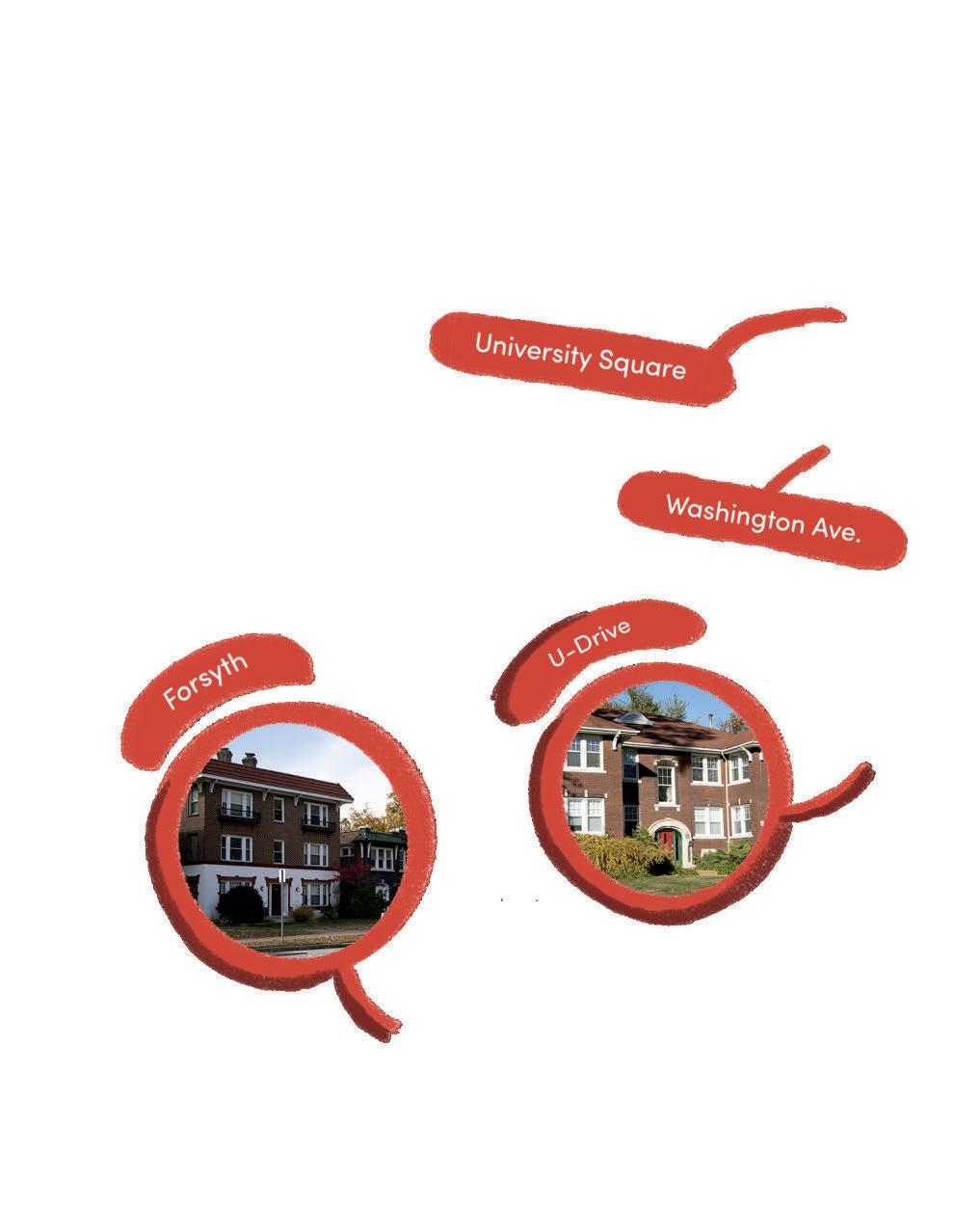
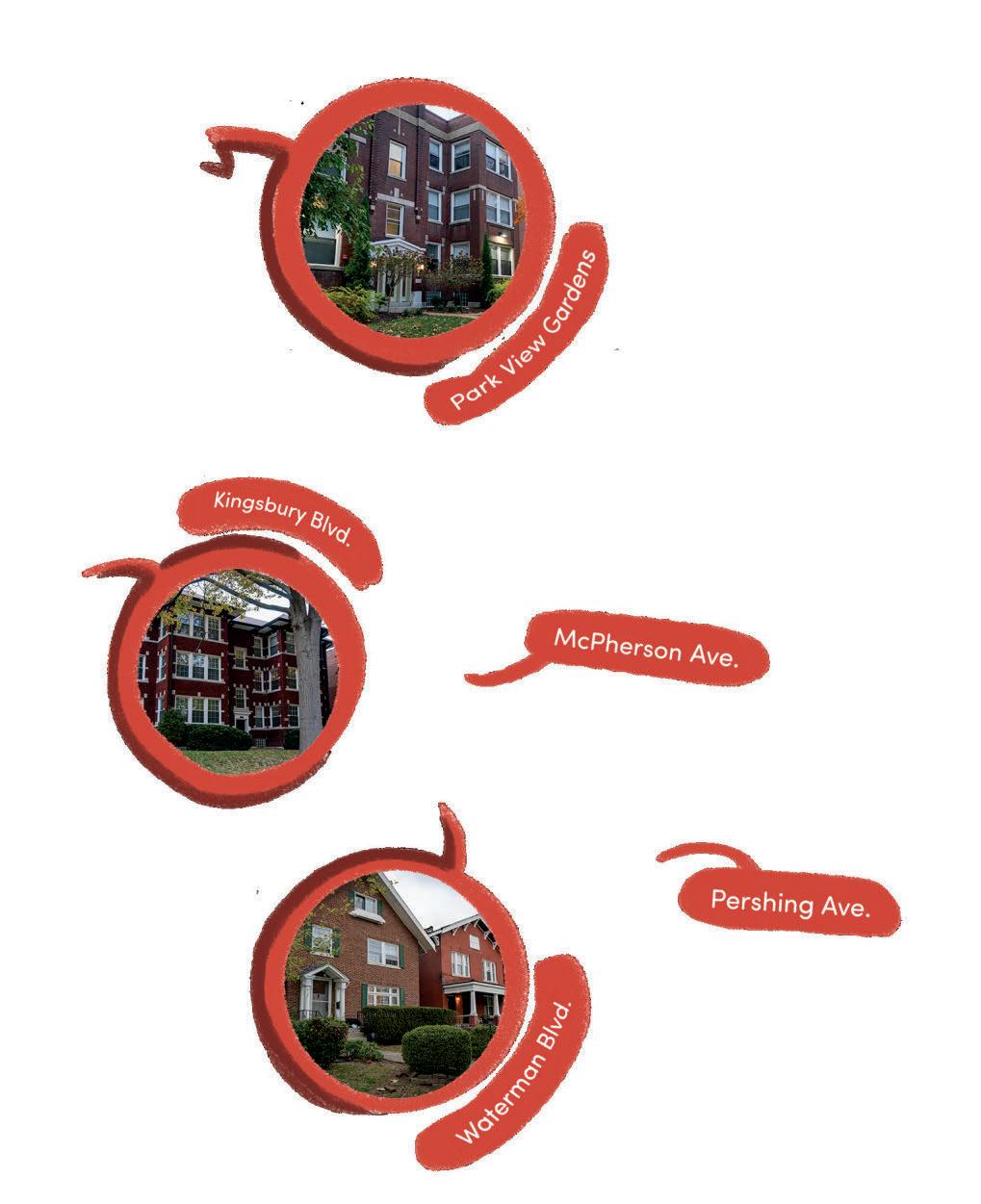
Drive, Greenway, the Lofts, as well as the Village on campus. Non-WashU housing includes many other options, like the Waterman, Pershing, and McPherson streets, or the University City and Skinker DeBaliviere neighborhoods, to name a few.
all really different, but each comes with its own neighborhood vibe.
One of the most important things to consider is the location and neighborhood of your potential housing option. WashU upperclassmen housing includes University
First, the big decision is whether to be on or off campus. The Village is convenient because you’re right on campus for your classes, and there’s a mix of grades and different apartment styles. Off-campus apartments can be a bit of a walk (to walk to Olin Library from Lofts, Greenway, and UDrive, it’s about a 20, 10, and five-minute walk, respectively), but there are also a lot of benefits. The Lofts, for example, are new and renovated, and you’ll be right on the Loop, which makes getting food or running errands very convenient. UDrive and Greenway are still close to campus while also giving you an off-campus apartment feel with decent space and variety in bedroom options. Non-WashU apartments are
Think about what environments you thrive in the most. My sophomore year, I chose to stay on the South 40 because it often feels a bit more social and lively than the Village. And while apartments are great, it definitely is a different vibe than living with and meeting new friends on a dorm floor.
live in, rent is typically lower than WashU-owned housing options, and you also get to determine how much to spend on housing instead of being forced into a price.
When considering whether or not to ditch WashU housing, be sure to consider the differences between the two options. In an off-campus apartment, you’ll often have to take care of utilities and Wi-Fi costs. Unlike WashU, you won’t have a maintenance team automatically available whenever you need something in your house fixed or you’re worried about whether or not those black spots are mold. You could also have a terrible landlord who isn’t responsive or just money-hungry. Taking apartments over from older friends is a great way to know the landlord and apartment are vetted.
After deciding between on- or off-campus housing, you also have to decide if you want to stay in WashU housing or lease an apartment. One of the biggest differences is the price. Depending on what type of housing you choose to
Make sure that, when you’re touring apartments, you consider what amenities they have and what they may lack. Does it come with a dishwasher? An in-unit washer and dryer? While they may seem like little things, consider what you need in your apartment to have the most enjoyable living experience.
Also, trust your gut if a landlord situation seems off. I once considered housing from a landlord named Chad, who told me not to show the lease to any lawyer (safe to say I did not continue with that housing process). You should definitely read through your lease and understand what it says, and if something feels wrong, make sure to ask your questions and not sign blindly. Worse comes to worst, there are a lot of other apartments to choose from!
With different housing options comes variations in how many roommates you can have. It becomes more common for off-campus apartments to have two or three bedroom options, whereas most on-campus housing is in groups of four to six. Or, you could rent a house with a larger group of people. The possibilities are endless! That being said, it’s important to be thoughtful about who you want to live with in an apartment where you will have more responsibilities, since you won’t have a dining hall a few feet away or a cleaning crew to vacuum for you. If you have a messy roommate that you don’t get along with now, it probably won’t get better when you’re in an apartment.
Also, be prepared to compromise with your roommates. There’s no perfect apartment that checks every box you’re looking for. It’s important to work with your roommates to fnd a place
that has a rent, location, and amenities that work for everyone. Since you have to start apartment hunting for off-campus apartments early, make sure to have conversations with potential roommates early too. Remember, it’s OK to not live with your best friends if they’re not the best roommates!
On the note of friends, keep in mind that friendships will take more effort to maintain when you are spread out among different neighborhoods instead of consolidated in the Village or South 40. If you and your friends are really coordinated and on top of things, you could try to share an apartment building or be neighbors with your friends (though that isn’t always likely). With your newfound space in an apartment, the hosting possibilities are endless, so you can still maintain friendships while living situations start to change.
At the end of the day, the most important thing is to go into the housing process with an open mind. No one housing option is guaranteed, and you can make any house feel like a home with good decorating and good company.





IRIS LEE CONTRIBUTING WRITER
Whether you’ve just met your suitemates this semester or you’ve known them since your frst year but never actually lived together, sharing a space can have its ups and downs. There’s something weirdly personal about brushing your teeth next to someone while half-asleep, or entering the bathroom in the morning and seeing your suitemate, unsure whether you’re supposed to say “good morning,” so you just settle for an awkward smile.
Living with other people can be many things — it can be the best part of college, or it can feel like a social experiment where you’re constantly being rage-baited. Regardless, you don’t have to feel like you’re living with a bunch of strangers. Whether you’re bonding with your suitemates for the frst time or trying to procrastinate on your next assignment, here are fve fun activities to do together.

The key to spending time with your suitemates is not returning to a common area that looks like a barren prison cell. Decide if you want to stick to a theme, and spend a weekend or two shopping for some decorations. Bonus points if you spend time together making something handmade — painted canvases, inside-joke signs, door art, etc. My suitemates procrastinated on decorating our dorm because we dreaded shopping for things that were both cute and affordable. We ended up printing out funny memes and television characters that reminded us of each other, and whenever we think of a new one, we print it out at Olin Library and tape it on each other’s doors. It’ll make your common area actually feel like home (and might even motivate you to spend more time there)!
Nothing brings a suite together like bonding through the chaos of trying to bake in a dorm kitchen. Gather your suitemates, grab whatever ingredients you have, and try to make something edible! For an added challenge, try to only bake with whatever ingredients you already have or can find at Paws & Go. Just a reminder, though: keep an eye on your oven! The last thing you want to do is add to the long list of late-night fire alarms on the South 40.


Put your laptops to use, and host a PowerPoint night! Everyone makes a PowerPoint on a random topic and presents it to the suite with a professional TED Talk-like confdence. Topics can range from “Disney men I wouldn’t let hold my drink” to “Who we’d be in the Hunger Games.” You’ll laugh until someone reveals a little too much about their dating history, and that’s when the real bonding happens.

This one’s a fun twist on your traditional bucket list, and it is especially perfect if it’s the beginning of the year. Spend some time filling out an empty bingo card with your own personal predictions for the school year, like “[insert name] accidentally sleeps through an exam” or “another power outage on the South 40.” Whoever fills a row first gets bragging rights or doesn’t have to take out the trash that week.


Yes, it’s basic, but it’s basic for a reason. St. Louis weather is unpredictable, and it’s practically guaranteed that you’ll have many nights hunkered down in your rooms. Pick a fun theme (rom-coms, comfort movies, movies with really long titles) and settle in with some snacks and a blanket. Or keep things productive by working on upcoming homework assignments while a movie runs in the background.



At the end of the day, living with suitemates means turning shared spaces into shared memories, so you might as well make them good memories. Whether you’re laughing over burnt brownies, debating which “Shrek” movie is the best one (it’s “Shrek 2”, by the way), or relaxing with a movie night, you might find that the best part of college isn’t the classes or the food trucks, but the people you get to share it all with.

NICOLE BACKAL
ELIZA STULMAN STAFF WRITER
JUNIOR SPORTS EDITOR
As much as we love our mothers and the internet, when it comes to packing for college, they sometimes lead us astray. Leaving the nest is hard, but sometimes it’s harder on parents than it is on us. While we love care packages of fashlights “for emergencies,” items we “forgot” at home, or fve bags of limes, our small dorm rooms rarely have space to accommodate these items sent to us with love and affection. (Mom, if you’re reading this, thank you for all your packages. I most defnitely always use everything you send me. I love you!)
So, if you’re unsure what to pack and who to trust, look no further! Luckily, the two of us (Nicole and Eliza) are still in college and know a thing or two regarding college life in the 21st century. We have made it our duty to share our knowledge about the items WashU students defnitely should and should not bring to college. Think of us as your upperclassmen packing gurus!
If you take anything away from this article, it’s this: you need a noise-cancelling mechanism of some sort. Noise-cancelling headphones/earbuds are a lifesaver in college. I (Eliza) truly do not go anywhere without mine — and it’s not just because I like to listen to music all the time, but because I listen to white noise when I work. There was even a time when I always had two pairs of music listening apparatuses in my backpack: noise-cancelling headphones for schoolwork and earbuds for the gym (I don’t like working out with bulky headphones). Don’t sleep on earplugs either! Well, actually, you should sleep with them. Earplugs are super helpful if you have a roommate who snores or a neighbor who loves to get frisky the night before your exam.

One of the best parts about living on campus is that almost every bed in the South 40 and the Village comes equipped with a Tempur-Pedic, so you don’t need to buy a foam mattress topper. Yes, you read that right. You get to sleep on an incredibly comfortable mattress and do not need to worry about fnding the best foam mattress topper — a luxury that students at most schools don’t have.

Moving into my dorm as a frst-year, people insisted that I needed bed risers to free up more storage space under my bed. As it turned out, WashU’s beds come with built-in risers, so you don’t need them! Yes, the task required multiple people and a hammer (this is a good time to wear your noise-cancelling headphones). Nevertheless, I was able to customize the height of our beds to our liking.

This one might be obvious, but bring a speaker. It doesn’t matter the brand or the size; as long as it can play music, you should bring it. You don’t want to be that person who throws a dorm party or has a picnic with friends outside, but has to frantically fnd someone with a speaker. Enough said. Full-length
While many people bring them, most dorm rooms come with fulllength mirrors. Before moving in my frst year, my roommate and I (Eliza) did not know whether we should order one. We decided to wait until we got to school, and, to our surprise, there was one hang ing on the back of our door! Nicole, on the other hand, did not wait, and she has endured the pain of wrapping and unwrapping her mirror in bubble wrap year after year to ensure it does not break, so she does not get cursed with seven years of bad luck. Nevertheless, some people tempt their fate and prefer to have their own mirror, but I advise waiting to order it until after you get to school, as you may realize you don’t have room for it.


A bike might seem like an unnecessary on a walkable campus, but in a car-driven city like St. Louis, a bike can be the determining factor between life and death (and by death, I mean being 15 minutes late). Sure, your morning walk from Lien to Simon Hall might be brief, but just wait until you have 8:30 a.m. College Writing in Rudolph Hall. You can get by without a bike while you are living on campus, but it’ll be your best friend the second you move off campus. Personally, nothing brings me more joy than gliding past my roommate, who left 10 minutes earlier than me to our 10 a.m. lectures (sorry, Eliza).


Steamer/iron/ ironing board
I (Eliza) have brought a steamer with me every year, and I still have yet to use it. When a hanger fails to do its job, I lazily free the wrinkles in my clothing with Downy’s wrinkle release spray. If you fnd yourself in the rare situation of needing a steamer/ iron, chances are one of

DON’T: DO: Electric kettle
Save yourself from social embarrassment and hospital bills; buying an electric scoot er is an immediate public health risk.

A little fun fact about the weather in St. Louis is that it’s pretty unpredictable. With that being said, here are some words of wisdom to guide you. The summer heat causes you to sweat more than you thought was possible; the fall brings wind and rain; the winter lasts for three weeks; and the spring is gorgeous. Having proper weather gear is imperative for maintaining your sanity, so consider the following when packing. Bring plenty of summer clothes. You will sweat through them all every day. Mind you, no matter how much you bring, you’ll probably wear the same thing every week anyhow. A good jacket is a must, but an umbrella is pretty useless against the St. Louis wind. Rain boots are choose-your-own-adventure; some people love having theirs, others just have a backup pair of sneakers. Be ready to have s(n)o(w) much fun. Although St. Louis is only miserably freezing for about a month when school is in session, bring beanies, scarves, and gloves because the wind in the winter is no joke. Pro-tip: Pack snowpants so you are prepared to play in the snow if or when the

Don’t let the September heat trick you into avoiding convenient cold-weather options like a kettle. It might not seem like it at frst, but wait until you are sequestered in your room while it’s pouring rain, and all you want is a nice cup of tea. Admittedly, this is not a necessity, and most hot water problems can be solved with a microwave, but having an electric tea kettle can be very useful. From noodles to hot beverages, the electric kettle can be your best friend during the darkest (and coldest) nights of the semester.

To mothers, we hope that this 10-item list was more helpful than offensive. Oh, and while we have your attention: Send your kid food. We might not have room for tangible things, but care packages containing our favorite foods help with homesickness and remind us to call you. And to our fellow students, you’re welcome.
CAROLINE GOLDSTEIN CONTRIBUTING WRITER
For many of us, college is our frst time living with a roommate. Contrary to popular belief, you and your roommate don’t need to be the best of friends. However, you need to be able to coexist in the same small dorm room. Here are fve tips to fnd that balance of being friends but also having clear boundaries.
We all have pet peeves. It’s normal. It’s hu man. But those annoyances become an issue when we allow them to fester in our minds. If your roommate always eats your food and nev er asks first, isn’t it better to resolve the issue sooner rather than later? I’m sure we’ve all ex perienced annoyance at a roommate, and our first instinct is to run and tell another friend.



2Keep
We’ve all had those days where we’re rushing out to our frst class in the morning and don’t have time to perfectly make our bed. Or when we’re feeling stressed during midterms and our laundry starts piling up. College can be a lot, and our biggest priority isn’t always making sure that our living space is tidy. But messes can, and will, build up. It can feel overwhelming to clean when you have dirty laundry everywhere, homework pages scattered around the room, and old water bottles that are nourishing their own ecosystems. This mess is also unfair to your roommate who is putting effort into their cleanliness and likely doesn’t want the sight of rotting food to greet them after a long day of classes. While a little messiness is normal, it’s important for everyone living in a room together to respect the shared space and clean up in a timely manner. One way to keep this mess under control is to start cleaning sooner rather than later. Instead of pushing your laundry to the next weekend, an easy solution is to do your laundry during a homework night at the dorm.

We’ve all had those days where we’re rushing out to our frst class in the morning and don’t have time to perfectly make our bed. Or when we’re feeling stressed during midterms and our laundry starts piling up. College can be a lot, and our biggest priority isn’t always making sure that our living space is tidy. But messes can, and will, build up. It can feel overwhelming to clean when you have dirty laundry everywhere, homework pages scattered around the room, and old water bottles that are nourishing their own ecosystems. This mess is also unfair to your roommate who is putting effort into their cleanliness and likely doesn’t want the sight of rotting food to greet them after a long day of classes. While a little messiness is normal, it’s important for everyone living in a room together to respect the shared space and clean up in a timely manner. One way to keep this mess under control is to start cleaning sooner rather than later. Instead of pushing your laundry to the next weekend, an easy solution is to do your laundry during a homework night at the dorm.

As I’ve mentioned throughout the earlier tips, conversations with your roommate are the most important thing to prevent arguments and drama. But they need to be just that: conversations. While you may want to practice your debate skills, roommate discussions aren’t the right place. It’s important to listen to understand your roommate’s feelings and opinions rather than to “win” the argument. The outcome of these conversations shouldn’t be all or nothing; there is always a solution that both roommates can agree with, but in order to find this solution both sides need to be honest with each other about their feelings and what they want. For example, if you and your roommate are having a disagreement about different sleep schedules, instead of trying to make your roommate completely conform to your schedule, you could buy a dimmable lamp or complete your homework in the common room while they are asleep.

While it can be easy to just hang out with your roommate, it is important to branch out and meet other people as well. Spending some time apart will allow you to grow your own interests and for your roommate to explore theirs as well. Make sure to join clubs or student groups that interest you and make connections in those groups. Dinner together in Bear’s Den twice a week or a trip to the mall on the weekend are ways to ensure that you are making time for your roommate, but that you are also expanding your social circle.

ZOE RHODES STAFF WRITER
Delineating and separating the spaces where you study, have fun, and rest is both more diffcult and even more important when you’re in college. Studying is something most WashU students do (or should do) nearly every day. So naturally, it’s worth giving some thought to where it should take place.
It’s worth asking why our
things in their bedrooms. While current reporting on the phenomenon across a wide variety of contexts lists higher rent and smaller homes as primary causes, this only explains part of the story for WashU students.
Understandably, sometimes there’s no other option than to resort to your room. A 24/7 study room isn’t always easy to access for those living on campus. That textbook is really heavy, and you don’t want to drag it around, or you’re push-
available. And on weekends, if your common room is in use and the nearest dining hall is closed for the night, an Uber Eats feast in your room may seem like the best option. Now, maybe it’s a bit clearer how our rooms become the space for anything and everything.
There’s advice online for artists and writers to pick a workspace and continue returning to the same space to “get in the zone” for producing their work. This logic can be applied to all
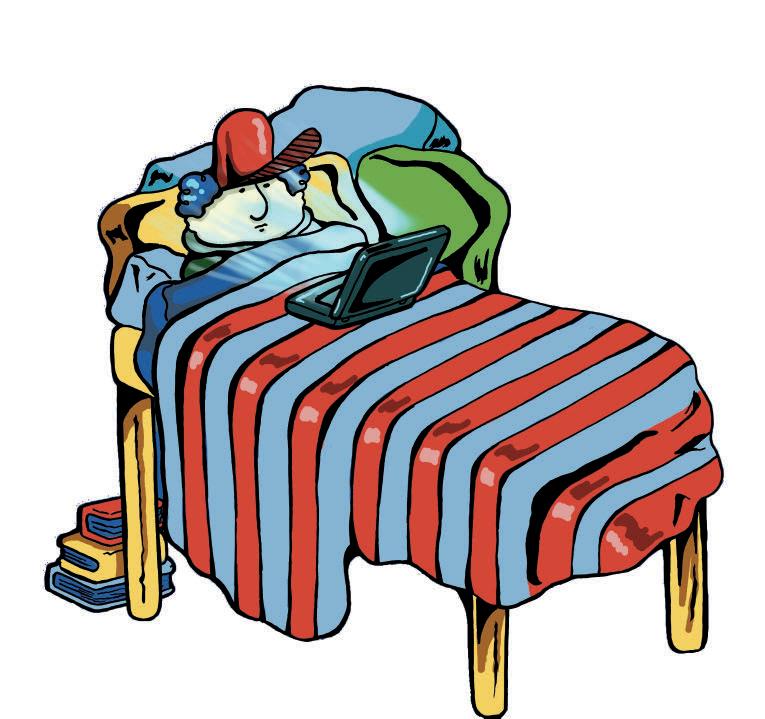
As college students with no other space that is solely our own, it makes sense that our rooms have become places for more than just resting. On any given night, you can fnd a college student studying, gaming, or eating a late-night snack in their bed. An Australian study from 2023 found that young people, specifcally, treat their rooms more like living spaces than areas predominantly for sleep.
It’s good to remember that even within your room, you can create separation for your mind between your sleeping space and your area for focusing. Your desk or a table to spread out your materials is a much better option for getting in the headspace for homework than a couch or another area usually reserved for relaxing.
It’s also worth considering separating the space where you hang out with friends or family and study. At an academically rigorous school like WashU, it can be easy to let friendships or other relationships fall to the wayside in favor of studying for the upcoming chemistry exam. Friendships should be prioritized, however, as healthy connections with others can lead to improved GPA and focus in both class and studying.
At a school like WashU, where it feels like midterm season never ends, maximizing productivity is important. The more effectively you study, the less time you have to spend bent over your computer instead of asleep or hanging out with friends.
So, think about going into another room to answer any texts or calls you get while studying or during a study break. And maybe that assignment is best done in a library or dining hall instead of your bed.


KEVIN KAN | ILLUSTRATION EDITOR
ZOE RHODES
MASON SUTTON STAFF WRITER DESIGNER
Bear’s Den or the Village House are (mostly) reliable options for getting food on campus, and sometimes a late night Uber Eats delivery can hit the spot campus dining can’t. But takeout and halfand-halfs can only sustain a person for so long before one must venture into the kitchen and cook their own food. To assist in this endeavor, Student Life has compiled recipes of varying diffculty. We hope the following will provide an answer to the ever-present question: “What’s for
dinner?” These recipes have something for all skill levels — people who have yet to venture into their dorm kitchens, the Dauten kitchen regulars, and even microwave-friendly options for those who really don’t want to leave their room on a rainy Sunday morning. Don’t have any of these ingredients in your dorm? No problem! Check out our cheapest picks for where to fnd these pantry essentials that you’ll use over and over again.
Ingredients:
• 1 russet potato — $0.79 at Target
Optional:
• 1 tablespoon of butter — $3.49 at Schnucks
• Shredded cheese or Paws and Go cheese stick — $0.99 at Paws & Go
• Salt and pepper to taste
• Sour cream — $1.29 at Target
Directions:
1. Start by washing your potato, then stab repeatedly with a metal fork or make thin slices with a knife.
2. Microwave for around 5 minutes, or press the ‘potato’ button if available.
3. Cut potato in half, then stir and smash the insides of both halves (if applicable, add butter and cheese here).
4. Top with a dollop of sour cream and/or salt and pepper if desired.

Ingredients:
• ½ cup of black beans — $0.99 at Target or Schnucks
• ½ cup of frozen or canned corn — $0.99 at Target or Schnucks
• 2 four tortillas — $2.89 at Target
• 1 bag of shredded Mexican-style cheese — $1.99 at Target
• ½ teaspoon chili powder, to taste — $0.99 at Target

• ½ teaspoon paprika, to taste — $0.99 at Target
• Sour cream — $1.29 at Target
• Salsa — $2.39 at Schnucks
Directions:
1. In a small bowl, combine black beans, corn, chili powder, and paprika. Cover with a paper towel and microwave for 3 minutes, then in 1-minute intervals until corn is thawed.
2. Lay a tortilla on a microwave-safe plate, and place a small layer of shredded cheese on top.
3. Scoop a thin layer of the bean and corn mixture onto the tortilla and top with additional cheese.
4. Once mixture runs out or a thin layer has been layed, top with a fnal layer of cheese and microwave for about 2 minutes or until the cheese is melted.
5. Cut into 8 slices and serve with sour cream and salsa.
Ingredients:

• 1 four tortilla — $1.79 for an 8 pack at Schnucks
• Cinnamon (measure with your heart) — $0.99 at Target
• Sugar (any type! Powdered works best) — $2.19 at Schnucks
• Butter (measure with your heart) — $3.49 at Schnucks
Directions:
1. Spread butter all over the tortilla to the edges.
2. Heat up the buttered tortilla in the microwave for 10-20 seconds.
3. Sprinkle as much cinnamon and sugar on the tortilla as you would like.
4. Roll up the tortilla and chow down!
• Chocolate chips — $3.89 at Target
French Toast Easy
• ½ banana — $0.29 at Target
• ¼ teaspoon baking powder — $1.99 at Target or Schnucks
• 1 tablespoon honey, agave, or maple syrup — $3.39 at Target or Schnucks
• 1 egg — $2.39 for a dozen at Target
• Rolled or quick oats — $2.89 at Target
1. Mix together all ingredients, except for add-ins (nuts and chocolate). This step can be done by hand, or in a blender if you so choose.
2. Pour the mixed contents into a microwave-safe container, such as a bowl, mug, or ramekin.
• Milk (any type) — $1.54 at Schnucks
• Any spices you would like! (Cinnamon and nutmeg work best)
• Any nuts you would like!
• Salt
• Water

3. Sprinkle the toppings onto the mixture.
4. Microwave the mixture for 30 seconds, give it a quick secondscouple of rest, then microwave for 30 more seconds. Repeat this twice more, or until it’s cooked to your satisfaction! (It’s good gooey!)
KI C E N H T RECI PES
Ingredients:
• 4 eggs — $2.39 for a dozen at Target
Easy
• ½ cup of milk or creamer — $1.54 at Schnucks
• 1 teaspoon cinnamon — $0.99 at Target
• 1 teaspoon cloves — $1.99 at Target
• 1 teaspoon nutmeg — $3.69 at Target

• 1 teaspoon salt — $0.89 at Target
• 1 teaspoon vanilla extract — $4.19 at Target
Directions:
1. Mix together all ingredients in a container you can dunk bread into, like a shallow bowl or pan (not over heat).
2. Heat up butter in a pan over mediumlow heat.
3. While your pan is heating up, dunk ½-inch to 1-inch slices of bread into the liquid mixture, making sure the bread completely soaks up the batter.
4. Start pan-searing the french toast slices, fipping them to cook both sides evenly to a golden-brown color.





Ingredients:
• 1 box of pasta (I recommend linguine or penne) OR 2 packages of frozen tortellini — $1.89 at Target
• 15 ounces of Alfredo sauce — $1.99 at Target
• 6-7 ounces of pesto — $3.49 at Target
• 1 pound chicken breast — $7.49 at Target
Directions:
• 8 ounces of baby bella mushrooms — $1.99 at Target
• Italian seasoning, to taste — $0.99 at Target
• 3 teaspoons garlic powder — $0.99 at Target
• 1 tablespoon olive oil — $4.99 at Schnucks
• ½ cup milk — $1.54 at Schnucks

1. Cut chicken into bite-sized pieces, and season with 1 teaspoon of garlic powder and Italian seasoning. Slice mushrooms vertically, trying for slices that you would see on Papas Pizzeria.
2. In the bottom of the pan, add a small amount of oil and the sliced mushrooms, and cook on low-medium heat until they are reduced in size (around 7 minutes). Remove mushrooms from the pan, and drain any liquid in the bottom of the pan.
3. Add chicken to a medium pan and cook on medium-high heat until you can cut through the largest piece and see no pink (around 10 minutes).
4. While cooking the mushrooms and chicken, fll a large pot with water and salt it heavily. Boil pasta according to package instructions. Drain pasta in a strainer, or using the lid of the pot.
5. Leaving the pasta in the strainer, add alfredo sauce to the pot. Add the milk to the sauce jar, then close the jar, shake, and pour to remove excess sauce. Add the jar of pesto, remaining garlic powder, and plenty of Italian seasoning.
6. Cook the sauce on medium heat until it begins to bubble, then add the pasta, chicken, mushrooms. Stir and serve!
• 4 cups white rice (pre-cooked and cooled is best) — $1.49 at Target
• 2 eggs — $2.39 for a dozen at Target
• 3 green onions — $0.99 at Target
• 2 carrots, diced — $1.49 at Target
• 1 cup frozen peas — $0.99 at Target
• 2 garlic cloves, diced — $1.79 at Schnucks
1. In the bottom of a tall-sided pan, put 1 cup of water into the bottom, then add diced carrots, peas, and the whites of the green onions and cook on medium until slightly softened (3-5 minutes).
2. Drain water, add vegetable oil and garlic, and stir until aromatic (around 1 minute).
3. If cooking chicken, remove vegetable mixture, cook diced chicken breast until no longer pink (around 7 minutes). Remove chicken from the pan.
• 2 tablespoons vegetable oil — $1.99 at Schnucks
• 1 ½ tablespoons soy sauce — $1.69 at Target
Optional:
• 1 pound chicken breast, diced — $7.49 at Target
• 1 small package mushrooms, diced — $1.99 at Target

4. Scramble the eggs in a small bowl, then add to vegetables (including diced mushrooms if applicable), stirring to avoid clumping.
5. Add cooled rice, soy sauce, and chicken if applicable. Cook on low until rice is warm and veggie mixture is integrated.
6. Top with the greens of the green onions and additional soy sauce.
*All prices listed are for the whole item as sold in the store, not just the portion you need. they are the lowest-priced options available in the area.

SOPHIA HELLMAN SENIOR SCENE EDITOR
So you found your dream apartment.
It’s close to campus, pest-free, and everything seems intact. Just one thing … it comes completely unfurnished. Nobody wants to live in an empty box, so, what do you do?
Don’t panic: furnishing is simply a matter of patience and procurement. As long as
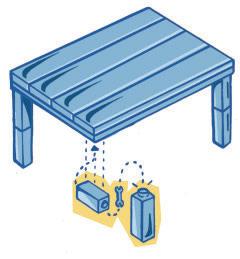
to sleep, you can do without a shelf or a coffee table for a few weeks. Start by determining your most essential items, then fgure out where to source them from.
Some good places to start looking for furniture are your most immediate options: friends, other graduating students, and local hand-me-downs. Join furniture sale group chats and visit second-hand stores (Goodwill, antique stores, etc.). Make sure to reach out to any previous tenants to see if they’d be willing to sell or leave furniture behind. There’s always IKEA, but to save time, money, and sanity (building IKEA furniture is not for the weak), choosing furniture that comes built makes life simpler. It also reduces waste and is likely sturdier than your average buildyour-own table. If you don’t mind a few creaky hinges and soul, preowned furniture is the way to go.
For smaller items such as appliances and storage, check out

the annual Swamp Move-In Sale, hosted by the WashU organization Sharing With A Purpose or SWAP. Look ahead to their annual moveout collection drive, as well, for an easy and sustainable donation opportunity. In addition to taking furniture off your hands, they plan to reuse those goods on campus or in the local community, so you’re doing something good, too.
Once you’ve exhausted your local secondhand options, it’s time to try Facebook Marketplace, the used furniture supply of your deepest, wildest dreams. Yes, even if you get all your interior design inspiration from the most curated Pinterest feeds, Facebook Marketplace will provide. The Facebook app feature contains the essentials you need: tables, couches, dressers, and lamps. It also offers anything else you could think of, from plants to art (and pianos, so many free pianos). What makes it special is that it also has these items in any color, any size, and at much lower prices. Usually, Marketplace sellers will ask you to pick up items. They also may live further away, but you can adjust the flter if you’d like to stick with closer options.
Some tips for furnishing:
Remember that it’s okay to reuse last year’s items or what you already have — this time, you can arrange it differently! Put those lights in the common area, if you want a change, or hang up some old postcards or fyers.
Less is more. The more
smaller, nonfunctional items you have lying around, the more cluttered your space will look, and the more you’ll eventually have to move out. Keep it simple and let your already owned items fll the space: books, coats, and mementos will take up much more space than you think. Tip: Buy a standing clothing rack for your room to display your favorite items AND save closet space!
Finally, for those looking to furnish with style, here are two tips: First, have an idea of what you are looking for. When it comes to items like desks and drawers, the number of options available may surprise you. It also helps to come prepared — choosing one tone of wood or layout based on visual references will help. Second, try to start as early as possible. The more time you have to fnd furniture, the better options you will come by. Keep refreshing Facebook Marketplace, and coordinate with your roommates to divide up the work. Just make sure you’re asking a few key questions: What are the dimensions? Do the legs on tables come off? Will you be able to heave your haul up a three-foor walk-up?
With this guide in mind, I set you free to acquire furniture — it’s easier than you might think. If you can imagine yourself as an HGTV designer on the hunt for the perfect pieces, you might even have some fun. Once you have your basics, you’re free to make your house (or unfurnished apartment) a home!


ELIZABETH GRIEVE SENIOR SCENE EDITOR
Blank walls, grey carpet, generic furniture — the default dorm room. Crammed into your suitcase, you’ve got your bedding, a few posters, and maybe a couple storage bins and some string lights. Even after unpacking and arranging everything you have, your
room still feels a little sterile. Now what? What can you do to make your room match your inner aesthetic a little more? How do you make it “you”?
Among the inconveniences college life brings, moving in and out of temporary housing, dorms, and short leases is a big one. The lack of a permanent space isn’t necessarily conducive to a homey, welcoming
vibe of the dingy white walls and harsh LED lighting is hard to dispel without breaking the bank (or accumulating too much stuff to fit in your suitcase back home). It’s important to me that my room is comfortable, inviting, and homey, and most importantly, matches my personal style.
Throughout my time in college, I’ve learned a lot about
space feel like mine for the time being, in ways that are easy, cheap, and most importantly, non-permanent and portable. In my fourth year of moving on a frequent basis, I’ve collected a number of small room decor items that follow me from place to place. Here are a few perhaps underrated ideas for how to translate your aesthetic into your space.
Chair covers
While dorm room walls are easy to cover, customizing the cookie-cutter, bland dorm furniture is a bit harder. Not much can be done about the shape, so why not add an extra layer of upholstery? Chair covers not only allow your desk chair, sofa, or armchair to match your color scheme, but also add a softer, more comfortable texture. They come in all shapes and sizes, but my must-have is the one on my desk chair. I picked out a cream shade to match the neutral beiges and whites I have in my room, which complements the medium shades of green I have in other places. Not to






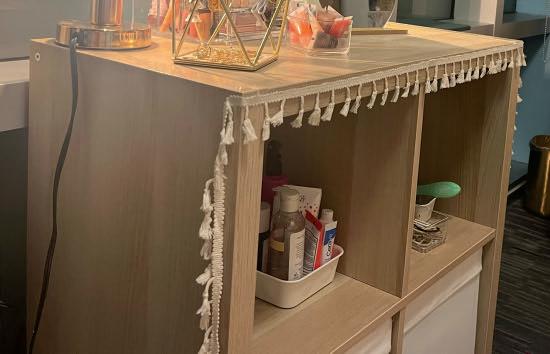
My favorite dorm decor hack is a little unconventional, which is why I’m sharing it: sewing trim. I bought several yards of a cream tassel trim that’s typically used for crafting, initially to cover the command strips sticking out from behind my mirror. Now, I use it all over my room to tie the space together: on window sills, along the sides of my desk — anywhere that looks a little plain. Plus, using it in many places helps make everything feel cohesive. I also reuse pieces from year to year. Sewing trim comes in many different variations, from fringe to lace to little pom-poms. It’s a cute way to add a little detail (or hide some ugly stains).
There is quite literally nothing that ruins a vibe more than the harsh LED lighting from a singular overhead light in dorm rooms. For any space to feel comfortable, soft lighting is an absolute must. Target sells mini lamps for around $10 and always has string lights on sale (look right after Christmas). I bought a set of rustic, raw lightbulb lamps for a little extra lighting. The goal is to never have to turn on that overhead light. For a really warm-toned light, look for light bulbs that are under 2500 Kelvin.


Every year, I buy a few new packs of refill Command strips. While they are a must for hanging up my lights and pinboard, I like to add some around my room to hang up items I use every day. In addition to being convenient and functional, they are a natural way to add some life to your walls. Hanging up your items quite literally puts your personal style on display. I hung my bags on a pillar, my jackets by my door, and even some of my jewelry on my walls. Plus, I can reuse the hooks themselves each year by just buying new adhesive strips.
At the risk of sounding like a HomeGoods mom, you can never have too many throw pillows. Throw blankets and pillows are great ways to make your room that much more cozy. They add texture that easily fts into your color palette, since you can fnd literally any color anywhere. The blankets are also functional; I personally love wrapping up in a cozy blanket while settling in to do homework on a chilly night, and I love that I can match that blanket to my space.





Posters are all fine and great, but why not personalize what you tape up on your wall a little more? Walgreens has a collage-making tool, where you can combine a bunch of your favorite photos together and get them printed on photo paper for a few dollars. You can either hang up the full collage or cut them out for mini photos to arrange on your wall or pinboard. It’s really convenient because you get a bunch of photos of different sizes, which allows you to arrange them as you like.






More to the theme of displaying your stuff, acrylic containers are a simple yet elegant way to keep your stuff organized. The clear material lends itself to any vibe and effortlessly keeps the space clean and organized, while still being convenient and accessible. My favorite is a little acrylic tray where I keep glass perfume and serum bottles.
SOPHIE SCHWARTZ JUNIOR SCENE EDITOR









A guide to curating the perfect common room
So you are starting the hunt for your sophomore year roommate crew, touring the corner room suites along the South 40 while crossing your fngers you get an early registration slot. Planning suite decor might be the least of your concerns right now, but what better way to procrastinate housing than scrolling through dorm room aesthetics on Pinterest, adding decor to your Amazon wishlist, or stalking the Instagrams of your favorite upperclassmen to see pictures of how their suites came to life? But in the spirit of staying organized, I’ve got you covered with a onestop shop for all the essentials for a chic and cozy-looking common space that will transform your suite into everyone’s favorite hangout spot.
The color scheme is the frst detail to plan out when crafting your vision for the suite. Priori-
tize a neutral tone complemented with a few fun pops of color. Some of my favorites include a white backdrop with pink and green accents for a fun springtime feel to scare away the winter gloom. For a more industrial look, a beige base with a navy blue or taupe-brown gives off organized casual with a modern fair.
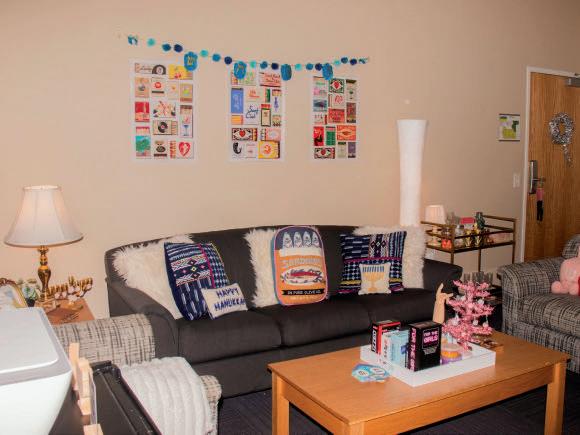
Color can come out in many ways through pillows, posters, and accessories. The best way to set up pillows is to layer a single-toned one behind a bright-patterned one. Furry and sherpa base pillows are an effortless way to enhance the hominess of the suite. Make sure to arrange the pairs in groups of three on the couch and a singular pair for each chair. A few of my go-to pillow purchasing places are the sale rack at World Market, T.J. Maxx, HomeGoods, and Target. If you have a mom anything like mine and need a simple money-saving hack, shop in her closet to see if she has
any extras lying around. Pillows from my bat mitzvah seven years ago are currently serving as my couch decor.
To further enrich the furniture provided to you by Residential Life, purchase a couple of blankets to hang on the back of the chairs and sides of the couches. I recommend investing in some with a variety of materials. Fabric plush blankets are great for cozy movie nights and come in a variety of colors to brighten the furniture, while linen ones help the space feel refned and organized. If you are a germophobe like me and don’t want your handpicked accessories ending up on the foor, buy a medium-sized basket for your friends to drop all the blankets and pillows in when they are spending time on the furniture.
When it comes to walls, the layout of sophomore suites on the 40 can vary. But for most, it looks like a rectangle: one large wall behind the couch, two medium-sized walls on both sides,
Decorating your common room is the best part of the housing craziness.
and an additional medium-sized space dividing the doors of the two rooms on each side directly across from the couch. Decorating these walls is a simple way to show off some personality. Three 16-by-24 posters behind the couch is the perfect ratio to keep the room looking chic. You’re especially lucky if you’re like me and have a roommate majoring in communication design who can custom-make posters. String lights that hang down are the ultimate fxture for one of the medium-sized walls, especially during darker hours of the day, to curate the perfectly lit room. To keep the vibes alive and competitiveness brewing, consider buying a dart board, mini basketball hoop, or magnetic tictac-toe board to hang up on the second medium-sized wall.
The fnal wall space is the perfect spot for a TV and extra storage shelves. Though a luxury, it’s a fun addition to bring the space to life. For a more cost-friendly option, consider looking on TikTok Shop for projectors — I know many people who have purchased them successfully. If you do choose to go the TV route, though, think about getting a TV stand with storage below. World Market and HomeGoods always mark certain items down. To serve as the snack station and home for the other miscellaneous belongings that clutter the suite, invest in one or two 30-by-14 shelves for either side of the TV.
Finally, what centers around the furniture and the focal point of your suite is the table. There are endless possibilities for this, but I would recommend going for a maximalist look. Find an extra rectangular-shaped tray lying around your house to place in the center of the table. Fill it up with party-friendly card games, slime, fdget toys, a notepad, some taller objects for
depth, and whatever else brings out your and your suitemates’ individual styles. Completing the vibe with a rug beneath the table is a nice extra for color and hominess, but I recommend going darker to prevent stains from showing.
The icing on the cake is all the extra touches. Though unnecessary, they can elevate your space into a personal escape. Two of my favorites in my suite are our color-changing foor lamp and our bar cart. While the foor lamp helps curate the perfect lighting for pictures, fun vibes, and a dreamy atmosphere, the bar cart fts seamlessly in with the furniture and can hold fun cups, napkin holders, candy jars, and other accessories.
Decorating your common room is the best part of the housing craziness, and although there might be many pieces involved (both metaphorically and physically), focus on the vision and trust that they will all fall into place. My brother served as my personal handyman throughout this entire process, so make sure to bring a toolbox and recruit a skilled family member. Happy housing season!









LEILANI BILLUPS STAFF WRITER
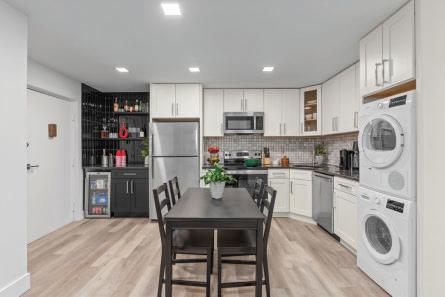
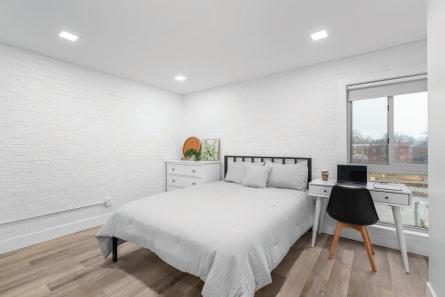
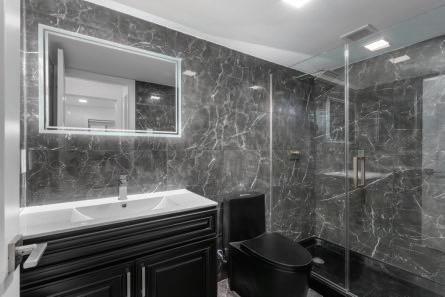
When I look around St. Louis, I see many changes from the landscape I grew up in. One of the biggest changes that strikes me is the uptick in student housing developments and other luxury apartments. These projects boast shiny details and rooftop lounges, marketed as an attractive option for students who want the off campus experience. However, the experience provided is expensive and inaccessible to most native St. Louisans and low-income students. These developments are trying to create a new urban lifestyle, but they also raise the question of who can really participate in this lifestyle.
One example of these luxury student housing projects is less than a mile off campus. LOCAL on Delmar is an apartment complex currently under construction that boasts amenities like a rooftop pool and hot tub, outdoor fre pits and grilling stations, and even a wellness suite with a sauna. This place markets itself towards students, with their Instagram full of pictures of college-aged students enjoying the scenery of St. Louis. They even follow me and other WashU students on Instagram to gain attention.

The prices of this development, however, are striking. A one-bedroom, one-bathroom unit begins at $2,105 per person. This is hundreds more than the average cost of rent in St. Louis, which is $1,331 for one bedroom. For students coming from places with higher costs of living, the $2,000 may seem cheap, but in
Creating high-rise luxury apartments in the areas of the city that already experience extreme wealth inequality furthers the lack of accessible housing.
St. Louis, this is incredibly expensive, with 28% of St. Louisans renting apartments for less than $1,000.
What makes housing projects like this so grim is that there are unhoused St. Louisans living on this same street. Luxury apartments like these contribute to a broader issue of gentrifcation and displacement in St. Louis. Large development frms buy up properties in St. Louis neighborhoods and build these expensive housing projects, which then drives up rent and cost of living for residents that have been living in the area for decades. Experts say that the West End of St. Louis is already experiencing this, and that while developers are making signifcant monetary gains from fipping these properties, residents in the neighborhood don’t reap the benefts.
These housing projects are also inaccessible to students who don’t come from wealthy backgrounds. These housing options aren’t marketed to students as a whole, but rather to affuent students who can afford to pay the steep rent prices of each unit.
This makes it harder for lower-income students to fnd off campus housing and perpetuates the economic divide on-campus.
I would love to see a revitalized St. Louis, one that doesn’t suffer from chronic underdevelopment. I don’t, however, believe that this should come at the expense of what the city really needs: affordable places for everyone to live. Creating high-rise luxury apartments in the areas of the city that already experience extreme wealth inequality furthers the lack of accessible housing.
As WashU students, we should be aware of this, and make efforts to combat these disparities. These efforts beneft us as well, because if St. Louis has affordable housing for everyone, that includes us. So, before you sign the lease on your shiny new off campus apartment, consider how your choice of residence affects our city. Otherwise, that carefully crafted version of St. Louis you’re buying might not leave room for the version of the city already standing.


SYLVIE RICHARDS MANAGING FORUM EDITOR
“Is your water also not working?”, “The dryer is broken again,” and “Does anyone else have a cricket problem?” are a few of many texts in my building’s group chat from the past few months. Yanking God-knows-what out of the shower drain, exterminating bugs, and calling four numbers to reach the City of St. Louis Water Division are a few of my thrilling off-campus apartment living experiences.
Before moving into my apartment, the only landlords I’d had to deal with were my
parents and WashU Residential Life (which, I should add, comes from a place of privilege). This experience is common for students living off-campus for the first time.
Landlords are a crucial part of your living experience, as building problems are part and parcel of living in a charming, historical St. Louis apartment or house. I don’t have any friends living off campus who have not had to message their landlord or maintenance at least once.
There are many types of landlords that rent properties nearby WashU. You have your large companies that
own many properties (over 40 properties, like Zheng Capital Realty, Byron Company, and Roberts Realty), medium companies (5-10 properties, many of which are expanding, like Clocktower Company and Mosaic Living), and smaller companies, usually individual people (fewer than five properties).
You should choose a landlord who is reliable and cares about their tenants; this process is all about research and asking the right questions. Once you’re living on the property, communicating with landlords is all about advocating for yourself.

ELMA ADEMOVIC | STAFF ILLUSTRATOR
When choosing an apartment, the quality of your landlord should be a primary consideration.
You often want to find outside information about a prospective partner — the same goes with a landlord. Always ask the current tenants about their experience living at a property. WashU students often live in the same buildings over many years, so these tenants will most often be your peers.
Like you would stalk someone on Instagram, research the landlord or company that owns the property you are interested in. Look for how many properties they own, where they are (do they seem to mostly rent to students, for example), how long they have been renting out properties, and whether they have shrunk or expanded. This research, found through a Google search, companies’ and landlords’ websites, and Reddit, will give you an idea of the kind of landlord you are looking at.
A large company that is expanding may be spread thin across many properties, especially if they are new and rapidly growing. An individual who owns few properties, especially in the same neighborhood, is likely more reliable. Landlords who have owned their properties for a long time have more experience and are often more reliable. Still, there are plenty of exceptions to these rules. Along with talking to current tenants, you can also consult many Reddit threads with information about property owners near WashU.
You must ask your landlord questions. I will not go over all the questions you should ask related to the property (i.e. “Is there parking available?”, “How do I pay rent?”, “What’s your subletting policy?”) — there are several helpful lists online. Instead, I am focusing on your landlord-oriented inquiries. Many of these details will be in your lease, but you often won’t receive it until you are in the final stages of getting the apartment.
1. Do you own the property? What is your role?
If the person touring you around the apartment is not the landlord of the property, that is your first red flag. If they do not have sufficient information about the property, maintenance, or tenant experiences, then you should ask for the contact information of the landlord and message them with your questions. This experience may signal that the property is owned by a larger company and could also indicate that contacting the proper people will be difficult after moving in.
2. How many properties do you (or the company) own?
In general, the fewer properties that the landlord or person owns, the more attentive they will be with you. A company may have more people to help you, but they are likely spread thin. A property owner with fewer properties (about one to four) also means that they can more directly get to know and communicate with you, meaning that they will likely care more about their individual tenants.
3. How do you communicate with tenants? How do I make a maintenance request?
A good landlord will provide a way to directly communicate with them. If they provide you with a portal, which is a common practice for maintenance requests, ask them what you should
do in case of an emergency. They should at least give you a phone number or email address for exceptional circumstances. Take note of your communications prior to signing the lease to get an idea of their response rate.
4. Who manages the property?
If the landlord directly manages the property, that is usually a good sign. There may be an outside management company, which is not a deal-breaker, but they will often have slower responses to your requests. Ask for the company name and do separate research for more information.
5. Who responds to maintenance requests? How quickly do they respond?
Regardless of who manages the property, what you really want to know is how quickly they will solve your issues. A professional should come to fix technical issues. Your landlord should give you a specific time frame, which will ideally be within 24 to 48 hours. Ensure that there is a quick response time to emergency requests.
6. What is covered under maintenance requests?
Some landlords will replace your fire alarm batteries, help solve your cockroach problem, or fix your clogged drain. Some will not. There are some maintenance problems that you should be comfortable dealing with on your own,
namely those that you have caused. In general, however, the landlords own the property and should fix the problems with their building.
7. What is covered by my rent? How much are utilities?
This question is less about your landlord, but it is the crucial question to ask when you tour an apartment. Talk to friends and research the average rent and cost of utilities in the area to ensure it is reasonable. Landlords should be transparent about these fees.
8. Do you do a walkthrough before and after move-in and move-out? What condition do you expect the apartment to be in?
Many apartments have a policy in which they will not look at or clean the property if you take furniture from past tenants. I have heard numerous horror stories of people having to deep-clean or call cleaning companies when they move in because of the conditions at move-in. Landlords should look at the apartment after move-out and hire a cleaning service for you. In addition, you should know what condition you need to leave the apartment in when you move out.
9. Have you ever had to keep a tenant’s security deposit?
You pay a security deposit when you sign a lease on a property that is refunded upon move-out, as long as
As students, landlords will often push us around because they think we do not know better, so don’t forget to advocate for yourself.
there are no large damages that they must repair and you have paid your rent on time. You should gauge what triggers a landlord to keep your security deposit; it should be for damages beyond normal wear and tear, very messy or dirty conditions, skipped rent, or missing items.
10. What do you do if tenants have conflicts with one another (i.e. noise complaints, cleanliness issues, smells, etc.)?
Landlords should be prepared to deal with internal tenant conflicts and, if needed, enforce the lease for someone violating the rules.
I recommend choosing a landlord who personally tours you around an apartment and is directly involved in your communications. A portal for maintenance requests is fine, but they should give you a way to contact them with any serious concerns.
Ultimately, trust your instincts. A vibe check can be the best way to know if someone is right for you.
You want to have a good relationship with your landlord. Communicate with them while respecting their rules; for example, use the proper lines of communication. At the same time, be assertive if your problems aren’t being fxed properly or effciently. Proper living conditions are more important than preserving a perfect relationship. Most maintenance, barring the exceptions on your lease, are fair game regardless of how often you are making them.
As students, landlords will often push us around because they think we do not know better, so don’t forget to advocate for yourself. If you think that your rights as a tenant are being violated, check Missouri’s Landlord-Tenant Law. Finally, as important as it is to develop your independence in college, it is okay to ask for help from your parents, guardians, friends, and other people with more landlord experience. Like all practices of adulting, understanding the ins and outs of landlords is a learning process.

APURVA GANTI CONTRIBUTING WRITER
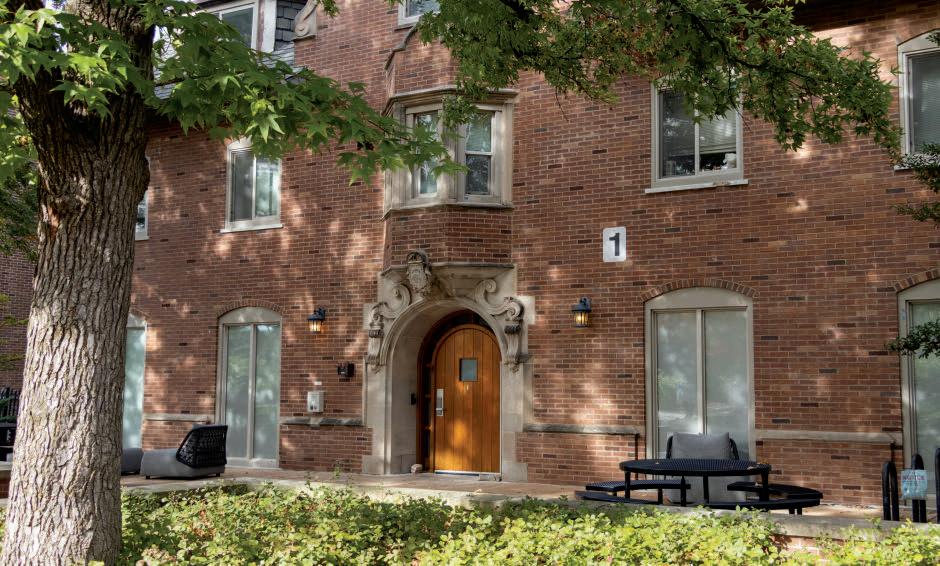
As a St. Louis native, I always envisioned myself venturing further than 25 minutes away from home for school. But, as you already know, that’s not how it worked out. Despite my initial reservations about WashU’s location, there were many other things that I loved about it. I loved the Collegiate Gothic architecture on campus. I loved the amount of food options, especially as a vegetarian. Of course, I also loved WashU’s commitment to a well-rounded education with world-class faculty.
But what I loved most about WashU was that I had the
option of commuting from home starting my sophomore year. The commute would save me almost $20,000 of WashU housing and meal fees, which, coming from a single-parent household, held a lot of appeal.
After deciding to attend WashU, however, the University changed its housing policy—over the summer. From fall 2025 onwards, frst-years and sophomores must live on campus, meaning I can’t commute until I am a junior. While I won’t speculate on why WashU changed the policy, I can say that this hasn’t been a welcome change for me and many other students.
The policy’s most obvious detriment is that it adds signifcant cost for students. For St. Louis natives, food and housing costs an unnecessary $20k on top of an already hefty tuition.
Even people who aren’t from St. Louis or do not plan to live at home can save a lot of money by living off campus. Renting an apartment is often cheaper than getting a dorm.
Students living on campus must also purchase at least a Bronze meal plan ($5,800 per year), as opposed to the Off-Campus meal plan ($1,622 per year). Students living off campus can customize their budget. There’s a lot more freedom for what you
eat, where you buy from, and how much you want to spend.
In addition to the fnancial problems with this policy, it could also impact students’ personal growth. For many people, college is a time to have more freedom, leave home, and explore the world without parental supervision. It’s also most students’ frst time having their own apartments and “adulting” (i.e., cooking, cleaning, and managing their own time). College offers an invaluable time for students to develop into adults, but WashU takes from this process, delaying it by a year.
While people on the South 40 and the Village live away from their parents, it doesn’t count as “adulting.” Housekeepers come to clean once a week in the South 40. I can count on two fngers the number of people I know who cook anything other than frozen Trader Joe’s meals. While living on campus is benefcial to frst-years because they are still adapting to college life, sophomores should not have to extend this experience if they don’t need to.
I understand why WashU wants students to live on campus. The most cited reason, especially for frstyears, is that being surrounded by fellow students creates a strong sense of community. Living on campus also means that it’s easier to travel to
club meetings and go to social functions, but that doesn’t mean that people who commute can’t also have that. It’s completely possible to be dedicated to social activities and be a part of the WashU culture without living on campus.
Being able to choose where you live, especially for people who cannot afford another year of living on campus, can be the difference between attending WashU and not. My mom specifcally budgeted for me to live from home my remaining three years of undergrad, and this new policy change has added fnancial stress. The University should revert their policy back to the requirement that students live on campus for one year instead of two in order to make WashU a more affordable and inclusive place.


(if you’re not in a frat)

SERENE HARRIS
WRITER
We’ve all heard the Village vs. South 40 debate, but this year, there was another option on campus. With one of the largest WashU frst-year classes ever, Residential Life needed more dorm space, even after moving many sophomores off the South 40 and into what is typically upperclassman housing in the Village. Administrative assignment is always a toss-up. Many people get assigned to roommates and buildings they end up loving; others have horror stories. This year, about 28 people, myself included, were assigned to House 1 — the frst house on WashU’s frat row, which was used as fraternity housing until last year.
While administrative assignment made this housing decision for us, there are many reasons someone might choose to live in chapter housing, whether or not they have an interest in Greek life. For one, the chapter houses are mostly single dorms.
For anyone whose roommate experience has scared them off of roommates or even suites, the
frat houses are the only dorms on the Village side of campus with single non-suite dorming options.
Frat row is the closest residential area to everything on campus as well. As soon as you step out the door, you’re on campus; Village dining is only a parking garage away; and Sumers Recreation Center is so close it’s like having a gym in your backyard. As someone who loves to sleep in, the fve-minute walk to my classes in Seigle Hall has spoiled me. It’s the easiest area to swing by for a nap, or to pick up/drop off food, books, laptop chargers, etc. in the middle of the day. And for anyone who thinks they’ll be spending a lot of time on Frat Row, the proximity is a plus, rather than a downside.
As someone with no interest in the frats, House 1 wouldn’t have been my frst choice. But if you like your weekends surrounded by the sounds of frat house bass and listening to the dulcet calls of “Duuuude!” around midnight, or if you just want to be able to look out of your window and see directly into the life of a frat boy, House 1 is there for all of your frat-adjacent needs.
Of course, if you’re looking for the true Frat Row experience, House 1 lacks one crucial thing: community. Most frat houses are designed with “brotherhood” in mind. In a frat, the whole house would have the feel of a large suite, rather than single, disconnected dorms. The giant empty basement area would have a use — Frat Row is known for its parties, after all. Without that community, the house feels awkward and empty, and the distance from the Village and South 40 communities can feel even more isolating. For some, that may sound good, but for me, the lack of community was a serious drawback.
And it was one of many. If you’ve ever heard the complaints about WashU’s other traditional dorms, the chapter houses are similar. They lack the ritzy amenities of the modern dorms: the facilities are old and in need of repair, the sparse common rooms feel more like waiting rooms than cozy places to study or hang out, and for anyone used to elevators, dragging suitcases up and down the stairs will be a learning curve. When it comes to communal
bathrooms, showering a curtain away from exposure isn’t the most relaxing experience, and leaving all of your products by the sink requires a tremendous level of trust.
Unlike the traditional dorms, the houses are built around a central staircase, not blocked off by doors. This means that every little sound travels through the entire house. The fushing of the toilets, the slam of the doors, the sounds of the paper towel dispensers. Nothing you or anyone else does will be private.
While all of these little annoyances do add up, they don’t necessarily make for a bad living experience. If the location or the parties or the single dorms sound good to you, then small things like paper towel dispensers or stairs aren’t deal-breakers. They’re just faws like any dorm has — fun to complain about but not life-wrecking — and House 1 may just be the dorm for you. But if proximity to the larger campus communities or modern facilities are important to you, you’d be better off looking elsewhere.

FLANNERY POON CONTRIBUTING WRITER
I barely remember anything from frst-year move-in, despite it only being a few months ago. The 90-degree heat paired with the emotional stress of leaving my parents and the creeping fear that somehow everyone already knew each other did not lend itself to much social interaction. Yet it was on this day, sweat-drenched and teary-eyed, that I met my now-closest friends.
I was excited but also nervous to meet my neighbors on the third foor of Lien House, which our RAs informed us was nicknamed TFL (Top Floor Lien). I was apprehensive of TFL during the frst couple days of school; a 2016 Student Life article proclaimed the foor was “known around the South 40 as the most spirited” with a reputation for partying and other such antics year after year, despite the fact that all frst-year students are randomly assigned to housing.
Slowly but surely, over the frst month together, our foor began to bond. There were little things at frst: active participation on the whiteboard my roommate and I hung outside our door, the
installation of a comically large pink Rafe Cameron American fag in the hallway, which was later followed by the addition of two more fags with the foor’s RA’s faces on them. The decorations were a unifying factor, demonstrating an investment in the shared community of TFL. However, I found that the most uniting force on our foor was our common room.
Night after night, students in TFL would sit in the foor’s common room and do homework, chat, use the microwave, and so on. Spending so much time with others on my foor in our shared space created a wonderful bond. Conversations that sprung from homework collaboration turned into conversations about what tickets we should buy for the Lorde concert. On busy nights, all the tables and couches were full as students debriefed the weekend happenings or planned someone’s birthday party.
The common room is decorated with knick-knacks from a plethora of TFL members, including plants, posters, and a strand of string lights — all of which invite people to sit and stay for a while. A room that was so foreign to me two months ago is now one of my favorite places on campus. I need
only sit there for a maximum of ten minutes before a friend comes along.
The community of the foor extends beyond my fellow residents. One day, when my roommate and I were sitting in the common room, Fadilla, the custodian who takes care of the plants, cut a stem from a plant on the windowsill and planted it in a pot for my roommate. Along with our new plant, she gave us a couple of pears she grew in her garden. We talked about our backgrounds and she told us stories about her family. Fadilla’s kindness towards us and her dedication to maintaining the beauty of the common room is one of the many reasons I feel so welcomed.
The common room became an extension of my dorm room; it became my home. My fellow TFL members became an extension of my suitemates and are now my closest friends.
Of course, this bond doesn’t happen magically. Nor does it happen overnight. You have to make the conscious choice to invest your time and energy into meeting new people. This can be as easy as saying “Hi” to others in the hallway or choosing to work in
the study room instead of in your room. Either way, you need to put in the effort to make the connection with your foor members. While it may be scary at frst, the reward is worth the risk.
It may be easy to feel isolated and alone in college, and for many, the transition is incredibly diffcult. But by connecting with the people on your foor, you automatically get a built-in, easily accessible support system.
While everyone befriends others outside of TFL, whether through sports, clubs, or classes, the specialness of the friends on your foor reigns supreme. You connect with others out of pure coincidence rather than a shared interest. The people on your foor are there for you in a different way than other friends. Whether that’s in small ways, like borrowing a hammer, WD-40, or a cowboy hat, or in bigger ways, such as helping you wake up your roommate at midnight because you got locked out of your room. (Sorry, Kate!) The people on my foor have been there for me in my time of need, just as I have been there for them. No matter where I live in the future, I know nothing will ever be quite like the magic of TFL.

LEVI CUTLER CONTRIBUTING WRITER
My roommate said that when choosing to go random, he “prayed to God for a good roommate.” Does that make me a gift from God? Personally, I don’t think so. Admittedly, my roommate and I are not best friends. We seldom if ever spend time with each other outside of our dorm. It is not that we have any mutual ill will; rather, we are just not best friends. We have different interests and run in different circles, but more importantly, we have different sleep schedules (only half joking). As a result of opting to go random for our roommate assignment, neither of us came to school with any expectation of being best friends. We merely expect each other to be both respectful humans and roommates.
Conversely, when opting to choose your roommate — which is sort of like flirting on Instagram with someone you’ve likely never met in person — you enter that relationship with a series of preconceived expectations often including friendship. In a perfect world, your firstyear college roommate would likely become your best friend for life. But we don’t live in a utopia.
More often than not, in the quest for utopia, you end up landing in dystopia. In a less dramatic sense, in the quest for the perfect roommate, you’re more often than not going to find yourself disappointed.
We should approach our roommate search randomly because doing so allows us to learn a lot more about ourselves and how to operate in the world than by attempting to handpick the perfect roommate.
With a chosen roommate, the lesson learned is clear: if
I don’t like my chosen roommate, I probably should have chosen a better roommate. With a random roommate, the lessons you learn are more akin to life outside the relative bubble that is WashU.
I acknowledge that we as humans are flawed, selfish, and limited by nature. I acknowledge that going random wouldn’t yield perfection, but instead, imperfection. However, acknowledging imperfection in a roommate allowed me to tolerate the everyday annoyances that every roommate inevitably brings.
National Academy of Sciences of the United States of America stated that we are more likely to have similar genes to close friends than to strangers. We are attracted to sameness. This extends to choosing a roommate through pseudo-flirting on Instagram. We search for sameness. We search for people who are the same as us. Who dresses similarly? Who looks similar? Who has similar interests? This is just the beginning of the countless amounts of things we look for when searching for the perfect roommate, but all are tied together by the
The case for a
an openness to the world and, subsequently, the learning that comes with it.
I’m neat (a bit militantly so). My roommate is messy. I go to bed and wake up relatively early. My roommate goes to bed at 3 a.m. and wakes up 20 minutes before his classes. Of course, it would be ideal if my roommate and I shared somewhat similar sleep schedules and if he were as neat as I was. All things considered, these differences have little effect on my life.
I didn’t ask for a perfect roommate. I asked for a roommate whom I can learn from. A 2018 study published in the Proceedings of the
theme of sameness.
There is nothing wrong with looking for sameness. It’s natural. But we don’t grow and learn about the world when we’re around similar people to us. Instead, we grow around those who are radically different.
Take my roommate and me, for example. I’m effectively agnostic. My roommate, on the other hand, is a devout Baptist who attends church every Sunday. This dichotomy makes for good conversation and often fruitful disagreement. Discussions about
the existence of God? The necessity (or lack thereof) of Judeo-Christian belief in 2025? Does love have to be dictated by the guideposts of Christianity?
The learning also extends to a greater understanding of myself. Having a messy roommate (by non-college standards) confirms that living in a clean environment is what works for me. And having one who goes to bed at ungodly hours (pun intended) has only reinforced my commitment to a reasonable bedtime.
Though not all of the lessons my roommate teaches me about myself are confirmation bias-based, there are many traits he possesses that I greatly admire. For example, as a pre-med student, he studies for hours on end in preparation for his exams, which is one of the reasons he goes to sleep at such ungodly hours. I have great admiration for his work ethic. Still, there is something greater we gain from embracing the choice to go random.
In a world where we often find ourselves in echo chambers — whether that be online or even in our friend groups — one of the most valuable things we can do is converse with people who live profoundly different lives and believe in profoundly different things from ourselves. In doing so, we humanize those often painted as “the enemy.”
To be clear, my roommate is not my adversary. Far from it. He is a different person with different interests, and I’m lucky to have him in my life. I may disagree with some of his actions and beliefs, but I don’t let that tear us apart; instead, I take it as an opportunity to learn.
The case for a random roommate: an openness to the world and, subsequently, the learning that comes with it.
ELEANOR STERNE CONTRIBUTING WRITER
Sharing your space is one of the most challenging transitions that college students face. We’ve all heard horror stories of random roommates whose gross habits make you scared to touch any surface in your dorm. It’s even harder when you room with a friend with one quirk that drives you up the wall. Roommate disagreements lead to awkward conversations that we naturally avoid, but complaining to your friends in hushed voices in the dining hall won’t help your situation.
The solution seems obvious: healthy and constant communication, a suggestion shared by every adult in my life going into college. I was overconfdent coming in, breezing through the suitemate agreement. All of my worries seemed like common sense. However, some of the habits that you’ve grown up valuing are minor to others. Assuming that your roommate’s standards align with yours is a pitfall that sets your relationship up for failure.
Starting the dialogue early is the only way to prevent confict. Fill out the suitemate agreement and take it seriously. Take your time with the discussions about minute grievances that, if left undiscussed, will affect your living space. Having the conversation before any incidents happen will decrease confict later. Not only will you already know each other’s preferences and pet peeves, but you’ll be more comfortable with talking it out the next time discord arises.
Sometimes, bigger issues require more substantial solutions. Yes, there are people out there with no respect for others’ space. You may get one month


into the semester and realize you do not mix well with the person you’re living with. More commonly, it’s just everyday annoyances. Often, there’s a natural tendency to avoid confrontation with someone you have to see for hours every single day. Nobody wants to fall asleep across from somebody angry with them.
However, confrontation doesn’t have to be scary. If you’re not communicating about the habit that’s frustrating you, there’s a good chance your roommate doesn’t even know about it. If you have communicated, and they ha-
ven’t changed, it may be more nerve-racking. Some people are okay with confict — if so, have a conversation. Sit down, and empathetically lay out your issues. Go into the conversation with the best intentions.
I will admit, confrontation scares me. At the slightest hint of a rebuttal, I clam up. Sometimes, it’s best to write someone a letter. This may seem excessive, but it gives you time and space to outline your frustrations so that you don’t get fustered in the moment. It also avoids some of the awkwardness of a face-to-face interaction.
Having confict with a roommate or suitemate shouldn’t be something to fear. A lot of people boast they have the “perfect roommate,” but I promise their roommate will forget to refll the Brita a few times, and someone will be left stewing in annoyance. There are no perfect roommates. Our rooms are where we go to shed the mask of manners from the day, and that will always lead to a few slipups. Lead with empathy and the hope that whoever you’re living with respects you enough to course-correct when they’ve made a few mistakes.









BEA AUGUSTINE | DESIGN EDITOR








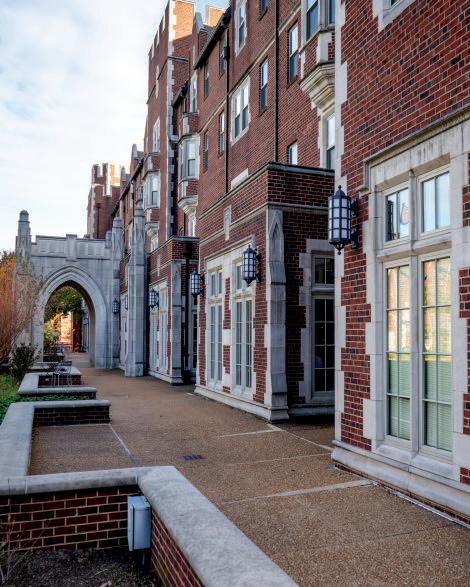
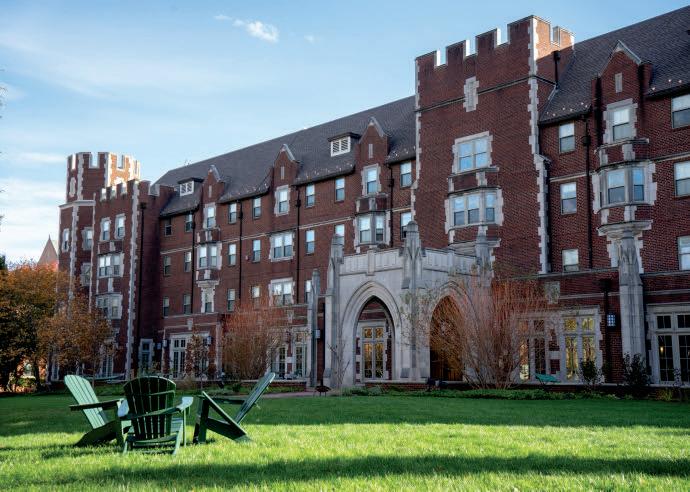


AwThe following pages contain the best apartment communities within 10 miles of WashU. 2B Residential is a local, award-winning, property management company that provides professional, concierge-level service to all residents.
Controlled Access Buildings n Washer & Dryer in Unit
Pet-Friendly n Outstanding Amenities
Resident Events & 2B Perks
Walkability to nearby dining, shopping & entertainment
Easy access to public transportation


View















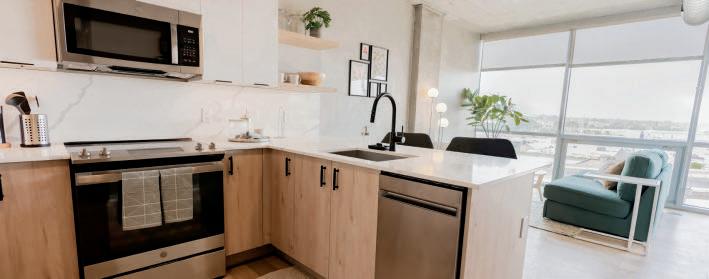

7th floor sundeck with pool, jacuzzi, cabanas & grills
7th floor garden terrace
14th floor resident lounge with chef’s kitchen, open seating area with fireplace, serving counter and dining area
Fitness center with cardio & free weights
Pet-friendly community with pet park
Controlled access building, & parking garage
Smoke & vape-free community
Bicycle storage room
Co-working space and private meeting rooms
On-site management
24-hour emergency maintenance

Expansive floor-to-ceiling windows
High ceilings with exposed concrete
Matte black finishes
Modern two-tone cabinetry in kitchen
Quartz countertop and backsplash
Plank flooring throughout
Modern lighting
Amazing city views
Walk-in showers with tile surround
Stacked washer and dryer in unit
Corner pool deck patio*
Courtyard or pool patio*
Balcony*
*select units
