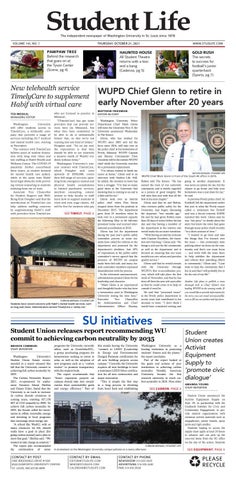
The independent newspaper of Washington University in St. Louis since 1878 THURSDAY, OCTOBER 21, 2021
VOLUME 143, NO. 7
PAWPAW TREE Behind the research that goes on at the Tyson Center (Scene, pg 4)
HAUNTED HOUSE All Student Theatre returns with a boo and a bang (Cadenza, pg 5)
New telehealth service TimelyCare to supplement Habif with virtual care TED MOSKAL MANAGING EDITOR Washington University will offer students access to TimelyCare, a telehealth company that provides a range of services including 24/7 medical and mental health care, starting in November. The contract with TimelyCare follows years of student frustration with long wait times and low staffing at Habif Health and Wellness Center. The COVID-19 pandemic further exacerbated these issues, as student demand for mental health care spiked, while at the same time Habif faced legal obstacles with providing virtual counseling to students studying from out of state. Associate Vice Chancellor for Student Support and WellBeing Kirk Dougher said that the introduction of TimelyCare can help address staffing concerns by supplementing Habif ’s staff with providers from TimelyCare
WWW.STUDLIFE.COM
who are licensed to practice in Missouri. “[TimelyCare] has got some providers that can provide services here [in Missouri], but what they have committed to be able to do is substantially bolster that, so that we're not running into any kind of delays,” Dougher said. “So on my end, the expectation is that they should be able to see relatively a massive swath of WashU students without delay.” Washington University’s oneyear contract with TimelyCare, which Dougher said costs upwards of $500,000, covers their full range of services, spanning from emergency mental and physical health consultations to limited psychiatric services, nutrition counseling, consultations to help faculty or staff learn how to support students in crisis and even yoga classes. All will be free for students who pay
SEE TIMELY, PAGE 2
CURRAN NEENAN | STUDENT LIFE
Students have voiced concerns with Habif’s mental health services, such as long wait times. Administrators termed TimelyCare a ‘safety net.’
WUPD Chief Glenn to retire in early November after 20 years MATTHEW FRIEDMAN EDITOR-IN-CHIEF Washington University Police Department Chief Mark Glenn will leave the University Nov. 8, the University announced Wednesday in The Source. Glenn, who has worked for WUPD since 2001 and led the force since 2016, will take over as the police chief in his hometown of Pevely, Missouri. WUPD Captain and Bureau Commander Dave Goodwin will be the interim WUPD chief while the University searches for a permanent replacement. “I’ve always wanted to finish my career at home,” Glenn said in an interview with Student Life. Still, he added, the decision to leave has been a struggle. “I’ve had so many good times at the University that knowing that is coming to an end is a little sad for me.” Glenn took over as interim police chief when Don Strom stepped down from the position in December 2015. The department grew from 55 members when he took over in a permanent capacity the following May to 66 full-time personnel today and received international accreditation in 2018. Glenn has led the department during the past year’s public safety committee process as some students have called for reforms to the department and protested for the department’s abolition. Just 45% of respondents to the public safety committee’s survey agreed that the presence of WUPD on campus made them feel safe, and many student committee members expressed dissatisfaction with the process. In the retirement announcement, administrators praised Glenn for his leadership and character. “Mark Glenn is an experienced and thoughtful leader who has been a tremendous asset to Washington University during his time here,” Executive Vice Chancellor for Administration and Chief Administrative Officer Shantay
SKYLER KESSLER | STUDENT LIFE
WUPD Chief Mark Glenn in front of the South 40 office in 2015.
Bolton told The Source. “He has earned the trust of our university community and is widely regarded as a person of great integrity. We will miss him and wish him all the best in his next chapter.” Glenn said that he and Bolton, who oversees public safety for the University, had begun discussing the departure “two months ago.” He said he had given Bolton more than 30 days of notice before his last day and that having a member of the department in the interim role would make for an easier transition. “With having an interim in-house with Captain Goodwin, the transition isn’t that long,” Glenn said. “He brings a real care for the community as well as the department and is focused on ensuring that our team models our core values and provides quality service.” Glenn said that he would remain with the University through WUPD’s first re-accreditation process, which will take place the first week of November, and that he has time off from his new role soon after so that he could come in to help or consult if need be. He said that “personnel issues” in the Pevely police department in recent years had contributed to his decision to leave. “I don’t think I would have considered retiring and
SU initiatives
Student Union releases report recommending WU commit to achieving carbon neutrality by 2035 MEHEER COMMURI STAFF REPORTER Washington University’s Student Union Senate recommended in a report released this fall that the University commit to achieving full carbon neutrality by 2035. The Carbon Neutrality Report 2021, co-sponsored by sophomore Senators Ishani Shethia and Danny Ecker, found that the University is on track to increase its carbon dioxide emissions in coming years, emitting 437,158 MT of CO2 annually by 2050. To achieve full carbon neutrality by 2035, the Senate called for investments in offsite renewable energy and investing in local programs that encourage clean energy use. “A school like WashU, with so many resources, we felt, should really have a goal in place [for going carbon neutral] and a plan to meet that goal,” Shethia said. “We wanted to take charge as senators.” The report also recommended the continuation of some
programs the University currently offers, such as GrowSolarSTL, a group purchasing program for homeowners seeking to invest in solar, as well as the adoption of new programs such as a “carbon tracker” to promote transparency with the student body. The report recommends that “future expansion projects on campus should take into consideration these sustainability goals and energy efficiency.” Part of
GOLD RUSH The secrets to success for football’s junior quarterback (Sports, pg 7)
this entails having the University “commit to LEED [Leadership in Energy and Environmental Design] Platinum certification for all new building projects across campus.” Currently, the University requires all new buildings to have a minimum LEED Silver certification for all new construction and major renovation. “This is simply the first step in a long process in divesting from fossil fuels and establishing
Washington University as a leading institution in protecting students’ futures and the planet,” the report concludes. Part of the report looked at the goals and actions of peer institutions in achieving carbon neutrality. Notably, American University became the first research university to reach carbon neutrality in 2018. Nine other
SEE CARBON, PAGE 3
going to another department. It was never an option for me, but the chance to go home and help your hometown was a real draw for me,” he said. A previous Pevely police chief, Al Eickhoff, left the department earlier this year in what the Pevely mayor called a retirement but Eickoff said was a forced removal, KSDK reported this week. Glenn said he was “not privy” to details about the story but knew the town had gone through many police chiefs recently “in a short amount of time.” “I wanted to go back and take the things that I’ve learned over the years — this community style policing where we focus on the community and that’s our main focus — and work with the team there to help stabilize the department and refocus their patrolling efforts to community,” Glenn said. “I just want to help the community that I live in and that I will probably live in for the rest of my life.” Student Life plans to publish a more thorough look at Chief Glenn’s time leading WUPD in the coming weeks. If you would like to provide information for the story, you can email news@studlife. com or fill out our pitches and tips form.
Student Union creates Activist Equipment Supply to ‘promote civic dialogue’ AMANDA YOUNG STAFF REPORTER Student Union announced the Activist Equipment Supply on Sept. 28, in partnership with the Gephardt Institute for Civic and Community Engagement, to provide student organizations with common activist materials such as megaphones, poster boards, spray paint and vigil candles. Students hoping to access the supply must apply at least 24 hours in advance and can pick up the reserved items from the SU office on the day of the action. Students
CURRAN NEENAN | STUDENT LIFE
A smokestack on the Washington University campus pollutes on a sunny afternoon.
CONTACT BY POST
CONTACT BY EMAIL
CONTACT BY PHONE
ONE BROOKINGS DRIVE #1039 #320 DANFORTH UNIVERSITY CENTER ST. LOUIS, MO 63130-4899
EDITOR@STUDLIFE.COM NEWS@STUDLIFE.COM CALENDAR@STUDLIFE.COM
NEWSROOM 314.935.5995 ADVERTISING 314.935.4240 FAX 314.935.5938
SEE EQUIPMENT, PAGE 3
2 STUDENT LIFE
GRACE KENNARD & ORLI SHEFFEY | SENIOR NEWS EDITORS | NEWS@STUDLIFE.COM
theFLIPSIDE THU 21
PARTLY CLOUDY 61/49
SUN 18 RAIN 64/45
FRI 22
PARTLY CLOUDY 66/45
MON 19
MOSTLY CLOUDY 61/40
TUES 20
SAT 17
PARTLY CLOUDY 67/56
PARTLY CLOUDY 67/53
WED 21
SHOWERS 68/52
EVENT CALENDAR THURSDAY 21 Faculty Reading: G’Ra Asim & Niki Herd Virtual Event, 8 p.m. Visiting Writer in Residence Niki Herd and creative nonfiction professor G’Ra Asim will be reading from their work in this virtual event.
FRIDAY 22 PAD Presents: ‘She Kills Monsters’ Edison Theatre, 8 p.m. The Performing Arts Department is proud to present “She Kills Monsters,” the first mainstage production of the 2021-2022 season. Directed by Bill Whitaker, “She Kills Monsters” is a fantastical experience featuring the beloved game “Dungeons and Dragons.” Tickets are free for WashU students and the show runs the weekend of Oct. 22 and Oct. 29.
SATURDAY 23 Measuring the Oldest Light in the Universe Virtual Event, 10 a.m. Professor Nagy will be exploring how cosmologists can understand the evolution and structure of the oldest light in the Universe, the Cosmic Microwave Background. This Physics Department lecture will cover the creation of microwave telescopes amongst other things.
TUESDAY 26 Free Bike Registration and U-Lock Sale: Danforth campus Olin Library (Whispers Café and the George Washington Statue), 11 a.m. - 1 p.m. If you bike to campus, you can register your bike for free, buy a U-lock at a discounted price and pick up bike giveaways. You can also learn about the different transportation options and support programs available at WashU. German Film Series: ‘Nosferatu the Vampyre’ Virtual Event, 7 p.m. To celebrate the month of October, the German Department is screening “Nosferatu the Vampyre” (1979). This virtual film screening is free and open to the public.
QUESTION OF THE WEEK WHAT SHOULD WASHU DO WITH ITS $15.3 BILLION ENDOWMENT? Here are the results from this week’s poll. Check out our Instagram for next week’s question.
“Buy three more lawn chairs.” “Book T-Pain for Spring WILD.” “More tulips.” Check our Instagram this week for next week’s question! Responses will be published here every Thursday.
TIMELY from page 1 the health and wellness fee to access. Student Union Health and Wellness Committee Chair junior Nicole Leers said that SU had begun looking into different telehealth providers in March 2020 after the pandemic forced many students to go virtual. When Vice Chancellor for Student Affairs Anna Gonzalez joined the University in July, her advocacy for additional funding helped push the initiative over the finish line. [During the 2020-2021 academic year] it didn't really seem like, at the time, something that the university was open to,” Leers said. “We didn't hear much about it until the beginning of this year or over the summer with the onboarding of Dr. G[onzalez]. Mental health has really been a priority for her, and I think she again saw this as a really good option for WashU.” The decision to adopt TimelyCare was informed by student input, including SU’s annual Improve WashU survey, which asks students to pick their top three most pressing issues at the University. In last year’s survey, Leers said, over half of the roughly one thousand respondents chose mental health as a top priority. She added that the wider selection of counselors at Timely Care
and their 24/7 service are major advantages of the service. “The fact that students have access to many more counselors and are able to find a counselor with a shared identity, I think that's a big pro,” she said. “I think having that ondemand counseling is really helpful. The wait times at Habif are super, super long. And if something happens, it's hard to just walk right in that day, whereas you could set up an appointment online pretty easily [with TimelyCare].” Still, Dougher emphasized the primacy of Habif ’s in-person services, characterizing TimelyCare as more of a “safety net” for Habif. “[Universities that adopt telehealth services] continue to find that the vast majority of their students still prefer the in-person services over the webbased services,” he said. “So we want to encourage people to go with that and call Habif if, for whatever reason, Habif is not able to schedule an appointment…then we recommend following up with TimelyCare.” Dougher said that in order to give Washington University more bargaining power, the contract with TimelyCare is also only for a single year, as opposed to peer
institutions such as Johns Hopkins, Emory and the Claremont Colleges, which typically have three or four year contracts. “I think to some extent, it's a bit of a trial run in the sense that if students are not finding the service helpful, we shouldn't be paying for it and we should be using those funds for a few more counselors or something else,” Leers said. “But if students are seeing this as a very valuable service, then I definitely think that we should be continuing it.” Habif and SU both plan on conducting an advertising campaign for TimelyCare leading up to its launch in November. One important element of this campaign will be encouraging students to preemptively download the TimelyCare app, which allows them to access all of Timely Care’s services. “When students have already done that work [of downloading the app], then they'll go and use it,” Dougher said. “But if they haven't already done that, what other schools have discovered is that it’s not always the best time for them to go through the process of downloading it and they tend not to use it that way. So as much as we can grab people and get them ready in case they need it, the better.”
THURSDAY, OCTOBER 21, 2021
Uncle Joe’s hosts suicide recognition and prevention workshop GRACE KENNARD SENIOR NEWS EDITOR Uncle Joe’s Peer Counseling and Resource Center facilitated a Suicide Recognition and Prevention Workshop, Oct. 16, to decrease stigmas around mental health and increase awareness of mental health resources on and off campus. Seniors and Co-Directors of Uncle Joe’s Emily Angstreich and Lily Swenson said that their decision to host the workshop was influenced by increasing national suicide trends, two student suicides at Saint Louis University in September and an increase in clients at Habif Health and Wellness Center. “We’ve noticed a trend nationally of increasing not just suicidal ideation, but suicides amongst college students,” Angstreich said. “And then when we heard about the suicide[s] at SLU we definitely wanted to make sure that we were doing our part at WashU to help prevent suicide and share our resources in the best way possible to help prevent that from happening in our community.” “Also we’ve been working with Habif a lot and … they are definitely having an uptick in clients,” Swenson said. With about 25 students attending, the workshop focused on common stigmas and misconceptions about suicide, warning signs associated with suicide and suicidal ideation, how to assess risk and safety planning. The Uncle Joe’s panelists emphasized the importance of asking loved ones if they have had suicidal ideations and using an empathetic, non-judgmental approach to the conversation. After the one-hour interactive presentation given by Uncle Joe’s members, participants were placed in small “fishbowl” groups with a club leader and asked to assess risk in different scenarios. Sophomore Jordan Shonfeld started the panel by addressing common misconceptions about suicide, dispelling the claim that asking about suicidal ideation increases one’s risk of completing suicide. “It actually can help them feel less isolated, more supported, so that’s definitely an important [stigma] to address,” Shonfeld said. Underscoring the importance of reducing stigmas around mental health and suicide, Shonfeld said that research has found suicide is the second leading cause of death for college students and 12% of college students experience suicidal ideation at some point in college. Continuing the panel, junior Noe Bustos explained how to assess risk with the scale that Uncle Joe’s uses, including low, moderate and high risk, noting that this is not meant to formally train participants in risk assessment. Potential characteristics of a high risk situation include when an individual has a plan, has a time frame (especially a close one), has acquired means, has attempted suicide in the past or is actively using a substance. Bustos clarified that having one characteristic of any given risk level raises the overall risk of the situation to that level. Sophomore Isa Huesa added that after assessing risk, safety planning should be the
next step in this scenario. “If someone is at high risk and you call Provident or the Behavioral Health Response team and provide them with the phone number of the person at risk, then they will be in contact with that person and take further steps to make sure that they are safe,” Huesa said. Senior Merry May Ma attended the event and appreciated how the workshop enabled her to not only learn but also to apply that knowledge and practice the ideas presented by Joe’s members. “[The workshop was] both… informative but also helped us to apply the knowledge to practice,” Ma said. “I remember taking notes about several principles: how to evaluate the risk … I think I have some basic knowledge of how to do this, but then they have the fishbowl practice where we interact with three different kinds of people under different circumstances and we need to apply what we learn to practice.” Participants also discussed the role of police and WUPD in responding to mental health crises, with Angstreich noting that Uncle Joe’s opts to utilize Behavioral Health Response’s mobile crisis units in an emergency, despite their potentially limited availability. “As an organization, we prefer not to use WUPD for crisis scenarios,” Angstreich said. “We prefer to use mobile outreach units which are proven to be more effective than police in these scenarios… These people are well trained, they know what they’re doing. We have had good experiences with them in the past.” She went on to detail ways to make a police intervention as safe as possible for everyone involved. “We suggest only calling the police if it’s high or imminent risk, if you really cannot guarantee someone’s safety,” she said. “And then it would be helpful if you’re with that person… be with them, help kind of mediate between police… and then when you get on the phone, especially with WUPD, you can say to them, ‘Hey, this person does not need an army coming down their door, they just need hopefully one officer, they need to feel safe… If you’re going to involve the police, communication is really key.” Sophomore Angela Han also attended the workshop and said that it was amazing to see many students at the event. “A lot of people came and I felt like that… was kind of a reinforcement of the idea that… what’s happening is real and that it’s important and people care about it and... there are people who want to help and who want to get to know more and really be there for people who are struggling,” she said. Despite her overall positive feedback on the event, Han said she wished that hospitalization related to mental health was incorporated because that can be a consequence of calling the police in mental health crises. The demand for mental health care at Washington University has increased in recent years. In line with the uptick in clients at Habif, Uncle Joe’s “numbers have shot up a lot” within the past three to four years, Angstreich
said, adding that “maybe a third as many people [were] coming in” about six years ago. When asked about the long wait times for mental health care at Habif, Swenson said that they are hoping TimelyCare, a telehealth company the University has partnered with, gets rolled out smoothly because it should alleviate the caseload at Habif for mental health services. “Other schools at our similar level have used TimelyCare, and they all have seen a more stable number of people coming into their student health service, rather than just being overwhelmed. So it definitely should decrease wait times,” she said. Angstreich suggested that off-campus mental health resources are a good option in addition to Habif. “Having therapy through Habif is definitely an asset and a great thing for people. But it would also be great if people could feel comfortable going off campus to find their own therapy. However, that process is really daunting,” Angstreich said. Mental health care manager Missy Showalter is the only Habif employee helping the student body locate services in St. Louis. In an email to Student Life, Director of Mental Health Services Thomas Brounk added that there are also two full-time staff in WashU Cares “that can assist students with finding mental health resources” in the area. For students who need financial assistance to seek mental health services off campus, the Student Union Mental Health Fund is a resource for students that Angstreich said she hopes to see expanded. As suicide prevention is Uncle Joe’s biggest priority for the year, this workshop was a starting point and will be given to RAs and WUSAs. Campus organizations can also set up their own workshop by emailing unclejoesoutreach@gmail. com. Angstreich emphasized that students can call Uncle Joe’s if they are concerned about a friend and are unsure how to handle a distressing situation. “We cannot tell someone exactly what they should and should not do because we’re not in that situation,” Angstreich said. “But we can give them resources. We can help them safety plan, we can be a sounding board. We can do the best of our ability to help them out.” Behavioral Health Response (BHR) is a Missouri organization that provides crisis support, telephone counseling and mental health resources. They can be reached 24/7 at 1-800-811-4760. The National Suicide Prevention Lifeline provides free and confidential support 24/7. They can be reached at 1-800-273-8255 or online at suicidepreventionlifeline.org/chat/. The Steve Fund, an organization dedicated to the mental health and emotional well-being of students of color, has a 24/7 crisis text line that can be reached by texting STEVE to 741741. Uncle Joe’s is a confidential resource with student counselors trained to provide support for a variety of issues. Counselors are available by phone 24/7 at 314935-5099 and in person during walk-in hours from 10:00 p.m. to 1:00 a.m.
HOLDEN HINDES | STUDENT LIFE
A Joe, left, leads a “fishbowl” training with two event attendees in Hillman 70 Saturday.
THURSDAY, OCTOBER 21, 2021
NEWS
GRACE KENNARD & ORLI SHEFFEY | SENIOR NEWS EDITORS | NEWS@STUDLIFE.COM
EQUIPMENT from page 1 must agree not to violate SU or university guidelines when using borrowed equipment from the supply, according to the registration form. The list of students who register for supplies will be accessible to SU members only. In a follow-up statement to Student Life, Student Union President junior Ranen Miao added that the guidelines for use are in the process of being finalized and that policy violations will not be conducted through SU. “We are still working with students on the guidelines for usage, and those guidelines will evolve as we better understand student needs, especially regarding privacy and the types of protests students engage with. SU does not participate in Student Conduct cases. If a student is found in violation of university guidelines, the Office of Student Conduct and Community Standards is responsible for taking on cases,” he said. Miao said that he first thought of the idea in late 2020 after a conversation with a classmate who wanted to organize a protest but could not find a megaphone. “I thought, ‘It would be great if Student Union would be able to offer that resource to people,’” Miao said. “Our organization has always been rooted in protest and in supporting the right for students to engage in protest and activism, and I think this is really built on that legacy.” According to its website, Student Union was established during the 1967-1968 school year when students were protesting the Vietnam War. In 1969, the organization set up a fund to bail students out of jail for protesting the war. Working with Gephardt Institute Student
Engagement Coordinator Colleen Smyth, Miao applied for funding through the Common Ground Grant. Any student, faculty or staff member can apply for up to $1,500 of funding through the grant, which Smyth said was created in response to the political divisiveness following the 2016 presidential election. A partnership between the Division of Student Affairs, the John C. Danforth Center of Religion and Politics and the Gephardt Institute, the “spirit of the grant [is to] promote some civic dialogue across campus,” Smyth said. “It’s about building bridges and the spirit of inquiry, asking questions, being curious and promoting civic dialogue. Protest is oftentimes a form of civic dialogue if it starts conversations.” During the committee review process, Smyth said there were questions about how students would access the materials, where they would be stored and whether or not people would be hesitant to use the equipment “because it’s been institutionalized in some way” through the supply’s partnership with the Gephardt Institute. Ultimately, Miao’s proposal was approved by the Gephardt Institute’s Common Ground Grant review committee in Spring 2020, which is when he ordered the equipment so that it would be available for the fall semester. All undergraduate students can access the Activist Equipment Supply, according to Miao, and there are no political or financial requirements. Miao said that the only reason why someone would be denied access is if they previously borrowed items that were either damaged and not compensated
CARBON from page 1 institutions were mentioned, from Duke University’s pledge to carbon neutrality by 2024 to Harvard University’s commitment to greenhouse gas neutrality by 2050. When asked why so many of the University’s peer institutions have carbon neutral goals but the University does not, Shethia said there is no clear answer. “In a lot of other areas concerning the environment, we are doing great,” Shethia said. “It’s just that, in this regard, we are a little behind.” “At the bare minimum, we should be able to meet what other universities are doing,” Student Union President Ranen Miao said. “But it would be even better if we can be a leader in this
for, or not returned at all. The supply was first announced to the student body in an email from Miao, Sept. 28, but Student Union had the equipment starting in early September, according to a follow-up statement from Miao. This enabled the organization #MeToo WashU, which began as an Instagram account (@metoo_washu) dedicated to providing survivors of sexual violence with a platform to share their stories, to utilize the supply in early September. “When the items for the Equipment Supply first reached the office, an organizer from MeToo WashU reached out and they were offered the opportunity to utilize the resources,” he said. #MeToo WashU wrote in a statement to Student Life that they used a megaphone and poster boards from the Activist Equipment Supply for their Sept. 10 vigil and Occupy the Red Zone protest. #MeToo WashU wrote that the supplies were an integral part of their protest. At the vigil, student volunteers “used the megaphone to amplify their voices as they read survivors’ stories,” and at the Occupy the Red Zone protest, facilitators turned “towards the fraternity and [led] protestors in a chant that condemned rapists, racists, classists, homophobes and ableists.” The megaphone provided by SU’s activist equipment supply iampacted the accessibility and power of the protest, according to #MeToo WashU. “After the protest, volunteer facilitators remarked on the transformative effect of the megaphone on speakers’ confidence levels. The megaphone emboldened
field.” Ecker added that although the University administrators have expressed enthusiasm about taking steps towards carbon neutrality, the steps to actually reach that goal will take considerable time and effort. “We have been talking with a number of administrators including the Assistant Vice Chancellor for Sustainability [Phil Valko] and [Associate Vice Chancellor for Student Affairs and Dean of Students] Rob Wild,” Ecker said. “They are obviously passionate about this issue. The main challenge is going to be following through with implementation in the next five, 10 and 15 years.” “We have five meetings set up with people in the
administration in the next couple of months, and the Office of Sustainability has already put together a plan on carbon neutrality,” Shethia said. Assistant Vice Chancellor for Sustainability Phil Valko did not respond to two email requests from Student Life for comment on this story. Both senators stressed the importance of gaining traction with the student body as SU moves forward with this issue. “As much as it will be important, at the end of the day, to get in contact with the administration as we have been doing and get them to implement [the policy], if there is student backing with us, that only helps,” Ecker said.
Reilly Brady Jamila Dawkins Senior Forum Editors forum@studlife.com
Curran Neenan Senior Photo Editors photo@studlife.com
STUDENT LIFE 3
previously-shy protesters to scream, to cry and to lead,” #MeToo WashU wrote. “Without the megaphone and poster boards, our protest would have been less accessible to deaf and hardof-hearing participants and less effective at catching the attention of—and communicating our message to—fraternity house residents. Best of all, these supplies, when in the hands of protesters, made protesters feel empowered.” Both Miao and Smyth hope that the supply gives students the tools they need to make their voices heard. “I’m a big fan of the First Amendment and of every single student’s right to protest and speak out on issues that they feel are unjust, so I really hope that this will offer
resources and support for students on campus who are engaging in a wide variety of activism, no matter what their partisan or political background is,” Miao said. “I believe it can be a resource for students who are really wanting to make their voices heard on campus but might not always have the tools right at the ready to be able to do that. I hope it can be utilized really to amplify people’s voices and things that they’re concerned about,” Smyth said. “I think students have been responsible too, if you look back in WashU history, for really pushing and moving us along sometimes when we need it. Institutions are very slow to change very often, so that feels important.” #MeToo WashU added
that the equipment supply makes activism more accessible. “This program lessens the burden of the cost of supplies on student activists, making it easier for lowincome students to organize protests should they want to do so.” Miao hopes to expand the supply in the future to make it even more useful for students. “There’s a lot of items that we’ve purchased already, and the way that we can expand this fund and make sure that it’s sustainable in perpetuity is to make sure that we continue gathering data from students who are using it and seeing where the needs are for the students on campus who are mobilizing and organizing for change.”
HN Hoffmann Kamala Madireddi Jaden Satenstein Senior Multimedia Editors
Adrienne Levin Coleman General Manager a.coleman@studlife.com
Copyright © 2021 Washington University Student Media, Inc. (WUSMI). Student Life is a financially and editorially independent, student-run newspaper serving the Washington University community. Our newspaper is a publication of WUSMI and does not necessarily represent the views of the Washington University administration.
VOLUME 143, NO. 07 Matthew Friedman Editor-in-Chief editor@studlife.com Jayla Butler Em McPhie Ted Moskal Isabella Neubauer Managing Editors Grace Kennard Orli Sheffey Senior News Editors news@studlife.com Olivia Poolos Julia Robbins Senior Scene Editors scene@studlife.com
Grady Nance Senior Sports Editor sports@studlife.com Jordan Coley Gracie Hime Senior Cadenza Editors cadenza@studlife.com Jade Leslie Sarah Wang Senior Design Editors design@studlife.com Brian Cui
Jordan Coley Grady Nance Senior Copy Editors copy@studlife.com Vivienne Chang Senior Engagement Editor Ani Kesanapally Senior Diversity, Equity and Inclusion Editor
Sabrina Spence Senior Social Media Editor Nathan Springman Senior Web Editor Reilly Brady Elle Su Christine Watridge Angela Xiao Designers
Tammy Dunsford Advertising Sales Manager dunsfordt@wustl.edu
4 STUDENT LIFE
SCENE
OLIVIA POOLOS & JULIA ROBBINS | SENIOR SCENE EDITORS | FORUM@STUDLIFE.COM
THURSDAY, OCTOBER 21, 2021
Rooted in St. Louis: The Tyson Center, a research ecosystem THOMAS HUMPHREY STAFF WRITER You cannot fit a forest into the lab, so in order to study large ecosystems, scientists must enter the wilderness. The problem is that wilderness is not so common anymore. There are few forests left untouched by humanity, and scientists are typically discouraged from burning them down for research. Instead, they are set loose upon environmental field stations like Washington University’s Tyson Research Center. Twenty miles west of campus on I-44, the grey concrete and gas stations melt into lush oak forest. Tyson can be used for experimentation precisely
bats that call it home. “This is WashU’s hidden gem,” Natural Resources Coordinator and Staff Scientist Beth Biro said. The area was first deforested in the mid-1800s, and then again by the U.S. Army after they acquired the land before World War II. Bunkers still dot the landscape, hidden among the natural hills to avoid aerial detection. “Part of why [Tyson has] come to be an asset for researchers is allowing them to do large landscape projects where they can manipulate the environment more, because [the area has] such a disturbed history,” Biro said. WashU acquired the land from the Army in 1963, when it was begin-
The pawpaw tree boasts an unusual custard-like fruit.
because it is not untouched wilderness. Historically, indigenous tribes regularly set fires to maintain open woodlands. More recently, the area was used as a limestone quarry, and it now lies abandoned except for the endangered
ning the process of reverting to the natural Missouri landscape. “If it occurs in Missouri, we have it, whether plant, animal or insect,” Tyson Outreach Coordinator Susan Flowers said. The environment is
not just forest; the mixed Missouri woodlands open up into prairies and fields. Unique to the region are the Missouri glades, desert-like areas of rocky soil filled with pricklypear cacti and tarantulas, many of which have been restored at Tyson. Among all of the flora that grows there, the pawpaw is a Tyson favorite. A native fruit tree that resists domestication, its unusual custard-like fruit tastes like a cross between a kiwi and a banana — pawpaw “banana bread” is always popular when in season, as are the native persimmons. Research projects at Tyson range in scale and scope. One of the largest, spearheaded by WashU professor of biol-
COURTESY OF SUSAN FLOWERS
ogy Jonathan Meyers, is the Forest Global Earth Observatory. Organized by the Smithsonian, Forest GEO is a global network of field stations collecting long term environmental data. “We have one plot here
COURTESY OF SUSAN FLOWERS
Dr. Katie Westby (center) and Dr. Kim Medley (left) explain their mosquito ecology research to undergraduate students at one of their experiment sites.
at Tyson, but there are 127 plots all over the world doing the same kind of thing,” Biro said. Tyson has collected detailed environmental data since the 1980s, facilitating a multitude of projects. “What’s super cool is as soon as you do a big giant manipulation like that, you can overlay all these research questions onto it,” Flowers said. A great example is their “experimental forest plots,” 16 two-and-a-half hectare plots organized in pairs. Every two years, as part of the Species Pool Functional Diversity project, one plot out of each pair is burned down. This allows for field research into the biodiversity effects of regular forest fires and their implications for particular species. Staff scientist Solny Adalsteinsson studies the effects such fires have on tick populations. While scientists generally speculate
that frequent fires would reduce them, “not much experimental research has actually been done,” she said. Bloodsuckers seem to be a particular interest of Tyson Researchers: Postdoctoral research associate Katie Westby studies Tyson’s mosquito populations both outdoors and in the lab. Despite their reputation, vampiric behavior in mosquitos is limited to egg-laying females — adult mosquitos primarily feed on plant nectar. Much of the mosquito life cycle happens underwater, intimately tied with local plant life. They are predators of bacteria who eat waterlogged plant detritus. The various projects combine into a rich tapestry of data about one area’s conditions to be used for decades by scientists at Tyson. Being able to collect local climatic data “is the
benefit of field stations,” Biro said. “That is what we are here for. Having these types of things based at field stations where you have a constant supply of researchers and funding to keep these long term studies going is how you really can study the actual effects of climate change.” The collection of microclimate data does involve the staff putting weird meteorological instruments in their yards — which can scare the neighbors — but they’re happy to do it. Building a research community is a key priority for the Tyson educational program. “We want to be bringing people in rather than weeding them out,” Flowers said. Tyson is not just an ecosystem of plants, bugs and bears. It is a community of scientists and students, researchers local and global, where humanity and the natural world collaborate.
Bergson’s best: Rating the cafe’s fall drinks ISABELLA NEUBAUER MANAGING EDITOR Fall is by far my favorite season. As soon as October started, I whipped out my Halloween attire. I’ve been eating apple-based desserts for the last two weeks. The weather is cooling off, finally reaching that perfect combo of chilly in the morning but warm in the afternoon. That means it’s time for another of my favorite seasonal traditions: fall-flavored beverages. This doesn’t always go well for me. Last month, I was disappointed by (and, apparently, allergic to) Starbucks’ new Apple Crisp Latte. But Washington University has some quality drinks. Quite a lot (read: all) of my apartment-plan meal points are spent at Café
Bergson. Bergson has introduced three fall beverages to their lineup this October, and over the last few weeks, I have sampled all three. Repeatedly. (Yes, the lattes may or may not also be available as cold brews with oat foam. As someone allergic to the oat milk it’s made from, I’m not including those options in my ranking. Also, and more controversially, what is the point of fall drinks if not to warm your hands against the chill?) Without further ado, here are my semi-comprehensive ratings of Cafe Bergson’s festive October drinks. Apple Cider: it pains me to Bergson’s apple 10/10. During
Readers, not give cider a my two
pre-COVID WashU years, I drank an apple cider nearly every day during the too-brief season it is available. Hot apple cider, caramel syrup nearly dissolved but still managing to build up at the bottom for an almost sickeningly sweet last two sips — flavor-wise, you can’t get better. Sadly, I must deduct points, because it’s just not filling. Maybe that’s a good thing. I can drink endless apple ciders without getting full. But in terms of my wallet — and my stomach, when I need both caffeine and a snack — it’s a definite downside. Rating: 8/10 Maple Latte: Don’t get me wrong, the maple latte is good. It just isn’t great. The latte is definitely sweet, but the maple flavor is drowned out by the sugar, leaving me with the impression that I’d just consumed a dessert beverage but without knowledge of what that dessert was. That said, I’m in favor of pretty much all desserts, and the maple latte functions pretty similarly to candy — it gives me a sugar rush and briefly fills me up, knowing that I’ll have a small crash later. All in all, I’d drink it again. Rating: 6/10 Pumpkin Spice Latte: The ubiquitous fall
GRAPHIC BY HN HOFFMANN
beverage, the pumpkin spice latte. A staple of making fun of girls in Uggs for at least a decade, the coffee can get a pretty bad rap. And yeah, maybe it is basic, but it’s delicious. Nutmeg and allspice
— the main components of pumpkin spice — are the flavors of fall, and they are best conveyed in a coffee. Bergson’s is not the best pumpkin spice latte I’ve ever had, but it’s far from the worst. It energizes me
without the sugar rush of the maple, and acts a lot like a small snack before lunch. Without question, it’s Bergson’s best fall beverage. Rating: 9/10
CADENZA
THURSDAY, OCTOBER 21, 2021
JORDAN COLEY & GRACIE HIME | SENIOR CADENZA EDITORS | CADENZA@STUDLIFE.COM
STUDENT LIFE 5
AST puts on a thrilling haunted house for Halloween JORDAN COLEY SENIOR CADENZA EDITOR On Friday, Oct. 15, I walked to the Village Black Box to attend All Student Theatre’s (AST) fall haunted house. I had never been to a haunted house before — in part because I don’t love scary things, so usually I choose to spare myself the heart palpitations — but AST put on a thrilling event despite the limited size of the Village Black Box. When my friends and I first arrived at the haunted house we met a girl named Mary, who joined our group because she was there alone and we all love friendship. The premise of the Haunted House is that there was a show called “Cooking With Kids” where a creepy chef and her puppet assistant Kiwi taught “children” from the live studio audience how to make a recipe. The chef made ribs, and after pouring a sauce that looked suspiciously like blood on them she asked Mary to come up as a volunteer from the audience. When cutting the meal the chef got pretty close to Mary’s fingers and I was sure I knew what was up; she would pretend to cut her, some cheesy fake blood would come out, and we would leave the theatre expected to believe that it was a (lackluster) haunted house. I did not, in fact,
JAMIE NICHOLSON | STUDENT LIFE
The chef in AST’s haunted house prepares to go after her next victim.
know what was up. The chef sliced into Mary’s arm, making an incredibly realistic cut, and then she was whisked away behind a curtain and our group was instructed to save her. At this moment I realized this was going to be a legitimately haunting experience. We then walked through the Black Box — where
curtains were strategically used to make the space seem much larger than it is — while different actors jumped out of nowhere, covered in fake blood. After I screamed multiple times at the jumpscares, we were led into an “oven” where other victims of the chef told us their horror stories, complete with bloody t-shirts and impeccable scar
makeup. The haunted house marks AST’s first return to live performances since fall of 2019, and it was also the first time they’d done a haunted house. Junior and co-director Leah Coleman said the show was a collaborative, devised theatre production where “every specific thing was come up with by actors.” Coleman
is experienced with devised theatre, which she describes as “playwriting and production all together,” and she especially loves the audience interaction that comes along with it. Because of the nature of devised theatre, it is a great way to introduce newcomers to theatre. Junior and AST president Aiden Stern remarked “It’s exciting
to get to see us all back together, in person, doing the stuff we love. There’s nothing better than live theatre, and especially bringing in the non-theatre community into this is just, it’s incredible.” AST haunted house was a truly thrilling return to live theatre, and one that made sure to center collaboration and community.
SPONSORED BY:
Start me up.
PUZZLE Mania
A talk on venture capital and transforming traditional industries LEADERSHIP PERSPECTIVES SERIES
October 26 at 12:00 PM CT • VIRTUAL EVENT Register: Olin.wustl.edu/leadershipperspectives
FORUM
6 STUDENT LIFE
REILLY BRADY & JAMILA DAWKINS | SENIOR FORUM EDITORS | SCENE@STUDLIFE.COM
THURSDAY, SEPTEMBER 21, 2021
STAFF EDITORIAL
The flu shot deadline is coming up –– here’s how you can get it
W
ith the new season comes flu season. That student in your class swearing they are COVIDfree between coughs may be telling the truth, but their sickness is not an isolated incident. As the semester continues, it has become more clear that COVID-19 is not the only transmissible illness on our campus. Getting your flu shot is not only important for your own health and the health of our community, it’s also required by the University. The deadline to upload documentation of your flu vaccination to the Student Health Portal is Nov. 1. If the documentation is not uploaded by then, a hold will be put on your student record account, disabling class registration. Last year, students received an email on Oct. 6 which gave notice on the flu vaccination deadline, which was Nov. 20. This year’s vaccination requirement didn’t give students as much notice, nor was it publicized as much as last year — and as of Wednesday night, there are no open Recreation Center appointments. In an email to Student Life, Habif’s Executive Director Cheri LeBlanc explained that the national health care worker shortage has been affecting Habif as well as Washington University’s Medical School as a whole. This has made it difficult to free up enough nurses
and medical assistants to administer flu shots, resulting in limited appointment availability. According to LeBlanc, more dates for flu shot appointments at the Athletic Complex may open up soon, so if you keep an eye out, you may be able to get your flu shot on campus after all. However, the fact remains that those who want to get their flu shot sooner rather than later will likely have to look off campus to do so. Accessing flu shots isn’t something our Editorial Board would normally focus on, but we want to ensure that students are aware of the deadline, are able to receive their flu shots and avoid the penalties of not doing so. With that goal in mind, here are some offcampus pharmacies that are offering the flu vaccine. Here are the closest and most convenient options: CVS on Delmar Hours: Monday - Friday 8 a.m. - 9 p.m., Saturday 9 a.m. - 6 p.m., Sunday 10 a.m. - 6 p.m. Location: 6211 Delmar Blvd; at corner of Delmar and Skinker Distance: About a 15 minute walk from campus Transportation: You can take the Delmar Loop Shuttle or walk north on Skinker. You can also take the Orange Line shuttle from the Clocktower to the edge of Skinker and Forest Park Parkway.
Appointments: They offer walk-ins and appointments. Insurance: Free with most insurance information Walgreens Hours: The pharmacy is open 7 a.m.-11 p.m. on weekdays and 7 a.m.–1:30 p.m. and 2–11 p.m. on weekends. Location: 6733 Clayton Road; at corner of Big Bend and Clayton Distance: About a 20 minute walk from campus Transportation: You can walk south on Big Bend or take the Campus2Home shuttle to Clayton. Appointments: Make an appointment online or call the pharmacy. Insurance: Free with most insurance information Millbrook Pharmacy Hours: 10 a.m.-4 p.m. on Sunday and 9 a.m.-7 p.m. the rest of the week Location: 7010 Pershing Ave.; at corner of Big Bend and Forest Park Parkway Distance: About a 3 minute walk from the Village Transportation: You can walk towards the northwest corner of campus. Appointments: Walk-ins are welcome. Insurance: Free with most insurance information Total Access Hours: 8 a.m.-8 p.m. everyday Location: 1005 S Big Bend Blvd.; opposite corner of
GRAPHIC BY TUESDAY HADDEN
Big Bend and Clayton from Walgreens Distance: About a 20 minute walk from main campus Transportation: You can walk south on Big Bend or take the Campus2Home shuttle to Clayton. Appointments: No appointment is needed. Insurance: Free with most insurance information Here are some alternative but less accessible options: CVS in Target Hours: Pharmacy is open 9
a.m.-6 p.m. on Sunday and 9 a.m.-9 p.m. the rest of the week Location: 25 Brentwood Promenade Ct. Distance: About a 3 minute walk to the University City Metro station from the Village, a 20 minute Metro ride, and a 15 minute walk from the Brentwood station to the Target Transportation: You can take the MetroLink to the Brentwood station and walk two parking lots down. Appointments: They offer appointments and walk-ins.
Insurance: Free with most insurance information Walmart Hours: Pharmacy is open 10 a.m.-6 p.m. everyday Location: 1900 Maplewood Commons Dr. Distance: About a 10 minute Uber from campus, or a 30 minute ride on the MetroLink Transportation: Uber would be easiest, though you can get there using the MetroLink. The MetroLink station is a 10 minute walk away from the store. Appointments: They offer appointments and walk-ins.
Modern language learning classrooms are broken SHAWN DUAN CONTRIBUTING WRITER
L
anguage learning comes overwhelmingly through input. No baby has ever learned to speak a language fluently by memorizing vocabulary flashcards, learning grammar from textbooks or even reciting long, monotonous dialogues, slowly but surely interrogating interlocutors on a variety of oddly personal attributes: age, height, residency, date of birth, interests, one’s mother and on and on. No, the truth is that all of us, from infancy, have learned language by observing it spoken or written in understandable contexts around us. As Noam Chomsky claims, there is a language-acquisition device inherent in all humans, separate from other skill-building parts of the brain, which can produce wonderfully complex and novel speech based on extremely sophisticated grammar rules. Just look at English: Native speakers and fluent learners alike know intuitively that “Do you’ve a fat, red, big horse?” should be “Do you have a big, fat, red horse?” even though we were never taught explicit rules about proper contraction placement or adjective order. Why, then, do foreign
language classrooms across America still treat language as a skill to be mastered, like physics or woodworking, when it should be considered a unique phenomenon built into our brains? Beginner language classrooms nowadays use what is called the “communicative approach” in which instructors openly embrace this misconception. Key to this method is forcing students to speak in sentences and constructions they have not yet mastered to other students who have not yet acquired the ability to understand those constructions. This approach creates some very apparent problems. Learners will often revert back to English to communicate, obviously a far less than ideal situation for a foreign language classroom. Even if, by some miracle of God, a pair of students successfully negotiate meaning, how much good can a scripted dialogue do? These conversations that communicative-approach classrooms train students to recite can never take into account the complexities of a real interaction. They teach students how to act as a foreigner in a foreign country (e.g. What is the line number of the bus? The name of the supermarket is Lucky’s.) rather than teaching
them to speak naturally and fluently, the supposed goal of any language department. Even if students try to form complexity in these “conversations,” in an attempt to “practice this skill at a higher level” or just in an effort to make the activity less soulcrushingly boring, they will be wrong the majority of the time; students will ingrain grammar structures that seem correct according to their native language but may be entirely wrong or extremely awkward in their target language. What students end up learning is not Spanish (or any other language) but an incestuous agglomeration of foreigner-speak and nativelanguage structures. It is no wonder, then, that the foreign language teacher must stand around like a hawk with an eye on its prey, snatching up a poor victim whenever a language monstrosity comes out of his mouth. All this absurdity arises because the teacher puts the onus of language teaching on the students. As Professor Jody Doran, the assistant director of undergraduate studies at the Department of Romance Languages and Literatures, explained through an email interview, “There might be a few minutes devoted to explicit
Senior Forum Editors: Reilly Brady, Jamila Dawkins
Senior Scene Editors: Olivia Poolos, Julia Robbins
Neubauer
Senior Sports Editor: Grady Nance Senior Cadenza Editor: Gracie Hime Senior Social Media Editor: Sabrina Spence Senior Multimedia Editors:
Senior Copy Editor: Grady Nance
HN Hoffmann, Jaden Satenstein
Editor-in-Chief: Matthew Friedman Managing Editors: Jayla Butler, Isabella
comes primarily from interaction when research more consistently suggests that it comes from input. As Professor Bill VanPatten, a second language acquisition (SLA) expert, has detailed in his book “Theories on Second Language Acquisition,” researchers have consistently found that “[e]xposure to input is necessary for SLA,” while at best, “[t]here are limits to the effects of output […] on SLA.” I in no way intend to criticize any specific foreign language teacher or any specific group of teachers at Washington University or elsewhere. These individuals are, by their nature, the nicest, most compassionate and most patient people that I have ever met. However, I must critique their methodology, especially when introducing a language to new students, precisely because I am so invested in their classrooms. (Higher level classes tend to focus on reading literature and other native-level input rather than communication, so this problem is far less pronounced.) So, I pose this challenge to foreign language professors at WashU. Rather than forcing students to produce, produce, produce from the first day, what if the teacher told an
engaging story incorporating grammatical structures, demonstrated vocabulary through a dialogue in front of the class or showed level-appropriate videos in the target language that incorporate the day’s theme? In sum, what if the teacher showed sufficient comprehensible input before making students communicate with each other? And for homework, why not give students tailored native content about what was discussed in class on which students will struggle as much as on a dull, formulaic exercise artificially created by textbook publishers but from which they will gain a hundred times more in appreciation and understanding of the language? For students who are beginning to learn language themselves, my advice would be to (first ditch the Duolingo, and then) simply find content that is understandable and interesting, if you have extra time in addition to the multiple hours per day of busy work thrust upon you by a language class. In short, American foreign language classrooms are failing their students because they force the burden of producing language on the student when it is the teacher who knows the language best.
YOUR VOICE: SUBMISSIONS
OUR VOICE: EDITORIAL BOARD Staff editorials reflect the opinion of a majority of editorial board members. The editorial board operates independently of our newsroom and includes members of the senior staff.
instruction [in Spanish], but the bulk of our classes are spent on communicative activities in pairs or small groups.” What happens is that students are receiving input, say, 60% of the time and producing output 40% of the time. Of that 60%, maybe 75% of the input will be coming from other students and only 25% from the instructor. There exists one and only one person in the entire classroom who actually knows the language, and it’s not any of the students. Professors supplement that with the “practice” (mostly busy work) that students must undergo outside the classroom — the matching of corporate stock photos to vocab words, the fill-in-the-blank sentences detached from any context, the cringe-inducing, cartoonish grammar videos, et cetera ad nauseum. Instructors seem to prepare students more for grammar or vocabulary tests than meaningful conversational competency. Is there any merit to the communicative approach? It’s certainly convenient: The global language-industrial complex has manufactured numerous textbooks which already use this approach. But the communicative approach’s fundamental flaw is in assuming that language competency
We welcome letters to the editor and opinion submissions from our readers. Submissions may be sent to forum@studlife.com and must include the writer’s name, class and email or phone number for verification. We reserve the right to print any submission as a
letter or opinion submission. Any submission chosen for publication does not necessarily reflect the opinions of Student Life, nor does publication mean Student Life supports said submission.
THURSDAY, OCTOBER 21, 2021
SPORTS GRADY NANCE | SENIOR SPORTS EDITOR | SPORTS@STUDLIFE.COM
STUDENT LIFE 7
The quarterback’s journey from no play to 4-2 record JOSH KUTLER STAFF REPORTER The Washington University football team has experienced many highs and lows early in the season. From a 41-7 win over North Park to a devastating 40-10 loss at the hands of Wheaton, the Bears have shown their best and worst colors in their first games under head coach Aaron Keene. A bright spot for WashU has been junior quarterback Matt Rush. In his first season of action at WashU, Rush has taken nearly every snap for the Bears and performed exceptionally, posting a 65.3% completion percentage and a 148.6 passer rating. Student Life sat down with the quarterback earlier this month to get his perspective on the season and his goals moving forward, among other things. This interview has been edited slightly for clarity and length Student Life: This is your first real college playing time after the pandemic cut your first seasons short. What has helped you adjust to the college game? Matt Rush: I think what’s helped me the most is the great coaching staff. We have great personnel so it makes my job easy when we have great receivers, a great offensive line and a coaching staff with great protocols. That’s really helped but it’s definitely a lot different coming in playing after not having a season last year, not really getting much playing time.
SL: Have you always known football is the sport for you, or did you play any other sports growing up? MR: I played basically every sport, but in high school I played basketball and football. Basketball and football were the biggest sports for me and my family growing up. I have three sisters and a brother. I’m the youngest of five so we were always out in the backyard, playing basketball and really any sport we could think of, just competing with each other to see who was the best. SL: Has that competitive battling with your siblings made you a better athlete? MR: Oh yeah, definitely. I feel like we can’t even play a normal card game without it getting heated, so I definitely think that helped me a lot. Getting pushed around in the backyard helped me learn how to compete and stand up for myself. SL: Do any of your siblings play college sports also? MR: I had two sisters that played college basketball and my brother played spring football, which is normal football but everybody’s below 175 pounds. SL: With the way the pandemic has separated the team, how has the team been able to come together and play so well? MR: It was definitely odd last year; every time we would start to get into the groove with practicing during the spring, COVID
would happen and we would have to take a step back and take time off, but being back in-person during summer camp helped the team gel and connect. We were spending a lot of time with each other, and you really get to know people when you’re with them for that long, so having that leading into the season helped us create chemistry and make up for lost time. SL: What’s one fact that your teammates might not know about you? MR: I feel like the one I always go to is that I broke my jaw, playing frisbee in high school, not football, which surprises some people. SL: What else do you like to do in your free time other than school or football? MR: I like to hang out with friends, spend time with my family. I like to listen to music too. And I also like to read, just like casually. If I’m not too burned out from, you know, reading textbooks. I like a lot of similar action novel type books where it’s a James Bond type of guy now. I’ve read a bunch of those, even though it’s pretty much always the same plot. SL: What type of music do you like to listen to? MR: I like to think I have diverse taste, I like a lot of hip-hop and some soft EDM, but hip-hop is the top one. In terms of artists, I feel like the basic answer is always Drake, I’m also a big J. Cole fan, so definitely those two are my top two
CURRAN NEENAN | STUDENT LIFE
Junior quarterback Matt Rush slides to the ground following a run against North Park in September. Rush has passed for 1475 yards through six games this season. artists. fish, you’re able to control SL: What are your goals the mouth and pick stuff SL: It’s coach Keen’s for this year for the rest of up and move the fins so it’s first actual season. How the season? not like they’re just flophas that adjustment been ping around for both you and him? MR: The biggest goal is to just win from here MR: I still would have to MR: I think he’s done on out, because I feel like, adopt the children. I don’t really well with it, and I like you said, we’ve had hear the song that often, definitely feel although it two tough losses, two good it’s a good song, but I don’t is his first year coaching wins. And I definitely think even remember the last there’s still some continuity we have momentum going time I’ve heard this song, I because he came here my forward and I feel like that mean, hopefully if I hear it freshman spring. He’s been would be huge if we were I can run out quick enough, here for a year and a half, able to keep winning. you know, give it a second so that’s definitely helped. I before the first note hits my think he’s doing a great job SL: Finally, would ears. and we’ve all done a good you rather have to adopt job working together. a child every time you SL: I just want to clarify hear the song “Bohemian that for every child you SL: Are there any par- Rhapsody” or have fish for adopt, you have to supticular opponents this year hands? port it into adulthood. The that you’re excited to face child is yours from birth or any teams you think are MR: I love a good and you have to support it going to be a particularly would you rather, this is a for 18 years. tough opponent this year? good one. I think I would have to adopt a kid every MR: Damn, I can’t adopt MR: We’re in a really time I hear “Bohemian a 17 year old? I’m not sure good conference. Every Rhapsody.” I feel like fish then, that’s a really tough week is a good opponent, for hands would be tough. question. I didn’t realize I a tough team, and we defiactually had to be a father nitely have a good rivalry SL: For the fish for and raise it fully. with all these teams. hands, you can control the
WashU’s fall teams: Where they stand and where they’re going GRADY NANCE SENIOR SPORTS EDITOR This year’s fall sports have already produced some of Washington University’s best teams and performances in a long time, and we have not even reached the end of the regular season. We here at Student Life thought it would be helpful to catch you up on where every team is, what their near future looks like and a key stat that has defined their season. Women’s soccer: The women’s soccer team, as in years past, is dominating the regular season; the No. 3 team in
the nation is 12-0-1, outshooting opponents in all of their matches while allowing only five goals on the season. Defense continues to be a strength, as they’ve swept their entire UAA slate up to this point while allowing only a single goal to Brandeis in their 2-1 victory. However, their toughest competition still lies ahead: they close out the season with three matches against UAA opponents, all of whom are ranked in the top 25 nationally, ending on a Nov. 6 matchup against rival No. 13 Chicago. Key stat: The Bears are producing their most efficient offense of the past decade: before Wednesday night’s 1-0
win over Illinois Wesleyan, the team had taken over four fewer shots per game (17.3) than their average over the past decade (21.8), but their average goals per game (2.58) is the third-highest over that span, leading to their highest shot percentage in a decade at 14.9%. Men’s Soccer: The men’s soccer team is having its best season in recent memory, as they have remained in the top 10 after breaking into the rankings following a huge win against the University of Rochester earlier this month. They’ve followed that up with a 1-1-1 record against stiff UAA competition, and they currently
CURRAN NEENAN | STUDENT LIFE
Junior Taryn Gurbach notches a dig against UW-Whitewater. The Bears lost three sets to one.
sit at No. 8 in the nation. Riding the offensive performances of junior Sergio Rivas and sophomore Owen Culver, as well as stellar goalkeeping from senior Matt Martin, the team hopes — and increasingly, expects — to make the playoffs for the first time since 2016. Key stat: The Bears have drastically bolstered their defensive front this season, and it’s the biggest reason for their success this season. Their average goals allowed is by far the lowest it has been in the past decade. Cross Country: The No. 10 and No. 3 men’s and women’s cross country teams are gearing up for their biggest competition after putting up consistently strong performances to open their season. Both teams have finished in the top five, and the women in the top three, of every meet they’ve competed in this season, but those results are far from on their minds as they turn their sights to the UAA Championships in Rochester on Oct. 30. The women look to defend their title for the seventh season in a row, while the men’s team will try to reclaim the throne after losing for the first time in five years in 2019. Both teams have performed excellently thus far, but as is always the case with cross-country, the regular season matters
little — it’s all about what happens on race day. Key stat: The women’s top finishers. During three out of four of their meets this season, the women’s team have had at least three runners finish within 14 seconds of one another. Earlier in the season, head coach Jeff Stiles emphasized the team’s strength when running as a group; if they want to succeed down the stretch, the Bears will look to maintain that strength and pace each other in their most important races. Football: If you wanted to bet the line on a WashU team, this is the easy choice. After a heartbreaking loss to Chicago to open head coach Aaron Keen’s tenure, the Bears responded with two commanding wins in which they looked dominant on both sides of the ball. That was quickly dismantled in a blowout loss to No. 6 Wheaton College, where they were incapable of stopping the rush and mustered very little offense. Quite simply, they’ve beaten less-talented teams and lost to more-talented ones. With competitive matchups with Millikin and Carroll the next two weekends before a face-off with No. 1 North Central (a matchup they have not won since they began playing each other in 2017), junior quarterback Matt Rush and the Bears hope to take care of business and
then push for an upset. Key stat: Turnovers. In their four wins, the Bears have turned the ball over only once. In their two losses? Four turnovers. Everyone knows that ball security is critical for any winning team, so WashU’s ability to hold onto the ball will be a good determinant of their success in the latter half of the season. Women’s volleyball: Despite their winning record, there are some key matches the volleyball team would like to have back. The first UAA Round Robin handed the team two heartbreaking losses against Chicago and NYU, putting them in a hole early. But they’ve since gone 3-1 in UAA competition after sweeping last weekend’s matches. Their sights are now mainly set — aside from a few matches in between — on the UAA championships starting Nov. 5, where they have the chance to avenge those early losses and claim a conference championship for the first time since 2017. Key stat: The first set. The Bears are undefeated in UAA competition when they win the first set, and they’ve lost every match in which they failed to take that first set. Fast starts bode well for the Bears, so look for them to try and come out hot against their competition.
8 STUDENT LIFE
CADENZA JORDAN COLEY & GRACIE HIME | SENIOR CADENZA EDITORS | CADENZA@STUDLIFE.COM
THURSDAY, OCTOBER 21, 2021
Who is KARL and why is he on our campus? Washington University’s improv comedy group K.A.R.L. makes their debut post-pandemic performance, proving to be truly better than Trevor. GRACIE HIME SENIOR CADENZA EDITOR
COURTESY OF K.A.R.L..
Members of K.A.R.L. pose for a silly photo.
The name "K.A.R.L" has been looming over our campus recently, and many want to know: Who exactly is K.A.R.L, and why do they hate Trevor? Sophomore Max Church gives us insight to what this mysterious name is about and how its resurgence on campus has taken the attention of many students. K.A.R.L. is one of the University’s three improv groups, along with Mama’s Pot Roast and Suspicious of Whistlers. K.A.R.L’s members set their focus on short-form improv, resulting in a show that consists of a variety of games. When asked what K.A.R.L. stands for, Church laughed and replied, “It’s a group secret; that’s one of those things I can’t tell you.” So, if you are reading this article just to finally find out what this acronym stands for, you can stop reading now. Church recounts the group’s first in-person show of the year, “Better than Trevor.” The promotional picture for the show was the group flipping off
a young boy, explicitly showing their hatred for the child. Again, Church replied very vaguely when prompted to explain who Trevor is and why K.A.R.L. has so much spite toward him — “Oh he’s a random kid. The way we choose names is completely random, but they wanted to create an idea of this fictional kid we all hate named Trevor.” Church auditioned for the improv group the spring of his freshman year, and recalls the audition process as very fun and lighthearted. He further describes how the audition process created a fun environment through warm-ups and icebreakers. One icebreaker in particular, where auditionees are placed in groups of three and then have the opportunity to give a oneliner based on the person before them, caught his attention. “This is a good icebreaker — it helps auditionees realize they can make a scene out of anything. It also helps them understand that they are in a group, and they have to make good use of their time,” he said.
The bond of all the improv groups seems to be the key factor in having a successful show. Church describes a trip to Chicago that the three groups attended, which was a great opportunity to watch different improv and sketch shows as well as create a bond with the groups and the WashU improv community. “Improv is very much a team sport. [The groups] want to know how you work with others as a team and not just [how you] do stand up.” The show last week proved just how important the group’s bond is. When asked about why and how he got involved with K.A.R.L., Church reflected on a memory of a K.A.R.L. show he watched upon visiting his older sister at WashU before he was a student. “I wasn’t into theater in high school, but once I saw people just go on stage and just have fun with their friends, I knew it was something I wanted to get involved with.” Even with several hours of practice during any given week, Church says
that the experience does not seem like work at all — it’s simply hanging out with friends and creating fun content. This is the exact thing the Church does in his free time anyway, so improv felt very natural for him. At their first performance of the year, the group previewed their skills with many short-form games. Church was especially impressed by the freshmen’s performance; they didn’t know what game or prompts they would get before coming out. In addition, they only had three weeks after auditions to prepare for the show. The group’s show had a great turnout, and they expect even better attendance at their other events on Nov. 11 and Dec. 4. Despite having a show in the middle of midterm season, the group’s lecture room had all of the seats filled. It was a great opportunity for the improv community to get their name out there, and specifically for K.A.R.L., it was a chance to stir commotion about the mystery of K.A.R.L.
drink. dine. play.
WEEKLY BAR, RESTAURANT AND FUN GUIDE
V LARGE SPECIALTY OR UNLIMITED TOPPING PIZZA
13
$
WE ARE THE DELIVERY EXPERTS!
7018 PERSHING AVE 314-726-3030 CLAYTON/WASH U
99
EACH CODE: 9025
OPEN LATE! SUN-THURS 10:30AM-12AM FRI & SAT 10:30AM-1AM
On view now at the Kemper Art Museum
EAT YOUR FEELINGS
GET YOUR $5 TICKETS! Student Tuesdays WEDNESDAYS galleria6cinemas.com
314-725-0856 The best comfort food. Advertised right here.
Subscribe to our free e-newsletter... head to studlife.com now and sign up!
Wherever you are, stay connected: Social icon
Rounded square
FACEBOOK.COM/STUDLIFE
@ STUDENTLIFENEWSPAPER
Only use blue and/or white. For more details check out our Brand Guidelines.
@STUDLIFE
STUDLIFE.COM