The independent newspaper of Washington University in St. Louis since 1878 THURSDAY, NOVEMBER 4, 2021
VOLUME 143, NO. 9
METRO INTERVIEWS
WWW.STUDLIFE.COM
FINAL GAMES
CONCUSSION JAMS
We talked to the people riding MetroLink on a Saturday afternoon (Scene pg 4)
The soccer regular season is wrapping up with a few big matches Saturday (Sports pg 8)
Calm and relaxing music to listen to as you recover from head trauma (Cadenza pg 5)
‘It’s a balancing act’: Student dance groups struggle One coach’s journey to to find practice space on campus the top
HUSSEIN AMURI STAFF REPORTER
space. An agreement between the PAD and Student Union (SU) gives priority for spaces first to the department (for faculty-directed shows and class projects), then department-sponsored performance groups (including some drama and dance groups and the four major cultural shows, Black Anthology, Diwali, Carnaval and Lunar New Year) and then other SU-recognized performance groups, according to Camp. PAD groups can reserve spaces anytime ahead of time; department-sponsored groups can reserve space in the studios three weeks in advance; and recognized performance groups can request space two weeks ahead of time. Under this system, clubs can book up to six hours per week in the Women’s Building Olin Dance Studios with a maximum of two hours per day. “The intent of that is to make sure that we’re giving many different groups a chance to use the spaces,” Camp said. He explained that before the six hour limitation, some groups used to book up to eight hours at a time, use what they need, and release the rest, but this tactic
New Washington University men’s soccer assistant coach Oscar Umar has been a game-changer for the Bears this season as the team fights for its first outright University Athletic Association title since 1999. Umar’s journey to WashU reflects the talent, determination and profound love for soccer that has made him such an asset for the Bears this season. “He’s brought the drive since day one,” sophomore John Daniels said. “He’s like, ‘It’s gonna be intense. We’re gonna act professional. We’re gonna train like the top team.’” Joining the coaching staff in April 2021, Umar came in with quite a resume: A four-varsity-letter athlete at Villanova University, a member of the 2012 All-Big-East Third team and an All-Big East AP Preseason selection in 2013. And that is just college. A former professional soccer player with then-USL championship Richmond Kickers and, more recently, St. Louis FC, Umar has achieved at 28 what many can only dream of. His journey began in Tamale, Ghana, where he was born and raised in a big family, helping his dad with farming. It is in Tamale that Umar first fell in love with the game of soccer and through kicking around in his neighborhood with friends developed his ambition to go to the top. While Umar was falling in love with soccer, many European countries like the Netherlands, Denmark and the United Kingdom were establishing academies in Ghana that they hoped would produce the next big African soccer superstars. Getting into the academies was extremely competitive, but Umar’s opportunity eventually came when he got accepted into Tom Vernon Academy (now called the Right to Dream academy). Despite his success, Umar acknowledged that he could not have made it to Vernon alone. Specifically, he credited his success to his older brother, who played for Fire, a Dutch team with an academy in Ghana. His brother left Tamale to go to the academy in southern Ghana. “When he had to leave home and stay there when he got that opportunity, that motivated me. I started taking soccer seriously, doing all the little extra work just to get better myself,” Umar said.
SEE DANCE, PAGE 3
SEE SOCCER, PAGE 6
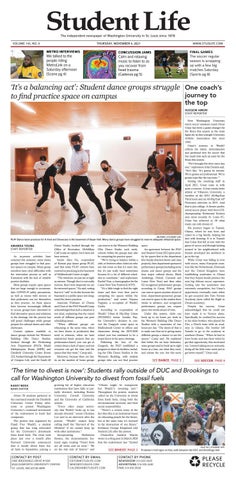
JIN PARK | STUDENT LIFE
PL4Y Dance team practices for K-Fest and Showcase in the basement of Bauer Hall. Many dance groups have struggled to reserve adequate rehearsal space.
AMANDA YOUNG STAFF REPORTER As in-person activities have resumed this semester, some dance groups have struggled to find practice spaces on campus. Many group members have cited difficulties with the reservation process as well as frustration with the lack of suitable practice facilities. Most groups require open spaces that are large enough to accommodate COVID-19 safety precautions, as well as rooms with mirrors so that performers can see themselves as they practice. As these spaces have become increasingly difficult to access, groups have innovated to find alternative spaces and solutions to the shortage, but the process has still posed challenges while groups prepare for cultural shows and other showcases. Current options available to dance groups include the Women’s Building Olin Dance Studios, booked through the Performing Arts Department (PAD); Mudd Multipurpose Room (MPR) and Danforth University Center Room 233, booked through the Department of Campus Life; and the South 40
Dance Studio, booked through the Office of Recreation. McMillian Café is also an option, but it does not have mirrors. Senior Alice Na, co-president of Korean pop dance group PL4Y, said that some PL4Y cohorts have resorted to practicing in the basement of Mallinckrodt Center at night. “The windows, we just use at night as mirrors. Though they’re not really mirrors, that’s how desperate we are for mirrored spaces,” Na said, noting that it is “odd” to do this because the basement is a public space not designated for dance practices. Associate Professor of Drama and Chair of the PAD Pannill Camp acknowledged that such a situation is not ideal, explaining that the varied needs of different groups can pose scheduling issues. “When different groups are rehearsing at the same time, when we have shows in production that need to rehearse, when we have student-led thesis projects that are performance-based, you can get at certain times a lack of space, and not everyone can get the time and the spaces that they want,” Camp said. Moreover, because there are limits on the number of hours groups
can reserve in the Women’s Building Olin Dance Studio each week, cohorts within the groups may also be competing for practice space. “We’re trying to balance within a club, or between other clubs too who use this room so that it’s more fair, but it’s just really hard sometimes because it’s a lot of different schedules to coordinate,” said sophomore Rachel Tian, a choreographer for the Lunar New Year Festival (LNYF). “It’s a little tough to find the right times and then even then you’re competing for spaces within the production,” said senior Nayana Vuppala, a co-captain of WashU Garba. According to co-president of WashU Urban & Hip-Hop Union (WUHHU) senior Annika Pan, the University’s decision to convert the Gargoyle venue space in Mallinckrodt Center to offices and classrooms during the 2019-2020 school year has continued to be a major factor in the space shortage. Following the loss of the Gargoyle, the PAD established a program to share its facilities, including the Olin Dance Studios in the Women’s Building, with student groups who can not find practice
‘The time to divest is now’: Students rally outside of DUC and Brookings to call for Washington University to divest from fossil fuels KASEY NOSS NEWS EDITOR About 50 students gathered in the courtyard outside the Danforth University Center Friday afternoon to protest Washington University’s continued investment of the endowment in fossil fuel companies. The protest was organized by Fossil Free WashU, a student group that has long advocated for the University’s divestment from fossil fuels. The event took place just over a month after Harvard University announced that it would divest from fossil fuels in September, joining a
growing list of higher education institutions that have fully or partially divested, including Brown University, Cornell University and the University of California system. “Every other major university that WashU looks up to has already divested,” senior Christina Lee said in an interview after the protest. “WashU cannot keep calling itself the ‘Harvard of the Midwest’ if we cannot keep up with other institutions.” Incorporating Halloween themes, the demonstration featured signs reading “Fossil fuels are all tricks and no treat,” “Be on the ride side of history” and
“Ghosts might be transparent but WashU’s investing isn’t.” Throughout the protest, students called on the University to divest from fossil fuels, citing both the environmental necessity and their social responsibility. “There’s a certain irony in the fact that this is an institution based on educating people for the future, but at the same time it’s invested in the destruction of our future,” freshman George Kingsland told Student Life after the protest. Chancellor Andrew Martin wrote in a blog post in March 2020 that the endowment has “limited
SEE DIVEST, PAGE 3
ELLE SU | STUDENT LIFE
Protestors hold signs as they walk between the DUC and Brookings Hall.
CONTACT BY POST
CONTACT BY EMAIL
CONTACT BY PHONE
ONE BROOKINGS DRIVE #1039 #320 DANFORTH UNIVERSITY CENTER ST. LOUIS, MO 63130-4899
EDITOR@STUDLIFE.COM NEWS@STUDLIFE.COM CALENDAR@STUDLIFE.COM
NEWSROOM 314.935.5995 ADVERTISING 314.935.4240 FAX 314.935.5938
2 STUDENT LIFE
GRACE KENNARD & ORLI SHEFFEY | SENIOR NEWS EDITORS | NEWS@STUDLIFE.COM
theFLIPSIDE THURS 4 SUNNY 52/28
FRI 5
SUNNY 54/28
MON 8 SUNNY 68/45
TUE 9
SAT 6
SUN 6
SUNNY 61/30
MOSTLY CLOUDY 66/46
SUNNY 68/39
WED 10 CLOUDY 63/48
EVENT CALENDAR THURSDAY 4 Advocacy & Allyship: Establishing a Racial Equity Framework that Goes Beyond HR Virtual Event, 12:30 p.m. - 1:30 p.m. As part of the Brown School’s Open Classroom series, two speakers from Heart of Missouri United Way will discuss the steps to establishing a racial equity framework, identify inequities within an organization and empower colleagues to constructively advocate for people with marginalized identities. The discussion will center the experience of Black people in the workplace, but the ideas shared will also apply to other groups and to an intersectional understanding of equity.
FRIDAY 5 Diwali 2021: Illuminate Edison Theatre, 7 p.m. Diwali, a major Hindu holiday known as the “Festival of Lights,” has been celebrated by Hindus, Jains and Sikhs all across India. At WashU, The festival is celebrated with an annual show in Edison Theatre. Diwali is run by Ashoka, the South Asian Student Association, and celebrated as a fusion of South Asian cultures. This year, the show will take place in Edison Theatre on November 5 and 6. Ashoka will donate the show’s proceeds to a charity every year.
SUNDAY 7 Film Screening: ‘From the Hood to the Holler’ Brown Hall 100, 7:30 p.m. The film “From the Hood to the Holler” follows Charles Booker’s attempt at one of the biggest upsets in political history by challenging establishment-backed candidate Amy McGrath. The movie tracks his campaign across Kentucky, from the most urban to the most rural settings, with Booker and his team rewriting the campaign playbook. The film’s title stems from his overarching message: Whether you are from the city “hood” — like Booker — or the Appalachian “holler,” you are not invisible. With director Pat McGee and subject Charles Booker.
MONDAY 8 50 Years of TRIO at WashU Holmes Lounge, 12 p.m. - 1 p.m. TRIO Student Support Services will celebrate their 50th anniversary with a three-day event. The program, which will include daily panels about the different identities that TRIO Scholars hold, will kick off with the acknowledgment of First-Generation Celebration Day on November 8 and will culminate in a discussion with WashU’s TRIO alumni. Since 1971, WashU’s TRIO program has served upwards of 10,000 first-generation, low-income, and students with disabilities.
THURSDAY, NOV 4, 2021
WU voting rate for 2020 election up eight percentage points since last cycle, to record 71% EM MCPHIE MANAGING EDITOR Seventy-one percent of eligible Washington University students voted in the 2020 election, more than four points higher than the national college average and an 8.4 point increase from the 2016 campus rate, according to new data from the National Study of Learning, Voting and Engagement. The 71% mark was a record for the University, The Source reported this week. The NSLVE study, from Tufts University’s Tisch College of Civic Life, found that 82.9% of eligible Washington University students registered to vote, meaning that the “yield rate” of students who followed through was 85.4%. Nationally, this figure reached 80%, a significant increase from the previous election cycle’s 69%. “It’s always exciting when [turnout] exceeds our expectations,” said Theresa Kouo, the associate director for civic engagement at the Gephardt Institute for Civic and Community Engagement. “As an institute, we were hoping, ‘Let’s increase by 5%,’ which is pretty substantial if you think about it, to increase turnout by 5%. But the fact that it increased so significantly, that was very surprising to me and very encouraging.” One of the major factors is that young people and college students are paying closer attention to politics, Kuou said. “They understand that in order to affect change, you have to be involved in the political process, and that starts with voting,” she
said. “And so I think, given the calls around racial injustice, around climate change and these necessary reforms, that people are paying attention and making their voices heard through their votes.” Kouo explained that previous NSLVE research has indicated that campus culture is a key factor differentiating high-turnout and low-turnout campuses. “I think over the last few years WashU has really done a great job at developing the campus climate and culture where discussion around political topics is encouraged,” she said. “I think it’s really important that as a campus community we engage in really hard conversations, and I think more and more of that’s happening over the years, so I would say that campus climate has a lot to do with [the increased turnout].” While student voting has increased across all demographics, certain discrepancies remain. For example, white students vote at a higher rate than students of color both nationally and at Washington University, Kouo said. “One of the things that we’re thinking about in partnership with WashU Votes student leaders is, how can we be more intentional about outreach to different communities to understand what are the barriers to voting and participation for them, and how can we support student leaders in those communities to help promote active engagement in our democracy?” she said. Some students, both at Washington University
and across the country, have long expressed doubts about the efficacy of electoral politics. “A healthy distrust of systems is important because what that does is it causes the general public to pause and ask questions about how can these systems work better for all of us,” Kouo said. “I think when students raise these questions about why doesn’t it work, it’s a really great way to engage in conversation about a vision for what can be possible.” While acknowledging the importance of those conversations, Kouo emphasized the importance of students using their power to vote, particularly in smaller local elections. “There have been so many elections in recent history and further where elections are determined by just a few votes,” Kouo said. “So if five of your friends say, ‘I’m not going to vote,’ those five friends could have determined many elections locally in St. Louis.” Kouo said that the energy around voting and elections on campus already is exciting. “With 2022 coming up and the midterm elections, already the type of energy that we’re seeing across campus from people who are really interested in getting involved in WashU Votes, even though it’s not a presidential election year..is really exciting, and I hope that our institute can continue to encourage a culture where students are not just thinking about the presidential election, but all elections up and down the ballot every year,” Kouo said.
TUESDAY 9 Craft Lecture with Visiting Hurst Professor Jerald Walker Virtual Event, 8 p.m. Jerald Walker, the author of How to Make a Slave and Other Essays, will lead a craft lecture. Walker is a finalist for the 2020 National Book Award in Nonfiction. His work has appeared in publications such as The Harvard Review, Creative Nonfiction, The Iowa Review, and Mother Jones, and it has been widely anthologized, including five times in The Best American Essays series. A recipient of National Endowment for the Arts Fellowship, a Pushcart Prize, and winner of the L.L. Winship/PEN New England Award for Nonfiction, Walker is a Professor of Creative Writing and African American Literature at Emerson College. Child Nutrition in the Kenyan Context Virtual Event, 10 a.m. - 11 a.m. Elizabeth Kamau, senior lecturer at Egerton University, will discuss current trends in child nutrition in Kenya, situating the Kenyan case in the larger global and African contexts. This talk will explore challenges such as high rates of stunting and undernutrition, and explain research approaches to better understanding these problems. Kamau will highlight ongoing intervention research studies to develop and test practical strategies and solutions to nutrition challenges. The program will be moderated by Kamau’s Washington University collaborators Lora Iannotti and Carolyn Lesorogol of the Brown School.
WEDNESDAY 10
MORAD SULIMAN | STUDENT LIFE
Students wait in line to vote at the Athletic Complex during the 2020 election.
Education, Engineering & Race seminar: Joel Alejandro Mejia Virtual Event, 3 p.m. Joel Alejandro Mejia, associate professor in the departments of Bicultural-Bilingual Studies and Biomedical and Chemical Engineering at The University of Texas at San Antonio, will lead a virtual seminar series on topics related to race and science, technology, engineering and math (STEM) education. Mejia’s current work seeks to analyze and describe the assets, tensions, contradictions, and cultural collisions many Latino/a/x students experience in engineering through testimonios. He is particularly interested in approaches that contribute to a more expansive understanding of engineering in sociocultural contexts, the impact of critical consciousness in engineering practice, and the development and implementation of culturally responsive pedagogies in engineering education.
QUESTION OF THE WEEK Happy (beginning of) cuffing season! How many hours should you wait before double-texting someone you’re interested in? 20%: Never 20%: 1 hour 16%: 5 hours 12%: 3 hours 28%: 24 hours 4%: 72 hours Check our Instagram this week for next week’s question! Responses will be published here every Thursday.
THURSDAY, NOV 4, 2021
GRACE KENNARD & ORLI SHEFFEY | SENIOR NEWS EDITORS | NEWS@STUDLIFE.COM
STUDENT LIFE 3
DANCE from page 1 “essentially monopolizes the space and doesn’t give other groups enough time to do the work that they need to do.” Meanwhile, there is no advanced notice needed to book standard-level Campus Life spaces like rooms in the DUC or Mudd MPR, according to Interim Executive Director for Campus Life Phyllis Jackson. “It just becomes what’s available,” Jackson said, noting that the department has fulfilled lastminute requests before. In an effort to promote easier access to performance spaces, a new maintenance and cleaning fee covered by SU ensures that student groups will no longer have to pay to rent spaces. “SU has a contract with the Performing Arts Department and with other departments at WashU to ensure that spaces are available to student groups without charging student group accounts. Student Union is charged on behalf of student groups and sets aside a pot in the general budget to do so,” SU Vice President of Finance senior Fadel Alkilani wrote in an email to Student Life. “[The removal of fees] has taken a lot of stress off our backs,” co-president of WUHHU senior Emma Rich said. “While it does still pose an issue with booking in general, at least you don’t have to worry about being able to afford it.” However, some groups have reported confusion about the cost of reserving campus spaces. “They change the prices to rent spaces, or what space you have to pay for and what spaces are available to you,” Na said, adding that her group, for example, has gotten “mixed messaging” about
whether or not it is free to rent the South 40 Dance Studio. Assistant Director of Fitness and Wellness in the Office of Recreation Meghann Feely confirmed in an email to Student Life that Student Union-recognized dance groups are not charged to use the South 40 Dance Studio unless they damage the space. But, because this policy was presented just this summer by Student Union, Feely acknowledged that some dance group leaders may not be aware of it yet. One new space that student groups have found helpful is the Asian Multicultural Council (AMC) Suite, which was made available for AMCaffiliated groups in September after the University installed high-efficiency particulate absorbing (HEPA) air purification filters. While the suite has historically been used for a “mild amount” of dance practices, AMC co-president junior Mandy Feenstra said that due to the space shortage, 70% to 75% of the suite’s open-booking hours are now used by performance groups. Some PL4Y groups can utilize the AMC Suite, but it is smaller than a typical dance studio, meaning “only a few dancers can [fit] in this space, so only a few dances qualify to use this space in the first place,” Na said. The difficulty finding practice space remains an issue for many groups, heightened by upcoming festivals and shows. WashU Garba is preparing for the annual Diwali show on Nov. 5 and 6 at Edison Theatre. The group typically practices in McMillian Café, where the space’s different shape relative to most performance spaces means that the group’s formations
DIVEST from page 1
exposure to non-renewable resources (which includes energy, materials, and mining) and high carbon emission sub-sectors (which includes auto/air transportation and certain industrials/ capital goods).” He further stated that the University would not “risk jeopardizing the financial support of the University’s mission” by divesting from fossil fuels. Martin confirmed that this was still the University’s stance in an interview with Student Life last month but recognized that fossil fuels are no longer strong investments. He explained that the University does not use “negative or positive screens” — scores of environmental, social and governance factors — to limit the types of investments made for the endowment portfolio. “When we put together the endowment portfolio, no negative screen is going to say we’re not going to invest in certain types of assets,” Martin said. “We’re going to invest wherever we think we’re going to get the very best return.” Many of the speakers at the protest expressed their disapproval of the
are very different than they would normally be, according to Vuppala. She added that, more generally, limited space means that groups are “limited on choreography” and have a harder time accommodating spacing for formations. WUHHU is also preparing for its annual fall showcase, scheduled for Nov. 20 in the DUC. “We’ve had to double up on some rehearsals in the upcoming weeks just to make the timing work because we’re so limited in how much time we have before our performance,” Rich said. Beyond physical space constraints, dance group leaders have also experienced issues with the communication from the booking system. “There’s no alert system for if your spot has been taken,” Rich said. “For example, we were physically in a space at the beginning of a rehearsal at the beginning of the semester, and a faculty member came in and was like, ‘I reserved the space,’ and nobody had notified us. We had to leave and practice with no mirrors in the garage because we had nowhere else to go.” “Mudd is sometimes booked—it says it’s booked on the website—but then you walk outside and no one’s in there. We’re always really angry because if no one’s in there, we want to practice in there because it’s a nice space,” Tian said. “I just want to see better organization with making sure how to reserve places.” Jackson said that there is no policy that requires advanced notice for cancellations. “We assume once it’s booked that it’s being used. There’s no penalty for cancellation. We do hope that people cancel their reservations if they decide not
to use it, so that we can better utilize our space,” she said. “With them being self-serve, we don’t contact or reach out to make sure they’re still using the space. However, if there’s some process or something that someone would like to suggest, I’m open to hearing it. I don’t know if we can implement it, but I’m happy to hear it.” When dance groups are able to book spaces, some have had to bring their own speakers. “We used to be able to use the internal sound systems. Now, on top of not knowing necessarily every week where we’re going to rehearse, we have to make sure someone is bringing a speaker so that we can even hear our music as opposed to being able to just use the system,” Rich said. There are currently no plans to expand access to the Women’s Building Olin Dance Studios. “We are adding faculty. Our department is growing,” Camp said. “It’s a balancing act. We don’t want to be selfish about the resources we have. But we have to make sure we’re
University’s stance on the grounds that it “prioritizes profit over people.” They also argued that divestment is not only economically feasible but preferable. “It will help secure our university’s fiscal future and cause real damage to the fossil fuel industry,” said senior Jared Moxley, a lead Fossil Free organizer. “Institutions that have divested have specifically cited the future instability of fossil fuel investments in their decision to divest.” Moreover, Lee and Kingsland both said they felt the University and its students have an even greater responsibility to divest in light of the unprecedented $5.7 billion endowment pool growth this past year. “Now that we have more money and seeing greater benefits here as students, I think we have greater responsibility to push the administration to make sure that money is used in a way that is ethical,” Kingsland said. After a series of speeches were given around the firepit in Edison Courtyard, approximately 40 protestors marched to Brookings Hall, reciting chants such
as “Divest divest! Put fossil fuels to rest!” and “Seas are rising, so are we. WashU, what’s your legacy?” They were followed by several Washington University Police Department officers, who had also been stationed near Graham Chapel and Bauer Hall throughout the protest. The organizers originally planned to end their protest at Brookings, but after urgings from the crowd, they renewed their efforts and marched back to the DUC, this time leading a procession of about 30 people through the building before disbanding. Both organizers and attendees of the protest declared that the University cannot consider itself a climate leader. “We cannot call ourselves a climate leader if we are continuing to bankroll the fossil fuel industry,” Lee said in a speech. “It’s that simple.” “WashU always claims to be a climate leader, always calls on students to take action, but they never actually put their money where their mouth is,” junior Frances Wu told Student Life after the protest.
Reilly Brady Jamila Dawkins Senior Forum Editors forum@studlife.com
Brian Cui Curran Neenan Senior Photo Editors photo@studlife.com
HN Hoffmann Kamala Madireddi Jaden Satenstein Senior Multimedia Editors
Grady Nance Senior Sports Editor sports@studlife.com
Jordan Coley Grady Nance Senior Copy Editors copy@studlife.com
Sabrina Spence Senior Social Media Editor
managing them responsibly, and making sure that the department’s mission is preserved.” Nor are there plans to build more studios, Camp said, but some dance group leaders hope to see a better utilization of campus space. “We don’t really have a designated student group space for dance anymore. It’s completely just things that we’re borrowing to use for our uses, but it’s not for us,” Pan said, suggesting putting mirrors into the Lopata Multipurpose Room so that there would be two spaces (Lopata MPR and Mudd MPR) that could function this way. Na suggested allowing the basement of Rutledge Hall to be rented out. “I know Rutledge, because I was [a resident advisor] there last year, Rutledge basement used to be a dance studio, so they have a mirrored wall. It’s not a space that you can rent because it’s a study room now for the residents of JKL.” The third floor of Wrighton Hall used to be the traditional practice space for some Lunar New Year Festival acts,
Feenstra said, but the space is no longer usable due to study cubbies. “It would be really nice if the University could take those study cubbies down because literally no one’s ever there, and it hogs all that space that traditional performance groups really need,” Feenstra said. Feenstra said that the problem was urgent because the current issues with practice space will start to affect student performance and morale. “Because cultural performance plays such a vital role in our diverse campus community—it brings together students from all regional and educational backgrounds— I honestly think it’s super important that this problem gets figured out soon because it can irreversibly affect the quality of the performance and the morale of the Asian student community, particularly as shows like Diwali approach,” Feenstra said. Editor’s Note: Amanda Young is a member of AMC but did not conduct the interview with Co-President of AMC Mandy Feenstra. Orli Sheffey and Grace Kennard contributed reporting.
Autumn at the Art Museum What to See in October: Oliver Lee Jackson, Galleries 249 and 257 Currents 120: Jess T. Dugan, Gallery 250 Damon Davis, Gallery 212S Connect with us! @STLArtMuseum | #SLAMAutumArt
One Fine Arts Drive, Forest Park Museum open Tuesday–Sunday, late on Fridays. General admission is free every day. Visit slam.org for exhibition information and safety protocols.
VOLUME 143, NO. 09 Matthew Friedman Editor-in-Chief editor@studlife.com Jayla Butler Em McPhie Ted Moskal Isabella Neubauer Managing Editors Grace Kennard Orli Sheffey Senior News Editors news@studlife.com Olivia Poolos Julia Robbins Senior Scene Editors scene@studlife.com
Jordan Coley Gracie Hime Senior Cadenza Editors cadenza@studlife.com Jade Leslie Sarah Wang Senior Design Editors design@studlife.com
Vivienne Chang Senior Engagement Editor Ani Kesanapally Senior Diversity, Equity and Inclusion Editor
Amanda Young Elle Su Erin Lee Kamala Madireddi Reilly Brady Designers
Nathan Springman Senior Web Editor
Adrienne Levin Coleman General Manager a.coleman@studlife.com
Sydney Crump Kasey Noss News Editors
Tammy Dunsford Advertising Sales Manager dunsfordt@wustl.edu
Copyright © 2021 Washington University Student Media, Inc. (WUSMI). Student Life is a financially and editorially independent, student-run newspaper serving the Washington University community. Our newspaper is a publication of WUSMI and does not necessarily represent the views of the Washington University administration.
SCENE
4 STUDENT LIFE
THURSDAY, NOV 4, 2021
OLIVIA POOLOS & JULIA ROBBINS | SENIOR SCENE EDITORS | FORUM@STUDLIFE.COM
Humans of the St. Louis Metro Blue Line realize everyone around you has incredibly complex lives, feelings and stories. I feel sonder most strongly on the metro — everyone going to the same places at the same times, but for vastly different reasons,
OLIVIA POOLOS SENIOR SCENE EDITOR “Sonder” is a made-up word from John Koenig’s “Dictionary of Obscure Sorrows.” It puts a word to the feeling where you
all thinking vastly different things. The best way to uncover these reasons and thoughts is to talk to people, which, while maybe a little socially awkward, reveals what we already know but often forget — that the feeling of sonder is, in fact, a tangible reality. Here are a few snippets of stories from people who were riding the MetroLink Blue Line on Saturday afternoon.
8th and Pine Harrese Wilson “I just got married, and I got a baby on the way, so I’m trying to move, and I’m trying to get a house. My kids were in the wedding. They were crying afterwards. I was crying as well, especially walking down the aisle. I had a big, white gorgeous dress.”
Cortex David Kicklighter “My youngest brother got married yesterday. I’ve got three brothers. I’m the oldest. I was expected to do everything right and set the standard. All the punishment and discipline was practiced on me first, so by the time it got down to my youngest brother, my parents were like ‘oh, that’s it,
Skinker Gladis Manzira “I’m getting off at Cortex… because, well, I want to get an Acai bowl.” Grand David Abrey DA: I’m going to the end of the line. Fairview heights? I work for a light rail company in the UK. I do this wherever I go, whatever city I go to, I just go to the end of the line, check it out. Olivia Poolos: What are you rating this metro experience? DA: Out of ten? So far I give it a good solid eight. But I actually haven’t eaten yet. I’m quite hungry. OP: What would you eat if you could eat anything? DA: Fish and chips. But that’s not going to happen. OP: That’s very British of you. And mushy peas? DA: Mushy peas! Yeah. Well, that’s more the north of England. I’m from the south.”
Forest Park-DeBaliviere Dominic Thedford “Yesterday, for example, we had a lady that overdosed. I went home and told my girlfriend that story. If it was a good day, I would tell her how my day went. If it was a bad day I tell her how my day went.” “Does it impact me? No. I come from that environment, so it’s pretty much normal to me. It doesn’t bother me.” “How often does it happen? I’ve been working Metro for a year, so… we’ve had about five overdoses since I’ve been here.”
Don't feel
well?
you
without
your
leaving
we take
need bed.
bear bucks
free delivery always
millbrookrx.com/w
ashu
Photos by Morad Suliman | Student Life
Rooted in St. Louis: Learning from the flora of Missouri THOMAS HUMPHREY STAFF WRITER
Get everything
we’re done.’” “We always had each other. My father was military, so we just moved around a lot. Holidays, vacations… it was just us. When we get together, we hang out and have too much of a good time. We’re all different but we get along and we always just kind of have each other no matter what.”
The flower that smells the sweetest is shy and lowly. -William Wordsworth Sophomore environmental biology student Michael Barash is really excited about oak trees–– but he’s also developing a greater appreciation for the entirety of the plant world, partly due to his internship at the Missouri Botanical Garden (MoBot). Among our leafy friends in the plant kingdom, trees often hog the spotlight; against the majesty of an ancient oak, common grasses and wildflowers cannot easily compete. This “plant blindness” causes a major imbalance in scientific knowledge of the natural world. As a research assistant at MoBot, Barash is working to correct this blindness. “We really don’t know a lot,” he said, “we know a majority of the animals that are out there, but we are really missing a lot about how plants work.” Barash’s earliest plant research was decidedly arboreal. As part of the Pathfinder program, Barash took a class with Biology Professor Stan Braude, and dove headfirst into the oak taxon (or group of related species) for a project. Through that class, Woody Plants of Missouri, he found that he admired the trees’ intelligence. “Oaks are pretty sneaky trees,” he said. As part of their evolutionary arms race with squirrels, oaks vary their acorn release, called masting. After a few years of starving out the furry critters with scant acorns, the trees will drop them all at once. Most astoundingly, the trees seem to sync up through some unknown method of communication.
Barash discovered the research position, which he began last summer, through the Living Earth Collaborative, a partnership between Wash. U., the St. Louis Zoo, and MoBot encouraging biodiversity research. Before then, he said, he had only been to the garden once, for their holiday light show. Of the garden’s purpose, Barash said: “plain and simple, a botanical garden is focused on biodiversity. That’s what takes it to a different level from a normal backyard garden.” But the garden itself is just a sliver of what MoBot does. “Botanical research can be a lot of different things,” Barash said. Many of Barash’s fellow researchers used the institution’s renowned herbarium, which houses over seven million plant specimens from across the globe to conduct research on genetic drift within species and inform practices of environmental restoration. Barash’s research is decidedly local, focusing on herbaceous (that is, nonwoody) plants in the Ozarks. “Missouri is wild,” he said, describing the variety of habitats he encountered. “In the Ozarks, there are about 2,000 native wildflowers and grasses. A stunning amount of diversity.” The Ozarks are primarily home to open woodland and meadow environments dominated by such herbaceous plants. Perhaps the most beloved of these open habitats are the Missouri glades: “these glades are mega-packed with diversity, with plants that aren’t even found two miles away,” Barash said. Among the most common plants in the area are the milkweed family (genus
Asclepias), and aster flowers like daisies (genus Asteraceae). Tons of grass and sedge species are present too, though only a trained eye can identify them: “they are very indistinguishable if you’re not very good,” Barash said. Barash worked on restoration: “I was doing research on what native seeds are available for purchase in the Ozarks, determining if there were any biases in the seeds’ availability,” he said. His preliminary results suggested that only 37% of native herbaceous species were available. In continuing his research this semester, Barash is expanding into the animal kingdom, using camera trapping to determine the predator-prey relationships of endangered plants. “If you’re looking at a particular wildflower that’s constantly getting eaten,” he said, “you want to know what’s eating it.” The mystery of plants continues to intrigue Barash, especially germination, which is one of the major black boxes that remains in the plant world: “many plant species will sit out there without growing for ten years,” he explained. But for someone without this interest, this research might seem irrelevant. Barash emphasized that even learning about obscure grass species is crucial for understanding the environment. “It’s a cumulative process,” said Barash. “We work on biodiversity not because it’s the only way to save the earth, but because it helps us practice working with the world we have. We don’t need to bring the world back to where it was 1,000 years ago, but we certainly should work on living with the earth that we have now.”
CADENZA
THURSDAY, NOV 4, 2021
JJ COLEY & GRACIE HIME | SENIOR CADENZA EDITORS | CADENZA@STUDLIFE.COM
Concussion Jams: Sound for when you’re concussed GRACE HIME SENIOR CADENZA EDITOR Unfortunately, concussions have been a bit too prevalent this year within the Student Life community, and for many, it is their first experience with head trauma. While the doctor can give you advice on how to heal, manage pain and return to normalcy, there are some factors that they don’t address as deeply. Especially as an active student, this type of experience is difficult and throws a wrench in your regular routine. In this day and age, technology is prevalent in nearly every waking hour. For many college students, music streaming has become a default of daily life. We can’t get through the day without some technological auditory entertainment, whether that be music, podcasts, movies or TV shows. Given that, getting concussed takes a big toll on college students. We are encouraged to remove these auditory “distractions” from our daily lives, and for many, this is not easy. While concussions are very subjective, there are a few things that “hit different” under these circumstances; namely, darkness, silence and dark chocolate. It’s hard to really understand the fogginess and cognitive discomfort that comes with concussions if you’ve never experienced one, but certain things bother and soothe this sensitive condition of the mind. In my experience, there
were certain songs that metaphorically “smoothed out my brain” when my injury seemed to cause distress. The best way to describe this sensation is that there are no gyri and fissures to be ignited or irritated in the brain, but instead, it is smooth and inoperable. It cannot be penetrated by thought, which, when you are down with a head injury, is the ultimate goal. That being said, here is some music that has proven to ease the brain during a head injury. Originally, it hurt my head to listen to anything, but then I listened to classical music, specifically Chopin. This is a great starting spot for music. As you ease back into the auditory stimuli, classical music is a solid option. It doesn’t have words, it is usually easy on the ears (especially if it’s only piano), and it doesn’t take too much thinking to appreciate the music. I also listened to “Look Up” by Joy Oladokun, “Drive” by Johnny P., and “Chasing Cars” by Snow Patrol. -Orli Sheffey
Norah Jones is by no means ‘brain smoothing’ because her music is boring or mindless, but rather, it is because her music provides so much peace. It is sweet, easy on the ears and slow. Slowness in music helps with concussions because it feels like it reduces any unnecessary anxiety. -Gracie Hime TV shows that I’ve already seen, but like a podcast — with a concussion, it’s detrimental to the healing process to spend too much time looking at electronics. This option gives your brain some kind of stimulation without you having to exert too much mental awareness. -Lydia McKelvie The Violin Pop Playlist. This playlist is perfect for the early-concussed because it takes out the extra pressure of words and is much less disorienting to listen to. A lot of the time, words in music can further confuse the already struggling mind, so this is an easy way to transition into music without too much cognitive interest. -Julia Cleary
GRAPHIC BY HN HOFFMANN
STUDENT LIFE 5
Dune: The pros and cons ISABELLA NEUBAUER & HN HOFFMANN MANAGING EDITOR AND SENIOR MULTIMEDIA EDITOR
“Dune,” released last month, was unquestionably one of the most anticipated movies of 2021. With an 83% critic score (and a 90% audience score) on Rotten Tomatoes, the movie seems to be a runaway success. And it was enjoyable — but far from perfect. Based on an incredibly long book, the three-hour movie, which is only part one of two, is still forced to consolidate, for which “Dune” aficionados decry the film. For two StudLife staffers who have never read the book, its faithfulness (or lack thereof) doesn’t even make the list of the movie’s pros and cons. The Pros The music. Hans Zimmer’s score may jump out at you from an otherwise quiet film, but that score is incredible. Zimmer somehow makes bagpipes work in a movie set in space, and that isn’t even the wildest part of the movie’s sound. It’s an eerie, atmospheric masterpiece — even if it will leave your ears ringing afterward. The brutalist aesthetic of “Dune” may not be visually welcoming, but it sets both the scene and tone of the film clearly. Stark spaceships that look like steel and concrete buildings
flying over empty desert landscapes is, in fact, my idea of a good time. The sand worms. Need I say more? If political drama is your cup of tea, “Dune” pulls off theirs spectacularly. Details mean spoilers, so I’ll only give an overview. Somehow, the film makes you care about House Atreides (this is also a con — colonialism). House Harkonnen is viscerally unsettling in a way that I still can’t shake. And the Emperor’s machinations are subtle enough to be devastating when they’re explicitly stated. Admittedly, it’s somewhat fun watching Timothee Chalamet get shoved around in space. He’s just a little guy. Punchable, but a little guy. The Cons If Timothee Chalamet standing in place for questionably long periods of time isn’t up your alley, maybe Timothee Chalamet standing in place for questionably long periods of time amidst an incredibly outdated settlercolonialist plot arc will be. “Dune” is unquestionably and uncompromisingly imperialistic, to a rather uncomfortable degree. While this white savior/ imperial figure is purportedly deconstructed in the book, that deconstruction doesn’t figure at all in the movie, leaving an audience with a sour taste in their
mouth. Zendaya — who is prominently featured in all promotional materials, marketing, and trailers as love interest Chani — gets maybe 15 minutes of screen time. And that’s generous. She’s set up to become a much bigger deal in the second film, but with the amount of time Paul spends having visions of Chani in this first film of the trilogy, having to pay another $10 ticket fee several years down the road to see her do anything at all is a huge letdown. This is, single handedly, the movie that will popularize subtitles in public theaters. This sounds like a pro (and would be a huge win), but the point’s cause is the con — “Dune” is insanely loud. Almost deafeningly so. This is entirely a fault in the sound design, with Chalamet’s whining practically impossible to decipher underneath the constant explosion noises. The design of House Harkonnen is troubling — yes, it’s horrifying seeing Stellan Skarsgard floating through the air without moving a muscle. But it also relies heavily on tropes of villains being defined by physical deformity. Are we not past villainizing the concept of disability in 2021? As a whole, “Dune” is a movie. You can watch, or not. One thing is sure — watching will be an experience.
SPONSORED BY:
Stronger together.
PUZZLE Mania
How a diverse culture fosters inspiration and innovation LEADERSHIP PERSPECTIVES SERIES
November 17 at 4:00 PM CT • VIRTUAL EVENT Register: Olin.wustl.edu/leadershipperspectives
SPORTS
6 STUDENT LIFE
THURSDAY, NOV 4, 2021
GRADY NANCE | SENIOR SPORTS EDITOR | SPORTS@STUDLIFE.COM
SOCCER from page 1 With the first step toward his soccer ambition reached, Umar packed to leave for southern Ghana to attend Vernon. After four years of grueling hard work both on the pitch and in class, Umar earned the opportunity to travel to the United States to attend Kent School, a private boarding school in Connecticut. There, Umar continued both his education and his dream of becoming a professional soccer player. But despite the readiness Vernon gave him to play soccer in the U.S., the culture shock at Kent School, he recalled, was immense. Sitting at the western front of Connecticut, Kent School challenged young Umar. “I’m not gonna lie, there were some challenges,” he said. “But with support, I was able to overcome them.” At Kent, the weather was far more frigid than what he had become accustomed to in Ghana. He recalled a time when he was playing a game late in November when he realized how cold Connecticut really was. “At halftime, I went into the locker room, and I went to the bathroom because I couldn’t feel my hands,” he said. “And so I went into the locker to turn on the hot water [for my hands], and it was painful.” Despite the tough transition to life in the U.S., Umar’s career at Kent was a
success. In the three years he attended, he led the school to its first playoff appearance in more than two decades and appeared in the New England Prep School Finals in 2009 and 2010. After graduating from Kent, Umar was offered a scholarship to play for Villanova, which he happily accepted. In his four years at Villanova, Umar was a hit. He started the majority of his games during his time with the Wildcats and provided a couple of assists in the process. After college, Umar’s main goal was to get drafted by a Major League Soccer club, but lack of interest and a couple of failed trials pushed him to find another path. Umar landed a job at IBM, but that was not enough for him. Soccer was his passion; he felt he did not belong in the office environment. In 2017, his hard work finally paid off when he signed his first professional contract with the Richmond Kickers. “I signed with an option [to play another year]. After that season they were impressed with me and so they signed me to the 2018 season,” he said. But with the Kickers deciding to join USL One, the third tier of American and Canadian soccer leagues, Umar decided to switch his allegiance to St. Louis FC for the 2019 season, as he
wanted the competition of USL Championship. With his talent, the switch to St. Louis FC was smooth. But after joining, he said, “the pandemic, and a lot of injuries… really affected [my game].” Having already been an assistant coach at Cabrini University in Pennsylvania, Umar started thinking about his coaching career a bit more. So last April, when an opening at WashU presented itself, Umar was ready. “Oscar is charismatic and he always has a smile on his face. And it’s not fake, he’s happy,” WashU men’s soccer head coach Joe Clarke said. “He’s done a good job building relationships, and he has a good approach with players. He has a lot of standing with them when he’s commenting because it’s so relevant, timely and it’s experienced.” Clarke described the coaches’ relationship as a partnership. “I consider our work together very horizontal. It isn’t vertical, it’s not me dictating him,” he said. “He’s capable and has a good experience. He runs good sessions with parts of the sessions that he’s doing. I know that I don’t have to worry about that and we’ve got to be on the same page going in the same direction.” The sessions Umar leads are apparently the joke of the team. The team “loves joking with him and his
EMMETT CAMPBELL | STUDENT LIFE
Two teammates embrace after the Bears upset North Park University 3-2 in September. With a win Saturday against the University of Chicago, men’s soccer will win the UAA conference.
warm-ups… as [they are] like fitness sessions [that] always get us tired, but he laughs it off,” Daniels said. “We all respect him. And that goes a huge way.” Seniors Armando Sanchez-Conde and Nao Yanese shared similar perspectives on Umar. “He’s like an old wise dude in the body of a 28 year-old,” Sanchez-Conde said. “One moment you see him as a friend, but the next moment he’s an old sage with so much wisdom and a lot of energy.” “Oscar is one of the most approachable guys I know.
And in practice or during the games, I always feel like I can just talk to him if I feel like I want to get his perspective on something or if I have any questions about certain things,” Yanese said. “Even outside of soccer, I feel like I can easily approach him to talk about personal things.” The players’ ultimate goal is to continue to build that sort of friendship with Umar that extends beyond the field, Sanchez-Conde said. “Maybe if we graduate... us seniors... can all go out to eat together or something,” he said. The WashU community is
clearly lucky to have Umar. His experiences playing professionally have been an asset to the team, and as the Bears prepare for their first playoff run since 2016, they will need him on the sidelines if they are to perform at the level they have been performing at all season. He’s [been] a huge part of our success, we all believe that and we’ve had a great season,” Daniels said. “We’re going to keep trying to finish the season strong and Oscar is a big part of that.”
drink. dine. play.
WEEKLY BAR, RESTAURANT AND FUN GUIDE
V LARGE SPECIALTY OR UNLIMITED TOPPING PIZZA
13
$
WE ARE THE DELIVERY EXPERTS!
7018 PERSHING AVE 314-726-3030 CLAYTON/WASH U
99
EACH CODE: 9025
OPEN LATE! SUN-THURS 10:30AM-12AM FRI & SAT 10:30AM-1AM
IN THEATERS NOV 4
IN THEATERS NOV 9
314-725-0856
galleria6cinemas@gmail.com
On view now at the Kemper Art Museum
Subscribe to our free e-newsletter... head to studlife.com now and sign up!
Wherever you are, stay connected: Social icon
Rounded square
FACEBOOK.COM/STUDLIFE
@ STUDENTLIFENEWSPAPER
Only use blue and/or white. For more details check out our Brand Guidelines.
@STUDLIFE
STUDLIFE.COM
FORUM
THURSDAY, NOV 4, 2021
REILLY BRADY & JAMILA DAWKINS | SENIOR FORUM EDITORS | FORUM@STUDLIFE.COM
STUDENT LIFE 7
STAFF EDITORIAL
I
Our Spring 2022 class recommendations
t’s a stressful time to be a Washington University student. Many of us have found ourselves in an endless loop of midterm exams, essays, presentations and projects with no end in sight. And on top of that, it’s somehow already time to start stressing over next semester’s classes. With registration starting next week, there’s a lot going on. But in the midst of advisor meetings and triplechecking major requirements, the Student Life Editorial Board advises you not to panic. It can be really easy for stress about the future to translate into comparing ourselves to everyone around us and feeling like we have to keep up with what everyone else is doing. If all of your friends are pursuing two majors and a minor and you aren’t, you might feel like you aren’t measuring up. If you’re taking 12 credits while everyone around you is taking on 21-credit workloads, it’s easy to think
you aren’t doing enough to get into graduate school or to get a job after graduation. Of course, there are a certain number of course requirements and less-thanfun aspects of receiving an undergraduate degree that you should be aware of. But the level of comparison and competition that most WashU students have unfortunately experienced ultimately only leads to burnout and dissatisfaction. Before you frantically open your registration worksheet for the millionth time this week, ask yourself: Which classes would you choose if you never had to tell anyone which ones you’re taking? Take the classes and pursue the degree that sounds most interesting to you, not just the one that will look good on paper. And please, for the sake of your mental health come January, remember that you can easily have a fulfilling academic experience by taking on a workload that seems lighter than your peers’.
We encourage you to branch out of your comfort zone and try taking that class you’ve been curious about for the past two years. Take advantage of the resources you have available to you, as well as your advisors, as long as you do your own research as well. Don’t be afraid to explore less traditional options either, whether that means following an accelerated degree program or taking classes through UCollege. If you’re looking for ideas on some tried-and-true classes, we’ve got you covered. Composition Workshop: L27 Music 130, Wednesdays from 3:00pm-3:50pm While I’ve always been interested in songwriting, I was initially concerned that I wasn’t qualified for this class. I enjoy singing and have very basic piano skills, but I’m in no way a skilled musician. However, because this class is focused on individual projects,
L14 E Lit 334: A History of the Golden Age of Children’s Literature
L30 Phil 306G: Philosophy of Language
this level of education. This class, on the other hand, provides a deep dive into how we identify things in the world and language’s role in that. This niche area of study allows you to explore philosophers you will likely never name in other classes. Despite being a philosophy class, there are a lot of interesting takeaways available for many different areas of study. From the neuroscientist to the psychologist to the computer scientist, there is a range of topics that are bound to interest students of all majors. —Gracie Hime, Senior Cadenza Editor
This is an English class. It’s a history class. It’s an early childhood education class. One of the first classes I took for my English major, Children’s Literature was always fun — despite my 4-5:30 p.m. time slot, and despite its location in the Simon basement. (Both of those downsides are no longer applicable next
As a PNP major with an emphasis in philosophy, I’ve taken a lot of philosophy classes. There are so many classes that have different names and themes, but most of the time, they focus on the same core philosophers. At a certain point, there is only so much you can say about Locke, Aristotle and Kant at
READ MORE AT STUDLIFE.COM
it’s truly accessible to students at every level. Each week, students meet with Professor Stark for 30 minutes to work on a composition. Stark meets students where they are, whether they’re composing a major orchestral piece or a song with just four chords (I’m clearly the latter). During the Wednesday class time, students present their progress and share helpful, encouraging feedback. —Jaden Satenstein, Senior Multimedia Editor
semester.) Each week, we read one classic work of children’s literature as well as some relevant secondary texts, which meant the workload was often high, but 300 pages of “Alice in Wonderland” is different than 300 pages of a textbook. In addition to revisiting some childhood favorites, I also learned a lot of the influences of the modern education system — you’d be surprised how much ideas from the 1700s still influence us now. —Isabella Neubauer, Managing Editor
The do’s and don’ts of interacting with a grieving friend REILLY BRADY SENIOR FORUM EDITOR
G
rief is a complicated process. My mom passed away almost three years ago, in January of 2019, and over the past three years, for the most part, I’ve avoided reflecting on my grief. But through it all, something that I haven’t forgotten is how other people have reacted to the news, how they have interacted with me and what they have chosen to say to me. Though I can’t speak for everyone experiencing grief, I can draw upon my own experiences to suggest how to best interact with a friend going through grief. So here’s my best attempt at outlining what you should –– and shouldn’t –– say to someone experiencing grief. The phrase that I have always had the hardest time
with is, “I’m sorry.” I always felt like I had to respond to this by saying, “It’s okay,” but it was never okay, so I usually just nodded in awkward silence. I’ve found that the best way to approach this is to allow the person experiencing grief to be able to respond with a “thank you” instead of making them feel like they need to say things are “okay.” A simple “I’m sorry for your loss” can be an appropriate response, or, “I’m sorry they can’t be here with you.” I always felt my stomach drop when someone would tell me that my mom was “in a better place.” How could anywhere be better than being with her family? I’ve also had people tell me that this is all “part of a plan” or that “everything happens for a reason.” This can be extremely confusing to hear; these words downplay the
person’s emotions instead of validating what they are feeling. I remember hearing this and doing mental gymnastics to try to reason how losing my mom could be part of a better plan in my life. In the end, that line of thinking only hurt me and made my grieving process more confusing. While some may find this rhetoric to be comforting, it is best to avoid it altogether, as it can potentially harm the person experiencing grief. Additionally, avoid putting the focus on you as the responder. When someone is opening up to you about their grief, they want to be heard, not lectured. Comparing their experiences to your own and creating a “grief Olympics” draws unnecessary focus to yourself. However, I would acknowledge an exception to this: During the months following my mom’s passing, I
received a few messages from other people my age who had also lost a parent and offered themselves as a resource for someone to talk to. I appreciated these messages; I felt a sense of community through our shared experience, through someone who could try to understand what I was feeling. At the same time, don’t ever expect a response –– a person going through grief has no obligation to reply, and they may not feel ready to share how they are feeling. I understand that grief is complicated, and people often do not know how to react or how to best offer support. Many may feel a need to offer help to a friend experiencing grief. Help in itself is not a bad thing, but how it is approached is important. Offer help as an if, not a what. Instead of saying, “What can
I do to help?” (which puts the pressure on the person to respond and draws focus on you), try, “If there is anything I can do to help, let me know.” This way, the person feels supported without being expected to give a response right away. Most importantly, give them a space to grieve. If they need some time alone, give them that time. I often found that when I started to be around friends again, there was a level of uncertainty and awkwardness; I didn’t want to bring anything up because I didn’t want to make things weird or make others uncomfortable. It’s important to give a friend space to grieve, either alone or with others –– even among a group of friends, they should feel comfortable to share emotions in a space where they can be listened to and supported.
I acknowledge that the vast majority of people who have spoken to me about my loss have been well-intentioned. Grief is difficult to understand unless you’ve been through it; even among those experiencing grief, there may be many disagreements about what is best to say and what shouldn’t be said. No one is perfect, and no one is ever going to be able to have a perfect response. In the end, it’s not about saying the right thing –– it’s about being there for somebody. You aren’t going to magically cure a friend’s grief with a phrase. Instead, offering yourself as someone who can listen and acknowledge all of the complex emotions they are feeling will allow them to better process and feel heard. Don’t stress about what to say or what not to say to someone experiencing grief. Often, just listening is enough.
Billy Porter and Harry Styles: Who’s credited for being revolutionary? JASMINE STONE STAFF WRITER
I
n a recent interview with The Times, queer icon Billy Porter criticized Vogue’s choice to let Harry Styles — a straight-passing, white male muscian — be their first cover of a man in a dress. Porter is most known for his activism and for the portrayal of Pray Tell, the lively ballroom emcee on the hit TV drama “Pose,” a show about the lives of Black and Brown queer and trans people during the HIV/AIDS epidemic. Porter also has a reputation for bringing flair and originality to any red carpet he walks, and has undeniably popularized queer fashion in recent years. Even though he didn’t literally start the movement, he is an active part of the communities that did. In a 2019 interview with
The Guardian, Styles said, “I think it’s a very free and freeing time … Am I sprinkling in nuggets of sexual ambiguity to try and be more interesting? No ... I think it looks cool. I just think sexuality’s something that’s fun. I can’t say I’ve given it any more thought than that.” Styles’ refreshing mindset and bold fashion choices are far from a bad thing. The broader, more relevant question is one of who we are willing to listen to. This isn’t a fault of Styles — rather an example of the intersectionality of underrepresentation in general, because we benefit from the contributions of both Styles and Porter. The cisgendered and/ or heterosexual boys challenging gender norms are indeed contributing to denormalizing toxic masculinity and ideas of limiting, binary “norms.” The “new normal” then has the chance at becoming the
deconstruction of social hierarchies in general, ideally eliminating the need to adhere to pre-set norms altogether. However, this fails to happen when representation like this outweighs those who have no choice in whether or not they will be seen as “queer,” as it is arguably activists like Porter who have made this time a “freeing one.” It isn’t that Styles is wrong for expressing himself in a nonnormative way — in fact it’s good, as it means it’s working — but that the representation is still disproportionate. As Porter said in his interview, “I had to fight my entire life to get to a place where I could wear a dress to the Oscars... All he has to do is be white and straight.” Queer fashion isn’t something especially reserved for gay people, but the issue with Styles being the first person to do a cover like this is that it isn’t an
Editor-in-Chief: Matthew Friedman Managing Editors: Jayla Butler, Isabella Neubauer
it is wrong that they were then catapulted into fame and fortune instead of the people who started it because of viewer biases. This is also comparable to an episode of “Pose,” in which the inventors of “voguing” — a style of dance inspired by the models’ poses in Vogue magazine — are thrilled when Madonna sheds a light on ball culture with her hit song, “Vogue.” This victory is short lived, however, because the queer POC who performed and invented this style of dance were not elevated to a higher social status or given more opportunities and acceptance. Rather, when the trend’s popularity died down, those whose lives were in it were still in the same place they started. The only credit remaining is to Madonna, and she, to most listeners, is the face of “voguing.” Styles received some backlash for the Vogue cover, so it
would be remiss to suggest this decision was without consequence, but that doesn’t negate his privilege as the person who was allowed to occupy this space for the first time. Space is often made for derivatives of queer and/or nonwhite cultures when they are introduced by people who aren’t a part of them. In the case of Porter or other queer POC who have been overlooked, offering consistent representation and opportunities for people whose lives aren’t dependent on this radical representation and activism fails to address the entire problem. Harry Styles himself is far from “problematic,” but a culture that is more interested in seeing him be the face of these historical firsts rather than a person whose culture is infused with and whose life has been dedicated to this type of activism, is.
YOUR VOICE: SUBMISSIONS
OUR VOICE: EDITORIAL BOARD Staff editorials reflect the opinion of a majority of editorial board members. The editorial board operates independently of our newsroom and includes members of the senior staff.
opportunity equally offered to people with identities such as Porter’s. When you consider how the trendy, aesthetic bits from marginalized American subcultures often make their way into pop culture without allowing the people it stems from the same entrance (nor are they the ones then securing the money, fame, etc.), it isn’t hard to understand why Porter feels the way he does. A similar issue arose recently on TikTok, where Black creators create trend-setting dances to Black music, but white creators who cover the dances are the ones whose names become attached to them. Addison Rae and the D’Amelio sisters aren’t wrong for covering Black content creators, since pretty much everyone who posts videos on TikTok is inspired by or blatantly copying something else they saw, (hence “trend”) but
Senior Forum Editors: Reilly Brady, Jamila Dawkins
Senior Scene Editors: Olivia Poolos, Julia Robbins
Senior Cadenza Editor: Gracie Hime Senior Multimedia Editors: HN Hoffmann, Jaden Satenstein
We welcome letters to the editor and opinion submissions from our readers. Submissions may be sent to forum@studlife.com and must include the writer’s name, class and email or phone number for verification. We reserve the right to print any submission as a
letter or opinion submission. Any submission chosen for publication does not necessarily reflect the opinions of Student Life, nor does publication mean Student Life supports said submission.
SPORTS
8 STUDENT LIFE
GRADY NANCE | SENIOR SPORTS EDITOR | SPORTS@STUDLIFE.COM
THURSDAY, NOV 4, 2021
Where the WashU teams stand with playoffs on the horizon GRADY NANCE SENIOR SPORTS EDITOR With some teams finishing their regular seasons this weekend and the rest soon to finish, I thought it would be helpful to look at where each team currently stands and what needs to happen for them to make the playoffs. No. 6 Women’s Soccer: 13-1-1, playoffs clinched The Bears have already captured the University Athletic Association title for the sixth straight year and secured their spot in the playoffs. Now it is just a matter of where they will be seeded. After suffering their first loss over the weekend, a quality win against No. 16 University of Chicago would get them back on the right foot (and back near the top of the rankings) heading into the NCAA tournament. No 3. Men’s Soccer: 112-1, clinch UAA and playoffs with win vs. Chicago Men’s soccer is having their best season in years. The Bears have a chance to win the UAA for the first time since 1999 — with a win against Chicago, they lock it up, and with it a spot in the playoffs for the first time since 2016. Football: 6-2, seeking at-large bid With No. 1 North Central, Saturday’s opponent, essentially having clinched the College Conference of Illinois and Wisconsin already, the football team
NOAH ORLOFF | STUDENT LIFE
Junior quarterback Matt Rush evades a Carroll University defender Saturday. Rush threw for 300 yards in the Bears’ 35-12 win.
needs to acquire one of the three at-large bids to get into the playoffs. Firstyear head coach Aaron Keen has led the Bears to a strong season so far. With two more games before their selection date on Nov. 14, WashU needs to go at least 1-1 to have a shot at the postseason.
Volleyball: 16-8, need to win UAA championship to get bid It’s been a bit of a disappointing season for the volleyball team. After starting out at No. 18 in week one, the team has dropped out of the top-25 and has suffered some heartbreaking losses at the hands of their UAA rivals. If they want a
playoff spot, the likely only way is to win the UAA championship, which requires beating three top25 teams, all of whom they lost to earlier in the season. Fingers crossed. Cross Country: Dependent on NCAA regionals For the seventh consecutive year, the No. 3
WashU women’s cross country team clinched the UAA championship; four team members all made XC All-UAA 1st Team; and the coaching staff won the UAA Women’s Coaching Staff of the Year — in short, it has been another standard season for the team. The No 14. men’s team has also ex-
celled, placing second at the UAA Championship. Both teams will run in the Red/White Invitational this weekend before leaving for NCAA Midwest Regionals, Nov. 13th. At the regionals, they have the chance to qualify for the NCAA National Championship, the ultimate prize they’ve sought all season.
Join us this Saturday at Francis Olympic Field! Saturday, November 6
WashU Football vs. North Central 12 p.m. CST
Admission is Free for WashU students with a valid WashU ID
Women’s Soccer vs. UChicago 4 p.m. CST
Admission: Free
Men’s Soccer vs. UChicago 7 p.m. CST
Admission: Free With a win, WashU men’s soccer clinches the 2021 UAA Conference Title! Follow Bear Sports on Social Media @WashUBears.