The independent newspaper of Washington University in St. Louis since 1878 THURSDAY, MARCH 25, 2021
VOLUME 142, NO. 19
TAKE THE WU IN F
O
WWW.STUDLIFE.COM
CUS SURVEY
SU candidates discuss platforms, answer How WU responded questions from WU community at forum to DeVos
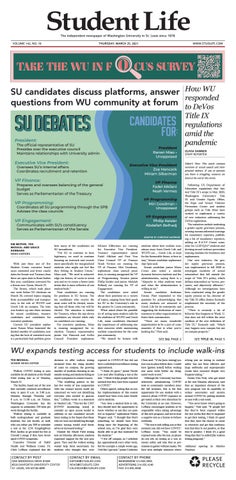
SU DEBATES
Candidates for:
President:
The official representative of SU Presides over the executive council Maintains relationships with University admin
Executive Vice President:
President Ranen Miao Unopposed Executive Vice President Zoe Hancock Miriam Silberman
Oversees SU’s internal affairs Coordinates recruitment and retention
VP Finance:
VP Finance Fadel Alkilani Noah Vermes
Prepares and oversees balancing of the general budget Serves as Parliamentarian of the Treasury
SEE SU, PAGE 2
SEE TITLE IX, PAGE 5
VP Engagement:
VP Engagement Philip Keisler Abdallah Belhadj GRAPHIC BY CHRISTINE WATRIDGE
EM MCPHIE, TED MOSKAL AND GRACE KENNARD NEWS EDITORS With just three out of five Student Union executive board races contested and fewer candidates for Senate and Treasury than there are open slots in those bodies this year, candidates convened for a forum over Zoom, March 23. The forum, which took place one week before SU elections on March 30, covered topics ranging from accountability and transparency to the role of WUPD and Greek Life on campus. The time was broken up into three sections for senate candidates, treasury candidates and candidates for executive positions. Current SU president sophomore Ranen Miao lamented the limited number of candidates, noting that the lack of contested races is a particularly bad problem given
how many of the candidates are SU incumbents. “For SU to continue to have legitimacy, we need to continue focusing on outreach and recruitment specifically for marginalized students who might not feel like they belong in Student Union,” Miao said. “We need to acknowledge our history of racist or sexist acts and try to create a better institution that is more reflective of our student body.” Nine candidates are running for positions in SU Senate. The ten candidates who receive the most votes will be elected, meaning that all those who run will be elected. The situation is similar for Treasury, where the top eleven candidates are elected while only six candidates are running. For executive positions, Miao is running unopposed for reelection. Treasury representative junior Zoe Hancock and ArtSci Council President sophomore
Miriam Silberman are running for Executive Vice President. Treasury representative junior Fadel Alkilani and First Year Class Council VP of Finance Noah Vermes are running for VP of Finance. Miri Goodman, sophomore class council president, is running unopposed for VP of Programming. Senator junior Philip Keisler and junior Abdalah Belhadj are running for VP of Engagement. The candidates were asked about their positions on a variety of topics, ranging from their goals for SU to the University’s role in the greater St. Louis community. When asked about the possibility of acting upon student calls for the abolition of WUPD and Greek Life, some candidates discussed the importance of addressing student concerns while maintaining realistic expectations for the campus community. “We should be honest with
Editor’s Note: This article contains mentions of sexual assault and interpersonal violence. If you or someone you know is struggling, resources are listed at the end of this article.
students about how realistic transitions away from Greek Life and WUPD are… Greek Life, at least for the foreseeable future, is here to stay,” Senate candidate sophomore Jojo Spio said. Senate candidate junior Maria Cresci also noted a similar dynamic between students and the administration, saying there is a “disparity in what students want and what the administration is willing to do.” Senate candidate freshman Emma Platt responded to this question by acknowledging that many students are attracted to Greek Life for its community and suggesting the dedication of more resources to other organizations to foster their communities. “There are many wonderful opportunities to be a part of communities if that is what you’re looking for,” Platt said.
VP Programming Miri Goodman Unopposed
Communicates with SU’s constituency Serves as Parliamentarian of the Senate
OLIVIA DANNER STAFF REPORTER
Following US Department of Education regulations that limited Title IX’s scope in May 2020, Washington University’s Title IX and Gender Equity Office, the Rape and Sexual Violence Prevention Center and student groups such as Title Mine have worked to implement a variety of new initiatives addressing the DeVos regulations. The initiatives include instituting a gender equity grievance process, creating trauma-informed trainings for mandatory reporters, publishing a list of mandatory reporters, adding an R.S.V.P Center counselor for LGBTQIA* students and devising sexual violence prevention training modules for freshmen and sophomores. One new initiative, the gender equity grievance process, was implemented in fall 2020 to investigate incidents of sexual misconduct that fall outside the scope of Title IX’s policy, which defines misconduct as “severe, pervasive, and objectively offensive.” Although no investigations have been conducted using the gender equity process so far, director of the Title IX office Jessica Kennedy emphasized the necessity of the process. “There is certainly a lot of behavior that happens at Wash. U. that does not fall within the strict confines of the new definition of Title IX,” Kennedy said. “Much may happen near campus but not on campus property.”
VP Programming:
Coordinates all SU programming through the SPB Advises the class councils
Title IX regulations amid the pandemic
WU expands testing access for students to include walk-ins TED MOSKAL SENIOR NEWS EDITOR Walk-in COVID testing is now available for all students at the Mudd Field testing tent as of Monday, March 22. The facility, based out of the tent that currently conducts surveillance tests, is open 8 a.m. to 3:40 p.m. Monday through Thursday and 8 a.m. to 11:40 a.m. on Fridays. Washington University has the capacity to administer 250 tests per week through the facility. Walk-in testing is available to both undergraduate and graduate students, but not faculty or staff, who can either pay $50 to schedule a test at the 1234 Kingshighway Blvd. facility or get tested for free at Umrath Lounge if they have developed COVID symptoms. Executive Director of Habif Health and Wellness Center Dr. Cheri LeBlanc explained that the
decision to offer walk-in testing stemmed from the rising number of cases on campus, the growing number of students choosing to use outside testing and students failing to report symptoms to contact tracers. “The troubling pattern in the last few weeks of less cooperation with our contact tracers made me concerned we were not identifying everyone who needed to quarantine,” LeBlanc wrote in a statement to Student Life. “This led the CMT [COVID monitoring team] to consider an open access model in addition to our mandated surveillance testing in the hopes that those who we were not identifying through contact tracing would avail themselves to increased testing.” Outside the Mudd Field testing tent on Monday afternoon, students expressed support for the new program. They said the walk-in testing would help limit uncertainty for students who thought they were
exposed to COVID-19 but did not have a scheduled surveillance testing appointment. “I think it’s great,” junior Nicole Lew said after finishing a test at the tent. “I think it helps people who feel stressed that they have been exposed to COVID.” Others agreed, noting that an earlier implementation of this system would have been even more beneficial to students. “Any time a student feels at risk, they should have the opportunity to know whether or not they are positive or negative,” sophomore Ruben Wagner said. “I thought that that’s something we should have been doing since the beginning of the school year, so I’m glad they were finally able to get that instituted for the students.” “I live off campus, so I schedule [an appointment] every other week, but for example a couple weeks ago, I felt like I got sick,” junior Catherine
Chun said. “If the [new testing] system was in place before then, I could have [gotten tested] before waiting one more week before my designated week to test.” Although the University has been selectively administering COVID tests to community members since the fall semester, this is the first opportunity for any student with a concern about COVID exposure to get tested at their own discretion by the University at no cost. However, LeBlanc encouraged students to be responsible when taking advantage of this new program, and not to treat a negative test as a license to behave recklessly. “The test is only telling you at that moment you did not have COVID,” LeBlanc wrote. “You could be exposed soon after the test, so please do not rely on testing as a way to ensure safety and take that as permission to gather without masks. We have seen multiple instances where
CONTACT BY POST
CONTACT BY EMAIL
CONTACT BY PHONE
ONE BROOKINGS DRIVE #1039 #320 DANFORTH UNIVERSITY CENTER ST. LOUIS, MO 63130-4899
EDITOR@STUDLIFE.COM NEWS@STUDLIFE.COM CALENDAR@STUDLIFE.COM
NEWSROOM 314.935.5995 ADVERTISING 314.935.4240 FAX 314.935.5938
relying just on testing to endorse safety has not been effective and large outbreaks and superspreader events have occurred despite very frequent testing.” Senior Erin Noh, who got tested at the tent Monday afternoon, said that an important element of the new program was its capability to reduce uncertainty and anxiety around COVID by putting students at ease with a test result. “You never know what’s going to happen,” Noh said. “If people feel like they’ve been exposed within the two weeks that they’re supposed to get their testing, I think it’s good that they have the chance to come in whenever and get that confirmation that they’re not positive, or that they’re positive. I think it’s a good thing that they’ve added [the walk-in testing program].” Additional Friedman
reporting
by
Matthew
2 STUDENT LIFE
EM MCPHIE & TED MOSKAL | SENIOR NEWS EDITORS | NEWS@STUDLIFE.COM
theFLIPSIDE FLIPSIDE THU 25
THUNDERSTORMS 59/44
SAT 27
FRI 26
AM CLOUDS/PM SUN 63/47
MON 29
MOSTLY SUNNY 68/50
TUES 30
PARTLY CLOUDY 69/51
PARTLY CLOUDY 75/44
SUN 28 SUNNY 63/41
WED 31
SHOWERS 58/35
EVENT CALENDAR THURSDAY 25 Skandalaris I-Corps IGNITE Virtual Event, 3 p.m. The IGNITE program is open to everyone with an idea for a new venture and provides an experiential learning opportunity to show how founders build startups. The Skandalaris Center’s Mike Seper will be joined by I-Corps national instructor Nakia Melecio for this event focused on customer discovery. A Conversation with Twyla Tharp Virtual Event, 5 p.m. Join Wash.U. alumnus Jamie Schutz, AB ’95, Emmy Award–winning producer and director, president of Stick Figure Entertainment, for a conversation with legendary dancer Twyla Tharp. Stick Figure Entertainment, in association with American Masters Pictures, is debuting the documentary Twyla Moves on March 26, 2021, on PBS. This documentary will feature never-before-seen interviews and select performances from Tharp’s vast array of more than 160 choreographed works, including 129 dances, 12 television specials, six major Hollywood movies, four full-length ballets, four Broadway shows, and two figure skating routines. #StopAAPIHate Unity Vigil Virtual Event, 7 p.m. A virtual opportunity to join in solidarity...honoring the 6 AAPI women, 8 lives lost in the most recent Atlanta shooting AND the 3,800 Asian Americans who have been targeted in hate incidents in the last year.
FRIDAY 26 African Film Festival: Opening night, ‘Black Mamba’ and ‘Subira’ Virtual Event, 7 p.m. For the first night of the African Film Festival, watch a short from Tunisia and a feature from Kenya that explore love, relationship and gender. Black Mamba: For Sarra, a middle-class girl from Tunis, everything seems to be going as her mother planned: she is taking sewing lessons and she is soon to be married to a good boy. But Sarra is hiding a dangerous plan with which she hopes to escape her current life. Subira: A free-spirited young girl, in Lamu struggles to live out her unique dream of swimming in the ocean, against local customs and an arranged upper-class marriage. Does Subria have courage to take her dream on, against all odds? Chinese-Language Tour: Picasso and Spain Virtual Event, 8 p.m. Pablo Picasso was born and raised in Spain, and the impact of this cultural background can be perceived in many of his artworks. In this Zoom tour, Yue Dai, doctoral student in the Department of Art History & Archaeology in Arts & Sciences, discusses Picasso’s works in the Kemper Art Museum collection in a range of media including paintings, prints, and ceramics, and their connections to Spanish culture.
SATURDAY 27 30th Annual Washington University Pow Wow Virtual Event, 12 p.m. The 30th Annual Washington University Pow Wow will be held virtually on March 27-March 28. This event is organized and hosted by the Katherine M. Buder Center for American Indian Studies in the Brown School. The Department of Art History and Archaeology is a co-sponsor for this event. MFA Student Dance Concert: ‘Pathway’ Virtual Event, 8 p.m. The MFA Student Dance Concert represents the final component of the MFA in Dance program. Each section of the concert combines the artistic expression and kinetic innovations of the MFA in Dance students. The overarching goal of the MFA in Dance program is to develop each student’s personal artistic practice while encouraging a global perspective on dance studies, performance, pedagogy and choreography.
MONDAY 29 Textbook Affordability Panel Discussion: Challenges and Solutions Virtual Event, 12 p.m. Washington University Libraries is hosting a panel discussion on textbook affordability and Open Educational Resources (OER). Speakers will discuss how their departments help students manage the challenges associated with the high cost of textbooks and review campus resources that are available to help these students.
TUESDAY 30 McKelvey Engineering Emerging Leader Awards Virtual Event, 1 p.m. The Emerging Leader Award honors recent alumni of McKelvey Engineering who exemplify leadership and continued service through scientific excellence, innovation, and collaboration. This award highlights the positive impact alumni make on their local community, the country, and the world.
WEDNESDAY 31 Americanist Dinner Forum: Stephanie Li on “Ugly White People” Virtual Event, 5 p.m. Professor Stephanie Li will discuss her current manuscript, “Ugly White People” which examines depictions of white Americans by 21st century white authors. Her conversation with Professor Jeffrey McCune will consider how whiteness signifies in contemporary culture. In the next few decades, whites will constitute less than half of the population, a demographic shift that has already caused profound transformations and stoked national anxieties. Li’s project aims to explore manifestations of what she terms “ugly whiteness,” entitled behavior that demonstrates how, as James Baldwin explains, white Americans remain “trapped in a history they do not understand.”
THURSDAY, MARCH 25, 2021
Anna Gonzalez named next Vice Chancellor for Student Affairs TED MOSKAL SENIOR NEWS EDITOR Anna Gonzalez, the current vice president for student affairs at Harvey Mudd College, will join Washington University as the next Vice Chancellor for Student Affairs, July 1. Gonzalez will succeed Dr. Lori White, who announced last March that she would be leaving her position to become the next president of DePauw University. Dean of Students Rob Wild held the interim position while a search committee of 15 administrators, faculty members and students considered different candidates. “Dr. Gonzalez is an exceptionally talented and well known leader in our field,” Wild wrote in a statement to Student Life. “She is coming to Wash. U. at a very exciting time for us. I have been in close communication with her during the past two weeks and I can confidently say our students and our team in Student Affairs have a lot to look forward to! She is an outstanding professional.” Gonzalez said that she was drawn to the University in particular because of the institution’s potential to be a catalyst for social change in an important region of the country. “[It is] the work of Wash. U. to really look at the privilege that the institution has and what to do with that privilege,” Gonzalez said. “I’m not just talking about wealth, but more importantly the talent of the faculty and students and staff, and to say we’re really going to open up opportunities for other communities… who do not have those same advantages.” As an immigrant and a first generation college student, Gonzalez emphasized the importance of intentionally designing spaces that are welcoming towards students from all backgrounds. “I think that when you talk about first gen, immigrant or low income students, how do we invite
their families and their experiences as something relevant and wonderful and not something that we expect the students to hide or we expect the students to be ashamed of,” Gonzalez said. “Shutting the doors of institutions [like Washington University] is not going to bode well for success.” Although Gonzalez has her own ideas about the work that needs to be done, she acknowledged the importance of gathering ideas and feedback from the Washington University community, something she hopes to accomplish with a “listening and learning tour.” “I want to hear from the different populations, different clubs and organizations and different types of involvement, all the way from athletes to students who are concerned about their experiences as a first generation student, for students who are in Greek Life, for students who are sixth generation college students trying to understand what this world is about,”
Gonzalez said. During her four years working at the University of Illinois at UrbanaChampaign, Gonzalez spent a lot of time visiting the city of St. Louis and said that she was excited to return and experience the city again. Although Gonzalez spent the last four years working at a college with only 844 students, she said that her experience working at the University of Illinois at Urbana-Champaign and the University of California Irvine, two large public universities, prepared her well to come to a school the size of Washington University. “The student experience is at the heart of what we do here at Washington University,” Chancellor Andrew Martin told The Source. “It is essential to our mission that we create a supportive, engaging campus environment where our students can learn, explore and thrive. We could not be more pleased to have attracted a talented leader like Anna Gonzalez to this critical role.”
COURTESY OF THE SOURCE
Anna Gonzalez was named the new Washington University in St. Louis Vice Chancellor for Student Affairs. Gonzalez, who currently serves as the vice president for student affairs at Harvey Mudd College, will start her tenure July 1.
SU from page 1 Miao criticized University administration for not supporting Greek Life abolition and called for fraternity houses to be turned into affinity spaces. “This is an issue of moral courage—the University...continues to not be able to justify why fraternities are the only student organizations on this campus that have their own houses,” Miao said. “That is why it is necessary for us to implement space equity and redistribute those fraternity houses to student groups, especially marginalized students, to create affinity spaces so that we are not just a top 20 school but we’re actually like other top 20 schools, all of which offer affinity spaces for students including international students, BIPOC students, gender minorities, LGBTQ+ students and low income students.” Executive candidates were asked about their perspectives on free political speech on campus, prompted by a conservative student’s claim that SU fundamentally misunderstood the issue. “You have the right to protest, to say what you want, but that doesn’t mean that you have the right to...avoid the consequences of you saying something,” Keisler said, adding that while many members of SU hold progressive beliefs, that accurately represents a largely progressive student body. “There is no requirement in
terms of belief or organization statement for you to become an SU-recognized group,” Hancock said. “We recognize and fund College Republicans and College Democrats and WashU For Life and WashU Planned Parenthood organizations—we have the ability to support all of those and we actively do so.” Another highly debated topic was disparities in how SU allocates its funding. Alkilani identified WILD as an area that is potentially overfunded. “We spent half a million dollars on WILD every year which I think is insane whenever we have inadequate mental health care and all these other things,” Aliklani said. “And every single year, I have advocated and pushed for reducing WILD funding in order to push more towards funding the student groups where people are actually doing activist work.” Vermes said that it was not appropriate for him to categorize certain parts of the budget as underfunded and overfunded since they all play important roles on campus, but highlighted his goal of establishing an “student activism fund” to support student protestors and activist organizations. Supporting activists was also brought up by Keisler, who said that SU should be doing more to support people like alumna Sabrina Sayed,
who was charged a $1,500 fine for spray painting the George Washington statue at a protest last fall. “It’s incredibly important that SU is standing up for activists when Wash. U. takes punitive measures on them as well,” Keisler said. “We’re seeing [this] with Sabrina Sayed, with Wash. U putting a very ridiculous fine that is way out of proportion with what was done. And I think that it's important that we don’t let Wash. U. make examples out of people and that we stand with them, not just at the protests, but afterwards as well.” Senate candidates were also asked how to best support segments of the student body that are hurt by an event on campus or elsewhere. Many candidates emphasized the importance of listening. “It’s important that one, we stand in solidarity with them but that two, it doesn’t stop there… also take action,” Cresci said, relating the question to the recent attacks against Asian American citizens in Atlanta. “The first critical step I believe is to listen,” Spio said. “Through listening is how we gain understanding and through understanding is how [we can act].” “It’s most important to be there for the student body when they’re hurting,” Platt said, noting the need for an active role in allowing students a platform to use their voices.
THURSDAY, MARCH 25, 2021
SPORTS
DORIAN DEBOSE & JOSH SHAPIRO | SENIOR SPORTS EDITORS | SPORTS@STUDLIFE.COM
STUDENT LIFE 3
CLARA RICHARDS STAFF REPORTER
On winning a tournament in your college debut Freshman Caraline Oakley opened the spring season for the Washington University golf team Mar. 14 in dominant fashion. In her first ever collegiate golf competition, Oakley won the Dechert Classic in Decatur, Ill., finishing seven under par to surpass a field of 63 golfers. Student Life talked with Oakley about her journey to Wash. U. and her young career with the Bears. This interview has been edited for length and clarity.
matter what the sport is. And I actually believe that practicing helps me stay organized because it helps me with time management. So throughout all my life I’ve just been used to the long practice schedule and having to take advantage of every moment that I have throughout my day. It definitely hasn’t been that bad. Overall, I’ve really enjoyed it and I love my team. We have such good times and we have great bonding experiences.
Student Life: What was your first sports memory? Did you start with golf? Or was it something else that introduced you to athletics?
CO: No, I’m not. There’s three other freshmen on the [South 40], so I spend a lot of time with them. But with COVID, it’s definitely been interesting. It’s been a little hard to practice because we can only have like two to three girls at each practice. So we don’t even get the chance to practice as a whole team some days—there’s been a lot of restrictions. And then I was in quarantine the two weeks right before my tournament, so that was very stressful.
CO: Honestly, I was just so happy to be out of quarantine and just be given the opportunity to play in the first place. I was just so thankful to be out there that I had a great time. I always have pre-tournament nerves. I was listening to pump-up music before I got out of the car, and I was just so happy to be out there. Even if I didn’t play great, I knew that I would enjoy it.
SL: Oh my god. So were you contact-traced or did you test positive?
CO: I’m not very superstitious about it. It’s kind of whatever I’m feeling. This isn’t really like a pump-up song, but I like listening to “Kings and Queens” by Mat Kearney. Okay, this is a little superstitious, but I played it before I played really well two years ago in a tournament. So now this has kind of been my thing. And I really like listening to EDM music. I get EDM music to get me going.
Caraline Oakley: My first sports memory would definitely have to be going to junior golf camp when I was little. My dad plays golf, and so does my mom—he introduced her to it. So I was definitely always surrounded by golf when I was little. My older brother is really good as well, so he also plays. I would go to the range with my dad, but I didn’t really love [it] at the time, but I did enjoy playing when I was maybe five or six. Then they enrolled me in a junior golf camp, which was just this fun little camp in the town next to me. My brother would go, and I remember we used to win prizes in these little competitions. And I just loved that feeling of winning. SL: Are you and your brother competitive? Do you play together at all?
SL: Definitely. And are you living with teammates too?
CLARA RICHARDS | STUDENT LIFE
played tennis, softball, golf, basketball, volleyball— I switched it up [for] a few years. But I think around my freshman or sophomore year, I decided that I wanted to stick with golf and commit to it. I still played my other sports outside of golf, but golf was my main focus. So I started reaching out to coaches around that time. And one girl from New York—she’s on my team now—she actually committed to Wash. U. my sophomore year. I actually didn’t know about the women’s golf program before that. And then when she committed I reached out to the coach and just went from there. I knew right when I visited campus that I wanted to go here, and I just fell in love with the coaches and everything.
CO: My suitemate tested positive. And then I got out the Wednesday evening before my tournament that was on Saturday and Sunday. SL: So you got virtually no practice on the green the two weeks beforehand. So how did you mentally go into the tournament, knowing that you’d been cooped up for two weeks?
CO: So it’s definitely been really nice being on like a team. A little backstory— when I was in seventh, eighth and ninth grade, my school didn’t even have a girls’ golf team. I played on the boys varsity team with my brother. So then my sophomore year when we created a girls’ golf team, that was a lot of fun. It’s just been really nice to be on a girls’ team. Like I just always enjoy it—girl power. I mean, I’m very used to having long practices, just no
CO: Well, I brought my putter and a putting mat with me into quarantine, along with some golf balls. I was putting in there, so I was kind of mentally preparing to play. I played it in my head and wrote down on paper the steps that I was going to take while I was out there, like what clubs I was going to use and everything. Then I got out on Wednesday, and on Thursday, a girl on our team actually tested positive so my practice got canceled. On Friday, I wasn’t even sure if I was going to be able to go, but it ended up that I was the only one on my team able to go. Me and my assistant coach went out, and we played nine holes. I hit a little bit and tried to just get back into the swing of things. And I just went into it trying my best. I met with my coach beforehand, and I set a goal to just go out there and
Emma Baker Editor-in-Chief editor@studlife.com
Kya Vaughn Senior Forum Editor forum@studlife.com
Curran Neenan Senior Photo Editor photo@studlife.com
Matthew Friedman Associate Editor
Dorian DeBose Josh Shapiro Senior Sports Editors sports@studlife.com
JJ Coley Isabella Neubauer Copy Chiefs copy@studlife.com
Isabella Neubauer Sabrina Spence Senior Cadenza Editors cadenza@studlife.com
Vivienne Chang Kathleen White Engagement Directors
CO: Oh, yeah, we’re really competitive. He’s three years older than me. But he is a really good golfer, so growing up, we would always compete. He’s always been better than me, to be honest. But we’re getting at the point now where I’m almost at the point where I’m beating him. So it feels really good. SL: So with golf, was Wash. U. always on your radar, in terms of playing? Is that something that you knew you wanted to do going into high school? CO: Going into high school, I wasn’t completely positive I wanted to play golf in college. I knew I did want to play a sport. I really love volleyball as well. And throughout high school, I actually played a sport every season. So I
SL: So run me through your training and your practices so far. Have they been harder or easier than you were expecting? Because I know it’s probably a lot just a lot more of a team environment. I don’t know how big your high school team was.
have fun. I wanted to have a two-day total of under 160. And my coaches just really expressed to go out there and try my best. There was no pressure around me because I was just cooped up. And then obviously, I ended up reaching my goal of 160—I shot a 151 two-day total. It actually just felt so good to be out of quarantine. So I think I just really enjoyed the experience of being outside. SL: Were you more nervous and normal though, stepping out there at first?
SL: What’s your number one pump-up song before you go out there?
SL: Yeah, EDM music hits the spot. You can’t always listen to absolute bangers right before you go out. So who was the first person you called after the tournament finished? CO: It was so fun, because I looked at my phone right after my tournament. I saw my team in our group chat were texting—I had 200 texts from them. So I saw that they were there to support me every step of the way. I also got multiple texts from people, like family members, community members, my friends at Wash. U., just everyone. But the first person that I called was my dad. And I FaceTimed him and he was like, “What happened?” Because the last two holes were not updated on the live scores. I was like, “I won.” And it was such a great feeling. And he was so happy for me. And then my mom came on the phone and we were ecstatic. And then I called my coach, because my head coach was not able to go with us because she was contacttraced. So then I followed up by calling her—that was a great feeling. She gets on the phone and she goes, “Hey, champ.” SL: That’s awesome. And there were something like 63 competitors there, right? CO: I think there was actually more than that. I think there might have been close to 100. I honestly never looked at the roster, because I didn’t want to focus too much on my score. I want to focus more
on the experience. SL: So out of all those competitors, what’s been something that you feel like has given an edge? I think I might have seen you in the pool, so do you do a lot of cross training? CO: I would say that my main advantage is honestly my mindset. I just go out there and I try to have a good time and not think so much about my score. Another thing is I think that I’m also pretty used to the nerves of everything, because I have played so many sports throughout my career. I know how to handle myself and put myself together. SL: So what’s next? I know Wash. U.’s hosting a tournament next weekend. So is everyone playing in that barring any COVID-related developments? CO: I mean, we’re hoping so. This past tournament, we obviously weren’t able to compete as a team, so I competed as an individual. Honestly, you never really know what’s going to happen with COVID. But I called my coach yesterday, and we set more goals going forward. My goal is to finish top five in at least 50% of my tournaments and to average shooting 76 or better throughout the season. The future is definitely unpredictable with COVID, but we have a game plan going forward, and we’re gonna do everything in our ability to stick to it.
WE ARE OPEN with safe social distancing practices. We offer curb side pick-up. Check out our newly revamped website www.sunshinedaydream.com
FREE SHIPPING ON ORDERS OVER $30 We carry Delta 8 products Open Monday through Saturday, 10am to 9pm • Sunday 11am to 8pm
6303 DELMAR BLVD IN THE LOOP
Follow us on
and on
@sunshinedaydreamstl
@sunshinedaydream420 for updates.
VOLUME 142, NO. 19
Jayla Butler Kya Vaughn Managing Editors Em McPhie Ted Moskal Senior News Editors news@studlife.com Benjamin Simon Senior Scene Editor scene@studlife.com
Mia Goldberg Design Chief design@studlife.com
HN Hoffmann Jaden Satenstein Christine Watridge Multimedia Editors
Sabrina Spence Social Media Director Nathan Springman Webmaster Jamila Dawkins Forum Editor Grace Kennard Julia Robbins Orli Sheffey News Editors
Christine Watridge Reilly Brady Spencer Linenberg Kamala Madireddi Clara Richards Designers Adrienne Levin Coleman General Manager a.coleman@studlife.com Tammy Dunsford Advertising Sales Supervisor dunsfordt@wustl.edu
Copyright © 2021 Washington University Student Media, Inc. (WUSMI). Student Life is a financially and editorially independent, student-run newspaper serving the Washington University community. Our newspaper is a publication of WUSMI and does not necessarily represent the views of the Washington University administration.
4 STUDENT LIFE
SCENE
BENJAMIN SIMON | SENIOR SCENE EDITOR | SCENE@STUDLIFE.COM
THURSDAY, MARCH 25, 2021
Rooted in St. Louis: Spring, hope and our favorite trees on campus THOMAS HUMPHREY STAFF WRITER Winter in St. Louis is pretty dismal (I have written my feelings about the topic multiple times now). A palate of grey and brown descends with the late fall gloom, and everything appears dead. Just as we humans retreat indoors to escape the chill and ditch our Hawaiian shirts, so too do the trees retreat inwards to their roots and ditch their colorful leaves. But trees do not have houses. Well, there are treehouses, but I think that is something different. Without the miracle that is indoor heating and insulation, they have to rough it
in the cold. Or do they? Maybe, skewed as we are to the visible, above ground world, we are looking at plants the wrong way. The surface world is only one piece of the action. Trying to understand a tree without roots is like judging a human on their head and arms alone–– perhaps those are the flashiest parts, but there is a whole lot more going on. Winter is not death to a tree, but rather a strategic retreat. Just like any living thing, trees are full of water; water which can freeze if it gets too cold. So, as weather cools in fall, deciduous trees ship their water down into the
HOLDEN HINDES | STUDENT LIFE
Yellow and white daffodils are planted across the Danforth campus, but bloom most prominently near Bauer Hall in the springtime.
roots, into the warm and snug underground. It’s like being able to send your whole essence down into your coziest slippers. Sometimes I envy the life of a tree. Meanwhile, the sap that remains above ground is altered in its chemical composition, acting as an antifreeze in the trunk. But enough about winter, winter is in the past. Spring has sprung, or at least is in the process of springing, and springing up with the season are the daffodils. Daffodils too go into hibernation in winter, sending their sap and water underground into a bulb, an onion-shaped package in dormancy until spring. As the days get longer and the nights get shorter, specialized photoreceptors in the dormant plant signal to begin growth. Now, all across campus they are poking out and beginning their bloom. A symbol of hope for a new sunny season. Daffodils all belong to the genus Narcissus, named for the Greek myth of the man so smitten with his image that he fell in love with
HOLDEN HINDES | STUDENT LIFE
Japanese Flowering Cherry ‘Kwanzan’ trees line the walkway between Cupples I and Crow.
his own reflection in a pond. He died there, his own affections unreciprocated, and as legend goes, on that very spot the first narcissus flower sprouted––another reflection of his beauty. To me this seems like character assassination of the flower, but it is a nice story. The trees are beginning to awaken as well, at least some of them are. Among the early bloomers are the Eastern Redbud with its stunning hot pink growth (hence the name),
along with Appalachian Dogwood. We should expect blooms from these trees soon enough. These buds are only the earliest in a string of spectacular blooming trees to come. In front of Graham chapel the Japanese cherries have just begun to flourish into a canopy of hot-pink, while later spring will bring the cascading snowy blooms of the Crabapple tree in front of Cupples II. As mighty as these trees are, there is a tiny magnolia tucked behind Cupples I
whose yellow blooms are just as splendid. To me, the new year begins not in the wintery depths of December, but now. In spring, not only plants but people come out to bloom––I expect shorts to be making a comeback on campus soon. I think it’s fair to say this has been a pretty awful year, and winter certainly did not help. But now is the time of rebirth, and with the buds and the blooms I feel hope reemerging with the season.
It’s getting warmer outside: We have five underrated outdoor spots for you to check out SCENE STAFF Temperatures are going up but it’s still a pandemic. That means people are flooding the East End, the tables outside of the DUC and the picnic tables near the clock tower. On a sunny weekday, sometimes it feels like you can’t find a chair outside anywhere on-campus. We’ve got you covered. Here are five underrated places on and near campus for those trying to get out of their dorm and enjoy the nice weather.
The Plaza Between Brown and Goldfarb Hall On those rare occasions, I find myself studying outside my dorm room, I almost always sit at the ornate gray tables at the plaza between Brown and Goldfarb Hall. I wouldn’t be surprised if the location doesn’t ring a bell—I hardly ever see
another person here. And, honestly, its characteristic of being relatively unknown (or at least unused) is one of the things I like most about this plaza. That mostly guaranteed privacy means that I can study without having to put up with the mortifying ordeal of being perceived while I curse out my chemistry assignments. This place has other great perks to take advantage of as well. Because there’s hardly ever anyone there, the area is very quiet, perfect for those like me who need complete silence to get their work done. Additionally, because it’s nestled between two buildings, the area is covered in constant shade, which is great for my laptop’s battery since I don’t need to crank up the brightness in a futile effort to outshine the sun. This place has it all, at least for me, and even if it does start getting used by more people as the weather gets warmer, I’m sure it won’t
lose its charm. – Ryan Ricks, Staff Writer
Kaldis on Skinker Whenever I build up enough energy to go farther than the walk from my dorm room to BD, I grab my backpack and my appetite and head to Kaldis. Right on the corner of Skinker Blvd. and Forest Park Parkway lies the lovely establishment, just steps off of campus. Most times I hop on the circulator shuttle, and on rare occasions, I take the walk because I know that what’s waiting at the end of the voyage will be worth it. Small grey round tables with green chairs populate the space right outside Kaldis. It’s the perfect place to get work done and run into friends and compare lattes. Take a deep breath, pat yourself on the back for making the journey, and tackle those
lectures you’re probably behind on. (Editor’s Note: They also have a very good breakfast burrito.) – Aashna Parameshwar, Contributing Writer
The Moorlands My favorite place to walk through the trees is right outside my door –– the beautiful Clayton neighborhoods in the Moorlands. Tall sycamores, mighty oaks and flourishing gingkoes flank the winding roads. It is the perfect place for a morning stroll, or an evening stroll, or an afternoon stroll, or really a stroll of any kinds. It is beautiful in summer when the trees have all their leaves, in autumn as they all turn, and in winter when their skeletal branches are stripped bare. A walk through the moorlands can leave you lost in minutes, but you will not want to find your way out. – Thomas Humphrey, Staff Writer
Mudd Field I know Mudd isn’t a “hidden gem” or anything close to that, but I think it deserves a little hype-up this year. Mudd represents the closest thing to normalcy during the pandemic that Wash. U. students can get. On a dry, sunny day, Mudd is filled with students throwing frisbees, studying, and picnicking. Block out the masks and large white testing tent and one could almost imagine that this year is like any other. For maximum enjoyment of the field, take off your shoes and take off your socks to feel the warm grass. Lay down and photosynthesize to your heart’s content. Bake for at least one hour (remember sunscreen!) and take in the noise of happy college kids around you. Trust me, the brief illusion of life as it was/should be is truly blissful. – Via Poolos, Staff Writer
The basketball hoop behind Jackson Park Elementary School I really shouldn’t even be giving away my favorite spot to unwind, but I will––for StudLife. With the Wash. U. rec center closed, I’ve needed to find new basketball courts to practice my jump shot. At this point, I know about a needless amount of outdoor basketball courts in the area. My favorite is the one behind Jackson Park Elementary School in University City. It’s not perfect. There are no nets, the ground is cracked and it’s a 5-minute drive from campus. But it does its job. For me, it’s just nice to be somewhere new, to break away from the Wash. U. bubble. You should bring your friends too, who can hang out on the field next door. The school is elevated, so if you go in the evening, the sun will set over the houses, making for a pretty backdrop. – Benjamin Simon, Senior Scene Editor
THURSDAY, MARCH 25, 2021
EM MCPHIE & TED MOSKAL | SENIOR NEWS EDITORS | NEWS@STUDLIFE.COM
STUDENT LIFE 5
TITLE IX from page 1 The Title IX and Gender Equity Office, the R.S.V.P Center and Title Mine also addressed the training and transparency of mandatory reporters. Hannah Jayne, relationship and sexual violence prevention specialist at the R.S.V.P Center, said that she has been working with Title Mine to improve mandatory reporter training procedures. “[Title Mine has] been oriented towards working really closely with Provost Wendland to bolster mandatory reporter training to be trauma informed and required for all faculty and staff who are identified as mandatory reporters,” Jayne said. “It's one thing for faculty and staff to go through a training about how to respond when a disclosure happens, it's another thing to do that when a student is face to face with you.” Title Mine President senior Maia Bender-Long said that, over the summer, Title IX and administrators also made it a priority to provide the campus community with information regarding which staff members are mandatory reporters. “We have added a more specific list of individuals at the University who are mandatory reporters and it now is on our website,” Kennedy said. “It's also part of the materials that we give out to students when they come into the Title IX office to talk about making a report.” Another concern the organizations addressed was how the University should center LGBTQIA* survivors given the 2019 AAU Campus Climate Survey’s results, which indicated that sexual violence was severly unrrreported by trans and gender-nonconforming students. “When I see that data, it means that there is a specific intersection of
experience survivors from the LGBTQIA* community are having related to their sexual violence trauma and are not feeling safe or comfortable utilizing Wash. U. resources,” Jayne said. “We need to learn and really work to remove barriers for LGBTQ+ students to seek resources.” In response to the survey results, Kayne said the RSVP center hired Matt Fanning, a therapist who focuses on marginalized, vulnerable and emerging adult populations, to provide a resource that LGBTQ+ students could better identify with. The pandemic has presented difficulties in access to resources for survivors, particularly since remote, out-of-state students cannot receive therapy through the R.S.V.P Center. However, it has simultaneously created the opportunity to implement beneficial new practices such as conducting Title IX hearings on Zoom, a more traumainformed practice. “If a student is a survivor and in a situation where they need emergency services, like a domestic violence shelter, many of those shelters have either been closed during the pandemic, or they have limited bed space,” Jayne said. Access to University resources are also limited to students that are not currently on campus. “If a Wash. U. student is not in the state of Missouri and they're a survivor of sexual violence, and their therapist is an R.S.V.P center counselor, that therapy cannot happen because of interstate reciprocity licensing regulations,” Jayne said. “There is some active legislation happening in DC, both statewide and nationally to talk about how to address that concern, because students should be able to see
their therapists, regardless of where they're living in the midst of a pandemic.” Kennedy explained how Title IX hearings are now held over Zoom, a practice she said is more trauma-informed. “As we move forward with investigations via the new Title IX process or the new gender equity process, those hearings are all being done remotely,” Kennedy said. “They're going to continue to be done remotely, even after the pandemic is over, so [the pandemic] gave us an opportunity to to try out that remote process without anyone being surprised by it.” “[A Zoom hearing] is the most trauma-informed practice, designed to eliminate the need for a survivor to have to be in the same room with someone that has assaulted or harassed them,” Kennedy said. Zoom hearings also shorten the length of investigations, a concern voiced by students after the DeVos regulations eliminated the 60-day guideline for investigations. “One of the pieces that has oftentimes made our process a lengthy one is scheduling and trying to get everyone available in the same room at the same time, so by doing it remotely, we eliminate some of those concerns,” Kennedy said. According to Kennedy, communication about new Title IX regulations and Washington University Title IX programs was provided through a story in The Record, several informational town halls, the Title IX and Gender Equity Office website, and materials distributed to student groups and athletics. In light of these changes, Bender-Long emphasized the importance of communication between students and administration. “It's more important than
CURRAN NEENAN | STUDENT LIFE
The Title IX Office just east of the Danforth University Center. The pandemic has presented difficulties in access to resources for survivors, particularly since remote, outof-state students cannot receive therapy through resources like the R.S.V.P Center.
ever that Wash. U. accounts for the student body and to hear students’ voices on what they would like to see from the University,” BenderLong said. “That can be open forums or having a scalable and quantifiable way of understanding students and moreover, the Wash. U. community.” Kennedy said that the Title IX and Gender Equity Office welcomes student feedback. “Dialogue can always be improved,” Kennedy said. “We are always eager to hear responses, particularly from people who have been through the process, either as a party or as someone who has supported a party during the process.” Kennedy added that, when looking forward to potential new Biden Title IX regulations, the Title IX and Gender Equity Office hopes to include more student feedback in implementing policies. “Depending on the timeline that they give us, our hope is to come up with our ideas and proposals and then engage
with stakeholders to receive their feedback,” Kennedy said. “It was such a limited amount of time last year when we went through this that it really tied our hands in terms of our ability to to get much feedback from stakeholders that were not involved actually in drafting the new policies and procedures.” Jayne emphasized that student groups like Title Mine should have a place in the process of implementing Biden Title IX policies. “[Title Mine] reads all sorts of resources: they're in the weeds of the work, they're able to ask big big questions that make us better at our jobs,” Jayne said. “I think that they need to be a huge part of the rewrite as well.” Although the Title IX and Gender Equity Office has had to adhere to stricter national guidelines, Jayne said that the Title IX and Gender Equity Office has still been working diligently to support survivors. “That entire staff at the Title IX office cares so much about not wanting to re-traumatize
students, not wanting to create an environment that is triggering,” Jayne said. “I think students can often assume, because the regulations are more complicated and messy and oftentimes not survivor centered, that the staff members are also that way, and that could not be further from the truth.” Editor’s Note: The Sexual Assault and Rape Anonymous Helpline (S.A.R.A.H) provides confidential and anonymous support and can be reached at 314-935-8080 during the fall and spring academic semesters. There are counselors at the Relationship and Sexual Violence Prevention (RSVP) Center, located in Seigle Hall, Suite 435, available confidentially to any University student. The office can be reached at tel:314-935-3445 or by email at:rsvpcenter@wustl.edu. The National Sexual Assault Hotline can be reached at tel:1800-656-4673 or via online chat at https://hotline.rainn.org/online 24/7.
SPONSORED BY:
puzzle Gateway
to Business
SUMMER PROGRAMS FOR NONBUSINESS STUDENTS
CLASSES START MAY 24
Choose from analytics, entrepreneurship & healthcare
olin.wustl.edu/ summergateway
mania
your AD here
6 STUDENT LIFE
CADENZA ISABELLA NEUBAUER & SABRINA SPENCE | SENIOR CADENZA EDITORS | CADENZA@STUDLIFE.COM
THURSDAY, MARCH 25, 2021
How one WU alum made it to Saturday Night Live SABRINA SPENCE SENIOR CADENZA EDITOR Annie Butler graduated from Washington University with a degree in Art History in the spring of 2019. While at Wash. U., she was an integral part of the performing arts culture on campus and since graduating, she has continued to foster that love of performance by working in acting professionally. Butler now lives in New York working as a tutor and an actress, as well as working on her own projects. For her most recent acting credit, she was an extra on Saturday Night Live (SNL). Student Life talked with Butler about life as an actress and her moments of late night comedy stardom. This interview has been edited for length and clarity.
ANNIE BUTLER: I guess since I was little I’ve always wanted to perform. I guess I was a dancer first, in the way that all kids are—or all little girls are made to do dance, and I really liked it. And then I just saw some shows at our local theatre and just fell in love and from then just started taking classes and doing shows. I never really questioned that that was what I wanted to do. I’ve always flirted with other ideas, like maybe I wanted to write or do something else in the industry but it’s always come back to acting.
SL: You said you’ve always wanted to do acting. Has there ever been a point in time where you looked at acting and said “I don’t want to do this” and you’ve come back to it?
and the success rate is so low. When I first got to college, to Wash. U. and I was figuring out what I wanted to study, I was thinking about fashion or writing—you know I wrote for StudLife for a very brief period of time...I was thinking through all these other ideas because I knew it would so hard to be an actor. And I was like ‘Maybe if I find something else that I’m passionate in, I should do that,’ but sophomore year I was an extra in a couple movies in Atlanta, where I’m from. Being there in my first professional acting experience, I realized that now that I’ve gotten a little taste, there’s no way I can not try it or go on without giving it a shot.
SL: Tell me about these movies you were an extra in.
AB: So a lot of filming is STUDENT LIFE: Can
AB: Yea, I think it’s a very
you tell me how you got your start with acting and performance?
weird profession. It’s—you’re told that if you can see yourself doing anything else, do it, because it’s so hard
done in Atlanta now...and that’s where I’m from. I was there for the summer and I started reaching out to different casting agents and
agencies and I was in the background of “Blockers”...I was way, deep in the background. There’s a prom scene and I was wearing heels for like 13 hours. It was very fun, but you can’t really see me in the movie. I was also in “A Bad Mom’s Christmas,” which is the second “Bad Moms” movie and you could definitely see me in that one. It was a really cool experience—I was hired as a carol singer, so we sort of sang a little bit with Christine Buranski and walked around in the fake snow when it was 95 degrees outside in Atlanta. [Butler laughs] And yea, just lots of really long days and I could not have been happier. It was very cool to see that in action. [“Bad Moms” and “Blockers”] were the sort of last background things I did before SNL most recently, but they were definitely foundational experiences for me.
star] Dan Levy…
AB: Yea, it was so cool. It came about because one of my closest friends works there, and she knew the right person to get into contact with and being on SNL has always been a dream of mine, whether as a cast member, as a host—comedy’s really my thing—it just sort of happened. They asked me once over the holidays and I was home in Georgia, so I was devastated that I had to say no and then luckily enough they asked me again, and it’s a very last minute sort of thing. You go in on Friday and sort of spend the whole day there and you rehearse a couple times...It was very cool to see it in action and how quickly everything comes together.
SL: You mentioned a love of comedy. Can you tell me where that started?
SL: Let’s talk about SNL and what that was like, because you sat next to [Schitt's Creek
AB: Sure! I never really knew I was—and this going
to sound weird—I never really thought of myself as funny until coming to Wash. U. I immediately sort of fell into Kids on Campus, the sketch comedy group. I heard about it through a friend because we had an acting class together; she told me to try it and I was just there as an actor…and then I realized how much I loved writing comedy and being in things that were funny. Most of my work up until then had been musical theatre, which is half comedy and half drama sometimes, but this was totally new, this comedy experience. After loving Kids on Campus, I realized I should try improv ,which is something that I’d always been terrified of doing....I actually tried out for [Suspicious of Whispers] my junior year, which is pretty unusual. Normally improv groups take people freshmen and sophomore year, and I got in and it was a whole different chapter of college for me.
Stop animating Black characters as inhuman SABRINA SPENCE SENIOR CADENZA EDITOR On Christmas Day, Disney released the long-awaited film “Soul” on Disney+. I was excited to see another Black character animated into the Disney lexicon of magic and whimsy. Upon watching the film, though, I was disappointed. You see, animators love to create Black storylines and then animate their Black characters not as people, but as animals or something other than human, and I don’t understand it. Looking at Disney as a whole, it’s not a far reach to condemn the company and media conglomerate for acts of creative racism. Their early animation styles and storylines speak for themselves.
However, the inclusion of positive Black storylines and the addition of pre-viewing memos that alert the audience to the racially insensitive aspects of the older films on the streaming platform could potentially make up for it. But it doesn’t. Take “The Princess and the Frog,” for example. The first Black Disney princess spends the majority of the movie not as a human, but as a frog. So does her Black love interest, who is seen as a frog in the film more than he is seen as a man. What does that say to Black people about their relation to dreams and fantasies where they envision themselves as royalty? What does this say about the Black imagination in relation to the way the self is viewed? What
does that say to Black girls about themselves and their humanity? Blackness in the media is equated with animalistic behavior and barbarism. The choice of animators to portray Black characters as less than human, sub-human if you will, reinforces this idea. That’s why I was so excited for “Soul.” I was excited to see a movie about a Black character and see them as a Black person, i.e. human, for the entire film—I naively decided to give Disney the benefit of the doubt. When that wasn’t the case and my expectations were not met, I wasn’t shocked. I was disappointed and I was sad, but I wasn’t shocked. I knew that having a Black lead animated character remain human for the entire
film was too good to be true, because no one knows what that really looks like. What do we do to Blackness when we take it, strip it and turn into something animalistic and subhuman for mass familial consumption? We turn into something that is given permission to be viewed in less than human terms. We decide it is okay for children to see themselves this way, because these films are targeted towards children. When I started “Soul,” I was optimistic because “The Princess and the Frog” let me down. Tiana is my favorite princess; is it because she looks like me or because we both like to cook?—I don’t know. But, she’s my favorite. From the moment I saw the movie poster, she was my favorite,
and despite the fact that she is a frog for the majority of her film as the first (and only) Black princess, I still love the film. But that doesn’t mean that it doesn’t perturb me. It doesn’t mean that I came into “Soul” expecting it to right all of the wrongs that animation did to Tiana, but I did hope that the lead would remain human. I didn’t expect that a white woman would inhabit a Black man’s physicality and live her life through him. What do you call Blackface in animation when it goes deeper than that? When the physical form of Blackness is worn like a garment to further plotlines and add shock value? Can you call it Blackface or is it something else entirely? I have been grappling with this since I watched “Soul”
for the first time during winter break. Yes, it was another Black character animated into a story by one of the biggest companies ever, but it was also another Black character who didn’t get to be human for the entirety of their story. It’s not hard to think of Black people as human. It’s not hard to animate Black people as human, or to write Black people as human in their own stories. Arguably it takes more work to change them into something else, whether that be a frog, a cat, etc. And that just doesn’t make sense. Why make more work for yourself instead of portraying Black characters and stories the way you would anyone else’s? Why not just animate Black people as human and call it a day?
drink. dine. play.
WEEKLY BAR, RESTAURANT AND FUN GUIDE
V LARGE SPECIALTY OR UNLIMITED TOPPING PIZZA
13
$
WE ARE THE DELIVERY EXPERTS!
7018 PERSHING AVE 314-726-3030 CLAYTON/WASH U
99
EACH CODE: 9025
OPEN LATE! SUN-THURS 10:30AM-12AM FRI & SAT 10:30AM-1AM
Hey!
Make sure you
play our newest puzzle! Visit the Puzzle Mania page, brought to you by
Subscribe to our free e-newsletter... head to studlife.com now and sign up!
Wherever you are, stay connected: Social icon
Rounded square
FACEBOOK.COM/STUDLIFE
@ STUDENTLIFENEWSPAPER
Only use blue and/or white. For more details check out our Brand Guidelines.
@STUDLIFE
STUDLIFE.COM
FORUM
THURSDAY, MARCH 25, 2021
KYA VAUGHN | SENIOR FORUM EDITOR | FORUM@STUDLIFE.COM
STUDENT LIFE 7
STAFF EDITORIAL
Enough is enough: We need to listen to and support our APIDA peers
N
ine days have passed since the March 16 Atlanta spa shootings that claimed the lives of eight individuals in an act of hate. We mourn the loss of these lives that were senselessly taken and the Student Life Editorial Board stands in solidarity with the members of the Asian, Pacific Islander and Desi American (APIDA) communities. Grievously, this instance of racism and violence against APIDA communities is the latest in a long history of maltreatment. Racism against members of APIDA communities did not begin with the
COVID-19 pandemic, yet it was exacerbated by it. Former President Donald Trump made commonplace the use of discriminatory phrases such as “WU Flu” and the “Chinese Virus” when referencing the COVID-19 virus. People in positions of power have been using this harmful, xenophobic language, leading to a common use of these phrases by the general population. Furthermore, the racism displayed against the Asian community during the COVID-19 pandemic intersects with a recent increase in hate crimes and racist acts targeted
against Asian-Americans. A 64-year-old grandmother was assaulted and robbed of her belongings. An 84-yearold Thai immigrant was killed in San Francisco. A Filipino-American woman was coughed on and cursed at. This violence illuminates the abuse that members of the APIDA communities face, and it’s a pattern of hatred that needs to end. We must remember, too, that racism is universal. It is not isolated to occur in one particular space. Racism is present everywhere, even at Wash. U., and we must stand up against it when we’re
confronted with its existence. As a community, and as individuals, we cannot tolerate these blatant acts of hate. We cannot stand by while our peers are hurting. We must act. Students have long been advocating for change, calling upon the University to address the issues of racism against APIDA communities. In 2019, members of APIDJ launched the “Disaggregated Data” campaign as a means to highlight the presence of underrepresented Asian groups at Wash. U. In 2021, groups are making the same ask yet again, but
the University has made no public acknowledgment or announcement of plans to address the proposed change. We must do better. The members of the Student Life Editorial Board thank Student Union and the Center of Diversity and Inclusion for providing resources for Asian students to seek mental health assistance and resources where students can continue supporting the causes of APIDA communities. We call upon the members of the Wash. U. community to show up when it comes to supporting members of APIDA communities.
Go to the Disaggregate the Diaspora virtual town hall today, Thursday, March 25 at 6 p.m. CST. Attend the #StopAAPIHate Unity Vigil tonight at 7 p.m. CST to honor the lives of Daoyou Feng, Delaina Ashley Yaun, Hyun Jung Grant, Paul Andre Michels, Soon Chung Park, Suncha Kim, Yong Ae Yue and Xiaojie Tan. And when these events have passed, continue demonstrating your support. When these events are over, there will still be work to do, and we need to come together as a community to do the work and support our peers.
OP-ED SUBMISSION
Let’s re-imagine academic integrity RANEN MIAO CLASS OF 2023
I
n the past year, during the COVID-19 pandemic and a shift to online learning, incidents of academic integrity violations have skyrocketed. With an over 200% increase in questions submitted to Chegg, it’s clear that more students are turning to the Internet, classmates and friends for assistance on homework assignments. However, our discourse surrounding this issue has been incredibly narrow, accepting a broken paradigm institutionalized by higher education. To fix the problems with academic integrity, we must start by redefining it. Before the start of the pandemic, the International Center for Academic Integrity polled over 71,000 undergraduate students over a period of 12 years. They
found that 68% admitted to cheating while in college, with 62% cheating on written assignments and 39% cheating on tests—yet clearly, 7 in 10 students at Washington University and around the country have not been investigated or suspended. That’s because our current conduct process, which threatens to reprimand, fail, suspend or expel students found guilty, only affects students who are caught and opts to seek punitive consequences. Because this system fails to discipline the vast majority of students who commit academic integrity violations and offers little to no room for redemption or forgiveness, it does nothing to deter cheating and encourages students to not get caught instead of not violating our conduct code. Furthermore, because cheating is so pervasive, students who abide by the academic integrity standards are at
an inherent comparative disadvantage. This creates even more incentives to cheat and violate the rules that currently exist. Addressing this problem requires us to attack the roots of academic integrity violations, namely archaic academic standards and student mental health. First, we must end higher education’s outdated refusal to allow students to access the Internet or work collaboratively on assignments. We do not live in a world without Internet access, co-workers and information. To prepare students to work and thrive in a modern society, all professors should end the use of closed-book exams and anti-collaborative policies, replacing questions that test memorization with ones that require application. This would solve for the vast majority of academic integrity violations which
occur because the academic standards we are held to do not align with the real world we live in. Second, we need to address students who are struggling. We know that when students experience mental illness or face intense external stress, they become more predisposed to make regrettable decisions. Instead of treating these students as irredeemable, we should approach them with empathy—and instead of using a conduct process that treats punishment as the end goal, we should find ways to attack the root causes of these issues. If a student experiences a death in the family, are we giving them enough time to heal, or do we force them to choose between sacrificing their mental health or failing their class? If a student is struggling to balance schoolwork and employment, how can
we support them, instead of expecting the same of them as a wealthier student who doesn’t work? Punishment does not fix underlying problems of mental strain or anguish, and certainly doesn’t help students’ mental health. This does not mean we don’t need to value academic integrity. Plagiarism, fabricating data and stealing answer keys are obviously not good academic practices we should endorse. At the same time, there’s a lot of room for re-evaluation and critique: When our models of testing evaluate memorization over application and critical thinking, they fail to prepare students for a technologically advanced, collaborative job market and society. When we focus on punishment over education, forgiveness and second chances, we impose longstanding scars on a student’s
conduct record without a chance for redemption. Most importantly, when we fail to address the root causes of this problem, we will never be able to make meaningful strides in upholding academic integrity. At its core, testing principles from the 19th century do not belong in the 21st— and denying people second chances is, at best, deeply regressive. This is not the only option. Together, we can create a new academic system that both preserves academic integrity while also acknowledging that students make mistakes and seeking to solve the roots of the problem. Most importantly, in more ways than one, a new system will allow us to truly set up our students for success instead of trapping them in a dystopian, archaic world where they are all by themselves.
the same. I have always thought that one day, if I am murdered in the streets while walking home to my apartment, it will be because of my womanhood. If I am holding hands with a girl then, it would be because of my queerness. I never thought that most likely, it would be because I’m Asian. In the dark, you see, I look like a white person. If you don’t see my face, you may be able to mistake me as one. Selfishly, I always thought that this proximity to whiteness would save me, and I don’t deny that as a light-skinned person I have privilege, but in the end, I am not white, and that will always cost me my life. Today, I couldn’t get out of bed because I am
mourning. I’ve been mourning for a while now, actually, but Atlanta was the last nail in the coffin, the last drop of water before the dam breaks. If the age was not dark before, it is dark now, and all I want to do is sleep in the dark forever. So, here is what I ask of you. While I am sleeping, I need you to share the infographics, donate to the funds and go to the protests. I need you to attend the seminars, unlearn your inner biases and include Asian-Americans into your anti-racism agenda. I need you to learn the history that has been written out of history books, and #stopasianhate. Please, do this for me while I sleep. I’ll wake up and join you when I’m ready.
OP-ED SUBMISSION
The day after JAREA FANG CLASS OF 2022
T
he day after the Atlanta spa shootings, I couldn’t get out of bed. I went to one class—Zoom on, camera off—and when that proved to be too much, I crawled under the covers once again. For the rest of the day, I slept. These days, going on social media is a death sentence. By that I mean, it hurts me to see the news but it also hurts me not to. It pains me to see the statistics, the deaths, but also everything else. I cry even more when I realize that for some people this is just another day, and that I’m the only one who is crying. In my head, I’ve started
categorizing people into two different types: the ones who would care if I died, and the ones who wouldn’t. The ones who are willing to march at protests with me, and the ones who won’t. The ones who will learn to be better allies, and the ones who don’t care. Here’s a lesson I learned over the past year, as I watched Asian-American hate crimes rise 1900% since the start of the pandemic: There are more people than I thought who don’t care. Through my art, writing and social media, I share about Asian-American activism to the world. For many of my peers, this is the first time they’re hearing about any of this. They like anime and k-pop and know about nothing else,
but at least they’re willing to listen. It gives me a little bit of hope; maybe I won’t be a stranger in my own home for much longer. Then the pandemic hit, and Donald Trump called COVID-19 the “Chinese Virus.” The same month, a man on the Delmar Loop yells at me to “get out of this f------ country.” For most of this tumultuous year, I feel like I’ve been asleep: like I’m dreaming, or like I’ve been screaming into an echo chamber, repeating the same chants to silent ears. I want to take a break—I need to take a break—but if I stop screaming, then who’s going to save us? Asian-American hate crimes didn’t start with “Chinese Virus.” It
YOUR VOICE: SUBMISSIONS
OUR VOICE: EDITORIAL BOARD Staff editorials reflect the consensus of our editorial board. The editorial board operates independently of our newsroom and includes members of the senior staff and forum section editors. Editor-in-Chief: Emma Baker Associate Editor: Matthew Friedman Managing Editors: Jayla Butler, Kya Vaughn
started with the Opium Wars, the US invasions of the Philippines and Hawai’i, and the burning and lynching of Chinese migrant workers during the California gold rush. It started with the Chinese Exclusion Act, the Japanese internment camps and the condemnation and demolition of Chinatown, St. Louis in 1958 in order to construct Busch Stadium. It started with wars, refugees and careless stereotypes. Do you eat dogs? Are you allowed to date outside your race? If I ask you to, will you wear a kimono and have sex with me? Did you know? After 9/11, Islamaphobic hate crimes skyrocketed in the US and the lives of muslims everywhere have never been
Senior Forum Editors: Kya Vaughn Senior Scene Editor: Benjamin Simon Senior Cadenza Editors: Isabella Neubauer, Copy Chiefs: Isabella Neubauer Director of Engagement: Kathleen White Multimedia Editors: Jaden Satenstein, Christine Watridge
We welcome letters to the editor and op-ed submissions from our readers. Submissions may be sent to letters@studlife. com and must include the writer’s name, class and phone number for verification. Letters should be no longer than 350 words in length, and readers may
OUR WEB POLICY also submit longer op-eds of up to 750 words. We reserve the right to print any submission as a letter or op-ed. Any submission chosen for publication does not necessarily reflect the opinions of Student Life, nor does publication mean Student Life supports said submission.
Once an article is published on studlife. com, it will remain there permanently. We do not remove articles or authors’ names from the site unless an agreement was reached prior to July 1, 2005.
8 STUDENT LIFE
SPORTS
DORIAN DEBOSE & JOSH SHAPIRO | SENIOR SPORTS EDITORS | SPORTS@STUDLIFE.COM
THURSDAY, MARCH 25, 2021
‘Chipotle Challengers’: The chain restaurant that powered one freshman’s March Madness bracket to the top REILLY BRADY AND AASHNA PARAMESHWAR STAFF WRITERS Freshman Kyle Puckett’s Chipotle order is a burrito bowl with chicken, black beans, pinto beans, brown rice, a pile of veggies and salsa. He even has a favorite Chipotle restaurant––the one located on S Shepherd Drive in Houston, Texas, where he is from. So when Puckett sat in Risa Commons at night on Thursday, Mar. 18 to make a last-minute, arbitrarily selected March Madness bracket, Chipotle naturally came to mind. Puckett knew that he wanted to base his random picks off of each college’s proximity to a restaurant, but his love for Chipotle wasn’t the only reason that he ended up choosing that restaurant specifically. “I started leaning towards McDonald’s or Wendy’s at one point, but I felt like Chipotle is very distinct, and it would be kind of fun because it’s not something that you would think of as a national chain at the start,” Puckett said. It was also a practical
choice. He avoided choosing a place like Starbucks, where bigger schools would dominate because of the likelihood of an on-campus location. According to Puckett’s logic, Chipotle was a “fair” choice–– it exists throughout the country, and it’s most likely not located directly on college campuses. Puckett used Google Maps to compare the distance from each college campus to Chipotle against their first-round competitor. If the gap in miles was a tie, Puckett narrowed his comparison to meters. If that data also resulted in a draw, the search was reduced to a stretch in feet. The campus closer to the restaurant was granted a spot in the next round, and this method continued until Puckett (and Chipotle) crowned a winner––Oregon State, located just 92 feet away from the nearest Chipotle. The entire process took no more than 20 minutes. Puckett had very little confidence in his bracket, dubbed “Chipotle Challengers,” on the morning of Friday, Mar. 19, the first day of the tournament. As the day went on and
the results of the games began to align with his bracket, Puckett was in disbelief. “I looked at it in the morning and I thought, there’s no way this thing does well,” Puckett said. “After the first day of the first round I was like, ‘How do I only have one loss right now?’” By the end of the day, Puckett correctly predicted the outcome of 15 out of the total 16 games played, and his bracket was ranked 12th worldwide on the leaderboard of the ESPN Tournament Bracket Challenge. It did not take long for the news to spread of Puckett’s success. The Instagram account @barstoolwashu reposted Puckett’s first TikTok about his bracket, and soon after, the majority of the South 40 was aware of “the bracket guy” on campus. His success didn’t end there. On Saturday night, after the end of the first round, Chipotle Challengers had risen to the rank of fourth worldwide on the ESPN leaderboard. At that point, friends and family were aware of Puckett’s lucky bracket. “My brother texted me,
Back on friendly courts, tennis teams defeat DePauw, Maryville MATTHEW FRIEDMAN AND JOSH SHAPIRO SENIOR EDITORS The Washington University tennis teams encountered success this weekend, as both the men and women beat DePauw University in Forest Park on Saturday afternoon and the men defeated Maryville University at home at the Tao Tennis Center Monday. With the wins, each team improved to 2-1 on the season. Women lead after doubles for first time this season, defeat DePauw For the women, the 7-2 victory over DePauw was significant because it was the first time the Bears had led after doubles. After falling 2-1 in doubles both of the first matchups of the year, Wash. U. focused on doubles play in practice leading up to the DePauw match, and their work paid off: Senior Laurel Wanger and junior Divya Sharma shut out their doubles opponents, 8-0, and senior Emma Sass and junior Hannah Johnston won their match in smooth fashion, 8-2. Senior Ally Persky and freshman Katherine Johnston fought their way to a close 8-7 finish, but could not pull off the doubles sweep.
Yet the Bears soon put the match away, winning five of the six singles matches to sail to victory. Persky lost her first singles set but battled back to win every game of the second set and dominate the tiebreaker. “I felt like we did a really good job of setting ourselves up to come in and close at the net,” Persky said Monday. “We were really strategically aggressive at the right times, not trying to hit the winning shot right away but being patient and playing within ourselves, knowing that when we had the chance to come in and close it we took it.” The Bears and Tigers are scheduled to face off again this weekend in Indiana. The two teams were initially supposed to meet last weekend, but that match was canceled because of COVID concerns on the DePauw team, Persky said. “Now we get to skip the part where we figure out what’s going to work and what doesn’t,” Persky said of facing the same team in backto-back weekends. “So that will change the dynamic a little bit.” Men shut out DePauw, Maryville Playing in St. Louis for the first time this year, the men’s
BILL FORD | WUSTL ATHLETICS
Sophomore Abhi Ramireddy plays against Maryville. Ramireddy secured a doubles win and swept the second singles match.
team shut out both of its opponents this weekend, beating DePauw 9-0 and Maryville 7-0. Across the two matchups, the Bears only had one match go beyond straight sets, a tight 0-6, 6-2, 10-8 comeback victory for senior Daniel Li against Maryville. “We’ve only played three matches so far, but I’ve been really happy about it,” Li said. “The energy on our team is really great, just how everyone gels with each other and how everyone supports each other on the court.” Playing the top singles spot for Wash. U. in both matches, senior Ethan Hillis excelled, losing just one game on his way to two two-set victories. He also paired with freshman Jeremy Ouyang for a couple of doubles victories, 8-2 over DePauw and 6-1 over Maryville. One major storyline for the Bears this spring is the addition of graduate student Scott Altmeyer, who joined the team from Colby College, where he was highly ranked and the Intercollegiate Tennis Association Senior Player of the Year for the 2019-2020 season. “Now we’re lucky enough to have him on our team,” Li said. “He’s been a really great presence on and off the court, just being a super positive figure for our younger guys and keeping the morale and energy high for everyone on the team.” The Bears do not play this weekend, but are scheduled to be back on the courts next Thursday for a home match against Webster University. Li was optimistic about the team’s next few weeks. “It really has impressed me how locked in we’ve started and how focused we are going into the next couple matches,” he said.
HOLDEN HINDES | STUDENT LIFE
Freshman Kyle Puckett stands outside the Bear’s Den Wednesday afternoon. Puckett used each team’s distance from the nearest Chipotle to build a bracket that was briefly the fourth best on ESPN.
‘I hate you for this. I can’t believe that a bracket that you chose is beating a bracket I actually selected,’” Puckett said. Puckett’s brother is a huge basketball fan––he’s big into sports analytics, and he studies each team while making his bracket. Yet Puckett, who rarely watches basketball, ended up with an almost perfect bracket, exemplifying how random the March
Madness competition can be. Some of Puckett’s friends had been keeping up with the bracket as well, constantly refreshing the website to see if Chipotle Challengers had risen in rank. Puckett made a second TikTok about his fourth place rank. “It hasn’t gotten over 1000 [views], but it’s okay,” Puckett said. “I just wanted Chipotle to notice.” Unfortunately, Chipotle
Challengers has slowly dropped since then, and the bracket now sits somewhere in the top 20,000 on the ESPN leaderboard. But Puckett isn’t discouraged, and he’s already thinking about ideas for his bracket next year, which he also plans to base off of a restaurant. “I want to see if there’s a national chain that kind of comes out of nowhere,” Puckett said.