The independent newspaper of Washington University in St. Louis since 1878 THURSDAY, OCTOBER 15, 2020
VOLUME 142, NO. 5
BACK TO THE GYM
WWW.STUDLIFE.COM
TIKTOK STAR
WU volleyball senior reflects on a fall without competition (Sports, pg 3)
On using internet fame to raise political awareness ahead of November election (Scene, pg 4)
Furloughed employees return to campus for fall semester
DANCING ZOOM
Dance students go on with the show with virtual classes (Cadenza, pg 6)
‘Out of the classroom, into the streets’: WUGWU joins with other local organizations to march for police abolition JULIA ROBBINS STAFF REPORTER
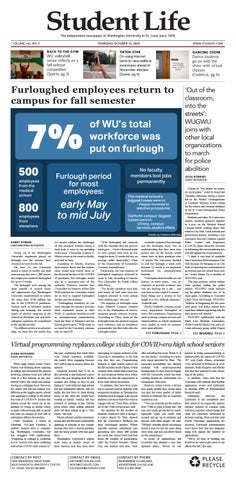
GABBY HYMAN CONTRIBUTING REPORTER Nearly all of the Washington University employees placed on furlough over the summer have returned to work for the fall. On June 11, the University issued a report to faculty and staff announcing that over 1,300 university employees would be furloughed for up to 13 weeks. The furloughs were among the most notable of several financial adjustments that Washington University implemented to relieve the more than $150 million lost due to the COVID-19 pandemic. Factors such as refunded student dining and housing, the cancellation of elective surgeries at the School of Medicine and new technological expenses all contributed to the significant loss. “As difficult as this is to acknowledge, we must face the reality that
we cannot address the challenges of this situation without taking a hard look at ways to cut spending in this area,” Chancellor Andrew D. Martin wrote in the email to faculty and staff in June. According to Martin, drawing from reserve funds and the endowment would help relieve some of the financial burden of the COVID19 pandemic, but furloughs would also be a necessary part of the cutbacks. However, Interim Vice Chancellor for Student Affairs Rob Wild said that the University would do its best to support furloughed faculty over the summer. “Furloughing members of our team through the summer provides them continued access to their Wash. U. employee benefits as well as unemployment compensation from the State of Missouri and the federal government,” Wild wrote in an email to the University community on April 29.
“[The furloughs] did coincide with the stimulus that the government gave… From a financial point of view, people who were on furlough for those 12 weeks did not, on average, suffer financially,” Chair of the Department of Economics Gaetano Antinolfi said. Fortunately, the vast majority of furloughed employees returned to work in July, according to Interim Vice Chancellor for Public Affairs Julie Flory. “No faculty members were lost, and nearly all staff who were furloughed returned to work almost three months ago,” she said. The majority of furloughs came from Medical Campus employees, as the elimination of elective surgeries greatly reduced revenue. According to Flory, most of the furloughs from the medical campus were voluntary, and no employees permanently lost their jobs after the furloughs ended.
Antinolfi explained that throughout the furloughs, there was an understanding that they were temporary and all the faculty would come back to their positions after 13 weeks. The University decided to end the furlough a week early because 12 weeks is an important benchmark for unemployment benefits. “Unemployment benefits are not forever: at some point… you are expected to provide evidence that you are looking for a job… and you have to take a job if it comes… these things put a person in furlough in a very difficult situation,” Antinolfi said. On the Danforth Campus, nearly every department furloughed at least a few employees. Departments such as dining, campus services and student affairs, in which employees were unable to work on campus, were most affected.
Chants of “No justice, no peace, no racist police,” could be heard last Thursday afternoon during a march led by the WashU Undergraduate & Graduate Workers Union calling for the reform and eventual abolition of the St. Louis Metropolitan Police Department. Students and other St. Louis community members gathered together at 4 p.m. on the Medical School Campus before walking about four miles to City Hall. Local activists and government leaders, including a representative from the Coalition Against Police Crimes and Repression (CAPCR), spoke about the necessity of reforming the current policing system throughout the demonstration. “I think it was kind of symbolic that it went from Med campus to City Hall because it’s bringing us to City Hall, it’s showing our commitment to go beyond just our school from now on,” senior Jessica Yu, a member of WUGWU, said. This past summer, amidst nationwide protests calling for police reform, WUGWU made advocating for police abolition one of its main goals. According to Executive Chair Trent McDonald, WUGWU “believes in bargaining for the common good, and police unions have used their militant organizing only for their narrow self interest.” WUGWU collaborated with the Black Law Students Association, White Coats for Black Lives and a St. Louis advocacy group called Expect
SEE FURLOUGH, PAGE 2
SEE WUGWU, PAGE 2
Virtual programming replaces college visits for COVID-era high school seniors CLARA RICHARDS STAFF REPORTER When high school senior Grace Martin was thinking about applying to college, she envisioned the process involving campus tours and official visits at a few schools, as she considered where she could best pursue rowing at a collegiate level. However, her reality this fall has looked very different as she juggles sports, school and applying to college in the turbulent time of COVID-19. Seniors like Martin across the world are in the position of trying to decide where to apply without being able to spend any time on campus or even talk to admissions officers face-to-face. Claire Hargrove, a senior in Charlotte, N.C.orth Carolina, is another student who is considering Washington University, but has struggled with applications. “[Applying to college] is confusing as it is. And it’s even more confusing with all the COVID stuff around it,”
she said, explaining that while there were virtual resources available, she hadn’t been engaging because she’s still trying to narrow down her options. Hargrove worried that “a lot of [the process] is just firsthand experiences, like just stepping foot on the campus and falling in love or just hating it.” And while her high school has had admissions officers visit virtually, she has been in class during many of the visits she would have wanted to attend. Instead, she has resorted to looking at the TikTok trend where other college students show off their college to get a “vibe check,” she said. Martin echoed a similar sentiment, saying that she felt more comfortable applying to schools in her vicinity because they were a known quantity, and she knew people who had gone there. Washington University’s admissions team is acutely aware of these barriers, and they have been
attempting to expose students to the University’s atmosphere in the best way that they can. Programming directed at high school seniors for the fall includes mock classes, virtual campus visits, online high school visits and academic theme days, where students can take the opportunity to learn more about curriculum. In addition, they have been working to connect current students with prospective students, as “[prospective students] want to engage with current students a lot more than they want to engage with us,” Tiara Wair, dDirector of the vVisit wExperience, said. The statistics for the number of students connected with is strong— a report shared by Wair showed that the University’s feedback has been exceedingly positive. Where typically summer admissions programming sees about 600 people per event, the virtual event had four times the number of participants. After the Virtual Summer Theme Day, one student said that, “now
after attending this event, Wash. U. is my top choice,” according to a quarterly report provided by Wair. The increased accessibility has allowed students with underrepresented backgrounds in rural areas to engage with the University, which has been exciting despite the unfortunate circumstances, Wair said. However, Adam Litwin, a former tour guide, doubts that virtual tours can give the same quality of information to students that an in-person experience can. “You can certainly get the surfacelevel ‘Tthis is what it looks like,’ but you can’t really get the feel as much, especially when you could walk around and go up to students and interact with other people,” he said. “[What’s valuable about on-campus tours] is that it’s not the same thing every time, and you can divert based on the actual space.” In terms of applications, the University has adopted a new testoptional policy “driven by our
CONTACT BY POST
CONTACT BY EMAIL
CONTACT BY PHONE
ONE BROOKINGS DRIVE #1039 #320 DANFORTH UNIVERSITY CENTER ST. LOUIS, MO 63130-4899
EDITOR@STUDLIFE.COM NEWS@STUDLIFE.COM CALENDAR@STUDLIFE.COM
NEWSROOM 314.935.5995 ADVERTISING 314.935.4240 FAX 314.935.5938
interest in being accommodating to students given the impact of COVID19,” said Emily Almas, aAssistant vVice pProvost & dDirector of aAdmissions. Both Hargrove and Martin said that they planned to take advantage of the policy. In addition, Alms said that the University will continue their holistic application review and dedication to meeting 100% of demonstrated financial need. Ultimately, however, the University is not completely sure how much of an impact the unprecedented removal of campus visits will have, and they acknowledge that visits are extremely influential in decision making. Wair said that until Eearly Ddecision applications are received, University administrators won’t know how this new programming will impact the number of applications. “We’re all kind of holding our breath to see what really stuck in our efforts this fall,” she said.
2 STUDENT LIFE
EM MCPHIE & TED MOSKAL | SENIOR NEWS EDITORS | NEWS@STUDLIFE.COM
theFLIPSIDE FLIPSIDE FRI 16
THU 15
SUNNY 61/37
AM CLOUDS/PM SUN 60/35
SAT 17 SUNNY 68/50
TUES 20
MON 19
PARTLY CLOUDY 60/42
AM SHOWERS 61/40
SUN 18
PM SHOWERS 64/45
WED 21
PARTLY CLOUDY 64/49
EVENT CALENDAR THURSDAY 15 Visiting Writer Steven Dunn Virtual Event, 8 p.m. Shortlisted for Granta magazine’s “Best of Young American Novelists,” Visiting Writer Steven Dunn is the author of two books from Tarpaulin Sky Press: water & power and Potted Meat, which was a co-winner of the 2015 Tarpaulin Sky Book Awards, a finalist for the Colorado Book Award, and has been adapted for a short film entitled The Usual Route, from Foothills Productions. Steven was born and raised in West Virginia, and after 10 years in the Navy he earned a B.A. in Creative Writing from University of Denver.
FRIDAY 16 Public Tour: Edition MAT Virtual Event, 12 p.m. Join us for live, interactive tours on Zoom. Student educators design and lead virtual tours featuring several artworks in the Kemper Art Museum collection or in special exhibitions, showing images of the artworks through screen sharing and answering participant questions. On October 16, Jay Buchannan (Arts & Sciences ‘21) discusses a selection of works from the temporary special exhibition “Multiplied: Edition MAT and the Transformable Work of Art, 1959–1964.”
SATURDAY 17 From Quantum Mysteries to Quantum Technologies Virtual Event, 10 a.m. Igor Pikovski, of Stevens Institute of Technology & Stockholm University, will present. Quantum theory is over 100 years old. In the early days, its consequences were often mapped out through “Gedankenexperiments” – imaginary experiments that reveal often bizarre and counter-intuitive phenomena. This way of thinking helped clarify some of the fundamental notions of quantum theory, but it was unimaginable that such scenarios could ever be realized in experiments. Today, not only have many such experiments become reality, they are also the basis of transformative new applications: quantum technologies that use and control unique quantum effects.
WU’s newest publication, the Danforth Dispatch, publishes its debut issue TED MOSKAL SENIOR NEWS EDITOR The Danforth Dispatch, Washington University’s newest student-run publication, published its first online issue, Oct. 1. The stated mission of the Danforth Dispatch is to “critique the radical ideologies dominating campus culture” by promoting critical analyses and ideological freedom. Articles from its first issue covered topics ranging from the Nagorno-Karabakh conflict to circumcision as a means for men’s oppression. Upperclassmen Matias Mayesh, Damian Servidio, Walter Treat and Jacob Ramer came up with the idea for the Dispatch last spring, in a reaction to what Servidio described as a “uniformity of thought” on campus. “It's not so much that we disagree with the opinions that people have, but we don't like the idea that [we have to] hear the same thing over and over again,” Servidio said. “And it gets kind of tiring after a while.” Over the summer, the students reached out for support from the Intercollegiate Studies Institute, an organization dedicated to promoting conservative thought on college campuses. Started in the 1950s by prominent conservative thinker and founder of the National Review William F. Buckley Jr., the organization has built up a network of around 18 student publications on college campuses including the Brown Spectator, the Princeton Tory and the Dartmouth Review. Certain publications such as the Princeton Tory or the Dartmouth review are self-described conservative
publications, while others such as the Stanford Review or the Middlebury Independent adopt a nonpartisan stance. The Danforth Dispatch plans to follow in the footsteps of the latter two publications, welcoming opinions from all ideological perspectives. Mayesh maintained that although the Dispatch receives funding from an organization dedicated to promoting conservative thought, the ISI will exert no editorial influence on the paper. “They [the ISI] sponsor our organization, but they have no editorial control over us at all,” Mayesh said. “We have full discretion over what happens and that's really about it. They've helped us organize a website—that's it.” Mayesh pointed to editorials by ISI-funded publications in favor of defunding the police and electing Bernie Sanders as examples of perspectives that the Dispatch would be open to publishing in the future. In the present, the publication’s first issue featured a mix of conservative pieces and apolitical content, with no left wing perspectives present. However, Mayesh welcomed leftist writers to join, pointing out that only one issue had been published so far, and that the Dispatch would welcome unconventional opinions from all sides of the aisle. “Generally we really are willing to publish anything that is unconventional,” he said. “You know, if someone came up to us with a traditional Marxist interpretation of something going on in academia and it was interesting, and we didn't see that before in some other kind of campus publication
we'd publish it.” When asked about the potential difficulty of finding left wing writers for the Dispatch, Servidio was unconcerned. “The fact of the matter is our rule is that we will publish unconventional opinions that we aren't seeing a lot,” he said. “If society is such that all of the unconventional opinions are right-wing, that's a problem for society to think about. It's not a problem for us.” For Mayesh, the fact that the Dispatch is funded by a conservative organization and at the moment mostly populated by right-leaning members, should not dissuade writers from other parts of the political spectrum from joining. “I am a conservative and yes, that's true that I am the president of the college Republicans, but I fully acknowledged that and I'm not going to deny it,” Mayesh said. “So it's not like I'm hiding from anybody… I've invited plenty of people to come write for us. And some of them have said, ‘no’, some of them out of fear, some of them just not wanting to be associated [with the publication]... I've made a concerted effort to invite people and I always will.” For the upcoming semester, the editors of the Dispatch are planning to include more reported content, more ideological diversity and potentially a print issue. “We’re hoping since this first issue is out, we'll get more people coming to us and having just a wider variety of opinions to choose from the published journal, next issues,” Treat said. “And then we're hoping to get a paper issue out next semester.”
THURSDAY, OCTOBER 15, 2020
FURLOUGH from page 1 “The [person furloughed from my department] mostly works on events, like seminars and conferences… Both of these were affected by COVID. This summer, we had very little in terms of events,” Antinofli said. During the furlough period, which, for most employees, was from May to July, staff shortages forced departments to adapt. Antinolfi shared that his department was able to cope with the furloughs, despite the added workload. “Toward the end it began to be hard because you have to prepare for the new academic
year and you have to make sure that all the courses are in order,” he said. “There was a little bit of rush at the end.” “We felt the other people had to do extra work but in the end it went okay,” he added. “Had it been longer than 12 weeks, I think we would have been in trouble. Towards the end I began to feel the stress… Overall, we recovered well.” After communicating with a furloughed colleague, Antinolfi revealed that the emotional aspect of the furloughs was the most difficult and impactful. “The psychological cost is still enormous… My concern
was the personal cost on the individual that was furloughed because that can actually have lasting effects. It is not a pleasant letter to get when you have been working in a place for many years. That was what I was worried about,” he said. Flory claimed that the impact of the furloughs on the experience of University students was almost nonexistent. “Most student services were able to shift to virtual operations during the spring and summer, and all are fully up and running for the fall semester, either virtually or in person,” she said.
WUGWU from page 1 Us, among other organizations, to organize the protest. The march was directly aimed at pushing for reforms within the SLMPD at a time when the St. Louis Police Officers Association (SLPOA) is renegotiating its collective bargaining agreement with the City of St. Louis. WUGWU Campaign Committee Chair Grace Ward said that the union’s role is “connecting the labor aspect to the larger racial justice push behind trying to influence the police contract.” “We are a fundamentally anti-racist organization, so we take anti-racist work as one of our key ongoing goals both at Wash. U. and in the city writ large,” Ward said. “As another labor organization, WUGWU identified [SLPOA’s renegotiation of the agreement] as a point of interjection to attempt to push the city to influence the contract negotiation process with measures that would counter police brutality.” CAPCR has created a list of proposed reforms for the SLMPD, such as ending seniority considerations in the force and ensuring that the Ethical Society of Police (ESOP), an “almost exclusively African American” organization, receives “equal access to information and benefits” as do members of SLPOA. CAPCR also recommends the expansion of who has authority to investigate “violations of police policy” so that “police would no longer simply be policing themselves.” The final recommendation is for a “more open process that allows for public input concerning CBA negotiations.” According to Yu, WUGWU believes that the CAPCR’s recommendations are a good start but do not go far enough. While the steps laid out by CAPCR call for reform, many members of the student movement go further by calling for police abolition. “Yes, we want to defund the police, but we need to abolish them,” junior Jasmine MacFarlane, a chant leader at the march and a member of WU Students for Abolition, said. “People will want to do reforms, and reforms only ever make the system bigger.” MacFarlane said a goal of
the student leaders is to push people to demand a say in the contracts that the police unions create. “The main focal point of why we were organizing, why we were trying to get people together, was to push people to fight and advocate for community oversight,” MacFarlane said. Ward also emphasized the importance of local community action. “I would just hope that for Wash. U. students, this localizes their larger concerns about social justice,” Ward said. “It's easy, I think, to be a student at Wash. U., undergrad or grad, and kind of ignore the city and the localized issues of the city, so one goal would really be to have people focus those concerns and that energy here in the city and at our University.” Although turnout was lower than expected, event organizers said they were satisfied with the energy of the demonstrators. The march lasted for about four hours, but people were chanting and singing and playing drums the entire time, MacFarlane said. “Nobody was discouraged, which I thought was amazing,” she said. “It was great to see how politically active the students at Wash. U. are.” “I just hope that we continue to do the hard things and not just the easy things when it comes to this, because it’s only gonna get harder,” BLSA President Cass Oliver said. Oliver pointed to donating, protesting and researching as ways for people to more fully engage in the Black Lives Matter movement rather than just carrying out performative actions on social media. Marlene Kanmogne, a medical student and a member of the University’s branch of White Coats for Black Lives, an organization of medical students dedicated to racial justice, expressed how attending the march had personally impacted her. “I think the act of marching and chanting is very powerful,” Kanmogne said. “It's that act of letting your voice be heard and trying your absolute hardest to kind of let the community know, ‘Hey, we’re here and we’re gonna fight for you,’ but also, ‘Hey, you’re welcome
to come join us in this fight.’” This type of community spirit emerged when students from Saint Louis University and Harris Stowe University joined marchers along the way, answering the chants of “Out of the classroom, into the streets.” While organizers appreciated the arrival of students from other schools, the presence of the SLMPD was a less welcome surprise for some at the march against that very department. Police cruisers cut in front of the cars that demonstrators were driving to carry supplies like food and water, and to offer transportation for marchers, Yu said. “That was a point of interference from them.” “I've been to protests and yes, there's usually a good number of police, but I was so surprised at how many police were there,” MacFarlane said. She added that while there were “no bad confrontations” between the protestors and the police, it seemed like the police were trying to stop them from going to certain roads. “They were basically just following us, and they were ahead of us and on all sides of us as we were walking,” MacFarlane said. Overall, leaders of the group expressed optimism with how the event itself went and what they see as the future of the movement. Yu said she left the march recognizing the passion that University students have for advocacy. “Wash. U. students are willing to take up intersections, to take up streets, and that was something some of the organizers were talking about... that they didn’t think Wash. U. students would have the guts, would have the courage to go into the streets,” Yu said. “But I think this shows that there are at least enough to do that, to take the streets, so I think that was great.” “It was empowering to know that we have numbers,” MacFarlane said. “People are willing and ready to fight for the things and change they want to see.” An Expect Us leader closed the night with the call: “We have nothing to lose but our chains.”
CREATIVE COMMONS/PASA47
The St. Louis Metropolitan Police Department headquarters. WUGWU and partners marched last Thursday, hoping to influence the department’s contract negotiations.
THURSDAY, OCTOBER 15, 2020
SPORTS
DORIAN DEBOSE & JOSH SHAPIRO | SENIOR SPORTS EDITORS | SPORTS@STUDLIFE.COM
STUDENT LIFE 3
Athlete of the Week: Volleyball senior Kirby Knapp on a fall unlike any other MATTHEW FRIEDMAN ASSOCIATE EDITOR In a year without a pandemic, the Washington University volleyball team would be preparing for its final set of regular season University Athletic Association matchups this week, a double-header against Case Western Reserve University and Carnegie Mellon University next Sunday in Rochester, N.Y. Instead, the Bears are still easing their way into practices. All NCAA games are canceled this year, but there is the hope that the spring will allow for scrimmages against individual teams. To get a sense of what the first few weeks of the fall semester have been like for the Bears, Student Life called Kirby Knapp. One of two seniors on the team, Knapp was third in the UAA in assists per set last year. She would likely have surpassed 3,000 career assists this year, vaulting herself even further into the University’s top 10. This interview has been edited for length and clarity.
with those two separate groups of 10? Are you able to have something that replicates what a normal practice would look like?
start off by asking about what you’ve been able to do as a team thus far. What have practices been like?
KIRBY KNAPP: We’re heading into our second week of practices in the gym and third week of lifts in the weight room, but we’re divided into two small groups of less than 10 people and we’re not mixing those groups at all. We wear masks when we practice and lift. But we’re getting into practice three times a week and lift twice, so a fair amount actually. SL: What are you able to do
KK: I was kind of expecting
now. We’re not doing as many team drills, both from a safety standpoint and also just getting back into touching a volleyball and stuff. I think it’s going to pick up more as the weeks go on, but right now it’s right now more individual skill-focused.
it. We weren’t the first team in our conference to have our season canceled and we knew we had a team meeting coming up, so I knew what was going to happen at the meeting, but it was still really hard to hear it come from my coach. I think the hardest part was not being around my teammates to process the news.
SL: Before you were allowed
SL: Yeah, it seems so tough
back in the gym, what sort of volleyball activities were you able to fit in over the summer?
to be physically separate from your team, even with tools like Zoom. Given how strange I’m sure this fall semester has been for you generally speaking with no sports, what’s been the weirdest part?
KK: It’s a little different right
KK: Over the summer, they sent us our summer workout program, which we do every summer, and I know that a few girls were able to get into gyms and play volleyball, depending on what state they were in. I was in California, so I wasn’t able to touch a ball that much in a gym setting. There wasn’t a lot over the summer, actually. SL: What was that like for you to return to practice after not playing over the summer?
KK: I was nervous at first, STUDENT LIFE: I want to
you heard the cancellation announcement back in July?
starting back up and having to wear a mask. And that definitely is tough, but it’s made me feel so grateful for all the time I have in the gym with my teammates now, especially with it being my last year here. It’s definitely really nice to get back into a routine of leaving my apartment and going and working out and exercising and stuff, just being around my coaches and my players.
SL: Given that it is your last year here, I imagine that it must have been incredibly difficult to find out that you wouldn’t have a typical fall season. What was it like when
KK: I think that waking up
SL: Right, that makes sense with it being a lot of the more informal times where you’re getting to know each other and all of that. If you think about what you want this year’s freshmen to learn from you during such a weird and unprecedented semester, what are some of the lessons that you want them to get out of Wash. U. volleyball, or that you want them to absorb as they head into hopefully being able to play next fall in what looks like a normal UAA season?
KK: I think the biggest thing
GRACE BRUTON | STUDENT LIFE
Then-sophomore Kirby Knapp gets underneath the ball for a set against Nebraska Wesleyan University in the fall of 2018.
is not to take anything for granted. Obviously, none of us expected this. My plans were to finish out my spring season last year and stay here over the summer and work out and then
finish senior season this year. And that all kind of stopped in March and my plans changed. So you just never know when your last ball is going to be—or your last game is going to be.
Even though they’re young, it’s really important to know that from the start, that you’ve got to work hard now because you never know when it is going to be the last time.
Sabrina Spence Social Media Director
Adrienne Levin Coleman General Manager a.coleman@studlife.com
Copyright © 2020 Washington University Student Media, Inc. (WUSMI). Student Life is a financially and editorially independent, student-run newspaper serving the Washington University community. Our newspaper is a publication of WUSMI and does not necessarily represent the views of the Washington University administration.
when the sun is already up is the weirdest thing. We usually have morning practices, so I’m out of the house by like six or so every morning. So a lot more sleeping in is happening this semester. One of our practices is in the morning, but it’s at like eight instead of 6:30. And then the other ones are in the evening. Wow, 8 a.m. is still impressive. What do you miss the most about a regular sports season?
SL:
KK: Just the amount of time I get to spend with my teammate on a daily basis. Right now, we are in the small groups and I do get to see my teammates, but I see half of them and we’re not allowed to shower in the locker rooms or use the locker rooms, really. We can’t eat together on campus, so it’s just all of the off the court stuff that you don’t really think means a lot, but it ultimately does.
WE ARE OPEN with safe social distancing practices. We offer curb side pick-up. Check out our newly revamped website www.sunshinedaydream.com
FREE SHIPPING ON ORDERS OVER $30 Come check out our CBD selection Brands we carry: BeLeaf Life Oils - Missouri Grown! • Eclipse Green Roads • JustCBD • Koi • Rescue CBD Open Monday through Saturday, 10am to 9pm • Sunday 11am to 8pm
6303 DELMAR BLVD IN THE LOOP
Follow us on
and on
@sunshinedaydreamstl
@sunshinedaydream420 for updates.
VOLUME 142, NO. 5 Emma Baker Editor-in-Chief editor@studlife.com
Kya Vaughn Senior Forum Editor forum@studlife.com
Curran Neenan Senior Photo Editor photo@studlife.com
Matthew Friedman Associate Editor
Dorian DeBose Josh Shapiro Senior Sports Editors sports@studlife.com
JJ Coley Isabella Neubauer Copy Chiefs copy@studlife.com
Isabella Neubauer Sabrina Spence Senior Cadenza Editors cadenza@studlife.com
Vivienne Chang Kathleen White Engagement Directors
Jayla Butler Kya Vaughn Managing Editors Em McPhie Ted Moskal Senior News Editors news@studlife.com Benjamin Simon Senior Scene Editor scene@studlife.com
Mia Goldberg Design Chief design@studlife.com
HN Hoffmann Jaden Satenstein Christine Watridge Multimedia Editors
Nathan Springman Webmaster Jamila Dawkins Forum Editor Christine Watridge Spencer Linenberg Jaime Lee Designers
Tammy Dunsford Advertising Sales Supervisor dunsfordt@wustl.edu
4 STUDENT LIFE
SCENE
BENJAMIN SIMON | SENIOR SCENE EDITOR | SCENE@STUDLIFE.COM
THURSDAY, OCTOBER 15, 2020
From boredom to TikTok fame: Senior shares life behind the screen SAMRA HASEEB STAFF WRITER Maya Nepos’ TikTok origin story began the same way as mine and probably yours too. After being sent home from school in March—in her case, a study abroad program—something had to fill the quarantine void. “I was just sad and in my room, and bored, and I was like ‘I guess I’ll download this, I don’t have anything else better to do with my time now that I have so much time.’” Our origin stories deviate from one another, though, in that she is TikTok famous and I, well, have zero public videos on my account. The Washington University senior has gained a large social media following for her informative yet entertaining TikTok videos pertaining to everything politics. From anti-Trump raps to reminders about voter registration, she brings viewers all the news coverage and commentary one could need in the confines of a minute. Initially, Nepos’ account was set to private for her and her friends. But as time went on and the 2020 political scene grew more insane, she decided to go public about her opinions. “Trump did the whole ‘yeah maybe you should put bleach in your system,’...I can’t not say anything about this,” Nepos remembers. By the time June rolled around, Nepos was filming about the Tulsa rally, the Black Lives Matter movement and even Kanye’s step into the election ring. She combined her passion for politics with her talent for freestyle rap to form relevant content. People seemed to
really like it, so she kept doing it. And 203,000 followers later, Nepos’ success has seen no limit. Just ask her about Alicia Keys, who recently reposted a TikTok of Nepos receiving her absentee ballot to the sound of Keys’ 2020 song, “Love Looks Better.” When she saw the singer’s Instagram story on Oct. 1, Nepos shrieked and proceeded to skip “all of school for the rest of the week.” While Nepos is technically still a full-time Wash. U. student, she said her senior year has been drastically altered by her TikTok career. The original plan of having a chill, 12-credit spring semester was scrapped in exchange for having a lighter course load this fall semester—the semester of the 2020 U.S. Presidential Election. Nepos likens the upcoming election in November to the Olympic Games. “Every four years the world is watching,” she says. And with less than four weeks left until Election Day, it is officially crunch time. “I have like 10 emails every two minutes in my inbox of people like, ‘Oh hey, we’re trying to get the vote out,’” Nepos says, “and I’m like, ‘Okay me too, let’s go!’” Her apartment mates know how busy she is, but from an outsider perspective, it can be pretty hard to tell. “It’s pretty chaotic and it’s pretty nonvisible chaos,” Nepos explains. In our current COVID-19 world, even working with the BBC News on a documentary must happen from the safety of one’s room. Despite the recurring theme of her videos, Nepos’ academic and career aspirations go far beyond the realm of civic activism. As
CURRAN NEENAN | STUDENT LIFE
Washington University senior Maya Nepos sits in Bowles Plaza. Nepos returned to campus this fall with over 200,000 followers on TikTok.
a Psychology major and Marketing minor, she sees herself getting involved with marketing and social media in the future, but not politics per se. Nepos does feel, however, that psychology makes its way into her TikTok experience through the connectivity of the platform. “Being able to relate to people is what gives me life,” says Nepos. And her videos have clearly resonated with all types of demographics, from fellow Wash. U. students to moms living in Alaska. “I never would’ve met these moms from Alaska if it weren’t for TikTok,” she adds. “It kind of just makes your world bigger, which is awesome, so I kind of just kept doing it.” That’s not to say that politics has not been an integral part of Nepos’ upbringing
though, because it has. “I was into it before [recent years], just because my mom teaches political science and sociology and stuff. And so we would talk about it… that’s just like normal dinner conversation. When I was 11, [my mom] took me to my first protest. I have a picture of it somewhere on my massive wall,” Nepos says, motioning to the extensive photo collage in the background of her Zoom video. They were bundled up on the streets of Madison, Wis., marching with the crowds of protesters demanding the recall of Governor Scott Walker. More than maybe even the specific cause itself, the mixed excitement of being in the capital and getting to skip school made that first protest a pivotal experience for Nepos and her
interest in activism. When asked which of her TikTok videos was her favorite, Nepos first mentioned one of her more viral ones: a Trump freestyle from July, when he first threatened to ban TikTok. After addressing him as “cinnamon bun,” Nepos goes on to call out the president on his attempts to limit freedom of speech when the words are not in his favor. That freestyle video has now been viewed over 2.3 million times on the social media app, with over 10,000 comments. “That was the one I started getting press about, even though I didn’t find out for like a month,” she said. Nepos also encouraged and informed viewers on her TikTok to participate in poll working. The feedback on the video was overwhelmingly positive, with people reaching
out to thank Nepos and let her know that they registered to be poll workers this November. “We were like hundreds of thousands of poll workers short and so that one was the one I felt like I made the biggest impact on, I guess.” Nepos went on to say that she loves all her videos though, because if she didn’t, they would not have been posted in the first place. When considering her account’s trajectory for post-election times, Nepos expressed a bit of uncertainty. “I really don’t know what I’m going to do after a month from now. I think I might just go on vacation or retire or something,” she laughed, “because hopefully I don’t have to be on TikTok for four more years. Like hopefully, things go well.”
Despite COVID-19 restrictions, RAs work to build community JONAH GOLDBERG STAFF WRITER When Residential Advisor (RA) junior Leo Karp passes the common room for Lee 0 or 1, he typically finds many people there. The empty South 40 halls are a very different picture from the freshman year most upperclassmen experienced at Washington University, an observation that the freshmen more than anyone are likely tired of hearing. But the obstacles to normal residential life for underclassmen are an ever-present concern for their RAs, who are working to make their residents’ year memorable
in the best way. Navigating the obvious health questions is a challenge for all RAs, and one especially poignant for Karp, whose traditional dorm has him sharing a bathroom with his residents. “From what I understand,” Karp explained, “Wash. U. and ResLife have been in close contact with infectious disease experts at the medical school, and they basically told us, if it wasn’t safe to live in LeeBeau [Lee House and Beaumont House], we wouldn’t have opened it up.” Karp also observed that health regulations were a “driving force” in RA training this year.
“For example, when we had a presentation from the Office of Student Conduct, which I believe they normally do every year, they made sure to emphasize the protocols for people who break the public health guidelines that the University has put into place.” Virtual training for RAs began three days before freshmen moved in, and the blend of synchronous and asynchronous sessions continued as residents arrived. Modules included how to support students of concern, the multitude of campus resources for students, emergency protocols and restorative and social
GRAPHIC BY CHRISTINE WATRIDGE
justice topics. Juniors Isra Ahmed and Naasik Syed both recall experiencing “Zoom fatigue” after six hours of modules each day. Although online training compounded its demanding nature, senior Davis Holmes spoke similarly of his experience last year. “Regular training is very intensive, it’s very in-depth and it’s easy to get lost in it sometimes, because there’s so much content,” Holmes said. This year returning RAs like Holmes were spared the bulk of the required training if they passed a review assessment. In Holmes’ view, “that’s a much more fair and appropriate way to structure training.” Holmes said that if Residential Life activities are normal next year, they would like to continue a hybrid version of that programming so former RAs only have to attend certain sessions. Zoom training quickly transitioned into Zoom programming. Syed acknowledged that “ResLife’s guidelines have made in-person programming a little tricky,” and many RAs are hosting Zoom sessions to play games like “Among Us.” Despite the challenge, RAs have found creative ways to get their residents off-screen. Syed and his co-RA junior Beth Althouse are planning a human foosball game for their Shanedling House residents. Junior
Emily Xu designed a campus scavenger hunt for her Wheeler House residents, awarding points to teams for taking selfies at obliquely described locations, such as “Minecraft lookin rocks.” To fill the gap in active programming, RAs have been asked to up the frequency of one-onones, a mildly dreaded experience of Wash. U. residential life, especially through Zoom. Holmes acknowledged that from the RAs’ end, “it could be awkward at times, because there are certain questions ResLife gives us to ask, which can be really weird and sometimes difficult to weave into natural conversation.” These questions include whether the student is getting the academic resources they need, and whether anyone has caused them stress since they’ve been on campus. All of that said, Holmes still sees the benefits in these one-on-one conversations. “It’s definitely nice to get to know the people on your floor,” Holmes said. “Like I know that there are three other people on my floor this year that are from the same 30-minute radius as where I’m from…At the end of the day, it’s just a conversation.” Xu echoed that the oneon-ones have been integral to connecting with her residents. She finds it understandable that
residents are not always as enthusiastic about the conversations as her, and remembers feeling similarly. “I didn’t realize at the time that the vibe can actually be really casual.” Even in the absence of community events like the annual Residential College Olympics, Xu believes that each additional one-on-one and weekly staff meeting have deepened her sense of belonging with not just her floor but also the William Greenleaf Elliot residential college, encompassing Danforth, Shepley and Wheeler Houses. “It’s surprisingly comforting to walk by someone in this corner of the 40 or see people hanging out on the WGE lawn and realize they’re probably a WGE walrus as well,” she wrote in a statement to Student Life. It is clear that all RAs are putting serious thought and effort into building a home for their residents and how, despite the obstacles presented this year, students are still forming those critical relationships. “The most rewarding thing for me has been that my residents have gotten really close,” Ahmed wrote. “They are mostly very friendly with one another, and they are casual in our GroupMe and when talking to me and my co-RAs, which makes me feel like we’ve done a good job.”
THURSDAY, OCTOBER 15, 2020
DORIAN DEBOSE & JOSH SHAPIRO | SENIOR SPORTS EDITORS | SPORTS@STUDLIFE.COM
STUDENT LIFE 5
MATT’S MUSINGS A FIFA soundtrack compilation playlist for the ages MATT SINGER SPORTS COLUMNIST Love-hate relationships are complicated. It’s literally in the name. Love and hate occupy opposite ends of the emotional spectrum. Logically, it makes no sense how someone could feel both ways about someone, but for whatever reason, these relationships exist. Don’t ask me why. I’m not a psych major. I, too, was once in a lovehate relationship. Not with a person though. No, for many years, I found myself in a complex relationship with FIFA. The video game, not the governing body of soccer. (I have no love for them.) It was actually because of FIFA that I really fell in love with soccer in the first place. Back in the day, I would play FIFA 08 or FIFA 09 on my friend’s Nintendo Wii. I would always choose Chelsea, and as a result, the Blues became my club. It took a few years for me to really start following the sport closely, with Chelsea’s 2012 Champions League Final triumph in Munich against Bayern igniting my passion for football. Since then, I have been as much a fan of soccer as I am of other sports, if not more so. It’s actually kind of funny how my soccer fandom took off right around the time I stopped playing the sport. I don’t know if the two are correlated, but let’s just say I was
never the most skillful player. As I was getting more into the sport, I also started playing FIFA. 2010 FIFA World Cup South Africa on Wii is one of my all-time favorite games. (Wavin’ Flag, anyone?) I tried Ultimate Team for the first time on FIFA 14, and it was the following year with FIFA 15 during which I truly got into it. I packed a Legend, Oliver Bierhoff, that year, something I didn’t realize the significance of until I told some friends who proceeded to freak out. FIFA 16 was my first full year of total devotion to the game, and I spent many a weekend night cursing at the television while my friends laughed over the headset. As I got more into the game, I began to realize just how annoying it could be. Nothing was more frustrating than dominating someone online and still losing (though it was understandable if they had Bernd Leno in net). Nevertheless, EA still had me hooked, and FIFA 17 was much of the same. I had a brilliant team that year, with Team of the Season Harry Kane, TOTS Christian Eriksen and in-form Son Heung-min leading the attack in my 4-3-1-2. But the game was as frustrating as ever, and by FIFA 18, my junior year in high school, I started to play the game less and less. I did get back into it by spring when I packed 98-rated TOTS Mohamed Salah. That
was probably my best team, with TOTS Michy Batshuayi and man-of-the-match Eden Hazard my stars in that edition. I barely played FIFA 19. I really only got into it over the summer when I had free time. I had had enough of all the crap players deal with, so for the sake of my mental health (and college applications), I basically stopped playing. I drew a line in the sand. You can see where the hate part of our relationship comes from. But why, you may ask, do you still love a game that has wronged you and your mom’s wallet (sorry, Mom) so many times? The soundtrack. The video game itself is always flawed and frustrates me to no end. But every year, FIFA puts together a fantastic soundtrack of 40 or so songs that I anticipate more than the game itself. As someone who doesn’t have the attention span to listen to entire albums in one sitting, the release of the FIFA soundtrack has become something I look forward to every year. Traditionally, alternative and electronic music have dominated the playlists, but in recent years, the curators have put together more diverse soundtracks, with UK rap, for example, getting several tracks in the last few editions of FIFA. To honor the release of FIFA 21 (a game I’ll probably play once and hate
immediately), I’ve put together a playlist of my favorite songs from FIFA 14 through FIFA 20. There are no more than 10 per game, even if I wanted to include more (which I definitely did). The playlist is 55 songs in total, but I’d like to highlight a few here.
Love Me Again – John Newman (FIFA 14): The quintessential FIFA song. “Love Me Again” is a fairly well-known track in its own right, but FIFA 14 players remember it from that game’s soundtrack. I actually had forgotten about it until a saw a tweet a couple years ago that reminded me just how much of a banger it was.
Shelter – Porter Robinson & Madeon (FIFA 17): When two of the best electronic DJs combine forces for a track, you hope that their collaboration will live up to the hype. “Shelter” does just that, as the American and French producers create a song that somehow makes you feel safe, living up to the track’s title.
The System Only Dreams in Total Darkness – The National (FIFA 18): The National are not a new act by any means, but I hadn’t heard of them until I heard this song on the FIFA
18 soundtrack. It instantly became one of my favorites, with the guitar solo being a particular highlight. It’s hard for me to pick my favorite FIFA song, but this would undoubtedly be in the running.
Feel the Vibe (feat. Anderson .Paak) – BJ the Chicago Kid (FIFA 20): You really do “Feel the Vibe” when listening to this song. Anderson .Paak stays winning with a smooth verse to start the track off, and BJ the Chicago Kid balances it out with a wonderfully vivid hook. I love this song so much that it’s currently my anthem on Tinder.
Crystal Express – Raury (FIFA 16): This one went a bit under the radar in FIFA 16, but boy is it good. Raury is known for blending genres, and he does that here with clear R&B and indie influences.
Love Songs – Lola Coca (FIFA 17): Breakups are a well-explored idea in music, but rarely is it done as freshly and honestly as in “Love Songs.” British artist Lola Coca combines her rapping ability with a lo-fi quality to create one of my favorite FIFA songs ever.
GRAPHIC BY CHRISTINE WATRIDGE
SPONSORED BY:
puzzle
mania
Minor in the Business of the Arts
your AD here
Open to all undergrads. Find out more. olin.wustl.edu/arts
sandraphilius@wustl.edu
2019
CADENZA
THURSDAY, OCTOBER 15, 2020
ISABELLA NEUBAUER & SABRINA SPENCE | SENIOR CADENZA EDITORS | CADENZA@STUDLIFE.COM
STUDENT LIFE 6
Go with the flow: How WU’s dance program has handled the pandemic GRADY NANCE STAFF WRITER In a semester that has challenged every academic department, dance classes at Washington University have gotten creative to try and adapt to a new environment. It’s hard enough to absorb class material when it is delivered through a Zoom meeting or an asynchronous module. Every department has confronted the issue of maintaining the same caliber of education for their students given the, to quote many a university email, unprecedented conditions. The Performing Arts Department’s dance program, however, faces the unique dilemma of trying to teach an intimate, physical discipline while
keeping students’ safety the top priority. When the COVID-19 pandemic forced everyone online in the middle of the spring semester, along with the ubiquitous hardship of adapting the curriculum to unfamiliar technology, dance classes struggled to find ways to engage students in the performance of the body through the abyss of the digital void. Using bedrooms as stages, fighting with family for bandwidth and struggling to stay in sync with music that cuts out twice a minute, students and professors alike have sorely missed the stability of the studio. Coming into the fall semester, dance program coordinator and professor David Marchant has exhausted every avenue to get dancers back in person
while continuing to provide opportunities for online students. This includes everything from 10 foot by 10 foot pods in studios to new technology that tracks foot movements for online dancers. Still, he acknowledges the obvious gap between the two formats. “It’s an idea to give [online students] the same experience—it’s not possible," he said. "Instead of pretending I’m trying to give them an equal experience, I’m acknowledging the fact that they are working in a different experience.” Catering instruction to online students has been particularly difficult for dance given its inherent physicality and focus on group synchrony, he said, but the program is doing what dancers do best: pivot. Instead of trying to
replicate an in-class experience, professors are using the pandemic’s constraints as a creative opportunity to explore new formats for performance—thinking outside the pod, so to speak. “After 25 years of teaching…you get into habits, assumptions about how the form works,” Marchant said. The virus has forced him and his colleagues to rethink their craft and how to use the limitations of a screen (or a pod) as a tool to express in new, unique ways. In Marchant’s case, this means incorporating the camera as an element of performance in his Dance Composition class. “I’m shocked I hadn’t thought of it sooner…we’re creating a new artform,” he said, demonstrating by picking up the camera
and slowly moving it as he performs a short dance. With constantly shifting conditions and new opportunities slowly being implemented, improvisation has become the new normal for dance instruction, but these professors are used to staying on their toes at all times. “I and my colleagues feel very grateful at this moment that we’re artists,” Marchant said. For students, it’s been refreshing to dance in any capacity. Junior Serena Schein, a dance minor and classroom engagement moderator, says that rejoining the dance community, even in a limited fashion, has been important in regaining a sense of structure. “Over Zoom, you’re not seeing other people struggle or succeed with you,
and you’re more aware of your own inability to do things…it feels like you’re struggling alone,” Schein said. Without the benefit of her classmates and professors, “as a dancer, you don’t know if you’re doing it right because you can’t watch yourself.” Still, the opportunity to return to the studio and have some degree of balance in her practice has been particularly rewarding in a year fraught with obstacles. Even with the limitations in place this semester, “it is still my highlight at Wash. U.,” Schein said. Nobody knows how long we’ll be separated by pods and learning from computers, but for Wash. U.’s dancers, moving with the times has been—and will be—the key to success.
Blackpink’s long-awaited ‘The Album’: 3.5/5 finger hearts MADDIE CHIU CONTRIBUTING WRITER After debuting in 2016, Korean girl group Blackpink released their first studio album on the first of this month. During this fouryear period, Blackpink fans—termed Blinks—have begged for an album and protested to Blackpink’s agency YG Entertainment for “starving” them. Blinks even began to interpret Blackpink’s lyric “See you later maybe never” from their song “See U Later” literally. With Blackpink’s success coming from a repertoire of only thirteen songs released before 2020, Jennie, Blackpink’s lead vocalist and main rapper, famously said at their Atlanta concert in 2019, “I had so much fun today. I want to do ten more songs if I had any.” Such was the starvation for Blinks and the frustration from Blackpink as a group, so the long-awaited album, appropriately titled “The Album," seemed like the culmination of years of patience, hope and persistence. Of the eight songs on the album, the title track, “Lovesick Girls,” dynamited Blackpink away from their typical black and pink colors, trappy beats and fierce yet cute image. Unlike the pre-release song, “How You Like That,” which was a
bold declaration of self-confidence, “Lovesick Girls” seems to be an anthem for single girls with a melodic chorus. There is a questionable message in “Lovesick Girls” from problematic lines like “I’m nothing without this pain.” Even more, what is being said is inconsistent, from the lines “love is a drug that I quit” to “but we are still looking for love.” The music video also appears inconsistent from a life-size neon sign that flickers between “Born Alone” and “Die Alone” to another sign that says, “You never have to be alone.” There are other depressing and random neon signs like “NO EXIT” and a 5 by 50 feet “NOTHING.” It leaves fans wondering if this song could be referring to YG Entertainment’s ongoing five-year dating ban for Blackpink members. However, it would be wrong to discredit Blackpink’s new venture into the melodious and more gradual realm. Songs like “You Never Know” continue this quest with a ballad that spotlights every members’ previously underutilized vocals. Other songs like “How You Like That,” “Pretty Savage,” and “Crazy Over You” refer back to their classic hits like “DDU-DU DDU-DU” and “Kill This Love” that garnered global fans and landed them a spot at the
2019 Coachella Music Festival. Though these songs fail to defamiliarize from the proven formula for success in the charts, they also have the idealized addictive beats and energy that fans love. Other upbeat songs like “Ice Cream” featured Selena Gomez and “Bet You Wanna” featured Cardi B. Such big-name features by Western artists and lyrics being all or majority English point towards Blackpink’s hopes of entering the Western market. Perhaps the most obvious turningpoint in audience targeting is the release time set by YG Entertainment: midnight in Eastern Standard Time rather than midnight in Korea. After the release, Blackpink continued their campaign into the Western market through interviews with Jimmy Fallon, Apple Music, Spotify, YouTube Released, Entertainment Tonight and Elle. Selena Gomez joined several interviews via Zoom and Cardi B did what Cardi B does best by tweeting non-stop about her feature in “Bet You Wanna.” Coincidentally, the night of the album’s release was also the night of Trump’s coronavirus announcement, prompting Cardi’s tweet to Trump, “’BET YOU WANNA’ wear a mask now.” It is also important to mention that Cardi B garnered
extra attention by entering a Twitter war with K-Pop fans and Blinks themselves and summoned her fans, the Bardigang, before returning to promoting the album. Since the release of “The Album,” Blackpink has broken the record for a K-Pop girl group selling the most physical albums on their first day, at 590,000 copies. They broke the record for fastest video to reach 100,000,000 views on YouTube with the “How You Like That” music video. They also broke the record for fastest girl group to reach 500,000,000 streams on Spotify. Despite not remaining within their binaries of black and pink, the colors of Blackpink we do see in “The Album” are so varied and erratic that the outcome is a rather confusing hue you would get from mixing too many colors together. Fans can hear Blackpink, but the songs lack the depth to hear them as individuals. The lyrics seem designed as quotes for fans to scream (“Sound the alarm!” or “Look up in the sky, it’s a bird, it’s a plane!”), and they also ring with an air of over-simplicity. There seems to be no subtext, and the album itself denounces love, then announces love as the sole objective to life. Such contradictions both within and between songs make it difficult to synthesize
an overall message from the album. “The Album” becomes an aesthetic project that lacks a greater statement besides “Blackpink in your area.” Yes, they are here, and that’s all. Yet Blackpink’s album has definitely been catered to their patient Blinks. From main vocalist Jisoo’s rap verses and deep notes, Jisoo saying “Blackpink in your area,” which all members have done except her, to Jennie and Lisa having longer raps, Rosé showing off her vocals and high notes, and an even line distribution, Blackpink has checked off several boxes that only
dedicated fans would know. The album itself also condemns haters with lines like “You ain’t worth my love if you only love to hate me” and what seems like a diss track in “How You Like That” with the line “Look at you, now look at me.” As Jennie said in an interview, “We just wanted our fans to enjoy whichever [song] that they like because we have everything ready for you.” Indeed, Blackpink has an appetizing feast satisfying those who have closely followed the band and their Blinks’ wishes, but it leaves new listeners still wondering who Blackpink really is.
drink. dine. play.
WEEKLY BAR, RESTAURANT AND FUN GUIDE
V LARGE SPECIALTY OR UNLIMITED TOPPING PIZZA
13
$
WE ARE THE DELIVERY EXPERTS!
7018 PERSHING AVE 314-726-3030 CLAYTON/WASH U
99
EACH CODE: 9025
OPEN LATE! SUN-THURS 10:30AM-12AM FRI & SAT 10:30AM-1AM
THURSDAY, OCTOBER 15, 2020
FORUM KYA VAUGHN | SENIOR FORUM EDITOR | FORUM@STUDLIFE.COM
STUDENT LIFE 7
STAFF EDITORIAL
We need transparency before it’s too late
S
tudents have been back on campus for over a month now, and while this situation certainly isn’t anywhere near normal, things seem to be going smoother than many may have expected. The University continues to hold in-person classes and students haven’t been told to move out of the dorms immediately like in the spring. All circumstances and Instagram posts about students breaking social distancing guidelines considered, things seem to be going better than expected. This is partially due to the efforts of many in the student body, but it also suggests that perhaps the Wash. U. community isn’t getting the full picture. Wash. U. ‘s COVID19 dashboard seems to support the idea that the University is handling the virus better than other universities, as we’ve only had 66 confirmed student cases since the beginning of August, whereas other Missouri schools have had hundreds.
Wash. U. recently changed its campus alert level from orange to yellow, signifying that “current regional and campus conditions are stable and reassuring.” Furthermore, the University changed their Thanksgiving policy from prohibiting students who travel outside of St. Louis from returning, to “strongly recommending” that students stay within the St. Louis area for the holiday. But these changes are concerning, as they raise many questions that seem to not have any answers. What conditions signaled to administrators that it was okay to change the alert level? What data was used to decide this? Essentially, we’re meant to blindly trust what we’re being told and that we’re “doing well.” There’s no available criteria to gauge how effectively Wash. U. is managing the virus apart from the dashboard, nor is there consistent communication as to how the alert-color system will
inform safety guidelines as the virus progresses. The color system seems arbitrary, and without more clarity, creates more questions than answers. In comparison to St. Louis University, for example, which outlined potential testing strategies and explained why they chose their current testing model, Wash. U. has largely left us in the dark about their thought process. Additionally, a study led by the Yale School of Public Health argued that students on college campuses need to be tested every two to three days to safely reopen. Every university has a different protocol this semester, and that is okay, but students have a right to know how and why these decisions are made, as these directions directly impact our health and safety That’s not to say that any of the information on the page is inaccurate or wrong, but if Wash. U. is only surveillance testing students every two weeks,
are we really getting the most useful, up-to-date information that we could? The infrequency of testing could make it harder to measure the magnitude of an outbreak right away; it might be two weeks too late before the scale of the spread is accurately reported, and by that point, it might be too late to contain it. Yes, students are required to complete a self-screening before coming to campus every day, but if administrators aren’t enforcing that policy, the system is not nearly as effective as it should be. Even if Wash. U. itself is managing the virus well, what about the rest of St. Louis and Missouri? With active cases at high levels across the city, county and state, it is simply untrue to claim that regional conditions are “stable and reassuring.” We have no way of knowing how the University is considering St. Louis and Missouri in their decision-making
process, because that information isn’t available anywhere. There’s a serious lack of transparency and clarity about the University’s efforts to manage the virus, and it potentially places the Washington University and St. Louis community in danger, especially with more students living off campus this year than what was initially planned. More students are interacting with the campus community and greater St. Louis community simultaneously, and the University bears at least some of the responsibility for making sure students interact with both communities safely. There is validity to the argument that more frequent testing could create a false sense of security--if students receive a negative test, they might be more tempted to host social gatherings or go outside without a mask more often than they would otherwise. However, as the current system stands, this false sense of security lasts for
two weeks, as opposed to 2 or 3 days should we test more frequently. We worry that Wash. U.’s lack of detailed information and lack of transparency about their rationale for how to contain the virus could lead to a false sense of complacency. We don’t have a clear or strict enough protocol to know if the testing system is actually working well. Just because we haven’t encountered an outbreak yet doesn’t mean it will stay that way for the rest of the semester, or that our system is foolproof enough to contain it. All it takes is one irresponsible act to trigger an outbreak with dire consequences, and students need to remain vigilant. In order to properly defend against COVID-19 and keep the student body, staff, faculty and St. Louis community safe, students need to stay properly informed, and that starts with the University. It starts with clear guidelines, enforced testing policies and above all, transparency.
Women’s reproductive rights are at risk GRACIE HIME STAFF WRITER
A
s my roommates and I watched the presidential debate, the passing of legendary Ruth Bader Ginsburg and the nomination of Amy Coney Barrett, we couldn’t help but feel an ominous fear of the future. With talk of female reproductive rights in Congress and the Supreme Court, women everywhere have shared their fear of losing access to mandatory family planning and reproductive resources. This is backtracking on progress.
Ruth Bader Ginsburg once said that the option to bear (or not bear) a child is “central to a woman’s life, to her dignity. It is a decision she must make for herself. When Government controls that decision for her, she is being treated as less than a fully adult human responsible for her own choices.” This proclamation is being completely trampled over as Amy Coney Barrett threatens to end the Roe v Wade ruling. If she is confirmed for the Supreme Court, she will have access to at least seventeen abortionrelevant bills and several
others addressing the Affordable Care Act. These claims alone justify the widespread fear of losing basic human rights. With the ever-changing political environment, here are some things you may want to consider looking into. Regardless of your sexual orientation, gender, age or where you live, it is to your benefit to educate yourself on this topic. It may not affect you directly, but it could directly affect over half of the US’s population. Consider the following actions! If you have had any interest in getting a form
of birth control (for any reason) talk to your OB/GYN about it now, especially if it is a form of IUD. Please do your own research on this as well. Some birth control is not good for certain people! Get in contact with your local Planned Parenthood. Stay updated on their status and what resources they offer. Check out Plan B options. They have a shelf-life of 4 years. Planned Parenthood provides this free for people 18+! Research your representatives and get in contact with them expressing your
concern. They are *supposed* to be here for their people. Study up and spread the word. While this is a prominent issue in Missouri, these rights may also be at risk in other states as well. If Roe v Wade is overturned, some states have a law set in place as a reaction. These are called trigger bans. These hostile states could be able to completely ban abortions, family planning and birth control. Individual states will hold a lot of power if threatening health bills are passed or overturned. In conclusion, vote!
This is such an important part of protecting human rights. Not only does your ballot have the potential to change legislation, but it also is a note to the local, state and federal officials who represent you; it states our demand. In Missouri especially, our legislators are not representative of the greater community—this is proven by the bills that are passed and proposed. Our representatives are not Missouri, but instead trustees of their own agenda. We are the only people with the power to change this. Vote for the greater Missouri.
The leaves are falling, and so are my spirits THOMAS HUMPHREY STAFF WRITER
A
h, the great outdoors. Trees and acorns, squirrels and racoons, more trees and more acorns. We have been lucky to have as our refuge the crisp late summer air and varied topiary of Saint Louis. Even as we have been more isolated inside, outside, where the breeze sweeps away viral particles, I can be more comfortable. But that time is over, or at least it is nearing its end. The dreaded damp grey hellscape of an urban midwestern winter is creeping in on us. Those yellow and orange leaves might look pretty, but
they represent something far more sinister. Sadness, despair, hopelessness, fatigue, discomfort and gloom. According to an USA TODAY report on college students with seasonal affective disorder, “The National Institute of Mental Health found in a 2011 nationwide survey that 30% of college students reported feeling ‘so depressed it was difficult to function.’” That statistic sounds bleak, and yet this survey was taken when you were allowed to see people indoors during winter. That is no longer the case. Now we do not even have each other—not really. You cannot convince me that any kind of
OUR VOICE: EDITORIAL BOARD Staff editorials reflect the consensus of our editorial board. The editorial board operates independently of our newsroom and includes members of the senior staff and forum section editors. Editor-in-Chief: Emma Baker Associate Editor: Matthew Friedman Managing Editors: Jayla Butler, Kya Vaughn
social engagement on Zoom is enjoyable, let alone emotionally fulfilling. Humans are not designed for isolation; we are social animals. We have not been getting better at doing this—at least I have not. I have been going insane. ‘Quarantine fatigue’ has been the new buzzword as people start letting little things slip through the cracks. When global crisis becomes the new normal, it becomes easier to ignore. But things are not getting better any time soon, and these little slips only make things worse. Winter is when viruses thrive, and the coronavirus will be no different . The United States has been seeing a steady uptick
Senior Forum Editor: Kya Vaughn Senior Scene Editor: Benjamin Simon Senior Sports Editors: Dorian DeBose Senior Cadenza Editors: Isabella Neubauer, Sabrina Spence
Copy Chiefs: JJ Coley, Isabella Neubauer Engagement Editors: Vivienne Chang Forum Editor: Jamila Dawkins Multimedia Editors: HN Hoffmann, Jaden Satenstein, Christine Watridge
in cases, and so has Missouri. What happens when people do things on Halloween and Thanksgiving? People will travel, they will party, they will do all kinds of things that they are not supposed to—it’s not good but the reality is that the guidelines will get broken, and we will not see the consequences of it until much later. But maybe I should focus back onto the micro, the day to day experience with “hybrid” learning. Winter will be awful. More people are living further away from campus and have to deal with longer commutes in the cold on foot. You cannot meet people in the park, you cannot sit outside and eat, you are still
not on campus. Encapsulated in a bubble of perhaps a few people in an apartment. Think of living on the International Space Station, only allowed out of the ship for a few masked space spacewalks in an unbearable cold vacuum. Think of how inhuman, alien that life is. That is about where we are at right now, albeit with cozier conditions. So how should you prepare for a long and terrible winter? Well I suppose you always have to look on the sunny side, even when the sun is not there. Perhaps you can take this opportunity to appreciate some of the beauty in winter that you might not have noticed before. I have
YOUR VOICE: SUBMISSIONS We welcome letters to the editor and op-ed submissions from our readers. Submissions may be sent to letters@studlife. com and must include the writer’s name, class and phone number for verification. Letters should be no longer than 350 words in length, and readers may
made it no secret in previous articles how much I detest this season of death, but there is beauty in winter. There is opportunity to gain strength through adversity, as long as you do not let yourself get beaten down. But you made it this far—eight months since Spring Break ended and normality refused to return. What I am saying is winter will be bad, but nothing you cannot handle after everything else that has happened. Do not focus on the light at the end of the tunnel, it’s still too far away to see. Rather, force your eyes to adjust to the darkness, and, before you know it, it will be much easier to see.
OUR WEB POLICY also submit longer op-eds of up to 750 words. We reserve the right to print any submission as a letter or op-ed. Any submission chosen for publication does not necessarily reflect the opinions of Student Life, nor does publication mean Student Life supports said submission.
Once an article is published on studlife. com, it will remain there permanently. We do not remove articles or authors’ names from the site unless an agreement was reached prior to July 1, 2005.
College is hard. Snacks help. Get FREE delivery. Start your 6-month trial, no cost to you
amazon.com/WashingtonU