The independent newspaper of Washington University in St. Louis since 1878 THURSDAY, NOVEMBER 19, 2020
VOLUME 142, NO. 10
MARIO BROS
Students find community around a Nintendo classic (Scene, pg 3)
WWW.STUDLIFE.COM
GOING FORWARD
FAMOUS FOODS
A look at the changes Black studentathletes are seeking to implement (Sports, pg 4)
The story of Jason Wang’s journey from WU student to restauranteur (Scene, pg 6)
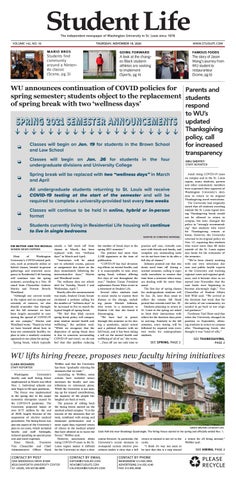
WU announces continuation of COVID policies for Parents and spring semester; students object to the replacement students of spring break with two ‘wellness days’ respond to WU’s updated Thanksgiving policy, call for increased transparency ORLI SHEFFEY STAFF REPORTER
GRAPHIC BY CHRISTINE WATRIDGE
EM MCPHIE AND TED MOSKAL entails a full week off from SENIOR NEWS EDITORS classes in March, has been replaced with two “wellness Most of Washington days” in March and April. University’s COVID-related poli“Instructors will be asked cies, such as primarily online or not to schedule exams, quizzes hybrid classes, limited in-person or assignment due dates on the gatherings and restricted occu- days immediately following the pancy in Residential Life housing instruction-free days,” Martin will continue into the spring and Wendland wrote. semester, according to a Nov. 18 The wellness days are schedemail from Chancellor Andrew uled for Tuesday, March 2 and Martin and Provost Beverly Wednesday, April 7. Wendland. Shortly after the announcement “Although our current trends was made, Student Union Senate in the region and on campus are circulated a petition calling for certainly of concern, we also the number of “wellness days” to should remember that through- be increased to five to match the out the fall semester we have typical length of spring break. been largely successful in con“We feel that [the] current taining the spread of COVID-19 spring break policy will comproon our campus,” Martin and mise student mental health and Wendland wrote. “Based on what wellbeing,” the petition read. we have learned about how to “While we recognize that the keep our community healthy, we dispersion of spring break days plan to take a similarly cautious is due to concerns surrounding approach to our plans for spring.” COVID-19 and travel, we do not Spring break, which typically feel that this justifies reducing
the number of break days in the spring 2021 semester.” The petition had more than 3,100 signatures at the time of publication. “COVID-19 has had devastating effects on mental health, and it is unacceptable to take away spring break without offering five days of rest throughout the year,” Student Union President sophomore Ranen Miao wrote in a statement to Student Life. Several other students took to social media to express their dismay at the change, including junior Moriah Johnson, who wrote in a statement to Student Life that she found it discouraging. “We have had to power through this semester so far during a pandemic, social unrest and a political disaster with no fall break, and it has been taking a toll on the mental health and wellbeing of all of us,” she wrote. “…Days off are our only time to
practice self care, virtually connect with friends and family, and complete any outstanding tasks we do not have time to do after a full day of classes.” Johnson pointed out that students need time off during a normal semester, calling it especially unrealistic to remove that time from a semester when many are dealing with far more than usual. The first day of spring classes for undergraduate students will be Jan. 26, later than usual to reflect the remote fall finals period that extends until Jan. 10. Students planning to return to St. Louis in the spring are asked to limit their interactions with others for the fourteen days prior to arriving. Similarly to the fall semester, entry testing will be followed by required tests every two weeks for undergraduate students.
SEE SPRING, PAGE 2
Amid rising COVID-19 cases on campus and in the St. Louis region, many students, parents and other community members have expressed their approval of Washington University’s decision to return to its original Thanksgiving travel restrictions. The University had originally stated that all students traveling outside the St. Louis region during Thanksgiving break would not be allowed to return to campus, but later changed the policy to “strongly recommending” that students who travel for Thanksgiving remain at home. However, the University returned to its original policy on Nov. 12, requiring that students who travel more than 60 miles outside of the St. Louis region stay home for the remainder of the semester. “We’ve been closely working with our own infectious disease and public health experts at the University and tracking regional cases and regional guidance, and it became clear as we moved into November that the case loads were beginning to become alarmingly high,” Vice Chancellor of Student Affairs Rob Wild said. “We arrived at the decision last week that for the safety of our community, we needed to go back to our original guidance.” Freshman Yael Shaw said that when the University changed its position in September, allowing students to return to campus after Thanksgiving break, she thought it was “kind of silly.”
SEE THANKSGIVING, PAGE 2
WU lifts hiring freeze, proposes new faculty hiring initiatives CLARA RICHARDS STAFF REPORTER Washington University’s faculty and staff hiring freeze implemented in March was lifted Nov. 1. Individual schools can now begin to fill open positions. The freeze was implemented in the spring due to the major economic disruption caused by the COVID-19 pandemic. The University projected losses of over $175 million by the end of 2020, largely because of the suspension of elective medical procedures. The hiring freeze was just one aspect of the University’s plan to cut costs, which included faculty and staff furloughs, reduced spending on special projects and travel expenses. Since March, Executive Vice Chancellor and Chief Administrative Officer Hank
Webber said that the University has been “gradually relaxing the measures that we took.” According to Webber, some actions have included salary increases for faculty and contributions to retirement plans. While the University is not making up for missed contributions, the majority of the people furloughed are back at work. The process of rolling back the hiring freeze started on the medical school campus. “It is the success of the measures that we took, combined with strong and dominant performance and a more rapid than expected return of clinics in the medical school that have allowed us to waive the freeze,” Webber said. However, uncertainty about rising COVID-19 cases in the St. Louis region makes it difficult for the University to chart a clear
GRACE BRUTON | STUDENT LIFE
Eads Hall sits near Brookings Quadrangle. The hiring freeze started in the spring and officially ended Nov. 1.
course forward. In particular, the University’s recent decision to re-suspend certain elective procedures makes it clear that a full
return to normal is not yet in the cards. “I think it's way too soon to be sure that this is a step toward
CONTACT BY POST
CONTACT BY EMAIL
CONTACT BY PHONE
ONE BROOKINGS DRIVE #1039 #320 DANFORTH UNIVERSITY CENTER ST. LOUIS, MO 63130-4899
EDITOR@STUDLIFE.COM NEWS@STUDLIFE.COM CALENDAR@STUDLIFE.COM
NEWSROOM 314.935.5995 ADVERTISING 314.935.4240 FAX 314.935.5938
a return for all being normal,” Webber said.
SEE HIRING, PAGE 2
2 STUDENT LIFE
EM MCPHIE & TED MOSKAL | SENIOR NEWS EDITORS | NEWS@STUDLIFE.COM
theFLIPSIDE FLIPSIDE THU 19 SUNNY 70/53
FRI 20
MOSTLY CLOUDY 70/50
MON 23
MOSTLY SUNNY 49/33
TUES 24
SHOWERS 48/38
SAT 21
SHOWERS 61/46
SUN 22
SHOWERS 50/33
WED 25
PARTLY CLOUDY 55/39
EVENT CALENDAR THURSDAY 19 The State of Education Virtual Event, 10 a.m. The Women’s Society of Washington University is hosting a panel discussion on the state of education in the midst of a global pandemic. Join Michelle A. Purdy, associate professor of education; Rowhea Elmesky, associate professor of education and Christopher Rozek, assistant professor of education for the panel discussion that will discuss the impact of COVID-19, mental health and the future of education. Nation Space Lecture Series: Ersela Kripa & Stephen Mueller Virtual Event, 12 p.m. This talk will transcend the political abstractions around the politics of U.S. sovereignty at the Mexican border with timely examinations of spatial conditions, constraints and convergences. Ersela Kripa and Stephen Mueller, partners in the award-winning firm AGENCY, will discuss a series of reports entitled “Border Dispatches,” an on-the-ground perspective from the southern border. Each report explores a unique “sleeper agent,” a critical site or actor with the power to reshape the diffuse and layered binational territory we know as the borderlands. STL Reentry Collective Panel Discussion Virtual Event, 5:30 p.m. The WashU student group Interrogating Incarceration will host a panel discussion with the STL Reentry Collective and formerly incarcerated individuals. Half the panel will consist of a Q&A and the other half will focus on new volunteer positions with the STL Reentry Collective.
FRIDAY 20 Mapping Social Justice Panel Discussion Virtual Event, 10 a.m. During Geography Awareness Week, the Data Users Group welcomes a panel to examine social inequities in our society with a spatial lens. Our speakers will address housing, voting, racial violence and ethical land use. The Collaborative for Community-Centered Conversations Virtual Event, 10 a.m. The Collaborative for Community-Centered Conversations, known as Collaborative Café, is a discussion and support network for those interested in community health-centered research and practice. Community partners are encouraged to attend. This section will focus on: Process for developing and launching a community advisory board (CAB) and Steps for adding community partners to the Institutional Review Board (IRB) application. Honoring Trans Remembrance Day a Community Panel: Who Decides Who You Are? Virtual Event, 12 p.m. Each of us was born into a world that came to define us before we ever had a say. This interactive panel will leverage Chimamanda Ngozi Adichie’s TED Talk “The Danger of a Single Story” and Academy Award-winning film “Moonlight” to process how individual and collective stories have been reclaimed and transformed through the grassroots work of community members at the intersection of some of our community’s most vulnerable populations.
SATURDAY 21 Topic Talks with Jason Chu Virtual Event, 3 p.m. AMC is excited to work with Jason Chu, bringing him and his knowledge to WashU for talks on issues such as diversity, equity, Asian American Identity, and allyship amongst marginalized communities. In two workshops, “Myths + Misconceptions: The Erased Reality of Asian America” and “Songs from Our Skin: Creating art in our bodies”, we hope this event can spark conversation around the topics that are more important now than ever.
SUNDAY 22 Public Tour: ‘House and Home’ Virtual Event, 2 p.m. Join the Kemper Museum for live, interactive tours on Zoom. Student educators design and lead virtual tours featuring several artworks in the Kemper Art Museum collection or in special exhibitions, showing images of the artworks through screen sharing and answering participant questions.
MONDAY 23 WashU Sports Analytics Guest Speaker - Mike Perelman Virtual Event, 6:30 p.m. Join WashU Sports Analytics as we host Mike Perelman, St. Louis Blues Hockey Data Analyst! The event is at 6:30 PM CT on Monday, November 23rd. There will be ample time for a Q&A with students, and we’ll discuss Mike’s work with the team during the Stanley Cup Winning 2019 season.
TUESDAY 24 The Art of Medicine Comes From Knowing Our Patients Virtual Event, 2 p.m. Join James Louie, MD ’65, Professor Emeritus of Medicine/Rheumatology at UCLA, for “The Art of Medicine Comes from Knowing Our Patients: Pierre-Auguste Renoir, Paul Klee, Ruth Asawa.” Louie will highlight the life and work of these three artists with a focus on their rheumatic diseases—Pierre-Auguste Renoir with rheumatoid arthritis, Paul Klee with systemic sclerosis, and Ruth Asawa with lupus. Some of the artists were able to manage their diseases through the grit of their own determination, the support of family and friends, and the best medical advice and therapies available during their lives. Some used their art to express their pain and turmoil, while others preferred to ignore and transcend their pain through their art. Louie gives patients hope for coping with their rheumatic diseases by illustrating how famous artists managed.
THURSDAY, NOVEMBER 19, 2020
SPRING from page 1 Entry testing will be optional for graduate and professional students. The last day of classes will be May 4, followed by a reading period and finals, May 5-13. Although a recent spike in COVID-19 cases both on campus and in the St. Louis area prompted
Dining Services to suspend in-person dining and the Habif Health and Wellness Center to suspend most routine health care services, the email from Martin and Wendland seemed to indicate that both organizations would return to their original COVID-19
policies in the spring. The suspension of all non-essential universitysponsored travel will remain in effect. All spring study abroad programs were suspended Oct. 30. The University has not yet announced any decisions regarding winter and spring sports.
THANKSGIVING from page 1 “We knew the numbers were going up and we knew that Halloween would spike numbers dramatically,” Shaw said. Parent Arturo Cazares said that the loosening of restrictions in September prompted many parents to advocate for more effective COVID-19 policies. The Facebook group “WashU Parents - Covid19 info exchange,” which now includes more than a thousand parents, served as a platform for parents to organize. Individual parents sent personalized feedback to the administration and the parents of freshmen created a petition. Cazares, along with two other parents, wrote an email to the senior administration on behalf of parents and later met with administrators. According to Wild, however, an “equally vocal number of parents” thought their children could safely go home for Thanksgiving break and then return to campus. “It would be impossible for the University to make decisions based on parent feedback because the parent feedback about Thanksgiving is as mixed…There is not a consensus,” Wild said. “We’re making decisions based on what we think is the right thing to do for the safety and the health of our community.” Parent Kate Tullis, while happy that the University returned to its original decision, said she was concerned that students who travel less than 60 miles outside the St. Louis region during Thanksgiving break can still return to campus. “It’s still a student getting outside of their pod or their Wash. U. community connections,” Tullis said. “I understand the University might not have been able to enforce that, and maybe there’s some legal reasons, but scientifically, there’s no difference.”
Residential Advisor junior Fadel Alkilani, who was given the choice of whether or not to remain on campus after Thanksgiving, said that from his perspective, the 60-mile limit seemed arbitrary. “There had to have been some radius to implement, but it probably should have been smaller, something more like in the range of 10 miles or so,” Alkilani said. “60 miles extends all the way out, outside of the entirety of St. Louis suburbia, so I’m not really sure why they chose that number.” Wild said that the administration arrived at 60 miles based on the parameter used in the spring when determining travel restrictions for faculty and staff. “We went back and looked at the guidance from the spring and agreed that that was still the right guidance,” Wild said. While community members believe that the University was right to return to its original decision, they remain concerned about rising COVID-19 cases as the Thanksgiving holiday approaches. According to the Danforth Campus COVID19 Dashboard, there are 37 active cases among undergraduate students and a total of 73 active cases including graduate students, faculty and staff as of Nov. 13, marking a sharp increase compared to previous weeks. This trend follows spiking regional and state-wide positivity rates. As of Nov. 15, St. Louis County had a 16.9% positivity rate, and on Nov. 12, Missouri’s 7-day positivity rate reached 40.8%, the highest it had ever been. “We first noticed the growth with the staff and faculty as early as midOctober. It wasn’t radical growth, but it was growing faster than it had been in the past. But by
October 30, the student cases started to really grow and they’re growing faster now, so that really is a concern,” Cazares said. “We are hopeful that the University is not going to be slow about implementing measures to limit the spread to protect the community.” On Nov. 12, all inperson Thanksgiving programming was switched to virtual programming, and on Nov. 16, the University closed all Dining Services seating in response to new St. Louis County restrictions. Cazares said that while the University has created a community that generally adheres to good safety practices, such as masking and social distancing, a more comprehensive surveillance testing is necessary. Cazares thinks the University should expand undergraduate surveillance testing to twice per week and begin routinely testing graduate students, staff and faculty. “That would identify more asymptomatic cases before they can spread,” Cazares said. “We’re seeing clusters growing that could become an outbreak.” Tullis agreed that students should be tested more frequently as cases rise before Thanksgiving and wanted the University to provide more transparency in general and on the dashboard. “I think they could be more forthcoming with how they arrive at their decisions,” Tullis said. “They could also tell us on the dashboard how many tests are done each week, how many students are in quarantine…Those numbers are important.” “If the community has better information with context, it can build trust,” Cazares added. “This will mitigate anxiety and most in the community will pull together to protect themselves and their community.”
HIRING from page 1 “It would be way too soon to say we're out of the woods—you'd have to have a crystal ball that's a lot better than mine.” The freeze, although temporary, did have repercussions for departments seeking new faculty members. The Department of Philosophy, for example, lost three faculty members last fall and needed to aggressively hire or risk the quality of their program. They managed to appoint and accept the new hires just days before the hiring freeze went into place. Chair of the Philosophy Department Ron Mallon said that the standing practice for new faculty was for each department to decide on a candidate and then submit an application to the dean. “We absolutely got lucky,” he said. “I think
if any of those three people that we had hired had turned us down, it may well be we would not have been able to make a second offer to someone on our list.” Since the end of the hiring freeze, Dean of the Faculty of the College of Arts & Sciences Feng Sheng Hu plans to use this opportunity to recruit top scholars for a variety of disciplines. “We are taking advantage of the fact that many institutions are unable to hire faculty this year and aiming to recruit a cohort of stellar scholars to Arts & Sciences,” Hu said. “More specifically, we will be announcing a faculty hiring initiative. This is a thematic hiring program with a focus on using data analytics and digital technologies to transform Arts
& Sciences disciplines and beyond.” Other universities have adopted different approaches to their hiring practices in the midst of the COVID-19 pandemic. For example, Harvard University has made an effort to scale down graduate programs in fields that are dependent on academic job markets that might suffer after the coronavirus. However, Hu said that the University has no current plans to scale down any programs. “We are always looking at student outcomes at both the undergraduate and graduate level to ensure that we are doing a good job in preparing our students for the workplace and helping them reach their goals,” Hu said. “The pandemic makes this more important than ever.”
THURSDAY, NOVEMBER 19 , 2020
SCENE
BENJAMIN SIMON | SENIOR SCENE EDITOR | SCENE@STUDLIFE.COM
STUDENT LIFE 3
Super Smash Bros Club turns friendly competition into community of friends SAMRA HASEEB STAFF WRITER Almost everyone comes to college in hopes of finding their “people.” Many satisfy this search through classes, others through Greek life and some through video game controllers and a Nintendo franchise classic. Smash Club, Washington University’s gathering space for players of Nintendo’s Super Smash Brothers series, has been on campus for eight years and attracts more and more appeal with every passing year. A normal, non-COVID year with Wash. U.’s Smash Club looks a bit like this: weekly tournaments— “weeklies”—every Tuesday evening in Ursa’s, monthlies in Risa Commons, an end of the semester tournament called Wonderland and a lot of casual gaming meet-ups in between it all. Smash Club’s co-president, senior Jack Goldberg, has been a part of Smash Club since his first year, but he has been an avid fan of the game since he started playing in middle school. This continued through high school, where he and a couple of his good friends would go to tournaments about once a week, sometimes more. So when it came time to apply to colleges, Goldberg had to at least look into the surrounding city’s Smash community. He joined the St. Louis area Super Smash Bros. Facebook page before he even toured Wash. U. Soon thereafter, he found a junior from Wash. U. on the page. “He said that when I come and visit Wash. U., he would be happy to have me over and we could play some games and just talk
about Wash. U.,” Goldberg recalled. “So I did that and it was a really fun time, and that helped me decide on Wash. U.” Four years later, Goldberg is quite pleased with his decision. “It certainly wasn’t on the top of my list of reasons to go to a school; it was more of a happy coincidence.” Most cities or regions in the United States have their own Smash community depending on numbers, and St. Louis has a solid following. “We have a lot of people who play here and obviously a subset of them are at Wash. U., a subset of them are at [St. Louis University].” Schools like Southern Illinois University Edwardsville and Webster University are also a part of the mix. Goldberg entered the St. Louis Smash sphere with an interesting background: his home state of Connecticut happens to be a hotspot for Super Smash Bros. This leaves Missouri at least a few steps behind what he had grown up with, but the impact of the local community here on Goldberg’s college experience is incomparable. “Especially freshman and sophomore year, it was really nice that I had a lot of friends that were Wash. U. friends, but I also had a lot of friends that were St. Louis people who had already graduated college and lived in St. Louis or were students at SLU; one of my best friends is at SLU who I met through Smash,” said Goldberg. But Goldberg’s list of gaming friends does not stop in Missouri or Connecticut or even North America. While studying in Shanghai last fall, Goldberg could not help but inquire about
the city’s Smash community. Nintendo games are much less popular in China because of past legal restrictions on consoles, but there exists a community nonetheless. “I went to tournaments every week there and was able to make a lot of friends outside of the Wash. U. bubble, which is really nice,” he said. And because the Smash scene was much less competitive in Shanghai than here, Goldberg and his go-to character Pokémon Trainer actually ended up qualifying for an invitational for the sixteen best players in China. During that same trip, he also spent a night playing Smash in Beijing with strangers who he met solely as a result of the game. The whole experience was surreal for Goldberg; in a country and city where he knew no one, he “was able to make friends and hang out for a night… just a lot of fun.” Back at Wash. U., Goldberg has been on the executive board for Smash Club since he first joined freshman year, serving this year as co-president with junior Nathan Thompson. Seniors Grant Marketta and Fadel Rodriguez also play essential roles on exec, and together they have witnessed the progression of the club through changing membership and strengthened connections. While all Smash Club tournaments have always been open to the public, Goldberg and his fellow exec leaders are now particularly interested in creating more of a Wash. U. community. This notion may have been a leading factor in the creation of the club’s online discord group two years ago. “Obviously when we started there was
no one in it, now we have a little over a hundred people in it. And it’s like a really good community of kids that just talk about games they like and watch stuff together,” explained Goldberg. In COVID times, the discord group has become increasingly active and increasingly essential. Goldberg shares that they sometimes play rounds of Among Us, and currently they are trying to initiate a routine weekly hangout in the discord. Goldberg describes this idea as probably a log-on and “play-whatever-games-youwant night… but it’s been hard for sure.” Because he is a senior, Goldberg’s remaining time
with Wash. U. Smash Club is limited. He admits that he has “zero expectation of any physical tournaments” before he graduates. Streaming online and playing is an option, but the huge loss of the social aspect makes it much less appealing. “Video game tournaments are the last thing in society that we need to bring back… like the least important, most spreadingcovid thing in the world,” said Goldberg with a slight laugh. One of those ‘this sucks but you kind of just have to make light of it’ laughs. The ultimate takeaway from Goldberg is that his time at Wash. U. has been profoundly shaped
by Super Smash Bros. He knows the many technicalities of the game in and out, and he could enthusiastically outline its history for you with no issue. But at the end of the day, what began as fondness for a video game has transformed into long-lasting memories and an unmatched network of friendships. “It is generally called the Smash Community— that’s like the wording that people use—but whenever I talk about it, I always just say the word community, and I think that’s like a really, really important part of it... like that’s how I meet people, that’s how people kind of get together.”
CHECK OUT OUR WEBSITE
FOR SPECIAL DEALS! ACKERMANTOYOTA.COM
2020 HAMPTON AVE. ST. LOUIS, MO 63139 AT THE INTERSECTION OF HIGHWAY 44 314-351-3000 COURTESY OF SMASH CLUB
While the Super Smash Bros Club has connections with players across the St. Louis area, the club hopes to strengthen its presence on the campus to connect with more Wash. U. students.
Toyota Care is a no cost maintenance program that covers the first 2 years or 25k miles, whichever comes first. The Ackerman For Life is valid only at Ackerman Toyota and is non-transferable. Offer contains 1 oil change maximum, per calendar year, when Toyota Care expires. Offer good to primary owner only.
VOLUME 142, NO. 10 Emma Baker Editor-in-Chief editor@studlife.com
Kya Vaughn Senior Forum Editor forum@studlife.com
Curran Neenan Senior Photo Editor photo@studlife.com
Matthew Friedman Associate Editor
Dorian DeBose Josh Shapiro Senior Sports Editors sports@studlife.com
JJ Coley Isabella Neubauer Copy Chiefs copy@studlife.com
Isabella Neubauer Sabrina Spence Senior Cadenza Editors cadenza@studlife.com
Vivienne Chang Kathleen White Engagement Directors
Jayla Butler Kya Vaughn Managing Editors Em McPhie Ted Moskal Senior News Editors news@studlife.com Benjamin Simon Senior Scene Editor scene@studlife.com
Mia Goldberg Design Chief design@studlife.com
HN Hoffmann Jaden Satenstein Christine Watridge Multimedia Editors
Sabrina Spence Social Media Director Nathan Springman Webmaster Jamila Dawkins Forum Editor Spencer Linenberg Jaime Lee Clara Richards Kamala Madireddi Designers
Adrienne Levin Coleman General Manager a.coleman@studlife.com Tammy Dunsford Advertising Sales Supervisor dunsfordt@wustl.edu
Copyright © 2020 Washington University Student Media, Inc. (WUSMI). Student Life is a financially and editorially independent, student-run newspaper serving the Washington University community. Our newspaper is a publication of WUSMI and does not necessarily represent the views of the Washington University administration.
4 STUDENT LIFE
SPORTS
DORIAN DEBOSE & JOSH SHAPIRO | SENIOR SPORTS EDITORS | SPORTS@STUDLIFE.COM
THURSDAY, NOVEMBER 19, 2020
Where things go from here: Next steps for WU BLAC MATTHEW FRIEDMAN ASSOCIATE EDITOR This article is the second in a two part-series about the Washington University Black Letterwinning Athletes Coalition. The first article explored Black athletes’ feelings of isolation, WU BLAC’s roots on campus and the organization’s efforts to foster community. You can find that article at studlife.com Organizing Zoom calls and creating spaces for Washington University’s Black student-athletes have been steps in the right direction, but they are just the start of WU BLAC’s work. There are numerous other initiatives that the organization’s members have posited to help address issues of isolation, racism and the need for on-campus support, and they have continued to collaborate with the Athletic Department to see the implementation of changes. Director of Athletics Anthony Azama stressed how, since he arrived at the University in 2017, there has been a shift in the Athletic Department’s overall approach. “I think what student-athletes will tell you is that they’ve seen a change since my arrival that really is focused on the studentathlete experience,” he said. From instituting expanded diversity, equity and inclusion training for administrators and coaches to the creation of a student-athlete experience task force a year and a half ago, he says the department had been working to address places where Wash. U. athletics does not live up to its mission. But he agreed that there is still significant room for improvement, and WU BLAC’s suggested reforms are already taking shape throughout the department. Since WU BLAC launched in the summer, members have been able to take a more active role in hiring processes. Junior Kameron Mack and senior Eka Jose, two WU BLAC executive board members, sat in on interviews with candidates for the open
athletic trainer position and got to ask questions about how potential trainers would handle issues of diversity and inclusion. The department ended up choosing a white man for the position, but WU BLAC saw the process as a victory. “Something [Mack and Jose] really liked about him was his dedication to diversity and that he wanted to meet with them often and figure out how he can make the athletic training part of the department... more diverse and inclusive,” said senior Caira Watson-Haynes, one of the WU BLAC co-presidents. “That the guy who was eventually hired was the person that the two [WU BLAC members] on that committee recommended says a lot about how much they do listen to the student-athletes.” The administration is listening to student-athletes in other ways as well. The push to find and hire coaches and staff who have a commitment to diversity and inclusion mirrors an effort to bring more Black student-athletes and other student-athletes of color to the University. “[We are] enhancing our recruiting budget for our coaches so that they can get off the beaten bath and try to take a deeper dive in trying to diversify the pool,” Azama said. Azama is also working with the University’s Office of Student Success to start an NCAAcompliant student-athlete opportunity fund to support low-income student-athletes. Mack said that work to increase the number of Black student-athletes on campus was a necessary aspect of what WU BLAC is trying to do. “You can do a lot of initiatives with diversity and inclusion, but to truly make people feel welcome, you need people who look like you in that space,” he said. “We have to recruit more Black student-athletes.” Yet supporting Black student-athletes does not stop the second they set foot onto campus. The WU BLAC members explained that the focus on creating a better experience for them should
highlight retention as well as things like recruitment. One of the key aspects of that retention is providing expanded mental health resources for student-athletes. Watson-Haynes said that the University’s studentathletes generally have been campaigning for a sports psychologist and that WU BLAC members are hoping that the University would hire a Black sports psychologist. At the same time, she acknowledged that finding the funding for that position would be tough. Azama said that simply adding a single sports psychologist would not be sufficient to support the University’s more than 500 student-athletes, so the Athletic Department is working with the Habif Health and Wellness Center to explore options when it comes to supporting student-athlete mental health. “I think mental health is a national crisis, and specifically in college sports, it’s something that we’re looking at very closely,” he said, explaining that the department is looking to find partnerships both on and off-campus. “At the end of the day, we all need tools to be able to deal with mental [health] challenges, especially now with the last 10 months that we’ve endured during this pandemic.” While the department searches for options, WU BLAC is taking things into their own hands. The group is planning to bring in a Black mental health professional in the spring to speak about different coping mechanisms. “Where we can take things into our own hands and bring in our own speakers, that’s something we’re trying to do as an organization,” WatsonHaynes said. WU BLAC has also planned other events for Black student-athletes. The group hosted a meeting on Nov. 4 with Dr. Brandon Roberts, a Black Wash. U. football alum who won the academic Heisman trophy and now works as a pediatric anesthesiologist in Ohio. The goal of events like that one goes back to the desire to
CURRAN NEENAN | STUDENT LIFE
Junior Samantha Weaver, a women’s basketball forward, is the WU BLAC communications chair.
create a community for Black student-athletes. “It’s just putting a name to the Black faces on campus and letting Black student-athletes know that these are the people they can reach out to if they’re interested,” said junior Samantha Weaver, the WU BLAC communications chair. “It’s bringing those resources to students rather than them having to go search it out themselves.” In addition to events for Black student-athletes already a part of the University community, WU BLAC is focused on fostering a better relationship between Wash. U. athletics and the St. Louis community more broadly. “A lot of St. Louis residents don’t even know that Wash. U. has an athletic department or sports in general, which I find to be kind of crazy, because we are one of the top Division III schools in the nation,” Jose said. “Especially since [St. Louis] is somewhere with one, a great African American presence and two, somewhere where we’re spending four years of a very formative part of our lives, it doesn’t really make sense for us to be so separated from the community.” WU BLAC members said that building more connections between Wash. U. athletics and the St. Louis community can happen in many ways. The group is working to establish
partnerships with local organizations who can serve as liaisons between Wash. U. athletics and the broader community. They hope to eventually host events in the community and collaborate with the University to increase fan presence and awareness of Wash. U. athletics. “We want to be engaged with people and want the community to know that we’re here and we’re available,” Mack said. Those efforts build upon work that has already gone on in the Athletic Department, which has had its own various initiatives to bridge the divide, from a program with Team IMPACT, an organization that connects children with chronic illnesses to college sports teams, to work with Normandy Middle School in St. Louis County. “It’s about engaging the community, specifically the youth, in a way that they look at Wash. U. not as an unapproachable school on the hill, but a school that they feel like they can attend and belong,” Azama said. The work to address isolation and other negative aspects of Black student-athletes’ experiences at Wash. U. is far from over. But there has been progress, and doing that work has been a crucial part of WU BLAC members’ time at the University. During her freshman year, WatsonHaynes, one of the fastest hurdlers in all of Division III,
almost left the track and field team. She told her coach that she was not sure whether she wanted to return to the team for the next season. If she did come back, she recalled explaining to the coach, it would be to create a support system for future Black athletes so that they would not have to experience what she did. Each year, she came back. On the surface, it was her love of competition and for her teammates and coaches, but something deeper pulled her back as well. “What kept me coming back all four years was wanting to start this organization so I can form this community for Black student-athletes so they don’t feel isolated in their sport,” she said. Now, years after WatsonHaynes and Jose started the work to create that community, their time at Wash. U. is running short. But Jose was optimistic that what the pair has done has at least gotten the ball rolling. “I’m definitely very optimistic,” she said. “Yes, it will take a while to accomplish or even roll out all the initiatives that we propose. It will definitely be beyond the semester and a half left that I have at Wash. U. and even maybe the time that the rest of the athletes on the exec board have at Wash. U. But eventually, I believe that everything will be executed.”
BY JOSH SHAPIRO SENIOR SPORTS EDITOR
Kevin Davet on his height, sibling rivalry and desire to get back on the court Kevin Davet is a sophomore center for the Washington University men's basketball team. In addition to being a freakishly tall (6-feet, 10-inches) and effective big man for the Bears, Davet also studies Computer Science and cognitive neuroscience. Davet sat down with Student Life to talk about his journey to Wash. U. and his goals for this most unusual of seasons. This interview was edited for length and clarity. STUDENT LIFE: How has restarting practices amidst this pandemic been different from last year’s winter season? KEVIN DAVET: It's definitely been very different from last year, especially when you start off the season. From my experience [in] freshman year, we would have twoand-a-half hour practices going over our entire offense, have all the guys there and get to know people. But this
year, it's a little different. We weren't necessarily allowed to go to the gym at the start of the year. We had trouble getting in the weight room. Even now, we only have eight guys in each group for practice. Not having your whole team there is very different from what we had last year. So yeah, it's definitely an adjustment, but at the same time, it's just good being back together with everyone. SL: Let’s back up for a minute. Your brother plays for Emory [University] basketball. Is it weird competing against your brother, or are you used to it by this point? KD: Actually, it was kind of funny. It felt a lot like in high school, when we would play in an open gym against each other, or even in the backyard when we were younger. It felt sort of like that, being on different teams and all. It was definitely weird being at different schools and trying to beat each other. Usually
it wasn't really for anything when we played each other, just bragging rights, but this time it went on a schedule. So yeah, it was a little bit different in that aspect. SL: Was there a big sibling rivalry growing up? KD: Oh, he always beat me. I won very few one-on-one games we played in the backyard. As I got older and a little bit bigger than him, I was able to take him inside a little more. But still, he was definitely an older brother in that aspect of just beating up on the younger one. SL: How did you end up at Wash. U.? KD: If I'm being totally honest, I liked Wash. U. the most of any school I went to. The thing was, I committed to [the Massachusetts Institute of Technology] pretty early, and didn't find out until April that I didn't get in there. At that point, I was kind of in a
scramble to contact [Bears' head coach Pat Juckem], because Wash. U. was technically my first choice, but on paper was my second choice. If I didn't get into Wash. U., my next choice would have been Emory. I would have played there with my brother. But yeah, I'm glad that Wash. U. worked out, and I couldn't be happier. SL: How does it feel to be so tall? KD: I feel like I'm almost too used to it. Being this tall all my life, I've had people come up and ask me, “How tall are you? Do you play basketball? Is it hard to fit through doorways?” You know, all the standard tall people questions. At this point, it's just part of my daily life. I mean, I have hit my head on doorways before, especially when there’s a crowd of people around you. It's a little embarrassing just bonking your head on the doorway in front of them. But it's also
kind of funny. SL: Have you picked up any pandemic hobbies? KD: When we first got into quarantine, I tried to start playing the piano. That didn’t last very long. I found out very quickly I didn't have the finger dexterity that I thought I did. So I dropped that pretty quickly, but I've been reading a little bit more than I usually did. I've also been using our George Foreman grill, and I've just been cooking stuff like chicken. Nothing too fancy, but it gets the job done. SL: How has your game evolved over time? KD: So as far as I remember, most all my grade school years, I didn't leave the block. So I wasn't allowed to take it out to the wing like most bigs you see nowadays are encouraged to do. When I was growing up, that just wasn't really a thing. As I got
older, even in high school, I started moving out a little bit more towards the perimeter, or even the high post and all that. And ever since coming to college, I've been working on developing more of a mid-range game. Maybe one day, I’ll even be working on perimeter pick-and-pop kind of actions and long-range threes. SL: Has your goal for this season changed, either on a personal or team basis? KD: For this season, I think one of the main things I want to do is get on the floor with all my teammates. You know, we haven't had that since last year when we got called off in the Sweet 16. I think we just all want to get back out there. Even just run practice together with the whole squad—that would really mean a lot to all of us. So any chance that we can get to make that happen would be the ultimate goal for the season.
THURSDAY, NOVEMBER 19, 2020
BENJAMIN SIMON | SENIOR SCENE EDITOR | SCENE@STUDLIFE.COM
STUDENT LIFE 5
Breaking outside of the WU bubble: Senior creates tutoring program to support St. Louis area students during pandemic ANIRUDH KESANAPALLY something bigger.” STAFF WRITER Wilder turned towards class groups to help spread For many public school the word and gauge how families in the greater St. many University students Louis area, the announcewould be interested. The ment that learning would response was just as plentitransition into a mostly ful. Within a matter of online format was met with days, a 44-page document a mixed-response. was created compiling all On one hand, a seemthe University students ingly never-ending interested in partnering. pandemic deserves a From freshman who haven’t socially distanced approach. even explored campus yet On the other hand, stuto experienced upperclassdents, especially younger men, the initiative really children, were expected to gained interest. break all sorts of convenSenior Matthew Bitnertion by spending their entire Glindzicz was just one of day in front of a computer, the nearly 100 students who constantly muting and chose to participate in the unmuting on Zoom and initiative. trying to engage with their “Honestly, I didn’t education without proper initially think I would be a access to teachers, mentors tutor,” he said, “but when and other resources. I heard about how there When senior Dani was a middle school kid Wilder heard the news, who was special needs and she treated it as her wanted a tutor, I knew I call-to-action. had to join.” “For me, I wanted to do Bitner-Glindzicz, who something to help alleviate will be graduating with a that tension parents would degree in mechanical engihave,” Wilder said. “I’ve neering, grew up with an tutored friends in the past autistic younger brother. and I know how important “I have an idea of just it is to have academic suphow difficult learning with port–especially in times like special needs is,” he said. this–and I felt like I could “My brother is one of the do something about it.” smartest people I know, Beginning in late sumbut his education didn’t mer, Wilder reached out to always instill confidence in numerous outlets geared his abilities. When I had towards parents to see if the chance to be a mentor anyone would be interested to someone who might in a tutoring program that be dealing with similar would partner Washington struggles, it was too hard to University students with pass up on.” K-12 students in the region. Bitner’s emphasis on She was shocked with being something more how many responses she than a tutor through this received. initiative is not unique “I was surprised,” she among the group. Many of said. “I got hundreds of the tutors are dealing with requests and I knew that challenges on their own– this project had to turn into online courses, a lack of
GRAPHIC BY MIA GOLDBERG
social interaction, difficulty in maintaining a balanced life amongst all the stress that comes with 2020–but chose to participate in this initiative to leave an impact on the community around them. Junior Camryn Payne, who is a general chemistry tutor on campus, used her pre-med experiences and STEM knowledge to teach first-graders. “It feels refreshing to just focus on the essentials of life, like knowing what the different shapes are, memorizing the alphabet and counting without using your fingers,” she said. When asked about what she gained from this experience, Payne echoed Bitner’s sentiment. “I’m definitely being an
academic resource but at the same time I’m providing some social interaction,” she said. “Zoom is a challenge, especially for a first grader, and it’s important I’m there to help out in terms of confidence and comfort. It’s been great for me, my first-grader and her family.” For Wilder, the University community was instrumental in helping this initiative take place. “This was all done through word-of-mouth, but faculty, Wash. U resources and of course students all came together to help with this,” she said. “It only took a few days before I had people talking to me about how they can contribute to the initiative in terms of logistics and organization
and that was amazing.” Although this initiative began in August, it marks another crucial component of the academic resources University students have provided in the greater St. Louis area. Whether it be Campus Y or Partners in East St. Louis, many clubs have developed a niche to play a role in this area and Wilder hopes this initiative continues to leave an impact. “The initiative turned out the way it was because I realized that with COVID19, quarantine, online learning and all that there was, a place where peers could add some positivity,” she said. “In fact, I know some students might be in need of financial assistance with the lack of
employment right now and this initiative is even helping with that by partnering them with families who are willing to pay for their services.” Wilder, who is graduating this December with a degree in biochemistry, knows her time is coming to a close at the University but has complete confidence in the ability for her initiative to continue on. “So many freshman and sophomores are involved,” she said. “My ‘second-incommand’ is a junior who is eager to continue this on. I’ll even be on gap-year, so certainly I’ll be there if help is needed. There is always a need for initiatives like this, and I think anyone interested will definitely be able to join soon.”
SPONSORED BY:
puzzle
mania
Minor in the Business of the Arts
your AD here
Open to all undergrads. Find out more. olin.wustl.edu/arts
sandraphilius@wustl.edu
2019
6 STUDENT LIFE
THURSDAY, NOVEMBER 19, 2020
BENJAMIN SIMON | SENIOR SCENE EDITOR | SCENE@STUDLIFE.COM
How alum went from WU kitchens to CEO of family business OLIVIA POOLOS STAFF WRITER Displayed on the home page of Xi’an Famous Foods’ website are mouthwatering images of hand-ripped noodles, spicy dumplings and brimming bowls of soup. Behind the pretty pictures, however, lies the father-son duo who put in years of hard work. Jason Wang, Washington University class of 2009 and graduate of Olin Business School, is the son half of the pair. Wang explains that going into the restaurant business was never his family’s original plan for him. Wang pointed to the first-generation Asianimmigrant stereotype, where the younger generation is supposed to go into a professional career, not a labor-based one. By going to Wash. U. and studying Finance, Marketing and Entrepreneurship at Olin, Wang started on the path to one such highly-regarded career in business. Wang’s father, David Shi, started Xi’an Famous Foods as a “hole-in-thewall” bubble tea shop in the Flushing neighborhood of New York City during Wang’s first semester at college, thinking that bubble tea was trendy enough to sell. But for loyal customers, there existed a “secret” menu of traditional Western Chinese cuisine—pork burgers and noodles reminiscent of their family’s hometown, Xi’an, where
Wang lived until he turned eight. Soon, the food became more popular than the bubble tea. During winter breaks, Wang worked at the shop and, during the summer between junior and senior year, he started learning how to cook the dishes for his friends back at school. At the time, he was living in Wash. U. housing and had access to a kitchen. He remembers his roommate coming home to chaos in the kitchen as Wang experimented with noodle dishes. “[The food] is pretty labor-intensive to make and easy to mess up,” he explained. After graduation, however, Wang kept on his intended career path by working for merchandising at Target in Minneapolis. Meanwhile, Wang was distracted by his father’s expanding noodle shop, and didn’t fully focus on his nine-to-five. “My mind was in New York,” Wang said. Finally, he just packed up and drove to New York, jumping into the fray of Xi’an Famous Foods. As the shop continued to attract attention, (notably from Anthony Bourdain in 2007), Wang and his father worked frantically to keep up. Wang was working 13-hour days, seven days a week in the kitchen. “I [would] sometimes go away for lunch and just sleep in my car for a couple of hours and then go back to work for the night,” he recalled. “That was the first three years.”
COURTESY OF JASON WANG
Jason Wang poses with Anthony Bourdain, who visited Xi’an Famous Foods in 2007. Wang has since expanded to 10 locations.
After a few years, when Xi’an Famous Foods began to expand from a hole-in-the-wall shop to four locations, Wang turned back to his training in business to start managing the company from up top. Now he serves as both the CEO and the only customer service representative. His
work with Xi’an Famous Foods made him one of five nationwide nominees for “Outstanding Restaurateur” at the 2020 James Beard Awards, which highlights “a restaurateur who demonstrates creativity in entrepreneurship and integrity in restaurant operations,” according to its website.
Throughout his years running the company, Wang has found that although his Wash. U. schooling didn’t prepare him for the exact situation he was in, it gave him enough background to find his footing in the industry. “I could definitely engage in conversations with the other partners in the business because of my education,” he said. Wang also gave credit to the few classes he took during college that weren’t business-oriented, such as psychology. “Sensation and perception, consumer behavior, they’re all tied together,” he said. On Nov. 19, Wang will return to the University virtually. In conjunction with the Wash. U. Alumni Association and the WashU Asian Alumni Network, Wang will complete a demonstration of a meal from his
new cookbook. Although he can’t do so from the Wash. U. kitchens, Wang will release the recipe and ingredients for his chosen dish, Hong Shao “Red Braised” Pork Spareribs, beforehand, so attendees can follow along at home. But back in New York City, Xi’an Famous Foods is struggling through the COVID-19 pandemic, which has inspired some creative thinking in order to keep the company afloat. Though nine out of ten locations are reopened, the typical drop in customers motivated Wang and his father to develop meal kits that can be shipped across the country. Additionally, the duo released a cookbook detailing recipes made in their kitchens, along with the story of Xi’an Famous Foods. “We’re in a good position to pick up where we left off,” Wang said.
drink. dine. play.
WEEKLY BAR, RESTAURANT AND FUN GUIDE
V LARGE SPECIALTY OR UNLIMITED TOPPING PIZZA
13
$
WE ARE THE DELIVERY EXPERTS!
7018 PERSHING AVE 314-726-3030 CLAYTON/WASH U
99
EACH CODE: 9025
OPEN LATE! SUN-THURS 10:30AM-12AM FRI & SAT 10:30AM-1AM
Subscribe to our free e-newsletter... head to studlife.com now and sign up!
Wherever you are, stay connected: Social icon
Rounded square
FACEBOOK.COM/STUDLIFE
@ STUDENTLIFENEWSPAPER
Only use blue and/or white. For more details check out our Brand Guidelines.
@STUDLIFE
STUDLIFE.COM
THURSDAY, NOVEMBER 19, 2020
FORUM KYA VAUGHN | SENIOR FORUM EDITOR | FORUM@STUDLIFE.COM
STUDENT LIFE 7
STAFF EDITORIAL
T
The University’s Thanksgiving policy flip-flop flopped
his semester was bound to be incredibly tough no matter what. With a pandemic upending nearly every aspect of the college experience, it has long been clear that there were few ways to avoid what is surely one of the hardest falls some of us will ever encounter. With that, Washington University should not be making our lives any more difficult or stressful. However, over the last few weeks, they’ve done just that. The administration’s flip-flop on the Thanksgiving policy has left students with little clue how to handle the weeks ahead. Yet again, the University’s communication with us has been lacking transparency and timeliness, leaving us in the dark when we need to be anywhere else. At first, the University said that any students who went home for Thanksgiving would not be able to return to campus after the holiday. That policy made sense; it was simple and straightforward. Then, on September
29, Wash. U. amended the policy to “strongly recommending” that students who traveled over the break not return to campus afterward. On a national level, cases were declining at the time, but it was still too early to determine that it would be okay to allow students to travel home for Thanksgiving. Although the University’s desire to allow students as normal a Thanksgiving as possible was admirable, given the unpredictability of the virus, it would have been best to err on the side of caution and maintain the original policy. Within a month, the situation had deteriorated. On October 28, Interim Vice Chancellor for Student Affairs Rob Wild warned in an email that “Should conditions continue to worsen nationally or locally, the University may decide that students who choose to travel outside of St. Louis will not be able to return to campus.” By the next week, an email from Chancellor Andrew Martin with
the ominous subject line “Worsening conditions in the St. Louis region” graced our inboxes, with yet more vague words of caution. And then, last Thursday, the hammer came down: anyone who went beyond 60 miles of the St. Louis region would not be allowed back on campus after Thanksgiving. Did Martin’s email, which arrived just two weeks before Thanksgiving, provide a rationale for the 60-mile radius? No. Was there an explanation for how students partying with dozens of people 59 miles away was any different from students seeing two family members 61 miles from St. Louis? No. The lack of clarity about the 60-mile radius guideline was annoying, surely, but that problem was not the key issue with the University’s handling of Thanksgiving. Instead, the situation with the 60-mile radius rule is simply emblematic of what has plagued Wash. U.’s planning throughout the last few months. For too long,
the University has thrust plan after changing plan upon us without rationale for its reasoning behind the changes, often sowing chaos and putting students—especially low-income students and those without a home to which they can safely return—in situations where there are few if any good potential outcomes. It happened with the rollout of the fall plan, when the University waited until just six weeks before the start of the semester to tell hundreds of students that they would be without housing for the fall, leaving them at the mercy of St. Louis landlords or forcing them to stay home. It has happened again this semester with the COVID-19 alert system, as the University has raised and lowered levels without providing students specific guidelines for understanding why colors change and what they mean. The administration has urged caution at the same time as they chose to approve an indoor event with donors and catered
alcohol. At this point in the pandemic, criticism was unavoidable no matter what Wash. U. decided to do about Thanksgiving. Few people envy university administrators these days, and Washington University’s leaders are certainly not alone. We recognize that, just as students continue to struggle through this unprecedented fall, University leadership is in a tough spot of their own, with fiscal constraints, a constantly shifting public health crisis and constant scrutiny of decisions large and small. But the University should have learned by now that there are things it can do to make our lives less hellish in this time of extended crisis, from providing clear and detailed explanations for its choices to giving us transparent and timely outlooks for the future, as grim as they may be. At a time when little is certain beyond the idea that the future is uncertain, the University should do everything in its
power to provide students and the community with at least a modicum of stability, especially when it comes to big decisions and announcements like those surrounding Thanksgiving. When policies change, students deserve to know why. The video from Dr. Steven Lawrence explaining the October upgrade to orange was a great example of what we’re looking for. We need more of that. Give us the data and the rationales for decisions and tell us what we can expect from the future. Chances are that there will still be pushback. That’s just where we’re at right now. But at least students will have a full sense of the situation and will have the information they need to make the best decisions that they can. Editor’s note: This staff editorial was written Monday, Nov. 16 before WU’s announcement regarding the spring 2021 semester. If you have opinions on the proposed plan please write to forum@studlife.com.
Please let me turn my camera off REILLY BRADY STAFF WRITER
I
t’s been eight months since my initial transition to online classes, and I’m still not used to Zoom. Whether I’m watching asynchronous lectures, taking online tests or raising my hand in front of my computer screen, much of the elements of a Zoom classroom still feel odd. But above all, the strangest feature to try to adapt to is the Zoom camera, which displays your face for not only your classmates, but also for yourself to see. It’s like going into a classroom and having a mirror in front of you at your desk.
We’re not used to seeing ourselves constantly throughout the day. When walking at the park or browsing at a store or talking to a friend, I’m not seeing my face–– other people are, but I only catch glimpses of myself in a window reflection or a car’s side mirror when I’m out in public. It’s not normal to constantly have an image of yourself displayed in front of you in forms other than selfie cameras, mirrors, or the small glimpses of reflections. Sometimes, that much self-perception can be overwhelming. In addition to creating this odd sense of self image, Zoom can be incredibly
draining. Apart from the physical strain that an electronic screen can cause on one’s eyes, Zoom is mentally exhausting. As there is often no change in location between online classes, Zoom classes seem to blend together. With all of these factors on top of each other––constant selfperception, physical strain, mental fatigue, undistinguishable meetings––sometimes we just need a break. Having my camera off doesn’t mean I’m not paying attention. Professors should show students trust and respect by allowing them to turn their cameras off at will. At the same time, that respect goes both ways. In return
for the leniency of allowing students to occasionally turn their cameras off, professors have the right to expect students to show that same respect by turning their cameras on when they are able to. If students take advantage of that trust by never turning their cameras on, professors may feel frustrated and understandably so––professors are more disconnected from students when they cannot see faces, reactions or expressions. In a class that relies on discussion and communication, this can be detrimental to the dynamics of the course. Just as being a student right now is not easy, being a professor may be even harder.
Trying to teach to both inperson and online students, reorganizing plans for an online setting and struggling to maintain communication with students are just some of the new challenges that teachers and professors are facing this semester. As someone who has had multiple teaching jobs, I have an idea of how hard it is to be a teacher, both online and in-person. Over the summer I taught an online art camp to kids. Muted mics led to an inability of the teachers to interact with students or hear their reactions and questions. When instructing my painting lesson, it felt like I was talking into an empty void. Much
of the enjoyment I get from teaching––interacting with students, answering questions, laughing and joking––was much more rare in an online setting. Because of my experiences, I try to have my camera on whenever I can. But sometimes, whether it be stress about current events, Zoom fatigue or simply a bad mental health day, I just need to turn my camera off. My request is that professors allow students to freely turn off their cameras. In return, I would extend that same respect by keeping my camera on whenever possible––and I would expect the same from my fellow classmates.
Consider not talking about it OLIVIA POOLOS STAFF WRITER
W
e’ve all probably heard it hundreds of times: “Talk to people you disagree with!” From civics teachers to well-meaning family members, the sentiment of expanding your worldview via confronting controversial ideas isn’t a novel one. The general premise is good—by exposing yourself only to people and ideas that agree with you, you’ll quickly be caught in a cycle of confirmation bias that can blind you to outside perspective. While this idea can be applied to a wide range of topics—I’m always
happy to debate whether we have free will or the merits of pineapple on pizza—it’s most commonly reiterated in the sense of political beliefs. During the 2016 Presidential election, as a young person in a blue city reading liberal news and seeing only support for Hillary Clinton, Trump’s victory was a massive shock to me. I never realized the widespread support for a candidate that I personally didn’t agree with, partially due to my own secure bubble of political ideology. In the years after, I did make attempts at expanding my horizons, at least halfheartedly. I read the
OUR VOICE: EDITORIAL BOARD
Wall Street Journal instead of just the New York Times. I sought out political discussion. I even went to a few of my high school’s Centrist and Conservative Club meetings, coming out either enlightened or, more often, with my heart racing and blood pressure elevated. But there was one bitter conservative pill I could never quite stomach. I have a close family member who is staunchly Republican. He is loving, kind and intelligent, and we’ve had a good relationship for most of my life. However, politics have always been a sticking point. I get emails from him that range from “isn’t Donald
Senior Forum Editor: Kya Vaughn Senior Scene Editor: Benjamin Simon Senior Sports Editors: Dorian DeBose, Josh
Staff editorials reflect the consensus of our editorial board. The editorial board operates independently of our newsroom and includes members of the senior staff and forum section editors.
Shapiro
Editor-in-Chief: Emma Baker Associate Editor: Matthew Friedman Managing Editors: Jayla Butler, Kya
Satenstein, Christine Watridge
Vaughn
Senior Cadenza Editors: Isabella Neubauer Copy Chiefs: JJ Coley, Isabella Neubauer Forum Editor: Jamila Dawkins Multimedia Editors: HN Hoffmann, Jaden
Trump the greatest” to “climate change is a hoax,” and just about everything in between. For a while, I would spend my time finding contrary informational videos or articles to send back. I found myself embroiled in debates about gun control, Obama, and worst of all, race and gender issues during family gettogethers or phone calls. I would walk away frustrated, and he would walk away unmoved. I know that my situation isn’t unique, either. Classmates, friends and other family members have commiserated about the same old story, hundreds of times over. It’s universally
exhausting. So why do we keep going back? It’s because we are either too confident in our ability to change someone’s mind, or that we’re still ingrained to believe that conflict can always be resolved given enough effort and passion. Here’s my seeminglybackwards call to action: consider inaction. When you’re banging your head against a wall of ideology that doesn’t match your own values, and it’s doing more harm than good, stop. I’ve stopped responding to political emails, and instead try and redirect conversation to more enjoyable topics, such as swapping baby animal videos or old
YOUR VOICE: SUBMISSIONS We welcome letters to the editor and op-ed submissions from our readers. Submissions may be sent to letters@studlife. com and must include the writer’s name, class and phone number for verification. Letters should be no longer than 350 words in length, and readers may
stories. The outcome has been predictable; while neither of us have shifted our ideology, that wasn’t going to happen even if we continued political commentary. Instead, I don’t have to feel my heart beating out of my chest every time I get an email with a subject line that directly conflicts my core values, and my relative and I can still have a relationship. Check in with yourself and the situation before you throw yourself into heated political discourse. If you and the person you’re debating aren’t both open to productive conversation, you may be wasting time, energy and precious sanity for nothing.
OUR WEB POLICY also submit longer op-eds of up to 750 words. We reserve the right to print any submission as a letter or op-ed. Any submission chosen for publication does not necessarily reflect the opinions of Student Life, nor does publication mean Student Life supports said submission.
Once an article is published on studlife. com, it will remain there permanently. We do not remove articles or authors’ names from the site unless an agreement was reached prior to July 1, 2005.
8 STUDENT LIFE
CADENZA ISABELLA NEUBAUER & SABRINA SPENCE | SENIOR CADENZA EDITORS | CADENZA@STUDLIFE.COM
THURSDAY, NOVEMBER 19, 2020
Space for Black creatives: Noir Collective validates the Black artistic voice SABRINA SPENCE SENIOR CADENZA EDITOR No one should ever have to modify their vision to make it more palatable for others to take in, because art and authenticity go hand in hand. Noir Collective, a new student group focused on creating a voice for Black creatives on Wash. U.’s campus, is making sure that doesn’t happen. “Being Black is an awkward space to be in when you’re in a room full of people who aren’t Black and trying to explain your vision, or trying to bring people over to be interested in your project can be difficult,” said junior Christian Means, a Film and Media Studies major. A transfer student from Texas Christian University (TCU), Means carried this feeling to St. Louis from his previous university as he tried out different student groups that focused on film and film production during his first semester at Wash. U. in the fall of last year. “I was literally the only Black person in the entire room,” said Means of his experience with TCU’s film club, “and I noticed that even though people were generally
nice, that I ended up silencing my own voice because I was so uncomfortable or unsure of myself being in that predominantly white space. And I knew that if I was feeling this way...that there would be other people who would be feeling the exact same way or would be shying away from arts or anything in film because they didn’t see Black faces doing it.” This speaks to a larger issue—the fact that Black students don’t feel like they have the option to explore their creative side and view it as a career path as opposed to more practical fields. In the Black community, there is this thought that a life as a practitioner of the arts, in whatever capacity, isn’t viable. “The film industry is so lacking of Black people because it’s not something that we’re taught as being viable or something that we’re taught as being dependable for a livelihood,” Means said. “I didn’t even think that making films was possible [for me] until I was 17 and saw ‘Black Panther’ in the movie theaters and I thought ‘Wait, I can do this.’” But that’s where Noir Collective is trying to prove
people wrong—that being creative is a viable option for Black people and that there is a space for them to explore that creativity, especially with other artists. Noir Collective co-founder junior Mola Adeyemi, a film and cognitive neuroscience double major who started Wash. U. as pre-med, spoke to the need for that space. “When I figured out that I didn’t want to be pre-med I was like, ‘So what do I do now?’” Adeyemi said. “And around the same time I figured out I didn’t want to be pre-med and that being a doctor just was not for me, that’s when I got into film.” The collective aims to support students like Adeyemi. “It is about communing with other artists and understanding that process,” said sophomore English major Carré Sadler, the third founder of Noir. Combating the cycle of ostracization and isolation Black creatives feel in these predominantly white spaces that are centered around what is considered to be a predominately white industry, Noir Collective is providing a space where Black students “don’t have to feel like their Blackness
is something that has to be explained, but more that it’s something that is expanded upon,” Sadler said. Noir came into being over the summer when Means had an idea—he wanted to create a space where Black students could create and produce the content they wanted without fear of backlash or disinterest from peers. While focusing heavily on film, Noir serves as a space for all creatives to come together, such as through planned workshops every two weeks that enable people to come and introduce their ideas, engage in peer review or create full-fledged projects. However, Noir isn’t stopping there. There are much larger projects that the club hopes to mount, such as producing a short film as a club and hosting a festival at the end of the year not only for the club itself, but for Wash. U. students and the greater St. Louis area, providing outreach to the community and bringing them into the artistic fold. Sadler explained why she felt such a pull to be a part of the collective: “Part of the Wash. U. culture,” she said, “is that you’re pre-med, you’re in engineering, you’re
in B-school, that’s it.” Sadler described feelings of invalidation not only as an artist, but as a Black woman artist as well. “It was important for me to take my own craft seriously and how I wanted to talk about Black stories…and finding a space where I was able to understand that I was talented in multiple areas and that primarily I’m a writer and that’s a valid choice to make,” she said. Adeyemi agreed. “I feel like this club is a good way to foster creativity and…for people who are unsure of going into the industry, help them build a portfolio, give them some knowledge on the industry so they’re not completely lost or at the very least they know that they have the option if they want to,” he said. Freshman Kaitie McGary, the group’s treasurer, considers herself to be a very creative person. With tentative plans to study psychology, she recalled often struggling to find the bridge between psychology and her creativity, so she said that getting involved with Noir Collective late in the summer and becoming part of an organization so committed to creating space for Black
voices and stories has had an immense impact on her first semester at Wash. U. “I thought it was a really really great opportunity especially for me just coming in [as a freshman],” she said. “Being able to facilitate creating that space for Black people to speak and, for me personally, not having an opportunity before and being afraid that I wouldn’t have that and being able to come into Noir in the beginning of my college experience and just knowing and having that foundation and that reassurance that people who were creative and people who wanted to be heard could be.” As Noir Collective continues to grow and expand, it is sure to leave a lasting legacy on this campus and the people who come to find a home in the organization. In creating a space for Black students to truly express themselves creatively, Noir is reiterating the point that Black creatives can and should take up space to tell their stories, that their stories are worth telling and their stories matter. And not just that their stories matter, but that they matter too.
Ariana Grande’s ‘Positions’ finds her switching up her style in the best way JJ COLEY SENIOR EDITOR On Oct. 30, 2020 pop star Ariana Grande released “Positions,” her sixth studio album. Unlike most pop albums, “Positions” had very little promotion before its release. Grande simply tweeted “i can’t wait to give u my album this month” two weeks before the album’s release on all streaming platforms. The surprise drop did not disappoint, and Grande’s album is a fun piece of joy in very chaotic times. “Positions” finds Grande revisiting the R&B style that skyrocketed her to fame as a singer on her debut album “Yours Truly,” a revisit experimenting with the more updated aspects of the genre. While “Yours Truly” showcased Grande’s powerhouse vocals and stellar range, “Positions” is a playful opportunity for her to utilize more dynamic and upbeat instrumentals, reminding us why she’s so acclaimed in the first place. The second track on the album, “34+35,” is a
buoyant sex anthem that sets the tone for the rest of the songs to come. In “34+35,” Ariana Grande coquettishly sings to a lover with tonguein-cheek lyrics like “just gimme them babies,” “you’re such a dream come true, true / make a b-tch wanna hit snooze, ooh,” and the innuendo of the title itself. With smooth transitions and an impressive list of features, “Positions” is stacked with flirtatious, cheerful songs that are a welcome distraction from the gloom of the ongoing pandemic. Ariana Grande mainly sings about sex and her self-confidence, and although these aren’t serious topics, these days I like to take my joy wherever I can get it. The Weeknd features on “off the table,” one of the most intimate songs on the album. The two duet on the slow song about lost loves, crooning “Will I ever love somebody like the way I did you?...If I can’t have you, is love completely off the table?” The song almost seems out of place amongst the other relatively
lighthearted tracks, but it’s also a testament to the multidimensionality of Grande’s talent and her ability to perform authenticity and intimacy at any moment. Critics have denigrated “Positions” for its lack of showstoppers, but this take fails to consider Grande as a real person. The album definitely isn’t as flashy as its predecessors, and on first listen its tracks blend together in a way that’s almost shockingly normal. But the songs get better and more distinct with each listen, and this normality actually makes the album feel more authentic. Although she’s not showing off her stunning belt, when Ariana Grande sings “never thought I’d believe in love again…but I knew you were the real thing/ when you walked through the door” in the penultimate track “obvious,” it feels like something any young adult would say when swooning over a new lover. Rather than focusing on emphasizing complex vocals, “Positions” is an examination of the ordinary yet deeply
WE ARE OPEN with safe social distancing practices. We offer curb side pick-up.
LIVE GLASS BLOWING BY LOCAL ARTISTS Come check out our CBD selection Brands we carry: BeLeaf Life Oils - Missouri Grown! • Eclipse Green Roads • JustCBD • Koi • Rescue CBD
Open Monday through Saturday, 10am to 9pm • Sunday 11am to 8pm
6254 DELMAR BLVD IN THE LOOP www.emporiumsmokeshopstl.com
important intimacy that we all experience. On Nov. 8, Grande tweeted “this is my favorite album yet,” and a lot of
listeners may feel similarly. It’s maybe not her best, but that makes it all the better. Instead of repeatedly striving for perfection, “Positions”
catches Grande exploring her sound as an evolving artist, a sound that’s more about self-growth than crowd pleasing.