The independent newspaper of Washington University in St. Louis since 1878 THURSDAY, JANUARY 28, 2021
VOLUME 142, NO. 11
FASHION FORWARD
Sam Fox senior brings creativefashion design to TikTok (Scene, pg 4)
WWW.STUDLIFE.COM
WAITING TO PLAY
PERIOD PIECES
Even with a fresh year, Bears basketball still faces uncertainty (Sports, pg 6)
For fans of ‘Bridgerton,’ here are some more titles to check out (Cadenza, pg 8)
WUSM partners with BJC to administer COVID-19 vaccine doses to qualified undergraduate, graduate groups
‘Knock the socks off that guy at the ballot box’: WU alumni launch antiHawley PAC MATTHEW FRIEDMAN ASSOCIATE EDITOR
“Even with the supply that we thought we were going to get for a week, we find out five days later how much we are actually getting and then we get that amount two days after that,” Babcock said. “So we just don’t have enough to plan that we can schedule lots of appointments, bring lots of people and get them ready because we might end up with half of what we ordered and then we can’t vaccinate those people.” The Pfizer vaccine must be stored in temperatures below -94 degrees Fahrenheit, while the Moderna vaccine requires -4 degrees Fahrenheit and the AstraZeneca vaccine only needs a temperature of around 36 degrees Fahrenheit. As a result of these requirements, thousands of doses have spoiled across the country. Once taken out of a controlled temperature, hospital systems must scramble to administer all doses to minimize the number wasted.
President Joe Biden only took office a week ago, but some members of the Washington University community are already looking beyond the 2022 midterms to a 2024 Senate race. A group of University alumni has created a political action committee (PAC) aimed at defeating Senator Josh Hawley in his potential 2024 re-election bid. The PAC, U Against Hawley, is the latest form of opposition to Hawley after the senator helped incite the Jan. 6 insurrection at the U.S. Capitol by being the first senator to announce an objection to the certification of the 2020 electoral college results. U Against Hawley hit its initial goal of raising $5,000 within one week of last Wednesday’s launch, PAC founder Dan Gaynor, a member of the class of 2010, said. However, he has much higher hopes for the future. “I’m hoping we can get to $1 million by 2024 and knock the socks off that guy at the ballot box,” Gaynor said. He declined to provide specific fundraising numbers, but said Tuesday morning that more than forty donors had contributed to the PAC. After the group’s first Federal Election Commission (FEC) filing deadline in April, the public will be able to access fundraising totals, a list of donors and other spending information. Other opponents of the senator formed Just Oust Seditious Hacks (JOSH), a PAC with similar goals, Jan. 13, but Gaynor and others thought that other sorts of fundraising could be beneficial in the efforts against Hawley as well. U Against Hawley is a multicandidate PAC, meaning that, unlike super PACs, the organization can donate directly to individual candidates.
SEE VACCINE, PAGE 2
SEE HAWLEY, PAGE 3
CURRAN NEENAN | STUDENT LIFE
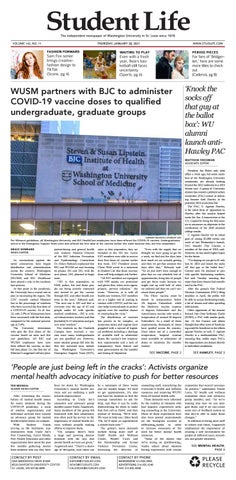
Per Missouri guidelines, all Washington University and BJC HealthCare employees have been offered the COVID-19 vaccine. Undergraduates active in the Emergency Support Team were also offered the first dose of the vaccine earlier this week because they are first responders.
GRACE KENNARD NEWS EDITOR As vaccinations against the novel coronavirus have begun distribution and administration across the country, Washington University School of Medicine (WUSM) and BJC Healthcare have played a role in the incolutation process. At this point in the pandemic, the University has a crucial role to play in vaccinating the region. The CDC recently ranked Missouri last in the percentage of residents who have received the first dose of a COVID-19 vaccine. As of Jan. 24, only 3.9% of Missourians have been vaccinated with the first dose, compared to the national percentage at 5.6%. The University determines who gets the first doses of the vaccine based on state and federal guidelines. All BJC and WUSM employees have now been offered the vaccine, as they fall into phase 1A, the first tier of Missouri’s suggested roll-out plan:
patient-facing and general health care workers. Medical Director of the BJC Infection Prevention and Epidemiology Consortium Dr. Hilary Babcock explained that BJC and WUSM are now focusing on phases 1B1 and 1B2, with the next phase, 1B3, planned to begin soon. “1B1 is first responders, so EMS, police, fire and those people are being actively contacted and invited to get the vaccine through BJC and other health systems in the area,” Babcock said. “The next one is 1B2 and that is everyone over the age of 65 and people under 65 with specific medical conditions…1B3 is critical infrastructure workers and that [includes] K-12 education and grocery store workers.” Few students on the Danforth Campus have received a vaccine since many undergraduates are not qualified yet. However, some student groups fall into the first few activated tiers, including Washington University’s Emergency Support Team (EST),
since as first responders, they are included in the 1B1 tier. Active EST members were able to receive their first doses of vaccine earlier this week. EST President senior Claire Wild wrote in a statement to Student Life that these vaccinations will help mitigate risk further. “All EST members are equipped with N95 masks, eye protection and gloves that, when worn appropriately, prevent infection,” she wrote. “However, as is with all health care workers, EST members are at a higher risk of coming in contact with COVID, and the vaccine helps tremendously to protect against even the smallest chance of contracting the virus.” The distribution of vaccines has proven to be complex, as numerous states and regions have grappled with a myriad of logistical problems including a shortage of available staff to administer doses, the vaccine’s low temperature requirements and a lack of transparency from federal and state governments on the number and timing of shipments.
‘People are just being left in the cracks’: Activists organize mental health advocacy initiative to push for better resources TED MOSKAL SENIOR NEWS EDITOR After witnessing the exacerbation of mental health issues for many students during the COVID-19 pandemic, a team of student organizations and individual activists have created an advocacy group for mental health-related issues on campus. With Student Union serving as the facilitator, representatives from Uncle Joe’s Peer Counseling, Active Minds, Peer Health Educators and other organizations have spent the past few months gathering stories from students who say they have
been let down by Washington University’s mental health services and are outlining a path towards improvement. According to Uncle Joe’s counselor and advocacy group member junior Emily Angstreich, many members of the group felt frustrated with how administrators often paid lip service to the importance of mental health services without actually making efforts to improve them. “On campus there's been a large and growing discontentment with the way that mental health services are given,” Angstreich said. “There's a shortage of therapists, wait times can
be a minimum of three weeks and are usually longer. It's hard to get appointments…It's also just hard for students to find the courage sometimes to ask for help, and then it can be really disheartening for them to make that first call to Habif, and then instead of hearing, ‘We're here. We want to help you,’ [they hear] ‘Oh, we’ll make an appointment a month from now.’” The group’s main demands include hiring more staff at Habif Health and Wellness Center, WashU Cares and the Relationship and Sexual Violence Prevention Center, increasing the diversity of
counseling staff, centralizing the University’s health and wellness resources and removing WUPD from all mental health calls. These demands were informed by the realities of students who had negative experiences seeking counseling at the University. Many of these experiences have also been posted anonymously on the Instagram account @ stillwaiting_washu in order to increase awareness of the need for better mental health resources. “Some of the stories that we're seeing on @stillwaiting_ washu talked about students having experiences with certain
CONTACT BY POST
CONTACT BY EMAIL
CONTACT BY PHONE
ONE BROOKINGS DRIVE #1039 #320 DANFORTH UNIVERSITY CENTER ST. LOUIS, MO 63130-4899
EDITOR@STUDLIFE.COM NEWS@STUDLIFE.COM CALENDAR@STUDLIFE.COM
NEWSROOM 314.935.5995 ADVERTISING 314.935.4240 FAX 314.935.5938
counselors that weren't necessarily positive,” sophomore Nicole Leers, SU health and wellness committee chair and advocacy group member, said. “So we’re looking into how we can mitigate those, and if we can create some sort of feedback system so that they're able to make those changes.” In addition to hiring more staff to reduce wait times, Angstreich emphasized the importance of creating a safe environment for people of different races, sexualities and gender identities.
SEE MENTAL HEALTH, PAGE 3
2 STUDENT LIFE
EM MCPHIE & TED MOSKAL | SENIOR NEWS EDITORS | NEWS@STUDLIFE.COM
theFLIPSIDE FLIPSIDE THU 28 SUNNY 35/23
FRI 29
PARTLY CLOUDY 44/29
MON 1
AM CLOUDS/PM SUN 37/23
SAT 30 RAIN 44/39
TUES 2
PARTLY CLOUDY 41/29
SUN 31
RAIN/SNOW 43/28
WED 3
PARTLY CLOUDY 45/40
EVENT CALENDAR Leadership Perspectives: 6 executives. 60 ideas. 60 minutes. Virtual Event, 12 p.m. How did great leaders get where they are today? Aside from talent, drive and smarts, how do they do it? Join us for our special event: 6 executives. 60 ideas. 60 minutes.—a fast-paced panel that gives successful business leaders the opportunity to boil down their philosophies and insights to a few choice words. Each panelist has 10 minutes to share 10 thoughts that have helped them achieve success in their careers. You’ll leave invigorated and armed with thoughtful, provocative and actionable tools to put into practice immediately.
FRIDAY 29 Native Futures, Native Voices Virtual Event, 12 p.m. Join us as we host the Alliance for Native Programs & Initiatives speaker series titled “Native Futures, Native Voices.” This three-part series focuses on ways Indigenous peoples continue to contribute and offer knowledge to the fields of art, education, history, humanities, environment and spirituality.
SATURDAY 30 African American Architecture in St. Louis: The Case of Charles E. Fleming Virtual Event, 10:30 a.m. In this panel discussion, Washington University architectural historians Shantel Blakely and Eric Mumford will join architect Michael Willis (AB ‘73; MArch/MSW ‘76) in an interview of Charles E. Fleming (UC ‘61) about his more than 50 years of experience as an architect. As one of the first African Americans to earn a degree in architecture from Washington University, Fleming has made significant contributions both regionally and nationally to the field of modern architecture, including numerous residential projects in the St. Louis region. The discussion will delve into Fleming’s design approach and experience related to several of these projects completed during the late 1960s and early 1970s.
SUNDAY 31 Celebration of life for Garrett Albert Duncan Virtual Event, 4 p.m. A virtual memorial service for Garrett Duncan, associate professor of education and of African and African American studies, both in Arts & Sciences. Duncan died Dec. 8 at the age of 59.
VACCINE from page 1 Director of the University’s Institute for Public Health Dr. William Powderly clarified the genetic makeup of the vaccine means that some doses will inevitably be spoiled. “Because of their [mRNA vaccines] instability, you have to discard unused vaccines at the end of the day,” Powderly wrote in a statement to Student Life. “Most vaccine sites try to use all their doses and will vaccinate people ‘out of turn.’ So for example, we have a wait list of people who don’t have an appointment but who could come to the center at short notice, and will call them to come in if we know we will have unused vaccines.” The result of this process is that some lucky individuals receive their vaccine dose earlier than anticipated. This is exactly what happened to Plant and Microbial Biosciences graduate student Eric Conners. “It was dumb luck that I got vaccinated,” Conners said. “And had I not gotten lucky, the situation I would be in now would be confusion.” Conners received a Slack message from another graduate student that a clinic on the WUSM campus had low turnout one day. He arrived at the clinic as soon as possible, and as a WUSM employee, he was able to get his first shot of the COVID-19 vaccine. However, he added that the vaccine distribution process had caused a lot of confusion for himself and other health care employees. “One [email] from Jan. 21 said the vaccine is now available to all WUSM and BJC employees so
that’s the latest we have heard,” Conners said. “So I think at this point they’ve opened it up to, I imagine that includes graduate students…but there’s been a lot of confusion.” Conners said that he understands the difficulties that WUSM, BJC and other health care systems face, but still wishes there was more frequent communication. “I get it because…the federal government didn’t do anything and so it was up to the states to figure it out and most states, including Missouri basically said ‘Ok, cities and counties you figure it out,’” Conners said. “So everyone just keeps passing it along and so nobody ends up being responsible for anything. Having said that, it’s weird that early on there wasn’t messaging to say ‘If you’re a student or employee, you are going to get vaccinated through us, just be patient.’ Which is why I think a lot of people are waiting around and aren’t sure when or how to get vaccinated.” Administrators appear to have responded to this call for transparency and communication, scheduling an “Ask the Doctors Town Hall” with top medical experts Dr. Cheri LeBlanc and Dr. Steven Lawrence, Jan. 27. “Many of you are wondering whether the University will be administering the vaccine to Danforth Campus faculty, staff and students,” the announcement in the Danforth Campus Digest read. “At this time, people working in higher education are not a specific group that is eligible to receive the
Parents, students call for increased COVID-19 testing and transparency in spring semester ORLI SHEFFEY NEWS EDITOR
THURSDAY 28
vaccine under the current guidance.” The announcement encouraged students and employees to pre-register with BJC healthcare and their local municipalities. “The major goal is to get everyone who wants to be vaccinated a vaccine,” Powderly wrote. “Right now (and for the next few months) demand greatly exceeds supply—so we don’t want to waste any vaccine.” The numbers from BJC’s new pre-registration system clearly illustrate this reality that the number of doses coming from the state is wildly inadequate. “We opened this pre-registration portal on Monday [Jan. 18] at eight o’clock in the morning,” Babcock said. “Over 180,000 people have registered on that site so far. The state currently gets about 70,000 to 75,000 doses per week for the entire state of Missouri. So as you can see, there’s a big disconnect…It’s not a great place to be.” The latest update from Drs. Lawrence and LeBlanc assured students that the University will remain in “close contact” with the state, BJC and regional health departments about potential vaccinations for Danforth Campus employees and students and keep the campus community updated about new developments. “I know a lot of people want to get vaccinated and like I said, I’m thrilled that so many people want to get vaccinated,” Babcock said. “We just have to ask for patience as we all wait to see how much vaccine we have and try to get that out to people.”
THURSDAY, JANUARY 28, 2021
With Washington University’s COVID-19 testing policies remaining largely unchanged from the fall semester, parents and students have called for more frequent COVID19 testing and increased transparency for the spring semester. Consistent with the fall plan, undergraduate students have been required to undergo entry testing upon arrival and will begin biweekly surveillance testing with the University’s PCR saliva test on Feb. 1. At any point in the semester, students, faculty and staff who present symptoms or who are contact traced have access to diagnostic testing. Public health requirements, including universal masking, physical distancing, daily self-screening and personal hygiene will continue to be enforced. Since Aug. 1, 224 undergraduate students, 76 graduate students and 159 faculty and staff members have tested positive for COVID-19. After receiving an email from Vice Chancellor for Student Affairs Rob Wild on Jan. 15 revealing that testing policies would not change, parents Arturo Cázares and Suzanne Jacobs authored a petition to the administration and Board of Trustees. “This is a very risky time, as the beginning of the second semester coincides with both the highest hospitalization and death rates of the pandemic, and, equally concerning, the emergence of Covid mutations that are much more contagious,” the petition read. The petition called for surveillance testing twice a week for all students, faculty and staff throughout the semester. Additionally, it requested two re-entry tests (one at arrival and one five days later), self-isolation until the second re-entry test result comes back negative and consideration of online classes for the first two weeks. Cázares and Jacobs garnered more than 240 signatures through the Facebook group “WashU Parents - Covid-19 info exchange,” which now includes approximately 1,100 parents. Cázares and Jacobs pointed to national experts such as Dr. Anthony Fauci, the President Joe Biden’s chief medical advisor, who advocated for ongoing “surveillance testing every few days” on college campuses, and Dr. Rochelle Walensky, incoming CDC director and Washington University alumna, who co-authored a JAMA report arguing that colleges need to test students every two days to prevent outbreaks. Moreover, the American College Health Association recommends that colleges test students twice per week. Dr. Cheri LeBlanc, executive director of Habif Health and Wellness, wrote in a statement to Student Life that “all expert panels, the American College Health Association, the National Academies of Science and Engineering Medicine and Dr. Fauci
have said that the strategies a University chooses need to match the needs and circumstances of that particular institution.” Wild agreed, saying, “With all due respect to Dr. Fauci, and I know he's been a great national leader, we are really trying to focus on our own data and evidence here in St. Louis and on campus as well as our physicians who are advising us on this to do the right thing strategy-wise.” LeBlanc wrote that infectious disease experts on the University’s COVID Monitoring Team reviewed many studies to find an “ideal” surveillance testing frequency, along with data from the campus and surrounding community. She argued that many studies did not include other mitigation efforts such as masking and physical distancing. “Each of the public health measures in our strategy has a proportional impact of reducing this number. Universal masking brings it down by at least 30-50%, physical distancing another 30-50%,” LeBlanc wrote. “That leaves testing to reduce the reproduction number by 10-20%, which can be done with a 14 day interval…More frequent testing would be unlikely to make a significant difference.” Parents are continuing to look to COVID plans on similar college campuses, questioning the major differences in testing protocols. “If testing twice a week is seen as unnecessary as a mitigation strategy, then why are the majority of peer institutions using it and why is frequent testing one of the cornerstones of the American College Health Association?” parent Kit Bix asked. Peer institutions such as Cornell University, Duke University, Rice University, Vanderbilt University, University of Pennsylvania, Johns Hopkins University, Tufts University, Princeton University, Northeastern University, Tulane University and the Massachusetts Institute of Technology conduct surveillance testing of undergraduate students at least twice a week. Many of those institutions also required more than one re-entry test and extended surveillance testing to graduate students, faculty and staff. “Parents can’t understand why Wash. U. is such an outlier on this and why they’re actually making arguments against more testing,” Cázares said. “Everyone else sees value in frequent testing.” Both Wild and Dr. Steve Lawrence, an infectious disease expert at the University, have said that testing students too frequently can “psychologically create a false sense of security” due to the possibility of false negatives. “I just find that argument really weak,” Bix said. “Wash. U. has really smart and capable students, so they understand the logic of false negatives.” Wild and LeBlanc have indicated that if the situation changes, they could increase the frequency of surveillance testing.
LeBlanc wrote that an increase in testing would be based on St. Louis Metropolitan area case statistics, along with campus statistics and the capacity at nearby hospitals—all metrics that the COVID Monitoring Team analyzes daily. “We could add in a minute’s notice increased surveillance testing, but we don’t believe that’s warranted right now going into the semester, based on the guidance that we received from our colleagues,” Wild said. “We are working seven days a week, carefully monitoring the situation and are ready to pivot and change our strategy if we need to,” LeBlanc wrote. Parents, however, have been frustrated by this response from the administration and have called for a proactive approach to surveillance testing, rather than a reactive approach. “The beginning of the semester is when you need to be most aggressive in testing and other mitigation strategies,” Bix said. “Students are coming from all over the country, there are new variants that are much more transmissible [and] most students have not done rigorous testing at home, so mixing them all together makes the worst possible situation. We shouldn’t just wait and see and then change protocol.” “The philosophy of ‘We’re flexible; if it gets bad we’ll pivot,’ is telling us parents that they will let a certain number of our beloved children get sick,” Jacobs said. “How many kids getting sick would it take before they increase testing? 100? 150? I don't want my kid to be part of that 100 or 150.” Students who support increased testing have also argued that it would help mitigate anxiety and improve mental health. “Getting tested more frequently would help calm my nerves,” freshman Justin Lewitus said. “The fact that testing was not very routine last semester, just every two weeks, meant that every test was more stressful.” Junior Jade Leslie added that more communication and transparency are needed. “I know that they have to work really hard to make all the decisions, but more upfront communication would help,” Leslie said. Cázares said that a more transparent COVID19 dashboard and more frequent communication from the administration regarding the data collected would improve the mental of the community. Unlike many peer institutions, the University does not publish the number of tests collected each day or the number of students in quarantine, and they do not consistently provide commentary on the data. “If they’re transparent about the numbers and where there are cases, which dorms, students can do a better job of taking care of themselves,” Jacobs said. “We’re all on the same side here,” Bix said. “We all want the same thing, which is the safety and health of the students and the community.”
THURSDAY, JANUARY 28, 2021
EM MCPHIE & TED MOSKAL | SENIOR NEWS EDITORS | NEWS@STUDLIFE.COM
STUDENT LIFE 3
HAWLEY from page 1 For Jordan Roberts, a graduate of the class of 2010 who has been handling FEC compliance for the PAC, the possibility that even an extensive advertising and advocacy campaign could get Hawley to resign did not seem realistic. A PAC seemed like a better way to push for long-term change. “Ultimately, this is a strategy that we think can be most impactful and have an actual result, because I don’t think any of us were fully confident that [Hawley] would just voluntarily remove himself from the situation,” Roberts said. He and Gaynor framed the PAC’s work as a way of having an impact on the state that they say had an incredible impact on their own lives while at Washington University. “Even if they don’t live there now, I think everyone has an affinity and connection to the school and a certain pride in standing up for and wanting to see the best for St. Louis, specifically in our case, and the state at large,” Roberts said, noting that this PAC could be one part of a broader effort to make sure that Missouri’s elected officials better represent the state’s people going forward. The group cannot give more than $10,000 to any individual candidate ($5,000 for a primary election and $5,000 for a general election). Still, Gaynor maintained that those direct donations could make a difference.
“I’ve worked in offices where 50 people are sharing the bathroom [and where] the only food available is a Costco bucket of pretzels,” he said, referring to past experience on political campaigns. “$10,000 makes an enormous difference in a campaign that is combating an incumbent.” The PAC’s tools extend beyond direct donations to campaigns. Multicandidate PACs can give up to $15,000 per year to a party national committee, and the organization can sponsor advertisements, flyers and other campaign materials. While PAC leadership expects that most viable challengers to Hawley will be Democrats, organizers remain open to donating to Republicans. Teddy White, a member of the class of 2011 who is an informal advisor to the PAC, stressed that the organization’s goal is more about defending democractic principles than anything partisan in nature. “We want to have representatives that have a higher baseline of integrity, and Hawley very clearly showed that he doesn’t meet the bar,” he said. The group plans to consider Republicans on a case-by-case basis. “If you take, for example, somebody who has displayed the courage of [Utah Senator] Mitt Romney, for example, or Jeff Flake, the former senator from Arizona, we certainly would consider supporting that candidate,” Gaynor said. Eventually, a steering
committee will determine how to disburse the money, and Gaynor said the PAC will be transparent with its donation strategy. For the time being, however, the PAC will wait and build up resources for future candidates. The PAC might extend support beyond 2024 Senate candidates to include other politicians who could help challenge Hawley in the future, such as House candidates or state and local elected officials, though the latter would both require the creation of a state-based PAC. “Regardless of which candidates emerge, we want to let those candidates know that they’re going to have support, as long as they abide by democratic principles, from U Against Hawley PAC from the start,” Gaynor said. So far, the PAC has done no marketing—all of its fundraising has come from word-of-mouth as organizers reach out to their friends, acquaintances and networks. While the organizers are mainly University alumni (Gaynor, Roberts and White were all part of a KWUR political talk show in the late 2000s), they have made efforts to make the PAC as inclusive as possible. In addition to raising money from University alumni and others across the country, they said they had received donations from alumni of other Missouri institutions such as Saint Louis University, the University of Missouri and Fontbonne University.
COURTESY OF NATUREOFTHOUGHT VIA CREATIVE COMMONS
Senator Josh Hawley at a campaign stop in 2018. Hawley beat incumbent Democrat Claire McCaskill that year by almost six percentage points. The new anti-Hawley group, U Against Hawley PAC, aims to raise $1 million by 2024 to prevent Hawley’s re-election.
“It strikes a chord with people,” White said. “Everyone seems to be very happy because it’s a step beyond just bemoaning the situation.” The response has also impressed Gaynor. “It’s been really, really encouraging to see donations roll in from both Democrats and Republicans, people who make a lot of money and people who are just barely scratching by during the pandemic,” he said. “They understand that regardless of how this election turned out, we’ve got to set the standard for all future elections that the will of the people is
upheld, and that political expediency or preparing for your own presidential run in 2024 isn’t an excuse to incite a mob to invade our capitol with zip ties and knives and guns.” Some have mentioned Hawley as a potential candidate for the 2024 Republican nomination for president, but Business Insider reported Tuesday that Hawley has said he will not run for president in 2024. However, Hawley campaigned for Missouri Attorney General in 2016 on the promise that he would not use the office as a springboard for political gain, but later announced
his Senate run within a year of taking office. In 2018, Hawley won his Senate race against incumbent Democrat Claire McCaskill by nearly six percentage points, 51.4-45.6. According to the Center for Responsive Politics, McCaskill’s campaign spent more than three times as much as Hawley’s—$38.7 million versus $11.4 million—and had more support from outside groups, $44.6 million versus $32.1 million respectively. Hawley’s office did not respond to requests for comment.
MENTAL HEALTH from page 1 “The majority of our therapists are white women, and so there are not a lot of places for people of color to go if they want someone who understands their own racial identity,” Angstreich said. “Same with students who are trans or even just in the community who are looking for someone that understands what they’re [going] through.” Another anonymous student from @stillwaiting_washu described feeling “overwhelmed” when multiple WUPD officers showed up in their room in response to a panic attack. Due to concerns that students of color often feel unsafe around WUPD officers, the advocacy group has joined many other student activist groups on campus in calling for WUPD to end its involvement in mental health calls. Angstreich, who is looking into this issue as part of the Gephardt Center’s Civic Scholars Program, outlined a few potential alternatives to WUPD. “Ultimately, a social worker could do that job in a much more effective
way,” Angstreich said. “One idea is that hypothetically, students from the Brown School could enroll in a practicum and they could actually be doing that work, since that is a really good experience...Another idea I know was proposed was adding money to the WUPD budget, specifically to hire social workers who can address mental health crises...However, because that’s still tied to WUPD, it might not be a good idea.” According to SU Senate Speaker and advocacy group member junior Gaby Smith, the last few months have been more of a planning phase for the group, but this semester she hopes to ramp up efforts to pressure administrators to take action. “We're hoping to consolidate them [stories from @ stillwaiting_washu], summarize some key scenes and findings and present them to the administration,” Smith said. “I think we've seen, at least in my time in Student Union, quite a few administrators seem to be ideologically committed to mental
health and have acknowledged that it needs to be a priority on campus. I think the main goal of this collective advocacy initiative is to actually ensure that we see tangible action to back up this commitment to mental health.” Although Smith’s presentation to administrators has yet to take place, Leers and other representatives from the advocacy group have spoken to the Office of Student Affairs about some short term solutions to the mental health crisis caused by COVID-19. “As of now, we are trying to get Student Affairs and some of the academic deans to allocate some of their funding to counselors for Habif,” Leers said. “We are also trying to find some more short-term resources for students, because in the big picture we want a lot more counselors...and are hoping eventually for a health and wellness building, but at the same time there has to be some kind of shortterm supplement as well. We've been seeing everything getting pushed down the line and people are just being left in the cracks.”
As a counselor for Uncle Joe’s, Angstreich expressed frustration with how her job often requires her to refer students to certain resources, which she knows have serious problems.
“We have to always give caveats like, ‘Hey, Habif will give you X amount of free sessions. However, it will take you three weeks for your first appointment, and the initial triage might be really harsh and clinical
and not feel very comforting,’” Angstreich said. “We have to be the ones to say, ‘Here's what's available, but it's not a great situation. We can offer you this resource, but it could be a lot better.’”
Emma Baker Editor-in-Chief editor@studlife.com
Kya Vaughn Senior Forum Editor forum@studlife.com
Curran Neenan Senior Photo Editor photo@studlife.com
Sabrina Spence Social Media Director
Adrienne Levin Coleman General Manager a.coleman@studlife.com
Matthew Friedman Associate Editor
Dorian DeBose Josh Shapiro Senior Sports Editors sports@studlife.com
JJ Coley Isabella Neubauer Copy Chiefs copy@studlife.com
Isabella Neubauer Sabrina Spence Senior Cadenza Editors cadenza@studlife.com
Vivienne Chang Kathleen White Engagement Editors
Copyright © 2020 Washington University Student Media, Inc. (WUSMI). Student Life is a financially and editorially independent, student-run newspaper serving the Washington University community. Our newspaper is a publication of WUSMI and does not necessarily represent the views of the Washington University administration.
VOLUME 142, NO. 11
Jayla Butler Kya Vaughn Managing Editors Em McPhie Ted Moskal Senior News Editors news@studlife.com Benjamin Simon Senior Scene Editor scene@studlife.com
Mia Goldberg Design Chief design@studlife.com
HN Hoffmann Jaden Satenstein Christine Watridge Multimedia Editors
Nathan Springman Website Editor Jamila Dawkins Forum Editor Grace Kennard Julia Robbins Orli Sheffey News Editors Jaime Lee Spencer Linenberg Kamala Madireddi Clara Richards Designers
Tammy Dunsford Advertising Sales Supervisor dunsfordt@wustl.edu
4 STUDENT LIFE
SCENE
BENJAMIN SIMON | SENIOR SCENE EDITOR | SCENE@STUDLIFE.COM
THURSDAY, JANUARY 28, 2021
New Year’s resolutions for a second semester in the pandemic OLIVIA POOLOS STAFF WRITER With one semester under my belt, I did a little reflecting on how it went. Now, I consider myself a seasoned sailor of the COVID-infested waters that at some points, I’ll admit, made me a little nauseous. I’m learning to steer my metaphorical boat more smoothly. Here are a few of my new semester resolutions that I’m hoping will guide me through whatever new challenges these next few months will surely bring:
Be unafraid to brave the weather With the safest activities occurring outside, where the risk of virus transmission is greatly reduced,
I don’t want to be held back from doing the things I want to do by a little precipitation or wind. I want to play frisbee in the rain, run in the snow and bundle up to eat distanced meals outside with other people. I’m choosing company over comfort, because while the weather will always be there to spoil your plans, I’m not wasting any time waiting for the perfect sunny day to make memories. Some of my best experiences stem from braving discomfort together. I have fond recollections of late-night runs in downpours and hot coffees after walks in the cold.
Take a class that scares me In college, and at
Washington University in particular, there is a pressure to find your path in life and run down it quickly. Even though I have a pretty good idea of what I like and am comfortable with, I want to take a class that doesn’t fit into my intended major’s bounds. I’m thinking about acting –– or maybe dance. Freshman year seems to be the best year to explore new fields before the weight of required credits becomes too heavy. I’m excited to break out of my comfort zone and maybe learn a little Shakespeare while I’m at it.
from many well-meaning upperclassmen and graduates before college was “these four years are not the time for sleeping.” The idea of sacrificing sleep for late-night memories is generally one I’m agreeable with. Yet when I started to lose some short-term memory functioning due to sleep deprivation fall semester, I realized that that advice has limits. This semester I am continuing my five-day-a-week nine a.m. classes and have decided to limit my late nights (defined as later than one a.m.) to weekends and the occasional weekday.
Fix my sleep schedule
Say yes to (almost) everything
One piece of advice I’ve heard over and over again
Before coming to Wash. U., I had a strong aversion
to board games –– one that originated from tedious hours of Monopoly and long, drawn-out explanations of rules. Yet once I got to school, I said yes to learning a few new games, and not only loved it, but met some of my closest friends through intense rounds of Coup and Resistance. Though this might be a small (and yes, nerdy) example, I’ve found that saying yes to things that I may have an aversion to or am uncomfortable with usually has good consequences. Of course, there are exceptions to the rule –– namely, things that are blatantly risky for contracting COVID or breaking a leg –– but for the most part, adopting a down-for-anything attitude has served me well at Wash. U.
Prioritize good eating Even though this may seem like the typical New Year’s “eat more vegetables” resolution, hear me out. By the end of fall semester, I got really lazy with my eating habits, getting the same food for each meal. And while I do like BD stir fry and cold sandwiches from Paws and Go, I’m going to make an effort to diversify my diet, as long as I’m still spending the same amount of money for each meal. I want to make the trek down to Parkside for hot paninis on Fridays, walk to the DUC for lunch specials and sample new restaurants on the Loop on weekends. Just like making the effort to find new and scary classes, I want to put in the work to eat more exciting meals.
Repurposed through quarantine: WU senior sews to TikTok fame JULIA ROBBINS STAFF EDITOR It all started at a summer camp in the mountains of New Hampshire. Every Saturday night the campers would get together for a weekly square dance. Sam Fox senior Emma Rubinson’s first foray into fashion was cutting up T-shirts with one of her friends so they had zany outfits to match the camper-agreed-upon crazy dress code for the dances. Rubinson is now on the cusp of receiving her Bachelor’s in Fine Arts in fashion and is the creator of a TikTok account with just under 110,000 followers, where she shares her extensive knowledge about the inner workings of fashion to the online world. After that square-dancefilled summer at camp, Rubinson took some sewing classes throughout middle school and got into upcycling: the process of repurposing goods, like shopping bags, newspaper and candy boxes, into new creations. “I’ve always been interested in taking materials and seeing how far I can push them.” On a flight to Israel during her senior year of high school, Rubinson used a pair of giant needles to knit together shredded up T-shirts. She had rounded up around 200 T-shirts from friends that she shredded into T-shirt yarn. After spending around 100 hours
on the project, she had finally completed a gownlength dress. While Rubinson has since parted ways with that dress she made at the age of 17 (affectionately referred to as “my firstborn child” in one of her video’s captions), she brought it back into the public eye on her TikTok account. Like a lot of people cooped up over the past summer, Rubinson’s friends told her that she should download the popular video-sharing app. Her friends not only succeeded in the initial push for her to download the app, but also successfully encouraged her to post fashion content. “For some reason I was bored enough that I was like, ‘I'm just gonna do it,’” Rubinson said. While the initial decision to start the account was largely made out of boredom, the decision to grow her audience was driven by the potential for opportunity that the app held. Rubinson saw TikTok as a way to grow a platform for her work and drive traffic to her Instagram, her website and her online store. Besides those tangible benefits, she recognized the importance that TikTok could hold in the workforce. She realized she could sell herself not only as a passionate designer, but as someone with a deep knowledge of this
burgeoning media tool. Rubinson currently has a total of 1.2 million likes on her videos and her most liked video, showing viewers how to sew a circle skirt, checks in at around 1.1 million views. Her videos are clearly being put to good use by some of her followers, with one viewer commenting “I just made this and I LOVE it,” and another commenting “this is the easiest way I’ve ever heard this explained” (both comments made complete with some emojis, true to TikTok form) on her circle skirt video. Her initial goal was to hit ten thousand followers so she could join TikTok’s creator fund and start getting paid. The next goal, which she has also met, was to reach a hundred thousand followers so she could start receiving sponsorships. “I’ll show you what I got,” Rubinson said on our Zoom call, reaching for a white water bottle from ‘The Coldest Water’ brand. “This is my first sponsorship. It has my name engraved in the back.” Rubinson’s current goal to reach a million followers is spurred not only by the immediate financial benefits that come with it, but from a drive to draw attention to her work. “How sick would it be to have a million followers to release my collection to?” Rubinson said, referring to the collection she’s making
as part of her Wash. U. capstone project. Rubinson is currently a part-time student at Sam Fox, taking two studio courses to work on the capstone collection that all fashion students are required to create for their major. “Mine’s about dreams,” Rubinson said. “I've always just been really interested in dreams and challenging our concept of reality.” Her fascination with dreams is manifesting itself in her work through different materials—some of which are light reactive, others that glow in the dark, some that are holographic and others that change their appearance under black light. “I’ve just done a lot of research into dreams over my life,” Rubinson said. “I feel like it's personal and it's something that people can relate to, and it was also an opportunity for me to just go crazy with whatever.” “You can't tell me that's not really a dream.” Rubinson is currently stitching together her phantasmagorical fashion world in the basement of Bixby Hall. She shares the room with the six other seniors completing their capstone projects and the resources they each have in their personal work space: a sewing machine, a desk, a cutting table and a mannequin. The confines of her workspace have not
COURTESY OF EMMA RUBINSON
Senior Emma Rubinson is studying fashion and is the creator of a TikTok account with just under 110,000 followers.
stopped Rubinson from thinking outside her present reality, into not only her world of dreams and the subconsciousness, but into the world that she will be entering post-graduation. “I've very strongly drawn a line between clothing design and fashion design,” she said. Rubinson spoke about wanting to become a fashion designer as opposed to a clothing designer with a level of certainty that comes only from years of engrossing oneself in a certain field. She explained that, in her eyes, clothing design is “meant for a consumer,” “a purpose;” that its foundation lies in its practicality. “I think that it does involve design, but it's not the type of design that I want to be doing,” she said. “I think fashion design, to me, is more of an art form,” Rubinson continued. “I think that it can inform a lot of trends and
a lot of things that you see in the market...but I also think that it has this extra level of creativity.” Developing T-shirt yarn and finding the “beauty in extremes” lines up well with Rubinson’s constant pursuit to reach new levels of creativity within her work. For now, she’s channeling her creativity into her capstone project while keeping an eye on her future. “I'm thinking in kind of two realms right now,” Rubinson said. “One of them is I need a job when I graduate, and one of them is my big dream of wanting to own a fashion couture line.” It was clear from talking to Rubinson that since first beautifying T-shirts for square dances, she has worked endlessly on weaving her creativity into fashion. And now she just has over 100,000 followers ready to see what she does.
THURSDAY, JANUARY 28, 2021
STUDENT LIFE 5
Upcoming Events: Jan. 28 - Feb. 28 25
M
26
T
27
W
28
T
29
F
1-2 pm: Work Group: Government, Politics, and Public Policy Internships and Jobs
1
2
3
4
5
5-6 pm: Major Decisions Workshop
7-8:30 pm: Where Do I Begin? Architecture Professional Development
12- 12:30 pm: Virtual Career Fair Prep - International Students session
6-6:30 pm: Virtual Career Fair Prep
12-12:30 pm: Virtual Career Fair Prep
12-1 pm: Meet with a Pro: Why Storytelling Matters, Mark Irwin, Kraft Heinz
8
9
4-4:30 pm: Virtual Career Fair Prep
3-6 pm: Spring Internship + Job Career Fair
7-8:30 pm: Digital Portfolio: The Portfolio Alternative
7-8 pm: [Architecture] Job Search and Getting Linked In
15
16
7-8:30 pm: [Architecture] Perfecting Your Portfolio
22
6-7 pm: Humanities and Social Sciences Career Mapping
1-4:30 pm: Training the Street: Investment Banking Interview Workshop 3-4 pm: Career Planning During COVID
11
12
2-3 pm: Communications Careers: Employer Perspectives
1-2 pm: Work Group: Government, Politics, and Public Policy Internships and Jobs
4-6 pm: Net Impact Sustainability Expo
8 am-5 pm: Sophomore Spring 2021 Investment Banking Mock Interviews
17
18
19
12-1 pm: Employer Spotlight: Royal Canin Shares What it Takes to Work in CPG (Panel Discussion)
2-3 pm: Communications Careers: Science Communication Alumni Panel
24
25
26
2-3 pm: Communications Careers: Alumni Leveraging Writing Skills
1-2 pm: Work Group: Government, Politics, and Public Policy Internships and Jobs
4-7 pm: Architecture | Urban Design | Landscape Architecture Career Fair
3-4 pm: Effective Job Search Strategies: For Careers in Industry, Government, and Nonprofits
10
7-9 pm: [Architecture] Speed Portfolio Review
1-2 pm: Work Group: Government, Politics, and Public Policy Internships and Jobs
23
7-8:30 pm: Success at the Fair
12-1 pm: [Pre-Med] Interviewing for Introverts
1-2 pm: Work Group: Government, Politics, and Public Policy Internships and Jobs 3-4 pm: Identifying, Translating, and Developing Your Transferable Skills
4-5 pm: McKelvey Engineering Student + Alumni Networking
7-8:30 pm: [Architecture] Success at the Fair
12-1 pm: [Architecture] Portfolio Discussion
Log into CAREERlink for more information and to RSVP: students.wustl.edu/careerlink SPONSORED BY:
puzzle
mania
Minor in the Business of the Arts
your AD here
Open to all undergrads. Find out more. olin.wustl.edu/arts
sandraphilius@wustl.edu
6 STUDENT LIFE
SPORTS
DORIAN DEBOSE & JOSH SHAPIRO | SENIOR SPORTS EDITORS | SPORTS@STUDLIFE.COM THURSDAY, JANUARY 28, 2021
Basketball teams in limbo as UAA cancels conference games JOSH SHAPIRO SENIOR SPORTS EDITOR Despite the change in calendar year, Washington University’s basketball teams remain stuck in holding patterns. The University Athletic Association has already canceled all conference games this year. And in line with many of its UAA counterparts, the Athletic Department has maintained
its own internal restrictions on practices and local competition. Individual players have been limited to masked shooting and non-contact practices, and it is still uncertain whether men’s or women’s basketball will be able to practice with contact, yet alone play against other teams. For women’s basketball head coach Randi Henderson, the extended
lapse has provided a unique opportunity to think outside the box and re-tool the Wash. U. student-athlete experience. Many of the team’s activities have moved off the court to Zoom, where Henderson has focused on building the team’s culture and rapport. “We've had some speakers come on to our Zooms that have been really great on leadership and worked with the
CURRAN NEENAN | STUDENT LIFE
Freshman Karisa Grandison spots an open passing lane against Claremont-Mudd-Scripps in December 2019. The Washington University women’s basketball team went 14-11 last season.
diversity and inclusion office on campus,” Henderson said. “I think the good part about this downtime is that we've been able to continue to really get to know each other better and as players and as people.” Henderson has also been forced to adapt her recruiting process to a remote environment. The pandemic postponed Wash. U. teams’ summer athletic camps and has canceled many high school basketball seasons, which are typically important recruiting tools. For the games that have been played, attendance has been highly restricted, forcing Henderson—who prefers to watch potential recruits play in person—to watch tapes virtually through Zoom. Fortunately, Wash. U.’s vast array of resources and academic reputation have allowed both the men’s and women’s teams to continue finding fresh talent. Men’s basketball coach Pat Juckem specifically praised the admissions office's vast outreach apparatus. Trappings such as virtual tours allowed prospective athletes to get a sense of what it looks like to
play for the Bears. Juckem believes that many of the new recruiting and team bonding practices will stick, even after the pandemic recedes. “We've certainly watched a lot more film of prospective athletes," he said. “In some ways, we've developed deeper relationships, because it was really the only thing we could do. We had more face-to-face interaction, and it really forced us to be creative.” Coaches and players have also gained a new sense of perspective and appreciation for competitive basketball. Just ten months ago, the men’s basketball team was poised to make a splash in the NCAA tournament, four short wins away from a championship. That now seems like a distant past. “I think the hardest part about some of the loss of opportunities this year is that these opportunities are finite,” Juckem said. A return to competitive play in next few months seems unlikely. Henderson worries that even if Wash. U. does allow its teams to play locally, the lack of formal practices may heighten the
risk for injuries. But for both teams, the unusual interlude has served as motivation to leave it all on the court when basketball finally does return. “I'm really proud of the way that my players have handled the lack of knowing and the constant adjusting,” Henderson said. “They've stayed super flexible. I think they've kept really good attitudes.” The hunger to win—particularly to honor those seniors whose final years have been stunted by the pandemic—runs deep in these teams’ cultures. “I think one of the hallmarks of our team is how connected they've been,” Juckem said. “Our older players take the younger guys under the wings and show them the ropes, not only within the sport, but also navigating Wash. U. In return, certainly those younger players feel indebted. I think you always have that dynamic where you want to send your seniors out in the right way.” Wash. U. athletics are not quite back yet. But when they return, you can be sure the Bears will be ready to play their hearts out.
Grit and Grind: The Memphis Grizzlies and the hope for a brighter future DORIAN DEBOSE SENIOR SPORTS EDITOR In 2019, I took an important step in my
journey to adulthood. After years of uncertainty, foot-dragging and apathy, I decided to commit to an NBA team. I grew up in
Overland Park, Kansas—a suburb of Kansas City. My blood runs University of Kansas Jayhawk blue and red, but I’ve always been
envious of people who grew up in places where fandom was instilled early. There’s something beautiful about devotion to a team—to celebrate triumphs and wallow in pitfalls of something over which you have no control. I ultimately chose to root for the Memphis Grizzlies. I always loved watching the Grizzlies play as a kid. Football was my first love and they played basketball like linebackers. The Grit and Grind Grizzlies that battered the San Antonio Spurs were one of the first basketball teams I really cared about. As a little chubster, I saw myself in Zach Randolph. I envied Mike Conley’s effortless scoring prowess and Tony Allen’s tenacity. I loved the Grizzlies, but I was still a wild horse, unwilling to be saddled with the label of “fan.” Appreciator, sure. But “fan” carried an intimacy that I just wasn’t ready for at 13. I spent my late teens rooting for various teams. I enjoyed the Warriors when Andrew Bogut was their centerpiece. I was on the Thon Maker hype train in Milwaukee. I tried to find a squad that I could really throw my support behind, but I never felt the same fervor I did when I first saw those Grizzlies. When Grayson Allen joined the team in 2019, I decided it was time to make things official and join the Grizzlies fandom. It appeared that Grit and Grind was back! I was wrong. The Grizzlies had some talented pieces in 2019, but they were not a very good team. Stalwart defender Marc Gasol was gone. Mike Conley—the heart and soul of the team—was gone. Randolph and Allen had retired. In their place was the Bruno Caboclo of teams: a team two years away from being two years away. A team full of potential. But Kwame
Brown had potential. There was a chance that I had hitched my wagon to a sinking ship and doomed myself to a decade of heartbreak and mediocrity. In March of 2020, the Grizzlies looked like I thought they would: They were clearly very talented, but they weren’t a truly competitive team in the NBA yet. I was on top of my classes, I was doing well personally. My biggest worry was whether the Grizzlies were going to reach their potential. I miss that naivety; when a sports team I decided to cheer for a year prior could monopolize my mind for hours on end. I miss the days before my angst shifted from Ja’s ankles to my mother’s lungs. During the pandemic, I’ve gone back and forth on how I should feel about watching sports. They’re a nice reprieve, but it often feels like I’m looking back at a past we can never regain. Staring at my TV screen reminds me of how many games I would have been at this year, how intimate it was to share stands with people who all cared about the same thing as me. The current season has lost its luster to me as a sports fan. It’s a nice gesture, but more than anything, I needed something to help me relish the
passing of time again. And funny enough, I’ve found that in the Grizzlies. Whether they win or lose this season is of little consequence to me because the Grizzlies now have a spectacular young core of players. Second year future point god Ja Morant is a burgeoning superstar. Forward/center Jaren Jackson Jr. has all the tools to become an elite defender and an offensive threat. Rookies Desmond Bane and Xavier Tillman are already solid contributors. The sky is the limit on young, athletic forward Brandon Clarke. And that isn’t even mentioning Grayson Allen, Dillon Brooks and Jonas Valanciunas. The Grizzlies look like the team of the future. The past nine months have felt like sputtering wheels, churning up more mud and hardly lunging forward. Survival is at a premium and the future is something we merely theorized about before the world ended. I hardly remember the sweetness of pandemicfree life. However, that the Grizzlies have a bright future is a reminder that our hellish present will eventually become the past. Grit and Grind will ride again.
COURTESY OF MARK RUNYON VIA CREATIVE COMMONS
Marc Gasol, a key member of the Grit and Grind Grizzlies during the 2010s, readies a free throw against the Atlanta Hawks in 2013.
THURSDAY, JANUARY 28, 2021
FORUM KYA VAUGHN | SENIOR FORUM EDITOR | FORUM@STUDLIFE.COM
STUDENT LIFE 7
STAFF EDITORIAL
W
hen we started this academic year, many of us held onto hope that this spring would be different. Come January, we could safely gather in classrooms, dorms and dining halls. That’s not the case. While the introduction of multiple vaccines provides some light at the end of the tunnel that we didn’t see back in September, we are in no way at the tail end of this pandemic. Case numbers are up, the Centers for Disease Control and Prevention have discovered new COVID-19 variants and Missouri’s population has the lowest vaccination rate of any state so far. This is all to say that things are still very, very hard. The Washington University community is struggling, and, although it may seem like this has all become a “new normal,” that doesn’t mean it’s any easier. Remote learning isn’t any easier. Isolation isn’t any easier. And the many financial, medical and mental impacts of the pandemic continue to worsen for many people.
As spring begins, enter with empathy That’s why we ask that the Washington University community starts this spring with an important goal in mind––to remain empathetic. While we may have gone through a similar semester in the fall, students, faculty and staff are still going through a tremendously difficult time. Even though we now have experience with remote classes, the challenges they pose have not gone away. We hope faculty and administrators remain cognizant of these challenges and the toll that this past year has taken on their students. After all, many students are going into this semester feeling burnt out from the mid-break finals period, and the lack of Spring Break will only exacerbate that feeling. In turn, we urge students to show empathy toward their professors, who have had to juggle many personal and professional responsibilities during this time, as well as the many staff members who show up in person each day to provide students with a safe campus experience. If you’re grateful for someone,
GRAPHIC BY HN HOFFMANN
show them. Your actions, large or small, can help people get through these next few months. Whether it be by staying patient with others, donating to mutual
aid funds or checking in with friends, make sure to let those around you, or those far away, know they have your support. This also means having
empathy for yourself. It’s easy to feel like you’re not meeting your own expectations when you’re struggling. And that’s okay. Give yourself some grace,
and remember that keeping yourself and others as safe as possible is still the most important thing you can accomplish as we enter this new semester.
Hindsight is 20/20: Don’t procrastinate on your social life KYA VAUGHN MANAGING EDITOR
M
y first year in college, I had big plans for everything I was going to accomplish in my four years of undergrad. I was going to take every class, see every show, attend every event. And then, of course, after a week or two of college, reality set in and I realized that doing everything was a bit of a stretch, but I could still do some things, most even. But then, of course, yet another reality set in: college isn’t always easy. Classes were harder and they took more
time. Office hours replaced the shows I was supposed to see, exhaustion replaced the events. Sleeping and studying were my two closest companions, as is somewhat the norm for many students who are adjusting to college life. So, I pushed things. My first semester, I pushed the shows and events to the next semester. And then again, I pushed those things to the following year, and the year after that, until all of a sudden three years had flown by and I was now entering my fourth year as an undergraduate. Even more so, I was entering my fourth year not from campus, but from
my childhood home with my family, studying remotely due to the ongoing pandemic. Now, all those things that I pushed and pushed, I can no longer make them a reality, as I pushed them out of existence. Now this is not to say that everything is doom and gloom. Of course, over the years I’ve made great memories, and I’m grateful for the time that I’ve spent. But this is more of a reminder that, although it may not seem like it, our time shared together at this institution is limited. Do the things that make you happy now. Do the things that bring you peace and joy now. Work will always be
there. There will always be another essay, paper, midterm, or final to do, as long as you carry out your education. But there may never be another concert, or a chance to be in the same space with all of your friends. Eventually, your friends may be spread out all across the world. You’ll have your memories, and you’ll have some good ones, but maybe you’ll wish you had more. You’ll look back and remember the fun you had and the things you did, but you will also remember the things you missed and the time you took for granted. That’s not to say that you should let your education fall
to the wayside. We’re all here for a reason, and that reason is largely to further educate ourselves, to become better members of our community and to contribute to the larger societal whole. But education comes in all forms, and not all come from a textbook. This is a time to grow, to learn about ourselves as individuals and to learn about our peers and their individuality. This education is equally important to what you learn in class, and it’s not something you want to abandon. The COVID-19 pandemic doesn’t make the task of enjoying yourself any easier. It can be challenging to see
friends in a safe way. But for what it’s worth, if it makes you happy, do what you can. Go to that virtual game night, check out that random webinar, do that sociallydistant activity that you’ve been wanting to do but have been putting off because of a busy schedule. Eventually, after many semesters, you’ll look up from that textbook and look back over your time here, and you’ll wonder why you didn’t do more when you had the chance. This semester, try to carve out some time for yourself to do that thing you love and make some memories. You’ll thank yourself later.
‘Tis (still) the season to be jolly JAMILA DAWKINS FORUM EDITOR
F
our days ago, I arrived on campus with 25 feet worth of Christmas lights and a resolution: to recreate for myself the Christmas spirit that last year’s holiday season sorely lacked. For most of my life, I’ve been pulled into arguments on Christmas season etiquette. “You start celebrating too early,” I was told when I began humming along to Mariah Carey’s Christmas Album in September. “At least wait until after Halloween,” lectured my spookier
acquaintances when I traded trick-or-treating for a night of Hallmark “Countdown to Christmas” favorites (because yes, Hallmark begins counting down to Christmas in October—as they should). “Let’s wait until after Thanksgiving,” cautioned my well-meaning (and perhaps somewhat overwhelmed) roommates when I started hatching dorm decorating plans in early November Normally, I’d be sympathetic towards–even understanding of–such demands. I’d keep the Christmas music down, or wait until Thanksgiving to start decorating and
enjoying the season in full. But last year, September came and I felt nothing. In October, my midterms started, and by my November slump, I wasn’t feeling much of any spirit, let alone Christmas spirit. Rather than walking around looking at the lights as they went up, I was in my dorm, working or sleeping or Zooming. And once it finally got to Thanksgiving time—the unofficial accepted threshold for the beginning of Christmas cheer—instead of being in my dorm, decorating and enjoying the Jackson 5’s best Christmas hits, I was on my way back home for the
Editor-in-Chief: Emma Baker Associate Editor: Matthew Friedman Managing Editors: Jayla Butler, Kya Vaughn
most COVID deaths and the highest hospitalization rates since the start of the pandemic. Many of us were isolated from family and unable to engage in longheld traditions–both things that we need now more than ever. I recognize that it is a privilege to be able to complain about a lackluster Christmas season. For being healthy throughout that time; for having family to miss during Christmas; and for being able to return to campus this semester to begin this Christmas tirade, I am grateful. That being said, I also recognize that December is
YOUR VOICE: SUBMISSIONS
OUR VOICE: EDITORIAL BOARD Staff editorials reflect the consensus of our editorial board. The editorial board operates independently of our newsroom and includes members of the senior staff and forum section editors.
semester out of fear of the spikes in COVID cases that were happening at the time. Where Christmas had previously crept up on me, always something to be anticipated around the corner, last year it came and went like another Friday. And once it went, I was left wishing that I could have a do-over. This holiday season was different for a lot of us, and probably a little worse than usual for most of us. For many Wash. U. students, the looming weight of January finals likely stripped a little bit of light from the occasion. In December, the US had the
Senior Forum Editor: Kya Vaughn Senior Scene Editor: Benjamin Simon Senior Sports Editors: Josh Shapiro Senior Cadenza Editors: Isabella Neubauer, Sabrina Spence
Copy Chiefs: JJ Coley, Isabella Neubauer Forum Editor: Jamila Dawkins Multimedia Editors: HN Hoffmann, Jaden Satenstein
We welcome letters to the editor and op-ed submissions from our readers. Submissions may be sent to letters@studlife. com and must include the writer’s name, class and phone number for verification. Letters should be no longer than 350 words in length, and readers may
my favorite time of the year and that last year, I spent mine studying, crying, trying to teach my aunts and uncles how to use Zoom so we could talk on the 25th, and generally in a holiday gloom. So—every year, but especially this year— let’s stop gatekeeping the holiday cheer. If you hear Whitney Houston’s “Do You Hear What I Hear?” drifting out of my room, look the other way—and yes, I will be watching Home Alone this weekend. Consider recreating the holiday of your choosing, too. Look for happiness wherever you need to find it.
OUR WEB POLICY also submit longer op-eds of up to 750 words. We reserve the right to print any submission as a letter or op-ed. Any submission chosen for publication does not necessarily reflect the opinions of Student Life, nor does publication mean Student Life supports said submission.
Once an article is published on studlife. com, it will remain there permanently. We do not remove articles or authors’ names from the site unless an agreement was reached prior to July 1, 2005.
8 STUDENT LIFE
CADENZA ISABELLA NEUBAUER & SABRINA SPENCE | SENIOR CADENZA EDITORS | CADENZA@STUDLIFE.COM
THURSDAY, JANUARY 28, 2021
Lusting for Bridgerton? Here’s what to watch as you wait for more SABRINA SPENCE SENIOR CADENZA EDITOR On Dec. 25, Shonda Rhimes knocked it out of the park once again with her new Netflix original series “Bridgerton,” based on the historical romance series of the same name by New York Times bestselling author Julia Quinn. Set in 1813, “Bridgerton” provides just the right amount of scandal, drama and intrigue to keep the Regency Era engaging to a modern audience. With all of season one released at once, it can be easy to slip into a post-show slump. If you believe that waiting for season two is going to be absolutely unbearable (and
even if you don’t), here are some of my favorite period pieces that you can watch in the meantime.
on Netflix—so it won’t take you that long to finish if you decide to watch it all in one weekend.
one season, so there’s time to catch up before the second one comes out.
‘Reign’
‘The Great’
‘The Frankenstein Chronicles’
If you’re a fan of political plots and royalty, you’re going to like “Reign.” Following the life of Mary, Queen of Scots starting in 1557, the first season is all about Mary’s betrothal to Prince Francis. Throw in all of her handmaidens who are also looking to find husbands while at court and you have a powerhouse group of ladies to focus the show around. Plus, the Medicis are involved. This show is only four seasons—and they’re
Where “Reign” is dramatic, “The Great” is funny. Starring Elle Fanning as Catherine the Great and Nicholas Hoult as Emperor Peter III, “The Great” chronicles Catherine’s rise to being the longest-reigning female ruler in Russian history. This show is irreverent, funny and Emmy-nominated, if that is something you pay attention to when choosing what to watch on the silver screen. Premiering last year as a Hulu Original, there’s only
Darker and more serious than others on this list, this Netflix original series does not disappoint. “The Frankenstein Chronicles” moves away from the more flowery, romantic aspects of most period pieces and hits the ground running as a crime TV show that serves as a retelling of Mary Shelley’s novel “Frankenstein.” In this reimagination the lead inspector, played by Sean Bean, finds a corpse made up of body parts from eight
different children. Dark and twisted, there are only two seasons of this chilling show at six episodes each, so it’s a quick watch.
‘Downton Abbey’ I would be remiss if I didn’t include this classic and absolute paragon of historical television. From 2011-2016, PBS ruled evenings with this post-Edwardian television series that garnered millions of viewers the night the first episode aired. Centered around one particular aristocratic family, this show is sure to fill the “Bridgerton” gap whether you’ve seen it before or you’re watching it for the first time. All six seasons are
available on Amazon Prime.
‘Lovecraft Country’ The last but certainly not the least on this list, “Lovecraft Country” combines suspense, the supernatural, and horror with 1950s Jim Crow laws to create a stunning show. Based on the novel of the same name by Matt Ruff, “Lovecraft Country” portrays a dark and silenced part of history with drama, accuracy and fabulous costumes. While a second season has yet to be announced, it still might be a good idea to get a head start on the 10 episodes already out and available on HBO Max.
From Lorde to Tarantino, arts and entertainment wishes for the new year CADENZA STAFF To say that 2020 was a disappointing year for the arts would be an understatement. Concerts were canceled, movie releases were postponed and festivals that would have brought people together couldn’t happen under new restrictions on gatherings. But we adapted; theater productions took to Zoom, musicians live-streamed from their homes and we made it work. It’s a new year, and while we are still dealing with the pandemic that brought life screeching to a halt last spring, the arts have had time to adjust. And though the COVID vaccine won’t be widely available for a while, now that it has started to roll out, we are beginning to see the light at the end of the tunnel and a possible return to inperson events. In case you, like us, felt starved of events last year, our Cadenza staffers list the arts and entertainment events they are most excited for in 2021.
Plays! In Person! I was so excited when I heard that there was a major off-broadway production of Chekhov’s Three Sisters, featuring Steve Buscemi and Greta Gerwig, slated for May of 2020. Needless to say, that production didn’t happen, but I am hopeful that we can resume seeing (and producing, and being in) plays in the flesh, so to speak. I attended a number of luminous Zoom productions in 2020, and these were wonderful in their own way. But I dearly miss hearing audience members react in real-time, being face-to-face with the production, even breathing in the dusty air of a theatre. Plays simply feel more human when you’re watching them in person. Here’s hoping we can feel that humanity in 2021. —Elizabeth Piasecki Phelan, Staff Writer
Catching up on what I missed I’ll be honest—I was looking forward to 2020. One year ago, things were looking great,
entertainment-wise. I have long been a Marvel fan, and 2020 was supposed to kick off the MCU Phase Four. I had tickets to see My Chemical Romance on their reunion tour. And for me, 2021 is like a second chance. None of the MCU content came out last year, but it’s slowly rolling out now, starting with the rollout of the first episodes of “Wandavision” last week. Yes, my concert was postponed a full year, but (at least for now) it’s still happening. Things are by no means the same now as they were a year ago, but they aren’t totally different either. —Isabella Neubauer, Senior Cadenza Editor and Copy Chief
Lorde’s new album (I’m manifesting it) Before you get too excited, no, I don’t know when this much-anticipated album is coming out. But I’m speaking it into existence. “Melodrama” will be a tough act to follow, but I’m sure Lorde’s brilliant mind will deliver something magical. She’s also announced that she’s working with Jack
Antonoff again, and if his recent collaborations with Taylor Swift and Carly Rae Jepsen tell us anything, it’s that this album is going to be a game-changer. —Jaden Satenstein, Multimedia Editor
A cappella concerts One of the biggest parts of Wash. U.’s campus culture is a cappella. Going to themed concerts and seeing friends perform is one of the highlights of my college experience and unfortunately, due to the pandemic, it was sadly absent from all of our lives this past semester. However, with auditions happening as we speak, it is safe to say that a cappella will be back this semester. I personally cannot wait to see how the various groups jump through the hurdles of singing in a pandemic to continue to provide the student body with the joy of song and vocal technique. Hopefully, the wait for our favorite a cappella groups to host a concert—virtually or in-person—won’t be too long. —Sabrina Spence, Senior Cadenza Editor
Movies I’m Anticipating
Upcoming Exhibitions
As Oscar season comes to a close, I’ve reflected on how badly I’ve missed going to movie theaters and sharing screenings with absolute strangers. That being said, there are several films I am excited to see—although probably not in person—this year. First, In the Heights, a movie representation of Lin-Manuel Miranda’s original broadway show. Anything concerning Lin’s music excites me. Next, Top Gun: Maverick, the sequel to the 1986 film Top Gun. This movie will probably be a let down, considering it is one of the most classic movies ever and it just can’t have the ‘80s charm of the original. Nonetheless, I’m interested to see how they follow it up. Finally, I want to manifest a final Tarantino film. Many anticipate him releasing one more film and calling it for good in his directing career, and honestly, that is what I need this year. 2021 really could (partly) redeem itself with a grand finale Tarantino. —Gracie Hime, Staff Writer
One of the things I missed most about my college life when I was stuck at home last year was going to all of the wonderful art museums in St. Louis. There’s nothing like a day at a museum looking at some new art to put your mind at ease during a troublesome semester. That’s why I am very much looking forward to all the exciting exhibitions that local museums have planned for this year! I’m particularly excited to see “Nubia: Treasures of Ancient Africa” at the St. Louis Art Museum, “Stories of Resistance” at the Contemporary Art Museum and “Hannah Wilke: Art for Life’s Sake” at the Pulitzer Arts Foundation. So, for anyone in St. Louis, I would encourage them to put on their cutest museum outfit (extra points for matching mask) and go check out some of the amazing art coming to town this year! —Lydia McKelvie, Staff Writer
drink. dine. play.
WEEKLY BAR, RESTAURANT AND FUN GUIDE
V LARGE SPECIALTY OR UNLIMITED TOPPING PIZZA
13
$
WE ARE THE DELIVERY EXPERTS!
7018 PERSHING AVE 314-726-3030 CLAYTON/WASH U
99
EACH CODE: 9025
OPEN LATE! SUN-THURS 10:30AM-12AM FRI & SAT 10:30AM-1AM
Subscribe to our free e-newsletter... head to studlife.com now and sign up!
Wherever you are, stay connected: Social icon
Rounded square
FACEBOOK.COM/STUDLIFE
@ STUDENTLIFENEWSPAPER
Only use blue and/or white. For more details check out our Brand Guidelines.
@STUDLIFE
STUDLIFE.COM