The independent newspaper of Washington University in St. Louis since 1878 VOLUME 148, NO. 4
THURSDAY, SEPTEMBER 17, 2026
WWW.STUDLIFE.COM
Enrollment in Bursky School of Public Health master’s program declined in 2026 ZANA KENNEDY NEWS EDITOR
Preliminary reports indicate that the incoming Class of 2028 of the Bursky School’s Masters in Public Health (MPH) has seen fewer applicants this year despite an anticipated 15% increase in enrollment. The Association for Schools and Programs in Public Health (ASPPH) estimates a 25% to 30% decrease in enrollment in schools of public health within its member institutions, including WashU, for the 2025-2026 school year, according to an email from Associate Dean for Education Angela Hobson. Hobson predicts that declining enrollment within Bursky has been impacted by decreased funding to public health programming, restrictions on borrowing federal loans for master’s students, and new policies preventing international students from obtaining visas. Regulation on immigration particularly impacted the Bursky School this application cycle. Out of the 90 international students who matriculated to Bursky last application cycle, more than half deferred or withdrew enrollment after being unable to obtain a visa, according to Hobson. “Our MPH cohorts have leaned heavily international in the last few cycles,” Hobson wrote in an email to Student Life. “This last cycle confirms the need for our efforts ... to think and act strategically
25%-30% decrease in MPH applications in the 2025-2026 school year compared to a national decrease of 15% in MPH applications in the year prior.
65 MPH students
last year; this year’s number has yet to be reported.
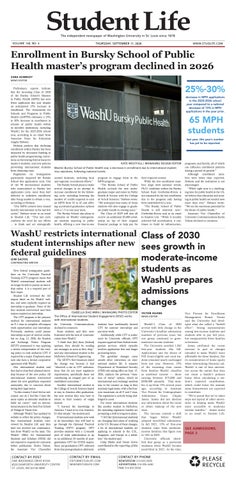
KATE WESTFALL | MANAGING DESIGN EDITOR WashU Bursky School of Public Health saw a decrease in enrollment due to international student visa rejections, following national trends. around domestic, including local and regional, recruitment efforts.” The Bursky School plans to make several changes in an attempt to increase enrollment for the following cycle, including lowering the number of credits required to earn an MPH from 52 to 42 and offering accelerated graduation options with a 1.5 or one-year track. The Bursky School also plans to capitalize on WashU undergraduate students majoring in public health, offering a new four-in-one
program to engage them in the MPH program. “The Bursky School of Public Health co-leads the new undergraduate major and minor in Public Health & Society with the College of Arts & Sciences,” Hobson wrote. “We anticipate that many of those students will also engage in graduate public health in coming years.” The Class of 2029 will also all receive an additional $5,000 scholarship on top of their original financial package to help pay for
their required courses. While the low enrollment numbers align with national trends, Ph.D. candidate within the Bursky School Raul Gierbolini-Rivera is not surprised by the low enrollment due to the program only having been established for a year. “The Bursky School of Public Health is still relatively new,” Gierbolini-Rivera said in an email to Student Life. “While it recently achieved full accreditation, it continues to build its infrastructure,
programs, and faculty, all of which can influence enrollment patterns during a period of growth.” Although enrollment numbers were lower than expected, Hobson said the institution is not discouraged. “While right now is a challenging time for public health in the US, we believe that education and training in public health are needed now more than ever,” Hobson wrote. “We see the enormous potential for the future of public health.” Associate Vice Chancellor of University Communications Kedra Tolson declined to comment.
WashU restricts international Class of 2030 student internships after new sees growth in federal guidelines
moderate-income students as WashU prepares admissions changes
LENI SALTOS
CONTRIBUTING WRITER
New federal immigration guidelines on the Curricular Practical Training (CPT) program mean that WashU international students will no longer be able to pursue an internship unless it is a required part of their major. Student Life reviewed the 163 majors listed on the WashU website, and none explicitly required an internship to graduate. None of the four students interviewed said their majors required an internship. The CPT program is the primary method for international students on F-1 visas to complete off-campus work opportunities and internships. Previously, students could pursue internships as part of elective credits, but on Aug. 12, 2026, the Student and Exchange Visitor Program (SEVP) announced it was applying a stricter interpretation of the existing policy to only authorize CPT if required for a major. Employers must now also have a formal cooperative agreement with WashU. One international student said they had to drop their planned internship because of the new policy. All international students interviewed about the new guidelines requested anonymity due to concerns about losing their legal status. “In this country I don’t feel as welcomed, nor do I feel like I have the same equity as domestic students to build my career,” said an international student in the Sam Fox School of Design & Visual Arts. Although WashU has updated its website to reflect the policy changes, four international students interviewed by Student Life said they have not received any communication from WashU on the issue. The WashU Office for International Students and Scholars (OISS) did not respond to requests for comment before publication. Kedra Tolson, the Associate Vice Chancellor
ISABELLA DIAZ-MIRA | MANAGING PHOTO EDITOR The Office of International Student Engagement (OISE) works with international students.
VICTOR HUANG
for University Communications, declined to comment. Some students said they were frustrated with the lack of communication from WashU. “I think that [for] these [federal] updates, they should be sending out messages as soon as they drop,” said one international student in the McKelvey School of Engineering. The SEVP’s first broadcast stated the change was because it had “observed a rise in CPT authorizations that do not meet regulatory requirements, specifically those not constituting an integral part of an established curriculum.” Another international student in the College of Arts & Sciences hoped to stay in America after graduation, but now worries they may have to return to their country of origin instead. “I learned the knowledge in America. I want to try it in America. It’s that simple,” the student said. If international students now wish to do internships, they will have to go through the Optional Practical Training (OPT) program. OPT provides students with a 12-month pool of work authorization or up to an additional 24 months of postgraduation OPT for STEM majors. Since pre-graduation OPT subtracts from that post-graduation allotment,
WashU’s Class of 2030 arrived with little change in the University’s headline admissions numbers of previous years, but one group continued to grow: moderate-income students. The University enrolled 1,942 first-year students this fall. Applications and the shares of Pell Grant-eligible and rural students remained nearly unchanged from last year. However, 19% of the incoming class comes from families WashU classifies as moderate income — those earning between $75,000 and $200,000 annually. That number is up from 15% several years ago, according to Assistant Vice Provost for Undergraduate Admissions Grace Chapin James. James did not disclose any information about the racial or ethnic makeup of the new class. The increase extends a shift that began before WashU adopted need-blind admissions. In fall 2021, 13% of first-year students came from moderateincome families; that figure rose to 14% in 2022. University officials identified that group as a particular weakness when WashU became need-blind in 2021. At the time,
students have traditionally favored CPT for summer internships and part-time work. Additionally, while CPT is authorized by University officials, OPT requires approval from federal immigration services, which typically involves application fees and longer processing times. The guideline changes come amidst other restrictions on international student life. A separate Department of Homeland Security (DHS) rule taking effect on Sept. 15, 2026, replaces the previous “duration of status” system, which let international and exchange students stay in the country as long as they maintain legal status, with a flat fouryear maximum on all F and J visas. The regulation is actively being challenged in court. For many international students, like another student in McKelvey, the mounting regulatory hurdles are prompting a shift in long-term plans. “I feel like [international students] are changing their plans of studying in the U.S. Because of these changes, a lot of international students are applying to schools in the U.K., Singapore, and Europe as a substitute,” the student said. Coby Rinke and Tanvi Gorre contributed to the reporting of this article.
NEWS EDITOR
CONTACT BY POST
CONTACT BY EMAIL
CONTACT BY PHONE
ONE BROOKINGS DRIVE #1039 #320 DANFORTH UNIVERSITY CENTER ST. LOUIS, MO 63130-4899
EDITOR@STUDLIFE.COM NEWS@STUDLIFE.COM
NEWSROOM 314.935.5995 ADVERTISING 314.935.4240 FAX 314.935.5938
Vice Provost for Enrollment Management Ronné Turner said the University had developed what she called a “barbell effect”: Strong representation among low-income students and students able to pay full price, but comparatively fewer families in between. James attributed the recent increase in part to changes intended to make WashU more affordable for those families, like its consideration of home equity when determining financial aid. WashU is one of four universities across the nation that does not count a family’s primary home when calculating a student’s expected contribution, which could lower the amount some homeowners are expected to contribute. “We’re proud that we’ve taken steps not typical of other universities in helping make WashU more accessible to moderate income families,” James wrote in an email to Student Life.
SEE ADMISSIONS, PAGE 2
NEWS
2 STUDENT LIFE
TANVI GORRE & COBY RINKE | MANAGING NEWS EDITORS | NEWS@STUDLIFE.COM
THURSDAY, SEPT 17, 2026
ADMISSIONS from page 1
Since 2024, the University has also replaced need-based loans with grants, scholarships, and work-study for students who receive financial aid. However, while its total cost of attendance has risen to $96,994 this year, WashU has not adopted a broad income-based tuition guarantee that some peer universities now offer to middle-income families. Beginning this fall, Emory guarantees free tuition to eligible students from families earning $200,000 or less. Harvard guarantees at least full tuition for families earning up to $200,000 with typical assets, while MIT says students from families earning less than $200,000 with typical assets typically attend tuition-free. WashU instead continues to determine aid based on each family’s financial circumstances instead of income alone. Other commonly reported measures of economic and geographic representation changed little. 23% percent of the Class of 2030 is Pell Grant-eligible, 17% are first-generation college students, 8% come from rural communities (unchanged from Class of 2029). 5% are eligible for the WashU
Pledge, which provides free tuition, room, and board for Missouri and southern Illinois students who come from a family with $75,000 or less in annual income. In total, WashU received 33,221 applications for the Class of 2030, compared with 33,283 for the Class of 2029, and admitted 12.2% of applicants. The slight decrease in the overall applicant pool contrasts with record application totals at several other universities. Duke received 61,935 applications, 3,237 more than the year before; Emory received 43,269, an increase of more than 5,000; and Vanderbilt and Northwestern each reported record pools exceeding 54,000 applicants. James did not directly address Student Life’s question about the difference between WashU’s application trend and those of several peer institutions. WashU did, however, avoid a broader decline in international applications and enrollment. International first-year applicants using the Common App fell about 10% nationally this admissions cycle, with particularly pronounced declines among applicants from Asia and Africa. “We’re thankful to our
partners in the Office of International Students and Scholars who work to make the visa process as smooth as possible so they can arrive,” James wrote. WashU has said separately that it enrolled more international students this fall than last year.
Admissions has also expanded geographically within the United States. James told Student Life that WashU recently hired full-time regional admissions staff based in Southern California, Dallas, and Atlanta — areas where the University expects the pool of prospective students to grow — allowing admissions officers to spend more time with schools and communities in those regions. “Our regional team members are full-time WashU staff, who are more available to the schools and communities in which they recruit because of their location,” James wrote. WashU remains testoptional with changes to the 2026-2027 admissions cycle While WashU’s recruitment footprint is expanding, it will remain test-optional for the Class of 2031. This approach increasingly differs from that of several other Top 20s. By comparison, Stanford requires SAT or ACT scores from applicants to its Class of 2030, while Yale will require the SAT or ACT beginning with the next admissions cycle. Other universities like Dartmouth and Brown have increasingly found that SAT scores predicted first-year GPA across socioeconomic groups. James wrote test-submitters and test-optional students are represented at similar rates in the University’s applicant and admitted-student pools, and emphasized that every applicant provides a highschool transcript. “Academic preparedness is of primary importance to our decision-making at WashU, and all students regardless of test score status share a high school transcript, which is invaluable as we consider a student’s readiness,” she wrote. In addition, James wrote WashU has only graduated two years of students admitted with the test-optional policy and therefore wants more years of data,
including graduation and longer-term outcomes, before determining its policy. Turner told The Source in August that WashU is examining outcomes beyond first-year GPA, including employment and admission to medical and graduate schools. “WashU’s decision about standardized testing policies is not solely made by the Admissions Office and involves collaborative work with academic colleagues, Student Success, the Provost, and the Chancellor,” James wrote. Additionally, WashU is adding an Early Action round. Beginning with the Class of 2031, applicants will be able to apply by Nov. 2 and receive an admissions decision in December without committing to attend. James wrote Admissions added the option following requests from students, families, and high-school counselors. She also disclosed that several thousand students who ultimately applied Regular Decision last year had already submitted their WashU applications by WashU’s ED decision date, Nov. 1. “To us, this was a sign students who didn’t want the commitment of Early Decision were ready to apply early,” James wrote. The distinction could be particularly significant for students who need to compare financial-aid offers. Last year, WashU, among 30 other institutions, was named in a class action lawsuit that claimed Early Decision policies allowed universities to fix the price of elite higher education. Approximately 60% of the incoming class is admitted through one of WashU’s two binding Early Decision rounds. Under Early Decision, admitted applicants commit to attend, while Early Action students will have until the spring to weigh other admissions and financialaid offers. James wrote the University cannot yet predict whether the new round will draw applicants away from Early Decision or
primarily shift applicants who otherwise would have applied Regular Decision. Simultaneously, demonstrated interest will again be a factor in admission for the Class of 2031. The change reverses a policy announced in 2021, when the University said that it would stop considering demonstrated interest. Turner said then that the factor could disadvantage rural and first-generation students and students at high schools with low college-going rates, who might have fewer opportunities or less knowledge about how to demonstrate interest. She also cited concerns that more advantaged applicants could game the system by registering for events solely to signal enthusiasm. When asked what had changed since 2021, James wrote WashU now offers more free opportunities for students to explore the University, including virtual and community events and the WashU Rural Scholars Academy, a free summer program on campus for rural students. “We are focused on encouraging students to use their engagement, in whatever way they choose to do it, to learn about whether we are a fit, and to bring that into their application process,” James wrote. WashU’s admissions website also lists campus visits, virtual information sessions, conversations with current students, high school visits and regional events among the ways students can engage. James wrote those interactions will be evaluated “holistically and contextually” and acknowledged that some students cannot afford to visit St. Louis. “Our hope is that students will find some way to genuinely learn more about WashU in a way that is accessible to them,” James wrote. “We want students to know their engagement will be taken seriously, but is one of many factors we will consider.”
THURSDAY, SEPT 17, 2026
SCENE HANNAH LA PORTE | MANAGING SCENE EDITOR | SCENE@STUDLIFE.COM
Paint Louis showcases global street art
STUDENT LIFE 3
Exhilarating, exhausting, and undeniably ambitious: A review of Na Hong-jin’s ‘Hope’ LENI SALTOS CONTRIBUTING WRITER
Since describing a movie as keeping you “on the edge of your seat” is quite an overdone cliché, I would instead like to describe “Hope” as a movie that straps you into an ejection seat, blasts you through the ceiling in the first five minutes, and keeps you flying for its whole 157-minute runtime. Yet on closer inspection, the seat you’re on seems to be made of miscellaneous bits and bobs that have no business being put together, and yet somehow they work, even if there is some turbulence along the way. “Hope” follows a local police chief, his rookie deputy, and a band of hunters in a small town in South Korea right as a mysterious monster suddenly starts wreaking havoc. Throughout its arguably too-long runtime, “Hope” mixes in countless expertly choreographed action scenes, horrifying moments that make you feel like your blood is running backward, and comedic bits that make you desperately hold back your laughter.
But after a propulsive first half, the tight structure that held its beginning together starts to wane. It trades narrative tightness for a plot so interested in its own details that it loses sight of the emotional intensity that made the picture beautiful to begin with. Similar to the ping-pong nature of its plot, the tone of the movie can elicit strong emotional whiplash. There are numerous moments where a character is trudging through a practically annihilated part of town that is littered with the bodies of townspeople, only to suddenly pivot into a comedic gag. Although this aspect of the movie undoubtedly got some laughs, I can’t help but think that this tonal audacity dilutes the deeper thematic weight that a more focused cut might have achieved. Despite a meandering second half, I can’t help but admire the sheer amount of ambition baked into this movie. Even though its clashing tones and wild influences won’t work for everyone, I still find plenty to appreciate in the unique genre gumbo that is “Hope.”
LILLIAN KAYE CONTRIBUTING WRITER
ALEX DERING | PHOTO EDITOR
During Labor Day weekend, over 400 artists gathered in St. Louis to paint the world’s largest graffiti wall. From Sept. 4 - 6, St. Louis’ 29th annual Paint Louis brought artists from around the world together to create live mural art, supported by live music and DJ sets. The art spans over two miles of the flood wall from Chouteau Avenue to Arsenal Street. The outdoor festival is open and free to the public, inviting people to witness the artwork whether they are passing on bikes or staying to interact with artists and vendors. The entire event was a stage for artists to collaborate on large illustrative pieces and showcase the breadth of global street art.
ARYA CATNA | STAFF ILLUSTRATOR
VOLUME 148, NO. 4 Laurel Wang Lewis Rand Editors-in-Chief editor@studlife.com Tanvi Gorre Coby Rinke Managing News Editors news@studlife.com Hannah La Porte Managing Scene Editor scene@studlife.com Dion Hines Managing Forum Editor forum@studlife.com Hannah Much Managing Sports Editor sports@studlife.com Kate Westfall Managing Design Editor designers@studlife.com
Amelia Spencer Special Issues Editor Ava Giere Managing Chief of Copy copy@studlife.com Lucia Thomas Managing Illustration Editor Isabella Diaz-Mira Managing Photo Editor photo@studlife.com
Sara Gelrud Sophie Schwartz Jake Isenberg Elle Ludwin Scene Editors River Alsalihi Kate Theerman Rodriguez Maddie Morgan Leilani Billups Forum Editors
Reeya Sharma Managing Social Media Editor
Eliza Stulman Bee Austin Harper Nix Ben Ollendorff Sports Editors
Quinn Moore Managing Newsletter Editor emailedition@studlife.com
Kate Matthews Kat Ziwot Social Media Editors
Alan Knight Managing Multimedia Editor
Jack Yang Senior Web Editor
Eran Fann Mac Motz Alex Dering Photo Editors Bea Augustine Jack Warren Tillie Szwartz Design Editors Victor Huang Selina Son Nicholas Demba Lexi Lawsky Ella Meshoulam Zana Kennedy Zoe Rhodes News Editors Ashwin Nair Audrey Tebow Newsletter Editors Marceline Lee Illustration Editor
Astrid Burns Designer Andrew Tian Echo Dong Georges Gewargis Junior Web Editors Julie Kassin Chief of Copy Eleanor Sterne Kayslay Cudjoe Anna Piasecki Claire Lu Eliana Green Copy Editors Campbell Crum DEI Editor Apurva Ganti Head of Training and Recruitment
Adrienne Levin Coleman General Manager a.coleman@studlife.com Sarah Huff Advertising Sales Manager huffs@studlife.com
Copyright © 2026 Washington University Student Media, Inc. (WUSMI). Student Life is a financially and editorially independent, student-run newspaper serving the Washington University community. Our newspaper is a publication of WUSMI and does not necessarily represent the views of the Washington University administration.
4 STUDENT LIFE
HANNAH LA PORTE | MANAGING SCENE EDITOR | SCENE@STUDLIFE.COM
THURSDAY, SEPT 17, 2026
WashU’s ‘King’ of Zumba teaches more than just dance moves ABDOULAYE FAYE AVA AYAD STAFF WRITERS
BEN MCKINLEY | STAFF PHOTOGRAPHER Students dance along as King Ausur leads Zumba. more, I’m gonna be dropping sweat on the dance floor somewhere,” Ausar said. Regular Zumba attendees will witness their physical, emotional, and mental health improve after participating in Ausar’s energetic choreography. What sets Ausar’s classes apart from any other form of exercise is his ability to teach people more than just dance moves. The life lessons he provides after each class enable his participants to develop a positive relationship to fitness and maintain a healthy mindset through it all. Ausar’s utmost compassion for those who take
2 EA 7 –2 SI 8 NG
For nine years, the BearFIT health and wellness series offered at the Sumers Recreation Center has featured King Ausar, who refers to himself as the “premier Zumba fitness professional in the Northern Hemisphere.” Over the course of his career both on and off campus, Ausar has solidified himself as a backbone of the Zumba community, quickly becoming one of the student body’s favorite instructors. Out of all the various forms of exercise offered by BearFIT, Ausar’s Zumba class stands out as a unique creative outlet focused on dance-based cardio. Every Friday from 6-7 p.m. and on Sundays from 5-6 p.m., you can find him busting a move in the Olympic Studio. Since 2012, Ausar has worked for the fitness brand Zumba as a “platform artist” and has taught Zumba to over 1 million people worldwide. He also got the chance to dance alongside the musical artist Michael Jackson for three months in 1982, citing it as what kickstarted his career in fitness and wellness. “I didn’t get picked up on his tour or anything, but that experience right there carried me for the rest of my life, and that’s why I have been dancing and ... have such a passion for it — to not only share my gift with the world but also acknowledge that I have this gift. And until I can’t do it no
L
0
W
with an upbeat attitude and encourages everyone to dance however they want, cultivating a judgement-free environment. Each Zumba lesson ends with an inspiring speech that reminds students to invest time in their health and take every week’s challenges or stressors in stride. Ausar has also created what he calls his “Zumba family” through a bonding activity. At some point during his closing speech, he directs everyone to partner up with someone they have not met before and compliment one another. As many of Ausar’s participants have witnessed, including
seniors Justice Crandall and Noah Zelin, these small but considerate elements of Ausar’s teaching are vital to what makes his classes so distinct. “Something that King emphasizes is not letting one week’s trash move into the next week — picking yourself up and motivating yourself to keep [being] your best self,” Zelin said. Crandall has been going to Ausar’s classes for over two years now, and cites Ausar as the reason for one of his daily affirmations. “King’s mantra — that you’re the absolute best of the best — that’s super, super important. I started
Pershing Living S E V E N A PA R T M E N T S · AC R O S S T H E S T R E E T F R O M CA M P U S
2
O N
his class extends past his career ambitions into genuine care for every individual he meets. “A lot of people get into Zumba instructor-wise ... just for the paycheck. It’s simply for their own exercise benefit, not even necessarily for the class. When I look at Zumba, I see all the benefits for so many different people,” Ausar said. “If I could be a part of that, and if I could get one person moving, then I’ve done my job.” Ausar’s classes are, above all else, a direct reflection of the positive impact Zumba can bring to others. He leads
doing morning affirmations, and that’s the first affirmation every morning,” Crandall said. For WashU students especially, Crandall said that Zumba functions as a mental reset amidst the weekly hustle of academics, extracurriculars, and having a social life, stating that Ausar’s classes serve to “lighten the load a lot.” Beyond affirmations, Ausar uplifts his participants with his music selection, diverging from the typical Zumba playlist to encourage exercise through movement. From Bruno Mars to Jeison El Brother’s “Rico Cha Cha Cha,” Ausar compiles diverse genres in his classes, allowing dancers of all skill levels to let loose and have fun. “There has to be a fine balance in Zumba of ... ‘world music’ versus ‘cultural music.’ A lot of people, when they come to Zumba, they’re expecting bachata and cumbia and reggaeton and salsa. Mine is different because I’ll throw in some R&B. I’ll throw in some jazz. I’ll throw in some ballet. I’ll throw in whatever it is that moves me,” Ausar said. On what makes Zumba special to him, Ausar said it is “the closest thing to a party that you can get to. Now, sure, you can get on a treadmill. You can walk the track with your headphones on and all of that. But when you get around a group of people ... [you get] that kind of camaraderie going in an exercise class disguised as a party.”
Closer than some dorms. Bigger and nicer than all of them. Seven fully furnished, beautifully renovated apartments across the street from WashU.
WHY PERSHING DIRECTLY ACROSS THE STREET
BIGGER, RENOVATED SPACES
YOUR OWN BATHROOM? YES.
2–5 minute walk to campus.
High-end kitchens, baths + finishes.
Available in select apartments.
LARGE BUILT-IN CLOSETS
ALL INCLUDED
YOUR OWN WASHER + DRYER
Built-in storage with room for everything.
Furniture, utilities, parking + more.
No shared laundry. Ever.
S E E P H O T O S + AVA I L A B I L I T Y
TEXT US
(314) 315-8856 livebywashu.com O N LY 7 A PA R T M E N T S · N O W L E A S I N G 2 0 2 7 – 2 8 Need to sublease for winter semester? January–May 2027 spots available.
PRIVATELY OWN ED AND N OT AFFILIATED WITH WASHIN GTON UN IVERSIT Y
THURSDAY, SEPT 17, 2026
HANNAH LA PORTE | MANAGING SCENE EDITOR | SCENE@STUDLIFE.COM
STUDENT LIFE 5
Bear and Brookie: Making a paw-sitive impact on campus life ELLE LUDWIN SCENE EDITOR
Anyone who has spent time on the WashU campus has heard of Bear and Brookie, the campus comfort dogs. They spend their days sleeping on couches in the DUC, receiving pets outside Olin Library, and even venturing to the Medical Campus on occasion to visit the medical students. The WUPD Comfort Dogs program began four years ago, when current WashU Police Department Chief Angela Coonce began working at WashU. Prior to that, she worked in North St. Louis and hoped to implement the program there. When she arrived at WashU, she thought that comfort dogs would be equally beneficial in a university environment. Coonce teamed up with Officer Greg Casem, who had previously suggested bringing comfort dogs to the WashU campus, to develop the program. The two went to Stray Rescue St. Louis, a nonprofit organization that Coonce had previously worked with, to pick out their dogs. Bear and Brookie were rescued by Stray Rescue a few weeks prior. The two puppies were abandoned in a trash can the week before Christmas, mere hours from freezing to death. Coonce and Casem met the dogs on their first visit to Stray Rescue and fell in love with them immediately. “I think we kind of underestimated the impact it would have on campus,” Coonce said. “The dogs have as much of [a] positive impact on our police officers. … We can have a pretty bad day outside of WUPD, and then when we come in and Brookie and Bear are running down the hall, it makes everything better.”
An unexpected impact of Bear and Brookie has been an increase in student contact with WUPD officers. When the dogs first arrived on campus, Coonce and Casem spent 40 minutes crossing Mudd Field, because so many students wanted to pet the dogs. “There was a student that came up and was talking to Greg in particular and and he was from San Francisco, where Greg was from, and they started just having a genuine conversation … and he said as he walked away, ‘I would have never come up and talked to you without the dog,’” Coonce said. Even when the dogs are not directly present, officers have seen an increased level of confidence among students when talking to WUPD officers. According to Bear’s handler, Sergeant Jesse Siefert, an interaction usually starts with a student asking an officer about the dogs and leads to a more genuine conversation. “We’ve had more students and staff feel more reliable in us and reach out to us during situations and in a timely manner because they have had positive interactions and positive conversations with us,” Siefert said. When the dogs were first introduced — their first appearance was at Bear’s Den when they were just 12 weeks old — some students were wary. According to Casem, students worried that Bear and Brookie were drug dogs, although the dogs were 17-pound balls of fluff at the time. Once Casem and Siefert explained that Bear and Brookie were WUPD’s new campus comfort dogs, the students “all got up
from their table and slowly walked towards Jesse and I — we were about three, four feet apart, and they totally surrounded the dogs and blocked the exit entrance, and Jesse got to me and said ‘OK, we’re gonna have to separate,’” Casem said. The students are also the ones who picked out Brookie’s name. While Bear was easy, there were several potential options for Brookie’s name. Once the options had been narrowed down (suggestions included “Millie” for Millbrook, “Franny” for Francis field, and other names from WashU personnel or graduates), the students voted for Brookie, inspired by Brookings Hall. According to Siefert, a lot of the dogs’ training is desensitization,
something that the students help them practice every day. They also have training in deep-pressure therapy, which helps them assist students through anxiety, panic attacks, and other crisis situations. Bear and Brookie’s favorite campus location is the red chairs at the Knight Center, where they snuggle in and stick their heads through the backs of the bucket chairs. The two dogs also have their own favorite spots to be pet: Bear will roll over on his back to get his belly and chest scratched, but he also has loves being scratched in one spot right by his collar, while Brookie likes students to pet her ears and the top of her back by her tail. Sometimes, other WUPD dogs can be seen around campus with Bear and Brookie: most notably, Archie and Misty. Archie is
Bear and Brookie relax outside of Olin.
LUCIA THOMAS |
a mostly-retired MANAGING ILLUSTRATION EDITOR comfort dog who belongs to Coonce are here for you. If we can and prefers to stay out of assist you in succeeding the limelight. Misty still in your academics or your works as a comfort dog but time here, and we can help spends more time out on make it better, that’s what patrol, as her handler is a they’re here for, and that’s patrol sergeant. why we’re here as well.” According to Siefert, The dogs attend all the most important thing Well-being Wednesdays for students to remember sessions, and they can about Bear and Brookie also often be found inside is that they are here for the Comfort Room in the students. South 40 WUPD station, “We might take them which is equipped with home. We might take care comfortable couches and of them. We might have fluffy blankets for anyone the leash. They might work in need of a quiet place with the police depart- to recharge. Whether stument. But they are here dents have just taken an for your well-being, your awful exam, turned in a positivity. You can have 20-page paper, or just need the worst day, the best day, to be cheered up, Bear and normal day, busy day, slow Brookie are always around day, whatever, and they for a cuddle.
ISABELLA DIAZ-MIRA | MANAGING PHOTO EDITOR
A Marine Moment
PUZZLE
ACROSS 1 Bombard with texts 5 Cultivate, as a garden 6 There's two per state in the Senate 7 Listening devices? 8 Friend
Mania Meetings Sundays at 11 a.m. puzzlemaster@studlife.com
Where in WashU? Where on campus is this?
DOWN 1 Take without permission 2 Oyster's treasure 3 Restless 4 Some BJC workers 6 Ariel's home
1
DOWN 1 Animal companion 2 Sweet smell 3 ___ girl (e.g. Marilyn Monroe) 4 Kick out of a house 5 It beats "scissors" in a common hand game
2
3
4
5
6
7
8
Crush or Cover ACROSS 1 It beats 5-Down in a common hand game 6 "Defying Gravity" singer Cynthia 7 Gin's partner, in a drink 8 Grime 9 Fitting
MAC MOTZ | PHOTO EDITOR Last week’s answer: Mildred Lane Kemper Museum of Art
Crossword by Vinisha Tripathi, Edited by Rena Cohen
Crossword by Vinisha Tripathi, Edited by Rena Cohen 1
2
3
4
5
P
A
P
E
R
E
R
I
V
O
T
O
N
I
C
M
U
C
K
A
P
T
6
7
8
9
6 STUDENT LIFE
SPORTS HANNAH MUCH | MANAGING SPORTS EDITOR | SPORTS@STUDLIFE.COM
THURSDAY, SEPT 17, 2026
Men’s soccer remains undefeated following a win against Hanover and a tie with Rhodes NEELA GUSSICK HARPER NIX
CONTRIBUTING WRITER SPORTS EDITOR
After two games away in Chicago last weekend, the men’s soccer team returned home to play two tight matches against Hanover College and Rhodes College. The Bears kicked off the weekend with a win against Hanover on Friday, Sept. 11, and ended with a last-minute tie on Sunday, Sept. 13, against Rhodes. The Bears have given up the opening goal in all but one of their first five games. Despite these setbacks, they have continuously regrouped and come back to tie or win those games. They hope to fine-tune their offensive and defensive execution with the upcoming home game against DePauw University on Saturday, Sept. 19. Despite some early-season injuries, with absences in the midfield and senior defender Quentin Gomez’s second-half exit on Sunday, the Bears’ undefeated record so far can be credited to a strong teamwide effort.
WashU vs. Hanover College: 2-1 win The Bears started their game against Hanover College strongly with consistent possession against a compact Panther formation. Despite
their strong offense, the game’s first goal came from Hanover in the 30th minute. This did not deter the offense, though, with sophomore defender Wole Adeoye’s goal off of a long ball assist from team captain Gomez coming less than two minutes later to even the score. The team’s second goal from senior forward Ethan Wirtschafter was precise, hitting the top left corner — making it impossible for the goalkeeper to save. After this goal in the 51st minute, the Bears controlled the tempo until the final whistle. Fighting back from an early deficit is nothing new for the team, with the only exception being their opener against Millikin University two weeks ago. Head Coach Andrew Bordelon acknowledged the resilience his team has shown. “It’s always just keeping your head,” Bordelon said. “I think this team’s done a good job of not getting rattled, despite going down in a few matches.” This composure seems to be a result of the connection between classes that this year’s team has already developed. The chemistry is apparent in these particular goals, with assists by Gomez and first-year midfielder Nick Lam. The two seniorunderclassmen pairings are representative of the team being put out on the field this season.
“I think we’ve got a really good balance of classes,” Bordelon said. “Our guys have integrated the newcomers really well. We’ve really shown the next man up mentality, and the next person who comes in has really contributed really well.” The game ended in a 2-1 win for the Bears, adding to their undefeated record.
WashU vs. Rhodes College: 2-2 tie WashU’s momentum coming off of Friday’s win was high, but the Rhodes College Lynx proved to be more formidable than expected. Their immediately aggressive style of play put the Bears on their heels. “We were all just very sloppy. Everybody, I don’t know why — it just wasn’t our best game,” Wirtschafter said. “This is a team we should definitely be beating.” The Lynx played an incredibly physical game from the first whistle. Six of the game’s eight yellow cards, as well as the only red card, were handed to Rhodes players. This physicality seemed to stun WashU’s offense, which failed to complete any of its attacks despite generating several corner and free kick opportunities. But instead of getting flustered, the Bears took time at the half to remind themselves to keep pushing.
“We tend to stay calm in those situations,” senior midfielder Colin Link said. “We know that we’re a pretty possession-based team, and sometimes it may go our way, sometimes it might not.” However, the second half did not provide immediate relief for the Bears, as within the first seven minutes, Gomez had to leave the game due to injury. Gomez was last week’s University Athletic Association (UAA) Men’s Soccer Defensive Player of the Week. With the loss of a strong leader on the field, the Bears had to adapt quickly. “Yeah, it’s
tough to lose Q [Gomez]. He’s incredible back there,” Link said. “[But] we have guys that know when to step up, and everyone did today.” And that they did. After going down 2-0 with under nine minutes left in the game, the Bears were able to squeak out a tying score. Wirtschafter scored their first goal on a strong penalty kick, and Link — after missing a penalty shot opportunity in the first half — tied up the match on a free kick less than four minutes later. “It’s obviously kind of tough after missing a pen [penalty kick], but we’ve had
the mentality this season that you just have to keep going,” Link said. “As a senior, you feel like you got to lead the rest of these guys. Although it’s easy, everyone always brings a spirit, so we never feel like we’re behind, even if we’re down on the scoreboard.” The game concluded with a 2-2 tie. Yellow and red cards
capitalize on opportunities early on. In preparation for their UAA conference debut in just two weeks, it is vital that the Bears come ready to play out of the gate. “Coach Bordelon schedules these tough games early on so we can get prepared,” Link said.
ALEX DERING | PHOTO EDITOR Sophomore Sebastian Valdes dribbles past a Rhodes defender. against Rhodes flew well after the final whistle, as the Lynx carried their ferocity into their post-game vernacular. However, this match demonstrated WashU’s grit and emphasized its need to
This weekend, the Bears will face DePauw University at home on Saturday, Sept. 19, at 6 p.m. This game will also be the team’s Senior Day.
No. 1 WashU women’s soccer continues season-long shutout streak ROMAN PETERSON
SENIOR STAFF WRITER
Two more games in the books for the No. 1 WashU women’s soccer team and two more dominant wins on the board. The Bears continued their season-long shutout streak, combining for a 38-0 total margin of victory. This past week saw the team’s two most closely contested wins yet — including a 2-0 victory at Rose-Hulman Institute of Technology (RHIT) and a 4-0 home win against Elmhurst University on Senior Day. On Thursday, Sept. 10, the Bears took on the RHIT Fightin’ Engineers, handing them their first loss of the season. Senior forward Madi Foley knocked in the first goal of the game, scoring off a pass from sophomore midfielder Grace Lynch to take a 1-0 lead. Both teams continued to battle defensively, but the Bears’ offensive chemistry resulted in them registering 22 total shots with 13 on goal,
compared to RHIT’s five shots with just two on goal. Despite WashU’s overwhelming shot advantage, RHIT did not allow another goal until the 77th minute, when junior midfielder Emily Fox put the Bears up 2-0 with her third goal of the season. The scoreboard did not change for the rest of the game, and WashU recorded their fourth win of the season. The Bears’ next match was their Senior Day game against Elmhurst, which took place at home on Sunday, Sept. 13. Unlike Thursday’s match-up, the Bears got their offense started early. The first goal came in the sixth minute on an own goal off an errant header from the Bluejays’ goalie. Just one minute later, junior forward and midfielder Cami Colpitts crossed a defender and sent a high-flying shot careening into the back of the net to put the Bears up 2-0. After the fiery start, the Bears would go cold and not score another goal for nearly 70 minutes of game
time. The drought ended in the 75th minute when senior midfielder Sophie Viscovich scored her first goal of the season with a pretty flick over the goalie’s head, bringing the Bears’ lead to 3-0. Just three minutes later, Fox put the finishing touches on the victory, knocking in a header off a pass from senior forward Julia Moore and putting the Bears up 4-0. In this two-game stretch, the Bears combined for a 42-5 shot advantage, including a 20-0 shot advantage against Elmhurst. Senior goalkeeper Charlotte Shapiro and junior goalkeeper Suzie Green recorded their fourth and fifth consecutive clean sheets in goal as the Bears kept their shutout streak alive. The Bears will stay at home for their tournament this weekend, where they will face the University of California, Santa Cruz on Saturday, Sept. 19 at 1 p.m. and then either Rhodes College or DePauw University the following day at 1:30 p.m.
RACHEL BENITEZ-BORREGO | STAFF PHOTOGRAPHER Senior Julia Moore wrestles for the ball.
THURSDAY, SEPT 17, 2026
STUDENT LIFE 7
HANNAH MUCH | MANAGING SPORTS EDITOR | SPORTS@STUDLIFE.COM
WashU women’s golf finishes third in UAA Championships BEE AUSTIN SPORTS EDITOR
The chances of shooting a hole-in-one are 12,500 to 1. You are more likely to find a four leaf clover (10,000 to 1) or be injured by a lawnmower (3,700 to 1). But on Monday, Sept. 14, at the University Athletic Association (UAA) Championships, sophomore Jessy Young beat those odds, hitting a hole-in-one on the eighth hole, sinking a 9-iron from 132 yards. Despite the excitement of Young’s hole-in-one, the WashU women’s golf team finished third out of four teams at the UAA
Championships, competing in a conference where all four teams rank among the nation’s top 10. The Bears lost to Emory University and Carnegie Mellon University (CMU) before defeating New York University (NYU) to claim third place. The UAA result comes after a first place sweep at Denison University’s Lynn Schweizer Invitational last weekend, while this week’s competition gives the Bears an early season test against the NCAA’s top three finishers. “It was a good feeling to know that we were playing kind of the top of the top in terms of D-III [Division III]
golf, and I think our mentality was actually being able to beat any of these teams,” senior Amy Beanblossom said. During the first day of the tournament, WashU women’s golf fell to Emory and CMU. Against Emory, junior Nicole McGuire picked up WashU’s lone victory, winning with two holes up. Sophomore Angela Chen earned a tie against Emory’s 2025 individual national champion Carys Code, while the remaining four Bears lost in their respective matches. WashU saw a similar outcome against CMU. Chen recorded the Bears’ only win, defeating her opponent by
two holes. Young added a tie, along with the highlight of the tournament: her hole-in-one. “I had some disappointing losses the first two days where I kind of I had a big lead and then gave it up, which is definitely upsetting to me,” Beanblossom said. “And so my mentality was definitely, ‘I’ve already lost two matches. Let’s see what I can do in this third match.’” Her shift in mentality shined through in the final match as the Bears closed out the tournament with a 4-2 victory over NYU, a team that finished third at the NCAA championships last season. McGuire and Young got WashU on the board early,
defeating their opponents by one and two holes, respectively. Beanblossom and first-year Eliza Meltzer followed with wins of their own, defeating their opponents by four and one holes. “We had nothing to lose. I think that freed us up a lot,” Beanblossom said. “We knew we had it in us the whole time, and we were ready to not let up our fight.” Facing three of the top teams in the country gave the Bears an early gauge for where they stand nationally and what they need to improve as the season continues. “The fact that we were able to beat NYU on the last day
just showed us that we can really compete with those other girls and these other three schools at UAAs,” Beanblossom said. The Bears will rematch Carnegie Mellon at the Tartan Invitational on Monday, Sept. 28 and Tuesday, Sept. 29, this time hoping to finish the tournament on top. “I think [the Tartan Invitational] will make for an exciting tournament in the next two weeks. … As my coach always says, it really comes down to short game. … I think at the level we’re at, where the strokes get fewer and fewer, it really comes down to making those clutch shots,” Beanblossom said.
No. 22 football defeats DePauw University, first ranked win in eight years AARON WILLIAMS BEN OLLENDORFF CONTRIBUTING WRITER SPORTS EDITOR
For the first time since 2018, the No. 22 WashU football team beat a ranked opponent. On Saturday, Sept. 12, the Bears took down No. 15 DePauw University, a conference opponent, 37-27 in their home opener. This win brings WashU’s record to 2-0 in their 2026 campaign, after a dominant 73-0 victory on the road against Rhodes College to open their season. WashU football has now reached the top 25 rankings for the first time since October 2022. The Bears wasted no time making a big first impression in their new conference, the North Coast Athletic Conference (NCAC). In addition to their first conference game, it was Alumni Day at Francis Olympic Field, making Saturday a date that the team had been looking forward to. The Bears’ defense got off to a hot start in the first half, forcing two early turnovers, courtesy of senior
safety Kellen Fraile’s 64-yard pick-six and then a forced fumble recovered by junior defensive lineman Aidan Hughes. Dual-threat senior quarterback Levi Moore, who combined for three passing and two rushing touchdowns against Rhodes the previous week, led WashU to outscore DePauw 24-0 in the first half. Moore started by connecting with senior wide receiver Makael Carter for a 25-yard touchdown pass, which sent the WashU football alumni section into a frenzy. Moore also scored on a one-yard quarterback sneak to increase the Bears’ lead to 24 at the start of the second quarter. The second half began with a bang as Moore rushed 61 yards for a touchdown. Later on, WashU’s junior kicker and punter Matias Adrogue drilled 42- and 45-yard field goals, keeping the Bears ahead of the secondhalf comeback attempt by the Tigers. After a shutout in the first half, DePauw came out of the locker room energized, outscoring WashU 27-13 in the second half. Despite the
CATHERINE D’ORAZIO | CONTRIBUTING PHOTOGRAPHER Senior quarterback Levi Moore stiff arms a defender. late-game rally, the Bears’ large first half allowed them to stay on top, 37-27, after 60 minutes of play. Moore was effective both in the air and on the ground, ending the game with two rushing touchdowns and one passing touchdown while leading
the team with 96 rushing yards and 160 passing yards. On the defensive side, senior linebacker Spencer Snipe and sophomore safety Brad Shearer each had five solo tackles, helping shut down the Tigers’ run game to a modest 86
Weekend recap: Women’s tennis and No. 13 volleyball hit the road ELIZA STULMAN HANNAH MUCH SPORTS EDITOR MANAGING SPORTS EDITOR
In a busy weekend of WashU sports, both the women’s tennis and volleyball teams hit the road for the first time this season. Tennis opened their fall season in St. Charles, Missouri, while No. 13 volleyball flew to Atlanta to compete in the team’s first away tournament of the season.
Women’s tennis The women’s tennis team kicked off its fall matches at the Lindenwood Invite on Sept. 11 and 12. WashU defeated Division I Southern Illinois University Edwardsville (SIUE) 12-3 and Lindenwood University, also D-I, 9-5. Fall matches do not technically count toward the team’s rankings, allowing teams to play opponents outside their division. The
Bears ended the weekend with 15 overall singles wins and six in one-set doubles. WashU finished its 202526 season as both the NCAA D-III and the University Athletic Association (UAA) conference runner-up. Additionally, two doubles pairs of All-Americans made it to the NCAA D-III Individual Semifinals: the then-ranked No. 1 team of then-junior Eleanor Archer and then-sophomore Caitlin Bui, and the No. 10 team of then-senior Eliana Hanna and then-sophomore Ally Lin. With Hanna now graduated, Lin needs a new doubles partner. Over the weekend, Lin played with junior Sam Slowik, beating SIUE 6-3. Lin then paired up with graduate student Leila Epstein to defeat Lindenwood 6-2. These fall matches will be crucial for Lin to find a new permanent partner before conference play starts in the spring. In singles play, all three
HANNAH DORVAL | STAFF PHOTOGRAPHER Bears huddle during tournament play.
first-years secured their first collegiate match victories on Saturday against Lindenwood. Cassan Li won three sets (6-4, 4-6, 10-4), and Emilie Lew and Mia Yin triumphed in two (6-3, 6-2 and 6-4, 6-3, respectively). Coming up, the Bears will host D-II’s University of Missouri–St. Louis Tritons on Saturday, Sept. 19, at 3 p.m. for their home opener.
Volleyball The No. 13 volleyball team competed in the EastWest Classic in Atlanta on Sept. 11 and 12. The Bears split the weekend, falling to No. 2 Colby College before defeating No. 25 Claremont-Mudd-Scripps (CMS) Colleges and No. 12 East Texas Baptist University. The Bears lost their first game against the Colby Mules in a back-and-forth five set match. After dropping the first set, WashU took the second and third sets, taking a 2-1 lead. The Mules dominated the fourth set, 25-11, forcing the game into a winner-take-all fifth set. The final set was closely contested, with the score tied at 13-13. The Mules claimed the last two points, winning the set and the match. Immediately following their loss, the Bears rebounded with a 3-1 win against the CMS Spartans. WashU started off the game
dominating, taking the first two sets. CMS won the third set narrowly, 25-22, but WashU quickly halted a potential CMS run as they took the fourth set to avoid another five set game. For the second game in a row, sophomore Abby Krause had a career high 19 kills and a double-double, meaning she reached double figures in two statistical categories. First-year Anya Mikhailenko also had her second double-double of the day with a remarkable 50 assists and 17 digs. Senior Ellie Laird led the Bears in digs this game, with 23. The Bears finished their weekend with a dominant 3-0 sweep of East Texas Baptist University. Although it was a sweep, each set was a battle, with scores of 25-17, 25-20, and 25-20. Mikhailenko secured her third double-double of the weekend, and her fourth in a row, with 34 assists and 10 digs. As a first-year, she has proved that she will be an asset for the Bears this season. The Bears will travel to San Antonio for the Trinity University (Texas) Tiger Classic. WashU will take on No. 18 Johns Hopkins University and the University of St. Thomas on Sept. 18, and No. 3 Trinity on Sept. 19. The Bears have now advanced their record to 5-2 but are yet to face any opponents in the UAA.
rushing yards. The key to winning was converting on third downs. WashU was able to convert 50% of the time (7-14) while holding DePauw to just a 25% conversion rate (3-12). Now 2-0 with a statement win under their belt in the NCAC, WashU will
head to Springfield, Ohio, to face another conference opponent, Wittenberg University, on Saturday, Sept. 19 at 12 p.m. The Bears look to stay undefeated as they take on a struggling 0-2 team that is coming off a shutout loss at Wabash College.
CAPTION CONTEST 9/17 WINNERS
DALIA GARDOS | STAFF ILLUSTRATOR First Place: The human housing crisis has generated interspecies spillover effects. - Daniel Xu, Current WashU Student Second Place: “I heard the rent was nuts here.” - Leo Penny, Current WashU Student Third Place: gentreefication - Luca Marianova, Current WashU Student
Caption this! Enter this week’s contest
DANESH TEMIRBEKOVA | CONTRIBUTING ILLUSTRATOR Scan the QR code to enter your submission by noon on 9/22.
8 STUDENT LIFE
FORUM DION HINES | MANAGING FORUM EDITOR | FORUM@STUDLIFE.COM
THURSDAY, SEPT 17, 2026
Reflections on Angela Davis The necessity of civil Freedom is indeed a constant struggle, so we disobedience: Breaking through our fears must keep working of retaliation LEILANI BILLUPS FORUM EDITOR
HANNAH DORVAL | STAFF PHOTOGRAPHER Angela Davis spoke in Graham Chapel on Sept. 10, 2026. DION HINES MANAGING FORUM EDITOR
I believe that academic freedom is integral to the self-actualization that people around the world need to achieve true social and political liberation. I am vehemently anti-Zionist and understand Israel to be a station of Western imperialism in the Middle East. So when I heard that the African and African American studies department was hosting a lecture and Q&A with scholar and activist Angela Davis at Graham Chapel, I was exhilarated. The focus of the talk, which took place last Thursday, was academic freedom, a topic that has returned to the spotlight with the Trump administration’s attacks on higher education. When asked to speak on the topic, Davis emphasized that many of the conversations that are happening today — which range from the “politicization” of academia to Israel’s occupation of Palestine — were happening in her time as much as ours. She offered this fact not to discourage future political organizers that may have been in the audience, but to emphasize the importance of constantly working toward political and social change. Davis and the talk’s moderator, Professor of Sociocultural Anthropology Shanti Parikh, repeated the word “community” throughout the lecture. Davis emphasized power in numbers on the topic of protesting: “The only way to make yourself less vulnerable is to become larger and larger and larger.” This emphasis on community is why Parikh’s deification of Davis — calling
her “queen” and portraying her life as an epic — has particularly unsettled me. Davis is the daughter of two teachers who instilled in her a passion for education, not a savior sent from the heavens. Yes, Davis has accomplished a nearly unfathomable amount of work during her lifetime, but turning her into a “goddess” strips her of her humanity. It has the same echo of the racist belief that Black women are magical superhumans that can’t get hurt and thus don’t need support. It makes her activism seem unattainable and irreplicable, something that requires otherworldly courage, something that the average Joe like you and I can’t do. But the fact of the matter is that Davis did not see herself becoming a spokesperson for a movement. It was a position that she fell into and accepted after recognizing the need for change. She also was not alone. Davis received hundreds of supportive letters, ranging from schoolchildren to government officials, during her incarceration. Her sister, Fania Davis Jordan, and a close friend, Franklin Alexander, founded and coordinated the National United Committee to Free Angela Davis — which, as the name suggests, advocated for Davis’ acquittal. Not everyone can do what Davis did alone, but many people can do what she did with a group of others at their side. So what do we do now? If freedom is a constant struggle, and all of the conversations we’re having now have already been had before, what hope can we have when these centimeters of progress don’t feel like enough? Davis responds: “We must realize that hopelessness is not
an option.” There can be no progress in a movement, not even those centimeters that we resent, if we have no hope. WashU administration has shown us that they are comfortable arresting 100 students and community members to repress the movement. The arrests weren’t examples of administrative power but rather proof that the fight for true expression and academic freedom simply needs more hands. Not everyone will feel confident organizing an encampment or “putting their body on the line,” but those same people can do more community-based work, whether it be educating or building a rapport with others in their organizing space. But while doing the forms of activism that keep us safe, we must also understand that, at some point, we’re going to have to be comfortable risking something. Before the talk, while waiting to enter Graham Chapel, I sat beside a retired judge named Judy. She told me about her upbringing in a military family that was constantly moving; of how she met her husband, George, a proud St. Louisan and Missouri Supreme Court Justice, and their commute back to St. Louis after receiving their degrees to practice law; of the struggles that she faced being a Black female attorney. She asserted that, back then, it didn’t matter what you knew but rather who you knew — especially if you were a well-off white man. I told her that her past mimics my present. “What’s that saying? The more things change,” she started. I ended, “The more things stay the same.”
HANNAH DORVAL | STAFF PHOTOGRAPHER
As a St. Louis native, I vividly remember being in awe of the vibrant community of activists on campus at WashU, even before becoming a student here. I recall passing by students protesting for Palestinian liberation while driving to Forest Park and longing to join the fight against imperial oppression. Longing to join the community of people with the courage to stand up against an institution as powerful as WashU. So when I first came to campus last year in the postencampment era and found a fearful silence rather than the activism that drew me here, I was disheartened. Fear of retaliation amongst students, faculty, and even my fellow journalists at Student Life seemed to be ever present. To utter the word “Palestine” publicly seemed to be a bit taboo, a potential offense to the status quo of Zionism that is present on our campus. There were organizing efforts, but these efforts didn’t dare to cause any disruption to campus life, with plans for demonstrations falling through in the face of potential suspension. The excitement and hope I had dimmed as I faced a repressed and beaten-down student body. When I found out that Angela Davis was coming to campus this year, I knew exactly what I wanted to ask her: How might campus activists break through fear of retaliation and continue to mobilize students for causes of political oppression? Her answer was beyond profound. Davis replied to me, saying, “People often don’t recognize that when they react by not doing the organizing because they think it will make them vulnerable, they are actually accomplishing the opposite of what they set out to do. They are making themselves vulnerable.”
If she is right, then, oh, how vulnerable we are to political oppression. We, those who believe in the liberation of all people, have self-censored our morals and thoughts while those who conform to imperialistic, Zionist, and colonial ideals get to express themselves freely at WashU. We have given up fighting against the universities that denounce and apologize for those who condemn the genocide happening in Palestine. We have allowed our spirits to be crushed by harsh retaliation from the people who hold power over us. Who hold our education and livelihoods in their hands while we stay because we have found community and knowledge here. Our silence as the progressives, radicals, liberated, anti-Zionists, anti-racists, anti-imperialists, or whatever you want to call us, has made us the most vulnerable group of students on campus. This cannot continue. We must look upon the wisdom of activists who came before us and the principles of civil disobedience that they employed in their fight. The Children’s Crusade of 1963 took place in Birmingham, Alabama, and child protestors intentionally sought to be arrested for their protesting as a strategy to fill the local jails and fight against segregation. The children who participated and their parents who allowed them knew they would be arrested and were even taught how to politely submit to arrest. Children as young as 9 years old were jailed. On the second day, they were brutalized by police and firefighters, bringing to light police brutality against Black Americans and serving as a turning point in the Civil Rights Movement. Like those in the Children’s Crusade, Nelson Mandela, Mahatma Gandhi, the British suffragettes, the protestors in Iran for Mahsa Amini, and the participants of the 1968 Brookings
Occupation that happened on our very own campus, we must channel this energy of civil disobedience. We must intentionally break the policies put into place by our university administration that oppress our academic and political freedom in the name of not being “disruptive.” We must expect the consequence that comes from this, not fear it. I understand that not everyone can participate in activism in such extreme ways, but everyone has a place within the sphere of organizing. Even if you do not feel comfortable putting your body on the line, you can write, educate, fundraise, and support using any privilege you have. All you need is courage. I, like many others, am scared. I am scared to even write this article. I, like many others, have a desire to leave WashU with a degree, to be educated, to have a career. We must not, however, let our fear paralyze us. The humanities and academic freedom are under attack by our federal government. The targeting of innocent civilians through mass killings and rapes in Sudan continues. The overturning of Roe v. Wade leaves reproductive justice under threat in many states, including ours. ICE continues to kidnap families off the streets. Black Americans are still being found hanging from trees across the nation. The genocide of Palestinans is not over. Political oppression remains ever present, and the work we have to do leading to the liberation of all oppressed peoples in our nation and globally is far from done. Whatever you are most passionate about, whether it be issues happening locally or across the globe, what is most important is that you do not let fear paralyze you into not speaking up and taking action against the oppression of free speech that leaves us most vulnerable. So go on, triumph over your fear, and disobey.
AUGUST MOON | STAFF ILLUSTRATOR
ILLUSTRATION
THURSDAY, SEPT 17, 2026
LUCIA THOMAS | MANAGING ILLUSTRATION EDITOR | ILLUSTRATION@STUDLIFE.COM
STUDENT LIFE 9
Submit your prompts here!
Comic Corner ABBY HU | CONTRIBUTING ILLUSTRATOR
DALE SON | CONTRIBUTING ILLUSTRATOR
Wizard casts FIREBALL, because he was spooked by a mouse wizard casting a cheese wheel spell.
A mischief of mice having a party in the Millbrook pool.
- Henry Zutter, Current WashU Student
ANNA DORSEY | STAFF ILLUSTRATOR
- Sara Gelrud, Current WashU Student
TILLIE SZWARTZ | DESIGN EDITOR
Trash is eating a raccoon.
A jellyfish cat
- Lucia Thomas, Current WashU Student
- Eesha Gottimukkala, Current WashU Student
DALIA GARDOS | STAFF ILLUSTRATOR
AUGUST MOON | STAFF ILLUSTRATOR
drink. dine. play.
WEEKLY BAR, RESTAURANT AND FUN GUIDE
THURSDAY, SEPT 17, 2026
10 STUDENT LIFE
D L E I F LEAR P U C ’ S R O T C E R I D
N O I T A R B E L E C L A V I T S E F AND Wednesday, Sept. 23 5-6:30 p.m. | Tisch Park Followed by the WashU Women’s Soccer match at 7 p.m.
Enjoy FREE food and beverages (while supplies last), arcade games, caricature artists, airbrush tattoos, a photo booth and other exciting activities!
Free Food. Free Fun. One Historic Celebration.
DIVISION OF STUDENT SUCCESS