
UndergradsSoftwareNewIntroducesCareerfor
ZACH TRABITZ CONTRIBUTING WRITER

Shelby Jordan, a Washington University alum who played in the National Football League (NFL) for 11 years, passed away on Sept. 9. Both the College Football Hall of Fame and the New England Patriots broke the news in statements released on Friday.Jordan was born in 1952 in St. Louis, and graduated from East St. Louis High School in 1969. That same year, Jordan began his football career at the University. From 1969 until 1972, Jordan led the WashU football team in tackles as a linebacker.Aftergetting drafted and then cut from the Oliers in 1973 during training camp, Jordan

transitioned to playing the offen sive tackle position for the New England Patriots in 1975. He proceeded to play for the Patri ots for seven seasons, starting in 87 games and playing in 95.
In 1983, Jordan signed a four-year contract with the Los Angeles Raiders and was with the team in their 1984 Superbowl XVIII win against the Washing ton Commanders. Jordan retired in 1986 and in 2013 received the honor of being elected to the College Football Hall of Fame; he was the first WashU alum to receive this distinction since Harvey Jablonski in 1978.
According to former WashU head football coach Larry Kind bom, who served in the position from 1989 until 2019, Jordan frequently reminisced on his years at the University, reveal
ing that despite his illustrious professional career, his “greatest experiences were right here at Francis Field.”
“He gave back to the Uni versity because of what he felt the University had given him,” Kindbom said. The coach named Gloria White, Bill Danforth, and Mark Wrighton as some of the University staff that impacted JordanSincegreatly.theday that Kindbom started his position at the school, he said that he saw firsthand the positive impact that Jordan had both on campus and on the football team’s morale.
Kindbom said that Jordan would come to campus to con nect with the football players over the years and since Jordan was a cherished alum, his advice was well-received.
“[He] was instrumental in getting into [the players’] mindset,” Kindbom said. Jordan was able to provide the kind of motivation that Kindbom said helped lead the 2016 team from two losses to winning the rest of their games that season.

Jordan played at WashU dur ing the national fight for racial equality in higher education, and Kindbom said that Jordan’s iden tity as a Black man on the team was important for generations of football players that came after him.“Shelby came in an era where WashU didn’t have a strong population of color,” Kindbom said. “His impact was more than the fact that he went to the NFL.
Shelby [broke] ground here at Washington University.”
Washington University has implemented two new careercentered softwares, Handshake and VMock, for students to use thisHandshakefall. provides students with listings for internships and jobs, company-hosted information sessions, and other career opportunities. VMock, on the other hand, is an AI software that gives feedback on resumes based on data collected from reputable employers and professionals.Bothplatforms are designed to be used by students of all disciplines, but VMock is currently used exclusively by students of the Olin School of Business. According to Madison Muschinske, industry and corporate event specialist at the Weston Career Center, the University plans for Handshake to be widely used by students across the “Handshakeschools. is the University’s primary job posting platform,” Muschinske said. She detailed that students can use the website to find internships, job postings, and on-campus employment; sign up for career center events; and connect with employers.Muschinske explained that while the school previously relied on CAREERlink, another career-focused software, they changed to Handshake as it provides more opportunities for students.Forinstance, Handshake already has 2,500 employers recruiting WashU students through the platform, and this number is expected to increase.
“We make sure there’s no red flags as far as scams or phishing or anything like that,” Muschinske said. “We’re targeting companies that students are generally interested in, and we look for opportunities with companies that tend to hire our students.”
SEE CAREER, PAGE 2Lecture: Sexual Political Economies of Slavery and Abortion
ANNIE POWELL CONTRIBUTING WRITERAs part of the new “Politics of Reproduction” course, law profes sor Dr. Adrienne Davis led a guest lecture, “Sexual Political Econo mies of Slavery and Abortion,” on Sept. 19.
In the lecture, Davis draws comparisons between antebellum fugitive slave laws that allowed for the capture of runaway slaves, and the recent Dobbs ruling that restricts travel between states for reproduc tive care. She also discussed the fractures between city and state governments on a person’s right to cross state borders for abortion care and on punishments for people who assist those who cross those borders.

While she believes that the cur rent events are not equal to slavery, Davis sees a parallel between the abortion laws and slave codes in their attempt to restrict travel for abortion access and reproductive health
“Enslavingcare. states sought to impose their values of Black sub ordination onto free states,” Davis
said. “In this instance, anti-choice states want to impose their values of restricting women and birthing people’s access onto other states.”
With her research focus on the experiences of Black women, Davis pointed out that the contesting of rights is not a new obstacle for Black“Therewomen.has been an ongoing struggle between Black women and the state over Black women’s reproductive autonomy,” Davis said. “This includes abortion, but it is bigger than abortion.”
In the wake of the Dobbs ruling, St. Louis Mayor Tishaura Jones al located $1 million to help cover the costs of accessing abortion care. Si multaneously, the state of Missouri has banned abortion unless the health of the mother is threatened.
An ongoing legal battle between the city and state began with Mayor Jones’ bill that St. Louis will likely lose, but it provides an “important signal,” said Davis.
On the national level, protecting the right to cross state lines for abor tion care split the Republican Party but did not pass in the Senate. Davis
made it clear in her lecture that while abortion is a complex moral subject, the rights of an individual to travel between states should be protected.“Tome it’s just terrifying,” Davis said. “I don’t know how to distinguish it from the fugitive slave laws.”Moving forward, Davis hopes that students will continue to talk about traveling for reproductive healthcare, bringing attention to the issue at all levels.
“In terms of advocacy and activ ism, get involved, however you can and however you feel comfortable,” Davis said. “The University com munity, St. Louis community, and national communities all need your voice and help.”
Davis hopes that “Sexual Political Economies of Slavery and Abortion” has shown students that reproductive healthcare is an intersectional issue.
“Abortion access is crucial as a matter of not only gender but race and class equity.” she said.
The decision to run a screen shot of a Zoom meeting next to a news article is an effort to rep resent the changed and chang ing nature of human interaction in a post-COVID-19 world. We considered taking a portrait of the speaker outside of the meeting: this more traditional approach omits the facts of the article’s sub ject. The Zoom screenshot is an experiment and an attempt, not a
final answer. I hope it both gives a more appropriate representation of what occurred — potentially at the cost of aesthetic intrigue — while also raising questions about what might end up being sacrificed in the name of accuracy, and how media can reflect an increasingly digital world.
Please email holden.hindes@ studlife.com with questions, com ments, and responses.
NATASHA CHUKA CONTRIBUTING WRITER COURTESY OF LARRY KINDBOM Shelby Jordan donning his jersey for a game on Francis Olympic Field. Note from the Photography Editor: Photo of Adrienne Davis delivering her Zoom lecture.COURTESY OF CHLOE CARLISHCONTACT BY POST ONE BROOKINGS DRIVE #1039 #320 DANFORTH UNIVERSITY CENTER ST. LOUIS, MO 63130-4899 CONTACT BY EMAIL CALENDAR@STUDLIFE.COMNEWS@STUDLIFE.COMEDITOR@STUDLIFE.COM CONTACT BY PHONE NEWSROOM 314.935.5995 ADVERTISING 314.935.4240 FAX 314.935.5938 The independent newspaper of Washington University in St. Louis since 1878 WWW.STUDLIFE.COMVOLUME 144, NO. 4 THURSDAY, SEPT 22, 2022 COVID DAY-BY-DAY Students share ex periences of having COVID the second week of school (Scene, pg 6) CALL FOR CHANGE A student’s ac count of a (Forum,semester’semergencymedicalatlastWILDpg3) VOLLEYBALL UNDEFEATED (Sports, pg 7)
WU
University hosts Jewish Sababa festival
ZACH TRABITZ CONTRIBUTING WRITERWashington University hosted The Sababa Festival, an exhibition of Jewish arts and culture, on Sept. 18.
The School of Medicine Farmers Market
University of Health Sciences and Pharmacy Quad, 10am-2pm
The market will take place outdoors at the University of Health Sciences and Pharmacy Quad, and will be held in the McDonnell Pediatrics lobby on rainy days and during the winter months. Vendors bring only the freshest produce and products to the market weekly. This year, vendors include: HOSCO Farms, Howie Farms, Mushroom Dave, Kakao Chocolate, Blooming Joy, and Heru’s Urban Farming.
FRIDAY 23
“Teaching to Transform: Awareness as a Path to Social Justice” Taylor Avenue Building, Virtual, 12 pm
Marisela B. Gomez will address pressing questions about how we transform the legacy of an unevenly developed society, harness mindfulness as a healing tool, and sustain the energy and presence to reeducate ourselves and our students.
SATURDAY 24
A.E. Hotchner Playwriting Festival 2022 A.E. Hotchner Studio Theatre, 7pm
For over 20 years the Performing Arts Department has produced the A.E. Hotchner Play writing Festival as a vehicle to support and develop new plays written by WashU students. The annual Festival begins with a university-wide solicitation of new, unproduced plays. All Readings will take place in-person in the A.E. Hotchner Studio Theatre. Admission is free and open to the public.
MONDAY 26
Donuts with the Vice Dean Office of Grad Studies Suite, 8:30 am
Join the Vice Dean for an important discussion about innovation in health care. The sym posium will address the challenges and rewards of taking an entrepreneurial approach to values-based innovation in health care.
Research Workshop: Expert Evaluator: Evaluating Information in the Wild John M. Olin Library, Instruction Rm. 2, 12 pm
Come to the Office of Grad Studies Suite and have coffee and donuts with Director of Grad Student Affairs, Andy Wiegert and Vice Dean of Graduate Education, Sophia Hayes. There is no agenda nor formal topics - this is your opportunity to come and chat, hear and be heard. It’s limited attendance, so attendees must RSVP. SUNNY26 74/53 PARTLY27CLOUDY 73/47 86/61SUNNY24
Muschinske said it’s important that students engage with Handshake.

“As far as Handshake goes, I strongly encourage students to set up their account and take some time to really explore,” she said. “There are tons and tons of opportunities and events and ways to discover new companies within the system. If utilized correctly, it can really help in their career journey.”BSBA career coach
Danny Kim said that VMock will help students create a top-tier resume.
“It will beautifully and magically transform the resume into the golden standard that we like to use for applications,” he said. “When you upload that resume, it will change the formatting and consistency of it, but it will also give you specific feedback.”Kimsaid while VMock is only for Olin students now, there’s a possibility
of other schools using it in theThefuture.feedback spe cifically addresses how to make resumes more action-oriented, specific, and easier to follow. Sen tences throughout the resume are highlighted in green, yellow, or red, indi cating how the AI views it.
Kim said MBA students have been using VMock for quite some time now, while undergraduates at Olin were still using an application called Optimal Resume. However, after both students and staff reported feedback that Optimal Resume was difficult to use, Olin made the switch to VMock.

“VMock has enhanced capabilities and is a better resource for students, so after evaluation, we chose to use VMock as one of the key tools students can access,” Kim said.The career coaching team at Olin is introducng VMock to students who take MGT 201, generally sophomores,
but it is open to all students of the business school. According to Kim, VMock is designed to help students create a resume that is more appealing to companies, with the added bonus of not necessarily having to meet with a career coach.
“It has reduced the number of resume reviews we need to do with our students, which makes more space for students who want to talk about things like creating a target company list or learning how to interview,” he said.

“It’s shifted a lot of the load of the career coaches so that they can serve students who want to talk about other things that are more
The festival, which was last hosted three years ago at the University, was held in the Simon parking lot and featured artists, ven dors, cultural foods, and musical performances that celebrated Jewish life.

Sababa Program Coor dinator Judy Kramer explained that the Univer sity is an ideal venue for the festival.“We wanted a place that was very highly respected in the community and that we felt was located where we could draw in students and people from the community that were both not Jewish, as well as Jewish people,” Kramer said. “And this sort
of is the epicenter of the St. Louis community, students and non Jewish community as well.”Kramer said the festival was set up to be mul ticultural. Food trucks that ranged from Jewish food to Asian food, and traditional American festival fare like hotdogs, were present at the celebration.LaurenAbraham, Direc tor of the St. Louis Jewish Community Relations Council student-to-stu dent program, said that the festival’s multicultural experience fits the Univer sity
“Awell.festival like this really goes hand in hand with the WashU community,” Abra ham said. “They can see the vibrancy of the St. Louis Jewish community and understand that we don’t only go to synagogues and pray. We don’t only include
a kosher restaurant, we include all different ideas and cultures, while also advocating for Jewish val ues like blowing the shofar.” Abraham said college students should try to inter act with different cultures and worldviews as much as possible, and that the Sababa Festival specifically is helpful in connecting the broader St. Louis Jewish community with the WashU Jewish
“Therecommunity.arebicycles and college students that are out on their Sunday and they turn around and they see this,” Abraham said. “They really get a clear picture of the Jewish community at WashU and in St. Louis. It takes them out of their bubble.”Freshman Anya Cough lin said the event was a rewarding experience.
Senior Multimedia Editor Jared Adel man follows four freshmen from their first day on campus until their first week of classes, tracking their thoughts and feelings during Bear Beginnings. From feelings of homesickness to imposter syndrome, And We’re Back captures all of the emotions associated with college orientation. And We’re Back is a two-part series, with this sec ond episode containing conversations one week into classes.
 ILLUSTRATION BY NICK CLONEY
HOLDEN HINDES | STUDENT LIFE
Group performs Jewish songs on stage during the event.
COURTESY OF VMOCK, HANDSHAKE
ILLUSTRATION BY NICK CLONEY
HOLDEN HINDES | STUDENT LIFE
Group performs Jewish songs on stage during the event.
COURTESY OF VMOCK, HANDSHAKE
theFLIPSIDE EVENT THURSDAYCALENDAR22
THU 69/52CLOUDY22 MON
TUES
WED 73/46SUNNY28 FRI 63/57CLOUDY23 SAT
SUN 77/52PARTLY25CLOUDY JULIA ROBBINS | EDITOR IN CHIEF | EDITOR@STUDLIFE.COM2 STUDENT LIFE THURSDAY, SEPT 22, 2022 SUN 77/52PARTLY25CLOUDY Hello World Alex Nickel 1 2 4 5 876 ACROSS 2 hallfavoriteFreshmen'sdining(abbr.) 4 WashU's library0-square-foot197,00 6 St. Louis _____ Co. 7 You can get checked for these at Habif 8 Stand __ Me DOWN 1 South _____ 2 What journalismgood is not 3 "Nat20"thisdedicatedstudentWashU'sclubtoiscalled 5 Basic decordorm(singular) 6 degreebusinessWashU Hello World Alex Nickel and Ella Brodey 1 2 3 4 5 876 ACROSS 2 hallfavoriteFreshmen'sdining(abbr.) 4 WashU's library0-square-foot197,00 6 St. Louis _____ Co. 7 You can get checked for these at Habif 8 Stand __ Me DOWN 1 South _____ 2 What journalismgood is
Center.orcontactHandshakeaboutForpressing.”moreinformationhowtonavigateandVMock,theCareerCenterOlin’sWestonCareer CAREER from page 1
ILLUSTRATION BY CHARLOTTE CHEN
FORUM
Why can never happen again
I arrived at last semes ter’s WILD ready to have a blast with my friends. But instead of spending my night watching Zedd perform, I found myself suffocated by the crowd and interrogated by the Washington Univer sity Police Department and off-campus paramedics. This was an encounter that made me feel unsafe, angry, and humiliated. WUPD’s incred ibly worrying failure to ensure the safety of students — and their bias toward me, a Black student experiencing a medi cal emergency — made what should have been a night of fun into one of the worst nights of my life. With prepa rations for Fall WILD already underway, what happened to me absolutely cannot happen again.My friends and I arrived rather early to WILD; we had nothing better to do and were eager to start experiencing the festivities. In preparation, I took one of my friend’s legal delta-8 hemp gummies and have experienced these before. Initially, there was much fun to be had. I recognized and greeted incoming acquain tances as I saw them, enjoyed listening to the starting acts, and had myself a cold soda. My friends and I took our place right behind the rail ing in front of the stage, but it wasn’t long before I found myself surrounded on all sides by students both familiar and unfamiliar.Popular artist IDK took the stage, and the atmosphere increased its energy. Zealous students were crowding up towards the front to get a better look at the performer. Strang ers surrounding me in the front started to become frus trated, imploring their peers to stop the pushing. Push ing back became a common response, and those of small stature stranded in the middle were left to adapt to the flow of the crowd. I suddenly found myself responsible for defus ing an argument between a few angry boys behind me and one of my friends before fight ing broke out. The group I was with when IDK first took the stage was nowhere to be seen, as I had been swept further to the left towards a few other friends. This new group was host to a rather small female friend that appeared to be get ting completely crushed under the weight of the big and tall spectators that formed a wall around her, and I became
same situation. With better crowd control, this could’ve easily been avoided, but instead, unprepared students were left to handle the rising tension in their wake.
I tried to look out for her, but I was swept away once again. My jovial attitude from earlier was replaced with worry and frustration, as stu dents once again almost came to blows with each other. I am not a tall person and also don’t weigh a lot, and my face was practically buried in another man’s hair. Jumping spectators around me con tinuously elbowed me in the front and back, and it wasn’t long before my oxygen sup ply was depleted. I began to hyperventilate, and my sur roundings turned dark. I fell over, going completely limp, but fortunately a few students caught me and called for assis tance. I went unconscious for a moment, and I could feel the same concerned students, along with some friends, fran tically getting me over the fence and carrying me to a safe location.
I was unable to see, speak, or move as I lay on the ground. EST rushed over to offer me assistance, and I was able to gradually show them that I could understand them and remain somewhat conscious. This was the last time that I felt cared for prior to what followed. Despite her lack of actual professional training and equipment, I felt safe with whatever student was with me in those moments. She genu inely seemed concerned for my well being, asking me questions and speaking ami cably but professionally with my friends. I laid there for a long time while I regained my facilities, before mov ing my head a little. At this point, my condition got much worse, and I started fading again. Off-campus paramed ics and WUPD officers finally arrived, carrying me away from Brookings Quad on a stretcher. What ensued next was
Asincomprehensible.previouslymentioned,
I took an edible earlier in the day. It made me more extro verted and sociable (I’m an introvert), but that’s about it.
I don’t drink for personal rea sons, so I hadn’t consumed any alcohol, and I hadn’t smoked anything. Since my condition got worse after I moved my head, my friends had to answer police ques tions for a while. My good comrade told them what I wrote here: that I hadn’t taken anything but an edible. They
had this strange fascination with returning to the ques tion of what substances I had encountered that night.

Eventually, I was able to answer for myself, and these same questions returned. I explained to them what my friends had told them sev eral times over. There was an accusatory tone to their prob ing, insinuating that what we were telling them was impos sible. They saw the color of my skin, the light orange ban dana loosely tied around my signature cadet cap, and my earrings. Surely it was impos sible that I didn’t drink. My comrade had to have been lying to protect me. Surely I had to have taken other sub stances, right? They told us several times about the med ical amnesty we are offered, assuming that we were keep ing secrets from them. My friends ignored the needless advice, trying to express to them that my passing out had nothing to do with drugs or alcohol.WUPD and the paramed ics needed a personal account of what happened from me, so I reiterated to them the obvi ous. I was asphyxiated, unable to breathe, and I passed out. What seemed like such a simple situation was elevated to an interrogation based on assumptions that I was lying, for reasons that can’t be removed from the fact that I was a young Black man.
At no point did I feel an iota of concern or care from the police or these so-called medical professionals. They waited until they had asked repeatedly how much I had drunk before they so much as took my vitals. I felt like I was being interrogated as a sus pect for an armed robbery, not a victim in need of medical assistance. It was so clear to see that the notion that I had simply passed out for the rea son we had expressed to them wasn’t feasible enough in their prejudiced, cold minds. They searched for some other expla nation, an explanation more fitting to the racist image of what a young Black male would do before and during a concert. Surely I snuck in alco hol or weed, and I passed out from substance abuse. That’s just the kind of thing we do, right?Idon’t have a full account of how WUPD handled crowd control after things escalated to that degree for obvious reasons, but the way that such serious situations were handled in general is appalling to me.
Everyone and their grand mas are now well aware of what happened at the Astro World Travis Scott concert, and it wouldn’t have been ridiculous for the same sorts of injuries and deaths to hap pen here. WUPD and the paramedics, however, acted as if they were doing a routine, low-stakes training exercise before an outing at Qdoba. I didn’t feel safe at all. Going to the hospital with those people was out of the question, and I adamantly stated that mul tiple times while interacting with them. They made me feel like I was so insignificant, and I am so grateful that I wasn’t in need of hospital treatment. It’s easy to imagine an alter nate outcome where things could’ve gone way worse.
Once I felt like I was able to walk, I got up and began to
head towards my dorm, but after about 20 minutes the full weight of what had transpired hit me. I had never felt more humiliated in my entire life. I began to cry, feeling like I had been reduced to some sort of pathetic animal.
One of the reasons that I sought to attend Washing ton University is because of its distance from my home state of Mississippi. I do find myself missing the South and the people there quite often; I spent my entire life there. However, I knew that I didn’t want to spend my undergrad uate years there if I could help it. We all know at this point the storied, racist his tory of the state of Mississippi and the innumerable prob lems that schools there have had with mistreating peo ple of color. While avoiding
racism completely is impos sible, I desired to be in a place where I knew I wouldn’t have to worry about it to the degree I would need to if I elected to go to Ole Miss, which offered me a full ride. I never would have thought that an on-cam pus experience at my new university would leave me wondering if I would have been treated with more care and respect in my home state.
The fact that this hap pened at a school-sanctioned event on campus is beyond me. We were all clearly stu dents of the University, but I was treated like an outsider. I don’t want any other WashU student to go through what I went through at WILD. Before the next WILD, and for the sake of other students like me, something has to change, and soon.

Copyright © 2022 Washington University Student Media, Inc. (WUSMI). Student Life is a financially and editorially independent, student-run newspaper serving the Washington University community. Our newspaper is a publication of WUSMI and does not necessarily represent the views of the Washington University administration. VOLUME 144, NO. 03
Julia Robbins editor@studlife.comEditor-in-Chief Via Poolos Managing Senior Scene scene@studlife.comEditor Jamila Dawkins Reilly Brady Managing Senior Forum forum@studlife.comEditors Clara Richards Managing Senior Sports sports@studlife.comEditor Ved Patel Managing Chief of Copy copy@studlife.com Sarah Wang Managing Senior Design design@studlife.comEditor Annabel Shen Senior Scene Editor Kellen Wang Emily Hu Head of Design Gracie Hime Cathay Poulsen Chief of Copy Holden Hindes Senior Photo photo@studlife.comEditor Kamala Madireddi Jared Adelman Senior Multimedia multimedia@studlife.comEditor Tuesday Hadden Head of Illustration Brian Cui Head of Business Development Tony Tong Senior Web Editor Paige Steuber Senior Web Designer Brooklyn Hollander Copy Editor Reilly Brady Clara Richards Designers Adrienne Levin Coleman General coma.coleman@studlife.Manager Sarah Huff Advertising Sales huffs@studlife.comManager REILLY BRADY & JAMILA DAWKINS | SENIOR FORUM EDITORS | FORUM@STUDLIFE.COM STUDENT LIFE 3THURSDAY, SEPT 22, 2022
my WILD experience
OPINION SUBMISSION BEEF PICKENS CLASS OF 2024 ZOE OPPENHEIMER | STUDENT LIFE Last semester’s WILD was the first WashU had held since fall of 2019.
With the passing of Labor Day, election sea son has unofficially begun. Yes, I said election season — but don’t panic, we don’t have to relive the horrors of another presidential election quite yet. On Nov. 8 of this year, we will have to settle for a boring old midterm. In fact, you may find this mid term so very boring that you feel tempted to skip out on voting. “It’s just a midterm, what difference can it make,” you may say to yourself. A number of feelings could underlie your desire to do something better with your time than vote. Maybe you feel there won’t be anything important on the ballot, or maybe you’ve never voted. Maybe you just think your vote won’t matter. Perhaps you take a less casually indif ferent stance and are more stridently opposed to voting; you may think that voting is an irrational waste of time.
No matter why you feel hesitant or skeptical about voting, I want to push back against any hesitation or skepticism that you may har bor. I want to prove to you that, seriously, you should vote (and you should start planning now). Starting with the cliche and then moving to the pragmatic, and even the cynical, here are some worthwhile arguments for why you should vote.
2First: voting is your civic duty (whatever that
FORUM
Seriously — you should vote
means). If that convinced you, then you must really love America, because that doesn’t even convince me.
Second: voting is an incredible privilege that you shouldn’t take for granted. America is far from perfect, but I still think it is important to appreciate what an incredible privilege the right to vote is. Certainly, from a historical perspec tive, the opportunity for us as ordinary citizens to col lectively decide who runs the government is an anom aly. You need not go far back in time or far away to find examples. Only sixty years ago, activists in the Civil Rights Movement risked imprisonment, assault, and even death to ensure more equal access to the ballot box in America. The right to vote mattered so much to these people that they were will ing to sacrifice everything — you can’t spare an hour?
With that said, you may appreciate the right to vote and the sacrifices that were made for it, while still believ ing that it is a waste of time for you personally to go to the polling place. “My one vote won’t decide the win ner,” you may think. I want to take this claim seriously, so let’s first address it on its own grounds.
Third: technically, your vote could matter. Elec tions, even tiny local ones, almost never come down to one vote differences. However, it is not math ematically impossible for
extremely improbable out comes to occur. Take the recent Republican primary in Pennsylvania, for exam ple. Over 1.3 million people voted, but Dr. Mehmet Oz (yes, that Dr. Oz) won the election by just 951 votes. That’s a margin of 0.0007 percent. Sometimes elec tions, even large ones, are really close. If you favor one outcome over another, is it worth letting chance decide the winner? It’s true, your singular vote probably won’t decide an election, but not voting has real conse quences. The inconvenience of voting rarely outweighs the potential downsides of bad candidates winning or policy initiatives you dislike being put into effect.
Fourth: even though your vote won’t decide an election, it voices your preference. I will concede that it is astronomically unlikely that your vote will matter in the sense that it single-handedly picks the winner. But even if you vote for a losing candidate or ini tiative, there is still a benefit to voting; you voiced your preference. Why does voic ing your preference matter?
Well, let’s take Donald Trump’s electoral victory in 2016 as an example. Trump received less than fifty per cent of the popular vote, even though he was elected president. It may not be immediately obvious, but the close nature of this elec tion almost certainly made Trump and Republicans
Letusintroduce toyournew welcomewashu

nationwide more moderate than they otherwise would have been. If you don’t believe me, imagine a world in which Trump received eighty percent of the vote. Republicans would have taken a landslide victory as a signal that it is safe for them to pass the most conserva tive laws they could come up with.A more realistic exam ple to think about is Bernie Sanders’ presidential cam paign in 2016. Sanders lost to Hillary Clinton in the primaries, but he and his voters still had an impact on the Democratic Party by pushing it to become more progressive. It’s impossible to say for sure, but Joe Biden and the oldest Congress in American history passing a slew of progressive poli cies (namely, an expansion of Obamacare, long-awaited climate legislation, and the cancelation of some student debt) seems less likely with out pressure from politicians like Sanders and their voters.
It is still true that your vote alone won’t have that much of an influence, but that doesn’t mean that your singular vote won’t matter. Your vote matters as much as it is a constituent part of a voting bloc (say, young adults) that is analyzed by politicians, journalists, aca demics, and all other sorts of politicos. Admittedly, your vote often makes up a very, very small part of the whole and your individual impact is correspondingly tiny. You

may find that frustrating, but social change in a pluralis tic, democratic society often advances at a snail’s pace. If you have opinions for how America, your state, or your local community should be, and you want to have an impact, then you have to play by the rules of the dem ocratic game. The best place to have your voice heard is at the polling booth.
Fifth: it is in your cyn ical self-interest to vote. Even if you don’t buy any of what I have said thus far, I still think the pros outweigh the cons of voting. Why? Well, if you don’t vote peo ple will judge you and think less of you. You may not think that is fair of them, but that won’t stop them from judging you. Not voting has downsides that immediately affect you as a social human being which can be offset with (often, but not always) little effort on your part.
Whether you believe in civic duty, you want to voice
your preference, or you are acting out of cynicism, I think your best bet is to turn out to vote. You may be thinking: “okay, I’ll vote, but why are you telling me this in September?” For one, some states require you to register a full thirty days before the election (meaning Oct. 10). Additionally, if you don’t have a passport or Missouri ID, then (for reasons that are outside the scope of this arti cle) I would recommend that you start planning how you will vote now. A couple of options are to get a passport or to vote absentee by mail in your home state. Either way, now is the best time to check your state’s Secretary of State website, register, and to get all of your documents in order so that you can suc cessfully return your ballot on Election Day. It may feel early, but you don’t want to be seen on November 8 with out your “I voted” sticker — I know I’ll have mine.
Old enough to hold a gun, too young to take a shot
JORDAN SPECTOR CONTRIBUTING WRITERFreshman year: my friend is slumped over his chair, sit ting in his own throw-up. Apparently, when we weren’t looking, he snuck twenty shots while we were hanging out in his room. Now, he can’t keep his head straight, can’t open his eyes, and is begging us to not call the campus police through minimal words. After half an hour of electrolytes, water, and more vomiting, we all surround him, weighing out the morally correct thing to do. We know that medical amnesty would protect him, but there’s more to consider: the cost of an ambulance, what might happen to him if his parents find out, and his own demand to stay put.
I think to myself that my parents wouldn’t care and would want me to get help. But it’s unfair to assume that his parents are the same. In fact, perhaps it’s because they’re stricter that he felt the need to rebel.We decide that he needs help, and when the Emer gency Support Team (EST) comes and our friend can’t even tell them his own name, we’re confident we made the right decision. But getting to this decision wasn’t easy, and unfortunately, it also wasn’t all that uncommon — at WashU and around the country.

Medical amnesty is a necessity, and I’m thankful that it exists. However, the fact that we even need it points to a larger problem. Why are there so many ambulances on the South 40? Why are so many students, especially freshmen, drinking to a point of serious danger?There are a great number of factors leading to this prob lem, but if I had to boil it down
to one broad origin, it’s that the minimum drinking age should be much lower than 21. At first, this might seem coun terintuitive. How can making alcohol more accessible to younger people lead to fewer drinking problems?
The common argument here is that 18 year olds can serve in the army, pay taxes, and vote. They are recognized as adults when it comes to operating a gun and partici pating in democracy, yet when it comes to alcohol, they’re too young to decide for themselves whether or not they want to indulge.Iwould agree with this line of reasoning, but I also acknowledge that it fails to consider another point of view: according to most research, the average human brain is not fully developed until the age of twenty-five. This is where the heart of political contention on this issue lies: the boiling point where one side right fully believes they’re in line with science and the other rightfully believes they’re in line with cultural standards.
However, the side “for sci ence” fails to understand that recognizing a problem and addressing it are two very dis tinct processes. Neither side denies that underage drinking is a physical health concern. The difference is that one side chooses to see that the cur rent restrictions in place don’t actually prevent drinking, and if anything, they lead to less regulated, more impulsive substance abuse.
The United States is one of only twelve countries with a minimum drinking age of 21. Our DUI and alcoholrelated death rates skyrocket past nearly all other West ern countries. When younger populations are exposed to alcohol, it becomes culturally
acceptable for them to learn how to use it properly. Not only is there less thrill in drinking legally, but it helps disrupt the idea that blacking out (or getting to a point of total unconsciousness) is the only reason drinking should be done, a horrible mindset shared by too many Ameri can college students.
I continue to question why so many of my friends ended up in similar situations last year. A common thread I’ve found is that my friend group is composed of similar peo ple. Generally speaking, we were all nerds in high school. Either we had no desire to drink or weren’t allowed to and never dared to question why not. Those friends of mine with the strictest parents were the ones who ended up in the poorest situations their first time drinking. They were subconsciously rebelling, consciously testing their lim its, and unconsciously ending up in the Loweringhospital.the drinking age won’t immediately solve every drinking problem, but it’s the start of a cultural shift. Science and culture do not have to be at odds with each other. A simultaneous recog nition of a factual problem and an applicable, realistic solution are necessary when it comes to parenting. The gov ernment is quite literally the parent of our nation. They can continue to hide alcohol from us, stigmatize it, and tell us it’s bad. Or they can stop pretending that telling peo ple not to do something ever actually prevents them from doing it. Maybe look around at other nations and figure out why kids who started being exposed to alcohol at sixteen aren’t typically the ones end ing up in the hospital every weekend.
TREY SHARP CONTRIBUTING SCARLETT PATTON | STUDENT LIFE A pyramid next to the Underpass promotes student voter regis tration before Missouri’s October 12 deadline.REILLY BRADY & JAMILA DAWKINS | SENIOR FORUM EDITORS | FORUM@STUDLIFE.COM4 STUDENT LIFE THURSDAY, SEPT 22, 2022
you
delivery on + around campus millbrookrx com/washu
we take bear bucks
WRITER
For as long as I can remember, being “smart” has been a significant part of my identity. It was being identified as smart that had me automatically enrolled in pre-AP courses in middle school and put on track for AP/Honors courses in high school. It was because of this designated intelligence that I knew of more obscure classes not even listed on my school’s curriculum, offered only in the morning before the official school day. It was because I had been recognized as smart that, despite not attend ing a particularly “good” high school, I still got into WashU.And in the summer before second grade, kick ing off this domino effect of opportunities, it was being smart — perhaps more pre cisely, testably “talented” — that would grant me access to PEAK: a special ized education program for
Born smarter FORUM
elementary students came to be. The Personalized Enrichment and Advance ment of Knowledge program (PEAK) is one of many variations of Gifted and Talented (G and T) ini tiatives around the country. These initiatives became especially common as the demand for integration spread, and are typically offered to students between 2nd-6th grade. While mis sion statements vary slightly depending on the institu tion, they all generally seem to support the notion that PEAK/G and T programs are for students with “out standing abilities,” in need of a more unique curric ulum than that typically taught in public schools.
In the podcast “Nice White Parents,” a dissec tion of school integration, host Chana Joffe-Walt begins episode 3, “This Is Our School, How Dare You?” by investigating the role of gifted programs in integrating public schools. Like the one she focuses
public schools. Gifted pro grams became a legal way to uphold school segregation, and still in many ways sup port this separation today. Almost 60% of students admitted to gifted programs are white (compared to 50% overall enrollment), and those who aren’t are gener ally more likely to be from middle class homes with college educated parents.
Additionally, there is no countrywide consensus for gifted testing or even an agreed upon definition of the word, and the way giftedness is determined is unsurprisingly entrenched in racist and inequitable testing measures. Survey ing seems to most often be a two-test process: first, a cognitive ability test — despite research indicating that cognitive testing is still racist and IQ tests hav ing a complicated past with eugenicists — and second, an individual evaluation conducted by a psychiatrist, although it is unclear what exactly this second evalua tion actually tests for.


Along with the sketchy (and now omnipresent) testing processes, parents that have access to outside resources and knowledge about gifted programs still have an extra advantage in ensur ing their kids are amongst the little Einsteins.
Parents and teach ers can refer students for gifted testing if they believe they have potential, and
then, should said kid per form well enough on the initial assessment, parents are responsible for trans porting them to a second location to receive the indi vidualized test. However, many parents that are not heavily involved in the inner workings of the school sys tem aren’t even aware of this process, or that recom mending their children for something like this is a pos sibility. Likewise, teacher bias also makes it such that qualifying Black and brown children are far less likely to be recommended for gifted testing.Joffe-Walt interviewed a former student in the NY public school system whose district had a separate gifted school. Despite her impres sive academic performance being exactly the type of thing that would result in a referral, she explained that she had never even heard of the gifted program. Instead, she recalls becoming aware of the other school through a visit with her band, where she saw that they had better instruments, more space, and more equipment, and readily described her school as having “second class hand-me-downs” in com parison. Joffe-Walt would also uncover that despite having the same school board, the gifted school had significantly smaller class sizes, specialized instruc tors, and a significantly lower teacher turnover rate.
Having the reputation of being a smart student
SPONSORED
(especially in small schools) extends beyond the end of gifted programs. In addi tion to automatic placement in pre-AP/AP courses (often despite test scores), niche opportunities — such as an advanced math class in my school taught in the morn ing and offered only to students the teacher men tioned it to — are more likely to be available for you as well. During my senior year of high school, admissions officers from Dartmouth, Columbia, and Yale held an informa tion session in the guidance counselor’s office and spoke to only six of us out of my senior class of almost 400. It was during school hours, and invite only. We were not chosen through any concrete system, but simply by who our administrators thought would benefit from the opportunity. We were not specifically the top six students in the school, and there were plenty of oth ers with rivaling grades who were never granted the choice and most of whom probably never knew it existed. It was again the perception of giftedness far more so than genuine abil ity that deemed us worthy of exposure to a potentially life-altering opportunity.

Included in every mis sion statement I found for gifted programs — regard less of the state they are in — is that these pro grams are necessary to help exceptional children achieve their destiny in
making exceptional con tributions to society. In the years since establishment, despite attempts at mak ing them more equitable, the general message main tains that some kids are just born smarter; some kids are just gifted. However, is it much of a surprise that stu dents placed in an optimal environment for success — smaller classrooms, more thought-provoking assign ments, more one-on-one attention, more behavioral exceptions, and more phys ical resources — are likely to outperform their peers? Does this prove anything other than that kids with more specialized instruc tion are more likely to do well, and is this anything other than common sense?
Hopefully, it’s obvious that my argument isn’t to suggest that kids selected for gifted programs aren’t intel ligent, it is to highlight that it wasn’t -and isn’t- neces sarily a unique intelligence. We were just chosen to have our skills honed and ambi tions supported. “Gifted” kids have inequitable access to choices. Gifted kids get unmatched opportunities because their reputation often precedes them, mak ing them who comes to mind when competitive opportunities arise. The practice of pouring an exces sive amount of resources into a select group of stu dents while depriving others is to make a knowing disin vestment from their futures.
PUZZLE Mania
JASMINE STONE ILLUSTRATION BY TUESDAY HADDENBY:
REILLY BRADY & JAMILA DAWKINS | SENIOR FORUM EDITORS | FORUM@STUDLIFE.COM STUDENT LIFE 5THURSDAY, SEPT 22, 2022
JUNIOR FORUM EDITOR
SCENE
Freshman Flu or COVID-19?
MIA BURKHOLDER CONTRIBUTING WRITERIt started as a sore throat that I blamed on my suit emate. She had lost her voice a few days prior, and I feared heading down the same route as I prepped for a cappella auditions. I kept up on my multivita mins, began taking vitamin C, and drank hot water as a way to soothe my throat.
Two days later, two of my suitemates tested posi tive for COVID-19.
I was fairly sure I had it, considering my sore throat had turned into a full-blown cough. I took at-home tests two days in a row, but both came back negative despite my symptoms wors ening. I hoped to get an appointment with Habif, but because it was Labor Day, I settled for calling
TimelyCare.AsIspoke to the doc tor in my gravelly voice, he suggested that I go to urgent care. Without a car or legs that were strong enough to take me anywhere, this was not a possibility.
I waited things out until the next day. I had set up an appointment with Habif and got a PCR test. The doctor prescribed me some cough syrup, and instead of having me sit in the waiting room as the prescription was filled, he had me stay in the exam room.
“Based on your symp toms, you probably have COVID, so I don’t want you sitting out there with the other patients,” he said. “If your test comes back positive, I’ll give you a call.”After downing my cough syrup and wrapping myself
in a blanket, my phone started to ring.
The first thing I did was text my suitemates (responses of “oh no!” arrived from my COVIDnegative suitemates, and a plea to “come hang out with us” came from the rest).
The next few days were a blur of rom-coms, cough drops, and guilty visits to pick up food from the dining hall (“Are we sup posed to be here?” I asked a COVID-positive suite mate, to which she replied, “What’s the alternative?”).
I thought that a week of isolation would give me more than enough time to keep up with my classes, but I found it impossible to read, let alone write an essay. I could barely keep my eyes open during a rewatch of “The Princess Bride” (and I love “The
Princess Bride”). Thank fully, professors and club leaders were very flexible. I even did a cappella call backs virtually, either over Zoom or through voice recordings.WhileI expected that I would get COVID in col lege, I didn’t expect to get it my second week of classes. Being a first-year, I didn’t have friends in my courses yet when I tested positive. I was on my own for notes and homework, and I felt like I missed opportunities to settle in. However, hav ing COVID with some of my suitemates encouraged us to grow closer — bond ing over missed club meetings, the difficulties of doing homework while sick, and a need for human connection.My COVID-nega tive suitemates faced
separate challenges as they attempted to avoid the spread. They abstained from using our shared bath room, showering at Sumers Rec and walking back to the South 40 dripping wet. They stayed in the dorm for as little time as possible and opened their windows to ventilate the space. While my COVID-negative suit emates tried to access resources from the Isola tion Housing Office, it was
closed every time they vis ited. Instead, they got free COVID tests from Habif.
After nine movies, four orders of BD stir-fry, and one-and-a-half bags of cough drops, I am finally COVID-free. I feel unpre pared going back to classes, but at least I have the secu rity of three months of immunity…until the next “freshman flu” comes around.
Real Dorm Living (Sorry, Mom)
SCENE STAFFThis time of year, stu dents fall into two clear camps. There are those who have unpacked their rooms into a beautiful, aes thetic haven of studying and those who may still be sleeping on their mattress cover, posters rolled up in a box

Thesomewhere.Student Life Scene Staff provides a peek into this range of dorm-room organization, from “con trolled chaos” to a “bright, homey feeling,” and has been allotted no more than 100 words to explain



themselves.Before anyone asks, yes, that is a pillow with the face of Harry Styles on it. And yes, you can make them cry. Harry loves the big windows in our second floor room at Park. They provide ample opportuni ties for people-watching (looking at you, 3 a.m. bas ketball players).
As for the decor, I wanted to create a bright, homey feeling with the peach sheets and spring green tapestry on the wall. But the drying dishes, ket tle, and pitcher probably contribute to the “homey” atmosphere a tad more…
— Adel CynolterThis is a picture of my dorm on the cleaner side. I still need to get rid of some excess plastic bags and clothes piled in the corner! It often goes back and forth in terms of neatness, but I find I can work better when the room is organized — especially the desk.

Currently, the desk has only necessities: just a water bottle, in addition to my computer and some hid den pencil boxes. In terms of decoration, I went for a calm vibe with light colors: white, gray, and purple.
I’m from New York City, so I decided to include some black-and-white New York art above my bed, but I’m also thinking of adding another painting with more color to the left wall.
— Sofia AllinsonThis dorm room serves two major purposes: fin ishing homework and achieving self-actualiza tion. With
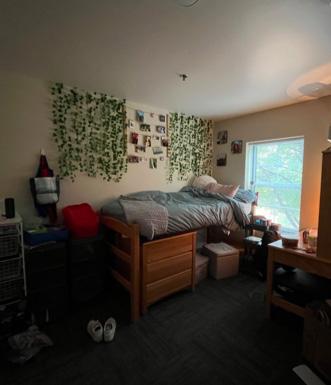
Welcome to my beautiful Gregg double. Here, you’ll find the blinds open and the overhead light never on (it’s just too bright). On the walls hang fake ivy leaves that are waiting for lights to entangle them, and photos of family, friends, and Lake Michigan.Thecommand hook on the wall houses my practice suits for water polo, and just under them lies more storage. The desk is packed with a variety of items — but, most importantly, an open LaCroix and a con tainer of Trader Joe’s ginger cookies (incredibly under rated). It’s a cozy corner consistently packed with blankets, snack bins, and an abundance of loose cords.
— Alice GottesmanIn short: controlled chaos? Trying to "organize" my long-term living space all at once for the first time basically resulted in me keeping everything on my desk, which, for authentic ity, also houses tonight's paneer tikka masala. The food won't be there for very long, but the other clutter is threatening to make the desk its home.
My bed is technically made, but done so hap hazardly, which I think is a good metaphor for the whole room. And I've adorned the walls with some movie posters: shout out to Chungking Express, my all-time favorite.
— Danny GrazianoMy room décor takes a lot of inspiration from Pin terest and relies heavily on posters acquired from FedEx. There are a lot of movie posters: Lady Bird, Grand Budapest Hotel, Marriage Story, and Gone Girl to pay homage to my Film and Media studies major, but I also featured a couple of my favorite musicians. Honestly, I was pleasantly surprised with the size of my dorm since it was originally a double that got converted to a single. Being a maximalist, I like my room to have an eclec tic, cluttered feel which is why I tried to fill it with a lot of random knick-knacks.
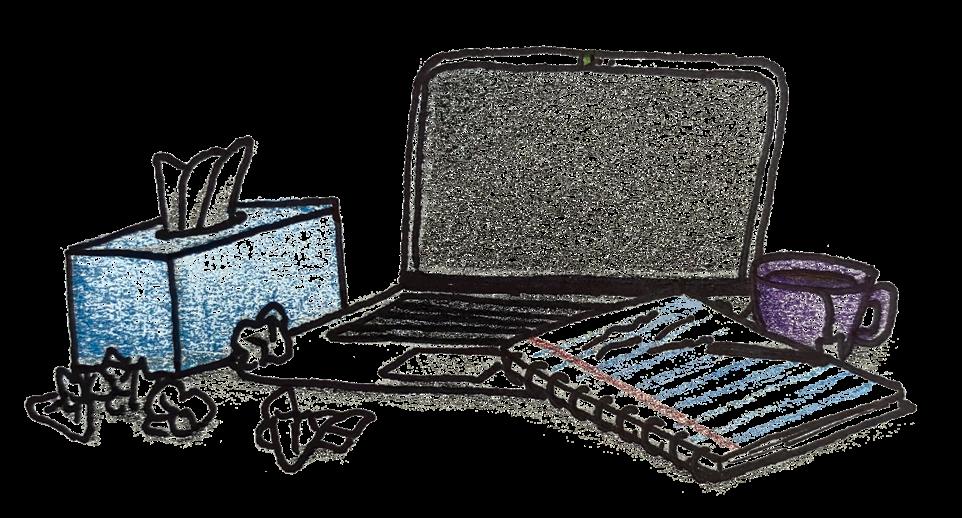
– Sanch Pothuru set to lying on top of my blankets while looking at the ceiling — looking for answers, and finding only chips of paint. — Lawrence Hapeman For my room, I really wanted a clean look — dec orated with a lot of plants and greenery to make it look cozier! The balcony view gives the room amaz ing lighting during the day and makes everything look so much brighter! — Annabel Shen This is what a freshman dorm looks like as COVID19 sweeps through the suite. The bed features cough drops, chips, and a computer playing “When Harry Met Sally” (medically necessary). The desk and chair are cov ered tastefully in tea bags, empty mugs, and finished single-serve cups of cereal. The vibe is chaos, chest pain, and cherry cough drops. — Mia Burkholder ILLUSTRATION BY SOPHIE LEONG Left column from top to bottom: Annabel Shen, Sanch Pothuru, Adel Cynolter, Sofia Allinson. Right column: Danny Graziano, Mia Burkholder, Lawrence Haperman, Alice Gottesman.ANNABEL SHEN & VIA POOLOS | SENIOR SCENE EDITORS | SCENE@STUDLIFE.COM6 STUDENT LIFE THURSDAY, SEPT 22, 2022
fromogy,“no-backboard”cutting-edgetechnolIcanseamlesslyjumpworkingonaproblem
Volleyball Remains Undefeated After First UAA Tournament
IAN HEFT CONTRIBUTING WRITERThe atmosphere was intense, the crowd was engaged, and the stakes were set as sophomore Zoe Foster walked past the sideline to deliver her third consecutive serve in the fifth set of Saturday’s match vs. NYU. Foster lofted the ball over the net, and a rally ensued; as posses sion shifted back and forth between No. 20 WashU and No. 6 NYU, each squad struggled to gain control until senior Jasmine Sells charged in for the kill to seal the deal for the Bears.
It took five sets
(the final three each decided by just two points), over two hours, and a number of lead changes, but WashU was able to cement the win vs. NYU (13-25, 25-18, 33-35, 25-23, 15-13), in a win that was the highlight of the weekend’s round robin. The team also won their two other conference matches vs. Carnegie Mellon (2523, 25-20, 19-25, 25-21) and Brandeis (25-22, 25-10, 25-20), to improve to a stel lar 12-0 record. After the win, WashU moved up fourteen spots into 6th place in the nation in the AVCA DIII coaches poll.

The Bears have matched their best start since 2015, a
year in which they finished first in the UAA and made it to the NCAA regional finals, but head coach Vanessa Walby isn’t doing too much thinking ahead.
“We truly are taking things day by day and match by match,” said Walby over email, after notching her 200th career WashU victory on Sunday. “[We’re] just trying to stay in the moment and not look far down the road.”Over the weekend, WashU was led by the fierce duo of outside hitters, sophomore Jasmine Sells and senior Lane Bohrer.
Through the first twelve games, Sells is tied with
dynamic fifth year right side hitter Michaela Bach for the team lead with 147 kills. Freshman setter Sam Buckley also impressed, with 51 assists vs. NYU.
Senior defensive specialist Taryn Gurbach led the team in digs, including a season high 18 vs. Brandeis, while fifth year Abby Li, who leads the team in blocks, chipped in with key plays as well, recording nine kills from the middle position vs. Carnegie
DespiteMellon.coming into the match as underdogs, WashU was able to remain focused heading into the crucial NYU match. Said Li on facing NYU, “I think
our team did a great job mentally preparing without psyching ourselves out. We felt amped, but also calm and ready to dig deep for the game ahead of us.” After the win, WashU leapfrogged NYU in the standings, tak ing the conference lead.
Upperclassmen Bohrer, Gurbach, Bach and Li have been instrumental to the team’s success thus far, in their performance as well as their leadership. Said Walby: “I think mentally we have grown a lot as a team and our upperclassmen have played a huge part in that development.”Onreturning for her fifth season, Li remains grateful,
especially after the time she spent with friend and for mer WashU Basketball’s Justin Hardy. “I know that my friend [Justin] would’ve done anything to play another year, so everyday I try to be grateful that I have been given another chance to play the game I love.”
Gurbach agreed, saying that Justin’s legacy is “some thing we take to heart in every practice and match.”
The team remained unde feated in their Wednesday matchup to improve their record to 13-0, the best start to the season since 2012.
The team’s next conference match is vs. Rochester on Oct. 2.
In the second quarter, Matt Rush sent a spiral ing pass to receiver Collin Goldberg, and the ball was bulleted into the endzone.
It wasn’t the game winning pass or the most climactic moment of the game — in two games, the Bears haven’t played with a deficit — but Rush looked like he had all the time in the world as he sent a ball flying to Goldberg.“Ijust have a ton of confidence, and Goldberg makes plays like that rou tinely,” Rush said. “When I threw it, I knew that he would track it down. That’s just what he does.”
That nonchalance — making over-the-shoulder sprinting catches routine — propelled the Bears to a 47 point win against Millikin in the team’s first confer ence matchup. They’ve outscored opponents 10614 in the best season opener since 1997, when the Bears went 141 – 7 in their first two games.

‘I think we played really well to start the game, just like we did the week before,” head coach Aaron Keen said. He said that the challenge came when he rotated players throughout


the game as the opponent brought pressure in the sec ond half. “We still need to get better in some areas: we turn the ball over a little bit too much for my taste, so we can clean those things up.”After not scoring dur ing the first drive, a pick 6 allowed Sam Mattecheck to sprint up the field for the first touchdown to jubilant cheers from the bench.
Rush was challenged all game with Big Blue’s defen sive line forcing him outside of the pocket area. Despite the pressure, he executed 18 out of 26 passes. “Matt does a tremendous job of putting the ball on [our
receivers’] hands,” Keen said. “You’ve got to make the tough catches when the defenders get a hand on the ball. And we’re doing that in spots. But we can con tinue to get Goldberg,better.”who totaled 4 touchdowns in 10 games played in 2021, made two over-the-shoulder catches for two touchdowns in Saturday’s game alone.

Kenneth Hamilton also landed two touchdowns with short runs on the back end. Sophomores were responsible for five out of the seven touchdowns, showing the potential of the underclassmen.Andevenwith senior
all-conference player Alex Vogel out of the game with an injury from the season opener, the defense didn’t falter. They are currently ranked seventh in Division III in total defense, thir teenth in scoring defense.
Despite the uncertainty from only returning two starters on the d-line, Rush wasn’t surprised by their strength. “I definitely saw it coming. I was practicing against them all summer, and life wasn’t wasn’t too fun going against them daily. So I definitely expected that.”
The Bears play their first road game next week, fac ing off against Carthage in
Kenosha, Wisconsin on the 24th. WashU won 37-16 in 2021, and the Bears have won three games straight against the Firebirds. The weekend will pose a chal lenge with the Bears not able to bring their entire
“It’ll be the first oppor tunity we’ve had to play a game where we don’t have our entire family there with us, if you will,” Keen said. “We’ve got to be able to adjust to that and play our best football in some
JAMIE NICHOLSON | STUDENT LIFE Jasmine Sells hammers the ball over the net in the team’s matchup against the top-ranked New York University. Sells has managed 163 kills so far this season. start since CLARA RICHARDS SPORTS EDITOR CLARA RICHARDS | STUDENT LIFE Kenneth Hamilton tries to squeeze past two Millikin defenders. Hamilton scored two touch downs in his second game as a sophomore for 40 rushing yardsCLARA RICHARDS | SENIOR SPORTS EDITOR | SPORTS@STUDLIFE.COM STUDENT LIFE 7THURSDAY, SEPT 22, 2022 JUST 2 BLOCKS FROM CAMPUS! NOW HIRING Servers Bartenders Barbacks Cooks 7347 Forsyth 314 757 1300 kruegersbar com Flipping great burgers since 1946! OPPORTUNITIES OPPORTUNITIES OPPORTUNITIES SPORTS
Football wins again in best
1997
MANAGING
ANDREW KASTELMAN JUNIOR SPORTS EDITOR
Many WashU students play at least one sport before arriving on campus. However, only a small per cent are fortunate enough to continue their sport in college at the varsity level.


Enter club sports: a com petitive alternative without the time commitment or recruitment process of varsity sports. Looking to continue your high school sport in college? Want to stay active and make new friends? Club sports might have a spot for you.“If you love your sport and you can’t necessarily play at the varsity level in college, I think club sports is a great way to go about it,” sopho more club baseball player


Jack Wineman said.


WashU offers 41 club sports, including more mainstream sports, such as soccer and basketball, and more niche options, such as

powerlifting and table ten nis. These sports serve as an outlet for both fitness and socializing.“It’sagreat way to meet people, because a lot of the social things that I do are through club sports,” sopho more women’s club soccer and women’s club lacrosse player Olivia Garman said. “You really bond with a team — like, you’re spending all this time practicing together, and that’s a lot of fun.”
Garman juggles two club teams, showing the versa tility of students’ options. Ultimately, the decision of what to join frequently comes down to how big of a com mitment each student wants to make. For example, club baseball and club soccer only have a few hours of practice each week. However, games on weekends force players to manage their time well dur ing the week.
“I think the captains do a really good job of making sure that everyone can bal ance their academics with the


sport,” sophomore men’s club soccer player Jacob Sherman said. Sherman said that each individual practice for club men’s soccer is optional, although players must show up to at least one practice dur ing the week to be able to play in the games that weekend.
Because of all the options, students may have a tough time deciding which sport to get involved in. Some stu dents will continue sports they played in high school, while others will pick up a new passion. This was the case for sophomore Ella Brodey, who swam in high school but decided to join women’s club water polo. Brodey wanted to do water polo in high school, but it was not offered. Now, water polo has given her a new community.“It’sjust a really fun way to be active and meet new people and be part of a com munity that’s outside your normal friend group,” Brodey said.Another aspect of club
sports is the tryout pro cess. These can vary greatly between the sports. For exam ple, women’s club lacrosse and women’s club water polo have no tryouts, making it easier for members to join.

The benefit of this is that the team then includes play ers of different skill levels and abilities, making the group more inclusive. “We take peo ple who have never touched a stick before,” Garman said about womens’ lacrosse. “We’re trying to teach the fundamentals, so even if you didn’t play lacrosse in high school, you’re welcome to join.”On the other hand, women’s club soccer has a rigorous tryout process, with two rounds of open tryouts and a closed tryout before making roster decisions.

One club sport that has a unique setup is women’s club ultimate frisbee. Women’s ultimate actually has two club teams: Locamotive — which is a little less competitive and is focused on fundamentals
— and Iron Horse, which plays at the highest level and is more Sophomorefast-paced.Leah Karush, who is on the Locamotive team, said that both teams offer a positive experience.
“It’s just such a great community,” Karush said.


“People are super welcoming, and it was just a great way to meet people my freshman year.”Karush hints at possibly the biggest benefit to club
sports: a positive social envi ronment to meet new friends. No matter your athletic abil ity or experience level, joining a club sport opens up social opportunities, from daily practice to mixers.
“Even if you don’t feel super confident about your sport, you can always just come and hang out at prac tice and then go to social stuff,” Garman said. “That’s really awesome, too.” Club sports
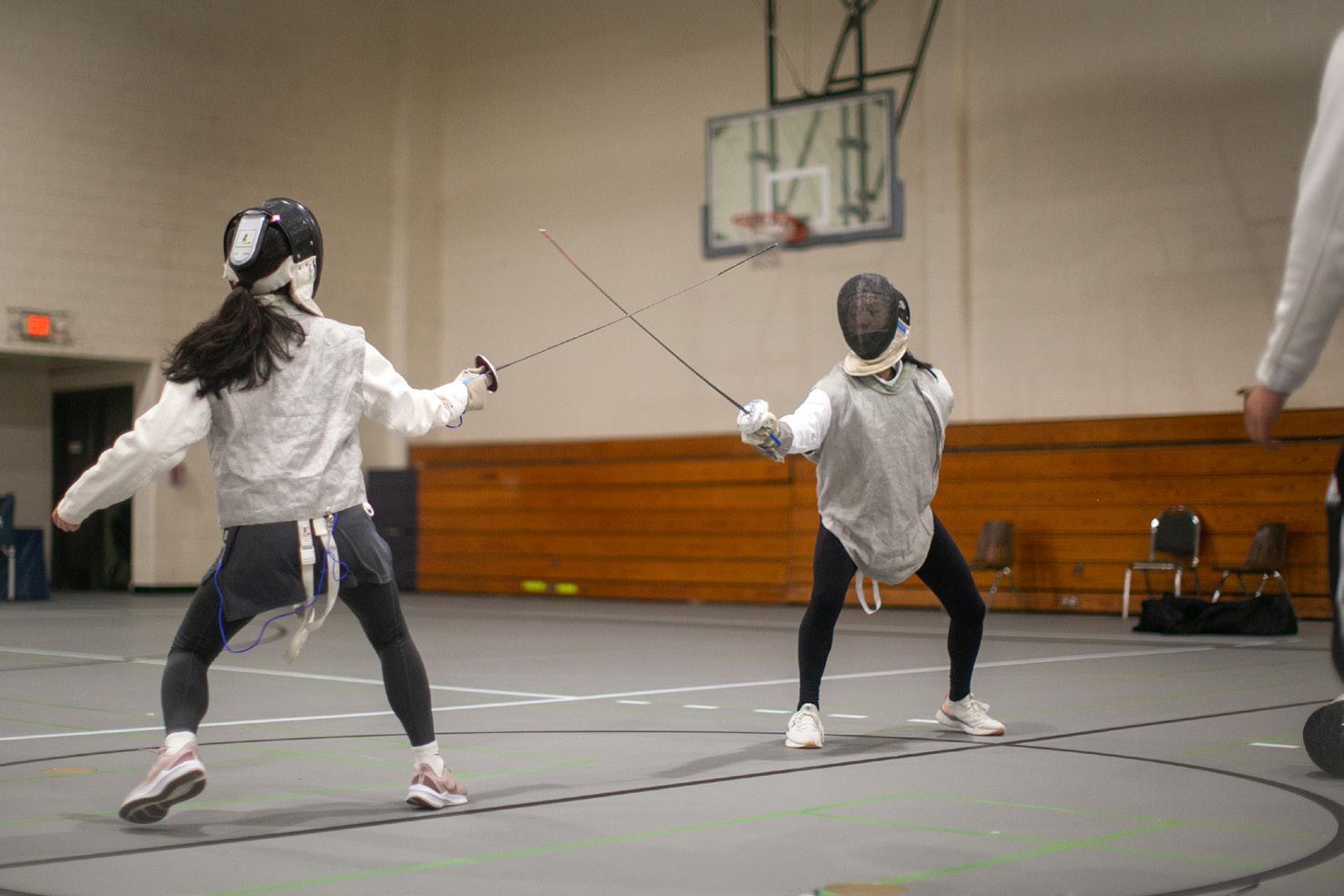
MADI HERMEYER | STUDENT LIFE SCARLETT PATTON | STUDENT LIFE Womens’ soccer practices on the South Campus field, where the group can practice after school. WashU’s fencing club stand off against each other on WashU’s open recreation facilities.drink dine Wplay. EEKLY BAR, STUDLIFE.COM Wherever you are, stay connected: Subscribe to our free e-newsletter... head to studlife.com now and sign up! FACEBOOK.COM/STUDLIFE @ STUDENTLIFENEWSPAPER @ STUDLIFE S E P T E M B E R 7 - 2 5 ( 3 1 4 ) 5 3 4 3 8 1 0 | t h e b l a c k r e p o r g 7018 PERSHING CLAYTON314-726-3030AVE /WASH U WE ARE DELIVERYTHEEXPERTS! V 1-TOPPINGLARGEPIZZA1099$EACHCODE:9011OPENLATE!SUN-THURS10:30AM-12AMFRI&SAT10:30AM-1AM 8 STUDENT LIFE THURSDAY, SEPT 22, 2022 don t worry ddarling on't worry, darling TICKETS ON SALE NOW harry styles florence pugh galleria6cinemas com GALLERIA 6 C I N E M A S TWOBLOCKS FROMCAMPUS!7347FORSYTH OPEN UNTIL 1:15 A M Wash U Students Save 25% after 7pm! Thursday Night= STUDENT NIGHT
Need an activity?
could be for you.
CLARA RICHARDS | SENIOR SPORTS EDITOR | SPORTS@STUDLIFE.COM