The independent newspaper of Washington University in St. Louis since 1878 VOLUME 148, NO. 7
THURSDAY, OCTOBER 15, 2026
WWW.STUDLIFE.COM
Federal four-year term limit raises concerns for WashU international students SARA STRASSBERG STAFF WRITER
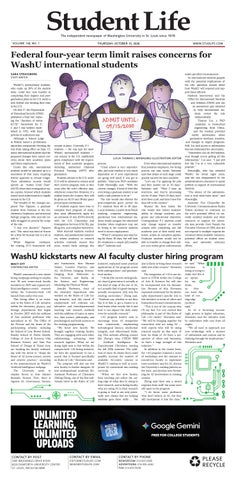
WashU’s international students, who make up 26% of the student body, could face new hurdles in completing their degrees and postgraduation plans in the U.S. under a new federal rule limiting their time in the U.S. On July 17, the Department of Homeland Security (DHS) published a final rule replacing the “duration of status (D/S)” framework for F, J, and I visa holders established in 1952, with fixed periods of authorized stay. Although a federal judge in Boston issued a preliminary injunction temporarily blocking the rule from taking effect on Sept. 15, many international students said the proposed changes have raised concerns about their academic plans and future employment. Under this rule, international students would be admitted up to a maximum of four years, requiring federal approval to remain longer. Their admission records would specify an “Admit Until Date” (AUD) when their immigration status expires, beyond which students would need authorization to legally remain in the U.S. The breadth of the changes surprised Van Nguyen, a graduate student from Vietnam in the biochemistry, biophysics, and structural biology program, who said she initially struggled to process the scope of the rule. “I was very shocked,” Nguyen said. “My mind was kind of frozen for a little bit because this is a lot to take in.” While litigation continues, the existing D/S framework will
remain in place. Currently, F-1 students — the visa type for most WashU international students — can remain in the U.S. indefinitely given compliance with the requirements of their academic program, including authorized Optional Practical Training (OPT) after graduation. Students already in the U.S. under D/S will be allowed to remain until their current program ends or four years after the rule’s effective date, whichever comes first. However, if a student leaves the country, they will be given an AUD and 30-day grace period upon readmission. If students require more time to complete their program of study, they must affirmatively apply for an extension of stay (EOS) directly with the U.S. Citizenship and Immigration Services (USCIS), pay filing fees, and complete biometrics. Most doctoral students, medical students, and postdoctoral researchers, whose academic or research activities routinely exceed four years, would likely undergo this
LUCIA THOMAS | MANAGING ILLUSTRATION EDITOR process. “Grad school is very unpredictable, and your timeline is very much dependent on if your experiments are going well [and] if you get to publish,” third-year PhD candidate Eylül Horozoglu said. “With the current changes, it kind of feels like even being a graduate student is not really a safe position to be in.” The rule would also shorten the post-completion grace period for F-1 students from 60 to 30 days. Lucas Salomão, a junior from Brazil studying computer engineering, questioned how international students would navigate the shortened timeline when employers may not be hiring at the moment students need to secure employment. “What if companies just stop hiring for those 30 days, but will look for employees a couple [of] months after?” Salomão said.
Even when international students find potential employers, the hiring process can take weeks. Salomão said that delays at each stage could quickly narrow the time available. “Let’s say I’m applying for jobs and they answer me in 10 days,” Salomão said. “Then I have an interview, and they’re processing me for 15 days. That’s 25 days, and I don’t have a job, and then I have five days left in the country.” Beyond the time limits, the rule would also restrict students’ ability to change academic programs and educational objectives. Undergraduate F-1 students could only change majors or transfer schools after completing one full academic year at their initial institution, unless an exception applies. Graduate students would not be able to transfer or change their subject area unless given authorization
under specified circumstances. As international students grapple with the potential implications of the rule, questions remain about how WashU will respond and support those affected. Students interviewed said the Office for International Students and Scholars (OISS) sent out an assessment quiz intended to help international students review the rule independently. Tianran Liu, a PhD candidate in biomedical engineering from China, said the module provided useful information about graduation timelines, transfers, and changes in degree programs. Still, Liu said access to information had not eliminated her uncertainty. “Sometimes you do feel helpless, even though you’re getting all this information,” Liu said. “I just still feel like I’m at a very vulnerable position.” Horozoglu, who has attended WashU for about eight years, said she was disappointed by the administration’s reluctance to speak publicly in support of international students. “The silence of the administration is truly what hurts most,” said Horozoglu. Associate Vice Chancellor for University Communications Kedra Tolson declined to comment on the rule’s potential effects on currently enrolled students and what resources or support the university may provide. Geet Vanaik, the Executive Director of OISS, also did not respond to multiple requests for comment about available resources, potential effects on student retention, and university advocacy efforts.
WashU kickstarts new AI faculty cluster hiring program MACY OTT
CONTRIBUTING WRITER
WashU announced a new cluster hiring campaign seeking to employ over 30 new tenure-track faculty members by 2029 and expand artificial-intelligence-centric research within the University-wide +AI launch from earlier this year. This hiring effort is an extension to the Rules of Life initiative within the chemistry, physics, and biology departments that began in October 2025 with the addition of four assistant professors who specialized in AI. The Office of the Provost and the deans of the participating schools, including the School of Law, Brown School, Bursky School of Public Health, College of Arts & Sciences, Olin Business School, and Sam Fox School of Design & Visual Arts, are heading the faculty onboarding with the intent to “shape the future of AI across science, society and creative practice,” according to the announcement on WashUs Artificial Intelligence webpage. The University seeks to employ hirees in four distinct thematic focuses. First, there is Agentic AI: Governance, Society,
and Institutions; then Human Values, Creative Practice, and AI; AI-Driven Imaging Science: Imaging from Molecules to the Universe; and finally, AI for Science and Engineering: Modeling the Physical World. Jennifer Heemstra, chair of the chemistry department, who worked on the Rules of Life hiring initiative, said this round of employment will continue collaborative and interdepartmental teaching and research methods with the addition of topics in statistics, data science, philosophy, and psychological and brain sciences to the existing programming. “We hired new faculty. We brought together existing faculty. They are engaging with each other, collaborating, advancing their research together. What we are doing right now is that within the campus-wide +AI hiring initiative, we have the opportunity to run a search that is focused specifically on Rules of Life,” Heemstra said. The program will also use this new faculty to further integrate AI into undergraduate academic life. Assistant Professor of Chemistry Zhiling Zheng, one of the first individuals hired in the Rules of Life
initiative, explained some practical applications of the program across both undergraduate- and graduatelevel studies. “I think [the current undergraduate class’s] generation is actually at this kind of edge of the rise of AI, so I actually find it’s good timing to actually incorporate [AI] into the existing curriculum,” Zheng said. “Students can, whether or not they like it or hate it, get a chance to at least know what exactly this is and how it can impact the daily study even for scientific research.” +AI program leaders seek to encourage more AI integration into coursework, emphasizing technological literacy, intellectual integrity, and ethics-based thinking. This includes offering courses like Zheng’s class CHEM 5080 – Artificial Intelligence for Experimental Chemistry, starting the fall 2026 semester. The addition of more AI cluster hires could possibly increase the number of available AI-centric courses in WashU’s catalog as well as incorporate AI coursework into existing curricula. “When we hire new faculty, their teaching can reflect the cutting edge of what they’re doing in their research, and so hiring faculty who are using AI in their research is going to lead to not only potenB:10.25" tially new classes that are helping students gain T:10" these skills … but
also is likely to bring those research skills into other courses,” Heemstra said. The integration of +AI is not isolated to STEM within the College of Arts & Sciences but will also be incorporated into the humanities. Because of this, Heemstra expressed excitement for the philosophy department’s specific role in this initiative in terms of ethics and humanities-focused considerations. “This is one of the reasons why I’ll say that I’m very excited that philosophy is part of this Rules of Life +AI cluster,” Heemstra said. “We will be bringing together the researchers who are using AI … with experts who will be doing research exactly on that topic of how we think of AI from a perspective of ethics and humanity, so that’s a huge strength of this initiative.” In addition to the cluster hires, the +AI program initiated a series of workshops over the summer to incentivize faculty to implement more academic uses for AI, discuss the University’s existing policies on the topic, and develop new formatting for AI involvement in existing courses. Zheng said there was a mixed response from staff, but some were still open to the program. “I do know some professors who don’t believe in AI, but they still incorporate it into the class,”
he said. “What everyone is doing is trying to make sure this is an option for students, so they can learn this kind of cutting-edge [technology].” As AI is becoming increasingly present in higher education, Heemstra said the initiative must be undertaken with care from all angles. “We all need to approach any new technology with a mixture of enthusiasm and caution and be thinking through the implications,” Heemstra said.
S:9.75"
CONTACT BY EMAIL
CONTACT BY PHONE
ONE BROOKINGS DRIVE #1039 #320 DANFORTH UNIVERSITY CENTER ST. LOUIS, MO 63130-4899
EDITOR@STUDLIFE.COM NEWS@STUDLIFE.COM
NEWSROOM 314.935.5995 ADVERTISING 314.935.4240 FAX 314.935.5938
T:2"
S:1.75"
CONTACT BY POST
2 STUDENT LIFE
TANVI GORRE & COBY RINKE | MANAGING NEWS EDITORS | NEWS@STUDLIFE.COM
Jewish student groups hold Oct. 7 vigil
THURSDAY, OCT 15, 2026
ZOE RHODES NEWS EDITOR
Sophomore Meital Atlas, an Emerson Fellow and cofounder of WashU Kulanu, handed out programs and greeted attendees. Atlas, sophomore Tzipora Guttman, president of WashU’s chapter of Jewish on Campus, and Jonah Hochstadt, president of the Jewish Student Association (JSA), flocked together as time came for the vigil to start. They adjusted the podium, placing it square in the middle of the St. Louis skyline seen through the Brookings arch. At 5:55 p.m. last Wednesday, over 150 WashU community members filed into Brookings Quadrangle. Everyone came as they were. People wore their orientation shirts, jeans, Converse, dresses, athleisure — even full EST gear. Two students wore Israeli flags. On the third anniversary of the 2023 Oct. 7 attack, JSA, Chabad, Jewish on Campus, WashU Israel Public Affairs Committee, Kulanu, and Hillel held a vigil in Brookings Quad in honor of lives lost. Hochstadt, who began the ceremony, spoke on the strength of community. “When we are confronted with tragedy, we come together,” Hochstadt said. “When we are met with hatred, we respond not by hiding who we are, but by holding one another closer and standing even more proudly as a community.”
ALEX DERING | PHOTO EDITOR Approximately 150 WashU community members attended a vigil commemorating the third anniversary of the 2023 Oct. 7 attack. Multiple speakers referenced people they knew, or their family knew, who were killed in the Oct. 7 attack. At 6:17 p.m., all students observed a moment of silence to honor the approximately 1,200 people who were killed in the attack. While the attack happened three years ago, Hodaya Butz, WashU Chabad’s Jewish Agency for Israel Fellow, said it “feels like it was
yesterday.” At the end of Butz’s speaking time, she played “White Angel,” a song written for May Naim, who died in the attack. The song flooded through the speaker placed to the right of the podium, singing, “The whole country already knows your name.” First-year Erin Drazen spoke about how the attack translates to broader discussions on hate. “We can remember what
“When we are confronted with tragedy, we come together,” Hochstadt said. “When we are met with hatred, we respond not by hiding who we are, but by holding one another closer and standing even more proudly as a community.” happens when hate takes over, and in the aftermath of October 7, just so much hate has blossomed into this world, and so much hate has affected people’s lives in such a horrible way,” Drazen said. “It’s so important to remember … what causes hate so we can avoid it as fast as possible.” The vigil also featured a prayer for the Israel Defense Forces and El Male Rachamim, a Jewish prayer for the deceased. Atlas read from “One Tiny Seed,” a poem by Rachel Goldberg-Polin. Atlas shared what
inspired the event’s continuation and the joint efforts required to put it on in a statement to Student Life. “The whole community really came together and supported each other,” Atlas wrote. “Everyone said something from the heart, and you could really feel it.” The vigil has become an annual occurrence. The rest of the vigil included memorial readings and prayers by student speakers and Rabbis Shlomo Ashkanazy and Hershey Novack. Throughout the vigil,
the yellow tablecloth next to the Israeli-flag-wrapped podium that read “We remember October 7” was clearly visible. Atop it sat 10 candles. At the very end of the ceremony, students took their own candles that had been passed out to place them all together. “All in all, when I was standing looking out at everyone, even on such a hard day, it was nice to see the community at WashU supporting each other,” Atlas wrote.
Former WashU Med neurosurgeon convicted of sexual assault in Scotland ZOE RHODES NEWS EDITOR
Former WashU School of Medicine Associate Professor Camilo Molina was convicted of sexually assaulting a woman at a nightclub in Glasgow, Scotland, last April and no longer works for the University. Forty-year-old Molina, a spine-fellow-trained neurosurgeon who ran his own lab at the School of Medicine and worked within the Hope Center for Neurological Disorders, was attending a conference in Glasgow. The 32nd International Meeting on Advanced Spine Techniques was held by the Scoliosis Research Society in Glasgow at that time. Molina assaulted a
20-year-old woman at Kong, a nightclub in Glasgow. Charges were filed after the event last spring, and Molina’s conviction came this September through the Scottish judicial system. Sheriff Paul Reid presented the charges against Molina in Scotland. Student Life reached out to the Judiciary of Scotland’s communications office for confirmation on key details in the case but was denied access. “The judiciary do not comment on cases,” Judiciary Communications Manager Alice Faulkner wrote. Molina’s information has been wiped from every WashU Med page. The page explaining his receipt
of the 2026 WashU School of Medicine Dean’s Impact Award, his lab page, and his faculty page all no longer contain any mention of Molina or his work. Student Life reached out to Molina’s undergraduate lab assistant but did not receive a response. Student Life also reached out to several of Molina’s former colleagues at the medical school and was redirected to the medical school’s marketing and communications team. “Dr. Molina is no longer employed by Washington University,” wrote Jessica Church, director of media relations for WashU School of Medicine.
SCENE
THURSDAY, OCT 15, 2026
HANNAH LA PORTE | MANAGING SCENE EDITOR | SCENE@STUDLIFE.COM
Campus Creamery’s new owners learn business in real time ANDI JACOBS CONTRIBUTING WRITER
The blasting music summons students from near and far. It is impossible to resist: Even at 1 a.m., students line up to get an ice cream concrete. Campus Creamery is a South 40 favorite, a classic midnight snack for WashU’s underclassmen. Three sophomores — Jei Han Hall, James Rukin, and Cooper Hazday — took over the well-loved ice cream shop last January as first-years. This year, they continue to own and operate the store, and they are excited to grow the business with their numerous new ideas. “As a freshman, you’re looking for a ‘thing,’” Hazday said. “I remember Harrison [the previous owner] emailed a lot of people, and I regretted not acting upon that first opportunity. But then, maybe a month later he emailed again, and I was so happy. [That is when] I started talking to him.” As first-year roommates, Rukin and Hall went to the Campus Creamery so often in their first semester that they began to know a lot of the employees quite well. In September, the owner approached them about buying the store, but
they declined. However, he approached them again in November, this time with a lower price. Because they were both interested in business, the two decided to buy the Creamery. This is when Rukin and Hall met Hazday, and the three made the purchase together. The Creamery closed temporarily in January so that the transition could take place, and it reopened under new leadership in February. “Being able to see and meet new people has really been fun,” Hall said. “It’s a place where people come to hang out and enjoy themselves, sit down and have a conversation.” Still, the three students have found that owning a business for the first time has a learning curve. There are numerous facets they did not anticipate. Throughout this semester, they have become comfortable communicating with government institutions, working with vendors, contacting plumbers and mechanics when issues arise, and so much more — all while juggling their academics. “Sometimes, we spend so much of our time and money and thought into a certain idea and we lose money on it,” Rukin said. “The hardest part is failing
STUDENT LIFE 3
LUKE PASSWATER
JACOB SELTZER | CONTRIBUTING PHOTOGRAPHER Campus Creamery serves ice cream to students on the South 40. when you work so hard and when you’ve put your actual money into it.” In particular, managing a staff of students the same age as them — or older — made it challenging to operate the Creamery. “Learning how to be a person that people respect and want to listen to and talk to has been super important,
CAPTION CONTEST 10/15 WINNERS
and it’s taught me a lot about what it means to be a leader,” Rukin said. When they first took over the Creamery, the trio had lots of ideas for how to bring more variety to the menu. They have started selling biweekly exclusive flavors. Their last exclusive flavor, mint chip, did very well, according to the trio. They are also considering brownie sundaes, among other things. “The moments that I really love [are] when I make
an ice cream and it’s [the customer’s] first time, and they turn to their friend, and without even thinking, they’re like, ‘Oh wow, this is really good!’” Hazday said. “That always brings a smile to my face. It’s a simple act, but it really makes people’s day.” Hall, Rukin, and Hazday want to make the
Creamery a place for students to meet new people, listen to music, dance, and study — not just to buy ice cream. “[I’ve learned that] people like the emotions that you bring to a place more so than the things that you give them,” Hall said.
Marceline Lee Illustration Editor
Beatrix Colbert Danesh Temirbekova Hannah Dorval Designers
Adrienne Levin Coleman General Manager a.coleman@studlife.com
First Place: clean plate club - Aubree Herzog, Current WashU Student Second Place: Better than BD - Mark Kimmel, Current WashU Student
KEVIN KAN | STAFF ILLUSTRATOR
Third Place: Professors after promising the exam “Is not as bad as people say” - Sean Henry, Current WashU Student
Caption this! Enter this week’s contest
Scan the QR code to enter your submission by noon on 10/20.
AUGUST MOON | STAFF ILLUSTRATOR
VOLUME 148, NO. 7 Laurel Wang Lewis Rand Editors-in-Chief editor@studlife.com Tanvi Gorre Coby Rinke Managing News Editors news@studlife.com Hannah La Porte Managing Scene Editor scene@studlife.com Dion Hines Managing Forum Editor forum@studlife.com Hannah Much Managing Sports Editor sports@studlife.com Kate Westfall Managing Design Editor designers@studlife.com
Ava Giere Managing Chief of Copy copy@studlife.com
Alan Knight Managing Multimedia Editor
Lucia Thomas Managing Illustration Editor
Sara Gelrud Sophie Schwartz Jake Isenberg Elle Ludwin Scene Editors
Isabella Diaz-Mira Managing Photo Editor photo@studlife.com Amelia Spencer Special Issues Editor Apurva Ganti Head of Training and Recruitment
River Alsalihi Kate Theerman Rodriguez Maddie Morgan Leilani Billups Forum Editors
Reeya Sharma Managing Social Media Editor
Eliza Stulman Bee Austin Harper Nix Ben Ollendorff Sports Editors
Quinn Moore Managing Newsletter Editor emailedition@studlife.com
Kate Matthews Kat Ziwot Social Media Editors
Eran Fann Mac Motz Alex Dering Photo Editors
Jack Yang Senior Web Editor
Bea Augustine Jack Warren Tillie Szwartz Design Editors
Andrew Tian Echo Dong Georges Gewargis Junior Web Editors
Victor Huang Selina Son Nicholas Demba Lexi Lawsky Ella Meshoulam Zana Kennedy Zoe Rhodes News Editors
Julie Kassin Chief of Copy
Ashwin Nair Audrey Tebow Newsletter Editors
Campbell Crum DEI Editor
Anna Piasecki Eleanor Sterne Kayslay Cudjoe Claire Lu Copy Editors
Sarah Huff Advertising Sales Manager huffs@studlife.com
Copyright © 2026 Washington University Student Media, Inc. (WUSMI). Student Life is a financially and editorially independent, student-run newspaper serving the Washington University community. Our newspaper is a publication of WUSMI and does not necessarily represent the views of the Washington University administration.
4 STUDENT LIFE
HANNAH LA PORTE | MANAGING SCENE EDITOR | SCENE@STUDLIFE.COM
THURSDAY, OCT 15, 2026
Fish faces, Pochitas, and glazed mugs: What to expect at this semester’s ArtMart LENI SALTOS CONTRIBUTING WRITER
RACHEL BENITEZ-BORREGO | STAFF PHOTOGRAPHER
L
2 EA 7 –2 SI 8 NG
home with ceramic bowls and mugs that she now wants to sell at her stand, Maddie Throws. A St. Louis native, she grew up taking art classes at Craft Alliance. She initially went with her best friend to de-stress, but through every warped bowl and overglazed mug, learned to better her craft and eventually use it as a form of expression. Her favorite part comes after the wheel. “Glazing is the really fun part where you get very experimental because you really don’t know how it’s going to turn out,” she said. Jeans eventually found herself gravitating toward earthy colors, but always makes sure to keep her experimental wits sharp. Jeans attended both fall and spring ArtMarts last year as a customer, and she hopes that visitors this year come for more than shopping. “I think everyone should go,” she said. “Maybe it would inspire someone to try doing something themselves.” Castaneda will be sitting alongside his handcrafted Pikachus and Pochitas, Hannah will be mid-portrait surrounded by Kan’s stickers, and Jean’s bowls will be waiting on the table, glazes gleaming. If you want to see what these and many other student artists at WashU have been up to, make sure to check out ArtMart on Mudd Field from 2-5 p.m.
0
O N
juniors Kevin Kan and Mark Hannah. The name is a joke that doubles as a division of labor — Mark makes the face, and Kevin makes the fish. Hannah’s half of the stand is the face, where he does live portraiture, drawn in two or three minutes. He’s trained in painting and realistic drawing but sees live portraiture as a unique way to connect with others. He’s upfront that speed has a cost. “Maybe they won’t be the most awesome or realistic portraits ever,” he said. “But it’s that experience which I think is the good part.” Drawing from a live person lets him capture their real emotions in the moment rather than getting caught up in the details. Kan’s half is the fish, an endearingly deadpanned fish the color of Dodger blue that he’s been drawing since before college. He initially drew the admirably indifferent fish for comics, but then he started making stickers. “I see myself in the character, and other people see themselves in it too,” he said. The two friends met in high school and, after coming to WashU, set a goal of opening a booth at ArtMart together. They hope that they can offer a unique experience where people can get a quick and high-quality portrait while browsing for charmingly fishy stickers. After years of weekend classes, sophomore Maddie Jeans had lined every inch of her family’s
Pershing Living S E V E N A PA R T M E N T S · AC R O S S T H E S T R E E T F R O M CA M P U S
2
W
Dozens of imaginatively fresh prints showcased across vendor stands, racks of effortlessly chic clothes, and collections of mesmerizingly beautiful jewelry are just a few things that this year’s ArtMart will showcase. And just like usual, it won’t simply be a place to browse. The music flowing throughout Mudd Field alongside the event’s authentically welcoming nature will give it the perfect atmosphere to connect with the people making the art. This semester’s ArtMart is set to be the largest ever and is on Friday, Oct. 16, running from 2-5 p.m. on Mudd Field. Organized by Armour Magazine and the Sam Fox Art Council, ArtMart continues its mission of using artistic expression as a way to bring people together. Each of the event’s vendors are students from across WashU’s schools offering a variety of crafts for sale. Just as many vendors are returning for this year’s event, swaths of students new to ArtMart are taking their shot at putting their work out there. Junior Esteban Castaneda is bringing his love for crochet to ArtMart in his stand, Caprinite Crochet, with handmade Pokemon ranging from Pikachu to Ditto, an adorably chubby Pochita, and a half-done Totoro sitting in his bag as he figures out how to get it perfect. His love for the art form manifested in high school
when he joined his friend’s crochet club, even though he had no prior interest. Since it was only the two of them in the club, what started as a nice gesture for a friend evolved into a “one-on-one tutoring session” where Castaneda’s passion and skills at crochet could take form. He evolved his craft from simple stuffed animals to specialized crocheted figures that depicted characters from his favorite shows. For Castaneda, crochet is a meditative process, where he can fully immerse himself in the process of creation. He dedicates hours to every one of his pieces, making sure that each has the correct proportions and stitching. Selling at ArtMart last year has given Castaneda more than sales. “Even if people didn’t buy anything, [people] wanting to take pictures or see my work was super validating,” he said. “I always want to make sure it’s as good quality as it can be so people are getting something worth their money.” He recently created an Instagram page, and his next goal is opening commissions to anyone interested. If you don’t see your favorite character on his table at ArtMart, then don’t be afraid to ask. “Something handcrafted of your favorite character can be pretty special,” he said. Usually calling someone a fish face is rude, but at ArtMart it’ll cost you $5. Fish Face is a stand created by two friends,
Closer than some dorms. Bigger and nicer than all of them.
WHY PERSHING DIRECTLY ACROSS THE STREET
BIGGER, RENOVATED SPACES
YOUR OWN BATHROOM? YES.
2–5 minute walk to campus.
High-end kitchens, baths + finishes.
Available in select apartments.
LARGE BUILT-IN CLOSETS
ALL INCLUDED
YOUR OWN WASHER + DRYER
Built-in storage with room for everything.
Furniture, utilities, parking + more.
No shared laundry. Ever.
S E E P H O T O S + AVA I L A B I L I T Y
TEXT US
(314) 315-8856 livebywashu.com O N LY 7 A PA R T M E N T S · N O W L E A S I N G 2 0 2 7 – 2 8 Need to sublease for winter semester? January–May 2027 spots available.
PRIVATELY OWNED AN D NOT AFFILIATED WITH WASHINGTON UNIVERSIT Y
FORUM
THURSDAY, OCT 15, 2026
STUDENT LIFE 5
DION HINES | MANAGING FORUM EDITOR | FORUM@STUDLIFE.COM
WashU’s neutrality allows recruiting budgets to shape student opportunity JACK ABRAHAM J.D. CANDIDATE CLASS OF 2028
I am from a mid-sized central Illinois town and a working-class family. We lived in a neighborhood where few had collegiate aspirations, and many of my friends and neighbors opted for bluecollar careers instead. The consequences of economic scarcity were readily apparent, and having seen the impact of these consequences firsthand, I knew I wanted my career to benefit communities like mine. I found like-minded people during my undergraduate education at Illinois State University (ISU). My peers wanted to find careers that would allow them to make positive impacts on the world. They sought positions in the government, nonprofit organizations, and public schools, and many of them achieved their aspirations. Some did not, but at a state school like ISU, it is understood that there are certain limitations on career opportunities. WashU, by contrast, has the reputation, resources, and influence to offer something more. When I got to campus, I expected the coffee chats, employer receptions, and networking events to expose students to new possibilities and empower them to pursue their ambitions — wherever those ambitions lead them. But while those resources do introduce students to some new possibilities, disparities in employer visibility disproportionately elevate some career paths, shaping which possibilities students see as accessible. And when WashU allows employers to purchase greater visibility, public-service employers — many of which face resource limitations — risk being
MARCELINE LEE | ILLUSTRATION EDITOR overshadowed. In this environment, employers’ financial capacity limits what careers students perceive as accessible rather than the breadth of their own ambitions. This is called career funneling: the process by which campus structures, student culture, and corporate recruiting cycles channel students toward a narrow range of career paths by shifting students’ perceptions of success and accessibility. By altering how students define success, universities steer students away from pursuing their once-aspired careers and toward careers more prominently promoted on campus. And when accessibility of public-service careers is limited, the substance of choice begins to erode. The result can still appear to be a free choice, but how free is your choice when your alternative is a career path with fewer recruiters, fewer events, fewer institutional connections, and fewer visible opportunities?
This is not because some employers recruit more aggressively or more strongly desire to employ WashU grads. Public-service-oriented employers and major corporations enter the recruiting process with stark differences in their available resources, and WashU’s institutional neutrality allows for those disparities to translate into limitations for students. Asymmetrical resources push public-interest recruiters into the corners of career fairs and the outskirts of campus, while corporate employers with more resources can maintain a constant presence in students’ lives. I am not advocating for WashU to restrict on-campus corporate recruiting. I am advocating for WashU to provide students with more opportunities by reducing the gaps between corporate and public-service recruiting. Treating employers with dramatically unequal resources as though they enter campus on equal footing does not
produce balance; it allows existing disparities to reproduce themselves, limiting student opportunity along the way. These structures were not built on bad intentions. WashU overwhelmingly wants its students to succeed, and its career resources are intended to support that success. But success is a subjective concept, and students are best positioned to determine what success means for them — not a corporate recruiter or a career advisor. Students may arrive on campus uncertain of what their definition of success is, but the University’s responsibility is to guide students in discovering that for themselves — not determine it for them. By remaining neutral in a recruiting environment that is anything but neutral, WashU risks allowing financial disparities between employers to influence how students define success. That concern becomes particularly salient when 88% of the
top employers at WashU are finance, Big Tech, or consulting firms, while zero are public-interest employers. In this context, neutrality begins to look much less like balance. But it doesn’t have to be like this. On-campus career funneling results from policy decisions that we can have a part in. This is why I joined Class Action, a national student organization urging elite universities to use their resources and influence to serve the public, rather than merely preserve their own prestige. We’ve done the research, and we’ve identified the pitfalls. Now it is up to all of us to voice our concerns to the university and call on our administrators to change We’re asking WashU to support students’ aspirations to pursue public service by increasing the summer internship fund, which is one of the lowest summer internship funds of peer institutions we reviewed. We’re asking WashU to expand public-service employers’ presence on
Doughy Days
DOWN 1 Cinnamon or saffron 2 Signature Ralph Lauren shirts 3 Actor's representative 4 Got up 6 Baking measurement: Abbr.
Mania Where in WashU? Can you recognize where this building is on campus?
ELIZA STULMAN | SPORTS EDITOR
1
ACROSS 1 Cuban of "Shark Tank" 5 Disney princess who saved the Emperor of China 6 Follower of battery or word 7 "The Taming of the ___" 8 Heartburn relief brand
2
3
4
5
6
7
8
Honor to Us All
DOWN 1 5-Across's sidekick 2 College student's morning annoyance 3 Angry states 4 Was aware (of) 5 Has to
Last Weeks Answer: McKelvey Hall
Crossword by Vinisha Tripathi, Edited by Rena Cohen
ACROSS 1 Throw some punches 5 ___ stick (bouncy toy) 6 Bathroom floor pieces 7 Tea time biscuit 8 Annoyance
PUZZLE
campus. We’re asking WashU to make career exploration a part of every student’s educational journey. And we’re asking WashU to adjust and leverage corporate recruiting fees to divert additional funding toward expanding public-service opportunities. These are the changes we are asking WashU to make, and we are inviting students, faculty, and staff to join us by signing our open letter. I am very proud to attend WashU, and I believe deeply in what this University can be. That is why these shortcomings matter so much. WashU has the influence and capacity to shape which aspirations students see as realistic; it should not leave that power to disparities in recruiting resources. Students come to WashU with ideas and dreams about the lives they want to lead, the problems they want to solve, and the impact they want to create. WashU should make these ambitions easier to pursue, not easier to abandon.
Crossword by Vinisha Tripathi, Edited by Rena Cohen 1
2
3
4
M
A
R
K
M
U
L
A
N
U
S
A
G
E
S
H
R
E
W
T
U
M
S
5
6
7
8
6 STUDENT LIFE
SPORTS HANNAH MUCH | MANAGING SPORTS EDITOR | SPORTS@STUDLIFE.COM
THURSDAY, OCT 15, 2026
No. 1 women’s soccer records another shutout with a 2-0 win over UAA opponent Case Western ASHER DARLING NEELA GUSSICK CONTRIBUTING WRITERS
The No. 1 WashU women’s soccer team recorded its 10th shutout of the season on Saturday, Oct. 10, beating the Case Western Reserve University (CWRU) Spartans at home 2-0. The Bears, who have outscored opponents 59-3 this season, moved to 12-0 overall and 2-0 in the University Athletic Association (UAA). WashU earned 11 corner kicks in the game, and both of the Bears’ goals came off corners. In the 31st minute, senior forward Madi Foley scored her sixth goal of the season, putting away a rebound after sophomore midfielder Monica MoralesMartinez’s shot off a corner
was blocked, bringing the score to 1-0. The Bears have earned 98 corners this season while limiting their opponents to 19. The Bears doubled their lead just two minutes into the second half. Junior midfielder Kate Martin scored, placing a header into the top left part of the net off a corner kick from senior midfielder Sophie Viscovich. “We practice the corner kicks almost every day, so we just stuck to our principles,” Martin said. “[Viscovich] played a great ball, and I just headed it back across.” Although Martin had taken 11 shots heading into this game, this was her first goal of the season. “My family [was] watching at home, and I had my grandparents come here to
visit, so I’m super excited to have them here for the goal,” Martin said. Martin’s header rounded out the scoring for the game, but the Bears remained comfortable for the final 40 minutes, despite consistent pressure from the Spartans. “I think we do a good job [handling the physical game],” Head Coach Jim Conlon said. “Obviously, I don’t think Case was any more physical than we were to them, and it was just a gritty game that they needed to find a way to manage.” No matter who stepped on the field for the Bears, the team looked cohesive. “We look to our leaders a lot throughout the game, kind of to settle the mentality,” Martin said. “The seniors play a big role in that,
knowing after their four years what to do on the field. So we listen to them a lot and lean on them.” Upperclassmen, including Viscovich, Martin, and junior
goalkeeper Kassidy Lanthier, stayed on the field for nearly the whole game, setting an example for the team’s composure. Their leadership has contributed to the Bears’
61-game unbeaten streak. The Bears look to keep their streak going at Carnegie Mellon University on Saturday, Oct. 17 at 1:30 p.m.
BRI NITSBERG | STUDENT LIFE Junior forward Olivia Clemons kicks the ball down the field.
Men’s soccer’s five-game win streak ends in 2-0 defeat to No. 7 Case Western ROMAN PETERSON SENIOR STAFF WRITER
For much of Saturday morning on Oct. 10, the WashU men’s soccer team had everything but the goals. The Bears outshot their opponents, dominated corner-kick opportunities, and spent much of the second half on the offensive. But in the end, the opportunities proved to be too futile against one of the nation’s best defenses. After playing their best soccer of the year so far and winning five consecutive matches while scoring 18 goals over that stretch, WashU was shut out 2-0 by No. 7 Case Western
Reserve University (CWRU). Coming into the game, the Bears sat at 8-1-2 overall, and 1-0 in conference play. Before Saturday, WashU had scored 31 goals in 11 matches. On the other hand, the CWRU Spartans entered the game having not conceded a goal in their previous four matches. The matchup looked like a battle between an unstoppable force and an immovable object. When the match began, WashU quickly found themselves in an uphill battle. The Spartans struck first, just three minutes in. A CWRU player sent a shot from 30 feet out careening off the crossbar, where his teammate was able
to knock in a header off the rebound. WashU had ample opportunities throughout the remainder of the half to equalize, earning six corner kicks. Senior midfielder Nik Avillo came particularly close to scoring in the 14th minute as he struck the crossbar following a corner-kick opportunity. Nevertheless, the Bears entered halftime trailing 1-0. The second half brought more of the same frustration. In the 50th minute, CWRU capitalized off an errant clearance from WashU, knocking another shot into the back of the net and doubling their advantage. Although the Bears would outshoot the Spartans 7-2 in the second half, they
were unable to overcome the 2-0 deficit and notched their second loss of the season. Senior forward Ethan Wirtschafter, who had scored eight goals through WashU’s first 10 games, led the Bears with four shots. The loss dealt a blow to WashU’s hopes of breaking into the national rankings and marked their first defeat in University Athletic Association (UAA) play this season. The Bears now sit at 8-2-2 overall, and 1-1 in conference play. The team will have a chance to bounce back on Saturday, Oct. 17, when they travel to Pittsburgh to face Carnegie Mellon University in its third UAA matchup.
BEN GANZ | STAFF PHOTOGRAPHER Sophomore midfielder Jack Hayeems dribbles the ball down the field.
The team traditions that power the No. 7 women’s cross country program ELIZA STULMAN SPORTS EDITOR
Picture this: You’re in the final stretch of a six-kilometer race. Temporary tattoos cover your body, and “not for me, for them” is written in Sharpie down your legs. You hear your teammates before you see them. They line the track, arms outstretched to form a tunnel as they cheer you on. You charge through it, summoning just enough energy to cross the finish line. For the No. 7 women’s cross country program, these are just a few of the many traditions that are associated with race weekends. Juniors Maddy Lee and Grace Todd are not sure how or when this end-of-race tradition arose, but it existed before they came to WashU. They credit Jeff Stiles, who has served as head coach for 26 seasons and led the program to two D-III titles, for fostering an environment that promotes such rituals. Stiles has required his runners to memorize four core principles since introducing them to the program roughly five years ago: 1) Run for fun and personal bests, 2) Fail forward, 3) Iron sharpens iron,
and 4) Not for me, for them. “Fail forward” is similar to having a growth mindset, treating inevitable poor performances as lessons rather than setbacks. “Iron sharpens iron” captures how one runner’s improvement can push the entire team to improve, too. And on race day, the Bears write the final principle on their legs in marker: “Not for me, for them,” a reminder that they are part of something bigger than themselves. Stiles is also big on “mojo,” which he defines as synergy with “flair” and “swagger.” In athletics, this synergy can be experienced when teammates and coaches are united by a common goal. “It’s [the] belief you’re a part of something special, and you’re not limited by one another, you’re actually spurred on by one another,” Stiles said. This emphasis on “mojo” contributes to why WashU is usually the most outwardly spirited team at cross country meets. It also explains the camaraderie and support the team expresses for one another before they even travel to a meet. The day before departure, the whole team puts notes of
encouragement or wisdom in the lockers of their first-year teammates. The night before a race, after sitting through a long bus ride, the team enjoys a carb-heavy meal together. After the athletes fill up on pasta, they gather in one hotel room, and each share two goals for race day: one personal and one team. Then, the tattooing party begins. The runners start with two bear temporary tattoos, one on their face and one on their hip. From there, they add more playful tattoos — from necklaces to fairies and beyond — to remind themselves to have fun on the course. These tattoos are also a way for Bears to communicate with each other on the course. The runners tap their own hip to send a message to nearby teammates. “When they tap you, I’m like, ‘Okay, we’re in this together’ or ‘we can do this,’” Lee said. Four hours before the runners take to the course, Stiles jogs alongside his athletes on a 10-minute “shakeout run” around a parking lot before sunrise. Stiles eases his team’s pre-race jitters with an
unwavering tradition: singing “Oh, What a Beautiful Mornin’” from the Broadway musical “Oklahoma!” throughout the entire run. At the starting line, just before the starting gun, the Bears slap each other’s backs and give each other high fives. “It’s kind of like getting you ready or primed [for the race],” Lee said. Todd always strikes a power pose and smiles before races to help calm her nerves and remind herself that she’s running for fun. She also smiles every time she hits another mile. Todd has other “hacks” she uses to handle her pre-race nerves, whether it’s mentally preparing for race day by visualizing herself running the course two days beforehand, eating a plain bagel with peanut butter, honey, and banana the morning of a race, or repeating mantras to herself at specific points in a race. “For the first two [kilometers] it’s ‘control, relax, there’s so much more,’” Todd said. “For the middle two [kilometers] it’s ‘this is where you put in the work’ … for the final two [kilometers], my mantra has been ‘it’s hard to be someone who doesn’t give up.’”
PHOTO COURTESY OF MADDY LEE The women’s cross country team embraces team spirit and “mojo” at every race. Like Todd, Lee has her own routines. She always wears a green and red ribbon in her hair during meets, along with the same sports bra and pair of socks she has raced in since high school. However, Lee does not consider herself superstitious; rather, she simply enjoys the familiarity and consistency of her routines. When WashU competes in the NCAA D-III Championships in November, not every Bear is there to race. Bears who are not running are there as members of the cheer squad; they deck themselves out in school colors and
brave the often frigid, snowy conditions, wearing not much more than green and red animal print shorts and a beanie to show the runners no Bear suffers alone. Along various parts of the course, members of this squad encourage their teammates as they run by, chanting “Olé, olé olé olé! WashU, go Bears!” Although cross country is an individual sport, the members of WashU’s women’s cross country team don’t run alone. There is always someone hyping them up and bringing the “mojo,” no matter the race.
THURSDAY, OCT 15, 2026
STUDENT LIFE 7
HANNAH MUCH | MANAGING SPORTS EDITOR | SPORTS@STUDLIFE.COM
Behind the Bear: Who is Forest? LILY RULNICK BEE AUSTIN
STAFF WRITER SPORTS EDITOR
On a mundane Monday evening, as many WashU students hunkered down in the library or rushed to Bear’s Den, six students secretly scurried to the basement of Village House to audition for a role unlike any on campus. Instead of prepping answers for a typical job interview, applicants were doing dynamic warmups and stretches, vying for the chance to become WashU’s Bear mascot. Since 1925, the Bear has represented WashU students. The grizzly companion has been a familiar presence on the Danforth Campus, making appearances at various events like sports games, Bear Days, and Dr. G’s Fun House. And while the costume had become a recognizable part of campus life, the role had never been formalized. This began to change over the summer, when the Bear was given a name, and, for the first time, a position within the University. The mascot program will now have formalized training, official coaches, and paid student positions — as opposed to the previous student volunteer position. Forest, as the Bear is now known, marks the beginning of a new chapter for WashU’s
century-old mascot. “Forest gives people a fun way to connect with WashU and with one another,” Director of Student Transitions & Engagement Ally Schipma wrote in a statement to Student Life. “From welcoming new students to celebrating at campus events, Forest can create shared moments that become part of someone’s university experience. We hope those moments help build school pride, belonging, and lasting traditions.” The new program will make Forest a more consistent presence on campus and allow for even more Forest appearances. “We’re still in the early stages of development for this program,” Assistant Cheer Coach Justin Barton said. “There has been a tremendous outpour of requests for Forest [appearances] … so we need more souls — spirits in the costume to be able to fulfill everything that the community is wanting.” Under the direction of Barton, who previously ran Webster University and Lindenwood University’s mascot programs, the program will develop standardized training. This is essential to create a cohesive and recognizable Forest, regardless of who is inside the costume. The new program will create a shared set of behaviors and even have a formalized
autograph that performers will be expected to perfect. Standardizing the role is essential as multiple student employees will share the role rather than a single performer. WashU’s mascot program consists of three employees, two of whom were already hired, as they played the Bear last year. Additionally, the mascot performers all share a handler, someone who acts as the mascot’s assistant, ensuring the actors’ safety while they’re in the suit. “I help [the performer] put on the costume, help them take it off,” current handler and junior JP Rogers said. “Sometimes there will be issues, like the gloves or the helmet coming untucked during a performance, so it’s my job to make sure that doesn’t happen — and if it does, to fix it.” Due to the costume’s restricted hearing capabilities and limited visibility, the handler often works as the eyes, ears, and voice for the mascot. “I make sure [Forest] has a clear path for where Forest needs to go,” Rogers said. “If Forest is unsure of what they should be doing, I can point out things for them to do.” Barton explained that the creation of the mascot program with formal, paid student positions was the natural next step for the
program. “The focus behind this was really wanting to make it a student brand type of role,” Barton said. “There’s been opportunities in the past where they’ve hired professional individuals to come in and mascot. Why are we doing that when we have students here that need jobs on campus?” And thus began the audition process. Barton and the mascot search committee knew that they needed to find someone who captured Forest’s magical essence. But they also had to consider the physical demands the position requires. According to Barton, the constant movement and physical exertion also require Forest to have strong endurance. “There’s a lot of cardiovascular [strength] that goes into this, and that’s why, when training actually happens, we will train [to] be in good cardio shape,” Barton said. “It comes down to being able to have that good, lasting cardio. … [It] is physically demanding.” Barton also explained that it is between 20 to 40 degrees hotter inside the costumes than it is outside, which adds an additional layer of strain on the performer. To ensure Forest’s safety, Barton said, people are only allowed to wear the costume for a maximum of 45 minutes at a time. Barton is also purchasing
two new costumes for Forest, each with their own internal ventilation system. High endurance and regulated body temperatures aren’t the only skills needed to be Forest, though. To fully encapsulate the spirit of the University, Barton said that the mascot must radiate the magnetism and charm expected of Forest. “Everybody loves the magic that surrounds the mascot,” Barton said. “It’s one thing for the cheer program to come out [and bring] that spirit because that’s their job. It’s another thing for that mascot to kind of bring that warmth, bring that curiosity, bring a little bit of mischievousness to the environment as well.” In order to ensure that the new Forest displays all of these qualities, auditions were held that tested the potential Forests on their energy, improvisation skills, and physical performance. Specifically, the judges scored each person who tried out on their Forest-style gait and hypothetical tactics for hyping up a crowd. “The scoring rubric covers four areas: movement and animation, interaction skills, professionalism and safety, and Forest’s personality,” Schipma wrote. “Candidates demonstrate skills such as communicating emotions through body language, interacting
with fans, and engaging a crowd without speaking. The evaluation considers how effectively they portray Forest’s friendly, playful personality while moving safely and remaining in character.” Tryouts were held in WashU’s Village Black Box theater on Sept. 28. Six students signed up to audition, each taking turns putting on the Forest costume and responding to different prompts given by Barton. Without making any noise, the contenders were told to display several emotions using body language only, use a provided object to engage with the crowd, and demonstrate how they would walk when in character. Each candidate was rated out of a total score of 100 based on their performance. Though all prospects struggled initially to find their bear-ing in the heavy costume, they eventually managed to run around and high five members of the crowd with ease. After auditions ended, Barton added all four judges’ scores together to see what each applicant scored out of 400. Decisions were then made based on both the scores and the overall feedback from the judges. Now that a new Forest has officially been selected, WashU community members can expect to see Forest spreading University cheer outside of just sporting events. Students and faculty can even book Forest for their own events by visiting the “Forest the Bear Appearance Information” page on the Student Transitions & Engagement website, or by emailing forestthebear@wustl.edu. Thanks to WashU’s official formalization of its beloved mascot, WashU pride is now on track to becoming stronger and better than ever. “A mascot manifests the spirit of the university. … It’s just a great representation of what the true heart and soul of a university is about,” Barton said.
REID KELLERMANN | STAFF ILLUSTRATOR
drink. dine. play.
WEEKLY BAR, RESTAURANT AND FUN GUIDE
A-LIST BEST TATTOO SHOP 2026
FIRST TATTOO? $20 OFF · CODE: BEAR
DELMAR IN THE LOOP 10 MIN FROM CAMPUS
T:11" S:10.5"
8 STUDENT LIFE
HANNAH MUCH | MANAGING SPORTS EDITOR | SPORTS@STUDLIFE.COM
THURSDAY, OCT 16, 2026