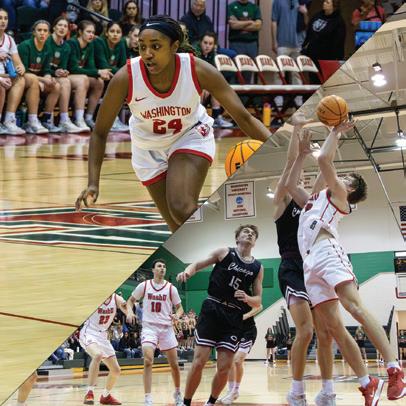
MARCH MADNESS! Men’s and women’s basketball to open NCAA tournament play.
(Sports, pgs 2-3)
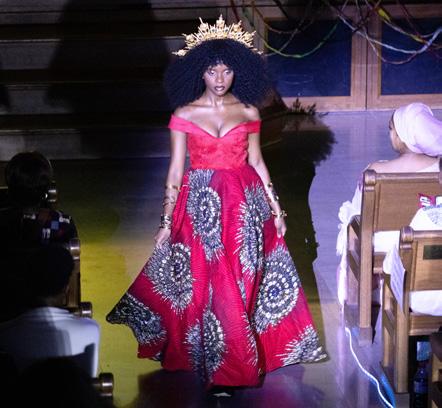
ASA celebrates African culture through fashion.
(Scene, pg 5)
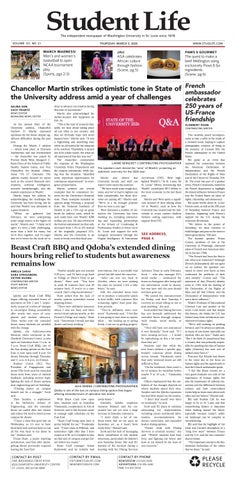
MARCH MADNESS! Men’s and women’s basketball to open NCAA tournament play.
(Sports, pgs 2-3)
ASA celebrates African culture through fashion.
(Scene, pg 5)
done to advance our mission during this time of uncertainty.”
Martin also acknowledged the shelter-in-place that happened on Feb. 24.
At his annual State of the University address, Chancellor Andrew D. Martin expressed optimism for the future despite significant difficulties during the past year.
During the March 2 address — which took place in Emerson Auditorium and was livestreamed — the chancellor was joined by Provost Mark West; Margaret C. Ryan Dean of the School of Public Health, Sandro Galea; and Vice Chancellor for Student Affairs, Anna “Dr. G” Gonzalez. The address mainly focused on topics such as the current financial environment, artificial intelligence, research breakthroughs, and the student experience at WashU.
Martin began the address by acknowledging the challenges the University has been facing, but he said that WashU was ultimately in a good situation.
“When we gathered last February, we were anticipating some rough waters in the higher ed world,” Martin said. “I think we’d agree it’s been a little challenging, more than a little for many, but we’re here together, and I’d argue that we’re better for the work we’ve
“This is the type of scenario that, sadly, we hear about taking place all too often in our country, and that we fervently hope will never happen here,” Martin said. “It was a frightening and unsettling time while we all waited for the situation to be resolved. Thankfully, it turned out to be a false report, but what we all experienced that day was real.”
The chancellor commended the response of the Washington University Police Department and the campus community, while saying that the situation “identified some important opportunities for continuous improvement” in emergency preparedness.
Martin pointed out several examples that he considered victories for the University’s financial state. These examples included an appeals judge blocking a proposal from the National Institutes of Health to put a 15% cap on grant funds for indirect costs, which he said could have cost WashU $200 million per year. He also referenced the federal endowment tax that only increased from 1.4% to 4% instead of the originally proposed 21%.
Martin said the University is on track to break even this fiscal year.

Martin also shared that University faculty and staff can expect merit raises this summer.
“We have made some tough decisions, and we’ve had to tighten our belts considerably, but those decisions are paying off,” Martin said. “We’re in a far stronger position than we were a year ago.”
West discussed a number of initiatives the University has been working on, including restructuring and expanding partnerships at the School of Continuing & Professional Studies to better serve St. Louis and support for technological innovation through the Digital Intelligence & Innovation
Accelerator (DI2). West highlighted WashU’s “In St. Louis, for St. Louis” efforts, mentioning that WashU contributed $9.3 billion to the local economy in the last fiscal year. Martin and West spent a significant amount of time talking about AI at WashU, such as how the University has created tools for individuals to create custom chatbots without coding experience, with support from DI2.
SEE ADDRESS, PAGE 4
and Qdoba’s extended dining hours bring relief to students but awareness remains low
“Studio usually gets out around 5:30 p.m., and I’d have to go back to Village or [Bear’s Den] to get dinner,” Hunt said. “You have to walk 20 minutes there and 20 minutes back. If you’re in a time crunch, that’s a big inconvenience.”
Qdoba and Beast Craft BBQ began offering extended hours of operation on Feb. 2 and 7, respectively, as part of a series of changes to on-campus dining accessibility after nearly two years of complaints and student advocacy. Three weeks into the extended hours, many students are satisfied with the change.
Qdoba, the build-your-own Mexican chain restaurant in the Danforth University Center, is now open on Saturdays from 11 a.m. to 3 p.m. Beast Craft BBQ, one of the four dining options on the East End, is now open until 8 p.m. for dinner Monday through Thursday and 11 a.m. to 6 p.m. on Fridays.
Student Union (SU) Vice President of Engagement and senior Ella Scott said the extended hours stem from years of student feedback, including surveys highlighting the lack of dinner options near engineering and art buildings.
“Finding dinner on campus should not be a struggle,” Scott said.
Theo Sanders, a sophomore in the McKelvey School of Engineering, said the extended hours are useful after late classes and reduce the need to travel across campus for dinner.
“I have a class that goes late on Wednesday, so it’s nice to have food back here and not have to run all the way back to my dorm to eat,” Sanders said.
Dylan Hunt, a junior studying architecture, said that after studio, getting dinner previously required leaving the East End.
Hunt added that the lack of nearby options sometimes meant skipping dinner.
“There were definitely instances where I was too busy and there weren’t food options nearby, or the Farmer’s Fridge was empty,” Hunt said. “Sometimes I would just skip dinner and keep working.”
reservations, but a successful trial period last fall eased his concerns.
“After our test run back in October, where we were making the sales we needed, I felt a little better,” he said.
Still, the extended hours have yet to produce a noticeable uptick in foot traffic, with customer flow remaining lighter than peak daytime periods.
“They’re definitely more scattered,” Kozlowski said. “I feel like it was going to start slow no matter what … but leading up to spring break, I can see us getting progres-
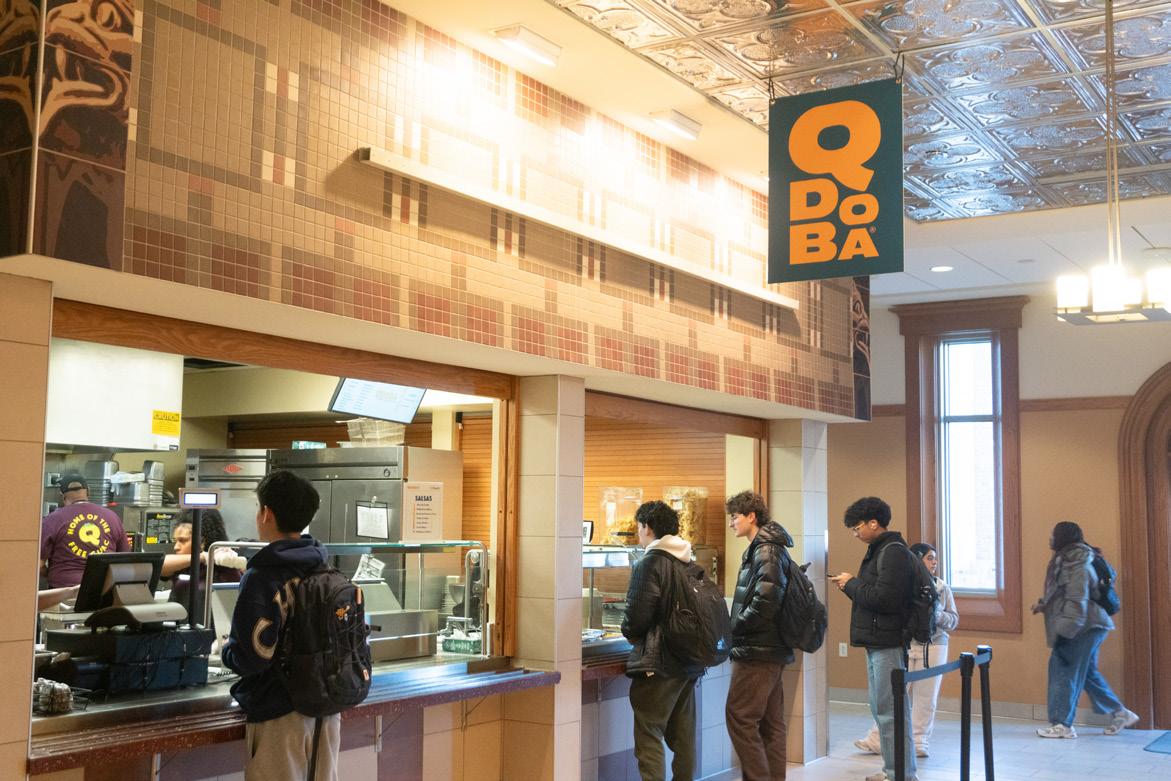
With Beast Craft now open later, students such as Asmithaa Vinukonda, a sophomore in Arts & Sciences, said it has become easier to manage tight schedules on the East End.
“Beast Craft being open later is pretty helpful for me,” Vinukonda said. “I have class in Hillman, and sometimes right after that I have exams at 6:30, so it’s helpful to stay on that side of campus and get dinner before my exams.”
Beast Craft manager Adam Kozlowski said he initially had
sively busier.”
Similarly, Qdoba employee Autumn Manuel said the restaurant has not yet seen a large increase in Saturday customers.
“I don’t think a lot of students know that we are open on Saturdays yet, so it hasn’t been really busy,” Manuel said.
Scott said the lack of messaging likely contributed to low student awareness, particularly for Qdoba’s new Saturday hours. She said SU learned of the decision during a meeting with the Dining Services
PAWS & GOURMET
The quest to make a beef Wellington using exclusively Paws & Go ingredients. (Scene, pg 6)
FLANNERY POON CONTRIBUTING WRITER
Two students posed inconspicuously to take a selfie in the midst of a crowded room, hoping to capture photographic evidence of being in the presence of Laurent Bili, the French ambassador to the United States.
Bili spoke at an event that explored the connection between the American Declaration of Independence and the French Declaration of the Rights of Man and of the Citizen on Thursday, Feb. 26. The event was part of a speaker series, French Connexions, hosted by the French department to highlight the shared influence between France and the United States on ideas of rights, citizenship, and democracy.
Bili spoke briefly about St. Louis’ French roots, as well as the 250 years of friendship between France and America, beginning with France’s support for the U.S. during the American Revolution.
“We believe in the power of friendship; we must continue to build bridges and pass on the torch to future generations,” Bili said.
The keynote speaker, Vivian Curran, professor of law at the University of Pittsburgh, discussed ideas of French and American identity in the late 1700s.
Advisory Team in early February. Scott — who also manages SU’s social media — announced the hours on Instagram after being told the information could be shared, but was later told the post should not have gone up.
“We posted the announcement on Friday, and then Saturday I received an email telling us not to post anything,” she said.
Scott added that Dining Services has not formally publicized the extended hours through campuswide emails, social media, or flyers.
“They still have not announced it very formally,” Scott said. “If I were running services … I would be capitalizing on this a lot more than they are.”
Students said that while the new hours address a specific gap, broader concerns about dining access remain. Vinukonda noted that early weekend meals are still difficult to find.
“On the weekends, there aren’t a lot of options for breakfast before maybe 9 or 10 a.m.,” Vinukonda said.
Others emphasized that the usefulness of the changes depends on where students spend their time.
Sanders said the Qdoba expansion has had little impact on his routine.
“I don’t find myself over there on weekends,” he said.
Scott said SU plans to continue advocating for improvements, including clearer nutritional information, accommodations for dietary restrictions, and expanded kosher dining options.
“Future work with Dining Services is certainly needed,” she said. “WashU students lead busy lives, and figuring out where and how to eat should be the least of our concerns.”
“The French had been the first to ask, what is an American? Although [French philosophers] did not agree on an answer, the question continued to hover over them as they confronted the problems of their own identity,” Curran said. “The statement of that [French] identity arose in 1789, with the drafting of the Declaration of the Rights of Man and [of the] Citizen, and the Declaration of Independence truly was a direct influence.”
WashU Professor of International Criminal Law and speaker at the event, Leila Sadat, said that despite this history, she thinks the U.S. has backed away from its historical commitment to human rights.
“We’re still working on pushing forward, and I’m always an optimist, as many of you know, especially my students who are here,” Sadat said, “But I do think it’s paradoxical that a country that was primarily responsible for sparking this idea of human rights [America] has now sort of walked away from it.”
First-year Kat Kluzak was drawn to the event due to the focus on human rights and the opportunity to hear the French ambassador speak.
“I feel like [these events] are a very good reminder not only of the importance of human rights, but also the importance of cultural connection and the differences between cultures and how cross-cultural events help us learn more about each other and our history,” Kluzak said.
Bili told Student Life he was happy to be in St. Louis and that remembering history is important when looking toward the future, especially because today’s political landscape can be complex or overwhelming.
Bili said that the highlight of the event was Curran’s description of a “long love story” between France and the U.S. and the two countries’ shared values.
“The important concept is the fundamental declaration of the values that we share,” he said.
JACOB RITHOLZ STAFF WRITER
Coming into the 20252026 season, the No. 20 WashU men’s basketball team had lofty expectations. They started the season ranked as the No. 5 team in Division III and were coming off a deep run in the NCAA tournament that ended in a bittersweet Final Four loss. This year, the Bears were poised to contend not only for another tournament run, but also a University Athletic Association (UAA) championship. After a tumultuous regular season, WashU came up short for the conference title, but the Bears will enter the playoffs on a fivegame winning streak. The Bears are geared up to contend for their first national championship in over 15 years.
“Starting [in the tournament], everyone’s zero and zero,” head coach Pat Juckem said. “You know, it doesn’t matter whoever you play at this point, either a champion of their league, a champion of their tournament, or had a great season, or all three of those. It’s more about us being us.”
The Bears will open their tournament campaign against Transylvania University, the champions
of the Heartland Collegiate Athletic Conference, on Friday, March 6, at the Field House. The winner of the WashU-Transylvania game will face either the No. 21 University of Wisconsin–Whitewater or Loras College in the second round matchup on Saturday, March 7.
Finishing with an overall 18-7 record (8-6 in conference), the Bears are heading into the tournament hot. While a midseason dip put their tournament hopes in jeopardy, WashU ended the regular season on a fivegame winning streak, capped off with a strong wire-to-wire victory over the No. 6 University of Chicago.
The Bears must double down on their regular-season strengths to put together a strong playoff run. This season, WashU has been especially dominant on the boards, averaging nearly 10 more rebounds per game than their opponents.
The Bears are led by senior guard Yogi Oliff and sophomore forward Connor May in rebounding with 7.2 and 7.0 a game, respectively. Both players are top 10 in the conference in rebounding and have shown to push the fast break after defensive boards, a vital
part of WashU’s offensive strategy. Oliff was named UAA Defensive Player of the Year in his senior campaign, while May was named to the All-UAA first team.
“Everything else I just learned from Yogi [Oliff] and the coaches, it’s amazing,” first-year guard Josh Kim said. “[We’re] really excited, man, that pressure, pressure creates diamonds.”
Getting out in transition has helped the Bears’ offensive efficiency. WashU is second in the UAA in both field goal and 3-point percentage and has outshot its opponents by more than 4% from the field overall this season. The Bears’ outside shooting has been led by sharpshooter junior guard Ryan Cohen, whose team-high 6.4 3-pointers a game goes along with an impressive 42% shooting clip from behind the arc. WashU has also been consistently able to find the open man this season, averaging over 15 assists per game as a team, nearly five more than their opponents.
“We execute our game plan well,” Kim said. “We trust our process, knowing we got hoopers, so we just got to share the ball and do what’s best for us.”
The strategy of outrebounding the opponent, finding good looks, and
maintaining a strong perimeter presence has allowed the Bears to achieve the success they’ve had in the second half of UAA play. But to make a deep tournament run, they’ll need to address their biggest weakness: taking care of the ball.
The Bears average 12 turnovers a game, over two whole turnovers more than they force from their opponents. The Bears have trailed their opponents this year in points off turnovers, which has led to a few heartbreaking finishes. The team is 0-5 in games decided by less than 5 points, and they’ll need to take care of the ball more down the stretch to close out games against the best defenses D-III has to offer.
“We’ve lost some [games], some tough ones where we had leads late, maybe turned it over versus press,” Juckem said. “You know, you’ve got to finish it right. And that’s just toughness and guys learning and growing in it. We’ve been there before, and there is belief in ourselves.”
WashU will face Transylvania on March 6 at 7:35 p.m. in the WashU Field House.


BEE AUSTIN CHRISTIAN KIM STAFF WRITER JUNIOR SPORTS EDITOR
The No. 2 WashU women’s tennis team has been riding high since becoming national champions last year, winning all four of their meets this year with perfect scores of 7-0. Last year, the Bears also started with a 4-0 record; however, they lost this perfect start to ClaremontMudd-Scripps in the first round of the ITA Indoor National Championship.
This past weekend, they faced the same team in the semifinals of the same competition with a chance to get revenge. The Bears could not rewrite history, as they narrowly lost to the No. 5 Athenas, going on to finish third in the competition.
WashU v. No. 27
Sewanee: The University of the South
WashU women’s tennis got out the gates hot with a
7-0 sweep of No. 27 Sewanee in the quarterfinals on Friday, Feb. 27.
The Bears set the tone early in doubles, securing the first point with a win on all three courts. Firstyear Lily Brecknock and sophomore Sam Slowik opened with a decisive 6-1 win, and the No. 7 pair of junior Eleanor Archer and sophomore Caitlin Bui followed suit with a 6-2 victory. Sophomore Ally Lin and senior Eliana Hanna, who was named University Athletic Association (UAA)

Athlete of the Week for her performances this weekend, finished doubles with a 6-0 win.
“I think it was definitely our strongest performance of the season,” Hanna said.
“Me and Ally specifically, we’ve been working on just trying to be more aggressive throughout all of our sets and all of our matches. …
That’s what we did, and we executed really well.”
The Bears took this momentum into singles play. At the top of the lineup, Hanna secured a 6-0, 7-5 win, while Brecknock battled for a 2-6, 6-1, 10-8 win. Bui and Lin followed with two wins of their own to secure the team’s victory.
With the victory, the Bears advanced to Saturday’s semifinal round against Claremont-Mudd-Scripps.
On Saturday, Feb. 28, WashU continued to show strong doubles play by taking all three sets. Archer and Bui defeated the nation’s top duo, Lindsay Eisenman and Rebecca Kong, 6-3. On the No. 2 court, Hanna and Lin dominated their opponents with a 6-3 win, and Brecknock and Slowik capped the sweep with a 6-0 bagel.
While the Bears earned two points in singles from Hanna and senior Nina Moravek, the Athenas clawed
back, winning four of the six matches to clinch the victory.
All of the other games would go the way of the Athenas. Archer fell to her opponent in straight sets, and Bui fell short in a three-set thriller, 6-7, 7-5, 6-3. Lin and Brecknock both also lost in straight sets, sealing the heartbreaking repeat loss for the Bears to the eventual champions of the tournament.
Hanna spoke on missing out on a chance to win the tournament by such a tight margin.
“I think it was really tough in the moment to know that we were that close to being in the final and potentially winning indoors,” she said. “I think especially just being the top seed, we all kind of had a hope and expectation that we would be in the finals on the third day.”
However, WashU’s weekend wasn’t over, as the Bears had a third-place match against Middlebury College.
WashU made it three doubles points out of three for the weekend, claiming two of the doubles sets to take a 1-0 lead. The dynamic duo of Archer and Bui dominated with a 6-3 win, and Hanna and Lin followed with a victory of their own.
At the No. 1 singles match, Hanna defeated her opponent decisively 6-4, 6-2. The other matches mirrored that momentum, with Archer
winning 6-3, 6-2. While Brecknock fell, it was not enough to slow the Bears as Bui secured her win, sealing the 4-3 victory and a third place finish. Coming back from such a difficult loss to move forward and beat Middlebury was no easy task, and Hanna spoke about the team’s resilience. “We wanted to show that, no matter what happened, we were going to come back and be the same team that we always will be, fighting to the end,” she said. “We came out really strong in doubles, and we had a very strong showing against Middlebury. They’re a tough team, … so I think it was a really good response from us.” However, this match does not mark the end of competition this year. The Bears will be hungry to improve their game in the outdoor spring season before conference championships in late April. Their hunt continues with a trip to Hilton Head, South Carolina from March 10-15, with a notable match against conference rivals No. 8 Emory University on March 11.

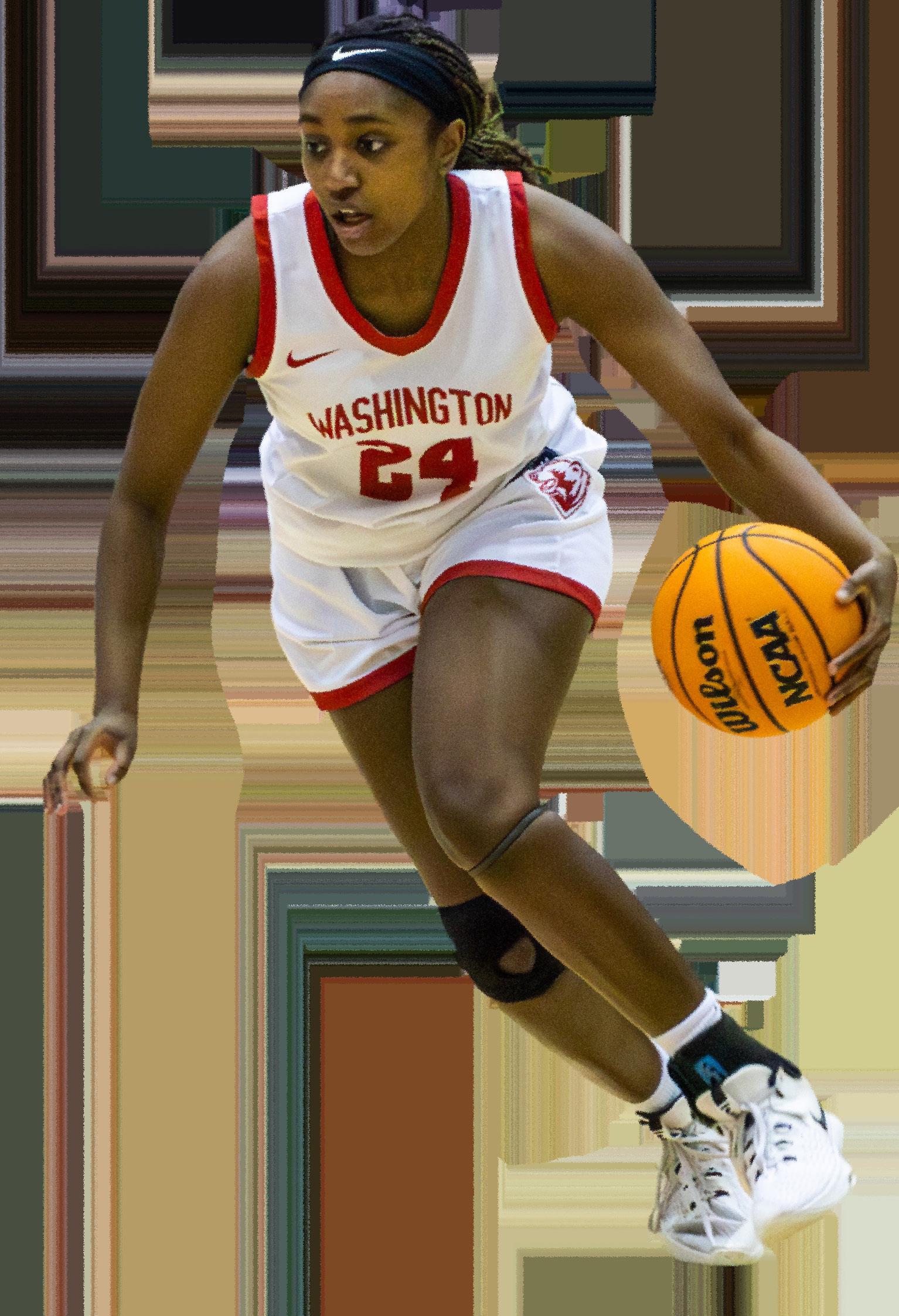
For the first time since 2019, the No. 15 WashU women’s basketball program is entering the Division III postseason tournament as a ranked team. After a dominant 19-6 season, the Bears are looking to make a deep tournament run for the first time in head coach Lisa Stone’s tenure after missing the tournament last season.
The Bears will travel to central Ohio this weekend, where they will begin their tournament campaign against SUNY Geneseo, the Empire 8 Athletic Conference champions, on Friday, March 6. The winner of this game will face either the host, No. 16 Ohio Wesleyan University, or DeSales University in the second-round matchup on Saturday, March 7. WashU finished the regular season hot, winning
eight of its last 10 games. The Bears’ 10-4 record was good for second in the University Athletic Association (UAA), behind only the reigning national champions, No. 1 New York University (NYU). The Bears excelled on both ends of the floor throughout the season, finishing with both the highest team field goal percentage and the lowest opponent field goal percentage allowed in the UAA.
The Bears were led all season by junior interior force center, Lexy Harris, whose 18.6 points per game led the UAA and 9.3 rebounds were second in the conference. Harris, alongside the team’s second-leading scorer, junior guard Sidney Rogers, was named to the All-UAA first team.
“We’re just gonna play how we always play, prepare the same ways,” Harris said after defeating the University of Chicago on Feb. 28. “Just keeping
everything that we’ve been doing, and just doing it better, more intentionally … Everyone’s super excited.”
Harris is joined by a backcourt of sharpshooters, Rogers and junior Alyssa Hughes, as well as the team’s sole senior, Jordan Rich, who was celebrated at Senior Day in her final home game last Saturday.
“Something we’re really focused on is knowing that every team, no matter if they won their college tournament or if they’re [an at large tournament bid], whoever we play first is going to be a good team.
… So we can’t just back down really easily, even if we know that we’re better than them,” Rich said after Saturday’s win.
The Bears have never faced SUNY Geneseo before. The Knights made it to the Sweet 16 last season before losing to eventual champions NYU. This year, they finished with an 11-5 record
in the Empire 8, good for fourth place, before upsetting conference top seed Nazareth University and winning the Empire 8 tournament. The Knights conceded the fewest points per game out of all Empire 8 teams.
If the Bears can win their first-round matchup, they’ll most likely face off against the home team, the Ohio Wesleyan Battling Bishops, whom they defeated in their
only matchup in a regular season game in 2022.
For Rich, keeping energy high and maintaining a focus on intangibles is the Bears’ top priority against Geneseo and beyond.
“I think something we struggled
with during our losses this year was low energy during warmups, low energy during the game,” she said after the game. “I think we’re really good … but it’s those other little details that we need to really get together before next week.”
RILEY HERRON
EDITOR-IN-CHIEF
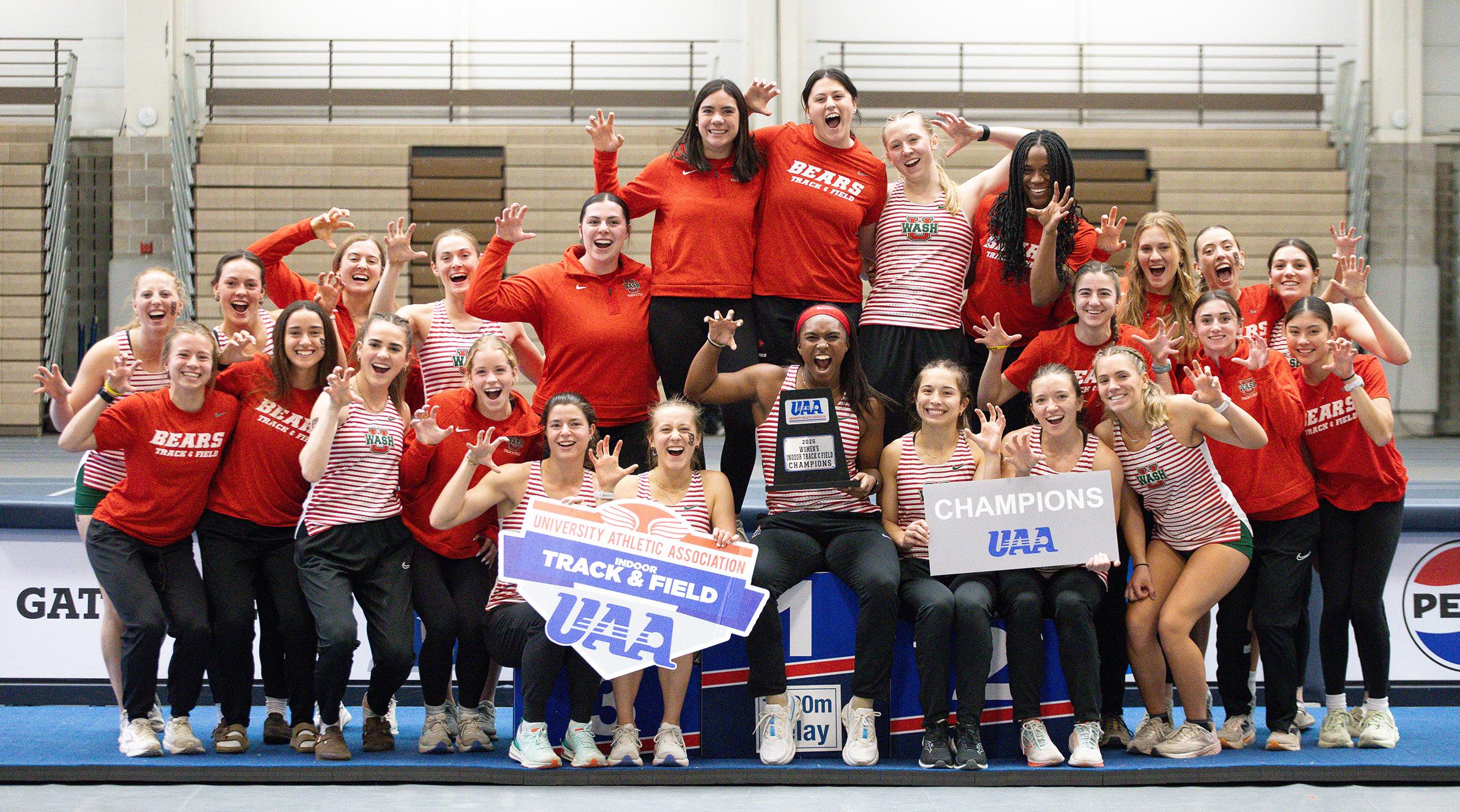
Dating back to 2018, one team has reigned supreme in the University Athletic Association (UAA) women’s track and field competition. On March 2, WashU continued its dominance, winning the Bears’ seventh straight UAA indoor track & field championship. Led by six first-place finishes, the Bears logged 186.5 points, significantly outscoring second place University
of Chicago’s 129.5 points. On the men’s side, No. 11 WashU finished in fourth place for the third season in a row, led by strong pole vaulting and middle-distance runs.
WashU’s women’s distance medley relay team of sophomore Lauren Raley, sophomore Ellie Cain, first-year Kate Delia, and sophomore Lucinda Laughlin broke the UAA record by three seconds, while the team of sophomore Quinn Bird, senior Kylie Spytek, junior
Caroline Echols, and junior Cate Christopher won the 4x400-meter relay.
Echols also finished first in the 800-meter race, followed by Delia and senior Cate Stevens to sweep the podium. The Bears also took the top three spots in the 60-meter, with senior Jasmine Wright, junior Maya Davis, and junior Julia Coric rounding out the top three. Coric followed up her 60-meter performance with a first place finish in the 200-meter race. Building off a strong
cross country season, Laughlin kept up her long-distance momentum, winning the 3000-meter race. In addition to excellent performances on the track, WashU thrived in the field elements. Senior Jenae Bothe won her second consecutive UAA indoor shot put title, while fellow senior Mackenzie Walker set a personal record with a 4.00-meter pole vault, the fourth-best mark in Division III this season.
The WashU men’s team
finished fourth, with their performance led by UAA records in the 4x400 and pole vault events. Senior Dayton Lasack, first-year Logan Fairchild, senior Brandon Brazil, and junior William Frohling set a conference best with a time of 3:16.46 in the 4x400. Lasack and Frohling also finished first place in the 400-meter and 800-meter races, respectively.
The Bears will open their tournament campaign against SUNY Geneseo at 3:45 p.m. CT. While the game will take place at the Branch Rickey Arena at Ohio Wesleyan, it will be available to stream for free on the NCAA website.
The Bears turn their attention towards NCAA qualifiers at Wartburg University this weekend, their last meet before the NCAA indoor championships in Birmingham, Alabama on March 13 and 14. After WashU’s women’s team finished second at indoor nationals last year, the UAA championship performance shows that WashU is ready to compete with the nation’s best at nationals once again.
The Bears’ men’s team has been the best in Division III in the pole vault this season, and the UAA meet was no exception. Junior Peter Lichtenberger and senior Tommaso Maiocco both shattered the previous UAA record — previously set at 4.96-meter by Lichtenberger in 2025 — with 5.07-meter pole vaults.

from page 1
“These are just a few of our examples of our work in a domain that we can’t afford to be left out of and, moreover, in which we intend to lead,” West said.
During Galea’s portion of the address, which focused on the WashU School of Public Health which opened last year, he pointed out that WashU offers a “unique vantage point” for public health since it is located in a state that generally votes Republican in the middle of the country. He stressed that public health should be depoliticized to best serve the general public. Galea shared that though the WashU School of Public Health opened a year earlier than expected, it already has about 220 graduate students, and the Public Health & Society program through the College of Arts & Sciences has 110 undergraduate majors and minors.
Martin and Gonzalez
also shared updates on construction plans for WashU’s campus. While the University has paused some construction projects, Gonzalez said that WashU is able to construct a new dorm on the South 40 because of the revenue it will generate and its role in meeting student demand for on-campus housing.
Given uncertainty around federal funding, Martin said it is difficult for the University to plan ahead for other major capital expenditures like redeveloping Fontbonne University’s campus, but pointed out that it could be used for opportunities like student housing, academic purposes, or temporary usage by community partners. Additionally, Martin explained that South Campus, which is currently being used to support club athletics, could be “taken off our books” and turned over to a developer in the
community in the upcoming years.
During the Q&A portion of the address, Jade Beauregard, a fourth-year Ph.D. student in Biological Anthropology, asked the University what it was doing to support graduate students in the face of funding cuts to the social, behavioral, and economic sciences.
In response, West said he “[hasn’t] dug into that much yet,” but emphasized the University’s commitment to supporting students who are feeling the effects of funding cuts. Martin added that the University is prepared to ensure all doctoral students currently on campus have the resources to finish their degrees, but he said that the future is “going to require some difficult decisions.”
The panelists were also asked about WashU’s “With You” campaign, a fundraising initiative announced last May. Martin shared that the
University has already raised more than $3.3 billion of its goal to raise $5 billion by 2030.
With the institution centered on new initiatives, financial positioning, and long-term goals, some members of the WashU community saw an overall optimistic outlook for 2026. Second-year MBA student Omotunde Oguntoyinbo commented on the tone the University carried throughout the address.
“The University has a distinct sense of where it’s heading,” Oguntoyinbo said.
“They provided updates and initiatives that we talked about last year, as well as some of the things that we learned to adapt to at the University.”
Eric Fournier, director of Educational Development at the Center for Teaching and Learning, shared a similar sentiment, noting the shift in tone compared to last year’s
address.
“Well, it certainly feels a lot more optimistic than last year,” Fournier said. “I think the big change in federal funding has made a difference in that, in some of the resolutions, I think [it] was important.”
Fournier also echoed concerns raised during the Q&A portion of the event, specifically regarding graduate student support.
“Right now, the graduate students make up about half the enrollment of this university,” Fournier said. “I’m really concerned about their future, both the support and the focus of the University.”
Similarly, sophomore Courtney Lucas II described funding as “both WashU’s biggest accomplishment and the biggest concern.”
Referencing WashU’s “With You” campaign, Lucas expressed cautious optimism about how financial success will translate into
long-term impact.
“In terms of WashU ‘With You,’ they raised $3.3 billion. I think that that’s really incredible, and that’s a huge accomplishment,” Lucas said. “But I think also continuing to secure funding for the future and making sure that undergrads and also professional students who appear on the Danforth campus and on the Medical Campus continue to [complete their] degrees.”
As a first-time attendee of the University’s address, Lucas left sharing WashU’s optimistic stance.
“I learned that WashU has started a lot of initiatives that have been really impactful, and they’re doing great work in the St. Louis community and also in the WashU community,” Lucas said. “I’m really looking forward to how the initiatives that have been started continue … and the ways that WashU continues investing in the community.”
administration and to bring a diverse perspective to WashU.
Amid heightened political turmoil in Venezuela, the Alexander Hamilton Society hosted former senior director for Western Hemisphere Affairs on the National Security Council and former U.S. State Department official, Daniel Fisk, to share his insights on recent events, Feb. 25. Venezuelan President Nicolás Maduro and First Lady Cilia Flores were captured by U.S. forces on Jan. 3, 2026, upending the Venezuelan government and catapulting the country into an uncertain future of potential economic change, government reconstruction, and unsettled relations with the U.S. Fisk shared his expertise on affairs in Latin America and discussed what the U.S. government’s next steps might be.
Junior Solana SorokinaMobbs, president of WashU’s Alexander Hamilton Society and the event’s host, said that she invited Fisk in hopes of bringing in a perspective that mirrored some of the ideals of the current
“In these politically polarizing times, I sought an unpopular narrative to qualify popular campus narratives,” Sorokina-Mobbs said. “More specifically, while we are living through the Trump administration, [I sought] a narrative representative of those currently governing our nation from the capital, which WashU can feel very isolated from.”
Throughout the evening, two moderators asked Fisk questions relating to ongoing events in Venezuela and U.S. relations with Latin America. Fisk argued that Trump’s order to capture Maduro was lawful, citing actions of previous administrations. He explained that former President Barack Obama never formally recognized Nicolás Maduro as Venezuela’s president, and that the Biden administration publicly acknowledged opposition figure Edmundo González Urrutia as Venezuela’s president-elect after his overwhelming win in the 2024 election.




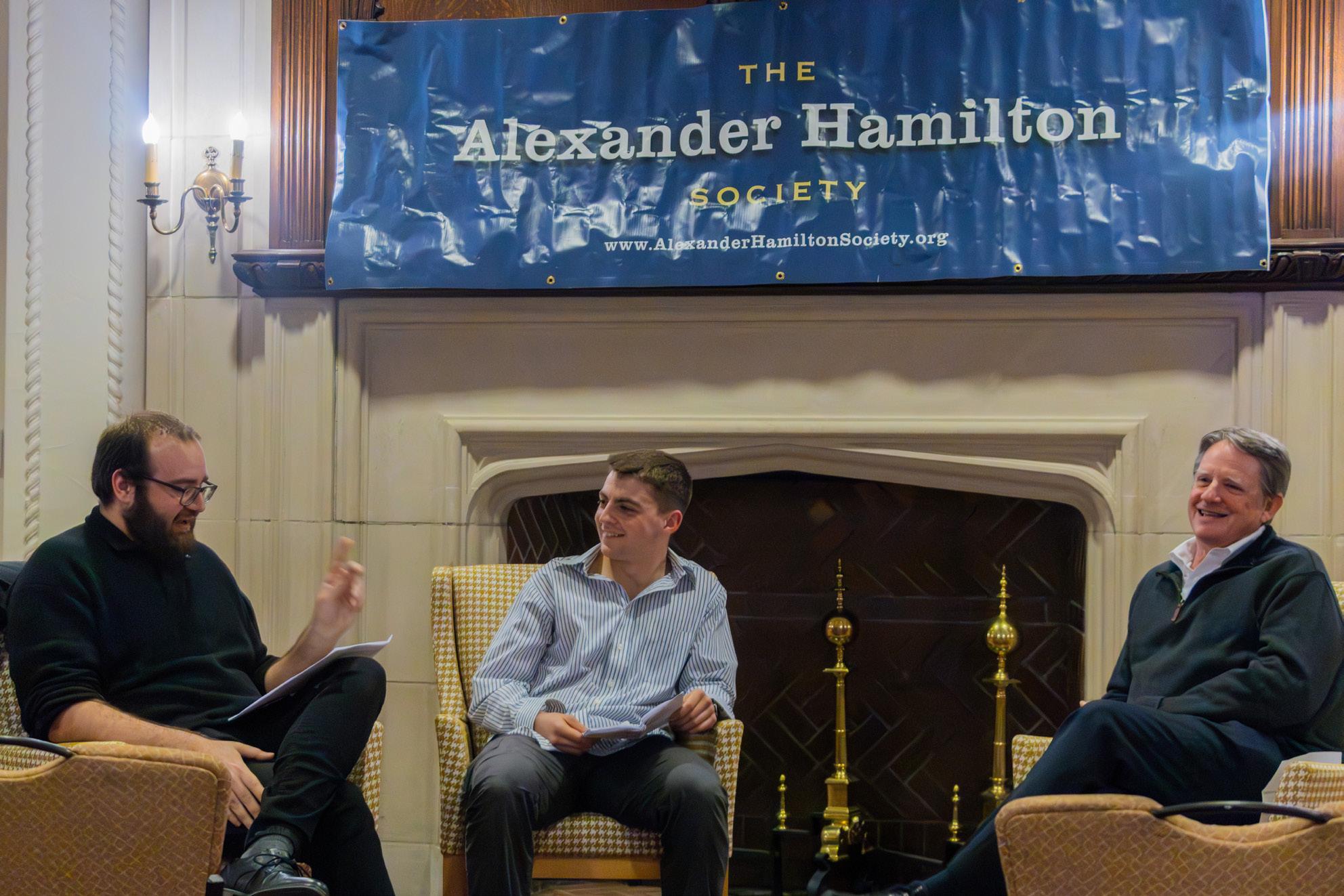
“I think with Venezuela, there’s a lot more context to what is happening,” Fisk said. “I think that the capture of President Maduro was under the president’s authority.”
Fisk was also asked to evaluate the governing capability of Nobel Peace







Prize-winning opposition leader María Corina Machado after President Donald Trump recently questioned her leadership. Machado had previously been barred from participating in elections, but since Maduro’s capture, is allowed to run for office.
“I have personally been disappointed in Trump’s treatment of her,” Fisk said.
Fisk did share Trump’s worries about Machado’s lack of support from the Venezuelan government and military, but acknowledged her as a resource because of her overwhelming approval from the Venezuelan people.
“I think she’s an asset because she has popular support,” Fisk said. “I think that Machado and the opposition have to be part of the process going forward.”
Fisk also argued in favor of holding elections sooner so that Venezuela can have a democratically elected president as quickly as possible. He argued that members of Chavismo, the political movement backed by Maduro, should be able to run in these elections, but that they almost certainly will lose to the
overwhelmingly popular opposition party.
On the subject of Trump’s current relationship with Venezuela’s Interim President, Delcy Rodríguez, Fisk explained that at this point, Trump has said respectful things about her and acknowledged her as the interim president.
“Trump is very transactional, so as long as she is willing to be transactional, U.S.-Venezuelan relations will be strong,” Fisk said.
Fisk was asked whether he believes that increased immigration had influenced Trump’s decision to pursue military operations in Venezuela. Fisk argued that for Trump, it was likely more about potential economic gain through Venezuelan oil. He also discussed the drugs coming out of Venezuela, primarily cocaine, but argued that shooting down the drug boats was a waste of American supplies.
“I think blowing boats out of the water is maybe not a good use of military resources,” Fisk said.
When asked what comes next for Venezuela, Fisk said that it is now time for the Venezuelan government to rebuild and
implement new democratic policies. He argued that the U.S. will likely play a role in this and will help implement free and fair elections.
“They have the policy, so they just need the people to do it, so that is where the U.S. comes in,” Fisk said. He also pointed to what he views as a broader conservative shift across Latin America, but he argued that the U.S. would likely work to preserve its relationships in the region regardless.
“There have been conservative shifts in many Latin American countries, which will start changing the dynamic of Latin America. Their relationships with us are deep on a cultural, economic, and political level. If Venezuela starts going another direction, we’ll deal with it,” Fisk said.
Fisk said he hoped that after the event, students would be more engaged in Latin American-U.S. relations.
“It’s a deep relationship,” Fisk said. “It has its moments of historical complications, but it’s got a lot of elements to it that are more positive than how we sometimes talk about the hemisphere.”
ABDOULAYE FAYE CONTRIBUTING WRITER
WashU’s African Students Association (ASA) hosted its 18th annual fashion show
“JALI: Threads of Memory” in Graham Chapel on Feb.
28. The event transformed the space into a living archive of African history and culture, honoring the West African jali — a traditional storyteller, musician, and cultural historian. Through fashion, poetry, music, and performance, the show celebrated the continent’s diversity while emphasizing storytelling as a means of preserving memory and sharing culture.
The show centered around the five main regions of Africa: east,
west, north, central, and southern.
“Each region of Africa showcases a different story that we’re aiming to express through the dynamism of the walks, music, and the performances,” Creative Director and senior Temi Ijisesan said.
Before each regional walk, emcees sophomore Izzy Mbatai and senior OreOluwa Oni narrated either a traditional story or a historical account, introducing the region’s values.
The show opened with “Jarabi” (translated from Mandinka, a West African language, as “beloved”), a song performed by senior Toni John, whose gentle voice filled Graham Chapel.
The song, rooted in traditional Malian melodies, set a reflective tone and established the theme of storytelling that carried throughout the night.

The first regional segment highlighted East Africa. Mbatai and Oni introduced a story about a lion, a hare, and a hyena, centered on a message about loyalty and wit. The tale set the stage for the East African walkway, which featured aesthetics from Kenya, Somalia, and the Democratic Republic of the Congo. As each model strutted forward in bright, patterned garments, the energy in Graham Chapel shifted, and cheers broke out. The audience was swept up in the rhythm of the walk, as each step, turn, and pose carried a story of pride, heritage, and celebration.
The models who walked also performed traditional East African dances, including Guragigna, Tigrinya, and Amhara styles. The performance blended movement and storytelling, using rhythm and coordinated steps to cultivate cultural identity.
Before the show transitioned to the next region, the second walk featured attire that ASA purchased from Cee Cee’s Closet NYC, a fashion brand founded by sisters Uchenna and Chioma Ngwudo. The brand celebrates West African heritage through bold prints, vibrant textiles, and cultural designs. The brand’s design came to life on the runway as students modeled pieces that blended tradition with modern style, transforming cultural expression into powerful pieces.
The North African segment shifted in tone, beginning with the ancient Egyptian myth of Osiris and his wife, Isis. Narrated by the emcees, the story centered on Isis’ devotion to her husband after he was betrayed by his brother Set. Even after Osiris was exiled and torn apart, Isis searched for him and restored him through her love. Framed as a story about hope and the power of love, the myth introduced the third walk, the North African walkway.
This walkway featured traditional garb from Algeria, Morocco, Tunisia, Sudan, and Egypt. Each model made the runway their own, bringing different personalities to the runway; some models added a quick dance, and others paused for dramatic poses, turning the chapel into a space of self-expression.
After the North African walkway, junior Ahmed Metti performed his poem
“The Heart of Algeria,” tracing Algeria’s journey through colonization and independence. “She rises, she resists, she is free,” Metti said, emphasizing the country’s enduring strength and hard-fought liberation.
In the poem, Ahmed also touches on the history of all the countries in North Africa, illustrating their struggles and the strength it took to overcome them. The poet shifted his attention to the present, shining a light on the ongoing hardship in Sudan.
“Colonialism lives when we are silent, watching someone else’s world burn,” Metti said. Metti’s poem shifted “JALI” from celebration into a call for change, reminding the audience that storytelling can also be an act of resistance.
The South and Central Africa segment followed with the tale of the Rain Queen, a historical figure whose powers were said to command the skies. The story was paired with a captivating per formance from the Afrique Dance Ensemble (ADE), a South African dance group that traveled from the University of Illinois UrbanaChampaign to showcase the rich and diverse movements of the region. This walk way featured views from the Democratic Republic of Congo, Cameroon, South Africa, Botswana, and Zimbabwe. The mod els strutted in solos or pairs, sometimes in oppositecolored pairs that played off each other. With play ful steps, small spins, and coordinated poses, each movement gave their walk its own energy and personality.
West Africa concluded the regional storytelling with the
tale of Anansi, a clever spider who won stories from the sky god and returned them to humanity. It was a fitting and memorable narrative for a night dedicated to reclaiming and sharing memories of Africa’s rich culture and history. A mesmerizing West African dance followed the story, its coordinated footwork and flowing movements bringing the energy and spirit of the region to life.
This performance led to the West African walkway, where models represented traditional attire from countries such as Senegal, Nigeria, Ghana, Gambia, and the Ivory Coast. Models walked with complete control as if they were carrying the weight and pride of their ancestors, with each step echoing the rhythm and spirit
importance of each country. The show concluded with the Executive Board walk. Members of ASA’s leadership took to the runway, celebrating not only culture but the months of planning and dedication that made the show possible.
“This idea started as jumbled notes on Google Docs, and seeing it come into [life] has been such a rewarding and deeply powerful experience,” Ijisesan said, reflecting on the journey of bringing the show to life. The 18th annual ASA fashion show transcended just a display of clothing; it was a celebration of Africa’s vast and rich traditions. From east to west, north to south, each walk represented the continent’s stories, culture, and resilience, leaving the audience with a deeper appreciation for Africa’s

By

FRITZ MURRAY
CONTRIBUTING WRITER
The beef Wellington is the epitome of fine dining. It oozes elegance, class, and a refined palette. Constructed in layers, it begins with only the most expensive cut of beef: a buttery and tender filet mignon seared to perfection, coated with a subtle yet complex Dijon mustard. The next layer is a luxurious helping of duxelles (that’s finely chopped mushrooms sautéed in butter and herbs, you Neanderthal), followed by a thin layer of melt-inyour-mouth prosciutto. Finally, these rich and complementary flavors are surrounded by delicate puff pastry and rolled into one stunning supper centerpiece, perfect for your genteel soiree. Gathering the ingredients for this delicacy can be a job only for WashU’s distinguished convenience store, Paws & Go!
a beef Wellington exclu sively with ingredients from Paws & Go. It will not be easy. It may not even be remotely possible. But there’s
only one way to find out, and that’s to go grocery shopping. I decided to go with my friend, first-year Diya Gupta. As it turns out, Paws & Go is not really into the whole “groceries” thing, so we’re really going to have to get creative. The only ingredient our recipe and the original beef Wellington have in common is Dijon mustard, which, for some reason, Paws & Go sells. Beyond that, it’s a complete wasteland. If, for some forsaken reason, you’re cooking along at home, here’s what we walked away with:
• Roast beef sandwich
• Dijon mustard
• Three bell peppers
• Ham and cheese sandwich
• White bread
• Eggs
This ingredient list may feel small, but real beef Wellington recipes also have short ingredient lists. Stop doubting us.
sure it’s seen some horrors over the years, but this has to be up there. Another hurdle — our cling wrap contact has fallen through (someone stole it from his dorm’s kitchen), so we’re going to be rolling this thing up with baking sheets and tin foil. We begin with the center. Instead of a gorgeous filet mignon, the closest Paws offers is the roast beef from a roast beef sandwich. It will have to do. We roll it into a small burrito-esque shape, using the Dijon mustard as a sort-of glue. Appetizing. It goes into the fridge to firm up.
The duxelles are next. Predictably, Paws & Go does not have mushrooms. In fact, they only sell two vegetables, as far as I can tell: cucumbers and bell peppers. The lesser of the two evils here, I feel, is bell peppers. As we do not have oil, the sautéing process is fraught. The charred bits add flavor, or something. Again, we
we use ham from a ham and cheese sandwich. I’d issue an apology to the entire nation of Italy, but desperate times call for desperate measures. With this, we can begin assembly of the Wellington innards. We lay out overlapping slices of ham, followed by a layer of our “duxelles” joined with Dijon, before retrieving our cold beef cylinder from the fridge and placing it in the center. Rolling it up with the tin foil is a complete mess, but eventually, we form a stable enough log to put it back in the fridge.
The final and most difficult hurdle awaits us: the puff pastry. Our plan is to roll the bread flat into a crust using a water bottle. At first, this plan works, but then the individual bread pieces stop adhering to each other; in classic Paws & Go fashion, the bread is a bit stale, and it falls apart on the baking tray. Clearly, the bread will need to be wet.
achieve a lovely golden hue.
For ours, the egg wash is going to have to step up in a big way. It must hold the crust together. We whisk two eggs in a bowl and soak the bread in the scrambled egg mixture. Finally, it has the moisture and structural integrity to wrap completely around the meat, mustard, and bell pepper log.
We put it in the oven for a while at 350 degrees Fahrenheit. Do you really care how long? Until crispy, or whatever. This isn’t a recipe — please don’t attempt!
Upon removal from the oven, it actually looks better than I thought it would.
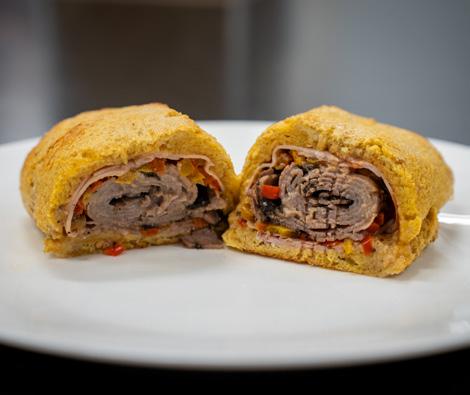
The egg has given it a nice yellow-gold color, and it’s rather Wellington-shaped as well. Jolly good! Cutting it open, though, reveals a much sadder sight. It looks bad, just really not good.
The roast beef is a distressing gray shade, and the pops of color from the bell peppers make it look more
flavor can come through. This is baffling, considering we did not add any salt. Not even the copious amount of mustard is discernible as a flavor. The texture? Generally unpleasant, as you likely suspected. The beef is shockingly wet, and the bread is too thick to cook through properly, so it remains soggy as well. The bell peppers are not a nice paste like real duxelles; instead, they are a sort of disconcerting chunk. Somewhere in England, Gordon Ramsay sheds a single tear. If there’s one takeaway from this sad experience, let it be this: The spirit of culinary experimentation is not dead on college campuses! The UCLA tiramisu guy proved it, and we have continued his work. Though today ends in failure, it is not for a lack of trying. Paws & Go has a wealth of ingredients, though it may take a bit of creativity to access some

ELLE LUDWIN STAFF WRITER
What is femininity? What defines our understanding of gender and sexuality? How does self-adornment fit into societal ideologies of womanhood?
“Lipstick,” a new book by WashU College Writing Professor Eileen G’Sell, explores these intersections between self-adornment, gender, sexuality, and femininity through the lens of an everyday object — lipstick.
On Wednesday, March 4, WashU’s Women, Gender, and Sexuality Studies Department, Association for Women Faculty, and Office of Public Scholarship hosted a book launch for “Lipstick,” which is the newest book in Bloomsbury Publishing’s “Object Lessons” series.
“Object Lessons” was co-founded by Christopher Schaberg and Ian Bogost in 2013. Schaberg is a writer and editor with a special focus on environmental thought and the culture of air travel. He also happens to be the director of Public Scholarship at WashU. Bogost, also a writer and editor, has had an astonishingly varied career: he is an awardwinning video game designer and artist, he worked in the digital tech field while in graduate school, and he is a contributing editor for The Atlantic. He is currently the Barbara and David Thomas Distinguished Professor and a Faculty Fellow at WashU, and he serves as the co-executive director of the Office of Public Scholarship.
“Object Lessons” is an
ongoing series of short books about the hidden lives of ordinary, everyday things. The books are intentionally brief, but written in a wide variety of styles — some are based on interviews and written analytically, while others are introspective reflections of the author. The topics range from physical objects, such as a golf ball or a shipping container, to abstract concepts, like silence or the idea of fakeness. Others are not easily categorizable, like jet lag and whale songs. The books span a variety of subjects, from the archaeological to the medical, from the technological to the environmental. Writers can pitch an “Object Lesson” on nearly any ordinary thing, as long as there is a story to be told.
“[‘Lipstick’] is for anyone who has ever wondered why femininity is so fraught, why ‘appearing girly’ can be so stigmatized in certain quarters, but also so mandated in others,” G’Sell wrote in a statement to Student Life.
“I want this book to encourage readers to challenge their assumptions about feminine adornment — painting the face specifically. Humans have painted their faces, tattooed and shaved their bodies, for thousands of years. Why and how is the act so charged in terms of gender today?”
G’Sell was invited to write a book for “Object Lessons” in 2023 after a conversation with Schaberg.
“I was known as a WashU professor who publishes frequently in public forums like Jacobin, The Baffler, and Hyperallergic,” she
said. “During our conversation, I expressed admiration for the book series, and he said, ‘Well, you should write one!’”
The crossroad of selfadornment and femininity has long been of interest to G’Sell, and in choosing her subject, she wanted an object that allowed her to explore that intersection.
“I always knew it would be lipstick, because lipstick is such an iconic, but also contentious, object — and it overlaps so well with larger conversations about gender, sexuality, femininity, feminism, and power — conversations I’ve been part of for years with my film and visual art criticism,” G’Sell said. “I also happen to have long loved lipstick, such that I thought my personal story and voice would be relevant.”
“Lipstick” is based around a series of interviews that G’Sell conducted with nearly 100 women and gendernonconforming individuals ranging from 18 to 78 years old from all around the world.
“I distributed a survey [in] the summer of 2024 to a broad array of people in my social network; I also encouraged certain friends and acquaintances to share with their families and communities,” she said. “I wasn’t aiming for quantitative data to aggregate and make deductions from. Rather, I was looking for voices, stories, and perspectives that differed from my own.”
G’Sell hopes that “Lipstick” will reach a broad audience, beyond those who enjoy beauty culture. She
emphasized that “Lipstick” is neither an endorsement of lipstick itself nor an attempt at persuading people to wear lipstick — instead, she uses lipstick to explore and confront complex societal issues of femininity and gender norms.
“The book is not
advancing the idea that everyone should enjoy lipstick or that everyone should wear it,” G’Sell said. “Like all vestiges of femininity, lipstick is fraught! That’s why it’s exciting to write about.”
The book launch centered on a panel featuring WashU faculty members and students in discussion on the book. While G’Sell talked about her writing process and shared an excerpt from the book, the event focused on the faculty and students featured, including many of G’Sell’s former students.

KEVIN KAN | ILLUSTRATION EDITOR
First Place:
I’ll get an internship this career fair…
I’ll get an internship this career fair…
I’ll get an internship this career fair… Sean Henry, Current WashU Student
Second Place:
When that one guy at Qdoba is on their phone and they don’t realize it’s their turn to order.
Romina Sanchez, Current WashU Student
Third Place: Is pre-packaged overpriced subpar food really worth a line that snakes through the entire cafe? Yeah, probably.
Abigail Brinkmeyer, Current WashU Student
Caption this! Enter this week’s contest


Scan the QR code to enter your submission by noon on 3/24.
On Tuesday, Feb. 24, at 9:19 a.m., thousands of devices across WashU buzzed with one terrifying message: “Armed person on Danforth Campus. Run, Hide, or Fight.”
For a generation that grew up with the constant threat of violence in our schools, this moment felt shockingly unreal. Even after all those years of running ALICE drills and scoping out escape paths during homeroom, none of it was comparable to the moment a threat materialized at WashU.
The greatest priority of the day was the safety and security of our community, and we are extraordinarily relieved that no one was hurt. While the investigation into the event is ongoing, what we do know is that this moment revealed systemic issues in the way our campus responded to the threat.
One member of our staff was in a class where the instructor continued to teach, even after students alerted her to the threat. After turning out the lights and locking the doors, she returned to her presentation. Students barricaded the doors themselves and begged their professor to stop the lecture. She acquiesced, but only temporarily,
and demanded that students huddling on the floor take out their laptops to follow along with a modified version of her class plans. The students were stunned — for those of us with extensive training on proper active-shooter procedures, this seems like an inconceivable response. Unfortunately, this response may reflect that, as a country, we have become so accustomed to gun violence that the threat of an active shooter no longer provokes the proper kind of response. It may also be a reaction of shock or an inability to process the situation. Either way, the outcome was wildly inappropriate and dangerous. Even after the all-clear was announced at 10:21 a.m., confusion and fear lingered. The emergency alert stated that police “did not locate an armed individual.” Although we understand that the Washington University Police Department would not be able to release all its information while the investigation was ongoing, the specific language of the alert was hardly reassuring. For some students, it seemed like the threat had simply not been found, not that it had been
neutralized.
Many of us turned to any place we could get even a whisper of information, including the anonymous social media platform Sidechat. Posts began spilling in: some true, others unverifiable, and some that capitalized on the panic to spread racist, AI-generated misinformation.
Campus was noticeably emptier that day. Students didn’t know whether or not they were safe, and later, whether or not they felt comfortable attending classes. The situation left campus in a state of uncertainty. The panic of the morning didn’t simply dissipate after the all-clear. Instead, it transformed into anxiety, unease, and, frankly, distrust.
WUPD Chief Angela Coonce sent out an email about the threat around an hour after the all-clear was announced, clarifying that authorities believed the initial reports of a shooter on campus were “not a credible threat,” followed by two emails from Anna “Dr. G” Gonzalez, vice chancellor for Student Affairs.
However, due to unfortunate timing, the first message we received from Chancellor Andrew D. Martin’s office was a scheduled press release
announcing the acquisition of a pharmacy school. This remained the only communication the chancellor directed towards the student body until the State of the University address on Monday, March 2. In the absence of direct communication from the top down, professors, students, and staff were left to make their own decisions based on incomplete information. Some classes continued, while others offered optional attendance or Zoom options. Another member of our staff had an exam that afternoon, which proceeded as normal. To simply go back to our individual lives, including our regularly scheduled exams, was jarring, to say the least. It was also a moment in which this community came together to protect its own. Some of our staff reported that dining workers, many of whom did not receive the emergency alert, acted with courage and swiftness to shelter students in kitchens. Administrators ran out of their offices to alert landscaping staff of the situation and ushered them inside.
This is a moment for WashU to evaluate emergency preparedness and protocols. WUPD and WashU Emergency
Management, which both conduct live action threat training biannually, responded swiftly, and we are thankful for their efforts to keep us safe.
Still, many of us around campus were caught off guard without formal training on active shooter procedures. Others discovered that their classrooms did not have locks or were in buildings with few places to shelter.
As Martin said in his address, “We each have a role to play in creating a safe campus environment, and we will keep working to strengthen our efforts in this area. Nothing is more important than the safety and well-being of our community.” Gun violence in schools is a systemic crisis we must address on campuses across the country. For our community’s safety, we also must focus on the issues laid bare on Feb. 24.
Staff editorials reflect the opinion of the majority of our editorial board members. The editorial board operates independently of our newsroom and includes members of the senior staff.
Laurel Wang, Senior Scene Editor
River Alsalihi, Senior Forum Editor
Lyn Wilkins, Junior Forum Editor
Kate Theerman Rodriguez, Senior Forum Editor
Amelia Raden, Senior Forum Editor
Sylvie Richards, Managing Forum Editor
David Ciorba, Senior Forum Editor
Will Rosenblum, Managing Scene Editor
Elizabeth Grieve, Senior Scene Editor
Hannah La Porte, Junior Scene Editor
Sophia Hellman, Senior Scene Editor
Bri Nitsberg, Managing Photo Editor
Isabella Diaz-Mira, Photo Editor
Mason Sutton, Special Issues Editor
Bea Augustine, Managing Design Editor
AnaElda Ramos, Managing Illustration Editor
Matt Eisner, Managing Sports Editor
Anna Crook, Junior Sports Editor
Ian Heft, Senior Sports Editor
Zoe Rhodes, DEI Editor
ELLA FESSLER CONTRIBUTING WRITER
A few weeks ago, WashU students gathered for St. Louis’ annual Mardi Gras parade in the Soulard neighborhood, one of the largest celebrations outside New Orleans. WashU students eagerly anticipate this event, attending both on- and off-campus gatherings before heading to Soulard for the parade and other festivities. However, this year, the morning was disrupted when personnel from the Office of Residential Life and the Washington University Police Department intervened in several student gatherings, leaving many upset and feeling their Mardi Gras was a letdown. In an attempt to control Mardi Gras activities, WashU pushed students toward riskier conditions, increased the alreadyexisting distrust between students and the administration, and inhibited some of the necessary growth students gain through experimental learning in college.
After spending the morning on the South 40, my friends and I decided to head over to Washington Avenue, where many fraternities and other student organizations host breakfasts and other Mardi Gras-related events, largely in off-campus housing not owned by the University. Upon arrival, we saw groups of students on the street unsure of their next steps. Residents had told them to exit the houses after speaking with WashU staff. ResLife officials and
WUPD patrolled the street, and eventually everyone went home after tenants stopped letting students inside. Many students planned to eat breakfast at these residences and left without a plan for the rest of the day. Others were already intoxicated with no food in their stomachs (a recipe for disaster).
Many returned to the South 40, including my friends and I, to adjust their plans and prepare for the parade. Before stopping by a friend’s room, we encountered her Residential Community Director (RCD) actively patrolling the hallway. Numerous individuals I spoke to during Mardi Gras recounted being questioned by ResLife, noting that their pregames in campus apartments were shut down, with some even having photos taken of their IDs and their alcohol dumped.
Once the events on Washington Avenue ended early, multiple students felt the only way to keep the fun going was to head straight to Soulard. Ironically, WUPD and ResLife’s presence pressured students to spend more time at the parade, where campus resources were unavailable if needed and where it was easy to lose sight of friends in the massive crowd, potentially placing students in a more dangerous situation. So, in their quest to disband Mardi Gras activities, presumably for student safety, they pushed students toward the less safe option, as Soulard is significantly farther from campus and less controlled than areas on and near campus in an
emergent situation.
Throughout Mardi Gras weekend, WashU students used Sidechat to share their frustrations and experiences with shutdowns. Although anonymous posts aren’t always reliable, the volume of unhappy students shows a rising sentiment of distrust and anger. Older students said they never felt this closely monitored by campus personnel in previous years. There were mixed reactions to these events, with some believing the University was trying to protect its students, while others felt its actions were overly intrusive.
WashU is an established dry campus, and alcohol is strictly prohibited, so the regulation of alcohol on campus is understandable. That being said, WashU has not recently banned alcohol, so the motivation for the increased surveillance this year is unclear. Moreover, their policing of off-campus apartments moves beyond a “dry campus” and is unexpected, so it breaches students’ trust.
There is also a stark difference between taking preventative safety measures and policing. Administration could have used alternative methods to ensure students’ safety, such as having more Emergency Support Team members and personnel ready in case of an emergency for extra on-campus support. Additionally, WashU could also have emphasized in its “Mardi Gras Weekend Safety Reminders” email before the event that safety is WashU’s number

one priority, and that, if needed, students could contact WUPD without fear of disciplinary action.
College is a major transitional period in most students’ lives, and they must become equipped to make better decisions and to become independent. Students need a space to practice decision-making with guardrails of support if needed. We are fortunate to have an administration that does its best to keep all students safe; however, patrolling during events, ID checks, and early shutdowns treat students like children and prevent the necessary growth that occurs in college.
College is largely about learning from one’s mistakes. Most individuals learn their max while drinking the hard way — by
ANNA
experience. WashU doesn’t necessarily need to stand idly by while individuals indulge in alcohol, but the actions taken during Mardi Gras felt less about safety and more about surveillance. Furthermore, as an NCAA Division III school, WashU students don’t often attend many campus-wide events, such as the tailgates at other schools. Mardi Gras is a way to unite the student body more and take a break from the immense pressure most of us face daily from being such an academically rigorous school; it also offers students a chance to connect with the broader St. Louis community, something many students at WashU don’t do. After the initial intervention on Washington Avenue, some students decided to call off
their plans and not attend the parade altogether. If WashU wants to effectively ensure its students’ security, I suggest making the student population feel more supported than monitored. Instead of immediately dumping alcohol at pregames, the school could offer rides back to dorms, or at least check in with students’ well-being without making them feel judged. I don’t believe eroding trust was part of the administration’s intentions. However, the administration’s questioning and overall demeanor as it shut down gatherings — ones that students have been looking forward to for weeks — do not make it feel like the policing of Mardi Gras was intended to serve students’ best interests.
RIVER ALSALIHI SENIOR FORUM EDITOR
In March 2020, Habif Health and Wellness Center Psychiatry Services, now the WashU Student Health Center, “suspended the treatment of new or transferred patients” who need stimulant medication for ADHD. The number of students seeking treatment for these disorders had increased so much that, in order to prioritize and support patients with “immediate mental health needs” (or “high-risk” patients), the Health Center stopped providing ADHD-related treatment completely.
The Health Center should reinstate its ADHD-related treatment because its inaccessibility perpetuates academic inequality, disproportionately affecting female, first-generation, and low-income students. The Health Center’s mission statement emphasizes “examining the places in which [their] practices perpetuate … inequalities, and working honestly and transparently to correct them.” The inaccessibility
of ADHD-related treatment has implications for students’ academic success, future employment prospects, and mental health and safety. Medication and academic accommodations, made available only after a diagnosis, can completely change a life.
WashU recognizes that college is a unique academic challenge, often requiring new skills or a higher level of skill than was needed for students to perform well in high school, and it offers various workshops to train incoming students on time management, procrastination, and organization. Not only do the elevated performance demands of college tend to bring undiagnosed ADHD to light, but students can reach the point of burnout after years of high achievement without treatment and coping skills.
Because women are more likely than men to receive an ADHD diagnosis once they have already reached adulthood, we can assume that the majority of students seeking a diagnosis for the first time in college are female.
Low-income students experience a similarly disproportionate negative impact when they lack sufficient access to healthcare until they arrive at college. As Congress moves toward increased requirements for Medicaid eligibility, many low-income grade school students will find their coverage on the chopping block. Efforts to support students with high need-based financial assistance, such as the TRIO, Kessler Scholars , and Taylor Scholars programs, must be supplemented on the clinical side.
Creating an inclusive, equitable, and nurturing school environment involves all types of support for neurodevelopmental differences.
The Health Center encourages students to seek ADHD diagnoses and treatment outside of its system, but accessing healthcare external to the University is not so simple. Students who are unfamiliar with the mental healthcare system and have to advocate for themselves as patients for the first time can face a “hidden curriculum”
in the healthcare sphere. The same students who are more likely to come into college undiagnosed are the ones with less experience, knowledge, and power to negotiate. The Health Center purposefully facilitates intake, appointment making, and provider communication in a way that is easy for students to understand and access.
Although WashU affords an insurance plan to students on need-based aid if they do not already have one, navigating health insurance with external providers can prove discouraging and anxietyinducing for students already concerned about finances.
Long waitlists, intake, expensive evaluation, and treatment from a provider outside of the school are all intimidating for college students. Whether they are thousands of miles from their parents, are on full financial aid with no experience with a mental healthcare provider, or simply feel that the obstacles outweigh their unconfirmed suspicions, students confronting the process are left vulnerable by the lack of care built into the
University’s health services.
In no way am I suggesting that patients with “immediate mental health needs” should have those needs pushed aside to serve different students. However, there is a correlation between undiagnosed ADHD, particularly in women, and development into a high-risk patient.
A recent literature review shows a pattern of maladaptive emotion-oriented coping, including substance abuse and sex as self-medication, in women with undiagnosed ADHD. Women with ADHD are far more likely to present psychiatric comorbidities, including self-harm, eating disorders, anxiety, and depression, than their male counterparts. They are also far more likely to experience suicidal ideation and attempt suicide than those without ADHD. It’s impossible to ignore the necessity of ADHD care to triage and prevent patients from escalating to “high risk.”
The decision to suspend ADHD treatment was made when the pandemic put an enormous stress and demand
on healthcare providers, and extraordinary circumstances call for extraordinary responses. I believe that we can do better now than during the adjustment period at the beginning of the pandemic. Peer institutions such as Emory University, Case Western University, and Rice University have almost identical policies to WashU. This pattern is concerning, given the unequal effect I’ve outlined. With such close ties to its medical school and the medical world, WashU has the opportunity and responsibility to set a precedent of equitable healthcare. If the Health Center’s current resources simply cannot be stretched or redistributed, then the University should increase its funding for the same reasons.
Having deeply benefited from WashU’s Center for Counseling & Psychological Services myself over the past few years, I appreciate this organization’s work beyond words and want all my peers to benefit as I have.
LAURA L. HOLT
During a recent game of “We’re Not Really Strangers,”
a friend asked about the most frustrating aspect of my job as a psychologist in a college counseling center. She speculated that it might be hard carrying the heavy things I hear from clients when the world is in chaos, or that I might get annoyed with the slow pace of growth. I explained that my training and the supportive work environment help me do my job, and that part of being a therapist is bringing a nonjudgmental understanding to the nonlinear process of healing.
As a scientist and clinician, the resistance I sometimes face — for understandable reasons — when delivering
my tremendous understanding of psychology is tiring. Overcoming this resistance is most challenging when I talk about group therapy. When I suggest to someone that I think group therapy (also referred to as “group”) is the best treatment option, the most common reaction is deep discomfort, even fear, as they imagine what it would be like to be vulnerable with a circle of strangers. All therapy is pretty mysterious, and it is even portrayed in movies and television incorrectly, often in direct opposition to reality. However, group therapy is often the hardest for newbies to grasp because it’s different from anything most people have experienced.
A therapy group can be imagined as a container that is solid, safe, and secure enough to hold the group’s vulnerability, tension, conflict, and emotionality. This safety is
often difficult for people to conceptualize, as they expect it to feel similar to other groups they have been in. That’s the very beauty of group therapy; people bring the selves they are outside of the group into the therapy space, but they get to experiment with new ways of relating and interacting with others in a safe and controlled environment. While they do this, therapists guide everyone to take risks and give and receive feedback. It’s the group leaders’ job to develop the safety and cohesion that feels so hard to imagine for those who have never experienced this unique space.
As a group therapist, I get to see how people relate to each other in real time and guide them in trying out different behaviors. This experience is wildly out of reach in the individual therapy dyad, where our clients show up differently than they do when trying to
connect with people in the world. This means group therapy is often more efficient than individual therapy for two reasons. First, you can benefit from the group even during sessions when you say little but listen carefully to others. You will find that you have much in common with other group members, and as they work on their personal concerns, you can learn more about yourself. Second, group members will often bring up issues that strike a chord with you, but you might not have been aware of or brought up by yourself. Therefore, learning from others can be a powerful therapeutic experience and often enhances the work.
We spend most of our lives seeking to be a part of groups and craving the support groups offer, so group therapy is a natural and highly beneficial form of treatment
for just about everyone. It offers a form of support, growth, and experience-based learning that you can’t get in individual therapy. Many times over the years, I’ve seen a single reflection from a fellow group member connect in a way that would have taken several hours of individual therapy. The cathartic universality of experiences, desires, and emotions is strong, and it results in a powerful projective identification and transference (seeing ourselves in others). My frustration stems from the difficulty of effectively describing how group therapy feels versus how people imagine it feels. If this article has helped you get on board, awesome. This spring 2026, the WashU Center for Counseling & Psychological Services is offering various group therapy options, including groups to help with belonging and acceptance, recovering from
unhealthy romantic relationships, focusing and avoiding procrastination, handling an injury as a student-athlete, and navigating college as a first-generation student. For additional information about these groups and more, or to learn how to get started, check out the WashU Counseling & Psychological Services website, which features details on our Group Therapy Support. Even if a group is full or doesn’t meet your schedule this semester, let a leader of a group know, and we can check in with you next semester! As a scientist and a clinician, I understand the difficulty of fully grasping the safety and benefits of group therapy; if one of our options represents an area in which you’d like to grow, I encourage you to engage in some science for yourself and experiment with group therapy.