The independent newspaper of Washington University in St. Louis since 1878 THURSDAY, MARCH 4, 2021
VOLUME 142, NO. 16
TAKE THE WU IN F
O
WWW.STUDLIFE.COM
CUS SURVEY
‘A multi-year paid crash course in cognitive dissonance’: Students rally in support of Greek Life abolition, dehousing of fraternities
WU public safety committee releases report recommending removal of WUPD officers from mental health calls, increased measures for transparency and accountability EM MCPHIE AND TED MOSKAL SENIOR NEWS EDITORS
ORLI SHEFFEY | STUDENT LIFE
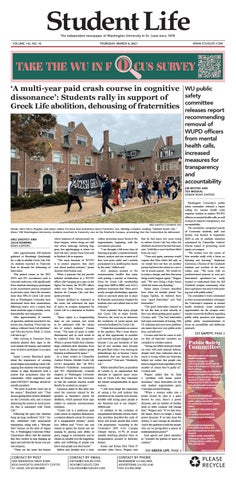
Senior John Harry Wagner and junior James Cevasco lead protestors down fraternity row, holding a banner reading “Abolish Greek Life.” About 100 Washington University students marched to fraternity row on the Danforth Campus, protesting that the fraternities be dehoused.
ORLI SHEFFEY AND JULIA ROBBINS NEWS EDITORS After approximately 100 students gathered at Brookings Quadrangle for a rally to abolish Greek Life, Feb. 26, students marched to Fraternity Row to demand the dehousing of fraternities. This protest comes as the 2021 WPA and IFC recruitment cycle is currently underway, with significantly fewer students choosing to participate in the recruitment process compared to previous years. Since the summer, more than 50% of Greek Life members at Washington University have deactivated from their oranizations, following outcry over a system that some students argue is classist, racist, homophobic and misogynist. After approximately 45 minutes of speeches, students marched to fraternity row, chanting “Don’t take my tuition, without Greek Life abolition” and “Hey hey, ho ho, Wash. U. Greek Life has to go.” After arriving at Fraternity Row, students planted their signs in the yard outside the houses, and students were invited to participate in an open mic. Junior Lawton Blanchard spoke about the importance of creating social stigma surrounding Greek Life, arguing that students who knowingly choose to align themselves with a system that perpetuates class discrimination, white supremacy and anti-LGBTQIA* ideology should be socially punished. “We need to pull the weed out at the source,” Blanchard said. “That means getting these houses abolished on the University side, and it means destroying the system of social prowess that is associated with Greek Life.” Following the open mic, students hung up large cardboard “AGL” letters, embedded with anonymous testimonies, along with a “dehouse frats” banner, on the door of Sigma Nu. A Washington University Police Department officer told the students that they needed to stop hanging up signs and said that the house was private property. “These are the same frat houses
where instances of interpersonal violence happen, where drugs are sold and where underage drinking happens, but sign-hanging is where we draw the line,” junior Nana Kusi said to Student Life in response. “The main function of WUPD is to protect property; they don’t care about student activism,” junior Jasmine MacFarlane said. When a protester did not provide solicited identification to a WUPD officer after hanging up a sign on the Sigma Nu house, the WUPD officer called over Beth Doores, associate director for Campus Life, and they spoke privately. Doores declined to comment at the scene, but addressed the topic of space on campus designated for Greek Life in a statement to Student Life. “Space equity is a long-standing issue on our campus and needs to be addressed with the identities of today’s students,” Doores wrote. “The topic of space is multidimensional and as such needs to be explored from that perspective. Where a person builds their relationships, celebrates their identities, lives, and meets to discuss student group business is influenced by space.” In a letter written to Chancellor Andrew Martin, Abolish Greek Life (AGL) demanded that “all WPA (Women’s Panhellenic Association) and IFC (Interfraternity Council) chapters at Washington University must be banned by the University so that the national charters would thereby be revoked on campus.” Concerns raised in this letter mirrored the concerns relayed by the speakers at Saturday’s march for abolition, which spanned from rape culture to systemic socioeconomic exclusion. “Greek Life is a multi-year paid crash course in cognitive dissonance, a constant obstacle course for anyone of a marginalized identity,” junior Izzy Jefferis said. “Every day you choose to ignore the harms you are causing by placing your ability to party, engage in community and be chosen as valuable over the happiness, safety and well-being of people you know and people you don’t know.” Jefferis also detailed how a toxic
culture permeates many facets of the organizations, beginning with the recruitment processes. “I sat through a full seven days of listening to people I considered family dissect, analyze and rate women as if they were prize cattle, and I actively participated in it, justifying the means by the ends,” Jefferis said. AGL speakers pointed to the socioeconomic hurdles that come with joining a sorority or fraternity. Dues for Greek Life membership range from $400 to $800, and AGL’s platform maintains that “there aren’t nearly enough scholarships, opportunities or payment plans put in place by fraternity and sorority chapters for students who can’t afford dues to feel welcome.” Kusi explained that many people join Greek Life to make friends. However, she went on to denounce the exclusivity of social spaces and networks facilitated by Greek Life. “I think that necessitates an answer to the question: Was I more deserving of that opportunity to socialize and network and get plugged in, just because I can pay hundreds of dollars of new member dues, because the girls liked what I was wearing on philanthropy day or because I knew somebody that was already in the organization?” Kusi said. “Absolutely not.” Jefferis described how, as president of Lamda Q, an organization that attempts to supports queer members of Greek Life, they witnessed the intense marginalization of queer women. “I will never forget the experience of seeing a live poll indicate that members of my sorority were uncomfortable with seeing queer people at our functions and in our chapter,” Jefferis said. In addition to the exclusion of marginalized identities, former fraternity members described the cycle of harm and sexual assault that Greek Life perpetuates. According to the University’s 2019 AAU Campus Climate Survey, 15.7% of sexual assaults involving physical force or incapacitation occured in fraternity houses. Senior and former Beta Theta Pi member John Harry Wagner said
that he had spent two years trying to reform Greek Life, but when the abolition movement formed last summer, “it felt like a cover had been lifted from my eyes.” “Time and again, someone would express that Beta didn’t feel safe, or we would find out that yet another person had been the victim or a survivor of sexual assault…We would try to make a change, and then that same thing would happen again,” Wagner said. “We were fixing a leaky faucet while the house was flooding.” Junior James Cevasco described how when he initially joined Tau Kappa Epsilon, he believed there were “good fraternities” and “bad fraternities.” “The good fraternities claimed to be not like frats at state schools, or they care about getting good grades,” Cevasco said. “The bad fraternities had open convictions of hazing, Title IX violations and even more problematic issues that were very public at the time, and still now.” Cevasco said that he came to realize that all fraternity members are complicit in a broken system. “Seeing my fellow fraternity brothers react with such staunch defense, despite such clear indicators that so much is wrong within our fraternity, helped me realize that people continue to support frats regardless of the number of crimes they’re guilty of,” Cevasco said. Wagner added that he finds a “problem with house power dynamics,” since fraternities are the only student organizations given University-owned housing. “When a woman walks into a house owned by men at a party thrown by men, there’s a power dynamic, and no number of facilitations or sober contacts will change that,” Wagner said. “If we take away the house, there’s no longer a house power dynamic. If we take away the system, it can’t corrupt its members. And if the problem is with the people, why are we giving them a source of institutionalized power?” Kusi agreed and asked attendees to “consider the politics of space on campus.”
SEE GREEK LIFE, PAGE 2
CONTACT BY POST
CONTACT BY EMAIL
CONTACT BY PHONE
ONE BROOKINGS DRIVE #1039 #320 DANFORTH UNIVERSITY CENTER ST. LOUIS, MO 63130-4899
EDITOR@STUDLIFE.COM NEWS@STUDLIFE.COM CALENDAR@STUDLIFE.COM
NEWSROOM 314.935.5995 ADVERTISING 314.935.4240 FAX 314.935.5938
Washington University’s public safety committee released a report calling for mental health crisis response workers to replace WUPD officers on mental health calls, as well as steps to improve transparency and accountability. The committee, composed mainly of University students, staff and faculty, was formed in September 2020 as one of multiple initiatives announced by Chancellor Andrew Martin aimed at promoting racial equity on campus. “We worked over the course of four months really with a focus on listening and learning,” Stephanie Kurtzman, Director of the Gephardt Institute and co-chair of the committee, said. “We came with no predetermined answers or even predetermined questions—we really wanted to understand from the full Danforth campus community what their experience was and is with policing and with public safety.” The committee’s work culminated in three recommendations: reimagine the University’s response to mental health incidents, create sustained opportunities for the campus community to provide feedback regarding public safety practices and improve public safety communications to focus on accessibility and deliberate outreach.
SEE SAFETY, PAGE 2
Public Public Safety Safety Committee New procedures for mental health incidents: -Certain emergency calls involving mental health will not require the presence of an armed WUPD officer -Additional funding for WUPD to hire mental health crisis response workers who would be trained to respond to these calls -Ensuring that crisis intervention and mental health training for WUPD officers is up to date Avenues for feedback: -Create an ongoing version of the public safety committee -An annual survey about public safety -Facilitated discussions with students -An online mechanism for students to give feedback Increased transparency: -Consolidating safety and security resources in one online location -Publish easily accessible information about WUPD’s training policies, public safety data, jurisdiction Graphic by Christine Watridge
2 STUDENT LIFE
EM MCPHIE & TED MOSKAL | SENIOR NEWS EDITORS | NEWS@STUDLIFE.COM
theFLIPSIDE FLIPSIDE THU 4
SAT 6
FRI 5
SUNNY 60/35
MOSTLY SUNNY 55/32
MOSTLY CLOUDY 55/31
MON 8
MOSTLY SUNNY 65/49
TUES 9
MOSTLY CLOUDY 65/52
SUN 7
PARTLY CLOUDY 60/40
WED 10
SHOWERS 66/49
EVENT CALENDAR THURSDAY 4 Eugene J. Mackey Jr. Lecture: Amanda Williams & Giles Smith Virtual Event, 12 p.m. The annual Eugene J. Mackey Jr. Lecture features speakers from two practices in dialogue: Amanda Williams, and Giles Smith of Assemble. In cities like St. Louis and Liverpool, vacancy creates an urban condition that is uniquely expressed, yet similar to other post-industrial areas. Each was once a center of manufacturing and workers’ communities, but they have emptied out since the decline of economic activity in the mid-20th century. A sole practitioner and a multimember collective, these two represent the gamut of forms that an architecture practice can take, the diversity of voices that are heard in the field today, and the persistence—and increasing visibility—of architecture’s activist tradition.
FRIDAY 5 Innovation Activation: Creative Trouble Makers Virtual Event, 2 p.m. The Skandalaris Center presents an interactive conversation and activation. This is an innovative, creative and collaborative opportunity for students to virtually work together to design a commercial. Winning teams will receive an Amazon gift card.
SAFETY from page 1 Executive Vice Chancellor for Civic Affairs and Strategic Planning Henry Webber, who commissioned the committee and received the report, said that University administrators were certainly supportive of the recommendations. “We listened to a lot, and what we heard—including from folks who are underrepresented on campus—was an overwhelming positive experience and perception of the police department,” Kurtzman said. However, the report also included survey data showing that certain demographics—particularly students of color and queer, transgender and nonbinary students—have been far less comfortable than the average student in their interactions with the police. 68% of white respondents reported being comfortable with interactions they had with WUPD, while only 50% of Black respondents and 55% of Hispanic/Latino respondents said the same. There were also significant disparities based on gender identity, with 15% of nonbinary respondents, 17% of transgender respondents,
61% of women and 74% of men reporting comfort in their interactions with WUPD. Overall, only 45% of survey respondents agreed that the presence of WUPD on and around campus made them feel safe. “I think it can always go up,” Kurtzman said when asked about these figures. “It should absolutely go up, and the ideal of equity would be that we would see data points that are not different based on people’s identities, and so no doubt, there’s more work to do.” “The single most disturbing thing in the report was the very low level of satisfaction among queer, gay [and] trans students,” Webber said. “The numbers were really disturbing, and clearly, while it is not directly a recommendation, I think that everybody who reads the report looks at the table and says we have a lot of work to do.” Over the past several months, students have been advocating for the defunding, disarming and complete abolition of WUPD. While one of the report’s primary recommendations is
in large part about gathering and listening to student concerns, the committee decided against taking steps to defund WUPD. “Over the past several years, there have been calls from groups of students and others to either disarm, reduce the budget or otherwise restrict WUPD,” Webber said. “There also have been very significant calls, usually associated with periods of significant crime waves, to significantly increase the WUPD budget… The calls to eliminate the police, while they exist and there certainly are people who believe that, are, let us say, a minority point of view.” “[Abolition and defunding of WUPD] was brought up and discussed,” Associate Vice Chancellor for Student Support and Wellness Kirk Dougher wrote in a statement to Student Life. “Many defunding movements are about repurposing funding and the sense of safety students might feel. Having an armed respondent makes many students feel nervous, for very good and historical reasons. The committee discussed the
GREEK LIFE from page 1
THURSDAY, MARCH 4, 2021
“Fraternities are the only organizations that have entire buildings dedicated to their operations; sorority women get suites; the Association of Black Students gets a suite that doesn’t have AC,” Kusi said. “We shouldn’t have spaces on campus that are sites of trauma, sites of violence and, frankly, sites of substance abuse. Think about the politics that the University throws itself behind by these shrines to institutions of classism, racism and heteromisogyny on our campus.” Rob Wild, interim vice chancellor for student affairs, said that he agreed that “fraternities do have unequal access to housing space on campus compared to other organized groups.” According to Wild, the fraternity houses on campus were historically owned and operated by the Fraternity Housing Corporation, but about 15-20 years ago, the University took over the management of these houses. Still, however, Wild said that each house has a specific agreement with the University, and it would take up to three years to break the terms of most agreements. Wild also said that the
University began trying to address the “unequal playing field on campus” by turning House Five into the Hamsini Living Learning Community—a residential space dedicated to exploring issues related to the African diaspora—in 2018, rather than turning it back into a fraternity. The Phi Delta Theta chapter had been permanently suspended earlier that year. “We’re still reviewing the recommendations that came out of the Co-Curricular Advisory Board, but we would agree that we need to equalize access to lots of things: social space on campus, housing space on campus and student groups based on campus,” Wild said. “We can’t just do it overnight; you have to work towards it.” While some WPA and IFC members argue that the current systems are flawed but reformable, members of the AGL movement insist that the system is past the point of reform. Jefferis said that diversity and inclusion trainings were so poorly attended that WPA members needed an incentive to attend. “We were told that we
would lose the privilege of going to a party if we didn’t attend,” Jefferis said. “The threat of losing the opportunity to be sexualized by men and to get drunk was the only way to get people to care about racism and assault in our own chapter.” Junior Emily Regan said that as the former WPA president, she was in charge of reform and witnessed firsthand the failures of reform efforts. She described how chapters would send in fake numbers to act like enough people attended interpersonal violence prevention and diversity and inclusion trainings. She also said that the University administration “forcibly proofread any piece of writing that was sent to the entire community to ensure that it didn’t portray the school in a bad light.” “I witnessed abysmal attendance at reform meetings, community members doing anything they could to cut reform corners and presidents dodging conversations about change,” Regan said. “Reform sounds great, in theory, but take it from someone who spent nine months trying, it doesn’t work.”
necessary components of what only the PD is able to do and what areas mission-creep has made the responsible for.” One element of this “mission-creep” that the committee identified was the role that armed WUPD officers often play on mental health calls. “Such a prevalent concern among so many people was the risk of negative impact on a mental health crisis situation when armed police show up to it, so I think we can be models for a different way to respond to mental health crises and hopefully that can be a guide to other universities as implementation goes forward,” Kurtzman said. “When there’s a problem, people typically call the police department,” WUPD Chief Mark Glenn said. “And I think this report really solidifies that we [should] take the opportunity to see if there’s a better way to handle these calls, if there’s a better resource that can help out immediately. So I’ve already started working with Kirk Dougher reviewing this particular recommendation, and starting to put together some
kind of framework” The report also called for the University to earmark funds for mental health crisis response workers, who would be available 24/7 to respond to mental health calls in place of WUPD officers. However, the extent to which these workers would be associated with WUPD remains to be determined. “There can be an inherent conflict between the investigative mission of the PD and the disclosure needs of mental health and medical responders,” Dougher wrote.” Those providers do not want to be making important decisions that [are] devoid of information because the students are wary or omitting information. Of course, the investigative role has an impact on on-going community safety as well and shouldn’t be overlooked as also including a health role.” Some specific proposals aimed at creating new avenues for feedback included facilitating discussions with students about their experiences with WUPD, an online mechanism for individualized feedback, making the public safety survey annual
and creating a permanent version of the public safety committee which would continue to meet and provide a platform for ongoing discussions about WUPD’s role on campus. “I really appreciate the candidness of many of the committee members, including faculty, staff, former students and current students, but especially the current students,” Glenn said. “They were pretty honest. Good and bad… I think this sets up a good starting point for us. And I think what’s really important is developing mechanisms for good, candid, honest feedback.” Kurtzman agreed that the committee’s recommendations are the first step in a long term process to reimagine public safety at Washington University. “This is one piece of an ongoing process,” Kurtzman said. “We really clearly recommended that this be a process essentially of continuous improvement. I have a lot of confidence and hope that it will be, and I would encourage those who really care about this topic to continue staying involved.”
Instagram account ‘@stillwaiting_washu’ reveals inadequacy of WU mental health services, pushes for better resources OLIVIA POOLOS STAFF REPORTER Editor’s Note: This article contains mention of suicide, self-harm, eating disorders, and discussion of mental health care. If you or someone you know is struggling, resources are listed at the bottom of this page. The anonymous instagram account @stillwaiting_washu, which provides a platform for students to anonymously share their negative experiences with the University’s mental health services, has spent the last two months raising awareness of inadequate mental health resources and calling for change. Each post starts with a trigger warning: “Self-Harm,” “Mental Health,” “Eating Disorder”. . . the list goes on. Washington University students can submit stories about their negative experiences with mental services, and Still Waiting WashU posts them anonymously. Sophomore Angela Gormley submitted
her story in an attempt to give voice to a larger community of people who aren’t getting the support they need. Gormley has struggled with an eating disorder, yet found that the University’s mental health care wasn’t prepared to give her adequate help. Her biggest complaint was a theme that shows up repeatedly in the stories shared by Still Waiting WashU—a lack of timely appointments in the Habif Health and Wellness Center. Gormley reported having to wait multiple weeks for concerns that she felt needed to be addressed immediately. “If you are a person who struggles with mental illness, you need an appointment every week, and you need to be able to keep up that sort of rapport with the therapist to actually be able to get the treatment needed,” Gormley said. Student Union (SU) President sophomore Ranen Miao shares this concern. Miao’s presidential campaign platform placed a heavy
emphasis on mental health, and he joined Still Waiting WashU out of his determination to fix mental health care on campus. He stated clearly that SU is pushing for Habif to hire more counselors so that appointments can be made faster. “It can’t just be more counselors, but it should be counselors that reflect the diversity of our student body,” Miao said. “As of right now, there is a lack of counselors of color or counselors that are LGBTQ[IA*]…As a gay man, I would like to see a therapist who understands what it’s like being gay.” Gormley also hopes for increased attention on specialized disorders. “They have some eating disorder specialized therapists, but they don’t have an eating disorder specialized dietitian, which has been something that has been really horrible for students in the past,” Gormley said. Habif Director of Mental Health Services Dr. Thomas
Brounk acknowledged that there may be gaps between what a student wants and what Habif can provide. “While we will always strive to meet the needs of students as best we can, we realize that there may be challenges to meeting those needs,” he said. He encouraged students with complaints to reach out to Habif via phone or email and ask to speak to a leadership team. Still Waiting WashU is mostly focused on creating change through its social media presence, but is also working behind the scenes to advocate for better resources. Some of the organization’s main goals include hiring more counseling staff, increasing the diversity of counseling staff, centralizing the University’s health and wellness resources and removing the Washington University Police Department from all mental health calls. Miao and Gormley both emphasized the importance of replacing WUPD officers
on mental health calls with emergency social workers or therapists who could respond on short notice. “There always should be someone available in crisis,” Gormley said. “[Students] shouldn’t have to turn to WUPD and EST to try and get the mental health support they need.” Still Waiting WashU has now accumulated nearly 30 separate stories from students writing about inadequate mental health care—they range from stories of Habif ignoring suicidal ideations to complaints about frazzled and condescending therapists. “I think we’re at the point where the University recognizes the severity of the mental health crisis, Miao said. “I know there are [financial] constraints. But I hope we’re able to move towards a place where this becomes one of the top funding priorities.” Though Miao had not heard of concrete solutions proposed by the University for the 2021-2022 budget
plan, Brounk recognized the importance of student concerns regarding wait times and confirmed that three new counseling positions have been approved for the next academic year. “We expect to continue to add additional counselors until we are able to significantly improve the current wait times,” he said. However, Brounk added that although hiring more counselors is a step in the right direction, more work remains to be done. “The supply and demand problem is a national issue which is not easily solved,” he said. “We also need to invest resources into prevention and develop systems that can provide assistance quickly and in a timely manner.” Editor’s Note: The National Alliance on Mental Illness (NAMI) can be reached Monday through Friday 9 a.m. to 5 p.m. Central Standard Time at 1-800950-NAMI (6264) or through email at info@nami.org.
THURSDAY, MARCH 4, 2021
SPORTS
DORIAN DEBOSE & JOSH SHAPIRO | SENIOR SPORTS EDITORS | SPORTS@STUDLIFE.COM
STUDENT LIFE 3
How WU's women's basketball coaches make it work JOSH SHAPIRO SENIOR SPORTS EDITOR As a basketball coach, Duez Henderson has had to make a lot of difficult decisions over the years. He’s managed lineups, debated defensive strategies and designed last-second, buzzer-beating play calls. But for all the choices Duez has made, one especially ambitious, rewarding gamble stands out. Randi Henderson was recruiting players for the Coe College women’s basketball team when she received an unsuspecting email from a former classmate. Randi had never formally met Duez in her time as an undergraduate at the University of Iowa; though the two had competed for the Hawkeyes’ basketball teams, their paths rarely crossed. In fact, she’d first encountered Duez only weeks earlier, when the two were placed on the same team for an alumnus fundraising event. Fortunately, the complete happenstance had opened a narrow window for Duez to shoot his shot, and the day after the game, Duez, who Randi joked had “taken all the shots” during the game, sent her a complete statistical breakdown of the team’s performance. Randi was entranced. The two started exchanging daily emails, culminating in Duez inviting Randi to watch one of his players work out in-person. Her recruiting trip turned into the Hendersons’ first informal date, and the rest is history. Even before their marriage, both Hendersons had been heavily involved with teaching the game of basketball since their collegiate days. Randi had coached for a number of Division III schools, including the University of North Carolina-Charlotte and Coe College. And Duez, who returned to the states after seven years in Germany, had turned to the private sector, focusing on skill development and leading
an Amateur Athletic Union team. Coaching basketball together seemed like a natural fit, so after serving as an unofficial assistant to Randi during many of the years she spent at UNC-Charlotte, Duez joined Wash. U. alongside his wife as her official assistant coach. As the only two fulltime coaches for the Wash. U. women’s team, Randi and Duez are a rare breed. Except at a few other schools, most notably Gonzaga University, you'd be hard pressed to find another squad led by married partners, a reality that—on its surface—seems self-explanatory. After all, forcing a married pair to resolve coaching disagreements between themselves—and only themselves—would appear to come with its fair share of disadvantages. But by tapping into the trust they have for each other off the court, the Hendersons have been able to make difficult choices without sacrificing their love for one another. “We are fortunate that we trust each other in general, both as husband and wife,” Randi said. “But also, the trust and respect that we have for each other professionally is tremendous. When he's presenting something, I know where he's coming from, and I can trust and respect that opinion.” That’s not to say Randi and Duez don’t have very different personalities. Duez, Randi noted, is the more light-hearted of the two. “He's very funny. And he's silly. And he’s always thinking about random things that come up, like a picture of something or a poster or a quote or a tweet that's ridiculous," she said. Randi, on the other hand, could better be described as the team’s wholesome mother. “I'm more of like, let's set up a FaceTime and talk and ask questions to each other,” she joked. The Hendersons have been able to transfer their unique bond
and energy onto the court. Since they arrived in St. Louis three short years ago, the duo has coached the Bears to two NCAA tournament berths. In the most recent of those years, 2019, Wash. U made it all the way to the Elite Eight. For all the joy that coaching together has brought Randi and Duez Henderson, there’s always been a sense that their days as co-parents of the Bears may be limited. Down the line, it’s likely that Duez may be offered a head coaching job of his own, an opportunity that would be hard to pass up. “Randi and I, we've had conversations that if that opportunity does come up, you know, I look at it from two different lenses,” Duez said. “Just like with anything, I look at, first, what's going to be the best decision for our family. And second, what's going to be the best move for me professionally. You weigh those two things out, and then you make the decision.” But for now, a job search is not really on Duez’s radar. The two have had their hands full enough navigating the challenges of running both a basketball team and a family during a global pandemic. And Duez has had to step into an even bigger role while Randi, who was diagnosed with breast cancer last February, gets treatment. For both Hendersons, it’s clear the ends justify the means. The coaching business, simply put, is addictive. “It's hard to explain, but like, I get goosebumps even thinking about yesterday's hour and 15-minute workout," Randi said with a smile. “Our kids poured everything into it. When you can be a part of a gym that creates this weird energy that you can feel, it makes you want to come back and do it again. And I think that, to me, is special about coaching, and I don't know if you can get that in any other type of environment.”
GRACE BRUTON | STUDENT LIFE
Randi (standing) and Duez Henderson (seated second from right) during a 2019 women’s basketball game against Fontbonne University. The duo has led the Bears to two NCAA tournament berths in their short time at Wash. U., including a 2019 trip to the Elite Eight.
ATHLETE OF THE WEEK:
Two years after shaking with nerves in his first appearance, Matt Lopes cannot wait to get back on the mound ROHAN GUPTA | STUDENT LIFE
VOLUME 142, NO. 16 Emma Baker Editor-in-Chief editor@studlife.com
Kya Vaughn Senior Forum Editor forum@studlife.com
Curran Neenan Senior Photo Editor photo@studlife.com
Matthew Friedman Associate Editor
Dorian DeBose Josh Shapiro Senior Sports Editors sports@studlife.com
JJ Coley Isabella Neubauer Copy Chiefs copy@studlife.com
Isabella Neubauer Sabrina Spence Senior Cadenza Editors cadenza@studlife.com
Vivienne Chang Kathleen White Engagement Directors
Jayla Butler Kya Vaughn Managing Editors Em McPhie Ted Moskal Senior News Editors news@studlife.com Benjamin Simon Senior Scene Editor scene@studlife.com
Mia Goldberg Design Chief design@studlife.com
HN Hoffmann Jaden Satenstein Christine Watridge Multimedia Editors
Sabrina Spence Social Media Director Nathan Springman Webmaster Jamila Dawkins Forum Editor Christine Watridge Designer Grace Kennard Julia Robbins Orli Sheffey News Editors
Adrienne Levin Coleman General Manager a.coleman@studlife.com Tammy Dunsford Advertising Sales Supervisor dunsfordt@wustl.edu
Copyright © 2021 Washington University Student Media, Inc. (WUSMI). Student Life is a financially and editorially independent, student-run newspaper serving the Washington University community. Our newspaper is a publication of WUSMI and does not necessarily represent the views of the Washington University administration.
4 STUDENT LIFE
SCENE
BENJAMIN SIMON | SENIOR SCENE EDITOR | SCENE@STUDLIFE.COM
THURSDAY, MARCH 4, 2021
‘It’s kind of my journey on the way of adulting’: How freshmen who spent the fall semester at home have adjusted to an in-person spring RYAN RICKS STAFF WRITER During the first week of classes, a common sight on Washington University’s campus is leagues of freshmen exploring their home for the next four years. Usually getting this initial lay of the land is an event that happens in the warm months of August and September. However, for freshmen who had attended classes remotely for their first semester of college, getting a first look at campus wasn’t something done in short sleeves and T-shirts, but rather under the many layers of clothing necessary for the bitter St. Louis conditions of mid-January. This event, the “Find Your Classes Tour,” was one of the many initiatives of the First-Year Center aimed at helping formerly remote freshmen transition to being in person, said Katharine Pei, director of the First-Year Center. Other programs included small-group meetings with WUSAs and a short phone call with a student leader explaining campus policies. Despite the bad weather, the tour was the most wellattended of the events the First-Year Center held for these roughly 60 freshmen, which is characteristic of
the eagerness these students have to connect with the community. Although the First-Year Center and Campus Life have been holding events like the tour, and despite them being well-attended, the ways that formerly remote students are connecting to the greater University community stem from a far more “grassroots” affair, explained Pei. These have included GroupMe chats and clubs, methods not uncommon among this year’s freshman class. “When I got here, I joined every organization that interested me,” said freshman Matthew Magnani. “I tried hard to get out there and meet as many people as I could.” While at home, Magnani was able to make friends through his online classes. Although this helped him feel more a part of the community, he still felt isolated because of his inability to actually hang out with his friends as well as the struggle of trying to “stay in touch” with what was happening on campus. Now that he’s in-person, he finds himself in a similar position to many other formerly remote students, his transition from remote to in-person being largely characterized by wanting to “make up for” what
he’d missed out on while at home. For most remote students, the biggest place to play catch-up is the social aspect of campus life, though some have found this has been made easier by initiatives they took while still at home. “I’m proud of myself,” said freshman Neha Adari, “in the sense of reaching out and actually trying out and joining clubs.” While she was remote, she was able to make a core group of friends that had regular meetings over Zoom, and she joined extracurriculars, such as the First Year Class Council (FYCC), of which she is the vice president of programming. “It made it easier for me to connect with everyone in the University.” Additionally, Adari has been able to meet plenty of new people due to the overall welcoming environment of campus. Living in Shepley, she has also been able to meet others in her dorm through chemistry and biology study groups. Magnani, too, has also found that he’s been able to meet people easily due to their friendliness. “Everyone is super inclusive and super supportive and trying to get to know each other and stuff like that,” Magnani explained.
CURRAN NEENAN | STUDENT LIFE
A U-Trucking student worker wheels a freshman’s belongings across the South 40 during move-in week in August. Around 60 students from the Class of 2024, however, stayed at home, completing classes virtually. Now, they’re having to catch up to life on campus.
“[They’ve] been helping me feel just included.” Even as campus newcomers say the vibes on the South 40 are friendly, some are missing the sense of eagerness to make friends that campus had back in September. “It doesn’t seem like people are that eager to really be reaching out unless you’re also a new student here,” said Maxine Zhang, a new-to-campus freshman from Seattle. Since coming to campus, Zhang has put a lot of effort into meeting people, while in Seattle, she had focused more on
connecting with old friends. “I knew that if I felt pressure to make friends, then I would just be a lot more stressed.” All of the reaching out, though, has taken its toll, leaving remote-to-in-person students like Zhang feeling rather drained from trying to catch up on all the socializing they missed out on. “Because I’m kind of an introvert,” Zhang said, “it is very mentally exhausting to try and reach out to people.” The transition from remote to in-person has also caused these students
to come to terms with what most freshmen learned back in September and October—college isn’t high school. Living on their own, friends aren’t right in front of them, and instead they have to go out and forge those bonds themselves. “I’ve just been learning so much because I’m having to do everything on my own,” said Adari, who used last semester to spend more time with her family, including her six-year-old brother. “It’s kind of my journey on the way of adulting.”
‘How’d you get a job on campus?’: Students struggle to find work at WU during pandemic JUSTIN MORENO STAFF WRITER Within the next couple of weeks will be the one-year anniversary of one of the most momentous days in history: the beginning of lockdown. As students at Washington University, many of us had flown home for Spring Break and would later receive an email that would alter the course of our lives. Today, many are still studying from home, taking a gap year or just trying to remain productive and enjoy life in an apocalyptic-seeming world. Everything changed, including the accessibility to on-campus jobs. While it is documented that Wash. U. has a lack of socioeconomic diversity, there are still many students who hold on-campus jobs as a means of further supporting their cost of attending college. Some do this through a federal work-study job. According to the Financial Aid Office website, workstudy is for students who qualify for need-based aid and have the opportunity to receive a part-time campus job. The student’s salary is federally funded while a nonwork-study job is not. Through my own experiences this year, work-study has provided me with minimal opportunities to work on campus. The website touts the program as a possibility to build your resume, but often these jobs are focused only in certain areas, such as working in a lab. While this may be beneficial for some, it leaves many students out. This has only been exacerbated by the pandemic. Last year, Amy Hattori, a sophomore in the College of Arts & Sciences, worked in the Rudolph Rettner Earth
and Planetary Sciences Library through the workstudy program. Her tasks included personal projects given to her by the librarians, creating material for research classes and even aiding in map repairs. “I could see my direct impact on the library itself,” she said. Overall, she does not regret the job and believes it is a good starting block for building up her skills. Hattori remarked how it taught her about persistence and basic clerk skills. However, after the pandemic hit, the library has been closed and she has currently been unable to find a work-study job on campus. She said that the search for a work-study job “has been really frustrating because the website doesn’t get updated and a lot of the jobs are heavily focused in biology and… other STEM departments. It’s not a bad thing…but like as a non-lab person, it’s kind of annoying.” Rashaan Yapp, a freshman in the McKelvey School of Engineering, works at Wash. U.’s Sumers Recreation Center. When he was recommended to the job and later hired, other students asked him, “How’d you get a job on campus?” Many places on campus that used to hire many students, such as the vast number of libraries, have reduced their numbers to far below what they used to be. My own personal experience has been similar to Hattori’s in which the work-study website is outdated, and a large number of the jobs listed are STEM related, require specific skills, or are at odd times of the week that do not work around my class schedule. Ricardo Alvarado, a sophomore studying Architecture, also wishes there were more
jobs that catered to skills that supplement all majors that are offered at Wash. U. His job last year and this year is working at the call center, which he had been referred to from his DENEB mentor. While he likes the job for the pay and the communal aspect that existed before the pandemic, Alvarado would not have gotten it had financial security not been an issue for him. “I need the money though,” he said, speaking of having to pay for groceries. Other students explained that their motivations for having an on-campus job were not entirely for the money. Eylül Horozoglu, a sophomore studying Biology and an international student from Turkey, worked in Olin Library last year in a non-work-study job after not being able to find a lab job. Her job involved a “healthy balance of fetching books, sitting at the desk helping people and shelving books.” Similar to Hattori, however, the pandemic led to the closing of the library which only just reopened late last semester. Horozoglu was able to get back her job and enjoys the ability to make money to pay for groceries. It helps her “have a hustle mentality,” she said. However, Horozoglu mentioned how her job has greatly changed due to the pandemic. Now she must wear her mask and gloves and spends her time mostly alone in the library that she had once described as “so chaotic.” One of her favorite aspects of the job was interacting with the people who walked through the library. Now, Olin “can be very lonely,” she said. A question that came up during the interviews was how much one’s financial
GRAPHIC BY CHRISTINE WATRIDGE
situation contributed to the decision to have an on-campus job. For some, having a job felt like a necessary commitment to pay for the cost of attendance. Tuition increased by $1,450 for the upcoming academic year, according to Amy B. Kweskin, vice chancellor for finance and chief financial officer. And that is one of the lowest percentage increases in tuition in years. If finances were not an issue, some would not have
taken their job but would have rather focused on their academics and extracurriculars. One noted that the job taught them not only soft skills, but about classism on campus, and how they would have devoted more time to clubs. For me, having a job takes away time that I could have spent studying or participating in a club. Instead, I have to worry about my finances and be conscious about the monetary and
time decisions that I make. Similarly, Alvarado mentioned how he had wanted to see multiple campus speakers, but his job prevented him from going. The COVID-19 pandemic has changed who we are as a campus. For the jobs that do remain for students, many have gone online and the remainder involve strict COVID protocols, both of which will mostly remain until the pandemic is over.
STUDENT LIFE 5
THURSDAY, MARCH 4, 2021
Upcoming Events: March. 1 - March. 31 1
M
2
T
3
W
4
T
12-1 pm: Launch: Put Your Career Plans in Motion 5:30-6:30 pm: Employer Spotlight: Expensify - WashU Alumni
8
5
F
12-1 pm: Meet the Industry: Democratic Campaigns 12-1 pm: Meet with a Pro: SmithGroup - Chicago, Hans Thummel
Software Engineer Panel
3-4 pm: Curating your Digital Presence: LinkedIn and more
9
10
11
12
5-6 pm: Build Your Skills: Consultify Your Resume with Maryville Consulting
3-4 pm: Build Your Skills: Consulting 101 Session
5-6 pm: Build Your Skills: Virtual + PreRecorded Interviewing and Case Study with EY
3-4 pm: Meet the Industry: Consulting - Undergraduate Student Panel
12-1 pm: Meet with a Pro: EYP - Washington, DC, Melissa Burns
6-7 pm: Humanities and Social Sciences Career Mapping
5:30-6:30 pm: Employer Spotlight: Jumpstarting Your Career with Open Source - WashU Alumni Software Engineer Panel
5-6 pm: Meet with a Pro: Starting Out in Communications with alum Caroline Roseman
15
16
17
18
19
9 am-3 pm: MOJOE 2021 Education Career Fair
5-6 pm: Class of 2021 Job Search Roundtable
2-4 pm: UCAN Virtual Internship Fair
3-4 pm: Tailoring Resumes and CVs
4:30-5 pm: Virtual Career Fair Prep
6-7 pm: Renting in New York webinar
25
26
3-6 pm: Startup Virtual Internship + Job Career Fair
4:30-5:30 pm: Employer Spotlight: Royal Canin Shares What it Takes to Work in CPG (Panel Discussion)
22
23
5-6 pm: Class of 2021 Job Search Roundtable
24
1-2 pm: Work Group: Government, Politics, and Public Policy Internships and Jobs featuring Madeline Wilson, Chemonics International 3-4 pm: Developing Your Network: Collecting Contacts, Career Stories, and Advice
12-1 pm: Employer Spotlight: HKS Washington, DC
5-6 pm: Class of 2021 Job Search Roundtable
1-2 pm: Work Group: Government, Politics, and Public Policy Internships and Jobs featuring Kelsie Landers, EverThrive Illinois 3-4 pm: Interviewing and Acing Questions
29
30
31
5-6 pm: Class of 2021 Job Search Roundtable
Log into CAREERlink for more information and to RSVP: students.wustl.edu/careerlink SPONSORED BY:
puzzle
mania
Minor in the Business of the Arts
your AD here
Open to all undergrads. Find out more. olin.wustl.edu/arts
sandraphilius@wustl.edu
6 STUDENT LIFE
CADENZA ISABELLA NEUBAUER & SABRINA SPENCE | SENIOR CADENZA EDITORS | CADENZA@STUDLIFE.COM
THURSDAY, MARCH 4, 2021
WU-SLam showcases written poetry in ‘Genesis’ zine ISABELLA NEUBAUER SENIOR CADENZA EDITOR WU-SLam, Wash. U.’s slam poetry club, released an online zine last month. Though the foray into written poetry isn’t unique in the club’s history, 2021 marks the club’s first zine in the last decade. The reason? The coronavirus pandemic. “I was trying to consider a way that we could have our poets incorporate more of their poetry in WU-SLam,” said club president junior Kaylaun Bonni, “and so the idea of an online zine just kinda came to mind.” Junior Kayla Williams, the head of the zine committee, agreed. “We’re poets, but because we’re mostly involved with spoken word, we’re not always—our written poetry is not always featured or focused on all the time,” they said. Once in-person poetry slams were shut down, it was the perfect time for a zine. The zine doesn’t mean there will be no slams this
year—WU-SLam hosted a Zoom slam in November, and they plan to host another on March 12. Williams said that page poems like those featured in the zine and slam poems are “two different art forms. The way you’re representing it, you have to focus on different aspects for it to be artistic.” While slams, the club’s usual fare, focuses more on performance, the poems published in the zine have to look good on a page. “The differences can be defined by the difference between speaking or telling a story versus if you write it down on a page, and the conventions that go into those two different things,” Williams explained. “Like, how do I make telling that story reach my reader, and how will they pick up on that emotion interacting with it that way versus on the page? You’re thinking about how to do that differently with a written voice.” Bonni described her poem in the zine as a page poem.
For her, that means it’s a little more abstract than one she would perform at a slam. “When I write poems, I try to make it so that they’re abstract enough so that it’s not all about me or the speaker, so that the reader can really relate to what I’m saying,” she said. “Whereas the slam poetry, that’s really my time to express how I’m feeling.” Williams, who has two poems in the zine, said that they would only read one aloud. “It kinda sounds pretty to the ear maybe,” they said, “so I would speak it out loud.” But they, too, see page poems as different from a slam poem. You read a page poem; you perform a slam poem. “When I perform my poetry onstage, it’s like it’s coming to life a little bit and it gets to be outside of me,” they said. “Sometimes I have poems where I don’t know how I can perform this onstage and have anybody really relate to it, besides just telling them a story or whatever,” Williams
said. “Or maybe, I wrote this thing, and it could resonate with somebody out there onstage, but I don’t know how it would do that without becoming a whole different poem. And so having the zine gives those poems, in my mind, a second life.” That new life is the theme of WU-SLam’s zine: Genesis. A genesis is the origin of something, but Bonni and Williams agreed that even if the club doesn’t produce another zine next year, the theme still stands. Genesis doesn’t have to be only a beginning, they said, it can be a way to honor their roots. When Bonni and Williams joined WU-SLam their freshman year, the club was down to only four members. The 13 people in their cohort revitalized the club and set it on the track to where it is now. “Since then, people have set their roots in at WU-SLam ... And we wanted to pay homage to that, the origins of that,” Williams said. “...That’s the Genesis.”
Still, they hope the zine will not be a one-time thing. “Hopefully next year, the new cohort we just got will continue with a zine,” Bonni said. Even if that doesn’t happen, though, they are happy with the zine. “Sometimes we talked about it like it could be recurring, but at the end of the day, we were making it for ourselves first,” Williams said. Because the zine is primarily for the club members, only WU-SLam members’ poems are featured. But at the end of the day, they wanted to make it accessible to everyone. “Once we had the poems, it was about like how do we make this a zine, something that you want to flip through and that seems enticing, and not just a book of all of our poems,” Williams explained. They accomplished that with the help of their friend Chrys Flowers, a non-Wash. U. student with an interest in graphic design. Flowers produced art for the zine,
The “Genesis” zine’s cover art, by Chrys Flowers.
including the front cover. The art, though, doesn’t take the focus away from the poetry at the heart of it all. “We’re really excited about people being able to see the zine so they get a sense of who we are, and to express our art,” Williams said. “That’s always exciting.” WU-SLam’s zine is available for online reading here or on their Instagram page. Editor’s note: Senior Cadenza Editor Sabrina Spence and Copy Chief JJ Coley, who are members of WU-SLam, were not involved with the production of this article.
St. Louis Symphony Orchestra chorus director celebrates milestone SABRINA SPENCE SENIOR CADENZA EDITOR Some people find what they love to do later in life after trial and error. Others discover their calling right away and continue to hone it and nurture it for the rest of their lives. Kevin McBeth,
Director of IN UNISON Chorus with the St. Louis Symphony Orchestra (SLSO) has done just that, fostering a 45-year connection to choral music and choral conducting. In February, McBeth celebrated 10 years as the director of IN UNISON Chorus. One of two auditioned choruses at
SLSO, IN UNISON focuses on performing music from Black cultures and Black composers, with singers that run the gamut in terms of age and life experience; the singers range in age from 20 to 80. As McBeth puts it, the chorus is made of “all kinds of humanity.”
CHECK OUT OUR WEBSITE
FOR SPECIAL DEALS! ACKERMANTOYOTA.COM
2020 HAMPTON AVE. ST. LOUIS, MO 63139 AT THE INTERSECTION OF HIGHWAY 44 314-351-3000 Toyota Care is a no cost maintenance program that covers the first 2 years or 25k miles, whichever comes first. The Ackerman For Life is valid only at Ackerman Toyota and is non-transferable. Offer contains 1 oil change maximum, per calendar year, when Toyota Care expires. Offer good to primary owner only.
These 120 auditioned voices perform at three different concerts “each with their own special appeal” as part of their performance season in a regular year. With auditions in August, they hit the ground running to be ready in time for the first concert on their calendar, Gospel Christmas at Powell Hall. Performing music from gospel greats like The Blind Boys of Alabama and Richard Smallwood to more traditional R&B artists, the IN UNISON Chorus Christmas concert is the group’s most popular event. “It is a night on the town,” McBeth said. “You see all the glitz and glamor and the fur coats. People are celebrating and dressed in their holiday best… It’s become kind of the event.” The second concert on their season calendar is Lift Every Voice: Celebrating Black History Month. While the Christmas concert is all about the holidays and getting in the Christmas spirit, the Black History Month concert is focused on “music of the Black experience” and “inspirational music around unity” in particular. The chorus’s final concert, typically held later in the spring, is a concert that McBeth does not
conduct. The spring concert is a community event, held at the IN UNISON churches in the St. Louis community. A guest composer and arranger conducts the concert, giving the group the chance to be led by and grow intimate with the creator of the music they’re singing. Pre-pandemic, the community would have anticipated these events and the choral numbers the group would perform, but because of COVID-19, the group has not performed since last year. “Choral music has really been on hiatus the longest for the Symphony because of the fact that it’s a highly sensitive area. It’s our hope for the fall that we’ll be able to begin again,” McBeth said. With the hiatus of choral music, McBeth has not been inside Powell Hall in a year, further cementing in him a much-felt absence—choral conducting is a part of who he is. From Houston, Texas, McBeth started choral conducting at his mother’s church when he was 15. “My mother volunteered me, volun-told me for that position,” said McBeth. From that point on, McBeth would surround himself with gospel and choral music, “steeping” himself in the literature
of gospel greats like Walter Hawkins and Andre Crouch until his journey brought him to St. Louis as the full time music director and workshop leader at Manchester United Methodist Church in Manchester, Missouri. In every church that McBeth has worked at, he always tried to not only be a member of the church community but the community of the church. When he arrived in St. Louis 25 years ago, he plugged himself into the community by finding a home at the SLSO, singing with the Symphony Chorus. The group that most people would be familiar with, the Symphony Chorus performs all of the big-name major choral pieces and is accompanied by the orchestra. The Symphony Chorus is also where he got his start conducting for the SLSO. For seven years, McBeth assisted in conducting the Symphony Chorus before he left to conduct the St. Louis Metro Singers. Although McBeth no longer worked directly with the Symphony, the St. Louis Metro Singers still sang with the Orchestra, so his ever-growing connection to the SLSO was not lost.
SEE IN UNISON, PAGE 8
WE ARE OPEN with safe social distancing practices. We offer curb side pick-up. Check out our newly revamped website www.sunshinedaydream.com
FREE SHIPPING ON ORDERS OVER $30 We carry Delta 8 products Open Monday through Saturday, 10am to 9pm • Sunday 11am to 8pm
6303 DELMAR BLVD IN THE LOOP
Follow us on
and on
@sunshinedaydreamstl
@sunshinedaydream420 for updates.
FORUM
THURSDAY, MARCH 4, 2021
KYA VAUGHN | SENIOR FORUM EDITOR | FORUM@STUDLIFE.COM
STUDENT LIFE 7
STAFF EDITORIAL
Now is not the time for complacency It’s been almost a year since the United States and the Washington University community shut down due to the COVID-19 pandemic. Since then, three vaccines have emerged and show promising prevention for contracting the virus. Furthermore, we’re a little bit deeper into the semester now and the weather is warming up, all of which together makes it easy to let our guards down when it comes to the COVID-19 virus. It’s important to note that even with the countrywide vaccination program in place and the decreased number of cases, the pandemic has not yet gone away, and we still must act accordingly. The choices we make now, although they may come with a sacrifice to our social lives, are comparably beneficial to us in the long term. For instance, traveling what seems to be a short distance via a small weekend trip may seem harmless. However, partaking in such a road trip has
the potential to bring the virus from our campus to the rest of the world, or vice versa. It is important to look at the long-term picture of not only our individual health but the health of the community. Additionally, continuing to indulge in these instant gratification activities would mean that many of the activities that we’ve been looking forward to returning would continue to be delayed. Things like going to a concert, celebrating a loved one’s wedding and this year’s commencement would become less and less likely to happen. All of the progress that we’ve made to this point can be undone—especially given the fact that there are new strains of the virus—if we choose to act as though the pandemic is over. In addition, it’s important to remember that just because more people are getting the vaccine, does not mean that it is okay to take a break from our
GRAPHIC BY HN HOFFMANN
efforts. Even if you are vaccinated, you still have to potential and carry and spread the virus without it impacting your health, but potentially being detrimental to the health of others. Furthermore, it is not fully known how the current vaccines will hold up against new strains. Staying vigilant and diligent in our
efforts to be mindful of the health of our community despite having the vaccine is important to ensuring the long-term gain for not only ourselves but also society at large. With the warmer weather, it is now much more accessible to continue socially-distanced hangouts with your friends outdoors.
Consider studying or having a picnic in Forest Park, playing non-contact sports like badminton and tennis, going on hikes or visiting sculpture parks including Laumeier Sculpture Park and Citygarden Sculpture Park. There’s one more Wellness Day to look forward to in April, and
although it is possible that many more members of the Wash. U. community will be vaccinated by then, it’s nonetheless important to continue taking the pandemic seriously. No more missed graduations and celebrations. Wash. U., let’s stay diligent in our efforts to keep our communities safe.
Bring back Orientation Week Energy OLIVIA POOLOS STAFF WRITER I had a strange experience a few weeks ago—I was tossing a frisbee with a few friends on the open patch of grass between Eliot B and Liggett Houses, when two voices called down from South 40 House: “Can we come toss with you?” We looked at each other, shrugged and said sure, a little caught off guard. The girls giggled and soon appeared. After throwing with us for a few minutes, they asked to exchange numbers. Again, a little sudden, but we were all agreeable. After a few
minutes of small talk, we learned the girls were both freshmen who had just arrived on campus for the first time this semester. Something clicked—asking strangers to participate in an activity, inquiring after contact information immediately and making plans to meet up again: It was Orientation Week Energy! Remember that first week on campus? No social endeavor was off-limits (except for the non-socially-distanced ones). I distinctly recall walking up to students at random outside Bear’s Den and introducing myself or grabbing snap codes or digits after hardly an hour of playing a board
game. And it wasn’t just me—most freshmen were desperate for friends and were thus receptive to each other’s advances. But something changed after those initial few weeks. Once you found a suitable cohort to lunch and study with, the hunger for new friends decreased, tanking right around the time dining seating closed and the opportunity to enjoy the company of strangers was limited to the GrubHub line. Now, when I pass students hurrying to class, I do recognize more faces and give a friendly nod or wave. But I also hardly glance at the people I don’t already know.
Clubs and classes are still foolproof ways to make new friends, especially if you’re not scared of a little Zoom DMing. Yet we all know that in the seemingly endless blur of the pandemic, the ways we are pushed together via in-person activities are hardly adequate for the social melee that college is advertised to be. Here’s my take: bring back Orientation Week Energy (OWE). Being outgoing and intentionally friendly still will be well-received by a majority of college freshmen. Just because you’ve found a good group of friends does not mean that you’ve even scratched the surface of
smart, funny and fantastic new people that Wash. U. has to offer. Even if you knew 700 people (which would put you many standard deviations above the average freshman), you would still have yet to meet 90% of Wash. U. undergrads. This isn’t to say that everyone holds the same view as I do—even though I discovered a kind of forgotten joy from having encountered OWE, it doesn’t mean that introverted or less receptive people don’t exist. However, it’s pretty easy to figure out if someone is less-than-pleased to be approached and equally as simple to exude
non-receptive energy if you’re feeling antisocial. Aside from those hopefully brief instances of rejection, my guess is that many students are still hungering for novel people and experiences. So ask to join pickup soccer games or turn around and talk to the stranger behind you in the Sally the Salad Robot line. You may find a surprised but smiling face, one that will become recognizable and make campus feel a little more familiar. I, for one, have been baking cookies with one of my newfound friends on a weekly basis. It’s nice— and I’m very glad I met her.
Be enthusiastic about anything THOMAS HUMPHREY STAFF WRITER Presidents’ Day may have passed, but the spirit of Presidents’ Day lives on! That might seem like a politically charged statement, but it really is not—for me, the spirit of Presidents’ Day has a lot more to do with infomercials and attitude than it has to do with presidential history or patriotism. You just read two sentences that do not make any sense, so let me pause and explain myself with a story. The year was 2007; it was Presidents’ Day. I was
on vacation in Florida, watching a local advertising channel. On the screen was a man giving away small sums of money to live callers because of the holiday in some kind of sweepstakes. In retrospect I’m sure this was probably a scam, but at the time that went over my head. What stuck with me was the presenter’s enthusiasm. While giving away $30 to some random caller he would proclaim, “Celebrate! It’s Presidents’ Day!” He was so positive and so genuinely excited about this holiday. That guy’s attitude stuck with me. The rest of the day I acted completely
OUR VOICE: EDITORIAL BOARD Staff editorials reflect the consensus of our editorial board. The editorial board operates independently of our newsroom and includes members of the senior staff and forum section editors.
without worry, remembering that “It’s Presidents’ Day!” More recently I have tried to reflect on why this weird Central Florida sweepstakes infomercial has stuck with me for so long and why it brings me joy. I’ve come to realize that it’s enthusiasm, genuine unbridled enthusiasm, a feeling so few of us allow ourselves in this ironypoisoned world. It is tough to be unironically enthusiastic about things without feeling silly, without feeling like whatever it is that you enjoy is unimportant and not worthy of the feeling. Oddly, this random
Senior Forum Editors: Kya Vaughn Senior Scene Editor: Benjamin Simon Senior Sports Editor: Dorian DeBose Senior Cadenza Editors: Isabella Neubauer, Sabrina Spence
Copy Chiefs: Jordan Coley, Isabella Neubauer
Directors of Engagement: Vivienne Editor-in-Chief: Emma Baker Associate Editor: Matthew Friedman Managing Editors: Jayla Butler, Kya
Chang
Vaughn
Satenstein, Christine Watridge
Forum Editor: Jamila Dawkins Multimedia Editors: HN Hoffmann, Jaden
huckster on daytime TV has provided me with the solution: If you already know how inconsequential it is, the excitement is all the more effective. Consider laugh therapy—it is commonly known that if you make yourself laugh for long enough it eventually becomes genuine. Try it right now and I guarantee it will work. My contention is that excitement is the same. If a daytime TV advertiser can pretend for hours to be excited about Presidents’ Day, then you too can get yourself to be excited about something. Enthusiasm is an
important emotion to allow yourself to have; it is the first step on the path to passion. Many people live dispassionate lives, caring about little and being excited about even less. But passion drives all of the greatest achievements of mankind. Passion for discovery is curiosity, passion for love is romance, passion for victory is determination. More importantly, passion is a positive form of motivation. Many are motivated by fear of failure, by anxiety over the future, worry over deadlines—all extensions of stress which lead to miserable work and
YOUR VOICE: SUBMISSIONS We welcome letters to the editor and op-ed submissions from our readers. Submissions may be sent to letters@studlife. com and must include the writer’s name, class and phone number for verification. Letters should be no longer than 350 words in length, and readers may
sloppy results. Meanwhile, if you find little insignificant things to excite you within whatever you have to do, everything becomes more pleasant and you become more effective. Get excited about cooking breakfast, savor the act of making your bed, find the small things you enjoy daily and exalt in them. And if you can’t find those things to enjoy, then make them up. That infomercial presenter had me fooled for the last 14 years, so I am sure you can convince yourself. And if you fool yourself long enough, it might end up becoming real.
OUR WEB POLICY also submit longer op-eds of up to 750 words. We reserve the right to print any submission as a letter or op-ed. Any submission chosen for publication does not necessarily reflect the opinions of Student Life, nor does publication mean Student Life supports said submission.
Once an article is published on studlife. com, it will remain there permanently. We do not remove articles or authors’ names from the site unless an agreement was reached prior to July 1, 2005.
8 STUDENT LIFE
THURSDAY, MARCH 4, 2021
ISABELLA NEUBAUER & SABRINA SPENCE | SENIOR CADENZA EDITORS | CADENZA@STUDLIFE.COM
Under the Spotlight is a Cadenza feature where we highlight the Washington University community's musicians, artists and other creators. To suggest someone for us to spotlight, scan this QR code.
Ahead of ‘Focus,’ Shaelee Comettant reflects on how the pandemic has shaped her art GRACIE HIME STAFF WRITER Junior Shaelee Comettant always thinks like an artist. Studying studio art and American culture studies with a minor in Latin American studies, her on campus activities showcase a myriad of interests. An active member of Leaders in Interpersonal Violence Education (LIVE), dance team WUFuego and experimental theater group Thyrsus, her appreciation for theater is where her artistic passions currently reside. While her artistic journey didn’t begin on the stage, she found her niche for theater in reflecting on the different artistic values that go into making up a show. Through theater, she has been able to incorporate her love of studio art, musical performance and experimental theater to actualize “Focus,” her first self-written filmed theater production.
STUDENT LIFE: How did you become a writer? Where did your passion for art begin?
SHAELEE COMETTANT: I didn’t ever get too involved in theater in high school—I was more involved in the
band, so I didn’t have that on-stage experience. I played in the pit, but that was about the extent of my experience in theater. That being said, I have a strong appreciation for the elements that go into building the production for more than just the acting, and that’s what I based my production “Focus” on.
SL: What is “Focus”? SC: “Focus” started out as an open-ended final project for Paige McGinley’s Contemporary American Theater class. I could do whatever I wanted, so I decided to write a play in two weeks! I had this idea of repetition and slowly building up because I really liked the process of creating a production, like I mentioned earlier. So, “Focus” is a multilayered show that repeats seven times, adding a new production to each scene. For example, one layer may only have voice acting, the next only motion action, and so on. The final scene is all of the layers together, revealing all of the components together.
SL: Where did the name “Focus” come from?
SC: I had no idea what I actually wanted to write about, and it was the night
IN UNISON from page 6
But conducting is not the only path that McBeth has taken to show his appreciation and love of choral music. For two years, he taught at Webster University as a choral adjunct professor. He claims that his time at Webster is
what enabled him to be a viable candidate for conducting the IN UNISON Chorus. “I’m convinced that all I have done up to this point, but especially my time at Webster, was really key in my being hired for the post with the Symphony,”
before it was due, and I could not focus on the project. I had songs stuck in my head, I kept Googling random stuff and simply couldn’t pay attention to the project. So, I decided to write down all the thoughts that came to my head. That kind of led me to this mental image of a person sitting in class unable to focus on what they are doing, which goes along really well with this buildup because when I struggle to focus, it is usually from a lack of focus in a certain sense or a hyperfocus. Honing in on a certain sense brought me to the idea of going element by element.
SL: How has Wash. U. impacted your art?
SC: When I came to Wash. U., I knew I wanted to get involved with theater in a low-commitment way. I auditioned for the student theater productions because they aren’t so directed towards drama majors but more towards people who just enjoy theater. Thyrsus was really the most important for me in branching between my past art experience to what it is now. This group really encourages exploration and experimentation, so it has greatly impacted my outlook on theater. It asks the question: What is theater? Studio
he said. Having just celebrated his 10-year anniversary with the IN UNISON Chorus, McBeth reflected on what keeps him coming back, not only to the Chorus itself but also to choral music in general. “It’s probably
art is still very important, and I’ve learned that I can merge my diverse passions in art at Wash. U.
SL: How has COVID-19 affected your art?
SC: When I wrote [“Focus”], we were about a month and a half into the pandemic, and we thought it would be over soon. I talked to my professor and she agreed with me that it was so theatrical and must be performed on the stage—it was made for a really immersive setting. I was nervous that it was going to lose a lot because of this, and although they are still working on the final product, seeing it with the masks and socially distanced reassured me that it was coming together perfectly. It is a really hard play to understand by just reading it. Like, there is one scene that is just background noise. I don’t think the pandemic affected the final outcome as much as I thought it would.
SL: Do you have any other
COURTESY OF SHAELEE COMETTANT
Comettant began writing “Focus” as a final project for her Contemporary American Theater class, but the work evolved to match the pandemic. “Seeing it with the masks and socially distanced reassured me that it was coming together perfectly,” Comettant said.
an audience if they don’t consent or don’t want to be in a public space? In addition, I have been trying to incorporate the idea of performance in my studio art. I’m really interested in the idea of time in a captured moment, so I’m working on a project in the style of trace-mono-printing which maps the motion of my everyday life.
artistic plans?
with Thyrsus to experiment with sound theater and guerrilla theater, which is a spontaneous public performance. The question at hand here is: Is an audience
Commettant’s “Focus” is expected to be accessible to the public in the next few weeks. While she is proud of what her theater experience has provided for her, she is excited to continue her experimental art as a
not a surprise to anyone,” he said, “but the sheer potential of the kind of music making and the kind of life-changing experiences that we can have through music is the driver.” For McBeth, creating the caliber of music that the SLSO
produces is a “thrill,” and that feeling hasn’t gone away for him. But the chorus isn’t just a community of singers and musicians, it’s a family as well. McBeth wishes that everyone who sees them perform could catch a glimpse of the
SC: I’m currently working
studio artist. She is also running a program through Thyrsus called ThyReads where the group focuses on the reading of plays, not the performance. She would like to thank a few of the people who helped make this production happen: Alexander Hewlett, Cameron Thompson, Dakotah Jennifer, Dani Sas, Dylan McKenna, Gavi Weitzman, Sophie Dinitz, Sparkle Whitaker and Thomas Westbrook. Editor’s Note: Senior Cadenza Editor Sabrina Spence served as the stage manager for “Focus.” She had no involvement with this article.
rehearsals, where he says the real bond is formed. Through their time together and the music they create, McBeth explains, the IN UNISON Chorus is “creating an atmosphere within the arts that speaks to everyone.”
drink. dine. play.
WEEKLY BAR, RESTAURANT AND FUN GUIDE
V LARGE SPECIALTY OR UNLIMITED TOPPING PIZZA
13
$
WE ARE THE DELIVERY EXPERTS!
7018 PERSHING AVE 314-726-3030 CLAYTON/WASH U
99
EACH CODE: 9025
OPEN LATE! SUN-THURS 10:30AM-12AM FRI & SAT 10:30AM-1AM
Hey!
Make sure you
play our newest puzzle! Visit the Puzzle Mania page, brought to you by
Subscribe to our free e-newsletter... head to studlife.com now and sign up!
Wherever you are, stay connected: Social icon
Rounded square
FACEBOOK.COM/STUDLIFE
@ STUDENTLIFENEWSPAPER
Only use blue and/or white. For more details check out our Brand Guidelines.
@STUDLIFE
STUDLIFE.COM