March 26, 2026 Student Life newspaper, WashU in St. Louis
WashU announces Andy Cohen as 2026 Commencement speaker
This week, WashU is running +AI Perspectives Week, a series of events and workshops focusing on the role of artificial intelligence (AI) at WashU as part of their +AI initiative. The initiative aims to encourage discussion about the role of AI at the University, promote the use of AI to supplement teaching and learning, and familiarize members of the WashU community with how to utilize artificial intelligence tools.
The initiative was created after deliberation with focus groups including administration, faculty, staff, and students. Provost Mark West said that, while the University is not trying to center AI, he and the administration believe the University has a duty to teach students, faculty, and staff how to use developing technologies.
“The goal for us at WashU, whether it’s AI or anything else,
is to be able to prepare students and, frankly, faculty too, for the world,” West said. “The idea is [that] we don’t learn AI for AI’s sake, although I’m sure there’s some people who do that. But for most WashU students, it’s going to be sociology plus AI, English plus AI, math plus AI. We’re not trying to make AI the center of an educational experience. The idea is to take the core education, the core educational values that we have now, and see it through the lens of AI.”
This viewpoint that AI has become critical for the University is shared among many members of WashU’s administration. At his State of the University address, Chancellor Andrew D. Martin said preparing students to use AI must become a priority for the University.
AI and its relationship with education has become a critical issue for higher education institutions in the past few years. Vice Provost for Educational Initiatives
Jennifer Smith said every university is going to struggle with this implementation.
“What does it mean to educate in a world and for a world that is AI enabled?” Smith said. “What are some new things that we need to make sure students are aware of and trained on? How do we safeguard the learning that we want students to have and make sure that AI use is amplifying learning and not undermining learning?”
AI has sparked both concern and excitement over its pedagogical applications for students, faculty, and staff at WashU.
“I believe that we need to muster the full force of our institution to address one central challenge: how to ensure that every undergraduate, graduate, and professional student who comes through our doors is able to lead in a society where AI is ubiquitous,” Martin said. “This needs to be our institutional north star with regard to artificial intelligence.”
West said that he is excited for AI’s applications to education, but it is important to respect and understand those who are skeptical of it.
“If we’re going to use AI as a pedagogical tool, we’re going to have to train more people and actually respect the skeptics,” West said. “Part of the challenge isn’t just that people are skeptical, it’s that there are some decent reasons to be skeptical. … To me, that just means, let’s ask more questions. Let’s make this an interrogatory exercise and an iterative exercise where we share ideas off of each other, and I think that might feel a little less scary.”
May 15. I’ll bring the Imo’s and the Busch beer.”
WashU seniors reacted with excitement to the announcement of Cohen.
Andy Cohen was announced as the 2026 Commencement speaker by Chancellor Andrew D. Martin at the annual Class Toast event on March 24. Cohen will speak at WashU’s University-wide Commencement ceremony on Friday, May 15, 2025, at 9 a.m. on Francis Field.
Cohen is an Emmy Awardwinning radio and television talk show host, writer, and producer. He is best known for Bravo’s latenight show “Watch What Happens Live with Andy Cohen” and for being the creator of The Real Housewives franchise. Cohen has also worked on a number of other hit shows, including “Top Chef” and “Project Runway,” and cohosts CNN’s annual “New Year’s Eve Live” special with Anderson Cooper. He is also the first openly gay host of a late-night talk show.
Cohen is a St. Louis native, having grown up in Clayton and graduated from Clayton High School in 1986. In the announcement video, Cohen joked about St. Louis, saying, “Seniors, I’ll see you
“I think it’s so great that we have somebody from St. Louis who is also so prolific in media and in our current debates,” senior Sophie Weiss said. “I’m hoping that he shows up with some of his New Year’s Eve commentary and entertainment, and I’m very excited.”
Senior Leah Sager said that her best friend, who graduated from WashU last year, adores Cohen, and Sager was excited on her friend’s behalf that Cohen will be speaking at WashU.
“Her favorite person ever is Andy Cohen,” Sager said. “So I called her up immediately. She said she might fly out just for him.”
Senior Chris Harvey is from St. Louis and said he has met Cohen.
“I love that he’s from St. Louis, and I know him personally,” Harvey said. “My best friend from high school, her dad, is best friends with Andy Cohen, so I got to meet him at Thanksgiving. He’s very nice, and I love his kids, too.”
Computer science major sees a decline in major enrollment, resulting in TA cuts
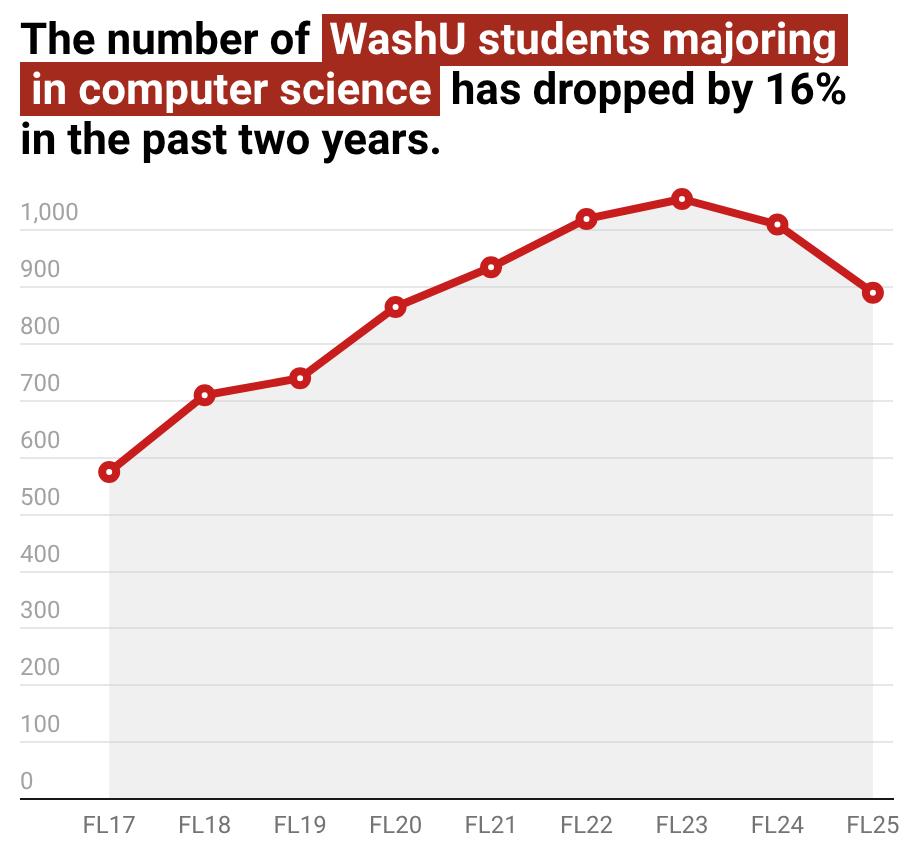
2024], the enrollment was about 350 students,” Weizhi Du, the head teaching assistant for CSE 2407 Data Structures and Algorithms, said.
“Now the number has dropped to below 170 — so [by] nearly 50%.”
The computer science (CS) major in the McKelvey School of Engineering, once the biggest major at WashU, is seeing a dramatic decline in enrollment in the 20252026 academic year.
According to CS Department Chair Roch Guérin, national trends over the past decade show that enrollment in CS programs was increasing rapidly until about a year and a half ago, when it began to plateau and then decrease slightly.
Guérin said this surge in the program’s popularity, beginning in 2013, resulted in massive waitlists for CS classes and a scramble to find more qualified professors.
In the past year, teaching assistants (TAs) in the department have noticed a decline in class enrollment.
“When I joined as a TA for Data Structures and Algorithms for the very first semester [in the spring of
However, Guérin said this decrease is not inherently bad.
“This is a little bit of a relief, in the sense that we were in a catchup mode pretty much for the past 10-plus years,” Guérin said. “The fact that the enrollment growth has abated is in some sense helping us take stock of where we are.”
TA and junior studying CS, Daniel Palmer, attributes the decline in CS majors to the new data science major and an increase in required classes to complete the CS major.
“A lot of previous CS-inclined people want to be data science majors because they’re more interested in data management, machine learning, that track,” Palmer said.
“So the creation of that major, and then the stats and data science department a few years ago, definitely takes a lot of enrollment away
from computer science.”
Another factor in the decline in students majoring in CS is the changing technology. Current TA and fifth-year student, Edgar Palomino, attributes this decline in class and major enrollment to generative artificial intelligence (AI) and its effect on the industry. Whereas there used to be high demand for CS students from companies, now that excitement has begun to die down, according to Palmer.
“From a student’s perspective who is trying to get a job, it definitely feels like the golden age [of CS] is kind of finished,” Palmer said.
Guérin elaborated on this sentiment, citing students’ fear that all the entry-level jobs were going to be taken away by AI as a reason for the declining enrollment.
“Whereas you used to need a person, or even a team of people, to set up a new website, to pitch a new product, or whatever it is you’re trying to do now, you can AI that in a matter of minutes,” Teaching Professor of CS Douglas Shook said.
While fewer students are choosing to major in CS, Guérin has not seen an exodus of students already in the program.
“There’s considerable uncertainty in terms of where the job market is headed,” Guérin said. “And so [the lack of clarity regarding which] skills ... you need is affecting the choices that students make, and that, I believe, is largely responsible for the decline that we [are seeing] now.”
As AI and machine learning skills become more important to employers, the electives within the program are beginning to change, and a master’s in AI engineering is under development, Guérin said.
While algorithmic thinking has always been at the core of CS, the program is in the process of moving the focus away from technical skills like writing code to more big-picture analysis and soft skills, according to
Guérin.
Shook argued that people are still necessary to oversee and direct AI, since it cannot predict human desires, but it can only do what is asked of them. He said he hopes the industry will continue to invest in training entry-level employees to set themselves up for success in the future when those in senior roles retire.
Palomino said students majoring in CS are pivoting their focus to better prepare themselves for the industry.
The decline in enrollment has affected the number of TAs hired, as well as their workload.
While it was difficult to quickly find qualified professors during the CS boom, TAs were in high supply.
In the hopes of providing students with enough support, more TAs than needed were hired, Guérin said. With the slowing and decline of enrollment over the past couple of years, however, the program has created and enforced guidelines for how to allocate TAs based on class size so as not to waste resources.
Lower enrollment in CS courses
has led to a decrease in the number of CS TAs because enrollment levels directly influence the allocation of budget for course resources.
According to Du, in spring 2024, there were more than 90 TAs in CSE 2407, but now, that number has dropped to 23.
Shook said that he wished there were more TA positions available for higher-level courses. However, supply is limited due to the enrollment-based budgetary restrictions. He said he has 28 TAs in his 170-person Introduction to Computer Science class but only two in his 90-person Programming, Tools, and Techniques 2000-level course.
Student usage of office hours has also declined as students can now rely on AI to answer questions instead of going to a TA, Shook said.
Palomino said that, ultimately, while CS will continue to change, it’s important to continue to pursue aspects of CS that call to students.
“Try to specialize, especially in the things that interest you,” Palomino said. “If you want to stay in CS, try to focus and know what you really want.”
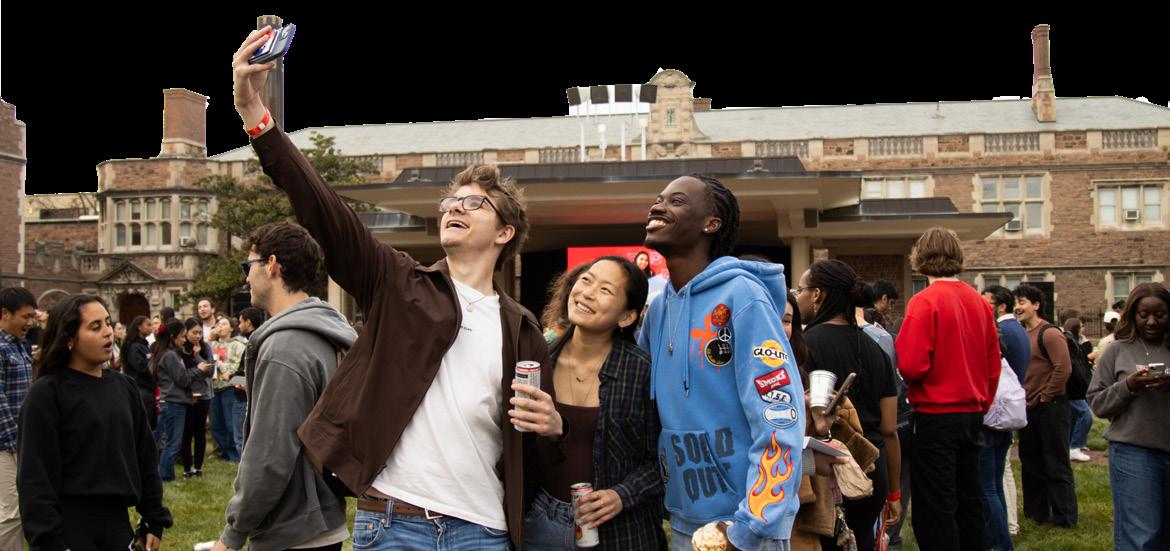
BRI NITSBERG | MANAGING PHOTO EDITOR WashU students celebrate at the 2026 Class Toast.
Faculty voice lack of preparedness for emergencies after February shelter-in-place
SARA STRASSBERG
JOEL SWIRNOFF STAFF WRITER NEWS EDITOR
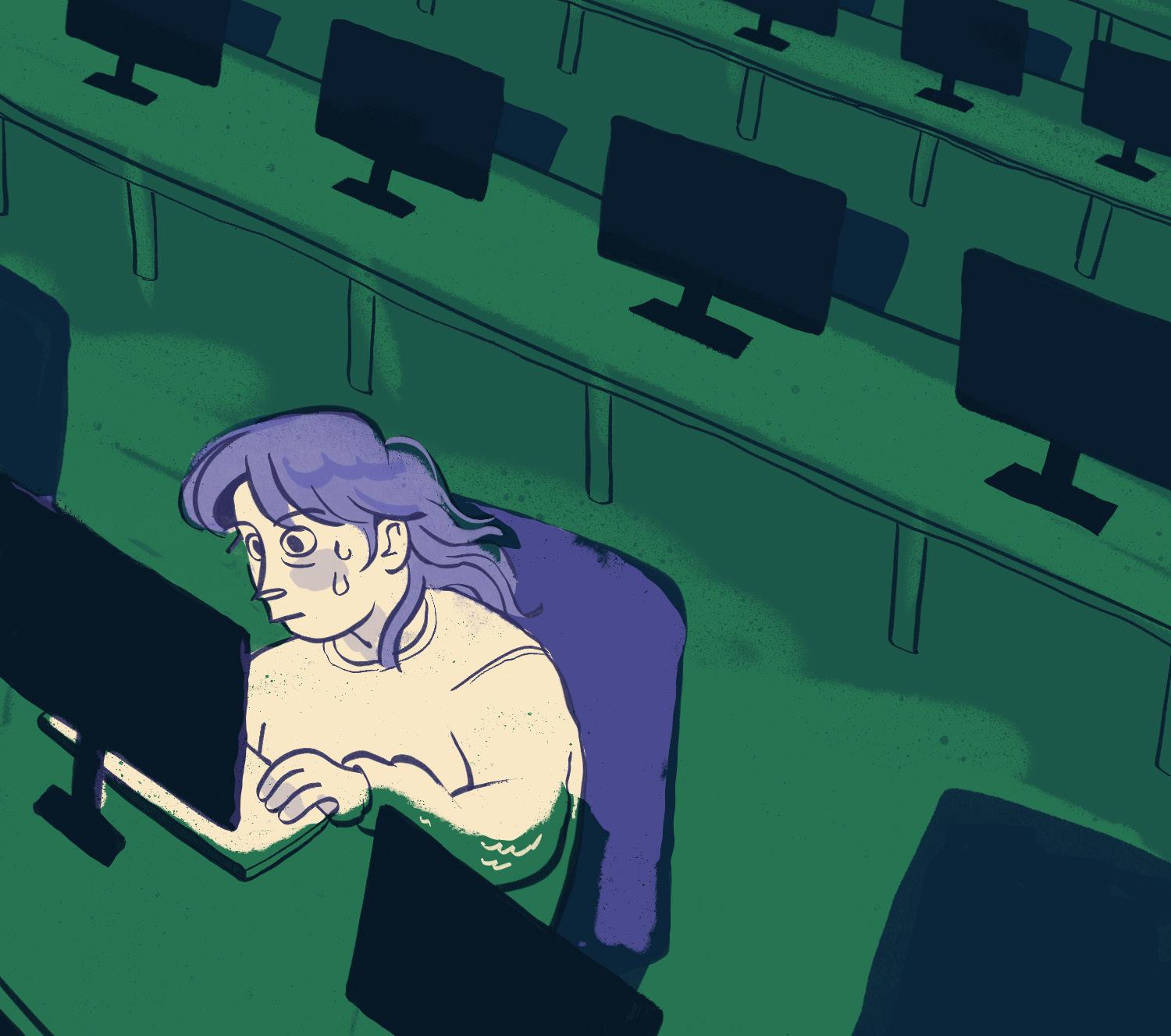
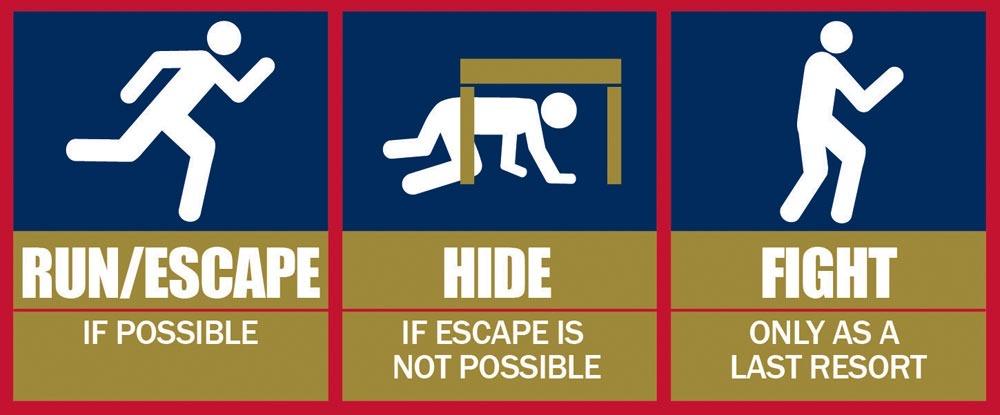
When the announcement to “run, hide, or fight” flashed on her screen on the morning of Tuesday, Feb. 24, lecturer Natalie Monzyk said she was “floundering.”
Monzyk’s College Writing section was in the middle of independent work on a paper when she saw the alert on her computer. It had been a long time since she had received training for emergency situations, like potential armed intruders.
“I couldn’t quickly recall what to do,” Monzyk said. “If I could just sit there and think about it and look it up on my phone, that’s fine, but we have to get this done quickly. Students are looking towards you.”
Monzyk wasn’t alone in feeling unprepared.
“[Faculty] don’t have specific training that we all do on really anything other than sexual harassment,” Beth Windle, a senior lecturer in the Department of English, said.
Both professors were speaking in reference to the shelter-in-place protocol implemented by WashU Emergency Management following false reports of an armed person on WashU’s Danforth Campus.
This lack of regular, required training reflects broader faculty concern about whether they are prepared to respond in emergency situations such as an armed person.
While resources outlining recommended practices for general emergencies exist, many professors described specialized training as inaccessible. This created uncertainty during the incident, as some instructors were left to rely on memory or personal initiative
to ensure safety.
“There isn’t a training module for a campus shooter or campus emergency like that,” Windle said. “The school does provide, certainly, information on what we should do, best practices and things like that.
But it’s not necessarily something that we would go back and review regularly.”
WashU Emergency Management is responsible for identifying risks and assisting the University with mitigating hazards, coordinating response efforts, and leading preparedness training in partnership with the Washington University Police Department (WUPD).
According to Ty Davisson, director of Emergency Management, faculty and staff can participate in both general preparedness training and active threat training. These training sessions are not mandatory and are only conducted in-person.
Training is available upon request, and to schedule a session, faculty must contact either WUPD or Emergency Management. In addition to these trainings, a Quick Reference Guide for Emergencies is available on Emergency Management’s website.
“It’s a one-page quick guide that gives a very brief snapshot of what faculty would need to know in case of an emergency in their classroom,” Davisson said.
Many faculty members say they have not been trained or been aware of training opportunities.
“Have I had any training on [what to do in case of emergencies, including armed persons] in my 23 years at WashU?” Catalina Freixas, an associate professor of architecture, said. “No.”
While Freixas said she was
thankful that not knowing what to do meant incidents like these are uncommon, she also feels that faculty need clear and effectively communicated guidelines for what to do in a situation like an armed threat.
“There has to be more of an organized effort in terms of what it is that we are asked to do as individuals and as professors as well,” Freixas said.
John Nestojko, a senior lecturer and director of undergraduate studies in the Department of Psychological & Brain Sciences, said that he and his teaching assistant (TA), Justin Dodd, had to decide in the moment what to do.
“I don’t recall ever being offered emergency preparedness training, and if I did, it got lost in the sea of emails,” Nestojko said. “I announced that we [were] going to go into a kind of shutdown mode, but I didn’t really know exactly what we needed to do then.”
At the time, Nestojko was teaching in Busch Hall 100, a medium-sized lecture hall without a manual lock. Because they weren’t certain the door would lock, he and Dodd stood on either side of the door to barricade it.
“We just took whatever precautions we needed to and got ready to meet whatever threat might have actually been there. On one level, it’s just like problem solving,” Nestojko said.
Nestojko later learned that the door locked via motion sensor, and by being close to the door, he and Dodd may have been triggering it to remain unlocked. He said this was frustrating, and he wished the University had notified him beforehand.
Several professors mentioned that students helped organize their class’ response to the alert.
“You could tell that a lot of students in this generation have had a lot of training, unfortunately,” Monzyk said. “One student was like, ‘Hey, we should get the lights,’ and another student helped me drag a table in front of the door.”
Senior Heidi Tamm, a TA for Intermediate Statistics and Data Analysis, was teaching in a classroom in Cupples II. In accordance with the “run, hide, or fight” announcement, she said she was debating having students leave, as they were close to the bridge over Forest Park Parkway.
“I was like, ‘Should I be letting people go off campus? Should we be staying here?’”
Tamm said. “I think that was the main debate of what I should be doing.”
Tamm and her students decided to stay in the classroom. She said they had to rely on training from before college to know how to react, as many high schools in the United States have drills for active shooter situations.
Merita Haxhia, laboratory and academic program manager in physics, noted that many international students, including TAs in charge of lab sections, have not had the same high school experience as students from the U.S., leaving them more uncertain during the shelter-inplace. Haxhia herself is from Albania.
“Half of the TAs are international students, and they don’t have drills,” Haxhia said. “Many people here have not had this kind of situation in their home countries.”
Tamm said that she felt responsible for her students’ well-being throughout the shelter-in-place, which added to the stress of the situation. She said she hoped there would be more explicit training in the future.
“I’ve not [yet] received new training, but I’m hopeful and confident that WashU will address that,” Nestojko said. “So [if] that does come about, I’ll likely sign up and take a session of training and be more prepared.”
In the wake of the incident, Davisson said Emergency Management has begun working with the Provost’s Office to increase the percentage of faculty and staff who are trained, to make training more accessible and comprehensive, and to ensure that the resources currently available are effective.
“We feel like we need to look at ways that we can expand that training even further,” Davisson said. “Hence, our ideas to start looking at some virtual offerings to make sure that there are ways that if people can’t come to an inperson training, they have an avenue to be able to receive it.” He also expressed plans to completely reevaluate the Faculty Resources page of Emergency Management’s website.
“My first reaction was, ‘I don’t know what to do,’” Tamm said. “There were a lot of windows, and so we closed the blinds. We turned off the lights, and we tried barricading the door. Everyone was using their knowledge from high school.”
“Because you are seen as an authority figure, you’re in command in these situations,” Tamm said. “I think the phrase ‘run, hide, fight’ is not very helpful. I think that education is best, like, just telling people how to deal with this scenario with more specificity.”
ACTIVE SHOOTER
Like Tamm, many professors said that their priority was students’ safety. They also said they would welcome additional training and would seek it out if offered.
“We want to bring a focus group together to see if those resources are hitting the right note for our faculty, if they’re useful, and if not, we want to redo all of those to make sure that we’re providing the best resources that we possibly can,” Davisson said.
‘Why now?’: Professor Krister Knapp discusses nuance of conflict in Iran
ZOE
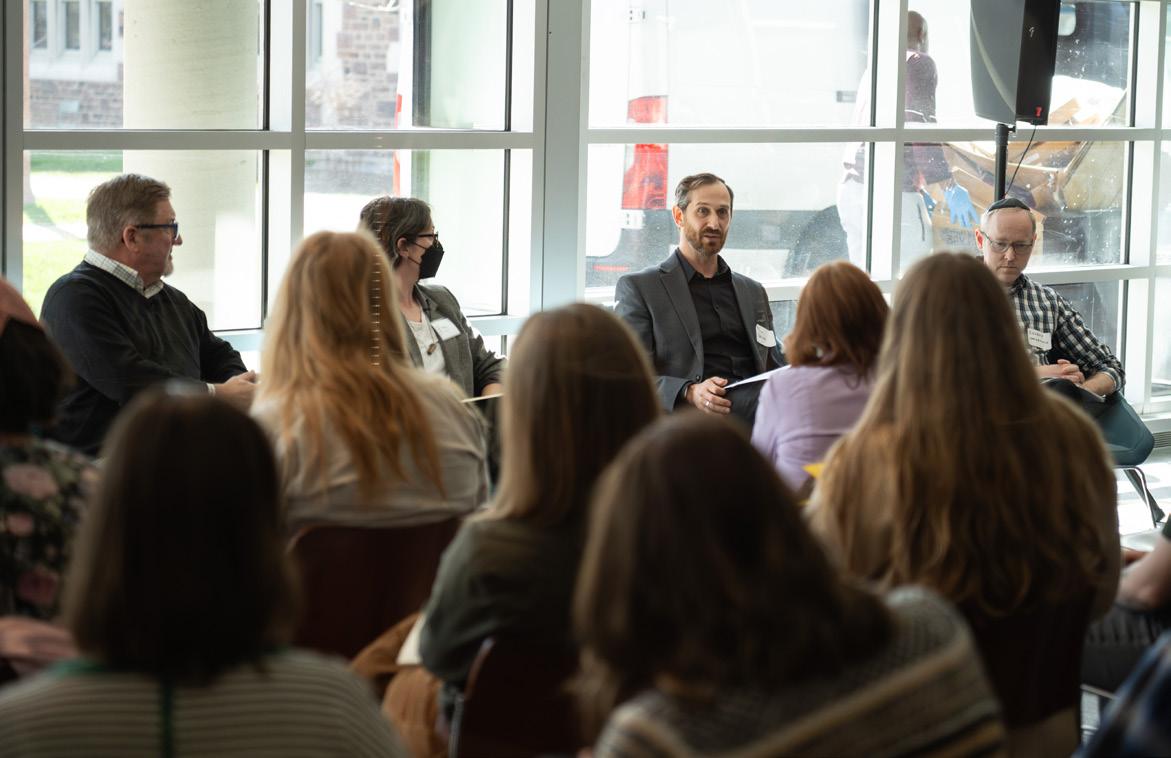
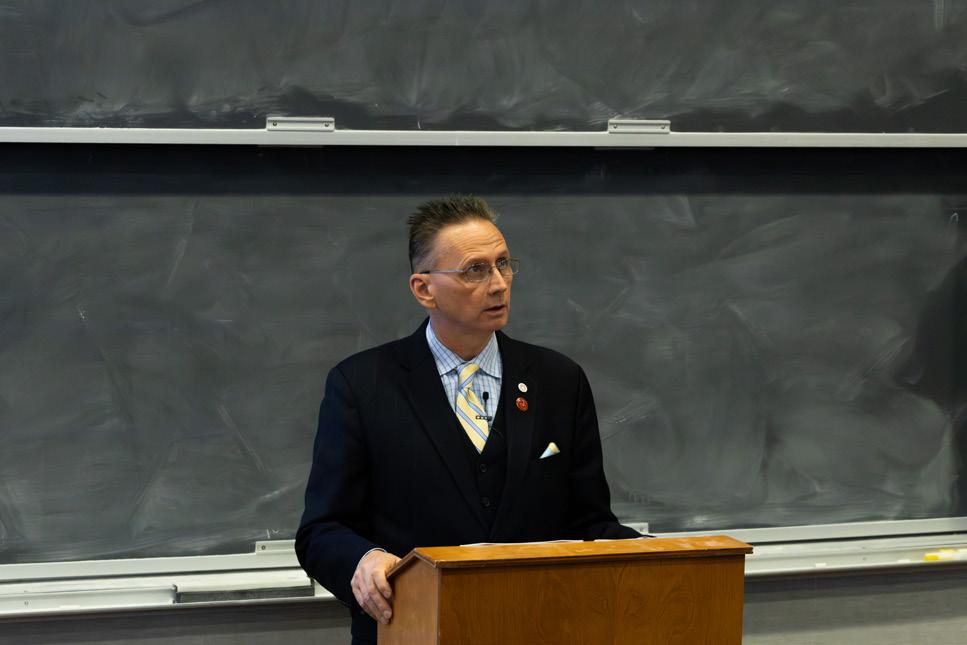
Professor Krister Knapp spoke on the ongoing war in Iran, assessing and explaining both the origins and possible outcomes of the conflict, March 19.
Busch Hall saw both community members and students alike fill its seats. Attendees stayed well past the end of his prepared talk to ask Knapp, a professor and faculty research fellow in the history department, multiple rounds of questions.
First-year English and history major Elise Hanna attended the lecture after learning about it during her first-year seminar course with Knapp.
“I think he’s very knowledgeable and was excited to hear his take on this monumental event going on in Iran,” Hanna said. Hanna said that Knapp presents current and historical conflicts in ways that feel accessible, as he provides the whole picture instead of just a snapshot.
“Knapp’s breaking down of the conflict into causes and continuities personally helped me understand the gravity of the situation,” Hanna said.
The war that started on Feb. 28 with Operation Epic Fury has now expanded to a larger Gulf War, with 11 additional countries in the Middle East getting involved.
U.S.-Israeli strikes killed Ali Hosseini Khamenei, the reigning Supreme Leader Ayatollah of Iran for the past three decades. Iran, in response to the U.S.-Israeli operation, has traded strikes of its own.
“It is a game of chicken — who will cry ‘uncle’ first,” Knapp said.
A central theme of the talk was, in Knapp’s words, explaining “why now?”
Many, including experts from the Brookings Institution, a notable think tank in Washington, D.C., have been trying throughout March to answer the same question Knapp proposed — why now?
To answer this, Knapp explained that the U.S. claimed to attack Iran due to the timeliness of its two strategic goals.
Those goals included reducing Iran’s capabilities as a threat, via mitigating the country’s nuclear, ballistic, and naval capabilities, and dismantling its support of proxy extremist groups. A secondary justification for the attack was in enacting regime change. Knapp explained that despite Iran being a significantly smaller country than the U.S., and not having an army the size of combined U.S. and Israel forces, Operation Epic Fury failed to overturn the Iranian regime, despite striking upon approximately 40
high-ranking Iranian officials. Knapp’s discussion of the U.S.’s strategic goals, namely the sentiments regarding the power of the Iranian regime, struck a chord with some attendees.
“I mean, I never thought this was likely, but I’d say that Knapp’s argument made me even less optimistic that any kind of internal movement would topple the current Iranian regime,” sophomore Ethan Skolnick said. Knapp then pivoted away from strategy towards the actualities of the conflict.
Iran is using “asymmetrical warfare to make the costs of the war too high for the U.S. and Israel to continue,” Knapp said.
The asymmetrical warfare to which Knapp is referring describes the contrasts in fighting styles of two militaries whose capabilities are
wildly different from each other, resulting in unconventional military tactics. Knapp also presented the history behind the current conflict.
“Over 50 years, many U.S. presidents from both parties have tried carrots and sticks with Iran, but to no avail,” Knapp said. “Trump’s decision to bomb Iran … thus represents not a ratcheting up of existing policy, but rather a distinct break with it.”
In the days of the Cold War, the U.S. and Iran had been allies. The Iran Hostage Crisis under former President Jimmy Carter led to the dissolution of U.S.-Iranian relations. In the Iran Hostage Crisis, 52 American citizens were held captive for more than a year after being kidnapped from the U.S. embassy in Tehran by militants.
“A twilight war set in, and it witnessed many destabilizing
events that undermined U.S.-Iranian back-channel diplomacy,” Knapp said.
Knapp pointed out that in the past three decades, the U.S. has engaged in three Gulf Wars. After the event, Knapp also told Student Life that he perceived the American public as not wanting any more “forever wars.” News sources such as CBS support Knapp’s point, reporting on increased fear of economic instability and raised gas prices.
Knapp referenced Shakespeare’s “Julius Caesar” and its themes of opportunism, driving home his interpretation of Trump’s reasons for ordering Operation Epic Fury as departing from relational precedent.
“This is a watershed moment in U.S.-Iranian and, dare I say, U.S.-Middle East relations,” Knapp said.
Regarding the plausible consequences of the newfound war, Knapp focused on economic and social reverberations.
A focal point of the conflict is the Strait of Hormuz — and with it, 20% of global natural gas and oil. As not only a finished good sold directly to consumers at the gas pump, these energy sources directly impact economic growth across general economies. Iran is exempting itself from these disruptions, however, letting its own ships through the strait.
“Now that [Iran] knows that they can, this will allow them to wreak havoc with markets at will,” Knapp said. Knapp said the oil price shocks will worsen inflation and scare investors, possibly leading to an energy crisis. Gas prices are already rising in the U.S., and Knapp said that soon enough, with the continuation of the conflict, $5 for a gallon may look cheap.
“What happens in the Middle East does not stay in the Middle East,” Knapp said multiple times during the lecture.
During the Q&A portion of the evening, audience members inquired about hypothetical scenarios where Iran was armed with nuclear weapons. In response, Knapp returned to the notion that history cycles in patterns.
“Wars are petri dishes for the next war,” Knapp said. Thursday’s talk was a part of the Crisis & Conflict in Historical Perspective (CCHP) lecture series, which Knapp directs. The next CCHP lecture will be held in the Umrath Lounge on March 30 at 5:30 p.m. American University professor in Foreign Policy & Global Study, James Goldgeier, will be speaking on the causes and consequences of the Russia-Ukraine War.
Nicholas Demba contributed reporting.
MAX SILBERG | STAFF PHOTOGRAPHER
Professor Krister Knapp lectures on the conflict in Iran as part of the Crisis & Conflict in Historical Perspective lecture series.
UCLA law professor argues Supreme Court has always been political in lecture at WashU
… it’s always been that way. There was never a golden age of pure legal decisions.”
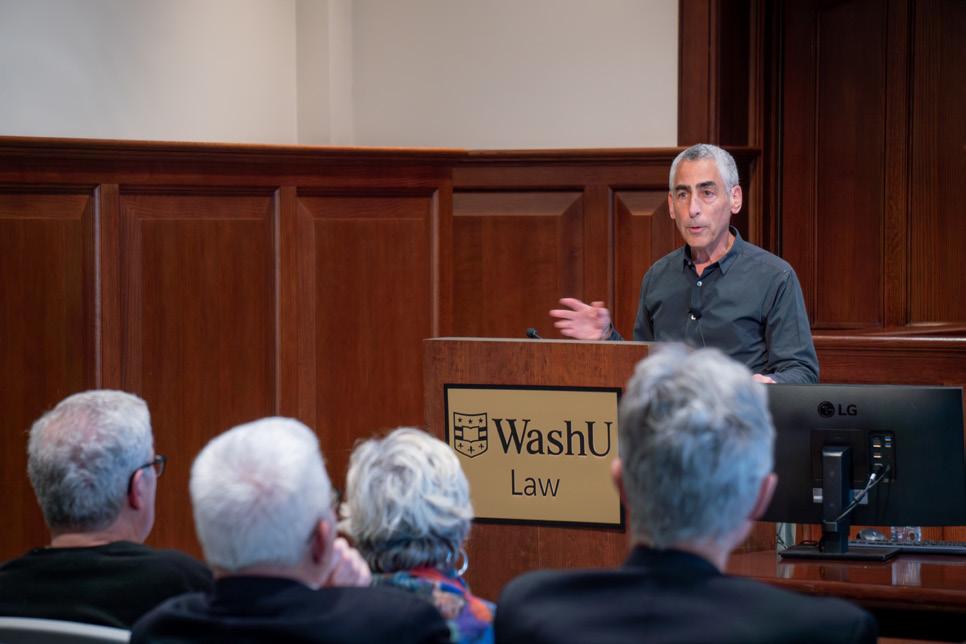
Stuart Banner, Norman Abrams Distinguished Professor of Law at University of California, Los Angeles, presented his research on the history of the politicization of the Supreme Court, March 25.
Banner’s lecture and argument centered around the fact that, despite popular opinion, today’s Supreme Court is not especially partisan compared to previous iterations of the Court. The event was part of the David T. Konig Lecture Series hosted by WashU’s Department of History.
Banner said that while many might view the contemporary court as particularly partisan compared to its past iterations, in his view, the Supreme Court has never been nonpartisan.
“People often criticize the Supreme Court today,” Banner said. “What I want to tell everyone is that [while] they often criticize the Court for deciding cases based on political grounds,
AI from page 1
Some of the events in +AI Week include the HackWashU AI Build Challenge, a town hall about AI ethics, sessions about the use of tools like NotebookLM for faculty and students, and a speaker series event with Nicholas Thompson, CEO of The Atlantic. These events, according to West and Smith, are meant to encourage discourse and discussion surrounding the role of AI.
One criticism of AI is that utilizing it can lessen the need to learn fundamental skills that a college education teaches. According to Smith, creating a balance between using AI tools and teaching these fundamental skills falls partially on professors.
“If we live in a world where AI can be used to defeat the purpose of assignments, how do you adapt to teach in ways that build the skills in students that you are trying to build [regardless],” Smith said.
However, not all faculty share the same viewpoint on using AI to teach, Smith said. She warned against faculty members who seek to totally ignore the emergence of AI.
Banner noted that anxiety about the Supreme Court’s political leanings can increase during midterm election years, when there is potential political turnover in the legislative branch. Rumors about Justice Samuel Alito’s retirement have spiked concerns about a conservative majority.
Although there is no official confirmation of Alito’s retirement plans, Banner said that historically, justices have often planned to retire when a president from their own party is in office.
Legal
justices to change their vote. I’d be very doubtful about that, but [it] might change results.”
Banner said the main discrepancies between the Supreme Court of the past and today center around the current Court’s public campaigns, the extent of its involvement in lower court cases, and its fixed location.
Banner’s event, said she found his lecture inspiring.
“I feel like my main takeaway was the fact that the Supreme Court is … ever evolving,” Dukes said. “I think it’s really interesting to see the changes that have been made, how far it has come … [in terms of] diversity.”
Administrative and academic coordinator in the Department of History, Anne Morgan, said that the event attracted a wide range of attendees within and outside of WashU.
“It’s the president and the people who work for the president who are different from what they’ve been in the past,” Banner said. “The Supreme Court’s by and large doing what it’s always done. But it’s suddenly confronting all these issues that no previous administration would have yielded up: … the whole issue of birthright citizenship, … that’s something that was really never questioned until Trump.”
One audience member expressed concern about
“The justices often try to time their retirement to ensure that a like-minded successor will be appointed,” he said. “The early justices tried to do the same thing — Gabriel Duvall, for example, was said to have delayed his departure from the Court for several years, despite being so deaf that he could not hear a word of oral argument, until he was assured that Roger Taney would replace him.” Banner said that if anything is notably different in contemporary politics, it is the executive branch rather than the judiciary.
the relationship between the executive and judicial branch under the current administration due to three out of six of the current judges being Trump’s nominees and posed a question to Banner about court packing. Banner responded that he was not particularly concerned about court packing.
“For a long time, … court packing was kind of off the table … until the first Trump administration, and now suddenly it seemed to come back,” Banner said. “I don’t think that increasing the size or threatening to increase the size of the court would cause any of the current
“Perhaps the biggest difference between the early Supreme Court and today’s Supreme Court is that until the 19th century, the justices sat in the nation’s capital as the Supreme Court for only about two months each year,” he said. “The rest of the time they spent riding around the country from city to city, conducting trials and hearing appeals as circuit judges.”
Banner highlighted the stark contrast in diversity between today’s Court and its earlier iterations. The current Supreme Court is composed of five men and four women, including two Black justices, whereas the Court was once made up entirely of white men.
Sophomore Lauren Dukes, who attended
COMMENCEMENT
from page 1
“It’s really interesting to see the diverse crowds that I brought in,” Morgan said. “Even the local community colleges came as well, which is kind of exciting.” Dukes added that she appreciates the opportunity to hear from different experts in their fields.
“I feel like it’s important to learn from distinguished professors and people who are in different work fields,” she said. “If you want to go into that specific type of work, it’s important to hear from [experts’] own experiences and learn from them as well.”
Despite Smith’s disagreement with faculty who refuse to acknowledge the presence of AI in their classrooms, she said it is up to individual professors to decide on their class policies, including ones on academic integrity.
“In the end, faculty have near total autonomy in their classrooms,” Smith said. “If there is a clear statement in a syllabus that certain types of use or any use of AI is a violation of that course’s policy, [and] it is demonstrated that the student did that, they would get a standard violation.”
Acknowledging the potential confusion caused by differing policies, Smith said the Office of the Provost is working on potential levels from which faculty can choose to define the amount of AI usage permitted in their class.
A similar issue arose a few years ago in regards to student collaboration on assignments, Smith said. One of the most common academic integrity violations was unauthorized collaboration, and many of those violations were due to confusion regarding specific classes’ policies.
“There should be a standard collaboration policy, but that’s not going to happen because some courses want you working with each other, and some courses
“I’m concerned that there’s some [people with their] head in the sand, just like, ‘I’m just going to forbid it, and I’m going to pretend this isn’t happening, and I’m not going to change anything,’” Smith said. “I don’t think that is serving students or education well, because that is not the reality that we are living in.”
VOLUME 147, NO. 22
don’t, and that’s appropriate for what they’re trying to teach. I feel like AI is the same thing.”
The objectives of an undergraduate education and what appeals to the job market are inherently different, Smith said, but the reality of what employers are looking for does impact how that learning is done.
“If we are training you for fields that use AI, we d*mn well better train you on AI,” she said.
Betsy Sinclair, assistant vice provost for digital transformation and professor of political science, shared that over 1,000 students have completed an AI Literacy module on Canvas, which educates students about responsible AI usage. She said that it is critical that the University continues to listen to students and faculty about AI, since it is impossible to predict what will happen next.
“I think it’s going to be really important that we keep listening to what students need,” Sinclair said. “I think it will be really important that the faculty have leadership here. The reality is that no one really knows what the future is going to hold.”
This article is the first part of a series on artificial intelligence at WashU. If you’re interested in being interviewed about how AI is shaping higher education, reach out to news@studlife.com.
Martin also announced the other speakers who will deliver addresses at the 2026 graduation ceremony.
Senior Mason Shaver will deliver the undergraduate Commencement speech. Shaver, a political science and educational studies major, is a Questbridge scholar and has been a Pershing and St. Louis Fellow, two civic engagement fellowships.
The graduate Commencement speaker will be Sejal Popat, a master of fine arts
student at the Sam Fox School of Design & Visual Arts studying illustration and visual culture.
Susan Stiritz, a professor emerita at the Brown School, will serve as honorary grand marshal and lead the academic procession.
In addition to Cohen, the University named five individuals who will receive honorary degrees at the May 15 ceremony: Kwofe Coleman, Municipal Theatre Association of
St. Louis (Muny) president and CEO; Deborah Lipstadt, former U.S. State Department Special Envoy to Monitor and Combat Antisemitism; Michael McDonald, backing vocalist for Steely Dan and lead singer of the Doobie Brothers; Marcus Raichle, Alan A. and Edith L. Wolff Distinguished Professor of Medicine at the medical school; and Anabeth and John Weil, philanthropic donors.
ALEX DERING | STAFF PHOTOGRAPHER
historian Stuart Banner discussed the political nature of the Supreme Court at WashU on March 25.
SCENE
Silly Squared turns student art into something that sticks
HANNAH LA PORTE
SCENE EDITOR
JUNIOR
There is a small and silly movement growing that is showing up on water bottles, laptop cases, trash cans, car bumpers, and street signs around WashU. Silly Squared, a student-run sticker organization, is turning everyday objects into canvases for student art while reshaping how creativity circulates on campus.
Omeed Moshirfar, who graduated from WashU in May 2025 with a bachelor’s degree in Communication Design and Supply Chain, Operations, and Technology, founded Silly Squared in 2023. It emerged from an observation about the fleeting nature of student artwork.
“I was watching my peers who were really invested in their work,” Moshirfar said.
“They would make such cool art and invest all their time into their creations, and then they’d have to go onto the next piece. They never really got the chance to share that work for a long period of time.”
Silly Squared became an answer to that problem, a space designed not just to showcase art but to share it with other people. Stickers, Moshirfar realized, were the perfect medium to do just that.
Each sticker collection begins with a campus-wide call for submissions, typically drawing between 50 and 100 entries from students across years, schools, and disciplines. From those, 10 designs are selected, with one ultimately chosen as the feature sticker, winning a prize of $100. Drops occur once a semester, and distribution happens twice a week. Stickers appear in boxes around campus and are shared by Silly Squared distributors, students who volunteer time to pass out 10 stickers per week.
The name Silly Squared reflects that balance between playfulness and intention.
“To be silly is to be joyful,” Moshirfar said. “And to square something is to
complexify it and give it meaning.”
By turning student artwork into something tangible and widely distributable, Silly Squared aims to ensure that creative expression reaches far beyond a studio or classroom.
Sophomore Ella Rosenberg, co-director of operations, emphasized that Silly Squared is for everyone.
“I think some people think of Silly Squared as an artist’s thing,” she said. “But really, Silly Squared is for everybody. Anyone can find a design that they love because we have such a wide range.”
Sophomore and curator Chanya Ngamvirojcharoen runs the Silly Squared podcast, interviewing Silly Squared winners on their process and work. She emphasizes how that flexibility is also reflected in how students approach the competition itself.
“A lot of the [artists] say their stickers are pretty different from their typical art style,” Ngamvirojcharoen said. “That’s so interesting and special because it just shows how Silly Squared,
the competition itself, is a different place for experi mentation and just being able to see a new side of your art skill.”
She emphasized how Silly Squared allows people to engage meaning fully with student work, as opposed to consuming only professional work.
“We often see such amazing work from already established cre ators and professionals,” Ngamvirojcharoen said. “Being able to see the work and share the work of students that are of similar age to us is very inspiring.”
The act of distribution is a key component of the organization’s impact. With a team of around 70 distributors, Silly Squared transforms the simple exchange of a sticker into moments of connection.
Senior and advancement officer, Mac Barnes, explained that these interactions can range from casual to meaningful.
Barnes also ensures that
Silly Squared is an organization built for the community.
“We’re not looking for a financial return,” he said. “It’s really about supporting artists and growing their impact.”
At the same time, Barnes is focused on ensuring the organization’s longevity by engaging with recent graduates and building a sustainable donor base.
“When our [distributors] give someone a sticker, that’s a moment to connect that is not digital, not related to classes,” he said. “It can be as easy as, ‘Here’s a sticker, have a nice day!’ or as deep as ‘Hey, here’s a sticker that touches on a certain topic, do you want to talk about it?’”
“I love bringing design, engineering, and business to my community to do good,” he said.
Moshirfar’s advice to current students reflects the experimental spirit that helped him found Silly Squared in the first place. “Treat college like a sandbox. Play around, try new things, see how the community interacts with it, and then apply what you’ve learned to the bigger world when you graduate,” he said.
Check out Silly Squared’s latest collection in sticker boxes across campus! To view or purchase past sticker collections, visit sillysquared.com.
Cast n’ Crew goes all out with ‘Carrie’
ELLE LUDWIN STAFF WRITER
On March 27, Cast n’
three student-run theater groups — will open “Carrie,” a musical adapted from the 1974 Stephen King novel of the same name.
“Carrie” was King’s first novel, and it is widely considered to have reshaped the genre of horror fiction.
“It’s been adapted into a
film a few times, and this is the musical adaptation of it. It’s about a girl who is ostra cized by her peers in high school, and it’s also about her very complex and often scary relationship with her mom,” senior Charlie Emanuel, the show’s director, said.
definitely want to see a lot of flexibility. I want to see how actors put their spin on different scenes or different songs,” Emanuel said.
“There is a supernatural element, but that’s not the scariest part of the show. ‘Carrie’, to me, is about the scary aspects of your peers, the scary aspect of your familial relationships. And sometimes the scariest part of your life could be what’s going on in your own head,” he said.
Emanuel joined Cast n’ Crew last year, performing in several shows and codirecting others.
“I realized that for ‘Carrie,’ the last chance I would have to do student theater, I wanted to go as big as possible, and so I applied to direct it,” Emanuel said.
Emanuel has an intriguing philosophy on directing that, at first glance, seems counterintuitive.
“I wanted to be very prepared for everything, but also super open minded. … When I was going through the script, I had a vision for every line, every word, every beat in the show, how I wanted the lights to look, what costumes I wanted to be worn, how I wanted actors to perform something,” he said. “But ever since then, I’ve asked people, ‘What do you think? How do you want to change it?’ Especially with our actors. I’ve always told them, ‘Follow your inclinations. If you’re naturally inclined to do the exact opposite of what I tell you, forget what I told you and do what feels right.’”
All the shows for the year are chosen over the summer, but preparations for “Carrie” began with auditions in November.
“What I look for [in an actor] is that they have fun with whatever they’re performing. It could be from a comedic piece, it could
Emanuel estimated that about 50% of those who auditioned were cast in the show, with a total of 17 actors cast. Emanuel also emphasized that Cast n’ Crew welcomed new performers alongside longstanding club members.
“Everyone who I have worked with in the past definitely had a leg up in the sense that I knew how incredible they were, but then all of our new faces had a leg up in that I saw how much potential they had, … and I think you could see that, how many new friends we have in our production this year.”
Cast n’ Crew’s name refers to what makes them unique: The cast and crew are a single, cohesive group.
Performers and crew members alike help build sets, crew members from one show audition for roles in the next, and actors similarly switch to crew roles.
“It’s not Cast or Crew, it’s Cast and Crew,” Emanuel said.
Matt Kraut, a first-year architecture student in Sam Fox and Cast n’ Crew’s set designer, served on crew in middle and high school.
“At the beginning of the fall semester at the Activities Fair, I was looking around at the different theater clubs, and I wanted one that wasn’t just for cast.
A lot of them seemed like they put a lot more emphasis on the actors, and Cast n’ Crew is literally in the name, and they were really excited when I said that I wanted to do crew,” Kraut said.
Kraut has participated in all three of this year’s Cast n’ Crew productions, serving as the set designer for two other shows, as well as being the master carpenter for one. He also explained
how the process of set design, including designing and building the set for each performance, can dramatically vary show by show.
“For this one, the director [Emanuel] had a pretty strong vision of what he wanted. So my job was less of making something new and more of taking his vision and making it a reality. In some past shows, like ‘She Kills Monsters,’ I knew the general layout, but I had more freedom with where each specific wall piece would be. And once we get out of the first production meeting, I tend to have a little bit more freedom with it,” Kraut said.
Still, developing the set for “Carrie” has come with unique tasks, especially related to integrating the supernatural elements into the backdrop.
“‘Carrie’ has definitely been a challenge with its eight different flats, and four of them move and spin around, some of them split apart. … So it’s been a lot of moving pieces, which is a lot more challenging, but it’s a lot more fun. ‘Trail to Oregon’ was just five static flats … so once we built it, my role was done. Now my role keeps going throughout the process, which I’m having a lot of fun with,” Kraut said.
Cast n’ Crew hopes the work they’ve put into managing these complexities will pay off in the final product.
“Every single person has put their heart and soul into this show. Looking back, I know I’ve spent countless hours, both at my computer and in our theater, working on stuff. The cast has shown so much dedication…The show looks like it’s gonna be an awesome time.” Emanuel said.
“Carrie” will have a total of six shows in the Village Black Box, running from March 27-28 and April 3-4. Tickets are being sold at the Cast n’ Crew table in the Danforth University Center from 11a.m. to 2p.m. until March 27.
Crew — one of WashU’s
KWUR’s Battle of the Bands brings a musical spark back to campus
On most days, eating at Bear’s Den on a Monday night sounds exactly like what you’d expect: students chattering about midterms and tales of eventful weekends, often between bites of BD’s All You Care to Eat food. However, on March 23, Risa Commons transformed into an indoor concert venue and brought the raucous, shredding noises that come with it — all thanks to Battle of the Bands.
Hosted by KWUR, WashU’s student-run radio station and club, Battle of the Bands offered a competitive space for student bands and spectators to connect over live music, amplifying their mission of reviving a once robust campus music scene.
Taking first place in the competition was Hounds, an alternative rock band with a unique origin story. The group originally began when two founding mem
an old QR code from the original poster — one that Cummings happened to check. First-year drummer Ethan Burack met Hanson during frisbee tryouts and Hanson, who noticed him air drumming, asked him to join. Despite their relatively recent formation, by this year’s fall break, the band had quickly developed a collaborative dynamic.
“We barely knew each other, … and we were already writing songs together,” Martinez said. “[We] came together surprisingly fast.”
Hounds describes itself as, at its core, a hard rock band, though their performances reflect a mix of genres. Their setlist included covers that lean towards alternative rock, indie, and pop rock.
“I feel like our setlist tendencies are different from when we write our own stuff. We pick songs people will know, which makes for a [good] set,” Cummings explained. “But at heart, we’re a hard rock band,”
dently before further developing them with the band over fall break.
Martinez crafted a guitar part, Cummings and Hanson filled in the vocal melodies, and Hanson perfected the beat.
Lyrically, the song reflects a sense of internal conflict.
Centered around the line “Why work like a dog when my work’s for the hounds?” the track explores tension between taking pride in one’s work while recognizing how that work serves larger systems of power. The imagery draws on ideas of performative action and complicity, with Cummings finding inspiration in a piece about individuals making “good” environmental choices like recycling, while ultimately reinforcing corporate and societal structures.
Although “Hounds” is their only written original, the band sees it as a starting point.
“We want to write a bunch of songs,” Hanson said.
nobody has heard until now, really showed.”
But the significance of the event extended far beyond a single band. For many performers and KWUR organizers, the night highlighted the importance of rebuilding a sense of musical community on campus.
“There’s been such a decrease in bands ever since COVID and now it’s slowly starting to come back,” sophomore Melyssah Toledo, KWUR’s internal events coordinator, said. “We thought this would be a good way to get people to start thinking about local bands and giving them more opportunities [to perform].”
KWUR has historically
it’s important for KWUR to bring that music scene onto campus and give students the opportunity to experience free live music.”
For student musicians, the event also provided an opportunity to connect.
Sophomore Devin Wallace, keyboardist for the band Jester, which placed second, emphasized the social aspect of live music.
“I think live music has a really unique way of bring ing people together,” Wallace said. “There are so many tal ented people on campus, and getting to show them off in a fun and accessible way is great.”
That sentiment was echoed by sophomore Noah Beyer, drummer for both Underpass and Jester.
feel especially urgent. With the shutdown of the Gaylord Music Library and relocations affecting facilities and organizations, some student groups are unsure what programming will look like in the coming semesters.
“With the music [library and some practice spaces] being taken down, there’s a lot up in the air about the future of music here at WashU and whether people will be able to participate as easily as they are now,” Beyer
“People bond over music.
… It brings people together intrinsically,” Beyer said. “Events like this fill a really good role, especially toward the end of the semester when people are looking for ways to connect.”
That uncertainty demonstrates the importance of continued support for student
“Given the recent uncertainty of the Gaylord Library and music spaces at WashU, it is now of the utmost importance to uplift student artists and music,” said Miriam Moyes, a sophomore who attended the event. “We as a community need to show that we support student art and music on campus.” Hounds will be open
In a society constantly navigating how to best use artificial intelligence and other forms of technology, “DreamQuil” is a film that asks audiences to reconsider their connection to what makes them human in this relatively new technological world. The film, written and directed by Alex Prager, premiered at the SXSW Film & TV Festival on March 16 and was produced by Alison Small, a WashU alumna.
In Prager’s retrofuturistic world, Elizabeth Banks (“The Hunger Games,” “Pitch Perfect”) stars as Carol, a mother and aspiring real estate partner struggling to connect with her husband and son. In an attempt to be happier, she decides to go on a virtual retreat that will help her reconnect with her family and feel a higher level of satisfaction with her life. After undergoing the “DreamQuil” treatment, Carol returns home to find that she has been replaced by an AI robot who is identical to her in looks and personality.
Originally a photographer, Prager is known for her eerie and unsettling photography that prioritizes careful consideration of mise-en-scène and vibrant colors. Her body of work combines this vision with the aesthetics of
Hollywood’s Golden Age.
“DreamQuil” is one of Prager’s photos come to life.
“I think what is really special about this movie is that it really transports you to a totally unique, almost surreal at times world, … and so it’s kind of just about immersing yourself in a world that lets you have some introspection into what your own personal relationship with technology is,” Small said.
Small graduated from WashU in 2004 with a bachelor’s degree in Film and Media Studies. Now she is the head of film at Brownstone Productions, cofounded by Elizabeth Banks and Max Handelman. At Brownstone, Small executive produced “Cocaine Bear” and produced “Bottoms,” which premiered at SXSW in 2023.
“I think South by is the perfect festival for ‘DreamQuil.’ South by audiences just kind of get movies that are unique and original and boundary pushing,” Small said.
“DreamQuil” explores the dangers of automation as it pertains to the slow loss of the traits that make humanity distinct from technology.
“There were constantly things in the news that I would send [Prager] and definitely contributed to, ‘Oh my god, we have to get this movie made soon, because it feels like it’s becoming a
reality,’” she said.
As a producer, Small works on multiple projects at once. The crux of being a producer is seeing the vision for each film realized from its conception to its premiere at a festival like SXSW and onwards to its proper release. In deciding which projects to produce, a key factor Small thinks about is the person involved in the project, namely the director and/ or writer of the film. At the same time, Small weighs the quality of the story and its characters against the many possible obstacles that could emerge during production.
“And then, from there,” Small asks herself: “Is this something that I actually love enough that I want to spend anywhere from two to six or seven years trying to get made and then making?”
Prager pitched “DreamQuil” to Brownstone in 2020 and wrote the script shortly after that. According to Small, production began a few years later and now, six years later, has finally premiered.
“Alex Prager is a phenomenally talented visual artist, and she actually came to us early on [in] the process with just the kernel of an idea for ‘DreamQuill.’ And so honestly, it really was Alex as a filmmaker that drew us to the project,” Small said. “She is so creative. Her work is so original, and it
has sort of a depth to it in terms of theme, even in her photography.”
Prager has directed various short films in the past for a collection of brands and magazines. “DreamQuil,” however, is her first featurelength film. In an industry saturated with sequels, adaptations, and incumbent directors, Small explains debuts like Prager’s are becoming increasingly rare.
“I think that there’s something sort of just inspiring about the story of someone who had this idea and had never made a movie before, I don’t even think written the script before, and then did it. I think for everyone who wants to make movies and be involved in the entertainment industry, it’s always really cool to see stories like that,” Small said.
Small’s main involvement at WashU was with WUTV, where her role as a producer first began. She was the general manager of WUTV, overseeing productions including “Wake Up WashU,” and hosted and executive produced “Missionary Positions,” a show where a live audience could ask their most pressing sex-related questions to a panel of hosts composed of the Hillel rabbi, the Catholic Student Center’s reverend, and the priest for the Episcopal Campus Ministry. At the time, WUTV had
a closed-circuit channel that students could access through their dorm room feeds to view both programs.
“It’s a completely different scale in Hollywood. But it’s also very similar. I definitely learned, too, that you have to really love what you’re doing, because it takes a lot of work,” Small said about her time at WUTV. Small also occasionally wrote for Student Life, publishing a review of “Don’t Say a Word.”
She described her current job as an entrepreneurial endeavor.
“At WUTV, it was the same thing,” she said. “I mean, there was no one telling us we had to do this. We were doing it because we love doing it. And so I think it really fostered a love of entertainment.”
Since graduating, Small has carried that passion through her career and into her work on films like “DreamQuil.” Small hopes “DreamQuil” forces audiences to reflect on the dangers of modern technology and the importance of our humanity. The multiple ways audiences can and will interpret “DreamQuil” is what Small loves most about films.
“I think that one of the things I love about movies is that everyone has their own sort of interpretation, and everyone takes something different away from something, and it may not even be exactly what the director intended,” she said.
“DreamQuil” premiered at SXSW 2026. The film is currently seeking nationwide distribution.
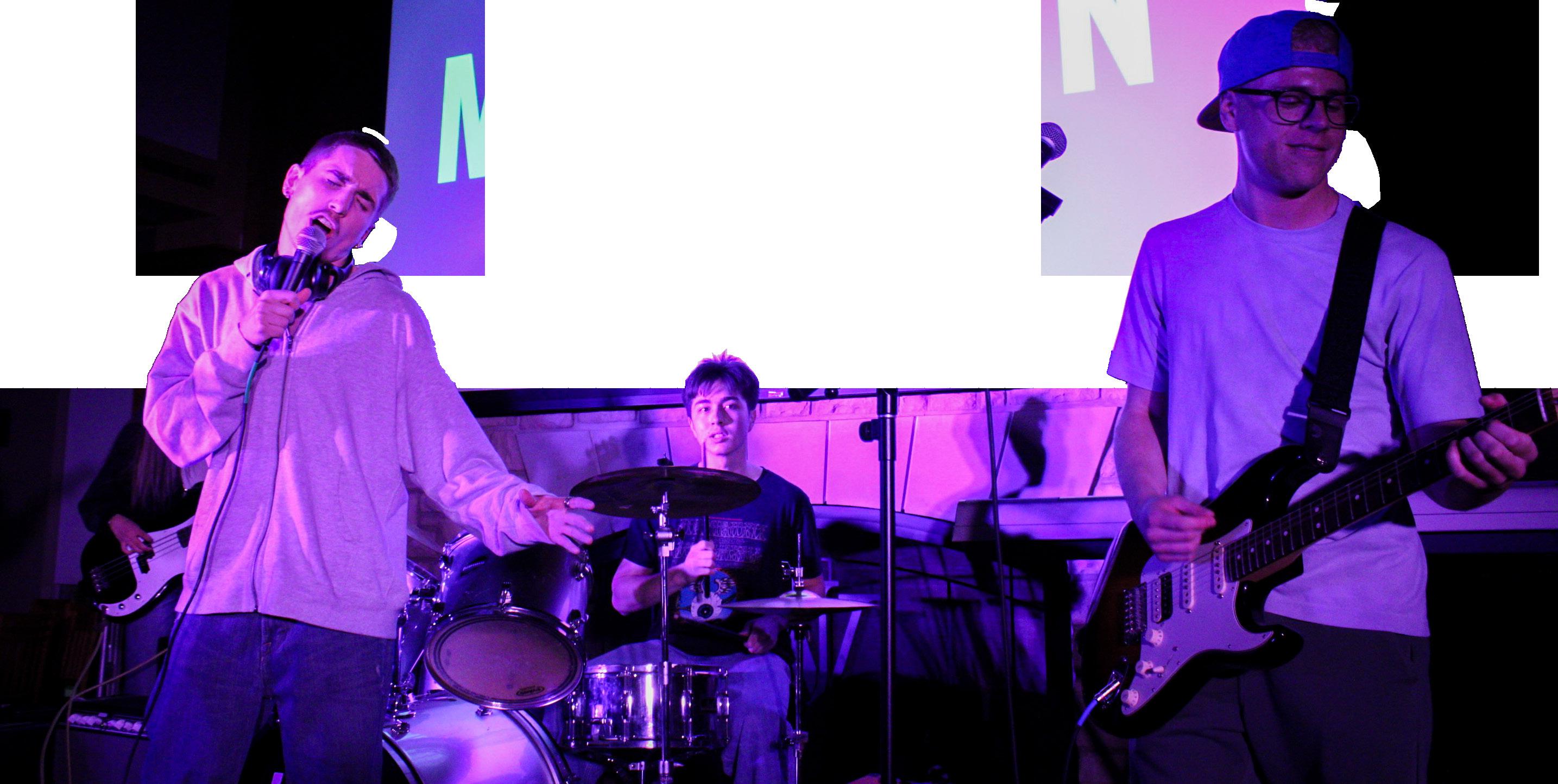
Student band Megatron performs in the first round of Battle of the Bands.
SPORTS Baseball sweeps last nonconference series ahead of UAA play
Association (UAA) play riding a six-game win streak.
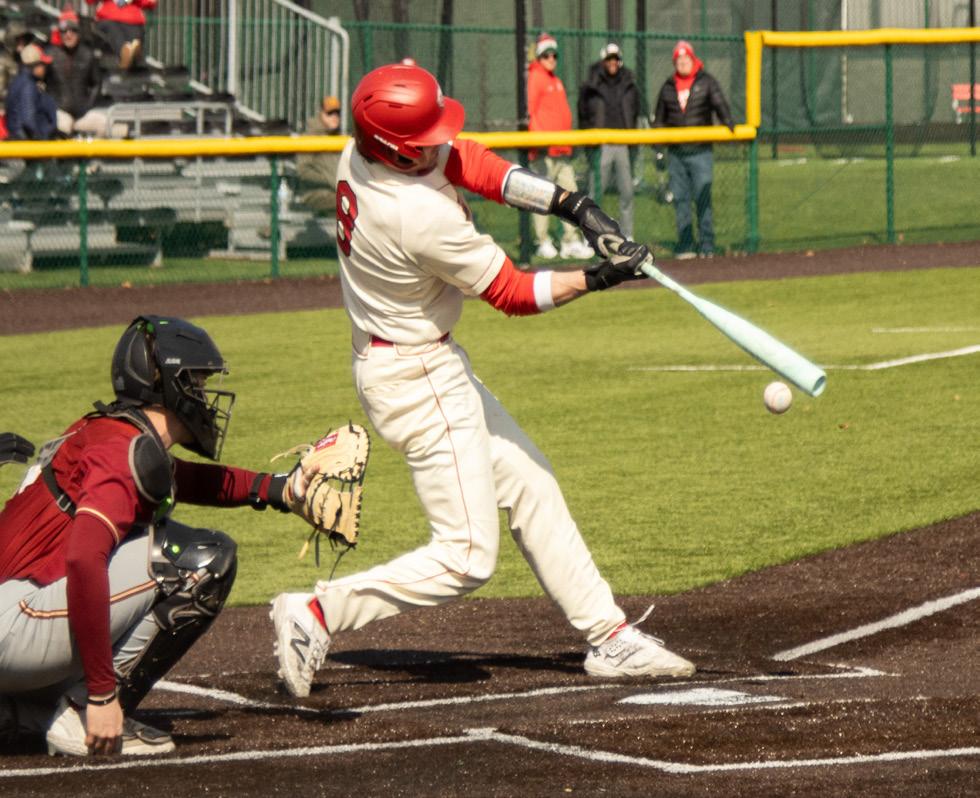
In the second game of the No. 10 WashU baseball team’s series against Gustavus Adolphus College, sophomore outfielder Will Taigen was forced to leave the game after suffering an injury.
In the second game of the doubleheader, the Bears were down 7-0 and were close to dropping the game against the Gusties. Amid Taigen’s triumphant return to the dugout sporting a hospital gown, the Bears scored six straight runs, regaining the momentum en route to a 13-9 win.
The win was one of four in a sweep of the Gusties on March 21 and 22. WashU also added wins over the University of Wisconsin–Platteville and Westminster College, meaning the Bears enter University Athletic
The Bears started their win streak on Wednesday, March 18, when they beat Platteville 8-5.
The late-game victory against the Pioneers was a tough battle. The two teams were tied 4-4 to start the seventh inning. Platteville managed a single run during the seventh inning. In the bottom half of the frame, WashU scored four runs on a combination of a fielding error, balk, and a two-run single from junior catcher Miles Birke.
“It was just pass it off to the next guy. We know everybody [will] do their job and have confidence that your teammates are going to pick us up,” sophomore outfielder Kevin Stephens, who scored the first run of the inning, said. “And that’s exactly
what happened, and we were able to pull through.”
The momentum gained from this game did not stop there, and the team went on to sweep Gustavus Adolphus in the two-day series on March 21 and 22. In their first matchup against the Gusties, the Bears scored a single run in the first inning, but did not score again until scoring twice in the seventh, while the visitors scored three runs in the sixth and seventh inning. Starting the bottom of the eighth inning tied 3-3, an RBI single by Birke kickstarted an eight-run inning to give WashU an 11-3 victory.
In the second game of the day, the Bears picked up the pace after they found themselves outscored 7-0 at the bottom of the fourth. Back-to-back doubles by sophomore infielder Cooper Greene and first-year outfielder
Eli Sitzer gave the Bears their first run, before a two-run single to left field by Stephens drove in Sitzer and senior shortstop Shane Pellegrino. WashU stayed steady, scoring three more runs in the fifth inning and six in the seventh. A final run by Sitzer off of a wild pitch brought the final to 13-9 to end the first of two doubleheaders the teams played over the weekend.
“The offense has been doing a great job picking us up, and we’re very appreciative of them just knowing that we have that little bit more slack on our end, the offense will pick us up if we don’t do it well,” Pellegrino said.
On Sunday, WashU was looking for two more wins to close the series. Led by strong pitching from graduate pitcher Chase Brickley, the Bears kept Gustavus Adolphus off the board until the fourth inning.
Game 2: WashU 7, Case Western 4
Long before the current seniors suited up, the No. 12 WashU softball team had a tradition of intensity every time they played No. 19 Case Western Reserve University.
“It was before I was even here, before my freshman year, … and ever since then, it’s been like ‘Case Hate Week,’” senior catcher Alexa Hanish said.
The constant trading of wins has only fueled the rivalry and added stakes to every matchup.
On Friday, March 20 and Saturday, March 21, WashU fell to Case Western in their opening University Athletic Association (UAA) series. The loss left a harrowing 1-2 mark on their UAA record and pushed the Bears to 12th in Division III.
Game 1: Case Western 4, WashU 1
Friday’s opener was dominated by the Spartans, who surged ahead early and never relinquished control in a 4-1 game. Case Western struck quickly in the first inning, building a cushion with three runs. In the third inning, a double brought the score to 4-0. WashU responded late, getting themselves on the
scoreboard in the seventh inning. Hanish sparked the rally, followed by junior third baseman Kennedy Grippo and senior infielder Jamie Cendana. With bases loaded, first-year outfielder Julia Sullo hit an infield single to score a run.
“Case, at the end of the day, are our rivals, [so] we wanted to come out with a bang,” Hanish said. “It didn’t necessarily start the way we wanted, but why not finish the way we wanted? I just wanted to do that for my team.”
The Bears pivoted from Friday’s loss in game two, prevailing 7-4. WashU grabbed early momentum in the second inning when Sullo hit a three-run home run to right field, scoring first-year utility player Austen Kinney and sophomore utility player Kennedy Rushing to give WashU a 3-0 lead.
“I think we wanted it a lot more, especially after losing the first one,” Hanish said. “We didn’t want to necessarily lose the series, but we wanted to be in a better place for the third game.”
WashU maintained this lead in the third inning. With sophomore first baseman Harper Nix and junior right fielder Kristina Donaldson on base, Kinney hit a double to left field that scored Nix, pushing the lead to 4-0.
Case Western responded in the third, fifth, and sixth
Though the Gusties scored two runs in the fourth, the Bears stayed strong defensively, not allowing any further runs for the rest of the game. Led by three early runs and a three-run homer by Stephens to seal the victory in the eighth, WashU won 6-2.
In the fourth game of the weekend, WashU did not let off the gas. Including a three-inning stretch where the Bears scored three runs in each inning, WashU pulled out an 11-4 victory over the Gusties to close out the weekend.
Senior pitcher Isaac Zhang led the way on the mound with six strikeouts and just one earned run in 4.2 innings pitched. Senior pitcher Miles QuemuelLabrador shut the door for the Bears with three strikeouts.
“I have all the faith in the world in our pitching staff and our defense and
our offense, so I think a lot of it just comes from trust and knowing that when you fail, you got guys that are behind you and they’re going to pick you up,” Pellegrino said.
On Tuesday, March 24, the Bears defeated Westminster College 12-4. Witte led the team with 3 RBIs, including a two-run double in the third inning. Pellegrino and Greene hit a pair of two-run homers as the Bears cruised to their sixth win in seven days, improving the team’s record to 16-3.
The Bears begin conference play on Friday, March 27, with a four-game series against the University of Chicago Maroons. As the only nationally ranked team in the conference, WashU will look to win the UAA for the first time since 2019 after finishing in fourth with a 10-10 conference record last season.
innings, scoring four runs to even the game at 4-4.
Tied after seven innings, the teams went to an extra eighth inning. WashU, not ready to give up yet, regained control in the extra frame.
Grippo singled, Hanish walked, and Sullo reached base on a fielder’s choice and error to put three runners on base. With two outs, Donaldson tripled to right field, and all three runners crossed home plate, giving WashU three runs and a 7-4 advantage.
Case threatened the win in the bottom of the eighth by loading the bases, but junior pitcher Maria Brooks ended the game with a strikeout to secure the win.
Game 3: Case Western 10, WashU 7
The Spartans took an early 2-0 lead in game three off of a throwing error and a single.
WashU trimmed the lead
in the third inning when first-year infielder Katie Fung singled to score Sullo and cut Case’s lead to 2-1.
The Spartans responded with a surge, scoring three times to stretch the lead to 5-1. Case built off this four point cushion by scoring twice in the fourth and once in the fifth for an 8-1 lead.
However, the Bears were not done yet. In the sixth inning, with bases loaded, first-year shortstop Katie Dolin was hit by a pitch, allowing one teammate to walk home and score.
Moments later, Grippo singled to left field, allowing for two runners to score and pushing the score to 8-4.
“We did not want to lose the third game, so we finally put our foot back on the gas in the second half of the game,” Hanish said.
The Spartans widened the lead to 10-4 with two runs at the bottom of the sixth. But WashU made one final push in the seventh inning.
“It was like the dugout got louder,” Hanish said. “Everyone was more intense; … we all had each other’s back, and we didn’t want to go home having lost.”
Kinney drove in one run with an RBI single and senior outfielder Sydney Schneider followed with a 2-RBI single to bring in two more. The late rally cut the deficit to three, but the comeback fell short as Case Western secured the win 10-7.
“We might have started a little too late, but at least we didn’t give up,” Hanish said. “It gives our team a good reality check: … a hiccup this weekend, but we know we can play softball and compete with these teams — they are not better than us.” The Bears will try to level their UAA conference record this weekend as they host the University of Chicago at home on March 27 and 28.
CECILIA O’GRADY STAFF WRITER
WRITER
Swim notches seven podium finishes at national
and getting to meet people around the country is just a blast.”
For the last month, the No. 10 women’s and No. 14 men’s WashU swim teams have been focused on one thing: performing at the NCAA Division III national championships.
The fastest eight men and nine women represented the Bears in Indianapolis from March 18-21, competing against 562 other athletes from across D-III. Over each of the four days of swimming, preliminary heats were held in the morning and finals in the evening.
The Bears enjoyed some particularly strong individual performances across the meet, setting five program records and earning 15 AllAmerican finishes.
“This meet is always super special because everyone at the meet is such a great swimmer,” junior Marco Minai said. “The level of competition is just awesome. … Getting to see these awesome swimmers do what they do best
The first day of the championships was very successful for the men’s team, with two recordsetting swims. First-year Parker Chan continued his incredible rookie season, finishing second in the nation in the 500-yard freestyle in 4:23.33. This time was good for a program record and the fastest swim by a first-year in D-III history.
“I was super proud of how he did,” Minai said about Chan’s performance.
“The amount of work and blood, sweat, and tears he puts into this sport in practices and races pushes me every day and seeing him have success made me super happy.”
Minai also enjoyed a strong start, setting a program record in the 200-yard Individual Medley (IM) prelims before breaking that record again in the finals as he finished fourth overall.
Day 2 also featured two more program records written in the history books of WashU swim. Minai showed out once again, this
time finishing in 3:50.81 in the 400-yard IM, good for third in the country.
“I think I thrive in a higher intensity atmosphere, which finals brings,” Minai said on his success. “You’re just narrowing down the pool to the fastest people from the morning so there’s more energy. … The two IM races I was definitely very
team. Senior Andrea Leng, junior Izzie Gattone, sophomore Iris Qi, and first-year Ayaan Olasewere finished in 11th place with a program-best time of 1:33.08.
The third day featured the most podium finishes for both teams. Junior Hannah Lee had the highest finish for the Bears, earning fifth in the 100-yard breaststroke. She also set
“The amount
of
work and blood, sweat, and tears he puts into this sport in practices and races pushes me
every day, and seeing him have success made
me super
happy with.”
Relays have been a strength for the women’s team throughout the season, and record number two of the day came from the 200-yard freestyle relay
happy.”
the program record in the prelims for this event.
“I think our teams did really well and we all worked together to do the best that we could at nationals,” Lee said. “I
think that working towards this common goal was something that bonded us all as a team, which made swimming fast for the team all easier.”
The women’s team earned two more AllAmerican honors in relay events in the 200-yard medley and the 800-yard freestyle relays.
“I try to go in with the same mentality, but obviously I think relays are a lot more fun,” Lee said about the difference between individual and relay competition. “You get to do [the relay] with three other teammates and the energy is just a lot higher.”
Chan continued his strong performance, notching an eighth place finish in the 200-yard butterfly alongside finishing ninth in the 800-yard freestyle relay with Minai, first-year Gavin Coggan, and senior Ethan Feng.
On the last day of competition, Chan earned another second place finish in the 1650-yard freestyle, only 12 seconds out of first with a time of 15:16.55 that would have been good to win the event last year. The other
podium finish of the day came from junior Shanze Karimi, who finished seventh in the 3-meter diving. All in all, the men’s team finished in 10th place, and the women’s team finished in 13th place, both relatively in line with their finishes in recent years. Though this competition breaks the Bears’ twoyear streak of having a national champion, with Alex McCormick and Kyle Wolford winning the 200-yard backstroke in back-to-back years, the number of program records and All-American finishes speaks to the teams’ overall strong performance. These national championships conclude another successful season for the Bears. Individually swimmers broke programs records and both teams finished in the top 15 in D-III. The grind does not stop there, though.
“It’s time to get back to work,” Minai said. “Maybe let my body relax for the week and then get back to work and build back up for next year and hopefully just keep getting better and better.”
Bear Breakdown: Winter sports season recaps Bear Breakdown: Winter sports season recaps
Women’s track and field
Women’s track and field won their second-ever indoor D-III national championship on March 14. The Bears were led by record-breaking performances in the 4x400 meter and the Distance Medley Relay (DMR). First-year Kate Delia won the 800-meter championship in her first ever nationals meet, and senior Kylie Spytek won championships as part of both the 4x400 and DMR teams. Additionally, 13 other Bears were named D-III All-Americans.
Men’s track and field
After finishing 20th last year, the WashU men’s team finished eighth at indoor nationals this year on March 14. Leading the team’s best finish since their national championship in 2022 were pole vaulters graduate student Tommaso Maiocco, seniors George Bourdier and Hayden Kunkel, and junior Peter Lichtenberger, who all finished between third and sixth. Four other Bears were named All-Americans after the tournament.
Women’s basketball
After beating Ohio Wesleyan University in the Round of 32, the No. 15 WashU women’s basketball team was eliminated by the No. 4 University of Wisconsin–Oshkosh in the Sweet 16 by a score of 64-43 on March 13. Junior center Lexy Harris, the Bears’ leading rebounder and scorer, was named an All-American by D3Hoops.com after the season. WashU will return its top three scorers, Harris and juniors Sidney Rogers and Alyssa Hughes, after making the team’s first Sweet 16 appearance in six years.
Men’s basketball
The No. 15 WashU men’s basketball team fell to the No. 3 University of St. Thomas (Texas) in the Sweet 16 on Friday, March 13. The Bears defeated Transylvania University and the No. 19 University of Wisconsin–Whitewater at home in the first two tournament rounds. Despite failing to advance to the late rounds of the tournament, the Bears’ three leading scorers — junior guard Ryan Cohen and sophomore forwards Connor May and Anthony Przybilla — will return next season.
FORUM
The music buildings’ demolition is an attack on the liberal arts
PRANATHI MURTHY STAFF WRITER
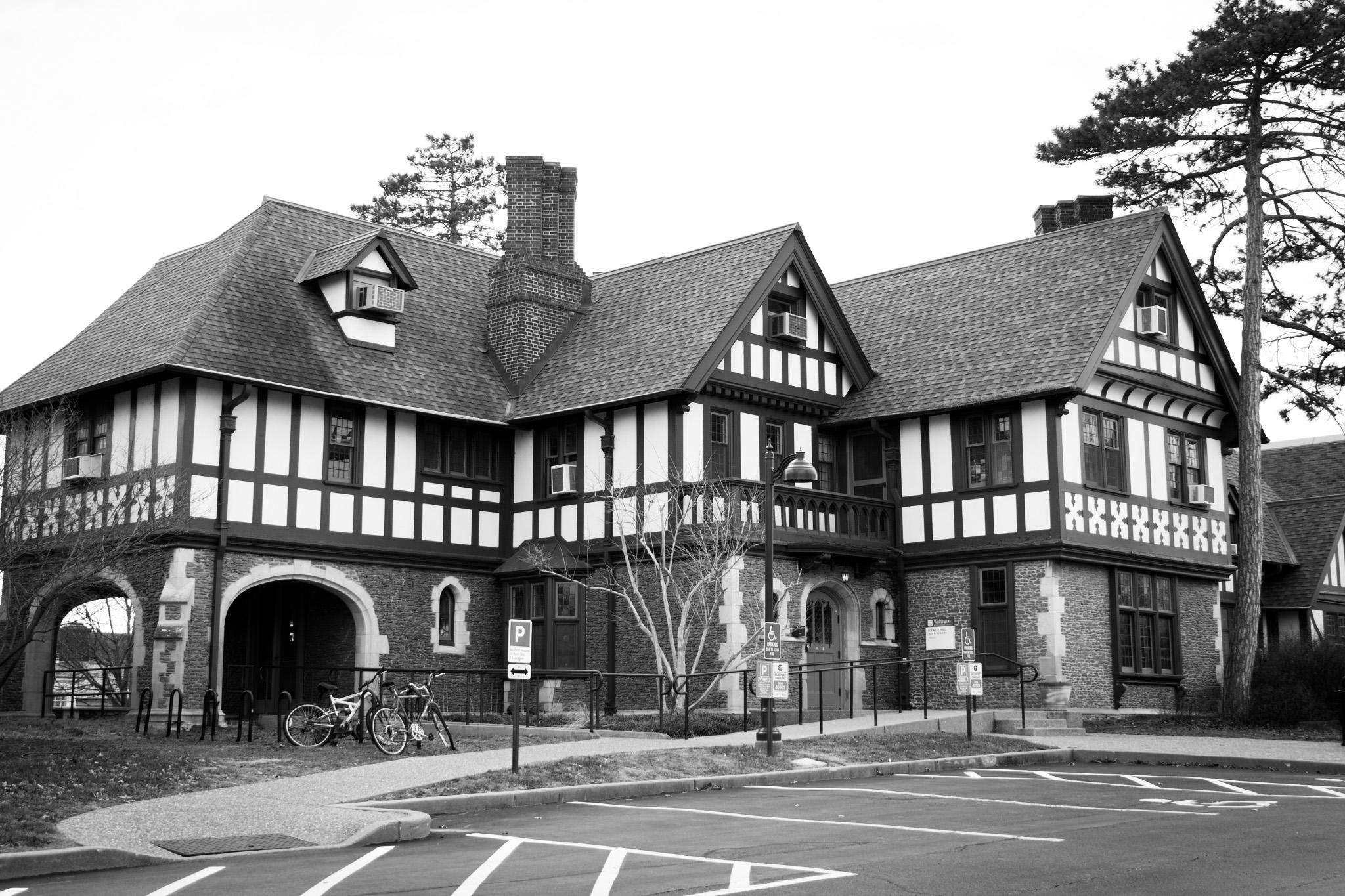
“Musicians and music scholars are used to having to advocate for what they do and why it matters. That’s a very familiar position for us to be in,” Alexander Stefaniak, Head of Musicology and Director of Undergraduate Studies, said casually while talking about the demolition of Blewett Hall, Tietjens Hall, and Gaylord Music Library. The comment didn’t sound dramatic or angry, but rather matter-of-fact. As an Indian classical vocalist and veena player, I nodded in agreement.
The University has already announced what will replace these buildings: new residential halls on the South 40, intended to house about 600 first-years and sophomores. The halls are being constructed to accommodate the policy requiring sophomores to live on campus starting next academic year. Now, the buildings that have housed the music department for decades are being removed to make space for this requirement — a trade-off that has enraged and disappointed me.
WashU’s plans to demolish the music department’s buildings reveal how the humanities — music, in particular — are always expected to justify their worth. For a university that describes itself as committed to a liberal arts education, the decision raises a broader question of how well this commitment is upheld when the physical spaces that support those disciplines are treated as expendable.
The history of the buildings and the significance of their proximity to each other put into perspective how hard this loss will be to campus culture. Blewett Hall has housed WashU’s music program since 1946, and Gaylord Music Library was built in 1960. For nearly 80 years, the department has existed in the same small cluster of spaces: offices in Blewett, classrooms and practice rooms in Tietjens, and the Library across the courtyard. When you spend time around these buildings, you start to realize how much of the music students’ and faculty’s daily lives depend on that physical closeness. Professors run to the library before class to grab a score. Students stop by a professor’s office before class. Random conversations erupt in the library.
Patrick Burke, chair of the Department of Music, explained that under the current relocation plan, the department will be split into offices at Seigle Hall and classrooms, practice rooms, and instructional labs at Lopata House. A department that has long been a close-knit hub will soon be dispersed across campus.
When the University demolishes this space, it’s not just about removing classrooms or offices. It’s also breaking up the physical center where all the small, ordinary interactions have taken place for decades. In the end, how a university organizes its campus says a great deal about what it believes is central to academic life.
Gaylord Music Library is the heart of the space.
The collections themselves — the scores, records, and historic journals — will be moved mostly to Olin Library, while some materials will go to West Campus storage. On paper, the materials still exist, the catalog numbers stay the same, and, technically, nothing has been “lost.” However, a dedicated library gives the discipline a visible place on campus where its material, history, and scholarship live together.
As Stefaniak said about the change, “Anytime a library gets knocked down, I consider it a loss on principle.” Once the dedicated library disappears and the collection is folded into a larger system, it becomes easier to diminish and deprioritize the discipline, another way the liberal arts can quietly lose space within the university.
Moreover, many students use these spaces and their resources every day. Tietjens Hall currently has 15 practice rooms and, according to Burke, around 300 students rely on them regularly. Under the current relocation plan, seven practice rooms will be included in the new Lopata House space, while the remaining eight still have no confirmed location. These rooms are not only used by music majors but also by students studying other subjects who want music to remain a part of their lives while at WashU.
The music department didn’t request or have a say in this relocation. Burke told me that the faculty learned about the demolition in November 2022, after the decision had already been
made.
Burke and Stefaniak explained that the music faculty have spent the past four years planning the kinds of spaces the program needs to function, from specialized electronic music labs to soundproof practice areas. Both professors sounded practical and optimistic about the department’s future. They also emphasized that the dean of Arts & Sciences has supported the music department throughout the relocation.
Still, the fact that the department learned about the demolition only after the decision had already been made, and it had no say in the future of its physical home, is dismissive of the people who actually teach, study, and create inside those buildings. The faculty and students were left without a voice in the decision and instead placed in a position of having to advocate for why their work — and
OPINION SUBMISSION
the spaces that support it — matter.
Many students have also expressed frustration about how the relocation was handled and questioned whether the school’s accommodations are only due to pressure from the department and students.
“As a music student, we need those practice rooms. The 560 Music Center has, like, six practice rooms, so I’m glad that they are gonna build new practice rooms with even better features, but I feel like it was only because there was pushback, and that kind of upsets me,”
Luke David-Pennington, a sophomore studying biology with minors in music and Spanish, said.
While the music department and its community will persist beyond the demolition of these buildings, losing a physical center that has existed for nearly 80 years is a real loss for the people who rely on
it. Universities inevitably change over time, but this particular change raises questions about how the University’s values translate to reality, especially when profit is involved. In displacing a department that has occupied the same space for decades for new housing, WashU reveals what spaces it chooses to protect and which ones it’s willing to sacrifice.
Stefaniak said that musicians and music scholars are used to advocating for why their work matters. Why are the humanities the departments that have to prove their worth over and over again? If WashU wants to continue describing itself as a university that values the liberal arts and humanities, then that commitment has to appear not only in mission statements but also in the choices the University makes about the spaces where those disciplines live, grow, and thrive.
The military should support higher education
JOHN
Brookings Hall is the centerpiece of WashU. It can be viewed along the grand, green length of Forest Park.
As you enter under the hall’s eastern facade, you see the Latin inscription, “Discere Si Cupias Intra: Salvere Iubemus,” meaning “If you wish to learn, enter: we welcome you.” These are words I remember walking under every day during my undergraduate and graduate years.
I was commissioned in 1975 after graduating from WashU. I served as an army officer and then an army civil servant before retiring. Only recently have I learned that, according to Defense Secretary Pete Hegseth, my time at WashU was detrimental.
Hegseth sees a world where might makes right. He believes lethality will accomplish American war aims. He believes globalist alliances with democratic governments are dangerous and debilitate a mighty “America First” foreign policy. He contends that universities that do not endorse lethality, do not have a warrior officer class, and have large international student bodies are detrimental to U.S. military officer
development. Thus, he says such universities should not receive Pentagon support for higher officer education. I disagree with him. Instead, I see WashU as a stellar model for an unbiased, open-minded education. Such learning can help guide officers’ decisions before asking anyone to die.
Hegseth claims that places like WashU and some 30 other universities are dangerous to military “lethality” because they “diminish critical thinking and have significant adversary involvement.”
He explained, “For too long, this department has sent our best and brightest officers to Harvard, hoping the university would better understand and appreciate our warrior class,” Hegseth said. “Instead, too many of our officers came back looking too much like Harvard — heads full of globalist and radical ideologies that do not improve our fighting ranks.”
Hegseth insinuates military higher education should involve universities that encourage a lethal “warrior class.”
However, America doesn’t want or need a warrior class. We want a citizen military that defends the rights of all Americans under our Constitution. We need leaders who outsmart our
enemies, think critically, and act ethically to do what is needed to protect our society.
Hegseth also claims we need to avoid places of “adversary involvement.”
I learned adversarial counterarguments are what require and even force us to think. They literally cause us to think critically, evaluate our biases, and act prudently in light of what we’ve thought through. Surrounding oneself with like-minded group thinkers can prolong wrong decisions long after they have failed.
Hegseth fears diversity, too. He says, “the single dumbest phrase in military history is our diversity is our strength.” What’s more, he claims these universities even challenge a “warrior ethos.’’ He expects all his officers to “remove the social justice, politically-correct, toxic ideological garbage that had infected our department.” However, our defense wins wars thanks to the contributions from Americans of all backgrounds. Denying potential recruits who are willing to defend our freedoms is just as short-sighted as a sole focus on lethality. Cancelling diversity serves only our adversaries.
Critical thinking at WashU is best developed among a diverse array of
people, including international students who bring different perspectives.
Engaging with international students made my life richer and my skill sets more valuable. I learned about other viewpoints. Did other people change my views? Not necessarily, but they certainly made me aware, “There are more things in heaven and earth.” That is from Shakespeare, whom I also read at WashU. Amazing what you can learn if you don’t arrive knowing all the answers already.
All these decades later, I remember sitting at breakfast before class one morning listening to a Jewish and a Palestinian student discuss the Middle East. I saw then that there was so much more to learn. This is the goal of education, even among adversaries, and especially for officers. To learn that there is always more to know.
Officers need to see the world with a wider lens than “lethality” if we are to be the good servants of those we defend. We must see our mission not as “killers,” but as wise protectors.
A political history course at WashU, taught by a Jewish refugee from the Holocaust, introduced me to the book, “The Art of War.” In his treatise, the
Chinese philosopher Sun
Tzu writes that “victorious warriors win first and then go to war.” Once we learn to think through all aspects of a problem, we might be able to do something that doesn’t require war to achieve a war aim. We need to be aware that there are many aspects to any issue — history, hopes, intentions, deception, capabilities, and even morals. We can’t pretend that mighty weaponry, physical strength, and tough attitude alone win wars.
Lethality is not the only key to winning wars, as we learned in Vietnam.
A great U.S. Army commander I once met, Harry G. Summers, wrote about a conversation he had with a former North Vietnamese adversary. Summers told the colonel that the Vietnamese never beat the U.S., to which he responded, “That may be so, but it is also irrelevant.”
The U.S. was lethal. We made body counts. The Vietnamese were thoughtful. And patient. This should teach officers something.
Thoughtful, clear war aims and an assessment of all factors are more important than lethality to achieve victory. All the weapons visited upon Ukraine have not won the war for Russia. Israel’s combat lethality has not
led to a resolution in Gaza. Why?
Perhaps the answer was reached at that breakfast long ago. What does lasting victory look like? Whose interests are served? This is what senior officers are supposed to think about and advise policymakers on. Sounding tough doesn’t make you tough. We now drop bombs all over the world, but lasting peace eludes us.
Most importantly, I learned self-awareness at my university. I learned that the freedoms we enjoy are infectious in a course on British colonialism. European imperialists did not appreciate that Western freedom could move even the colonized to fight. People in French Algeria, Vietnam, and central African colonies continued to fight despite the enormous human cost. Also, a course on German history explained how propaganda can exploit fears and hatreds, rallying people to horrors unimaginable in defense of an abstract ideal. In short, my university made me open to learning. It showed me how to be a better officer because it showed how I could, as Sun Tzu explained, “Know your enemy and know yourself, and you can fight a hundred battles without disaster.”
W. DAVIS CLASS OF 1974
JONAH GLASS | STAFF PHOTOGRAPHER
The University is demolishing Blewett Hall, Tietjens Hall, and Gaylord Music Library to build residential halls for underclassmen.
Stop making reading ‘efficient’
The market economy may be right: Reading has a terrible return on investment. It’s not scalable. It’s easily outsourced to artificial intelligence. It offers no networking upside, doesn’t increase shareholder value, and (probably) doesn’t pair well with an afternoon Zyn. In the modern efficiencyfocused economy, reading doesn’t seem to be a worthwhile investment. Humanity is divesting accordingly.
For many students, the practice of reading assigned texts has become a vestige of the outdated education system. WashU, like most universities, reports a large proportion of students who regularly use AI to summarize or explain readings. Students and teachers alike are bombarded with studies that claim literacy is declining in America, while being reminded by scholars that democracy relies on a literate population. Yet, the protocol remains the same: Our professors continue to assign readings, we engage with them less, and our reading muscles slowly atrophy.
The problem isn’t that students dismiss the benefits of reading, but that they have been taught to view it as a mechanism for extracting information. Reading supplies the content needed to pass tests, write essays, and get participation points. When students discover a more efficient pathway to information, like AI summaries, our natural response is to adopt it.
But reading isn’t just a channel for relaying information. It drastically improves attention spans, cultivates
empathy, feeds creativity, and allows you to digest and wrestle with complex information. At the societal level, our country cannot function without well-informed, literate voters. We know all this — we have been warned for years. Yet, readership still declines.
Herein lies the contradiction. What dissuades students from reading is entirely utilitarian: Reading is both more involved and less efficient than relying on summaries. Yet when academics adopt a similar pragmatism to encourage reading, it’s ineffective.
Academics don’t recognize that lofty petitions to save democracy or promises to increase productivity will never persuade non-readers to read.
I’m convinced the solution stems from the same giddy intoxication shared by BookTok romantasy girlies and seventh-grade Harry Potter superfans. They don’t read with an altruistic motive to preserve humanity, but a genuine love of the game. Educators and academics can’t cultivate readership through civic obligation, but they might inspire civic responsibility through enjoyment.
To do so, we need to change the conversation that surrounds reading. Nonfiction isn’t the only valuable form of reading; “To Kill a Mockingbird” teaches us more about power dynamics than “How to Win Friends and Influence People” and “48 Laws of Power” ever could. Moreover, reading doesn’t always need to challenge you or prepare you for your KPMG interview. Classics aren’t the inherently superior form of literature. Enjoying “easy books” doesn’t contribute
CAPTION CONTEST
3/26 WINNERS
to the rise of anti-intellectualism; picking up a Colleen Hoover novel likely won’t kill any brain cells.
The material people start out reading is largely unimportant; the priority should be reading for enjoyment, because enjoyment is what builds a lasting habit. Once this habit has formed, it can carry readers towards more challenging material that deepens their understanding of the world.
A reversal of
ANAELDA RAMOS | MANAGING ILLUSTRATION EDITOR
First Place:
...how many mg was that edible last night? Zoe Rhodes, Student Life Staff
Second Place: Boss said to do a Poisson distribution. Leo Penny, Current WashU Student
Third Place:
The latest WUPD hearts and minds campaign was a real flop. Jason Merkel, Casual Student Life Reader
Caption this! Enter this week’s contest
Scan the QR code to enter your submission by noon on 3/31.
downward-sloping readership and literacy rates would require many to abandon their current notion of what it means to read. If reading’s only purpose is to convey information, then students supplementing it with AI are simply increasing their efficiency. By treating reading as a means to an end, professors encourage students to outsource it. But if an educator’s goal for their students is true intellectual growth, they need to encourage them to linger,
to wrestle, and — yes — to read what has no discernible “value.” WashU should be built for this type of unoptimized reading; it should be an example for the larger education landscape. That could mean funding one-credit reading seminars with no exams or creating classes that allow students to read what interests them instead of adhering to a rigid syllabus. Reading cannot remain inseparable from performance metrics. WashU
needs to signal that reading exists for more than a numerical grade. Reading for enjoyment, not for a return on investment, is a return to reading in its purest form. And that is why it should be defended and celebrated. Some things that drive value can’t be quantified, scaled, or automated. When we prioritize enjoyment in reading, it becomes a habit — and this habit is what truly creates the most capable citizens.
DIYA GUPTA | STAFF ILLUSTRATOR
KEVIN
Regaining our sensitivity: Reflections on the armed threat alert
Just one month ago, WashU students were scared for their lives. They were huddled in classrooms, hidden in closets, and barricaded in bathrooms. Some of us frantically sent texts to people we knew were on campus, hoping that they were safe. To our relief, the threat of an armed person on campus on Feb. 24 was declared a false alarm, and no one was actually hurt.
Within just a couple of days, it seemed as if we had all moved on. Campus activities resumed as normal, and now, the event is barely a topic of conversation. Ultimately, we so quickly forgot the trauma of the alert because we are troublingly desensitized to violence. This desensitization doesn’t just impact how we process campus threats but also how we view President Trump’s recent actions that in isolation would have caused more public outrage. Regaining our sensitivity is step one of fighting against the erosion of democratic ideals. Desensitization stems from abundance. The information age has flooded us with never-ending waves of headlines, news, opinions, and more, to the point where this overexposure fosters indifference. At WashU, this means that the threat of violence on our campus didn’t end up feeling major or surprising in its aftermath. School
shootings have become, quite frankly, a recurrent piece of the national news cycle, and that abundance has desensitized us to the idea that schools might not be safe.
From a broader perspective, the fact that many of us seem to have forgotten the very real emotions from the Feb. 24 alert reflects how our excessive media consumption dulls our sensitivity. This desensitization is exemplified in the practice of scrolling on social media, which is now a major source of entertainment and information for Americans. Your feed can give you a video of a puppy playing piano, then immediately after, spit out actual war footage. By equating the news with entertainment, scrolling allows us to ignore atrocities with the simple swipe of a finger. That is desensitization.
The decline in local news engagement has also meant that Americans are often removed from the media and information they are exposed to, leading to more indifference regarding current events. Usually, local avenues for change, such as city or regional government, provide everyday citizens with tangible outlets for channeling their political concerns. When people only see major geopolitical events in their news brief, it is easy to mentally discard — and become desensitized to — troubling information. Questions like “What can I do to stop the violence in the Middle East?” make us feel helpless.
In short, excessive exposure to non-local news has led to the desensitization epidemic of our time. This dynamic helps explain our current political moment in which President Trump is using this ethic of abundance to desensitize Americans to his policies. We are now less sensitive when President Trump
initiates the American military without consent from the American people, because, well, he keeps doing it. We are less sensitive when that militaristic mindset is turned against actual Americans, as in ICE, because we just add it to the list of outrageous policies the administration has enacted. This is
“Desensitization stems from abundance. The information age has flooded us with never-ending waves of headlines, news, opinions, and more, to the point where this overexposure fosters indifference.”
WEEKLY BAR, RESTAURANT AND FUN GUIDE
exactly the idea behind Trump’s “flood the zone” strategy — a tactic used by his administration to overwhelm the public and policymakers at the beginning of his second term.
Whether it’s our community’s ability to quickly bounce back from the threat of violence on our campus or the increasing lethargy with which we view or talk about the Trump administration’s actions, we are facing a crisis of desensitization.
Although the alert was just a false alarm, those feelings of fear during the event were real. We were afraid, because we knew that school shooting threats need to be taken seriously. Similarly, we must recognize that the Trump administration’s
undemocratic actions are deeply troubling to the ideals of our nation. The paradigm that normalizes moving on from our fear during the alert is also what allows Trump to remain unaccountable for fascist policies. We must resist the urge to forget the shooter threat.
Let’s re-sensitize ourselves to gun violence and to encroachments on American democracy. This could look like engaging more with local news outlets like the St. Louis Post-Dispatch and St. Louis Public Radio and spending time processing each piece of media we engage with instead of doomscrolling. If we don’t act now, we can only hope that the next threat is another false alarm.