The independent newspaper of Washington University in St. Louis since 1878 THURSDAY, MARCH 18, 2021
VOLUME 142, NO. 18
TRIPLE JUMP
Despite season cancelation, track and field star is still optimistic (Sports, pg 3)
WWW.STUDLIFE.COM
UP AND AWAY
ESSENTIALS
WU junior voiced the character Russell in Pixar’s ‘Up,’ but he does other stuff too (Scene, pg 5)
Our staff writer’s review of the 32nd edition of Black Anthology (Cadenza, pg 6)
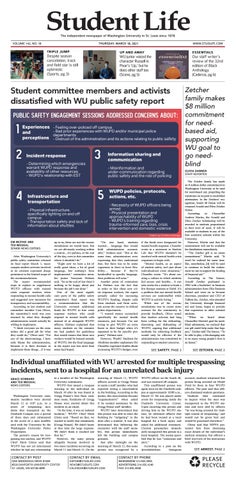
Student committee members and activists dissatisfied with WU public safety report
Zetcher family makes $8 million commitment for needbased aid, supporting WU goal to go needblind OLIVIA DANNER STAFF REPORTER
EM MCPHIE AND TED MOSKAL SENIOR NEWS EDITORS After Washington University’s public safety committee released its final report March 1, many campus student activists involved in its creation expressed disappointment in the limited scope of the recommendations. The report recommended steps to replace or supplement WUPD officers with trained crisis response workers when responding to mental health calls and suggested new measures for transparency and accountability. According to law student and committee member Cass Oliver, the committee’s work was constrained by what they thought administrators would actually be willing to implement. “I think everyone on the committee did a good job for what they could do,” Oliver said. “For any of the shortcomings, I honestly blame the administration, because it is their decision to implement these things…if it was
up to us, these are not the recommendations we would have. But we are obviously working within a system…it’s politics, at the end of the day, even in this committee where it shouldn’t be.” “Right now we have a lot of really good ideas, a lot of good language, but nothing’s been implemented,” committee member junior Tennyson Holmes said. “So at the end of day there’s nothing to be happy about just because the job’s not done.” One of the most significant parts of the public safety committee’s final report was a recommendation that the University earmark additional funds for WUPD to hire crisis response workers who could respond to mental health calls instead of or alongside WUPD officers. Holmes explained that many students on the committee had pushed for guidelines that would ensure that these new workers would be housed outside of WUPD, but the final language in the report was less strict than some had hoped.
“On one hand, students wanted… language that would hold administrators accountable,” Holmes said. “But at the same time, administrators were expressing that they understood that, but there has to be some vagueness in there to leave flexibility… because if they’re handcuffed to specific language, then problems will arise.” Another point of contention for Holmes was the fact that in order to hire these new crisis response workers, the report actually called for increasing WUPD’s funding, despite calls from students and from activists across the country to defund police departments. “I wanted money earmarked specifically for mental health resources, just because I’m not trying to give WUPD an extra boost in their budget when it’s supposed to be for specific purposes,” Holmes said. However, WashU Students for Abolition member sophomore Bri Chandler expressed doubts about increasing WUPD’s budget, even
if the funds were designated for mental health response. Chandler wrote in a statement to Student Life that WUPD shouldn’t be involved with mental health crisis responses to begin with. “Mental health, as an aspect of student safety, isn’t just about individualized crisis situations,” Chandler wrote. “It’s about creating a culture in which students feel secure and healthy... It can take weeks for a student to book a few therapy sessions at Habif. It’s a problem that our mental health services are understaffed while WUPD is actively hiring.” While one of the recommendations was to create more avenues for the community to provide feedback, Oliver noted that student activists had long been calling for the defunding, disarming and disbanding of WUPD, arguing that additional methods for collecting feedback would only be effective if the administration was committed to responding to student concerns.
The Zetcher family has made an 8 million dollar commitment to Washington University to be used for need-based aid, propelling the institution on its path to need-blind admissions. In the Zetchers’ recognition, South 40 House will be renamed Arnold and Ellen Zetcher House. According to Chancellor Andrew Martin, the Arnold and Ellen Zetcher Scholarship will be awarded to students proportional to their level of need. It will be available to students in any of the four academic schools within the University. However, Martin said that the commitment will not be available for distribution immediately. “The Zetcher gift is an estate commitment,” Martin said. “It won’t be realized for some time. But, nonetheless, [it] will be used to continue to build the endowment we use to support the funding of financial aid.” According to The Source, Arnold Zetcher graduated in 1962 with a bachelors’ in business administration from Olin Business School and went on to become chairman, president and CEO of Talbots Inc. Zetcher, who attended the University through financial aid and loans, hopes to provide that experience to other talented students. “When we heard about Chancellor Martin’s goal for needblind admissions, we realized that our gift could help make that happen,” Zetcher told The Source. “To be able to play a life-changing role in so many young people’s lives is an honor.”
SEE SAFETY, PAGE 2
SEE ZETCHER, PAGE 2
Individual unaffiliated with WU arrested for multiple trespassing incidents, sent to a hospital for an unrelated back injury GRACE KENNARD AND TED MOSKAL NEWS EDITORS
Washington University community members were alerted March 12 at 4:07 p.m. to a series of trespassing incidents that transpired on the Danforth Campus over a period of three days and culminated in the arrest of a man unaffiliated with the University by the Washington University Police Department. The person’s reason for trespassing was unclear, and WUPD Chief Mark Glenn said that WUPD has not yet determined whether he had any relationship
to a member of the Washington University community. WUPD first issued a trespass warning to the individual on March 10 after he was found in Gregg House’s first floor common room. Residents of Gregg House were alerted about this incident in an email. “At the time, it was an isolated incident,” WUPD Chief Mark Glenn said. “Based on that, we wanted to notify that community [Gregg House]. We didn't know at that time the large expanse. We didn't think it reached out that far.” However, the same person allegedly became involved in two more incidents occurring on March 11 and March 12. On the
morning of March 11, WUPD officers arrived at Gregg House to assist a staff member who had reported seeing a non-resident in the building. According to the memo, this non-resident became “argumentative” when asked if he needed assistance by the Gregg House staff member. WUPD later determined that this person was able to enter the building by “tailgating” in the door after a student. It was also determined that following the encounter with the staff member, this person immediately left the building and campus grounds. Just after midnight on the morning of March 12, this same person was recognized by a
WUPD officer on the South 40, and was escorted off campus. This unaffiliated person was again seen on the Danforth campus at approximately 10:00 a.m., March 12. He was placed under arrest for trespassing inside the Danforth University Center. Upon escorting this person and driving him to the WUPD station, he informed officers that he had been treated at a local hospital for a back injury and asked for additional treatment. Clayton paramedics immediately transported this person to a local hospital. The memo specified that he was “conscious and alert.” According to a post on the @wu4abolition Instagram
CONTACT BY POST
CONTACT BY EMAIL
CONTACT BY PHONE
ONE BROOKINGS DRIVE #1039 #320 DANFORTH UNIVERSITY CENTER ST. LOUIS, MO 63130-4899
EDITOR@STUDLIFE.COM NEWS@STUDLIFE.COM CALENDAR@STUDLIFE.COM
NEWSROOM 314.935.5995 ADVERTISING 314.935.4240 FAX 314.935.5938
account, students witnessed this person being arrested on Mudd Field by three to four WUPD officers. The post said that officers dismissed student questions. Students then continued to inquire when the man was transported to the WUPD station and were told by officers “he was being arrested for ‘multiple counts of trespassing,’ and would not be given bail and would be processed elsewhere.” Glenn said that HIPPA prevented him from disclosing exact details of the individual’s medical situation, but offered a brief overview of his interaction with WUPD.
SEE ARREST, PAGE 2
2 STUDENT LIFE
EM MCPHIE & TED MOSKAL | SENIOR NEWS EDITORS | NEWS@STUDLIFE.COM
theFLIPSIDE FLIPSIDE THU 18
RAIN/WIND 49/30
FRI 19
SAT 20
SUNNY 52/28
SUNNY 57/35
TUES 23
MON 22
SHOWERS 62/50
CLOUDY 65/50
SUN 21
PARTLY CLOUDY 64/42
WED 24
PARTLY CLOUDY 65/47
EVENT CALENDAR THURSDAY 18 Venture Café - Megan A. Cooper & Jorge Di Paola Virtual Event, 4 p.m. Jorge Di Paola and Megan Cooper investigate rare genetic disorders of blood cells, with Di Paola focusing on diseases affecting platelets and Cooper studying dysfunction of immune cells. They will discuss their ongoing efforts to identify new diseases that have the potential to lead to targeted therapies for patients and an understanding of pathways important for human health that can be used to design drugs and other diseases. EUSS Success Series: What to do when you don’t know what to do Virtual Event, 5 p.m. Hitting the COVID Wall? Stressed by looming deadlines on papers and exams? Feel like you need better strategies for lowering the anxiety of remote learning? Everyone is feeling the stress of remote learning and working environments, the lack of connection with classmates and instructors, and it is weighing on productivity. Join EUSS on Thursday, March 18 at 5pm for the second part of their Success Series: What to do when you don’t know what to do... A panel of representatives from several resources across campus will discuss strategies and tactics to improve mental health, stress and test anxiety, and who to talk to.
SATURDAY 20 Francophone Online Job Fair Virtual Event, 3 p.m. The French faculty in Romance Languages and Literatures is a partner of “Le Forum de l’Emploi Francophone en ligne” (a Francophone online job fair). This event is organized on Handshake by the Cultural Services of the Embassy of France in the United States. It will benefit our students (undergraduates/graduates) with French language skills seeking new opportunities to network with employers searching for young talent with interest and passion for the French language.
SUNDAY 21 Public Tour: ‘Figures of Myth and Legend’ Virtual Event, 2 p.m. Join us for live, interactive tours on Zoom. Student educators design and lead virtual tours featuring several artworks in the Kemper Art Museum collection, showing images of the artworks through screen sharing and answering participant questions. This tour considers how artists working in various artistic mediums have connected figures from ancient Greek and Roman mythology to their own historical contexts.
MONDAY 22 Black Italians and Digital Culture in Contemporary Italy Virtual Event, 11 a.m. Italian-Ghanaian director Fred Kuwornu discusses issues of culture, race, identity and citizenship in contemporary Italy drawing from the new arena of social media. Kuwornu shines a spotlight on a generation of Black Italians - artists, entrepreneurs and bloggers- who have been affirming themselves in Italian culture and society gaining more visibility nationally and in the Global Black Diaspora. Among the topics: race and national identity, second generations and issues of citizenship in Italy, new media and activism, Black women in Italy, music and media industry.
ZETCHER from page 1 “I’m deeply grateful for the Zetchers for making this commitment,” Martin said. “You know, for them, the ability to support students with need and for us ultimately to become a need-blind institution is something that they’re quite committed to, and [they] have shown that commitment through their philanthropy.” Martin sees the Zetcher family commitment and those like it as integral to the University’s goal of becoming need-blind, an important step in increasing campus socio-economic diversity. The necessity of diversifying became especially apparent when, in 2015, the New York Times labeled the University “the least economically diverse top college.” According to Martin, the University has already made significant progress towards increasing campus socio-economic diversity since then. 16% of the entering class of 2024 was Pell-eligible, Martin said, an increase from 15% of the class of 2022, and 6% campuswide in 2015. To continue fostering socio-economic diversity, Martin said the University plan to continue to invest in financial aid, fund grants such as technology grants, which were first provided in
fall 2019, and invest in initiatives like Deneb STARS, a program supporting firstgen students and students from under-resourced socioeconomic backgrounds. Trinity Weinhaus, a freshman in the Deneb STARS program, described how students from underresourced backgrounds can feel out of place given the University’s wealthy student body. “Wash. U. is a private university, and the majority of the people that attend Wash. U. are higher income, so, whenever lower-income students go into Wash. U., they are sort of encountered with the sense of isolation because they cannot relate to certain experiences that other students can,” Weinhaus said. “It helps to gather all of the low-income, first-generation students and make a sort of community where they can rely on each other for support.” Weinhaus sees need-blind admissions as a necessary step toward increasing socioeconomic diversity and said it is important to recognize the Zetchers through renaming South 40 House, given the value that donations hold for financial aid. Anthony Tillman, assistant provost for student success and director of the
Deneb STARS Program, clarified that Wash. U. will not go need-blind knowing it cannot offer students sufficient financial support. “When the University decides to fully engage into a need-blind admissions practice, he [Chancellor Martin] will only do so knowing that it has the financial resources to support any student who has need to come to the institution,” Tillman said. Tillman guessed that the switch to need-blind admissions will occur in around two fiscal years. “It's gonna take time,” he said. “We are still in the embryonic stages of our development in this space and narrative as relates to socioeconomic diversity at Wash. U., so there's still a lot of things that need to be done.” When asked, Martin would not provide a timeline as to when the shift to need-blind admissions will occur. He said that the transition towards needblindness is slow moving, with admissions cycles only occurring annually. “We continue to carefully analyze all aspects, and I’m looking forward to being able to announce to our community that we're going to make the switch as soon as it’s possible for us to do so,” Martin said.
THURSDAY, MARCH 18, 2021
SAFETY from page 1 “Unfortunately, the students who will use these channels are the students who already use other channels,” she said. “What’s the expansion [of communication] if you’re not going to listen to it?” Chandler said that she did not feel like her voice or the voices of other anti-WUPD activists were seriously considered by administrators. “While students who propose abolitionist views may be in the minority, it is important to recognize that students within demographic minorities, such as ‘students of color and queer, transgender and nonbinary students’—have been far less comfortable than the average student in their interactions with the police. I can definitively say there is overlap between these two groups,” Chandler wrote. “Therefore, I feel that the committee’s lack of care towards abolitionist sentiment is not one of just ideological difference, but one with racialized and gendered implications for whose safety and comfort is prioritized.” Oliver said that the report failed to adequately consider what safety means for marginalized students. “Having police around makes me feel unsafe,” she said. “No matter the interaction I have with them, I don’t feel safe… We’re not looking at the nuances of what safety means for Black people, and specifically Black students at Wash. U.” The report included survey data that showed significantly lower levels of comfort with WUPD among racial, sexual and gender minorities. Despite the discrepancies, committee co-chair Stephanie Kurtzman said that she believed the data showed “an overwhelming positive experience and perception of the police department.” Junior Lawton Blanchard, a committee member, noted the importance of not merely considering numbers but looking at the meanings behind them to ensure the safety of marginalized students. “If we’re just looking at the numbers when you go to a university that’s so heavily skewed towards upper-class, white, straight, etc. students, you’re automatically going to be saying that the concerns of straight white heterosexual male students are more important than anyone who is not that category,” Blanchard said. “And so if we’re looking at the numbers of students of color, students who are low SES, students who have LGBT identities, showing that they’re very uncomfortable with WUPD
and policing in general—if we just go ahead and say that that’s an issue that can be resolved, we’re saying that the concerns of those communities are not as important.” Oliver agreed, and pointed out that the discomfort of marginalized students was largely not taken into account in the committee’s recommendations. “Looking at these statistics that clearly speak volumes to policing, how much do they really inform our recommendations? Probably not as much as they should have,” she said. Additionally, Oliver pointed out that the report failed to consider the perspectives of community members living in areas surrounding the University, even though several neighborhoods around campus are heavily patrolled by WUPD. “We know Wash. U.’s presence extends beyond the Danforth Campus, so that was probably the biggest shortcoming—that we did not touch on Wash. U.’s presence in other communities outside of people who attend Wash. U. or work for Wash. U.,” Oliver said. Blanchard agreed, saying the oversight meant “prioritizing the sense of comfort for students who, realistically, vacation in St. Louis for four years over the people who actually live here.” She also said that while the committee’s conversation was heavily focused on offcampus violent crime, saying that other issues are far more relevant to students. “If you’re going to talk about actually attacking violence against students, we would bring up things like sexual assault, and then need to bring up things like Greek Life,” Blanchard said. “But Greek Life was brought up exactly zero times. Interpersonal violence within the context of the University was never brought up, even though the rates of that are extremely high at Wash. U.” During the 2020–2021 school year to date, WUPD’s crime log lists 25 crime reports. Of these 25, all but three are pending larceny cases, most involving stolen bikes that remain unrecovered. Two of the other cases are also pending, meaning that just one case is marked as having been cleared by WUPD. Although WUPD is an armed police force with 66 full-time employees and substantial funding, it almost exclusively responds to cases of petty theft and rarely succeeds in recovering property. Given this, Blanchard argued that University resources could be better directed
toward combating things such as sexual violence, which affects at least 13% of students but tends to go unaddressed by WUPD. In addition to ignoring the prevalence of interpersonal violence, Holmes expressed disappointment that the possibility of disarming WUPD officers on campus did not receive more consideration. “Something that did come up and that I’m personally going to pursue is a form of demilitarization, because of my personal belief I don’t think all WUPD officers need firearms,” he said. “I get it if you’re going past Delmar or if you’re going to different areas at night… but in the daytime when you’re in plainclothes and walking around, I feel like a lot of students will feel safer if those officers don’t have lethal weapons.” Holmes plans to continue advocating for disarming WUPD officers through his role in Student Union, and is currently working on a survey to obtain data about demilitarization so that it can be explored further. Blanchard was less optimistic about the University’s capacity for reform, saying that she did not anticipate any significant change resulting from the recommendations. “The committee’s whole thing is to have something to point at and say, ‘Look, we’re doing something, we’re responding to the student activism so that we can wait until students graduate and then immediately kill it and nip it in the bud,’ which is a very common trend with university organizing,” Blanchard said. “That’s why it’s really hard to create long standing changes, because the University doesn’t want to change.” Chandler held similar views, drawing a parallel to the ongoing national struggle for police reform. “At the national level, police departments commit themselves to reform all the time,” Chandler wrote. “Reforms that ostensibly hold police accountable rarely succeed in preventing the violence inherent to policing—Minneapolis PD put $300,000 into police bias training in 2015. However, we all know that George Floyd was murdered 5 years later.” Oliver agreed, saying that after going through the committee process, she was actually less optimistic about the prospect of WUPD reform. “Policing is fundamentally flawed,” Blanchard said. “Reform is not possible. We need to abolish WUPD.”
ARREST from page 1 “He stated that he was being treated at a local facility for a back injury and was having problems with his back again,” Glenn said. “We immediately called paramedics and they responded as quickly as possible, and transported him to go get further treatment.” Second year law student Alec Jessar did not witness the arrest on March 12, but upon hearing of the events that had transpired, he called WUPD to gain information about the arrest and the departure of a man from campus on a stretcher. Before the security memo was sent out this afternoon, it was unclear if the man involved was an affiliated or unaffiliated person of the University. “When I said, ‘I’m
calling to ask about the arrest of the community member,’ they cut me off and said they’d transfer me to a supervisor,” Jessar said in a statement. “I was then transferred to a voicemail and left a message.” Jessar attempted to call again four minutes later where he requested to speak with a real person and was told the police chief was available only to be told right before sent to voicemail that Glenn would call him back. “An hour and fifteen minutes later the police chief called me and left a message,” Jessar said. “I called back just after [and] I said I was calling to ask about what had happened and why the person was arrested. He asked what I had been told and I told him that I knew that a
community member had been arrested and then left the station unconscious. He said that he wouldn’t comment on the investigation but that the person needed an ambulance so they had an ambulance come to the station.” Jessar also inquired about WUPD’s policies regarding individuals on campus who are unaffiliated with the University. Glenn said WUPD investigates when they are called about people but do not check IDs and do not stop people because of how they look. The investigation into these incidents is currently still in progress, but WUPD will send information to be reviewed by the St. Louis county counselor after the investigation is complete.
THURSDAY, MARCH 18, 2021
SPORTS
DORIAN DEBOSE & JOSH SHAPIRO | SENIOR SPORTS EDITORS | SPORTS@STUDLIFE.COM
STUDENT LIFE 3
MATTHEW FRIEDMAN ASSOCIATE EDITOR
One sophomore jumper’s hopes for the future About a half hour before I called sophomore jumper Abayomi Awoyomi last week, he got an email that practices for the Washington University men’s track and field team had been put on hold yet again. The entirety of the indoor track season has already been canceled, and practices have been on and off because of COVID safety measures, so the email was not entirely unexpected, but it was yet another setback in what has been a year of repeated frustrations. Awoyomi was still willing to talk to me though, and he gave some insight into his life, his Wash. U. track career and what might come next for the Bears. This interview has been edited for length and clarity. STUDENT LIFE: I saw online that you set some school records back at St. Ann’s in Brooklyn, where you went to high school. Do you remember what that was like when you set those records? ABAYOMI AWOYOMI: I had been trying to set those records all through high school. I was mainly a sprinter in high school and I was fast, but I was the only sprinter on my team because we had a really really small team. So it was me, a 5-foot, 8-inch freshman running against 6-foot, 2-inch seniors, so it was a little difficult. I didn’t break the 100-meter record until my senior year. It felt amazing. I was really happy, super proud of myself. As for triple jump, which is now my main event, I didn’t start doing that until junior year. I broke the record my first week, so I was like ‘why not stick with this?’ and I consistently got better. SL: Wow, that’s a great story. What was that transition like from, like you said, mainly being a sprinter as a freshman to doing the triple jump and focusing on that at Wash. U.? AA: It’s been interesting, because I had been a sprinter for most of my life, but apparently I had been sprinting with really bad form. I was just straight up going at it as fast as I could with super crappy form. When I got here, my coach was like ‘your form sucks,’ which was a little sad to hear but it was also encouraging, because it meant that I could go faster, which is good, and that also helped me with my
you were a member of [the Washington University Black Letterwinning Athletes Coalition, WU BLAC].
safety and the safety of the community, given the COVID-19 virus. So there’s not really anything you can get mad at, but it is a little disappointing.
AA: Yeah, I am. SL: What’s that been like for you, because I remember I talked to some of the WU BLAC executive board members in the fall and it seems like a lot of the work they were doing to support Black student-athletes on campus was having a really positive impact. What’s that been like for you to be a part of that organization?
COURTESY OF ABAYOMI AWOYOMI
triple jump because fixing my form will help me jump farther. I feel like during practices, sprinting is definitely harder. Obviously a lot more running and a lot more consistent energydrain, whereas for jumping it takes a lot of practice and you really just have to slam into the ground a couple thousand times. SL: If your five year-old self knew that you were a college athlete right now, how do you think you would react? AA: I’m pretty sure I’d be speechless. When I was five, I was super athletic. I’ve been super athletic my entire life and I really like running. I used to tell my parents that I was trying to be in the Olympics. And they were like ‘alright, go for it.’ And now, I don’t know about that, but I think I’d be pretty speechless. I’d be super proud of myself. SL: Was there someone you looked up to when you told your parents that you were going to go run in the Olympics? AA: Not really, not when I was five. But I feel like as I grew up, Wilma Rudolph was a very influential character for me, just learning about her history and how she persevered.
SL: It seems quite frustrating, just to have that uncertainty and then after all of the work that you guys have put in, not being able to see the fruits of that labor. As a sophomore right now, there aren’t that many juniors on the team and the seniors are graduating soon. How do you envision your role as a leader on the team going forward, and how do you think your role is going
to change in the next couple of months going into next year? AA: I’m not entirely sure— I haven’t given that much thought. I feel like on the team, I’m just a goofy character. Though I feel like from freshman year to now, it’s definitely changed and I’ve definitely matured. Maybe, I don’t know, I’ll get more serious next year, given that the seniors will have graduated and there aren’t that many juniors. I really have no idea. SL: Yeah, that’s fair. Since the indoor season was
canceled, like you said, what are your goals and how do you continue to motivate yourself to keep working even when there isn’t an upcoming meet or a competition on the horizon? AA: My main goal is to really just hold out hope and maintain the belief that things will change for the better eventually. Sometimes I just recall what it feels like to jump in the pit or run down the runway, and at least for me those are really important moments that I hold onto. I’m just like ‘maybe in the future I’ll get to do that again.’
AA: I’m super grateful to be a part of it. I feel like the exec members put a lot of work into making Black student-athletes feel heard, and I’m definitely feeling more heard and more welcome as a result of being a part of such an organization. SL: What are some of the ways that you’ve noticed Black student-athletes being heard more on campus? AA: Oh boy, well I haven’t been a part of it for that long. But I feel like we’ve had a decent amount of discussions, not necessarily just within WU BLAC, but as a track team we’ve had some discussions about race and racism. I remember joining a Zoom call over the summer and it literally is just that: having people listen to you is important, having people listen and hear you and actually try to understand what you’re going through. SL: Yeah that makes a lot of sense, and it echoes a lot of what the WU BLAC board members said about how having people recognize their concerns and listen to them is really powerful... On another note, I just now heard that the men’s team was just put on pause again about half an hour ago for COVID stuff, is that right? AA: Yeah, I just read that email. SL: What’s that been like for you guys, constantly having those starts and stops and pauses and everything?
SL: I saw that you did an interview with Tim Farrell, from the University Athletic Association, for his series on race and racism, and I was curious whether
AA: Obviously, it’s been a little frustrating. We had a couple meets get canceled and then we heard that the entirety of the indoor season had been canceled and that we were on pause and then off pause. It’s a lot to handle, for sure. But it is necessary, for everyone’s personal
Emma Baker Editor-in-Chief editor@studlife.com
Kya Vaughn Senior Forum Editor forum@studlife.com
Curran Neenan Senior Photo Editor photo@studlife.com
Matthew Friedman Associate Editor
Dorian DeBose Josh Shapiro Senior Sports Editors sports@studlife.com
JJ Coley Isabella Neubauer Copy Chiefs copy@studlife.com
Isabella Neubauer Sabrina Spence Senior Cadenza Editors cadenza@studlife.com
Vivienne Chang Kathleen White Engagement Directors
VOLUME 142, NO. 18
Jayla Butler Kya Vaughn Managing Editors Em McPhie Ted Moskal Senior News Editors news@studlife.com Benjamin Simon Senior Scene Editor scene@studlife.com
Mia Goldberg Design Chief design@studlife.com
HN Hoffmann Jaden Satenstein Christine Watridge Multimedia Editors
Sabrina Spence Social Media Director Nathan Springman Webmaster Jamila Dawkins Forum Editor Grace Kennard Julia Robbins Orli Sheffey News Editors
Christine Watridge Reilly Brady Spencer Linenberg Kamala Madireddi Clara Richards Designers Adrienne Levin Coleman General Manager a.coleman@studlife.com Tammy Dunsford Advertising Sales Supervisor dunsfordt@wustl.edu
Copyright © 2021 Washington University Student Media, Inc. (WUSMI). Student Life is a financially and editorially independent, student-run newspaper serving the Washington University community. Our newspaper is a publication of WUSMI and does not necessarily represent the views of the Washington University administration.
4 STUDENT LIFE
SCENE
BENJAMIN SIMON | SENIOR SCENE EDITOR | SCENE@STUDLIFE.COM
THURSDAY, MARCH 18, 2021
Rooted in St. Louis: The ethnobotanical work of Professor Memory Elvin-Lewis THOMAS HUMPHREY STAFF WRITER In the mid-80’s, a military helicopter touched down in the Peruvian Amazon, in a tribal Jívaro village. Forty men— on edge due to recent forced conscription into the Peruvian national army— came out to defend their village from more western incursion, with blowguns pointed at the sky, their darts laced with a paralytic poison. In that helicopter were two researchers from Washington University, Memory Elvin-Lewis and her husband Walter Lewis. The two knew these men, so Walter waved his hand from their helicopter and the blowguns went down. After they landed and greeted the tribe, their work began. They would spend weeks among the Jívaro, who brought them medicines— made from the plants of the Amazon— that often proved as effective as western medicine. Even the poison on their darts, an alkaloid plant extract called curare, is now used as a muscle relaxant. Many years later, having dedicated her life to the study of medicinal plants both in the Amazon and across the world, Memory Elvin-Lewis looks back on her time there with fondness. “It was a wonderful adventure, just a totally excellent and super adventure, and I miss it every day.” She recalled the beauty of these people’s spirituality, their connection with nature saying, “To me the most beautiful thing is that these people had three souls…the last soul is the most beautiful, the last place your soul resided is in a Blue Morpho butterfly.” Rooted in St. Louis is a series about why you should care about plants; about why us living in urban jungles should care about the forests we left behind––perhaps the best way to do this is to learn
from those who never left. For the Jívaro, plants are your food, your medicine, everything that keeps you alive. Professor Emerita of Biology Memory Elvin-Lewis, with her collaborator and late husband Walter, studied these botanical cures, categorizing and cataloguing thousands of specimens in their seminal book, “Medical Botany: Plants Affecting Human Health.” Their “ethnobotanical” studies of traditional medicines have proved their continued relevance in the modern world. Professor Elvin-Lewis began her career of ethnobotanical interest with dentistry, initially traveling to Peru to study the indigenous dental practice of teeth blackening––part of her National Geographic grant to study methods of dental hygiene around the world. “This was what we call a backburner project, a ‘Let’s have fun and see what happens’ thing,” she said. At that point, she was working in virology, and incidentally had identified what turned out later to be an early case of HIV. Experiments in microbiology sparked her further interest in medical botany. “I used those plants and found out how very bioreactive they were.” And so she began to study traditional dental practices, teeth blackening among them. This practice exists both in East Asia and Latin America, and it is exactly what it sounds like. The practice is often culturally motivated, yet also correlates with improved dental health by preventing tooth decay. In 1989, National Geographic documented one of the Lewises’ expeditions among the Jívaro people of the Peruvian Amazon in “Secrets of the Rainforest.” These tribes had a plethora of cures; they used more than 500 distinct medicinal plants, many of which proved effective in laboratory
settings. The Peruvian Amazon had long before been proven to be pharmaceutically rich––the elemental anti-malarial drug quinine, familiar to many from the hydroxychloroquine controversy, originates in Cinchona tree bark. Yet quinine is a newcomer, a treatment for an old-world disease found by Europeans––the Lewises were interested in cures that had been preserved orally in native societies for generations. Many Jívaro women have their own herbal gardens, equivalent to a local drugstore, each plant with a purpose passed down with it. Among a tribe, ideas about a plant’s proper use varied; Professor ElvinLewis recalled how, while the men of the tribe came forward to explain use of certain plants, the women would hang behind and laugh at their ignorance, confiding in her their real uses. Among the Jívaro, the women are the keepers of their own botanical knowledge. Take Balansia cyperi, a parasitic sedge fungus used to stimulate contractions during childbirth. Once brought back it was determined to be the only close relative of Claviceps, commonly known as ergot. Claviceps was used by European midwives in the same way as the Jívaro––these two societies, separated by the Atlantic, independently discovered the same fungal medicine. The efficacy of orally transmitted medical knowledge is oft hard to conceive of, yet through years of trial and error the Jívaro discovered a myriad of medically useful plants, many of which were previously unknown to researchers before they were documented by the Lewises. Many of them are now found in “Medical Botany,” however one specimen that you will not find is the tropical tree discovered to be efficacious in treating Hepatitis B. “It is their knowledge to keep,” Elvin-Lewis told me.
FROM THE PHOTO LIBRARY OF DRS WALTER LEWIS AND MEMORY ELVIN-LEWIS
Dr. Memory Elvin-Lewis and her husband, Dr. Walter Lewis, on one of their research trips.
After working on this topic for many years, ElvinLewis became quite aware of protecting the “intellectual property rights” of the people she studied––indeed she has yet to disclose the identity of this plant in any publication. The plant was discovered over a five-year study across four river systems in communities with hepatitis outbreaks. Eventually, when visiting a sick girl, she heard that “if you take this plant [the root of a tropical palm], you don’t die.” The medicinal power of plants is global, but attitudes towards it are not universal. Women were the keepers of Jívaro medicine, male “witch-doctors” held such knowledge in West Africa— Professor Elvin-Lewis recalled the difficulty in getting these men to reveal their medicines. Ayurvedic medicine in India and traditional Chinese medicine constitute the most trusted medical knowledge for millions of people. According to “Medical Botany,” 80% of the world’s population primarily use traditional medicine. Though they vary somewhat, they often come to the same conclusions. Both in China and India, the oil of Azadirachta indica (the
neem tree) has been used both medicinally and as pesticide for 4,000 years. Families’ and cultures’ own idiosyncratic cures and systems do not act alone, but rather in conversation with each other––even among the upper Amazonian tribes, different groups were always in communication about their plants. Starting in the ‘90s in Peru, Memory ElvinLewis witnessed the “sad disappearance of medical knowledge in accultured villages.” As contact with the west deepened, tribal peoples developed more western ways and started to lose their traditional medicinal system. Missionary conversions undermined faith in traditional practice: “They were beginning to not believe in the worth of their plants... in the ‘90s a lot of their plant knowledge had since disappeared.” Often this came with negative health consequences; as teeth blackening fell out of favor, cavities became much more common. As acculturation deepens, the clock is ticking on this knowledge, as wisdom preserved for decades starts to wither and disappear. The least we can do is meet the rest of the world halfway and preserve our own pocket
of medical botany on our campus. In my experience, learning from plants is a process that cannot be purely an intellectual pursuit––it is tactile, visual, olfactory, all of your senses contribute to understanding. And so, according to Elvin-Lewis, we should install our own slice of the ethnobotanical world with a garden, a garden including medicinal plants from across the continent. And she has developed a plan. There are 24 plants included on Elvin-Lewis’s “Eclectic Garden” list, plants from native medical traditions across North America. Some of these, you have likely heard of: Floridians like me will be familiar with the saw palmetto, and most students will have seen the purple coneflower flanking the campus along Forsyth. Others are more obscure, though it does not take an expert to figure out what “pukeweed” is used for. With appropriate conditions to grow plants from across the continent, we are well positioned to take advantage of some of the richest ethnobotanical traditions in the world. Surely, as the professor emphasized to me, there is room on campus, instead of “more grasses and stuff.”
‘Everything felt like it fit, like a puzzle coming together’: How the WU Class of 2025 has adapted to a college cycle like none other AASHNA PARAMESHWAR CONTRIBUTING WRITER In any other year, Washington University’s campus would be filled with campus tours of hopeful prospective students and their overly eager parents. They’d be led through the Danforth Campus by a backward-walking and cliche-joke-giving tour guide who is equipped with historical factoids about the bunny statue and trivial statistics about the University. But for incoming freshman Arjun Singh and the majority of Wash. U.’s incoming class of 2025, the view of the campus was limited to the 13-inch screen of a laptop, restrained to the four walls of a bedroom, thousands of miles away from St. Louis. Universities around the country worked fast to rework their admissions portal to adapt to COVID-19. At Wash. U., administrators designed a virtual campus tour to
replicate the in-person experience and enforced test-optional policies for applicants of high school seniors graduating in 2021 and 2022. “I did attend the tours in my pajamas,” Singh joked. “But a low point was the repetitive nature of everything being on the computer, staring at a video screen. Being able to experience campus in person is a completely different feel. When you go through ten different online tours back to back, everything starts to blend together.” Even from the comfort of his bed, Wash. U.’s virtual tour stood out to Singh. A student voiceover accompanies the click-through guide of the Danforth campus, allowing Singh to immerse himself in the landscape instead of spending time reading lengthy descriptions at each stop. A drop-down menu on the left-hand side of the screen enables users to “walk” through several landmarks
on campus and includes popular student areas such as Forest Park and the Delmar Loop. Still, Singh felt the unique pressure of committing via early decision to a school he has never seen in person. He relied on quantitative statistics based on GPA and test scores through the college readiness software Naviance to factor into his decision. “Making that decision to commit was harder this year than others,” Singh explained. “I ended up making a lot more choices based on what was realistic for me considering Naviance or how students last year did, and less upon the actual campus itself.” Other members of the incoming freshman class turned to social media for honest insights into student life at universities. “I was on all the Reddits and whatnot,” said incoming freshman Ben Ewer. “It surprised me how useful it was because a lot of people
were asking questions on there that were similar to what I had.” Ewer appreciated the straightforwardness of Reddit users who ranged from alumni to Ph.D. students and helped him paint an accurate description of several schools he was interested in. Despite Wash. U. making an effort to replicate the inperson experience, students who were able to tour the University before the pandemic agreed that it was a major deciding factor in committing early decision to the school. “I remember just being very elated at everything I was seeing,” explained incoming freshman Elie Weitzman, who came to campus in Feb. 2020. “Everything felt like it fit, like a puzzle coming together.” Despite the relief of getting the chance to visit schools in person, the COVID pandemic affected all aspects of the college
process. Under his high school’s current hybrid model, Weitzman attends school in-person only half the week. His guidance counselor’s in-person days rarely overlap with his, restricting him from communicating with her for weeks. Moreover, she juggles over 300 seniors going through the same difficult process. The anxiety that came with the new challenges of this year only increased when, between May and August, several SAT and ACT testing dates got postponed and then ultimately canceled due to pandemicrelated concerns. As seniors stood by and watched the cancellations, they debated whether it was worth it to send their standardized test scores to universities. “My friends who had taken the ACT and didn’t get the score they wanted were extremely stressed,” incoming freshman Pema Childs explained. “They
were conflicted, thinking, ‘Do I submit the score and show them that I got a score that isn’t up to their full expectations, or do I not submit a score and let them think that I didn’t try hard enough?’” Those who have committed to Wash. U. in either early decision round have made it out of the grueling college admissions process. Some had to use more imagination than others to picture themselves on the Danforth Campus. One thing unites them all: They hope that they’ve picked the right home for the next 4 years. “There’s that fear factor that I haven’t been to campus,” Singh said. “Will I really enjoy my life on campus? Do I think I’ll fit into the community? I tried to get as much as I could out of the virtual tours but there’s only so much you can get. I’m most looking forward to getting to see campus with my own eyes for the first time.”
THURSDAY, MARCH 18, 2021
BENJAMIN SIMON | SENIOR SCENE EDITOR | SCENE@STUDLIFE.COM
STUDENT LIFE 5
Yes, WU junior Jordan Nagai played Russell in ‘Up.’ And yes, he’s down to talk about it. VIA POOLOS STAFF WRITER Jordan Nagai has hiked Mt. Fuji—twice. That’s his go-to fun fact during a typical club icebreaker introduction. Or he might tell you that he’s a seconddegree black belt in the martial art form judo, or that he plays piano, guitar and saxophone. What Nagai won’t tell you? That he was the voice actor for Russell, the main character for the enormously popular Pixar movie “Up,” which won Best Animated Feature in 2010. It’s not that he doesn’t like talking about it—even though Nagai says that people have assumed that before—it’s just that he feels strange introducing himself that way. “I never really bring it up myself to people when I meet them,” Nagai said. “I didn’t want people to try to become friends with me or treat me differently because of it.” Nagai, who is a junior at Washington University, admitted that people usually find out sooner or later, either by word of mouth or by his own volition after he’s become close friends with someone already. Overall, however, Nagai is pretty nonchalant about the whole business, partly because pursuing acting wasn’t an uncommon extracurricular in his hometown of Los Angeles. “A lot of kids from LA do random commercials and stuff to see if they are
meant for show business,” he said. Nagai was pretty neutral about acting, even while actively auditioning. “I kind of just accepted it as part of my childhood,” Nagai said. Though as a kid he was committed to an agency, Nagai’s parents only found out about the “Up” audition through a flyer passed out at his Japanese school. Nagai’s older brother, Hunter, decided to try out, and Nagai tagged along. Though Nagai was a few years younger than the advertised age––only seven years old at the time—the casting director asked him to audition with the other 500 Russell hopefuls. In a 2009 article for the LA Times, director Pete Docter said that the casting crew knew Nagai was the perfect actor for Russell when they heard his audition tape talking about judo. “They brought the tapes up to Pixar and we listened to like 35 tapes,” Docter said during the LA Times interview. “As soon as Jordan’s voice came on we started smiling because he is appealing and innocent and cute and different from what I was initially thinking.” Nagai remembers that his parents were ecstatic when he got the role. Yet true to his character, Nagai didn’t share much of their enthusiasm for his new job. “I was like ‘Oh, I have to do more recording? For a movie? That’s a lot,’” he said.
Even though the recording took place over a decade ago, Nagai has vivid memories of the room he worked in, the director and, of course, the catering. “I remember the chocolate strawberries really well,” he said. As a kid, Nagai was a little shy to say his lines, but he recalls the creative ways that Docter got him to work up the right energy for the role. “Sometimes he told me to run around the studio a couple times if I needed to deliver a line that [needed to] be out of breath,” he said. Nagai also remembered at least one occasion where Docter would hold him upside down and tickle him in order to make him authentically laugh. An adorable YouTube video showing the voice recording process can easily be found by Googling Nagai’s name, a fact which Nagai is well aware of. “I feel like everyone I’ve met that knows has immediately found that video,” he said. The voice recording took two years, with Nagai in the studio about once a month for sessions that would last up to five or six hours. Once Pixar released the movie, in May of 2009, it immediately became a hit, gaining attention from an audience that spanned from young kids to New York Times film critics. In Nagai’s world, however, not much changed.
CURRAN NEENAN | STUDENT LIFE
Junior Jordan Nagai sits in front of the array of posters that decorate his room. Although he is known for his role as Russell in Up, Nagai is also a second-degree black belt, plays multiple instruments and studies Biology and Healthcare Management.
Since he attended a small private elementary school, where everyone knew everyone, his movie role wasn’t groundbreaking news. And since the film is animated, he wasn’t recognized on street corners or in grocery stores like a typical movie star might be. Nagai did get to visit the Pixar store, was showered in “Up” merchandise and has received annual Christmas cards from Docter—all things he considered perks, not fame. When Nagai broke out of his LA-school bubble and came to Washington University, he was surprised to realize that students in his grade had figured out his background. Someone had recognized his name and sent a message in the class
of 2022 group chat before the school year, which resulted in a semi-famous status during Nagai’s first years. Though Nagai wasn’t in said group chat, he realized what had happened after kids in his grade began to approach him. “Freshman and sophomore year people would come up to me, but I think it’s died down a little,” Nagai said. Since then, the rumor around campus is that Nagai doesn’t like talking about his past acting career— which isn’t true. “A lot of people got the misconception that I really didn’t like talking about it and it really annoyed me or angered me if people brought it up,” he said, noting it doesn’t bother him when people ask
questions. Since his stint as Russell, Nagai has been in only a couple of other things, including an episode for the Simpsons and the “Up” video game. He looks back on his time as Russell with a positive lense and most recently, is extremely grateful for the paycheck that came out of playing the role. Looking forward, Nagai is pretty sure that he’s not returning to acting any time soon. Instead, he’s focused on obtaining his degree––in Biology and Healthcare Management––and going to medical school, where perhaps he can finally put a Russell line to good use: “Good afternoon sir. Are you in need of any assistance today?”
SPONSORED BY:
puzzle Gateway
to Business
SUMMER PROGRAMS FOR NONBUSINESS STUDENTS
CLASSES START MAY 24
Choose from analytics, entrepreneurship & healthcare
olin.wustl.edu/ summergateway
mania
your AD here
6 STUDENT LIFE
CADENZA ISABELLA NEUBAUER & SABRINA SPENCE | SENIOR CADENZA EDITORS | CADENZA@STUDLIFE.COM
THURSDAY, MARCH 18, 2021
Black Anthology embraces identity, community in the virtual age LYDIA MCKELVIE STAFF WRITER As an avid theatre-goer and lover of live performance, I have been a bit apprehensive about recorded “live” theatrical events. To me, they often just remind me of what we have lost in the last year and make me miss the before-times even more. However, this year’s Black Anthology performance, “Essential(s),” truly embraced the gifts of the digital age and brought me fully into the story and performances of the evening. The night began with a great set from DJ Soko on Facebook Live intermixed with interviews from various production team members. The atmosphere was lovely, and it was nice to feel like I was dancing to
the same music as others, even if I was in my own apartment. That sense of connectivity continued once the show started, as the livestream had a chat feature that I very much enjoyed. I didn’t comment very much myself, but it was nice to feel like I was watching and reacting to the story alongside other people, complete with their live commentary. The production team also utilized the streamed format very effectively through smooth editing, oftentimes showing elements of phone or computer screens that would have been difficult to show well on an actual stage. The play itself was incredibly moving and wove the theme of identity beautifully throughout. It follows the story of Trish, played by sophomore
Goodness Adekanmi, as she starts college and grows in her relationship with being a Black woman. Trish was adopted into a white family at a young age, but still has close ties with her birth mother Cynthia (junior Idia Ogbomoh) and sister Nia (sophomore Raevyn Ferguson), who support and uplift her along this journey while taking their own. The title “Essential(s)” comes from a paper Trish struggles to write in which she must identify the “essential” aspect of herself that she would not be herself without. All the characters had great chemistry with each other and created relationships that were very realistic on stage, which was especially impressive given the physical distance
and masks necessary for the performance to be safe. Ferguson’s performance as Nia, who is opening her own salon to provide accessible hair care for Black women while working to save her strained relationship with Micah (junior MK Townsend), was a standout of the evening. She brought incredible power, emotional depth and relatability to each scene and was honestly a delight to watch. I was especially moved by the scene in which she and Trish are sitting in her yet-to-be-opened salon and she talks about her relationship with her hair as an inheritance to be treasured. The beautiful writing and fantastic performances of both Ferguson and Adekanmi made that moment a highlight of the evening.
The themes of the show were furthered by other visual elements, such as costume and dance sequences. The costumes, in addition to being incredibly cute, told a story about each character’s journey within the show. It became clear that yellow and orange were significant colors, as characters began to wear them as they became more assured in their identities and relationships, especially in their relationship with Blackness. In the final scene, Trish, who had been struggling to place her identity as a Black person as “essential” to who she was, wears unmissable orange pants as she reads her final paper about that very idea. The dance sequences were also beautifully done, reflecting the themes and
energies of the adjacent scenes very well. One, set to “Wash & Set” by Leikeli47, takes place in a hair salon to go along with the previous conversation about natural hair that Nia and Trish had just had. I especially enjoyed the final dance in which the dancers read the aspects of themselves that are “essential” to who they are. Dressed in white and dancing alone, they were edited together like ghosts on the same screen. Separate but united, they were a beautiful reflection of the evening itself. Though separated, we were shared in experiencing this story. Editor’s Note: Senior Cadenza Editor Sabrina Spence was the stage manager for Black Anthology. She was not involved with the production of this article.
‘FOCUS’ traps audiences inside their own heads (in a good way) GRADY NANCE STAFF WRITER Watching “FOCUS,” I felt a strange sense of déjà vu. Not that I had seen the performance before, but that I had experienced the exact thing happening on stage; that the sprawling and untamed thoughts that overwhelm the show’s sole character had, on many an occasion, taken hold of me. Divided into seven repeating scenes, each adding a piece and building onto the show’s audiovisual landscape, “FOCUS” instills in its audience the discomfort and freneticism that an unnamed student (played by sophomore Alexander Hewlett) feels while trying to pay attention in class. With every new dramatic fragment—sound effects, lighting or a set, for example—director junior Dakotah Jennifer grants her
audience, pulling back the curtain a bit farther, tension builds toward the final iteration that incorporates all of these production elements at once. I hesitate to call the finale a release, however. It was more of the satisfaction that comes with seeing the show’s unified form, the disparate elements of a jagged consciousness finally coalescing into a (somewhat) coherent image. The show succeeds at building anxiety through its structure, forcing you to adapt to whatever each layer throws at you (and withholds from you). “FOCUS” begins by dropping the audience into the chaotic mind of the student. The first layer, only a voice accompanied by a black screen, introduces the internal conflict—the student’s thoughts appear and vanish in a moment or chase their own tail to
exhaustion, jumping from idea to idea and lamenting the lack of clarity, all while tiptoeing around what the character should be focusing on. He worries that he is alone in this losing battle, that everyone else mans the helm of their consciousness while he spins in circles, unable to gain control. The second scene forces the audience to retain the aural experience of the opening as a bare stage appears among complete silence and the student whose voice was just heard mimes his monologue. In Beckettian fashion, he seems incapable of maintaining calm for more than a moment, as if every attempt to quiet his mind was met with an even stronger barrage of thoughts, causing him to restlessly move around the stage while he performs his speech. Even from a
distance and with a mask on, Hewlett excels in his physical performance. He expresses only through motion the discomforting agility of a distracted mind, and he does it three times throughout the play as new elements such as lighting and a set are added. When the final scene puts everything together and he actually speaks while performing, it almost feels like discounting his ability to express things so well through the body. While the show develops through its repetitions, the more complete picture does not settle the mind of the student nor the audience— rather, it amplifies the feeling of overstimulation. Even when deprived of sound or visual, the periodic invasion of uninvited thoughts proves disorienting, and the anxiety of feeling powerless in this
struggle is captured well in the student’s bursts of monologue, explaining how “my thoughts are being screamed around me through a megaphone, and I hear the feedback constantly screeching in my ears.” The deliberate introduction of new elements does, however, highlight their role. For example, the fourth scene featured more dynamic lighting that emphasized the brightness and overexposure of the student’s thoughts. Aside from the stellar work of Hewlett onstage, the show’s success can be attributed to the strength behind the scenes. Writer junior Shaelee Commettant manages the tension of her character’s mind beautifully, balancing wild and fleeting thoughts with genuine monologue to create a full, coherent space for the audience to
inhabit during the show. Jennifer’s direction makes a hard task—telling a story without key theatrical elements—look seamless. The play was written with the knowledge that it would be produced and shown online, and leaning into that curve, incorporating radio elements and taking advantage of not performing live, certainly helped make this show pop. But most importantly, the show expresses a critically relatable aspect of the student experience (even writing this I’ve felt its effects). It brings to life and examines in a unique way the most confounding, most inexplicable and most human flaw of the young mind. Editor’s Note: Senior Cadenza Editor Sabrina Spence was the stage manager for FOCUS. She was not involved with the production of this article.
drink. dine. play.
WEEKLY BAR, RESTAURANT AND FUN GUIDE
V LARGE SPECIALTY OR UNLIMITED TOPPING PIZZA
13
$
WE ARE THE DELIVERY EXPERTS!
7018 PERSHING AVE 314-726-3030 CLAYTON/WASH U
99
EACH CODE: 9025
OPEN LATE! SUN-THURS 10:30AM-12AM FRI & SAT 10:30AM-1AM
Hey!
Make sure you
play our newest puzzle! Visit the Puzzle Mania page, brought to you by
Subscribe to our free e-newsletter... head to studlife.com now and sign up!
Wherever you are, stay connected: Social icon
Rounded square
FACEBOOK.COM/STUDLIFE
@ STUDENTLIFENEWSPAPER
Only use blue and/or white. For more details check out our Brand Guidelines.
@STUDLIFE
STUDLIFE.COM
THURSDAY, MARCH 18, 2021
FORUM KYA VAUGHN | SENIOR FORUM EDITOR | FORUM@STUDLIFE.COM
STUDENT LIFE 7
STAFF EDITORIAL
Need-blind admissions should be more than just a goal
E
arlier this month, Arnold and Ellen Zetcher donated “at least $8 million in outright and estate gifts” as a university-wide scholarship for incoming students in need. On why they felt compelled to donate, Mr. Zetcher said, “When we heard about Chancellor Martin’s goal for need-blind admissions, we realized that our gift could help make that happen.” Washington University has long been the subject of national conversation for its lack of socioeconomic diversity. In response to these criticisms, the administration renewed their commitment to work towards making the admissions process as equitable as possible with concrete goals for the University in 2015. This included a promise to double the percentage of students on campus who are eligible for a Pell Grant by 2020: a concrete vow with a deadline—one that was met. However, for all this concrete change, the topic of need-blindness as University policy has remained lofty and immaterial. Wash. U. currently boasts being able to meet 100% of demonstrated financial need, which may be part of the reason why need-blind admissions haven’t been pursued as a goal in the past. While meeting demonstrated need is good—and many people come to Wash. U. because of the University’s good financial
aid packages—a need-aware admissions system is inherently inequitable because it limits accessibility. Once Wash. U. has run out of scholarship resources, financial need can become a factor—said more frankly, a deterrent—in the process of deciding whether or not to admit a student. Since the renewed commitment to economic diversity, need-blind admissions have seemed closer in sight, with former Chancellor Wrighton referring to it as “an ideal that we can work towards” in 2018 and Chancellor Martin claiming that he was “committed to securing the resources necessary to be able to practice need-blind admissions in due course,” in his 2019 inaugural address. Lovely as these stated commitments sound, actual deliverance on them has been slim. In January of 2020, in response to the question of whether or not the University had developed a plan to become need-blind, former Vice Chancellor Lori White admitted that she could not offer a date or timeline, but could reassure them that becoming a need-blind institution was “one of [Chancellor Martin’s] highest priorities.” In an interview with the Chronicle of Higher Education, Martin elaborated on his inaugural promise. “Our students
GRAPHIC BY HN HOFFMANN
appropriately want me to define what ‘in due course’ means,” he said, “And of course I haven’t been able to.” What’s stopping Wash. U. from becoming need-blind? According to Wrighton, the endowment would need a significant boost: as much as $1 billion more invested in financial aid funding. In 2019, Martin explained that attempting to become need-blind prematurely could leave some students with lackluster aid plans or potentially inhibit Wash.
U. from meeting 100% of demonstrated need. Obstacles to becoming need-blind, however, do not explain or justify the University’s inability to deliver a tangible plan for achieving it in the future. If it’s true that this initiative is a priority for the University, why do the administration’s conversations on the subject so often default into nonspecific, wishful lip service? A moral responsibility requires action. If the endowment isn’t large enough, what is the plan to fundraise the
needed money? If there’s a risk of delivering sub-standard aid to students should we become need-blind, what procedures are in the works to mitigate that possibility? Wash. U.’s renewed commitment to socioeconomic diversity falls flat without a commitment to becoming need-blind that is more than a declaration of aspiration. The Zetchers’ contribution is indeed a step toward pulling this goal out of the realm of possibility and into reality. It’s an act of generosity that the
Editorial Board hopes will not only galvanize other donors to contribute toward the cause, but inspire the University to reinvigorate fundraising efforts toward the need-blind goal. Since construction on the East End is nearing completion, perhaps now is the perfect time. The vision that the Zetchers contributed toward is one we’d all like to see. It’s hardly an imposition for us to ask that the administration has a path to get us there—and that they let us in on it.
OP-ED SUBMISSION
Op-Ed: Disaggregate the diaspora RANEN MIAO CLASS OF 2023 CHRISTIAN MONZON CLASS OF 2022 JESSICA YU CLASS OF 2021
D
uring Chancellor Martin’s inaugural address, he proclaimed that Washington University “aspire[s] to become a place that is both diverse and unapologetically committed to equity and inclusion—because we know full well that diversity on paper is one thing, and equity and inclusion are another.” Today, we call on our administration to follow through. According to the Office of the University Registrar, “nearly 50% of Wash. U. students identify with a non-white ethnic or racial group or international population.” The overly broad label “non-white ethnic or racial group or international population,” however, dangerously trivializes the diasporas and intersectional
identities of students across campus. All South Asian and East Asian students are forced under the Asian umbrella; all Central American and South American students are squeezed into the Hispanic/ Latino monolith; and all Afro-Caribbean and African students are cramped under the Black label. Chancellor Martin—and Wash. U.— cannot claim to celebrate diversity without understanding the cultures and people it purports to admit, enroll and support. Our campaign, Disaggregate the Diaspora, is based on the fundamental truth that those in positions of power—not at Wash. U., not anywhere—cannot serve students while generalizing individual diasporas into these wide labels. We—and the leaders of the Association of Black Students (ABS), the Association of Latin American Students (ALAS), Asian and Pacific Islanders Demanding
OUR VOICE: EDITORIAL BOARD Staff editorials reflect the consensus of our editorial board. The editorial board operates independently of our newsroom and includes members of the senior staff and forum section editors.
Justice (APIDJ) and Queens—urge that administrators and Washington University acknowledge the varied experiences within the categories to which they assign us. We—the authors of this article—identify not just as Latin American or Asian, but as specific identities, including gay, Mexican, Chinese-American, and first-generation students. Just like a Jamaican student is not only Black, just like a Saudi Arabian student is not only Middle Eastern. Thus, we call on Washington University to disaggregate its data on undergraduate and graduate student demographics, including ethnicity, class, gender and more to substantially reflect and serve its students. By doing so, Washington University will hold itself accountable in its claims to create a more inclusive, supported student body. Recognizing that Hmong or Afro-Latinx students are underrepresented,
Senior Forum Editors: Kya Vaughn Senior Scene Editor: Benjamin Simon Senior Cadenza Editors: Isabella Neubauer, Sabrina Spence
Copy Chiefs: JJ Coley, Isabella Neubauer Forum Editor: Jamila Dawkins Multimedia Editors: HN Hoffmann, Jaden Satenstein, Christine Watridge
Editor-in-Chief: Emma Baker Associate Editor: Matthew Friedman Managing Editors: Jayla Butler, Kya Vaughn
Wash. U. can create more targeted affirmative action programs. Understanding that greater numbers of students might come from low socioeconomic status who are Nigerian can prompt Wash. U. to create a food pantry with Nigerian ingredients. Seeing higher numbers of non-binary students, Wash. U. could hire more gender-affirming mental health professionals. While none of the aforementioned examples occurred in any specific university to our knowledge, we list them to illustrate the possibilities of what Wash. U. could observe with disaggregated data, and how Wash. U. can use disaggregated data to create a more supportive campus. For example, we can look no further than the University of California system to see a form of what we want. In 2014, the University of California system supported 102,758 Asian students—no more, no less. But within that
group, they also had 43,169 Chinese students, 1,400 Pakistani students and 537 Malaysian students. Everyone can see it, including UC’s upper administration. One can question their methods— why they disaggregate into so many individual countries for Asian students but not as many for Black and Latinx students, or why they use whole numbers rather than percentages— but ultimately they took a step forward in acknowledging the diversity under the surface. UC implemented disaggregated data in 2014, offering them a pathway to support all their students, not just the students fitting the broader labels. And they did it across 9 schools. Wash. U. has no excuse. This initiative to disaggregate student body data initially started as a single-organization campaign in 2019 by APIDJ to disaggregate the Asian undergraduate student body demographics. However,
YOUR VOICE: SUBMISSIONS We welcome letters to the editor and op-ed submissions from our readers. Submissions may be sent to letters@studlife. com and must include the writer’s name, class and phone number for verification. Letters should be no longer than 350 words in length, and readers may
subsequent administrative transitions and the COVID19 pandemic led APIDJ’s effort to become essentially forgotten and stalled for 2 years. But the importance and urgency of this for our community has not changed; it has only grown along with our continuously diversifying institution. So, for Wash. U. to make this a priority, we need momentum. Check out our Instagram, share our materials and come to our virtual town hall on March 25 at 6:00 p.m. CST. There, we will discuss why we believe disaggregation to be not only important but also essential for Wash. U. to follow through on Chancellor Martin’s promises. To echo the chancellor’s own words, “diversity on paper is one thing, and equity and inclusion are another.” But so far, what Wash. U. has on paper is emphatically not equity or inclusion. Washington University, we call on you to disaggregate the diaspora.
OUR WEB POLICY also submit longer op-eds of up to 750 words. We reserve the right to print any submission as a letter or op-ed. Any submission chosen for publication does not necessarily reflect the opinions of Student Life, nor does publication mean Student Life supports said submission.
Once an article is published on studlife. com, it will remain there permanently. We do not remove articles or authors’ names from the site unless an agreement was reached prior to July 1, 2005.
8 STUDENT LIFE
SPORTS
DORIAN DEBOSE & JOSH SHAPIRO | SENIOR SPORTS EDITORS | SPORTS@STUDLIFE.COM
THURSDAY, MARCH 18, 2021
What you missed from a full weekend of spring sports DORIAN DEBOSE AND JOSH SHAPIRO SENIOR SPORTS EDITORS This weekend represented the most full days of Washington University sports in more than a year, with four different teams of Bears in action. The baseball team swept the University of Dubuque in a doubleheader Saturday, softball dropped two blowouts to Wartburg College, golf freshman Caraline Oakley won her first college tournament and the men’s tennis team returned to the courts in a nail-biter against Division I University of Memphis. Here’s what you need to know about the weekend in Wash. U. sports.
BASEBALL Baseball sweeps doubleheader from Dubuque to rise to no. 3 nationally Last season, the Wash. U. baseball team was briefly
ranked No. 1 in the country. The Bears’ assortment of ace pitchers and solid lineup made them a terror for opponents. This season, through five games, it appears that nothing has changed. They remain undefeated after a road trip to the University of Dubuque this weekend where they won both games of a doubleheader, 7-0 and 10-2, and have risen to No. 3 in the national Division III baseball rankings. The pitching staff—which has been extraordinary with such regularity, it’s starting to feel ordinary—allowed only five hits on the afternoon. In game one, through seven innings, senior Ryan Loutos allowed two hits against 12 strikeouts before senior Jared Fong entered to close the game. Game two was a similar story. Senior Troy Bauer allowed a home run in the fourth inning to tie the game at 2-2, but the Bears didn’t allow another run and they put up eight more of their own. All five pitchers for the Bears on Saturday were seniors. The services of a
number of talented junior and underclassman arms were not required. “We’re just so deep and so experienced,” Loutos said. “You know whoever you put out there, you can trust them to go shut a team down, no matter who they are. We never really feel like we’re out of a game. Even if we do give up three runs, I feel pretty good that we’re going to hold them there. It’s just fun.” On the flip side, the Bears’ batters lit up their opponent. The Red and Green put up 12 hits in the first game and 14 in the second. Junior Tim Van Kirk drove in four runs while going 3 for 5 at the plate in the second game. “It’s been nice my first few starts, pitching well and then also getting good run support behind me,” Loutos said. “It just makes all the pitchers’ lives easier. It’s so much easier to pitch with a lead. It’s so good to see our offense take care of business this year.” The Bears will play a double header against Cornell College on Friday before playing a three-game series against DePauw University—home of beloved former Vice Chancellor for Student Affairs Lori White—on Saturday and Sunday.
SOFTBALL GRACE BRUTON | STUDENT LIFE
Senior Ryan Loutos pitches against Illinois Wesleyan in March 2019. Loutos tossed seven scoreless innings against Dubuque.
Softball falls in twin blowouts to no. 20 Wartburg The softball team failed to
score over 12 innings of play in a Saturday doubleheader against No. 20 Wartburg and dropped the two games, 9-0 and 10-0. The two losses bring the Bears to 2-5 on the young season. Wartburg showcased its top-25 status throughout the doubleheader. Each Knights pitcher tossed a complete game and Wartburg held Wash. U. to just three hits overall, lowering the Wartburg staff earned run average to just 1.42 on the season. The games were just the fourth and fifth time in the last three seasons that opponents have kept the Bears scoreless. Things started well for Wash. U. on the mound, too, as pitcher junior Madison Denton held the Knights scoreless through the first four innings of the first game, but the Bears eventually faltered. Wartburg’s pair of one-out singles in the fifth set the table for a six-run frame that quickly left the Bears in the dust. The Knights then added three more runs in the sixth to put the finishing touches on the victory. The second game was much of the same. Junior Katie Gould led off the home first for the Bears with a single and sophomore Payton Irwin doubled in the second inning, but Wash. U. could not convert those hits to runs. The Bears did not reach base again for the rest of the afternoon. Wash. U. committed four errors and three different Knights had multi-hit games, as they piled
on in the late innings to secure another big win. “I think it’s great to play good teams because you want to compete against the best all the time,” head coach Michelle Venturella said Monday. “That is how you’re going to get better, when you’re facing an opponent and they’re challenging your defense to see if you’re thinking the game the way you should. We are trying to play the game a certain way, and we’re not doing it yet.” Venturella noted that it has been hard to get effective practice time in the early season, though she said many teams have faced those same constraints. “I think a lot of teams have [faced limitations], which is why we don’t really harp on it,” she said, “but we do value practice. We do value the team being together for practices, and that has been a struggle.” Despite the losses, Venturella was optimistic about what is to come for the Bears. “There’s no doubt that we’re continuing to learn every time out there,” she said. Wash. U. will take on Westminster College in two games Sunday that will serve as a rematch of last Wednesday’s doubleheader, which the Bears and the Blue Jays split.
GOLF Golf freshman wins tournament Freshman Caraline Oakley won her first collegiate
tournament this weekend at Millikin University. By day one, she was already four strokes ahead of the competition. Oakley was the only Bear in action this weekend. Later this month, Wash. U. is set to host their own tournament.
TENNIS Men’s tennis falls to Division I University of Memphis After more than a year without competitions, the Washington University men’s tennis team was back in action Sunday, as the Bears lost their season opener to the Division I University of Memphis, 4-3. Graduate student Scott Altmeyer, who played three seasons at Colby College before joining Wash. U. this year, partnered with sophomore Abhi Ramireddy to win the first doubles match. Yet the Bears could not maintain the lead. Junior Ethan Hillis and freshman Gaurav Singh also won their doubles match, but the Bears dropped four of the six singles matches to lose the day. They will return to the courts with a match 2 p.m. Saturday against DePauw University at the Dwight Davis Tennis Center in Forest Park. Matthew Friedman contributed research.