The independent newspaper of Washington University in St. Louis since 1878 THURSDAY, JANUARY 25, 2024
VOLUME 145, NO. 14
RHODES SCHOLAR
WWW.STUDLIFE.COM
MAKING WAVES
D1 transfer finds community within WashU swim (Sports, pg 8)
WashU senior wins coveted scholarship (Scene, pg 4)
WUSM Climate and Culture Report reveals systemic inequalities
SALTBURN SHOCK
On the harmful glorification of shock value (Forum, pg 6)
No. 1 women’s track and field dominates I-55 Triangular, men’s team finishes second LEWIS RAND JUNIOR SPORTS EDITOR
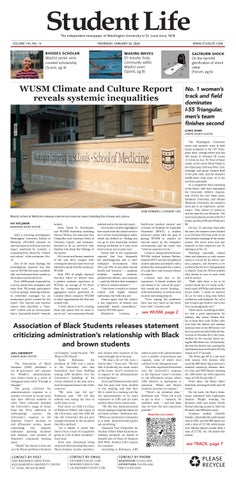
SAM POWERS | STUDENT LIFE WashU school of Medicine releases internal and external report detailing the climate and culture. AVI HOLZMAN MANAGING NEWS EDITOR
After a year-long investigation, Washington University School of Medicine (WUSM) released an internal report as well as an external report conducted by Catalyst, a consulting firm, about the “climate and culture” of the institution, Dec. 14. One of the main findings the investigations reported was that men at WUSM feel more included, safe, and welcomed than women at the student and faculty level. Over 4,000 people responded to a survey about their workplace and more than 350 people participated in focus groups, listening sessions, or submitted messages via an anonymous portal created for the report. The internal and external reports both described a “boys’ club” culture and an environment that is “potentially hostile” towards
women. Dean David H. Pearlmutter and WUSM leadership including Sherree Wilson, the Associate Vice Chancellor and Associate Dean of Diversity, Equity, and Inclusion, declined to do an interview with Student Life about the findings of the reports. All current and former members of the task force charged with creating the internal report were not allowed to speak with the media per WUSM. Only 29% of people reported that they “often” or “always” have a positive inclusive experience at WUSM, an average of 7% fewer than the “comparator score,” an aggregated metric generated by Catalyst which compares WUSM to other organizations the firm has worked with. “I don’t know if we’re creating those safe spaces that we seem to say we are,” one anonymous female
resident said in the internal report. One faculty member highlighted how much work the school needs to do in terms of psychological safety which she defined as “feeling you can go to your leadership without fearing retribution or it may come back to harm you in some way.” Nearly half of the respondents reported that they frequently felt psychologically safe in their workplace environment. Only 35% and 39% of non-white female faculty and “learners,” — graduate students, medical students, postdoctoral fellows, and residents — said they felt that their workplace is “often or always inclusive.”” “Interviews revealed an intense culture with highly talented individuals, but both men and women agree that the culture is less supportive of women and potentially hostile towardthem,” read the WUSM report. Mackenzie Lemieux, a
fourth-year medical student and co-leader of Students for Equitable Treatment (SFET), a student advocacy group with the goal of getting WUSM to conduct an internal report on the workplace environment, said the report was “what we expected it to be.” Lemieux, along with fourth-year WUSM student Jackson Burton, founded SFET, and the two gathered student opinions and helped craft a petition that demanded the creation of a task force and eventual release of a report. Lemieux said that in her experience, if female students did not choose to be “one of the guys” they would not receive funding, , work with mentors, or work on work on more interesting projects. “Even among the professors there was very much an old white boys’ club,” Lemieux said.
see WUSM, page 2
Association of Black Students releases statement criticizing administration’s relationship with Black and brown students JOEL SWIRNOFF JUNIOR NEWS EDITOR
The Association of Black Students (ABS) published a list of grievances and requests for WashU’s administration over winter break in a series of Instagram posts titled “Enough is Enough.” The group criticized the administration’s response to a number of events in recent years that have affected students of color. Their criticisms included the University’s usage of bones from the Terry collection in anthropology courses, the University’s response to the Supreme Court’s decision to end affirmative action, issues concerning two separate underpass painting incidents and removal, and removal of Hamsini’s communal housing space. “WashU has shown it does not care for Black and Brown Students
on Campus,” reads the post. “We Want to BE Heard!” Taylor Robinson, the president of ABS and a junior at the University, said that frustration had been building among ABS members over the University’s handling of the events outlined in the post and a lack of responsiveness to the club’s concerns. “We were just fed up,” Robinson said. “We felt like nobody was taking the time to really listen to us.” Paul Scott, an ABS Co-Chair of Political Affairs and junior at the University, said that ABS felt like the University did not give enough attention to the incidents that they outlined. “As a whole, it seems like there’s been a lack of recognition given to a lot of these incidents,” Scott said. Scott also mentioned being surprised when learning that many Black students, faculty members,
and alumni were unaware of the issues brought up in the post. “We hear a lot of ‘Oh, wow, I had no idea,’” Scott said. “We feel that if [students] are made aware of the issues, they’ll certainly be in support of the administration rectifying them.” Scott and Robinson both noted that the post had been months in the making, and that they felt it could be a wakeup call for the administration to be more responsive to ABS and act more quickly when future issues arise. “We felt that [administrators] weren’t going to respond unless we put them on blast,” Robinson said. “When an institution’s reputation is at stake, [administrators] gotta say something.” Associate Vice Chancellor for Student Affairs Mark KamimuraJiménez declined, on behalf of himself and of Dean of Students Rob Wild, Student Life’s request for comment. According to Robinson, ABS
asked to meet with administrators over a number of grievances and requests, some of which were outlined in the Instagram post. One slide expressed frustration over the University’s response to the Supreme Court’s decision to end affirmative action, which ABS believes is inadequate to maintain “Black and Brown students’ presence on campus.” “There’s no retention plan,” Robinson said. “Their job is just to get us here — honestly, for numbers’ sake — and just hope that we have the best experience possible.”
Read the rest online:
CONTACT BY POST
CONTACT BY EMAIL
CONTACT BY PHONE
ONE BROOKINGS DRIVE #1039 #320 DANFORTH UNIVERSITY CENTER ST. LOUIS, MO 63130-4899
EDITOR@STUDLIFE.COM NEWS@STUDLIFE.COM CALENDAR@STUDLIFE.COM
NEWSROOM 314.935.5995 ADVERTISING 314.935.4240 FAX 314.935.5938
The Washington University men’s and women’s track & field teams competed at the I-55 Triangular meet, setting twelve new top 100 marks in Division III across 12 events on Jan. 20. Four of those marks, set by senior Ebun Opata in the triple jump, first-year Peter Lichtenberger and junior Yasmin Ruff in the pole vault, and the women’s 4x400-meter relay team, sit in the top three nationally. In a competitive field consisting of the Bears, who have dominated the University Athletic Association (UAA) for over three years, Elmhurst University, and Illinois Wesleyan University, the women’s team put in an impressive performance. They tallied 112 points to win the meet by over 60 points. The men’s team placed second with 85.5 points, just shy of Illinois Wesleyan’s 88. On Jan. 23, just three days after the meet, the women’s team clocked in as Division III’s best team in the first national rankings of the indoor season. The men’s team was also honored in their respective top 25, slotting in at No. 22. Notching nationally ranked times and distances at early season meets is crucial for the Bears’ runners, jumpers, and throwers to be invited to the NCAA Championship in March. Only the 20 best athletes who declare to race in each event will be invited. “Both sides have a lot to be excited about but it’s really early,” head coach Jeff Stiles said about the team’s result. “I mean it’s January 20, so we have a long time before conference and nationals. So, we’re just trying to get work in, but it was very encouraging for sure.” These meets, according to Stiles, are also a great opportunity for athletes, like senior Emma Kelley, to hone their craft. Kelley, who won both the indoor and outdoor national titles in the 800-meter run last year and currently holds the fastest time in Division III in the event, worked on her top-end speed racing the 400-meter run. On Saturday, she won the shorter race, posting the sixth-fastest time in Division III this season at 57.37 seconds. The Bears got off to a hot start with seniors Ally Sarussi, who raced the 800-meter leg in last year’s national runner-up distance medley relay, and Will Houser winning the 1200-meter run with respective times of 3:38.28 and 3:06.17. From there, the Bears didn’t look back, winning 16 of the next 28 events. On the track, the Bear’s dominance continued with sophomore Jasmine Wright winning the 60-meter dash and junior Nicole Stewart placing second in both the 60-meter and 200-meter races. Graduate student Danielle Schultz, who holds the ninth fastest time in DIII, won the 800-meter run with a time of 2:17.48, while junior Izzy Horton placed second with a time of 2:17.92, the 11th fastest this season.
see TRACK, page 7
NEWS
2 STUDENT LIFE
AVI HOLZMAN | MANAGING NEWS EDITOR | NEWS@STUDLIFE.COM
THURSDAY, JAN 25, 2024
Protesters call on county council for cease-fire JULIA ROBBINS LILY TAYLOR INVESTIGATIVE NEWS EDITOR
SENIOR NEWS EDITOR
About 55 community members protested Washington University’s investments in Boeing on Mudd Field, and urged the St. Louis County Council to call for a cease-fire to the IsraelHamas war, Jan. 23. The protest was part of a global strike week, Jan. 21-28, asking people to boycott companies that invest in Israel and to strike from work and classes. Bisan Owda, a Palestinian journalist reporting out of Gaza on the ongoing conflict, called for the global strike on her Instagram account. She asked her followers to deploy strikes as a method for demanding “an immediate
and permanent ceasefire” in Gaza. Resist WashU, a direct action based collective on campus, is encouraging the University community members to participate in the strike. Among the protesters’ specific demands are for the University to suspend Boeing’s recruitment events, which one speaker said makes the University “a recruiting ground for the military industrial complex,” and to divest from the company. After several students delivered speeches on Mudd Field calling for the University to take action against Israel, protesters took the Metro or drove to a St. Louis County Council meeting to demand the Council pass a resolution calling for a cease-fire. The St. Louis City
Board of Aldermen already supported a resolution calling for a cease-fire in the IsraelHamas war, Jan. 12. Washington University students joined several dozen other individuals in calling for a ceasefire between Israel and Hamas at the St. Louis County Council meeting, according to KSDK.com. Senior Dvora Redlich attended the campus protest and subsequent demonstration at the Council meeting. She said that activists are pushing local governmental bodies to pass ceasefire resolutions to put pressure on the federal government to do the same. Redlich said she believes this activism is important because it ensures that more people gain an awareness of Israel’s existence as an “apartheid state.”
“When counties and cities pass ceasefire resolutions, it is a step in making sure tax payers are not going to keep paying for this genocide,” she said. Major international human rights organizations, including Amnesty International and Human Rights Watch, have categorized Israeli policies as apartheid. According to the Associated Press, these groups are joined by an increasing number of retired Israeli military officials who are endorsing the idea that Israel is engaging in apartheid practices. Other organizations, including the AntiDefamation League, have argued that Israel is not engaging in apartheid practices and that many of the country’s policies being
viewed as parts of apartheid are “justified by security considerations.” The term “genocide” is also being disputed internationally. Certain bodies, including the South African government, have deemed Israel’s military actions as genocidal, while other bodies, including the American State Department have said Israel is not committing genocide. Junior Eman Teshome, who attended the protest on Mudd Field, said she thinks the demonstration helps express to the University that student support for Palestinians is not a fleeting cause on campus. “This isn’t a trend that will dry out,” Teshome said. Nour Ziada, a Palestinian graduate student in Sam Fox, said that the University
should stop supporting study abroad opportunities to Israel and end their financial support to the state. A senior who asked to stay anonymous for safety concerns as a hijabi student, said that people should be calling for a cease-fire, regardless of their stance on the conflict, to end the killing of Palestinians and Israeli hostages. “You just have to be human to see everything that is happening over there and demand a cease-fire,” she said. The Council meeting ended early due to the proPalestinian protests, and students plan to continue attending Council meetings weekly to demand a ceasefire resolution.
SU election sees new members of Treasury, Senate, ArtSci Council; new SU leadership chosen in internal elections TANVI GORRE TIM MELLMAN
Council President with a history of opposing the existence of SU.
STAFF WRITER NEWSLETTER EDITOR
ArtSci President
After the fall 2023 Student Union (SU) election, new members were elected to Senate, Treasury, and the Arts & Sciences Council, and two constitutional amendments were passed, Nov. 16. The election had the lowest voter turnout since spring of 2022, and among those elected is an ArtSci
Senior Scott Sauers, who received 28.90% of the votes in the Nov. 16 election, has been elected as the new ArtSci Council president following the disqualification of incumbent junior Rachel Kim, who received the other 70.13% of the vote. Sauers has historically opposed SU Senate and
Treasury as an organization on campus. In a now-deleted post on the r/WashU page on Reddit from Nov. 16, 2022, Sauers called on classmates to vote for him as a write-in candidate for all positions infor the 2022 election. “My goal is abolishing Student Union and replacing it with random polling for decision making,” he writes. “There is not really a need for student politicians making decisions without student body oversight.”
2024 Spring Lecture Series
REVERENT IRREVERENCE: PARODY, RELIGION, AND CONTEMPORARY POLITICS
18
5:00-6:30PM Dodging the Sisters: Why Queer Nuns Keep Going Viral
J A N Melissa Wilcox, University of California-Riverside
7:00–8:30PM Earthalujah! Reverend Billy & The Church of Stop Shopping: A Conversation with William Talen and Savitri D
06 FEB
29
5:00-6:30PM Pranksters, Standups, and Fitness Gurus: F E B New Perspectives on Parody
Joshua Wright, Hope College; Samah Choudhury, Ithaca College; Cody Musselman, Washington University in St. Louis
16
5:00-6:30PM Playing Sacred: The Camp Aesthetics of Feminist A P R and Queer Art
Anthony Petro, Boston University
All events in Knight Hall’s Emerson Auditorium at Washington University in St. Louis Register at rap.wustl.edu
This fall, Sauers was officially a candidate for ArtSci Council president. In his statement on the ballot, Sauers pledged to “advocate for abolishing the confusing and outdated ‘integration’ and ‘integrated inquiry’ system, or expanding the courses which count towards it,” as well as plan both career-centric and fun events inspired by programming organized by Engineering Student Council (better known as EnCouncil) like
Vertigo. Scott Sauers declined to comment on his previous statements and his campaign platform. Rachel Kim, the previous ArtSci Council president, received the most votes in the election but was disqualified for not filing her expenditure report before the deadline. According to Election Commissioner senior Constantin Carrigan, all candidates in the SU election are told that failure to submit
an expenditure report will result in disqualification, which was a rule that was passed through Treasury, Senate, and the Election Commission.
Read the rest online:
WUSM from page 1 Emil Unanue Distinguished Professor of Pathology and Immunology and former president of the Academic Women’s Network (AWN), Gwendolyn Randolph, connected with SFET after making a speech at AWN’s annual holiday reception which emphasized issues of reporting and sexual harassment brought to light by a Student Life article published in December 2022. Randolph accepted the position to become Division Chief in 2015 and frequently found herself the only woman in most of her meetings. She stepped down two years later because she felt she was being tokenized by those around her. “I felt like I was being used in part to [show] the outside world we have a woman leader, that we have no problems,” Randolph said. “We’re overcoming our boys’ club reputation, but inside it was really a challenging experience.” While serving as Division Chief she became motivated to work closer with students after hearing female graduate students saying they were being treated as “second-class citizens.” In 2017, Randolph resigned and began working as the immunology program director, a role she held until 2023. The experience of these students and others points to the larger problem of procedural fairness, defined in the external report as “fair, timely, and respectful decision-making processes are in place of individual outcome,” which was one of the lowest-scoring metrics for the school. Only 29% of respondents reported that their workplace was “often or always inclusive” when it came to procedural fairness. The vast
majority, roughly 84-85% of white and minority female faculty, responded saying the procedures at the school were “not fair” often or always. One female resident said that at the medical student and residency-level students are recognized for their work, but beyond that, the recognition is not the same as it is for men. “We don’t have transparency in promotion criteria,” the female faculty member said. “What things do you need to be promoted? [I know] one woman that took 10+ years to become an associate professor...If we don’t do a better job of supporting people’s careers, we won’t be able to maintain excellence of care, research, and clinical production because young people are not staying. They are leaving.” According to the WUSM guidelines for faculty appointments and promotions, transfer between tracks at the assistant professor level generally should happen before the end of one’s fifth year as an assistant professor. Institutional mistrust runs especially deep when it comes to the Human Resources department, which multiple interviewees described as a “black box.” “One of the most frustrating things is our ability to constantly talk about what we know to be the problem, but the lack of action is deafening,” a male faculty member said in the Catalyst report, referring to past complaints that had not been addressed. The lack of standardized protocol for dealing with faculty misconduct was another issue for Lemieux and something addressed by the WashU report. According to her, “you
submit your HR report. It’s a black hole, and most of the time, nothing happens.” Randolph and Lemieux support WUSM’s decision to simplify the existing system and institute a “one front door” policy so those filing reports are aware of their status after submitting the complaint with HR. According to Lemieux, her experience as a co-leader of SFET has exposed her to a number of stories from students who worry that faculty can see the filed complaints and will treat students differently based on their contents. “Students say they want more clarity on the [reporting] process, they wonder who sees their report, who chooses the punishment for the perpetrator or if there will even be a punishment,” Lemieux said. Randolph said that the report, released days before students went on winter break, is not being widely discussed within her department at WUSM. She is trying to remain optimistic but is concerned there will be some pockets within the institution where it will be difficult for meaningful change to take place. “[I’ve] had a number of faculty colleagues who left over the years, and it’s possible that part of the cause was related to gender discrimination, intentional or not,” Randolph said. The culture at WUSM and the reports have left Randolph begging the question, “Do we really want to change, or do we want to make it look like we want to change and, if we want to, then what would be the path to doing it?”
THURSDAY, JAN 25, 2024
STUDENT LIFE 3
AVI HOLZMAN | MANAGING NEWS EDITOR | NEWS@STUDLIFE.COM
Queer Nuns: WashU welcomes the “Reverent Irreverence “series LAUREN SMITH STAFF WRITER
Washington University’s John C. Danforth Center on Religion and Politics hosted Dr. Melissa M. Wilcox, author of “Queer Nuns: Religion, Activism, and Serious Parody,” as the first speaker in the new lecture series “Reverent Irreverence: Parody, Religion, and Contemporary Politics,” Jan. 18. Wilcox is a professor and chair of Religious Studies at the University of CaliforniaRiverside who has published books and research on the intersection between queer identity and religion. She grew up in San Francisco, where the first House of the Sisters was created in 1979. Her lecture focused on the same subject as her book, the history of the Sisters of Perpetual Indulgence, a global order of queer and trans nuns. The Sisters, who are majority gay men, but include transgender women and people of many other queer identities, have been in the national news many times since the 1980s. They made headlines most recently in June 2023 when the Los Angeles Dodgers nominated the Sisters for the Community Hero Award.
Willcox explained how Florida Senator Marco Rubio wrote a letter criticizing the team’s decision to consider the Sisters for the award, claiming that honoring them would be alienating and offensive to Catholics because some see the Sisters to be mocking the Catholic religion. The President of the Catholic League, Bill Donohue, said the sisters promote hate speech and even compared the Sisters to blackface performers. Wilcox described how the Sisters’ commitment to service distinguishes them from other instances of people dressing as nuns, such as during Mardi Gras or Halloween. “Unlike people who wear sexy nun costumes for Halloween, they’re organized and promoting the public good,” she said. Examples she gave of the Sisters’ community service were their significant contributions to AIDS/ HIV awareness, including the creation of the firstever safer-sex guide for gay men, “Play Fair!” by Sister Roz Erection. Wilcox also discussed how the AIDS activism of the Sisters was a transition from the intense anger present in the activism of groups like ACT-UP.
“Several people have told me that they came to the Sisters because they burned out on the rage and they found the joy that the Sisters brought to their activism much more sustainable,” she said. “Rage is a powerful driver of activism, but pairing that with the joy and caring that comes along with parody and laughter allows people to lighten up and thrive.” Wilcox argued that the negative reaction the Sisters receive is not from people misunderstanding what the Sisters are doing, but from viewing their actions as mockery intended to offend, rather than viewing it as the Sisters emulating nuns for their own causes. “This misunderstanding happens both on the right and the left, so whether you respond to it by gleefully saying, ‘Yes! They’re mocking the Church!’ or by being appalled as they’re mocking the church, it’s still that refusal to accept that the Sisters might be emulating,” she said. Wilcox mentioned coverage of a vigil the Sisters had in the early 1980s. The vigil was in response to the presence of evangelical protesters in the Castro district, an area of San Francisco she called the
“gay-borhood.” “[The protestors] were shaming the people that were walking by them, telling them that they should give up the sin of homosexuality and come to God as though you can’t do both,” she said. She described how the coverage of the vigil details the Sisters singing songs to help the protestors see themselves in a different light and how they prayed to be relieved of the sins of the protestors’ homophobia. What was notable to Wilcox wasn’t just the vigil itself but the way the reporter covered it. “What was really interesting about that coverage is the number of scare quotes,” she said, referencing the reporter’s overuse of sarcastic quotation marks. “It’s littered with scare quotes. ‘Nuns,’ ‘Sisters,’ they held a ‘vigil,’ a ‘parade’, they had ‘hymns.’ Everything is in scare quotes like it isn’t real. It looks to me, reading that article, that the reporter had no idea what he was looking at.” Similar to the coverage from the 1980s, the fault of reporters to understand how the Sisters are different from someone dressed as a sexy nun for Halloween is what Wilcox attributes to
the failure of press coverage surrounding the Dodgers. “This is neither a sports story nor culture war story, and almost all of the press coverage about this story focused on it in one way or another,” she said. She cited the historical divorce of sex and religion, as well as the notion that queer people and gender variance are inherently sexual, as reasons why people see the nuns as offensive. Sophomore Nicole Caruso said that the history behind the categorization of queer people as inherently sexual was one of the things that stood out to her about the lecture. “I’d never really considered thinking about that,” Caruso said.”It’s making me want to go down a rabbit hole and further research about the ways we started categorizing things.” Two Sisters attended the event, dressed in habit with makeup and painted white faces. An audience member asked Wilcox a question about why the Sisters chose to incorporate makeup into their uniform, and Wilcox referred to one of the Sisters for a response. The Sister spoke about the relationship between the beauty of Catholic
iconography, like in paintings, discussing how makeup bridges Catholic iconography and the gay community. “Playing with makeup just brings joy. It’s a transformative element,” the Sister said. Johari Hunt, a visitor to WashU for the event, attended because of his interest in working in queer and trans communities, especially to make other forms of religiosity outside of mainstream religion visible. He talked about Wilcox’s exploration of the unique spaces serious parody creates for the communities involved. “Part of it’s fun, but [it] is also supposed to be read as a form of seriousness, explaining the different points in which it becomes a real engagement as far as a ministry and community engagement,” Hunt noted. Wilcox’s next book is titled “Devotions: Spirituality and Religion in LGBTQ Leather and BDSM Communities.” The next event in the Reverent Irreverence series, “Earthalujah! Reverend Billy & The Church of Stop Shopping: A Conversation with William Talen and Savitri D,” is scheduled for Feb. 6.
Photo essay: Snow day on campus
PHOTOS BY ELLE SU ILLUSTRATIONS BY RYAN DAVIS
VOLUME 145, NO. 14 Via Poolos Clara Richards Editors-in-Chief editor@studlife.com Avi Holzman Managing News Editor news@studlife.com Annabel Shen Managing Scene Editor scene@studlife.com Reilly Brady Managing Forum Editor forum@studlife.com Riley Herron Managing Sports Editor sports@studlife.com
Ved Patel Managing Chief of Copy Sydney Tran Head of Design Tuesday Hadden Ryan Davis Heads of Illustration James Ellinghaus Lily Taylor Senior News Editors Elle Su Bri Nitsberg Senior Photo Editors photo@studlife.com Tony Tong Senior Web Editor
Mia Burkholder Cathay Poulsen Chiefs of Copy Ian Heft Senior Sports Editor Zara Shariff William Labrador Senior Scene Editors Sylvie Richards Jasmine Stone Senior Forum Editors Julia Robbins Zach Trabitz Investigative News Editors Camden Maggard Social Media Editor
Lydia Nicholson Alan Zhou Junior Photo Editor
Tim Mellman Newsletter Editor emailedition@studlife.com
Amelia Raden Jordan Spector Junior Forum Editors
Brooklyn Hollander Samantha Elegant James Surnamer Natalia Jamula Reya Mehta Copy Editors
Lewis Rand Elaheh Khazi Junior Sports Editors Olivia Lee Sophia Hellman Junior Scene Editors Zach Trabitz Aliana Mediratta Joel Swirnoff Junior News Editors
Grayce Cooper Alex Savin Gabriella Amurao Designer Sanchali Pothuru Multimedia Editor
Adrienne Levin Coleman General Manager a.coleman@studlife.com Sarah Huff Advertising Sales Manager huffs@studlife.com Copyright © 2023 Washington University Student Media, Inc. (WUSMI). Student Life is a financially and editorially independent, student-run newspaper serving the Washington University community. Our newspaper is a publication of WUSMI and does not necessarily represent the views of the Washington University administration.
4 STUDENT LIFE
SCENE
THURSDAY, JAN 25, 2024
ANNABEL SHEN | MANAGING SCENE EDITOR | SCENE@STUDLIFE.COM
WashU senior wins Rhodes Scholarship VIA POOLOS EDITOR-IN-CHIEF On Nov. 11 — a Friday — senior Tori Harwell (they/ she) was standing in a room full of Rhodes Scholar finalists in Chicago, waiting for the announcement of the two names that would be awarded the scholarship. It took a lot — of time, energy, and inspiration — for Harwell to be standing in that room. First, Harwell, who majors in African and African American Studies and Environmental Analysis, learned about the scholarship from Robyn Hadley, former Ervin Scholars director and a Rhodes Scholar herself. “I think that just kind of sat in the back of my head. Like, ‘This Black woman can do it — there's potential for me, too,’” Harwell said. Then in spring of her junior year, Harwell had to request no fewer than eight recommendation letters from professors and mentors, as well as craft personal and academic statements. After that, Harwell had to be endorsed by Washington
University — another application — before officially applying to the national scholarship program. Finally, after being named one of 12 finalists in District 12 — which includes Tennessee, Arkansas, Iowa, Kansas, and Missouri — Harwell had to find a way to get to Chicago for one last 20-minute interview. They chose to take a flight there, and bought a train ticket for the return trip. The scholarship that inspired all this effort from Harwell is named after Cecil Rhodes, who served as the prime minister of the English Cape Colony, now modernday South Africa, in the late 19th century. At the time, Rhodes used his political power to create more stringent voting laws and removed many Black citizens from their land. At the end of his life, Rhodes created the Rhodes Scholarship, with the goal of allowing male scholars from current or former British territories to study at Oxford. Harwell, who studied abroad in Cape Town their junior year, observed the
“Rhodes Must Fall” campaign, a movement that advocated for the removal of the Cecil Rhodes statue on the University of Cape Town’s campus in 2015 and continues to push for greater awareness of institutional racism. This Rhodes legacy, however, did not deter Harwell from the scholarship. Rather, the loaded history behind Cecil Rhodes sparked her interest. “I think that’s what intrigues me,” Harwell said. “A lot of WashU alums who were Rhodes Scholars were Black Rhodes Scholars. And I kind of like that subversive tradition.” Harwell has often followed her curiosity. Prior to studying abroad in South Africa, they spent a month in Ghana, where they conducted research in cocoa farming. Over several months, Harwell followed the path of cocoa from local Ghanaian farmers to the United Kingdom’s Cadbury Chocolate company. This past summer, they studied at the University of Birmingham, delving into dense primary documents
No-point policy: Left Bank Books’ mission-driven approach to bookselling SOPHIA HELLMAN JUNIOR SCENE EDITOR Buying books for class can often feel utilitarian, especially when going straight off a syllabus: you walk in, and ask something like, “Can you please show me where to find ‘The Great Gatsby’?” and in a moment, you’re holding what you were looking for. Semester after semester, it can become a routine, nothing more than a list to check off so you can just get on with life. For the tightest of schedules, an online purchase through a site like Amazon makes for an even faster transaction — one click and books are bought in an instant. Sitting on the corner of Euclid and McPherson in Central West End, Left Bank Books offers an entirely different take on the book browsing experience. Established by a group of WashU graduate students in 1969, Left Bank is a mission-driven bookstore that doubles as a community space, making a point to form genuine connections with its customers. It may not be the usual visit, but if you were up for the trip, the perfect birthday gift or a handpicked novel for chilly, lazy days could be sitting a mere two Metrolink stops away. Danielle King is the general manager of Left Bank Books as well as its “Jane of all trades,” according to her business card. She helps with nearly all parts of running the store, whether it’s buying books, training staff, or working behind the scenes. With this insight, she spoke to the uniqueness of the store. “I work with some of the most empathetic people on the planet who want to see people, and we have customers who will come in and be like, where is that girl who was talking to me two weeks ago about romance books?” King
said. King went on to explain that at Left Bank, employees are always open to building a connection with their customers. “That’s not always going to happen, but creating a space where that’s possible is both to your benefit and theirs,” King said. Hence, their no-pointing policy that means the staff will walk alongside their customer instead of pointing to where a book is located, making recommendations to ensure their client is taken good care of. These relationships aren’t limited to the store. Left Bank runs about 250 events per year, ranging from events with local poets to dignitaries including Hillary Clinton and Jimmy Carter. “We talk all the time about being not just a bookstore but a community space,” King said. Boasting tight relationships with writers and professors at WashU and Saint Louis University, Left Bank also hosts events such as poetry readings, consistently hosting WashU’s English department. It also holds open community events and has its own organization aiming to increase public access to books and their
authors called the Left Bank Books Foundation. One of the foundation’s recent undertakings is the Literacy & Justice Project, which offers anyone, especially young people, free copies of select banned books in response to the increasing amount of book banning in public schools. King went on to discuss reasons for this widespread increase. “[It’s] [u]sually because a group that’s either oppressed or marginalized in some way is being assertive. So, it’s not surprising that you see an uptick in book bans after things like Michael Brown and George Floyd,” King said. Currently, Missouri is ranked number 3 in the nation for the most banned books, so Left Bank Books always ensures that banned books are in stock. Banned or not, each title in the store is handpicked through a careful selection process, but take it from King, who works directly to make these choices.
Read the rest online:
ILLUSTRATION BY MANUEL LOPEZ
about the internal history of Cadbury. It was on that Friday in Chicago that Harwell learned she would be going back to the UK: this time, for two years at Oxford University. When her name was called as a winner, Harwell said she was in shock. Then, she called her dad. “He was like, ‘Oh, wow, that's cool,’” Harwell said, imitating his nonchalant response. After they wished the other finalists farewell, reality set in. “I ended up crying because it just seems so far beyond what both my living family and ancestors would have seen for me,” Harwell said. Harwell will board a flight to Oxford in September, where they will earn two degrees: one in Nature, Society, and Environmental Governance and the other in African Studies. Harwell is the 30th winner of the scholarship from Washington University and the first since 2018. Along with her studies,
SAM POWERS | STUDENT LIFE Tori Harwell is the 30th winner of the Rhodes Scholarship at Washington University.
Harwell is excited to be back amongst old friends. While researching in Birmingham over the summer, she joined a book club and became friendly with local jazz musicians. “I don't play jazz,” she clarified. “I just like listening to it.” Until her trip to Oxford, Harwell has plans to stay mostly local. They hope to get a job in St. Louis over the summer to soak in a little more time with college friends. And of course, they have New Year’s resolutions to complete. A whole bingo board of them, actually. The
goal isn’t to do all 25 things, but just to get a five-in-a-row bingo. To do that, Harwell could learn how to surf, spend a month not traveling, take a stranger to lunch three times, travel around Asia, put on an art show, or approach an underclassman and become friends. And, of course, graduate. After the prescribed twoyear stint at Oxford, Harwell isn’t quite sure which direction life will take her. Maybe community-based work, she said. “And, hopefully, take a break from school.”
How to get cheap concert tickets 101 ETHAN PENN CONTRIBUTING WRITER Stuck at home due to a Chicago snowstorm one break, I had started getting bored of playing bridge with my grandparents. Trying to find something to occupy my time, I thought about the city: The United Center, Guaranteed Rate Field, the Chicago Theater, and Second City. Suddenly, I realized what I would do: everything. All I needed were tickets. In every American city, there are unique events ad infinitum. However, expensive tickets often prevent many from partaking in such activities. With only a summer camp counselor’s salary to fund my adventures, I needed to find a way to do everything without spending everything, hence my obsession with finding affordable tickets emerged. Both my hometown, Chicago, and my college city, St. Louis, offer countless ways to obtain event tickets: online, at the box office, from the artist, venue, or a reseller. Initially, it can be overwhelming. To best explain the process that I utilize, I have broken it down into a few key steps. First, let’s discuss finding the events you want to go to. Two websites that I recommend using for a database of events in St. Louis are songkick.com for music concerts and dead-frog.com for comedy shows. Sites like these list events happening on any particular day as well as future events. Even so, these lists are not exhaustive and often concerts fall through the cracks. Therefore, the unfortunate reality is that I recommend subscribing to the mailing lists of most of the venues in the city and those of your favorite artists, festivals, sports teams and more. You should follow them on social media. This helps you stay ahead of presales, discounts, and on-sale dates for popular concerts that will sell out. I love going into a show knowing nothing and
ILLUSTRATION BY TUESDAY HADDEN discovering if I like the artist or music in real-time. Almost all of the music I listen to is from artists I have seen live, and most I did not listen to before then. I look for any band with very passionate fan bases, artists who have been interviewed by Nardwaur (an awesome, quirky journalist who has interviewed everyone from Nirvana to Jay-Z), and artists whose shows are almost sold out. Selling out a smaller venue like Blueberry Hill may not seem like the biggest accomplishment, but when filled up, it’s electric: I saw indie artist Andy Shauf there, and it was one of the best concerts I have stumbled upon. Secondly, in regards to tickets, set your reservation price. That is, come up with a price you are willing to pay for the given ticket you want. When or if the ticket is below the price, buy it right away. Once I want to go to an event, I first look at the venue’s primary method of selling tickets (often Ticketmaster, a greedy, bloated company of which I am not a fan). I then move on to re-selling sites. I prefer Gametime and SeatGeek, not because they are necessarily the cheapest, but because they are the most transparent about their fees, have good customer service, and deliver tickets relatively quickly. It really sucks when
you have to wait outside the venue because you are waiting on your ticket to be delivered, so I recommend at least 10-15 minutes of expected wait time when buying from those third party sites to deliver your tickets. Lesser-known sites like CashorTrade and TicketExchange by Ticketmaster sometimes have significantly cheaper tickets than other sites. For example, I wanted tickets for Willie Nelson, Zach Bryan, and the Turnpike Troubadours at a Country music festival, and they were nearly triple the price on every site except Ticket-Exchange. I highly recommend going to the venue in person to get around paying ridiculous processing fees. If I am unsure if the event will sell out before I have the chance to buy tickets at the box office, I call ahead. Additionally, take advantage of being a student. The St. Louis Blues offer student discount tickets and Broadway in St. Louis offers $30 student tickets you can buy at the box office ahead of that
Read the rest online:
FORUM
THURSDAY, JAN 25, 2024
Understanding Forum’s process and content FORUM EDITORS The Student Life Forum section is unique in its mission to facilitate discourse between all members of the Washington University campus community. In light of the recent uptick in opinion submissions, the Forum editorial staff has decided to put together an outline of our editing process and journalistic goals. Forum serves to promote productive discourse about matters affecting college students. It should be a place for members of the WashU community to freely express their own beliefs and engage with the opinions of others. In a time of global crisis, we seek to maintain our presence as a space for these conversations. We aim to be transparent in our process and are always open to more submissions and suggestions from the community in which we serve. Some of Forum’s articles are published within specific categories. Opinion Submissions (previously known as “op-eds”) are opinion pieces written and submitted by members of the community who are unaffiliated with Student Life and are typically 500-1000 words. Letters to the Editor are opinion submissions that respond to other Student Life articles or to Student Life content in general. Staff Editorials
STUDENT LIFE 5
REILLY BRADY | MANAGING FORUM EDITOR | FORUM@STUDLIFE.COM
exist to provide an additional perspective on key issues relating to the Washington University community. Staff Editorials are the product of the regular meetings of the Student Life editorial board, which is composed of editors from across the StudLife staff and operates separately from the newsroom. A great benefit to being a platform for college students is that we are able to read and publish pieces from a diversely opinionated cast of writers. As a student newspaper, we are committed to publishing as many opinions as possible and do not curate based on any interests within Student Life. Forum articles, with the exception of Staff Editorials, solely reflect the opinion of the author or authors, not that of Student Life or its editors. However, unlike typical public forums on sites like Quora and Reddit, we edit and evaluate the content we platform, and we aim to use our best journalistic and moral judgment in what we publish. We approach Opinion Submissions and Letters to the Editor slightly differently than opinion pieces written by our staff, as we take extra care to ensure that the voice and central argument of an Opinion Submission or Letter to the Editor are maintained throughout our editing process. Every submission to the Forum section goes through
at least three rounds of reads and edits. When we receive an Opinion Submission, our priorities are fact-checking (ensuring that objective events, policies, and facts are substantiated by reputable sources) as well as editing for overall clarity and consistency in the author’s argument. Some edits are required for publication; most are strong suggestions that are open to discussion with the author. We then send the piece over to the copy editing team, which reviews the piece for proper grammar, punctuation, and overall consistency with Student Life stylistic standards. Finally, the managing Forum editor, and occasionally, a majority of the managing team, read and leave edits on the article before final publication. While we are committed to providing a place to share different ideas, beliefs, and views, this does not mean we will publish hate. As written on our website, “We reserve the right to reject opinion submissions for any reason or no reason at all. Reasons include but are not limited to factual inaccuracy, racism, sexism, homophobia, transphobia, or otherwise objectionable content.” As we read opinion submissions, we first ensure that statements are backed by a reliable source. We acknowledge that one’s interpretation or opinions of those facts can be subjective, something we
consider as we discuss edits as a team. We edit every article to serve the interest of the author’s own intended argument while maintaining the journalistic integrity of Student Life. We see Forum as a space for respectful and productive dialogue, especially important in a time of global crisis. We invite all WashU community members to submit to us. You can send your submission to forum@studlife.com, or contact us at the same email for more information. We, as editors, are always looking for more perspectives to publish. In a world of condensed media, clickbait, and political extremes unable to converse with one another, we take our responsibility in maintaining the Forum section very seriously. Core to our section is the purpose of serving the WashU community, and we hope that complete transparency in how we operate continues to serve that goal. Reilly Brady, Managing Forum Editor Jasmine Stone, Senior Forum Editor Sylvie Richards, Senior Forum Editor Amelia Raden, Junior Forum Editor Jordan Spector, Junior Forum Editor
OPINION SUBMISSION
You need to go to the Interfaith Dinner. Yes. You.
exceptional group of student leaders who were eager to share their beliefs and, most importantly, to learn from one another. Right before Thanksgiving Break, our diverse team led an Interfaith Progressive Dinner with over 100 students in attendance. Together, we learned about Sunni and Shi’a Islam, Judaism, Christianity (Catholic, Evangelical), the Sikh faith, Hinduism, Agnosticism, Buddhsim…the list goes on. We shared our favorite customs. We broke bread together. We laughed, and we listened. We listened. Most of all, we were joyous. Because think of how much there is to celebrate when we think of what faith really means. How it shapes us, how it holds us and keeps us in community and in our minds. Interfaith Week is Feb. 2 to 9, 2024. The Interfaith Dinner is Tuesday, Feb. 6 from 5:30-7 p.m. in Tisch Commons.
DEBORAH MEER ALUMNA OF THE SCHOOL OF ARTS AND SCIENCES, CLASS OF 1995
At no other time have so many eyes been on Washington University in St. Louis. It is not because of the superior academics, the outstanding campus facilities, or the dorms that the Princeton Review said are some of the best in the world. Nor is it the ground-breaking research or the top professors in their fields. That’s not what people are looking at. They are looking at you. At your hearts, and at your hands. In 1992, I was asked by the Executive Director of Hillel to lead the second Interfaith Progressive Dinner in the history of WashU. I was a junior, busy with school work and my social life, and besides that, I didn’t feel I was qualified to take on such an endeavor. The then-director said to me, “Deborah. You are a community leader. You can do this.” I did do it, but not alone, because that’s impossible. I did it by word of mouth. I knew someone, who knew someone, who knew someone else. Before you knew it, we had assembled an
Read the rest online:
SPONSORED BY:
PUZZLE PUZZLE Mania
New Year's Resolutions ACROSS 1 Memberships to this spike in January 4 Hit the town 6 Summa cum _____ 7 Skillfully avoid 8 Annual sports awards DOWN 1 New Year's Resolutions, essentially 2 Late-night text 3 Like hiking trails on a rainy day 4 "And that's what you missed on ____!" 5 Concert souvenirs
Crossword by Alex Nickel 1
2
3
4
5
6
7
8
Last crossword’s solution Reading Week
Solution to puzzle from our last issue (12/7/23):
ACROSS 1 With 9 Across, a WashU student may be studying for this right now 6 "West Side Story" role played by Rita Moreno and Ariana DeBose 7 Ran without moving? 8 Baton-passing race 9 See 1 Across DOWN 1 Laissez-_____ 2 Word before "finger" or "card" 3 Nabisco wafer brand 4 Starting squad 5 Word before "Gaga" or "Bird"
Crossword by Alex Nickel 1
2
3
4
5
F
I
N
A
L
A
N
I
T
A
I
D
L
E
D
R
E
L
A
Y
E
X
A
M
6
7
8
9
6 STUDENT LIFE
The case for re-sensitization AMELIA RADEN JUNIOR FORUM EDITOR
“She’d do anything for attention,” Elspeth remarks in “Saltburn.” She wasn’t talking about mainstream media and its need for shock value, but she may as well have been. Everything in “Saltburn,” the graphic violence in “Napoleon,” and the glorification of drugs and abuse in “Euphoria” all beg the question: Have we seen everything? As media gets more and more graphic, we are all subject to the race to shock audiences. Nothing inspires change or conversation in today’s society like shock. Films and books and television shows produce shock value because it’s effective. Nearly every social media post about “Saltburn” focuses on the nature of one of three explicit scenes, none of which are cinematically great. In a study conducted by the University of British Columbia, it was proven that safe sex advertisements with higher shock value promoted higher rates of change in consumer behavior. Often, writers and directors choose to shock us simply because they have the opportunity to. Scorsese’s new film rendition
THURSDAY, JAN 25, 2024
REILLY BRADY | MANAGING FORUM EDITOR | FORUM@STUDLIFE.COM
of the book “Killers of the Flower Moon” contains a clip of Robert De Niro repeatedly spanking Leonardo DiCaprio. The scene is not found in the book nor important to the plot in any way. Similarly, in “Blonde” — a Marilyn Monroe biopic that is also Netflix’s first NC-17 movie — they depict a graphic scene of a sexual encounter between Marilyn Monroe and JFK. Because they could. Critics have since labeled the film “trauma porn.” This kind of purposeless shock value is not limited to Hollywood. “Lapvona” by Ottessa Moshfegh (the wildly popular author of “My Year of Rest and Relaxation”) is packed with scenes of graphic violence and sex. “The New Republic” declared the book a “relentless gore fest” and Moshfegh a “virtuoso of bodily fluids.” Desensitization to violence and sexual content has serious and significant effects on our everyday lives. A study, which was performed on undergraduates, found that habitual exposure to media violence results in much higher rates of real-life aggressive behavior. Violence in “13 Reasons Why” led to an increase in youth suicide rates, which
resulted in the removal of a scene depicting the main character’s suicide two years after the show’s release. However, the television show, which centers on minors, still contains scenes of graphic sexual violence. We can all agree that censorship is harmful to societal growth and personal development. I am not arguing against media with difficult themes and complex narratives. Rather, I am arguing against the use of these themes and narratives with no intention other than to elicit gasps in consumers. According to entertainment scholar Maria Popova, “A powerful story transcends the shock value to help the reader reconcile the cognitive dissonance of controversy and emerge closer to the ‘truth,’ if only just a little bit.” As consumers, we can work against desensitization. Let’s be sure not to conflate tragedy or violence with progressiveness. If something shocks you, talk about why without glorifying it. When you see graphic scenes of violence and abuse, start conversations about why these things are not okay — not about how crazy the movie was. Controversy does not equate with creativity.
STAFF EDITORIAL
It’s never too late to join clubs The spring activities fair was last Friday, held in the Athletic Center for anyone brave enough to endure the frigid temperature to get there. It was markedly different from the fall activities fair, held in September — not only in terms of weather, but also the atmosphere inside. While the fall fair was buzzing with excitement, everyone signing up for many more clubs than their schedules could conceivably hold, this one was a little more subdued. Students appeared a little more anxious and unsure, often nervously admitting that they were a junior – – was it too late to join? We are here to tell you that no, it's not too late. If you’re a freshman who couldn’t find their footing in the first few months of college; a junior who’s trying to pick up something new; or, yes, even a senior who’s been eyeing that one club for years but never had the time — just do it. For anybody who is still searching for their “people” or group, we want to encourage you to keep trying. Many of us have joined clubs way, way past those initial weeks of college and realized that it was the place we were meant to be. The worst that can happen if you try something new is that you find you don’t like it as much as you thought you would. The best thing?
You find friends, a hobby, and a newfound purpose for beekeeping (or whatever your “thing” may be). College is putting yourself out there — for doing that dance tryout, learning how to DJ on KWUR, or joining an affinity group that your high school didn’t have. And while those activities may lead to discomfort, or embarrassment, or even failure, that’s also what college is for. If joining a new club or organization teaches you how to fail and move on, that’s okay. While we encourage you to go for it and try out for that dance team or student theater production, we also understand that the existence of competitive clubs at WashU can appear overwhelming and limiting. During times when campus is abuzz with business frat rush or a cappella auditions, it can seem like tryoutbased groups are all that WashU has to offer. The good news – – there is an abundance of clubs at WashU that are excited to accept anyone interested in the group. Regardless of whether a group selects less than five people each year or remains open to hundreds, each can bring valuable senses of community and enrich your college experience. Everyone has probably heard of, at least vaguely, this thing known as “The WashU Bubble.” As a simple explanation, it means
that our campus is pretty sheltered from the outside world. Even though we’re Washington University in St. Louis, it can be easy to forget the “in St. Louis” part if you stay within The Bubble. Clubs are a great way to begin to venture outside that bubble. Try a service club, outdoors club, or even run club for an easy way to force yourself outside of the routine of class, gym, dining hall, class that can keep you within the same few square miles all week. Within all of the excitement of clubs on campus, remember the importance of balance in your schedule. While we emphasize that it’s never too late to get involved in clubs, make sure to not overextend yourself. It’s not about the number of clubs you can sign your name onto, but rather the communities you can find in joining a group of people coming together around a shared interest, hobby, or passion. So whether you are in one of your first semesters here or your last, it’s never too late to get involved. Selfish self-promo – – that includes our community here at StudLife! Staff editorials ref lect the opinion of the majority of our editorial board members. The editorial board operates independently of our newsroom and includes members of the junior and senior staff.
We cannot forget WashU Greek Life’s recent (and notso-recent) history of harm REILLY BRADY MANAGING FORUM EDITOR
ILLUSTRATION BY RYAN DAVIS
Caption this! Enter this week’s contest!
ILLUSTRATION BY SOPHIE LEONG
Scan the QR code to enter your submission by 11:59 pm on Monday.
OUR VOICE: EDITORIAL BOARD Staff editorials reflect the opinion of a majority of editorial board members. The editorial board operates independently of our newsroom and includes members of the junior and senior staff.
Managing Forum Editor: Reilly Brady Senior Forum Editor: Sylvie Richards Junior Forum Editor: Amelia Raden Managing chief of copy: Ved Patel Chief of Copy: Cathay Poulsen Editor-in-Chief: Clara Richards Editor-in-Chief: Via Poolos
As a senior, I’ve watched campus change from my Zoom-filled first semester to in-person exams, packed cultural shows, and bikes almost running over the nowpacked pathways on campus. These changes have become a part of a living memory for WashU seniors. But what exists within this collective memory extends beyond a return to in-person learning, encompassing events that have shaped our perceptions of WashU institutions. As graduation looms, I wonder, with worry, what knowledge will fade into WashU history — knowledge that must be kept alive and continuously discussed for the goal of an informed, safer, and better campus community. As spring rush begins, we must remember the stories shared in the summer of 2020 about the long-lasting existence of racism and sexual violence within Greek Life. In July 2020, Black sorority members shared experiences of racism within WashU sororities, such as racist slurs used by a sorority member during
which non-Black members said nothing. This event led to other current or former members of Greek Life sharing their experiences with racism as well as stories of sexual violence, homophobia, and socioeconomic exclusion. By late September of 2020, over half of fraternity and sorority members had deactivated from their organizations. These events also brought to the forefront of campus conversation the larger systemic factors at play within Greek Life at WashU and beyond. In 2020, Student Life reported on systemic racism and other structural issues in Greek Life, including various forms of exclusion — such as financial barriers — as well as lack of accountability through structures within the national organizations that were built to protect perpetrators of sexual assault in fraternities. Histories of harm in Greek Life at WashU predate 2020. A 2018 survey by the Women’s Panhellenic Association, which included responses from about half of all members of WashU sororities at the time, found significant rates of gender-based
violence experienced by sorority members and perpetuated by fraternity members, as well as reports of unwanted sexual contact within every fraternity on campus. The perpetuation of sexual violence within fraternities as well as other harmful practices, such as hazing, also have longer histories at our University. While histories of harm within Greek Life are not unique to WashU, the events and histories specific to WashU must be continually addressed, especially since newer students who may be joining Greek Life during this semester’s rush may not know this history. As time passes, our campus conversations tend to shift with the f luctuation of current events. So, as a senior worrying what campus knowledge will continue to fade into memory, I urge current students to stay informed about the history — past and recent — of Greek Life at WashU. The stories of those who experienced significant and serious harm must remain at the forefront of our collective memory.
YOUR VOICE: SUBMISSIONS We welcome letters to the editor and opinion submissions (or op-eds) from our readers. Submissions may be sent to forum@studlife.com and must include the writer’s name and email for verification. We reserve the right to print
any submission as a letter or opinion submission. Any submission chosen for publication does not necessarily reflect the opinions of Student Life, nor does publication mean Student Life supports said submission.
THURSDAY, JAN 25, 2024
SPORTS RILEY HERRON | MANAGING SPORTS EDITOR | SPORTS@STUDLIFE.COM
STUDENT LIFE 7
Women’s basketball falls to No. 1 NYU, bounces back against Brandeis ELAHEH KHAZI JUNIOR SPORTS EDITOR The Washington University women’s basketball team faced No. 1 New York University (NYU) Violets and Brandeis University Judges on Jan. 19 and 21. They fell to the Violets 56-67, but beat the Judges 83-48, snapping a three-game losing streak. The Bears have been battling in the University Athletic Association (UAA) for the past few weeks. Through five games, they have garnered two wins, one of which was against Brandeis, leaving them at a 2-3 UAA record and a 9-7 overall season record. After last weekend’s losses to Emory and Rochester, the Bears entered their games this past weekend hoping to improve their play. However, on Friday, they faced their toughest challenge yet: the defending UAA champion Violets, who are ranked No. 1 in the country. Despite losing by 11, the Bears’ staunch defense held NYU to just 67 points, their second-lowest total of the season so far. NYU started the game strong on Friday evening, going on a 14-0 run. Seven minutes in, a layup by firstyear Lexy Harris kicked off the Bears’ attempt to close the gap. However, at the end of the first quarter, NYU led WashU 17-4. First-year guard Catherine Goodwin’s three-pointer, which cut the score gap to
12, started the second quarter for the Bears. Despite WashU’s persistence, it was not able to close the gap. Even though both teams scored 10 points in the quarter, the Violets ended the half with a 27-14 lead. Although NYU extended its lead to 43-24 in the first 5 minutes of the third quarter, the Bears were not deterred. They went on a 13-point run, cutting the deficit to a mere six points late in the third quarter. WashU’s spectacular defense kept NYU scoreless for over five minutes, while senior Jessica Brooks accounted for seven of the 13 points. Brooks’ performance has been critical for the Bears in UAA play, averaging a team-high 17.6 points per game against conference foes. “No one likes losing games, but we competed with the best team in the country on their home floor after a really slow first quarter. So, we are really proud of the growth we’ve made throughout the season,” Brooks said about the game against NYU. In the fourth quarter, the Bears pushed for a late comeback. Brooks, who finished with 23 points, scored the last nine points of the game, but her effort was to no avail. NYU held on for a 67-56 win. Despite the loss, head coach Randi Henderson praised her team’s fighting spirit. “I believe we are improving every day, and our team’s
BRI NITSBERG | STUDENT LIFE
Sophomore forward Jordan Rich battles against Rochester in a conference matchup.
ability to fight back from being down shows [the] competitive resilience necessary for long-term success. I loved that in both games our team made necessary second-half adjustments to be even more competitive,” she said. On Sunday, the Bears continued their UAA matchups in Massachusetts against the Brandeis University Judges. Sunday’s matchup saw the Bears redeem their UAA performance with a win, fueled by strong play from first-year Sidney Rogers. Rogers scored 20 points, in addition to career-highs in rebounds (6) and steals (4). Unlike the NYU game, WashU’s offense got off to a hot start. Harris scored 8 points in the first 10 minutes, including 4 off of free throws. “I think that our performance this weekend
reflected how we’ve been practicing this week — with a lot of energy, high effort, and focusing on fast starts,” Harris said after the game. The Judges, however, managed to equalize the score in the last minute of the first quarter. With less than 5 seconds left, Rogers’ three-pointer ended the quarter and gave the Bears a 21-18 lead. The second quarter continued to be back and forth between the Bears and the Judges, although the Bears went on a six-point scoring run midway through the quarter to establish a ninepoint cushion. From there, the teams exchanged baskets for the next five minutes and ended the first half of the game at 40-30. At the start of the third quarter, the Bears pulled away. Harris continued her impressive performance,
Men’s basketball falls late in back-to-back games during East Coast trip JACOB RITHOLZ CONTRIBUTING WRITER This past weekend, the Washington University men’s basketball team could not catch a break. Maybe the Bears were due for it after a 12-2 start to their season and a 2-1 start in the University Athletic Association (UAA) leftthem in the upper echelon of the elite Division III conference. Coming off an OT thriller against the University of Rochester where the Bears barely escaped with a win, it seemed now that the engine pushing their late-game heroics had run out of fuel as WashU headed East for a two game trip against the New York University (NYU) Violets and Brandeis University Judges. Starting the weekend on a sour note, the No. 14 Bears dropped a tough loss to the No. 13 Violets 65-64 on Jan. 19. Every time the Bears started to pull away in the back-and-forth game, the Violets had an answer. Despite leading for nearly the entire game, WashU just couldn’t put the game away. Late in the second half, however, the Bears appeared to be firmly in control. After scoring seven points in a row to establish a commanding 62-52 lead with just four minutes to go, they looked set to cruise to their 13th win and continue their strong start to the season. However, the Bears surrendered a 13-0 run, which ultimately cost them the lead and the game. Two free throws by sophomore Will Grudzinski — who scored 10 points in the game — in the dying
seconds were not enough, and the Bears lost 65-64. WashU faltered late in the clutch during the game, not converting a single field goal in the last four minutes. However, the Bears’ defense was ultimately what failed them during this late run, as the Violets hit five straight shots to end the game, three of them from beyond the arc. Junior guard Hayden Doyle, who is averaging 14.8 points per game on the season, led the team in scoring with 20 points to go along with two rebounds. “[This was] definitely not the result we wanted, but I was so proud of how we competed until the buzzer,” he said. “I wouldn’t say much went wrong with the game plan in either game, we were just one rebound, one shot away from winning either game.” The Bears surely missed junior forward Drake Kindsvater, who did not play in either game over the weekend. According to head coach Pat Juckem, Kindsvater suffered a broken nose last week. Kindsvater, who was averaging team highs with 16.2 points and 7.1 rebounds per game, said over text that the injury is expected to exclude him from playing the remainder of the season. One player who impressed in Kindsvater’s absence was junior Kyle Beedon, a sharp shooting guard who took his spot in the starting five. Beedon scored 12 points in both games over the weekend, and leads the team with 2.1 three-point shots made per game. The tough losses
RILEY HERRON | STUDENT LIFE
Will Grudzinski plays a conference matchup against Rochester.
continued on Sunday when the Bears dropped another nailbiter, this time to the Brandeis University Judges, with a final score of 54-59. The Bears certainly had their chances, but again had trouble putting the ball in the hoop. Once again, the team failed to make a single field goal in the last 4 minutes. “We had some late-game breakdowns. Both games came down to one possession, and unfortunately, both teams made one more play than we did,” sophomore guard Yogi Oliff said. “Sometimes [we] play really well and execute [our] game plan and still [have] close games. That’s just the nature of the league and how competitive it is.” The Bears have had plenty of experience competing in close games so far. Their five UAA games have been decided by a combined margin of just 12 points, and the loss to NYU was one of three conference games that have been decided by just a single point. To compete for a UAA championship, they will need to convert these tight contests into
victories. Usual areas of strength faltered this time for WashU, as the Bears gave up an uncharacteristically high amount of offensive rebounds, usually a strength for the team. The 12 offensive boards by Brandeis afforded them extra possessions in a game where points were hard to come by. All in all, the Judges won the rebounding battle 41-36. Again, Doyle impressed, leading scoring for the Bears with 18 points, including shooting 3/6 from three-point range. He stated the team’s keys to getting back on track are “stick[ing] to [its] process…learning and applying the lessons from the games …and playing super hard for 40 minutes.” With the two losses, the Bears — who entered the weekend tied for first place in the UAA — fell into a five-way tie for last. The Bears will seek to end this skid at home on Jan. 26 against Carnegie Mellon University, before taking on No. 2 Case Western Reserve University on Jan. 28.
scoring four quick points to extend the Bears’ lead. Harris and fellow first-year Alyssa Hughes’ offensive play helped the Bears outscore the Judges 22-10 in the third quarter. The Bears continued their offensive prowess into the fourth quarter. Ultimately, their dominance of the second half led to a second UAA win, with a final score of 83–48. “UAA weekends are always tough with traveling on Saturday and playing on Sunday, so being able to bounce back after Friday’s loss and beat Brandeis was a really good feeling for us,” Brooks said. “A lot of our own personal performance is so dependent on the team because we play so well together and have a unique chemistry that highlights the best parts of everyone’s game.”
Just like most of their season, the Bears’ win over Brandeis was led by critical performances from young players. Three out of their five starters —- Harris, Rogers, and Goodwin —are first-year students, as are Hughes, Sydney Starks, and Amelia Rosin, all of whom logged at least 14 minutes against Brandeis. Through five games, Henderson’s young squad has gained critical UAA experience. “Every game and every practice is adding to our collective team experience. We are one of the youngest teams in our league in experience,” Henderson said. “We have learned a lot about ourselves, and we believe we can become [better] with each challenge, and every UAA game is a challenge.” Harris, who is averaging a team-high 15.6 points on the season, pointed out a few areas the team will be looking to improve. “Our goals for the upcoming games are to have fast starts to our game and play hard, with a lot of effort, for all four quarters. We also want to focus on our defensive intensity and taking the right shots that fit within each player’s strengths,” she said. The Bears are set to play Carnegie Mellon University and Case Western Reserve University on Jan. 26 and Jan. 28 in St. Louis as they continue the UAA competition.
TRACK from page 1 In the one-mile run, the distance squad showed their depth, with junior Matthew Hornung leading the Bears to clinch nine out of the top ten finishes with a time of 4:21.02. The distance squad rounded out the meet in the 3000-meter run, with both the men’s and women’s teams sweeping the podium. All three women, sophomores Jillian Heth and Katie Rector and senior Avery McCammon, posted impressive times placing them within the top 100 nationally. In the last running event, the women’s 4x400-meter relay team of sophomore Kylie Spytek, first-year Cate Christopher, Schultz, and Kelley, set the third fastest time in DIII, winning the event by almost eight seconds with a time of 3:56.62. The Bears continued their stellar form in the field, highlighted by the performances of Opata, Lichtenberger, and Ruff. The Bears’ pole vaulters were able to combine for five out of six spots on the men’s and women’s podiums. Lichtenberger’s vault of 4.95 meters and Ruff’s of 3.90 meters were both good enough to count as the second-best marks in DIII this season. The fact that first-year Lichtenberger was able to compete right alongside his teammates was more important than his performance. “It means significantly less to me that I got such a high bar than the fact that this was the first time I ever had teammates who were at these bars with me. So that was awesome,” the Massachusetts native said. Senior Tommaso Maiocco, whose second-place finish in the event was also enough to propel him into the top ten in DIII, was one such teammate. Like Lichtenberger and Ruff, Opata’s winning jump of 12.11 meters in the triple
jump places her amongst the top three athletes in the nation. In the long jump, Opata continued her winning form, with first-year Olivia Theisen and Maya Davis placing second and third respectively. On the men’s side, senior Solomon Kang came out victorious with a jump of 6.57 meters, and sophomore Carson Page placed third, only 0.31 meters behind. The team takes to the track again on Jan. 26 in Terre Haute, Indiana at the Friday Night Spikes Series #2, one of five meets until the UAA Championship in late February. Over these next five meets, Lichtenberger is looking to develop more consistency in his jumps. “Even if you jump really well just one time, it doesn’t matter unless you can repeat that over and over and make small adjustments,” he said. “So on my best jumps I can jump much higher than I already have. But, I need to make those jumps, every jump.” Stiles has two goals for the team during the meets leading up to the UAA and NCAA Championships: for each athlete to improve specific aspects of their events and grow closer as a team. One such way the team has achieved this is through what he called “speed dating” on the bus ride back from Illinois, where runners moved around the bus asking each other questions, getting to better know each other, and growing closer as a team. “Some of it’s very specific to their performance and then some of it is more community-based, or we’re just trying to grow where we know each other better,” Stiles said. “Because you’re going to be able to perform at a higher level, the more connected you feel [as a team].”
8 STUDENT LIFE
RILEY HERRON | MANAGING SPORTS EDITOR | SPORTS@STUDLIFE.COM
THURSDAY, JAN 25, 2024
Changing Tides: How Devin Bunner’s transfer to WashU reinvigorated his love of swimming BRI NITSBERG | STUDENT LIFE
LEWIS RAND JUNIOR SPORTS EDITOR Waiting behind the blocks before the 100-yard breaststroke at the Denison Invitational on Dec. 1, junior Devin Bunner looked next to him and saw fellow juniors Nathan Lin and Justin Rockaway. “I noticed that was the first time I was smiling behind the blocks,” Bunner, who transferred to Washington University this fall, said. “Because those are my teammates. Those are the people who accepted me and I just get to get up and race them.” Bunner finished 12th, two places behind Lin, swimming a time of 57.01 in prelims. The time, a season best, was less than a second off of his personal best of 56.71, set at the 2022 Metro Atlantic Athletic Conference (MAAC) Championship. “I was two and a half seconds faster in the 100 breaststroke than last year and over seven seconds faster or right around seven seconds in the 200 [breastroke] faster than last year,” Bunner said about his performance on Dec. 1. “So things are looking very positive.” Bunner’s growth has not been limited to the confines of the Millstone Pool. Since joining the Washington University men’s swimming team this fall after two years at Division I Rider University in New Jersey, the junior from North Carolina has found a strong community with his new teammates, while making the most out of WashU’s academic opportunities. Bunner has been swimming for most of his life. Like many younger brothers, he first found himself in the sport at age three, when his older
brother started swimming. And, when his brother left the sport, so did Bunner, who was in sixth grade at the time. However, Bunner couldn’t stay away from the pool for too long. In high school, he returned, swimming for the Carolina Aquatic Team and Cedar Ridge High School, where he led his high school relay team to victory at the North Carolina state championship in his senior year. Bunner had first set his sights on swimming at the collegiate level during his junior year. Throughout his search process, he had his eyes set on the highest level of college swimming. “Initially, I just wanted the Division I name tag and I was pretty stubborn about that,” he said. “So I kind of looked to schools where I can not only swim at a Division I program, but also get a solid education. This search would lead Bunner to Rider University, a perennial swimming powerhouse that had won the MAAC title every year since 2012. In his first-year at Rider, swimming and winning were the priorities. “I was surrounded by winners and people who wanted nothing less than to win. So it did put a lot of stress on my swimming,” he said. “When you show up to a Division I program, people are there to swim. Yes, we were student-athletes and everyone tried very hard in the classroom, but at the Division I level when scholarships are available, it’s a job to people,” Bunner said. This emphasis on training took a toll on Bunner, who in the summer after his freshman year, realized he had worked himself too far. “I had pushed my body a little bit too far and they told me it was time to
take a little break,” he said. This temporary setback would turn out to be a pivotal moment in Bunner’s academic and athletic career. Returning to campus for his sophomore year, Bunner wanted to shift the emphasis in “student-athlete” towards the first-half of the phrase. At the start of the fall semester, he set a goal for himself: achieve a 4.0 GPA.When he received his grades over winter break and realized he had hit his target, he came to a different conclusion than the high school senior version of himself had made, deciding that he was capable of pursuing an academic and athletic career at an academically rigorous Division III school like WashU. “I’ve had some health issues that kind of humbled me and reminded me that it’s over at some point. I’m going to be done with swimming at some point in my future but academics have a long lasting impact,” Bunner said. One day, Bunner, who was studying actuarial science and mathematics, was talking with a close friend who was also transferring. His friend suggested he look at schools like WashU, New York University, and the University of Chicago, all of which had previously been off of his radar. “I thought it was kind of crazy,” Bunner said. “Because I was like, where am I gonna go? Who would want a sophomore or a rising junior who is okay at swimming right now, not doing his best, and turned things around in college but wasn’t a great academic student out of high school.” Bunner found that person in Bears head coach Brad Shively. Bunner distinctly remembers the day he heard back
from Shively, while he was lifting with a friend. When he got the email, he responded immediately, starting the first of what would be many conversations over the next few months with Shively and assistant coach Jim Halliburton. Throughout their conversations, it became evident to Bunner that Shively and Halliburton wanted him as part of the Bears program.““I had pretty much made my decision well before I actually announced it. But the lengths they went to to get me here, the amount of help they gave me, the amount of resources they found for me to help get my application and make sure I got what I needed as a student here. [It] just made the decision really easy for me,” he said. Once he arrived at WashU, he found similar support from his new teammates, including graduate student Bert Wang, who also transferred to WashU this year. “We bonded over like, hey, we don’t know anyone here and we’re not freshmen. So he and I kind of clicked that way. Throughout the season, he has just been a really cool guy, really fun guy to hang out with,” Wang said. Despite being new to both the team and University, Wang remembers the overwhelmingly warm welcome the two were given by their new teammates.“The team just did a really good job of making us feel welcome not like outsiders but like hey, you’re a part of us now, like you’re a part of this Bears family here,” he said. Bunner also was quickly welcomed in by his teammates, who he describes as “the greatest people I’ve ever met.” Bunner, who is now studying statistics, has found the
University academically challenging, but is looking to embrace it.“It is unbelievably hard here,” Bunner said. “But like I said, I’m just excited because I’ve seen so much progress.” Bunner’s passion for statistics and academics comes from his desire to help others through his career. Originally majoring in biology, Bunner decided to change his course of study to one where he could use math to help others. He looked to his father, a statistician, for inspiration. “My dad was a statistician, and I was like, ‘Oh, he helps people a lot.’ I’ll follow in his footsteps and so I picked it up,” he said. In the pool, Bunner’s training has also changed, from focusing on anaerobic sprint sets at Rider to more aerobic distance and mid-distance sets with the Bears. Unlike sprint sets which focus on shorter distances at faster intervals, often with longer recovery, aerobic sets often focus on longer distances at more moderate intervals. “It helps when a studentathlete has an understanding of their needs and the willingness to do the work,” Shively wrote in a statement to Student Life. “He wants to be good and truly is willing to do everything he can to build not only his aerobic capacity and endurance, but his strength, flexibility, explosiveness, and technique.” Bunner similarly explained that his coaches’ willingness to let him experiment with his training has allowed him to improve as a swimmer. Even though Bunner is not a distance swimmer, Shively and Halliburton will let him attempt distance sets to test his fitness and make him a better swimmer in the process.
This new training has translated to more success in the pool. At the Denison Invitational, the Bears major mid-season meet, Bunner came close to lifetime personal bests in multiple events. “It gave him confidence that his successes this fall will lead to even stronger swims during the second half of our season. I really like where he is right now!” Shively wrote. But despite his serious work ethic and dedication in the pool, Bunner, who Wang and others also call “D Dog,” has been able to find a working balance between academics, athletics, and other interests, including professional football, basketball, and hockey. Wang describes Bunner’s attitude as supportive, adding that “he just brings positive good vibes all around,” Wang said. “He makes you laugh.” One of Wang’s favorite memories from him and Bunner’s stint on the team was after the Illinois Wesleyan Invitational. After the tournament, the team made the 30-minute drive to a local restaurant to not just enjoy a team dinner, but also to see who can eat the most pizza. Wang was this year’s champion, tallying 31 slices, but admitted that “D Dog battled hard.” Bunner’s ability to take himself seriously in the pool and classroom while being “goofy” outside of the pool, as Wang would describe, has led to his greatest breakthrough. He has rediscovered his passion for the sport of swimming. At the Denison Invitation, where he was able to race alongside his new WashU teammates, Bunner made that realization. “So that was when I was like man, I really love this sport again.”
drink. dine. play.
WEEKLY BAR, RESTAURANT AND FUN GUIDE
VIEW OUR MENUS & ORDER ONLINE
Open Daily, from 7a to 2p! Now Open at NIGHT - Sat & Sun, 4p - 10p
Dine-in, carry-out & delivery!