TREASURY MEETS
A breakdown of SU Treasury’s meeting this week.
(News, pg 2)
EDITORIAL COMIC

Four Tuesdays in Tisch Commons with and without tea.
(Forum, pg 6)

A breakdown of SU Treasury’s meeting this week.
(News, pg 2)
Four Tuesdays in Tisch Commons with and without tea.
(Forum, pg 6)
Dr. Fiona Hill, the former Senior Director for Europe and Russia of the National Security Council (2017-19), spoke about the dangers of Putin, the Russian invasion of Ukraine, and her interest in foreign affairs in Hillman Hall, Jan. 26.
Hill now serves as a senior fellow for the Brookings Institution and was recently appointed Chancellor of Durham University in the United Kingdom.
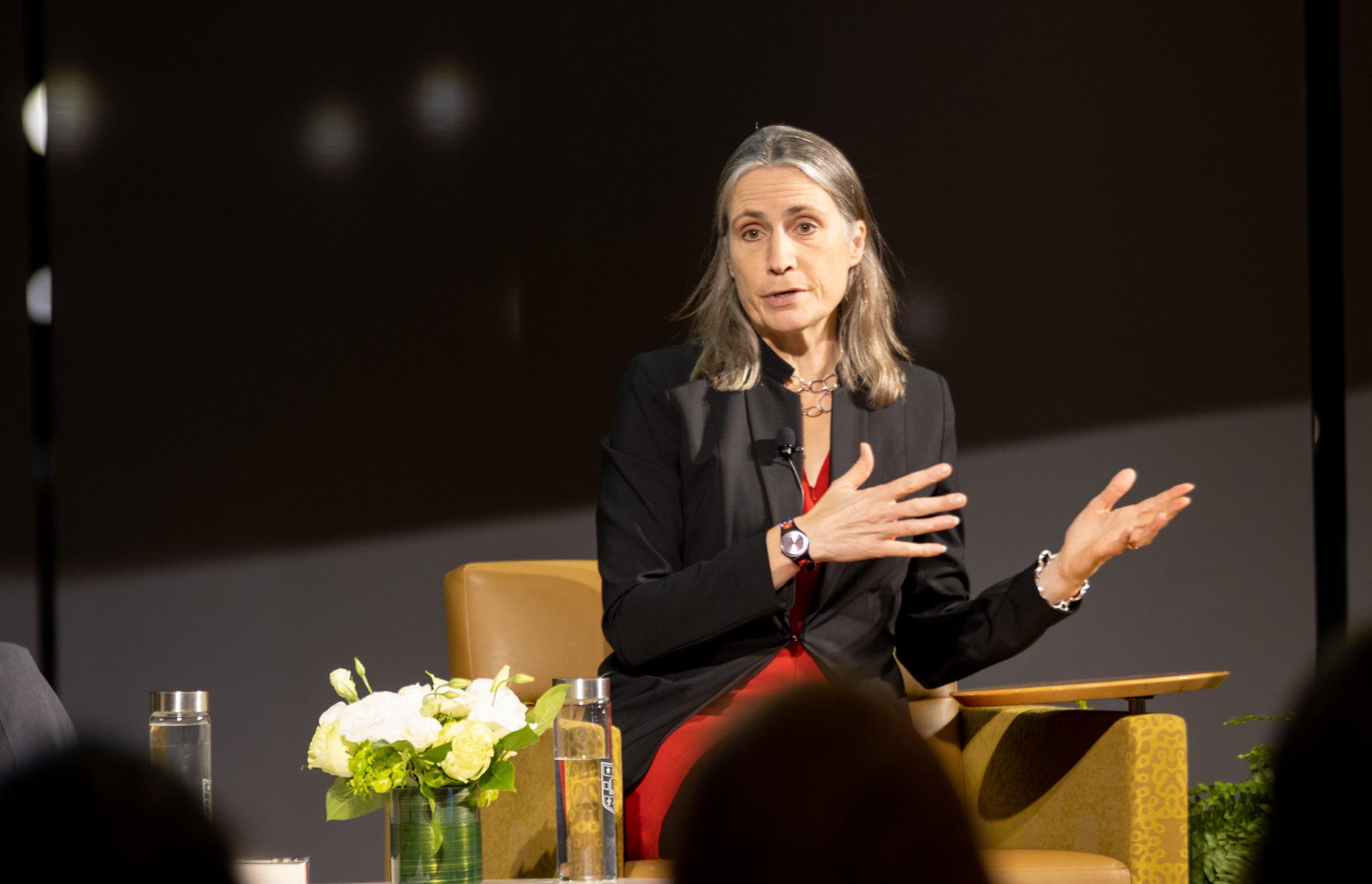
The discussion, titled “The World Putin Wants: The Invasion of Ukraine and the Threat to the International Order,” is part of the University’s assembly series. The assembly series has been a tradition at WashU for 70 years, and has featured speakers such as Eleanor Roosevelt and the Dalai Lama. According to Vice Provost for Interdisciplinary Initiatives Mary Mckay, Hill’s visit underscores the global focus of the new “Here and Next” strategic plan.
Mckay spoke to Student Life following the event about the University’s emphasis on “global perspectives” under the new strategic plan.
“One of the guiding principles [of ‘Here and Next’] emphasizes and elevates global perspectives,” she said. She said that this principle extends to both undergraduate and graduate education, as well as research.
“A global perspective should influence the research that is done at Washington University,” she continued. “There needs to be an eye on partnerships that matter across the globe.”
Mckay explained that Dr. Hill adds to the University’s global perspective mission because she is a “deep content expert in her area” of international conflicts and is able to bring the “globally interested” WashU community together.
Hill was introduced by Vijay Ramani, the Vice Provost for Graduate Education and International Affairs, and she sat down with Anthropology and Global Studies professor James Wertsch, who moderated the discussion. Ramani highlighted Hill’s expertise on international conflicts and Soviet
history, as well as the success of her 2021 book, “There Is Nothing for You Here: Finding Opportunity in the 21st Century”.
Wertsch began the talk by asking Hill, “What does Putin want?”
In response, Hill first talked about how Putin has been in power for 23 years and that his own interest is now intertwined with the interest of Russia as a whole.
Hill then described Putin as a man who wants the world to believe his false narratives.
“Putin is a storyteller, but it is a distortion of stories,” she said. “He is someone who tells stories for a living to make a connection to people, to recruit them, or to get them to do what he wants.”
Hill also provided context for Putin’s upbringing. She said that he was born in 1952 and grew up in the ‘70s — the peak of Soviet power –and later joined the KGB.
Putin is proud of his military background and loves to tell stores that make him seem tough, sly and clever, Hill explained. He also has a reputation of being a history lover, which Hill said was the “most dangerous part of his personality” due to his lies being masked as historical truths.
Hill then addressed the debate on whether or not the invasion of Ukraine was justified.
“Isn’t it the case that…Putin
felt provoked by the expansion of NATO,” she said, referring to what some people say about the conflict. “Shouldn’t we be carving up Ukraine now to find a way of resolving this [conflict]?”
Hill added context to the Ukraine-Russia conflict by reflecting on European history and the continent’s changing borders. Territories, like Crimea, have been occupied by many societies over time, so staking a claim to the land will depend on how far you go back, she said.
“Every European country has a checkered history,” Hill said. “Most European countries fall into the same category as Ukraine. They’ve [became] independent at different points, with different empires, and their borders have changed.”
“After World War II, we said ‘no more forceable change of borders,’” she continued. “What Putin is trying to do is gloss over the fact that he and Russia signed on to [the agreement] after World War II.”
As for the relationship between the United States and Russia, Hill summed it up in a quote from There Is Nothing for You Here.
“Russia is America’s Ghost of Christmas Future,” she wrote.
In the discussion, Hill expanded upon this idea, saying that Americans on both sides of the political spectrum tell false stories about
the other party. Russia is a warning about letting myths turn people against each other.
“Putin wants us to have totally lost faith in our democracy,” she said.
Another topic that Hill addressed is the possibility that a replacement for Putin is waiting in the wings. She said that many of Putin’s former political rivals are now dead, and others do not pose a threat to him.
“Putin is testing out the waters and signaling [to his country] that maybe he is the best bet,” Hill said.
After discussing more of Putin’s goals and Dr. Hill’s background, Wertsch asked a concluding question: “what can we do?”
Hill said that because Putin has been dissuaded from using nuclear weapons, we have been shown that a “way out” of the Ukraine conflict is possible. She discussed reinvigorating the United Nations as a possible effort to combat Russia.
On a smaller scale, having discussions to promote diplomacy is helpful, Hill said. She urged the audience to push back against false narratives and get “our own house in order.”
“Sometimes you have to stand up and do something,” she said. “This is one of those times now, whether we like it or not.”
SPORTS CENTER
New varsity sports performance center finally unveiled in the AC.

(Sports, pg 8)
Two years after Title IX policy changes, fraternities have developed alternative methods to remove alleged perpetrators of sexual assault from their organizations.
During the 2019-20 school year, the Abolish Greek Life movement led to nearly half of affiliated students dropping their organizations, but the drop in membership wasn’t the only significant change for Greek organizations on campus. 2020 was also the year that thenacting Secretary of Education Betsy DeVos made changes to Title IX, a federal civil rights law that prohibits discrimination on the basis of sex in any federally funded school, including Washington University.
DeVos made numerous changes to Title IX to establish that students should be treated as innocent until proven guilty. Her policy changes make it impossible for student organizations to suspend, sanction, or otherwise punish members of their groups for accusations of interpersonal violence, until an official Title IX investigation deems them responsible.
As student organizations continue to navigate potential allegations of assault and harassment, some students have expressed discontent with the limiting nature of DeVos’ Title IX alterations, including fraternity members.
A senior in a fraternity, who wished to remain anonymous and will be referred to in this article as ‘Member Z,’ explained that Title IX cases can unfold over long periods of time. Devos’ regulations prohibit fraternities from taking action against alleged perpetrators, regardless of the length of the investigation.
“One of the frats had a four month investigation where a brother was being investigated by Title IX,” Member Z said. “He was coming by the house and they couldn’t tell him to leave because of the rule, but they were pretty sure he did it and didn’t want him there.”
In some cases, fraternities have been able to internally and
SEE TITLE IX, PAGE 2
ChatGPT, an advanced artificial intelligence interface that can generate essay responses, solve mathematical equations, and more, is changing the field of academia and education.
Since ChatGPT’s launch for public use in November 2022, the University has adapted its academic integrity policy to include the usage of ChatGPT to complete assignments as a violation. Although campus leaders are worried that students will abuse ChatGPT for plagiarism, some University leaders are excited about the future of ChatGPT as a partner in learning.
WashU students and faculty have begun testing the possibilities of ChatGPT, asking it to answer essay prompts that they’ve received or assigned in class or asking the software to write poems and songs.

Sophomore Bemi Folayan,
studying Computer Science, said that she knows people who have already used ChatGPT for assignments.
“I had a friend who put in all of his essay prompts just to see,” Folayan said. “It spit out the whole response.”
Folayan said that she expects ChatGPT is less effective for her Computer Science assignments, which rely less on information recall and more on problem solving.
Ed Fournier, the Director of the Center for Teaching and Learning, said that he has experimented with ChatGPT, too.
“I asked ChatGPT some of the questions I asked my students,” Fournier said. “The questions that were quite straightforward were answered nicely and would've been full point answers.”
Although ChatGPT can recall information, Fournier says that it didn’t perform as well when he asked it to answer more complex and creative prompts.
“I tried to think of more creative questions that asked for more analysis and comparison,” Fournier said. “It cranks out text, but the answers were not nearly as convincing and would not have been full point answers.”
Many courses use information recall writing prompts rather than creative ones, which makes it easy to plagiarize with technology like ChatGPT. Educators worry that students will use the technology to answer these questions and that it will be difficult for professors to detect.
“I think there was a lot of collective anxiety about it,” Fournier said. “People were surprised and frightened by what was possible.”
Over winter break, academic leaders brainstormed how they should move forward with ChatGPT. In the week before second semester courses began, the Center for Teaching and Learning held virtual training sessions to inform educators about ChatGPT and
how classrooms should respond to it. Over one hundred faculty members participated.
Fournier said the training facilitators tried to emphasize the importance of building healthy relationships between students and professors as they navigate ChatGPT.
“We started with a question,” Fournier said. “Are you and your students adversaries or partners in the learning process?”
After these sessions, the Center for Teaching and Learning recommended concrete actions for Professors to bring ChatGPT into classroom conversation, including making space for it in course syllabi. Some, but not all, professors incorporated it.
Marshall Klimasewiski, a fiction writing educator in the English Department, made the choice to talk to his creative writing students about ChatGPT.
“Deciding to put it on the syllabus was partly prompted by the
University suggesting that we start thinking about it and talking to students about it,” Klimasewiski said.
However, the University’s suggestion wasn’t the only reason Klimasewiski wanted to incorporate ChatGPT in conversation. Like many educators, he is interested in how classrooms can use ChatGPT as a tool rather than avoiding and banning it in their courses.
“It might be something that can be interesting in a creative context if you take possession of it as a tool and make the process of how you use it part of your fiction making, or any other kind of creative endeavor,” Klimasewiski said.
Klimasewiski said that he thinks exploring the technology’s functions in a dialogue could prompt interesting discussions and that he could see a future in which ChatGPT gains more creative capabilities.
SEE CHATGPT, PAGE 2
Fournier echoed Klimasewiski’s thoughts, indicating that professors might begin to use ChatGPT in creative, educational ways. Klimasewiski imagined scenarios in which faculty could train ChatGPT to be the other side of dialogue and respond to certain prompts.
Dave Walsh, a Professor in the American Culture Studies Department who specializes in technology and digital rights, says he already has plans to use ChatGPT in his course this semester.
“We’re going to do an experiment in groups just to see what it can do,” Walsh said. “What do we have to do to make it sound like it knows what it's talking about and how can we make it sound like it has no idea what it's talking about?”
Walsh said that he understands that ChatGPT can be used for plagiarism, but echoes the opinion that there are creative and engaging ways to incorporate it in the classroom.
Even if professors choose to not use ChatGPT in their courses, Fournier says that the Center for Teaching and Learning is encouraging professors to try new,
creative types of assignments in their classrooms. He says he believes that adjusting the way classrooms operate is a more productive alternative to attempting to ban ChatGPT entirely.
In part, this is because policing usage of ChatGPT is difficult. The University has not banned ChatGPT on school Wifi because students could easily maneuver around this ban by using other networks or data, according to Fournier.
Fournier and other
Several St. Louis news sources announced today that Washington University purchased nine properties on the Delmar Loop from Joe Edwards, a longtime St. Louis property owner, at the end of 2022. The University, now one of the district’s largest property owners, acquired two parking lots and seven buildings, including the well-known Pin-Up Bowl, a bowling alley near campus.
professors see a positive future for upper level education, where the emergence of powerful AI technology encourages professors to come up with creative learning methods rather than the typical straightforward essay prompt.

“If what [ChatGPT] ends up doing is refocusing how assessment works and how we measure student learning, I think that could be a positive thing,” he said.
The St. Louis Dispatch describes Edwards as the “longtime steward of the Loop whose revitalization efforts turned it into one of the St. Louis region’s most popular shopping, dining and entertainment districts.” Edwards, who founded Blueberry Hill in 1972, established and owns a variety of Loop attractions, including the St. Louis Walk of Fame, the Pageant, the Peacock Diner, and the Rooftop Terrace Bar.
sexual assault module in their member toolkit, this resource does not provide information for how a chapter should move forward if a member is accused of assault.
Some national organizations have information that directly contradicts the federal laws set by Title IX.
St. Louis Public Radio reported that neither Edwards nor the University disclosed the price of the transaction.
“I’ve always had a good relationship with Washington University because I respect them so much, what they mean to St. Louis, not just the Delmar Loop,” Edwards said to St. Louis Public Radio. “Little by little, over a period of time it evolved, and we decided and agreed on which properties to sell at this point in time and which ones not to.”
The St. Louis Dispatch said that, despite being exempt from certain property taxes, the University will continue paying taxes on commercial properties leased to businesses in the area.
In a comment to StudLife, Vice Chancellor for Marketing and Communications Julie Flory wrote that businesses acquired by the University will continue to operate as usual. While there are no plans for
due to allegations, that decision would be against Title IX policy and could possibly be countermanded.
the vacant properties at this time, it is possible that some may be used as space for administrative offices.
“With the Loop’s proximity to the Danforth Campus, we have a particular interest in preserving the vibrant nature of the area, as well as ensuring that small businesses — especially those that are small familyor minority-owned — are able to continue to operate and serve the community, including our students, faculty and staff who enjoy the many benefits of the Loop,” Flory wrote.
With the transaction finalized late last year, Edwards plans to use the sale to help him invest in more projects, including Magic Mini Golf, which is set to open later this year.
“I love creating places where people can put their troubles behind them for a couple hours and just enjoy life before they go back to whatever they had been going through,” he said.
informally handle accusations without going to Title IX, sometimes at the request of the survivor.
According to a junior on the executive board of one fraternity, who wished to remain anonymous and will be referred to as ‘Member A,’ his organization has dealt with two of these situations during his time as a member.
“Having Title IX involved is a significant step,” Member A said. “Truthfully, a lot of victims don’t want to go to Title IX, [they] don’t want to go through that process because it’s incredibly re-traumatizing.”
Sexual assault is a statistically underreported crime; only 12% of sexual assaults on college campuses are reported. In a 2019 survey, responses from 3,810 undergraduate students at WashU indicated that 17.3% of students experienced a sexual encounter that was non-consensual, coerced, or did not include ongoing active consent.

However, the University Sexual Harassment Investigation Board reported just 61 Title IX investigations between 2013 and 2022, 34 of which ended with the accused individual being found responsible.
“We had a situation where someone came to us and said, ‘One of your members did this, I don’t want it to go to Title IX, please do something,’” Member A said. “We have an obligation to do something about this, and it was instantaneously clear that what she was saying was completely true.”
He explained that in order to respect her wishes, the fraternity severed all relationships with him until he eventually dropped the organization of his own accord
weeks later.
Title IX Coordinator Jessica Kennedy explained that this method of resolving the conflict is not a direct violation of Title IX policy.
“As long as they don't force that person to leave, they're allowed to ask, they are allowed to appeal to their desire to protect the fraternity or the a cappella group or whatever it may be,” Kennedy said. “They can certainly appeal to that, but they're not allowed to remove that student.”
Member A recounted a time when both the fraternity’s efforts to go to Title IX and to convince the member to leave were unsuccessful. This process was made more difficult by the lack of guidance provided by his fraternity’s national organization.
“We had a situation where there was a @metoowashu post about a member of our frat and it was clearly identifiable to us who this person was, so we went to Title IX and said, ‘Look, this happened,’” Member A said. “It was a very vague post, and Title IX said they couldn’t do anything about it.”
Since its inception in 2020, the Instagram account @metoowashu has posted nearly two hundred survivor stories in which individuals post their experiences with sexual assault, harassment, abusive relationships, and other interpersonal violence.
According to Member A, the survivor story on Instagram was about the then-acting president of his fraternity, which led members of the organization to reach out to the national organization for guidance about how to handle the situation and remove the president from his position.
“Nationals said we could
impeach him, but if the impeachment essentially resembles in any shape or form impeaching him for the post on Instagram that accused him of assault, you could be sued,” Member A said.
He also added that Title IX told their organizations that if the fraternity did an internal review to kick someone out, they could be liable to a lawsuit if that individual was aware of their legal rights as someone facing an assault allegation.
Member A explained that even though many members of the fraternity made attempts to socially isolate the former president and convince him to drop, the accused perpetrator believed that leaving his position would be an admission of guilt and remained in his role until his graduation one semester later.
In January of 2021, @ metoowashu posted a list of ten fraternities who had members with some type of active sexual assault allegations against them. Member A’s fraternity had one allegation against it; he stated that he knew it was alluding to the @washumetoo post alleging the president at the time had committed assault.
“There’s nothing I can do about it because of the rules, that was the unfortunate reality of it,” Member A said. “Many people tried to tell him to drop, but he wouldn’t.”
Additionally, many fraternities have national bylaws that provide very few or even contradictory guidelines for handling assault accusations.
For example, Alpha Delta Phi’s website offers current versions of their constitution and bylaws, neither of which mention the words “sexual assault” in any capacity. While the organization has a
For example, the 2021 edition of the Sigma Phi Epsilon National Grand Chapter Bylaws states that if a chapter member is alleged to have been involved in a sworn declaration or official notice of an interpersonal violence incident, the student must be suspended until all University, police, and legal investigations into the matter are completed. A fraternity would be violating Title IX if they followed these Bylaws.
Similarly, the Alpha Epsilon Phi 2021-22 Chapter Operations Guide states, “In most situations, the Brother should be suspended until the case has been resolved. This is for their benefit as well as the chapter’s benefit.”
The Sigma Chi governing laws also include that their Chapter and Membership Accountability Committee has the authority to suspend members for the duration of a University disciplinary investigation.
As part of Campus Life’s efforts to explain Title IX to student organizations and offer guidelines for conduct, the department released a document, in late 2020, called “Student Group Guidance for Member Expectations and Accountability.”
The multi-part document lays out potential methods of creating rules and communicating them, including establishing expectations for members and creating accountability plans.
While it is not required for student organizations to submit outlines of their plans to the school, the document includes information about Title IX policy that groups are required to follow, including regulations on imposing punishments or sanctions to members accused of assault.
However, the mechanisms of enforcement begin to blur when looking at the informal ways in which fraternities actually handle assault allegations.
According to Kennedy, if a fraternity were to explicitly make an internal decision to require a member to leave an organization
“That would be in violation of the recommendations that we have made, so we would negate that sanction, whatever it may be, but it would be up to the respondent student to let us know that was going on,” Kennedy said.
Kennedy explained, though, that when it comes to scenarios that are more difficult to define, such as members of a fraternity socially isolating someone until they themselves make the decision to drop, there are fewer enforcement mechanisms available.
“We don't dictate how members treat each other, and so if a person were to be isolated and treated poorly by the fellow members of their organization, unless any of that rises to a policy violation, that's not something we would take action on,” Kennedy said.
When it comes to Title IX policy issues like these, Kennedy explained that it is difficult to provide a generic answer because much of the decision making is reliant on the context of each individual case.
Kennedy emphasized that Title IX is only able to carry out its procedures in situations where someone brings an incident to their attention, referring to both instances of sexual assault and potential scenarios where a fraternity may violate official sanction policy.
In many situations, the exact circumstances are unknown to those outside of the fraternity or to Title IX based on how the fraternity chooses to communicate that information.
During the fall semester, the fraternity Sigma Nu took to Instagram to post a statement about another social media post alleging an instance of interpersonal violence against one of their members.
On November 9, @ metoowashu posted a survivor story where an individual detailed an experience having sex with her former boyfriend, a Sigma Nu brother, for the first time. She wrote that their boyfriend claimed to be STD negative before having sex but later revealed he was aware he had oral herpes at the time, which the survivor then contracted.
Five days later, Sigma Nu took to Instagram with a statement from the chapter in a post that has since been deleted. Directly referencing the survivor story in question, the statement revealed that the perpetrator was no longer a member of the fraternity, without clarifying if he was told to leave or voluntarily dropped.
The statement read, “The Sigma Nu Gamma Omicron Chapter does not condone any form of sexual misconduct, violence, or harassment. We also will not protect those who commit acts contrary to our values as a fraternity and as students at WashU. This past week Chapter Leadership learned of a member’s inexcusable conduct and can now say that he is no longer affiliated with our organization.”
Member A said that he believed the language of the post indicated that the fraternity asked the member in question to drop, although he had no personal knowledge of the situation.
“The post says that the member is ‘no longer affiliated with our organization.’ What that means is that [Sigma Nu] said to someone, ‘We don’t have the power to kick you out, but you need to leave’,” Member A said. Looking forward, Member Z expressed a desire for a better system, while admitting he is unsure what that system would look like.
“I definitely think [the updates to] Title IX significantly limit how the frats deal with their issues, but I don't think it's the worst idea to have someone overseeing how the frats are doing them because I don't trust frats to do it alone,” Member Z said.
“I just think Title IX doesn’t work well the way it is.”
Kennedy emphasized that the Title IX office serves as a resource for student organizations that are unsure about their guidelines or who are facing issues with sexual harassment or assault within their groups.
“We're happy to work with groups with educational efforts, talking to them about why it's important to address these issues head-on and make sure that they're reporting things, but also how to prevent these things from happening in their houses or social events.”
Student Union Treasury approved all of this week’s appeals in their latest session, Jan. 31.
Leaders in Interpersonal Violence Education (LIVE), a group that, according to their website, “hopes to empower all members of [the WashU] community to take a stand against sexual violence,” asked Treasury for $16,500 to fund a visit from U.S. gymnast Maggie Nichols. Nichols was one of the many sexual assault survivors of Larry Nassar, a former sports doctor. To protect her identity, Nichols was referred to as “Athlete A” during Nassar’s investigation. She now speaks out against abuse and shares her story.
Breaking down the cost, $14,500 would be paid to Nichols as an honorarium for speaking at WashU, while $2,000 would be allocated towards her travel and hospitality expenses.
LIVE anticipates at least three hundred people to attend, based on the size of the Zoom audience at the group’s 2021 speaker event with Aly Raisman, another U.S. gymnast and victim of Larry Nassar.
Treasurer Christine Ling contested the $2,000 travel and other expenses fee, asking LIVE why they did not try to negotiate a lower amount with the help of a liaison. LIVE noted that Nichols requested first-class travel, which brought the cost up. Treasurer Sadie Karp, however, added that speakers have “different standards and different prices,” and she thinks that the event is worth the cost.
Another treasurer, Hieran Andeberhan, encouraged LIVE to choose more diverse speakers in the future, as both Nichols and Raisman are white female gymnasts.
“Sexual assault affects
everyone,” Andeberhan said. “Just limiting [LIVE’s speakers] to athletes and white women is going to limit the scope of people who feel [that the events] speak to them.”
The motion to fund Nichols’ visit was passed, with a large majority of Treasurers favoring the appeal.
Several athletic club teams made appeals to Treasury this week.
The Run Club asked to bring 28 runners to Chicago for the Shamrock Shuffle, an annual race on St. Patrick’s Day. Accounting for hotel rooms, Amtrak tickets, and race registration fees, the trip would cost $4,866.89 in total. After a brief deliberation period, Treasury approved the appeal.
WashU’s Rock Climbing Club asked to take 16 climbers to the Horseshoe Canyon Ranch in Arkansas. The group plans to drive to their destination, so expenses would include a gas fee in addition to fees for housing and climbing passes. The total proposed cost was $1,090.80.
Women’s Ultimate Frisbee appealed for $2,640 to get 40 of their members each a U.S.A. Ultimate (USAU) membership, which grants the players access to tournaments. Each USAU membership costs $68.
Club Swim’s appeal generated heightened debate among the Treasury. The team asked to bring 27 swimmers to their league’s national conference at Ohio State University (OSU). A total cost of $15,623.42 was recommended for the trip, including hotel rooms, Enterprise car rentals, food and Uber expenses, as well as flights.
Karp asked why the group needed to fly to OSU when it is within a 500-mile radius from WashU. The group cited Campus Life’s rule against driving late at night as a reason for flying.
Also, Treasurer Leslie
Sackey asked for clarification as to why Club Swim was bringing 27 swimmers when only 19 or 20 swimmers have qualified for nationals so far. The group said that they anticipate another seven to eight swimmers will end up qualifying.
The motion to approve funding passed, but during the open forum after the appeals, Vice President of Finance Max Roitblat encouraged the new Treasury representatives to be more proactive in questioning unneeded expenses, such as Club Swim’s plane tickets.
Treasury also heard appeals from the Muslim Student Association for a speaker series and the WashU Fencing Club for several local tournaments. The debate team made two appeals, each for a trip to a debate tournament, one in Boston and one at Yale University. All appeals were funded.
Takeaways
Treasurer Alan Xiong, a new representative this semester, said the treasurers did a good job of questioning student groups on how they were finding their hotels and whether or not events were necessary to attend.
“This high level of engagement is really great,” he said.
As he continues his work as an SU Treasurer, Xiong hopes to “contribute to making Student Union a more accessible body to all WashU students.”
Mishka Narasimhan, Speaker of the Treasury, was “extremely happy” with how the meeting went.
“I think there is a lot of continued participation from new [representatives],” she said. “As the semester goes on, I think we are going to become more and more efficient.”
The University announced that undergraduate tuition will increase by $2,330 (3.9 percent) for the 2023–2024 academic year, Feb. 1. This increase marks the highest annual tuition hike since the 2011–2012 academic year.
Provost Beverly Wendland emailed undergraduate students to announce the decision. The email included a copy of the letter sent to students’ families, which breaks down the comprehensive increase.
The health and wellness fee will be $616, compared to $576 for the 2022–2023 academic year, and the
VOLUME 144, NO. 14
Julia Robbins Editor-in-Chief editor@studlife.com
Via Poolos Managing Senior Scene Editor scene@studlife.com
Jamila Dawkins Reilly Brady Managing Senior Forum Editors forum@studlife.com
Clara Richards Managing Senior Sports Editor sports@studlife.com
Ved Patel Managing Chief of Copy copy@studlife.com
student activity fee will be $616, compared to $594 for this year. Meal plan prices will range from $5,018 to $7,590, compared to $4,824 to $6,702 for the 2022–2023 academic year. Fees for a double room will range from $12,648 to $13,188, compared to $12,178 to $12,698 for this year.
The 2023–2024 tuition hike follows a steady increase in tuition over the last few decades, including an increase in tuition by 2.9% from 2021–2022 to this academic year.
In Wendland’s letter to families, she emphasized the fact that tuition and other fees help support “course offerings and majors, mental health and
Washington University’s School of Medicine is no longer submitting data used for national medical schools rankings to U.S. News & World Report (USNWR).
The decision comes after the past month where multiple prominent medical schools including Harvard, Stanford, and Duke, announced they would stop submitting data to the ranking.
The listing, which ranks schools by quality, student success, and research activity, has recently come under criticism. Harvard Medical School Dean George Daley said the ranking creates “perverse incentives” for institutions to report misleading data.
Dean David Perlmutterreleased a statement on Jan. 26 stating the medical school will no longer continue to submit data to USNWR, citing issues with the medical school’s holistic philosophy of education and how it interacts with the rankings.
“Commercialized rankings have not kept up with these transformations,” Perlmutter wrote. “They recognize the values and aspirations of the past, not the skills and tools that will carry us into the future.”
Joseph Krambs, a member of the Committee of Medical Student Education (COMSE,) said the rankings are primarily used for business rather than educational value, and that education itself is not necessarily a priority to the ranking.
“I sort of see it as a marketing and fundraising tool

for institutions, because it's not really limited to medical schools, or undergraduate institutions,” Krambs said. “It's also applied to hospitals and other businesses…20 percent of [the ranking data] comes from the GPA and MCAT scores. It doesn't really say anything about preparedness or medical training or the medical profession, other than to say that people who come into this institution are good test takers.”
Krambs also said that because WashU as an
Read the rest online:
Holden Hindes Managing Photo Editor photo@studlife.com
Kellen Wang Head of Design design@studlife.com
Tuesday Hadden Head of Illustration
James Ellinghaus
Nina Giraldo Avi Holzman Senior News Editors
Annabel Shen
Alice Gottesman Senior Scene Editors
Gracie Hime Cathay Poulsen Chief of Copy
well-being resources, and university-funded internships and fellowships while continuing to offer students enriching residential life, research and co-curricular opportunities.”
Neither Wendland nor the University’s Office for Marketing and Communications responded directly to a question from Student Life on what, specifically, the tuition increase will go towards. They also did not respond to a request to see a breakdown of how tuition dollars are spent.
Tuition will also increase for graduate school, parttime, and evening students, with increases ranging from 2 percent to 3.9 percent.
Mia Burkholder Copy Editor
Elle Su
Zoe Oppenheimer Senior Photo Editors
Kamala Madireddi
Jared Adelman Senior Multimedia Editors multimedia@studlife.com
Sydney Tran Junior Design Editor
Jasmine Stone Junior Forum Editor
Emmett Campbell
Jamie Nicholson Junior Photo Editors
Zara Shariff William Labrador Junior Scene Editors
Lily Taylor Zach Trabitz
Bella DiGenova Junior News Editors
Camden Maggard Social Media Editor
Tim Mellman Newsletter Editor
Clara Richards Celina Xie Designers Tony Tong Senior Web Editor
Paige Steuber Senior Web Designer Adrienne Levin Coleman General Manager a.coleman@studlife. com
Sarah Huff Advertising Sales Manager huffs@studlife.com

 WILLIAM LABRADOR JUNIOR SCENE EDITOR
At Washington University, students are able to wholly operate their own businesses on campus. Currently there are seven businesses run by undergraduate students. Much of this enterprise is thanks to The Student Entrepreneurship Program (StEP), run by the Skandalaris Center. StEP is a 24-year-old program that grants students entrepreneurial opportunities.
II Luscri, managing director for the Skandalaris Center, believes StEP’s value is in the full ownership by students.
“There are some universities that have studentrun businesses, but that’s a lot different than student businesses because it could not work out right,” Luscri said. “[Our] businesses aren’t immune to market conditions. There’s real money at stake in that.” Students who own and open businesses assume all of the risk of running a business as well as any opportunity for profit. Any student currently enrolled at the University can work with the Skandalaris
Center to found a business on campus. In 2020, seniors Drake Shafer and Justin Reiling created Gallery 314, a store for selling items made by WashU students. What was originally something to focus on and keep busy with during COVID-19 has since become a fruitful business.

“We decided that we wanted to open a businesslike gallery that would focus on selling handmade items from around the area,” Shafer said. “We started the business from scratch and then in September 2020, maybe 3 months later, we opened for the first time on campus.”
Because the businesses are fully incorporated, owners and workers are in charge of all decision-making and operation of the business.
“There was a lot of work that had to be done kind of outside of the store: keeping track of finances and balances of all the consignors and small business accounts that we had, upkeeping [the] website, social media, marketing, and emails,” Shafer said. He estimated that he put in a total of 10 to 20 hours a week of work.
Many StEP businesses currently at the University have a history older than their current owners. Bears Bikes has been operating for 19 years, Vicky Zhang, class of 2021 graduate and former owner of Bears Bikes, bought her ownership in 2018.
“When I bought in, it was an established business, meaning somebody had created it like an LLC. It had gone through legal integration, legal iterations, and it had been successful in the past,” Zhang said.
Businesses in StEP primarily serve the WashU community and are established to fill a need or improve campus life in some capacity.
“I know it has a tangible impact on the community and I really enjoyed seeing some of the things that I’ve implemented in the store work out really well,” said junior Campbell Sharpe, the storefront manager of Sharing With a Purpose (SWAP).
Not only do the businesses positively impact the University’s community, but operating them behind


the scenes also offers unique business experience to undergrad students. The business owners in StEP gain practical management experience through their ownership and growth.
“The biggest thing you learn is the ability to actually act on things. A lot of times the world has really good ideas…But we are not thinking about the day to day of it or the potential
implications,” Zhang said.
To run a StEP business takes commitment. She added, “I’m gonna be honest with myself about what it’s gonna take, and I’m gonna be willing to do it, plan it out, and deal with the problems that come with it.”
For students looking to get involved and move their own ideas forward, the Skandalaris Center encourages students to present all their
entrepreneurial plans. Skandalaris Center will then attempt to help make them work.
“I would encourage students to come forward with any business idea. Maybe it fits with StEP, maybe it doesn’t. If it doesn’t, we’ll help find another avenue, find another place to help get that company up and running and help students launch that,” Luscri said.
Survivors and Allies for Social Support (WUSASS) is a new club on campus dedicated to empowering survivors to reclaim their campus
experiences and educate their peers about sexual assault prevention. Founded during the summer of 2022 by junior and president Erin Ritter,
Washington University
WUSASS’ main mission has been to hold space for students with sexual trauma who have felt excluded from places they once felt comfortable at.
“WUSASS is trying to give people the skills that they need to deal with the fact that the administration is not as willing to protect students during these events,” Ritter said.
The first priority of WUSASS is cultivating a safe and empowering community of like-minded people. The club engages in collaborations and social mixers with other student groups, while maintaining a strict attendance list and coordinating bystander intervention and sober contacts to ensure all students feel safe.
WUSASS also facilitates trainings and discussions surrounding RSVP (Relationship and Sexual Violence Prevention). Their most recent training was conducted by SARAH (Sexual Assualt and Rape Anonymous Hotline) Safe, which focused on engaging in trauma-informed speech and supporting peers who disclosed traumatic sexual experiences.
“We decided to go
with this training because when accompanying other members to events or parties, it is very easy for them to become triggered if they don’t have access to the type of mental health resources that help them identify their triggers and learn how to respond to them,” Ritter said. “In this case, you could use support from the people around you.”
Sophomore Claudia Markel, the training organizer at WUSASS, said that these trainings are required before members are allowed to go to parties as the sober contact. The club goes by a “by members, for members” buddy system, where per a member’s request, individuals are paired up with one another to serve as their support when venturing into the social scene. Members of WUSASS are largely anonymous, so attendees at the party or gathering aren’t aware of the bystander’s club status.
Currently, WUSASS goes to both on and off-campus parties, and they are currently working on ways to intervene with sexual violence at fraternities — which will necessitate greater training — before sending their members out to them.
While there are a few other sexual assault awareness clubs on campus, Ritter noted that there isn’t widespread conversation about bystander intervention training, especially when it comes to putting this training into practice. While many clubs offer hotlines for support after a situation has occurred, not many offer interactive training and education to help equip members with the tools they need to diffuse a situation in the moment.
“I think everyone knows that sexual assault does happen on WashU’s campus, and there is not going to be a trained person at every single party,” Markel said. With the dedicated and educated members of WUSASS, Markel stated how they plan to share their information not only to club members, but also to all WashU students.
“We want to spread the bystander intervention protocol so that people will be able to defuse a situation. We are here to teach them how to do it safely,” Markel said.
WUSASS can be reached via email, at washu. survivorsandallies@gmail. com or Instagram @wu_sass.
Overseas Programs at Washington University
invite students to consider international study as part of their academic journey.
There are over one hundred programs located across the globe from all four undergraduate schools. Not only can students bring back credits for their degrees, but they can also return with a wider global perspective and more independence.
Four WashU students who have just returned from their overseas programs shared stories of their adventures with Student Life — just in time for current sophomores to start deciding on their abroad excursions.


Sam Schwartz (Computer Science + Mathematics) — Auckland, New Zealand


Why did you pick New Zealand? Why did you decide to do this program?
I wanted to go somewhere that had an abundance of natural beauty and warm weather (my STEM [self] is also terrible with other languages, so I had to
choose an English-speaking country). I also wanted something that was selfguided and an experience that I really would only have this one opportunity in my life to take.
Can you tell me one highlight and one lowlight of your study abroad experience?
Highlight: I was wandering around a gorgeous lagoon in Rotorua. An island dog (yes, it’s a thing there, and it’s wonderful) came up to me and was very friendly and led me to [its] favorite sunspot — and then proceeded to husk a coconut with its paws.
Lowlight: Easily day one. I arrived during Auckland’s winter, which is very rainy and gray. This combined with the overwhelming nature of moving across the world, dealing with an 18-hour time difference, being alone, and realizing my face wash had exploded in my suitcase upon arrival [made] for a really rough first day.
What are three things you have to pack to study abroad?
1. Something to remind you of home, whether it be a keepsake or poster or
picture or whatever — you will get homesick, and these little reminders can be super helpful.
2. Some little activity that requires other people — bring a frisbee or board game or deck of cards or something that can help you out with meeting new people those first few days.

3. A universal adapter! You don’t know where you’ll travel to or how long you’ll be stuck in some random airport for.
What American food did you miss the most? What New Zealand food do you miss after coming back?
Tie between deli bacon egg and cheeses and New York-style pizza (I had dreams about both…).
Auckland had incredible and affordable Indian and Vietnamese food that is oh-so-good.
Do you feel less, more, or about the same academic pressure when studying abroad as you do at WashU?
Significantly less. Through McKelvey and this program, all courses were taken pass/fail. This, combined with easier and more hands-off classes ([for] most classes, your whole grade was just a few exams, assignments, and projects), made it very easy academically, and I was able to spend more time exploring and cooking and hanging out with friends

Sophia Xu (Psychology)
— Copenhagen, Denmark
Can you tell us one highlight and one lowlight of your study abroad experience?
Highlight: I enjoyed the trips that were part of the
program. The first trip was a short three-day study tour. It was great to get the opportunity to talk to doctors and people on the street about the healthcare system. Some activities included a walking tour, river cruise, zoo, and rainforest. The second trip was a week-long tour to Vienna and Budapest.
I also traveled on my own and, in total, visited 12 countries, including Denmark, Norway, Sweden, Germany, France, Switzerland, Spain, Austria, Hungary, the Czech Republic, Britain, and the Netherlands. I learned to say cheers in 15 different languages!
Lowlights: It was a very homogenous environment. Many of the Danes were not used to being around people of different backgrounds and cultures, such as Asian Americans. My host family and some professors made a few comments that were a bit insensitive, but I
acknowledge that that was likely due to unawareness rather than malintent. For example, they sometimes asked where I was “really from” after I responded [with] Texas. My host family also commented that me and other Asian students looked alike, probably just based on our shared race. Did you experience any culture shock?

Being in a [place where I was] a minority was a bit different, and the way people reacted to me as an Asian student [was also different]. In addition, this wasn’t necessarily culture shock but I did observe how the professors in Denmark were much more casual than [the ones in] the U.S., which was fascinating. Students and teachers were often seen hanging out with each other, and professors were called by their first names.
Do you have any suggestions for what to pack for a study abroad?
It would have been useful
to have cash for thrifting flea markets. This was a fun activity to do on the weekends, but unfortunately, the flea markets did not take credit cards.
Were there any foods in Denmark that were special to you? What American food did you miss the most while you were there?
There was something called smørrebrød, which is a Danish open-faced sandwich with pickled herring and onions. It was good. They also had lots of candy, such as salted licorice, which I personally did not love.
Read about more experiences online:
They definitely did not have all the American fast food options. I missed
The institution of Greek Life, undeniably, has been built on the systematic exclusion of those who do not fit the mold of society’s “normal” and “desirable” classes, including Black and brown people, disabled people, people from disadvantaged socioeconomic backgrounds, and members of the LGBTQ+ communities.
In fact, that’s the whole point of the rushing process. Those that have been accepted into the institution select others who they deem worthy of entrance and community. Mirroring the slow progression of our society, more and more of those previously mentioned classes have been accepted into Greek communities (though the majority of

Greek Life remains disproportionately rich and white and notoriously cisgender and straight).
Advocates for reforming Greek life point to such progress as evidence for their cause, framing the Abolish Greek Life movement as a collection of radicals that are seeking to tear down an inherently good institution.
While progress is certainly nothing to be scoffed at, proponents of reforming Greek Life ignore the fact that our society will always have people who do not fit the mold of “normal” and “desirable” and that the very idea of Greek Life is to only accept those who fit that mold. We must examine the rush process, in which prospective brothers and sisters must prove to various fraternities and sororities that they are
likable, relatable, and desirable enough to be offered a bid.


Though I understand that each fraternity and sorority may have their own specific criteria when judging the members worthy of accepting a bid, the core of Greek Life is social. It is not academic or professional, so it does not need to strive for any semblance of objectivity. Greek organizations are not basing their selections upon merit or effort, but more upon a variety of factors, mostly subjective qualities revolving around snap judgements of character.
So, what is the logical end of a selection process in which members are looking for people that they think will fit a certain kind of “vibe”? What happens when members are essentially choosing new
people to recruit based on who they click with and who they think would be the “right fit” for the organization? In other words, who do we think that Chad from Sarasota will like more: Brad from Miami or Rajesh from rural Illinois?
Social psychology (or basic common sense, take your pick) tells that these members will end up choosing recruits that are most like themselves in terms of personality, background, and shared interests. As my social psychology professor (shoutout Professor Calvin Lai) would always say, birds of a feather flock together.
Given that this social subjectivity seems to be at the core of Greek Life and its claims of “creating a community,” is it any wonder that members of the abolition movement
are skeptical of reformist efforts? Fraternities today are undeniably more inclusive, allowing for people of different races and sexual orientations to join. One only has to hear stories about WashU in the ‘80s and ‘90s or even just ten years ago to understand that fact. But I argue that they will never truly be diverse.
As an inherently exclusive social organization, Greek Life’s commitment to inclusivity rings incredibly hollow. The existence of people of color in an organization is not proof that the organization is accepting of their background and identity. It seems like the structural equivalent of saying, “I can’t be racist, I have a Black friend, and I voted for Barack Obama.”
At the end of the day, Greek life fosters a home and community in which
people from low socioeconomic backgrounds or people who want to express identities that are not seen as mainstream are not going to be fully welcome.
To the credit of some of those in Greek Life, particularly some sororities at WashU, this is not for lack of trying. Often, the individuals participating in these organizations turn out to be incredibly kind and understanding. However, the nature of facilitated social interactions, the kind that Greek organizations are built on, make this exclusion inevitable. How can an organization built upon the idea of social exclusion, that some people deserve material benefits because they fit the vibe, ever be inclusive enough to include those of us that don’t fit their mold?
Over winter break, I was rewatching season two of “Euphoria” with my mother. Why, I’m not entirely sure, as anyone who has seen the show knows that watching it with one’s parents is a terrible, horrendous, even nightmarish scenario. When Faye strutted onto the screen and introduced herself to Zendaya, my mom’s eyes widened and jaw dropped. “Look at her mouth! She looks like a porn star!” To which I responded, “Well…she is.”
as both a high-profile actress and porn star. And she might be right. Despite being incredibly famous (Chloe has over 1.3 million followers on Instagram), Chloe Cherry has yet to secure another role that’s achieved the cultural stardom of “Euphoria,” though she has been cast in two in-production films. On the other hand, she has been overwhelmed with brand deals and sponsorships since her “Euphoria” fame and has been the face of campaigns for Versace, Urban Decay, and Steve Madden.
ILLUSTRATION SOPHIE LEONG
Last year, model and writing sensation Emily Ratajkowski launched “High Low” with EmRata, a feminist podcast that has developed a focus on sex and relationships.
In the last four months, Ratajkowski has hosted two former sex workers, Chloe Cherry and Mia Khalifa, on the podcast to share their experience in the pornography industry, forcing her listeners to ask: Are porn stars the new celebrities?
BY RYAN DAVIS
During her porn career, Chloe Cherry was scouted on Instagram by Sam Levinson, creator of “Euphoria,” for season two. The season was a huge success and Chloe’s character, Faye, was a crowd favorite. The show launched Chloe to exponential fame, and she decided to devote her time to being a full-time actress. According to her interview on “High Low,” she quit pornography because of the incomparable money she was making as an actress, and she thinks that the world just may not be ready for a powerful woman actively working
Before Chloe Cherry’s appearance on “High Low,” Emily Ratajkowski hosted Mia Khalifa, another former porn star with much to say about the industry. Mia is even more famous than Chloe, boasting 27.5 million followers on Instagram and an audience that is entirely global. She spoke on “High Low” about her followers, expressing that for the first time in her career, her demographic is over 40 percent women. This is largely due to her comedic presence on TikTok, where she humorously discusses crazy exes, holds McDonald’s mukbangs, and contrasts her glamorous photoshoots with a less glamorous reality. Stella Barey is another sex worker with a huge social media presence, and not because of her work in the sex industry. Her TikTok has over 627,000 followers, and it serves as a platform for her reviews of philosophy books, frank discussions about OnlyFans, and relationship tips. On her
TikTok, Stella opens up about her experience as a pre-med student at UCLA, planning to go to NYU for medical school before choosing to pursue a career on OnlyFans. According to her, she is in the top .01 percent of creators on the platform, raking in over $200,000 per month.
These women’s entry into the celebrity sphere normalizes sex work as an industry in the larger scope of media. Chloe Cherry says in her “High Low” episode that she shares her experience to ensure that the next girl who decides to follow her path does not face the same extreme level of backlash that she did, and it is working.
Stella Barey especially works to combat the idea
that women in sex work are unintelligent, and all three of these women are building respect for women everywhere, regardless of their occupations or industries.
All three of these women are incredibly successful, whether they still participate in sex work or not, and their followings are growing. Modern women are, for the first time, able to shamelessly admire and revere sex workers and former sex workers as strong and powerful women in the eyes of society. Their opinions and experiences are not only being shared widely on large platforms, but are actually being heard and understood by wide audiences, regardless of gender.
Washington University basketball didn’t lose a
game all weekend.
As they flew to New York to take on United Athletic Association (UAA) opponent
Rochester University, both the men’s and women’s teams were ranked as underdogs. Traveling south to Emory
University, the odds were against them on the road in a tough Sunday matchup. Even in the final minutes of play in
Atlanta, both teams were playing from behind. But both squads flawlessly executed threes from deep on the court with mere
seconds on the clock, closing out hard-fought wins and vaulting the Bears to the top of their conference rankings.

In the final minute of the Bears’ game against Emory, the play-by-play announcers sounded more and more anxious.
“Don’t give the ball to him.” Sophomore Hayden Doyle passed the ball to graduate student Charlie Jacob. “Or him.” Jacob shot it over to freshman Will Grudzinski. “Or him.” The ball left Grudzinski’s hands, his wrist snapping. The trey that swished through the net won the game for the Bears.
That’s the threat of the men’s basketball program: the collective damage of every single player in their lineup. The team shot an average of .450 from three this weekend, and Grudzinski individually scored eighteen points from three-pointers alone, going 6-10 from outside the arc.
On Friday, Doyle had a season-high night, scoring eighteen points. In their previous win, Jacob was the top-scoring player on the court. The time before that, it was sophomore Drake Kindsvater, with sixteen points.

“Today was a good day for [Doyle and Grudzinski],
and next Friday it might be different guys,” head coach Pat Juckem said. “And that might be the strength of this team: we’re not reliant on one. We’re a collection, and we have several guys who are capable of leading us depending on where the opportunities come.”
In the team’s first game on Friday against Rochester, the Bears created a small firsthalf lead that they pushed open with a seven-point run to open the second half. Their accuracy in the net coupled with an unbreakable defensive scheme stymied by Rochester, who shot with 36.7 percent accuracy — only one out of seven three-point attempts in the second half. The final score of 63-47 was the lowest Rochester has scored all season.
Emory posed a unique challenge to the Bears at the outset. They played more zone, they mixed up their zones, and they consistently put pressure on the WashU defense. The team had a film session Saturday morning and a short practice on Saturday night, and from the beginning, it was clear that
the Bears did their homework. The lead bounced back in the fourth, the Eagles never letting WashU get out of reach. With eight minutes to go, a layup gave Emory the lead until Grudzinski’s three swished through the net. Two free throws from Kindsvater put icing on the win, freezing the scoreboard at 72-69.
For Juckem, the UAA wins are so important given the quality of his opponents. Before the Bears’ first conference game against the University of Chicago, Juckem broke the team huddle with words of warning: “We’re gonna play a really good team tomorrow,” he told them. Then, he corrected himself. “Guys, I’m gonna say that for fourteen straight games, because we’re playing 14 NCAA tournament-level games.”
Now halfway through the season, Juckem said that the UAA schedule has lived up to his early-season premonition. “This is the best [Division III basketball] league in the country right now; I don’t think that’s a question.”
The women’s team has won seven out of their last eight games. They’re streaking through conference play, showing their ability to both close out tight games and take big victories against competitive opponents.
Their first game against Rochester stayed competitive through the first quarter, but the combination of junior Sammi Matoush and senior Maya Arnott gave the Bears a lead that they only built on. Rochester drew even in the fourth quarter, but by the time the buzzer sounded, the Bears had built up a comfortable eight point margin in their 75-67 victory.
Maya Arnott, the 6-0 senior who has been a weapon for the bears as a Big, hit a season-high twenty-three points in the game, going 9-10 from inside the arc. She’s averaged .646, scoring twenty points

or more in three out of her past four games.
Arnott was once again the leading scorer on Sunday in a close matchup against Emory that saw eight lead changes over the course of the fortyeight minutes. The Bears dominated the turnovers, scoring eleven to
Emory’s eight. But an early deficit created by accurate shooting from beyond the three-point line put the Bears at an early deficit, and midway through the second quarter, the Bears trailed by eleven points.
After halftime, the squad slowly fought back. With the score tied and twenty seconds on the clock, a three-pointer from senior Karisa Grandison sealed the victory for the Bears.
After passing the halfway mark, the Bears have to flip around and play the exact same teams again that they faced this last weekend. They’ll play Rochester on Friday and Emory on Sunday in the fieldhouse, two teams looking for redemption on the road. The women hold a slight edge as the only team with only one conference loss. They sit 6-1 in UAA play.
A mesmerizing dribble, a perfectly-weighted chip, a simple pirouette, an emphatic finish.
This sequence between Paris Saint Germain’s (PSG) forwards Lionel Messi, and Neymar Jr. was emblematic of the beautiful game I have grown up watching, playing, and adoring. It was a connection I had seen well over 100 times between the two players throughout their stints at the Spanish club Barcelona and now at PSG.
The composed Argentine displayed an otherworldly dribble to free himself from a sea of Angers defenders who surrounded him, then he played an inch-perfect pass to his counterpart Neymar. With his trademark Brazilian flair and confidence, alongside a magical twirl, he slotted the ball past the cemented keeper. This sequence was football* heritage that I previously could only dream of seeing live. Though the goal was soon denied after — it was found
to be offside by fewer than five inches — watching it unravel in person was one of the most incredible sporting event memories I have ever witnessed.
Over break, I was lucky enough to travel with my family to France to visit family and friends and see the country’s rich cultural history. My love for football has been a lifelong affair, and when I learned that my family would be visiting France, I knew I had to make a trip to the Parc de Princes, the home playing fields of French football giants Paris Saint Germain, a priority. With the rest of my family mouthwatering at the prospect of a quintessential French trip with visits to the Louvre, the Champs Elysee, the Musee D’Orsay, and the Eiffel Tower, I was determined to visit the stadium.
Since I was three years old, football has been one of my favorite sports to watch and play. The fluidity of movement, the precision of technical execution, and the complexity of tactical decision-making are all aspects that initially made me fall in
love with it. The fans’ passion and the players’ athleticism have kept me continually interested, and the nuanced strategies, tactics, and formations adds an additional layer of intrigue. So when I got the chance to visit the stadium and subsequently attend their league game against Angers, I jumped at the opportunity.
Located within the 16th arrondissement in the Parisian suburbs, the Parc de Princes was conveniently situated only 10 minutes away from the Port D’Auteil stop on the No. 10 metro line.
Upon arrival at the stadium, a massive mural of all the players enwrapped a portion of the cement outside with the club’s motto, “ICI C’EST PARIS” (This is Paris), plastered on top. After seeing the mural, we made our way inside the stadium.
As we walked around the concourse, I couldn’t help but feel a sense of awe at the history and grandeur of the stadium. From the VIP seating areas to the locker rooms all the way down to the pitch, the stadium was simply mesmerizing. After a brief trip to the club museum
and a much longer journey in the stadium store, I left the Parc de Princes with a sense of awe and amazement at the beautiful stadium, a bubbling excitement for the upcoming game, and a brand new Kylian Mbappe jersey to sport at the game.
As I scootered up to the stadium on Jan. 11, I was immediately entranced by the buzz in the air. The atmosphere was electric as fans from both teams filled the stands, eagerly anticipating the start of the game. Then, as the teams took to the field, the tension was palpable, and the crowd’s energy was contagious. With huge tifos, flares, flags, and constant singing and drumming, the stadium was electric and genuinely symbolic of any top-flight game I have ever watched on television.
The match began with a high tempo, and both teams quickly established their attacking play. PSG dominated possession in the game’s early stages, and this possession paid off within the first five minutes. A low cross from fullback Nordi Mukiele was played perfectly
into the path of striker Hugo Ekitike who calmly slotted the ball into the bottom left corner. The stadium absolutely erupted. Fireworks, flags, drums, and pure elation bellowed from the sold-out Parc de Princes as they saw their team move confidently throughout the game and into the lead. The goal gave PSG a boost of energy, and they continued to press forward, but Angers also had their chances, creating several opportunities to equalize but failing to convert.
The second half began with a renewed sense of urgency from Angers, but PSG’s defense held strong. Finally, in the 72nd minute, after another Mukiele assist, Lionel Messi scored the second goal of the match with a perfectly placed shot, putting the game out of reach for Angers. The goal was met with deafening cheers from the home crowd, and Messi’s celebration was met with a standing ovation — marking his return from an incredibly triumphant World Cup for Argentina. After an annoying offside on one of the most technically gorgeous
Neymar goals I’ve ever seen, PSG controlled the game, and Angers couldn’t find a way to score.
As the final whistle blew, the stadium erupted in cheers, and I couldn’t help but feel a sense of euphoria. The passion and emotion the fans and players displayed were infectious, and I couldn’t help but feel a sense of pride and connection to the team. Tens of thousands of Parisians were sent into raptures with cheers of jubilation and happiness as PSG returned to their winning ways following a worrisome 3-1 defeat to RC Lens in their last league game.
We boarded the metro full of enthusiastic fans who continued to sing and cheer past the sparkles of the Eiffel Tower and to our stop. As we returned to our hotel, I vividly reminisced on the experience of attending my first European football game at the Parc des Princes — an unforgettable one that solidified my love and appreciation for the beautiful game.
Note: The term occer wil be referred to as “Football”
When junior softball player Emily Talkow first saw the newly unveiled Washington University Sports Performance Center (SPC) facility, her mind was blown.
“My reaction to seeing the new Sports Performance Center felt like a kid in a candy store,” she said. “The attention to details truly blew me away. When [the softball team] walked in there, we made a video for our alumni to showcase it.”
The new SPC has it all. It contains personalized weights with WashU logos. It is equipped with Perch technologies that utilize cameras to track sets, reps, peak power, mean power, eccentric mean velocity and eccentric time, peak velocity, and mean velocity. It’s installed with a state-of-the art desiccant wheel air conditioning system. A 30-by-5 yard turf flooring area has a WashU logo on it. But more importantly, the SPC is filled with excited and determined WashU student-athletes — many of whom have been waiting for this moment since their first days on WashU’s campus. If one didn’t know that WashU athletics competed in NCAA Division III, they might put the SPC in the same league as that of NCAA Division I programs around the country.
the long awaited 7,000–square–foot SPC facility, located within the existing athletic complex, to the campus community. Initially, the facility was billed to open in the fall of 2022. However, delayed construction pushed the opening to the winter.
Alongside Azama at the unveiling ceremony was Chancellor Andrew D. Martin and Vice Chancellor for Student Affairs, Dr. Anna Gonzalez. The completion of the SPC is a demonstration of Chancellor’s Martin and Dr. Gonzalez’s commitment to this idea of “healthy excellence.” But more specifically, it is evident of Azama’s vision to brand WashU — a Division III university — with the tools and space of a Division I program in the hopes of elevating WashU athletics programs through modernized training practices, but more importantly, through recruitment.
“It’s going to be great for attracting recruits,” said sophomore student-athlete Eugene Heger of the men’s soccer team. “I think that’s definitely a big part of it. Any recruit is going to want to see how the gym is looking…now… that we’ve got a state of the art [facility].”
It’s not just student-athletes who see the positive the SPC will have on future recruitment, but the people who do the actual recruiting.
“You better believe that we’re going to use…this…as a recruiting pitch,” said base-


of kids who really want to get the most out of their athletics experience. It sends a message to the kids that athletics really matters here.”
And from the student-athletes that are already here, it looks like the message that the University wants to send about its commitment to athletic experience has been well received.
Bradley Hamilton is a senior who plays football as a defensive back for the school. Among the many WashU student-athletes who have been waiting for the SPC unveiling since their first day on campus, he is grateful for it and states that it was awesome to see the space.
“I was really ecstatic,” he said. “To be able to see the kind of progress the university has made towards improving the experience for our student-athletes was just really awesome to see come through.”
But it’s not just Hamilton.


Other WashU students-athletes across a range of teams expressed their gratitude to the school and those involved in completing the SPC project for the university campus community, but more specifically to the students-athletes themselves who represent WashU day in, day out.

“[The SPC] goes to show that athletics has a lot of faith in us, [and] that the athletics really cares about us enough to give such a high caliber of equipment,” said senior Abayomi Awoyomi, a long
areas of the sports that we do.”
“From fundraising to first breaking ground for the new Sports Performance Center, this space is the result of years of tireless work and planning by an array of leaders across the athletic department and university,” said sophomore student Jasmine Sells of the WashU volleyball team.
“We feel extremely fortunate to have this facility to maximize our performance and enhance our development as student-athletes. I am beyond excited to utilize the new equipment.” Another member of the volleyball team, sophomore McKenzie Washington also concurred with Sells’ gratitude to the athletic department.
“The team was very glad to see the new weight room and we are excited to be able to train in such a great room with all the resources we need,” she said. “I can see that a lot of work went into this space, and I am thankful for all the effort that was put in. It was definitely worth the wait, and when I first heard a new facility was being made, I never could have pictured this.”
For many WashU student-athletes, there is a lot to celebrate about the SPC. But out of everything the new facility has to offer, the square footage of the facility is one of its biggest benefits. WashU sports teams have long had to lift and train with other

wanted. But the SPC changes all that, and the impact is being immediately felt.
“The golf team was elated to have a new space to workout in,” said junior golfer Caraline Oakley, who leads the Student Athlete Advisory Committee’s health and wellness committee. “Since we are a smaller team, we tend to workout alongside a larger team. We are glad that this space is bigger and will allow us to efficiently workout alongside another team.”
But despite the incredible buzz surrounding the SPC, it’s important to remember that under the leadership of Azama and Dr. Gonzalez, there is more to it than just showcasing the university commitment to athletics.
Since her inauguration as WashU Vice Chancellor of Student Affairs, Dr. Gonzalez has partnered with Azama to sell this idea of “healthy excellence”. The


invested time and funds into both our physical and mental health,” said Talkow. “With people like Alicia Watson, softball’s sports performance coach, we are surrounded by such positive, motivating figures who inspire us to be the best athletes we can be.”
The new SPC has WashU student-athletes talking, and for good reasons. But as student-athletes first and foremost, they are ready to get to work and start putting in the gains in their new home.

“I love to workout in general, but this space makes me even more excited to workout,” said Oakley. “There is a culture throughout the athletic department where we give our lifts our all. We want to see gains. This new space will help us get there.”
“While a beautiful sports performance center itself doesn’t mean we will automatically win every game, it demonstrates that we have
