Latest production brings the 60s back to life. (Scene, pg 3)
Latest production brings the 60s back to life. (Scene, pg 3)
ELLA MESHOULAM
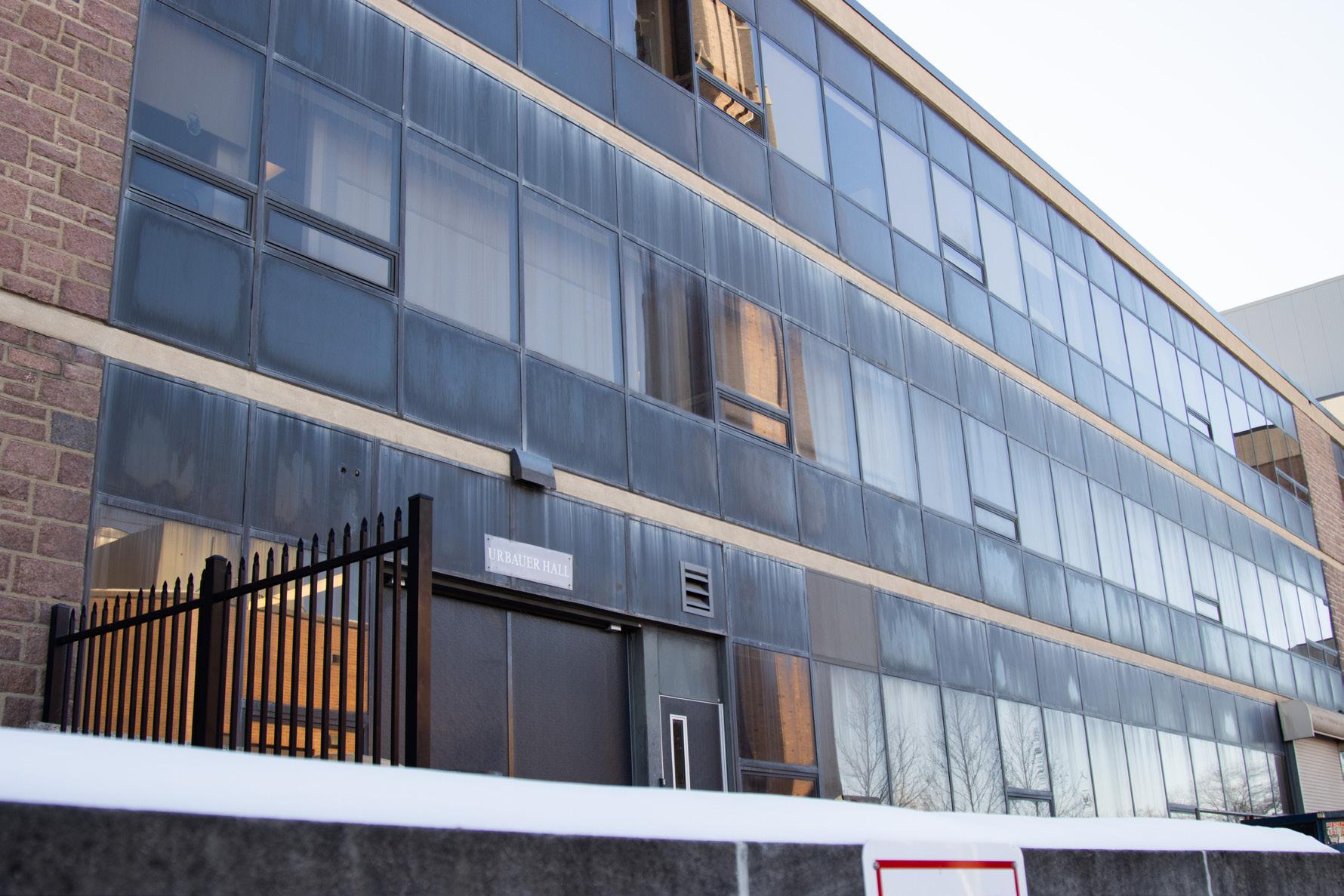
The Engineering Communication Center (ECC) at the McKelvey School of Engineering will be phased out by May 2028, Dean Aaron Bobick wrote in an email to the school’s faculty, staff, and students on Feb. 3.
The ECC currently employs seven full-time faculty members, only one of whom will have their employment contract renewed by McKelvey. Using WashU salary data, Student Life estimates that the center’s closure will save McKelvey roughly $500,000 to $600,000 annually. Since its founding in 1994, the ECC has offered a range of undergraduate and graduate courses covering topics such as writing, ethics, and team collaboration. Among these courses is Technical Writing, a required course for all undergraduates pursuing a bachelor’s degree in engineering. Future plans for the previously taught ECC courses have
not yet been formally announced to the McKelvey community.
In addition to their course offerings, the ECC offers students, faculty and alumni resources and guidance on journal articles, dissertations, presentations, and resumes, among other materials.
The ECC’s phasing out follows the quiet closure of the Women & Engineering Center over the summer. Bobick told Student Life that McKelvey currently has no additional plans to close any other student-facing centers.
Cathy Essner, a senior lecturer in the ECC, said that she was shocked and disappointed when she learned, that the center was closing in mid-January.
“It’s sad to be laid off; it’s sad to see your friends laid off,” Essner said. “But I think we’re sad for what our students are losing.”
Bobick said the decision to close the ECC was driven by a desire to avoid duplicating courses already offered elsewhere at the University.
“We don’t want to be redundant with what other offerings are being
of the week.
The Sexual Assault and Rape Anonymous Hotline (S.A.R.A.H.) at WashU is ceasing 24/7 service after almost 10 years, citing decreased staff capacity. The peer hotline will now only be available from 4 p.m. to 8 a.m starting Feb. 6 and through to the end of the semester.
S.A.R.A.H. is a peer-counseling service which is available for students to discuss sexual assault, sexual harassment, intimate partner and sexual violence, relationships, and mental and sexual health.
S.A.R.A.H. is one of the few peerhotlines offered on campus and the only one dedicated to sexual health and violence.
Caroline Cramer, the external facilitator and co-president of S.A.R.A.H., said the hotline is strategically choosing hours they will be available to ensure students will still have resources. S.A.R.A.H. is considered to be part of the Relationship and Sexual Violence Prevention Center at WashU, and the RSVP Center itself is open Monday through Friday from 8:30 a.m. to 4:30 p.m. Additionally, Uncle Joe’s Peer Counseling is available from 7 a.m. to 1 a.m every day
Cramer also said she remains hopeful that S.A.R.A.H. will return to 24/7 access in semesters to come, depending on staffing availability.
Kim Webb, director of the RSVP Center, said the center will continue to have a 24/7 emergency line available.
“After 5 p.m. and on weekends and holidays, we have an on-call counselor who is available for situations that involve risk to safety or harm that has occurred within the past five days,” Webb wrote in an email to Student Life. “We can facilitate or discuss emergency options such as hospital care, medications, alternative housing, orders of protection, etc.” Additionally, she said that the RSVP Center should be able to accommodate the foreseen increase in demand for their services, given that S.A.R.A.H. is no longer operating 24/7.
“We have the current capacity to cover the potential increase in appointments and the needs that arise due to S.A.R.A.H’s reduction in hours,” Webb said. “I do not anticipate needing any adaptations immediately. However, if we find that we need to make changes to meet the needs, we will do what we need to do to continue to serve
April 24, 2024 ‘A
DOWN GOES NO. 1
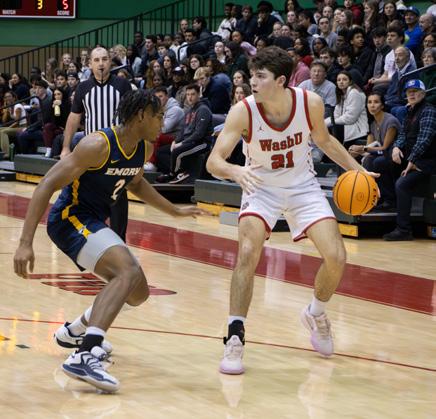
Men’s basketball upsets top-ranked Emory. (Sports, pg 7)
ELLA MESHOULAM
MANAGING NEWS EDITOR STAFF WRITER
Following continued student advocacy, the American Culture Studies (AMCS) program at WashU has created a “focus area” for Native American Studies.
Noah Cohan, assistant director of AMCS, said that Native American Studies (NAS) will be available as a subject focus area alongside pre-existing focus areas in American Culture Studies (AMCS) such as Race & Ethnicity, Gender & Sexuality, and Ability & the Body. Students will be able to add the focus area to their AMCS major or minor by taking three courses in the field, two of them above the 300-level.
done on campus. That’s not particularly efficient or effective,” Bobick wrote. “Effectiveness and efficiency, in terms of how we invest our funds, is fundamental, and that’s true regardless of how many funds you have.”
In his email, Bobick wrote that McKelvey students will be encouraged to use other University resources to develop their communication skills. He also announced that McKelvey undergraduates will now be required to take College Writing, a course of which McKelvey students could previously test out.
“This does not represent a change in our values with respect to communication,” Bobick wrote in the email. “We remain committed to ensuring all McKelvey students develop professional communication skills through a variety of communication-focused educational opportunities available across campus.”
Interim director of the American Culture Studies program, Elaine Peña, said the focus area is operational immediately and will be officially announced on Feb. 20. She said the availability of future aspects of NAS, such as a minor or major, hinges on whether the program can get enough faculty and classes to support a minor or major and if there is sustained student interest in the creation of a minor or major.
“We need instructors,” Peña said. “We need students. It’s going to be a team effort. It’s not just AMCS and the dean’s office doing this from the top down. We need word to spread among students that if this is something that the student body is really interested in, we’re going to need their buy-in as well.”
Senior Marissa Mathieson, Diné student and president of the Washington University Native American Student Alliance (WUNASA), has been an advocate for greater Native visibility since her first year of university.
Students Marissa Mathieson and Taryn Dixon submit an opinion submission to Student Life arguing for greater Native American representation, support, and academic visibility.
Jan. 15, 2025
StudLife’s news team publishes its first article regarding NAS, reporting that Native students on campus are frustrated by the lack of academic options and resources.
Oct. 13, 2025
Mathieson, Dixon, Schisler, and Young submit a report on Indigenous Peoples Day calling for an NAS department in addition to increased faculty in NAS, along with implementation of scholarships and recruitment for Native American students. Oct. 17, 2025
The St. Louis Post-Dispatch ran an article on the Native American student activism at WashU on its front page.
Nov. 5, 2025
Mathieson and Aspen Schisler met with Vice Deans J. Andrew Brown and Erin McGlothlin to discuss the report.
Nov. 7, 2025
Mathieson and Schisler met with Associate Vice Chancellors Rob Wild and Mark Kamimura-Jiménez to discuss the report.
November 2025
Mathieson and Schisler invite senior leadership of WashU to meet about the report. Dean Feng Sheng Hu, Provost Mark D. West, and Chancellor Andrew D. Martin do not attend discussions.
February 2026
The focus area of NAS in AMCS becomes operational. MASON SUTTON | SPECIAL ISSUES EDITOR
students first.”
Cramer said the decision to cease 24/7 functioning was unanimous, with every S.A.R.A.H. peer counselor agreeing it was best for the organization given the staffing issues. Cramer speculated that the time-intensive nature of recruitment and training, in conjunction with individual S.A.R.A.H. members dealing with external circumstances, could explain member loss.
New S.A.R.A.H. members train for more than 100 hours in the first spring they are a member and, as Actives, complete around 360 hours of on-call time per semester. Cramer explained that Actives also do other work that is not factored into the 360 hours, such as training new members.
“We do all of our training inhouse, [so] the members who are already in S.A.R.A.H. — ‘Actives’ — help with all the training during the spring,” Cramer said. “We only can really have as many trainees as we can support, Actives helping them out. Not that it’s a one-toone ratio, but because of that, we couldn’t accept a ton of people this last fall. I think we’ve also lost members throughout this year, more than we typically do.” Further, some Actives, if they choose to, can also participate in
outreach to other student organizations on campus.
“We present to other student groups on how they can be a good friend for someone who’s going through this,” Cramer said. “We not only help survivors or help people who just want to call; we also have people who care about their friends [and] family members who might have experienced any mental health issues, but also any sexual assault.”
Cramer said S.A.R.A.H. can also present on Title IX and reproductive health in the St. Louis area.
Every S.A.R.A.H. peer counselor is completely anonymous, and the callers’ identities are also protected. Cramer said that though this is a key tenet of the organization, it can also make outreach difficult.
“I think that sometimes it’s a challenge because we can’t advertise as much about how S.A.R.A.H can be a resource because our members themselves can’t advertise,” Cramer said. “[That] is how you hear about a lot of student groups on campuses — their members talking to other people about how cool their organization is and what change they’re making on campus.”
Webb said the students who work as S.A.R.A.H. peer counselors are exceptionally dedicated and hard-working, and the decision to
cut 24/7 service came after much deliberation.
“The students who have committed to being a S.A.R.A.H. peer counselor are among the most dedicated student leaders I have ever worked with,” Webb said. “When they realized how difficult it was to fill shifts this spring due to students being abroad, and a few students leaving for some demanding academic endeavors, they had very intentional and thoughtful conversations about how they could continue providing quality and ethical care to our community.”
To Cramer’s knowledge, no S.A.R.A.H. peer counselor has ever publicly announced they were a member of S.A.R.A.H., but in the midst of their shifting hours, Cramer felt compelled to assure WashU students that the decision to cease 24/7 operations was made in the interest of both the members of S.A.R.A.H and the student population.
“I think a statement can sometimes read quite blank, and I want to have continued trust with our callers and keep encouraging them to call,” Cramer said. “Know that we’re here, and you can always call. We want to serve the WashU community as best as possible and hope that this decision doesn’t lose any trust or support in S.A.R.A.H.”
CHLOE LIU
The Burning Kumquat, a student-run garden on the South 40, faces potential displacement due to the construction of new dorm buildings.
The garden has more than 40 beds and has been around since 2007. Student volunteers take care of the garden and receive free vegetables in return.
Members of Burning Kumquat had not heard about the potential effects of construction on the garden from the administrative team. Rather, first-year Diego Carmona saw a blueprint of the construction project through a post on Sidechat and noticed that one of the buildings overlaps with the garden’s current location.
“Are we going to move to a new place? Is the construction even going to happen? We are
page 1
This past fall, Mathieson submitted a detailed report to the administration, alongside co-writers senior Aspen Schisler and alumni Taryn Dixon and Amanda Young, advocating for increased academic options in NAS and greater outreach to prospective Native students.
The report outlined steps to create a NAS department in the College of Arts & Sciences, requests for a cluster hire of faculty with this specialization, and the implementation of a scholarship and recruitment program for Native American students. The report argued that these changes would put WashU on par with peer universities that already have similar programs.
Mathieson said that, even though the upcoming focus area is a good step, she thinks WashU still has room for progress.
“In all practical manners, it is a phenomenal stepping stone,” Mathieson said. “But I think that it is also imperative to know that it is not the last step. It is not the end goal, and I think that WashU still has a ton of progress to make.”
Professor of Sociocultural Anthropology Bret Gustafson said, while he personally views a minor as feasible for the University, the issue is
from page 1
The decision to close the center was first communicated to Seema Mukhi Dahlheimer, the director of the ECC, in early January. The six ECC lecturers were informed of the closure at an in-person meeting on Jan. 14, and adjuncts were notified via email later that same day.
A full time lecturer in the ECC who asked to remain anonymous due to concerns of retribution said the center’s staff was told the decision was made due to budget constraints.
“What we were told was essentially an extension of messages that we’ve already received about McKelvey being in some tough financial straits,” they said. “That they just needed to make hard decisions about what was ‘core’ in engineering and what was ‘nice to have.’”
Lecturer J. Tucker Krone was told via email that his contract would be renewed. Krone, a McKelvey alum, has taught courses within
just not sure,” senior Cameryn Berryhill, co-president of Burning Kumquat, said.
Berryhill oversees the garden side of the club.
“We are kind of nervous because this spot has been ours since 2007,” she said. “It is a really nice spot. It’s huge, and we get to hang out there. We get to have [pit fires] there.”
The club executive team is currently in discussion with the Division of Student Affairs, including Associate Vice Chancellor for Student Affairs and Dean of Students, Rob Wild, and Vice Chancellor for Student Affairs Anna “Dr. G” Gonzalez regarding the future of the garden.
“[From] what the school has told us … we would have to leave by June 1,” senior and co-president Eden Naureckas said. She manages the external side of the club. “The ultimate goal would be to stay
more whether the University will continue developing NAS beyond a minor.
“The bigger question is, will the dean or the University say, ‘Okay, there’s your minor. We gave you something. Stop your activism.’ Whereas the students that I know have a longer-term vision; they would like to create a major, and maybe the major would become something else,” Gustafson said.
Peña explained that the pace of the release of a minor is intended to ensure that any NAS offering is sustainable. She added that progress in academia tends to be slow, and that she does not view the rollout of a potential NAS minor at WashU as particularly delayed.
“The report just came out, right?” Peña said. “It’s something that [we are] not deferring … I think what both the dean’s office and the American Culture Studies program want is for us to put this in place in ways that will have longevity. We prefer that we’re doing it methodically, that we’re covering all our bases to make sure that we have money for tomorrow.”
She also said that AMCS is invested in adding more NAS opportunities within the program, but that a focus area is more sustainable at the moment. She said that a
the ECC and in the wider Division of Engineering Education since 2017. He will continue to teach courses such as Engineering Statistics within the Division after the center’s closure.
On Feb. 13, proposed ways for maintaining communication skills in other departments will be presented and voted on in the faculty assembly. Dahlheimer said she thinks plans will be shared with the broader McKelvey community after a decision has been reached. However, Bobick said that the Curriculum Committee has two years to solidify the new plan.
In the 2026 fiscal year, the Danforth Campus aims to operate at a $7.4 million deficit. This past fall, these budget cuts resulted in layoffs across the University. Bobick noted that when school budgets are decreased, certain departments within schools may be prioritized for funding over others.
exactly where we are, [and] I don’t think that is off the table at this moment,” Naureckas said.
The club’s backup plan would be to relocate the garden to a different location still on the South 40.
“If we were to move anywhere, the next couple of years are going to look like rebuilding, putting in new beds, and re-grappling — not really gardening,” Naureckas said. “At the beginning of that process, it would certainly involve a lot of construction, rather than plant growth and harvest.”
Many club members express that they have had memorable times in the garden and say it has become an important part of their time at WashU. Until they receive more communication from the administration, the club is still running and preparing for upcoming projects.
“I am graduating, but I
minor requires programming and public-facing events that AMCS does not have the infrastructure to support at the moment.
“Even if [expanding NAS options] is going to be a stretch for us in terms of work, in terms of labor, in terms of finances, this is something that we think is very important to the American Culture Studies profile,” Peña said. “So we don’t mind the fact that this is going to stretch us.”
Peña said that students in particular will need to continue advocating so that the dean’s office recognizes NAS as something that students want implemented.
AMCS is one of the few programs or departments at WashU that has an endowment. Though they have an endowment, Peña said that AMCS cannot hire a professor of NAS solely from the endowment.
“It’s very complicated,” Peña wrote in an email to Student Life. “The bottom line is that AMCS needs support beyond its endowments to move forward.”
Sophomore Jenny Barnett grew up on a Yankton Sioux reservation in Wagner, South Dakota, and she went to WashU intending to study NAS through AMCS and apply to the 3-2 program at
“We have things that we need to do within the core academic disciplines, and so it’s just a matter of making choices of what we need to offer,” he said.
Another anonymous lecturer employed by the ECC told Student Life that McKelvey is losing out on a critical resource that gives both the school and their graduates a competitive edge.
“If you look at our peer institutions, they all have robust communication centers and programs so that they can graduate students who are ready and have the basic competencies to navigate these responsibilities that they’re inheriting in our world right now,” they said.
“My real concern is that our students aren’t going to be as prepared anymore.”
Retiring adjunct lecturer
Jeffrey Hamilton, who has taught writing classes in the ECC and in the English department of Arts & Sciences, said he felt that the

am really sorry for the rising members of our garden,” Naureckas said.
However, whether or not their current space is taken over by new dorms, the Burning Kumquat will persist.
“The garden isn’t just valuable to people who already
the Brown School of Social Work. As an area often understudied even in her own community, Barnett said she was excited to pursue it further and thinks that establishing formal academic visibility would help educate students.
“I’m from a Native American reservation, lived there my whole life,” Barnett said. “Growing up, there is a kind of common sense of Native culture and the history for me, and even there, I thought that we didn’t learn about it enough … Then coming here was just a total shock to me, just how little people knew.”
First-year Alyson Lone Bear is a member of the Hidatsa tribe based in North Dakota. While applying to colleges, Lone Bear was drawn to WashU because of the Kathryn M. Buder Center for American Indian Studies and the potential to eventually pursue a Master’s in Social Work with American Indian and Alaska Native Concentration (AI/AN) through WashU.
However, Lone Bear, who has been drawn to NAS courses as an undergraduate, said she found difficulties when trying to enroll in multiple NAS courses in one semester.
“There were only three
primary aim of classes like Technical Writing was to provide an engineering-specific writing class.
“It’s always been my understanding that McKelvey wanted a course specifically tailored to their students,” Hamilton said.
“An upper-level writing course like they do over in the School of Arts & Sciences, but to do it on more technical, scientific grounds for their students.”
In addition to teaching undergraduate and graduate courses, the ECC also serves as a writing center. An additional anonymous lecturer at the ECC said they have noticed a decrease in appointments at the center, possibly due to the rise of generative AI.
“I have heard through professional organizations that, nationwide, writing centers are seeing less traffic, and they do connect that to the advent of widespread generative AI,” they said.
know a lot about gardening, about plants,” Naureckas said. “I think one of the most important functions of the garden is being a community space and a natural space.”
Naureckas emphasized the importance of the Burning Kumquat to the entire WashU community.
“I would encourage, especially as the weather gets warmer, everyone to pay the garden a visit and stop by and help us out and to get a real sense of who we are,” she said.
options for Native American Studies courses this semester, and two of them were at the same time,” Lone Bear said. Peña said the AMCS program is in the process of integrating classes from the Buder Center, so they are accessible to undergraduate students. However, she said this process depends on bureaucratic processes, such as whether AMCS can get credit hours for a graduate class offered in the Buder Center to count as a 4000level class.
Mathieson said that, though she understands the desire for a sustainable program, she is frustrated that the burden of advancing an NAS initiative has fallen on Native students.
“I think that incrementalism puts the burden on a lot of Native students to keep the momentum up and show interest and prove themselves,” Mathieson said. “I feel a huge burden as a Native woman to carry this movement forward.”
Eman Ghanayem, a former postdoctoral fellow in Indigenous studies in AMCS, said that, though she found AMCS supportive of her and her research, the shortage of NAS scholars at WashU made it difficult for her to discuss her research with others. Additionally, Ghanayem
However, Krone thinks that it is important that students learn writing skills as they will not be able to rely on AI in the workforce.
“There are going to be situations in which engineers, whether it’s a security clearance, whether it’s working with HIPAA, they’re not going to be able to use AI to write,” Krone said.
Essner said that the ethics and analysis skills taught through the ECC are especially relevant for current engineering students.
“The times that we’re in right now really mandate that engineers be able to recognize the complexity and the human stakes behind the technical decisions that they are making,” Essner said. “That kind of awareness does not develop automatically. It has to be cultivated, and that’s exactly what the ECC is for.”
Erin Ritter, who received her bachelor’s degree from McKelvey in 2024, said that
said that the pressure on students to continue to advocate for NAS seems unsustainable for students mentally and logistically, and that faculty should also play a role in advocacy.
“How do you keep the momentum going? I would say [this] falls within the hands of the faculty,” Ghanayem said. “They could always do more. Additionally, I think this is a project that should be embraced by [everyone] outside of AMCS, because it would benefit all WashU students.”
Mathieson said that though she thinks they could be expanded, the existing opportunities she has had at WashU to engage with NAS academically have provided her with mentorship and growth.
“My professors in AMCS, like Dr. Gill or Dr. Eman, have been … the best mentors I will ever encounter in my entire life,” Mathieson said. “They’ve made me feel seen. They have helped me forge my own path. They’ve taught me things about my own culture and identity and about other tribes that I never would have had the opportunity to learn. And they also created a zest in my academic career that I would not have had otherwise.”
the skills she learned in the ECC have helped her stand out in an increasingly competitive job market.
“The skills that we learned from the ECC, like resume writing, personal statement writing, were especially important for getting people into positions that could potentially open up other doors,” Ritter said. While the Writing Center at WashU offers similar resources, Ritter told Student Life that a center geared specially towards engineers offers something irreplaceable. She added that the ECC’s closure poses an equity issue.
“There’s a lot of students who are neurodivergent or who might speak English as a second language, and that’s the type of support that can be necessary for success,” Ritter said. “Being neurodivergent myself, that’s something that I’ve struggled with a lot and got adequate support for from the ECC.”
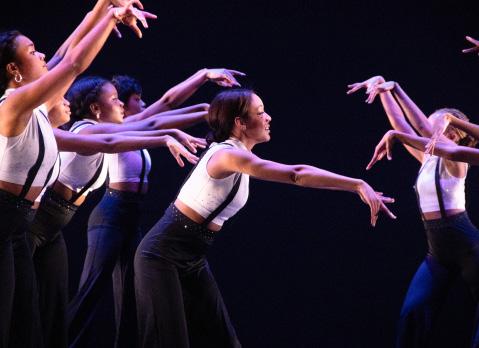
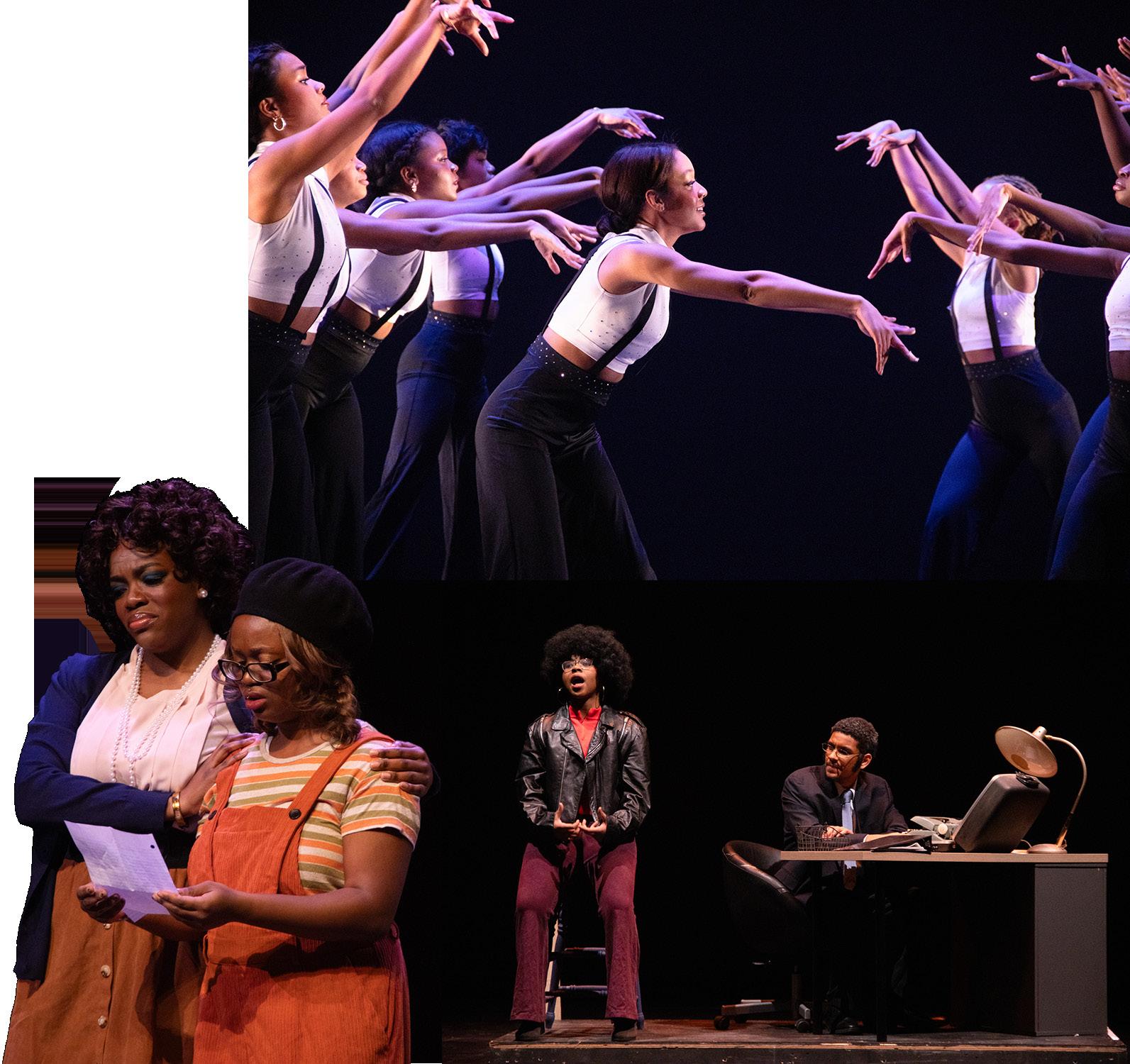
As the play begins, lighting illuminates a simple yet pleasant family room, filled with vintage furniture in yellow and orange tones. Suddenly, conflict arises: the main character, Nellie, is gone. As domestic chaos unfolds, her entire family questions her disappearance, and the living room becomes the stage where complex intergenerational differences are woven around activism with sitcomlike ease.
Black Anthology’s (BA) 2026 performance, “It’s Easy Going,” centers around Nellie’s departure and the fallout of her choice. The production ran Friday, Jan. 30, and Saturday, Jan. 31, in the Edison Theatre. This year, the students behind the show brought a fresh perspective to their production, inspired by the culture, activism, and social dynamics of the late 1960s. The result was a story that resonated with audiences beyond any single background or lived experience. The play reflected not only the nuances of real life but also the timeless dilemmas young people face as they grow up, balancing tradition and independence.
In a flashback before her disappearance, Nellie joins her uncle on the sofa, laughing as they flip through TV channels together. Her uncle then begins telling the story of his youth, when he left home to work as a member of the Pullman porters, sleeping car attendants who went on to form the first union led by Black workers. It all sounds unbelievable, and it’s later revealed that he’s actually retelling Malcom X’s life story as his own. For the moment, though, the mood grows sentimental as he describes the tiresome yet exciting brotherhood of the job. Moved by his journey, the niece feels inspired to find a community for herself.
Producer and senior Ha-Ya Davis explained how her team envisioned the meaning behind the title, “It’s Easy Going,” to reach the audience.
“It’s an oxymoron in the sense that it’s really not ‘easy going.’ These are your ideologies, your political beliefs. They’re important to you. They’re a part of who you are,” Davis said. “Acting upon those beliefs can be very easy, but also it comes with its hardships, its consequences.”
The show takes place during the Vietnam War
and intentionally coincides with Philadelphia’s famous Historically Black Colleges and Universities’ student protests. Although the script is rooted in history, the play includes themes that carry into modern-day life. In the panel discussion before the show, audience members were encouraged to consider how values can grow and the importance of staying true to ourselves as our surroundings change.
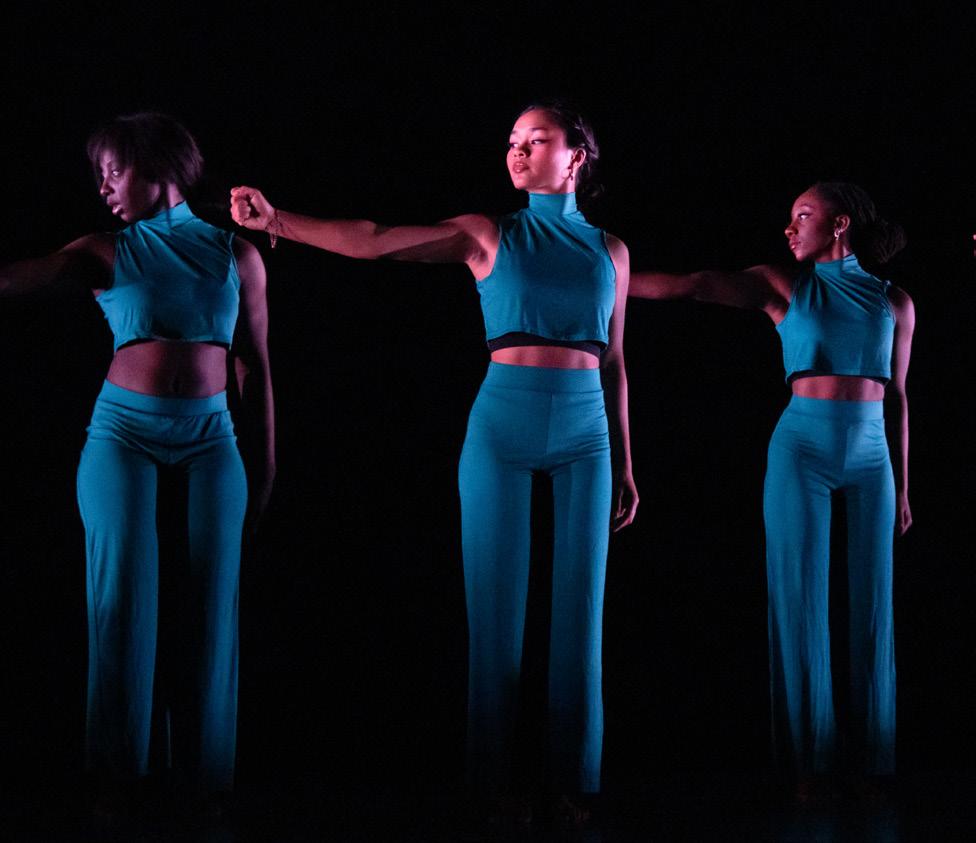
With late 1960s Philly as the backdrop, there is something enduring and often joyful about the stylistic choices made by the cast and crew. Dances to Marvin Gaye, “It’s a Man’s World” by James Brown, and multiple R&B pieces allow rhythm to further the story of homesickness and old, yet ever-present struggles. Monologues about sibling or spousal dynamics earned plenty of hums of recognition from the audience, while bursts of lighthearted, slapstick humor sent everyone into hysterics. Feuds among friends and relatives burned bright, highlighting the casualties that come with challenging the norm.
Set designer and senior Obike Anwisye explained that the set, which was created in tandem with the script, flourished thanks to the hard work of each member of the show.
“It feels like a place that somebody might call home,”
Anwisye said. “Whether it’s a brush stroke of paint on the set that somebody did when they had 15 minutes to spare, or if it’s the most technically complex dance move or whatever our longest monologue is … the audience will see the effort that [the cast and crew] have put in so far.”
Anwisye has been part of Black Anthology throughout all four of his years at WashU. Speaking on
community within Black Anthology, his expression melted into one of ardent reminiscence.
people from so many dif ferent walks of life that come to BA to do what ever performance it is that they’ve come to do,” he said. “I think that that’s really something that I’ve cherished all four years, knowing we’re here to tell a story, [and] that every one kind of fits into that story.”
Marcia HayesHarris
founded Black Anthology in 1989 to educate others about and celebrate Black contributions, the organization has gradually transformed into a student-operated production, which reflects on Black culture and experiences. The organization is grounded in a community of its own, and Davis and Anwisye share a hope that more students will feel welcome to join in the future.
“Everyone in the world is so deeply intertwined that as long as you are passionate about telling a story about not only the Black experience, but how the world
intertwines with that, then Black Anthology is for you,”
Anwisye said. Davis reflected on the message she hoped would shine through in “It’s Easy Going.”
“I feel like if we are moving towards the better world that we all envision, we have to be
able to have hard conversations and be able to experience or put ourselves in tough shoes, as well as … shoes that are maybe not so bad,” Davis said. “We try to balance telling an accurate story, but also telling an impactful story.”
“It’s Easy Going”
presents ideas that are likely to resonate: themes of home, standing up for your values, and avoiding compliance. The performance shows that it is okay to make space for yourself and stand up for what you believe in, even when you’re standing alone.

SOPHIE SCHWARTZ
SENIOR SCENE EDITOR
While black satin camisoles, tube tops, simple corsets, and dark wash jeans are the usual suspects for a night out, Mardi Gras — known for its golds, purples, and greens, — requires over-the-top looks. This year, Mardi Gras, also known as Fat Tuesday, falls on Feb. 17. The holiday celebrates the last day before the fasting season of Lent begins. The Saturday that precedes Mardi Gras, Feb. 14, is when the city comes together and celebrates in anticipation. The Bud Light Grand Parade, taking place in downtown Soulard, makes St. Louis home to the nation’s second-largest Mardi Gras celebration (behind New Orleans).
The key to having the best day starts with the outfit you choose. Below are four curated outfits for anyone looking to have fun, fill their Instagram feeds, and celebrate in style.
For those looking to stay comfortable but still be festive, elevating the going-out staples to Mardi Gras level is the way to go. Start with a pair of black,
low-rise, baggy jeans and pair them with any gold chain belt. Y2K and ‘90s chain belts are trending this season, and Edikted and Amazon have a large variety of options. In the name of all things Mardi Gras colors, pair your bottoms with a glittery, sheer top in purple, yellow, or green. To weather the cold, a light colored fur coat is just right for staying warm. Accessorize with chunky jewelry and sunglasses, and pair the outfit with any style of boots or metallic sneakers. Don’t forget your digital camera at home; this outfit is too good not to capture.
Sequins and glitter exude all things Mardi Gras, so why not take advantage of the occasion and dress to impress? Start with a pair of sequined or sparkly bellbottom pants. Or, if the St. Louis weather is on your side, consider throwing on a pair of micro shorts. H&M and Target are my go-tos when I want a standout pair of pants for a good price. Match your bottoms with a tank top that fits the color scheme, and pair it all with a denim jacket or fur
coat of your choice. Don’t forget to accessorize with jewelry and a cute pair of sneakers or boots. This outfit will have your friends begging to borrow it for next year’s festivities.
It’s all in the accessories
While an all-out Mardi Gras outfit may not be for everyone, there are many ways to be both spirited and subtle. Start with an all black or white look. Jeans with a tank top, halter top, or whatever you have lying in the closet are the perfect base. To spice it up, consider adding a purple, green, or yellow feather boa, colorful sunglasses, and a Mardi Gras-themed headband. Beaded necklaces of all sizes are also a classic accessory. You’re certain to find many downtown in Soulard, but there’s no harm in coming prepared. For all the hairstyling lovers out there, rhinestones, pearls, or any type of hair gems add a chic pop of fun. If you’re willing to take the risk, drugstore hairspray is a fun and non-permanent way to dye your hair. Make sure to watch out because people will be eyeing these amazing accessories with burning desire.
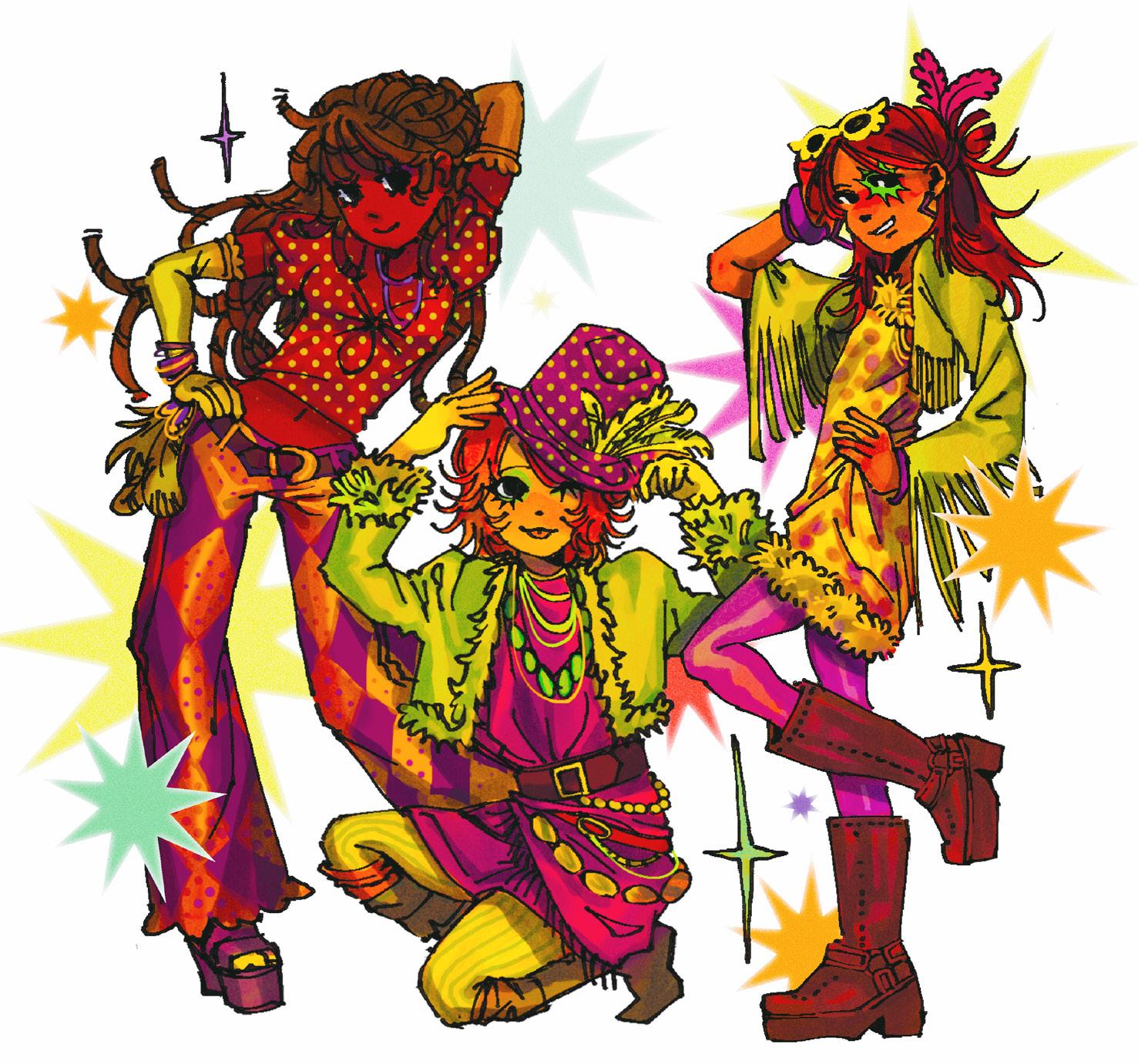
A dress is always the solution for those struggling to bring an outfit together. Since Mardi Gras calls for going all out, colorful dresses are certainly on the lookbook. For those looking to stand out, a mini sequined cowl-neck dress in purple, green, or yellow is the route to take. Amazon, Edikted, and Princess Polly are go-to websites. Dresses
of this style pair nicely with a gold chain belt and tall brown leather boots, and a few chunky necklaces help to accentuate the dress’s neckline. Unless the weather forecast is above 65 degrees, a jacket will likely be necessary to finish the outfit off. Fur coats fit well with dresses and are always a stylish option. This Pinterest-worthy outfit will not only bless your Instagram feed but also be the perfect colorful
going-out staple in your closet. At the end of the day, your confidence and comfort are what matter, and any outfit you choose will make a statement. Before you hit the shops, make sure to dig through your closet to save money before splurging. Don’t forget to live in the moment and take in all this classic St. Louis celebration has to offer.
Happy Mardi Gras!
ISENBERG STAFF WRITER
A combination of electric dancing, vibrant lighting, and a surprisingly emotional mother-daughter story cement “Hell’s Kitchen” as a show absolutely worth checking out. The semi-autobiographical Alicia Keys musical stopped on its nationwide tour at the Fabulous Fox Theatre. It follows Ali (Maya Drake, in her professional theater debut), a 17-year-old New Yorker, as she falls in love with Knuck (JonAvery Worrell),
an apartment painter who drums outside of her building.
But “Hell’s Kitchen” isn’t a love story.
At least it isn’t one between Ali and Knuck. Instead, Ali’s desire to pursue him ends up driving a wedge between her and her strict single mother, Jersey (Kennedy Caughell), and it pushes her to pursue piano lessons from Miss Liza Jane (Roz White), who lives in her building. Like a lot of teenagers, Ali is rebellious, adventurous, and hopelessly in love with someone she barely knows,
but the heart of the story is in her relatable relationship with her mom.
“Hell’s Kitchen” is a jukebox musical, where each of the songs that the characters sing is either one of Alicia Keys’ biggest hits (“Girl on Fire,” “Empire State of Mind,” “Fallin’”) or original songs that Keys wrote for the show in her characteristic R&B style. This music is what forms the foundation of the show, and almost all of its musical scenes are thrilling.
While Drake brings Ali to life with great dancing and strong singing, she is


outshone by Caughell as Jersey.
Caughell takes on the burden of playing both an antagonist and a caring mother to Ali, disrupting her relationship with Knuck and yelling at her while still needing to remind her to be home at 6 p.m. for dinner. But Caughell knocks it out of the park, effortlessly showing Jersey’s anger while slowly revealing her sympathetic background and becoming a compelling mother character.
And Caughell’s vocals during the 11 o’clock number “Pawn It All” are absolutely showstopping, earning the show’s sole standing ovation thanks to her wildly impressive belts and vocal runs.
Camille A. Brown’s propulsive choreography guides a large ensemble of dancers through effortlessly suave spins, kicks, and bounces in the show’s many dance breaks. When accompanied by Gareth Owen’s booming sound design and Dede Ayite’s vibrant oversized costumes, each song-and-dance scene becomes highly entertaining and a lot of fun.
But, of course, “Hell’s Kitchen” is not perfect.
First Place: “Nah, bro I’m not cold. Yeah bro I’ve been cold before. I’ve tried every winter bro. Really bro.”
Kate Theerman Rodriguez, Current WashU Student
Second Place: Average white man on the coldest day of the year
Bella Woolsey, Current WashU Student
Third Place: Stupidity, colorized. Quinn Moore, Current WashU Student
Although Drake, who plays Ali, does the best she can with her role in an extremely impressive debut, the show is weighed down by Ali’s reliance on narration. She opens the show, setting the scene for the audience, but then she continuously tells us what Ali is thinking and recaps her thoughts on each scene, even when it is already obvious from her lines and actions.
The projection design from Peter Nigrini is colorful, combining with Robert Brill’s scaffold-like sets to create a constantly shifting New York City skyline in the background, but projecting the name of every location across the back of the set is superfluous. The audience does not need to see that, especially when Ali has already narrated it to us.
The story is also dedicated to Ali’s music education with Miss Liza Jane, who teaches her how to play the piano every day in their apartment building. White, who portrays Jane, brings a severity with kindness to the role, encouraging Ali to “listen to [her] pain, do something with it,” and turn that
anger into song. But toward the end of the show, Jane’s story ends a little abruptly, and her lack of time onstage makes Ali’s resulting emotions feel unearned. While sweet, Jane’s storyline was ultimately less compelling when compared to Ali’s relationship with her mother Jersey or father Davis (Desmond Sean Ellington). As the show progresses, Jersey calls Davis to seek his help with Ali. Davis has been a very absent father, but worms his way back into Ali and Jersey’s story with a reworked crooning arrangement of “Fallin.’” But “Hell’s Kitchen” is ultimately Ali and Jersey’s story. It’s about a mother and a daughter pushed apart and pulled back together, fighting with and for each other. Book writer Kristoffer Diaz may have relied too much on narration and wrapped up the show slightly clumsily, but the pulsing heart of “Hell’s Kitchen” is a thrilling soundtrack, energetic dancing, and a heartwarming story of two women. See “Hell’s Kitchen” at the Fabulous Fox Theatre through Feb. 8. Tickets are still available.
Caption this! Enter this week’s contest
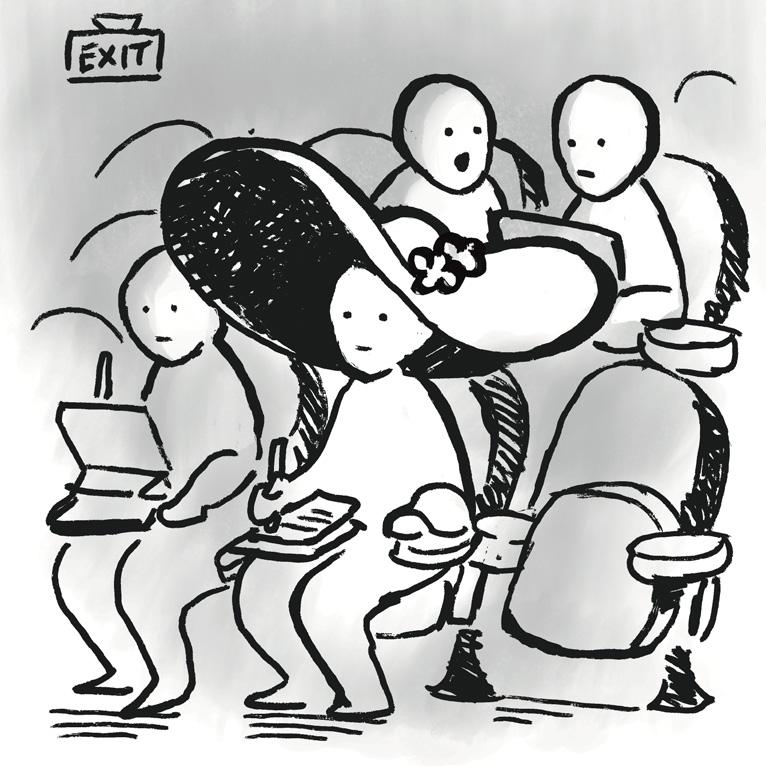
Scan the QR code to enter your submission by 11:59 p.m. on Monday.

Will Mahony stands in front of the camera, shirtless, on a townhouse roof in New York City. He points to an easel with “CHINESEMAXXING
101” scrawled in Sharpie across it. “Today, WE are Chinese,” he says. His “very Chinese day” begins at a market where he shakes hands and bows to the smiling shopkeepers (whom he refers to as “low cortisol people”) before buying a $100 statue of a golden ram. Then he’s off to dinner, where he takes “10 Tsingtaos to the dome.” He smokes a few cigarettes before heading to the casino to end his night at the baccarat table.
Last summer, I watched videos like these from my dorm room in Beijing in frustration. Somehow, other Americans without Chinese backgrounds had discovered what I had thought was my secret to gatekeep: China is awesome.
A wave of “Chinesemaxxing” has swept the Internet over the past few months, prompting a slew of non-Chinese influencers to proclaim their Chinese-ness through activities like eating communally with a large group of friends, using traditional Chinese medicinal
herbs, or only drinking warm beverages. People spanning race, age, and gender divides have decided that they are so interested in select aspects of Chinese culture that they “are Chinese.” To me, a Chinese major, it was a great offense. I put in hundreds of hours of work for the opportunity to drink with Chinese uncles, and they think a few Instagram Reels are enough?
Though the narrative pushed by the American government positions China as our chief adversary, this trend presented Americans with an opportunity to look past the U.S. government’s inflammatory rhetoric and instead reach out to the millions of Chinese people living in America and the thousands on our campus. It seemed as though the wave of anti-Chinese sentiment that had been building since 2020 was finally starting to flip.
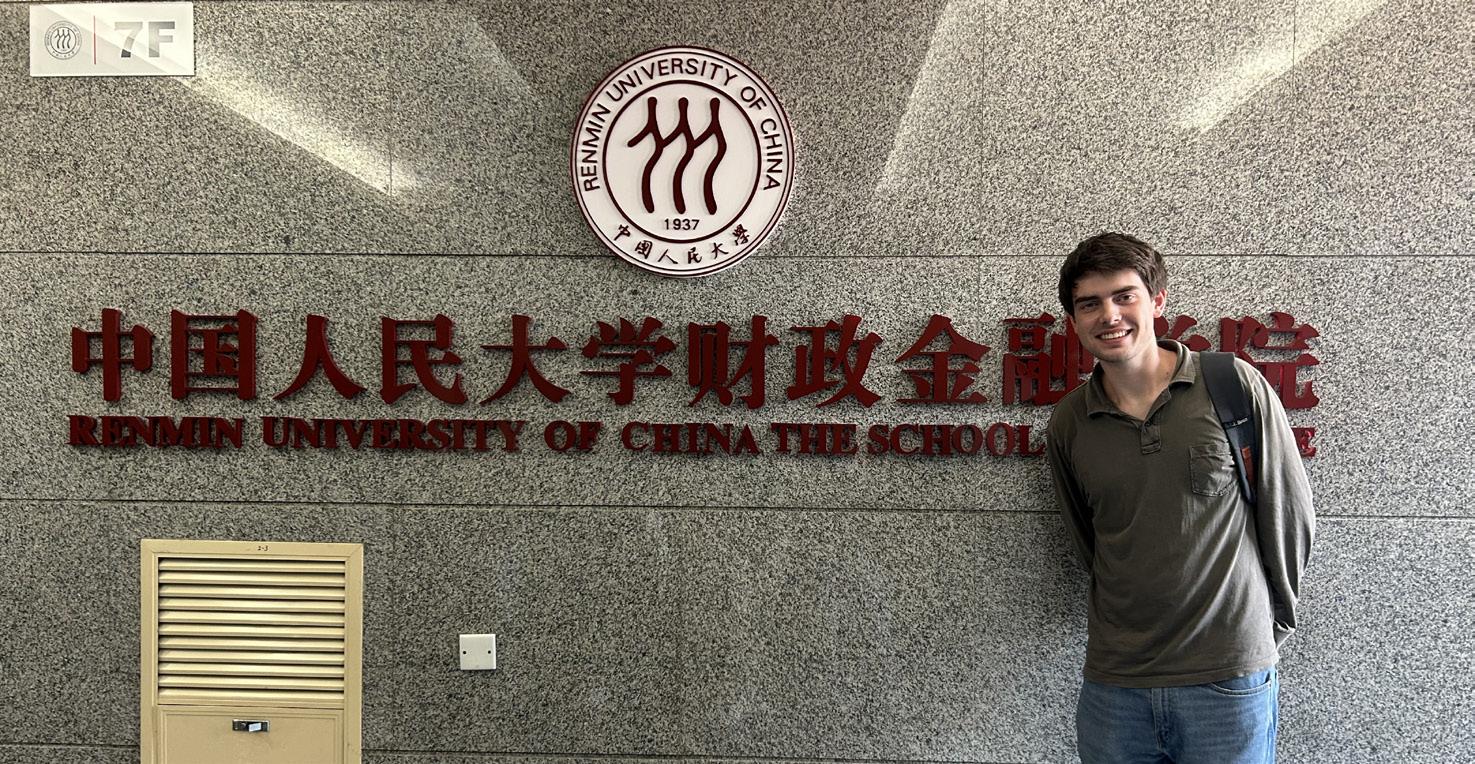
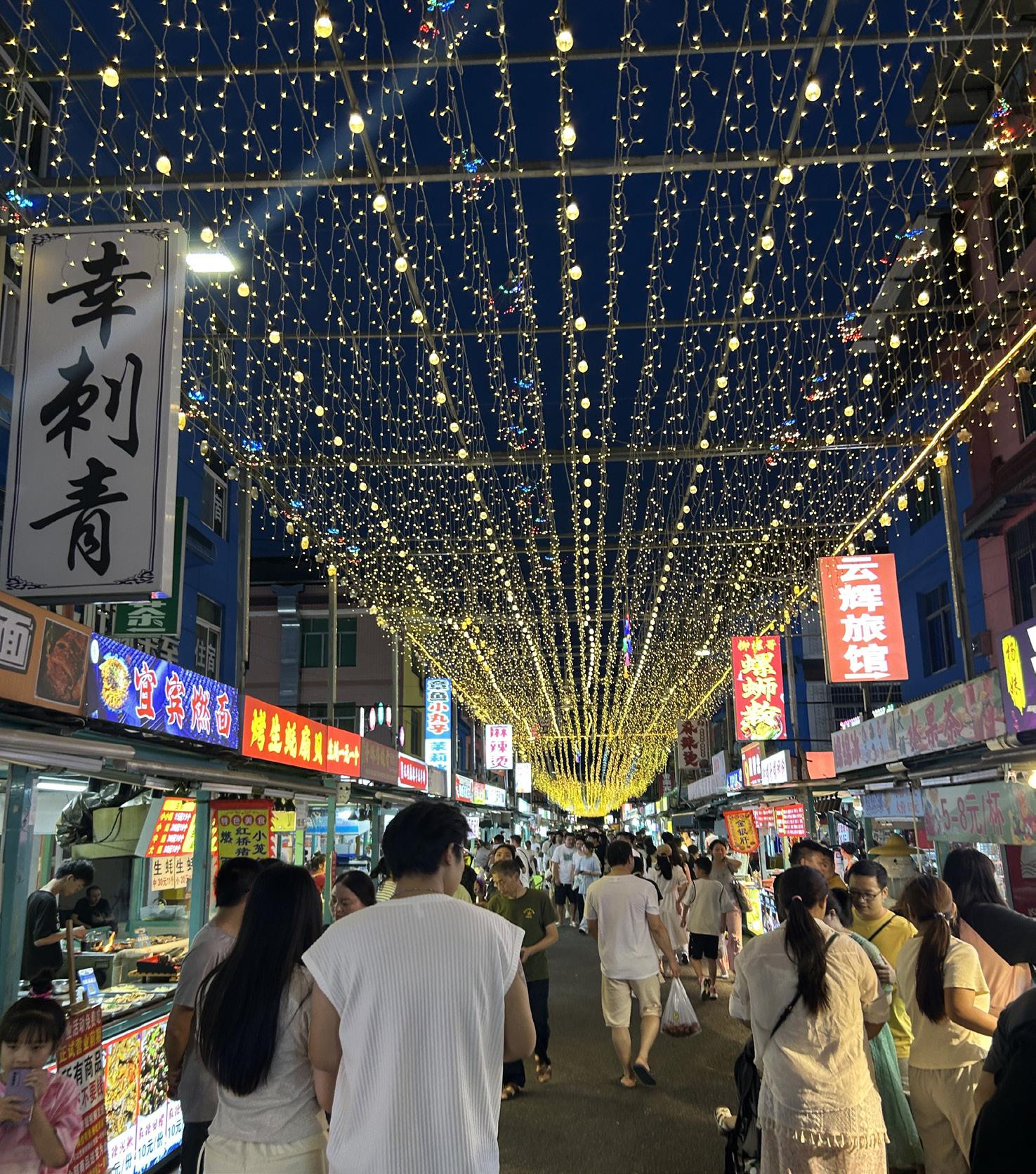
I lived in Beijing for two months last semester as part of a study abroad program, and while I loved spending time with my American friends in the program, my best nights were spent without them. I would venture out alone with no plan but to see Beijing and experience China. Next thing I knew, I’d be eating lamb skewers with a couple who want to know if America
really is the culture-war hellscape that they’ve heard it is, fighting with three college students to pay for the bill after they treated me to their favorite dishes at a local restaurant, or trying to explain in Chinese why I don’t have a girlfriend to the incredulous owner of a one-woman beef noodle soup shop. When my time was up, I returned to the beautiful city of St. Louis, excited to channel my friends’ newfound appreciation of Chinese culture into exploration. Instead, I found a completely different reality.
As the government waged war on Chinese students through rhetorical assaults, the promise to “aggressively revoke” visas, and performative legislation, our Chinese classmates got none of the love that we directed toward our favorite parts of their culture. Though online it seemed like Americans were finally ready to overcome the notion that Chinese people are our enemies, I didn’t see this reflected on campus. It didn’t seem like we were excited to welcome them or to show them the things that should make them love America in the same way I grew to love China. This is just as much a missed opportunity for us as it is for them. Take my first-year dorm, for example. I would practice Chinese with a suite
of international students across the hall from me, and we quickly became friends. Every other week or so, they would make a feast in our tiny dorm kitchen for a huge group of Chinese students who flocked to our building for the meals. But when I’d reference my friends by name to other people in the building, most of them didn’t know who I was talking about. It wasn’t until I called them “the Chinese group” that I got a flash of recognition. Most American students weren’t willing to take the slightly awkward step of saying hello, or better yet, inviting them to our parties and events.
Ignored by American students, most Chinese students remain in their insular
bubble. One day, I asked my friend Edward why he was only friends with other Chinese students. “I tried to be in an American group,” he told me. “But I think we’re just too different.”
There is a pervasive dissonance in the way we interact with Chinese culture and people. We love “being Chinese,” cherrypicking our favorite aspects of Chinese culture to adopt as our own. Why don’t we include Chinese people in our newfound appreciation for China? Mahony, with his tattoo-covered, hairy beerbelly unabashedly showing, may have put it best: “Uh, ‘scuse me … are these people so different than me, or are we actually the same exact person?”
Instead of scrolling on Instagram Reels and liking videos of Americans saying “I’m so Chinese that Chinese food is just food to me,” invite the Chinese student in your group project to dinner. Instead of watching clickbait edits of the “INSANE cyberpunk city Chongqing,” buy tickets to the student-run Lunar New Year performance this weekend, and say hello to the person next to you. Spoiler alert: The easiest way to “be more Chinese” is to interact with Chinese people and Chinese culture in real life. Who knows, maybe you’ll like the memes even more after you’ve been to the karaoke bar on Delmar or shared a meal at Chilispot with your new Chinese friends.

ALEXA WELLS CONTRIBUTING WRITER
“The Party told you to reject the evidence of your eyes and ears. It was their final, most essential command,” writes George Orwell in his visionary dystopian novel, “1984.” Set just 40 years ahead of his own time, Orwell imagined a world not dissimilar to his own postwar reality — a world made unrecognizable by totalitarianism. Suffocated by the surveillance of their dictatorial government, the protagonists struggle to find truth and meaning in a society that has rewritten history and punished free thought. In the end, both characters succumb to the futility of resistance, falling complacent. Today — and almost 70 years after the novel’s publication — this quote resonates with many Americans, with the excerpt featured in many social media posts, sometimes pasted over a photo of the bloodied front seat headrest of Renee Nicole Good’s car.
On Jan. 7, Good, a Minnesota mother and
American citizen, was fatally shot four times by an Immigration and Customs Enforcement (ICE) agent during an operation in Minneapolis. At least three different videos taken by bystanders captured the murder from different angles, which have since become scathing evidence against the Department of Homeland Security’s (DHS) claims that agent Jonathan Ross acted in self-defense. Eyewitnesses to the murder have corroborated that Good was attempting to drive away rather than hit the agent who fatally shot her. Despite the evidence, DHS Secretary Kristi Noem has labeled Good as a “domestic terrorist,” stating that she deliberately tried to “run over” Ross with her vehicle and that Ross “did what he was taught to do” in the situation, using his firearm in an act of selfdefense. President Donald Trump posted a Tweet calling Good a “professional agitator,” claiming that she “viciously ran over the ICE officer,” and he finds it “hard to believe that he is alive.”
These statements have turned the videos and eyewitness accounts of Good’s murder into contestable material, weaving a portrayal of Good as an agitator and the ICE agent as an American hero. By vilifying a victim of murder in order to cover up its own mismanagement, the Trump administration’s defense claims have sparked outrage throughout the country.
Many have since associated the current government with the oppressive regime of Orwell’s premonitory novel, and while Americans might not be in as dire a situation as the citizens of Airstrip One, we all ought to see this comparison as a wake-up call. As our government begins to carry out the same actions as the quintessential literary example of authoritarianism, we have a duty to call out these injustices for what they are before they get worse.
Since his first term, when Trump denied the veracity of a leaked “Access Hollywood” clip that recorded him joking about sexually assaulting
women, the president has constructed narratives in direct conflict with the factually-provable ones. Consider the president’s claims that “there is virtually no inflation” in the U.S. despite continued inflation, or that gas prices went down to $2 in some parts of the country, with no supporting evidence. These contradictions resemble the “doublethink” of Orwell’s novel, in which The Party — the novel’s authoritarian government — lays out two opposing facts as both true despite the obvious cognitive dissonance. The Party’s claim that “War is peace” feels eerily similar to the DHS’s deployment of ICE to “make America safe again,” even as these agents injure and kill innocent Americans with no repercussions.
Reputable news sources have debunked plenty of Trump’s contradictory claims since his time in office, but his continued spread of falsehoods clearly demonstrates that, for him and his Cabinet, objective truth has no importance. As the book shows us, when
figures of authority can lie about important truths without consequence, they wield the power to distort reality in dangerous ways.
Frighteningly, many Trump supporters believe the false narrative regarding Good, denying the evidence in favor of a palatable storyline that reinforces ICE’s innocence and avoids criticism of our government. Orwell’s quote warns against this very phenomenon — namely, people rejecting all evidence that weakens the regime and blindly trusting their leader’s incongruous narratives.
We must remain vigilant against the tirade of misinformation brought on by our current administration, using our own eyes and ears to discern facts from convenient distortions of the truth.
It is absolutely a scary time to speak out; there’s no denying that. But there has never been a time when it is more important to bear witness, to document the truth as lies run rampant. Though it may be easier to rely on one person or source for our information,
we instead must fact-check, cross-reference, and question the origins of the news we read. Factcheck.org is a great nonpartisan website that can be used to check the veracity and bias of news sources. We must continue to make our voices heard through protest, voting, and even spreading awareness online, especially as our administration continues to silence protestors and deny evidence of ICE’s misconduct. Recording officers is also our constitutional right, and has proven to be helpful in holding ICE accountable and counteracting the administration’s attempt to control information. And above all else, read. Reading novels like “1984” makes us aware of the totalitarian leanings of our government through comparisons to the imaginary worlds of writers who lived through fascism and foresaw the trajectories of unchecked power. At this pivotal and uncertain time in our country, we must rely on our eyes and ears to prevent Orwell’s prophecy from becoming reality.
ICE’s violence won’t end in Minnesota. We cannot be complacent.
On Jan. 7, 37-year-old
Renee Good was shot and killed by an Immigration and Customs Enforcement (ICE) officer in Minneapolis, Minnesota. On Jan. 24, 37-year-old intensive-care unit
nurse Alex Pretti was fatally shot by ICE officers while peacefully protesting.
Since the agency’s inception in 2003, ICE has obstructed due process and treated immigrants inhumanely. What ICE has not been known for, until recent events, is the murder of United States citizens.
What is happening right now is not exclusive to a single city or state. Since September, the Department of Homeland Security (DHS) has shot 13 people during immigration enforcement operations. In Trump’s second term in office, ICE agents have also killed Silverio Villegas González in Chicago, Isaias Sanchez Barboza along the U.S.-Mexico border in Texas, and Keith Porter in Los Angeles. While these three people were not citizens and have gotten little comparable news coverage to Good
and Pretti, any use of extreme violence by ICE is unacceptable. Multiple others have been wounded. ICE’s violence is not limited to any one place, person, or citizenship status and could just as easily have happened in St. Louis.
Missouri Governor Mike Kehoe has stood in direct support of ICE. In September 2025, for example, he ordered the Missouri National Guard to assist in ICE’s “administrative, clerical, and logistical duties.” All six of Missouri’s Republican U.S. House representatives also voted in favor of DHS and ICE funding last week.
The fact is, ICE is here, and its presence in Missouri may continue to grow. Just last month, ICE officials toured a warehouse in Kansas City, Missouri, as part of a broader initiative to convert industrial buildings into detention centers intended to hold future detainees across the U.S.. Although Kansas City’s City Council blocked this effort, U.S. Representative Mark Alford named Missouri’s 4th Congressional District as
an alternative location. Last year, Missouri Senators Josh Hawley and Eric Schmitt suggested using Fort Leonard Wood in Pulaski County to train ICE agents.
Although to our knowledge ICE has not entered WashU’s campus, many students are already reckoning with the presence of ICE in their hometowns. It can be hard to conceptualize the very real consequences of news headlines or the most recent immigration raid. Yet, for students who are immigrants, have undocumented family members, or stand in opposition to these attacks, the danger and fear are very real.
As college students, the mundane life of classes may make our daily actions feel meaningless against the backdrop of national unrest. Yet, we each have the ability and obligation to stay informed about ICE’s impact on our community and oppose their presence and actions.
It may be tempting to simply repost Instagram infographics, but our work should not stop there.
Resistance comes in many

shapes and forms and can exist in your daily work. What you consume, what you create, and who you choose to work for all matter. Let current events be a part of your daily conversations. Make connections with your course materials, and have discussions with your friends, peers, and professors.
We can all act today by contacting our elected officials, both in St. Louis and our hometowns, and voicing our frustration and anger. We can demand that ICE leave Minnesota and that officers be held accountable for their actions. We can urge officials not to grant any additional funding to ICE without a thorough bipartisan investigation into its actions. Enough pressure from constituents can and has affected the way elected officials vote. Facing pressure, the Trump administration struck a deal with Senate Democrats to remove the DHS from a year-long funding bill, agreeing to negotiate with Democrats over reforms to ICE.
Boycott businesses cooperating with ICE. Consider supporting local immigrant-owned and minority businesses, especially those that have directly opposed ICE and supported immigrant rights, such as Balkan Treat Box, The Gramophone, The Novel Neighbor, Corner 17, and more.
Volunteer with local organizations that help immigrants and refugees in the St. Louis area. WashU students have worked — and actively work — with the Migrant and Immigrant Community Action (MICA) Project, Monarch Immigrant Services, Welcome Neighbor STL, Health Protection and Education Services, and Kindness Begins with Me STL.
Go to meetings of student groups on campus that focus on advocacy work that interests you. For example, Response in Action: Students for Immigrant Justice (RAISE) provides training for students looking to volunteer with the St. Louis Rapid
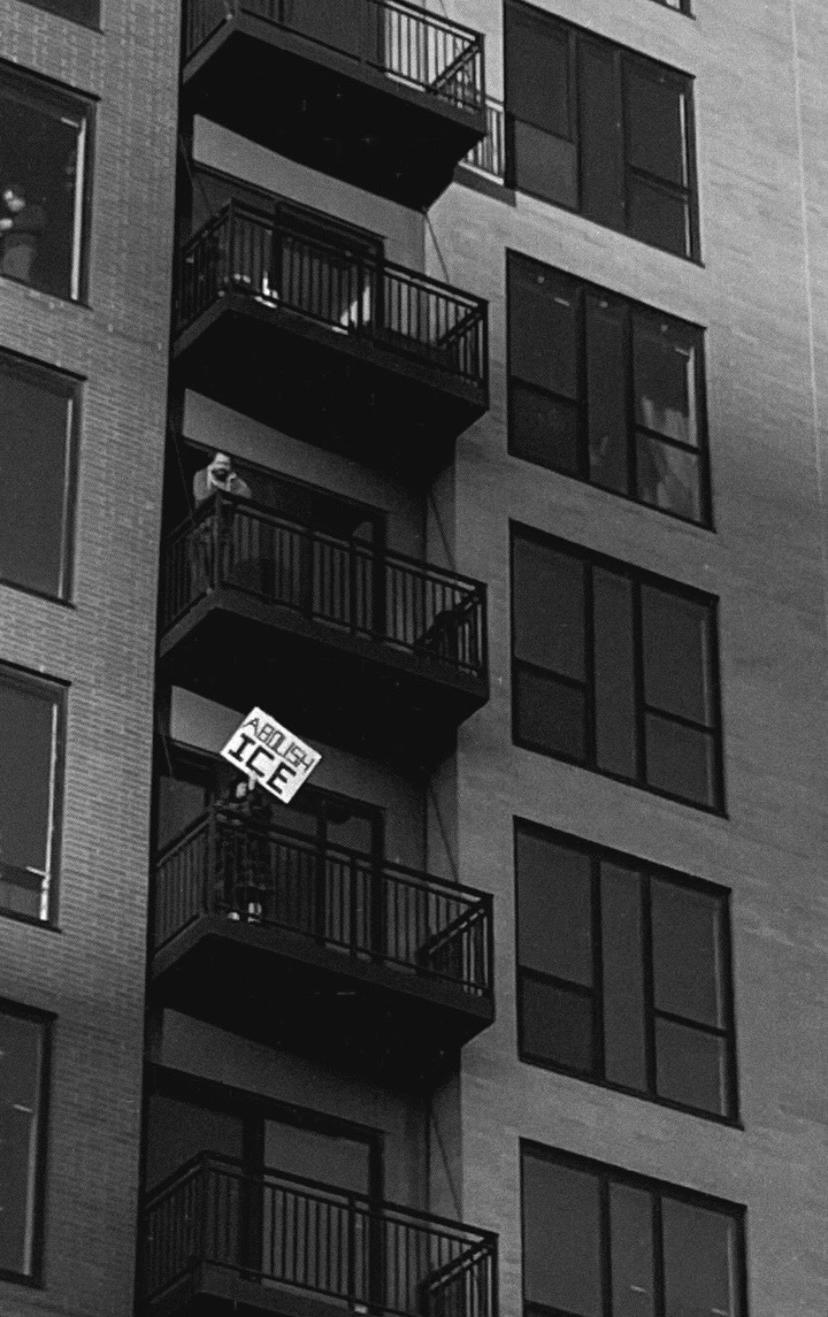
Response Hotline.
No matter what we choose to do — as families are ripped apart, as people are shot and killed, and as our rights as Americans are degraded — standing by and watching cannot be an option.
Staff editorials reflect the opinion of the majority of our editorial board members. The editorial board operates independently of our newsroom and includes members of the senior staff.
Hannah La Porte, Junior Scene Editor
Sylvie Richards, Managing Forum Editor
David Ciorba, Senior Forum Editor
Lyn Wilkins, Junior Forum Editor
Kate Theerman Rodriguez, Senior Forum Editor
River Alsalihi, Senior Forum Editor
Amelia Raden, Senior Forum Editor
Sydney Tran, Editor-in-Chief
Riley Herron, Editor-in-Chief
Mason Sutton, Special Issues Editor
Bea Augustine, Managing Design Editor
Laurel Wang, Senior Scene Editor
Elizabeth Grieve, Senior Scene Editor
Sara Gelrud, Senior Scene Editor
Matt Eisner, Managing Sports Editor
Mac Motz, Photo Editor
Zoe Rhodes, DEI Editor
AnaElda Ramos, Managing Illustration Editor
Quinn Moore, Managing Newsletter
Editor
Isabella Diaz-Mira, Photo Editor
Ella Giere, Photo Editor
Bri Nitsberg, Managing Photo Editor
After a rough start to conference play, the No. 20 WashU men’s basketball team came back big with a win against then-No. 1 Emory University on Friday, Jan. 30. And if beating the best team in the nation at home wasn’t energizing enough, the game was also dedicated to former WashU basketball player Justin Hardy, who tragically passed away after a fight against cancer during his senior season in 2022.
“[This game] is an opportunity for us to retell the story, to open up a whole new group of people to this amazing WashU kid in Justin,” head coach Pat Juckem said. “That’s the really cool opportunity we have, and so this game was meaningful in so many ways.”
The 2025-26 season has proved to be tumultuous for the Bears so far. Going into University Athletic Association (UAA) play, the Bears had a record of 10-1 and were the No. 5 team in the nation. But over the past three weeks, the Bears racked up four losses to UAA teams, making their conference record 1-4. With the determination to get back on track, the Bears focused on Emory, the top team in Division III entering play.
“We put our heads down,” junior guard Ryan Cohen said. “We believe in each other so much. We have so much confidence in our coaches and our players.”
Full of determination, the Bears stormed into the game and developed a large lead of 17-5 in just the first five minutes. They left the first half leading 37-32. The Eagles were stunned, and the game turned incredibly physical, with the Eagles receiving
numerous technical fouls that swung the momentum further in favor of the Bears.
“I think you saw two very prideful teams, and sometimes the emotions get the best of you,” Juckem said. “Emotion can be a good thing if you’ve got it channeled, but it can also lead you to a place where you cross over and run disciplined and make emotional decisions.”
Cohen took the shots for all of WashU’s technical free throws. He went 9-12 at the free-throw line and led the team in scoring, racking up 24 points.
“I work so hard on my game, and I’m always ready to shoot the ball,” Cohen said. “I have the best teammates in the world who can find me, and they trust me so much. So I do it for them.”
Ultimately, WashU was the better team. The Bears shot 50% from the field in the game, thanks to a second half in which they had a 71.4% shoot ing percentage.
Sophomore for wards Connor May and Anthony Przybilla both played large roles in scoring, adding 19 and 13 points, respectively, to the Bears’ final score. Additionally, first-year guards Josh Kim and Theo Rocca saw significant playing time, with Rocca tacking on 8

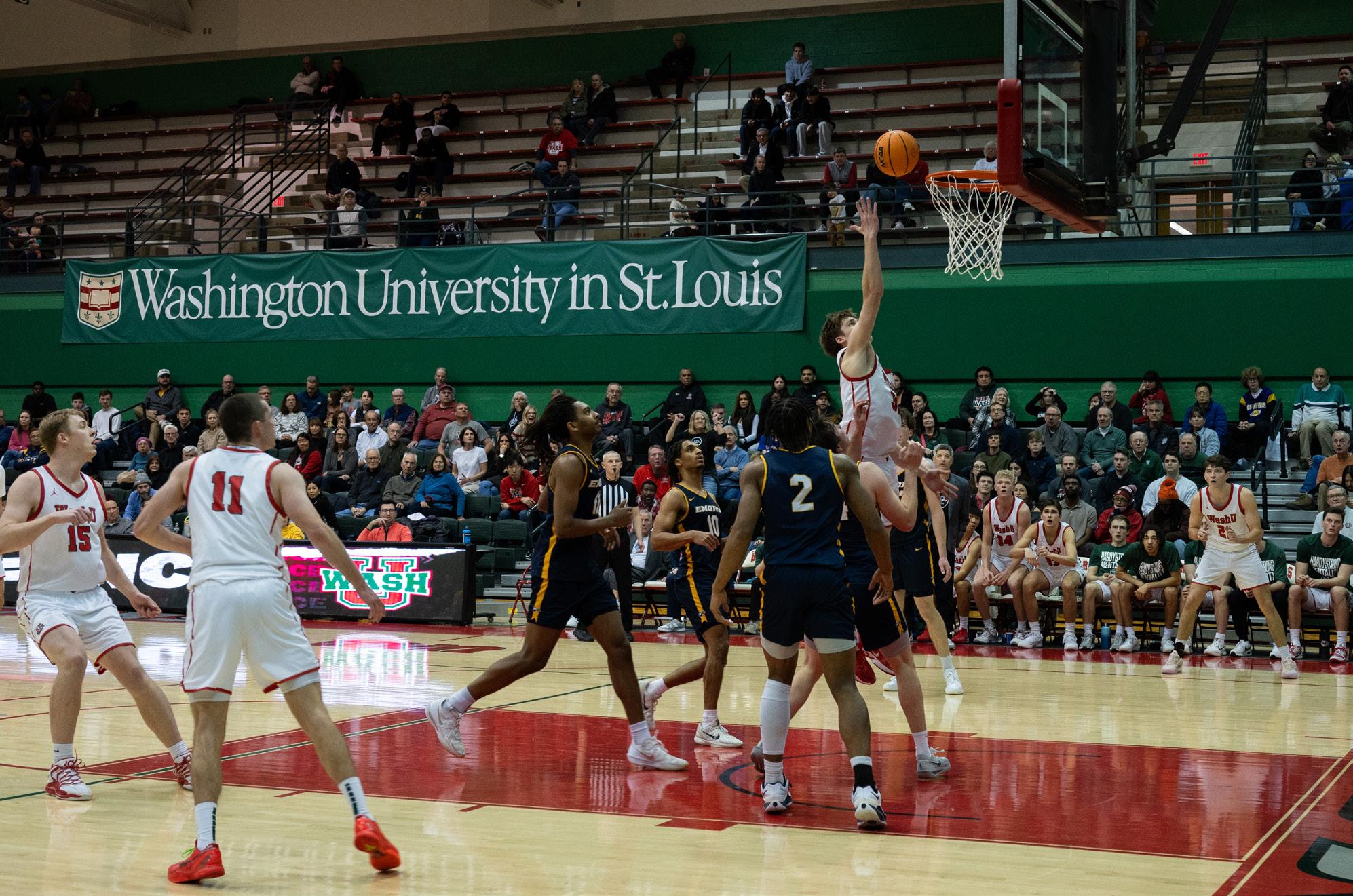
points to the Bears’ lead.
“I thought the leadership of our team grew this week,” Juckem said. “I thought our young players became older players. Our older players started to really understand what it means to be [a leader], that it’s not just when things are going
The Bears maintained a large lead against the Eagles and won the matchup with a final score of 89-74. WashU had beaten the number one team in the nation. But this win went much deeper than conference records and national standings. This was a win in honor of one of the best WashU basketball players to come out of the program: Justin Hardy.
Hardy played for the Bears from 2018 to 2022. After a 13-month battle with Stage IV
stomach cancer, Hardy passed on May 29, 2022. Despite undergoing intense treatment during his senior year, Hardy continued to fight to play the sport he loved. His heart and his passion during his seasons at WashU deeply inspired the athletics community and beyond.
“We play for him. Everything we do is through him, and he energizes us. He gives us belief.” Cohen said.
Before the start of the game, graduate student guard Kyle Beedon spoke to the fans in the Field House about his former teammate and the wonderful impact Hardy had on the people around him.
Beedon is the last current player to have played with Hardy, but the team continues to maintain its connection to him and pass down his legacy.
“We [are] entering into a new phase of this where all of our students and now all
of our players, save for Kyle, [never met Hardy],” Juckem said. “It’s a story they’ve heard about, but they weren’t here to see it firsthand, the emotional, miraculous embodiment of all the right things that Justin was.”
Two days later, the Bears continued their momentum and beat the University of Rochester, adding another conference win to their record. After leaving the first half trailing 39-37, the Bears came into the second half swinging. Thanks to a triple-double from senior guard Yogi Oliff, the Bears scored 52 points in the second half and came back to win 89-78. May led the team in scoring with 20 points. Men’s basketball will face the same opponents on the road next weekend, travelling to Emory, now ranked No. 7 in the D3Hoops.com poll, on Feb. 6, and Rochester on Feb. 8.
When the final buzzer sounded in the No. 15 WashU women’s basketball team’s victory over the University of Rochester on Feb. 1, the Bears achieved what is arguably the hardest feat to complete in their regular season — they swept a weekend series against University Athletic Association (UAA) opponents.
After defeating Rochester and No. 23 Emory University, the Bears are crafting a strong resume to return to the NCAA tournament for the first time under head coach Lisa Stone’s leadership.
“Every single game in the UAA is a prize fight,” Stone said after the Bears defeated Rochester. “Everyone can beat everybody, any time. And it’s just been an amazing week.”
WashU vs. Emory
WashU first defeated No. 18 Emory 67-56 on Jan. 30. Before the game, the Bears honored the late men’s basketball alumnus Justin Hardy, who lost his tragic battle with cancer in 2022. Junior Alyssa Hughes, who received a scholarship to play at WashU from the HardyStrong Foundation, spoke about Hardy’s
legacy before the game, and the WashU bench donned HardyStrong shirts throughout the game.
“It was huge that we could dedicate ourselves to playing like Justin Hardy played,” Stone said. “He left his sweat and his tears on the court. He was gritty, and we tried to be like that today.”
The Eagles got off to a hot start, outscoring WashU 20-14 in the first quarter. The Bears battled back to tie the game at 30 by halftime, largely thanks to junior center Lexy Harris. Harris scored 20 of the Bears’ 30 points in the first half, with the Emory defense largely able to shut down Hughes and junior guard Sidney Rogers from beyond the perimeter.
In the second half, a strong WashU defense prevented Emory from taking advantage of their opportunities. The Eagles shot just 36% from the field, and the WashU defense held Emory to convert just four of their 23 3-point attempts. Harris dominated the boards, recording a double-double in the win. Rogers ultimately scored 14 points, and WashU benefitted from strong defensive performances from senior forward Jordan Rich and junior guards Catherine Goodwin and Sydney Starks.
“With Lexy [Harris] having
20 of our 30 points at halftime, we knew we had to make an adjustment,” Stone said.
“Thank goodness we started hitting shots from some other people, and I thought Sydney Starks … and [junior forward] Amelia [Rosin] did a good job coming off the bench.”
WashU vs. Rochester
Two days later, the Bears defeated Rochester 62-55.
While Emory limited the Bears’ ability to score from long-range, Rochester targeted their defensive efforts on Harris. Stone adjusted by rotating Harris and Rosin at the center position after Harris received a technical foul, with WashU taking advantage of Rosin’s strong rebounding ability. Rogers provided a jolt to the Bears’ offense; she scored 14 points including hitting two 3-pointers, while playing a full 40-minute game.
“Some games, we know they’re going to be sucking up on our shooters,” Rogers said. “But today, they played us really heavy in help [defense], and that eventually our shots would start falling, so it’s just a matter of knowing that we put the work in and shooting our shots.”
The Bears led for the majority of the game, despite the close final score. After the Bears lost a game against
Carnegie Mellon University
earlier this season in which they failed to convert key opportunities, the Bears converted their opportunities late in the game to win against Rochester.
“The good thing is that we were able to win the game in the post,” Stone said.
“This game went the other direction at Carnegie, so we’re getting better.”
Stone used just eight players off of her roster against Emory and Rochester. All six of the Bears’ juniors played key minutes, while Rich started at forward and sophomore Ava Blagojevich provided relief at guard.

The Bears will face Emory and Rochester again next weekend. They will travel to Atlanta to face Emory on Friday, Feb. 6, and conclude their road trip in Rochester on Sunday, Feb. 8. With three more UAA weekends left in the season, the Bears look to continue the momentum from this sweep into their rematches next weekend.
“We’re focusing on the next one ahead,” Rogers said. “We’re focusing on who they have, how we’re going to play them, and really just taking it all one game at a time.”


With just one jump at the Friday Night Spikes meet, senior pole vaulter George Bourdier broke four records at once. His jump of 5.22 meters was the highest pole vault in his career, in WashU track and field history, among University Athletic Association (UAA) athletes, and the facility best at the Rose-Hulman Institute of Technology.
Bourdier’s jump is the highest vault in all of Division III this indoor season. His success reflects the dominance of the pole vault program that WashU has built, which has produced champions and record-breakers from both the men’s and women’s programs.
Bourdier missed significant time in his first two seasons after various surgeries to repair an abdominal tear. Last season, he was named a First
Team All-American in the pole vault, but he has taken his success to new heights — literally — this season.
“Ever since I graduated high school, I always knew that I had the [5.22 meter] jump in me but never knew if I would actually hit it,” Bourdier said. “To see all the hard work come to fruition … it was just a beautiful moment that I got to share with my team and with my coach, and I was just ecstatic.”
It isn’t just Bourdier who excelled last weekend for the Bears. Graduate student Tommaso Maiocco cleared 5.02 meters at the same event, good for fourth-best in D-III this season. As of publication, WashU holds five of the top 19 marks in Division III men’s pole vault this indoor season, with senior Hayden Kunkel, junior Peter Lichtenberger, and sophomore Zachary Duckworth rounding out the Bears’ top five.
“We have a high caliber of jumpers all across the board,
and it’s just a constant competition. It’s also constant care for one another on top of that competition,” Bourdier said.
“We’re caring for each other’s process and trying to lead each other in the right direction, even though we’re trying to beat one another every single day at every practice.”
The women’s team has been just as elite, despite the graduation of three-time national champion Yasmin Ruff after the 2025 season. WashU had all the top six clearers at the Friday Night Spikes event, led by senior Mackenzie Walker and her meet-best 3.90-meter jump. Following Walker, junior Meredyth Barr got second with a height of 3.40 meters. Sophomore Maddie Elhaik and first-years Campbell Pallera and Talia West all cleared 3.20 meters, rounding out the top five.
“Yasmin Ruff set the example for them to see how a champion does it,” assistant coach Lane Lohr, who leads
the pole vaulting program, said. “They saw what she did on a daily basis … Yasmin set an example for all of them to follow, and I think they’re doing a good job of following it.”
The women’s pole vaulting team is made up of four firstyears and one sophomore, in addition to upperclassmen Walker and Barr. On the other hand, the men’s team’s success comes from a talented group of upperclassmen. Led by Maiocco, Bourdier, Kunkel and Lichtenberger, the Bears have led by example and improved year over year.
“It’s sort of a perfect storm on the guys’ side,” Lohr said.
“If Hayden [Kunkel], Peter [Lichtenberger], Tommy [Maiocco], or George [Bourdier] were in any other era, they would be the best guy on WashU’s team. And now they just happen to all be here at the same time.”
Both the men’s and women’s teams practice together, creating a community feel to
an otherwise individual sport. As a result, there is a culture of success under Lohr and jumps coach Stephen Fleagle.
“They feed off of each other in training, and they feed off of each other in the meets, “Lohr said. “And it’s about the group doing well, not each individual.”
Both Lohr and Bourdier agree that it takes a unique combination of skills to excel at pole vault.
“What makes it a special sport is it kind of combines two qualities that are not often found in the same person,” Lohr said. “There’s a lot of thinking, a lot of calculating … but then once you make all those calculations, you have to be able to throw caution to the wind and let go … It’s thinking to the point where you know what you’re doing is right and then just trusting it and doing it.”
Bourdier, who is also a sprinter, focuses on the run up to a vault.
“I’d say 70 to 80% of a
good jump is just the runway,” Bourdier said. “It’s how much speed you can produce on the runway and then how well and how efficiently you can deliver and transfer all that speed into a strong, tall takeoff.”
The group still has a month to improve before the highly anticipated UAA Indoor Championships. The winter season concludes with the national indoor championship in March, an opportunity for the team to have their best performance in history. The team will then continue to train for the outdoor championships that follow in April and May.
“I believe that we can have the best year we’ve ever had,” Lohr said. “We can have more people at nationals. We can have people place as high or higher than last year … There are several people on this team that want to be a national champion, and are trying to do everything they can do to make that happen.”