THURSDAY,

FUTURE
OF FINANCIAL AID Admin backs needblind policy amidst financial struggles. (News, pg 2)
MAY DAY
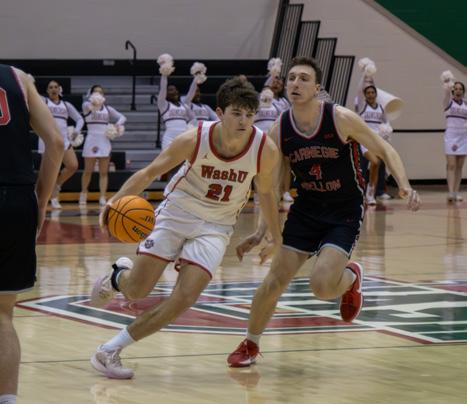
Connor May scores career high as No. 24 men’s basketball sweeps weekend.
(Sports, pg 4)
THURSDAY,
OF FINANCIAL AID Admin backs needblind policy amidst financial struggles. (News, pg 2)
MAY DAY
Connor May scores career high as No. 24 men’s basketball sweeps weekend.
(Sports, pg 4)
ZACH
SYDNEY
MANAGING NEWS EDITOR
EDITORS-IN-CHIEF
On Tuesday, Feb. 24, WashU’s Danforth Campus went into shelter-in-place protocol following false reports of an armed person on campus, according to the Washington University Police Department (WUPD). WashU Emergency Management first notified campus of the potential armed individual at 9:19 a.m. after WUPD “received multiple calls reporting an individual with a weapon on the Danforth Campus,” according to a 11:30 a.m. email from WUPD Chief Angela Coonce to Danforth Campus students, faculty, and staff.
WashU Emergency Management declared there was no active threat in a message at 10:21 a.m. after police completed their search of the Danforth Campus. In the 11:30 a.m. email, Coonce said WUPD believed the reports “were not a credible threat.”
Some individuals also claimed that Saint Louis University (SLU) received similar calls, but SLU Senior Media Relations Specialist Maggie Rotermund told Student Life that SLU did not receive such calls.
Student experiences
Senior Robin Pyo was in her Sculpture Practices course when two classmates alerted the class that they had received a text saying to run, shelter, or hide. The class hid in the basement of Walker Hall, where the course took place.
“I was concerned, for sure, but I felt pretty safe in the basement,” Pyo said. “It felt like it could just be a false alarm, but at the same time, [after] the Brown shooting, it definitely felt more real.”
Pyo appreciated the emergency alerts she received but said she would have preferred Emergency Management to share more information alongside the all-clear alert.
“Afterwards, when we’re being told we are released and free to go around campus and that they had searched the premises, I feel like a lot of people were concerned about the fact that there was no arrest, and people still feel unsafe going to their next classes and being on campus today,” Pyo said.
Some students, like sophomore Lexie Rooks, expressed concerns when they realized that the locks on their classroom doors didn’t work.
“Once we turned off the lights, we figured out that the door wouldn’t lock, and so we just shoved all of the chairs and desks in front of it so that you couldn’t open it from the outside,” Rooks said. “It was still very nerve-racking to sit there and hide, knowing that the door wasn’t locked and that if the potential perpetrator were to try and enter, they would probably be able to.”
Some undergraduate teaching assistants (TAs), like senior Alexia Leek, were directing classes in the absence of a professor. Leek was leading her Environmental Systems class alongside graduate teaching assistants on the second floor of Givens Hall. When the alert happened, she said other students on the floor went to hide in the room her class was in.
“The room is actually too small for the [amount] of people we had,” Leek said. “We had some people that were in the hallway, some people were in the bathroom. We
just tried to grab anyone who was there. ... We just grab everybody, get inside, and then we close the doors and we lock it, and we forget the lock is broken on that door. It’s been broken for years.”
Leek said some students moved heavy tables in front of the doors and, after fidgeting with the door, were able to lock it. Later, Leek said she and the other students realized a student was left outside.
“As the TA, you’re like, ‘Okay, well, I need to keep these students safe. How do I know the person is not possibly the shooter?’” Leek said. “Again, we don’t know at this moment, how do we know that they’re not with him, or they’re not using him to get into the room? …
I felt super bad because I’m like, man, there’s a chance that that’s one of my kids who’s going to possibly be out in the hallway and not know where to go.”
She said that though WUPD was doing the rounds on rooms in the building, the students did not want to make their presence known out of fear for their safety.
“[WUPD] swept the building, and we’re staying silent,” Leek said. “[We didn’t] open the door for anybody. [They said,] ‘Police, let yourself be known,’ and we stayed quiet again. But we’ve all seen the videos of people pretending to be police just to get into the room. … But what really freaked us all out was [when police] tried to get in the door, they [were] rattling [it] full-blown.”
Senior Julia Peppe was in Design of Thermal Systems and said that during her class, undergraduate teaching assistants proctored the course while the professor, who was out of town, instructed over Zoom. When a public address sys-
workers, who passed out candy and drinks to try to keep everyone calm while they were waiting.
After the all-clear message was sent by WashU Emergency Management, students and faculty remained hypervigilant while exiting campus. First-year Owen Hotra noted that the message sent did not make him feel safe and many around him were still cautious of their surroundings.
“We ran into a couple seemingly stray professors, [and] they seemed very jumpy to see us and it startled us to see them,” Hotra said.
Leek said that she did not completely process her emotions until she got home.
“Honestly, [the experience] didn’t even hit me until I got home and I felt the safety of my own door lock,” Leek said. “[When I entered the door], I just kind of crumpled to the floor.”
Faculty handling of the situation
Professors across the University handled the situation differently. Some professors cancelled classes in response to the situation.
One lecturer — who is anonymous due to concerns as an untenured instructor — decided to cancel his classes and described the decision as difficult.
“Honestly, [the experience] didn’t even hit me until I got home and I felt the safety of my own door lock,” Leek said. “[When I entered], I just kind of crumpled to the floor.”
tem announced the armed person alert and advised students to “run, hide, fight,” students were unsure of what to do.
“People were frantically debating if we should stay, hide and lock the doors, or run, but without an adult or a professor [or] any kind of faculty presence, there was a bit of panic,” Peppe said.
Senior Nina Fischer, one of the TAs in the class, noted that she wasn’t trained on how to deal with a situation like this.
“We’ve been doing lockdown drills since we were kids, but it’s different when you’re doing it in real life,” Fischer said.
During the shelter-in-place, students in the Danforth University Center hid in a storage space, according to junior Matthew Isaacs.
“The workers and the manager knew exactly what to do. They closed the door, they turned off the lights, [and] we sat on the floor,” Isaacs said. “Then it seemed like the manager coordinated with someone and made the decision to have us all go down to this storage facility-slash-kitchen.”
Isaacs said he was “touched” by the generosity of the dining

CULT OF BETHANY
How one lecturer transforms her classroom into a community. (Scene, pg 5)
TRAN | EDITOR-IN-CHIEF
NINA LASER TANVI GORRE LEWIS RAND NEWS EDITORS SENIOR SPORTS EDITOR
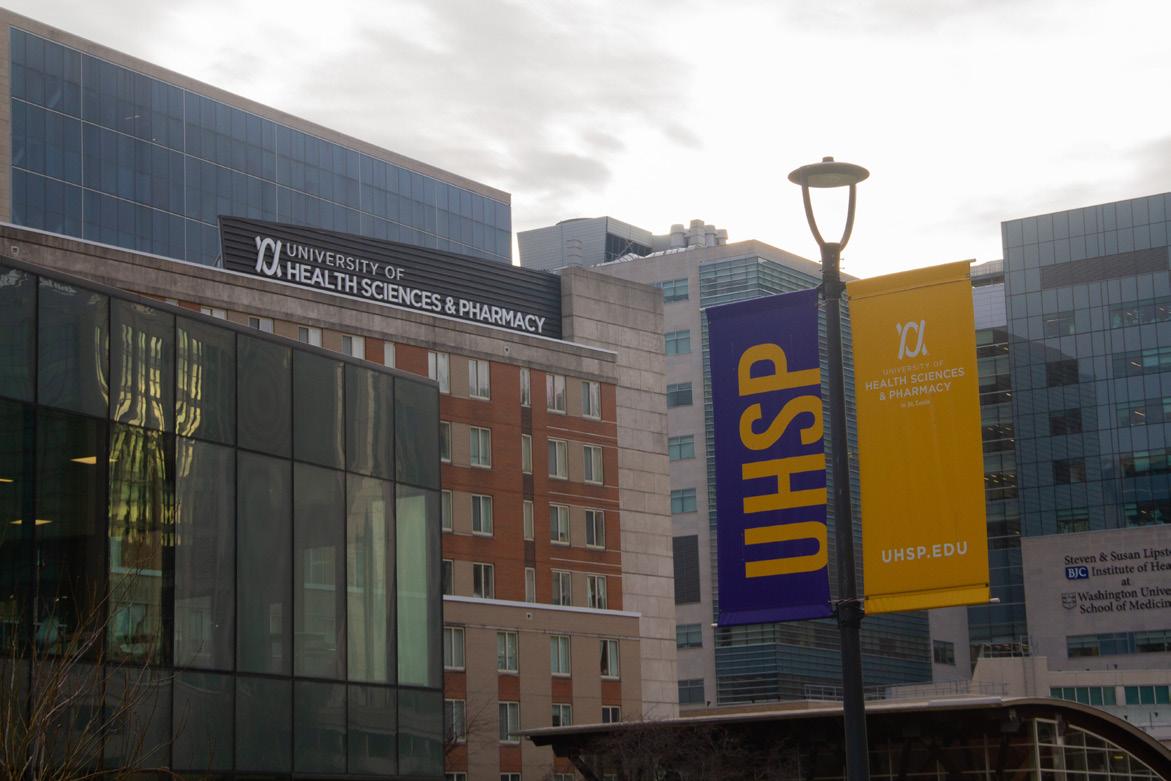
WashU is creating a new pharmacy school after entering into an agreement to integrate the University of Health Sciences and Pharmacy (UHSP) into the University, according to an email sent by WashU Chancellor Andrew D. Martin on Feb. 24.
“It is not an easy [choice] for instructors to make, as it constitutes a significant lost learning opportunity,” the lecturer wrote in an email to Student Life. “However, in this course, we have contingency plans in place and the ability to reschedule and accommodate the missed lab in a way which minimizes this loss, but this is due to resources which are available to us, which may not be available to every course on campus.”
The lecturer emphasized that the health of their students was paramount during the situation.
“All of this, in my view, is background noise to prioritizing the safety and mental health of my students,” the lecturer wrote. “Sharing support resources, minimizing contribution to that stress where possible, and doing what I can to empathize with students who were stuck in rooms, fearful, earlier that day, is exactly what I would like to do.”
Other courses, particularly those scheduled for later in the day, continued with normally scheduled class programming. Some professors continued teaching during the shelter-in-place notice. For students who did not feel comfortable attending class on campus, some professors also created virtual options or eliminated mandatory attendance requirements.
Isaacs praised the ability of the WashU community to continue in the face of the morning’s events.
SEE ALERT, PAGE 2
UHSP’s Doctor of Pharmacy (PharmD) program will become WashU’s new school, still operating at its current location on the UHSP campus, which is next to WashU’s medical campus.
According to the UHSP press release, programs other than the PharmD will be phased out after the 2026-2027 academic year. WashU’s press release in The Source states that “some” programs UHSP has besides the PharmD program will transition to WashU.
UHSP and WashU have reached an agreement about this merger but are still awaiting regulatory approvals that will take place over the next year and a half. UHSP’s press release states that they are still working with WashU on a “transition plan.”
While UHSP’s announcement states that there will be “minimal disruption” for current PharmD students, its undergraduate students who do not graduate in time will be required to relocate following the 2026-2027 academic year.
UHSP currently has 372 undergraduate students.
Options for undergraduate students will include a teachout agreement offering limited spots with WashU’s School of Continuing & Professional Studies (CAPS), pending agreements with other institutions that will not be finalized until March of this year, and a traditional transfer.
Some undergraduates are former Fontbonne University students who moved to UHSP after Fontbonne closed in 2025 under a teach-out agreement. For UHSP students opting for the teach-out agreement, they will be offered automatic admission to a partnered school, matched tuition and fees, matched transfer credit, and facilitated graduation on their original timeline.
There is no stated mention of similar programs for part-time Master of Public Health students, as UHSP suggests that these students may be required to take on a full-time schedule in order to finish their degree before the integration.
UHSP is offering students the opportunity to meet with faculty and staff to plan for the future. The university has not publicly released information regarding the impact on faculty.
Neal Sample, chair of UHSP’s board of trustees, cited challenges facing higher education, including decreasing enrollments and high costs nationwide, as factors in the decision.
“Over the last decade, UHSP has made several difficult but strategic decisions to adapt to these changes,” Sample wrote in a press release. “Despite these efforts, the realities of the higher education landscape and long-term financial projections made it clear that we needed a sustainable solution that would secure our mission, students, and legacy.”
As of Nov. 17, 2025, financial intelligence agency S&P Global projected a negative outlook for UHSP as the university projected above-policy annual endowment draws for the 2025 fiscal year and extending onward to the 2028 fiscal year. Although these draws maintain sufficient financial resources, they could minimize the financial flexibility of the institution going forward.
Julie Flory, vice chancellor for Marketing and Communications, explained the timing of the announcement, which happened just hours after WashU entered a shelter-in-place protocol over reports of a potential armed person on campus, was unintentional.
“We would have preferred not to have to make this announcement today given other events, but UHSP was informing its community this morning and we needed to coordinate the timing with them to support their communications,” she wrote in a statement to Student Life.
The addition of a pharmacy school is the second new school WashU has added in three years, following the formation of the School of Public Health in January of 2025, and it is the University’s 10th school overall. Before that, WashU had not added a new school division in a century. In his email, Martin assured the community that the decision was not made as a result of any shortterm financial considerations.
“This integration is not a response to short-term actions,” he wrote. “It is a strategic decision grounded in our long-term academic priorities and made possible in part by the University’s strong foundation and our longstanding affiliation with BJC HealthCare.”
NINA LASER RILEY HERRON NEWS EDITOR EDITOR-IN-CHIEF
Over the last decade, WashU has significantly increased its financial aid spending as the University has implemented a number of financial aid policies. The need-blind admissions policy, a no-loan commitment, and expanded scholarships for local students have allowed WashU to improve socioeconomic diversity.
Executive Vice Chancellor for Finance and Chief Financial Officer David Gray said though the University is navigating financial challenges, WashU will not back away from its financial aid commitments. According to Gray, all University programs are subject to reexamination, but the University values its financial aid initiatives as a key part of WashU’s mission.
“At least that I am aware of, we’re not backing away from that level of commitment,” Gray told Student Life. “It does come with a hefty price tag, but we feel it’s part of the mission that we’re extremely proud of.”
Vice Provost for Undergraduate Enrollment and Student Financial Aid Ronné Turner emphasized the University’s commitment to meeting students’ needs in difficult periods.
“The University has always worked hard to meet our commitment for students and to meet students’ financial needs when there’s a downturn in the economy and folks have challenges,” Turner said. “I anticipate that the University will continue to support students and want to dedicate the resources that we need to not only enroll students but to support students throughout their time here at the University.”
Gray discussed the sustainability of financial aid and need-blind programs, as higher tuition fees allow the University to accommodate more funding going toward remissions and scholarships.
“I think everything each year is always subject to examination. Nothing is sacrosanct, and that would include student aid programs,” Gray said. “We want to make sure that when we allocate dollars to specific programs that we are having the maximum impact possible.”
Over the last year, WashU has taken steps to address financial challenges, including significantly increasing tuition last year, laying off over 300 staff members, and cutting spending across the University. Gray said that declining international graduate student enrollment and the projected “demographic cliff” have played a role in recent financial struggles at WashU and peer institutions.
“[The University] has been heavily reliant on Chinese students in particular, and there have been noteworthy drop-offs in enrollment there at the graduate level. … They’re very nearly paying 100% of the cost of their education with very few subsidies though remissions or scholarships provided,” he said. “The loss of net tuition income has been radically harmful to those schools that are so reliant on that student base of enrollment.”
According to data shared by Gray, WashU’s graduate student population has decreased from 8,818 students in 2021 to 7,702 in 2025. There has been an especially sharp decline among international graduate students, with enrollment going down from a peak of 3,977 in 2022 to 3,283 in 2025.
Amid this situation, Gray said that the administration is looking to make further reductions to the cost of administration with a more “targeted approach” this year.
He said that the University is planning a transition to a more centralized “shared services” model for human resources and financial services.
He also said that next year’s tuition should be announced in early March and to expect a more “moderate increase”
compared to last year.
“I think we all recognize that, you know, there are lots of pressures on families,” Gray said. “They are dealing with a lot of inflationary costs in their household budgets, and we think it is important that we not continue to add pressure to that situation, which can be accomplished through more moderate [tuition] increases.”
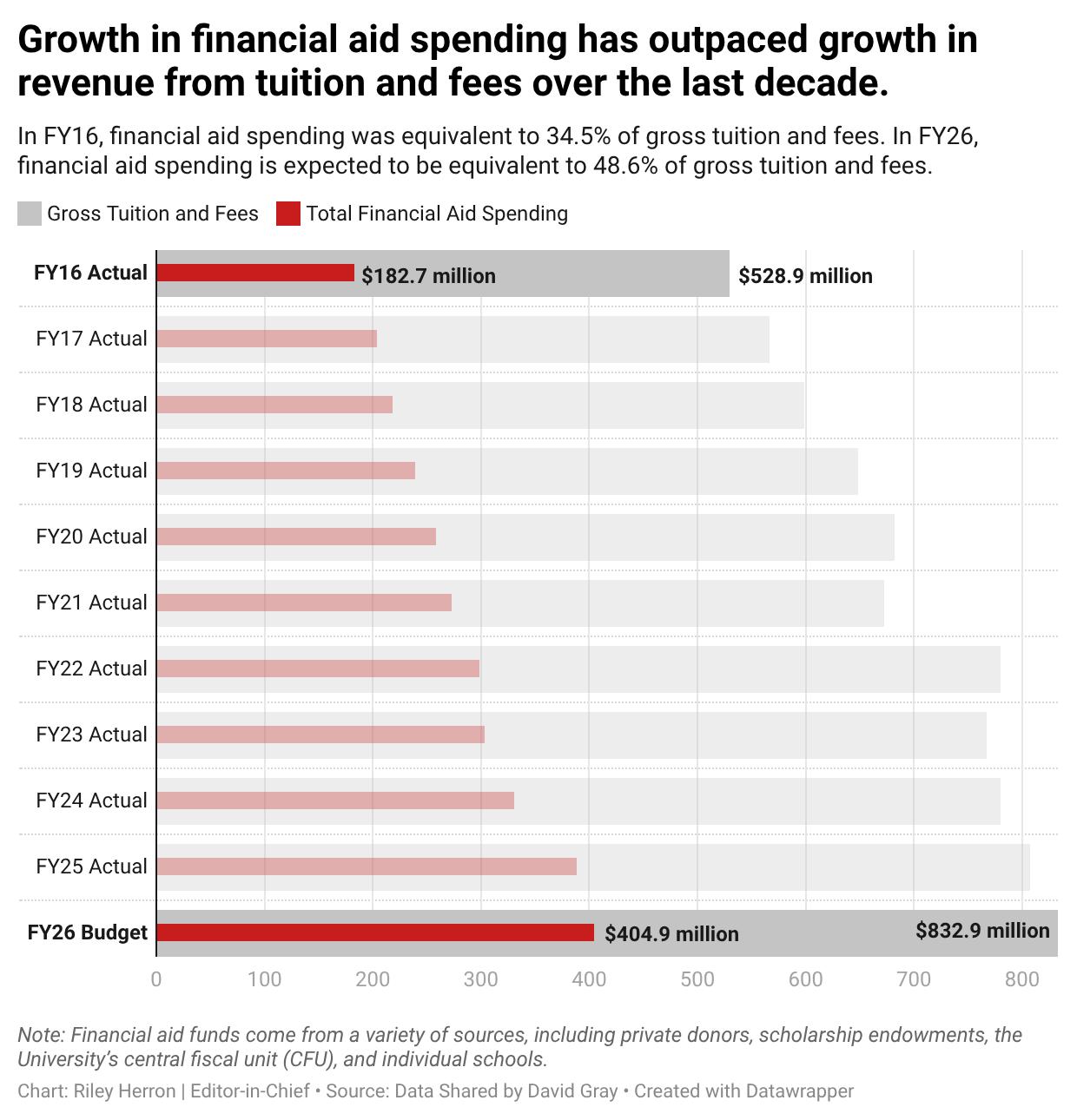
WashU’s financial aid spending has outpaced the increase in revenue from gross tuition and fees over the last 10 years, according to data shared by Gray. WashU’s gross tuition and fees increased from $528.9 million in Fiscal Year 2016 (FY16) to $832.9 million in Fiscal Year 2026 (FY26). At the same time, financial aid has more than doubled, going from $182.7 million in FY16 to over $400 million in FY26.
Gray also shared that funding for financial aid comes from private donors, scholarship endowments, the University’s Central Fiscal Unit (CFU), and individual schools. He highlighted the CFU’s increased spending, saying that the CFU funding for undergraduate scholarships increased from $2.8 million in FY16 to $76.8 million in FY26.
The increased financial aid spendings come as the University has expanded aid offerings since being named the least socioeconomically diverse elite university in the country in 2014 by a New York Times article. In 2021, the University announced a need-blind policy within admissions, making it the final Top 20 college in the nation to do so, and in 2024, WashU implemented a no-loan program for all students.
The need-blind policy was made possible by significant return on the University’s endowment in FY21, and it transformed the way WashU reviews applications, according to Turner.
“What [need-blind] policy does is it allows the
admissions team to review an application and make admissions decisions and really just admit who we feel are the most competitive applicants in the applicant pool that year, and we’re not worried about the financial aid budget,” Turner said.
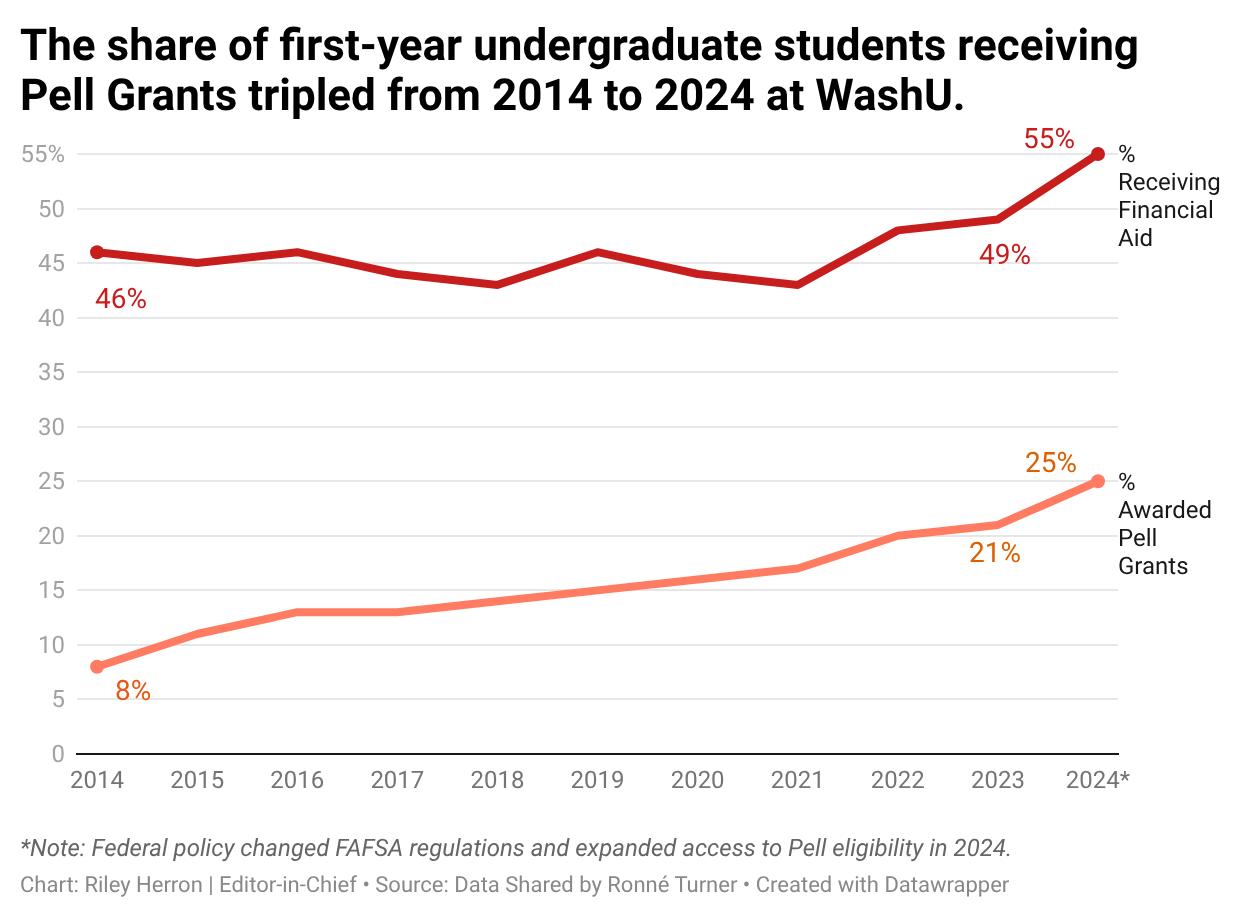
The share of WashU undergraduates receiving Pell Grants, a federal needbased financial aid program,
has increased from 8% of the incoming class in 2014 to 25% of the class starting in 2024, according to data shared by Turner. Both Turner and Gray cited the high number of Pell Grant recipients enrolled at WashU as representative of the school’s success in making WashU education accessible to qualified students, and emphasized the University’s commitment to continuing to promote socioeconomic diversity.
“There’s still a very highlevel commitment from the top of the institution, from Chancellor Martin on down, to the need-blind program, to continuing to ensure that there is access to WashU for all qualified students who are interested in coming here,” Gray said.
The U.S. Department of Education’s Office for Civil Rights (OCR) announced Feb. 19 that WashU is among the 31 universities that reached settlements with the agency following investigations into partnerships with The Ph.D. Project, a nonprofit that promotes doctoral study in business among underrepresented groups.
In March 2025, OCR opened investigations into 45 universities, including WashU, over their collaborations with the organization, alleging that it “discriminates on the basis of race.” In its
from page 1
“I had to go right into a presentation soon thereafter, but I think it’s actually good to return to a sense of normalcy,” Isaacs said. “It was really impressive how the campus really bounced back.”
In Fisher’s class, the professor sent a message encouraging students to stay safe and made
Feb. 19 announcement, the agency said it had secured resolution agreements with 31 institutions to address those violations. The resolution agreements between the OCR and universities end civil rights investigations without a court proceeding. Under such agreements, universities usually commit to specific corrective actions and federal monitoring.
According to OCR, the 31 institutions had already ended their partnerships with The Ph.D. Project or agreed through the settlements to terminate them. The agreements also require each institution to review
the in-class worksheet optional.
other external affiliations for potential Title VI violations, and OCR said negotiations are ongoing with the remaining universities.
Because OCR did not release institution-specific terms, it is unclear whether WashU ended its involvement before the agreements were finalized or as a result of the federal action, or whether the University will be subject to ongoing reporting or oversight requirements.
“This is the Trump effect in action: Institutions of higher education are agreeing to cut ties with discriminatory organizations, recommitting themselves to
“She sent a message to the entire class being like, ‘Stay safe.’ But she also told them immediately, ‘[Class] is optional, and also the topic covered today won’t be on the midterm,’” Fisher said. “I know a lot of other professors who did something similar.”
Professors also reacted in varying manners during the incident. For example, Rooks said that her professor was “in shock” during the situation. Since her professor didn’t immediately give instructions, the students took the lead in responding to the situation.
“It kind of surprised me
abiding by federal law, and restoring equality of opportunity on campuses across the nation,” U.S. Secretary of Education Linda McMahon said.
Vice Chancellor for Marketing and Communications at WashU, Julie Flory, said the University had no comment on the announcement.
After the investigations were first announced in March 2025, Flory told Student Life that WashU had supported the program with “a small amount of funding” and was reviewing its participation. At that time, an Olin Business School Equity, Diversity, and Inclusion
to hear that professors and actively teaching faculty aren’t really informed on what to do in situations like this,” Rooks said. “It took the students, more so than our professor, to take it upon ourselves to make sure we were safe.”
In an email, Coonce praised the WashU community for their handling
(EDI) webpage listed WashU as a participating university, though the extent of student involvement remained unclear.
Archived versions of that webpage indicate the reference was removed in spring 2025. A snapshot dated March 24, 2025, included a bullet stating that Olin was a participating university in The Ph.D. Project, while a snapshot dated April 24, 2025, no longer contained that language. The Olin EDI website itself is no longer publicly accessible and currently appears restricted to administrators.
WashU has not announced whether it will replace the
partnership with alternative efforts, nor has it provided details on how the settlement will affect University programs. Federal officials described the settlements as part of a broader effort to enforce civil rights law across higher education and prevent similar arrangements in the future.
“We are hopeful that other institutions with similarly discriminatory practices will follow suit, paving the way for a future where we reject judging individuals by the color of their skin and once again embrace the principles of merit, excellence, and opportunity,” McMahon said.
of the situation. “I’d like to thank our students, faculty, and staff for responding quickly and appropriately to the alert by sheltering in place and following instructions as they were communicated through WashU Alerts and officers on the scene,” she wrote. “Your cooperation made it possible for our officers to do their work quickly and safely.” Coonce also said that WUPD will “investigate and pursue charges against anyone who is found to be responsible” for the false reports that caused the shelter-in-place.
ALIZA LUBITZ INVESTIGATIVE NEWS EDITOR
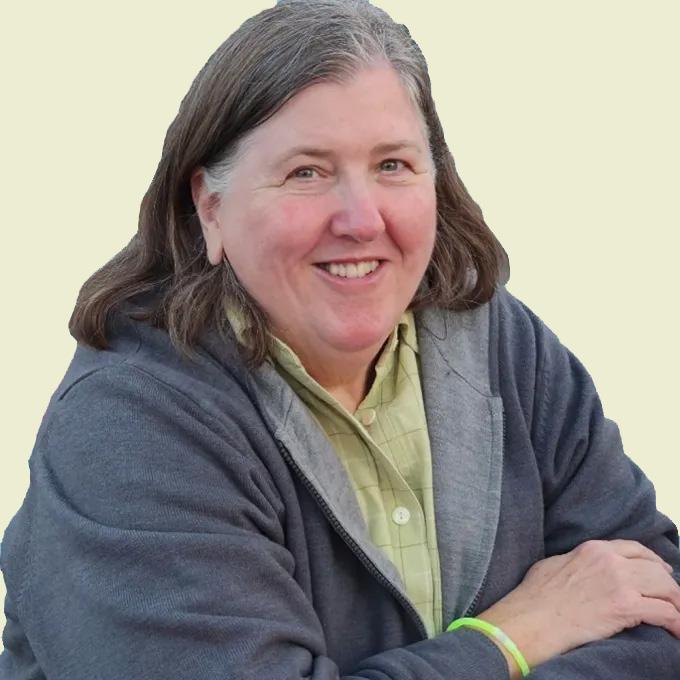
Kathleen Finneran, a beloved instructor and accomplished writer in WashU’s English department, passed away on Feb. 14 after a long battle with illness. She was 68.
Finneran taught nearly a thousand students over the course of two decades at WashU. She was a creative nonfiction writer and primarily taught introductory and advanced courses in the genre, including “Personal Essay and Memoir” and “Portraits and Profiles.”
She was also instrumental in the creation of the nonfiction writing track within the English department’s prestigious Master of Fine Arts (MFA) in Writing Program.
Several of Finneran’s colleagues and friends, including English professor Edward McPherson, described her as kind, thoughtful, and attentive — qualities that helped make her a great companion, a dedicated mentor to her students, and a gifted writer.
“She had the most discerning eye for the sparkling, special thing in a student, friend, essay, or place,” McPherson said.
English professor Mary Jo Bang, a close friend of Finneran’s, said one of her most remarkable qualities was the way her “keen intellect was married to her brilliant sense of humor.”
“When I told her I had found evidence of moths in a closet, knowing I was working on a series of poems about the Virgin Mary, she immediately exclaimed, ‘O Holy Mother of Moths!’” Bang wrote in an email to Student Life.
“Her deftness with language was such that even a personal small-scale disaster could become the funniest moment of the day.”
An accomplished writer
Finneran was born and raised in the greater St. Louis area. In 2000, she published her memoir “The Tender Land: A Family Love Story,” a piece that reflects on her coming of age in the area and the loss of her younger brother, Sean, who died by suicide at age 15. The book received widespread acclaim from readers, fellow writers, and major newspapers, such as The Boston Globe and USA Today.
Finneran’s memoir was the culmination of a decade of work, and, as McPherson put it, “a total
masterpiece” in its final form.
“It’s so good. It’s universally wise, but also so much about this city she loved and the people in it,” he said. “The subtitle is ‘A Family Love Story,’ which is sweet, but it’s a very heavy book. It brings up lots of sad material, but it’s written with such attention and care that it’s just luminous.”
English professor David Schuman, a longtime friend of Finneran’s, said the memoir captures her generous spirit.
“[It] is such an honest account of a really, really difficult part of her life, and it’s just so revealing,” he said. “As a writer or as a person, you don’t have to be honest. You can hold things back. And she just was not like that. She let people see inside. And I think that that’s a kind of generosity, too.”
In addition to her writing being generous, Schuman said she was good at writing in all the ways one can be.
“She was wonderful on the level of the sentence — sentences that reveal information in the most compelling ways,” he said. “She could go off on these spiraling digressions in a story, and then come back to where she started, and you never felt like you lost anything.”
In addition to her memoir, Finneran wrote essays published in the anthologies “The Place That Holds Our History,” “Seeking St. Louis: Voices from a River City,” “The ‘M’ Word: Writers on Same-Sex Marriage,” and “My Bookstore: Writers Celebrate Their Favorite Places to Browse, Read, and Shop.”
She received several awards over the course of her career, including a Guggenheim Fellowship in 2003 and a Whiting Writers’ Award in 2001.
A dedicated teacher and mentor
Finneran received her undergraduate degree from WashU in 2000. After living in New York for several years and then teaching at Webster University, the University of Missouri, and St. Louis Community College, she returned to WashU in 2005 as an instructor. During her time at WashU, she taught and mentored hundreds of students.
WashU MFA student
Amaris Bouchard had Finneran as an instructor in one of the last classes she taught at WashU. In an online forum honoring Finneran, Bouchard posted
a tribute to her former teacher.
“Kathleen convinces me that the bond between student and teacher is one forged through mutual delight,” Bouchard wrote. “It is a sacred bond, structured upon respect. If one becomes close to a teacher, an intuitive grace unfolds, instructing us when to stay humble and when to be bold.”
Maya Samuels-Fair, who received her bachelor’s degree from WashU in 2020, said Finneran was deeply devoted to her students.
“I think of all of the professors I’ve ever had, she was extremely invested in every single student that she interacted with, and she got to know us as people — what our interests were, where we came from,” Samuels-Fair said.
“She remembered everybody’s birthday, everybody she ever met, and would always send a ‘happy birthday’ email.”
Talya Zax, who graduated from WashU in 2014, had Finneran as both an academic advisor and a teacher. She said Finneran cultivated close relationships with students that sometimes endured long after they left her classroom. Their own friendship continued over a decade after Zax graduated from college.
“[There was a] sense of really deep love,” Zax said. “I think love is not a word that enters into the relationship between professors and students all that often, but Kathleen really loved her students. You can tell when someone loves you, it’s an extremely powerful thing, and I knew that she loved me, and I loved her, so that’s the recipe, I guess.”
In addition to her friends and students, Finneran cherished her family members, especially her nieces and nephews and her five grandnieces and grandnephews, all of whom survive her. She is also survived by her brother
Michael (the late Sauni) Finneran, and sisters Mary Ellen (Daniel) Elder and Kelly Anne (Duane) Sonntag.
A thoughtful and generous friend
Several of Finneran’s colleagues and students described her as extraordinarily generous. McPherson said Finneran was someone who always created space for others and had a gift for forming deep connections.
“She gave so many people so much,” he said. “It was like she could somehow bend space-time. I
don’t know how she had time for everyone everywhere, but she made time for everyone everywhere.”
Professor G’Ra Asim, a colleague and friend in the English department, described Finneran as “a great artist, an inspiring mentor, and a super solid hang.” He called it a “triple axel that not many people can pull off.”
Asim said that Finneran’s artistic gifts and qualities as a companion were connected. She moved through the world and engaged with others with an artist’s attentiveness and care.
“[She was] sensitive, observant, patient, attentive to [an individual’s] complexity — not trying to be one thing and not trying to make anyone else into one thing,” he said.
Finneran was someone who was comfortable with pauses and periods of silence. After Asim heard that she had passed away, he held two minutes of silence during each of his classes in tribute to her.
“It felt appropriate because of Kathleen’s pace,” Asim said. “She was someone who was absolutely not determined to fill every silence. Since I share that sensibility, it was like being around her was kind of like an oasis. There [were] a lot of times when we were hanging out or talking, she could get lost in thought and then come back and communicate verbally.”
He said that during those moments of silence in his classes, he felt he was honoring something he admired about her and sharing a small part of that
special quality with his students.
Unique passions and interests
Several people close to Finneran spoke fondly of her distinctive passions and interests. She loved western films, the Mark Morris Dance Company, poetry, blowing glass, tiaras, moss, dahlias, cemeteries, and sitting on screened porches.
“She had very particular things about the world that she just absolutely loved, and she talked about them with so much sparkle,” Samuels-Fair said. “She would just capture her audience and talk about something that’s very much overlooked, like a cool old grave or a weird old movie, and everyone would just be enraptured.”
McPherson said Finneran loved hay bales, and whenever he came across one, he would snap a photo of it and send it to her.
“I have so many blurry pictures of hay bales from the window of a train or a car. I [would] just send them to her,” he said. “When it was her anniversary of maybe 15 years at WashU, I bought a bunch of little miniature hay bales online and put them in her office.”
Finneran loved going on adventures, whether in or out of town. She often brought her colleagues and students to a variety of spots that might seem off the beaten path.
“She knew everything about St. Louis, but she liked to try new things,” McPherson said. “So we’d go somewhere [or] just
drive around, and then there’d be a weird building, and we’d just walk up to the building and knock on the door.”
Schuman said one of the moments he treasures with her took place several years ago, after she had an operation. He drove to Finneran’s sister’s house, where she was recovering, and took her out for a short drive through a state park. She spotted a turtle crossing the road and worried it might get run over. Schuman stopped to pick up the turtle and move it away from the road.
“She told me to not send it back the way it was coming because turtles want to keep going the way they’re ‘supposed to be going,’” Schuman said. “So I had to take it across to the other side.”
He said it felt like the kind of thing that would appear in her writing, but it was also just something unfolding in their lives. He continues to cherish that moment with her to this day.
A memorial visitation for Finneran will be held on Saturday, Feb. 28, at 1 p.m., followed by a service at 3 p.m., at the Hutchen Mortuary & Cremation Center in Florissant.
Individuals are invited to share tributes to Finneran online at:

After facing Wartburg College last season in the NCAA Regional Tournament, the No. 16 WashU softball team won the rematch against Wartburg, 10-2 and 8-7 in a doubleheader on Saturday, Feb. 21 in St. Louis. With these two wins, the Bears moved to 4-0 on the season. WashU cruised to victory in their first game, handily defeating Wartburg 10-2. The Bears got out to an early lead, scoring six runs in the first two innings off of hits from sophomore first baseman Harper Nix and first-year outfielders Emmy May and Julia Sullo. In the last two innings, WashU combined for four runs while Wartburg only tallied one, sealing the game for the Bears by mercy rule.
In the second game, Wartburg got off to a quick start, scoring two runs in the first inning. What ensued was a back-and-forth game that saw WashU trailing entering the fifth inning. However, WashU responded with a dominant offensive performance in the fifth inning, notching five runs to surge ahead of Wartburg and entering the sixth inning with a 6-5 lead. Junior outfielder Kristina Donaldson then drove in a pair with a tworun double, giving the Bears an 8-5 lead. WashU weathered a late Wartburg surge to win 8-7.
WashU will continue their non-conference competition with a doubleheader against Grinnell College on March 1.
The
The No. 20 WashU baseball team opened their season with a sweep in the Babe Howard Classic tournament, recording dominant wins over Benedictine University, Millikin University, and No. 15 Webster University. The Bears won twice by the 10-run mercy rule. On opening day against Benedictine, pitching staff ace junior Townsend Stevenson struck out seven in four innings of work, and the Bears got timely hits from sophomore outfielders Will Taigen and
Kevin Stephens to lead WashU to a 10-0 win. Against Millikin, sophomore infielder Cooper Greene drove in a pair of runs to lead the Bears to a 3-1 win. In the Bears’ final game of the weekend versus crosstown rival Webster, graduate student pitcher Chase Brickley struck out seven while the Bears’ offense dominated Webster’s strong pitching staff to win 10-0.
The Bears will return to St. Louis to face Coe College on Feb. 28 and March 1.
The WashU women’s golf team won the Centre College Classic at Pinehurst Resort by 7 strokes, beating conference rivals No. 2 Carnegie Mellon University and five other ranked opponents. Junior Amy Beanblossom won the tournament, and first-year Saxon Skinner came in second place. This
DePauw University, and No. 15 Kenyon College so far this year. WashU was dominant in both singles and doubles play. The first-pairing doubles team of junior Eleanor Archer and sophomore Caitlin Bui continued their strong play from last season, and the Bears dominated UW–Whitewater in all competitions. The Bears will travel to College Grove, Tennessee next weekend to face No. 27 Sewanee: The University of the South in a knockoutstyle tournament at the ITA Division III indoor championships. If WashU advances to the finals, they could play a rematch of last year’s national championship match against the No. 4 Pomona-Pitzer Colleges.
The No. 16 wom
en’s basketball team fell to No. 1 New
University (NYU) on Feb. 20 but rebounded to beat Brandeis University on Feb. 22. NYU, which has not lost in 86 games, defeated WashU 82-62. Juniors center Lexy Harris, guard Sydney Starks, and guard Sidney Rogers all scored double digits in the loss, but the WashU defense was outmatched by the
Hughes led the Bears to a 67-59 win over Brandeis. The Bears play their final game of the regular season against the No. 17 University of Chicago on Feb. 28 at the Field House.
was the Bears’ first tournament of the spring season, and the win was the Bears’ first tournament win of the season. WashU will next compete in the Savannah Invitational, hosted by Berry College at the Club at Savannah Harbor, on March 9 and 10.
In every season this decade, the WashU men’s basketball team has qualified for the Division III NCAA tournament. This year, the streak was in jeopardy. With two wins this past weekend on the road, the No. 24 Bears solidified their resume and appear to be on track to return to the tournament. They defeated New York University (NYU) 84-74 on Feb. 20 and Brandeis University 74-68 on Feb. 22. It has been an up-and-down season for the Bears, who have a 17-7 overall record and 7-6 record in University Athletic Association (UAA) play. At the beginning of the season, the Bears were consistently ranked in the national top five, but fell several spots after the first few weeks.
However, the Bears have been hot as of late. Their biggest victory so far came at the end of January, as they upset No.1 Emory University at home, and have won five of their last seven games. Currently, WashU is third in the UAA, and with only one game left in the regular season, each contest is vital to the Bears’ postseason push.
“Even though we lost some tough games, we had substantial leads and just didn’t close out some games,” head coach Pat Juckem said. “Our belief in our system and in each other never wavered. We’ve just continued to stick with our process.”
After losing to NYU on Jan. 23 on a heartbreaking buzzer beater, WashU was eager to get revenge this weekend. The Bears quickly got out to a 10-1 lead six minutes in. WashU extended their lead to 12 halfway through the first half, off of a 3-pointer from first-year guard Josh Kim. After a bucket from senior guard Yogi Oliff and two more 3-pointers from Kim and junior guard Ryan Cohen, WashU found themselves up 30-14, dominating the first half of play.
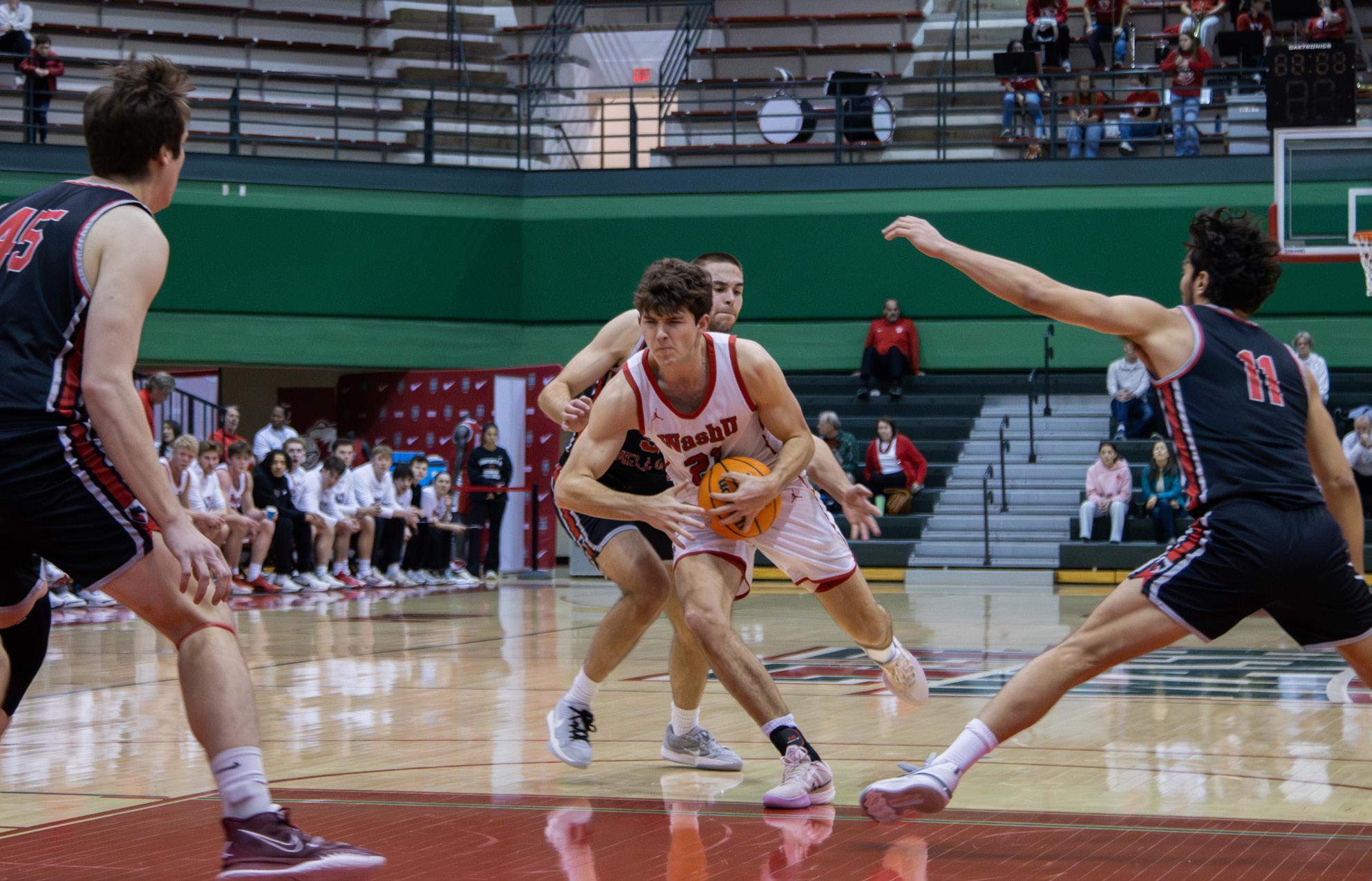
Before halftime, NYU went on a run, cutting the Bears’ advantage to just 8. Still, WashU excelled offensively throughout the first half, going 56% from the field compared to the Violets’ 33%. Kim led the way, scoring 10 of WashU’s 35 first-half points. The Violets came out of the locker room hot, hitting three 3-pointers and eventually tying the game at 40-40 five minutes into the second half. Sophomore forward Connor May and first-year guard Theo Rocca kept the Bears in the closely contested matchup, scoring WashU’s next 13 points. With six minutes left in the game, WashU went on a 12-2 run, hitting four 3-pointers and giving them a 10-point lead. Cohen then scored 6 more points, sealing the Bears’ 84-74 victory over the reigning national runners-up. May finished the game with a career-high 30 points, followed by Kim, who had 16. Overall, WashU shot 53%
from the field and 50% from behind the arc.
The Bears then traveled to Massachusetts for a rematch against Brandeis, whom they narrowly lost to earlier in the season. This time, it was the Judges who went on a run early, leading the Bears 10-0 after the first four minutes. WashU fired back, making it 13-10 in favor of Brandeis. With six minutes left in the first half, the Bears took their first lead of the day, 23-22, off a layup from May. This was part of a 22-0 WashU run with key points from Rocca, May, and senior guard Will Grudzinski.
By halftime, the Bears had
flipped their deficit into a 10-point, 39-29 lead. WashU was phenomenal off the glass, out-rebounding the Judges 27-15, including 11 offensive rebounds that turned into 10 second-chance points.
However, WashU’s offense fell stagnant early in the second half, allowing the Judges to come back into the game.
A few minutes into the second half, Brandeis cut the lead to only four, 41-37. With 12 minutes left in the game, the Bears held onto a narrow onepossession lead as the teams traded buckets.
A 3-pointer from Grudzinski sparked a 6-0 WashU run, giving them a
slightly more comfortable advantage, 56-49. As the clock ticked under five minutes left, Cohen hit a pair of 3-pointers, and May drained a key jumpshot to keep the lead in the final minutes of the contest.
Ultimately, WashU would hold on 74-68 for their fourth consecutive victory.
In 25 minutes of playing time, Grudzinski recorded his best performance of the season, knocking down five 3-pointers and 21 total points. May finished with 16 points and six rebounds as well. The Bears shot 47% from the field while getting 45 rebounds.
“We fought down to the final few minutes in both
games this weekend … and our guys have shown some real toughness during this stretch,” Juckem said. “Playing meaningful games in February is what college basketball is about.”
The Bears got the job done this past weekend but will face tough competition again, playing at home against the No. 4 University of Chicago on Saturday, Feb. 28. The Bears will seek revenge after the Maroons defeated them 85-62 at the beginning of January. A win will almost certainly send the Bears to the tournament, but a loss would hurt their chances.
Bethany Daniels teaches two writing courses at WashU: Writing the Visual World and Exposition. Regardless of which class her students take, they often come to realize two states of being — the state before taking her class, and the state after. The transformation that follows her mentorship is measurable, to the point where Daniels and her students jokingly call themselves the “Cult of Bethany.” One way to recognize a Bethany congregant is through an emoji pin on their bag, one of the many “gifties” given out throughout the class on special occasions. Another way? Self-discovery, inspiration, and a sense of connection in a class full of students working to embrace their own writing.
Daniels sat down to chat over coffee on a Friday afternoon. Clad in a brown fur cape, she happily dove into the quirks that make her class unforgettable.
Her first move is to reach out to students before the semester. She emails out a mass greeting to her students as a taste of what her class will be like, including many photos that inspire her. She then kicks off each semester with what she calls “Inspiration Days,” where her students share who they are and what inspires them. She also gives each of them their own journal to keep, which many of her students continue to use outside of class.
Daniels went on to describe both of her classes’ primary and final assignment: a memoir. Citing memoirs she teaches by Stephen King and Judith Ortiz, she explained the power of telling a story through memory.
“I always want to spend a
lot of time in any writing class that I teach thinking about how our memory works,” Daniels said.
Daniels notes that writers might be unsure about the reliability of their memory. To address this, she assigns her students excerpts covering the intersection between memory and imagination.
“There’s all this negative space where you see a little bit, but not everything. It’s like if you go to the eye doctor,” Daniels said. “It’s constantly sharpening it and changing it, and you never get the full picture, because we never fully see people.”
Once her students have a better understanding of their memory, Daniels encourages them to think about how exactly they wish to tell their story. Sometimes, especially over time, she notes, those stories change.
“Sometimes students … want to mine similar territory about family history, but it shifts a little bit, because now they’re at a different place in their life. And so the story is different. … It’s interesting how your memory is also changing each time,” Daniels said. “That’s the beauty of storytelling.”
Just as memory changes, the style in which Daniels teaches her class also stretches to accommodate her students’ moods. With a laugh, she admitted her lessons can be long-winded or in-themoment. For students, it’s perhaps part of the charm. For Daniels, if it allows her to connect with her class, it’s all part of the plan.
“Everything is intentional, even if you don’t realize it. I mean, it’s spontaneous, but it’s also intentional,” Daniels said. Daniels continued about the importance of writing. Coming from a tumultuous
childhood, she explained that she gravitated toward reading and writing early on and found herself coming back to it later in life. Daniels also noted that coming from a place of darkness was part of her motivation to teach the way she does.
“In my early childhood, I found safety with my grandparents, but I also found safety in the arts,” Daniels said.
Her classroom serves as a safe environment, but also as a catalyst to write something meaningful. Alum Shrinidhi Jeyaram discovered a love for writing while taking classes with Daniels for a full year and eventually wrote and gave a speech at Commencement. Daniels now reads Jeyaram’s speech to kick off each semester and notes that although it is only a couple of pages, it has moved her students in different ways.
Senior AnaElda Ramos took Exposition with Daniels in the spring of her junior
year to finish her Writing minor. She recounted immediately feeling a connection after Daniels complimented her Keith Haring phone case. Last fall, Ramos extended her membership in the cult by taking Writing the Visual World.
“I can see how she understands and cares about her students in a way I haven’t seen any other professor do. Honestly, when I read the feedback she leaves on my memoir drafts, sometimes it feels like she knows me better than I know myself,” Ramos said.
Along with the attention she gives to each student, Daniels tries to expose them to new perspectives. For instance, she often incorporates written and visual works of photographers and artists into her teaching. Ramos, who is majoring in Communication Design, appreciated this approach.
“I love being in classes with Bethany because she shares
my excitement about the intersection between art and writing,” Ramos said.
Daniels noted a recent shift toward building happiness into classes at WashU, which she commends, but incorporating fun into the learning process has always been part of her mantra.
Depending on the semester, Daniels’ classes celebrate Halloween or Valentine’s Day, with distinct writing exercises for each occasion. Leading up to this past Valentine’s Day, WashU a cappella group The Aristocats performed “Part of Your World” in her class.
Daniels expressed her hopes to implement more a cappella in future semesters, including the fall. This might sound excessive for most classrooms, but for Daniels, this is very much the norm.
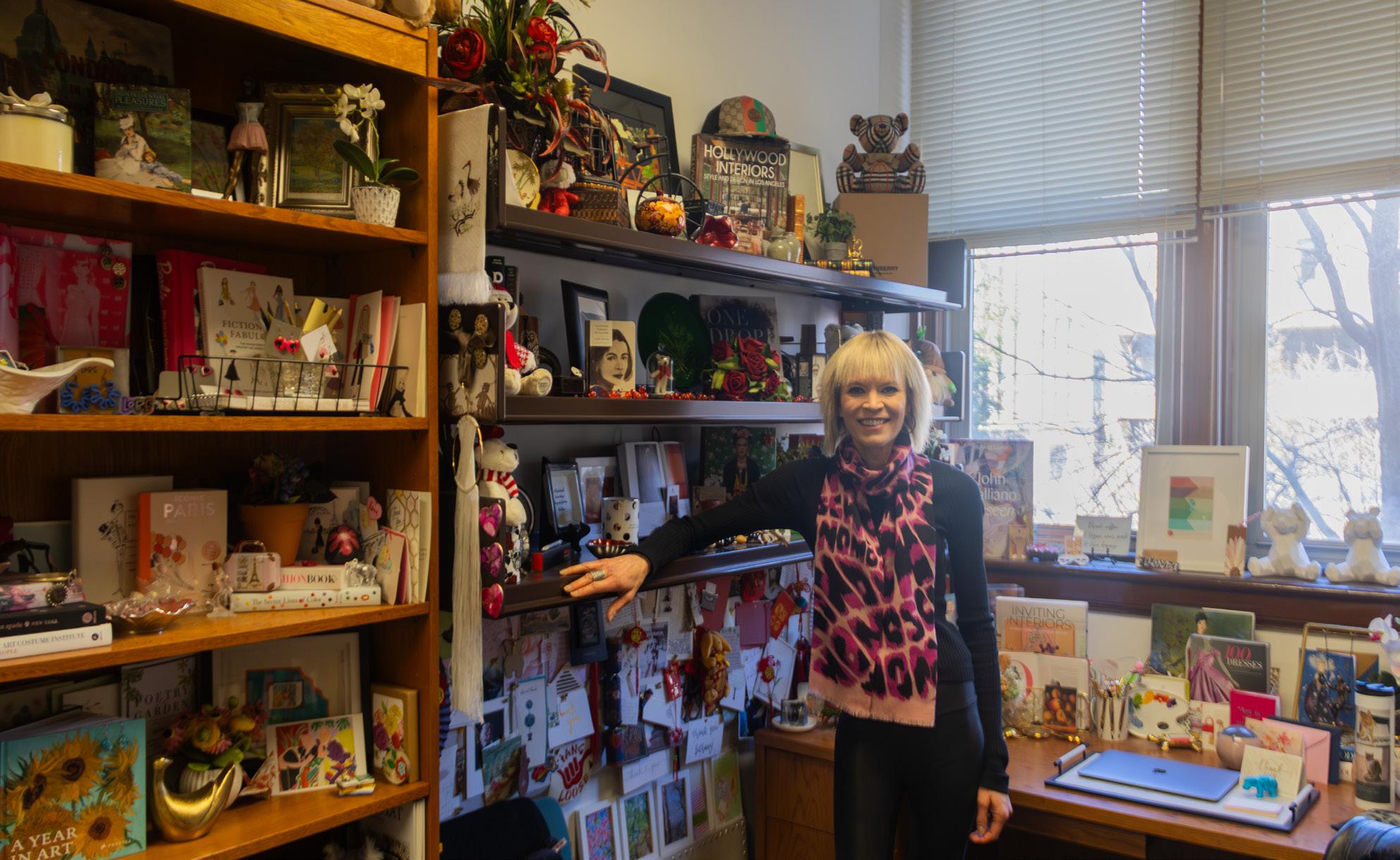
One word to describe Daniels, that she uses herself, is “eclectic.” Her office is the same way.
“It’s jam-packed, but it’s
curated,” Daniels said. “It showcases everything that’s inspired me from my students or from things from around the world, because I’m endlessly learning new things and fascinated by new things. Like tomorrow, I might be interested in shark teeth, I don’t know.”
Kaldi’s closed, thus marking the end of the interview, though it was not complete without a personalized reading assignment of my own: The cult had decided it was my time to read Joan Didion. Indeed, the Cult of Bethany is powerful. On the individual level, it represents an exploration of potential and inspiration. On the class level, it represents a community: a mosaic of her students, past and present.
Editor’s Note: AnaElda Ramos is the Managing Illustration Editor of Student Life and was not involved with the writing, editing, or reporting of this piece

‘There’s
“You are in a generation that has been screwed over by the older generation. … You guys have lost the right to be young, and that’s the thesis of this book,” author Soman Chainani said.
The St. Louis-based author, widely known for his series “The School for Good and Evil,” is leaving the world of middle-grade fantasy behind for the first time. Under a new publisher, target audience, and genre, his upcoming book “Young World” is an exciting leap in a new direction.
Chainani’s propulsive new political novel tells the story of high schooler Benton Young, a 17-yearold St. Louisian who decides to run for president to impress a girl in his AP U.S. Government class. Within the first few pages, Benton goes viral over a video he posts online to impress her, is appointed to the presidency by the Supreme Court, and survives a drone attack on the White House. Slowly, a global movement begins as more youth leaders take similar positions of power.
“The whole book is about young people having to live in an adult space,” Chainani said. “And if you’re going to be asked to survive an adult world, then I think you should have the power to be able to run, to actually have power in that adult world, rather than just suffer through it.
Chainani might be the only world-famous author who plays tennis with members of the WashU tennis team — which, according to him, is his favorite part of his entire writing routine — especially when it came to writing “Young World.” His writing process involves alternating between working out and writing, making him physically exhausted but giving him great mental clarity to write with.
“He definitely thinks on the court as much as he does when he’s writing,” senior Case Fagan, a member of the WashU men’s tennis team, said. Fagan and Chainani play tennis together usually three times a week, starting at around 6:30 a.m.
Although Chainani wrote “Young World” as a young adult novel, he believes that its message is valuable to readers of all ages.
“[Young World] is supposed to be a manual for how all of you can start to get involved in government so that you actually have a future, because all the old ways of doing things are just not going to work out,” Chainani said. “Things are moving too quickly in a way that only benefits old people.”
When he was younger, Chainani’s involvement in politics began and ended with his term as the student body president of his high school. “Anything political, I felt, was for narcissists and the superficial type of people who just wanted power,” he said.
“Young World” moves
at a rapid pace and is told through more than just words: Over a hundred pieces of original artwork help push the story forward. Everything from propaganda posters to tattoos, a guide to being a room service waiter to video game screenshots are included throughout the chapters.
“It was like making a movie,” Chainani, who graduated from Columbia University with an MFA in film, said. “I wanted a book that felt like the way you process information now … which is fast and fractured and emotional and different in terms of media. And so the book wouldn’t have worked if it’s just words. It needed to be that feeling of the multimedia experience that is our daily life.”
The book is not just unique in its dependency on artwork, because each chapter is written as one of Benton’s journal entries.
“In a first-person diary, I can have a character just tell the truth, because it’s confessional,” Chainani said. “And [Benton] can be unreliable sometimes. He can be an asshole sometimes. He sometimes can lie. He goes through all the things a teenager goes through. But as you go through the story, you do trust him more than you trust the adults you know, because at least he’s telling you the truth.”
Chainani finished writing “Young World” in December 2024. Since then, the book has proven to be somewhat prophetic in nature. Within the novel, a global fight over Arctic
resources breaks out alongside the election of young leaders across the globe.
Less than a year after Chainani finished “Young World,” Gen Z-led movements inspired regime changes in Madagascar and in Nepal. Then, in December 2025, protests dominated by Gen Z led to the resignation of Bulgaria’s Prime Minister, Rosen Zhelyazkov.
“The book is actually happening, so it’s kind of amazing, but it also validates the reason I felt like I had to write it. Because I don’t think I was ever given a choice in the matter. It just kind of was this weird calling that told me I had to write the book,” he said.
In the novel, newlyelected youth leaders following in Benton’s footsteps from countries like Canada, the United Kingdom, and Japan gather for a G-8 summit in Sweden. Chainani wants readers to know that “Young World” extends beyond American politics.
“There’s a reason ‘World’ is in the title,” Chainani said.
Chainani emphasized that all hope is not lost and that political engagement is still very much possible. By reading “Young World,” readers can take a step forward into the world of activism and stand up for their own “right to be young,” which turns out to be Benton’s campaign slogan as he runs for president.
“The reason I chose to do this as a book rather than a movie or a TV show is because I felt like only

by reading it and going through it are you going to actually be able to take all the messages and come up with your own action plan of what that means for you,” Chainani said.
“It might be as simple as just getting rid of your phone, [or using] it less.
Or maybe it is running for office. Maybe it is registering to vote for the first time. You’re going to interpret the book in a different way.”
Chainani emphasized his novel’s broad appeal. His message is universal, and he explicitly calls all of the young readers to action.
“I don’t think of [Young World] necessarily as a political book. It’s not endorsing either side. In the book, Democrats and Republicans are equally kind of treacherous. What the book is telling you, is that as young people, you are your own force and your own army. Unless you start leveraging for power, people are going to continue to take advantage of you,” he said.
“Young World” is set to release on May 5 and is available for pre-order now.
SOPHIE SCHWARTZ
For the past two and a half years since Oct. 7, Michal Magen and Yael Raz Lachyani have held on to one dream: to return to their home, Kibbutz Nahal Oz, in Israel and begin the process of rebuilding their lives. Now, they’re sharing that dream with others to honor the stories of those whose lives were cut short as a result of Oct. 7.
This past Wednesday, students and community members came together in the Goldberg Formal Lounge to listen to the testimonies of Magen and Raz Lachyani, members of the Kibbutz Nahal Oz community who endured and survived the horrors of Oct. 7 and are coping in its aftermath. The event was organized in partnership with the Jewish Federation of St. Louis and WashU Hillel.
Both Magen and Raz Lachyani grew up on Kibbutz Nahal Oz and returned to raise their families. A kibbutz is a communal living situation where members work together, sharing income and property tax. Magen and Raz Lachyani have been integral members of the kibbutz throughout the years, and their connection to their community has only strengthened in the time since Oct. 7. Magen now serves as the community manager, leading the kibbutz’s recovery and strengthening process. Raz Lachyani works in community process facilitation and social initiatives and has spent time serving as the spokeswoman of Nahal Oz, accompanying the families of hostages as their loved ones returned to Israel.
Kibbutz Nahal Oz is
situated in the northwest Negev desert near the Israel-Gaza border in southern Israel and was the first kibbutz attacked on Oct. 7. It was founded on Simchat Torah, a Jewish holiday that marks the completion of that year’s cycle of Torah readings, in 1953. Oct. 7, 2023, would have marked the 70-year anniversary since its establishment, but instead, 15 people were killed and eight taken hostage to the Gaza Strip by members of Hamas.
“From the beginning, it wasn’t easy to be in Nahal Oz. But again, the founders were Zionists, and they had a vision that they wanted to build a big community together,” Raz Lachyani said.
On the morning of Oct. 7, Magen and her family woke up around 6:29 a.m. to the sounds of red alerts, Israel’s emergency alert system consisting of sirens and mobile app notifications, and missiles overhead. No strangers to these spontaneous attacks, the Magens headed over to their neighbor’s house for some Saturday morning coffee. Everything changed in an instant.
“My daughter was looking out the window, and she told me, ‘Mommy, there are some people near the fence. They look like terrorists,’” Magen said. “So we went home, and from this moment, our day looked like hell.”
The Magens immediately retreated to their safe room, closing all the windows, pulling down the shutters, and locking the doors. Risking revealing her location, Magen called the head of security on the kibbutz to ensure he knew of the severity of the situation and could alert others.
“He didn’t answer me the first time, but the second
time, it was a little bit after 7 o’clock in the morning, and I could hear him fighting already with the terrorists. He said, ‘Michal, I know, I know, I can’t talk with you.’ And I think it was the one of the last calls that he took, because he was killed about 20 minutes after,” Magen said.
About an hour later, the Magens decided to head upstairs and lock themselves in the safe room on the second floor, hopeful that if the militants were to enter their home and break open the first floor safe room door, they would see it vacant and leave the home. They stayed up there as the militants raided their home until they were rescued by the Israel Defense Forces 12 hours later.
“All we could hear was gunfire, grenades, bombs, and shouting in Arabic all day,” Magen said.
Raz Lachyani’s day looked similar. After receiving alerts from her phone and the kibbutz group chat where other people were begging for help after seeing dead bodies, she and her family headed to the second floor for their upper safe room.
“My memory is gone from that day. I do not remember much about being in the safe room, so you are not going to get a story about what we were doing there, but I can promise you, it wasn’t pleasant,” Raz Lachyani said.
As the hours in the day crept by, Raz Lachyani and her family slowly lost contact with the outside world. Their phone batteries began to die one by one, and with the power out, they were left sitting alone in the darkness.
“We didn’t know we were going to be in the safe room for so many hours, so we did not take food, water, or anything. There
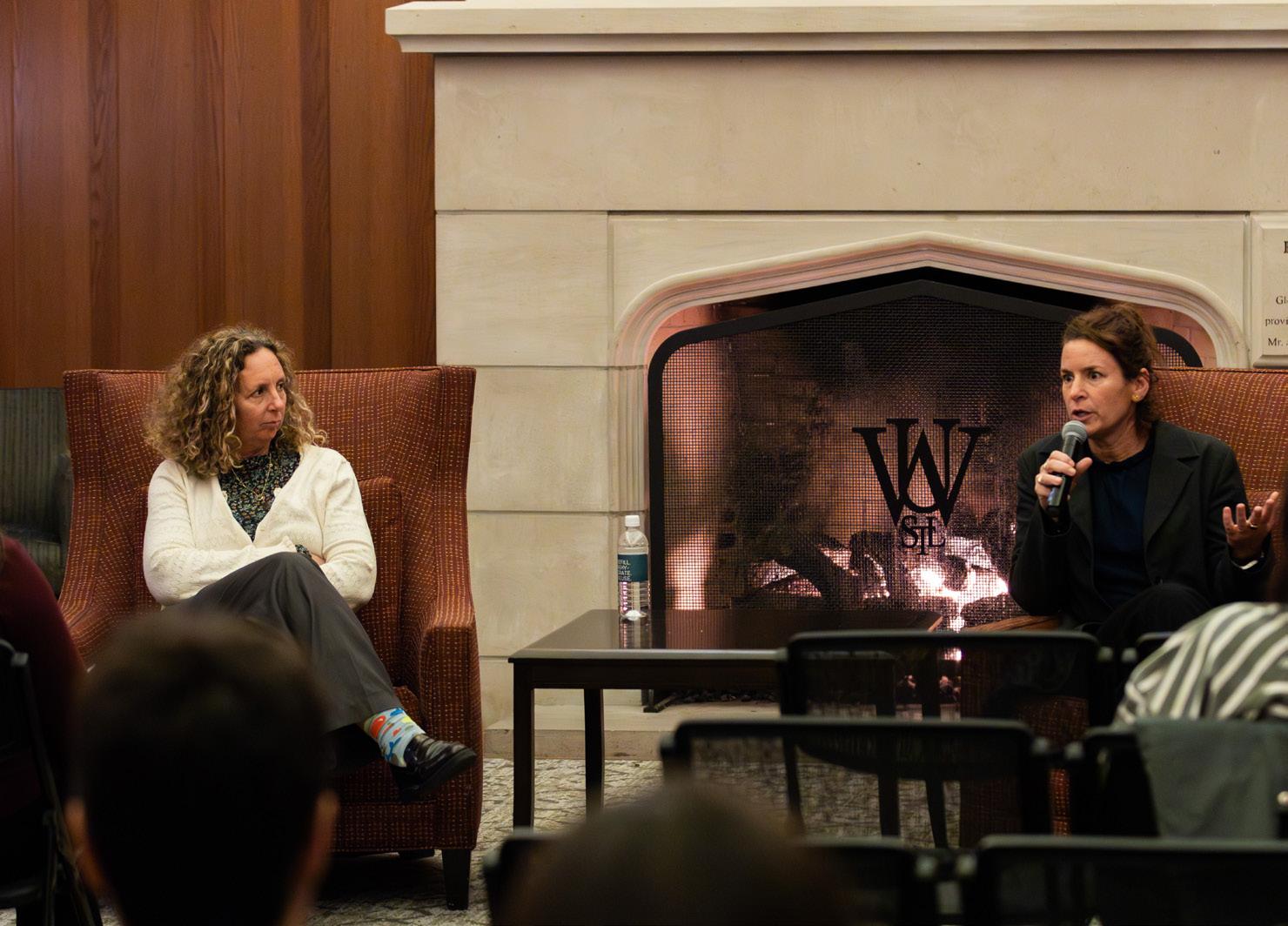
was no choice if we wanted to use the restroom,” Raz Lachyani said. “Usually when we go into a safe home in Nahal Oz, it’s only 10, 15, or 20 minutes.”
Hamas militants eventually entered the area next to Raz Lachyani’s home as the family sat in terrified silence above. An electricity lock on the front door stopped them, and the Raz Lachyani family survived that day.
“We heard the noises from our home, we kept hearing more and more, and we didn’t know what was going on,” Raz Lachyani said.
The family and others living on Nahal Oz were transported to an army base and then took refuge in a boarding school on a nearby kibbutz. Community members had stocked the school’s building in advance of their arrival.
“We all try to help each other out,” Raz Lachyani said. “They knew we were coming with nothing, so they brought over sheets, brushes, and shampoo. Of course, what any Jewish
family does when there is a disaster.”
From there, Magen and Raz Lachyani began their new lives. Yet, they weren’t alone, sharing in the pain with thousands across Israel.
“We were very together during this time. We were seeking a lot of power together, crying together, and laughing together,” Magen said.
As mothers, these two years for Raz Lachyani and Magen have been an especially difficult journey in finding ways to give their children a sense of normalcy while dealing with the hurt they carry beneath the surface.
“You can imagine my young boy who was 15 years old. All his life he played soccer, and one day, it was gone. He didn’t go join another group; he gave up his hobby. He changed schools twice in two years and got separated from all of his friends. All of his life was taken from him beyond the trauma he endured and loss of strength,” Magen
said. Since Oct. 7, Nahal Oz has erected various memorials around the kibbutz honoring those whose lives were taken and those who carry invisible scars.
“The trauma is not going away, whether it be after two years, 10 years or 20 years. We all need to learn to live with it,” Magen said. In time, the community is prepared to rebuild and keep the legacy of the kibbutz alive.
The event concluded in a show of strength with Raz Lachyani encouraging the audience to remember the horrors of the day and be a driving force for change.
“Learn, listen to stories like mine and Michal’s and bring it out to the world,” Raz Lachyani said. During a day when so much life was stripped away, Magen reminded the community to never take for granted the time we are given.
“Life itself is powerful and stronger than anything,” Magen said.
It’s that time of year: the dreaded midterm season. With dwindling study spaces, grade-defining exams right before spring break, and multiple looming deadlines, it’s no wonder stress levels on campus are rising.
This part of the school year is hard for so many reasons: We are bogged down with schoolwork, extracurricular activities, and the search for next year’s job or internship. All too often, we get caught up in the rat race and forget the real purpose of university — to learn about the topics, majors, and classes that we are genuinely curious about.
Regardless of why anyone chooses to come to WashU, everyone works hard to get here. That desire to work hard is likely guided by an inherent purpose that is different for everyone. Take a second to reflect on
your “why.” What is it that drives you when you have to trudge through tedious coursework? As you study, try to remember these motivations and infuse them into what you do. It can be hard to appreciate difficult coursework when the end goal for many students is securing a job or internship. While you do not have to love all or even most of the things that you study, it can be helpful to find little things that make the monotony of studying, class, or lab just a little more interesting — maybe even fun. Collect fun facts from lectures, study with friends, or apply the topic of a class to an issue you are passionate about. Sharing our studies with the people that we love and relating what we learn back to our core interests make it easier to find your “why” and rediscover your passions for
learning.
The Student Life editorial board comes from all sides of campus. Some of us study writing and want to be journalists, others are design or photography majors in the Sam Fox School, and many of us are studying to be doctors, chemists, entrepreneurs, or engineers. While we have different approaches to midterms, all of us believe that passion can power perseverance. Passion can be easier to find when we look for it in multiple places including and beyond our classrooms, extracurricular activities, loved ones and friends.
It is also important to remember that there is no shame in changing your course of study if you discover an interest in another topic. If you are struggling with your work and unable to find your “why” to the point where it adversely
CHENEY ZHANG CLASS OF 2029
During an upper-level Women, Gender, and Sexuality Studies class last week, I found both familiarity and distance in our conversation about the racialization of Chinese immigrants in the U.S.
We discussed the Gold Rush, the Chinese Exclusion Act, anti-Chinese political cartoons, and medicalized stereotypes. We considered an advertisement from 1886 caricaturizing Chinese men; their faces were exaggerated, all drawn exactly alike, being pushed out by Uncle Sam. A smiling sun hovered in the background.
As a Chinese international student who moved here only a year ago, I sometimes have a strange experience in American classrooms. Chinese students are both present and abstract. Our countries appear in lectures as case studies, geopolitical rivals, economic competitors, or historical subjects. Yet we ourselves, the people in the room, remain slightly outside the frame: present in discussions about China, but not always centered as lived voices within those narratives.
I am not sharing this example to criticize my class. Our discussion was excellent. In fact, I appreciated being in a space where these kinds of histories are discussed. But it made me reflect about how the United States thinks about China through just a few lenses: war, communism, censorship, and global trade. When this becomes the dominant means of entry into conversation, we get further away from the reality of other places and cultures.
China is a big, far-off place of politics and power for many Americans. But for me, it is the image of rolling dumplings with my own hands the night of
New Year’s Eve, calligraphy ink drying on crimson paper, the fireworks bursting in the night sky as the clock strikes midnight, and the yearly tide of humanity trying to get home for the Spring Festival — arguably the world’s greatest migration — to simply put their butts in a seat and eat a meal together. Sometimes I wonder if we separate culture from people too easily. It is easy to enjoy dumplings, lion dances, or “cyberpunk Chongqing” TikToks. It is harder, and more meaningful, to build relationships with the Chinese students sitting next to you in class.
This distance is also visible in subtle everyday moments on campus. A group of Chinese international students cook together every few weeks in my dorm. The smell of soy sauce and ginger fills the small kitchen, and the suite is filled with the sound of laughter. But the other students in the building refer to them as “the Chinese group” and nothing more.
That small detail stays with me.
As international students, we sometimes remain in our own circles, partly because of language, partly because of comfort, partly because reaching across differences can feel awkward. But I don’t believe we are “too different,” as one friend once told me after struggling to join an American social group. I think we simply haven’t created enough shared spaces.
Spring Festival, also known as the Lunar New Year, is one of those spaces. Over the past few weeks, student organizations on campus celebrated the Spring Festival through a series of events. The festival activities were fun, vibrant, and open to all. But the festival activities carried more meaning than just celebrations: They were invitations to renewal, connection, and
affects your mental health, consider switching your academic focus.
Of course, not everyone will love what they study; maybe they cannot change their academic program or want to persevere through a topic even if it is not what brings them joy. We encourage these students to take some classes that interest them outside of their major, even if they are far and few between. All students should also remember that it is also okay to take a class pass-fail, whether it be a general education requirement or a topic that interests but intimidates you. Beyond academics, a love for learning can be found outside of classrooms — in clubs, daily conversations, and even through campus events like cultural shows.
This midterm season, think about slowing down and appreciating what
you are learning. Breathe. Find your community and strength in numbers. We’ll get through these weeks together.
Staff editorials reflect the opinion of the majority of our editorial board members. The editorial board operates independently of our newsroom and includes members of the senior staff.
Matt Eisner, Managing Sports Editor
Sylvie Richards, Managing Forum Editor
Kate Theerman Rodriguez, Senior Forum Editor
David Ciorba, Senior Forum Editor
River Alsalihi, Senior Forum Editor
Lyn Wilkins, Junior Forum Editor
Sydney Tran, Editor-in-Chief
shared understanding.
The celebration is a reunion. A meal is shared with family on New Year’s Eve. Dumplings, or “ 饺 子 ,” represent good fortune and wealth, as they resemble ancient gold ingots. Red is a symbol of happiness and protection. Characters written in calligraphy, such as “ 福 ” for fortune, are displayed upside down, representing the arrival of good fortune. Elders gift children red envelopes, or “ 红包 ,” as a way of showing care and continuity.
It is a celebration of moving forward, of new possibilities, and of narrowing the distance I sometimes feel in classrooms, where China appears as an abstract subject while Chinese students remain quietly present. Small things like sharing a Lunar New Year show, practicing calligraphy, or eating dumplings with someone whose native language is not English help us better understand each other.
I came to WashU to learn. Learning, however, is more than ideas, concepts, theories, and knowledge. Learning is the conversations that take place after an event, awkward first meetings, and shared meals. Learning is realizing that no country is just what the media makes it out to be. Learning is realizing that no group of people is just what the media makes them out to be.
This year’s Spring Festival celebrations, including those hosted by WashU Lunar New Year Festival (LNYF) and WashU China Connection (WUCC), were joyful and meaningful. Yet their significance should not end with the festival itself.
Appreciating Chinese culture is not a once-a-year event, but an ongoing practice of curiosity, conversation, and connection.


Riley Herron, Editor-in-Chief
Mason Sutton, Special Issues Editor
Sophie Schwartz, Senior Scene Editor
Bea Augustine, Managing Design Editor
AnaElda Ramos, Managing Illustration Editor
Zoe Rhodes, DEI Editor
Bri Nitsberg, Managing Photo Editor
Hannah Much, Junior Sports Editor
Will Rosenblum, Managing Scene Editor
Mac Motz, Photo Editor
Sophia Hellman, Senior Scene Editor
Ella Giere, Photo Editor
First Place: POV: Staring in the mirror trying to pick your vibe when you know all roads lead back to doing homework by 8pm.
Sean Henry, Current WashU Student
Second Place: Holidays were confusing for the local Ewok community.
Jason Merkel, Casual Student Life Reader
Third Place: That feeling you have when you can’t decide which holiday to get naked for.
Jason Merkel, Casual Student Life Reader

Scan the QR code to enter your submission by 11:59 p.m. on Tuesday.

Lately, I’ve noticed students are unafraid to promote their own clubs or events, often in situations which feel random or abrupt. This phenomenon has been coined the “shameless plug.” Shameless plugs can feel like trivial diversions from a group’s focus, but they actually prove to be more helpful than one might think.
Shameless plugs are important to me because I simply don’t know what’s going on at WashU. I play on the varsity softball team here, and like many of the other athletes, I often feel disconnected from the rest of the student body.
It is difficult to maintain friendships with people
outside of athletics. When I went through the recruiting process, my club softball coach described college life as a triangle with three points: social life, athletics, and academics. I remember him saying, “You can only ever choose two points; one will always be left out.”
With a season under my belt, I can confirm his words are true. There are simply not enough hours in the day to accommodate all three, especially when an athlete is in season. That is why I believe the athletic community stays very internal — other athletes get it. We often prioritize athletics. Hence, we are left with odd hours of availability for things like campus events or hanging with friends. Plus, we’re always in the Athletic
Complex.
Our commitment to athletics doesn’t stop us from wanting connection and community outside of sports. When I went to recruitment camps at various schools, one of the most common questions was, “Are athletes here able to hang out with the rest of the student body?” Part of the reason I decided to go Division III was because I wanted the chance to do something outside of softball.
But many athletes don’t know where to start. With our social life based in the athletic community, we share little information about student groups, clubs, or events in our conversations. Due to this limited information, a lot of athletes assume that groups on campus are exclusive and
require hours of commitment that we don’t have.
I believe that’s why a lot of athletes are a part of social or professional Greek life — it’s an established and wellknown way to meet others that usually does not require a lot of time. But many athletes choose not to partake in Greek life and would love to be a part of something else. They just don’t know what’s out there.
Last spring, K.A.R.L. Improv had an upcoming performance that was shamelessly plugged during one of my classes. A group of my teammates decided to attend: We loved it. Soon enough, a small softball improv fanclub was born, and we continued to attend their performances throughout the semester. This
obsession continued into last fall, when we met some of the K.A.R.L. performers in passing. Recently, we gathered for an improv session with K.A.R.L. Now, we play improv games as a part of our pre-game ritual. This seemingly random mix of students created so much joy, opening up doors for us athletes to meet new people. Shameless plugs are an essential part of community building at WashU. The rise in these abrupt promotions have given others, including me, the opportunity to attend more events on campus. In effect, I feel closer to the community as a whole. From a drag show in the DUC to an academic discussion between an atheist author and a Catholic New York Times
columnist, I’ve come to realize this year that WashU does have a lot of accessible campus life events — you just have to look for it. So keep plugging your craft night in the DUC, your a cappella concert, or even an upcoming assembly series speaker — you may just open a whole new world for those around you. Speaking of, WashU softball has home games for the next two weekends, and K.A.R.L. has upcoming performances on Feb. 26, April 11, and April 26 — I recommend coming to softball for a good time under the sun and going to K.A.R.L for some early evening laughs! Maybe you should even write for Student Life.
LISSY PORTORREAL
ZOE RHODES
CONTRIBUTING WRITER
DEI EDITOR
Australia’s done it, Spain’s doing it, and the U.S. is… not?
The U.S. is the latest country to see legal fights over the negative impacts of social media on youth. For years, related cases have increased across the globe. Australia and Spain have both enacted restrictions on social media for minors, along with a host of other countries.
In America, January saw the first round of bellwether cases go to trial, meaning the strongest cases have been bundled together and their rulings will set a precedent for the other hundreds of trials to come.
Last December, Australia banned social media accounts for children under 16. Instead of punishing children or parents for infringing on the ban, social media companies can face fines up to $32 million. The law states that social media companies are responsible for taking “reasonable steps” to keep children off the platform by requiring government identification, facial recognition, or other similar measures.
On Feb. 3, Spanish Prime Minister Pedro Sánchez announced that Spain will begin to pass legislation banning those under 16 from
social media, asserting that the government must protect youth from the “digital Wild West.” French President Emmanuel Macron and Denmark’s Prime Minister Mette Frederiksen have both announced they are working to implement similar bans for children.
The U.S. should follow suit. Everyone in the U.S. should pay close attention to the current legal proceedings — they can show us the harm of social media addiction and the platforms’ effects on political polarization, body image, and self-worth.
The plaintiffs of these trials include individuals, school districts, and entire states. The collection of cases appealing before the Los Angeles Superior Court allege that social media algorithms use the same behavioral and neurobiological techniques used by slot machines and the cigarette industry.
Although the international community’s push to regulate social media for minors seems obvious to us, social media plays a diverse, yet often personal, role in the majority of young people’s lives. We decided to interview some of the youngest people on campus because they are the closest to those who might be affected by a social media policy change.
Will Washko, a first-year at WashU, shared his opinion
on the matter.
“Honestly, we need to do more than introducing restrictions. [We need to] think about better ways to make … more effective legislation. I mean, our government’s old as hell,” Washko said.
We think Washko has a point: Big Tech has blocked laws aimed at defending kids from the negative externalities of social media in states like Texas and California. Social media companies have pushed back against Congress’ attempts at regulation for years. While we are not policy experts, there are methods by which the government could successfully regulate social media to mitigate the multitude of negative impacts social media has.
One of the major questions addressed in U.S. legal battles is whether or not the apps are addictive and if they were intentionally designed to addict young people.
Representatives from YouTube, Meta (parent company of Facebook and Instagram), and other companies have argued that they have always supported their young users and question the validity of ties between addiction, tech usage, and harm to youth.
We both think the “addictiveness” of social media can’t even be questioned. For Zoe, working at a summer camp that forbids phones means seeing kids as young
as eight in distress over not being able to see any social media content. At Lissy’s boarding high school, freshmen have their phones taken away during study hall between 7-10 p.m. every weeknight. Many students struggled with not being able to access social media for even three hours. However, this soon helped new students build reliable study habits and have more structured social media use while away from home for the first time.
Recently, both of us have started using Opal, a social media blocking app, after multiple conversations regarding how negatively the apps have affected our lives.
Since using Opal, we’ve both recognized a decreased urge to “doomscroll,” increased productivity, and less inclination to use our phones when hanging out with our friends.
Despite social media companies arguing that their products are not addictive, some WashU students would beg to differ. We asked some friends for their opinions on the legal battle.
“Yes, definitely. I think they’re super addictive,” firstyear Eli Regardie said. “You never actually get satisfied because you’re not engaging with anything, you’re just passively consuming.”
control — as with many other types of addiction, people often cannot quit of their own volition. Therefore, some type of government regulation is necessary.
“I think when your brain is barely developed and [you’re already] having to be conscious of how you’re presenting yourself, … [it’s] really bad for people’s self esteem,” first-year Kendall Carlish said.
First-year Austen Downey explained his view of the psychological effects social media can have on young users.
“One of the worst parts is comparing yourself to people that are older and more developed than you,” Downey said.
Still, many are hesitant about government intervention regarding social media use, including students we interviewed.
“I don’t think that the government should have a say in whether kids are on social media or not. I think that’s more about what a parent should decide,” first-year Apurva Ganti stated.
We understand the argument for personal freedoms, but not at the expense of young people’s well-being.
“I think banning it for younger children sounds good in theory, but … it definitely poses questions about censorship and activism, since it is such a huge way that teenagers get involved in politics and the issues that they care about,” first-year Leilani Billups said. Billups is right that many young people get their news from social media, which propels them to act for certain causes. Still, social media can also disproportionately affect young people’s opinions and can spread misinformation faster than other sources of information, such as classrooms and in-person discussions with peers.

For many young people, their usage of social media is not totally within their

Frankly, it’s not realistic that every parent is going to know the ins and outs of the threats and benefits of social media and regulate their children’s usage accordingly.
Regardless of how the bellwether trials conclude, the sheer volume and intensity of the legal fights against large social media corporations should inspire our generation and community to rethink our relationships with social media. Consider whether regulations and age restrictions (actually enforceable ones) would have benefited or hindered your childhood, your relationships, and your opinion self-image. We believe that age-defined restrictions on social media in the U.S. would have benefited our childhoods, and yours, too. Contact your local, state, and federal representatives today to share your opinion on age restrictions for social media.